Asnoune Khadidja | Feldji Kaltouma | Nehila Tarek* | Benachour Elhadj | Hasnat Mohammed | Elmir Mohammed
© 2026 The authors. This article is published by IIETA and is licensed under the CC BY 4.0 license (http://creativecommons.org/licenses/by/4.0/).
OPEN ACCESS
Circular heat sources represent a cornerstone in the engineering of high-efficiency thermal systems. They facilitate optimal heat flux within a compact footprint, provided that temperature gradients are strictly controlled to prevent structural warping. Copper is a cornerstone material in industrial design, particularly when thermal management and durability are paramount. Its role is defined by a unique combination of high thermal conductivity, corrosion resistance, and excellent fabricability. Despite being easy to bend, copper is strong enough to withstand high internal pressures. While aluminum is sometimes used as a cheaper, lighter alternative (especially in car radiators), copper remains the premium choice for performance, longevity, and reliability in most high-end and industrial heat exchange applications. Copper is 100% recyclable without any loss of quality, which motivated its selection in this study, which employs a finite element approach to investigate conjugate natural convection within a square enclosure containing a copper heat source with varying degrees of eccentricity ranging from 0.25 and 1. By evaluating Rayleigh number (Ra) from 10³ to 10⁷, the study demonstrates that the spatial positioning of the heat source profoundly impacts fluid-solid interactions and thermal performance. While modest eccentricity supports stable vortex structures and efficient heat dissipation, increasing the displacement ratio leads to a significant breakdown in flow symmetry, causing a 35% decline in stream function intensity and a 50% reduction in the average Nusselt number (Nu). The analysis of entropy generation and Bejan number (Be) further confirms that excessive asymmetry promotes thermal stratification and reduces heat transfer effectiveness. These insights, along with a newly proposed empirical correlation for Nu, provide a practical framework for optimizing the geometry of compact heat exchangers and electronic cooling systems. These results provide important new information for passive cooling, electronic heat sinks, compact natural-convection heat exchangers, and enclosure geometry optimization.
angular Nusselt number, pipe heat exchanger, coaxial heat, Bejan-Brinkman number efficiency, eccentric circular crown heat source, vertically mobile central heating, copper-conductivity, entropy and convection coupling
Because of its importance in energy systems, free convection in enclosed cavities has garnered a lot of interest in electronic cooling and thermal management applications. Among passive control strategies, geometric eccentricity-introduced by off-centering internal components-has been widely recognized as an effective means of modifying flow structure and enhancing heat transfer performance.
Previous studies have shown that eccentric configurations significantly influence thermo-fluid behavior across various geometries and operating conditions. Enhancements in heat transfer have been reported in elliptical and annular cavities [1-3], while more complex flow structures, including multicellular patterns and secondary recirculation, have been observed in porous media [4, 5]. The combined effects of eccentricity with non-Newtonian behavior, rotation, nanofluids, and magnetic fields further demonstrate its strong impact on flow organization and thermal performance [6-10].
In finned and enhanced systems, eccentricity has been shown to significantly improve thermal performance, particularly when combined with structural modifications [10-12]. Application-oriented studies also confirm the engineering relevance of geometric and thermophysical modifications in heat exchangers, phase-change systems, and porous thermal devices, where they affect flow organization, heat-transfer rates, and entropy generation [13-25].
Despite extensive research, most existing studies focus on simplified configurations such as purely convective or porous systems, while the coupled conduction-convection interaction in eccentric enclosures under high Rayleigh number (Ra) conditions and thermal conductivity contrasts remains insufficiently explored. In addition, entropy generation behavior in such configurations is still not fully understood.
The present work extends our previous study on horizontal displacement of the heat source. In response to reviewer recommendations, the current investigation focuses on vertical displacement effects, aiming to offer a more thorough comprehension of conjugate heat transfer and entropy generation in eccentric thermal cavities. While horizontal deflection disrupts bilateral symmetry and induces lateral tilting of the fluid column, vertical deflection alters the buoyancy path by selectively widening or narrowing the acceleration and collision zones of this column. This study reveals that downward deflection enhances convection heat transfer by reducing the hydrodynamic resistance of the fluid column, a mechanism distinct from the asymmetric vortex expansion observed in horizontal cases. Furthermore, we have identified a previously unknown nonlinear relationship between vertical displacement and the transition to unsteady flow, a key finding of this research. It was found that vertical eccentricity relative to horizontal eccentricity reduces the transfer by approximately 54.43%, or 1.85 times. The scope of application for this type of study is vast, particularly in industrial heat exchangers and convection systems similar to our configuration.
Table 1 provides a summary of the key values and measurements used in this study, the main geometric parameters, along with a detailed description of the conductivity ratio between the solid and the fluid.
Table 1. Values and measurement standards adopted in the study configuration
|
Setup Name |
Setup Designation |
Operator |
|
The outer radius |
$D^{\bullet}{ }_i$ |
2 |
|
The inner radius |
$D^{\bullet}{ }_0$ |
1 |
|
The dimensionless length |
L |
10 |
|
The thermal conductivity ratio |
$1 / K r=\frac{K f}{K s}$ |
6.4e-05 |
|
Offset ratio |
E |
0.25, 0.5, 1 |
Due to the laminar flow system, the range of Ra from 103 to 107 was chosen to focus on the laminar regime and the initial onset of the convective zone in an interface circular wall (low fluid velocities), where the Boussinesq approximation remains highly accurate. Table 2 summarizes thermophysical properties and dimensionless ranges and provides the thermophysical properties of basic fluids.
Table 2. Fluid thermophysical properties
|
Physical Properties |
Air |
Copper |
|
Density (kg/m3) |
1.240 |
8960 |
|
Cp (J/(kg·K)) |
1006 |
385.00 |
|
λ (W/(m·K)) |
0.0257 |
401.00 |
|
Viscosity (kg/(m·s)) |
1.181e-05 |
- |
2.1 Problem description
Fluid dynamicists use the square cavity to establish fundamental truths about heat and motion before moving on to the more "messy" geometries of the real world.
The use of square cavities (specifically 2D square enclosures) in the study of thermal convection—such as the differentially heated cavity or Rayleigh-Bénard convection-is not accidental. It is the "gold standard" for researchers for several mathematical, physical, and historical reasons, such as: The most fundamental reason is that a square fits perfectly into the Cartesian coordinate system; easy mesh generation because, in computational fluid dynamics (CFD), creating a grid (mesh) for a square is trivial. There is no need for complex coordinate transformations, "body-fitted" coordinates, or unstructured meshes required for circular or irregular shapes. Also, simple boundary conditions: Setting boundary conditions (e.g., constant temperature on the left wall, insulation on the top) is mathematically straightforward because the boundaries align perfectly with the axes. The square cavity represents a "unit" aspect ratio (Ar = 1).
Not forgetting the most important historical and scientific element, the "de Vahl Davis" Benchmark.
In the world of fluid dynamics, there is a legendary paper by G. de Vahl Davis titled "Natural convection of air in a square cavity: A bench mark numerical solution."
Because he provided highly accurate numerical data for this specific geometry, it became the "standard test" for any scientist developing a new simulation code.
If you write a new algorithm to solve the Navier-Stokes equations, the first thing you do to prove it works is replicate the square cavity results. This has created a massive library of existing data for researchers to compare their work against.
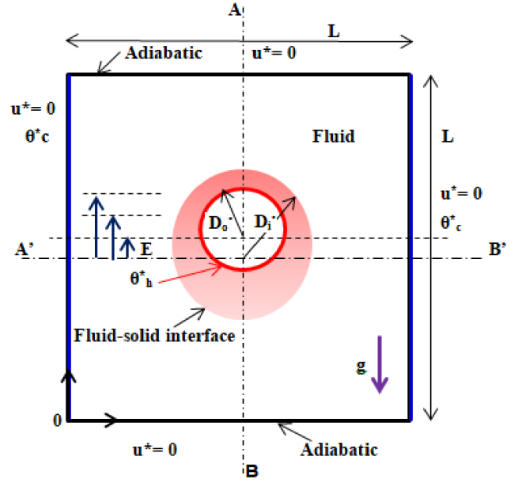
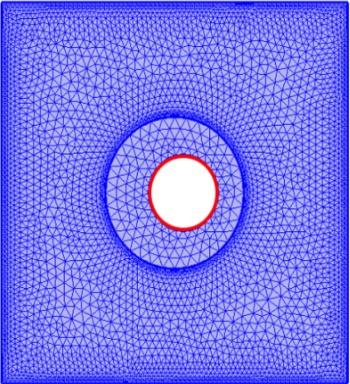
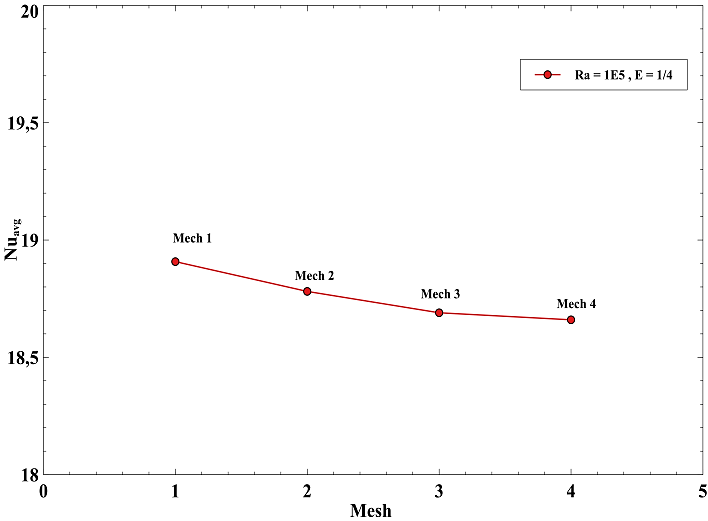
Therefore, this work in Figure 1, which combines square and circular cavities, remains a significant challenge in obtaining accurate results. This has led us to refine and test the network, as illustrated in Figure 2 (computational mesh) and Figure 3 (the Nu line).
Figure 1. Physical model diagram
Figure 2. Computational mesh used in the present study (fine)
Figure 3. Nusselt number (Nu) curves for different computational meshes
To examine this study, we considered a two-dimensional square cavity (L*L) of side, as illustrated in Figure 1. The vertical boundaries are subjected to a uniform cold temperature (θc•), while the horizontal boundaries are assumed to be adiabatic.
An eccentric annular crown-shaped heat source is embedded inside the enclosure. The geometry is characterized by an inner diameter (Di•) and an outer diameter (Do• = 2 Di•). Geometric asymmetry is introduced through a displacement (y•), quantified by the offset ratio (E).
The inner surface of the crown is maintained at a constant hot temperature (θh•), generating buoyancy-driven flow within the cavity. Air is assumed to behave as a continuous fluid, allowing its motion to be described using calculus rather than by considering the individual motion of its constituent molecules. Furthermore, the flow is assumed to be incompressible, such that variations in density can be neglected when the flow velocity is sufficiently low for compressibility effects to have a negligible influence on the results.
For this reason, laminar, incompressible, and Newtonian are the assumptions considered for the working fluid (air), with constant thermo-physical properties.
The Navier-Stokes equations are complex equations of fluid dynamics that can be simplified through the use of the Boussinesq approximation. The reason we regard density as a constant in all cases except for the buoyancy term is due to a comparison of scales and forces. In short, density variations are taken into account only in the buoyancy term, using the Boussinesq approximation.
Thermal energy transport within the fluid is driven by a combination of buoyancy-induced convection and conduction, while heat migration through the solid crown is restricted to conduction as defined by Fourier’s law. The integration of these two regions through matching temperature and heat flux at their boundary creates a conjugate heat transfer scenario.
2.2 Mathematical formulation
Characteristic scales are utilized to non-dimensionalize the governing equations, leading to the following dimensionless parameters:
$\begin{gathered}(\underline{x}, \underline{y})=\frac{\left(\underline{x}^*, \underline{y}^*\right)}{L},(\underline{u}, \underline{v})=\frac{\left(\underline{u}^*, \underline{v}^*\right) E}{\underline{U}_C}, \underline{P}=\frac{\underline{p}^* E^2}{\rho_f \underline{U}_C^2} \\ \theta=\frac{\theta^{\bullet}-\theta_{\text {ref }}^{\bullet}}{\theta_h^{\bullet}-\theta_c^{\bullet}}, t=\frac{t^* \underline{U}_c}{L E},\left(D_i, D_o\right)=\frac{\left(D_i^{\bullet}, D_o^{\bullet}\right)}{L}, \nabla=\nabla^{\bullet} \cdot L\end{gathered}$ (1)
$R a=\frac{g_y \beta\left(\theta^*-\theta_{\text {ref }}\right) L^3}{\alpha_f v_f}, \operatorname{Pr}=\frac{v_{\text {fluid }}}{\alpha_{\text {fluid }}}, \alpha_r=\frac{\alpha_{\text {solid }}}{\alpha_{\text {fluid }}}$ (2)
$\underline{U}_c=\sqrt{g \beta\left(\theta_h-\theta_c\right) L}$ (3)
where, Ra measures the strength of buoyancy-driven convection relative to viscous and conductive effects, Prandtl number (Pr) describes the relative rates of momentum and thermal diffusion within the fluid, and the thermal diffusivity ratio between the fluid and the solid crown is denoted by αr, governing the conjugate heat transfer interaction across the interface.
The following is the expression for the dimensionless governing equations:
Continuity equation:
$\frac{\partial u_i}{\partial x_i}=0$ (4)
Momentum equations:
$\frac{\partial u_i}{\partial t}+u_j \frac{\partial u_i}{\partial x_j}=-\frac{\partial P}{\partial x_i}+E^{{\frac{\partial^2 u_i{ }}{\partial x_j \partial x_j}}^2}$ iy $\sqrt{\frac{P r}{R a}}$ (5)
where, $x_i$ and $x_j$ are spatial coordinates in Cartesian tensor notation $(i, j=1,2)$.
where, the velocity components are denoted by $u_i$ and $u_j$, $\delta_{i y}$ is the Kronecker delta (equal to 1 when $i=y$, representing the direction of gravity),
Energy equation (fluid):
$\frac{\partial \theta_f}{\partial t}+u_j \frac{\partial \theta_f}{\partial x_j}=\frac{E}{\sqrt{\operatorname{RaPr}} \frac{\partial^2 \theta_f}{\partial x_j \partial x_j}}$ (6)
Energy equation (solid):
$\frac{\partial \theta_s}{\partial t}=\alpha_r \frac{E}{\sqrt{\operatorname{RaPr}} \frac{\partial^2 \theta_s}{\partial x_j \partial x_j}}$ (7)
2.3 Boundary and interface conditions
All solid surfaces must be non-slip. The vertical walls are kept at a steady, cool temperature thermally, whereas the horizontal walls are adiabatic.
$\nabla \theta_{\text {fluid }}=0$ (8)
The eccentric crown's inner surface is prescribed at a uniform hot temperature $\theta_s=1$, thereby generating buoyancy-driven flow within the enclosure:
Conjugate coupling is accomplished at the fluid-solid interface via temperature continuity.
$\theta_{\text {solid }}=\theta_{\text {fluid }}$ (9)
and normal heat flux:
$\nabla \theta_{\text {solid }}=\frac{E^2}{\text { RaPr }_{\text {fluid }}}$ (10)
where, the thermal conductivity ratio is denoted by $K_r=\frac{\underline{K}_{\text {solid }}}{\underline{K}_{\text {fluid }}}$.
2.4 Heat transfer analysis
The Nusselt number (Nu) is used to quantify the rate of heat transfer at the fluid-solid interface.
Local Nu:
$N u_l=-\left.\frac{\partial \theta_{\text {solid-fluid }}}{\partial n}\right|_{\text {near interface }}$ (11)
Average Nu:
$\overline{N u}=\frac{1}{p} \int_S N u_l d S$ (12)
These parameters are used to characterize the spatial variation and intensity of convective heat transfer.
2.5 Dimensionless entropy generation analysis
In natural convection, dimensionless entropy generation per unit volume in the fluid domain is given by the sum of two contributions: irreversibility due to heat transfer and irreversibility due to fluid friction (viscous dissipation). The total entropy generation rate, expressed in Cartesian tensor notation, is:
$\dot{S_{g e n}}=\underbrace{\frac{1}{\theta^2} \frac{\partial \theta}{\partial x_i} \frac{\partial \theta}{\partial x_i}}_{\text {Heat transfer irrevrsibility }}+\underbrace{B r\left(\frac{\partial u_i}{\partial x_j}+\frac{\partial u_j}{\partial x_i}\right)^2}_{\text {Viscous disipation irrevrsibility }}$ (13)
The Brinkman number (Br) is based on the characteristic velocity, leading to:
$B r=\frac{\mu \underline{U}_c^2}{k\left(\theta_h-\theta_c\right)}=\frac{\operatorname{Pr}}{\sqrt{R a}}$ (14)
The Bejan number (Be) expresses the relative dominance of thermal irreversibility:
$B e=\frac{\frac{1 \partial \theta \partial \theta}{\theta^2 \partial x_i \partial x_i}}{\frac{1 \partial \theta \partial \theta}{\theta^2 \partial x_i \partial x_i}+B r\left(\frac{\partial u_i}{\partial x_j}+\frac{\partial u_j}{\partial x_i}\right)^2}$ (15)
Be near 1 indicates heat transfer-dominated entropy generation; near 0 indicates dominance by viscous effects.
To resolve the governing Eqs. (4)–(10), the finite element method (FEM) was utilized, employing a mesh of triangular elements to accommodate intricate geometric features [26]. The primary field variables, including temperature, pressure, and velocity, are represented within each element via Lagrange polynomials, with Gaussian quadrature used to perform precise numerical integration [27]. Accuracy at solid-fluid boundaries is prioritized through a non-uniform mesh featuring boundary layer refinement, which also serves to enhance computational speed. Thermal behaviors are addressed using an implicit Newton-Raphson scheme to maintain stability and ensure convergence for nonlinear terms [28]. The simulation concludes once the residuals for velocity and temperature reach a threshold of 10-6, thus confirming the validity of the numerical results. Numerical comparisons are performed with experimental work [29] and numerical work [30].
To guarantee the accuracy of the numerical results, a mesh size verification study is presented. In order to do this, both in transient and steady-state regimes, the dimensionless temperature at the point (Y = 00.50, X = 00.70) is investigated as a function of dimensionless time. Table 3 summarizes the four distinct mesh density scenarios used in this investigation. A mesh independence analysis is conducted to verify the accuracy and robustness of the numerical solution. The time evolution of the dimensionless temperature at the monitoring site (X = 00.70, Y = 00.50) is assessed in this study. During both transient and steady-state regimes. The assessment is performed using four progressively refined mesh densities, as reported in Table 3.
Table 3. Details of the computational meshes employed in the grid independence study
|
Mesh Type |
Domain Elements |
Boundary Elements |
Final Temperature Value |
|
Mesh1. |
1162 |
154 |
0.625 |
|
Mesh2. |
1780 |
200 |
0.640 |
|
Mesh3. |
2260 |
242 |
0.650 |
|
Mesh4. |
7936 |
468 |
0.650 |
To provide additional results for mesh convergence based on at least one global criterion, we included a visual depiction of the solid-fluid interface's average Nu. which proved the network's independence, as shown in Figure 3.
The grid independence results obtained for Ra = 105, Pr = 0.71 and E = 1/4 are summarized in Table 1 and Figure 3. The analysis demonstrates that Mesh 3 yields result nearly identical to those of the finest grid, while significantly reducing the computational cost, thereby providing an optimal balance between accuracy and efficiency.
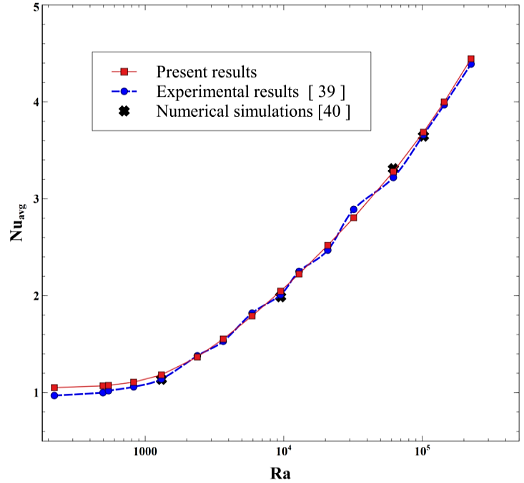
Figure 4 illustrates the verification process using a numerical model that was carried out through experimental work [29] and numerical research [30].
Figure 4. Validation of the numerical model: Comparison with Kuehn and Goldstein [29] and Shahraki [30]
The distribution of Nu at the fluid-solid interface for different Ra is compared with reference data.
In an annular space between two eccentric vertical tubes, a numerical study [29] was conducted using the FEM for Ra ranging from 103 to 105 and a radius ratio of 2.6, with various degrees of eccentricity. The validation of our results is based on the first case, featuring zero vertical deflection, where the verification employs the same solid filling, material properties, and boundary conditions. To further validate our results, we selected another experimental study [30] conducted under the same conditions, which examines the influence of eccentricity and the Ra on natural convection heat transfer through a fluid confined between two horizontal isothermal cylinders. The eccentricity of the inner cylinder significantly modifies the local heat transfer between the two cylinders within the studied eccentricity range (ϵ/L = 0, Pr = 0.7). The heat transfer results are presented in a table, allowing for a comparison of the Nu under the same conditions as those illustrated in Figure 4, given that the coefficient of determination, which measures the goodness of fit of this model, is 0.998106 < (R2) < 0.998611.
There is a pretty strong consensus between the present simulations and the reference solution. In both cases, reflecting a similar thermal behavior along the interface.
This research investigates conjugate heat transfer between a high-conductivity copper insert and air (Ra = 103–107) at various vertical eccentricities. Due to extreme thermal property contrasts, heat transfer is conduction-dominated within the solid, creating sharp interface gradients that significantly influence convective performance as geometric asymmetry increases (Figures 5–14).
5.1 Geometric eccentricity variation
While concentricity is often the design ideal for uniformity, eccentricity variation is a reality of manufacturing. In some cases, such as lubrication or specific heat exchangers, eccentricity is intentionally engineered to manipulate fluid flow and pressure. However, in structural applications, it is generally avoided as it creates dangerous localized stresses. Geometric eccentricity in a circular cavity refers to the displacement of the cavity's center relative to the center of the surrounding structure or an outer boundary. This work presents three axial displacements of E = 0.25, 0.5, and 1, respectively.
5.2 Flow structure and circulation intensity
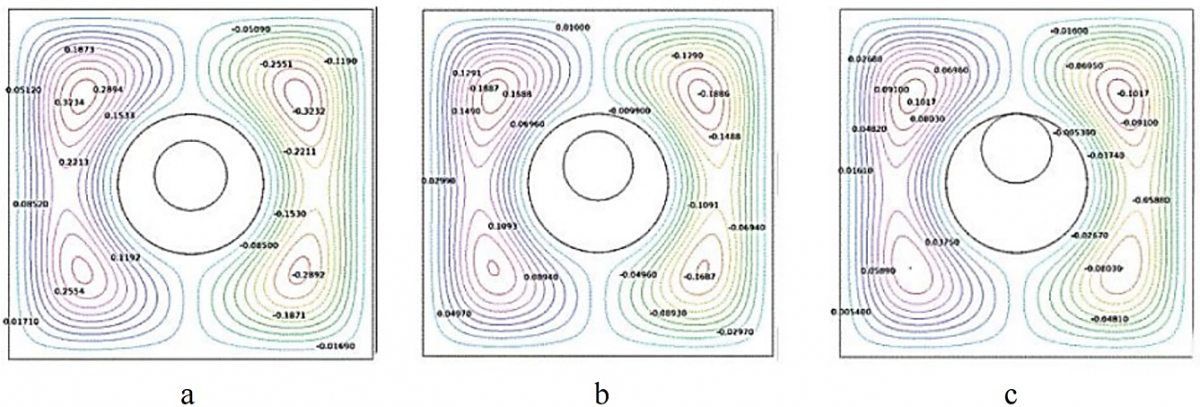
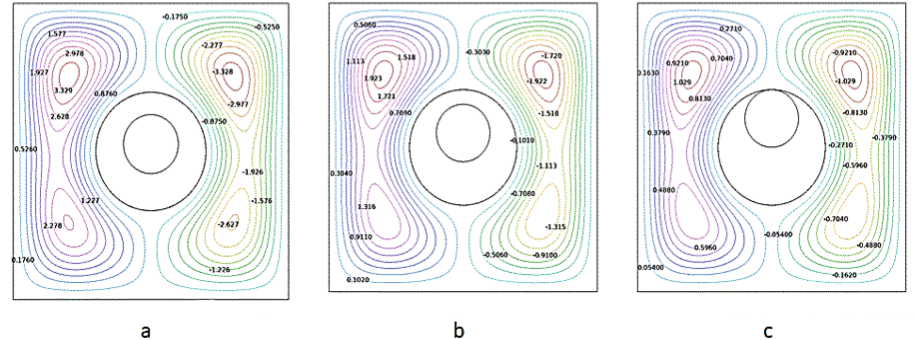
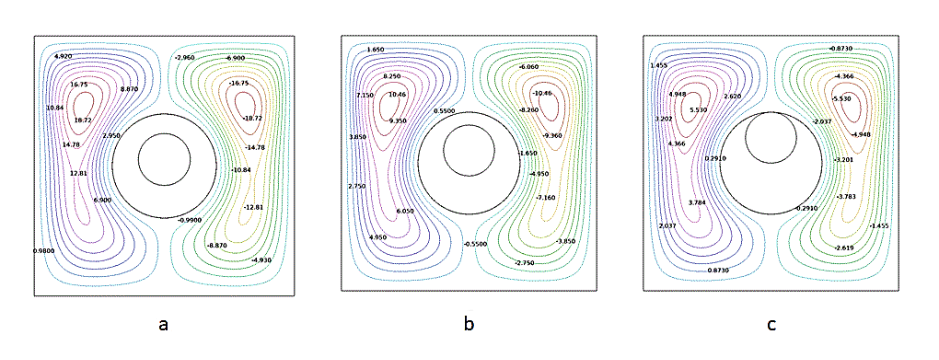
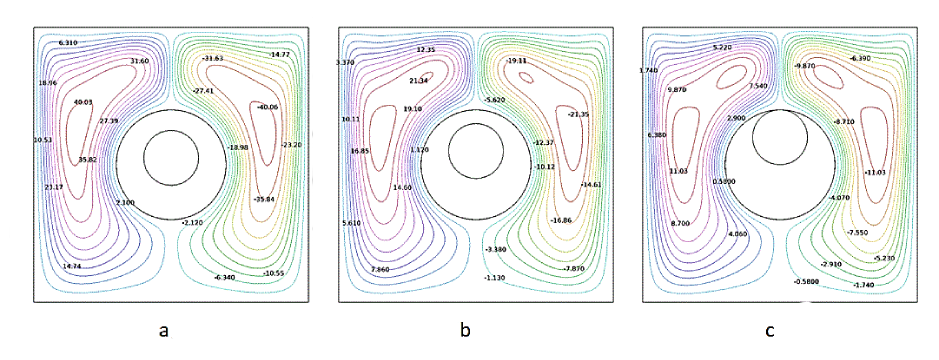
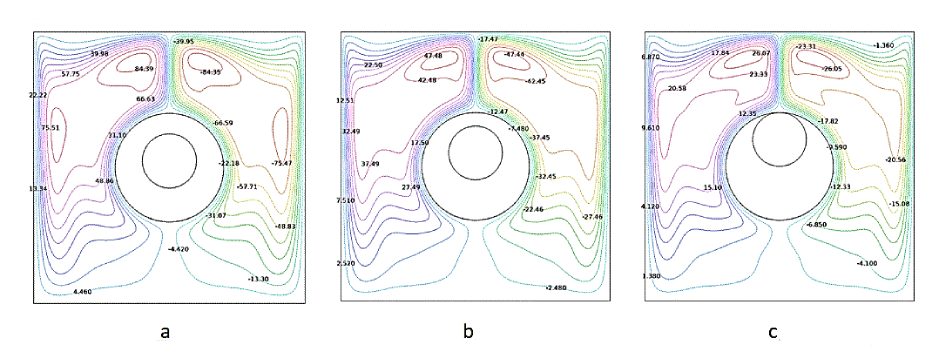
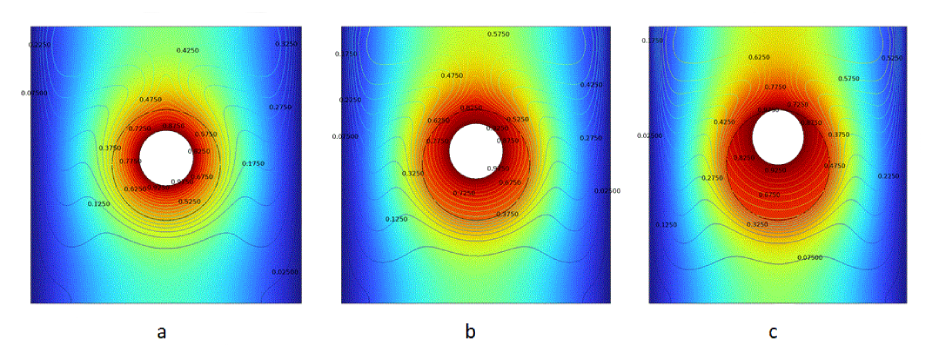
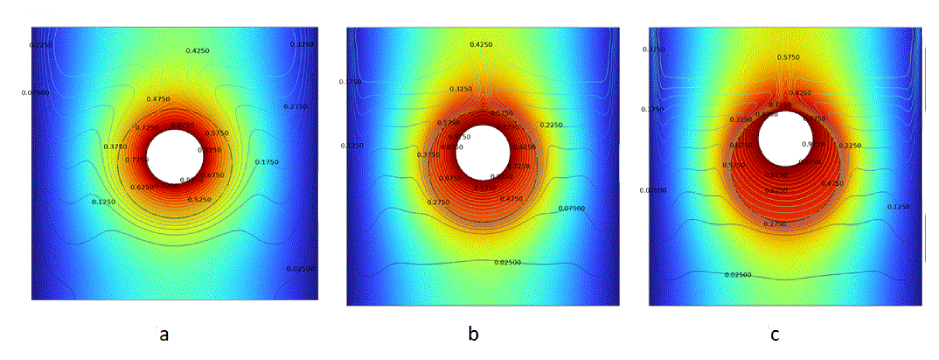
Figures 5(a–c) to 9(a–c) show the streamlines that varying vertical offset ratio and Ra (103 to 107) significantly alters flow patterns, mixing, and thermal stratification around a heated circular crown. At Ra = 103, and increasing offset ratio E from 1/4 to 1/2 and 1 reduces fluid circulation by 41% and 68%, respectively. This decrease is a result of stagnation and flow restriction close to the heat source. which inhibits the development and intensity of convective cells. The presence of asymmetric eddies and secondary vortex formation in E = 1 confirms that excessive eccentricity leads to chaotic flow patterns, diminished core circulation, and increased localized recirculation, adversely affecting overall thermal performance.
5.3 Thermal stratification and isotherm topology
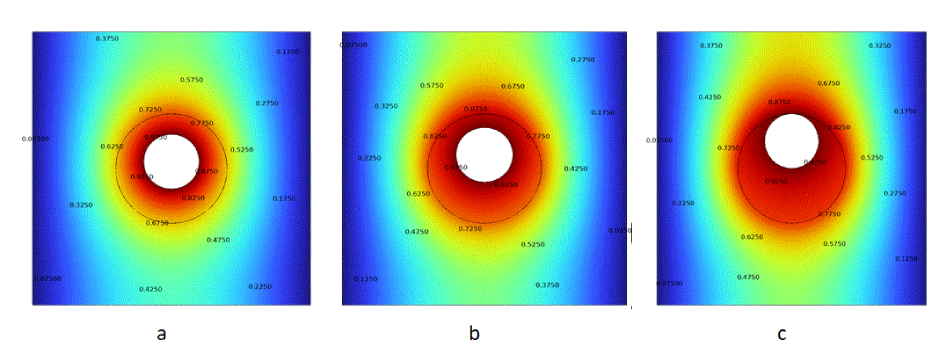
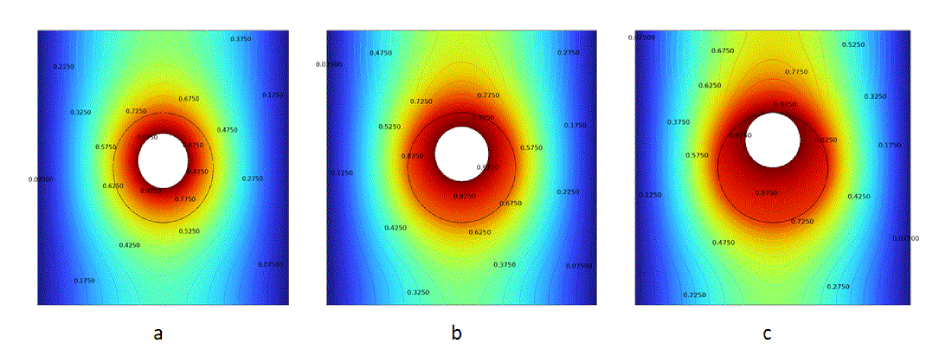
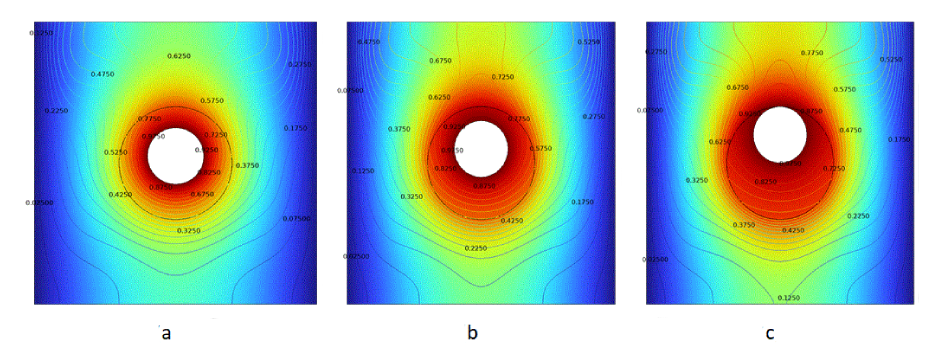
Lower offset ratio (1/4) facilitates efficient vertical convective transport. However, increasing offset ratio (1/2) to 1 distorts thermal plumes, leading to increased stratification, stagnation, and reduced heat transfer uniformity across all Ra (see Figures 10(a-c)-14(a-c)).
5.4 Local and average heat transfer analysis
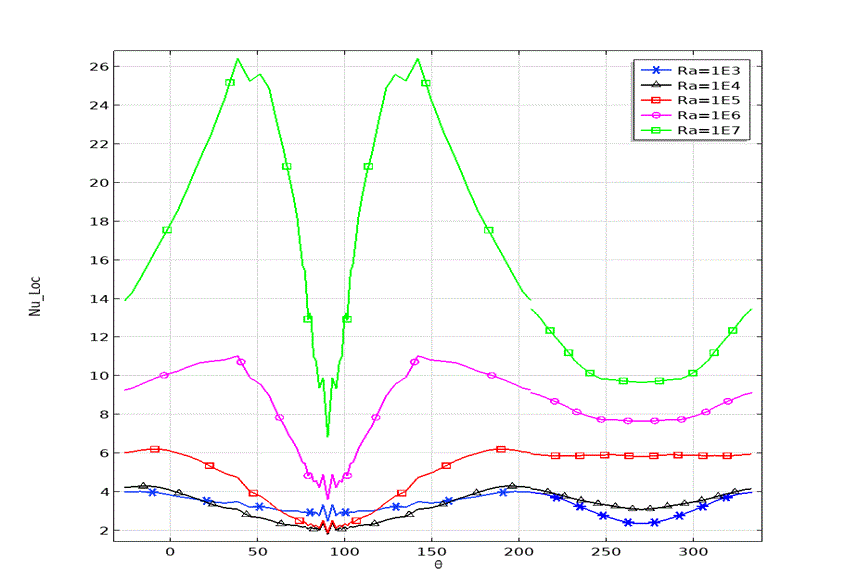
Figure 15 shows that increasing Ra enhances the change from heat transfer dominated by conduction to that dominated by convection. At low Ra, the Nu distribution along the fluid-solid interface remains relatively uniform, indicating weak convective effects. As Ra increases, pronounced heat transfer peaks develop due to the strengthening of buoyancy-driven circulation. The offset ratio (E) further modifies the location and intensity of these peaks by altering the flow structure and promoting secondary recirculation zones.
Figure 15. Profiles of local Nusselt number (Nu) along 0°–360° at the fluid solid interface for (Ra = 103–107) and E = 1
For this reason, we calculated the relative errors predicted by this new correlation. We estimated the relative errors, which are small at Ra = 103, for example, for the first vertical eccentricity Er = 0.2209% and for the subsequent eccentricities Er = 0.2270% and Er = 0.22704159%, respectively. Furthermore, at Ra = 105, the error ranged from 0.2309% to 4.158%.
The eccentricity effect would make the discussion much stronger. For this reason, we present an average Nu value for different Ra (see Table 4).
Table 4. Nusselt number (Nu) values for different Rayleigh numbers (Ra)
|
$\overline{N u}$ |
|||
|
Eccentricity |
E/4 |
E/2 |
E |
|
Ra = 104 |
12.967 |
8.0796 |
4.3729 |
|
Ra = 105 |
18.652 |
11.961 |
6.8171 |
|
Ra = 106 |
25.279 |
17.855 |
10.984 |
5.5 Heat flow empirical correlation
A highly non-uniform heat transport behavior along the fluid-solid interface is revealed by the distribution of the local Nu in the range 0ᵒ ≤ ϕ ≤ 180ᵒ. This behavior is governed by the interplay between buoyancy-driven convection and geometric eccentricity, which together control the formation of localized enhancement and suppression regions of heat transfer.
where,
$\overline{N u}=2.932 R a^{(0.19-0.053 E)} \cdot P r^{0.2} \cdot\left(1-0.5 E+0.1 E^2\right)$ (16)
This relation provides a predictive tool for natural convection in enclosures with eccentric geometries, enabling estimation of heat transfer performance and supporting thermal design and optimization in engineering applications.
The distribution becomes progressively more asymmetric as the eccentricity increases, highlighting how geometric displacement has a significant impact on regulating the spatial distribution of stagnation zones and heat transfer enhancement.
5.6 Entropy generation and Bejan number analysis
The study in this section shows that increasing Ra shifts heat transfer from conduction to convection, thus reducing the Be. Simultaneously, increasing offset ratio (E) increases cross-sectional asymmetry, shifting the stagnation peaks from 90°/270° towards 120°/240°, reflecting altered flow patterns and generating localized entropy.
In terms of fluid movement and heat transmission, the second law of thermodynamics. In any thermal system, waste comes from two primary sources:
Heat moving across a finite temperature differential generates thermal entropy. The generation of frictional entropy is brought on by fluid viscosity and pressure drop.
Since the total entropy is the sum of both, the geometry forces these two to compete. The geometric displacement acts as a lever that shifts the balance between these two mechanisms. When you decrease the characteristic size (e.g., smaller diameter), we have the thermal benefit because the fluid is physically closer to the walls. The "displacement" of heat is more efficient because the thermal resistance is lower. This decreases thermal entropy generation. But in the frictional penalty, to move the same amount of fluid through a smaller space, velocity and shear stress must increase. This increases frictional entropy generation. The role of Be to track this competition, scientists use this number to measure which mechanism is "winning" the competition. If Be ≫ 1: Thermal entropy dominates (the system is thermally inefficient); else if Be ≪ 1: Frictional entropy dominates (the system is being "choked" by flow resistance). Else (Be ≈ 0.5), the mechanisms are balanced.
The increasing eccentricity significantly modifies flow structure and reduces convective strength, which is a core principle in fluid dynamics, particularly when studying natural convection in annuli with an unsteady natural convection model. The reason this happens comes down to symmetry breaking and viscous resistance.
The flow structure changes from a straightforward circular motion to a more intricate, distorted pattern where fluid tends to "bypass" or stagnate in the narrowest sections.
A transition from symmetric to asymmetric convection is observed, accompanied by up to 35% reduction in stream function and 50% decrease in heat transfer for E = 1.
Entropy generation analysis confirms increased thermodynamic irreversibility with eccentricity. The proposed correlation provides predictive capability for design optimization of eccentric thermal systems.
This study extends previous work on horizontal displacement by investigating vertical eccentricity effects, providing a more complete understanding of conjugate convection in asymmetric cavities.
|
$Nu_1$/$\overline{N u}$ |
Local/average wall Nusselt number |
|
Ra |
Rayleigh number |
|
Be |
Bejan number (irreversibility ratio) |
|
Pr |
Prandtl number |
|
Br |
Brinkman number (viscous dissipation) |
|
Ar |
aspect ratio |
|
E |
[1] Seo, Y.M., Park, Y.G. (2026). Heat transfer and flow characteristics of natural convection induced by an elliptical-circular composite body in a square enclosure. Journal of Mechanical Science and Technology, 40: 5197-5210. https://doi.org/10.1007/s12206-026-0630-1
[2] Al-Hadad, A. (2026). Free convective thermal transmission through different shapes of enclosures: An overview. Defect and Diffusion Forum, 449: 73-100. https://doi.org/10.4028/p-4eONhz
[3] Rashid, U., Wang, Q.Y., Yang, K. (2025). Numerical and deep learning approaches in double diffusion natural convection modified nanofluid flow in a hexagonal cavity with a circular heated obstacle. Results in Engineering, 28: 107451. https://doi.org/10.1016/j.rineng.2025.107451
[4] Saidani, L., Tayebi, T., Djezzar, M., Malekshah, E.H. (2025). Magneto-double-diffusive natural convection and irreversibility analysis of a nanofluid flowing in an annular concentric space. Numerical Heat Transfer, Part A: Applications, 86(5): 1137-1159. https://doi.org/10.1080/10407782.2023.2272787
[5] Ghalambaz, M., Mehryan, S.A.M., Ayoubi Ayoubloo, K., et al. (2026). Unsteady melting and solidification of a nano-encapsulated phase change materials hybrid nanofluid in an eccentric porous annulus. Waves in Random and Complex Media, 35(7): 13071-13097. https://doi.org/10.1080/17455030.2022.2139015
[6] Mahmood, M.Y., Abed, W.M. (2025). Influence of inner cylinder rotation and eccentricity on convective heat transfer in power-law non-Newtonian flow within annular cylinders. Anbar Journal of Engineering Sciences, 16(2): 24-35. https://doi.org/10.37649/AJES-25-011
[7] Olayemi, O.A., Al-Manea, A., Ismael, M.A. (2025). Aspiration effect on the convection of a rotating hot rod covered by an eccentric porous annular layer. Heat Transfer, 54(7): 4407-4427. https://doi.org/10.1002/htj.70002
[8] Abdi, M. (2025). Laminar convective heat transfer combining buoyancy and thermal radiation of Carreau fluid within a concentric and eccentric annulus. Numerical Heat Transfer, Part B: Fundamentals, 86(9): 2879-2908. https://doi.org/10.1080/10407790.2024.2350052
[9] Azzawi, I.D., Hasan, A.F., Yahya, S.G. (2023). Computational optimum design of natural convection in a concentric and eccentric annular cylinder using nanofluids. Proceedings of the Institution of Mechanical Engineers, Part A: Journal of Power and Energy, 237(3): 517-526. https://doi.org/10.1177/09576509221117936
[10] Abed, W.M., Al-Damook, A., Khalil, W.H. (2021). Convective heat transfer in an annulus of concentric and eccentric cylinders with an inner rotating cylinder. International Journal of Heat and Technology, 39(1): 61-72. https://doi.org/10.18280/ijht.390107
[11] Jafari, S., Rahnama, M. (2018). Simulation of natural convection in eccentric annulus: A combined lattice Boltzmann and smoothed profile approach. AUT Journal of Mechanical Engineering, 2(1): 13-26. https://doi.org/10.22060/mej.2017.13013.5500
[12] Mota, J.B., Saatdjian, E. (2026). Natural convection between eccentric, horizontal porous cylinders. WIT Transactions on Engineering Sciences, 5: 9. https://www.witpress.com/elibrary/wit-transactions-on-engineering-sciences/5/11579
[13] Fan, M.Y., Bao, Z.W., Liu, S.B., Huang, W.X. (2022). Flow and heat transfer in the eccentric annulus of the helically coiled tube-in-tube heat exchanger used in an aero-engine. International Journal of Thermal Sciences, 179: 107636. https://doi.org/10.1016/j.ijthermalsci.2022.107636
[14] Sheikholeslami, M., Hayat, T., Alsaedi, A. (2017). On simulation of nanofluid radiation and natural convection in an enclosure with elliptical cylinders. International Journal of Heat and Mass Transfer, 115: 981-991. https://doi.org/10.1016/j.ijheatmasstransfer.2017.07.119
[15] Picoli, F., Oliveski, R.D.C., Kerber, R.M. (2024). Influence of eccentricities and mass ratios in a PCM melting process. Applied Thermal Engineering, 245: 122749. https://doi.org/10.1016/j.applthermaleng.2024.122749
[16] Gholamalipour, P., Siavashi, M., Doranehgard, M.H. (2019). Eccentricity effects of heat source inside a porous annulus on the natural convection heat transfer and entropy generation of Cu-water nanofluid. International Communications in Heat and Mass Transfer, 109: 104367. https://doi.org/10.1016/j.icheatmasstransfer.2019.104367
[17] Singh, S., Sengupta, B., Rana, S. (2024). Analysis of thermal mixing and entropy generation during natural convection flows in arbitrary eccentric annulus. Axioms, 13(4): 233. https://doi.org/10.3390/axioms13040233
[18] Bejan, A., Lorente, S. (2013). Constructal law of design and evolution: Physics, biology, technology, and society. Journal of Applied Physics, 113(15): 151301. https://doi.org/10.1063/1.4798429
[19] Yu, Z.T., Hu, Y.C., Fan, L.W., Cen, K.F. (2010). A parametric study of Prandtl number effects on laminar natural convection heat transfer from a horizontal circular cylinder to its coaxial triangular enclosure. Numerical Heat Transfer, Part A: Applications, 58(7): 564-580. https://doi.org/10.1080/10407782.2010.508435
[20] Shahzadi, I., Nadeem, S. (2017). Stimulation of metallic nanoparticles under the impact of radial magnetic field through eccentric cylinders: A useful application in biomedicine. Journal of Molecular Liquids, 225: 365-381. https://doi.org/10.1016/j.molliq.2016.11.062
[21] Abdulah, Z.F. (2016). Entropy generation of shell and double concentric tubes heat exchanger. Journal of Engineering, 22(6): 66-75. https://doi.org/10.31026/j.eng.2016.06.05
[22] Bonab, S.A., Goharkhah, M. (2026). Influence of partitions and eccentricity on the phase change material melting in double-tube and triple-tube latent heat storage systems. Heat Transfer, 55(4): 2468-2489. https://doi.org/10.1002/htj.70204
[23] Khaoula, B.A., Fayçal, B.N. (2021). Improved energy efficiency of mixed convection heating process in eccentric annulus. Advances in Mechanical Engineering, 13(8): 16878140211039150. https://doi.org/10.1177/16878140211039150
[24] Khazaal, M.A., Daneh-Dezfuli, A., Habeeb, L.J. (2023). Influence of nanoparticle concentrations on heat transfer in nano-enhanced phase change materials. Power Engineering and Engineering Thermophysics, 2(4): 228-237. https://doi.org/10.56578/peet020404
[25] Li, C., Mo, D.M., Wu, C.M., Li, Y.R. (2026). Experimental observation on flow pattern of thermal convection in eccentric annular deep-liquid pools. Experimental Thermal and Fluid Science, 175: 111720. https://doi.org/10.1016/j.expthermflusci.2026.111720
[26] El Glili, I., Foukhari, Y., Akkaoui, H., Sammouda, M., Driouich, M., Belhouideg, S. (2025). Natural convection enhancement with nano-encapsulated phase change materials in differentially heated square cavities. Journal of Thermal Analysis and Calorimetry, 150(26): 22119-22131. https://doi.org/10.1007/s10973-025-15102-x
[27] Lorsung, C., Farimani, A.B. (2022). MeshDQN: A deep reinforcement learning framework for improving meshes in computational fluid dynamics. AIP Advances, 13: 015026. https://doi.org/10.1063/5.0138039
[28] Zhu, Y.Z., Zhao, S.J., Zhou, Y.Y., Liang, H., Bian, X. (2024). An unstructured adaptive mesh refinement for steady flows based on physics-informed neural networks. Journal of Computational Physics, 540: 114283. https://doi.org/10.1016/j.jcp.2025.114283
[29] Kuehn, T.H., Goldstein, R.J. (1978). An experimental study of natural convection heat transfer in concentric and eccentric horizontal cylindrical annuli. ASME Journal of Heat and Mass Transfer, 100(4): 635-640. https://doi.org/10.1115/1.3450869
[30] Shahraki, F. (2002). Modeling of buoyancy-driven flow and heat transfer for air in a horizontal annulus: Effects of vertical eccentricity and temperature-dependent properties. Numerical Heat Transfer, Part A: Applications, 42(6): 603-621.