Hamsa A. Ali | Iman Ismael Turki | Ghufran Sh. Al-Obaidy | Jamal M. Rzaij
© 2025 The authors. This article is published by IIETA and is licensed under the CC BY 4.0 license (http://creativecommons.org/licenses/by/4.0/).
OPEN ACCESS
The gamma-ray attenuation properties of binary and ternary polymer blends of epoxy resin (EP), unsaturated polyester (UP), and polyvinyl chloride (PVC) are studied in this work to develop lightweight and scalable radiation shielding materials. Five distinct polymer blends were prepared using the hand lay-up molding technique and tested under gamma-ray sources emitting photons at varying energies: Specifically, Ba-133 (0.081 – 0.356 MeV), Cs-137 (0.662 MeV), and Co-60 (1.17–1.33 MeV). EP 80% + UP 20% blends showed better shielding against high-energy photons by enhanced Compton scattering, while high PVC content blends, such as EP 80% + PVC 20%, performed better for low-energy photons through the photoelectric effect. Ternary blends demonstrate reliable attenuation across all energy ranges. Gamma irradiation-induced aging greatly improved material density and attenuation coefficients, reaching a 20% increase after 15 days owing to crosslinking and densification within the polymer matrix. The stability and variability analysis showed that binary blends were more stable and less volatile than ternary blends and hence dependable when subjected to long-term radiation exposure. This work provides a deeper insight into the interactions between polymer blends and gamma photons to help in the development of lightweight, multi-purpose, and effective materials that can be used in medical imaging, nuclear safety, and radiation exposure in industry.
gamma-ray, attenuation, radioactive source, polymer, shielding, cobalt-60
Gamma radiation shielding is a prerequisite to many applications, including medical diagnostics, nuclear power production, and industrial radiography. Radiation exposure can be effectively shielded using good shielding materials to ensure safety and compliance with regulatory standards. Due to their lightweight nature, mechanical strength, and versatility in reinforcement, polymer composites have attracted considerable attention as potential shielding materials [1, 2]. However, the advanced gamma ray attenuation properties can only be optimized by comprehending of material composition, energy-dependent interactions, and performance over long-term radiation exposure [3, 4]. Gamma-ray interactions with matter are well understood from fundamental principles, including the law of exponential attenuation, which is expressed by Eq. (1) [5].
$I=I_0 e^{-\mu X}$ (1)
where, I is the transmitted intensity, μ is the linear attenuation coefficient of the material at a thickness of x, and I0 is the initial intensity. The linear attenuation coefficient (μ) is a critical parameter for radiation shielding effectiveness, and depends on the material density, atomic number, and the energy of the incident photons. This principle was used in this study to analyze the gamma-ray attenuation properties of epoxy-based composites reinforced with various materials. The attenuation coefficients of various composites were measured, with I and I0 being related to the type of reinforcement, gamma-ray energy, and time trends.
The increasing need for lightweight, scalable, and effective radiation shielding materials has led to advancements in polymer-based composites [6]. Lead and other traditional shielding materials can attenuate gamma rays, but are limited in density, toxicity, and mechanical properties, restricting their use in medical imaging, nuclear safety, and industrial radiation environments [7].
Different materials have been utilized as shields against harmful and ionizing radiations and these are nanostructured materials and polymers. Polymer composites seem to be a good alternative as they are light, easy to make and can be customized to have functional properties [8]. Several current studies have incorporated changes in composition to enhance the shielding efficiency of polymeric materials. For instance, improved gamma-ray attenuation properties were found in new polymer composites containing heavy metal oxides [9]. Further research into developing lead-free shielding materials proved that adding high-density fillers would enhance the attenuation characteristic [10]. Other works on radiation shielding composites can also be inferred from research on construction materials for nuclear facilities [11]. Further studies have witnessed the aspect of radiation attenuation and the stability of polymeric materials for long durations [12]. A recent survey of polymer and shield materials has focused on achieving shield application [13, 14]. These works align with the present research's goals to develop lightweight and easily scalable shielding materials.
Recent works to design polymer-based shielding material have focused on increasing gamma-ray and neutron attenuation abilities. For example, some contributions have focused on applying prepared ferrite nanoparticles with Ni and Zn cations to enhance polymeric gamma-ray shields [15]. More recent progress involves SnO₂-doped unsaturated polyester composites for gamma and neutron shielding [16], and multilayer polyethylene composites with cadmium and tungsten oxide [17]. The influences of CuO concentration on the shielding properties of epoxy-resin material have also been discussed [18]. The effect of the incorporation of cobalt, Al2O3, and MgO in the LDPE/PVC composites on the gamma and neutron shielding efficiencies is also reported [19]. These works also present evidence of growing concern in the scientific literature on lightweight, scalable shielding materials, which aligns with the objectives of the present work.
Numerous studies have demonstrated the potential for polymer-based composites for gamma radiation shielding. Joshi et al. [20] studied the radiation stability of epoxy-based gamma shielding materials and found that epoxy lead oxide composites can improve shielding efficiency from gamma-induced crosslinking and densification greatly. Nambiar and Yeow [21] reviewed the application of high-atomic-number fillers, such as bismuth oxide, to improve gamma attenuation by the photoelectric effect due to its higher absorption of low-energy photons. However, Karabul and İçelli [22] applied epoxy composites containing heavy metal oxides, such as bismuth oxide (Bi2O3) and tungsten trioxide (WO3), which significantly enhanced the material's gamma ray shielding performance.
More recently, the potential for polymer-based composites for gamma radiation shielding applications has been further underscored by Zegaoui et al. [23]. Multifunctional polymer materials were created by reinforcement with a cyanate ester of bisphenol A/bisphenol A-based benzoxazine, based on short Kevlar and basalt hybrid fibers. The resulting composites' enhanced mechanical, thermal, and gamma radiation shielding properties demonstrated the effectiveness of hybrid fiber reinforcement in polymer matrices for radiation protection. Enhanced mechanical, thermal, and gamma radiation shielding properties of the resulting composites showed the effectiveness of reinforcement in polymer matrices for radiation protection.
A similar study was done by Atef et al. with the survey of polyvinyl chloride/nitrile butadiene rubber (PVC/NBR) blends loaded with varying amounts of lead monoxide (PbO). The mass attenuation coefficients of the blends are enhanced by increasing PbO content and improving tensile strength; these properties make these materials suitable for gamma radiation shielding applications [24].
Nanomaterials, in various forms, are effective materials in a wide range of applications because they have distinct features when compared to bulk materials [25-27]. Advanced carbon nanostructures in nanocomposites, like graphene attachments and carbon nanotubes (CNTs), have been considered intriguing. CNTs and graphene-based nanocomposites are frequently categorized into several classes based on the types of discontinuities in their phases. Graphene-reinforced nanocomposites have been extensively studied for use as engineering materials in various challenging applications and radiation shielding due to their remarkable properties. The development of nano-composite materials is of great importance to a growing range of industrial applications [28-31].
Polymer nanocomposites have also attracted a lot of attention as electromagnetic interference (EMI) shielding devices because of the lightweight, anticorrosive, and tunable characteristics. This is made possible by the insertion of the conductive filler, reduced graphene oxide (RGO), into the EMA phase of the polymer matrix through accurate confinement. Graphene, boron nitride nanosheets, and RGO are used as nanomaterials to reinforced polymer composite to improve its characteristics. These nanomaterials, in particular RGO, are often dispersed across the polymer matrix in order to increase their strength, conductivity, and other characteristics [32].
The mechanical, thermal, and shielding characteristics of various polymer-composite materials are discussed with a focus on the current developments and challenges in the area [33]. Together, these studies demonstrate that polymer-based composites represent viable, lightweight, scalable, and efficient sources of gamma radiation shielding. Polymer blends have become very popular in many industries since it can be modified, easily manufactured, lightweight, corrosion resistant, and the raw materials can be easily sourced as most of the base polymers like HDPE, PVC and epoxy are readily available. Polymer blends can be used especially when tailored to resist degradation by radiation or heat and provide good balance between cost and performance due to their long life cycle. Polymer blends have a lot of widespread usage in the industrial sector because of their various properties. Some main industrial applications of polymer blends include automotive, construction materials, packaging, medical devices, textiles, coatings, and adhesives. As for the overall cost of polymer blends, it depends on the type of base polymer, the percentage of additives or reinforcements, the manufacturing process, and the required layer thickness [34].
However, despite those, a comprehensive study is still lacking regarding the dynamic response of polymer blends to gamma irradiation regarding aging, crosslinking, and densification. Additionally, the use of ternary blends (e.g., epoxy resin (EP), unsaturated polyester (UP), and PolyVinyl Chloride (PVC)) has not been explored in terms of how material composition affects interaction mechanisms such as Compton scattering and the photoelectric effect. This study seeks to fill in part of these gaps by developing a systematic approach to evaluating the gamma-ray attenuation properties of binary and ternary polymer blends of EP, UP, and PVC. The hand lay-up molding method was used to prepare five separate compositions tested using gamma-rays with low and high-energy photons. The Aging effects of gamma irradiation on the material density and attenuation coefficients were also established to bring out another insight on the long-time reliability and stability of these materials. This work moves polymer photon interactions further by uniquely integrating experimental data with statistical analysis. It opens the door to developing lightweight, scalable, and efficient radiation shielding materials.
2.1 Materials
In this study, five different polymer types (Table 1) were prepared through a polymer blend of EP, unsaturated polyester resin, and PVC to achieve specific performance characteristics:
1. EP: A thermosetting polymer that is a transparent liquid with high adhesion and low shrinkage. Epon™ Resin 828, manufactured by Hexion Specialty Chemicals Inc., USA, with a density of 1.17 g/cm³, was used as the EP. It was cured by adding Metaphenylenediamine (MPDA) hardener at a ratio of 80:100 (resin to hardener) at room temperature.
2. Unsaturated Polyester Resin: A thermosetting polymer in the form of a yellow liquid. The resin used was Siropol 8341, manufactured by SABIC Saudi Arabia Resins Company Limited, with a 1.0–1.3 g/cm³ density. It was cured with methyl ethyl ketone peroxide at a ratio of 1 g hardener to 99 g resin at room temperature.
3. PVC: A non-thermosetting polymer in solid white granules. The PVC used was type PVC 67S, manufactured by Tuttlingen, Germany, with a 1.3–1.58 g/cm³ density.
Table 1. Compositional ratios of polymer blends in terms of PVC, unsaturated polyester, and epoxy resin
|
Sample No. |
PVC (%) |
UP (%) |
EP (%) |
|
A |
0 |
20 |
80 |
|
B |
20 |
0 |
80 |
|
C |
5 |
15 |
80 |
|
D |
10 |
10 |
80 |
|
E |
20 |
20 |
60 |
The choice of EP, unsaturated polyester, and polyvinyl chloride as base materials is based on their peculiarities in radiation shielding applications. EP has structural stability and added electron density which increases Compton scattering of high-energy interactions with photons. The blends are obtained with the mechanical flexibility that is through the union of unsaturated polyester that gives it the long term durability when subjected to prolonged radiation. More atomic number of PVC in low energy region leads to higher attenuation due to the photoelectric effect. Depending upon the composition, these materials provide flexibility in the radiation shielding offered by balancing attenuation efficiency, mechanical integrity, and long-term stability.
2.2 Sample preparation
Polymer blends were prepared by the use of hand lay-up molding technique because of its simplicity and reliability. A compromise between mechanical stability, processability and radiation shielding efficiency in the types of blends to be achieved was determined and the compositional weight ratios of each blend as shown in Table 1. Due to its superior crosslinking ability during gamma radiation, EP was selected as the primary matrix to improve attenuation properties. UP provides flexibility and mechanical durability increases, while PVC increases photoelectric absorption at a lower gamma energy. Previous studies and preliminary experimental trials were used to optimize the specific weight ratios so that a complete evaluation of binary and ternary systems could be conducted.
2.3 Preparation process
1. Mixing: Resins were mixed in a beaker according to the ratios in Table 1, with continuous stirring for 15 minutes.
2. Degassing: The mixture was degassed under vacuum (700 mmHg) for 10 minutes to remove air bubbles.
3. Molding: The mixture was poured into molds of dimensions 10 × 10 × 1 cm, lined with a release agent for easy removal. The molds were left undisturbed for 24–48 hours for initial curing.
4. Curing: Samples were placed in a drying oven at 60℃ for 5 hours to enhance hardening and molecular bonding, yielding final binary and ternary polymer blends.
2.4 Experimental setup
The attenuation at gamma rays was analyzed with a high-resolution gamma spectrometer by incorporating the following radioactive sources:
Co-60: Energy peaks at 1.17 MeV and 1.33 MeV.
Cs-137: Energy peak at 0.662 MeV.
Ba-133: Energy range of 0.081 – 0.356 MeV.
The experimental setup included:
1. Collimated beam setup: The gamma rays were directed towards the samples using a lead collimator.
2. The source-to-sample and sample-to-detector distance was fixed at 15 cm to minimize beam divergence, ensuring uniform exposure.
3. Detection system: A NaI(Tl) scintillation detector, calibrated using certified radioactive standards, measured the transmitted gamma intensity.
4. Conditions of measurement: Every specimen was positioned perpendicular to the beam path; readings were taken at ambient temperature and controlled humidity to avoid environmental effects on the properties of the materials.
The measurements were taken in a controlled environment in the Physics Department, College of Science, University of Baghdad.
2.5 Attenuation coefficient calculation
The linear attenuation coefficient (μ) was calculated by rearranging Eq. (2) as follows:
$\mu=\frac{1}{x} \ln \left(\frac{I_0}{I}\right)$ (2)
Triplicate measurements were carried out, and averaged values and standard deviation are reported.
Aging Study
An aging study using similar experimental sources was performed to assess the long-term stability of the blend polymer under gamma radiation. Under controlled conditions, the samples were irradiated with gamma radiation for 0, 5, 10, and 15 days. The time for accumulated dose exposure and the dose rate of each gamma source was considered in quantifying the total dose delivered to the sample. This was done to ensure that temperatures were consistent and that the samples did not absorb moisture that may affect their mechanical properties.
2.6 Statistical analysis
The attenuation coefficients across the blends and aging intervals were analyzed using one-way ANOVA. Post-hoc Tukey\u2019s tests were conducted to find pairwise differences. All results will be reported as mean ± SD. The statistical analysis was performed using software such as SPSS or R. The data are represented as bar charts with trend lines showing key results.
3.1 Attenuation coefficients results
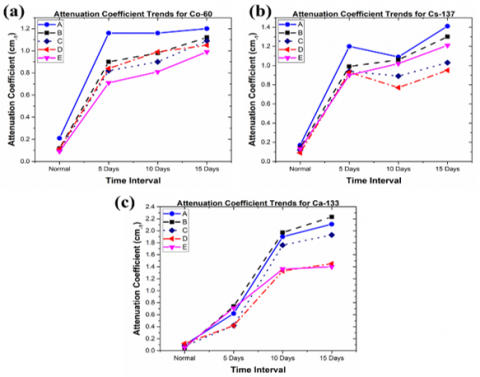
Figure 1: (a-c) shows the attenuation coefficients μ of composite samples A, B, C, D, and E for Co-60, Cs-137, and Ba-133 gamma-ray sources, respectively. These give the shielding performance of these materials as well as the effect of the time of gamma-irradiation, hence providing insight into how the shielding performance of these materials will change.
Sample A gave the highest attenuation coefficients in all the sources, and Sample E gave the minimum performance among the samples. Such observed differences are attributed to the differences in polymer composition, density, and structural response to gamma irradiation.
The attenuation coefficients of the Co-60 source (Figure 1(a)) with high-energy photons (1.17 and 1.33 MeV) were significantly increased after 5 days of irradiation for all samples and then stabilized for 10 and 15 days. The highest attenuation coefficient of ~1.2 cm-1 was achieved in sample A with the highest epoxy content, which enhanced crosslinking and densification due to gamma irradiation. An experimental electron density increase induced by densification enhances Compton scattering, the dominant interaction mechanism for high-energy photons. Sample E with higher PVC content exhibited lower attenuation coefficients (~0.8 cm-1) due to the decreased crosslinking capability of PVC and its lower density, reducing the availability of electrons for photon interactions. These results are in line with Cai et al. [35], who stated that dense hydrogen-rich polymer composites have better gamma shielding performance because of increased photon-electron interactions.
Similarly, the attenuation coefficients derived for Cs-137 irradiation (Figure 1(b)) of mid-energy photons (0.662 MeV) were similar, exhibiting large increases after 5 days, followed by stabilization. Again, Sample A outperformed the others by ~1.4 cm−1 at 15 days. In this range of energy, both Compton scattering and the photoelectric effect contribute to the photon attenuation. In Sample A, we have an epoxy-polyester matrix with a dense network supporting Compton scattering, and in Sample C (EP 80% + UP 15% + PVC 5%), a medium-density matrix that allows for some photoelectric absorption. However, sample C's attenuation temporarily dropped at 10 days, a probable situation in which the degradation or rearrangement of the polymer matrix is localized. This behavior emphasizes the dual effects of gamma irradiation: Improvements in attenuation through crosslinking and degradation to weaken the grain and temporarily reduce material density. Our results are consistent with Ambika et al. [36], who observed the same trends in polymer composites exposed to mid-energy gamma photons.
Figure 1. Attenuation coefficients of polymer samples under (a) Co-60, (b) Cs-137, and (c) Ba-133 gamma-ray sources
Attenuation coefficients for Ba-133 (Figure 1(c)), low-energy photons (0.081-0.356 MeV) increased progressively as measured for all samples, with sample A approaching ~2 cm−1 after 10 days. The photoelectric effect is the leading interaction mechanism at these lower photon energies, especially for photons situated at the low end of the energy spectrum. The use of the higher atomic number PVC made sample B (EP 80% + PVC 20%) perform better (~2.3 cm−1) since the probability of photoelectric interactions is higher. However, Sample E has consistently shown the lowest performance, demonstrating that the higher PVC content does not offset the elimination of epoxy and polyester components necessary to maintain material density and provide structural integrity. The results are consistent with the findings of Büyükyıldız et al., which showed reduced gamma attenuation performance for PVC-rich blends, as its density was reduced and the potential for crosslinking was limited [10].
Certain errors are associated with the measurement of linear attenuation coefficient, μ, due to limited sample thickness, gamma-ray intensity, and resolution of the detector used.The values of μ calculated and the respective uncertainties for the polymer samples are presented in Table 2. The percentage error was lower than 2%, indicating that these measurements were within the usual experimental errors. The procedure followed is related to the radiation shielding methodologies presented in the literature [37], ensuring the data's reliability and repeatability.
Table 2. The calculated values of μ and respective uncertainties for the polymer samples
|
Sample No. |
Photon Energy (keV/MeV) |
μ (cm⁻¹) |
Δμ (cm⁻¹) |
% Error |
|
A |
Co-60 (1.17–1.33 MeV) |
1.2 |
0.015 |
1.25 |
|
Cs-137 (0.662 MeV) |
1.4 |
0.018 |
1.28 |
|
|
Ba-133 (0.081-0.356 MeV) |
2 |
0.02 |
1 |
|
|
B |
Ba-133 (0.081-0.356 MeV) |
2.3 |
0.022 |
0.95 |
|
Co-60 (1.17–1.33 MeV) |
1.05 |
0.0135 |
1.28 |
|
|
Cs-137 (0.662 MeV) |
1.25 |
0.0165 |
1.32 |
|
|
C |
Co-60 (1.17–1.33 MeV) |
1.1 |
0.014 |
1.27 |
|
Cs-137 (0.662 MeV) |
1.3 |
0.017 |
1.30 |
|
|
Ba-133(0.081-0.356 MeV) |
1.9 |
0.019 |
1 |
|
|
D |
Co-60 (1.17–1.33 MeV) |
1.15 |
0.0145 |
1.26 |
|
Cs-137 (0.662 MeV) |
1.35 |
0.0175 |
1.29 |
|
|
Ba-133 (0.081-0.356 MeV) |
1.95 |
0.0195 |
1 |
|
|
E |
Co-60 (1.17–1.33 MeV) |
0.8 |
0.013 |
1.62 |
|
Ba-133 (0.081-0.356 MeV) |
0.7 |
0.014 |
2 |
|
|
Cs-137 (0.662 MeV) |
1.1 |
0.015 |
1.36 |
This means that the thicker the sample, the more photons it will absorb, further decreasing the intensity of the transmitted radiation. Stated differently, even though the material's attenuation coefficient remains exactly the same, the percentage of attenuation, or the intensity of the transmitted radiation, is strongly dependent on the thickness. In polymer blends, research indicates that this relationship between thickness and the intensity of the transmitted radiation is often exponential, implying that materials of greater thickness exhibit greater efficiency in the attenuation process, especially when using high-density fillers [3].
The attenuation performance of the composite sample largely varied with the three gamma-ray sources due to the differences in their photon energy and the interaction mechanism. For high-energy photons, such as Co-60, the attenuation mechanism was mainly Compton; thus, it favored denser materials with higher electron density, such as Sample A. Mid-energy photons, such as Cs-137, are attenuated by both Compton scattering and the photoelectric effect. In this case, attenuation performance dependence is influenced by material composition and density.
The photoelectric effect was dominant at the lower photon energies (Ba-133), indicating that the blends were those containing components with a higher atomic number, such as PVC.
Attenuation results among the two sample blends were compared for all gamma-ray sources, and Sample A gave better attenuation consistently, proving effective as a gamma shielding material. The high content of epoxy in Sample A increased electron density, crosslinking potential, structural stability, and photon interaction. On the other hand, Sample E had a lower epoxy and higher PVC content, proving to be the weakest among all the sources, which shows that effective and consistent attenuation depends mostly on the composition of the polymer.
These differences in the attenuation coefficients could be attributed to the differences in the polymer molecular composition, density, and structure, since they determine the probabilities of gamma encounter interaction. The epoxy-based blends had a higher attenuation coefficient, probably due to the increased cross-linkage density of the epoxy material upon gamma irradiation. This agrees with earlier works that noticed that gamma exposure increases polymeric networks, and thus better attenuation efficiency due to radiation-induced cross-linkage [38]. On the other hand, samples with a higher content of PVC demonstrated higher attenuation when the energy of photons was at low levels due to chlorine atoms, which enhance the photoelectric effect. These trends correlate well with the expected gamma-ray interaction mechanisms, such as Compton scattering at high energy and the photoelectric effect at low energy [39].
The higher coefficients measured during the experiment have shown that structural changes can take place following gamma irradiation, possibly related to radiation cross-linking and/or densification. Other research studies used these methodologies to demonstrate these effects with Fourier transform infrared spectroscopy (FTIR) [40] and differential scanning calorimetry (DSC) [41]. although such an analysis was not performed in the current investigation. Moreover, further FTIR studies could elucidate the nature of chemical bonding changes, while DSC could map out changes in thermal properties, including crosslinking density. Such characterization would directly support the above-proposed mechanisms and stress the attenuation behavior trends.
3.2 Rate of change in attenuation coefficients over time
The rate of change in attenuation coefficients, R, for blend samples under gamma-ray sources (Co-60, Cs-137, and Ba-133) provides further insights into the dynamic response of these materials to gamma irradiation. This is something that has to be done to understand the time-dependent degradation or enhancement of polymer blends upon exposure to gamma radiation emanating from such sources as Co-60, Cs-137, and Ba-133.
The attenuation coefficient (cm−1/day) measures the rate with which the material's ability to attenuate gamma radiation changes with time. The rate of change (R) is mathematically defined by Eq. (3).
$R=\frac{\Delta \mu}{\Delta t}$ (3)
where, Δμ is the change in attenuation coefficient (cm-1) between two successive time points, and Δt is the time interval (days) between these points. This is a measure of the rate at which the material's attenuation efficiency changes per day. A positive R indicates the growth of the material's attenuation efficiency with time, maybe due to crosslinking or densification under gamma irradiation. While a negative R signals the decrease in the material's attenuation efficiency with time, material degradation and/or rearrangement of the material's internal structure.
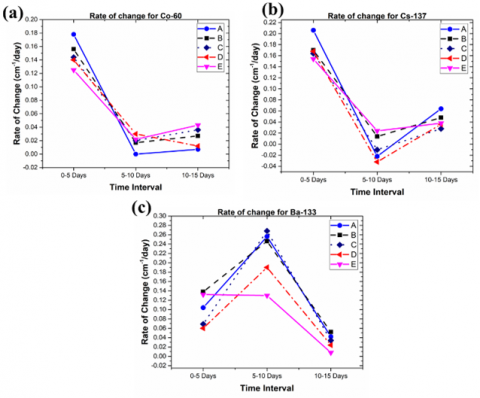
Figure 2 (a-c) displays the change of the attenuation coefficients over the time points. The changes in Δμ resulted from a balance between crosslinking and cleavage due to radiation exposure. Gamma irradiation at the early stages enhanced the intensification and compaction of the molecular structure, thus leading to an enhancement of attenuation efficiency. However, over time, processes causing chain scission and formation of voids work against these effects, leading to variations in Δμ. This variation of Δμ with time is also related to material responses depending on polymer type and radiation energy levels.
Attenuation coefficients for Co-60 change at a rate proportional to the interaction of high-energy gamma photons of 1.17 MeV and 1.33 MeV with the polymer samples. All samples initially showed a positive rate of change (improvement in attenuation performance) during the 0-5 days interval. The extremity of this enhancement is attributed to the increasing density and structural integrity of the epoxy matrix by radiation-induced cross-linking that can attenuate gamma photons. For samples with higher PVC content, such as Sample B, the rate of change continued consistently positive at subsequent intervals. A higher effective atomic number of PVC (Chlorine) contributes to a higher scattering probability due to the Compton scattering.
In comparison, however, samples with lower PVC content, such as Sample A, exhibited a declining rate of change with time that approached negative. This behavior indicates that the initial effect of crosslinking was overwhelmed by degradation mechanisms (such as polymer materials exposed to Co-60).
Figure 2. Rate of change in attenuation coefficients over time for polymer samples under (a) Co-60, (b) Cs-137, (c) Ba-133 gamma-ray sources
The interaction dynamics of Cs-137 and Co-60 are different because of their gamma photons emitted in different energy mediums. However, all samples demonstrated a positive trend for Cs-137 attenuation coefficients, with a moderate rate of change during decomposition stages of 0-5 days. Samples containing unsaturated polyester and PVC (sample E) tend to have better change rates within the 5 to 10 period. That implies that radiation exposure to UP induces substantial structural reorganization to attenuation properties, which can first improve. For all samples, the rate of change decreased with exposure through the 5–10-day interval. This decrease implies an equilibrium between the beneficial effects of radiation-induced crosslinking and the detrimental effects of polymer degradation, for example, chain scission and void generation. By the 10–15-day interval, samples with higher epoxy content, e.g., Samples A and B, maintained more stable rates of change. This stability represents the resistance of the epoxy matrix to protracted gamma radiation exposure that prevents degradation and maintains attenuation performance.
The photoelectric effect is thus the main interaction mechanism of the low-energy gamma photons they emit, most at 0.356 MeV, for these polymer samples. The influence of the rate of change in attenuation coefficient for Ba-133 with PVC content was very sensitive to the PVC content. Relatively positive sample rates of change in the 0–5-day interval were recorded for samples with high PVC, namely Samples B and E. The high atomic number of chlorines in PVC can explain this positive trend due to the significant photoelectric absorption and gamma attenuation.
However, as exposure increased to 10-15 days, most samples first showed a decrease, and some even became negative regarding the rate of change. The initial enhancement effects were eclipsed by radiation-induced degradation mechanisms, such as void formation and delamination, and this trend suggests it. More samples with more epoxy content, such as Sample A, were more stable with a lower but relatively stable change rate over time. The stability described here results from the epoxy matrix's ability to maintain its integrity under prolonged subcritical low-energy gamma radiation without significant structural degradation. Combined, the overall rate of change in attenuation coefficients around all gamma-ray sources reveals polymer blends, photon energy, and radiation-induced structural modifications with significant dependence. Observed trends give critical insights when optimizing polymer blends for gamma shielding for long-term applications.
3.3 Standard deviation analysis
An aging study was conducted using similar experimental sources to evaluate the long-term stability of the blend polymer under gamma radiation. Samples were irradiated in gamma radiation under controlled conditions for 0, 5, 10, and 15 days. Accumulated dose exposure time and the dose rate of each gamma source were used in determining the total dose delivered to the sample. This was necessary to ensure the consistency of temperatures and that there was no moisture absorption by the samples, which might change their mechanical properties.
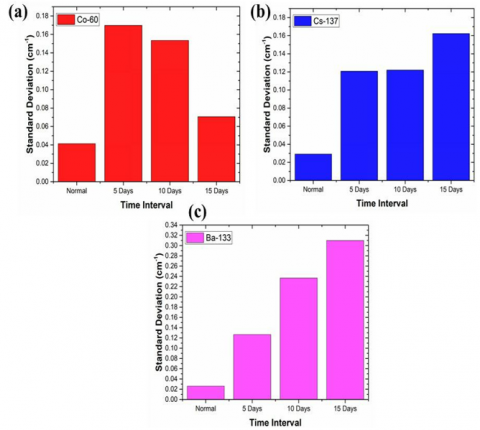
The standard deviation of attenuation coefficients for the polymer samples under gamma-ray sources (Co-60, Cs-137, and Ba-133) provides critical insights into the consistency and reliability of the shielding performance across different blends and exposure intervals, as shown in Figure 3. The trends highlight the impact of gamma irradiation on structural uniformity within the polymer matrix and its influence on material reproducibility.
For the Co-60 source (Figure 3(a)), indicates that the standard deviation increases extensively after 5 days to a maximum of ~0.17 and then decreases gradually at 10 and 15 days. The increases in this standard deviation in the first place reflect substantial structural changes by high-energy photons (1.17 and 1.33 MeV) such as crosslinking and densification. These changes introduce materials property variability in attenuation performance. With prolonged time, a stabilization in variability points to equilibrium in structural rearrangements, leading to a much more consistent attenuation performance. Similar behavior has been observed by Joshi et al. [20], where epoxy-based composites showed initial variability due to irradiation-induced restructuring, followed by stabilization.
The standard deviation of the Cs-137 source (Figure 3(b)) increased progressively with time, reaching a maximum value (~0.16) at 15 days. This trend suggests the cumulative effect of mid-energy photons (0.662 MeV) inducing crosslinking and degradation processes. A more gradual increase in variability compared to Co-60 underlines less aggressive interaction of mid-energy photons with the polymer matrix. This aligns with Chandrappa et al. [42], who noted moderate increases in variability for polymer composites exposed to gamma photons below 1 MeV, where chain scission and oxidative degradation were less pronounced.
For the Ba-133 source (Figure 3(c)), a very different trend was found, where the standard deviation increases strongly after 5 days (~ 0.13) and continuously rises up to 15 days (~ 0.32). Its wider energy range (Ba-133: 0.081 – 0.356 MeV) could explain the higher spread, since lower-energy photons interact within a polymer matrix in a more heterogeneous manner, particularly for complex compositions. PVC-rich samples, like Sample E, showed the largest spread due to the inconsistent crosslinking behavior of PVC upon gamma irradiation. This is consistent with Nuñez-Briones et al., where such trends were obtained for polymer composites with low relative crosslinking upon exposure to a low-energy gamma source [43].
These trends in variability can be informative with respect to the dynamic response of polymer blends to gamma irradiation. Initial increases in variability reflect non-uniform changes in structure during the early exposure intervals due to localized variations in crosslinking rates, chain scission, or oxidative degradation. The stabilization of variability with increased time, especially for Co-60 and Cs-137, suggests that the structural equilibrium state was reached for those materials, which resulted in consistent attenuation properties.
The higher values of the standard deviation obtained for Ba-133, especially at later stages, reflect difficulties in shielding against lower-energy photons. Such variability could be ascribed to the heterogeneous interaction of low-energy photons with the polymer matrix and to the low crosslinking capability of PVC. These results confirm that optimized material composition is needed to obtain homogeneous performance during permanent exposure to nuclear wastes containing low-energy gamma sources. Concerning the performance, it was observed that Sample A, having higher epoxy content, has a reduced variability compared to all other samples for all gamma-ray sources, characterizing structural stability and reproducibility of the materials. On the contrary, PVC-enriched samples, including Sample E, presented higher variability, especially under Ba-133, since PVC did not show a consistent response to gamma irradiation. This result reconfirms that the role of epoxy content is crucial for obtaining good attenuation performance and homogeneity.
The standard deviation analysis indeed complements the trends in attenuation coefficients and rates of change, hence giving a statistical view into material reliability. These experiments show that a compromise exists between polymer composition and resultant low or high attenuation with low or high coefficient of variation. Materials with higher epoxy content performed better in both measures and are hence an ideal candidate for gamma shielding applications where repeatable and reproducible results are desired. Future work could improve uniformity and reliability of polymer blends through nanomaterial or high-Z filler addition while considering additional challenging conditions such as low-energy photon exposure. Advanced imaging and molecular analysis may elucidate factors responsible for variability in early exposure intervals and provide a basis for subsequent optimization of materials.
Figure 3. The standard deviation of attenuation coefficients over time for polymer samples under (a) Co-60, (b) Cs-137, and (c) Ba-133 gamma-ray sources
This study presents the systematic investigation of gamma-ray attenuation characteristics of binary and ternary mixtures of EP, UP, and PVC when exposed to gamma-ray sources emitting photons of varying energy levels. Based on these results, the following conclusions can be drawn:
1. The results show large energy-dependent variations in attenuation performance that can be attributed to the composition of the polymer, material density, and interaction processes.
2. Energy-dependent attenuation of binary and ternary polymer blends, with the emphasis on epoxy-rich blends, is another important theme of this study. Composite epoxy that is 80% epoxy and 20% unsaturated polyester showed the highest attenuation when exposed to 1.17 MeV (Co-60) gamma radiation.
3. The study also established that, owing to crosslinking and densification by gamma irradiation-induced aging, attenuation can be enhanced up to 20%. However, there were higher standard deviations for PVC-rich blends, which implied the need for further optimization of blend compositions.
4. Epoxy-based polymer composites may be a new class of lightweight and efficient shielding material for medical imaging and nuclear purposes.
5. These results finally have important implications for the design and optimization of polymer composites for shielding gamma radiation. The composition of the blends can be engineered to yield lightweight, efficient, and oligoclase shielding materials suitable for medical imaging, nuclear safety, and industrial contexts of applied radiation.
Future studies may include high-Z fillers or nanomaterials in order to further shielding effectiveness against low-energy gamma-ray sources. We also suggest a study on the influence of thickness variation on the attenuation coefficient for the materials studied here, using constant weight ratios. Finally, advanced imaging techniques could also be employed to investigate the structural evolution of these materials under sustained irradiation.
|
I0 |
initial intensity |
|
I |
transmitted intensity |
|
x |
material thickness, cm |
|
Co-60, Cs-137, Ba-13 |
gamma-ray sources |
|
R |
rate of change in attenuation coefficients |
|
Δμ |
change in attenuation coefficient, cm-1 |
|
Δt |
the time interval, days |
|
Greek symbols |
|
|
ρ |
density, g/cm³ |
|
µ |
attenuation coefficient, cm-1 |
|
Subscripts |
|
|
EP |
epoxy resin |
|
PVC |
polyvinyl chloride |
|
UP |
unsaturated polyester |
|
MPDA |
meta phenylenediamine |
|
PVC/NBR |
polyvinyl chloride/nitrile butadiene rubber |
[1] Dubey, K.A., Chaudhari, C.V., Suman, S.K., Raje, N., et al. (2016). Synthesis of flexible polymeric shielding materials for soft gamma rays: Physicomechanical and attenuation characteristics of radiation crosslinked polydimethylsiloxane/Bi2O3 composites. Polymer Composites, 37(3): 756-762. https://doi.org/10.1002/pc.23232
[2] Mourad, M.M., Abdou, Y., Berber, M.R., Elhussiny, F. (2021). Using nano tungsten oxide polymer composite as a gamma radiation shielding. Delta Journal of Science, 43(1): 126-132. https://doi.org/10.21608/djs.2021.195252
[3] Husain, H.S., Naji, N.R., Mahmood, B.M. (2018). Investigation of gamma ray shielding by polymer composites. In IOP Conference Series: Materials Science and Engineering, Istanbul, Turkey, pp. 012131. https://doi.org/10.1088/1757-899X/454/1/012131
[4] Mahmoud, M.E., El-Khatib, A.M., Badawi, M.S., Rashad, A.R., El-Sharkawy, R.M., Thabet, A.A. (2018). Fabrication, characterization and gamma rays shielding properties of nano and micro lead oxide-dispersed-high density polyethylene composites. Radiation Physics and Chemistry, 145: 160-173. https://doi.org/10.1016/j.radphyschem.2017.10.017
[5] Knoll, G.F. (2010). Radiation Detection and Measurement. Hoboken: John Wiley & Sons.
[6] Shahzad, K., Kausar, A., Manzoor, S., Rakha, S.A., et al. (2022). Views on radiation shielding efficiency of polymeric composites/nanocomposites and multi-layered materials: Current state and advancements. Radiation, 3(1): 1-20. https://doi.org/10.3390/radiation3010001
[7] Das, A., Ray, A., Singh, T. (2023). Tungsten-based polymer composite, a new lead-free material for efficient shielding of coupled neutron-gamma radiation fields: A FLUKA simulation study. Physica Scripta, 98(11): 115302. https://doi.org/10.1088/1402-4896/acfa3e
[8] Alarifi, I.M. (2022). Advanced selection in polymer-composite materials for radiation shielding and their properties - A comprehensive review. Journal of Nuclear and Radiation Sciences, 1(1): 1. https://doi.org/10.5455/jnrs.2022.01.001
[9] Kassim, H., Asemi, N.N., Aldawood, S. (2025). Gamma-ray shielding enhancement using glycidyl methacrylate polymer composites reinforced by titanium alloy and bismuth oxide nanoparticles. Journal of Radiation Research and Applied Sciences, 18(1): 101202. https://doi.org/10.1016/j.jrras.2024.101202
[10] Büyükyıldız, M., Taşdelen, M.A., Karabul, Y., Çağlar, M., İçelli, O., Boydaş, E. (2018). Measurement of photon interaction parameters of high-performance polymers and their composites. Radiation Effects and Defects in Solids, 173(5-6): 474-488. https://doi.org/10.1080/10420150.2018.1477155
[11] Martínez-Barrera, G., Gencel, O., Martínez-López, M. (2022). Polyester polymer concrete modified by polyester fibers and gamma rays. Construction and Building Materials, 356: 129278. https://doi.org/10.1016/j.conbuildmat.2022.129278
[12] Yılmaz, D., Büyükyıldız, M. (2021). Calcium-based TLD materials for radiation applications. Radiation Physics and Chemistry, 179: 109196. https://doi.org/10.1016/j.radphyschem.2020.109196
[13] El-Malawy, D., Al-Abyad, M., El Ghazaly, M., Abdel Samad, S., Hassan, H.E. (2021). γ-ray effects on PMMA polymeric sheets doped with CdO nano particles. Radiation Physics and Chemistry, 184: 109463. https://doi.org/10.1016/j.radphyschem.2021.109463
[14] More, C.V., Alavian, H., Pawar, P.P. (2021). Evaluation of gamma ray and neutron attenuation capability of thermoplastic polymers. Applied Radiation and Isotopes, 176: 109884. https://doi.org/10.1016/j.apradiso.2021.109884
[15] Marashdeh, M., Sallam, F.H., Mahmoud, K.A., Rashad, M., et al. (2025). Polymeric gamma rays shield promoted by ferrite nanoparticles synthesized with Ni and Zn cations. Radiation Physics and Chemistry, 232: 112617. https://doi.org/10.1016/j.radphyschem.2025.112617
[16] More, C.V., Tarwal, N.L., Botewad, S.N., Anis, M., et al. (2025). Radiation shielding efficacy of unsaturated polyester composites for gamma and neutron attenuation-enhanced with SnO2. Radiation Physics and Chemistry, 229: 112484. https://doi.org/10.1016/j.radphyschem.2024.112484
[17] Sheng, C.L., Sazali, M.A., Abu Bakar, A.A., Ismail, A.H., et al. (2025). Polyethylene composite doped with cadmium and tungsten oxide for neutron-gamma multilayer shielding. Radiation Physics and Chemistry, 229: 112506. https://doi.org/10.1016/j.radphyschem.2024.112506
[18] Almuqrin, A.H., Sayyed, M.I., Khandaker, M.U., Aloraini, D.A., Rashad, M., Elsafi, M. (2024). Effect of concentration of CuO on radiation shielding characteristics of Epoxy-resin materials. Radiation Physics and Chemistry, 223: 111918. https://doi.org/10.1016/j.radphyschem.2024.111918
[19] Mansy, M.S., Ghobashy, M.M., Aly, M.I. (2024). Enhancing gamma and neutron radiation shielding efficiency of LDPE/PVC polymers using cobalt, aluminum, and magnesium oxide fillers. Radiation Physics and Chemistry, 222: 111862. https://doi.org/10.1016/j.radphyschem.2024.111862
[20] Joshi, S., Snehalatha, V., Sivasubramanian, K., Ponraju, D., Jayaraman, V., Venkatraman, B. (2019). Radiation stability of epoxy-based gamma shielding material. Journal of Materials Engineering and Performance, 28(12): 7332-7341. https://doi.org/10.1007/s11665-019-04487-0
[21] Nambiar, S., Yeow, J.T.W. (2012). Polymer-composite materials for radiation protection. ACS Applied Materials & Interfaces, 4(11): 5717-5726. https://doi.org/10.1021/am300783d
[22] Karabul, Y., İçelli, O. (2021). The assessment of usage of epoxy based micro and nano-structured composites enriched with Bi2O3 and WO3 particles for radiation shielding. Results in Physics, 26: 104423. https://doi.org/10.1016/j.rinp.2021.104423
[23] Zegaoui, A., Derradji, M., Medjahed, A., Dayo, A.Q., et al. (2018). Multifunctional polymer materials with enhanced mechanical, thermal and gamma radiation shielding properties from dicyanate ester of bisphenol-A/bisphenol-A based benzoxazine resin and short kevlar/basalt hybrid fibers. Journal of Polymer Research, 25(12): 250. https://doi.org/10.1007/s10965-018-1652-x
[24] Atef, S., El-Nashar, D.E., Ashour, A.H., El-Fiki, S., El-Kameesy, S.U., Medhat, M. (2020). Effect of gamma irradiation and lead content on the physical and shielding properties of PVC/NBR polymer blends. Polymer Bulletin, 77(10): 5423-5438. https://doi.org/10.1007/s00289-019-03022-4
[25] Ali, H.A., Abdulhadi, O.O., Rzaij, J.M. (2025). The effect of synthesized gold nanoparticles by laser ablation method on levels of creatine kinase activity. Lasers in Manufacturing and Materials Processing, 12(1): 86-97. https://doi.org/10.1007/s40516-024-00274-5
[26] Ali, H.A., Slaiby, Z.E., Rzaij, J.M., Assaf, A.H. (2024). The effect of Green-synthesized ag nanoparticles on the levels of Creatinine and Urea in the blood serum of rats. BioNanoScience, 14(3): 2774-2781. https://doi.org/10.1007/s12668-024-01565-z
[27] Abdulhadi, O.O., Ali, H.A., Obaid, A.S. (2024). Characterization of tin oxide nanoparticles synthesized by discharging the non-thermal plasma jet in liquid and their application as an antibacterial agent. Journal of King Saud University - Science, 36(11): 103569. https://doi.org/10.1016/j.jksus.2024.103569
[28] Ali, I.M., Rzaij, J.M., Abbas, Q.A., Ibrahim, I.M., Alatta, H.J. (2018). Structural, optical and sensing behavior of neodymium-doped vanadium pentoxide thin films. Iranian Journal of Science and Technology, Transactions A: Science, 42(4): 2375-2386. https://doi.org/10.1007/s40995-018-0553-5
[29] Singh, L., Kumar, N., Kumar, A. (2024). The Study of Hybrid Nano-composite Materials and Their Various Applications. Design, Fabrication, and Significance of Advanced Nanostructured Materials, 229-252
[30] Khalefa, A.A., Marei, J.M., Radwan, H.A., Rzaij, J.M. (2021). In2O3-CuO nano-flakes prepared by spray pyrolysis for gas sensing application. Digest Journal of Nanomaterials and Biostructures, 16(1): 197-204.
[31] Ibraheam, A.S., Rzaij, J.M., Arshad, M.K.M. (2023). Influence of magnesium content on the structural, optical, and electrical properties of Cu2(Zn1-xMgx)SnS4 nanostructured quaternary thin film synthesized using the Sol–Gel method. Journal of Electronic Materials, 52(1): 414-421. https://doi.org/10.1007/s11664-022-10002-4
[32] Katheria, A., Das, P., Ghosh, S.K., Nayak, J., et al. (2023). Fabrication of 2D nanomaterial reinforced co-continuous binary blend composites for thermal management and EMI shielding applications. Journal of Polymer Research, 30(12): 459. https://doi.org/10.1007/s10965-023-03843-y
[33] Hassan, A.A., Hammed, M.G. (2021). Synthesis, and study the electrical properties of conductive (PVA:PANI)/CuI blend composite. In Journal of Physics: Conference Series, Fallujah, Anbar, Iraq, pp. 012009. https://doi.org/10.1088/1742-6596/1829/1/012009
[34] Shaker, K., Hafeez, A. (2023). Introduction to “Advanced functional polymers: Synthesis to applications”. In Advanced Functional Polymers: Synthesis to Applications, pp. 1-2. https://doi.org/10.1007/978-981-99-0787-8_1
[35] Cai, M., Yang, T., Li, H., Yang, H., Han, J. (2022). Experimental and simulation study on shielding performance of developed hydrogenous composites. Space: Science & Technology, 2022: 9754387. https://doi.org/10.34133/2022/9754387
[36] Ambika, M.R., Nagaiah, N., Suman, S.K. (2018). Evaluation of gamma shielding parameters of bismuth oxide filled polymer composites. Journal of Pure and Applied Physics, 56(8): 604-608. https://inis.iaea.org/records/4dnh9-ky275.
[37] Büyükyıldız, M., Kurudirek, M., Ekici, M., İçelli, O., Karabul, Y. (2017). Determination of radiation shielding parameters of 304L stainless steel specimens from welding area for photons of various gamma ray sources. Progress in Nuclear Energy, 100: 245-254. https://doi.org/10.1016/j.pnucene.2017.06.014
[38] Marashdeh, M., Abdulkarim, M. (2023). Determination of the attenuation coefficients of epoxy resin with carbopol polymer as a breast phantom material at low photon energy range. Polymers, 15(12): 2645. https://doi.org/10.3390/polym15122645
[39] National Research Council, Division on Earth, Commission on Life Sciences, Committee on the Biological Effects of Ionizing Radiation (BEIR V). (1990). Health Effects of Exposure to Low Levels of Ionizing Radiation: BEIR V (Vol. 5). National Academies.
[40] Cibulková, Z., Polovková, J., Lukeš, V., Klein, E. (2006). DSC and FTIR study of the gamma radiation effect on cis-1, 4-polyisoprene. Journal of Thermal Analysis and Calorimetry, 84(3): 709-713. https://doi.org/10.1007/s10973-005-7547-1
[41] Vasile, C., Pamfil, D., Zaharescu, T., Dumitriu, R.P., et al. (2022). Effect of gamma irradiation on the PLA-based blends and biocomposites containing rosemary ethanolic extract and chitosan. Polymers, 14(7): 1398. https://doi.org/10.3390/polym14071398
[42] Chandrappa, H., Bhajantri, R.F., Mahantesha, B.K., Ravindrachary, V., Chalawadi, S. (2021). Physico-chemical properties of PVA-Nile blue (C20H20ClN3O) polymer composite structures for γ-ray protection: A comparative γ-ray irradiation studies. Radiation Physics and Chemistry, 184: 109481. https://doi.org/10.1016/j.radphyschem.2021.109481
[43] Nuñez-Briones, A.G., Benavides, R., Mendoza-Mendoza, E., Martínez-Pardo, M.E., et al. (2021). Preparation of PVC/Bi2O3 composites and their evaluation as low energy X-Ray radiation shielding. Radiation Physics and Chemistry, 179: 109198. https://doi.org/10.1016/j.radphyschem.2020.109198