Niveen J. Abdulkader | Marwa A. Abass | Mohammed M. Alkhafaji | Ghufran Jassim*
© 2025 The authors. This article is published by IIETA and is licensed under the CC BY 4.0 license (http://creativecommons.org/licenses/by/4.0/).
OPEN ACCESS
In this research were investigated the mechanical characteristics and microstructural characterization of metal matrix composites (MMCs) reinforced with nanoscale boron nitride (BN) particles made of aluminum (Al6061). Al6061 was used as the basic matrix and nano boron nitride as the reinforcing phase in the stir casting technique used to create the composites. To examine its influence on the composite's behavior, the volume proportion of BN reinforcement was varied between 0% and 4%. This study's main goal was to assess how nano BN reinforcements affected the Al6061 matrix's microstructure and mechanical performance. Scanning Electron Microscopy (SEM) was used to undertake microstructural investigation in order to evaluate the phase distribution and dispersion of the reinforcing particles inside the matrix. Vickers microhardness tests, tensile strength measurements, and wear rate studies were all part of the mechanical characterisation process. Results showed that, according to SEM imaging, BN nanoparticles were evenly dispersed throughout the Al6061 matrix. As the amount of BN in the composites increased, so did their microhardness. In particular, with 4% BN reinforcement, the greatest microhardness value measured was 119 Vickers Hardness Number (VHN), which is a 28.81 improvement over the base alloy. The addition of reinforcements also increased the composite's tensile strength, which peaked at 341 MPa at 4% BN, or 13.89% higher than the original Al6061 alloy. These results demonstrate that adding nano boron nitride to Al6061 MMCs greatly improves their hardness and tensile strength. When compared to the unreinforced Al6061 matrix, the produced composites showed noticeably higher hardness and lower wear rates due to the nano boron nitride reinforcement. Significantly, the composite with 4 weight percent nano BN showed the best mechanical performance, suggesting that adding nano-scale reinforcements successfully increases the base alloy's durability and wear resistance.
Al6061, mechanical properties, nano particles, stir casting, aluminium metal matri
Steel is the most often utilized secondary structural material, followed by aluminum alloys. Products made using plastic deformation techniques like hot or cold working are referred to as wrought aluminum. Traditional cast iron and steel components are gradually being replaced by metal matrix composites in a variety of applications, particularly those composed of aluminum (Al) [1-3]. Due to their high strength-to-weight ratio, high specific strength, and low density, aluminum alloys have attracted considerable interest in the aerospace industry. Among lightweight materials, aluminum-based composites are regarded as some of the most advanced options available [4-6].
The primary technique for producing aluminum matrix composites is stir casting, also known as the vortex method a liquid-state process [7]. This approach is especially effective when incorporating reinforcing particles such as silicon carbide or alumina.
These particles are evenly distributed throughout the molten aluminum during stir casting, allowing for the creation of composites with specific forms and characteristics [8-11]. Before adding the reinforcements, it is essential to degas the molten metal to avoid unintended chemical interactions with oxygen. By spinning a rotor inside the molten aluminum to produce a vortex, uniform mixing—which is essential to guaranteeing an even distribution of the particles—is accomplished. This vortex is subsequently filled with the degassed reinforcement particles. The final composite is shaped using traditional casting techniques following extensive mixing [12, 13]. The potential of nano-ceramic reinforcements to modify and improve the characteristics of aluminum alloy AA6061 for certain uses has been shown in earlier research. Because of their special qualities, which include enhanced hardness, compressive strength, wear resistance, and remarkable tensile strength, boron nitride (BN) nanoparticles have garnered a lot of interest among these [14, 15]. By preventing dislocation movement, these nanoparticles improve the composite material's strength and durability. Additionally, as stress concentrators, ceramic particles like BN can stop cracks from spreading and improve structural integrity [16]. The mechanical performance of aluminum alloys is greatly impacted by the addition of boron nitride (BN) [17]. However, BN particles are added to the aluminum matrix, reinforced composites show improved stiffness and strength [18-20], which results in noticeable increases in hardness [21], yield strength, and tensile strength. Additionally, BN affects aluminum alloy composites' corrosion resistance in addition to their mechanical qualities [22]. Al-BN composites reinforced with 20 µm cubic BN (cBN) particles have demonstrated enhanced mechanical properties and resistance to both general and pitting corrosion when compared to pure aluminum and other composite systems. The homogeneous stress distribution of the matrix and the lack of adverse chemical reaction or boundary phases forms at processing temperatures of about 550 °C are the main causes of these enhancements in performance [23]. Overall, the incorporation of BN ceramic particles markedly enhances the mechanical properties of aluminum-based composites. The reinforcing impact of BN particles, which adds to the overall increase in composite strength and rigidity, is mostly responsible for the reported improvements in hardness, tensile strength, and yield strength [24-27]. Yathiraj et al. [28] fabricated and evaluated of Al6061-hBN metal matrix composites using stir casting. Al6061 offers good toughness, corrosion resistance, and weldability, while boron nitride provides high thermal stability and hardness. After fabrication, mechanical tests showed that hardness and ultimate tensile strength (UTS) improved with increasing hBN content, reaching 59.3 HBW and 156.72 MPa at 9% reinforcement. Microstructural analysis confirmed uniform distribution of hBN particles, and overall, the composites demonstrated enhanced mechanical properties compared to pure Al6061. Shaik Mujeeb Quader et al. [29] produced the Al6061 metal matrix composites reinforced with varying weight fractions (up to 10 wt.%) of Al₂O₃ and red mud particles by using the vortex method. The study observed that increasing the reinforcement content enhanced both hardness and tensile strength, although it also resulted in increased porosity. SEM analysis revealed a generally uniform distribution of particles, with some instances of clustering. After the reinforcements were added, the ideal fabrication conditions were determined to be a pouring temperature of 710°C, a stirring speed of 450 RPM, and a stirring time of 5 minutes. The mechanical properties and microstructure of AA6061 aluminum alloy supplemented with 7.5 weight percent SiC nanoparticles, which was created via powder metallurgy, were assessed by Melik et al. [30] in relation to the sintering temperature. SiC particles were homogeneously distributed, according to characterization, and their density and hardness improved as the sintering temperature rose to 600°C, while higher temperatures led to decreased properties. Thus, 600°C was identified as the optimal sintering temperature for the composite. Yakoub et al. [31] examined the impact of adding silicon carbide (SiC) and titanium dioxide (TiO₂) nanoparticles, individually and combined, on the mechanical properties of Al6061 alloy using stir casting. SEM analysis confirmed good nanoparticle distribution, and mechanical tests showed significant improvements in hardness, tensile strength (up to 39%), stiffness, and flexural strength (up to 60%) compared to pure Al6061. The combination of SiC and TiO₂ offered the best overall performance. Further research is needed to optimize nanoparticle configurations and processing for industrial applications. The use of boron nitride (BN) nanoparticles as reinforcements in AA6061 alloy composites has been investigated in the Previous studies, but most of this research has focused on how individual reinforcements affect the properties of the isolated material. By examining the synergistic impact of BN nanoparticle reinforcement on a wide variety of characteristics in AA6061 composites, the current study aims to make up this gap. The novelty of this research lies in its holistic evaluation of the influence of BN nanoparticles on key characteristics such as hardness, microstructure, and wear resistance, across various reinforcement volume fractions. To date, the integration of BN nanoparticles into a single AA6061 composite through stir casting has not been comprehensively reported in the literature. This investigation provides new insights into the behavior of such nanocomposites and contributes to the design and development of high-performance aluminum alloys for advanced engineering applications.
2.1 Materials
In this research, commercially available AA6061 aluminum alloy rolled plates were selected as the primary matrix material. This choice was driven by the alloy’s widespread industrial applications, given its superior combination of mechanical strength and favorable chemical composition (as detailed in Table 1). As a reinforcing phase, boron nitride nanoparticles were added to the AA6061 matrix to improve its mechanical characteristics. At different weight fractions of 1%, 2%, 3%, and 4%, the nanoparticles—which had an average particle size of roughly 53 nanometers—were mixed with the aluminum matrix. The goal was to methodically examine how various loadings of nanoparticles affected the final composites' structural and performance properties.
Table 1. Chemical composition 6061 aluminum alloy
|
Elements |
Mg |
Mn |
Si |
Fe |
Cu |
Zn |
Other |
AL |
|
(wt) 100% |
0.68 |
0.33 |
0.42 |
0.84 |
0.25 |
0.18 |
0.11 |
Rem. |
2.2 Fabrication process of composites
The stir casting technique, a popular and economical way to fabricate metal matrix composites, was employed to create the composite materials. The aluminum alloy AA6061 served as the matrix material in this procedure, and boron nitride nanoparticles were added as nanoceramic reinforcements. Because of their shown ability to significantly improve the mechanical characteristics of metal matrices, BN nanoparticles were chosen.
For individual castings of the AA6061 alloy, BN nanoparticles were added to the molten alloy at various weight fractions, including 1%, 2%, 3%, and 4%. Each concentration was added independently. To reduce contamination and preserve alloy purity, the alloy and nanoparticles were melted together at 700 °C in a graphite crucible inside a resistance furnace. Mechanical stirring was used to guarantee that the nanoparticles were distributed uniformly throughout the molten matrix. For about 3-5 minutes, the molten composite was agitated at rotational velocities between (1000-1200) revolutions per minute (rpm). Hexachloroethane powder (C₂Cl₆) was added to the melt as a degassing agent in order to release trapped gases and enhance the dispersion of nanoparticles. The goal temperature of about 630°C was reached by heating the molten composite. The melt was poured into a permanent cylindrical steel mold that had been heated once the required temperature had been reached and consistent stirring had been finished. The mold had dimensions of 15 mm in diameter and 150 mm in length and was preheated to 500°C prior to pouring to reduce thermal shock and promote proper solidification.
2.3 Hardness test
The Vickers hardness test was used to evaluate the composite materials' surface hardness, with applied loads ranging from 100 to 1000 grams. Prior to testing, the specimens were meticulously prepared to ensure flat, smooth, and parallel surfaces. A load of 125 grams was applied for 10 seconds to create each indentation. For accuracy, three measurements were taken for each sample and averaged to determine the overall hardness.
2.4 Tensile test
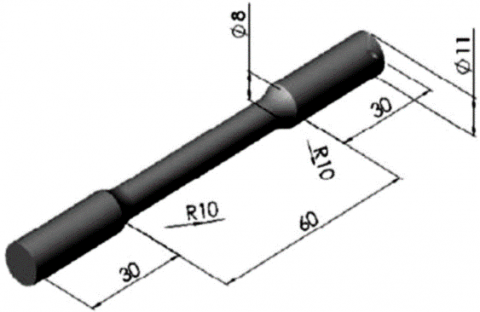
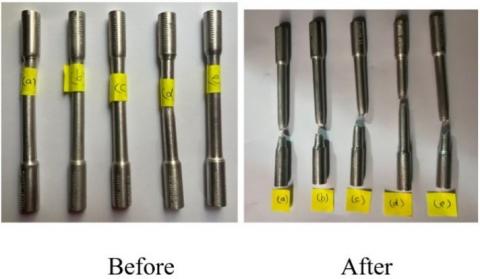
Tensile testing was conducted on cylindrical specimens with a strain rate range from 0 to 30 and a uniaxial load ranging from 0 to 500 MPa. As shown in Figure 1, the test specimens were made in compliance with ASTM-E8 guidelines. An universal machining test was employed in the tests. The specimens' visual state both before and after the tensile test is shown in Figure 2.
Figure 1. Schematic representation of the tensile specimen dimensions (in mm) in accordance with ASTM-E82 standard
Figure 2. The visual appearance of the specimens for tensile test
2.5 Wear Test
In accordance with ASTM G99-95 guidelines, a pin-on-disc wear testing equipment was used to determine the wear resistance of the cast aluminum alloy AA6061 reinforced with nano-sized boron nitride (BN). The test specimens were 30 mm long and 10 mm in diameter. Under applied loads of 5, 10, 15, and 20 N, wear tests were conducted. The stainless-steel disc, which rotated at 950 rpm and had a hardness of 63 HRC, had a sliding velocity of 6 cm/min. The time allowed for each test was 15 minutes.
2.6 Scanning electron microscopy
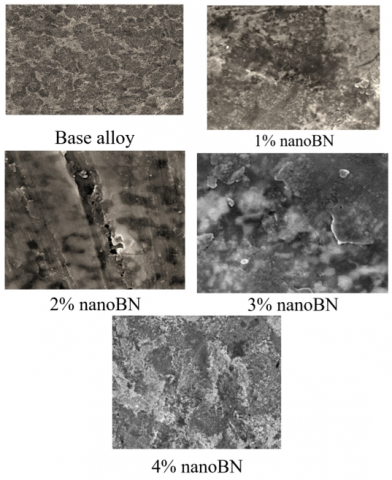
The microstructure of the aluminum AA6061 alloy and its composites was examined using a scanning electron microscope (SEM). In SEM analysis, a focused high-energy electron beam interacts with the sample's surface, producing signals that reveal detailed morphological features. An acceleration voltage of 15-20 kV was applied during imaging, and micrographs were captured at a magnification of approximately 2000×.
2.7 X-ray Diffraction
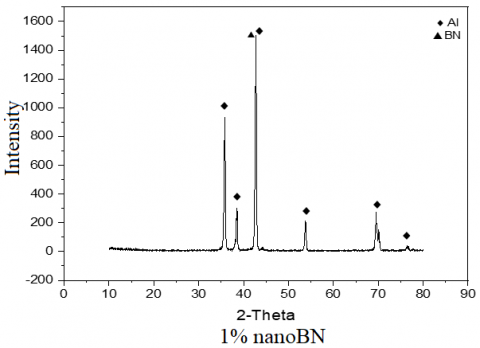
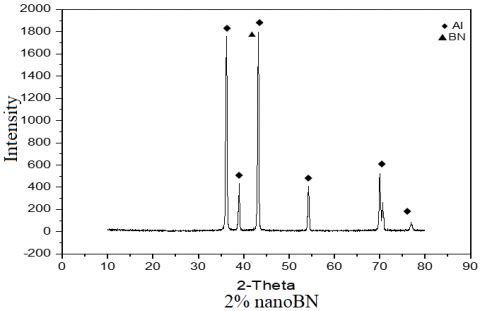
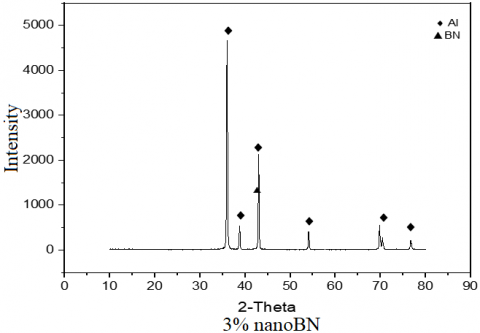
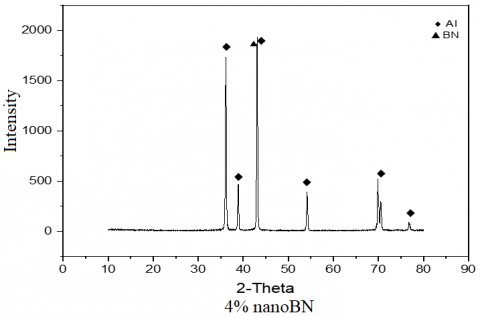
X-ray Diffraction (XRD) was used to identify the composite alloys' solid-state phases and crystalline structure. The test was performed using a Shimadzu XRD-6000 diffractometer with a Cu-Kα radiation source (λ = 1.5406 Å) operating at 220 V/50 Hz. A 2θ range of 10° to 80° was scanned in order to identify all relevant phases. The JCPDS database was used to analyze the generated diffraction patterns and determine which phases were present in the composite.
3.1 Results of microhardness
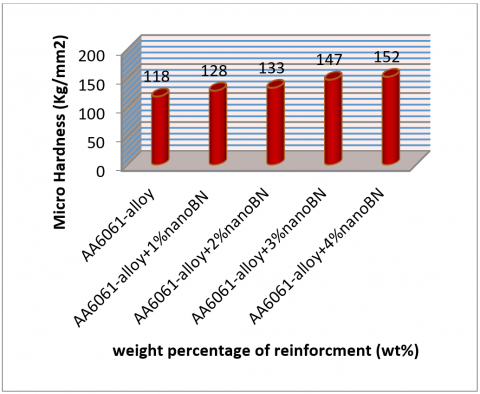
The microhardness values of Al alloy and its composites supplemented with Varity weight percentages of BN nanoparticles are shown in Figure 3. The findings unequivocally show that, in comparison to the unreinforced base alloy, the adding of BN nanoparticles greatly increases the hardness. Hardness readings exhibit an approximately linear increase with increasing BN content. The hardness of the basic alloy is 118 HV, whereas the highest value, 152 HV, is obtained at 4 weight percent BN, which is an increase of about 28.81%.
The main cause of this increase in hardness is the higher dislocation density brought forth by the ceramic nanoparticles, which prevent dislocation motion. The hard, non-deformable BN particles reduce plastic deformation and increase the matrix's load-bearing capability. The combined impacts of several strengthening mechanisms, the Hall-Petch effect, nanoparticle reinforcing, and refinement of grains, are responsible for the increased hardness at 4 weight percent BN. Together, these mechanisms increase the composite's overall hardness and resistance to indentation [32].
Figure 3. Microhardness values of AA6061-alloy and its composites
3.2 Tensile strength and reinforcement effects
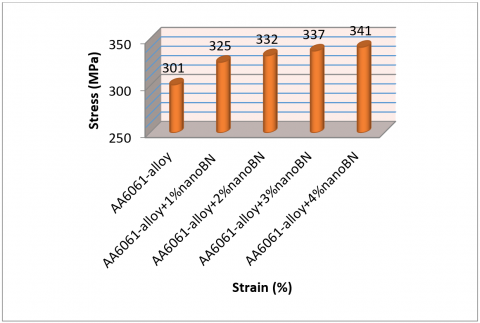
The results observed the tensile strength values of the AA6061 alloy and its composites, along with the corresponding percentage increases. Figure 4 shows the stress-strain curves for the samples. Observations show that the tensile and yield strengths of the composites increase with the addition of BN nanoparticles. Similar to the trend in microhardness, strength improvements correlate with increasing nanoparticle content.
This improvement is largely due to the interaction between dislocations and nanoparticles, in line with the Orowan strengthening mechanism. When dislocations by pass the hard, non-deformable BN particles, residual stress fields are generated around each grain, enhancing the overall strength. The nanoparticles serve as obstacles to dislocation movement, effectively enhancing the material's resistance to deformation.This effect becomes more pronounced with higher nanoparticle content [33]. The composite containing 4 wt.% BN exhibited the highest tensile strength, showing a 13.89% improvement over the base alloy, demonstrating the significant reinforcing effect of the nano-BN additions.
Figure 4. Tensile stress - strain chart for reinforced composites based of AA6061 alloy
3.3 Wear rate results
Despite an overall increase in wear with greater applied loads, which indicates a transition from moderate to severe wear conditions, Figure 5 illustrates how the composites' wear rate decreased with the addition of BN nanoparticle reinforcements. In contrast to the reinforced composites, this wear transition was more noticeable in the unreinforced AA6061 alloy. The enhanced hardness resulting from BN reinforcement contributed to improved resistance against the penetration and abrasion caused by hard particles.
Among all tested materials, the AA6061 composite containing 4 wt.% nano-BN demonstrated the lowest wear loss under all load conditions. The wear rate continued to decline with increasing BN content, likely due to the synergistic effect of the nanoparticles forming a stable, protective tribolayer on the composite surface [34]. The addition of ceramic nanoparticles not only improved surface hardness but also promoted the development of this tribolayer, which reduced material loss during wear. Overall, the BN-reinforced composites outperformed the base alloy in both hardness and wear resistance, with the 4 wt.% BN composite exhibiting the most favorable mechanical performance. When compared to the unreinforced alloy, a discernible decrease in wear rate is frequently seen when aluminum alloy is reinforced by nanoscale boron nitride (BN) particles. The addition of BN nanoparticles increases hardness and decreases surface deformation, which explains this improvement. Because of its solid lubricating activity and structural similarity to graphite, boron nitride reduces wear rate by lowering friction between contacting surfaces.
Figure 5. Wear rate chart of AA6061 alloy and its composites
3.4 SEM images analysis
Figure 6 displays the SEM micrographs of the AA6061 alloy and its composites. The SEM images reveal the characteristic dendritic structure of the AA6061alloy and its composites. This observation is consistent with previous studies that have examined dendritic segregation and the micro/nanostructured morphology of based alloys [35]. Furthermore, there are no voids visible in the SEM pictures, suggesting that the matrix and the nanoparticles have a strong interfacial interaction. This suggests the stir casting process was effective, causing in uniform diffusion of the nanoparticles within the matrix, with particles often aggregating at grain boundaries. The microstructure of the composite shows a consistent distribution of reinforcement particles throughout the base alloy. No evidence of agglomeration was observed, even with increasing weight percentages of nano BN. The microstructure exhibits a dendritic pattern, and the mechanical stirring process appears to have fragmented the primary dendrites, contributing to the improvement in mechanical properties. It also indicates that the interdendritic areas created during the solidification of the reinforced alloy are probably where nanoparticles will be integrated and confined [35].
Figure 6. SEM images of base alloy and composites produced by stir casting technique
3.5 X-ray diffraction analysis
A material characterisation method called X-ray diffraction (XRD) can be useful in determining how the structure of the composite has altered after processing. The following specimens were subjected to X-ray diffraction analyses: 6061Al and 6061Al alloy reinforced with nanoBN particles. The several phases present in Aall samples were unquestionably identified by XRD, as shown in Figure 7. It displays discrete peaks that match several bands, such as Si, Mg, and Al. The absence of reactive components in the XRD and the study's detection of distinct peaks in composites for BN show the stability of nanocomposites.
Figure 7. XRD- images of base alloy and composites produced by stir casting technique
The research used the stir casting method for composite fabrication to investigate the effects of adding (BN) nanoparticle on the mechanical performance and microstructural characteristics of an aluminum alloy. The study aimed to assess how varying reinforcement content affects key material properties, with a particular focus on a 4 wt.% addition of nano BN. Experimental results indicated a substantial improvement in mechanical performance with the incorporation of BN nanoparticles. The composite containing 4 wt.% BN exhibited an increase in microhardness by approximately 28.81% compared to the unreinforced AA6061 alloy. In addition, tensile strength improved by 13.89%, and a notable reduction in wear rate was observed, indicating enhanced wear resistance. Scanning electron microscopy (SEM) microstructural investigation verified the homogeneous and uniform dispersion of BN nanoparticles in the aluminum matrix.
The absence of significant porosity and the uniform distribution of reinforcing particles allowed for an overall improvement in mechanical properties. The results showed that enhancing the mechanical performance of composites requires a stable microstructure and an effective interfacial bond between the reinforcement and matrix. These findings show that nano-BN has the potential to be a useful reinforcing agent in the creation of high-performance composites made of aluminum. The mechanical performance of aluminum composites is significantly influenced by the size distribution of boron nitride (BN) nanoparticles. A uniform and fine particle distribution improves hardness, wear resistance, and tensile strength by effectively avoiding dislocation motion and promoting load transmission. Automotive parts, industrial tools, medical devices, and aerospace components can all benefit from the usage of composites reinforced with (BN) nanoparticle.
I thanks Dr. Hussain Mohammed Yousif and I thanks all Materials Engineering Department/ University of Technology staff and my family.
[1] Ranjan, N., Kumar, R., Kumar, R., Kaur, R., Singh, S. (2023). Investigation of fused filament fabrication-based manufacturing of ABS-Al composite structures: Prediction by machine learning and optimization. Journal of Materials Engineering and Performance, 32(10): 4555-4574. https://doi.org/10.1007/s11665-022-07431-x
[2] Dewangan, S., Biswas, C.K., Gangopadhyay, S. (2014). Optimization of the surface integrity characteristics of EDM process using PCA based grey relation investigation. Procedia Materials Science, 6: 1091-1096. https://doi.org/10.1016/j.mspro.2014.07.180
[3] Sharma, S.K., Gajević, S., Sharma, L.K., Pradhan, R., Sharma, Y., Miletić, I., Stojanović, B. (2024). Progress in Aluminum-Based Composites Prepared by Stir Casting: Mechanical and Tribological Properties for Automotive, Aerospace, and Military Applications. Lubricants, 12(12): 421. https://doi.org/10.3390/lubricants12120421
[4] Abdulkader, N.J., Abed, M.S. (2023). Influence of SiC nanoparticles addition on the microstructure and mechanical properties of stir-cast Zn-Al alloy. International Journal of Cast Metals Research, 36(4-6): 142-150. https://doi.org/10.1080/13640461.2023.2260662
[5] Bharath, V., Nagaral, M., Auradi, V., Kori, S.A. (2014). Preparation of 6061Al-Al2O3 MMC’s by stir casting and evaluation of mechanical and wear properties. Procedia Materials Science, 6: 1658-1667. https://doi.org/10.1016/j.mspro.2014.07.151
[6] Yawer, A.K., Zainalaadbeen, A.A., Abdulkader, N.J. (2021). Effect of hybrid nanoparticles on compression strength of recycled composite Zn-Al alloy. Materials Today: Proceedings, 42: 2095-2101. https://doi.org/10.1016/j.matpr.2020.12.291
[7] Prabu, S.B., Karunamoorthy, L., Kathiresan, S., Mohan, B. (2006). Influence of stirring speed and stirring time on distribution of particles in cast metal matrix composite. Journal of materials processing technology, 171(2): 268-273. https://doi.org/10.1016/j.jmatprotec.2005.06.071
[8] Bhowmik, A., Kumar, R., Beemkumar, N., Kumar, A.V., Singh, G., Kulshreshta, A., Mann, V.S., Santhosh, A.J. (2024). Casting of particle reinforced metal matrix composite by liquid state fabrication method: A review. Results in Engineering, 24: 103152. https://doi.org/10.1016/j.rineng.2024.103152
[9] Abd Alkadir, N.J., Ahmed, P.S., Abdulqader, A.J. (2015). Optimization of corrosion behaviour of aluminium metal matrix composite reinforced with nanoparticles using Taguchi’s techniques. In International Conference on Industrial Engineering and Operations Management. Management Dubai, UAE.
[10] Yuvaraj, N., Koli, Y., Vedabouriswaran, G. Issar, P. (2023). Mechanical and tribological properties of AA6061/SiC/Aloe vera powder hybrid Al composites fabricated by stir casting. Silicon, 15: 2451-2465. https://doi.org/10.1007/s12633-022-02168-7
[11] Batraev, I., Chaitanya, S., Cheng, X., Dudina, D.V., et al. (2014). Metal Matrix Composites: Materials, Manufacturing and Engineering (Vol. 3). Walter de Gruyter GmbH & Co KG.
[12] Surappa, M.K. (2003). Aluminium matrix composites: Challenges and opportunities. Sadhana, 28: 319-334. https://doi.org/10.1007/BF02717141
[13] Waheed, M.S., Abdalkadir, N.J. (2015). A comparative corrosion studies of aluminum metal matrix composites reinforced with nano (Al2O3 and SiC) particles in Fao water. Engineering and Technology Journal, 33(4): 723-732.
[14] Moustafa, E.B. (2021). Hybridization effect of BN and Al2O3 nanoparticles on the physical, wear, and electrical properties of aluminum AA1060 nanocomposites. Applied Physics A, 127(9): 724. https://doi.org/10.1007/s00339-021-04871-5
[15] Porz, L., Klomp, A.J., Fang, X., Li, N., et al. (2021). Dislocation-toughened ceramics. Materials Horizons, 8(5): 1528-1537. https://doi.org/10.1039/D0MH02033H
[16] Nautiyal, P., Bustillos, J., Selvam, T., Zhang, C., Seal, S., Boesl, B., Agarwal, A. (2022). In situ investigation of deformation mechanisms induced by boron nitride nanotubes and nanointerphases in Ti–6Al–4V alloy. Advanced Engineering Materials, 24(12): 2200610. https://doi.org/10.1002/adem.202200610
[17] Boopathi, S., Jeyakumar, M., Singh, G.R., King, F.L., Pandian, M., Subbiah, R., Haribalaji, V. (2022). An experimental study on friction stir processing of aluminium alloy (AA-2024) and boron nitride (BNp) surface composite. Materials Today: Proceedings, 59: 1094-1099. https://doi.org/10.1016/j.matpr.2022.02.435
[18] Yawer, A.K., Abdulkader, N.J., Zainalaadbeen, A.A. (2021). Study of wear properties of recycled composite Zn-Al alloy reinforced with hybrid nanoparticles. In IOP Conference Series: Materials Science and Engineering, 1094(1): 012145. IOP Publishing.
[19] Reddy, M.P., Manakari, V., Parande, G., Ubaid, F., Shakoor, R.A., Mohamed, A.M.A., Gupta, M. (2018). Enhancing compressive, tensile, thermal and damping response of pure Al using BN nanoparticles. Journal of Alloys and Compounds, 762: 398-408. https://doi.org/10.1016/j.jallcom.2018.05.205
[20] Hashim, F.A., Abdulkader, N.J., Jasim, N.S. (2018). Effect of nano BN addition on the properties of an aluminum metal matrix composite. Engineering and Technology Journal, 36(6A): 691-695. https://doi.org/10.30684/etj.36.6A.14
[21] Wie, J., Kim, K., Kim, J. (2020). High thermal conductivity composites obtained by novel surface treatment of boron nitride. Ceramics International, 46(11): 17614-17620. https://doi.org/10.1016/j.ceramint.2020.04.063
[22] Adnan, F.A., Abdulkader, N.J., Hamza, M.S. (2019). Corrosion behavior of zinc alloy based metal matrix composites reinforced with nano BN. Journal of Physics: Conference Series, 1279(1): 012031. https://doi.org/10.1088/1742-6596/1279/1/012031
[23] Irshad, H.M., Farooq, A., Hakeem, A.S., Azeem, M.Z., Ehsan, M.A. (2023). Electrochemical study of aluminum–cubic boron nitride composites synthesized via spark plasma sintering for engineering applications. Journal of Alloys and Compounds, 965: 171210. https://doi.org/10.1016/j.jallcom.2023.171210
[24] Kheirkhah, S., Imani, M., Aliramezani, R., Zamani, M. H., Kheilnejad, A. (2019). Microstructure, mechanical properties and corrosion resistance of Al6061/BN surface composite prepared by friction stir processing. Surface Topography: Metrology and Properties, 7(3): 035002. https://doi.org/10.1088/2051-672X/ab2a4b
[25] Bisht, A., Kumar, V., Li, L.H., Chen, Y., Agarwal, A., Lahiri, D. (2018). Effect of warm rolling and annealing on the mechanical properties of aluminum composite reinforced with boron nitride nanotubes. Materials Science and Engineering: A, 710: 366-373. https://doi.org/10.1016/j.msea.2017.10.101
[26] Ruh, R., Donaldson, K.Y., Hasselman, D.P.H. (1992). Thermal conductivity of boron carbide–boron nitride composites. Journal of the American Ceramic Society, 75(10): 2887-2890. https://doi.org/10.1111/j.1151-2916.1992.tb05525.x
[27] Wu, B., Ibrahim, M.Z., Raja, S., Yusof, F., et al. (2022). The influence of reinforcement particles friction stir processing on microstructure, mechanical properties, tribological and corrosion behaviors: A review. Journal of Materials Research and Technology, 20: 1940-1975. https://doi.org/10.1016/j.jmrt.2022.07.172
[28] Yathiraj, K., Chandraiah, M.T., Mohan Kumar, A.R. (2016). Evaluation of mechanical properties of aluminium 6061 reinforced with boron nitride MMC’s using OM. International Journal of Innovative Research in Science, Engineering and Technology, 5(9): 16128-16133.
[29] Quader, S.M., Murthy, B.S., Reddy, P.R. (2016). Processing and mechanical properties of Al2O3 and red mud particle reinforced AA6061 hybrid composites. Journal of Minerals and Materials Characterization and Engineering, 4(2): 135-142. https://doi.org/10.4236/jmmce.2016.42013
[30] Melik, W., Boumerzoug, Z., Delaunois, F. (2022). Characterization of the Al6061 alloy reinforced with SiC nanoparticles and prepared via powder metallurgy. Malaysian Journal on Composites Science and Manufacturing, 9(1): 22-34. https://doi.org/10.37934/mjcsm.9.1.2234
[31] Yakoub, N.G., Bakrey, M.A. (2025). Optimizing mechanical properties of Al-6061 alloy with varied nanoparticle reinforcements: A Study using titanium dioxide and silicon carbide nanoparticles. SVU-International Journal of Engineering Sciences and Applications, 6(1): 39-45.
[32] Krishnan, P.K., Arunachalam, R., Husain, A., Al-Maharbi, M. (2021). Studies on the influence of stirrer blade design on the microstructure and mechanical properties of a novel aluminum metal matrix composite. Journal of Manufacturing Science and Engineering, 143(2): 021008. https://doi.org/10.1115/1.4048266
[33] Mahathanabodee, S., Palathai, T., Raadnui, S., Tongsri, R., Sombatsompop, N. (2013). Effects of hexagonal boron nitride and sintering temperature on mechanical and tribological properties of SS316L/h-BN composites. Materials & Design (1980-2015), 46: 588-597. https://doi.org/10.1016/j.matdes.2012.11.038
[34] Naik, P., Pradhan, S., Sahoo, P., Acharya, S.K. (2020). Effect of filler loading on mechanical properties of natural carbon black reinforced polymer composites. Materials Today: Proceedings, 26: 1892-1896. https://doi.org/10.1016/j.matpr.2020.02.414
[35] Singh, S., Pahsha, E., Kalla, P. (2023). Investigations on GUJCON-CRF Nylon 6 fiber based cement concrete for pavement. Materials Today: Proceedings. https://doi.org/10.1016/j.matpr.2023.03.026