Al Ansare Aula Jamal Hasan | Agusril Syamsir* | Ean Lee Woen | M. I. Najeeb | Vivi Anggraini
© 2025 The authors. This article is published by IIETA and is licensed under the CC BY 4.0 license (http://creativecommons.org/licenses/by/4.0/).
OPEN ACCESS
The escalating demand for construction materials and the concurrent increase in glass waste pose significant environmental challenges globally. This review synthesizes existing literature on the utilization of glass powder (GP) as a partial substitute for cement or sand in concrete, aiming to establish key determinants for optimizing its integration and enhancing concrete properties. Through a systematic analysis of various studies, it was found that the replacement ratio, GP particle size, water-to-cement (W/C) ratio, and curing time significantly influence concrete's mechanical performance, including compressive, flexural, and split tensile strengths. Notably, a 20% replacement ratio generally yielded optimal results, with cement replacement often outperforming sand replacement. Finer GP particles (typically <2.36 mm) were more effective due to enhanced pozzolanic reactions, which improved strength and filled voids, although excessive fineness could lead to cracks. Increased curing time consistently improved strength, while GP type and specific gravity influenced concrete density. This study proposes preliminary determinants for effectively recycling higher quantities of glass waste into concrete, offering practical guidance for sustainable construction practices and mitigating environmental impact.
replacing glass, replacing cement, chemical reaction, mechanical properties
The demand for the construction sector has increased in recent years owing to rapid development and population growth [1]. Sand and gravel are considered the largest quantities of land used after water, and for example, consumption is increasing; in China, it consumed 455,9824.98 thousand metric tons in 2015 and 464,7231.96 thousand metric tons in 2016. Studies show that the consumption rate of sand and gravel is higher than the rate of natural renewal, which takes thousands of years [2]. The increased use of sand leads to erosion of rivers and a decrease in the level of groundwater, which leads to a disturbance in the ecosystem. Also, the increase in sand mining leads to high levels of atmospheric carbon dioxide due to the exposure of soil organic carbon to the surface because of the destruction of the topsoil. Furthermore, the growing population leads to the pile-up of waste around the world, which causes pollution levels to rise and an increase in landfills, reducing the area of green lands and cultivable lands [3]. Because of this, scientists are currently turning to recycling various wastes, and one of the most important of these wastes is glass, as glass is involved in many uses and industries at present (such as beverage bottles that are used once and then thrown away) [4]. Despite the number of studies, the difference between scientists regarding the method of recycling glass waste inside the concrete leads to the fact that a high percentage of glass is not recycled inside the concrete [5].
The impact of external factors on concrete (such as rain, seawater, external loads, etc.) is one of the important reasons that lead to a weakening of its resistance, which leads to various types of failure, such as corrosion of concrete and its inability to withstand compression. One possible solution is to partially substitute cement or sand inside the concrete [6]. A concrete mixture with glass powder (GP) has been shown to improve durability and reduce corrosion of steel in concrete [7, 8]. Nevertheless, there is an absence of comprehensive research on the effectiveness of GP as a substitute for cement or sand, especially in terms of its impact on the mechanical qualities and long-term durability of concrete, due to the physical or chemical factors that occur during the process of mixing concrete and processing it, such as choosing the materials that make up the concrete, the proportions of the materials that make up the concrete, the chemical reactions inside the concrete, and the duration of treatment, which affect the hardness of the concrete.
It was shown that the substitute percentage of cement or sand with glass and the size of the GP particles used inside the concrete affect the concrete's resilience. The researcher used recycled crushed glass between 4.75mm and 0.3mm inside the concrete by adding crushed glass in place of sand, and the researcher noted that the compression strength (CS) had improved by 5.8% 7 days after curing concrete containing 20% GP. The researcher instructed that this increase is owing to the angular nature of recycled glass as opposed to the rounded sand molecules, but when increasing the replacement rate, the compression resistance was reduced because of the difficulty of cohesion between glass and cement inside the concrete, but the researcher noticed that increasing the replacement rate to 60% had a positive impact on the resistance of the compression and an opposite effect on tensile strength (TS) [1]. However, in another study, when replacing sand with recycled crushed glass from the cathode tube, which was the size between 5mm and 0.15mm by 25%, 50%, 75%, and 100%, there was an adverse impact on the characteristics of the concrete, where the CS and flexural strength (FS) decreased, and the researchers attributed the reason to the crushed glass not having good adhesion strength with cement inside the concrete [9]. In a study, Yang et al. [10] focused on the effect of the dimensions of glass aggregates only, so the researcher used glass aggregates with a size greater than 0.3mm to avoid the pozzolanic interaction of glass inside the concrete. A fixed size of glass aggregates was used each time when replacing sand with glass aggregates by 100%. The CS of control concrete is higher than that of concrete that contains glass aggregates sized between 4.75mm and 0.6 mm (with gradations of 2.36mm and 1.18mm). The best CS among the samples containing glass aggregate occurred when the size was 1.18mm of glass aggregate, and the lowest CS occurred when the glass aggregate volume was 0.6mm, and the cause of this reduction in the CS was not clear [10].
To investigate the impact of GP on the pozzolanic reaction inside the concrete, the recycled glass was pulverized into a powder with a particle size of less than 0.5mm to investigate the pozzolanic reaction inside the concrete. This resulted in an increase in the CS by 50% compared to the control concrete when the ratio of replacing sand with GP reached 40%, but when the replacement ratio was increased by more than 40%, the compression resistance decreased, and that was due to the nature of GP due to its friability and fragility [3]. However, in the study [11], it was found that the best CS of concrete was when replacing cement with GP (0.075mm) at 5%, and when the proportion of replacement was increased, the CS decreased in comparison to the control concrete, and that was attributable to the fact that the researcher conducted a CS test after a 28-day curing period only. In the previous study, curing time was short, which Islam, Rahman, and Kazi explained. The compressive resistance increases after a curing duration of 90 days, and by increasing the curing time, the CS increases. The researchers also noted that the pozzolanic reaction inside concrete for transparent and coloured glass is similar because, in both cases, the fine GP (75µm) is composed of silica, where the GP forms secondary calcium silica hydrate when it undergoes the pozzolanic reaction inside the concrete, and it was found that the best compressive resistance was when 20% of cement was replaced with GP compared to control concrete [12]. However, in another study, the maximum CS that was established was when 20% of sand was replaced with GP (less than 2.36 mm) after curing samples for 7, 14, and 28 days, but when the replacement ratio was increased to 30%, the CS decreased slightly, but it was still higher than that of control concrete; the splitting TS and the FS exhibited the same behavior [13]. In another study, cement was replaced with GP at a ratio from 0 to 40 with a difference of 5% for each replacement, and the GP size was less than 90 mm with the addition of a superplasticizer to all samples. The researcher noted that the best mechanical properties of the samples were found at a replacement rate of 30%, and this progress was attributed to the pozzolanic reaction of the GP, which formed C-S-H gel in the cement paste, which helped to fill the voids, although the researcher did not explain the reason for the decrease when the [14].
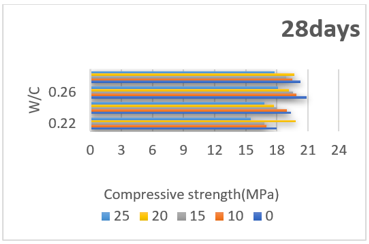
In Li et al.'s study [15], the researchers aimed to investigate the impact of the water-cement ratio (W/C) on concrete containing different amounts of GP, where the researchers replaced cement with GP at 0%, 10%, 15%, 20%, and 25%. For each replacement percentage, the W/C ratio was increased to proportions of 0.22, 0.24, 0.26, and 0.28. It was observed that the maximum compressive strength, FS, and TS in the control concrete occurred at W/C=0.26. By comparing it with concrete containing 20% GP, it was observed that the GP sample had higher compressive resistance, attributable to the pozzolanic reaction and the effect of GP filling the pores of the concrete. However, if the CS was compared in a sample of concrete containing 20% of GP and 25% of GP, a decrease in CS was observed in samples of 25% at w/c=0.26 [15], and the researcher did not explain the cause of this reduction in CS despite the increase in the replacement ratio, which is a major reason for the decrease in the CS due to the lack of cement that binds the components of the aggregate, as well as the smoothness of the glass surface, which leads to the difficulty of cohesion between it and the cement paste [9].
In all studies, a difference was observed in the results about the optimal ratio of replacing cement or sand with GP. Although the replacement ratios used were similar or close, the researchers did not take into their studies all the following variables at the same time: the size of the glass particles, the pozzolanic reaction, the type of glass, the replacement ratio, the behaviour of GP inside the concrete and its physical and chemical properties that effect on the concrete, curing time in case of sand replacement, curing time in case of cement replacement, and the amount of reaction water.
The increasing global population and rapid development have significantly amplified the demand for the construction sector, leading to increased consumption of raw materials like sand and gravel. This surge in demand has profound environmental implications, including river erosion, groundwater depletion, and elevated atmospheric carbon dioxide levels due to extensive sand mining. Simultaneously, the growing volume of waste, particularly glass, exacerbates pollution and reduces cultivable land, despite glass being highly recyclable. While researchers have increasingly focused on incorporating (GP) into concrete as a partial substitute for sand or cement to mitigate these issues, existing studies often present disparate findings regarding optimal replacement ratios and performance.
Despite extensive research, a critical gap exists in the systematic integration and comprehensive analysis of how multiple influential factors — such as GP particle size, the pozzolanic reaction, glass type, replacement ratio, water-cement (W/C) ratio, and curing time — interact to affect concrete properties. Many studies have focused on isolated variables, leading to incomplete conclusions and conflicting optimal parameters. Consequently, a high percentage of glass waste remains unrecycled in concrete due to these unresolved differences among scientists regarding optimal methods. This review aims to address this critical gap by systematically synthesizing and critically analyzing previous studies to identify the interplay of these key variables and establish preliminary determinants for the effective and optimized utilization of GP in concrete. By doing so, this study seeks to provide clearer guidance for maximizing glass waste recycling while enhancing the mechanical and physical properties of concrete, thus contributing significantly to sustainable construction practices.
In this study, research papers will be reviewed to find the best way to replace cement or sand with GP by reviewing the impact of the above variables on the characteristics of concrete.
This study employs a systematic approach to review and synthesize existing literature concerning the use of GP in concrete. The primary objective was to identify and critically analyze the key variables influencing the mechanical and physical properties of concrete when GP is incorporated as a partial replacement for cement or sand.
2.1 Data collection framework and sources
A comprehensive literature search was conducted across prominent scientific databases, including Scopus, Web of Science, and Google Scholar. The search queries combined various keywords related to the subject matter, such as GP, waste glass, recycled glass, concrete, cement replacement, sand replacement, compressive strength, FS, split tensile strength, workability, density, water absorption, and durability. Boolean operators (AND, OR) were utilized to broaden the search scope and capture relevant studies.
2.2 Inclusion and exclusion criteria
Studies were selected based on their relevance to the scope of this review. The inclusion criteria were:
* Research articles and review papers published in peer-reviewed journals.
* Studies focusing on the use of GP as a partial replacement for cement or sand in concrete.
* Papers reporting on mechanical properties (compressive strength, flexural strength, split tensile strength) and physical properties (slump, density, water absorption).
* Studies providing sufficient experimental details for analysis and comparison.
Studies were excluded if they:
* Focused solely on glass cullet or coarse glass aggregates without fine GP.
* Did not report on concrete or mortar properties relevant to this review.
* Were non-English publications (due to translation limitations).
2.3 Data extraction and analysis
From the selected studies, relevant data were extracted, including:
* Type of GP used.
* Glass particle size/fineness.
* Replacement ratio (of cement or sand).
* Water-to-cement (W/C) ratio.
* Curing conditions and duration.
* Reported mechanical and physical properties.
* Observed chemical reactions (e.g., pozzolanic activity, ASR).
The extracted data were then subjected to a comparative and critical analysis, focusing on identifying trends, discrepancies, and the interactions between different variables. This systematic review aims to provide a consolidated understanding of GP's influence on concrete performance and to highlight areas for future research.
3.1 Physical properties of GP
Lass is one of the most extensively used materials globally, and there are different types of glass, such as vitro-ceramic glass, soda-lime, bio glass, etc. [16], which are used in many industries, including windows, screens, utensils, medical, and electronic industries [4]. This is attributed to its special properties, such as optical transparency, chemical inertness, high inherent strength, and low transmittance [17]. The concrete industry uses GP because of its chemical composition, which has a significant proportion of silica [18], according to the Table 1.
Table 1. Chemical constituents included in GP And the replacement ratios for cement or glass
|
The Study |
Replacement |
Replacement Ratios |
Glass Particle Size |
% Chemical Components |
|||||||
|
SiO2 |
Al2O3 |
Fe2O3 |
CaO |
MgO |
Na2O |
K2O |
SO3 |
||||
|
[18] |
Cement and sand |
0%, 20%, and 30% |
88%<10μm 12%>15μm |
72.4 |
1.45 |
0.48 |
11.5 |
0.65 |
13.0 |
0.43 |
0.09 |
|
[19] |
Cement |
10 to 25% at 5% intervals |
74μm-150μm 44μm-74μm 20μm-44μm 15μm-20μm |
69.31 |
3.42 |
0.31 |
9.53 |
2.53 |
11.42 |
0.06 |
0.02 |
|
[14] |
Cement |
0 to 40% at 5% intervals |
<90mm |
74.3 |
2.20 |
0.9 |
62.3 |
1.6 |
12.9 |
1.1 |
0.08 |
|
[20] |
Cement |
0 to 25% at 5% intervals |
20μm |
74.11 |
0.01 |
0.12 |
10.01 |
2.60 |
12.40 |
0.25 |
- |
|
[19] |
Cement |
0 to 25% at 5% intervals |
74-150μm |
69.31 |
3.42 |
0.31 |
9.53 |
2.53 |
11.42 |
0.06 |
0.02 |
|
[20] |
Cement |
0 to 25% at 5% intervals |
45μm |
71.2 |
3.12 |
0.54 |
7.6 |
2.49 |
11.23 |
0.068 |
0.016 |
|
[11] |
Cement |
0 to 20% at 5% intervals |
75μm |
70.82 |
2.22 |
0.51 |
10.82 |
1.41 |
12.95 |
0.28 |
0.10 |
|
[5] |
Sand |
50% |
<45mm |
68.43 |
2.59 |
0.375 |
11.28 |
1.22 |
14.77 |
0.598 |
0.187 |
|
[21] |
Sand |
5%,10%,15% and 20% |
<4.75mm |
69.54 |
1.81 |
1.42 |
- |
11.24 |
12.59 |
0.52 |
- |
|
[22] |
Cement and sand |
5%, 10%, 15% and 20% |
150μm |
59.7 |
1.31 |
0.77 |
18.2 |
3.59 |
14.7 |
0.348 |
0.243 |
|
[23] |
Sand |
20% |
<4.75mm |
69 to75% |
0.5 to 2.5% |
- |
9 to13% |
- |
13 to 17%, |
- |
- |
|
[12] |
Cement |
10 to 25% at 5% intervals |
75μm (Clear GP) |
68.1 |
0.9 |
0.6 |
14.5 |
1.8 |
12.2 |
0.8 |
0. 4 |
|
75μm (Color GP) |
68.7 |
1 |
0.9 |
12 |
1.8 |
13.3 |
1 |
0. 1 |
|||
The specific gravity of GP differed from one type of glass to another, and this is due to the different types of recycled glass, as shown in the following Table 2.
Table 2. The specific gravity for glass powder
|
The Study |
GP Type |
Specific Gravity |
|
[21] |
waste glass |
2.38 |
|
[22] |
Waste window glass |
2.5 |
|
[23] |
Waste glass |
2.53 |
|
[24-28] |
Waste glass |
2.53 |
|
[29] |
Waste Glass |
2.64 |
|
[13] |
Waste Glass |
2.43 |
|
[23] |
Waste bottles glass |
2.28 |
3.2 Chemical reaction
GP of various types shares a chemical composition with sand [24]. Therefore, when replacing sand or cement with GP, the GP enters the pozzolanic reaction because the GP contains reactive silica $\left(\mathrm{SiO}_2\right)$ and alumina $\left(\mathrm{Al}_2 \mathrm{O}_3\right)$, which in turn react with calcium hydroxide $\mathrm{Ca}(\mathrm{OH})_2$ present in Portland cement to form pozzolanic products and chemical reformers [25], and the pozzolanic reaction occurs during cement hydration in the presence of water at ambient temperature [26]. As the size of the GP particles decreases, the pozzolanic reaction increases [25]. The chemical reactions shown in Eqs. (1) and (2) describe the pozzolanic reaction.
Chemical reaction Eq. (1) [5]:
$\mathrm{SiO}_2+\mathrm{Ca}(\mathrm{OH})_2 \rightarrow \mathrm{C}-\mathrm{S}-\mathrm{H}($ calcium hydroxy silicate $)+\mathrm{Ca}(\mathrm{OH})_2$ (1)
$\mathrm{Al}_2 \mathrm{O}_3+\mathrm{Ca}(\mathrm{OH})_2 \rightarrow \mathrm{C}-\mathrm{A}-\mathrm{H}($ calcium hydroxy aluminate $)+\mathrm{Ca}(\mathrm{OH})_2$ (2)
These pozzolanic reactions are fundamentally important for enhancing concrete performance. The formation of additional C-S-H and C-A-H gels significantly densifies the cement matrix, filling microscopic voids and refining the pore structure. This densification directly translates to improved CS, FS, and TS, as evidenced by various studies showing strength gains when GP participates effectively in the pozzolanic reaction. For example, the increased grouting effect and resistance offered by the interfacial transition zone (ITZ) are attributed to the formation of these secondary compounds.
Furthermore, the consumption of Ca(OH)2 by GP is crucial for mitigating the ASR, a detrimental expansion mechanism in concrete. GP contains a high percentage of silica, and its addition leads to a lower Ca/Si ratio in the C-S-H products, which enhances the adsorption of alkali cations. This reduction in available Ca2+ ions, vital for the formation of ASR-induced swelling gels, consequently decreases the ASR effect after adding GP. Studies have shown that finer GP particles (less than 50µm) react more effectively to prevent ASR formation, as they consume calcium more efficiently and lead to fewer cracks. This direct chemical mechanism enhances the long-term durability and structural integrity of concrete, making GP a valuable material not just for strength but also for longevity.
It was observed that substituting cement with GP in different proportions of 10%, 20%, and 30%, and after 14 days, the expansion values were 0.33%, 0.12%, and 0.0478%, respectively, as the ASR expansion rate decreased when the replacement rate increased [8]. Also, Jiang et al. [25] noted that GP contains a high percentage of silica, where the Ca/Si ratio ranged between 1.2-2.3 for the C-S-H reaction before adding GP, and when GP was added, the secondary C-S-H reaction exhibited Ca/Si ratios between 0.6 and 1.4, and Na/Si ratios between 0.05 and 0.20. The low Ca/Si ratio resulted in a negative charge for the C-S-H, which enhanced the adsorption of cations (especially alkalis), which leads to higher Na/Si ratios, and that leads to the consumption of Ca2 as it shows in the chemical reaction Eq. (3), where the Ca2 is important in the reaction of ASR, and therefore the effect of ASR decreases after adding GP [25].
Chemical reaction Eq. (3):
$2 \mathrm{Ca}^{2+}+\mathrm{SO}^{4-}+\mathrm{SiO}_2 \rightarrow \mathrm{Ca}_2 \mathrm{SiO}_4($ Calcium Silicate $)+\mathrm{SO}^{4-}$ (3)
Lu et al. [16] also observed that replacing 20% of cement with GP resulted in a decrease in ASR reaction, because the GP is responsible for the decrease in the reaction of the calcium/silicon ratio by sequestering the majority of the Ca2 ions that are required for the formation of a swelling gel, and C-S-H has a significant concentration of alkali (Na/Si was 0.758). It was observed that C-S-H with a low Ca/Si ratio was able to assimilate much higher amounts of alkali compared to standard C-S-H. It was also noted that whenever GP size was less than 50μm, it reacted in a better way that prevented the formation of ASR [16].
Also, the size of GP directly affects the ASR, as it was determined that the smaller the particle size of the GP, the less affected the ASR due to the ability of fine GP to consume calcium, which is a major action in the C-S-H reaction. It was discovered that an ASR reaction occurs in the fine cracks of GP attributable to the Pozzolanic interaction, so the finer size of GP and the greater surface area led to fewer cracks, which reduces the effect of ASR inside these cracks. The critical size of GP was determined to be between 1-0.9mm, and the researcher recommended using GP passing through a 0.6mm sieve as it leads to limited ASR expansion [4].
The chemical composition of GP, particularly its high silica (SiO2) content, is a primary driver of its efficacy as a cement or sand replacement. As detailed in Table 1, GP typically contains a substantial percentage of SiO2, ranging from 59.7% to 74.3%. This reactive silica is crucial for the pozzolanic reaction, where it combines with Ca(OH)2 from cement hydration to form secondary C-S-H and C-A-H gels. These gels contribute to a denser matrix and improved pore structure, directly enhancing the compressive, flexural, and tensile strengths of concrete. For instance, studies show that finer GP particles, which generally have a higher surface area for reaction, lead to a more effective pozzolanic interaction and consequently better mechanical properties.
Furthermore, the physical properties of GP, such as its specific gravity, have a direct impact on the resultant concrete characteristics. Table 2 illustrates that the specific gravity of various waste glass types typically ranges from 2.28 to 2.64. This is generally lower than that of conventional sand (around 2.62) and cement (around 2.62). Consequently, the partial replacement of sand or cement with GP often leads to a reduction in the overall density of the concrete. For example, replacing fine aggregate with GP has been shown to decrease concrete density, with a greater reduction observed at higher replacement ratios, directly correlating with GP's lower specific gravity compared to sand. However, it is important to note that the type of recycled glass influences specific gravity; for instance, cathode ray tube (CRT) GP, due to its lead content, can have a higher specific gravity (2.99g/cm³) than sand (2.09g/cm³), leading to an increase in concrete density. These variations underscore the necessity of considering both chemical and physical properties of the specific GP type when designing concrete mixes to predict and optimize mechanical performance effectively.
The type of glass utilized for producing GP is a critical factor influencing its properties and subsequent impact on concrete performance. While soda-lime glass is widely used, other types, such as CRT glass, exhibit different characteristics. For instance, the specific gravity of GP can vary significantly depending on its origin, as shown in Table 2, with waste glass typically ranging from 2.28 to 2.64. However, recycled GP from CRT can have a higher specific gravity (2.99g/cm³) compared to sand (2.09g/cm³) due to the presence of lead. This directly impacts concrete density; studies replacing sand with CRT-GP demonstrated an increase in density, with 100% replacement yielding a density of 2472kg/m³ compared to 2208kg/m³ for control concrete.
Furthermore, the chemical composition, as presented in Table 1, varies among glass types, which can influence their pozzolanic activity. While most GP contains a high percentage of silica (SiO2), the presence of other oxides in varying proportions can affect the formation of C-S-H and C-A-H gels during the pozzolanic reaction. For example, the researchers Islam, Rahman, and Kazi noted that the pozzolanic reaction inside concrete for transparent and colored glass is similar because, in both cases, the fine GP (75µm) is composed of silica. This highlights that even subtle differences in chemical make-up due to glass type can influence the effectiveness of GP as a supplementary cementitious material. Future research should systematically categorize and analyze the specific chemical signatures of various waste glass streams to better predict their performance and optimize their use in concrete applications, particularly considering any potential long-term interactions.
3.3 GP recycling
Glass waste is considered solid waste, which constitutes a large proportion of solid waste around the world [8]. Mechanical, thermal, and chemical recycling methods are used to enhance the quality of recycled materials and augment the rate of recycling [29-31], according to the United States Environmental Protection Agency (EPA) in 2018, the glass production across all goods in the United States amounted to 12.3 million tonnes. while recycled glass is only about 3.1 million tonnes for a recycling rate of 31.3% (EPA 2020). For recycling glass, first, the glass will be collected by recycling companies, as there are several processes for recycling glass before reusing it in different industries. These processes vary according to the type of glass and its previous use, for example, when recycling auto glass, the size is first reduced and the component materials are separated, and when the size is reduced, crushing comes after shredding and then is followed by grinding, and in the process of material separation, the polyvinyl butyral sheets are separated and the GP is separated. After crushing and separation by gravity, the polyvinyl butyral is recovered by rubbing and pressure washing [32]. As for the other types of glass waste, after the glass waste is collected, the impurities are removed, as the impurities affect the quality of the glass to be recycled. The cleaner the glass, the higher the percentage of recycled glass waste. Then the glass waste is classified according to colour, and the plastic and iron covers are removed manually. Then the glass is crushed by machine; After that, the organic waste is eliminated by washing; the aluminium is also extracted using the machine vibration method; and finally, the GP is produced [32, 33].
Despite the ability to recycle glass by melting it and producing new glass materials, there are many obstacles that prevent this from happening, such as mixing different types of glass and mixing glass colors and different contaminations, where the glass wastes are buried as this glass is buried occupies large areas of waste dumps due to the inability of glass waste to decompose [34, 35]. This not only leads to wasting the materials but also pollutes the environment [4, 25]. The accumulated glass waste around the world amounts to 200 million tons annually in landfills [25]. It was also found that in Hong Kong, 90% of glass waste is buried in landfills [35], and in Australia, it was found that 1.1 million tons of glass waste were generated and only 57% was recycled from 2017 to 2018 [36].
The increase in the population led to an increase in the concrete industries for building housing and other service buildings, which led to an augmentation in the use of raw materials used in the manufacture of concrete, such as sea or river sand, as well as gravel, and the production of large quantities of cement, the production of which leads to various environmental damages. With the increase in glass waste [1], researchers turned to partial or total replacement of concrete components with recycled glass, such as replacing sand with fine glass powder or gravel with coarsely ground glass waste, and this will reduce the use of non-renewable natural resources [37, 38].
The GP will be taken from waste glass recycling companies, which crush waste glass through three stages and these stages include the implosion, the shearing apparatus and the sanding apparatus. The glass will be crushed by rotating blades inside the device, and then the glass particles are transferred to the shear unit for further crushing operations, and before reaching the sanding unit, several large glass fragments and other contaminants are eliminated. The researchers used 3mm fine glass as an alternative aggregate for sand inside the concrete [1]. In another study, the researchers recycled household glass waste by grinding it in a ball mill after washing it with an ionic emulsifier and then sifting the ground glass using a 20-micrometre sieve [19].
The methodology followed in this study involves summarizing the essential studies related to the study topic to create a research review on the physical factors and chemical interactions affecting glass powder-containing concrete. Then, a more in-depth analysis of these factors and interactions is conducted, leading to conclusions that contribute to enhanced comprehension of how GP affects the characteristics and overall performance of concrete.
4.1 Slump test
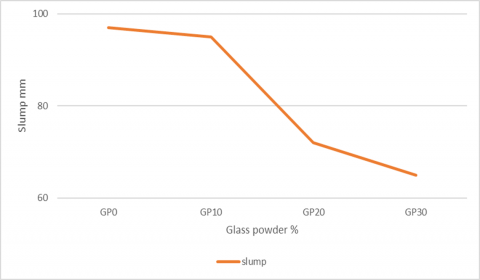
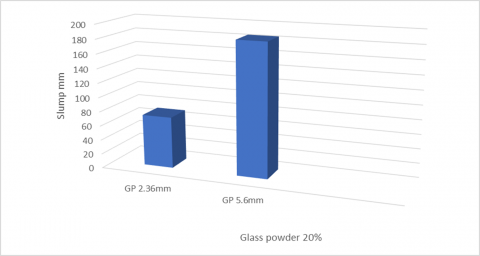
Workability, crucial for ensuring concrete homogeneity and ease of placement, is significantly affected by the characteristics of GP additions, particularly when used as a sand replacement. Researchers consistently determined that the slump generally diminishes with an increasing proportion of GP when replacing sand. For instance, in a study replacing sand with mixed-color soda-lime GP (3 mm particle size) at 20%, 40%, and 60%, the slump decreased from 90mm (control) to 60mm, 65mm, and 40mm respectively, as shown in Figure 1. The considerable slump reduction (69% at 20% and 71% at 40% compared to reference concrete) was attributed to the angular morphology and softness of the GP particles, which can influence the water-cement (W/C) ratio effectively [1]. Arivalagan and Sethuraman [13] similarly found that for sand replacement with GP (<2.36mm) at 10%, 20%, and 30% (W/C=0.45), the slump decreased proportionally with increasing replacement percentage, as depicted in Figure 2 [13].
Figure 1. Slump value of conventional aggregate and GP fine aggregate concrete
Figure 2. Comparison between two samples of concrete glass powder of 20% different sizes
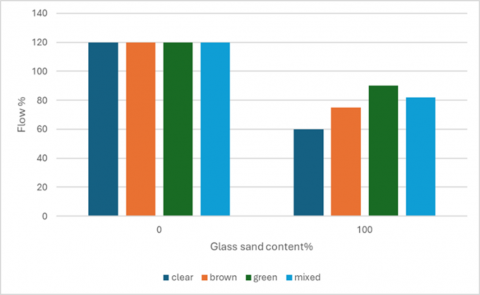
Figure 3. Flow of glass sand mortar
However, the impact of GP size and admixtures on slump is critical. In a contrasting study where 20% sand was replaced with coarser GP (5.6mm) from a home glass bottle, and a superplasticizer was used (W/C=0.45), the slump reached approximately 185mm, significantly surpassing control concrete [23]. A direct comparison between Arivalagan and Sethuraman's [13] study (2.36mm GP, W/C=0.45, lower slump) and this study (5.6mm GP, W/C=0.45, higher slump) highlights the complex interaction between GP particle size and workability, as shown in Figure 3. The finer GP (2.36mm) likely consumed more water due to increased surface area, while the superplasticizer in the latter study mitigated the uneven grain morphology of the larger recycled glass sand (RGS), improving dispersion and workability. This indicates that while finer GP can reduce slump due to increased surface area and pozzolanic reaction, coarser GP can sometimes improve it, especially with the aid of superplasticizers to overcome morphological challenges [1, 25].
It was clear that the replacement ratio had a major impact on the slump of the concrete mix. increasing the replacement ratio resulted in an escalation of the slump. This is what the researcher found when replacing different percentages of GP with cement (0%, 5%, 10%, 15%, and 20%) the slump (6.5cm, 7.5cm, 8.6cm and 10.2cm) respectively, while GP type, W/C ratio (0.5), and GP size (measurement less than 0.075mm) were constant in all samples. In another point of view, this may be due to an elevated replacement rate and the difficulty of adhesion of the GP particles with the rest of the mixture components owing to the smooth texture of the GP particles [11].
In this regard, Fanijo et al. [30] noted that replacing 30% of cement with GP led to an escalation in the slump of around 10% compared to control concrete, that was by using the same type of GP and a fixed size (10µm) for all samples that contain 10% GP. Also, the W/C was constant in the control concrete and the concrete containing the GP (207kg/m3). Therefore, the researcher suggested that the change in slump resulting from the angular morphology of the GP results in a decrease in the water absorption capacity and an enhancement of the workability [30].
In general, it was noticed that the slump of concrete containing GP depends on several factors such as glass roughness, size, and type, and the slump of concrete is also affected if cement or sand is replaced with GP [5]. This was also proven by researchers Tan and Du, who tested the fluidity of mortar samples after using different types of glass to make GP having different sizes. It found that the flow of brown, green, transparent, and mixed glass sand slurry was 75%, 90%, 60%, and 82% of the flow compared to normal mortar sand, respectively, as shown in Figure 4.
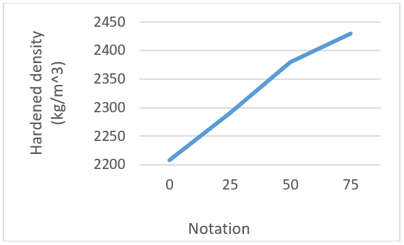
Figure 4. Density of control concrete, concrete with recycling glass powder (RGS)
This study supports the idea that the increase or decrease of the slump is affected by the type of replacement in terms of replacing sand or cement with GP and the size of glass particles. When comparing the previous results, it was found that replacing sand with GP decreased slump, and when replacing cement, slump increased.
4.2 Analysis of concrete density
The density of concrete incorporating GP is primarily governed by the specific gravity of the GP relative to the material it replaces (sand or cement). Generally, a reduction in concrete density is observed with an increasing GP replacement ratio, primarily because the specific gravity of most GP types is lower than that of conventional sand or cement. For instance, when fine aggregate (sand) was replaced by 20%, 40%, and 60% with GP (4.75mm to 0.3mm), the concrete density decreased consistently; the density for control concrete was 2396kg/m³ (56 days), while 60% RGS replacement resulted in 2361kg/m³, as shown in Figure 5 [1].
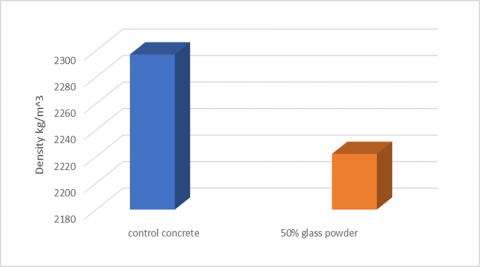
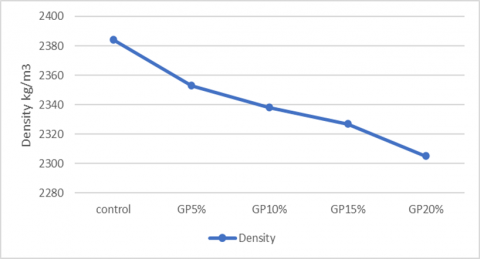
Similarly, the impact of various GP replacements on concrete density can be observed, highlighting the general trend of density reduction when GP replaces cement or sand, as illustrated in Figures 6 and 7. Furthermore, specific types of glass, such as cathode ray tube (CRT) GP, can alter this trend due to their higher specific gravity, leading to an increase in concrete density, as detailed in Figure 8.
This aligns with other findings where 20% sand substitution with GP (specific density 2.44) led to reduced concrete density compared to control concrete using sand with a specific density of 2.7 [7]. Similarly, using 50% GP recycled from beer bottles (density 2.49g/cm³) instead of sand (density 2.62g/cm³) reduced concrete density by 3.3% [5]. When GP replaced cement, a progressive reduction in concrete density was also noted (e.g., 1.3% to 3.31% for 5% to 20% replacement), attributed to GP's specific gravity (2.60) being slightly less than that of cement (around 2.62) [11].
Figure 5. Effect of cathode ray tube GP replacement on the hardened density of mortar
Figure 6. Density of concrete
Figure 7. Density of concrete containing GP
Figure 8. Comparison of concrete containing GP with control concrete
However, the type of recycled glass significantly influences this trend due to variations in specific gravity. In a notable exception, replacing sand with recycled GP from CRT at proportions of 25%, 50%, 75%, and 100% resulted in an augmentation of concrete density. For example, 100% CRT GP concrete reached 2472kg/m³, while control concrete was 2208kg/m³ [9]. This increase is directly due to the higher specific gravity of CRT GP (2.99g/cm³) compared to the replaced sand (2.09 g/cm³), a characteristic often linked to the presence of lead in CRT glass [9, 27]. Therefore, it is concluded that while the typical outcome of GP incorporation is a decrease in concrete density, the specific gravity of the GP, which varies by its source and composition, is the dominant factor dictating the final concrete density.
4.3 Assessment of water absorption in concrete
The water absorption of concrete incorporating GP is a complex property influenced by the GP's particle size, replacement ratio, and particle morphology, as well as the type of material being replaced. Conflicting results in the literature highlight these intricate interactions.
When GP replaces cement, the effect on water absorption appears to be highly dependent on GP fineness and replacement level. Balasubramanian et al. [7] found that replacing cement with very fine GP (50µm) at rates of 5% to 20% led to a lower absorption rate, ranging between 4.3% and 48.0% compared to control samples. This reduction was potentially attributable to the ability of the fine GP to fill voids within the concrete matrix and its inherently low water absorption capacity. However, in another study where cement was replaced with coarser milled waste glass (4.75-12.5mm) by 30%, water absorption increased by 23% compared to control concrete, and further increased by 30% when samples were immersed in sulfates for extended periods [39, 40]. Similarly, Jain et al. [41] observed an increase in water absorption at 20% and 25% cement replacement with 90µm GP, primarily due to the decrease in the percentage of cement, which can lead to higher porosity if not compensated by adequate pozzolanic reaction.
When sand is substituted with GP, the trend often leans towards increased water absorption. For instance, Tanwar et al. [40] noted that replacing sand with 150µm GP at rates from 5% to 20% led to an increased water absorption rate as the replacement percentage grew, with 20% GP samples showing a 40.83% higher absorption compared to control concrete [40]. This increase was attributed to the angular shape and smooth surface of the GP, which, when used in large quantities, can create voids that facilitate water penetration into the concrete [40]. However, it is important to note that this specific study's certainty about GP's effect on water absorption is limited, as the researcher also replaced sand with granular blast furnace slag [40].
In conclusion, the effect of GP substitution on water absorption is not uniform. While very fine GP might reduce absorption by acting as a filler and contributing to a denser matrix, coarser GP or higher replacement ratios, especially when replacing sand, may lead to increased absorption due to the creation of more voids or less effective bonding caused by the GP's morphology and surface properties. The overall consensus is that substitution with GP can lead to increased water absorption, particularly due to the angular nature of glass particles. However, the exact impact depends critically on the particle size and the type of material replaced, underscoring the need for further research to determine the optimal GP size and application method for minimizing water absorption and enhancing concrete durability.
4.4 Compressive strength
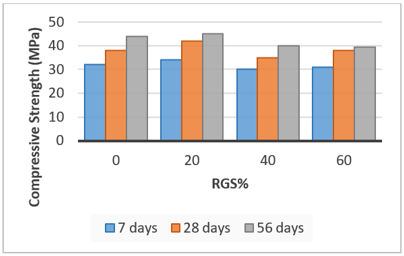
To ascertain the impact of GP on the CS of concrete, studies have investigated varying replacement ratios and particle sizes. Tamanna et al. [1] replaced 20%, 40%, and 60% of sand with mixed-color soda-lime GP, ranging from 0.3mm to 1.13mm. They observed that the CS increased by 7% at 20% replacement compared to control concrete after 28 days of curing. However, increasing the replacement to 40% and 60% led to a decrease in CS by 14% and 4%, respectively, compared to the control concrete. This initial improvement was attributed to the angular nature of GP, providing better interlocking than rounded sand particles. The subsequent decrease at higher replacement rates was linked to a weakening of the mechanical bond within the concrete's microstructure between GP and cement, affecting the interfacial transition zone (ITZ), as presented in Figure 9.
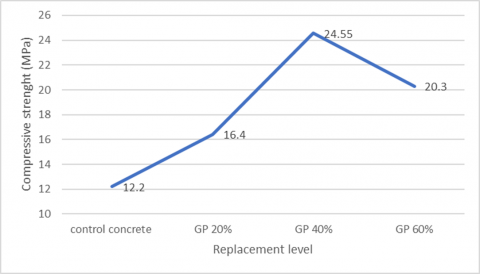
In contrast, Ez-zaki et al. [3] used similar sand replacement ratios (20%, 40%, and 60%) but with finer glass particles (less than 0.5mm) and a higher water-cement (W/C) ratio of 0.6. Remarkably, they found that when the ratio of replacement was 40%, the CS rose by 50% relative to the control concrete, as seen in Figure 10. The significant improvement was ascribed to the enhanced pozzolanic behavior of the finely ground glass. However, at 60% replacement, the CS decreased, which the researchers attributed to the smooth surface of the GP and its friability, as well as high brittleness. These contrasting results highlight a critical interaction between replacement ratio and particle size: while a moderate replacement of coarser GP might improve CS, a higher replacement with finer GP can yield substantially better results due to increased pozzolanic activity and void-filling capabilities, despite the potential challenges of workability and brittleness at very high dosages.
Figure 9. Compressive strengths of GP at different replacement levels
Figure 10. Effect of GP replacement levels on concrete compressive strength
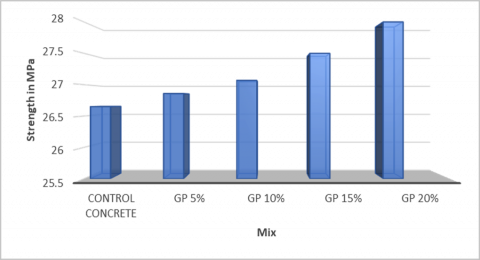
Balasubramanian et al. [7] noticed that the CS for samples after curing 28 days increases after a rise in the percentage of replacing cement with GP by 5%, 10%, 15%, or 20%, where the percentage increase was between 1% and 5% in comparison with the control sample as shown in the Figure 11, noting that the GP utilised was 50μ in size and the W/C ratio was 0.5. However, despite the good results obtained, the researcher did not give a clear reason for the increase in compression resistance, but it may be attributable to the good pozzolanic interaction of the GP due to the very small particle size.
When GP is used as a partial replacement for cement, the fineness of the powder becomes even more critical for strength development, particularly at varying replacement levels. Balasubramanian et al. [7] observed that the CS for samples after 28 days of curing increased when cement was replaced with 50 μm GP by 5%, 10%, 15%, or 20%. The percentage increase ranged between 1% and 5% compared to the control sample, as shown in Figure 12. While the authors did not provide a specific reason for this improvement, it can be attributed to the good pozzolanic interaction of the very small particle size GP, which effectively fills voids and densifies the matrix.
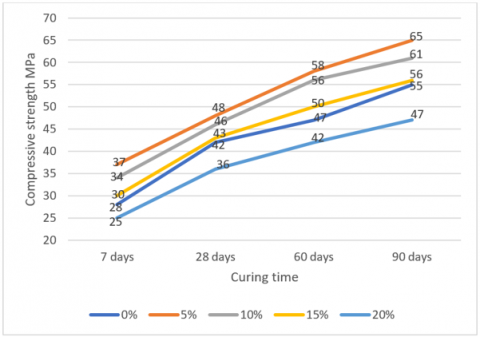
In a contrasting study, Ibrahim [11] investigated cement replacement with even finer GP (0.075mm) at ratios of 0%, 5%, 10%, 15%, and 20%, maintaining a W/C ratio of 0.5. Interestingly, the best CS was found at only 5% replacement, showing an increase of about 7.51% compared to the control concrete, as seen in Figure 13.
However, at higher ratios (10%, 15%, and 20%), the CS decreased by 3.48%, 6.98%, and 21.65% respectively. Ibrahim [11] attributed this decline to the high fineness of the recycled GP leading to internal cracks because of insufficient adhesion between the recycled GP and the interphase cement paste. This discrepancy underscores that while fineness generally enhances pozzolanic activity, excessive fineness (e.g., 0.075mm vs. 50µm) can introduce workability challenges and increase internal cracking, particularly when not accompanied by optimized W/C ratios or extended curing, thereby potentially leading to a reduction in mechanical properties at higher replacement levels even with good pozzolanic potential.
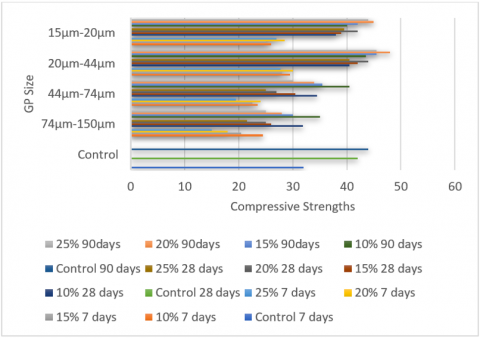
But in another study, to investigate the impact of the fineness of GP on the CS of concrete, it had been replaced with cement by GP in the same proportions (10%, 15%, 20%, 25%) as in the previous study, and a 0.5W/C ratio was used for all samples. A compressive resistance test was conducted after a treatment period of 7, 28, and 90 days, and it was found that the concrete samples that contain different proportions of GP (measuring 74μm-150μm) had lower CS compared to control concrete as seen in Figure 14, and the higher the replacement, the CS decreased. Also, samples containing a powdered glass of 44μm-74μm exhibited the same behaviour, and their CS was lower than that of control concrete, although the samples containing powdered glass of 44μm-74μm showed higher CS than samples containing GP measuring 74μm-150μm, and that was resulted to the low activity of pozzolanic GP due to the size of its particles and the low cement content, as well as the appearance of most of the particles in the cement mortar in the form of fine aggregates, which reduced the content of hydration products in the system. As for the samples that contain GP of 20μm-44μm and 15μm-20μm, it was found that the CS was lower than that of the control concrete at a curing period of 7 days, but when the cure duration was extended to 28 and 90 days, it was found that the best CS was in the samples contained 20% GP (20μm-44μm), which was 3.5% and 9.6% higher than the control sample, respectively, and the CS of the same samples decreased when the substitution ratio increased to 25%, and the researcher attributed this decrease to the increase in the water absorption of GP due to the high surface area of GP, which affects cement hydration.
Another study showed similar results when the researcher replaced cement with GP (measurement 0.075mm) at ratios of 0%, 5%, 10%, 15%, and 20%, and the amount of W/C ratio was 0.5 for all samples. It was found that the CS decreased by 3.48%, 6.98%, and 21.65% at ratios of 10%, 15%, and 20%, respectively, attributable to the high fineness of the recycled GP leading to cracks because of the high fineness of the recycled GP which leads to cracks that lead to insufficient adhesion between the recycled GP and the interphase cement paste; however, the best CS was at 5%, which was higher by around 7.51% in comparison to the control concrete, as shows in Figure 13 [11].
Figure 11. Compressive strengths of GP at 28, 56 and 112 days
Figure 12. Compressive strengths of GP
Figure 13. Compressive strengths of glass powder 0.075mm
Figure 14. CS of concrete containing different WGP as a substitute for cement
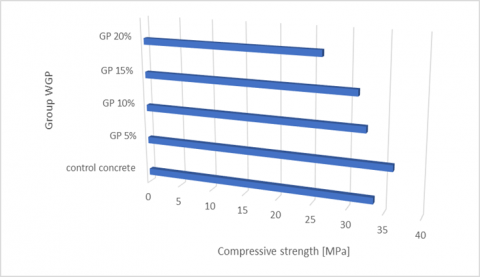
To know the impact of replacing sand or cement with GP on compressive resistance, first, the cement was replaced with GP with a size of 150μm, and second, the sand was replaced with GP with a size of 4.75mm in proportions of 5%, 10%, 15%, and 20%. It was noticed that replacing cement with GP gives a higher CS. This results from the good pozzolanic interaction of the GP inside the concrete when the size of the GP particles is 150μm, while the reason for the decrease in CS after replacing the sand with GP is the weak connection between the glass aggregate and the W/C paste, and the sand also has greater resistance to breakage compared to glass. Despite this, it was found that the best replacement ratio in both cases was 5% in comparison to the control concrete, while the rest of the ratios gave a lower CS than the control concrete, as seen in Figures 15 and 16 [26].
Figure 15. CS of concrete containing different WGP as a substitute for sand
Figure 16. Bending and tensile split strength
In a study, cement was substituted with GP (size<90μm) at 0%, 5%, 10%, 15%, 20%, 25%, 30%, 35%, and 40% (identified as G0, G1, G2, G3, G4, G5, G6, G7, and G8, respectively) after curing the samples for 90 days. According to the findings, the CS of samples containing 30% GP was 20.35% higher than that of control concrete,and the researcher attributed this increase in CS to the fact that the GP enhanced the strength due to the formation of C-S-H gel in the cement paste [15].
Despite the impressive results achieved by previous studies, it was noted that the reason for the failure of compressive strength is that some factors were ignored. For example, when Tamanna studied the focused on the smoothness of the GP, the replacement ratio, and the treatment duration. Still, he did not mention anything about the type of glass that he used or the use of different ratios of reaction water that are affected by the smoothness of the glass. This has also happened with Gupta's study [14]. Ez-zaki et al. [3] also used similar replacement ratios and increased the w/c, but he did not clarify the type of glass that he used, nor did he specify the treatment duration of the samples. Balasubramanian et al. [7] were neutral in his study, as he used lower replacement ratios, and the maximum replacement ratio was 20%. He used a specific w/c ratio and specified the treatment duration and found that the best CS was at 20%. He attributed this to the pozzolanic reaction, as he ignored the type of glass and whether replacing different types of glass might give the same results or not. He also did not specify the interactions. The study by Ibrahim [11] was unlike previous studies. Where it was found that the best percentage is 5%, despite specifying the W/C ratio as 0.5 and measuring the GP as 0.075mm, and the decrease was attributed to the softness of the GP, the difficulty of bonding, and cracks within the GP particles, but from another point of view, it did not take into account the use of different percentages of W/C ratio that will be affected by the surface area of the GP on the absorption and the chemical reaction that will occur due to the softness of the GP and the type of GP. Researchers also focused on increasing the curing period and its effect on increasing the strength of concrete, as Fanijo specified the replacement ratio, the type of glass used, smoothness, and the curing period, but he did not mention the W/C ratio. However, Li et al. [20] gave relatively clear and accurate results due to their consideration of the reaction water ratios, replacement ratios, and curing period, as they did not clarify the effect of the angular surface area of GP. He attributed the decrease in concrete resistance at a replacement ratio of 25% and a curing period of 56 days to the smoothness of the glass and the difficulty of its cohesion with the other components. However, we noticed in the results that when the curing period was increased to 112 days for a replacement ratio of 25%, CS increased, which was the optimal ratio. The researcher did not give any logical reason for this contradiction in the results. Researcher [18] also tried to consider the same previous factors, but he did not research changing the different W/C ratios and did not take them into account accurately. Tried to compare the replacement of sand or cement with glass and reached somewhat satisfactory results due to neglecting the type of glass used, the percentage of reaction water, which was not specified for both cases, and the duration of treatment [26].
By comparing the previous studies, we find that the CS of concrete containing GP is affected by the type of glass used, the measurement of the particle size of the GP, the ratio of replacement, the amount of W/C ratio, the curing time for the concrete, the type of replacement with sand or cement, and the pozzolana behaviour of GP inside the concrete, and all these variables can be considered as a basis that must be taken into account at once to obtain the optimum ratio of use of GP inside the concrete.
4.5 Bending and tensile split strength
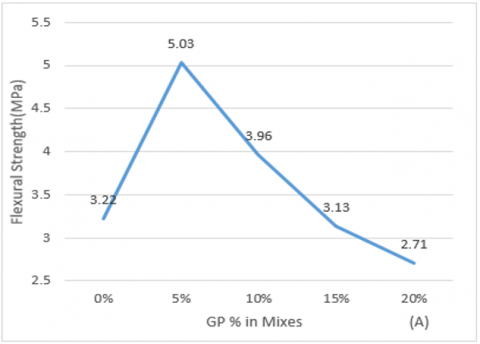
FS and TS of concrete containing GP are significantly influenced by a complex interplay of GP fineness, replacement ratio, water-to-cement (W/C) ratio, and curing time, particularly when cement is partially replaced. Balasubramanian et al. [7] demonstrated that replacing cement with 50 µm GP at rates of 5%, 10%, 15%, and 20% increased FS and TS after 28 days of curing, with strength gains ranging from 1% to 3% compared to control concrete, as shown in Figure 17.
This improvement is likely due to the fine GP particles effectively filling voids and promoting pozzolanic interaction. Similarly, Gupta et al. [14] observed a positive effect of long-term curing; for cement replacement with <90 µm GP, FS reached 5.44 MPa at 56 days and 5.9 MPa at 90 days for 30% GP. They attributed this to the increased grouting effect and resistance offered by ITZ.
However, the optimal conditions are highly sensitive to the specific combination of these factors. Li et al. [15] further validated the impact of the W/C ratio and curing duration on FS and TS for concrete containing 40 µm GP. While control concrete showed the highest strengths at 28 days across various W/C ratios (0.22-0.28), at 56 days, 20% GP replacement yielded higher strengths. By 112 days, all GP replacement ratios (10-25%) surpassed control concrete, with 20% GP at W/C=0.26 showing the highest strength due to robust pozzolanic interaction and pore filling. A reduction in strength was observed at 25% replacement compared to 20%, attributed to the fine texture of GP hindering cohesion. This highlights that for cement replacement, especially with finer GP, optimal performance is achieved through a synergistic combination of replacement ratio, a precisely tuned W/C ratio, and sufficiently long curing periods to allow the pozzolanic reaction to fully develop.
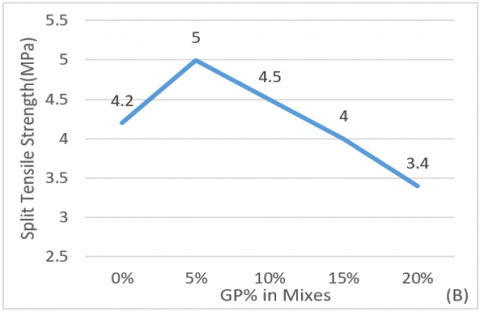
Conversely, Ibrahim [11] reported that for cement replacement with very fine GP (<0.075mm) at a constant W/C ratio of 0.5, TS was highest at only 5% replacement, increasing by 13.15% compared to control concrete, as seen in Figure 18. At higher replacement ratios (10%, 15%, 20%), TS decreased significantly. This contrasts with studies finding higher optimal replacement rates (e.g., 20% or 30%) and suggests that excessively fine GP, without appropriate W/C ratio adjustments, might lead to workability issues or insufficient bonding within the cement paste, thereby compromising strength despite its high surface area for pozzolanic activity.
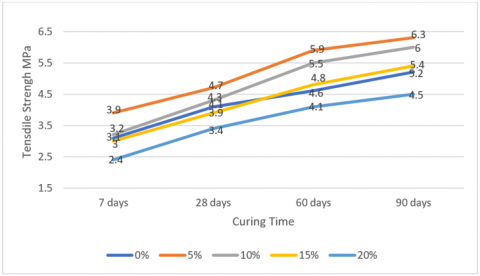
When sand is substituted with GP, the impact on flexural and split tensile strengths also demonstrates complex interactions between particle size, replacement ratio, and bonding characteristics. Tanwar et al. [40] observed a significant increase in FS by 56% at only 5% sand replacement with 150µm GP, using a W/C ratio of 0.4, after 28 days of curing, as shown in Figure 19. This enhancement was attributed to the pozzolanic interaction of GP, forming secondary cement compounds that condense the cement matrix and the ITZ. However, at higher substitution ratios, FS decreased, as the GP's limited water absorption capacity and smooth texture led to reduced adhesion with the cement slurry, even with its pozzolanic potential.
(a)
(b)
Figure 17. Flexural (a) and split tensile strength (b)
Figure 18. Splitting tensile strength
Figure 19. Tensile strength after replacing cement with GP 150 micrometers
Table 3. Resistance of FS and TS
|
Mix |
Flexural Strength (MPa) |
Split Tensile Strength (MPa) |
||||
|
7 days |
14 days |
28 days |
7 days |
14 days |
28 days |
|
|
0% |
2.5 |
3.75 |
4 |
3.02 |
3.12 |
3.45 |
|
10% |
2.61 |
3.95 |
4.01 |
3.07 |
3.03 |
3.40 |
|
20% |
2.65 |
3.95 |
4.60 |
3.19 |
3.16 |
3.46 |
|
30% |
2.30 |
3.54 |
3.90 |
2.80 |
2.65 |
3.04 |
Similarly, Arivalagan and Sethuraman [13] noted that the best resistance to FS and TS was at a 20% sand replacement with coarser GP (>2.36mm) and a W/C ratio of 0.45. While increasing curing duration generally improved strength, increasing the substitution rate to 30% led to a decrease in FS and TS compared to control concrete, as seen in Table 3. The authors did not explicitly detail the reasons for these changes or the role of pozzolanic reaction and GP size, but the larger particle size and increased replacement could contribute to weaker bonding.
Muhedin and Ibrahim [22] further highlighted the difference between sand and cement replacement. For sand replacement, they found that only 5% GP (size 4.75mm) yielded better or similar TS results to control concrete, as shown in Figure 20. This lower optimal replacement rate for sand is often attributed to the weaker connection between the glass aggregate and the W/C paste, and the fact that sand generally has greater resistance to breakage compared to glass. Unlike cement replacement, where finer GP promotes pozzolanic reaction, for sand replacement, the physical bonding and aggregate properties become more dominant factors, especially as replacement ratios increase, leading to a reduction in bonding and overall strength due to the smooth surface of GP and decreased cement content.
By comparing the previous results, an effect was observed in the type of glass used, the measurement of the particle size of the GP, the ratio of replacement, the amount of W/C ratio, the curing time for the concrete, the type of replacement with sand or cement, and the pozzolana behaviour of GP inside the concrete. Consequently, we notice that the highest rates of recycling GP were when replacing cement, as it gave good resistance to TS and FS, as happened in the study of Balasubramanian et al. [7], The researcher attributed this increase in resistance to the small size of the pozzolan polymer particles that fill the voids, as well as the pozzolanic reaction of the pozzolanic polymer inside the concrete. However, future researchers can clearly pay attention to the type of glass used in its chemical composition. Also, researcher [14] concluded that increasing the curing period to 56 and 90 days led to an increase in the replacement rate by 30%. Although he took into account the use of different rates of W/C when using GP with a size of less than 90 micrometres, as the angular surface of the GP absorbs the reaction water, the study [15] came up with different results from the two previous studies.
Figure 20. Tensile strength after replacing sand with glass powder, size 4.75mm
Despite using the same rates of replacing cement with GP, he found that the TS and FS were low until the curing period reached 112 days, which was the optimal rate for replacement. 20%, and did not give clear results for this contradiction from previous studies, but he did not focus on the effect of the angular surface area of the GP, which may have a major role in this failure. This previous conclusion was supported by the results of the study [20], as he used the same percentages as previous studies, but he used GP with a size of less than <0.075 mm and treated the samples for only 28 days, unlike previous studies, which led to the optimal percentage being 5%, as the researcher did not care about increasing the treatment period due to the effect of the surface area of the GP on the absorption of W/C. When replacing sand with GP, Tanwar et al. [40] found that the resistance increased by 56% when replacing only 5% at 28-day curing, while the other percentages decreased when the replacement percentage increased. Future researchers can consider increasing the duration of concrete curing, especially since he used a 150-micrometre GP, as other researchers did. As for Arivalagan and Sethuraman [13], they were interested in proving that the duration of curing has a positive effect and that the longer the curing period, the greater the resistance, but they did not consider the effect of pozzolan interaction, the effect of GP size, and the effect of W/C. The study by Muhedin and Ibrahim [22] supported the conclusion of the previous study.
Despite the valuable insights garnered from this review, the current body of literature exhibits certain methodological and reporting limitations that hinder a comprehensive understanding and the practical implementation of GP in concrete. A prevalent issue is the inconsistent reporting of detailed experimental procedures in some studies, including precise curing environments (temperature, relative humidity) and the specific testing standards (e.g., ASTM vs. ISO) applied for mechanical property evaluations. This lack of meticulous documentation can compromise the reproducibility of results and complicate direct, quantitative comparisons across different research groups.
Furthermore, a significant limitation encountered during this review was the inconsistent presentation of data in some graphical representations. Specifically, several figures (e.g., Figures 8-20) lacked error bars or explicit statistical significance indicators, which inherently restricts a precise quantitative comparison and assessment of data variability. While this review synthesizes qualitative and quantitative trends, the absence of such elements affects the overall reliability and interpretability of findings from the original sources. We have addressed the clarity of our presented figures by ensuring all axes are clearly labeled with appropriate units, and all abbreviations in tables and figures are defined in the Nomenclature section.
Crucially, while current research extensively investigates the immediate mechanical properties of concrete containing GP, a significant gap remains in the comprehensive assessment of its long-term durability. A thorough understanding of GP-modified concrete's performance under various aggressive environmental conditions (e.g., freeze-thaw cycles, sulfate attack, chloride ingress, exposure to extreme temperatures) is largely unexplored. This omission significantly limits its widespread practical applicability and confident implementation in diverse structural applications.
Therefore, future research should prioritize addressing these identified limitations by:
By focusing on these critical areas, future research can develop more precise guidelines for optimizing GP utilization, promoting significantly higher rates of glass waste recycling in concrete, and fostering truly sustainable construction practices globally.
This study systematically reviewed factors influencing the performance of concrete when GP is incorporated as a partial replacement for cement or sand. Key findings indicate that increasing the replacement percentage of cement or sand generally enhances CS, TS, and FS, with an optimal replacement typically observed around 20. Replacing cement with GP consistently yielded better results than replacing sand with GP. The water-to-cement (W/C) ratio significantly influences concrete resilience; an increase in the W/C ratio may be necessary at higher replacement percentages due to the high surface area of GP particles and their water absorption capacity.
Finer GP (ideally less than 2.36mm) demonstrably improved CS, TS, and FS by promoting a more effective pozzolanic reaction, where substantial quantities of SiO2 and Al2O3 react with Ca(OH)2 to generate C-S-H and C-A-H gels, filling voids and enhancing resistance. However, excessively fine GP can lead to cracks and weakening of the concrete's resistance. Concrete containing GP benefits from extended curing times, with notable strength gains observed after 28 days and further improvements with longer durations. The type of GP also affects concrete density; using uncontaminated recycled glass (e.g., soda-lime glass) generally leads to a decrease in density as replacement percentage increases due to GP's lower specific gravity compared to cement and sand. Effective recycling processes that minimize contaminants (colors, paint) are crucial to ensure optimal pozzolanic reactions.
This work was supported by UNITEN through the Higher Institution Centre of Excellence (HICoE), Ministry of Higher Education (MOHE), Malaysia, under the project code 2024001HICOE as referenced in JPT(BPKI)1000/016/018/34(5).
|
CS |
Compressive Strength |
|
TS |
Split Tensile Strength |
|
FS |
Flexural Strength |
|
GP |
Glass Powder |
|
W/C |
Water-to-Cement Ratio |
|
RGS |
Recycled Glass Sand |
|
ASR |
Alkali-Silica Reaction |
|
ITZ |
Interfacial Transition Zone |
|
C-S-H |
Calcium-Silicate-Hydrate |
|
C-A-H |
Calcium-Aluminate-Hydrate |
|
CRT |
Cathode Ray Tube |
|
EPA |
Environmental Protection Agency |
|
MPa |
Megapascals |
|
μm |
Micrometer |
|
mm |
Millimeter |
|
kg/m3 |
Kilograms Per Cubic Meter |
|
g/cm3 |
Grams Per Cubic Centimeter |
[1] Tamanna, N., Tuladhar, R., Sivakugan, N. (2020). Performance of recycled waste glass sand as partial replacement of sand in concrete. Construction and Building Materials, 239: 117804. https://doi.org/10.1016/j.conbuildmat.2019.117804
[2] Chilamkurthy, K., Marckson, A.V., Chopperla, S.T., Santhanam, M. (2016). A statistical overview of sand demand in Asia and Europe. In Proceedings of The International Conference UKIERE CTMC, 16: 15.
[3] Ez-Zaki, H., El Gharbi, B., Diouri, A. (2018). Development of eco-friendly mortars incorporating glass and shell powders. Construction and Building Materials, 159: 198-204. https://doi.org/10.1016/j.conbuildmat.2017.10.125
[4] Dong, W., Li, W., Tao, Z. (2021). A comprehensive review on performance of cementitious and geopolymeric concretes with recycled waste glass as powder, sand or cullet. Resources, Conservation and Recycling, 172: 105664. https://doi.org/10.1016/j.resconrec.2021.105664
[5] Nasiru, S., Jiang, L., Yu, L., Chu, H., Huang, Y., Pei, C., Gu, Y., Jin, W., Eyram Klu, E., Guo, M.Z. (2021). Properties of cement mortar containing recycled glass and rice husk ash. Construction and Building Materials, 299: 123900. https://doi.org/10.1016/j.conbuildmat.2021.123900
[6] Liu, D., Wang, C., Gonzalez-Libreros, J., Guo, T., Cao, J., Tu, Y., Elfgren, L., Sas, G. (2023). A review of concrete properties under the combined effect of fatigue and corrosion from a material perspective. In Construction and Building Materials. Elsevier Ltd, 369: 130489. https://doi.org/10.1016/j.conbuildmat.2023.130489
[7] Balasubramanian, B., Gopala Krishna, G.V.T., Saraswathy, V., Srinivasan, K. (2021). Experimental investigation on concrete partially replaced with waste glass powder and waste E-plastic. Construction and Building Materials, 278: 122400. https://doi.org/10.1016/j.conbuildmat.2021.122400
[8] Khan, M.N.N., Saha, A.K., Sarker, P.K. (2020). Reuse of waste glass as a supplementary binder and aggregate for sustainable cement-based construction materials: A review. In Journal of Building Engineering, 28: 101052. https://doi.org/10.1016/j.jobe.2019.101052
[9] Ling, T.C., Poon, C.S. (2011). Utilization of recycled glass derived from cathode ray tube glass as fine aggregate in cement mortar. Journal of Hazardous Materials, 192(2): 451-456. https://doi.org/10.1016/j.jhazmat.2011.05.019
[10] Yang, S., Ling, T.C., Cui, H., Poon, C.S. (2019). Influence of particle size of glass aggregates on the high temperature properties of dry-mix concrete blocks. Construction and Building Materials, 209: 522-531. https://doi.org/10.1016/j.conbuildmat.2019.03.131
[11] Ibrahim, K.I.M. (2021). Recycled waste glass powder as a partial replacement of cement in concrete containing silica fume and fly ash. Case Studies in Construction Materials, 15: e00630. https://doi.org/10.1016/j.cscm.2021.e00630
[12] Islam, G.M.S., Rahman, M.H., Kazi, N. (2017). Waste glass powder as partial replacement of cement for sustainable concrete practice. International Journal of Sustainable Built Environment, 6(1): 37-44. https://doi.org/10.1016/j.ijsbe.2016.10.005
[13] Arivalagan, S., Sethuraman, V.S. (2021). Experimental study on the mechanical properties of concrete by partial replacement of glass powder as fine aggregate: An environmental friendly approach. Materials Today: Proceedings, 45: 6035-6041. https://doi.org/10.1016/j.matpr.2020.09.722
[14] Gupta, J., Jethoo, A.S., Ramana, P.V. (2022). Evaluating long term properties of concrete using waste beverage glass. Materials Today: Proceedings, 61: 297-306. https://doi.org/10.1016/j.matpr.2021.09.446
[15] Li, A., Qiao, H., Li, Q., Hakuzweyezu, T., Chen, B. (2021). Study on the performance of pervious concrete mixed with waste glass powder. Construction and Building Materials, 300: 123997. https://doi.org/10.1016/j.conbuildmat.2021.123997
[16] Du, H., Tan, K.H. (2017). Properties of high volume glass powder concrete. Cement and Concrete Composites, 75: 22-29. https://doi.org/10.1016/j.cemconcomp.2016.10.010
[17] Lu, J.X., Zhan, B.J., Duan, Z.H., Poon, C.S. (2017). Using glass powder to improve the durability of architectural mortar prepared with glass aggregates. Materials & Design, 135: 102-111. https://doi.org/10.1016/j.matdes.2017.09.016
[18] Shayan, A., Xu, A. (2006). Performance of glass powder as a pozzolanic material in concrete: A field trial on concrete slabs. Cement and Concrete Research, 36(3): 457-468. https://doi.org/10.1016/j.cemconres.2005.12.012
[19] Li, Q., Qiao, H., Li, A., Li, G. (2022). Performance of waste glass powder as a pozzolanic material in blended cement mortar. Construction and Building Materials, 324: 126531. https://doi.org/10.1016/j.conbuildmat.2022.126531
[20] Ibrahim, S., Meawad, A. (2022). Towards green concrete: Study the role of waste glass powder on cement/superplasticizer compatibility. Journal of Building Engineering, 47: 103751. https://doi.org/10.1016/j.jobe.2021.103751
[21] Bahadur, R., Kumar Parashar, A. (2023). An investigation of waste glass powder with the substitution of sand on concrete mix. Materials Today: Proceedings. https://doi.org/10.1016/j.matpr.2023.02.123
[22] Muhedin, D.A., Ibrahim, R.K. (2023). Effect of waste glass powder as partial replacement of cement & sand in concrete. Case Studies in Construction Materials, 19: e02512. https://doi.org/10.1016/j.cscm.2023.e02512
[23] Bostanci, S.C. (2020). Use of waste marble dust and recycled glass for sustainable concrete production. Journal of Cleaner Production, 251: 119785. https://doi.org/10.1016/j.jclepro.2019.119785
[24] Ahmed, K.S., Rana, L.R. (2023). Fresh and hardened properties of concrete containing recycled waste glass: A review. Journal of Building Engineering, 70: 106327. Elsevier Ltd. https://doi.org/10.1016/j.jobe.2023.106327
[25] Jiang, Y., Ling, T.C., Mo, K.H., Shi, C. (2019). A critical review of waste glass powder-Multiple roles of utilization in cement-based materials and construction products. Journal of Environmental Management, 242: 440-449. https://doi.org/10.1016/j.jenvman.2019.04.098
[26] Kar, K.K. (2021). Handbook of fly ash. Butterworth-Heinemann. In Handbook of Fly Ash. https://doi.org/10.1016/B978-0-12-817686-3.00035-9
[27] Tan, K.H., Du, H. (2013). Use of waste glass as sand in mortar: Part i-Fresh, mechanical and durability properties. Cement and Concrete Composites, 35(1): 109-117. https://doi.org/10.1016/j.cemconcomp.2012.08.028
[28] Baikerikar, A., Mudalgi, S., Ram, V.V. (2023). Utilization of waste glass powder and waste glass sand in the production of Eco-Friendly concrete. Construction and Building Materials, 377: 131078. https://doi.org/10.1016/j.conbuildmat.2023.131078
[29] Anandaraj, S., Raja, K., Mohamad Abbas, M., Madan Kumar, T., Varatharajan, K., Nivashini, N. (2023). Experimental study on luffa fiber reinforced concrete using glass powder as cement replacement. Materials Today: Proceedings. https://doi.org/10.1016/j.matpr.2023.03.501
[30] Fanijo, E.O., Kassem, E., Ibrahim, A. (2021). ASR mitigation using binary and ternary blends with waste glass powder. Construction and Building Materials, 280: 122425. https://doi.org/10.1016/j.conbuildmat.2021.122425
[31] Liu, Y., Farnsworth, M., Tiwari, A. (2017). A review of optimisation techniques used in the composite recycling area: State-of-the-art and steps towards a research agenda. Journal of Cleaner Production, 140: 1775-1781. https://doi.org/10.1016/j.jclepro.2016.08.038
[32] Swain, B., Park, J.R., Lee, C.G. (2022). Industrial recycling of end-of-life vehicle windshield glass by mechanical beneficiation and complete recovery of polyvinyl butyral. Journal of Cleaner Production, 334: 130192. https://doi.org/10.1016/j.jclepro.2021.130192
[33] Lin, K.Y. (2018). User experience-based product design for smart production to empower industry 4.0 in the glass recycling circular economy. Computers & Industrial Engineering, 125: 729-738. https://doi.org/10.1016/j.cie.2018.06.023
[34] Idir, R., Cyr, M., Tagnit-Hamou, A. (2011). Pozzolanic properties of fine and coarse color-mixed glass cullet. Cement and Concrete Composites, 33(1): 19-29. https://doi.org/10.1016/j.cemconcomp.2010.09.013
[35] Lu, J.X., Duan, Z.H., Poon, C.S. (2017). Combined use of waste glass powder and cullet in architectural mortar. Cement and Concrete Composites, 82: 34-44. https://doi.org/10.1016/j.cemconcomp.2017.05.011
[36] Naeini, M., Mohammadinia, A., Arulrajah, A., Horpibulsuk, S., Leong, M. (2019). Stiffness and strength characteristics of demolition waste, glass and plastics in railway capping layers. Soils and Foundations, 59(6): 2238-2253. https://doi.org/10.1016/j.sandf.2019.12.009
[37] Somani, P., Gaur, A. (2020). Evaluation and reduction of temperature stresses in concrete pavement by using phase changing material. Materials Today: Proceedings, 32: 856-864. https://doi.org/10.1016/j.matpr.2020.04.214
[38] Bisht, K., Ramana, P.V. (2018). Sustainable production of concrete containing discarded beverage glass as fine aggregate. Construction and Building Materials, 177: 116-124. https://doi.org/10.1016/j.conbuildmat.2018.05.119
[39] Mostofinejad, D., Hosseini, S.M., Nosouhian, F., Ozbakkaloglu, T., Tehrani, B.N. (2020). Durability of concrete containing recycled concrete coarse and fine aggregates and milled waste glass in magnesium sulfate environment. Journal of Building Engineering, 29: 101182. https://doi.org/10.1016/j.jobe.2020.101182
[40] Tanwar, V., Bisht, K., Kabeer, K.S.A., Ramana, P.V. (2021). Experimental investigation of mechanical properties and resistance to acid and sulphate attack of GGBS based concrete mixes with beverage glass waste as fine aggregate. Journal of Building Engineering, 41: 102372. https://doi.org/10.1016/j.jobe.2021.102372
[41] Jain, K.L., Sancheti, G., Gupta, L.K. (2020). Durability performance of waste granite and glass powder added concrete. Construction and Building Materials, 252: 119075. https://doi.org/10.1016/j.conbuildmat.2020.119075