Hejran Q. Faris | Radhiyah M. Aljarrah*
© 2025 The authors. This article is published by IIETA and is licensed under the CC BY 4.0 license (http://creativecommons.org/licenses/by/4.0/).
OPEN ACCESS
The purpose of this research is to increase the photocatalytic degradation of Methylene Blue (MB) dye using samples of zinc oxide/nickel oxide nanoparticles alone (100%), or in combinations (75%, 50%, 25%, and 0%) of zinc oxide/nickel oxide nanoparticles. In this regard, zinc oxide and nickel oxide nanoparticles, as well as their nanocomposites, were prepared hydrothermally under specified temperatures and pressures. The process required saline solutions of zinc acetate and nickel nitrate in distilled deionized bent water, with varying precursor concentrations. The samples were characterized using X-ray diffraction (XRD), field emission scanning electron microscopy (FESEM) and energy-dispersive spectroscopy (EDX) to establish the structural and morphological properties. The results confirmed that nanoparticles were uniformly distributed with the possible exception of the 100% ZnO. The XRD patterns indicated that ZnO formed a hexagonal wurtzite structure and NiO was rock salt with a face centered cubic (FCC) structure. Also, the final concentration of each nanoparticle influenced the size of the nanoparticles seen using both XRD and FESEM. Further, ultraviolet-visible (UV-Vis) spectra were also acquired to determine the effect of adding nanoparticles to the absorption spectra. We verified a marked increase in the photocatalytic acticity of the ZnO and NiO systems when nanoparticles were included in the corresponding systems. Further, the system with the 25% ZnO (the combined system) attained the highest degradation efficiency (82%) after 180 minutes of UV light exposure.
hydrothermal, methylene blue, nanoparticles, nickel oxide, photocatalytic, zinc oxide
Water pollution from toxic substances, including chemicals and pathogens, is recognized as a leading factor for global environmental decline. The discharge of untreated polluted water into natural systems has huge negative downstream impacts and can go beyond just contaminated water pollution, including severe ecological harm and damage to aquatic life [1]. Dyes are one of the most problematic and long-lasting pollutants in the wastewater stream of many industries. Further, dyes are used in huge quantities in a variety of industries, including textiles, leather, paper, and plastics, which presents serious concerns for the extent of pollution [2]. The chemical complexities of dye materials, including the variations in structural polymerization and the variants of treatment processes, make conventional wastewater treatment processes ineffective for degrading these materials [2]. As treatment tends to focus on biological methods, pollutants that metabolize and stay metabolic active can easily work their way into the food chain and ecosystem. Not surprisingly, the wastewater treatment market has increasingly focused on research development into more advanced materials and processes. Among these processes are materials that assist in photodegradation degradation, which are metal oxides that can boost the degradation activities of light activation. Examples of metal oxide catalysts for degradation include zinc oxide (ZnO), titanium dioxide (TiO₂), and nickel oxide (NiO). Zinc oxide (ZnO) has received great interest due to its photocatalytic activities resulting from UV light activation. When photosensitive ZnO is illuminated by UV light it generates reactive oxygen types, specifically hydroxyl radicals, and are known to degrade organic pollutants, e.g. dyes, into less harmful byproducts [3]. Additionally, ZnO is an inexpensive material and environmentally benign [4]. In turn, Nickel oxide (NiO) is similarly valued for oxidizing organic compound oxidation reactions. Interestingly, NiO possess magnetic properties that enable easy recovery and recycling. Importantly for sustainable water treatment, NiO catalyst recovery could lead to multiple reuse events. Current work comparing the two types of catalyst behavior have likely accounted for combinations of metal oxides, such as ZnO/NiO nanocomposites create additive/ synergistic effects and higher photocatalytic efficiencies and degradation rates of pollutants [5]. The motivation that stems from these findings regarding the need for producing ZnO and NiO nanoparticles for water treatment is our goal as part of this brief experiment, as well as creating numerous weight ratios to explore for potential use in purifying water from dangerous organic metabolites or pollutants. For nanoparticle to undergo our hydrothermal process we select the hydrothermal to produce nanoparticles for its number of positive factors as a method; small, inexpensive, simple equipment, no catalysts, inexpensive, and environmentally friendly. Additionally, the hydrothermal method can produce nanoparticles with large scale, uniforming, which helps create uniform, possible quantities, environmentally friendly, and safe overseeing for when we experiment with them in like, wastewater treatment.
In this research, the hydrothermal synthesis technique was utilized to produce nanoparticles of zinc oxide (ZnO), nickel oxide (NiO), and their composite forms. Hydrothermal synthesis is one of the best ways to fabricate nanomaterials since it has many benefits compared to other synthesis methods; namely, it uses equipment that is accessible and simple, it occurs without catalysts, it is inexpensive for production, it allows uniform nanomaterials over large surface areas, it is environmentally friendly, and it is minimally hazardous. The molar concentration (M) of the salt (saline) solutions that were prepared was determined by using the following equation [6]:
$M=\frac{W_t}{M_{w t} \times \frac{V}{1000}}$ (1)
where, M: is the molar concentration, $W_t$: weight of material. $M_{w t}$: Molecular weight, and V: volume of distilled water. To fabricate zinc oxide nanoparticles (ZnO NPs), a suitable zinc-based saline solution was prepared by dissolving 3 grams of zinc acetate in 75 ml of deionized water (DI) while stirring continuously for 1 hour. Concurrently, a sodium hydroxide (NaOH) solution was also prepared, by dissolving 1. 5 grams of NaOH into 75 ml of DI water and stirring for 30 minutes. After preparing the NaOH solution, it was added slowly into the zinc solution while stirring continuously until a milky solution appearance was observed, this suggested that the ZnO particles had formed. After confirming the formation of ZnO, the solution was stirred for an additional hour and poured into a 100 ml Teflon-lined stainless steel autoclave for reaction under high pressure. The autoclave was put into an oven, along with the solution where it was heated at 140℃ over 5 hours until acclimating back to room temperature. As the zinc oxide precipitated from the solution, a white precipitate appeared as the final product, which was collected and washed several times with distilled water and ethanol to remove impurities. Finally, it was spun dry with a centrifuge at 5500 rpm and dried in an oven at 80℃. The powder was later annealed at 400℃ for 2 hours. The calcining process improves the crystallinity of synthesized nanoparticles which enhances the photocatalytic ability and optical property [7].
To prepare o Nickel Oxide Nano Particle (NiO NPs) the same steps followed as used in preparing (ZnO) but dissolved 3 gm of nickel nitrate Ni , in deionized water.
To Synthesis of ZnO/NiO Nano Composite (NCs) three samples of nanocomposites have been preparing involve; (75/25, 50/50, 25/75%) by dissolved $\mathrm{Zn}\left(\mathrm{CH}_2 \mathrm{COO}\right)_2 2 \mathrm{H}_2 \mathrm{O} /\mathrm{Ni}\left({NO}_3\right)_2 \mathrm{Ni}$, (2.25/0.75, 1.50/1.50, and 0.25/2.75g) in 75 ml of deionized water. Then, gradually add NaOH (0.5 M) and stir it for one hour. The solutions were subjected to heat treatment: they were heated to 140℃ for 5 hours and left to cool gradually to room temperature. Then, the same steps were followed to prepare the zinc and nickel oxide nanoparticles.
For photocatalytic measurements, a 15 ppm solution of methylene blue dye was prepared, and UV light (a Xenon lamp, 2400 Watts, 365 nm wavelength) was used. The lamp and the sample were about 30 cm apart, and the intensity of the ultraviolet radiation used was 2400 watts.
3.1 X-ray diffraction analysis
The samples' character was determined using a Philips X-ray diffractometer (λ =1.5406, 30 mA current, and 40 kV voltage) system.
The data were collected over a 2θ range of 20 to 80°, and the results were compared with the American Standard for Testing Materials (ASTM) cards for ZnO and NiO.
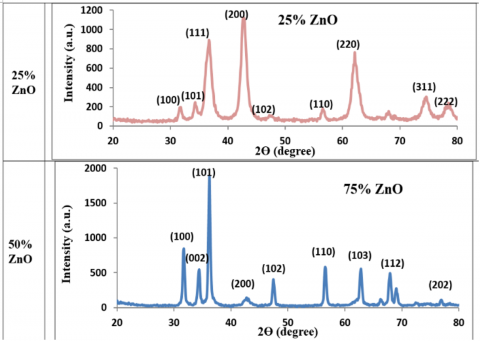
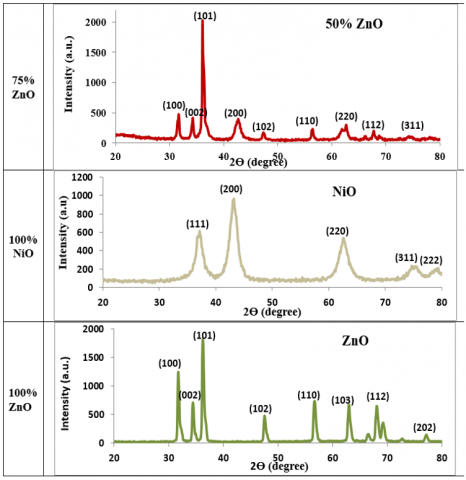
Figure 1 shows the emergence of new peaks as the nickel oxide concentration increases, reflecting NiO contribution in the crystal structure. It can be expected that the addition of NiO to ZnO has distorted the crystal lattice of ZnO, as the cubic structure of NiO overlaps with the hexagonal lattice of ZnO. Until 75% of ZnO, the influence of NiO remains limited and then changes in the crystal structure lead to the appearance of new peaks and a decrease in the intensity of the ZnO peak. These results confirm the possibility of forming a ZnO/NiO composite that could be utilized for many applications, such as photocatalysis, sensors, or improved magnetic properties.
Figure 1. XRD patterns of X% ZnO/NiO NCs
The average grain size of the samples was estimated with the help of Scherrer equation [8]:
$\mathrm{D}=0.89 \lambda /(\beta \operatorname{Cos} \theta)$ (2)
where, λ is the wavelength of the ray (1.5406 Å), β is the full width at the half-maximum (FWHM) in rad, θ is the diffraction angle. Figure 1 shows the XRD patterns of ZnO particles synthesized with various concentrations of ZnO/NiO (100/0, 75/25, 50/50, 25/75 and 0/100). These results show that the sizes of the prepared particles were within the nano range, and the average grain size was in the range of (21 – 30) nm, depending on the growth condition and material composites.
The results show that increasing NiO concentration is accompanied by FWHM increases, which means the size of nanoparticles decreases due to the change in growth rate between the different crystallographic planes; the average nanoparticle size is listed in Table 1. The result is consistent with Gnanam et al. [9].
Table 1. The average of crystalline size of X% ZnO/NiO nanocomposite
|
Compositions ZnO/NiO % |
Crystalline Size (nm) |
|
100/0 |
21.1 |
|
75/25 |
25.3 |
|
50/50 |
30.27 |
|
25/75 |
22.15 |
|
0/100 |
26.04 |
3.2 FESEM testing and EDX analysis
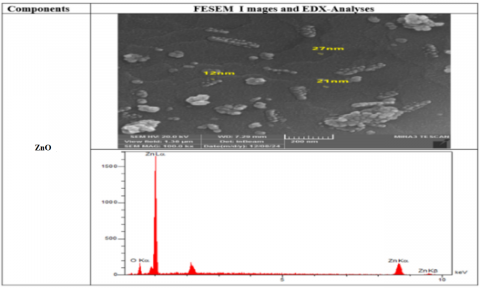
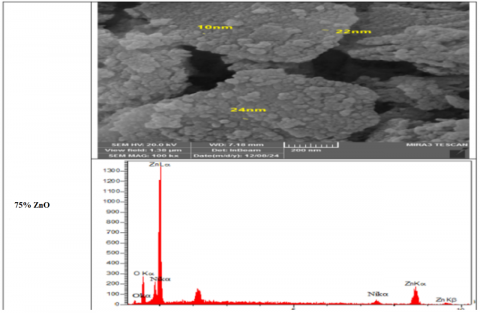
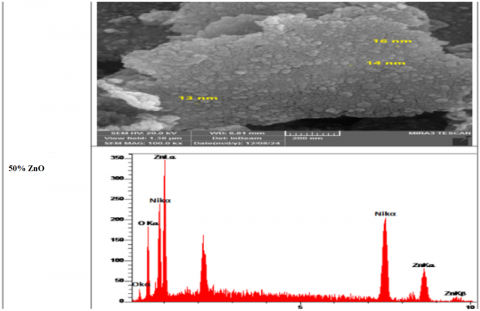
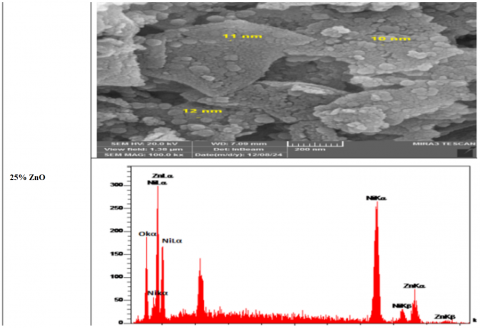
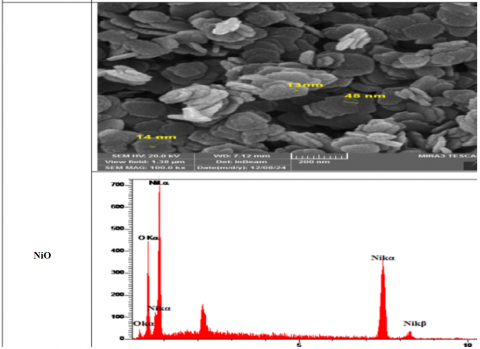
The synthesized samples' nanostructure was inspected using Scanning Electron Microscopy (SEM) at 100KX magnification. The SEM images suggest that the nanoparticles synthesized using the techniques described in this research are of high quality. The morphological data provides some insight into potential applications for the nanomaterials in several technological directions, such as photocatalysis, sensing, and fabrication of nanoelectronics. Furthermore, if improved synthesis protocols were employed, with ant-agglomeration techniques and monitoring of thermal processing conditions, can be able achieve greater dispersal of the particles and improve the functionality and versatility of the materials. The ranges of nanoparticles sizes shown in Figure 2 (from 12 nm to 48 nm) support the conclusion that successful synthesis occurred. The variety in size is partially due to the fact that chemical thermal synthesis is temperature and time dependent. The inhibition to the growth of the nano-sized zinc oxide was significant due to the implications of nickel oxide, which further hints that nickel oxide may have an influence on size control. An Energy-Dispersive X-ray Spectroscopy (EDX) was done alongside the SEM investigation for the purpose of revealing the elemental compositions, a portion of which are displayed in Figure 2. The EDX spectrum findings confirmed the presence of zinc (Zn), nickel (Ni), and oxygen (O).
Figure 2. FESEM images and EDX analysis of X% ZnO/NiO nanocomposites
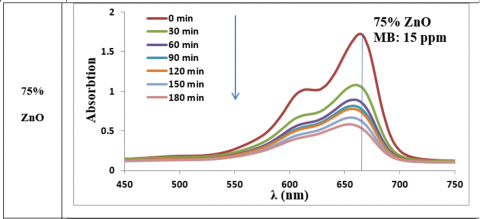
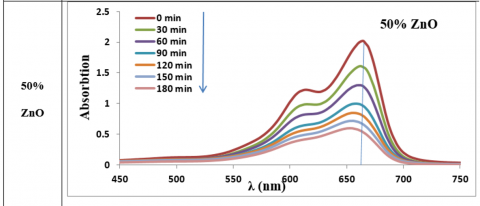
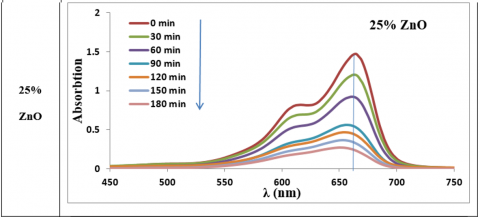
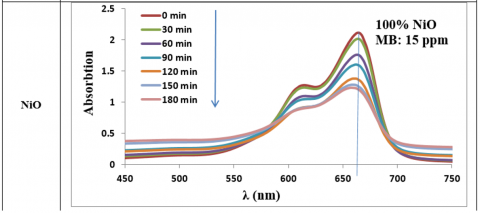
To remove hazardous organic pollutants, Advanced Oxidation Processes (AOPs) such as Photocatalysis, have been used for the removal of methylene blue [10]. Photocatalysis has become one of the more favorable AOPs for the removal of MB, as the potential to mineralize all dye molecules and reduce treatment costs exists. Thus, in this study, a 15 ppm concentration was made, and the photocatalytic degradation efficiency (PDE) of methylene blue was evaluated after removing from solution and decolorizing 0. 15 g of dye. To create the dye solution, 0. 1 gm of MB dye was dissolved in 100 mL distilled water to create a stock solution. Then, 1. 5 mL of stock solution was diluted to form a 15 ppm working solution in 100 mL of distilled water. In order to test for the photocatalytic degradation efficiency of MB under UV light irradiation, five different catalyst concentrations: pure ZnO, 75% ZnO/25% NiO, 50% ZnO/50% NiO, 25% ZnO/75% NiO, and pure NiO, were used. MB dye. The experiments were carried out under identical conditions to ensure a reliable comparison among the different catalysts. This included maintaining a constant concentration of methylene blue (MB) dye and exposing all samples to UV light irradiation for 180 minutes. The absorption spectra of the dye solutions were recorded at 30-minute intervals using a double-beam UV-Vis spectrophotometer (Model: MEGA-2100, SCINCO, Korea), covering a wavelength range of 200–1100 nm, to assess the photocatalytic response of each catalyst.
To calibrate the spectrophotometer, two cuvettes filled with solvent were initially placed in the path of each beam to set the baseline (zero absorbance). One of the cuvettes was then replaced with the sample containing the dye solution and the catalyst. Absorbance readings were collected across the wavelength range, with particular focus on the characteristic absorption peak of MB at 665 nm. The photocatalytic degradation efficiency (PDE) was evaluated based on the reduction in absorbance at this wavelength over time, in accordance with the method described in the study [11].
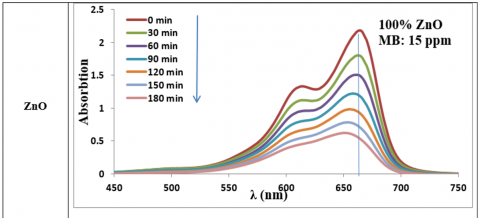
Figure 3. UV–Vis spectra of MB degradation with versus irradiation time
The results, as illustrated in Figure 3, demonstrated that the type and composition of the catalyst had a significant impact on the degradation rate of methylene blue, highlighting the effectiveness of certain nanocomposite ratios in enhancing photocatalytic activity.
The sample degradation efficiency as a percentage has been detected from the following Eq. (3) [12-15]:
Efficiency $\%=\frac{C_0-C}{C_n} \times 100$ (3)
here, $C_0$ and C represents initial and after exposure time solution concentration. After 180 min of a monochromatic.
After exposure to a wavelength UV light source (Xenon lamp, 2400 W, wavelength 365 nm), methylene blue dissolved in water begins to degrade. A small quantity of OH radicals in water supports the breakdown of MB.
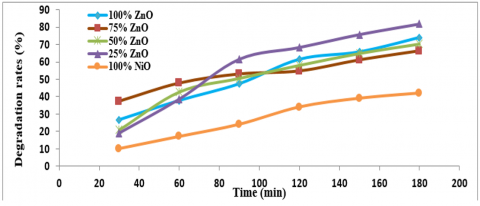
Figure 4. Variation of X% ZnO/NiO degradation rate of MB dye with exposure time
The results confirm that ZnO, NiO nanoparticles, and their nanocomposites exhibit high sensitivity to UV light and effectively function as photocatalysts. Thus, they present a promising strategy for the removal of environmental contaminants. As shown in Figure 4, the degradation rates of methylene blue (MB) vary with different ZnO/NiO catalyst concentrations. Notably, the composition containing 25% ZnO achieved the highest degradation efficiency, reaching approximately 82% after 180 minutes of UV exposure.
This enhanced photocatalytic activity can be attributed to the nanoscale size of the particles, which increases the surface-to-volume ratio (S/V), thereby improving the interaction between the catalyst and dye molecules [16]. Moreover, the increased degradation rate is associated with the improved efficiency of electron–hole pair generation and the suppression of their recombination. These conditions promote the formation of reactive species such as hydroxyl radicals (*OH), holes (h⁺), superoxide ions (O₂⁻*), and peroxide radicals (*H₂O₂), all of which actively participate in the degradation of organic dyes [17, 18].
Additionally, surface modification of nanoparticles can facilitate oxygen adsorption, activation, and cleavage, while accelerating two-electron oxygen reduction reactions. These changes contribute to the generation of more reactive oxygen species (ROS) on the nanomaterial surface, further enhancing the photocatalytic activity and stability of the ZnO/NiO nanocomposites [19].
The photocatalytic degradation efficiencies for the different samples are summarized in Table 2. Interestingly, increasing the ZnO content beyond the optimal point led to nanoparticle agglomeration, which reduced the effective surface area and, consequently, the catalytic activity [20-22]. These findings are consistent with previous studies [23, 24].
Table 2. Photo degradation efficiency (PDE) of MB dye with catalysts percentage after 180 min under UV irradiation
|
Type of Catalyst |
$C_o$ |
C After 180 Mint |
PDE (%) |
|
ZnO |
2.3 |
0.6 |
74 |
|
75% ZnO |
1.72 |
0.85 |
66 |
|
50% ZnO |
2.02 |
0.6 |
70 |
|
25% ZnO |
1.48 |
0.27 |
82 |
|
NiO |
2.11 |
1.22 |
42 |
Overall, this work demonstrates the potential of the synthesized ZnO/NiO nanocomposites not only for wastewater treatment but also for supercapacitor applications, offering a foundation for further development in both environmental and energy-related fields.
The following conclusions can be drawn from this study: X-ray diffraction (XRD) analysis indicated, based on the observed peaks, that there was some degree of lattice overlap between hexagonal zinc oxide and face-centered cubic nickel oxide. In addition, the examination of FESEM images concluded the average grain size was within the nanometer range and between 16 - 48 nm. The best catalytic dose for differentiating X% ZnO/NiO composites with 15 ppm MB dye was attained. It was discovered that the nanocomposite with 25% ZnO/NiO exhibited the most significant degradation of this dye, with the greatest degradation efficiency of 82%. Therefore, it can be concluded that zinc oxide and nickel oxide nanocomposites could act as photocatalysts for the photodegradation of aquatic and environmental pollutants. In addition, these photocatalyst agents are highly chemically stable, low-cost, and reusable. Therefore, this work allows the synthesized sample to be utilized in wastewater treatments as well as supercapacitors.
[1] Karthika, K., Ravichandran, K. (2015). Tuning the microstructural and magnetic properties of ZnO nanopowders through the simultaneous doping of Mn and Ni for biomedical applications. Journal of Materials Science & Technology, 31(11): 1111-1117. https://doi.org/10.1016/j.jmst.2015.09.001
[2] Barzinjy, A.A., Azeez, H.H. (2020). Green synthesis and characterization of zinc oxide nanoparticles using Eucalyptus globulus Labill. leaf extract and zinc nitrate hexahydrate salt. SN Applied Sciences, 2(5): 991. https://doi.org/10.1007/s42452-020-2813-1
[3] Wang, S.B., Wu, H.W. (2006). Environmental-benign utilisation of fly ash as low-cost adsorbents. Journal of Hazardous Materials, 136(3): 482-501. https://doi.org/10.1016/j.jhazmat.2006.01.067
[4] Mou, R., Liu, Z., Zhang, D., Yang, A. (2023). Enhanced visible light induced photocatalytic degradation of oxytetracycline hydrochloride by n-ZnO/p-NiO composite. Chemical Physics Letters, 829: 140741. https://doi.org/10.1016/j.cplett.2023.140741
[5] Selvaraj, V., Karthika, T.S., Mansiya, C., Alagar, M. (2021). An over review on recently developed techniques, mechanisms and intermediate involved in the advanced azo dye degradation for industrial applications. Journal of Molecular Structure, 1224: 129195. https://doi.org/10.1016/j.molstruc.2020.129195
[6] Aljarrah, R.M., Hamza, H.A. (2023). Effected of spraying solution concentration on SnO2 films properties for photo-detector application. In AIP Conference Proceedings, Baghdad, Iraq, p. 050011. https://doi.org/10.1063/5.0118315
[7] Hashim, M., Usman, M., Ahmad, S., Shah, R., Ali, A., Rahman, N.U. (2024). ZnO/NiO nanocomposite with enhanced photocatalytic H2 production. International Journal of Photoenergy, 2024(1): 2676368. https://doi.org/10.1155/2024/2676368
[8] Aljarrah, R.M., Aljawdah, A.M. (2021). Concentration effects on characteristics of gas sensors based on SnO2: Sb2O3 thin films. In Materials Science Forum, Trans Tech Publications Ltd., pp. 416-425. https://doi.org/10.4028/www.scientific.net/MSF.1039.416
[9] Gnanam, S., Shynu, R.K., Gajendiran, J., Ramya, J.R., Thennarasu, G., Arul, K.T., Kumar, G.R. (2024). Synthesis and characterization of ZnO-NiO nanocomposites for photocatalytic and electrochemical storage applications. Ionics, 30(10): 6653-6665. https://doi.org/10.1007/s11581-024-05728-6
[10] Singh, V., Sapehia, R., Dhiman, V. (2024). Removal of methylene blue dye by green synthesized NiO/ZnO nanocomposites. Inorganic Chemistry Communications, 162: 112267. https://doi.org/10.1016/j.inoche.2024.112267
[11] Khan, I., Saeed, K., Zekker, I., Zhang, B., Hendi, A.H., Ahmad, A., Khan, I. (2022). Review on methylene blue: Its properties, uses, toxicity and photodegradation. Water, 14(2): 242. https://doi.org/10.3390/w14020242
[12] Yusmaniar, Y., Premono, A., Susetyo, F.B., Yudanto, S.D. (2023). Preparation, characterization, and photocatalytic activity of Ni-Cd/Al2O3 composite catalyst. Bulletin of Chemical Reaction Engineering & Catalysis, 18(4): 627-639. https://doi.org/10.9767/bcrec.20045
[13] Sankar, M., Jothibas, M., Muthuvel, A., Rajeshwari, A., Jeyakumar, S.J. (2020). Structural, optical and Photocatalytic degradation of organic dyes by sol gel prepared Ni doped CdS nanoparticles. Surfaces and Interfaces, 21: 100775. https://doi.org/10.1016/j.surfin.2020.100775
[14] Alahmari, S.D., Alsalhi, S.A., Abdullah, M., Al-Sehemi, A.G., Henaish, A.M.A., Ahmad, Z., Aman, S. (2024). Development of Mn doped CeTe as an environmental purifier for photodegradation of noxious methylene blue dye in water. Journal of Physics and Chemistry of Solids, 188: 111909. https://doi.org/10.1016/j.jpcs.2024.111909
[15] Adam Adam Abakar, M., Bahadar Khan, S. (2024). Alginate-wrapped NiO-ZnO nanocomposites-based catalysts for water treatment. Journal of Experimental Nanoscience, 19(1): 2375787. https://doi.org/10.1080/17458080.2024.2375787
[16] Yang, J.L., An, S.J., Park, W.I., Yi, G.C., Choi, W. (2004). Photocatalysis using ZnO thin films and nanoneedles grown by metal-organic chemical vapor deposition. Advanced Materials, 16(18): 1661-1664. https://doi.org/10.1002/adma.200306673
[17] Hoffmann, M.R., Martin, S.T., Choi, W., Bahnemann, D.W. (1995). Environmental applications of semiconductor photocatalysis. Chemical Reviews, 95(1): 69-96. https://doi.org/10.1021/cr00033a004
[18] Herrmann, J.M. (1999). Heterogeneous photocatalysis: fundamentals and applications to the removal of various types of aqueous pollutants. Catalysis Today, 53(1): 115-129. https://doi.org/10.1016/S0920-5861(99)00107-8
[19] Huang, S., Xu, Y., Liu, Q., Zhou, T., Zhao, Y., Jing, L., Li, H. (2017). Enhancing reactive oxygen species generation and photocatalytic performance via adding oxygen reduction reaction catalysts into the photocatalysts. Applied Catalysis B: Environmental, 218: 174-185. https://doi.org/10.1016/j.apcatb.2017.06.030
[20] Murdoch, M.G.I.N., Waterhouse, G.I.N., Nadeem, M.A., Metson, J.B., Keane, M.A., Howe, R.F., Idriss, H. (2011). The effect of gold loading and particle size on photocatalytic hydrogen production from ethanol over Au/TiO2 nanoparticles. Nature Chemistry, 3(6): 489-492. https://doi.org/10.1038/nchem.1048
[21] Shao, T., Cao, L., Li, L., Su, Y., Hou, B., Lin, J., Wang, X. (2024). A noble-metal-free catalyst with MoC nanorod for low-temperature water gas shift reaction. Chemical Engineering Journal, 485: 149967. https://doi.org/10.1016/j.cej.2024.149967
[22] Zhu, H., Ke, X., Yang, X., Sarina, S., Liu, H. (2010). Reduction of nitroaromatic compounds on supported gold nanoparticles by visible and ultraviolet light. Angewandte Chemie International Edition, 49(50): 9657-9661. https://doi.org/10.1002/anie.201003908
[23] Yousaf, S., Zulfiqar, S., Din, M.I., Agboola, P.O., Aboud, M.F.A., Warsi, M.F., Shakir, I. (2021). Solar light irradiated photocatalytic activity of ZnO–NiO/rGO nanocatalyst. Journal of Materials Research and Technology, 12: 999-1009. https://doi.org/10.1016/j.jmrt.2021.03.012
[24] Ma, L., Ai, X., Chen, Y., Liu, P., Lin, C., Lu, K., Jiang, W., Wu, J., Song, X. (2022). Improved photocatalytic activity via n-type ZnO/p-type NiO heterojunctions. Nanomaterials, 12(20): 3665. https://doi.org/10.3390/ nano12203665