Luis M. Soto-Juscamayta* | Enrique Guadalupe-Gomez | Jorge Escalante-Contreras | Félix S. Sánchez-Benites | William G. Escudero-Simon | Edward León-Palacios | Jaime L. Bendezu-Prado | Kelvis Berrocal-Argumedo | Roberto J. Gutierrez-Palomino | Yarkoff W. Porras-Marquina | Cristhian G. Soto-Juscamayta
© 2025 The authors. This article is published by IIETA and is licensed under the CC BY 4.0 license (http://creativecommons.org/licenses/by/4.0/).
OPEN ACCESS
The stabilization of sandy soil is a crucial challenge in coastal regions due to its low cohesion and high vulnerability to erosion. This study evaluated the use of activated sugarcane ash and calcareous residues, agricultural and industrial byproducts, to improve soil mechanical properties, particularly its bearing capacity and compactness. The objective was to determine how these additives affect the soil's maximum density and California Loading Rate (CBR) index. Proctor compaction tests and CBR tests were performed according to ASTM D1557 and D1883 standards. Natural soil samples were mixed with different proportions of ash (3–9%) and calcareous residues (2–4%). The results showed a significant improvement: the CBR index of the natural soil was 9%, while the mixture of 6% ash and 3% calcareous residue reached 60%—an increase of 550%. This increase is relevant, as CBR is a key indicator of soil bearing capacity for road infrastructure. Stabilization with these materials offers an economical, accessible, and sustainable solution for improving road infrastructure in coastal regions. This approach promotes a circular economy, reduces environmental impact, and enhances infrastructure resilience in the face of extreme weather events.
soil stabilization, sugarcane ash, calcareous residues, bearing capacity, CBR index, Proctor compaction
Soil stabilization is a crucial issue in civil engineering, especially for road infrastructure in areas with unstable soils, such as coastal or mountainous regions [1-3]. These soils, characterized by their low cohesion and high susceptibility to erosion, represent a significant challenge for the construction and maintenance of transportation infrastructure, particularly in developing countries and in areas prone to natural phenomena such as heavy rains, landslides, and earthquakes [4, 5]. In coastal regions, sandy soils with high humidity are common, and due to the action of wind and water, these soils tend to be more vulnerable to erosion and loss of strength [6, 7]. This has a direct impact on road safety, as infrastructure can become unstable over time, compromising both user safety and the durability of structures. Extreme weather conditions, such as periods of heavy rainfall followed by long periods of drought, can further exacerbate these problems [1].
Soil stabilization is essential to ensure the durability of road infrastructure, especially in areas where soils are more susceptible to deformation and wear [3]. Stabilization techniques can include the use of different materials and methods, such as the addition of chemical additives, lime, cement, or even industrial and agricultural waste, such as sugarcane ash or limestone residues. These methods not only improve the mechanical properties of soils but can also be more environmentally and economically sustainable [2, 8, 9].
In many countries, soil stabilization also responds to an additional challenge: the scarcity of resources and expensive materials typically used in traditional stabilization [10, 11]. In this sense, the search for more economical and accessible alternatives, such as the use of industrial and agricultural waste, has gained relevance. Reusing these materials not only reduces the costs associated with infrastructure construction but also contributes to waste reduction and promotes the circular economy, an approach increasingly necessary in the modern world [12, 13].
In this context, Peru, with its vast geography and geotechnical diversity, faces additional challenges, such as the need to use local and accessible materials to reduce costs and minimize environmental impact [14].
In the specific case of the Peruvian coast, the problem of soil stabilization is aggravated due to the characteristics of sandy soils, common in coastal regions [14-16]. These soils are highly susceptible to erosion and have low levels of cohesion, making them vulnerable to landslides and damage from heavy rainfall or earthquakes. Coastal roads, which connect important urban and tourist areas, are particularly affected, as they not only face soil instability but also a lack of proper maintenance due to the financial constraints of local and regional governments [14, 17].
In this context, research into new soil stabilization techniques on the Peruvian coast is of great importance. The use of alternative materials, such as sugarcane ash and limestone residues, emerges as a possible solution from both a technical and environmental perspective. Sugarcane ash, the result of burning agricultural residues, is an abundant source of material that, until now, has not been adequately utilized [9]. Similarly, calcareous waste, generated by the extraction of marine resources, is a form of waste that, when used correctly, can be a valuable resource for improving soil properties [18, 19].
These materials not only have the potential to improve soil quality and reduce road maintenance costs, but also offer a sustainable solution that contributes to the circular economy. This approach, which promotes the reuse of agricultural and industrial waste, aligns with the principles of sustainability and environmental protection, two increasingly important aspects in civil engineering and urban planning. In the construction industry, specifically in road engineering, few successful cases have reported the use of alternative materials, such as sugarcane ash and limestone waste, to stabilize sandy soils. Therefore, this research has high development potential.
Within the literature review, there is the study carried out by Rotimi Olafisoye et al. [20], who investigated the use of agricultural waste in soil stabilization in India, with an emphasis on the reuse of rice straw and rice husk ash, as well as sugarcane slurry. This study highlights the possibility of partially replacing cement with agricultural waste, contributing to a more environmentally friendly and sustainable solution for soil stabilization. The study of Hoque et al. [21] explored the use of crushed shells to stabilize sandy soils in paving applications, showing that the addition of crushed shells significantly improved the load-bearing capacity and compaction properties of the soil, increasing the California Loading Rate (CBR) index from 51% to 100%. Likewise, the study of Vincevica-Gaile et al. [22] presented sustainable alternatives for soil stabilization using secondary materials instead of conventional ones like cement or lime. These materials not only contribute to the circular economy but also reduce greenhouse gas emissions and save natural resources. There is also the study of Singh [14], who investigated the effectiveness of a combination of quinoa ash and lime for soil stabilization on the Sacred Lake Highway in Puno, Peru.
The objective of this research is to evaluate the impact of alkali-activated sugarcane ash and limestone residues on the stabilization of sandy soils along the Peruvian coast, particularly in regions affected by erosion and soil instability. Through an experimental design that includes compaction tests, the CBR, and other geotechnical analyses, the study seeks to determine how these additives can improve soil mechanical properties and ultimately contribute to the safety and durability of road infrastructure.
The relevance of this study lies in the fact that soil stabilization using local, accessible, and sustainable materials not only reduces roadwork costs but also offers a viable solution to address infrastructure challenges in economically constrained regions. This approach also enables greater self-sufficiency for local communities, as sugarcane ash and limestone residues are readily available in many areas of the country, making this technique applicable to a large portion of Peru.
Peru, as a developing country, faces a growing demand for road infrastructure to improve connectivity between regions, facilitate trade, and promote tourism. However, road quality in many areas, especially coastal zones, remains poor due to soil instability and a lack of adequate stabilization solutions. This study offers an opportunity to address these problems by proposing an accessible, sustainable, and efficient technique that can benefit both local communities and the country's economy.
One of the key aspects of this research is the evaluation of the effects of sugarcane ash and limestone residue on soil bearing capacity, a fundamental parameter for the stability of road infrastructure. The CBR index is a crucial indicator in civil engineering, as it measures a soil's resistance to penetration, which translates into its ability to withstand traffic loads. Improving this index by adding these materials can be an effective way to ensure road durability, especially in regions where natural soils are unstable.
Throughout the research, laboratory tests and geotechnical analyses will be conducted to determine the optimal proportions of the additives, as well as the ideal conditions for their application. The results obtained will not only optimize the use of these materials in soil stabilization but will also generate a set of practical recommendations for their implementation in road projects nationwide. This study also has a significant environmental impact, as the use of sugarcane ash and limestone waste contributes to waste reduction and minimizes the extraction of natural resources, which aligns with sustainability goals in civil engineering. At the same time, leveraging these local materials reduces the carbon footprint associated with transporting stabilization materials from other regions or abroad, making the proposed technique even more efficient and environmentally friendly. Regarding the justification of the study, it is important to highlight that, despite advances in traditional stabilization techniques, such as the addition of lime and cement, these solutions are not always economically viable or sustainable in the long term. The techniques proposed in this work offer a more economical and environmentally friendly alternative, taking advantage of local resources that would otherwise be discarded. This methodology not only has the potential to improve the quality of infrastructure but also to foster the local economy and sustainable development in Peru's coastal regions. The results of this research will not only be useful for soil stabilization on coastal roads but could also be applied to other areas of the country facing similar soil instability problems. Furthermore, the findings could serve as a basis for future research seeking to further optimize the use of these materials and expand their application to other areas of construction and infrastructure.
This study proposed an environmentally friendly methodology for stabilizing sandy soils using alkaline-activated sugarcane ash and calcareous residues, aiming to improve soil mechanical properties and contribute to the sustainability of the process. These alternative materials, widely available in Peru, not only offered a local and economical resource but also enabled the reuse of agricultural and industrial waste, contributing to the circular economy and reducing environmental impact.
The methodology adopted was structured in three key stages as shown in Figure 1: soil sample preparation, experimental work for soil stabilization through the addition of selected materials, and evaluation of the improved properties of the stabilized soils. These stages were carried out according to standardized and rigorous procedures, using advanced geotechnical analysis techniques to ensure the reliability of the results.

Figure 1. Fork phases
The development of these phases allowed us to establish the effectiveness of soil stabilization using sugarcane ash and limestone waste in improving the stability of the Magdalena de Cao Highway – Cao Complex. The data obtained are crucial for future applications of this technique in road infrastructure projects in Peru and other regions with similar geotechnical conditions.
2.1 Stage 1 preparation of the study sample
2.1.1 Evaluation of the study area
The study area is located on the Magdalena de Cao Highway in La Libertad, Peru, where representative samples of sandy soils with low bearing capacity and high vulnerability to erosion were selected. Lack of maintenance and extreme weather conditions exacerbate the terrain's instability.
2.1.2 Soil sample selection
Samples were extracted from four test pits at a depth of 1.5 meters, following MTC recommendations. These samples were representative of the soil conditions in the highway subgrade.
2.1.3 Characterization of the soil sample
In this phase of the study, a detailed characterization of the soil extracted from the test pits was carried out, to evaluate its physical and mechanical properties before subjecting it to stabilization processes. The tests performed included particle size analysis, the Proctor compaction test, and determination of the CBR index. The procedures followed and the results obtained are described below:
• Granulometric analysis
The soil particle size distribution was determined using particle size analysis, following the method established in ASTM D422. This analysis classifies the soil according to its particle size, providing essential information about its mechanical behavior.
(1). Sample preparation: Approximately 500 grams of air-dry, homogeneous soil free of plant material or organic particles were selected.
(2). Dry sieving: A series of sieves with progressively smaller openings was used, starting with the largest sieve at the top. The sample was placed in the sieve column and vibrated for 10 minutes.
(3). Weighing: After sieving, the material retained on each sieve was weighed using a precision balance.
(4). Calculations: The percentage by weight of material retained on each sieve was calculated, and the granulometric curve was constructed.
• Proctor compaction test
The maximum density and optimum soil moisture content were determined using the Proctor compaction test, in accordance with ASTM D1557. This test is essential for establishing optimal compaction conditions in construction projects.
(1). Sample preparation: Soil samples were prepared with varying moisture contents, ranging from 10% to 20%, increasing by 2% for each series.
(2). Compaction: 2.5 kg of soil was placed in molds of known volume, forming 5 layers. Each layer was compacted with 25 blows of a 4.5 kg tamper, from a height of 45 cm.
(3). Density determination: The dry density of each compacted sample was calculated by dividing the mass of dry soil by mold volume.
(4). Compaction curve: The densities obtained were plotted against moisture content, identifying the maximum density and optimal moisture.
• CBR index
The soil's load-bearing capacity was evaluated using the CBR index, following ASTM D1883. This test measures the soil's resistance to penetration under load and is essential for pavement design.
(1). Sample preparation: Molds were prepared with 5.5 kg of soil per layer, compacted in 3 layers with 56 impacts per layer, reaching the previously determined maximum density and optimum moisture content.
(2). Saturation: The molds were immersed in water for 4 days to ensure complete soil saturation.
(3). Penetration test: A penetration load was applied using a standard piston, recording the penetration depths at specific loads.
2.2 Stage 2 experimental work
2.2.1 Chemical analysis of ash and limestone residue
In this stage of the study, detailed chemical analyses of sugarcane ash and limestone residue were carried out to evaluate their potential as soil-stabilizing materials. The procedures and results obtained are described below.
• Analysis of sugarcane ash
Sugarcane bagasse ash, a byproduct of bagasse combustion in sugar mill boilers, was analyzed to determine its chemical composition and evaluate its potential use as a supplementary cementitious material.
(1). Sampling and preparation: Representative samples of bagasse ash were collected directly from the exhaust boilers. The samples were dried at 105℃ to constant weight and then ground to a fineness suitable for analysis.
(2). Determination of chemical composition:
Amorphous SiO₂ analysis: The amorphous silica content, a key component in the ash's pozzolanic activity, was quantified.
• Loss on Ignition (LOI) determination: The amount of volatile matter present in the ash was evaluated when subjected to a temperature of 750℃.
• Major element analysis: The contents of oxygen, carbon, nitrogen, and other elements present in the ash were measured.
• Analysis of calcareous residues
The calcareous waste generated in industrial processes, commonly used as stabilizers in construction, was evaluated.
(1). Sampling and preparation: Samples of limestone waste were obtained from various industrial sources. The samples were dried and crushed to obtain a uniform particle size distribution.
(2). Determination of chemical composition:
• Calcium carbonate (CaCO₃) analysis: The calcium carbonate content, the main active component in acid neutralization, was quantified.
• Nutrient determination: The nitrogen, phosphorus, potassium, and other micronutrient contents of the waste were measured.
2.2.2 Addition of ash and calcareous residues
In this phase of the study, the effect of incorporating sugarcane ash and calcareous waste on the stabilization of clayey soils was evaluated, with the aim of improving their geotechnical properties for applications in road subgrades.
(1). Selection and preparation of soil samples:
• A representative sample of clayey soil with low bearing capacity was selected.
• The sample was air-dried and sieved to obtain particles smaller than 4.75 mm.
(2). Preparation of mixtures:
• Soil mixtures were prepared with additions of sugarcane ash and calcareous residues in the following proportions:
• Sugarcane ash: 3%, 6%, and 9% by soil weight.
• Limestone residue: 2%, 3%, and 4% by soil weight.
• The mixtures were homogenized, and the humidity was adjusted to 12% to facilitate compaction.
3. Laboratory tests:
• Sieve analysis: Particle size distribution was determined according to ASTM D422.
• Atterberg limits: Soil plasticity was evaluated according to ASTM D4318.
• Proctor compaction test: Maximum density and optimum moisture content for compaction were established according to ASTM D1557.
• CBR index: The bearing capacity of the stabilized soil was measured according to ASTM D1883.
2.3 Stage 3 validation of results
2.3.1 Comparison of results
In this phase of the research, the results obtained from the compaction tests and the CBR index carried out on the soil stabilized with sugar cane ash (CCA) and calcareous residues (RC) were compared with the results obtained on the non-stabilized natural soil.
3.1 Results of the study samples
3.1.1 Evaluation of the study area
The study location was identified along the Magdalena de Cao CP – Cao Complex highway in the Magdalena de Cao district, La Libertad region, Peru. The area, 8.2 km long, was evaluated for soil stabilization. Soil samples were collected from four test pits along this section, as shown in Table 1.
In Table 1, the initial conditions of the soil were sandy with low cohesion, typical for the region, making it susceptible to erosion and low load capacity for road applications.
Table 1. Characteristics of the sample location
|
Pit |
Location |
Depth (m) |
GPS Coordinates |
|
Pit 1 |
Magdalena de Cao Highway – Km 1+000 |
1.5 |
-7.87687° S, -79.29644° O |
|
Pit 2 |
Magdalena de Cao Highway – Km 2+000 |
1.5 |
-7.87535° S, -79.29560° O |
|
Pit 3 |
Magdalena de Cao Highway – Km 3+000 |
1.5 |
-7.87429° S, -79.29417° O |
|
Pit 4 |
Magdalena de Cao Highway – Km 4+000 |
1.5 |
-7.87372° S, -79.29340° O |
3.1.2 Characterization of the soil sample
•Granulometric analysis
In this investigation, a detailed particle size analysis was carried out on the samples obtained from the four test pits located in the study section. The results of this analysis, which were essential for evaluating the soil's properties in its natural state, are presented in Table 2, which shows the percentages of the particle size components: gravel, sand, and fines, which were classified according to international standards.
Table 2. Granulometric classification of soil
|
Composition |
Gravel (%) |
Sand (%) |
Fines (%) |
Classification |
|
Sample 1 |
0 |
94.4 |
5.6 |
SP-SM / A-1-b |
|
Sample 2 |
0 |
96 |
4 |
SP-SM / A-1-b |
|
Sample 3 |
0 |
94 |
6 |
SP-SM / A-1-b |
|
Sample 4 |
0 |
93.9 |
6.1 |
SP-SM / A-1-b |
In Table 2, the sand content was very high, and fines (silt and clay) were minimal. The low percentage of fines and the lack of liquid/plastic limits indicate that the soil does not exhibit plasticity, and the cohesion is very low, affecting its load-bearing capacity.
•Proctor compaction test
The results of the Proctor compaction test indicate that natural soil has a moderate compaction capacity. The maximum density ranged between 1.64 g/cm³ and 1.66 g/cm³, and the optimum moisture content was between 5.4% and 6.8%. These values are typical of sandy soils with moderate compaction and low cohesion, as shown in Table 3.
Table 3. Proctor compaction test results
|
Sample |
Optimum Moisture Content (%) |
Maximum Density (g/cm³) |
|
Floor C1 |
5.7 |
1.65 |
|
Floor C2 |
6.5 |
1.66 |
|
Floor C3 |
6.8 |
1.66 |
|
Floor C4 |
5.4 |
1.64 |
The variability in maximum density (1.64 to 1.66 g/cm³) suggests slight differences in compaction but no significant inconsistencies. Soil C3 showed higher moisture content, indicating that it required more moisture to achieve optimal compaction. These differences in moisture are typical for sandy soils, indicating that minor adjustments in moisture are needed for optimal compaction.
•CBR index
The CBR values for the natural soil ranged from 8% to 9%, low values indicating poor bearing capacity. According to the AASHTO classification, soils with CBR values below 10% are considered unsuitable for road construction without stabilization or improvement. This confirms that the natural soil is unsuitable for road construction in its natural state without stabilization, as can be seen from the results in Table 4.
Table 4. CBR test results
|
Sample |
CBR (%) |
|
Floor C1 |
9 |
|
Floor C2 |
9 |
|
Floor C3 |
8 |
|
Floor C4 |
8 |
The CBR values of 8–9% suggest that natural soil in this area is poorly suited for bearing heavy road traffic. These values are consistent with sandy soils that lack cohesion and have low fines content.
3.2 Results of the experimental work
3.2.1 Chemical analysis of ash and calcareous residues
A chemical analysis of sugarcane ash and calcareous residues was performed to evaluate their suitability as soil stabilizers. The results are shown in Table 5 and Figure 2, with a significant difference in their chemical compositions. Sugarcane ash had a high percentage of SiO₂ (80.94%), while calcareous residues were rich in CaO (78.24%).
Table 5. EDS test results for sugarcane ash and calcareous residues
|
Compound |
Sugarcane Ash (%) |
Calcareous Residues (%) |
|
SiO₂ |
80.94 |
0.12 |
|
CaO |
6.95 |
78.24 |
|
Al₂O₃ |
2.6 |
3.65 |
|
Fe₂O₃ |
1.94 |
4.51 |
|
MgO |
1.99 |
3.5 |
|
MnO |
1.95 |
2.78 |
|
Otros |
3.63 |
2.7 |

Figure 2. DTA
Sugarcane ash's high SiO₂ content suggests it is siliceous, contributing to soil cohesion and stabilization. Calcareous residues, with high CaO, are alkaline, ideal for improving soil pH and compressive strength.
Figure 2 shows the graph obtained from the Differential Thermal Analysis (DTA) test performed on the calcareous waste. The main objective of this test is to determine the endothermic and exothermic changes of the material as it is subjected to temperature variations. Through this analysis, the temperatures at which phase changes occur in the material can be identified, providing valuable information on its thermal behavior and stability.
The results show endothermic peaks between 100℃ and 200℃, indicating that the material absorbs heat during this temperature range, which could be associated with dehydration processes or decomposition of volatile components. Subsequently, an exothermic peak occurs at 890℃, which corresponds to the final phase change of the material, which could be related to the final decomposition of the compounds in the calcareous waste. This type of information is crucial for understanding how calcareous waste behaves under thermal conditions, which can influence its application in soil stabilization processes or pavement construction. A material's ability to withstand extreme temperatures without undergoing significant phase changes or degradation is essential to ensuring its durability in road applications.
3.2.2 Results of the addition of ash and calcareous residues
This section describes the results obtained from the addition of sugarcane ash and calcareous residues to natural soil, evaluating their impact on the soil's physical properties using Proctor compaction tests and the CBR index. The additive combinations were made in different proportions, as detailed below:
1. Soil + 3% ash + 2% calcareous residue
2. Soil + 3% ash + 3% calcareous residue
3. Soil + 3% ash + 4% calcareous residue
4. Soil + 6% ash + 2% calcareous residue
5. Soil + 6% ash + 3% calcareous residue
6. Soil + 6% ash + 4% calcareous residue
7. Soil + 9% ash + 2% calcareous residue
8. Soil + 9% ash + 3% calcareous residue
9. Soil + 9% ash + 4% calcareous residue
Each of these combinations was evaluated in terms of maximum density, optimum moisture content (using the Proctor compaction test), and bearing capacity (using the CBR index). These tests are essential for determining how the incorporation of sugarcane ash and limestone residue improves soil characteristics, particularly in terms of penetration resistance and load-bearing capacity.
• Proctor compaction test with the addition of ash and limestone residue
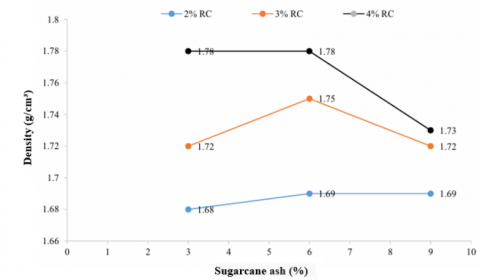
The Proctor compaction test, according to ASTM D1557, determined the maximum density of each mixture and the optimal moisture content for optimal soil compaction. This is crucial to ensure that the stabilized soil can withstand the expected loads without excessive deformation, as shown in Table 6 and Figure 3.
The addition of sugarcane ash and calcareous residues significantly increased the maximum density, with the highest values of 1.78 g/cm³ observed at 3% ash + 4% calcareous residue and 6% ash + 4% calcareous residue. These combinations improve the soil cohesion and compaction capacity, making the soil more resistant to loads.
Figure 3 shows the trends obtained from the soil densification values with the addition of sugarcane ash activated with calcareous residues, where it is shown that by increasing the amount of sugarcane ash the dry density values increased when they were combined with 2% and 3% of RC, when they were combined with 4% the values did not show an increase. It is also shown that the maximum limit obtained with respect to the amount of ash was 6% since from there the values.
Table 6. Proctor compaction test results with natural soils and additives
|
Sample |
Optimum Humidity (%) |
Maximum Density (g/cm³) |
|
Soil + 3% ash + 2% calcareous residue |
6.6 |
1.68 |
|
Soil + 3% ash + 3% calcareous residue |
6.05 |
1.72 |
|
Soil + 3% ash + 4% calcareous residue |
4.9 |
1.78 |
|
Soil + 6% ash + 2% calcareous residue |
4.8 |
1.69 |
|
Soil + 6% ash + 3% calcareous residue |
4 |
1.75 |
|
Soil + 6% ash + 4% calcareous residue |
7.2 |
1.78 |
|
Soil + 9% ash + 2% calcareous residue |
6.4 |
1.69 |
|
Soil + 9% ash + 3% calcareous residue |
5.6 |
1.72 |
|
Soil + 9% ash + 4% calcareous residue |
5.5 |
1.73 |
Figure 3. Dispersion of maximum density results with natural soils and additives
•CBR index
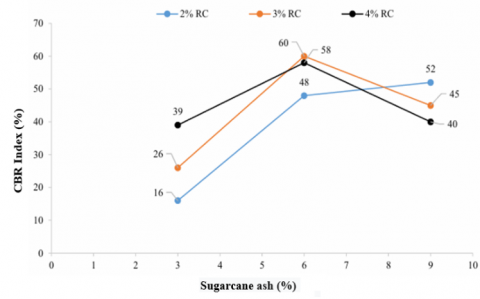
The CBR index was used to assess the strength of the stabilized soil. In the natural soil samples, the CBR index was relatively low, underscoring the importance of additives in improving soil properties. By incorporating sugarcane ash and limestone residues, a substantial improvement in the CBR was expected, indicating greater load-bearing capacity and structural stability, as seen in Table 7 and Figure 4.
The CBR index for natural soil was 9%, indicating poor load-bearing capacity. The highest CBR value was 60% with 6% ash + 3% calcareous residue, a significant improvement that indicates better penetration resistance and structural stability for road applications.
Table 7. Results of the CBR index (%) test with natural soils and additives
|
Sample |
CBR (%) |
|
Soil + 3% ash + 2% calcareous residue |
16 |
|
Soil + 3% ash + 3% calcareous residue |
26 |
|
Soil + 3% ash + 4% calcareous residue |
39 |
|
Soil + 6% ash + 2% calcareous residue |
48 |
|
Soil + 6% ash + 3% calcareous residue |
60 |
|
Soil + 6% ash + 4% calcareous residue |
58 |
|
Soil + 9% ash + 2% calcareous residue |
52 |
|
Soil + 9% ash + 3% calcareous residue |
45 |
|
Soil + 9% ash + 4% calcareous residue |
40 |
Figure 4. Dispersion of CBR index results (%) with natural soils and additives
Figure 4 shows the trend lines obtained from the CBR results of soils with mixtures of sugarcane ash and calcareous waste. It can be seen that up to 6% ash, the values increased, and then decreased. This phenomenon occurs when the soils are combined with 3% and 4% calcareous waste. However, when mixtures of ash with 2% calcareous waste were used, the values only increased.
3.3 Validation of results
3.3.1 Comparison of results
The comparison of the results focuses on two key parameters that are fundamental to assessing the behavior of the soil in terms of its load-bearing capacity and stability:
• Maximum density and optimum moisture content are obtained through the Proctor compaction test.
• CBR index, which indicates the soil's capacity to bear.
These parameters are compared in the natural soil samples with those stabilized with sugarcane ash and calcareous residues in different proportions (3%, 6%, and 9% ash with 2%, 3%, and 4% calcareous residues). This comparison allows us to verify whether the additives effectively improve the soil properties and provide a viable solution for stabilization in road construction projects, as shown in Table 8 and Figure 5.
In Table 8 of the results, it can be observed how the additions of sugarcane ash and calcareous residues affect the soil properties, specifically in terms of optimum moisture, maximum density, and the CBR index.
(1). Optimum moisture content
• The optimum moisture content of natural soil is 5.7%, indicating that the soil requires a moderate amount of water to reach maximum density.
• As additives are added, a progressive increase in optimum moisture content is observed in mixtures with sugarcane ash and calcareous residue, especially when combining 6% ash and 3–4% calcareous residue, reaching a value of 7.2% in the sample with 6% ash + 4% calcareous residue.
• Additions of 3% ash result in a comparatively lower moisture content, suggesting that mixtures with higher amounts of calcareous residue or sugarcane ash may require more water to reach maximum density.
(2). Maximum density (g/cm³)
• The maximum density of natural soil is 1.65 g/cm³, a value that reflects the compaction that natural soil can achieve without any additives.
• By adding sugarcane ash and limestone residue, the maximum density increased considerably in several samples. The densest mixture was the one containing 3% ash + 4% limestone residue, reaching 1.78 g/cm³.
• This increase in maximum density is due to the improved compaction capacity provided by the additives, especially the limestone residue, which acts as a stabilizer that increases soil cohesion.
(3). CBR index
• The CBR index is a crucial indicator of soil bearing capacity, especially in road engineering.
• The natural soil had a CBR of 9%, indicating that the soil has a low bearing capacity in its original state.
• The additions of sugarcane ash and limestone residue caused a significant increase in the CBR index. Mixtures with 6% ash + 3% limestone residue achieved the highest value of 60%, reflecting a considerable improvement in penetration resistance.
• Combinations with 3% ash + 4% limestone residue also showed a notable increase in CBR (39%), indicating that increasing the amount of limestone residue improves the soil's bearing capacity.
• Overall, all mixtures with additives significantly exceeded the CBR of natural soil, demonstrating that stabilization with these materials is an effective strategy for improving soil mechanical properties.
• Regarding maximum density, Figure 5 shows how the samples with additives achieve higher density values compared to the natural soil.
• Regarding the CBR index, Figure 5 highlights a significant improvement in the soil's bearing capacity with the addition of sugarcane ash and calcareous residue, especially with combinations such as 6% ash + 3% calcareous residue, reaching values of up to 60%.
Table 8. Compaction and CBR test results on natural soils and additives
|
Sample |
Optimum Moisture (%) |
Maximum Density (g/cm³) |
CBR (%) |
|
Natural Soil |
5.7 |
1.65 |
9 |
|
Soil + 3% Ash + 2% Calcareous Residue |
6.6 |
1.68 |
16 |
|
Soil + 3% Ash + 3% Calcareous Residue |
6.05 |
1.72 |
26 |
|
Soil + 3% Ash + 4% Calcareous Residue |
4.9 |
1.78 |
39 |
|
Soil + 6% Ash + 2% Calcareous Residue |
4.8 |
1.69 |
48 |
|
Soil + 6% Ash + 3% Calcareous Residue |
4 |
1.75 |
60 |
|
Soil + 6% Ash + 4% Calcareous Residue |
7.2 |
1.78 |
58 |
|
Soil + 9% Ash + 2% Calcareous Residue |
6.4 |
1.69 |
52 |
|
Soil + 9% Ash + 3% Calcareous Residue |
5.6 |
1.72 |
45 |
|
Soil + 9% Ash + 4% Calcareous Residue |
5.5 |
1.73 |
40 |

Figure 5. Dispersion of CBR index results (%) with natural soils and additives
This study shows that the addition of sugarcane ash and calcareous residues significantly improves the mechanical properties of sandy soils. The optimal combination of 6% sugarcane ash and 3% calcareous residues resulted in a CBR increase to 60%, surpassing the natural soil value (9%), which improves the stability and durability of road infrastructure in coastal areas. Additionally, improvements in maximum density and optimum moisture content were observed, indicating an increase in soil cohesion and resistance to compaction and vehicular traffic.
The results are consistent with previous studies, showing that sugarcane ash improves cohesion and bearing capacity of soil, while calcareous residues enhance resistance and modify the soil's pH. However, the optimal ratio was 6% ash and 3% calcareous residues, with higher proportions showing no significant improvements.
An important trade-off when increasing sugarcane ash is cost and availability, as although it is relatively inexpensive, no linear improvement in soil bearing capacity is obtained when exceeding 6%.
The study presents limitations such as variability in the quality of materials and the potential difference between laboratory and field conditions, where factors such as moisture and extreme temperatures could influence long-term behavior.
Finally, the applicability of this technique is promising for other coastal regions and rural infrastructure projects in Peru, contributing to sustainability and cost reduction by using local and recyclable materials. However, further field and long-term studies are recommended to evaluate the durability of stabilized soils.
The study confirms that the addition of sugarcane ash and limestone residue significantly improves the mechanical properties of sandy soils. The optimal mixture of 6% ash and 3% limestone residue resulted in a CBR index of 60%, marking a substantial increase compared to the natural soil (9%). This improvement in bearing capacity and maximum density demonstrates the effectiveness of these additives, aligning with previous studies like the one in Puno, Peru, where quinoa ash and lime improved CBR to 32%. This highlights the advantages of using sugarcane ash and limestone residue over more traditional materials.
The best results in terms of maximum density and strength were achieved with 6% ash and 3% limestone residue. This combination emphasizes that optimal results do not necessarily require larger quantities of additives, making the use of local resources not only more efficient but also more cost-effective. Compared to studies using lime, sugarcane ash, and calcareous waste are not only more economical but also meet high technical standards for soil stabilization.
The use of local materials, such as sugarcane ash and calcareous waste, highlights the importance of the circular economy in civil engineering. These materials contribute to the reduction of agricultural and industrial waste, promoting sustainable construction. Compared to other alternatives like crushed seashell waste and rice ash, the use of local waste reduces material costs, supports sustainable waste management, and lowers CO₂ emissions, aligning with sustainability principles in engineering.
In coastal Peru, where sandy soils are prevalent, stabilization using sugarcane ash and calcareous residues offers a practical solution for improving soil bearing capacity and counteracting erosion. This is crucial for ensuring the durability and safety of road infrastructure in regions prone to natural events, such as heavy rainfall and earthquakes. Compared to more costly stabilization methods like lime and cement, this technique not only strengthens soils but also reduces the carbon footprint associated with external material transport.
|
SC |
Soil Classification (Clayey Sand according to SUCS) |
|
NTP |
Peruvian Technical Norms |
|
CBR |
California Bearing Ratio |
|
ATD |
Differential Thermal Analysis |
|
EDS |
Energy Dispersive Spectroscopy |
|
ASTM |
American Society for Testing and Materials |
|
MTC |
Ministry of Transportation and Communications Soils and Pavements Manual |
|
SUCS |
Unified Soil Classification System |
[1] Hayder, M.R., Ziari, H., Shaban, A.M. (2025). Characterizing geotechnical properties of sand subgrade soils stabilized with geopolymer based on metakaolin. Case Studies in Construction Materials, 22: e04389. https://doi.org/10.1016/j.cscm.2025.e04389
[2] Montenegro, V., Hernández, D., Domínguez, A., Vergara, F., Arrocha, J., González-Valoys, A. (2024). Stabilization of expansive soils in Panama with seashell residue mixtures. Revista Politécnica, 54(1): 45-52. https://doi.org/10.33333/rp.vol54n1.05
[3] Soto-Juscamayta, L.M., Mayorga-Rojas, J.C., Valle-Jurado, C.D., Gallarday-Bocanegra, T.E., Diaz-Cartagena, W.J., Lizarbe-Alarcón, H., Romero-Baylón, A.A. (2024). Validation of the slope stabilization technique in sedimentary rock with kikuyu grass cultivation to improve soil shear resistance. Mathematical Modelling of Engineering Problems, 11(11): 2953-2966. https://doi.org/10.18280/mmep.111108
[4] Abdulrahman, S.M., Al-Kaream, A., Khalid, W., Ihsan, E.A. (2024). Enhancing soil with low-cost pozzolanic materials: Rice husk ash and groundnut shell ash compared to cement. Mathematical Modelling of Engineering Problems, 11(4): 1115-1122. https://doi.org/10.18280/mmep.110430
[5] Debnath, D., Chouksey, S.K. (2022). Experimental study of strength behavior of soft soil stabilised with alkali activated copper slag. Materials Today: Proceedings, 65: 2112-2117. https://doi.org/10.1016/j.matpr.2022.07.106
[6] Ruiz, G., Farfán, P. (2016). Use of crushed seashell by-products for sandy subgrade stabilization for pavement purpose. In Proceedings of the 14th LACCEI International Multi-Conference for Engineering, Education, and Technology: Engineering Innovations for Global Sustainability, pp. 1-6. https://doi.org/10.18687/LACCEI2016.1.1.053
[7] Llano, E., Ríos, D., Restrepo, G. (2020). Evaluation of technologies for stabilization of road soils using accelerated weathering. A Strategy for Analysis of Impacts on Biodiversity. TecnoLógicas, 23(49): 164-178.
[8] Rahgozar, M.A., Saberian, M., Li, J. (2018). Soil stabilization with non-conventional eco-friendly agricultural waste materials: An experimental study. Transportation Geotechnics, 14: 52-60. https://doi.org/10.1016/j.trgeo.2017.09.004
[9] Ricardo, M.A.D., Rodriguez, C.L., Leal, S.C.O., Hernández, C.D.G. (2024). Estabilización de suelo mediante adición de ceniza de caña de azúcar en la vía Jerusalén-Guataqui, Cundinamarca, Colombia. Encuentro Internacional de Educación en Ingeniería, pp. 1-10. https://doi.org/10.26507/paper.3980
[10] Almuaythir, S., Zaini, M.S.I., Hasan, M., Hoque, M.I. (2024). Sustainable soil stabilization using industrial waste ash: Enhancing expansive clay properties. Heliyon, 10(20): e39124. https://doi.org/10.1016/j.heliyon.2024.e39124
[11] Mareeswaran, M., Suryaprakash, T., Srinivas, N.T., Rathnavelu, P. (2023). An investigation on agricultural wastes as soil stabilizers. Materials Today: Proceedings. https://doi.org/10.1016/j.matpr.2023.04.330
[12] Gidebo, F.A., Yasuhara, H., Kinoshita, N. (2023). Stabilization of expansive soil with agricultural waste additives: A review. International Journal of Geo‑Engineering, 14: 14. https://doi.org/10.1186/s40703-023-00194-x
[13] Shinde, B., Sangale, A., Pranita, M., Sanagle, J., Roham, C. (2024). Utilization of waste materials for soil stabilization: A comprehensive review. Progress in Engineering Science, 1(2-3): 100009. https://doi.org/10.1016/j.pes.2024.100009
[14] Singh, S. (2021). Experimental investigation of corn cob ash on silty clay stabilized with calcium carbide. Materials Today: Proceedings, 37: 3658-3660. https://doi.org/10.1016/j.matpr.2020.10.146
[15] Zhou, Y., Huo, M., Zhang, L., Guan, Q. (2024). Strength development and solidification mechanism of soils with different properties stabilized by cement-slag-based materials. Case Studies in Construction Materials, 21: e04034. https://doi.org/10.1016/j.cscm.2024.e04034
[16] Petchgate, W., Pongsivasathit, S., Tangpagasit, J., Piyaphipat, S., Pinpatthanapong, K., Thongindam, P. (2025). Sustainable soil stabilization: Evaluating the feasibility of hydraulic cement in the deep mixing method. Case Studies in Construction Materials, 22: e04394. https://doi.org/10.1016/j.cscm.2025.e04394
[17] Agate, E.E., Timothy, N., Nathaniel, A.O., Ngassam, I. (2024). Performance of expansive soil stabilized with bamboo charcoal, quarry dust, and lime for use as road subgrade material. SSRG International Journal of Civil Engineering, 11(2): 108-120. https://doi.org/10.14445/23488352/IJCE-V11I2P110
[18] Hayder, M.R., Ziari, H., Shaban, A.M. (2025). Characterizing geotechnical properties of sand subgrade soils stabilized with geopolymer based on metakaolin. Case Studies in Construction Materials, 22: e04389. https://doi.org/10.1016/j.cscm.2025.e04389.
[19] Yan, X., Xu, Q., Dong, S., Sun, Y., Ma, L., He, X., Zhou, Y. (2024). Improved stabilization of loess soil using magnesium oxysulfate cement-based ecological composite binder. Construction and Building Materials, 445: 137865. https://doi.org/10.1016/j.conbuildmat.2024.137865
[20] Rotimi Olafisoye, E., Assadi-Langroudi, A., Donyavi, S., Esmatkhah Irani, A. (2022). Scopes for use of Indian agriculture wastes in soil stabilisation. In International Workshop on Advances in Laboratory Testing of Liquefiable Soils and Nature Inspired Solutions for the Built Environment Conference, pp. 13-23. https://doi.org/10.1007/978-3-031-51951-2_2
[21] Hoque, N. M. R., Islam, S., Ray, S., Sarker, S., Islam, J. (2024). Optimization of fly ash and cement for stabilizing clay soil. Research Square. https://doi.org/10.21203/rs.3.rs-4679698/v1
[22] Vincevica-Gaile, Z., Teppand, T., Kriipsalu, M., Krievans, M., Jani, Y., Klavins, M., Burlakovs, J. (2021). Towards sustainable soil stabilization in peatlands: Secondary raw materials as an alternative. Sustainability, 13(12): 6726. https://doi.org/10.3390/su13126726