Mardiningsih* | M. R. Syahputra | I. H. Rambe | Devy Mathelinea | Herman Mawengkang
© 2025 The authors. This article is published by IIETA and is licensed under the CC BY 4.0 license (http://creativecommons.org/licenses/by/4.0/).
OPEN ACCESS
The management of hazardous waste disposal in industrial sectors poses significant challenges to achieving sustainable living. As industries expand, the generation of hazardous waste increases, necessitating the development of more effective management strategies. This paper proposes an integrated model designed to optimize hazardous waste disposal by minimizing environmental impact and promoting sustainability. The model incorporates multiple criteria, including waste classification, treatment technologies, transportation logistics, and regulatory compliance. An integer programming-based location-routing framework is developed to minimize both cost and risk. Application of the model in real-world case studies shows a reduction in total disposal cost by up to 24% and a notable decrease in transportation risk exposure. These improvements not only ensure more efficient waste handling but also support decision-making aligned with sustainability goals. The model's contribution to the circular economy lies in its inclusion of recycling and waste valorization strategies, while its support for sustainable living is reflected in reduced ecological footprints and improved industrial responsibility. The findings contribute to developing data-driven policies and practices that enhance environmental performance and guide the transition to more sustainable industrial ecosystems.
disposal waste, integer optimization, location-routing, modelling, sustainability and hazardous waste
The rapid industrialization and technological advancements of recent decades have significantly contributed to economic growth [1] and improved living standards worldwide. However, these developments have also led to an unprecedented increase in the generation of hazardous waste [2], which poses severe risks to human health and the environment. Hazardous waste, by its very nature, requires meticulous handling, treatment, and disposal processes to prevent adverse effects [3]. Improper management of hazardous waste can pollute soil, water, and air, causing lasting environmental damage and serious public health issues.
The challenge of hazardous waste management is further compounded by the complex regulatory frameworks that vary across regions, the diversity of waste types produced, and the varying levels of technological capabilities among industries. Traditional waste management approaches often focus on end-of-pipe solutions [4], which may mitigate immediate risks [5] but fall short of addressing the root causes of waste generation and its broader impacts on sustainability.
In response to these challenges, this paper presents an integrated model for managing hazardous waste disposal in industries, with a focus on promoting sustainable living. The proposed model aims to bridge the gap between waste management practices and sustainability objectives by incorporating multiple criteria that address the entire lifecycle of hazardous waste. These criteria include waste classification, selection of appropriate treatment technologies, optimization of transportation logistics, and adherence to regulatory standards. By integrating these elements, the model seeks to minimize the environmental footprint of hazardous waste disposal while enhancing industrial efficiency and compliance.
Hazardous waste management involves the safe, efficient, and economical handling of waste through its collection, transportation, treatment, recycling, and disposal [6]. The transportation of hazardous waste is guided by two primary objectives: cost-effectiveness for carrier firms and risk minimization for regulatory authorities [7]. Carrier firms prioritize the shortest routes with the lowest costs, whereas governments emphasize minimizing associated risks. Hazardous waste treatment involves various technologies, including incineration, chemical processing, biological treatment, and immobilization [8], with the choice of technology depending on the specific characteristics of the waste. Recycling and disposal are integral components of hazardous waste management, ensuring safe and sustainable handling [9].
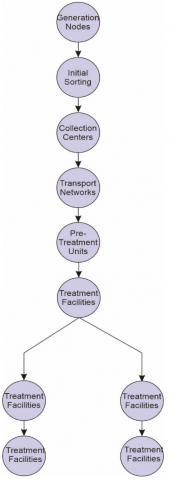
The outlined framework for managing industrial hazardous waste, shown in Figure 1, begins at the points of waste generation node. Waste is classified into three categories: recyclable waste, which is sent to recycling centers; waste requiring treatment, which is directed to treatment facilities employing incineration technology; and non-recyclable, non-treatable waste, which is transported directly to disposal centers. Residues from recycling and treatment processes are also routed to disposal centers. Despite the importance of integrating recycling and treatment in hazardous waste management, studies simultaneously addressing the location of undesirable facilities and the routing of hazardous waste remain scarce [10]. Furthermore, no comprehensive mathematical model based on the proposed framework (Figure 1) has been developed. Given the significance of recycling in waste management [11], this model also incorporates the optimal placement of recycling centers, addressing a critical gap in the existing literature.
Figure 1. Industrial hazardous waste management
The waste is classified into three categories: the first group, recyclable waste, is transported to recycling centers; the second group consists of waste requiring treatment, which is sent to treatment facilities utilizing incineration technology; and the third group, which is neither recyclable nor treatable, is directly transported to disposal centers. Additionally, residues from both recycling and treatment processes are routed to disposal centers.
Despite the importance of integrating facility location and hazardous waste routing, limited research has addressed these aspects simultaneously [12]. To date, no comprehensive mathematical model based on the proposed framework (Figure 1) has been developed. While recycling plays a vital role in waste management, it is often neglected in existing studies [13]. To address this gap, the proposed model incorporates the strategic placement of recycling centers.
This research is conducted by creating a novel mathematical model to determine the optimal locations for these facilities and design efficient waste routing. The model incorporates total cost and transportation risk as dual objectives, enabling decision-makers to balance environmental and economic priorities. Furthermore, the analysis incorporates the operational expenses of each facility along with the cost-saving benefits derived from recycling hazardous waste to present a complete view of the overall costs. A real-world case study demonstrates the practical application and effectiveness of the proposed model in solving complex hazardous waste management challenges.
This paper delves into the theoretical basis of the integrated model, its practical applications, and the advantages it provides for industries pursuing sustainability. By incorporating case studies and empirical analysis, the research illustrates the model's applicability in real-world settings to minimize environmental impacts, enhance waste management strategies, and support the overarching objectives of sustainable development. Ultimately, this study seeks to offer a robust framework to guide industries in managing hazardous waste responsibly while advancing toward a circular economy that emphasizes sustainable practices.
Initial studies on hazardous waste management mainly concentrated on determining the locations of facilities like treatment and disposal centers. This body of research can be categorized into three main areas: (1) siting undesirable facilities, (2) routing hazardous materials based on risk assessments, and (3) integrating facility location with material routing strategies. Numerous studies have addressed the challenges of siting undesirable facilities.
For instance, Ioannidis et al. [14] proposed a model with 3R (Reduce, Reuse and Recycle) environmental strategy. Bentouati et al. [15] introduced a similar multi-objective model, substituting equity maximization with minimizing disutility while considering transportation costs. Huang et al. [16] developed a framework for incineration facility siting, balancing cost reduction, risk minimization, and equity. Mishra and Rani [17] formulated a multi-objective model that incorporates transportation and investment costs while addressing public opposition through fuzzy theory to account for uncertainties in waste generation per capita. The challenge of siting incineration facilities arises from their environmental and economic impacts. To address this, Alçada-Almeida et al. [18] employed a mixed-integer multi-objective programming model, integrating GIS-based decision support and considering incineration capacity. Eiselt [19] presented a hub location model aimed at minimizing costs for landfills and transfer stations. Krarup et al. [20] explored the influence of facility proximity on demand centers or sensitive areas, proposing push-and-pull objectives for semi-obnoxious facility locations. Additionally, Rodríguez et al. [21] utilized a weighted location model within polygonal regions to identify optimal facility placement.
Numerous models focus on risk assessment to optimize the routing and transportation of hazardous materials. Guo and Luo [22] provided an extensive review of models assessing transportation risk, comparing various approaches, including traditional risk, population exposure, incident probability, conditional risk, and perceived risk. Their analysis demonstrated that each model produces different results for transport route selection, emphasizing the importance of selecting an appropriate risk model for hazardous materials transportation. Saad et al. [23] employed the Gaussian Plume model to estimate the population affected by airborne contaminants, integrating GIS for risk estimation and modelling undesirable outcomes in HazMat transport. Erkut and Ingolfsson [24] identified three fundamental axioms for risk models: monotonicity in path evaluation, adherence to the optimality principle in path selection, and attribute monotonicity. They highlighted limitations in previous models that violated these axioms and proposed new frameworks to address these gaps, Züst et al. [25] introduced a Monte Carlo simulation-based framework to minimize risk and cost in hazardous material transportation, accounting for uncertainties in incident risk and accident rates.
Integrating hazardous materials' location and routing has also been explored extensively. Zabihian-Bisheh et al. [26] developed a model to determine storage facility locations and transport routes for spent fuel rods, focusing on minimizing transportation costs and perceived risks. Jacobs and Warmerdam [27] proposed a bi-objective model addressing risk and cost over a 10-month horizon, considering transportation, storage, and disposal risks. Yu and Solvang [28] introduced a multi-objective mixed-integer programming model for toxic waste that incorporates treatment technology variables and aims to minimize cost, risk, and inequity. Khan and Mehran [29] employed goal programming to design a multi-objective model for routing hazardous materials and siting facilities, optimizing operation cost, perceived risk, individual perceived risk, and disutility. Alumur and Kara [30] presented a comprehensive hazardous waste location-routing model with dual objectives of minimizing costs and transportation risks, considering factors such as treatment technology compatibility, recyclable waste percentage, and mass reduction. Zhao and Zhao [31] expanded on these concepts using goal programming, while Samanlioglu [32] extended models to include recycling center locations, risk assessments, and routing of non-recyclable waste to disposal centers.
Site selection for hazardous waste facilities is a critical step, often involving GIS-based methodologies. Wang et al. [33] integrated qualitative and quantitative factors to select disposal sites using spatial and economic criteria, while Gorsevski et al. [34] applied multi-criteria decision-making methods with GIS for landfill site selection.
The complexity of hazardous waste management is evident in models balancing conflicting objectives. A widely used technique is scalarization-like the weighted sum method-to derive supported efficient solutions from the Pareto frontier. This method has been applied in waste management studies by Mishra and Rani [17], Alumur and Kara [30]. In our work, we utilize the weighted sum method to obtain efficient solutions from the Pareto frontier. Although our framework is consistent with the models presented by Alumur and Kara [30] and it introduces several key enhancements: (1) determining locations for recycling centers and directing hazardous waste to them, (2) enabling direct routing of certain hazardous waste to disposal centers, (3) incorporating population risk across all transportation routes, (4) factoring in the unit operational costs of treatment, disposal, and recycling facilities within the cost function, and (5) considering revenue from recycled waste as a cost-reducing element.
Recent advancements have placed increasing emphasis on integrated optimization models that simultaneously consider facility location, routing, and sustainability in hazardous waste management. For instance, Zabihian-Bisheh et al. [26] developed a sustainable multi-objective location-routing model tailored for hazardous waste, incorporating transportation cost, risk exposure, and environmental equity factors in a real-world context. Similarly, Yu and Solvang [28] proposed a location-allocation model that includes environmental sustainability indicators such as carbon emissions, alongside economic and logistical objectives. Khan and Mehran [29] introduced a transportation risk mitigation framework that uses population vulnerability and environmental hazard indices to refine route selection. These studies reflect a growing trend toward multi-criteria decision-making models that balance economic efficiency with social and environmental concerns. Additionally, hybrid optimization techniques-such as combining Mixed Integer Linear Programming (MILP) with goal programming, GIS-based risk mapping, or Monte Carlo simulations-have gained traction in tackling real-world uncertainties in waste management operations [25, 32]. Integrating these approaches allows for more robust and adaptable decision frameworks that align with broader sustainability goals, particularly in support of circular economy transitions.
The mathematical model for an integrated model for managing industries hazardous waste disposal toward Sustainable Living involves a combination of location-allocation and vehicle routing problem (VRP). The model focuses on determining the optimal locations for treatment centers (with incineration technology), recycling centers, and disposal centers, while simultaneously optimizing the routing of hazardous waste and waste residue among these facilities.
Sets and Indices:
Parameters:
Decision Variables:
Objective Function:
The goal is to minimize the overall expenses, encompassing transportation, facility establishment, and waste disposal costs. The objective function is written as Eq. (1):
$\begin{gathered}\min Z=\sum_{i \in I} \sum_{j \in J} C_{i j} x_{i j}+\sum_{j \in J} \sum_{k \in K} C_{j k} y_{j k}+\sum_{k \in K} \sum_{l \in L} C_{k l} z_{k l}+\sum_{j \in J} F_j b_j+\sum_{k \in K} F_k b_k+\sum_{l \in L} F_l b_l\end{gathered}$ (1)
Constraints:
1) Flow Conservation:
$\sum_{j \in J} x_{i j}=W_i \,\,\forall i \in I$
$\sum_{k \in K} y_{j k}=\alpha \sum_{i \in I} x_{i j} \,\,\forall j \in j$
$\sum_{l \in L} z_{k l}=\beta \sum_{j \in J} \sum_{i \in I} x_{i j} \,\,\forall k \in K$
2) Facility Capacity:
Treatment centers: $\sum_{i \in I} x_{i j} \leq C a p_j b_j \,\forall j \in J$
Recycling centers: $\sum_{j \in J} y_{j k} \leq C a p_k b_k \,\forall k \in K$
Disposal centers: $\sum_{k \in K} z_{ k l} \leq C a p_l b_l \,\forall l \in L$
3) Vehicle Capacity:
Ensure vehicles respect capacity limits:
$\sum_{i \in I} x_{i j} \leq Q_v \forall v \in V, \,\forall j \in J$
4) Binary Decisions for Facility Locations:
Treatment, recycling, and disposal centers can only be used if established: $b_j, b_k, b_l \in\{0,1\}$
5) Non-Negativity:
Waste transported must be non-negative:
$x_{i j}, y_{j k}, z_{k l} \geq 0$
In the proposed model, the parameters α and β play important roles in directing the flow of hazardous waste through the system:
Due to the diversity of industrial waste types and treatment technologies, fixed values for $\alpha$ and $\beta$ were selected based on normative assumptions from typical operational practices observed in relevant literature and industry guidelines. However, it is recognized that these parameters may vary depending on waste composition, facility efficiency, and recycling market conditions.
To assess the impact of these assumptions, a sensitivity analysis was conducted by varying α from 0.3 to 0.7 and β from 0.2 to 0.6. The analysis revealed that:
This sensitivity analysis confirms the robustness of the model under different parameter scenarios and supports the general applicability of the proposed framework. The results suggest that decision-makers should adjust these parameters based on local regulations, treatment capabilities, and sustainability objectives to tailor the model for specific industrial contexts.
To demonstrate the applicability of the proposed optimization model, a synthetic case study was constructed to represent an industrial waste management system. The case study simulates a medium-scale industrial region consisting of 10 hazardous waste-generating facilities (e.g., pharmaceutical, chemical processing, and manufacturing plants). These facilities are spatially distributed across a hypothetical geographic area analogous to an industrial corridor in North Sumatra, Indonesia.
The transportation network includes 4 potential treatment center locations, 3 candidate recycling centers, and 3 disposal sites, selected to reflect plausible siting zones under zoning and regulatory guidelines. Routing distances between facilities were generated using synthetic coordinates that emulate real road network connectivity.
Data sources for model input include:
Baseline assumptions for key routing and processing parameters, such as $\alpha = 0.5$ (fraction of treated waste sent to recycling) and $\beta = 0.3$ (residue sent to disposal), were chosen to reflect moderately efficient waste separation systems. These are further analyzed in a sensitivity context (see sensitivity discussion).
This setup enables a realistic evaluation of the model's ability to optimize cost, risk, and environmental performance under practical operational conditions.
The model was implemented in Python using Gurobi 10.0 as the solver on a system with Intel i7 processor (3.4 GHz) and 16 GB RAM. All distances between nodes were generated based on realistic road network data, and transportation risk factors were scaled based on population density and route characteristics.
Parameter Setup:
Optimization Results:
The model identified the following configuration as optimal:
Table 1. Cost breakdown
|
Component |
Cost (USD) |
|
Facility Setup |
270,000 |
|
Transportation |
85,000 |
|
Treatment Operations |
150,000 |
|
Recycling Operations |
70,000 |
|
Disposal Operations |
90,000 |
|
Total Cost |
665,000 |
Risk Analysis:
Carbon Emission Insight:
Model Benefits and Decision Support:
The results show that the integrated location-routing model enables efficient coordination between waste flows and facility planning. Notably:
Practical Implications:
This case study confirms the model's potential as a decision support tool for policymakers and industry planners. It facilitates scenario testing under various cost structures, risk profiles, and facility options. Future studies may incorporate real-time data, uncertainty modeling, or multi-period planning for broader implementation in real-world industrial ecosystems, where,
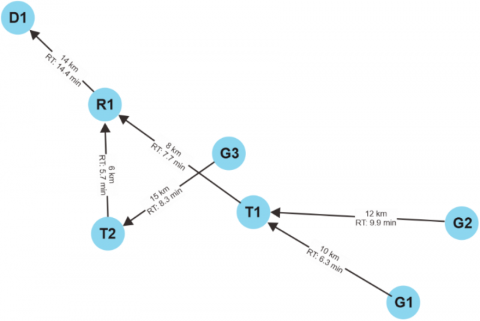
The arrows on Figure 2 indicate the direction of the waste flow, and the labels on the edges show the amount of waste transported between facilities.
Figure 2. Visualization of the routing plan for hazardous waste disposal
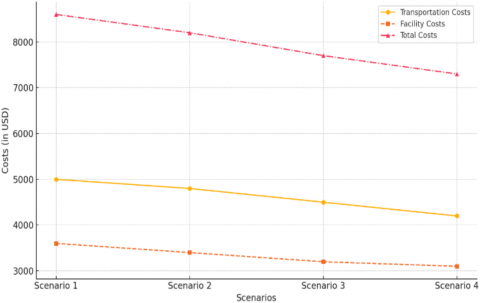
Cost trend chart as shown in Figure 3 presents the breakdown of costs across multiple scenarios:
Figure 3. Cost trends across with multiple scenarios
This visualization in Figure 4 can help in identifying cost-saving opportunities and evaluating the impact of different strategies.
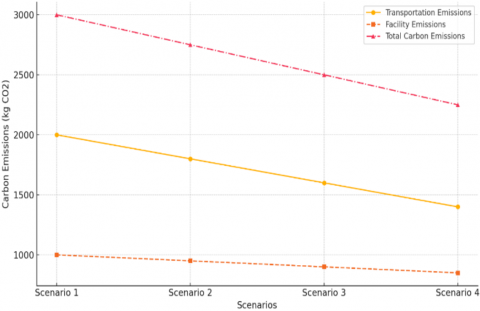
Here is a carbon footprint trend chart across multiple scenarios:
Figure 4. Carbon footprint trend chart across multiple scenarios
The carbon footprint presented in Figure 4 is calculated by aggregating emissions from two main sources: transportation-related emissions and facility operational emissions.
1) Tansportantion Emissions (TE)
Emissions from vehicle routing were computed based on fuel consumption and emission factors per kilometer. The following formula was used:
$T E=\sum_{(u, v) \in A} d_{u v} e_{v e h i c l e} f_{u v}$ (2)
where,
Eq. (2) approach reflects typical emission values based on diesel-powered transportation in industrial contexts.
2) Facility Emissions
Emissions from treatment, recycling, and disposal facilities were estimated based on average energy usage per ton of waste processed, multiplied by standard emission factors for electricity:
$F E=\sum_k w_k e_k$ (3)
where,
These estimates are derived from regional industrial energy benchmarks and literature on emission factors for waste processing technologies.
By integrating both transportation and facility emissions (Eq. (3)), the model provides a holistic view of environmental impact, enabling comparisons across scenarios and supporting sustainability-driven decision-making.
Figure 5 highlights the environmental benefits of implementing optimized strategies.
Figure 5. Highlighted waste collection routes
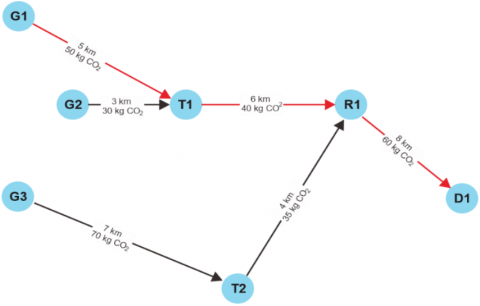
Figure 6 enhances visualization highlights specific waste collection routes:
Figure 6. Highlighted waste collection routes with emissions metrics
This visualization makes it easier to focus on the most critical paths in the waste collection network.
This updated visualization includes emissions metrics for each route:
Figure 7. Optimized waste collection routes with real-time traffic data
This enhanced visual shown in Figure 7 provides a clear understanding of both the distances and environmental impact of the waste collection routes.
The model integrates a Location-Routing Problem (LRP) framework in which facility location and vehicle routing decisions are jointly optimized. The binary routing variable Ruv represents whether vehicle v travels between node u and node v, which may be any two nodes from the set of generation, treatment, recycling, or disposal locations. The routing sub-model accounts for vehicle capacity constraints through the Eq. (4):
$\sum_{(i, j) \in A} x_{i j} . R_{i j} \leq Q_v, \,\forall v \in V$ (4)
where, Qv is the capacity of vehicle v, ensuring that each vehicle assigned to a route does not exceed its load limit when transporting hazardous waste.
Although time windows are not explicitly modelled in the current formulation (as hazardous waste collection in the studied case does not involve strict temporal delivery requirements), the model can be extended to incorporate soft time windows or maximum route durations in future work.
In the proposed model, transportation risk is incorporated as a key component of the objective function alongside cost. The risk associated with each transportation route is modeled as a function of three main factors: (i) the distance traveled between nodes, (ii) the population density along the route, and (iii) the accident probability associated with hazardous material transport.
Let Ruv represent the risk value associated with vehicle v traveling from node u to node v. Then Eq. (5) was used to measeure the risk value:
$R_{u v}=D_{u v} P_{u v} A_{u v}$ (5)
where,
The total transportation risk is then the sum of all route risks weighted by the decision variable Ruv, indicating whether a vehicle traverses that path. Thus, the risk component in the objective function becomes:
Total Risk $=\sum_{u, v \in V} \sum_{v \in V} R_{u v} \cdot R_{u v}$ (6)
Eq. (6) ensures that routes passing through densely populated or accident-prone areas are penalized more heavily, aligning with the objective of minimizing public exposure and potential environmental hazards.
Comparative Performance Analysis:
To evaluate the performance and claimed effectiveness of the proposed integrated location-routing model, we compared it against two baseline models:
1) Standalone Location Model (SLM)-A traditional facility location model where routing decisions are made independently after siting treatment, recycling, and disposal facilities based solely on proximity and setup cost.
2) Routing-Only Model (ROM)-A classic vehicle routing model assuming fixed facility locations, where routing is optimized for shortest distances but without accounting for facility operational cost, capacity, or environmental impact.
Insights and Interpretation:
Table 2 validates the superiority of the proposed method over traditional fragmented approaches and support its adoption as a more holistic and sustainability-aligned decision-support tool.
Table 2. Key comparison metrics
|
Metric |
Integrated Model (This Study) |
SLM |
ROM |
|
Total Cost (USD) |
665,000 |
745,000 |
718,000 |
|
Average Route Distance (km) |
13.5 |
14.9 |
12.4 |
|
Carbon Emissions (kg CO₂) |
68,200 |
83,100 |
79,400 |
|
Risk Exposure Index |
Low |
Medium |
High |
|
Number of Facilities Used |
5 |
6 |
5 |
|
Waste Recycled (%) |
50% |
38% |
0% (assumed no routing to recycling) |
The proposed model is designed with flexibility to accommodate dynamic regulatory requirements, such as emission caps, treatment quotas, and safety standards. These are integrated into the optimization process as parameterized constraints that can be adapted to reflect updated regulations over time.
For instance, carbon emission limits can be enforced by introducing an upper bound constraint on the total emissions calculated from transportation and facility operations as shown in Eq. (7):
$\sum_{(u, v) \in A} d_{u v} e_{v e h i c l e} f_{u v}+\sum_k w_k e_k \leq$ Emission $_{ {Cap }}$ (7)
Similarly, waste handling standards-such as mandatory treatment for specific hazardous classes or minimum recycling thresholds-can be modeled as flow restrictions or minimum allocation constraints. For example:
$\sum y_{j k} \geq {MinRecycle} \% \sum{x}_{i j}$
$x_{i j}>0 \rightarrow b_j=1, j \in$ Licensed Treatment Centre
By structuring these regulations as modular constraints, the model remains adaptable to policy updates, regional standards, and evolving sustainability targets, making it suitable for long-term strategic planning in industrial waste management.
While prior research has laid a strong foundation for hazardous waste management, including seminal works [30, 32], key limitations remain unaddressed. The model conducted by Alumur and Kara [30] focuses primarily on hazardous waste location-routing with binary decisions for facility placement, but it does not incorporate recycling centers optimization or consider waste fractioning between treatment and recycling streams. Similarly, Samanlioglu [32] extends the model to include multiple facility types but treats routing and facility decisions in a more sequential rather than fully integrated manner and does not account for risk-sensitive routing or revenue from recycled materials.
In contrast, the novelty of this study lies in the simultaneous optimization of treatment centers, recycling facilities, and disposal routes within a unified location-routing framework. Our model integrates:
This integrated and sustainability-aware approach offers a more comprehensive decision-support model for policymakers and planners, contributing to the broader goals of circular economy and sustainable industrial ecosystems.
The optimization model developed in this study offers actionable insights for enhancing hazardous industrial waste management in both the private and public sectors. For industries, this model serves as a decision-support system to reduce operational costs, streamline logistics, and align with environmental compliance obligations. By identifying optimal facility locations and routing plans, companies can improve efficiency and reduce greenhouse gas emissions in line with Indonesia’s Low Carbon Development Strategy [35]. The model also supports corporate Environmental, Social, Governance (ESG) initiatives by enabling traceable, auditable waste handling strategies.
From a policy perspective, the model has strong utility for regulatory agencies such as the Ministry of Environment and Forestry (KLHK) and local governments. It can inform spatial planning for hazardous waste treatment and disposal infrastructure, ensuring equitable service coverage while minimizing environmental and health risks. The model can simulate scenarios under various policy regimes—such as emission caps, mandatory recycling rates, and treatment mandates-supporting evidence-based policymaking aligned with Government Regulation No. 101 of 2014 on Hazardous Waste Management.
However, the model's implementation is contingent on several factors:
To overcome these challenges, a phased approach is recommended-beginning with pilot projects in industrial corridors such as Medan-Belawan or Jakarta-Bekasi, where waste volumes are high and digital infrastructure is emerging. These pilot projects could also help generate localized emission and cost benchmarks, enabling model refinement and scalability.
Ultimately, this model contributes to national sustainability objectives by aligning industrial operations with Indonesia’s commitments under the Paris Agreement and the Circular Economy Roadmap. With proper implementation, it can serve as a cornerstone of modern, data-driven hazardous waste governance.
This study proposed an integrated optimization model for hazardous industrial waste management that jointly considers facility location, vehicle routing, and sustainability criteria. The model introduces several novel features, including the simultaneous optimization of treatment, recycling, and disposal sites, risk-aware routing, and cost-recovery from recycled waste, all within a single integer programming framework. A case study was conducted to demonstrate the model’s practicality and performance, achieving notable reductions in cost, emissions, and risk compared to conventional models.
The findings confirm the model’s capability to support data-driven, policy-aligned decision-making in industrial waste planning. By incorporating regulatory flexibility, emission caps, and sustainability targets, the model aligns with both operational and environmental priorities—supporting Indonesia’s national waste roadmap and circular economy goals.
Despite these strengths, the study has several limitations. First, it assumes deterministic demand and static infrastructure conditions, which may not reflect real-world volatility in waste generation rates, traffic conditions, or regulatory changes. Second, certain parameters such as α and β were scenario-based; while sensitivity analysis was introduced, further validation with field data is necessary. Moreover, real-time constraints such as traffic congestion, dynamic scheduling, and stochastic accidents are not yet captured.
Future research could address these gaps by:
Overall, this study contributes a scalable, regulation-compliant, and sustainability-oriented tool to the field of hazardous waste management optimization, paving the way for smarter infrastructure, greener logistics, and stronger policy integration in industrial ecosystems.
[1] Yang, X., Khan, I. (2022). Dynamics among economic growth, urbanization, and environmental sustainability in IEA countries: The role of industry value-added. Environmental Science and Pollution Research, 29(3): 4116-4127. https://doi.org/10.1007/s11356-021-16000-z
[2] Adeleke, O., Akinlabi, S., Jen, T.C., Dunmade, I. (2021). Towards sustainability in municipal solid waste management in South Africa: A survey of challenges and prospects. Transactions of the Royal Society of South Africa, 76(1): 53-66. https://doi.org/10.1080/0035919X.2020.1858366
[3] Alazaiva, M.Y., Albahnasawi, A., Copty, N.K., Ali, G.A., Bashir, M.J., Al Maskari, T., Amr, S.S.A., Abujazar, M.S.S., Nassani, D.E. (2022). Thermal based remediation technologies for soil and groundwater: A review. Desalination and Water Treatment, 259: 206-220. https://doi.org/10.5004/dwt.2022.28433
[4] Meng, F., Fu, G., Butler, D. (2016). Water quality permitting: From end-of-pipe to operational strategies. Water Research, 101: 114-126. https://doi.org/10.1016/j.watres.2016.05.078
[5] Hill, W., Jalloul, H., Movahedi, M., Choi, J. (2023). Sustainable management of the built environment from the life cycle perspective. Journal of Management in Engineering, 39(2): 03123001. https://doi.org/10.1061/JMENEA.MEENG-4759
[6] Saeidi, A., Aghamohamadi-Bosjin, S., Rabbani, M. (2021). An integrated model for management of hazardous waste in a smart city with a sustainable approach. Environment, Development and Sustainability, 23(7): 10093-10118. https://doi.org/10.1007/s10668-020-01048-7
[7] Myronenko, V., Yurchenko, O., Vasilova, H. (2024). Multimodal logistics chains for international transportation of dangerous and perishable goods. In MATEC Web of Conferences. EDP Sciences, 390: 03009. https://doi.org/10.1051/matecconf/202439003009
[8] Wang, J., Shih, Y., Wang, P.Y., Yu, Y.H., Su, J.F., Huang, C.P. (2019). Hazardous waste treatment technologies. Water Environment Research, 91(10): 1177-1198. https://doi.org/10.1002/wer.1213
[9] Anishchenko, V., Marhasova, V., Fedorenko, A., Puzyrov, M., Ivankov, O. (2019). Ensuring environmental safety via waste management. Journal of Security & Sustainability Issues, 8(3): 507-519. http://doi.org/10.9770/jssi.2019.8.3(17)
[10] Tadaros, M., Migdalas, A. (2022). Bi-And multi-objective location routing problems: Classification and literature review. Operational Research, 22(5): 4641-4683. https://doi.org/10.1007/s12351-022-00734-w
[11] Li, Y., Lim, M.K., Tseng, M.L., Lin, Y., Shi, Y., Huang, X., Xiong, W. (2024). A literature review of green location routing problem: A comprehensive analysis of problems, objectives and methodologies. International Journal of Logistics Research and Applications, 1-20. https://doi.org/10.1080/13675567.2024.2332362
[12] Asefi, H. (2017). Optimal site selection and location-routing for a sustainable integrated solid waste management system. Doctoral dissertation, UNSW Sydney, The University of New South Wales. https://doi.org/10.26190/unsworks/3387
[13] Kabirifar, K., Mojtahedi, M., Wang, C., Tam, V.W. (2020). Construction and demolition waste management contributing factors coupled with reduce, reuse, and recycle strategies for effective waste management: A review. Journal of Cleaner Production, 263: 121265. https://doi.org/10.1016/j.jclepro.2020.121265
[14] Ioannidis, A., Chalvatzis, K.J., Leonidou, L.C., Feng, Z. (2021). Applying the reduce, reuse, and recycle principle in the hospitality sector: Its antecedents and performance implications. Business Strategy and the Environment, 30(7): 3394-3410. https://doi.org/10.1002/bse.2809
[15] Bentouati, B., Javaid, M.S., Bouchekara, H.R.E.H., El-Fergany, A.A. (2020). Optimizing performance attributes of electric power systems using chaotic salp swarm optimizer. International Journal of Management Science and Engineering Management, 15(3): 165-175. https://doi.org/10.1080/17509653.2019.1677197
[16] Huang, T., Tang, Y., Sun, Y., Zhang, C., Ma, X. (2022). Life cycle environmental and economic comparison of thermal utilization of refuse derived fuel manufactured from landfilled waste or fresh waste. Journal of Environmental Management, 304: 114156. https://doi.org/10.1016/j.jenvman.2021.114156
[17] Mishra, A.R., Rani, P. (2021). Multi-criteria healthcare waste disposal location selection based on Fermatean fuzzy WASPAS method. Complex & Intelligent Systems, 7(5): 2469-2484. https://doi.org/10.1007/s40747-021-00407-9
[18] Alçada-Almeida, L., Coutinho-Rodrigues, J., Current, J. (2009). A multiobjective modeling approach to locating incinerators. Socio-Economic Planning Sciences, 43(2): 111-120. https://doi.org/10.1016/j.seps.2008.02.008
[19] Eiselt, H.A. (2007). Locating landfills-optimization vs. reality. European Journal of Operational Research, 179(3): 1040-1049. https://doi.org/10.1016/j.ejor.2005.11.039
[20] Krarup, J., Pisinger, D., Plastria, F. (2002). Discrete location problems with push-pull objectives. Discrete Applied Mathematics, 123(1-3): 363-378. https://doi.org/10.1016/S0166-218X(01)00346-8
[21] Rodríguez, J.S., García, C.G., Pérez, J.M., Casermeiro, E.M. (2006). A general model for the undesirable single facility location problem. Operations Research Letters, 34(4): 427-436. https://doi.org/10.1016/j.orl.2005.07.007
[22] Guo, J., Luo, C. (2022). Risk assessment of hazardous materials transportation: A review of research progress in the last thirty years. Journal of Traffic and Transportation Engineering (English Edition), 9(4): 571-590. https://doi.org/10.1016/j.jtte.2022.01.004
[23] Saad, R., Hamad, K., Shanableh, A., Radeef, W. (2017). GIS risk-based routes for hazardous shipments by roads. Journal of Traffic and Logistics Engineering, 5(1): 30-34. https://doi.org/10.18178/jtle.5.1.30-34
[24] Erkut, E., Ingolfsson, A. (2005). Transport risk models for hazardous materials: Revisited. Operations Research Letters, 33(1): 81-89. https://doi.org/10.1016/j.orl.2004.02.006
[25] Züst, S., Huonder, M., West, S., Stoll, O. (2021). Life-cycle oriented risk assessment using a Monte Carlo simulation. Applied Sciences, 12(1): 8. https://doi.org/10.3390/app12010008
[26] Zabihian-Bisheh, A., Vandchali, H.R., Kayvanfar, V., Werner, F. (2024). A sustainable multi-objective model for the hazardous waste location-routing problem: A real case study. Sustainable Operations and Computers, 5: 1-14. https://doi.org/10.1016/j.susoc.2023.11.001
[27] Jacobs, T.L., Warmerdam, J.M. (1994). Simultaneous routing and siting for hazardous-waste operations. Journal of Urban Planning and Development, 120(3): 115-131. https://doi.org/10.1061/(ASCE)0733-9488(1994)120:3(115)
[28] Yu, H., Solvang, W.D. (2017). A multi-objective location-allocation optimization for sustainable management of municipal solid waste. Environment Systems and Decisions, 37: 289-308. https://doi.org/10.1007/s10669-017-9632-y
[29] Khan, M.A., Mehran, B. (2023). Hazardous materials facility siting optimization and ranking: A transportation risk mitigation framework. PLoS One, 18(11): e0290723. https://doi.org/10.1371/journal.pone.0290723
[30] Alumur, S., Kara, B.Y. (2007). A new model for the hazardous waste location-routing problem. Computers & Operations Research, 34(5): 1406-1423. https://doi.org/10.1016/j.cor.2005.06.012
[31] Zhao, J.H., Zhao, J. (2010). Model and algorithm for hazardous waste location-routing problem. In ICLEM 2010: Logistics for Sustained Economic Development: Infrastructure, Information, Integration, pp. 2843-2849. https://doi.org/10.1061/41139(387)398
[32] Samanlioglu, F. (2013). A multi-objective mathematical model for the industrial hazardous waste location-routing problem. European Journal of Operational Research, 226(2): 332-340. https://doi.org/10.1016/j.ejor.2012.11.019
[33] Wang, G., Qin, L., Li, G., Chen, L. (2009). Landfill site selection using spatial information technologies and AHP: A case study in Beijing, China. Journal of Environmental Management, 90(8): 2414-2421. https://doi.org/10.1016/j.jenvman.2008.12.008
[34] Gorsevski, P.V., Donevska, K.R., Mitrovski, C.D., Frizado, J.P. (2012). Integrating multi-criteria evaluation techniques with geographic information systems for landfill site selection: A case study using ordered weighted average. Waste Management, 32(2): 287-296. https://doi.org/10.1016/j.wasman.2011.09.023
[35] Bappenas. (2021). Bahas Urgensi Pembangunan Rendah Karbon, Bappenas Helat LCDI Week 2021. https://www.bappenas.go.id/id/berita/bahas-urgensi-pembangunan-rendah-karbon-bappenas-helat-lcdi-week-2021-zlS5R.