Guangzhong Sun* | Xiaoyan Sun
© 2026 The authors. This article is published by IIETA and is licensed under the CC BY 4.0 license (http://creativecommons.org/licenses/by/4.0/).
OPEN ACCESS
To investigate the gas permeability evolution of coal-rock combinations containing tectonic coal soft interlayers under true triaxial stress, tectonic coal was sampled from the No.2₁ coal seam in western Henan Province, a region significantly affected by the Songshan tectonic structure. Remolded coal and mortar were employed to simulate the coal seam and its roof/floor strata, respectively, and "rock–tectonic coal–rock" composite specimens were fabricated. Pure coal and pure rock specimens were also prepared for comparative purposes, and seepage experiments were carried out under different stress conditions and gas pressures. The results indicate that the combined specimens exhibit a three-stage permeability evolution during loading and failure, characterized by "compaction-induced permeability reduction–low-permeability maintenance–post-peak permeability enhancement". The marked permeability increase occurs after the peak stress, reflecting the transition of fractures from compression-induced closure to propagation and coalescence. Under fixed triaxial stress conditions in each group, the permeability generally first decreases and then increases with rising gas pressure, with a low-permeability region observed at approximately 0.8–1.2 MPa. At the same gas pressure, higher stress levels correspond to lower permeability. The specimen structure markedly influences the permeability enhancement process: the pure rock specimen shows a rapid post-failure permeability increase, the pure coal specimen exhibits relatively moderate variation, and the composite specimen displays a higher post-peak permeability than the pure coal specimen, which reflects the influence of coal–rock interfaces on the evolution of seepage channels. On this basis, a "gas pocket" outburst mechanism is proposed, incorporating the energy confinement provided by the roof and floor strata, the low-permeability sealing of tectonic coal, the disruption of the sealed structure induced by mining disturbance, and the feedback effect of fragmentation and desorption. This study provides experimental evidence and mechanistic insights for gas migration analysis and outburst prevention in coal seams containing tectonic coal.
combination body, tectonic coal, gas seepage, gas pocket, coal and gas outburst
China is the world's largest coal-producing country and one of the countries most severely affected by coal and gas outburst disasters [1-3]. In recent years, with the progressive depletion of shallow coal resources, the mining depth of coal mines has been extending downward at a rate of 10–25 m/a. By 2025, more than 50 mines in China had exceeded a mining depth of 1000 m. Deep coal seams are commonly characterized by a complex geological environment described as "three highs and one low," namely high stress, high gas pressure, high geothermal temperature, and low permeability, which poses unprecedented challenges to the prediction and prevention of coal and gas outburst disasters [4].
Coal and gas outbursts result from the coupled action of in-situ stress, gas pressure, and coal structure [5, 6]. Under tectonic action, the original coal seam structure is disrupted, giving rise to tectonic coal (soft coal) layers characterized by low strength, high porosity, and pronounced rheological behavior [7, 8]. Extensive field statistics indicate that more than 80% of outburst accidents occur in coal seams containing tectonic coal, and the thickness ratio of tectonic coal is significantly positively correlated with outburst risk [9]. Accordingly, permeability research on coal seams containing tectonic coal constitutes a fundamental scientific issue for gas drainage and outburst prevention.
However, most previous studies have focused on "single coal samples," neglecting the interactions among roof and floor rock strata, tectonic coal interlayers, and the primary coal seam within the seam [10-12]. In reality, a coal seam is a layered composite medium composed of roof, primary coal, tectonic coal, and floor, and gas flow within it represents a typical interlayer-coupled seepage problem. Conducting permeability research on "coal–tectonic coal–rock" combinations is therefore of considerable theoretical and engineering significance for revealing the gas seepage mechanism of outburst-prone coal seams, optimizing the layout of drainage boreholes, and evaluating the effectiveness of outburst prevention measures [13-16].
The factors influencing coal permeability mainly include effective stress, gas pressure, temperature, and coal deformation and damage. The classical Palmer and Mansoori [17] and Shi and Durucan [18] models derived permeability evolution equations from the perspectives of matrix shrinkage and effective stress, respectively. Connell [19] systematically compared coal permeability models under CO₂ geological sequestration conditions. Liu et al. [20] and Chen et al. [21] further proposed improved models that account for the anisotropy of adsorption-induced swelling.
Tectonic coal refers to the special coal structure formed by deformation and fragmentation of coal seams under tectonic action, exhibiting low strength, strong rheological behavior, and high gas desorption rate. It can be classified into brittle deformation series (cataclastic coal, granulated coal, and pulverized coal) and ductile deformation series (wrinkled coal and mylonitic coal).
In terms of permeability, the permeability of tectonic coal is typically 1–3 orders of magnitude lower than that of primary structured coal [13-16]. Wang et al. [22] performed triaxial seepage experiments and reported that the permeability of mylonitic coal is 1/100 to 1/500 of that of primary structured coal. Zhang et al. [23] quantitatively characterized the pore structures of different types of tectonic coal using nuclear magnetic resonance (NMR) techniques.
Research on the permeability of coal–rock combinations remains comparatively limited, although it has attracted increasing attention in recent years. Chen et al. [24] established a multi-field coupled model for coal–rock combinations in the context of deep coal seam group mining. Liu et al. [25] fabricated physical models of coal–rock combinations with different fracture structures using 3D printing technology and carried out systematic seepage experiments. Wang et al. [26] quantitatively predicted the permeability of coal–rock combinations by integrating digital core technology with machine learning methods. Zhao et al. [27] developed a permeability evolution model for coal–rock combinations that incorporates damage evolution.
Coal and gas outburst is a transient failure process of gas-bearing coal–rock systems. He [6] proposed the "three-factor coupling" mechanism for coal and gas outbursts. Li et al. [28] investigated the evolution of outburst precursor information through a multi-field monitoring system.
From the perspective of porous media fluid transport and solid–gas coupling physics, a synthesis of the above literature reveals the following deficiencies in current research on the permeability of coal–rock combinations containing gas-bearing tectonic coal: existing studies have predominantly focused on single coal samples, with comparatively limited investigation of the permeability characteristics of "rock–tectonic coal–rock" combinations; the dependence of tectonic coal permeability on coal structure has yet to be fully elucidated; and in particular, the theoretical interpretation of the outburst process of gas-bearing inclusions confined within "rock–coal–rock" sandwich structures remains inadequate.
2.1 Experimental equipment
The experiments were conducted using a "Multi-field Coupled Experimental Apparatus for Pulsation Fracturing of Deep Gas-Bearing Coal and Rock," independently developed by Henan Polytechnic University, to investigate the mechanical instability behavior and seepage characteristics of gas-bearing coal–rock combinations under true triaxial stress paths. The core structure of the apparatus is illustrated in Figure 1. The experimental system consists primarily of a true triaxial model system, an independent servo loading system, a gas seepage and pressurization system, an outlet metering system, and a vacuum system. These subsystems operate in coordination to achieve six-directional independent loading, gas adsorption and seepage, and precise measurement of pressure and flow rate.

Figure 1. Schematic diagram of the multi-field coupled experimental apparatus for pulsation fracturing of deep gas-bearing coal and rock
2.2 Preparation of experimental specimens
The coal samples were collected from the Jinling Coal Mine of Zhengzhou Dengcao Group. The No.2₁ coal seam of this mine is outburst-prone, with a dip angle of 27°. Influenced by geological tectonism, tectonic coal is widely developed within the seam, which exhibits low seam strength, a firmness coefficient ranging from 0.12 to 0.28, an initial gas desorption velocity of 27 mmHg, and a coal seam damage type of Classes IV and V.
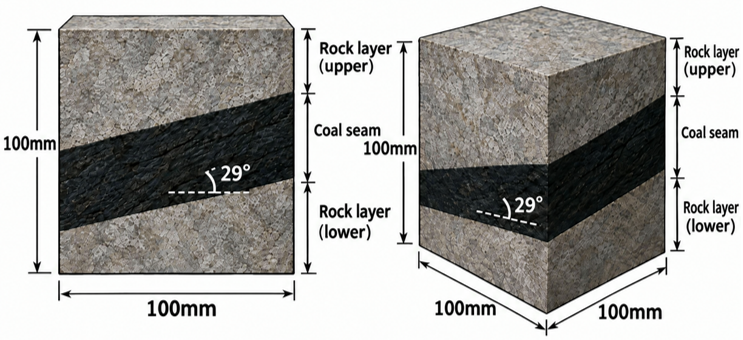
An integrated casting method was employed to fabricate briquette coal, briquette rock, and "rock–coal–rock" combination specimens. Mortar was used to simulate the rock strata, while remolded coal was used to simulate the coal seam. Based on extensive trial mixing, the mass ratio of the mortar (simulating the rock strata) was cement: river sand: water = 1:1.5:0.5, and that of the remolded coal (simulating the coal seam) was cement: coal powder: water = 1:2.5:1. The materials were processed into cubic specimens with dimensions of 100 mm × 100 mm × 100 mm. A schematic illustration is shown in Figure 2, and the fabrication process is depicted in Figure 3. For comparison purposes, pure coal and pure rock specimens were also prepared and tested.
Figure 2. Schematic illustration of the“rock–coal–rock” combination specimen

Figure 3. Specimen preparation procedure
2.3 Experimental design
The experiments were primarily designed to investigate the permeability characteristics of "rock–coal–rock" combinations under triaxial loading, on the basis of the three principal factors governing coal and gas outbursts: gas pressure, in-situ stress, and coal structure. The permeability was calculated in accordance with the method reported in reference [29].
The experimental parameters were designed as Table 1.
Table 1. Loading conditions for the true triaxial seepage tests
|
Specimen |
σ₁ Loading Rate (MPa·s⁻¹) |
σ₂ (MPa) |
σ₃ (MPa) |
Gas Pressure (MPa) |
|
RCR11 |
0.05 |
5 |
3 |
0.4 |
|
RCR12 |
0.8 |
|||
|
RCR13 |
1.2 |
|||
|
RCR14 |
1.6 |
|||
|
RCR15 |
2.0 |
|||
|
RCR21 |
0.05 |
3 |
3 |
0.8 |
|
RCR22 |
5 |
|||
|
RCR23 |
7 |
|||
|
RCR24 |
9 |
|||
|
RCR25 |
11 |
2.4 Experimental procedure
(1) Equipment inspection: The airtightness of the seepage system was checked, the data acquisition system was verified, and the oil drainage line was confirmed to be in the closed position. Potential hazards were identified and eliminated to ensure experimental safety and reliability.
(2) Specimen installation: The specimen was fixed on the base pedestal, the gas conduit was connected, and the lateral pressure platens were adjusted to be parallel with the specimen surfaces. The horizontal principal stress hydraulic servo system was then activated to drive the lateral platens into close contact with the specimen. Finally, the axial pressure transition plate and various sensors were installed. The installation procedure is illustrated in Figure 4.
(3) Cover plate installation: A hoist was used to position the cover plate over the triaxial loading chamber, enabling the application of axial stress.
(4) Vacuum pumping: A vacuum pump was connected, and the experimental chamber and gas delivery pipelines were subjected to continuous vacuum pumping for 12 hours to eliminate interference from residual gas.

Figure 4. Specimen installation
(5) Adsorption equilibrium: The inlet valve was opened and the gas pressure was set to the prescribed value, allowing the specimen to adsorb gas for more than 24 hours. Adsorption equilibrium was considered to be achieved once the variations in axial and lateral strains stabilized.
(6) Disassembly and cleaning: Upon completion of the test, the gas cylinder was closed and the stress was released slowly. The components of the experimental apparatus were subsequently dismantled and cleaned to restore them to a ready state for subsequent experiments.
3.1 Gas permeability characteristics during the complete stress–strain process of the "rock–coal–rock" combination
Throughout the experiments, the minimum principal stress was maintained at 3 MPa. Under this condition, the gas permeability evolution during the loading and failure process of the "rock–coal–rock" combination was examined under different gas pressures and lateral pressures. Representative experimental data are presented in Figure 5.
As can be observed from the figure, the gas permeability exhibits broadly similar trends under different gas pressures and intermediate principal stresses. During the initial loading stage, the principal stress difference increases with rising strain, while the permeability decreases rapidly. This behavior is consistent with the progressive closure of original pores and fractures: the aperture of effective seepage channels narrows, and some channels lose connectivity, thereby inhibiting gas migration. Previous experimental studies on coal have likewise demonstrated that the contraction, closure, and disconnection of connected fractures constitute the principal cause of permeability reduction under increasing effective stress.
As loading proceeds, the rate of permeability decrease gradually diminishes, and the permeability is maintained at a relatively low level in the vicinity of the peak stress. A reasonable interpretation is that the compaction effect on the original fractures progressively weakens, whereas newly formed fractures have not yet developed into a connected seepage network. Consequently, a low permeability does not necessarily indicate the absence of internal damage within the specimen, but rather that the damage has not yet been translated into effective connected pathways.
Upon entering the post-peak softening stage, the principal stress difference decreases while the permeability rises rapidly, eventually exceeding its initial level in the latter portion of the curve. This is consistent with the propagation, opening, and coalescence of fractures, which gives rise to dominant seepage channels. The pronounced permeability enhancement evidently occurs after the peak stress, indicating that a certain deformation interval exists between the onset of load-bearing capacity deterioration and the formation of an efficient seepage network.
3.2 Influence of gas pressure on the gas permeability of the "rock–coal–rock" combination
To examine the effect of gas pressure on permeability, the triaxial stresses were held constant while the gas pressure was varied stepwise. The gas flow rate was measured, and the permeability was calculated according to Darcy's law. The resulting permeability evolution curves are shown in Figure 6.
The curves in the figure illustrate the evolution of permeability with gas pressure for the rock–coal–rock combination specimens under three sets of triaxial stress conditions, with permeability k on the vertical axis and gas pressure on the horizontal axis. At all stress levels, the permeability exhibits a V-shaped variation, first decreasing and then increasing, with a distinct critical gas pressure located at approximately 1 MPa.
Within the low gas pressure range (0.4–0.8 MPa), the permeability of the specimen decreases progressively as the gas pressure rises. This stage is dominated by matrix adsorption-induced swelling and effective stress effects. Gas adsorbs onto the surfaces of the coal matrix, inducing swelling deformation that compresses the original fractures within the coal body as well as those at the coal–rock interfaces, leading to the closure of seepage channels. Simultaneously, the elevated gas pressure reduces the effective stress acting on the coal, which further promotes fracture compression. The resulting reduction in flow space causes a continuous decline in permeability.
Once the gas pressure exceeds the critical value, the permeability rises continuously with increasing gas pressure. At this stage, the gas slippage effect and the high-pressure fracture-opening effect become dominant. As the gas pressure rises, the mean free path of gas molecules decreases, attenuating the inhibitory effect of gas slippage. Meanwhile, the high-pressure gas exerts a wedging action within the fractures, counteracting the closure effect induced by matrix adsorption swelling, thereby promoting the opening and propagation of fractures in the coal body and at the coal–rock interfaces. The expansion of seepage channels leads to a marked enhancement in permeability.

(a) Under different intermediate principal stresses

(b) Under different gas pressures
Figure 5. Gas permeability of rock‑coal‑rock specimen under full‑range stress‑strain responses

Figure 6. Influence of gas pressure on permeability under different stress states
A comparison among the three sets of curves indicates that, at the same gas pressure, higher triaxial stress levels correspond to lower overall permeability. The elevated stress compacts the coal body and the coal–rock interfaces to a greater extent, resulting in more pronounced fracture closure and more compressed seepage channels, which confines the permeability to a lower level. Nevertheless, the evolution patterns of the three curves remain consistent, suggesting that the stress level only alters the magnitude of permeability without changing the overall "first decrease then increase" trend with respect to gas pressure.
From an engineering perspective, these findings provide guidance for underground gas drainage. A critical gas pressure exists within the coal seam: below this value, an increase in gas pressure suppresses seepage, whereas above it, permeability improves with rising gas pressure, facilitating gas migration. The repeated opening and closure of fractures at the rock–coal interface, governed by the coupled action of effective stress, gas adsorption, and gas pressure, represents the core mechanism controlling the seepage behavior of rock–coal–rock combination specimens.
3.3 Influence of coal–rock structural characteristics on permeability
To examine the gas permeability characteristics of the "rock–coal–rock" combination, pure coal and pure rock specimens were also tested as references. Figure 7 presents the relationship between permeability and axial deformation for the different specimens.
Three types of specimens exhibit an overall "first decrease then increase" trend in permeability. During the initial compaction stage, original fractures are compressed and closed, leading to a reduction in seepage channels and a progressive decline in permeability. Upon entering the micro-fracture stage, permeability is maintained at low values. Once the strain exceeds a critical threshold, internal cracks propagate and coalesce within the specimen, and permeability begins to recover. The structural characteristics of the specimens lead to marked differences in the permeability evolution.

Figure 7. Relationship between gas permeability and axial strain for different specimens
The pure rock specimen exhibits pronounced brittle behavior, undergoing abrupt failure at an axial strain of approximately 1.8%. Macroscopic through-going fractures form instantaneously, and the permeability shows a sudden explosive increase, far exceeding those of the other two specimens after failure. The pure coal specimen displays stronger ductile behavior, with fracture initiation and propagation proceeding gradually. Permeability varies moderately throughout the loading process, and the limited connectivity of fractures after failure results in the smallest permeability increment. The "rock–coal–rock" combination specimen is governed by the coal–rock interface effect, as the contact interface between the coal and the surrounding rock constitutes a mechanically weak zone. Under loading, fractures preferentially initiate at this interface, and the newly formed interface fractures, together with the original fractures within the coal body, jointly form seepage channels. Under the same axial strain, the permeability of the combination specimen is higher than that of the pure coal specimen but lower than that of the pure rock specimen after failure.
These results have engineering implications for underground gas migration. The in-situ coal seam is sandwiched between the roof and floor rock strata, representing a coal–rock combination structure. The coal–rock interface is prone to fracture initiation, which endows the seam with a higher gas permeability than an isolated coal body, thereby facilitating gas flow. Meanwhile, the development of interface fractures modifies the stress distribution, constituting a favorable structural condition for coal and gas outbursts.
In coal and gas outbursts, the "gas pocket" hypothesis emphasizes the localized accumulation of high-pressure gas and the process by which the gas-expansion-driven ejection of coal fragments occurs following the failure of the gas-confining coal body. As illustrated in Figure 8, the "gas pocket" hypothesis for gas outbursts can be further refined on the basis of the present findings. The figure systematically depicts the "gas pocket" hypothesis for coal and gas outbursts.

Figure 8. Theoretical model of the "gas pocket" based on the "rock–coal–rock" structure
(1) Confinement by the roof and floor, creating conditions for gas storage and energy accumulation.
The tectonic coal is sandwiched between the roof and the floor. Under the action of in-situ stress, the coal body is constrained, and portions of its fractures and interparticle channels are compressed and closed, thereby impeding the outward migration of gas. Concurrently, the loaded coal body and the roof/floor undergo elastic deformation, accumulating releasable strain energy; this energy storage is represented by the "spring" symbol in the figure. Confinement plays a dual role: during the preparatory stage, it maintains the constrained and sealed state of the coal body, whereas after the destabilization of the confining structure, the surrounding coal and rock may release energy toward the failure zone. Whether the roof and floor are hard or not cannot, in itself, determine the magnitude of stored energy, which depends on stress conditions, elastic parameters, loaded volume, and boundary conditions.
(2) Low-permeability sealing by tectonic coal, enabling the preservation of local high-pressure gas.
Although tectonic coal is fractured and porous, the effective seepage channels may be closed or poorly connected under in-situ compression. Therefore, "gas storage capacity" and "ease of gas permeation" are two distinct properties. In the figure, the dense roof and floor restrict vertical gas escape, while the low-permeability zones within the seam restrict lateral escape; together, these preserve local high-pressure gas. The term "gas pocket" refers to a local coal mass containing adsorbed and free gas, and does not denote a gas-filled cavity in the underground void space. The low-permeability zone itself does not generate gas; its role is to retard gas dissipation and sustain the pressure differential.
(3) Excavation unloading alters the stress and pressure boundaries, triggering failure of the sealed structure.
Excavation creates free surfaces along the roadway, weakening the constraint near the working face and inducing stress redistribution in the coal mass ahead. When the load-bearing capacity of the local coal body becomes insufficient, fractures advance and the sealed zone ruptures. A pronounced pressure gradient develops between the internal high-pressure gas and the roadway. The combined action of coal–rock stress and gas pressure promotes coal deformation and failure, and drives gas and fragmented coal toward the free surface. "Unloading" in this context should be understood as the local release of confinement and the redistribution of stress, rather than a synchronous decrease in stress throughout the entire coal mass.
(4) Fragmentation and desorption mutually reinforce one another, sustaining the outburst.
Initial fragmentation reduces the size of coal particles, exposes fresh surfaces, and shortens the gas diffusion pathways; the pressure drop in turn promotes desorption of the adsorbed gas, replenishing the gas available for expansion and flow. The gas flow continues to drive the migration of fragmented coal and promotes subsequent failure, generating the feedback loop illustrated on the right side of the figure: coal fragmentation → exposure of fresh surfaces → accelerated desorption → enhanced gas expansion and migration → further fragmentation and ejection. The low strength of tectonic coal and its rapid post-fragmentation desorption characteristics facilitate the progression of this process.
Based on the evolution of seepage characteristics in porous media and the theoretical interpretation of the "rock–coal–rock" gas-bearing inclusion model for tectonic coal, the following conclusions can be drawn:
(1) Under true triaxial loading, the permeability of the "rock–tectonic coal–rock" combination exhibits distinct staged evolutionary characteristics. During the initial loading stage, pores and fractures are compressed and closed, leading to a rapid decrease in permeability; the rate of decrease then diminishes, and permeability is maintained at low values in the vicinity of the peak stress. Upon entering the post-peak softening stage, fractures propagate and coalesce, and permeability rapidly recovers and exceeds the initial level. The pronounced permeability enhancement occurs after the stress peak, indicating that a certain deformation interval exists between the decline in load-bearing capacity and the formation of effective seepage channels.
(2) Within the experimental gas pressure range of 0.4–2.0 MPa, the permeability under each fixed triaxial stress condition exhibits a "first decrease then increase" trend with rising gas pressure, with a low-permeability region located at approximately 0.8–1.2 MPa. At the same gas pressure, specimens subjected to higher stress levels display overall lower permeability. However, the three stress conditions examined do not alter the overall "first decrease then increase" trend, indicating that stress confinement and gas pressure jointly govern the seepage response of the combination.
(3) Differences in coal–rock structure influence the failure process and the permeability enhancement characteristics of the specimens. The pure rock specimen exhibits rapid permeability enhancement after an axial strain of approximately 1.8%, demonstrating pronounced abruptness. The permeability of the pure coal specimen varies moderately, with a relatively limited increase in the later stage. The post-peak permeability of the combination specimen is higher than that of the pure coal specimen but lower than that of the pure rock specimen after failure. Combined with structural analysis, the synergistic development of fractures at the coal–rock interface and within the coal body represents a key factor governing the formation of seepage channels in the combination.
(4) On the basis of the experimental observation that the combination transitions from low permeability to permeability enhancement, an explanation of the "gas pocket" outburst mechanism grounded in the "rock–tectonic coal–rock" structure is proposed: the confinement provided by the roof and floor, together with the low-permeability zones, creates the conditions necessary for local gas sealing and strain energy accumulation; mining disturbance weakens the local constraint and redistributes the stress, leading to the rupture of the sealed structure; and coal fragmentation, gas desorption, and gas expansion-migration mutually reinforce one another, driving the development of the outburst. This explanation links coal–rock structural confinement, permeability evolution, and the gas release process into a coherent framework. Its in-situ applicability, however, requires further verification.
This paper was supported by the Key Scientific and Technological Research Projects of Henan Province (Grants No.: 182102310723; 262102320026), the Key Scientific Research Projects of Institutions of Higher Education in Henan Province (Grants No.: 17A440002; 21A440001), the Doctoral Research Fund of Henan University of Engineering (Grant No.: D2016021), and the Natural Science Foundation of Henan Province (Grant No.: 252300421323).
[1] Xie, H.P., Gao, F., Ju, Y., et al. (2015). Rock mechanics and engineering disaster prevention and control in deep mining. Chinese Journal of Rock Mechanics and Engineering, 34(11): 2161-2175.
[2] Yu, Q.X. (2012). Mine gas prevention and control. Xuzhou: China University of Mining and Technology Press.
[3] Shi, J.Q., Durucan, S. (2004). Drawdown induced changes in permeability of coalbeds: A new interpretation of the reservoir response to primary recovery. Transport in Porous Media, 56(1): 1-16. https://doi.org/10.1023/B:TIPM.0000018398.19928.5a
[4] Li, B.B., Wang, Z.H., Ren, C.H., et al. (2021). Mechanical properties and damage constitutive model of coal under the coupled hydro-mechanical effect. Rock and Soil Mechanics, 42(2): 315-323. https://doi.org/10.16285/j.rsm.2020.5848
[5] Yuan, L. (2017). Scientific conception and key technologies of precise coal mining. Journal of China Coal Society, 42(1): 1-7. https://doi.org/10.13225/j.cnki.jccs.2016.1661
[6] He, M.C. (2014). Research progress and challenges of deep soft rock engineering. Journal of China Coal Society, 39(8): 1409-1417. https://doi.org/10.13225/j.cnki.jccs.2014.08.001
[7] Ju, Y.W., Jiang, B., Wang, G.L., et al. (2004). Tectonic coal structure-genetic classification system and its geological significance. Journal of China Coal Society, 34(5): 609-616.
[8] Ju, Y.W., Li, Q.G., Yan, Z.F., et al. (2014). Genetic types of coalbed methane and research progress in its geochemistry. Journal of China Coal Society, 39(5): 806-815. https://doi.org/10.13225/j.cnki.jccs.2014.0086
[9] Zhang, Z.M. (2009). Gas Geology. Xuzhou: China University of Mining and Technology Press.
[10] Li, S.G., Qian, M.G., Shi, P.W. (2005). Experimental study on shear characteristics of coal-rock combination planes. Chinese Journal of Rock Mechanics and Engineering, 34(2): 5583-5587.
[11] Huang, X.W., Tang, C.A., Wang, Y.G. (2010). Experimental study on creep characteristics of coal-rock combinations. Chinese Journal of Rock Mechanics and Engineering, 29(1): 2618-2622.
[12] Zhang, Q.H., Yuan, L., Wang, H.P., et al. (2015). Advances in fluid-solid coupling numerical simulation of coal and gas outburst. Coal Science and Technology, 43(4): 12-18. https://doi.org/10.13722/j.cnki.jrme.2015.0996
[13] Xu, J., Peng, S.J., Tao, Y.Q., et al. (2009). Experimental analysis of the influence of creep on the permeability of gas-bearing coal. Chinese Journal of Rock Mechanics and Engineering, 28(11): 2273-2277. https://doi.org/10.3321/j.issn:1000-6915.2009.11.010
[14] Yin, G.Z., Li, X.S., Zhao, H.B. (2010). Experimental study on the variation law of coal-rock permeability during confining pressure unloading. Chinese Journal of Rock Mechanics and Engineering, 29(1): 2983-2987.
[15] Peng, S.J., Xu, J., Tao, Y.Q., et al. (2011). Creep-seepage coupling model of coal seam and its experimental study. Journal of China Coal Society, 36(8): 1249-1253.
[16] Cao, S.G., Bian, J., Li, P. (2002). Rock creep constitutive relation and improved Nishihara model. Chinese Journal of Rock Mechanics and Engineering, 21(5): 632-634.
[17] Palmer, I., Mansoori, J. (1998). How permeability depends on stress and pore pressure in coalbeds: A new model. SPE Reservoir Evaluation & Engineering, 1(6): 539-544. https://doi.org/10.2118/36737-MS
[18] Shi, J.Q., Durucan, S. (2005). A model for changes in coalbed permeability during primary and enhanced methane recovery. SPE Reservoir Evaluation & Engineering, 8(4): 291-299. https://doi.org/10.2118/87230-PA
[19] Connell, L.D. (2016). A new interpretation of the response of coal permeability to changes in pore pressure, stress and matrix shrinkage. International Journal of Coal Geology, 162: 169-182. https://doi.org/10.1016/j.coal.2016.06.012
[20] Liu, J., Chen, Z., Elsworth, D., Miao, X., Mao, X. (2010). Linking gas-sorption induced changes in coal permeability to directional strains through a modulus reduction ratio. International Journal of Coal Geology, 83(1): 21-30. https://doi.org/10.1016/j.coal.2010.04.006
[21] Chen, Z., Liu, J., Pan, Z., Connell, L.D., Elsworth, D. (2012). Influence of the effective stress coefficient and sorption-induced strain on the evolution of coal permeability: Model development and analysis. International Journal of Greenhouse Gas Control, 8: 101-110. https://doi.org/10.1016/j.ijggc.2012.01.015
[22] Wang, Y., Liu, S.M., Zhang, H.B., et al. (2023). Triaxial seepage test on permeability of tectonic coal under different confining pressures. International Journal of Coal Geology, 271: 104252.
[23] Zhang, J.P., Wang, S.W., Li, Y.H., et al. (2025). Quantitative characterization of pore structure of different tectonic coals using NMR technology. Energy & Fuels, 39(4): 1920-1933.
[24] Chen, Y., Li, W.P., Zhang, S.C., et al. (2024). Multi-field coupling model for coal-rock combination in deep coal seam group mining. Rock Mechanics and Rock Engineering, 57(11): 9583-9601.
[25] Liu, Q.J., Wang, H., Chen, Z.W., et al. (2025). 3D printing physical modeling of coal-rock combinations with different fracture structures for seepage experiments. International Journal of Rock Mechanics and Mining Sciences, 182: 105894. https://doi.org/10.1016/j.ijrmms.2025.105894
[26] Wang, Y., Li, X., Zhang, D.C., et al. (2025). Permeability prediction of coal-rock combinations based on digital core and machine learning. Computers and Geotechnics, 169: 106178.
[27] Zhao, H.B., Liu, S.M., Wang, Y., et al. (2025). A damage evolution-based permeability model for coal-rock combinations. Engineering Geology, 350: 107983.
[28] Li, X.H., Wang, Z.F., Zhang, Y., et al. (2025). Evolution of outburst precursor information based on multi-field monitoring. Rock Mechanics and Rock Engineering, 58(3): 2471-2489.
[29] Sun, G.Z., Hao, Z., Sun, X.Y. (2025). Experimental investigation on the influence of water content on gas permeability characteristics in tectonic coal. International Journal of Heat and Technology, 43(2): 618-624. https://doi.org/10.18280/ijht.430222