Ibrahim A. Saeed* | Abdul Hadi N. Khalifa | Ahmed J. Hamad
© 2026 The authors. This article is published by IIETA and is licensed under the CC BY 4.0 license (http://creativecommons.org/licenses/by/4.0/).
OPEN ACCESS
Freshwater scarcity has increased the demand for efficient, low-cost, and sustainable solar desalination technologies. However, the combined effects of fin orientation, hollow cylindrical geometry, and phase change material (PCM) integration on the thermal performance of double-basin solar stills (DBSSs) have received limited experimental attention. This study experimentally evaluated the freshwater productivity and thermal efficiency of a DBSS equipped with different heat-transfer enhancement configurations under the climatic conditions of Baghdad, Iraq. A conventional single-basin solar still (SBSS), an unmodified DBSS, and DBSS configurations incorporating south-facing thin fins, east-facing thin fins, hollow cylindrical copper fins, and PCM-filled hollow cylindrical fins were comparatively tested. The directional thin fins were selected to assess the effect of solar orientation on heat absorption, whereas the hollow cylindrical fins provided a larger heat-transfer surface and received solar radiation from multiple directions. PCM was incorporated into the hollow fins to store latent thermal energy and sustain evaporation during periods of reduced solar radiation. The daily freshwater productivity increased from 4.158 L/m²·day for the SBSS to 8.750 L/m²·day for the unmodified DBSS. The south-facing, east-facing, and hollow cylindrical fins achieved productivities of 9.025, 9.310, and 9.575 L/m²·day, respectively. The PCM-filled hollow cylindrical fins provided the best performance, producing 10.070 L/m²·day, corresponding to improvements of 140% over the SBSS and 15% over the unmodified DBSS. The corresponding daily thermal efficiency reached 88.26%, compared with 62.98% for the SBSS and 83.24% for the unmodified DBSS. These findings demonstrate that combining hollow cylindrical fins with PCM effectively enhances solar-energy absorption, thermal storage, evaporation continuity, and overall DBSS performance.
double-basin solar still, phase change material, hollow fins, thermal efficiency, freshwater productivity, solar desalination
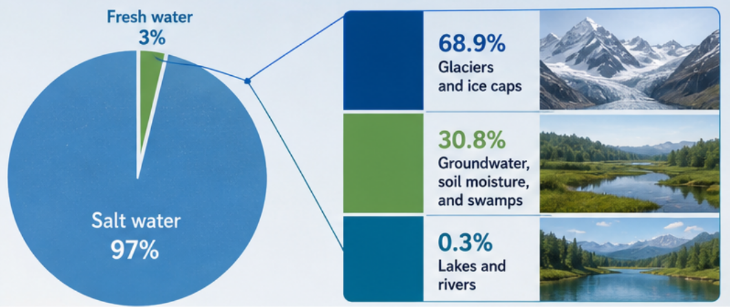
Approximately 71% of the Earth’s surface is covered by water; however, only about 3% is available as freshwater suitable for human consumption. This limited fraction is mainly distributed as glaciers (68.9%), followed by groundwater, soil moisture, and swamps (30.8%). In comparison, only 0.3% of the surface water is accessible, such as lakes and rivers, as illustrated in Figure 1. According to the United Nations International Children’s Emergency Fund (UNICEF), water scarcity is expected to force around 700 million people to migrate by 2030, while by 2040, one-quarter of the world’s children are projected to live in regions suffering from severe water stress [1]. Therefore, developing sustainable and innovative solutions for freshwater production is urgently required. Among the most promising solutions is solar distillation, which utilizes abundant solar energy to convert saline or contaminated water into potable water through natural evaporation–condensation processes. This technology is clean, low-cost, and particularly suitable for arid and semi-arid regions. It provides a decentralized approach to freshwater production, reducing dependence on conventional energy sources and supporting long-term water security [2].
Figure 1. Water resources distribution
Despite these advantages, conventional solar stills generally suffer from limited freshwater productivity because of the small effective heat-transfer area, weak heat distribution within the basin water, and rapid reduction in water temperature when solar radiation decreases. Double basin solar stills can be designed to have a second evaporation–condensation basin and to use some heat recovery, but they might still have problems due to the non-uniform heating of the basins, loss of heat from the extra surface area, and loss of heat to the atmosphere during periods of less solar radiation, which these systems cannot handle with the use of conventional basin enhancement surfaces. Moreover, the performance of the directional fins is highly dependent on the angle made by the fins to the path of the sun, and fins without thermal storage react quickly to the sun's attenuation. Thus, using copper hollow cylindrical fins and phase change material (PCM) is a potential engineering solution. The cylindrical fins have higher exposed heat transfer area, better heat distribution, and can receive solar radiation from various directions, but the PCM can store heat when the solar radiation is high and release heat when the solar radiation is low. This integrated effect should improve the effectiveness of heat transfer during the day, mitigate the fast drop of water temperature, and extend the effective evaporation time. A considerable number of experimental and theoretical studies have been conducted to enhance the performance of single-basin solar still (SBSS) using fins, PCM, photovoltaic (PV) systems, and nanomaterials. Kateshia and Lakhera [3] in India (23°10′N, 72°38′E) experimentally investigated an SBSS integrated with palmitic acid PCM and pin fins. The productivity obtained by the combined PCM–pin-fin arrangement was 5.4 L/m²·day, which showed improvements of 30%, 47% and 63% in terms of freshwater productivity, energy efficiency and exergy efficiency, respectively, from the conventional solar still. Abdel-Aziz et al. [4] in Egypt (31.1316° N, 33.7984° E) used paraffin wax as PCM with an electric heater in SBSS, increasing productivity to 7.78 L/m²·day and efficiency by 61%. Although both studies used PCM, their configurations differed because the latter system employed auxiliary electrical heating. Therefore, the reported improvements cannot be attributed to PCM alone. Kumar et al. [5] in Pakistan (25.4300° N, 68.2800° E) numerically studiedan SBSS with 10 square fins, reporting a productivity of 8.33 L/m²·day and an efficiency improvement of 60.10%. Ghriss et al. [6] investigated a double-slope solar still in Tunisia (33.88° N, 10.10° E) equipped with different numbers of square fins. The 12-fin configuration achieved the highest daily productivity of 3.01 kg/m²·day, representing a 54.50% improvement over the conventional still. The corresponding energy efficiency reached 76.8%, representing a 54.11% improvement, while the exergy efficiency reached 0.53%, corresponding to a 78.43% improvement. These results were obtained using different still configurations, fin geometries, analysis methods, and climatic conditions; therefore, their productivity values are not directly comparable. The thermal performance also depended on the available heat-transfer area and basin arrangement. Falah et al. [7] conducted a theoretical study in Iraq (31.590° N, 44.190° E) on fin number and configuration; they found that the maximum productivity was 11.853 L/m²/day and that efficiency improved by 56.2%. Attia et al. [8] in Algeria (33.15° N, 6.3° E) studied the addition of copper conical fins filled with sand to the conical solar still (CSS). They reported productivity of 7.75 L/m²/day and an efficiency improvement of 44.4%. Mohtasim et al. [9] conducted a study in Bangladesh (24.37° N, 88.60° E) on a hybrid PVT-integrated solar-still system incorporating PCM and hollow fins. The system achieved a freshwater productivity of 4.109 L/m²·day, while the PV efficiency increased by 15.7%. Because the investigated configuration combined PVT, PCM, and hollow fins, the reported performance represents the integrated effect of the hybrid system rather than the isolated contribution of PCM. Saad et al. [10] in Iraq (33.3° N, 44.38° E) used longitudinal fins with PCM in SBSS, achieving 5.119 L/m²·day and a 45.12% efficiency improvement. Mcluret and Gnanaraj [11] in India (8.7847° N, 78.1383° E) optimized the operating parameters of a double-slope solar still using machine-learning techniques, achieving a freshwater productivity of 6.0 L/m²·day. Rahman et al. [12] in Bangladesh (23.7932° N, 90.2713° E) used floating foils and a condenser in DBSS, achieving 2.725 L/m²·day. Aldarabseh and Abdallah [13] investigated a modified stepped pyramid solar still incorporating PCM, hollow rectangular fins, and photovoltaic-powered electrical heaters. The combined configuration provided the highest overall performance among the investigated cases. Therefore, the reported performance represents the collective effect of thermal storage, extended surfaces, and auxiliary electrical heating rather than the isolated contribution of PCM.
Kumar et al. [14] experimentally investigated a solar still incorporating hollow cylindrical fins and carbon-enhanced PCM. The optimized configuration achieved a freshwater productivity of 5.1 L/m²·day, demonstrating the potential of combining hollow extended surfaces with latent-heat storage for enhancing solar-still performance.
These systems differed in still type, fin geometry, PCM arrangement, and auxiliary energy input. Consequently, their reported improvements represented the combined effects of several modifications rather than the isolated thermal contribution of PCM storage. Overall, previous studies investigated different still configurations, fin geometries, PCM arrangements, and operating conditions, which limited direct comparison among their reported results. Moreover, directional thin fins, hollow cylindrical fins, and PCM-filled hollow cylindrical fins have not been systematically compared within the same DBSS under identical experimental and climatic conditions. This unresolved issue represents the specific research gap addressed in the present study. Most investigations examined a single fin geometry or PCM configuration separately, while the influence of fin orientation, exposed heat-transfer area, and latent-heat storage was not systematically compared under the same experimental operating conditions while accounting for the climatic variations among the separate test days. Directional thin fins may absorb different amounts of solar radiation during the day because their thermal performance depends on orientation. In contrast, hollow cylindrical fins provide a larger exposed surface and can receive solar radiation from multiple directions; however, their ability to maintain evaporation decreases when solar intensity declines. The south-facing thin fins were selected as a reference orientation to evaluate their response to the dominant daytime solar path, whereas the east-facing fins were chosen to examine the effect of enhanced morning exposure and earlier heating of the basin water. The selection of hollow cylindrical copper fins was chosen as this would minimize the sensitivity to a single orientation, as the curved surfaces would be exposed to solar radiation over a larger range of incident angles. Their geometry also offers increased wetted heat transfer surface area, and the copper's high thermal conductivity helps heat to transfer to the basin water quickly. Finally, the same hollow cylindrical fins were filled with RT62HC to separate the extra benefit of latent-heat storage from the other influence of fin geometry and compare it with the combined effect of fin geometry and latent storage.
Accordingly, the present study experimentally compared a conventional SBSS, an unmodified DBSS, and DBSS configurations incorporating south-facing thin fins, east-facing thin fins, hollow cylindrical copper fins, and PCM-filled hollow cylindrical fins under the same controlled operating conditions and comparable clear-sky climatic conditions. The comparison was conducted to clarify the individual and combined effects of fin orientation, cylindrical geometry, and PCM storage on freshwater productivity, thermal efficiency, temperature distribution, and daily operating performance.
Two solar stills, namely a conventional SBSS and a double-basin solar still (DBSS), were fabricated and tested under the climatic conditions in Baghdad (33.3152° N, 44.3661° E) during May 2026.
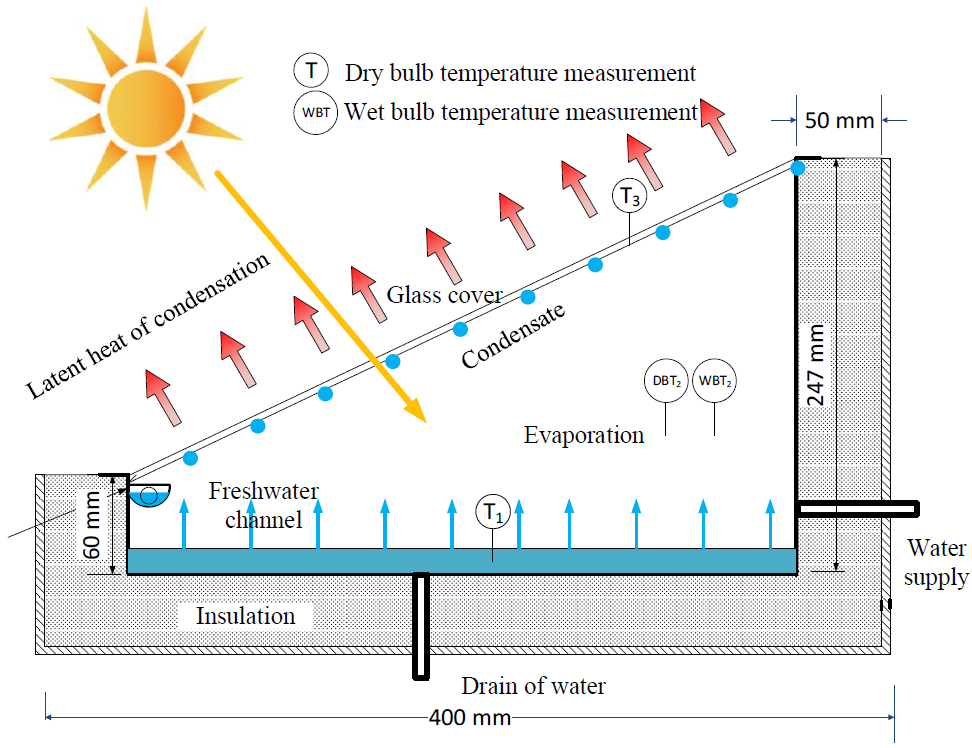
The SBSS was built from 1.5 mm-thick galvanized steel. The basin dimensions were 400 × 1000 mm, corresponding to a plan area of 0.40 m². The still’s height was 60 mm at the front and 247 mm at the back. The still was equipped with 3 openings: one to feed the brine, another to drain the brine into the base, and another connected to a channel under the 4 mm-thick glass cover to draw out the condensed water. Figure 2 shows a schematic diagram of the SBSS.
Figure 2. Schematic diagram of the single-basin solar still (SBSS)
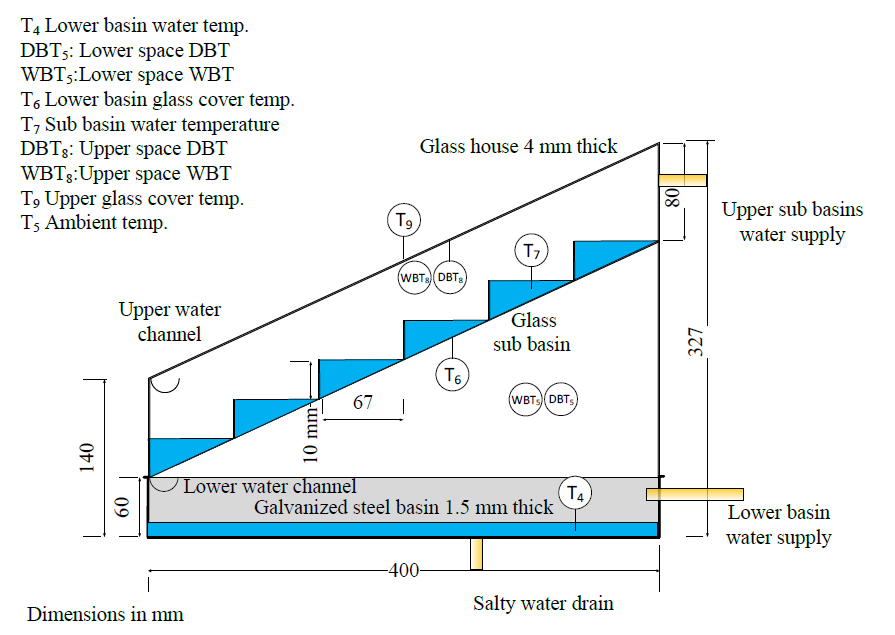
Figure 3. Layout of the double-basin solar still (DBSS)
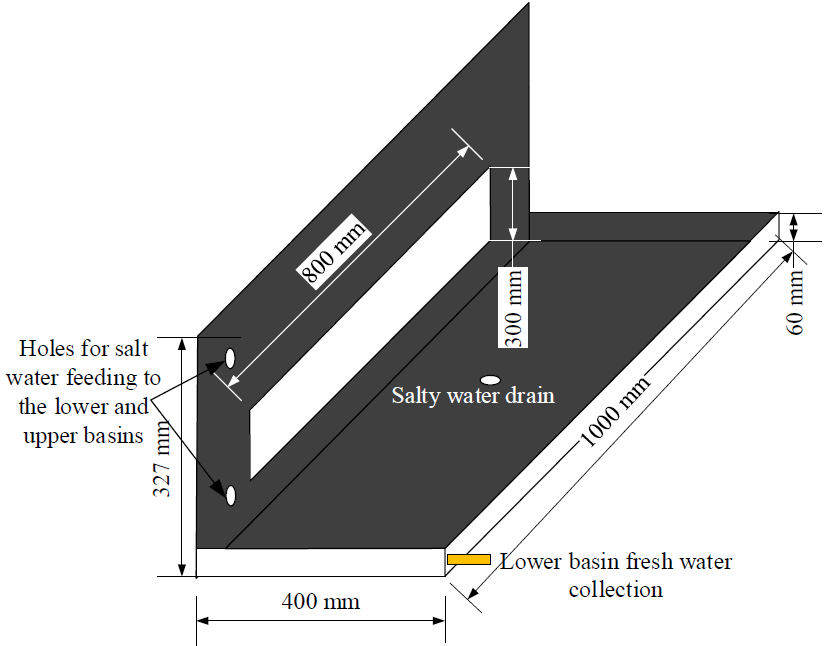
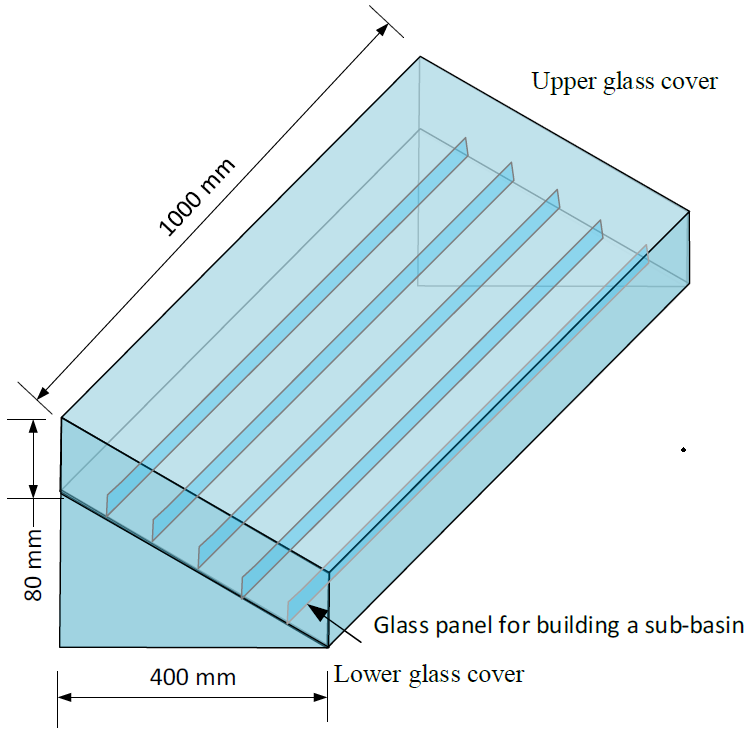
The DBSS consists of a 1.5 mm-thick galvanized steel frame, a lower basin, a lower glass cover, an upper basin, and an upper glass cover. The frame of the DBSS includes a lower basin measuring 400 × 1000 × 60 mm, corresponding to the same plan area of 0.40 m² as the SBSS basin. The rear section extends across the width of the still and has a height of 327 mm. The rear section has an opening measuring 800 mm wide by 300 mm high for maintenance and inserting various types of fin bases, as discussed later. Four 12 mm diameter holes are made in the still body: the first in the lower basin for discharging brine; the second on the side of the still, which connects to the condensate collection channel, for drawing distilled water; the third on the same side for feeding brine into lower basin; and the fourth on the top of the rear section for feeding brine into upper basin and water discharge from the upper basin. The second part of the DBSS is the 6 mm-thick glass structure, which contains the two sides of the still: the upper and lower glass covers. Five glass sheets of length 1000 mm were used to build the sub-basins of the upper basin of the still, as shown in Figure 3. Figures 4 and 5 show the metal and glass frames of the DBSS.
Figure 4. The double-basin solar still (DBSS) metal frame
Figure 5. Layout of the double-basin solar still (DBSS) glass frame
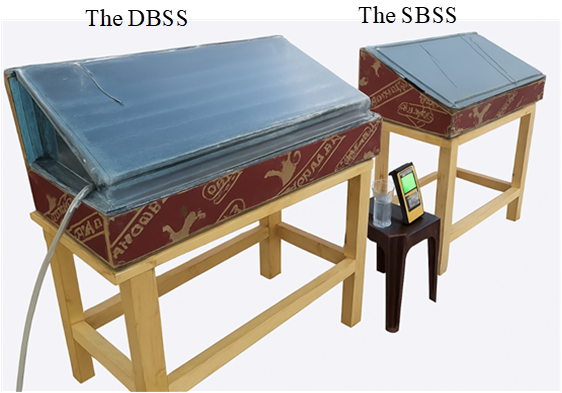
For both stills, the inner surfaces are painted with black matt paint, then the still is insulated with a 50 mm-thick foam layer with a density of 30–34 kg/m³, and contained in a plywood box 18 mm thick, as shown in Figure 6.
Figure 6. The installation of the single-basin solar still (SBSS) and the double-basin solar still (DBSS)
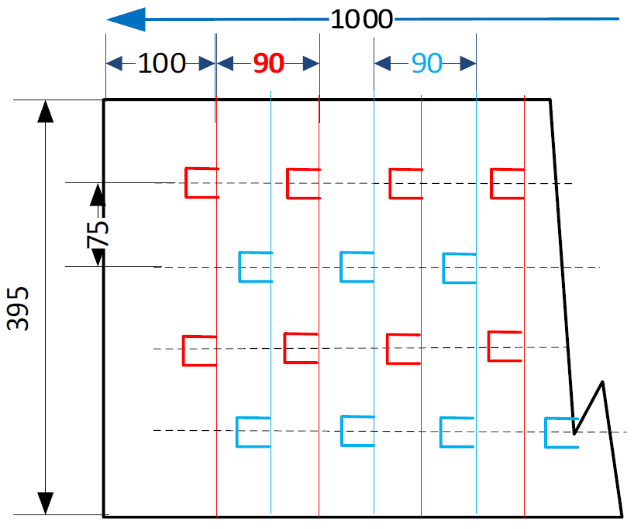
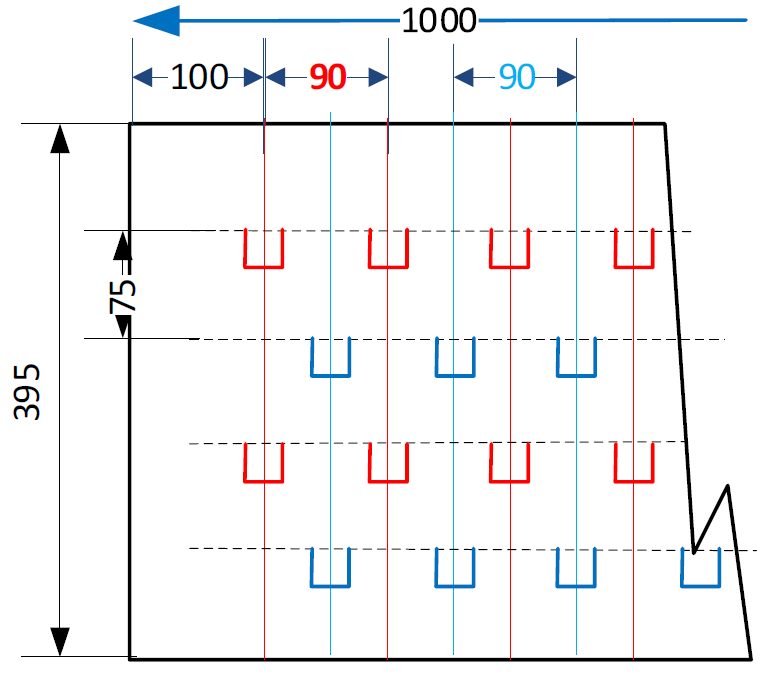
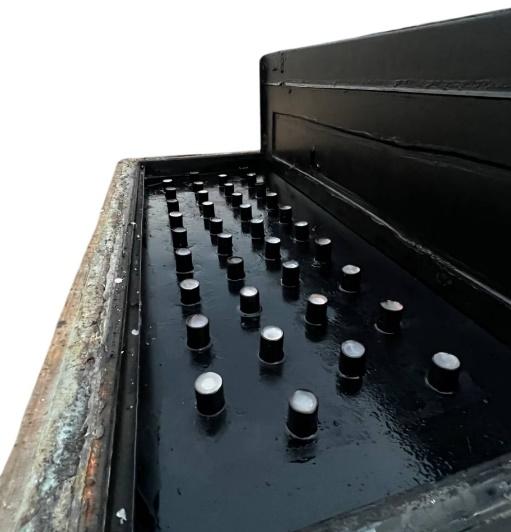
The fin base consisted of a 1-mm-thick black galvanized-steel plate measuring 395 × 1000 mm. The base width was intentionally selected as 395 mm to allow the fin assembly to fit within the 400-mm-wide basin without altering the effective basin area used for productivity and thermal-efficiency calculations. The plate was divided into 38 fin positions at 90 mm intervals along the length and 75 mm intervals along the width. Each thin fin measured 30 × 30 mm, with one fin set facing south and the other facing east, as shown in Figures 7 and 8. After completion, the fins were manually bent to form fins perpendicular to the plate and installed in the DBSS basin as shown in Figure 9.
Figure 7. The fabrication of the south-facing fins
Figure 8. The fabrication of the east-facing fins
Figure 9. The installation of the south-facing fins in the double-basin solar still (DBSS)
The third fin configuration consisted of 38 hollow cylindrical copper fins mounted on a 1.5-mm-thick black galvanized-steel plate measuring 395 × 1000 mm. The fins were fixed through circular apertures in the supporting plate using a swaging process. Each hollow cylindrical fin had an outer diameter of 25.4 mm, an inner diameter of 24.4 mm, a wall thickness of 0.5 mm, and a height of 35 mm. Based on these dimensions, the internal geometric volume of each hollow fin was approximately 16.37 cm³. The fins were arranged with center-to-center spacings of 90 mm horizontally and 75 mm vertically, as shown in Figure 10. For the PCM-assisted configuration, each hollow cylindrical fin was filled with 13 g of RT62HC paraffin wax, resulting in a total PCM mass of approximately 494 g for the 38 fins, as shown in Figure 11. The specifications of Histoplast™ paraffin wax type RT62HC are shown in Table 1.
Figure 10. Hollow cylindrical fin base
Table 1. Thermophysical properties of RT62HC phase change material (PCM)
|
Properties |
Range |
|
Melting range |
62–63 ℃ |
|
Congealing area |
62 ℃ |
|
Heat storage capacity ± 7.5% |
230 kJ/kg |
|
A combination of latent and sensible heat in a temperature range of 55 ℃ to 70 ℃. |
64 Wh/kg |
|
Specific heat capacity |
2 kJ/kg‧K |
|
Density of a solid |
990 kg/m3 |
|
Density of liquid |
850 kg/m3 |
|
Thermal conductivity |
0.2 W/m‧K |
|
Maximum operation temperature |
90 ℃ |
|
Corrosion: slight corrosive effect on metals |
|
Figure 11. Installation of the phase change material (PCM)-hollow cylindrical fin in the double-basin solar still (DBSS) lower basin
The temperatures of both stills were measured using type K thermocouples with a temperature range of -100 to 1300 ℃. The measurements included the water temperature in the still basin, the dry and wet bulb temperatures of the still space, the glass lid temperature, the PCM temperature, and finally, the ambient temperature, as shown in Figures 2 and 3. Table 2 shows the Root Sum Square (RSS) approach for uncertainty propagation, which assumes that the data follow a normal distribution, are independent, and have no systematic errors. The uncertainties of the measurement variables have been determined, as illustrated in Table 2. The uncertainty of measurement variables was analyzed using the Engineering Equation Solver (EES) software.
Table 2. Absolute accuracy of measurement
|
Sr. No. |
Measuring Parameter |
Measuring Instrument |
Specifications |
Standard Uncertainty |
|
|
Range |
Accuracy |
||||
|
1 |
Distillate |
Beker |
0–100 ml |
±1 ml |
0.577 ml |
|
Collection |
0–250 ml |
±2.5 ml |
1.555 ml |
||
|
2 |
All temperatures in SBSS and DBSS |
Type K Thermocouple connected to data logger |
-270 to 1260 ℃ |
±2.2 ℃ |
1.1 ℃ |
Note: DBSS = double-basin solar still; SBSS = single-basin solar still.
The hourly thermal efficiency of the solar still is calculated as follows [15, 16]:
$\eta_{D_{-} S B}=\frac{m_{pure} \cdot h_{f g}}{{ GHI\tau} \cdot \alpha \cdot A \cdot 3600}$ (1)
The daily thermal efficiency of the solar still is as follows [17].
$\eta_{D_{-} D B}=\frac{\sum_{24 h} m_{pure} \cdot h_{f g}}{\sum_{24 h} G H I \tau \cdot \alpha \cdot A \cdot 3600}$ (2)
where,
$m_{\text {pure}}$: The hourly freshwater productivity (L/m²·h).
GHI: Global Horizontal Irradiance on a horizontal surface (W/m²).
$\tau. \alpha$: Transmittance − absorptance product equals about 0.9.
A: Effective basin area of the solar still (m²).
$m_{d a}=\sum_{24 h} m_{\text {lower }}+\sum_{24 h} m_{\text {upper }}$ (3)
where,
$m_{upper}$: The hourly freshwater productivity of the upper basin (L/m²·h).
$m_{Lower}$ : The hourly freshwater productivity of the lower basin (L/m²·h).
The latent heat of evaporation can be either extracted from the steam table at a given temperature or using the equation below [17]:
$h_{f g}=2.4935 \times 10^6\left(1-9.4779 \times 10^{-4} T_{w 1}+1.3132 \times 10^{-7} T_{w 1}^2-4.7974 \times 10^{-9} T_w^3\right)$ (4)
where,
$h_{f g}$: Latent heat of vaporization of water (J/kg).
$T_w$: Basin-water temperature (℃).
Experimental errors and uncertainties may arise from instrument limitations, environmental variations, and the experimental setup. Hence, a systematic assessment of the uncertainty that arises from the variation in time, productivity, and thermal efficiency was conducted to increase the reliability and confidence of the presented experimental results.
Uncertainty in Time:
The experimental time was measured using a digital stopwatch with a time resolution of 1 s. The relative uncertainty of time was estimated to be about 0.028% for the maximum measurement interval of 3600 s.
Uncertainty in Hourly Productivity:
Determination of water productivity is done using the following equation [18]:
$M=\frac{m}{t}=\frac{\rho \cdot V}{t}$ (5)
$M=f(V, t)$ (6)
The uncertainty of hourly productivity, assuming that the density remains constant, can be measured using the equation that follows [19]:
$u_M=\sqrt{\left(\frac{\partial M}{\partial V} u_V\right)^2+\left(\frac{\partial M}{\partial t} u_t\right)^2}$ (7)
Accordingly, the propagated relative uncertainty in the hourly freshwater productivity was estimated to be ±0.578%.
Uncertainty in Thermal Efficiency:
The propagated uncertainty in the thermal efficiency of the solar still can be expressed as follows [20]:
$\eta=f\left(M, A, h_{f g}\right)$ (8)
$u_\eta=\sqrt{\left(\frac{\partial \eta}{\partial M} u_M\right)^2+\left(\frac{\partial \eta}{\partial A} u_A\right)^2+\left(\frac{\partial \eta}{\partial h_{f g}} u_{h_{f g}}\right)^2}$ (9)
Table 3. Experimental accuracy
|
Variables |
Accuracy Error |
|
A |
0.1% |
|
$h_{f g}$ |
0.1% |
|
Hourly productivity |
± 0.578 |
|
η |
± 0.595% |
Given the relative uncertainty levels of the variables listed in Table 3, the overall uncertainty can be evaluated accordingly.
2.1 Experimental procedure and test cases
To compare the performance in a systematic manner, six experimental configurations have been studied such as (1) conventional single basin solar still (SBSS), (2) double basin solar still without fin, (3) DBSS with south facing thin fins, (4) DBSS with east facing thin fins, (5) DBSS with hollow cylindrical copper fins and (6) DBSS with PCM filled hollow cylindrical copper fins. The hollow-fin configurations contained 38 cylindrical copper fins. In the PCM-assisted configuration, each fin contained 13 g of RT62HC, corresponding to a total PCM mass of approximately 494 g distributed among the 38 fins. Each experimental run was preceded by the still being cleaned, installation of the prescribed fin base, and filling the basins with saline water to the prescribed level. The water level in both lower and upper basins of DBSS was kept at 10 mm.
During the experimental investigation, all the following parameters were maintained constant, while the still orientation was kept fixed; only the fin geometry or fin orientation was varied: Geometry of the basins, type of water, measuring instruments, procedure of the data recording, and the type of insulation. During the experiments, the following were measured: solar radiation, ambient temperature, basin-water temperatures, glass-cover temperatures, dry-bulb temperature, wet-bulb temperature, PCM temperature (if used), and freshwater productivity. The configurations were tested on separate clear-sky days under climatic conditions of Baghdad, Iraq, in the month of May 2026. The incident solar energy corresponding to each test day was considered in the performance comparison. As shown in Table 4, the meteorological conditions varied slightly among the experimental days; therefore, the performance results were interpreted with consideration of the corresponding incident solar energy.
Table 4. Experimental dates and estimated representative meteorological conditions for Baghdad, Iraq
|
Configuration |
Test Date |
Daily Solar Irradiation (kWh/m²·day) |
Ambient Temperature Range (℃) |
Wind Speed (m/s) |
Relative Humidity (%) |
|
Conventional SBSS |
30 April 2026 |
5.35 |
18–29 |
2.3 |
33 |
|
Conventional DBSS |
30 April 2026 |
5.35 |
18–29 |
2.3 |
33 |
|
DBSS + south-facing fins |
1 May 2026 |
5.45 |
18–29.5 |
2.35 |
32 |
|
DBSS + east-facing fins |
2 May 2026 |
5.55 |
19–30 |
2.46 |
31 |
|
DBSS + hollow cylindrical fins |
3 May 2026 |
5.65 |
19–30.5 |
2.48 |
30 |
|
DBSS + PCM-filled hollow fins |
4 May 2026 |
5.75 |
20–31 |
2.5 |
29 |
Note: DBSS = double-basin solar still; SBSS = single-basin solar still; PCM = phase change material.
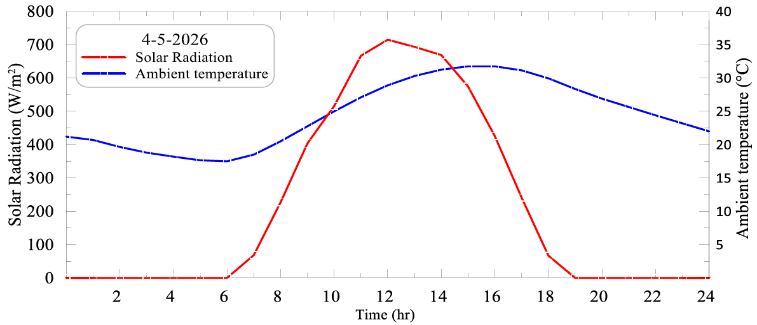
The effects of fins on DBSS and SBSS performance were studied under weather conditions in Baghdad, Iraq (33.3152° N, 44.3661° E), with saline water depths fixed at 10 in both the lower and upper basins of DBSS. The experiments were conducted under clear-sky conditions during May 2026, and Figure 12 shows the solar intensity and ambient temperature.
Figure 12. Weather data for Baghdad, Iraq (33.3152° N, 44.3661° E)
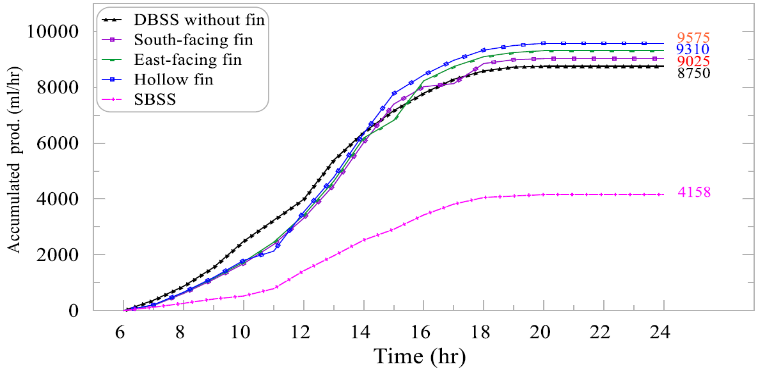
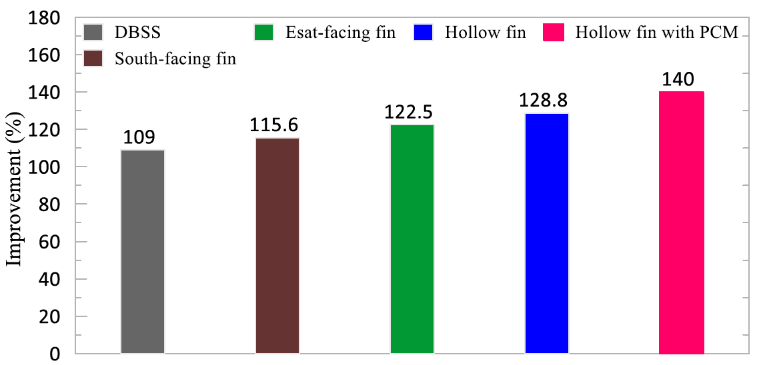
The performance of DBSS with the three-finned type mentioned before, namely east-facing fins, south-facing fins, and hollow cylindrical copper fins, was compared with that of a DBSS without additives and an SBSS. Figure 13 shows the effect of fin geometry on the accumulated productivity of the SBSS and modified DBSS. Figure 14 shows the productivity improvement of the still using different fin geometries. From Figure 13, it can be seen that the lowest daily productivity of the SBSS, which served as the comparison source, was 4158 ml/m²‧day. This productivity increased to 8750 ml/m²‧day, as shown in Figure 14, when using a two-basin still without additives, representing a 109% improvement over the simple still. The reason for this increase in productivity was the presence of two sources of productivity: the lower basin and its glass cover, and the upper basin and its glass cover. When thin, south-facing fins were used with the DBSS, productivity increased to 9025 ml/m²·day, representing a 115.6% improvement compared to the simple still, as shown in Figure 14. The improvement obtained with the thin fins was not caused only by increased solar absorption. The black base of the fin absorbed the radiation from the sun, and this absorbed heat was conducted into the fins and into the water in the basin. The thin fins had a relatively low thermal mass, so they were very responsive to solar radiation changes and transferred heat to the water with minimal thermal delay. The fins further enhanced the solid–liquid contact area and caused a disturbance of the thermal boundary layer close to the surface of the basin, which led to an improvement of the natural-convection mixing effects at the local scale and a decrease of temperature stratification in the water. The disparity between the south-facing and east-facing designs was primarily because of the area of the fins that were exposed to the varying sun angle projection. The east-facing fins were more directly exposed to radiation during the morning hours, and the total heat transfer to the basin water was higher, and subsequent productivity was higher than the south-facing arrangement. East-facing fins improve productivity compared to south-facing fins, achieving a yield of 9310 ml/m²‧day, a 122.5% improvement over a simple still. The improved productivity resulting from changing the fin orientation is because, at sunrise, the solar radiation is nearly perpendicular to the fin face, whereas at midday, the south-facing fins do not receive sufficient solar radiation because the sun is directly overhead.
Figure 13. The effect of fin geometry on the accumulated productivity of the single-basin solar still (SBSS) and modified double-basin solar still (DBSS)
Figure 14. The productivity improvement of the still using different fin geometries
When hollow cylindrical copper fins were used, the daily productivity reached 9575 ml/m²·day, representing an improvement of 128.8% compared with the SBSS. The superior performance of this configuration can be explained by both geometric and material effects. The cylindrical geometry provided a larger exposed perimeter and heat-transfer area than the flat thin fins and allowed part of the fin surface to receive solar radiation over a wider range of solar angles during the day. Furthermore, the high thermal conductivity of copper facilitated rapid heat conduction from the irradiated fin surface and the supporting plate to the surrounding water. The cylindrical surfaces also increased the wetted contact area and promoted local buoyancy-driven circulation around each fin, which improved heat distribution and reduced the stagnant thermal layer near the basin base. Consequently, the hollow cylindrical fins achieved more uniform heating of the basin water and maintained a higher evaporation potential than the directional thin-fin configurations.
Additionally, the circular fin faces the sun throughout the day, effectively acting as a fin facing east and another facing south.
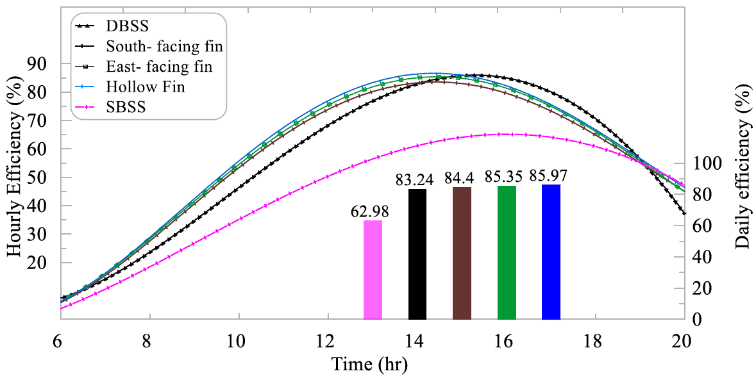
Figure 15 shows the hourly efficiency and daily efficiency of the stills under test. The figure shows that the SBSS has an hourly efficiency of around 60%, while the DBSS, both with and without fins, exhibit very similar efficiencies. The DBSS achieves the highest hourly efficiency with hollow cylindrical fins of about 80%. The lowest daily efficiency was for the SBSS at approximately 63%. The daily thermal efficiencies of the investigated DBSS configurations ranged from 83.24% to 85.97%.
Figure 15. The effect of fin geometry on the hourly and daily efficiencies of the single-basin solar still (SBSS) and modified double-basin solar still (DBSS)
While the same performance ranking was observed for freshwater productivity and thermal efficiency, the percentage increases were not the same due to representing two different performance indicators. The productivity of freshwater is the total amount of distillate obtained, and thermal efficiency is the ratio of useful energy in the form of evaporation to the energy in the form of solar radiation received by the still. The lower and upper basins combined to produce freshwater, which was included in the evaporation energy for the DBSS. The DBSS resulted in significantly greater productivity as it had two evaporation–condensation zones and a fraction of the latent heat released when water vapour from the lower basin condensed on the inner surface of the lower glass cover was conducted through the glass and transferred to the upper-basin water. The extra basin, the glass surfaces, the water mass, and the additional structural heat transfer components added to the system increased the thermal capacity of the system and created additional conductive, convective, and radiative heat losses. In addition, the configurations were tested on different days, which meant that the thermal efficiency denominator was directly influenced by changes in incident solar energy throughout the testing period. It was therefore not thought to be possible to have a corresponding increase in the productivity of freshwater with an increase in thermal efficiency. The present study showed that the daily productivity of the SBSS was 4.158 L/m²·day compared to 8.750 L/m²·day for the unmodified DBSS, and the daily thermal efficiency of the SBSS was 62.98% compared to 83.24% for the unmodified DBSS. This verifies that the DBSS generated additional freshwater due to its increased effective evaporation capacity as well as heat recovery mechanism inside the DBSS, while some of the heat absorbed was retained in the DBSS or dissipated to the surrounding environment.
Based on this, the best fin configuration is the hollow cylindrical fin, followed by the east-facing fin, and finally the south-facing fin. Therefore, hollow cylindrical fins are explored in future experiments.
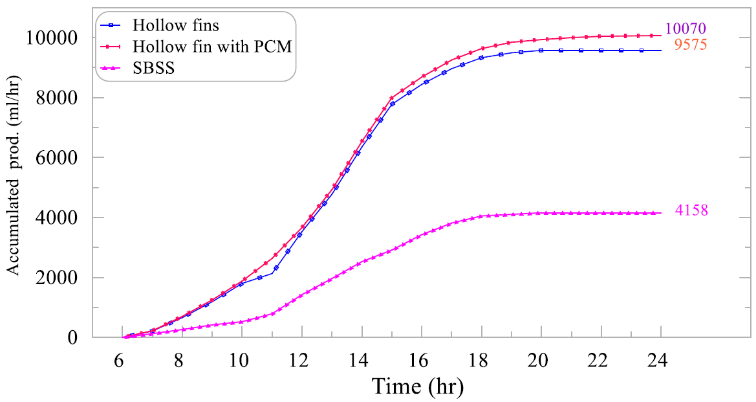
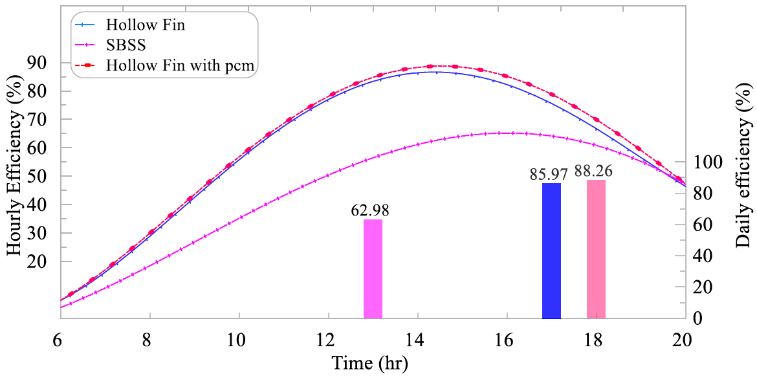
Figures 16 and 17 illustrate the effects of filling the hollow cylindrical fins with PCM on accumulated freshwater productivity and thermal efficiency, respectively. As shown in Figure 16, the PCM-filled hollow-fin configuration achieved higher accumulated productivity than the hollow-fin configuration without PCM, particularly during periods of decreasing solar radiation. This improvement was mainly attributed to thermal-energy storage during periods of high solar radiation and delayed heat release when solar intensity decreased. During the charging period, heat absorbed by the black basin plate and hollow copper fins was conducted through the copper walls to the RT62HC. The PCM initially stored sensible heat and subsequently absorbed latent heat as its temperature approached the melting range of 62–63 ℃. During the discharging period, the stored energy was released as the PCM cooled and solidified and was transferred through the copper walls to the basin water. This process delayed the reduction in water temperature and extended the effective evaporation period. The delayed heat release also enhanced the evaporation–condensation process by maintaining a relatively high basin-water temperature while the glass-cover temperature decreased. Consequently, a favorable water-to-glass temperature difference was maintained, supporting continued evaporation and vapour condensation. As shown in Figure 17, these combined effects increased the daily thermal efficiency from 85.97% for the hollow-fin configuration to 88.26% for the PCM-filled hollow-fin configuration. The corresponding daily productivity increased from 9.575 to 10.070 L/m²·day.
Figure 16. The variation of accumulated productivity of the single-basin solar still (SBSS) and modified double-basin solar still (DBSS) along the day
Figure 17. The variation of hourly thermal efficiency of the single-basin solar still (SBSS) and modified double-basin solar still (DBSS) along the day
While the PCM-filled hollow fins had the greatest thermal performance, there are more steps to their manufacture than there are to the manufacture of the directional thin fins. The hollow copper fins were carefully sealed to prevent PCM leakage during melting and solidification. Since the measured PCM temperature remained within the specified operating limit, no direct thermal exceedance of the PCM operating range was observed during the experiment. Nevertheless, seal integrity and PCM thermal stability should be considered during long-term cyclic operation. Additionally, this configuration will use more materials than the thin-fin configuration and may be more expensive for the initial fabrication, but a quantitative economic analysis is outside the scope of the present study. Thermal cycle stability of the PCM, fin seal integrity, material compatibility, corrosion resistance, and maintenance needs should be considered for long-term operation. So, the choice of this configuration should take into consideration the advantage it gives in terms of productivity as well as the fabrication complexity and long-term operational reliability.
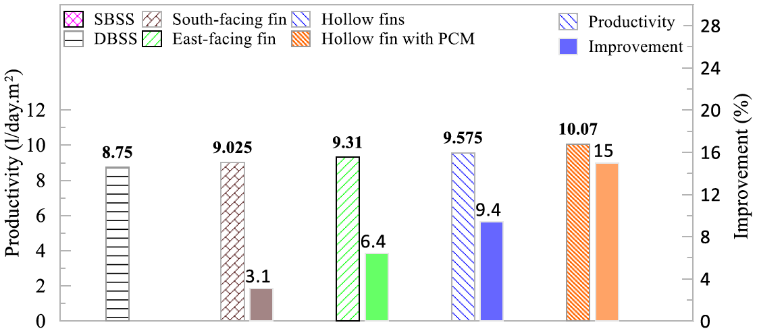
Figure 18 summarizes the daily productivity and productivity improvement of stills with different fin geometries when added to DBSS. The highest daily productivity was 10.07 l/m2.day observed with the PCM-filled cylindrical finned still, resulting in a 15% improvement over the DBSS without fins. The still with hollow cylindrical fins achieved a productivity of 9.575 l/m²/day, representing a 9.4% improvement. The east- facing yielded a daily productivity of 9.31 liters/m²‧day, a 6.4% improvement, while the south- facing fin yielded 9.025 liters/m²‧day, a 3.1% improvement compared to the DBSS without the fins.
Figure 18. Summary of daily productivity of different types of stills
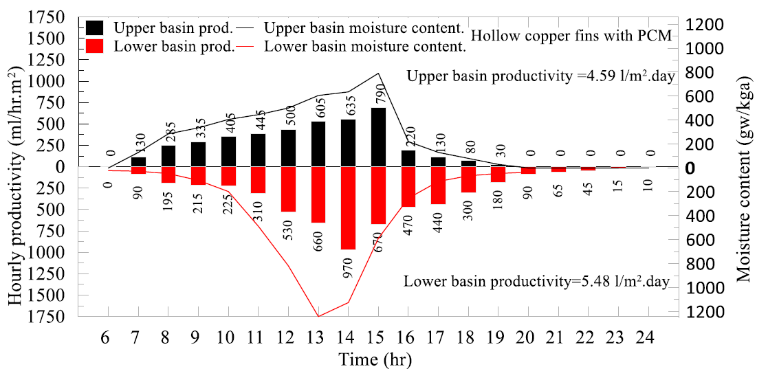
Figure 19 shows the hourly productivity of still from the upper and lower basins, along with the basin space moisture content, calculated from the dry and wet bulb temperatures measured during the experiment. It is observed that in both the upper and lower basins, the productivity is a function of the moisture content in the basin space. The figure shows that the lower basin has the highest moisture content at 1242 gw/kga, while the upper tank has the highest at 629 gw/kga. This difference is due to the lower tank receiving direct solar radiation, unlike the upper tank, leading to increased evaporation and, consequently, a higher moisture content in the water. This is reflected in the productivity, which shows that the maximum hourly productivity occurs in the lower tank at 970 ml/m²h at 14 hr.
Figure 19. The upper and lower basin productivity and moisture content for the double-basin solar still (DBSS) with PCM-filled cylindrical fin
In comparison, the maximum productivity for the upper basin is 790 ml/m²h. At 15 hr, the cumulative productivity of the upper basin was 4.591 L/m²·day, while it was 5.48 L/m²·day in the lower basin. Therefore, the lower-basin productivity was approximately 19% higher than the upper-basin productivity.
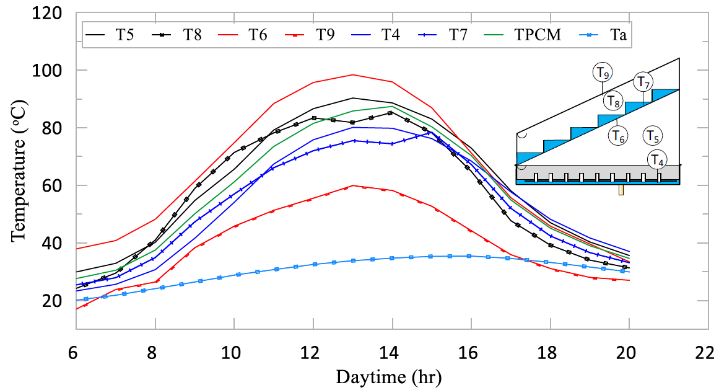
Figure 20 shows the temperature distribution of the components of a DBSS containing cylindrical copper fins filled with PCM. The highest temperature is observed at the lower basin glass cover, reaching approximately 98 ℃. This is due to condensation of water vapour on the cover's inner surface and to the hot water from the upper basin on the glass outer surface. Conversely, the lowest temperature in the still is at the outer glass cover, at 60 ℃, due to direct contact with the outer environment. Therefore, the upper and lower covers of the still determine the operating temperature range of the DBSS. The PCM temperature remained below its specified maximum operating temperature of 90 ℃, whereas the lower glass-cover temperature reached approximately 98 ℃. Therefore, the higher glass-cover temperature should not be interpreted as the PCM temperature. The lower and upper basins are the third highest, with temperatures around 80 ℃. As shown in the figure, the temperatures of the upper and lower components of the DBSS are similar, except for the two glass covers.
Figure 20. Temperature distribution for the double-basin solar still (DBSS) with phase change material (PCM)-filled cylindrical fin
Table 5. Comparison of freshwater productivity between the present study and previous solar-still investigations
|
Study |
Solar-Still Configuration |
Main Enhancement |
Reported Productivity |
|
Kateshia and Lakhera [3] |
SBSS |
Fins integrated with palmitic-acid PCM |
5.400 |
|
Abdel-Aziz et al. [4] |
SBSS |
Paraffin PCM with an electric heater |
7.780 |
|
Kumar et al. [5] |
Numerical SBSS |
Ten square fins |
8.330 |
|
Ghriss et al. [6] |
DBSS |
Twelve rectangular fins |
3.010 |
|
Attia et al. [8] |
Conical solar still |
Sand-filled copper conical fins |
7.750 |
|
Mohtasim et al. [9] |
PV-integrated SBSS |
PCM-filled hollow fins and PV system |
4.109 |
|
Saad et al. [10] |
SBSS |
Longitudinal fins immersed in PCM |
5.119 |
|
Present study: SBSS |
SBSS |
Reference configuration |
4.158 |
|
Present study: Unmodified DBSS |
DBSS |
Addition of the second basin |
8.750 |
|
Present study: South-facing fins |
DBSS |
Directional thin fins |
9.025 |
|
Present study: East-facing fins |
DBSS |
Modified fin orientation |
9.310 |
|
Present study: Hollow cylindrical fins |
DBSS |
Hollow copper-fin geometry |
9.575 |
|
Present study: PCM-filled hollow fins |
DBSS |
RT62HC added to the same hollow fins |
10.070 |
Note: SBSS = single-basin solar still; DBSS = double-basin solar still; PCM = phase change material.
The freshwater productivity obtained in the present work is tabulated and compared with the selected previous solar-still investigations in Table 5. The comparison highlights the influence of differences in still configuration, fin geometry, PCM integration, and auxiliary-energy input on the reported performance.
The present experiments were conducted under the hot and predominantly clear-sky climatic conditions of Baghdad; therefore, the reported absolute productivity values should not be directly generalized to other locations. In regions with less solar radiation, colder ambient temperatures, more cloud cover, and varying wind and humidity conditions, the basin-water and glass-cover temperatures and evaporation–condensation rate should be different. However, it is expected that the hollow cylindrical fins will still enjoy a relative advantage, as they will have curved surfaces which would reduce the need for the fins to be oriented in a particular direction to the sun, and the PCM will store the thermal energy when the sun is more intense and release it when solar intensity is lower. This advantage can be different depending on the solar profile, ambient temperature, wind speed, relative humidity, and the range of the melting point of the PCM. So more experiments in various seasons and different climate zones need to be conducted to validate the proposed configuration at a larger scale.
Two types of stills were tested: namely, SBSS and a DBSS. The results showed that the DBSS’s daily productivity was 8750 ml/m²‧day, compared to 4158 ml/m². day for the SBSS, representing a 109% improvement. The daily efficiency of the SBSS was 62.9%, while that of the DBSS was 83.24%.
Among the DBSS fin types, the highest productivity was observed with the hollow cylindrical fin, reaching 9575 ml/m²‧day. This represents a 128.8% improvement in productivity over the SBSS and a 9.4% improvement over the DBSS without fins. At the same time, the daily efficiency was 85.97%.
Using PCM with the hollow cylindrical fin improved productivity to 10070 ml/m²‧day, a 140% improvement compared to the SBSS and a 15% improvement compared to the DBSS without additives. The daily efficiency was 88.26%.
The upper and lower covers of the still determine the operating temperature range of the DBSS. For the DBSS with a cylindrical fin filled with PCM, the highest temperature is observed at the lower basin glass cover, reaching approximately 98 ℃, and the lowest is at the outer glass cover, at 60 ℃. The upper and lower spaces, along with the PCM, are the second-highest, all reaching approximately 90 ℃. The lower and upper water in the basins is the third-highest temperature, with temperatures around 80 ℃.
These findings provide practical design guidance: directional thin fins are suitable for simple daytime enhancement, whereas hollow copper fins filled with PCM are recommended when extended heat retention and sustained evaporation under decreasing solar radiation are required. Future solar-still systems should select the thermal enhancement method according to the intended operating objective and should combine optimized fin geometry with suitable thermal storage while considering local solar conditions, material durability, and long-term operational reliability.
|
DBSS |
Double-Basin Solar Still |
|
SBSS |
Single-Basin Solar Still |
|
PCM |
Phase Change Material |
[1] Musie, W., Gonfa, G. (2023). Fresh water resource, scarcity, water salinity challenges and possible remedies: A review. Heliyon, 9(8): e18685. https://doi.org/10.1016/j.heliyon.2023.e18685
[2] Modi, K.V., Modi, J.G. (2020). Influence of wick pile of jute cloth on distillate yield of double-basin single-slope solar still: Theoretical and experimental study. Solar Energy, 205: 512-530. https://doi.org/10.1016/j.solener.2020.05.086
[3] Kateshia, J., Lakhera, V.J. (2021). Analysis of solar still integrated with phase change material and pin fins as absorbing material. Journal of Energy Storage, 35: 102292. https://doi.org/10.1016/j.est.2021.102292
[4] Abdel-Aziz, E.A., Mansour, T.M., Dawood, M.M.K., Ismail, T.M., Ramzy, K. (2023). Exergoeconomic and enviroeconomic evaluations of conventional solar still using PCM and electric heater powered by solar energy: An experimental study. Environmental Science and Pollution Research, 30(24): 66135-66156. https://doi.org/10.1007/s11356-023-26761-4
[5] Kumar, R., Kumar, L., Mirjat, N.H., Harijan, K. (2024). CFD simulation of modified solar still for effective condensation and evaporation: Energy and exergy analysis. Frontiers in Water, 6: 1436169. https://doi.org/10.3389/frwa.2024.1436169
[6] Ghriss, O., Mekki, N., Dhaoui, S., Abdel-Aziz, M.M., Bouabidi, A., Attia, M.E.H. (2025). Experimental assessment of square fin number variation on energy and exergy performance in double-slope solar stills under Tunisia weather conditions. International Communications in Heat and Mass Transfer, 162: 108660. https://doi.org/10.1016/j.icheatmasstransfer.2025.108660
[7] Falah, S., Hachim, D.M., Abd Al-wahid, W.A. (2025). The performance of cylindrical solar still with hemispherical dome using circular fins in basin. International Journal of Thermofluids, 25: 101026. https://doi.org/10.1016/j.ijft.2024.101026
[8] Attia, M.E.H., Elazab, M.A., Salam, A.S. (2025). Overcoming shading challenges in solar distillers: A comparative study of copper conical fins and sand-filled fins. Solar Energy Materials and Solar Cells, 280: 113293. https://doi.org/10.1016/j.solmat.2024.113293
[9] Mohtasim, M.S., Kibria, M.G., Pranto, M.M.H., Das, B.K. (2025). Hybrid PVT integrated pyramid solar still: 11E, sustainability, and sustainable development goals assessment. Renewable Energy, 246: 122914. https://doi.org/10.1016/j.renene.2025.122914
[10] Saad, W., Abed, A.H., Kayabasi, E. (2025). Enhancing energy storage and water productivity of single basin solar still using immersed fins within phase change material. Solar Energy, 298: 113663. https://doi.org/10.1016/j.solener.2025.113663
[11] Mcluret, Gnanaraj, S.J.P. (2025). Optimizing water purification in double slope solar stills using ABC algorithm and machine learning techniques. Desalination and Water Treatment, 322: 101151. https://doi.org/10.1016/j.dwt.2025.101151
[12] Rahman, T., Nehar, L., Prodhan, Y., et al. (2025). Enhancing solar still performance using external condensers and floating fins: A comparative study. Cleaner Chemical Engineering, 11: 100167. https://doi.org/10.1016/j.clce.2025.100167
[13] Aldarabseh, S.M., Abdallah, S. (2025). Energy and exergy analysis of PCM-based pyramid solar still. International Journal of Thermofluids, 29: 101349. https://doi.org/10.1016/j.ijft.2025.101349
[14] Kumar, V., Gogoi, M., Das, B., Gupta, R. (2026). Experimental investigation of energy, exergy, and economic performance of a solar still with hollow cement fins and carbon-enhanced PCM for clean water production. Thermal Science and Engineering Progress, 70: 104539. https://doi.org/10.1016/j.tsep.2026.104539
[15] Hameed, H.G., Diabil, H.A.N., Al-Moussawi, M.A. (2023). A numerical investigation of the enhancement of single-slope single-basin solar still productivity. Energy Reports, 9: 484-500. https://doi.org/10.1016/j.egyr.2022.11.199
[16] Bait, O. (2019). Exergy, environ–economic and economic analyses of a tubular solar water heater assisted solar still. Journal of Cleaner Production, 212: 630-646. https://doi.org/10.1016/j.jclepro.2018.12.015
[17] Ghazy, A. (2023). Theoretical study of a double-slope solar still with solar air heater condenser. International Journal of Renewable Energy Development, 12(6): 977-986. https://doi.org/10.14710/ijred.2023.53928
[18] Al-Nagdy, A.A., Omara, M.A., Abdelaziz, G.B., Elhefnawy, E.M., Sharshir, S.W. (2025). Improving solar distillation performance using a conical solar still combined with hang wick and ultrasonic mist generator: Thermoenviroeconomic assessment. Separation and Purification Technology, 377: 134371. https://doi.org/10.1016/j.seppur.2025.134371
[19] Kumar, A., Prakash, O. (2019). Solar Desalination Technology. Springer Singapore. https://doi.org/10.1007/978-981-13-6887-5
[20] Abood, M.M., Khalifa, A.H.N., Hamad, A.J. (2026). Enhancing solar still performance using phase change material and ultrasonic mist generators. International Journal of Heat and Technology, 44(3): 1104-1112. https://doi.org/10.18280/ijht.440318