Athmane Zeghdi | Chiraz Kechkar* | Ghania Nigri | Mahboub Mohammed Sadok | Tarek Djedid
© 2026 The authors. This article is published by IIETA and is licensed under the CC BY 4.0 license (http://creativecommons.org/licenses/by/4.0/).
OPEN ACCESS
This research examines the effect of calcining eggshell powder at a temperature of 950 ℃ for 1 h on the performance of the mortar. To achieve this objective, two types of eggshell powder were used as a partial substitute for cement in the mortar formulations: calcined powder and uncalcined powder. The substitution rates for the two powders are 0%, 5%, 7.5%, 10%, 12.5%, and 15% of the cement mass. The properties studied are: workability, compressive strength, flexural strength, ultrasonic Pulse velocity, water absorption, and chemical attack by hydrochloric acid (HCl). The results demonstrated that calcined eggshell powder (CESP) generally outperformed uncalcined eggshell powder (UESP). At a 10% replacement level, the incorporation of CESP improved workability by 10.40%, while compressive and flexural strengths increased by 17.06% and 11.05%, respectively, compared with the control ordinary mortar (OM). Furthermore, it reduced water absorption by 2.87%. However, mortars containing UESP exhibited greater resistance to chemical attack than those incorporating calcined eggshell powder.
cement, waste, eggshell, calcination, performance, mortar
Concrete is a cornerstone of the global construction industry, used in the construction of most structures, including buildings, roads and pavements [1]. Although cement is the key binder of concrete, its production poses significant environmental challenges, accounting for around 7% of global carbon dioxide emissions [2]. This percentage could rise to 8–10% in the future [3]. Furthermore, the global production of over 1.6 billion tonnes of cement consumes more than 2.5 billion tonnes of raw materials, including clay and limestone, leading to the severe depletion of natural resources [4]. In light of these challenges, the concept of sustainable concrete has emerged as a key area of research aimed at mitigating environmental impacts, in particular by minimizing the consumption of conventional cement [5].
Recent cement research prioritizes cutting energy use and reducing non-renewable resource consumption to drive industry sustainability [6, 7]. Consequently, there is a growing trend toward utilizing cost-effective waste materials without compromising the mechanical properties of concrete [8]. Among these waste materials, eggshells have been increasingly used in the construction sector as fillers, fine aggregates, and even as a partial cement replacement [9].
It is estimated that replacing 15% of global cement could reduce CO2 emissions by approximately 250 million tons [4].
Eggshells, composed of 94% calcium carbonate (CaCO3) and 6% trace elements such as magnesium, aluminum, sodium, zinc, iron, and copper, exhibit promising potential for reducing reliance on cement [10, 11]. The high calcium oxide content of eggshells enhances their suitability as a supplementary cementitious material. In this context, several studies have been conducted to evaluate the performance of fresh and hardened concrete when partially replacing cement with eggshell powder [12].
Among these investigations, the study by Hama et al. [13] evaluated the effect of uncalcined eggshell powder (UESP) on the mechanical properties of concrete by partially replacing cement at dosages of 0%, 3%, 5%, 8%, 10%, 13%, and 15%. The results demonstrated that up to an 8% replacement rate, the compressive strength, flexural strength, and density were improved compared to the control mix.
Similarly, in the study by Chiraz et al. [14], cement was partially substituted with UESP at rates of 0%, 5%, 10%, and 15%. They found that up to a 10% substitution rate, compressive and flexural strengths were improved compared to the control mix. Furthermore, the addition of eggshell powder enhanced workability and reduced density.
Five concrete mixtures were prepared by substituting cement with eggshell powder at replacement levels of 0%, 5%, 10%, 15%, and 20% by volume and were studied by Vasudevan and Seah [15]. They observed that, up to a 15% replacement, the addition of eggshell powder improved the mechanical properties. However, compressive strength decreased progressively when the replacement level exceeded 15%.
In the same context, an experimental study was conducted by Shah and Bhat [16], in which cement was partially replaced by UESP at rates of 2.5%, 5%, 7.5% and 10% by mass. The results showed that the optimal replacement rate was 7.5%. At 28 days, the mixture achieved a maximum compressive strength of 40.39 MPa and a splitting tensile strength of 4.95 MPa, compared with 34.45 and 4.52 MPa for the reference mixture. A reduction in water absorption was also recorded, reflecting increased strength and lower permeability.
However, Zhang et al. [17] showed in their study that replacing cement with UESP at rates of 0%, 7.5%, and 15% led to a gradual decrease in the compressive strength of all mortar samples. At 28 days, they reported a compressive strength of 54.8 MPa for the ordinary mortar (OM), compared with 43.4 MPa and 35.5 MPa for the mortars containing 7.5% and 15% eggshell powder, respectively.
Similarly, Abbas and Jabr [18] showed that the addition of UESP at rates of 15%, 30%, and 45% decreases mechanical properties, regardless of the substitution rate.
Other studies have explored the impact of calcined eggshell powder (CESP) on the performance of cementitious materials.
Among these is the study by Abbasi Dezfouli [19], which examined the effect of replacing cement with CESP at replacement rates of 0%, 10%, and 20% after being calcined at 950 ℃ for 2 h on the mechanical properties of concrete. The results demonstrated that replacing 10% of the cement with eggshell powder led to an increase in compressive strength, a reduction in water absorption, and an improvement in density.
In their study, Amanah and Khalil [20] replaced cement with eggshell powder that was sieved through a 0.5 µm mesh and calcined at a temperature of 750 ℃ for 1 h. The replacement rates were 0%, 5%, 10%, 15%, and 20% by weight of cement. The results showed that up to a 15% replacement rate, the mechanical properties of the concrete were improved. They observed an increase in compressive and flexural strengths of 14.7% and 6.5%, respectively. Furthermore, this dosage reduced water absorption by 10.7% and thermal conductivity by 10.65%.
Another study by Jaber et al. [21] investigated the effect of calcining eggshell powder on mortar performance. The authors used two types of eggshell powder: one calcined at 750 ℃ for 1 h and one uncalcined, incorporated into the mortar at replacement rates of 5%, 10%, 15%, and 20% by mass of cement and sand. The results showed that the addition of eggshells improved compressive strength, and that strength values for mortars with CESP were higher than those for mortars with uncalcined powder. Compared with the control mortar, adding 15% CESP improved compressive strength by 29% and reduced water absorption by 30%.
Therefore, based on previous studies, researchers hold divergent opinions regarding the effect of eggshell powder and its optimal replacement rate, as well as whether the calcination of eggshell powder improves the performance of cementitious materials compared to UESP.
The present study aims to estimate the effect of incorporating CESP as a partial cement replacement on the physical, mechanical, and durability properties of cement mortars. To ensure high reactivity of the eggshell powder, a thermal calcination process was applied prior to its incorporation into the mortar mixtures. The eggshell powder was calcined at 950 ℃ for 1 h. This calcination condition was chosen in light of the thermal decomposition behavior of CaCO3 and previous experimental studies. Tangboriboon et al. [22] demonstrated that calcination at 900 ℃ for 1 h was sufficient to achieve the complete conversion of eggshell CaCO₃ into CaO, whereas Hossain and Roy [23] successfully employed a calcination temperature of 950 ℃ for 2 h to produce highly calcined eggshell-derived CaO. Based on these findings, a calcination temperature of 950 ℃ combined with a 1 h holding time was adopted in the present study to ensure a high degree of decarbonation while avoiding unnecessarily prolonged heat treatment. The influence of this calcination condition was then evaluated by comparing mortars containing calcined and UESP used as a partial replacement for cement at replacement levels of 5, 7.5, 10, 12.5, and 15 wt.%.
2.1 Materials
In this experimental study, the following materials were used:
- A Portland cement of type CEM II/B‑L 42.5N, produced by the Lafarge plant in Biskra (Algeria), in accordance with EN 197-1:2011. The cement’s physical properties are: a specific surface area of 3400 cm²/g, a bulk density of 1.40 g/cm³ and a density of 3.05 g/cm³. Its average chemical composition is presented in Table 1.
Table 1. Chemical compositions of cement and eggshell powder: Uncalcined eggshell powder (UESP) and calcined eggshell powder (CESP)
|
|
Cement |
UESP |
CESP |
|
SiO2 |
19-25 |
0.65 |
0.00 |
|
Al2O3 |
2.5-6 |
0.0 |
0.16 |
|
Fe2O3 |
0-6 |
0.06 |
0.00 |
|
CaO |
60-67 |
57.11 |
63.2 |
|
MgO |
5≥ |
0.49 |
1.43 |
|
Na2O |
1-2≥ |
0.14 |
0.28 |
|
K2O |
1-2≥ |
0.11 |
0.10 |
|
SO3 |
3.5≥ |
1.93 |
0.44 |
- A natural sand with a particle size distribution of 0/3 mm from the Tebessa region (Algeria). It has a density of 2.56 g/cm³, a fineness modulus of 2.02, and a sand equivalent of 77%.
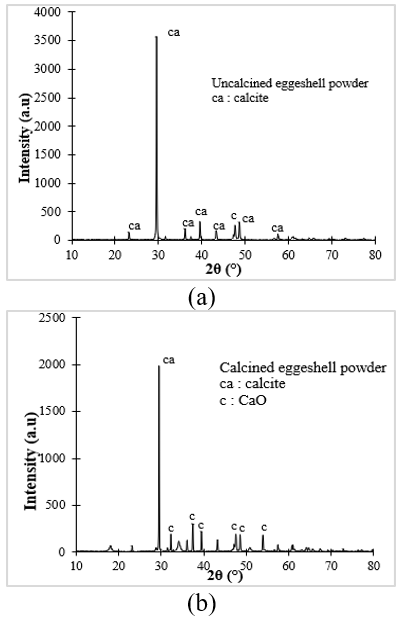
- Eggshells were collected from local eateries and households, thoroughly cleaned with tap water to remove impurities and dust, and then sun-dried for approximately 24 h. The shells were then placed in an oven at 105 ℃ for an additional 24 h to ensure complete drying. The dried shells were subsequently crushed and sieved through an 80 µm mesh to obtain a fine, homogeneous powder. The prepared powder exhibited a Blaine specific surface area of 3970 cm²/g and a density of 2.67 g/cm³. Part of this powder was calcined in an electric furnace at 950 ℃ for 1 h. Table 1 reports their chemical compositions. The XRD patterns of both the calcined and UESPs are presented in Figure 1.
Figure 1. X-ray Diffraction (XRD) analysis: (a) uncalcined eggshells, (b) calcined eggshells
- The superplasticizer used is a high‑range water‑reducing superplasticizer «SIKA‑PLSAT 40PRO», based on polycarboxylate ether, compliant with standard NF EN 934‑2, with a density of 1.055 ± 0.015 and a pH of 4.5 ± 1.0.
According to Figure 1(a), it can be observed that the uncalcined powder exhibits intense and distinct diffraction peaks, dominated by calcite CaCO3, with a major peak at 2θ ≈ 29.4°, which confirms the relatively stable crystalline and carbonated nature of the raw material.
After calcination at 950 ℃ for 1 h, as shown in Figure 1(b), the intensity of the calcite peaks decreases, while new peaks attributed to calcium oxide (CaO) appear. This indicates that calcination at 950 ℃ for 1 h led to substantial decarbonation of the eggshell powder, with clear formation of CaO. The associated release of CO₂ during this process is consistent with the reduction in loss on ignition (LOI) commonly reported for calcined eggshell powders, as illustrated by the following reaction:
$\mathrm{CaCO}_3 \xrightarrow{950^{\circ} \mathrm{C} \text { for } 1 \mathrm{~h}} \mathrm{CaO}+\mathrm{CO}_2$ (1)
2.2 Experimental methodology
In this study, 11 mortars were prepared in accordance with standard EN 196-1:
- One OM,
- 05 mortars containing UESP, replacing cement by weight at rates of 5%, 7.5%, 10%, 12.5% and 15%,
- 05 mortars with CESP with the same replacement ratios (CESP5%, CESP7.5%, CESP10%, CESP12.5% and CESP15%).
All mortar mixtures were prepared using a constant W/(C+A) ratio of 0.6, as summarized in Table 2.
The tests carried out on the different mortar formulations are:
- The workability test according to standard NF EN 1015-3.
- Compression and flexural tensile tests at 7, 28, 90 and 180 days were performed on specimens measuring (4 × 4 × 16) cm3 according to standard EN 196‑1.
- The ultrasonic test was performed on specimens measuring (4 × 4 × 16) cm3 in accordance with EN 12504-4:2021.
- The water absorption test was performed on specimens measuring (4 × 4 × 16) cm3, according to the standards NBN B 15-215:1989.
- Chemical attack test with hydrochloric acid (HCl) on (4 × 4 × 16) cm3 specimens previously cured in water for 28 days; they were then immersed in a 5% HCl solution in accordance with ASTM C267-97.
Three specimens were tested for each mixture and testing age.
Table 2. Mix proportions of the studied mortars
|
|
Sand (g) |
Cement (g) |
UESP (g) |
CESP (g) |
Water (mL) |
Superplasticizer (%) |
W/(C+A) |
|
OM |
1350 |
450 |
-- |
-- |
270 |
0.6 |
0.6 |
|
MUESP5% |
1350 |
427.5 |
22.5 |
-- |
270 |
0.6 |
0.6 |
|
MUESP7.5% |
1350 |
416.25 |
33.75 |
-- |
270 |
0.6 |
0.6 |
|
MUESP10% |
1350 |
405 |
45 |
-- |
270 |
0.6 |
0.6 |
|
MUESP12.5% |
1350 |
393.75 |
56.25 |
-- |
270 |
0.6 |
0.6 |
|
MUESP15% |
1350 |
382.5 |
67.5 |
-- |
270 |
0.6 |
0.6 |
|
MCESP5% |
1350 |
427.5 |
-- |
22.5 |
270 |
0.6 |
0.6 |
|
MCESP7.5% |
1350 |
416.25 |
-- |
33.75 |
270 |
0.6 |
0.6 |
|
MCESP10% |
1350 |
405 |
-- |
45 |
270 |
0.6 |
0.6 |
|
MCESP12.5% |
1350 |
393.75 |
-- |
56.25 |
270 |
0.6 |
0.6 |
|
MCESP15% |
1350 |
382.5 |
-- |
67.5 |
270 |
0.6 |
0.6 |
3.1 Workability
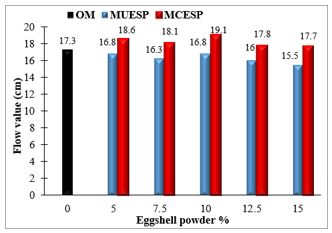
The flow values for the different mortars studied are presented in Figure 2. Based on the results, it can be noted that the use of uncalcined powder caused a slight decrease in flow compared to the reference mix (17.3 cm), with values ranging between 15.5 and 16.8 cm, which is linked to its high porosity and water absorption capacity. In contrast, the calcined powder notably improved the workability of the mortar, with values ranging between 17.7 cm and 19.1 cm, confirming that calcination reduces porosity and absorption, thereby contributing to improving the fluidity of the mix.
Figure 2. Influence of eggshell powder on the workability of mortar
The 10% substitution gave the best workability (19.1 cm versus 17.3 cm for the OM, so an improvement of 10.4%), while a progressive decrease was observed at higher replacement rates, attributed to increased water absorption and the reaction of calcium oxide with water. These observations agree with the work of Amanah and Khalil [20], who showed that eggshell ash is less absorptive than Portland cement, thus slightly improving workability.
3.2 Compressive strength
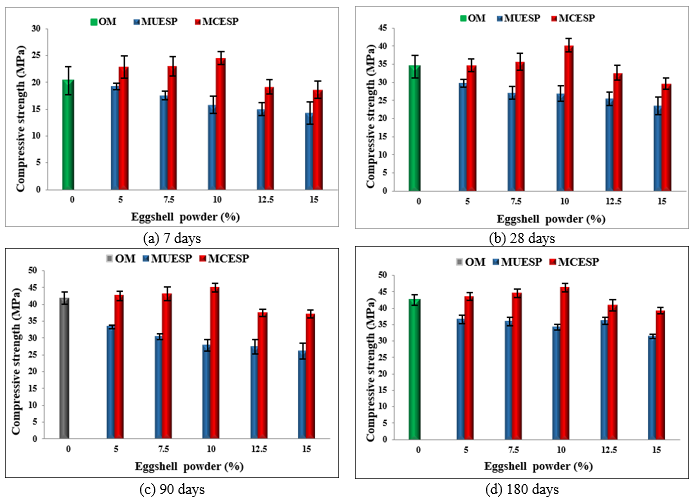
The variation in compressive strength at 7, 28, 90, and 180 days is presented in Figure 3. According to the results, it is observed that the addition of UESP as a partial cement substitute decreases the compressive strength, and this reduction became more pronounced as the replacement rate increased. For instance, at 28 days, a compressive strength of 34.34 ± 3.2 MPa is observed for the reference mortar OM, compared to 29.79 ± 1.1 MPa for the mortar with uncalcined eggshell powder (MUESP) 5% and 23.55 ± 2.4 MPa for the MUESP15%. This represents a decrease of 13.25% and 31.42% for the MUESP5% and MUESP15% mortars, respectively. This decline in strength is attributed to the low pozzolanic activity of the UESP, which acts primarily as a filler rather than a binder [18]. These results are consistent with those reported by Ambreshwar et al. [24] and Tie et al. [ 25].
Figure 3. Variation of compressive strength for the two-mortar series
Concerning the mortar with calcined eggshell powder (MCESP), the results showed a noticeable improvement in compressive strength for substitution rates not exceeding 10%. For example, at 28 days, the strength increased from 34.34 ± 3.2 MPa for the OM to 40.2 ± 1.9 MPa for the MCESP10% mortar, +17.06%. This improvement could be attributed to the potential chemical transformations induced by calcination, particularly the decarbonation of CaCO3 into reactive calcium oxide. This may promote the formation of additional hydration products and the densification of the mortar microstructure [26].
Beyond the 10% substitution rate, a decrease in strength was observed due to the accumulation of unreacted CaO and the dilution effect of the active cement. These results confirm the previous studies by Jaber et al. [21] and Ngayakamo [26].
In the long term (90 and 180 days), the evolution of compressive strength confirms the trends observed at 28 days: a decrease in strength is noted for mortars containing UESP, whereas an increase is observed up to 10% substitution for those made with calcined powder.
3.3 Flexural strength
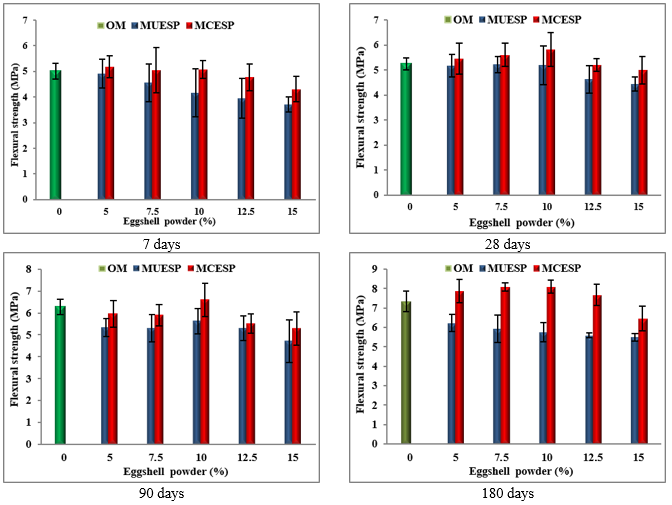
The flexural strength test results at 7, 28, 90, and 180 days for the two mortar series are presented in Figure 4. The same trends are observed as for compressive strength. A decrease in flexural strength occurs with increasing substitution rate for mortars incorporating UESP. For example, at 28 days, a flexural strength of 5.25 ± 0.23 MPa is recorded for the OM, compared to 4.44 ± 0.28 MPa for the mortar MUESP15%, representing a reduction of 15.43%. This decrease is attributed to the inert nature of the UESP, which mainly acts as a filler; similar results were reported by Hama [27].
On the other hand, an increase in flexural strength is observed up to a substitution rate of 10% for mortars incorporating calcined eggshell powder. A flexural strength of 5.25 ± 0.23 MPa is observed for the OM mortar, compared with flexural strengths of 5.46 ± 0.61 MPa, 5.61 ± 0.46 MPa and 5.83 ± 0.67 MPa for the MCESP5%, MCESP7.5% and MCESP10% mortars, respectively. This corresponds to an increase of 11.05% for the MCESP10% mortar. Similar observations have been reported by Ramya et al. [28].
Figure 4. Variation of flexural strength for the two-mortar series
3.4 Ultrasonic pulse velocity
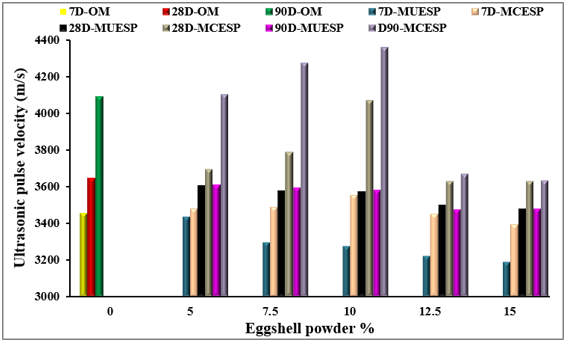
The ultrasonic pulse velocity values of the different mortars studied at 7 days, 28 days, and 90 days of age are presented in Figure 5. For the different ages, it is observed that the addition of non-calcined eggshell powder decreases the ultrasonic velocity. For example, at 28 days of age, the ultrasonic velocity decreases from 3644.6 m/s for the OM to 3601.1 m/s, 3573.5 m/s, 3570.3 m/s, 3498.0 m/s, and 3475.3 m/s for mortars MUESP5%, MUESP7.5%, MUESP10%, MUESP12.5%, and MUESP15%, respectively. Therefore, a decrease of 1.19%, 1.95%, 2.04%, 4.02%, and 4.65%. This can be explained by a reduced reactivity of the CaCO3 and increased porosity within the structure. The same observation was reported by Zhang et al. [17].
Figure 5. Ultrasonic pulse velocity values at 7, 28, and 90 days for the two series of mortars studied
In contrast, CESP considerably improved the ultrasonic pulse velocity (UPV) values. After 28 days, the ultrasonic velocity increases from 3644.6 m/s for the OM to 3691.3 m/s, 3786.7 m/s, and 4069.8 m/s for mortars MCESP5%, MCESP7.5%, and MCESP10%, respectively. Therefore, an increase of 1.28%, 3.9%, and 11.67%, respectively. This increase is likely related to a denser microstructure resulting from the incorporation of calcined eggshell powder, which may foster the formation of additional hydration products.
However, for MCESP12.5% and MCESP15%, a decrease in ultrasonic velocity is observed, with velocities of 3628.1 m/s and 3625.6 m/s, respectively. This decrease is probably due to the higher specific surface area of MCESP compared to Portland cement. At constant W/C+A ratio, the higher surface area increases physical water demand, reducing mix workability and promoting micro-void entrapment during compaction.
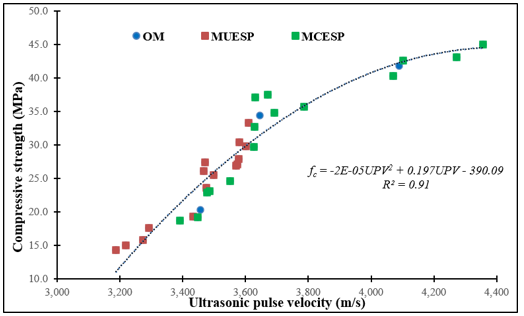
Several studies have shown that the ultrasonic pulse velocity can be used to predict variations in compressive strength [29, 30]. Figure 6 shows the relationship between compressive strength and ultrasonic pulse velocity based on the results obtained at 7, 28, and 90 days for the different mortars studied. According to Figure 6, the compressive strength and ultrasonic pulse velocity of the concrete exhibit an approximately non-linear increasing relationship. This result is confirmed by several researchers [31, 32].
From the results obtained (33 experimental data points), the following empirical quadratic relationship between compressive strength (fc in MPa) and ultrasonic pulse velocity (UPV in m/s) was derived, with R² = 0.91:
$\begin{gathered}f_c(M P a)=-0.00002 U P V^2+0.197 U P V-390.09\end{gathered}$ (2)
Figure 6. Relationship between ultrasonic pulse velocity and compressive strength
3.5 Water absorption
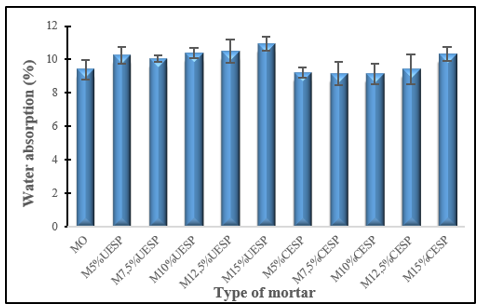
The water absorption values for the different mortars studied are shown in Figure 7. The results indicate that the addition of UESP increases water absorption, regardless of the substitution rate. This increase ranges from 9.40 ± 0.6% for OM to 10.94 ± 0.4% for mortar MUESP15%, representing an increase of 16.4%. This increase is attributed to the inert nature of the UESP and the absence of a pozzolanic reaction with calcium hydroxide resulting from cement hydration, which leads to a decrease in the density of the cementitious matrix, an increase in porosity and voids [29]. The same results were found by Hama [27] and Şenol et al. [29].
Figure 7. Water absorption values for the different mortars studied
For mortars with calcined eggshell powder, a slight decrease in water absorption is observed for substitution rates up to 10%. It decreases from 9.40 ± 0.6% for the OM to 9.20 ± 0.3%, 9.14 ± 0.7%, and 9.13 ± 0.6% for mortars MCESP5%, MCESP7.5%, and MCESP10%, respectively. Beyond this, it begins to increase. This could be attributed to the reactivity of the CESP as a reactive CaO-rich material, resulting from the transformation of CaCO3 into active calcium oxide during calcination. Upon mixing with water, this active oxide may participate in further hydration reactions within the cementitious mortar to form additional hydration products. These potential products could help fill the pores, thereby improving the compactness and impermeability of the matrix. The same trend was observed by Khan et al. [33].
3.6 Attack by hydrochloric acid
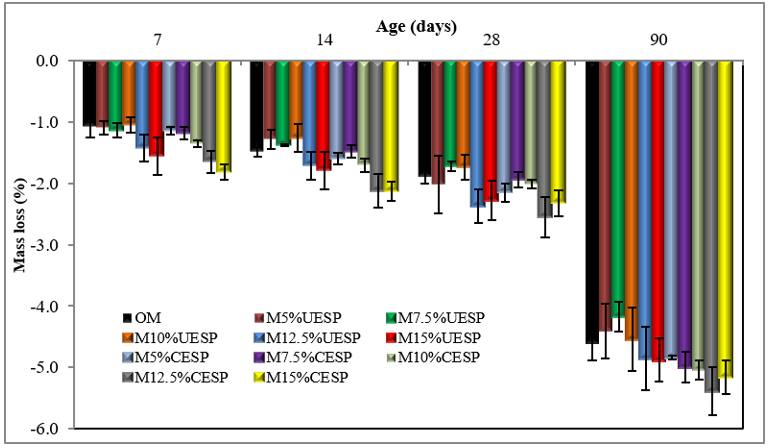
Figure 8 illustrates the mass loss of the 11 mortars studied after immersion in a 5% concentration HCl solution for 7, 14, 28, and 90 days. According to the results, it is observed that all mixtures experienced a decrease in mass, with the most significant loss observed for samples containing eggshell powder.
Figure 8. Mass loss of mortar mixtures after different ages of immersion in hydrochloric acid (HCl)
For the different ages studied, the addition of non-calcined eggshell powder at rates below 10% shows a mass loss similar to or lower than that of the OM. For example, at 90 days of age, OM showed a mass loss of 4.6 ± 0.29%, compared to mass losses of 4.41 ± 0.45%, 4.17 ± 0.24%, and 4.54 ± 0.52% for mortars MUESP5%, MUESP7.5%, and MUESP10%, respectively, representing a decrease of 4.13%, 9.35%, and 1.3%, respectively. This is likely attributable to the influence of UESP, which is rich in CaCO3 and contributes to slowing down acid penetration. The same trend was observed by Tan et al. [34].
However, mortar samples containing CESP exhibited a slightly higher mass loss than the control sample, regardless of age and replacement rate. At 90 days, the OM showed a mass loss of 4.6± 0.29%, compared to mass losses of 4.84 ± 0.03%, 5.0 ± 0.25%, 5.04 ± 0.15%, 5.39 ± 0.39%, and 5.16 ± 0.27% for mortars MCESP5%, MCESP7.5%, MCESP10%, MCESP12.5% and MCESP15% respectively. So, an increase of 5.22%, 8.69%, 9.56%, 17.17%, and 12.17%, respectively. This may be due to the calcium oxide (CaO) produced during calcination. This oxide reacts rapidly with the acidic medium to form soluble products, leading to the cracking of the cementitious material and additional mass loss.
This experimental study examines the effect of calcination of eggshell powder used as a partial cement substitute (0% to 15%) on mortar performance. From the results obtained, we can conclude that:
- Uncalcined eggshell powder progressively reduces workability, whereas CESP improves it.
- The addition of UESP results in reductions in compressive strength, flexural strength, and ultrasonic pulse velocity, particularly at higher replacement levels. In contrast, CESP notably enhances these properties at replacement levels up to 10%.
- The addition of UESP increases water absorption. In contrast, the addition of calcined powder up to a replacement rate of 10% decreases it.
- The addition of UESP at rates up to 10% improves resistance to chemical attacks by HCl; however, the addition of calcined powder decreases it.
- Calcination transforms eggshells from an inert mineral filler into a reactive material with pozzolanic properties within the cementitious matrices. This material contributes to the formation of hydrates and enhances the reactivity of the system.
- Addition of 10% of CESP provided the best overall balance of performance, although acid resistance was reduced.
[1] Tan, B.L., Rahman, N.S.A., Kassim, S., Mokhtar, M. (2022). Utilisation of eggshells powder in construction of concrete. Multidisciplinary Applied Research and Innovation, 3(1): 183-192.
[2] Hussein, A.O., Ghayyib, R.J., Radi, F.M., Jawad, Z.F., Nasr, M.S., Shubbar, A. (2024). Recycling of eggshell powder and wheat straw ash as cement replacement materials in mortar. Civil Engineering Journal, 10(1): 83-99. http://doi.org/10.28991/cej-2024-010-01-05
[3] Khalil, W.I., Frayyeh, Q.J., Ahmed, M.F. (2020). Characteristics of eco-friendly metakaolin based geopolymer concrete pavement bricks. Engineering and Technology Journal, 38(11A): 1706-1716. https://doi.org/10.30684/etj.v38i11A.1699
[4] Jhatial, A.A., Sohu, S., Memon, M.J., Bhatti, N.U.K., Memon, D. (2019). Eggshell powder as partial cement replacement and its effect on the workability and compressive strength of concrete. International Journal of Advanced and Applied Sciences, 6(9): 71-75. https://doi.org/10.21833/ijaas.2019.09.011
[5] Jhatial, A.A., Kumar, A., Bheel, N., Sohu, S., Goh, W.I. (2022). Assessing the sustainability and cost-effectiveness of concrete incorporating various fineness of eggshell powder as supplementary cementitious material. Environmental Science and Pollution Research, 29: 84814-84826. https://doi.org/10.1007/s11356-022-21635-7
[6] He, Y.H., Che, D.H., Ouyang, X.W., Niu, Y.F. (2022). Surface properties of eggshell powder and its influence on cement hydration. Materials, 15(21): 7633. https://doi.org/10.3390/ma15217633
[7] Bouras, F., Nigri, G., Kechkar, C., et al. (2025). Characterization and optimization of olive pomace ash as a partial cement replacement. Revue des Composites et des Matériaux Avancés-Journal of Composite and Advanced Materials, 35(6): 1099-1105. https://doi.org/10.18280/rcma.350610
[8] Gowsika, D., Sarankokila, S., Sargunan, K. (2014). Experimental investigation of egg shell powder as partial replacement with cement in concrete. International Journal of Engineering Trends and Technology (IJETT), 14(1): 65-68. https://doi.org/10.14445/22315381/IJETT-V14P214
[9] Wei, C.B., Othman, R., Ying, C.Y., Jaya, R.P., Ing, D.S., Mangi, S.A. (2021). Properties of mortar with fine eggshell powder as partial cement replacement. Materials Today: Proceedings, 46: 1574-1581. https://doi.org/10.1016/j.matpr.2020.07.240
[10] Binici, H., Aksogan, O., Sevinc, A.H., Cinpolat, E. (2015). Mechanical and radioactivity shielding performances of mortars made with cement, sand and egg shells. Construction and Building Materials, 93: 1145-1150. https://doi.org/10.1016/j.conbuildmat.2015.05.020
[11] Kaur, H., Bala, M., Kumar, S., Chandel, S.K., Angral, M. (2023). Investigate the properties of concrete as partial replacement of cement with egg shell powder. International Journal of Innovative Research in Computer Science and Technology, 11(1): 10-16. https://doi.org/10.55524/ijircst.2023.11.1.3
[12] Mahmood, L.J., Rafiq, S.K., Mohammed, A.S. (2022). A review study of eggshell powder as cement replacement in concrete. Sulaimani Journal for Engineering Sciences, 9(1): 25-38. https://doi.org/10.17656/sjes.10150
[13] Hama, S.M., Hamdullah, D.N., Ashour, H.M. (2019). Effects of eggshell powder as partial replacement of cement on flexural behavior of one-way concrete slabs. Journal of Engineering Science and Technology, 15(5): 2509-2521.
[14] Chiraz, K., Zohra, B.F., Ghania, N., Houria, H., Hamid, A., Karima, M. (2025). Utilization of eggshell powder as a green mortar material. Materials Science, 31(2): 241-247. https://doi.org/10.5755/j02.ms.37855
[15] Vasudevan, G., Seah, C.W. (2020). Utilisation of eggshell powder (ESP) as partial replacement of cement incorporating superplasticizer. IOP Conference Series: Materials Science and Engineering, 840: 012016. https://doi.org/10.1088/1757-899X/840/1/012016
[16] Shah, S., Bhat, A.R. (2024). Eggshell waste to wonder: A novel approach to sustainable cementitious materials. International Journal for Research in Applied Science and Engineering Technology, 12(12): 1519-1527. https://doi.org/10.22214/ijraset.2024.66053
[17] Zhang, G.Y., Oh, S., Han, Y., Meng, L.Y., Lin, R.S., Wang, X.Y. (2024). Influence of eggshell powder on the properties of cement-based materials. Materials, 17(7): 1705. https://doi.org/10.3390/ma17071705
[18] Abbas, A., Jabr, E. (2025). Experimental investigation of bio-concrete using eggshells as supplementary cementitious material. MATEC Web of Conferences, 409: 13007. https://doi.org/10.1051/matecconf/202540913007
[19] Abbasi Dezfouli, A. (2020). Effect of eggshell powder application on the early and hardened properties of concrete. Journal of Civil Engineering and Materials Application, 4(4): 209-221. https://doi.org/10.22034/JCEMA.2020.241853.1036
[20] Amanah, B.H., Khalil, W.I. (2021). Evaluating the use of eggshell waste ash in high strength concrete. Engineering and Technology Journal, 39(8): 1321-1327. http://doi.org/10.30684/etj.v39i8.2102
[21] Jaber, H.A., Mahdi, R.S., Hassan, A.K. (2020). Influence of eggshell powder on the Portland cement mortar properties. Materials Today: Proceedings, 20: 391-396. https://doi.org/10.1016/j.matpr.2019.09.153
[22] Tangboriboon, N., Kunanuruksapong, R., Sirivat, A. (2012). Preparation and properties of calcium oxide from eggshells via calcination. Materials Science-Poland, 30: 313-322. https://doi.org/10.2478/s13536-012-0055-7
[23] Hossain, S.K.S., Roy, P.K. (2019). Development of sustainable calcium silicate board: Utilization of different solid wastes. Boletín de la Sociedad Española de Cerámica y Vidrio, 58(6): 274-284. https://doi.org/10.1016/j.bsecv.2019.06.003
[24] Ambreshwar, Brunda, G.S., Reddy, P.S. (2025). Investigation on partial replacement of eggshell powder with cement. In Recent Advances in Infrastructure Development and Management—Volume 1. MTCEIDM 2023. Lecture Notes in Civil Engineering, vol 570. Springer, Singapore, pp 275-283. https://doi.org/10.1007/978-981-96-1554-4_26
[25] Tie, I.M.W., Azmi, M.A.M., Maridan, N.Q., Ramdzam, M.S.H.M. (2022). An experimental study on concrete strength using egg shell powder (ESP) as partial replacement of cement. Multidisciplinary Applied Research and Innovation, 3(1): 193-199.
[26] Ngayakamo, B.H. (2025). Transforming cement mortar performance: Impact of eggshell powder as an eco-friendly cement substitute. Discover Concrete and Cement, 1: 22. https://doi.org/10.1007/s44416-025-00021-9
[27] Hama, S.M. (2017). Improving mechanical properties of lightweight Porcelanite aggregate concrete using different waste material. International Journal of Sustainable Built Environment, 6(1): 81-90. http://doi.org/10.1016/j.ijsbe.2017.03.002
[28] Ramya, A.K., Manoj, A.V.P., Veerendra, G.T.N., Rao, P.K.R. (2019). Strength and durability properties of concrete with partially replaced cement with egg shell powder and fine aggregate with quarry dust. International Journal of Innovative Technology and Exploring Engineering, 8(10): 4585-4590. http://doi.org/10.35940/ijitee.J9134.0881019
[29] Şenol, A.F., Çalışkan, Ö. (2026). Effect of eggshell powder calcined at different temperatures on the workability and mechanical properties of cement-based mortars. Niğde Ömer Halisdemir University Journal of Engineering Sciences, 15: 1-12. http://doi.org/10.28948/ngumuh.1790353
[30] Wang, C.C., Wang, H.Y. (2017). Assessment of the compressive strength of recycled waste LCD glass concrete using the ultrasonic pulse velocity. Construction and Building Materials, 137: 345-353. https://doi.org/10.1016/j.conbuildmat.2017.01.117
[31] Breysse, D., (2012). Nondestructive evaluation of concrete strength: An historical review and a new perspective by combining NDT methods. Construction and Building Materials, 33: 139-163. https://doi.org/10.1016/j.conbuildmat.2011.12.103
[32] Shah, A.A., Alsayed, S.H., Abbas, H. Al-Salloum, Y.A. (2012). Predicting residual strength of non-linear ultrasonically evaluated damaged concrete using artificial neural network. Construction and Building Materials, 29: 42-50. https://doi.org/10.1016/j.conbuildmat.2011.10.038
[33] Khan, K., Ahmad, W., Amin, M.N., Deifalla, A.F. (2023). Investigating the feasibility of using waste eggshells in cement-based materials for sustainable construction. Journal of Materials Research and Technology, 23: 4059-4074. https://doi.org/10.1016/j.jmrt.2023.02.057
[34] Tan, Y.Y., Doh, S.I., Chin, S.C. (2018). Eggshell as a partial cement replacement in concrete development. Magazine of Concrete Research, 70(13): 662-670. https://doi.org/10.1680/jmacr.17.00003