Ahmed H. Oleiwi* | Akram R. Jabur | Qusay F. Alsalhy
© 2026 The authors. This article is published by IIETA and is licensed under the CC BY 4.0 license (http://creativecommons.org/licenses/by/4.0/).
OPEN ACCESS
Electrospinning is an adaptable, technologically advanced process of fabricating nanofibrous membranes for the water treatment process. The technique can produce continuous fibers of nanoscale size, a high specific surface area, and a highly interconnected porosity structure. These properties significantly increase the water filtration ability of the membrane and the ability of the membrane to separate contaminants. It then discusses the electrospinning process and explains how a polymeric solution is converted to nanofibers and assembled into a porous membrane for separation, purification, and filtration applications. It also details the main physicochemical properties controlling membrane effectiveness, including pore structure, permeability, and contaminant removal capability. It also discusses theoretical models of membrane behavior interpretation (including Darcy's law, the Hagen–Poiseuille equation, and flow models through porous media). Porosity and filtration efficiency can then be calculated using equations. Additionally, the interaction between membrane operation and microstructural behavior (e.g., fiber diameter, pore size distribution, and pore connectivity) has a powerful impact on filtration efficiency and fluid flow resistance. Finally, this review provides a basis for the scientific optimization of electrospun nanofiber membranes (ENMs) and directs further research to develop cheap, environmentally friendly, and highly efficient water purification systems able to handle microorganisms, suspended solids, and an array of organic and inorganic contaminants.
electrospun membranes, Nano-filters, water treatment, separation processes, fluid transport theories, permeability, filtration efficiency
Water pollution is arguably among the major environmental issues faced by humans today, as it not only causes various health problems but also harms the environment [1]. Human activities like rapid population growth, industrialization, urbanization, agriculture, and even climate change are responsible for causing various pollutants to be discharged in water bodies, which include heavy metals [2], dyes [3], pharmaceuticals [4], pathogens [5], etc. The complexity in the nature of pollutants demands an effective, economical, and versatile approach towards the purification of contaminated water as well as addressing the issue of freshwater scarcity [6, 7].
Water pollutants include organic or inorganic compounds, heavy metals, rare earth elements, dyes, oils, greases, and radioactive compounds, they originate from sources such as textile industries, pharmaceutical industries, petroleum industries, food processing units, agricultural practices, and mining practices [2, 8], Various conventional techniques like coagulation–flocculation, sedimentation, adsorption, biological treatment, and advanced oxidation have been used extensively in order to remove these pollutants from the effluents and contaminated water samples. However, these treatments may suffer from various drawbacks like high consumption of chemicals, inefficient removal of emerging contaminants, sludge formation, and high cost of operation [9, 10]. Membrane-based separation techniques have garnered significant interest due to their superior selectivity, ease of use, low energy consumption, and ability to purify water without generating substantial secondary pollution [11, 12]. However, conventional membranes created through phase inversion techniques and similar processes have been plagued by numerous issues such as membrane fouling, poor permeability, inadequate anti-fouling capabilities, mechanical weakness, and the permeability-selectivity dilemma [6, 11, 13].
To overcome these constraints, there has been an emphasis on developing membrane materials with superior surface characteristics, controllable porosity, and increased water flux [14, 15].
Electrospinning, which is considered one of the most sophisticated methods of membrane fabrication, enables the development of highly customizable and versatile electrospun nanofiber membranes (ENMs). Solution electrospinning refers to an approach wherein a charged jet of a polymer solution is placed in a strong electric field until it undergoes elongation and solidification to form nanosized fibers [16-18]. As a result, ENMs feature such characteristics as nanofiber diameter, interconnected pores, high porosity, large surface area, and tunable surface chemistry. Consequently, the application of ENMs in the context of water treatment benefits from their specific properties, such as pore size, hydrophilicity, surface charge, and functional groups, which are directly involved in the processes of water permeability, filtration efficiency, and fouling inhibition [19, 20]. The properties of electrospun membranes may be further improved using techniques like polymer blending, surface modification, and introduction of nanoparticles [7, 21].
The incorporation of nanoparticles, photocatalysts, bactericidal materials, carbon-based substances, metal oxides, and biopolymers allows for the introduction of adsorption, photodegradation, antibacterial, oil/water separation, and increased hydrophilicity properties. Hence, ENMs can be used to design multifunctional membranes that are able to treat contaminated water through a combination of various mechanisms, such as size exclusion, adsorption, selective wettability separation, catalytic decomposition, and anti-biofouling [22, 23].
In this review, the emphasis will be placed on the use of electrospinning as a cutting-edge approach for developing nanofibrous membranes for water treatment applications. This includes discussing the basic theory of electrospinning, the structural characteristics of ENMs, and the connection between membrane design and filtration properties [24]. Special attention is paid to the influence of fiber diameter, porosity, pore size distribution, surface chemistry, wettability, and additional functionalities on permeability, selectivity, adsorption ability, antifouling properties, and filtration efficiency [25]. Also, the review briefly describes the primary processes of water purification by means of ENMs, such as physical sieving, adsorption, oil–water separation, photocatalytic reactions, and antimicrobial activity. Moreover, the article covers selected theoretical and mathematical approaches describing the water flow, permeability, porosity, and fouling processes within ENMs, such as Darcy's law, the Kozeny–Carman equation, and traditional fouling models.
The water purification mechanism in ENMs involves physical, chemical, and biological processes. In contrast to other filters, ENMs consist of nanofibers, porous channels, high porosity, a large surface area, and adjustable surface chemistry. These properties enable ENMs to regulate water and contaminant flow via pore size-based separation, surface forces, electrostatic effects, adsorption, catalysis, and antimicrobial action [26].
In ENMs for wastewater purification, the effectiveness of the process depends on the association between the membrane structure and the pollutants' properties. The factors include fiber diameter, pore sizes, membrane thickness, porosity, surface charge, wetting capacity, and functional groups that dictate whether the contaminants are rejected physically, absorbed on the fiber surfaces, chemically reacted, or biologically inactivated. Thus, pollutants such as particulates, pigments, heavy metals, oils, drugs, and microorganisms can be separated by distinct yet possibly overlapping processes [27, 28].
Due to the porous nature of ENMs, there are always continuous channels for water migration, but the passage of any contaminants beyond the effective pore size is hindered. Simultaneously, the large surface area of the nanofibers increases the interaction between contaminants and active centers on the membrane surface, leading to enhanced adsorption and removal through surface effects [29]. In this regard, the mechanisms responsible for water purification using ENMs will be addressed in the upcoming sections. The mentioned mechanisms include size exclusion, adsorption, ion exchange/chelation, wettability-dependent separation, chemical reactivity filtration, and antimicrobial/biofouling control processes. Table 1 shows these mechanisms and their significance for the ENM performance.
Table 1. Water filtration mechanisms and their relevance to electrospun nanofiber membranes (ENMs) [31, 35, 43, 55, 56]
|
Principle |
Main Target |
Mechanism |
Advantages |
Limitations |
|
Size exclusion |
Suspended solids, turbidity |
Physically blocks particles larger than pore size |
Simple, fast, low-cost |
Cannot remove dissolved chemicals |
|
Adsorption |
Dissolved organics, chlorine, and some metals |
Molecules stick to the surface of media via physical or chemical forces |
Effective for organics, taste, odor |
Saturates over time |
|
Ion exchange |
Hardness ions, nitrates, heavy metals |
Exchanges undesirable ions with harmless ones on functional sites |
Specific, high capacity for target ions |
Sensitive to competing ions and fouling |
|
Antimicrobial activity |
Organic matter, ammonia, pathogens |
Uses microbes or antimicrobial surfaces to degrade, consume, or inhibit contaminants |
Natural, eco-friendly, good for organics |
Slow, sensitive to environmental changes |
|
Chemical filtration |
Metals, chlorine, iron, pH correction |
Reacts chemically with contaminants to change or remove them |
Remove difficult contaminants (e.g. Fe, As) |
Require chemical dosing and monitoring |
2.1 Size exclusion and pore-controlled sieving
Size exclusion, otherwise referred to as sieving, is among the major physical processes by which electrospun nanofibrous membranes (ENMs) effect particle removal from water. Size exclusion involves physical retention of contaminants larger than the pore size of the membrane as water passes through the interconnected pore network. Unlike other common filter materials, ENMs have nanoscale fiber diameters, high porosity, and controllable pore size distribution, allowing them to offer efficient contaminant retention coupled with higher water permeability [30]. Sieving activity of ENMs is highly influenced by the membrane structure, which includes fiber diameter, fiber packing density, thickness, pore size distribution, and tortuosity. Reduced fiber diameter and higher fiber packing density typically lower the effective pore size, leading to improved rejection, but too high packing density causes higher hydraulic resistance and lower permeate flow. This makes it important to balance the two competing processes during the design of ENM membranes [31, 32].
Particles larger than the membrane pores will be retained on the membrane surface via surface sieving and entrapped in the interior pore network by depth filtration. In electrospun membranes, the disorganized nature of the fiber arrangement leads to interconnected flow paths that help to effectively trap particles. The development of pore clogging and cake formation is likely when operating the membrane for an extended time, thus necessitating the need for proper membrane design and adequate cleaning methods [32].
This sieving process works well for the removal of suspended solids, particles responsible for turbidity, microplastics, and some microbial contaminants. The size exclusion technique alone is ineffective for the removal of dissolved organic pollutants such as dyes, heavy metals, and other pharmaceuticals. This makes it necessary to integrate size exclusion with other processes such as adsorption, electrostatic interactions, ion-exchange reactions, photocatalysis, and antimicrobial activities [33].
2.2 Adsorption
Adsorption is another form of removal through a surface-based process whereby molecules of contaminants dissolved in the water are adsorbed onto active sites on the surface of the adsorbent material. For ENMs used in water purification, adsorption serves as a complimentary technique to size exclusion in capturing contaminants that are too small or too soluble for removal by physical screening, including dyes, medicinal drugs, organic pollutants, and heavy metal ions [34]. Adsorption differs from adsorption in that adsorption takes place on the surface of the material rather than inside the bulk phase [35].
ENMs are especially suited for adsorption treatment of water due to the high specific surface area, porosity, and tailorable surface chemistry. Adsorption in ENMs can happen due to various forces of interaction, which include van der Waals interactions, electrostatic interactions, hydrogen bonding, π-π interactions, complexation, and chemisorption, among others. All these forces of interaction are dependent on the physicochemical characteristics of the pollutants as well as the surface chemistry of the material. Carbon-based materials like activated carbon can facilitate the adsorption of non-polar organic molecules, while metal oxides can provide active sites for ion binding by virtue of electrostatic interaction or surface complexation [36].
Adsorption behavior in ENMs is affected by factors such as membrane porosity, fiber diameter, surface area, surface charge, functional groups, contaminant concentration, pH level, temperature, and contact duration. The functional modification of electrospun fibers using adsorbents like activated carbon, zeolites, metal oxides, clay minerals, and chelating ligands enhances adsorption capabilities by increasing the availability of reactive sites and the efficacy of eliminating dissolved pollutants [37, 38]. Nevertheless, adsorption capacity drops as the reactive sites become saturated, necessitating periodic regeneration, replacement, or reactivation of the membrane surface. Despite this restriction, adsorption is still one of the most commonly employed strategies for eliminating dissolved contaminants in aqueous solutions, specifically organic molecules, dyes, heavy metal ions, and taste-and-odor-causing substances. In an ENM, adsorption can occur alongside other processes such as size exclusion, electrostatic interactions, catalytic oxidation, and microbial inhibition, providing ENMs with the potential to perform multiple roles in wastewater remediation applications [39].
2.3 Ion exchange
Ion exchange is a chemical separation approach whereby unwanted ions dissolved in water are substituted with other ions, which are deemed to be more suitable via a reversible reaction with charged sites in the solution. For purposes of water purification, this chemical separation approach occurs when ion exchange resins are utilized, which are normally polymers containing functional groups that can bind specific ions [40, 41]. On ENMs, ion exchange can take place through the integration of charged polymers, functional additives, or modified nanomaterials into the fiber membrane.
The ion exchange approach occurs due to electrostatic attraction between the dissolved ions and the oppositely charged membrane surfaces. Cation exchange takes place in case there are functional groups like carboxyl, sulphonate, or other negative ions, which attract positive ions like Ca²⁺, Mg²⁺, Pb²⁺, Cu²⁺, Cd²⁺, and others [42].
Anion exchange is the process whereby positively functionalized functional groups interact with negatively charged anionic species like nitrate (NO₃⁻), fluoride (F⁻), arsenate (AsO₄³⁻), and chromate, among others [43, 44].
In ENMs, the increased surface area and interwoven porous network facilitate better access to active sites for ion exchange reactions. Additionally, electrospun fibers can be modified with amine, carboxyl, hydroxyl, sulfonic, or chelating functional groups that increase ion exchange selectivity and capacity. The process of ion exchange can also coincide with chelation involving coordination of metal ions by functional groups located at the membrane surface. Such simultaneous ion exchange and chelation reactions are especially valuable for heavy metal and radioactive species removal from polluted waters [41]. Various factors affect the effectiveness of ion exchange within ENM systems, such as the availability and concentration of functional groups, membrane porosity, surface charge, pH value, contact time, presence of competing ions, and the initial concentration of contaminants. With increasing occupation of active sites, the capacity for ion exchange progressively reduces, necessitating membrane regeneration or substitution. When coupled with other processes like adsorption, size exclusion, or catalytic degradation, ion exchange ENMs allow for selective and flexible water purification [42].
2.4 Biological interactions and biofouling control in electrospun nanofiber membranes
Interactions involving living organisms significantly affect the operation of ENMs, especially in terms of microorganism removal and biofilm inhibition or development. As stated above, in traditional biological filtration, microorganisms adsorbed on the filter materials can transform pollutants due to their metabolic activities [45]. However, when applied to water purification and treatment, ENMs are mostly considered in terms of the capacity to hold or block microorganisms from entering the downstream stages of the purification process.
Functionalization of ENMs can be achieved using antimicrobial polymers, metal nanoparticles, metal oxides, carbonaceous materials, and bioactive molecules. Functionalized ENMs can have antibacterial properties, as they could prevent microbial growth by disrupting microbial cell walls, generating reactive oxygen species, interfering with cell metabolism, or preventing microbial attachment. Antimicrobial functionalization can be very helpful in designing membranes used in wastewater purification, pathogen removal, and other applications that involve interaction with biologically active liquid streams [46, 47].
Some ENM membranes can be utilized in biologically enhanced treatment applications when they are bioactive or biofilm-based. In these systems, attached bacterial colonies would promote the biodegradation of organic substances, ammonia, nitrite ions, and other biodegradable pollutants. However, special care must be taken to regulate the supply of dissolved oxygen, nutrients, fluid flow, and biomass deposition to prevent unwanted biofilm formation on the membranes [48].
The biological function of ENMs in wastewater treatment depends on factors such as membrane morphology, surface chemistry, wettability, and the inclusion of antimicrobial or bioactive elements. The physical entrapment of microorganisms, along with antifouling or antimicrobial surfaces, can provide additional benefits in terms of pathogen removal, fouling prevention, and overall performance stability of advanced wastewater treatment processes.
2.5 Chemically reactive and catalytic filtration
Chemical filtration is defined as the process of removal or reaction of contaminants via the chemical reactions taking place on the surface of the filter material. For ENMs, however, this term can be better defined as chemically reactive or catalytic filtration, wherein the functional groups, reactive additives, and nanomaterials contained in the filtration medium interact with contaminants, leading to redox reactions, precipitation, neutralization, chelation, and catalytic degradation [28, 49]. While mechanical filtration works on sieving, chemical filtration targets dissolved and chemically active contaminants.
Chemical reactivity in ENMs can be induced using approaches such as surface functionalization of ENMs as well as the use of reactive materials that can be incorporated into the nanofibers. Examples of such chemicals include metallic nanoparticles, metal oxides, carbonaceous materials, and photocatalysts, as well as redox chemicals, which could enable chemical reactions that would immobilize or degrade pollutants within the filter. Redox chemicals may oxidize metal ions into less soluble or less mobile forms, which can subsequently be immobilized in the membrane or removed during downstream filtration [50]. Chlorine and other reactive species can be chemically degraded into less harmful products, depending on the nature of the reactive medium.
In addition to oxidation, precipitation can also be facilitated using a reactive medium. Metallic ions such as iron and manganese ions, in their soluble states, can be oxidized to produce insoluble or particulate ions that can easily be captured by the filter. In conventional filtration systems, chemicals such as potassium permanganate are used in filtration systems. This process is analogous to the use of catalytic/oxidative nanomaterials in the ENM-based filtration systems [51].
Besides the redox process, the ENM is capable of removing the contaminant via neutralization, chelation, and surface complexing. Various functionalities, such as hydroxyl, carboxyl, amine, or metal oxide surface functionalities, may react with the contaminant like arsenic, fluoride, heavy metal, or other inorganic ions. Activated alumina, iron oxides, and other inorganic additives improve the adsorption, chelation, or surface complexing processes when integrated or coated onto electrospun nanofibers [52, 53].
Chemical and catalytic functions of the ENM are dependent on many parameters, such as the surface area of the membrane, availability of the reactive group, pollutant concentration, pH level, reaction time, redox level, and stability of the functional materials added. The reactive or adsorption site will be consumed, deactivated, or saturated during the prolonged use and thus may reduce the efficiency of water purification. Thus, the chemical and catalytic function needs to be complemented by size exclusion, adsorption, ion exchange, or antimicrobial function to develop advanced ENMs for water purification [54].
Electrospinning has been commonly used during recent decades to fabricate continuous nanofibers, while the scientific background of this process can be linked back to the earlier studies on liquid jets actuated by electricity. This process was first associated with Lord Rayleigh’s study published in 1897, while Zeleny made an additional discovery in 1914 by explaining the electrospray process under the action of an electric field. Anton Formhals made another advance during his experiments conducted between 1934 and 1944, developing the process of electrospinning for the production of textile threads and commercializing electricity-actuated fibers [57, 58].
Another theoretical advancement in electrospinning was achieved by Geoffrey Taylor in the 1960s, explaining the deformation of a liquid droplet actuated by an electric field and the formation of the cone-like structure, referred to as the "Taylor cone." Another important contribution in electrospinning was made in 1988 by Simon, who showed that the process of electrospinning can produce mats of nanofibers from materials like polystyrene and polycarbonate to be used as a substrate for in vitro cell cultures. Later on, Reneker and Rutledge developed the process of electrospinning into a tool for making nanofibers of many types of organic polymers [6].
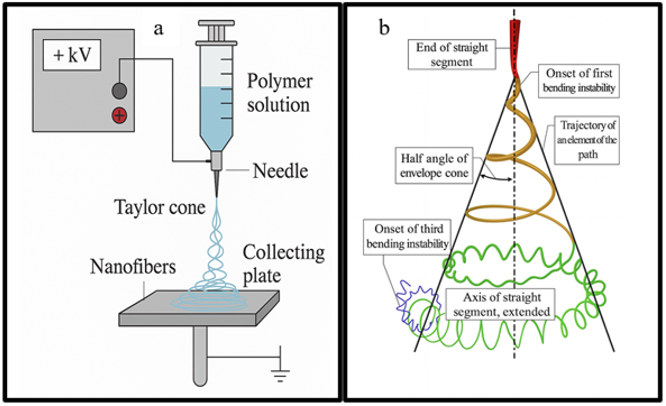
Electrospinning is well-known due to its simplicity, low-cost process, wide range of polymers, and controllability of fiber morphology based on the parameters of processing. Electrospun nanofibers are unique since they have nanometer-scale diameters of fibers, high surface-to-volume ratios, high aspect ratios, interconnected porosity, and customizable physical and chemical properties. ENMs can be applied in different areas such as water purification, biomedical material fabrication, sensor preparation, catalysis, and environmental decontamination [17, 59]. The electrospinning apparatus is usually composed of a high-voltage generator, a syringe or spinneret equipped with a thin needle, and a grounded collector, which could be either a flat surface or a drum, as shown in Figure 1(a). In an electrospinning procedure, the solution or melt of polymer is subjected to an external electric field. In this case, the electrostatic force overcomes the polymer solution surface tension, a charged polymer jet is extracted from the spinneret. While moving, it experiences various forces leading to stretching and thinning of a jet, including electrostatic, Coulombic, viscoelastic, surface tension, gravitational, and aerodynamic [60, 61].
As a result of solvent evaporation or melt solidification during the flight, the solidified fibers are collected in the form of a nonwoven nanofibrous mat. Bending and whipping instability of the charged jet results in elongation of the fibers and reduction of their diameter, thereby providing the formation of ultrafine fibrous materials [62]. Jet instabilities occur after the initial straight portion of the jet and result in lateral oscillations or spiraling of the jet, increasing the trajectory path length and fiber elongation, as schematically presented in Figure 1(b). Control of the jet instability process is crucial for regulation of the fiber diameter, pore structure, surface morphology, and uniformity of the resultant membranes [63, 64].
Figure 1. Schematic illustration of the electrospinning process and nanofiber formation route: (a) the principle of electrospinning technique, and (b) the path of nanofiber formation through the electrospinning stages [66]
ENMs possess significant advantages over other membrane types in relation to their structure and function that make them suitable for water treatment applications. Namely, the highly porous nature of electrospun membranes and interconnected pore structure may provide an opportunity for efficient water flow through the membrane, while nanometer-diameter fibers and control of pore size will enable particle retention and filtration on the size basis. Moreover, due to the large specific surface area, ENMs can have a sufficient active surface for adsorption, ion exchange, catalytic reactions, and even antimicrobial modifications [65].
Electrospun membranes have unique physical properties that include high porosity, ultrafine diameter, interconnected pores, large specific surface area, and modifiable surface chemistry. These physical properties significantly impact water transport and contaminant adsorption in filtration operations [66]. While empirical models such as the Darcy law and Kozeny–Carman equation are commonly applied in predicting flow across porous media, their application to ENMs is not straightforward due to membrane microstructure, pore-size distributions, tortuosity, compressibility, and surface effects [67, 68].
In ENMs, water transport is not limited by bulk hydraulic resistance alone but could also be impacted by the fiber surface chemistry, hydrophilicity, surface charges, interfacial interaction, and liquid confinement in small pores or tortuous pores. Hence, classical filtration models can still provide estimates on permeability and structure-transport properties; however, the underlying assumptions of these models need to be clarified and adjusted accordingly where required.
4.1 Darcy’s law
Darcy’s law is the classical continuum equation that represents the steady-state flow of a single-phase incompressible fluid through a porous medium. It has been developed based on experimental studies on the behavior of water flow through sand layers. The equation has now become an established relation that explains pressure-driven mass transport through porous media and membrane separation systems [69]. In membrane technology, Darcy’s law establishes a relationship between the permeate flux and the pressure gradient, the viscosity of the fluid, the thickness of the membrane, and its intrinsic permeability.
For a one-dimensional flow through a homogeneous porous membrane, Darcy’s law may be written as:
$J=\frac{K \times \Delta P}{\mu \times L}$
where, J is the flux (m³·m⁻²·s⁻¹), K is the intrinsic permeability of the membrane (m²), ΔP is the pressure difference across the membrane (Pa), μ is the viscosity of fluid (Pa·s), and L is the effective flow path length (m).
On the other hand, when the membrane hydraulic permeability is used, Darcy’s law may be written as:
$J=L_p \times \Delta \mathrm{P}$
where, Lp is the hydraulic permeability of the membrane (m·s⁻¹·Pa⁻¹).
Darcy's law is normally used in membrane filtration processes to predict permeate flux, considering the following key aspects: laminar flow of viscous fluid, homogeneous porous medium, no concentration polarization, and constant membrane permeability. Despite the wide use of the classic approach described above in studies on ENMs, caution should be exercised since the permeability of ENMs depends significantly on the fibrous nature of the membranes. The relevant parameters include fiber diameter, porosity, pore-size distribution, fiber separation distance, tortuosity, membrane wettability, chemical properties of the surface, and membrane compression [70]. Numerical and experimental investigations have revealed that the permeability of fibrous membranes is not always constant and depends upon several fiber properties, including morphology, porosity, and surface effects [71]. Thus, Darcy's law can be used in the analysis of pressure-driven filtration through ENMs, while empirical and semi-empirical corrections may be considered when necessary [70, 72].
4.2 Kozeny–Carman model
The Kozeny–Carman equation illustrates the dependence of permeability on the properties of the porous medium in terms of parameters such as porosity, tortuosity, and specific surface area [73]. When it comes to membrane filtration processes, the Kozeny–Carman model is often applied to study the impact of pore structure within a membrane on transport phenomena. A general expression of the equation may be stated as:
$k=\frac{\varepsilon^3}{K \times(1-\varepsilon)^2 \times S o^2}$
where, k is the permeability of the membrane (m²). K is the Kozeny constant, a dimensionless empirical factor that accounts for the tortuosity (how winding or curved the pores are) of the material. ε is the porosity of the membrane (a value between 0 and 1). So is the specific surface area per unit volume of solid or porous medium (m²/m³). The Kozeny constant is a dimensionless empirical parameter that accounts for pore geometry and tortuosity.
Since ENMs are porous and fibrous networks, the Kozeny–Carman equation could help relate the permeability of these structures to their structural features, including porosity, fiber diameter, specific surface area, and tortuosity [74]. Porosity and specific surface area can be measured using membrane morphology to determine fluid permeability through ENMs [75]. The Kozeny–Carman equation is quite helpful in predicting permeability, analyzing flow behavior, and designing membranes. Using the equation, fluid movement can be calculated from the microstructural characteristics of ENMs. The Kozeny–Carman equation helps establish a correlation between the membrane's structure and its filtration performance. The equation is instrumental in optimizing electrospinning parameters that include concentration, voltage, flow rate, and collector configuration, which determine permeability among other properties.
But there is a need for care when applying the Kozeny–Carman model directly to ENMs. K, the Kozeny constant, varies depending on membrane structure, fiber orientation, pore interconnectivity, and tortuosity. Since ENMs typically possess more complex structures than traditional packed beds and porous materials, their permeability may need to be estimated based on experimentally determined values of K or using K values obtained from similar fibrous structures [76].
4.3 Hagen–Poiseuille model
The Hagen–Poiseuille equation gives a theoretical relation for the flow of a Newtonian fluid through a cylindrical pipe driven by a pressure difference. The equation is frequently used in theory to calculate the flow rate as a function of pore radius, pressure difference, viscosity, and pore length. In the case of membrane filtration, it can be helpful to estimate the flow rate of fluid in an ideal cylindrical pore system; but in the case of ENMs, it cannot be applied directly due to their complex pore structure [77]. The classical Hagen–Poiseuille equation is expressed as:
$Q=\frac{\pi r^4 \Delta P}{8 \mu L}$
where, Q is the volumetric flow rate (m³/s), r is the radius of the cylindrical pore (m), ΔP is pressure difference across the pore (Pa), μ is dynamic viscosity of the fluid (Pa·s), and L represent the length of the pore (m).
It was assumed that there is uniform, incompressible, and laminar flow; a constant diameter of the cylindrical pore; a Newtonian fluid; and a no-slip boundary condition at the pore wall. With no slip, the solid surface velocity is zero. Although no-slip assumptions work well for a majority of conventional porous membranes, exceptions can occur in very small pores and for those with particular interfacial characteristics, especially those where surface wetting, charge, roughness, or hydrophobicity affects fluid transport [78, 79]. With ENMs, the transport pathways are dependent on fiber diameter, pore size distribution, distance between fibers, tortuosity, porosity, and surface chemistry. Thus, the hydraulic behavior of ENMs can rarely be accurately described using the concept of an ideal cylindrical pore. Sometimes, interfacial phenomena, like partial slip, can reduce hydraulic resistance and increase permeate fluxes relative to predictions obtained from the classic no-slip Hagen–Poiseuille relation. Interfacial phenomena of this type can be expected more often in cases where fluid-solid interactions can affect the velocity profile in highly restricted pores or hydrophobic substrates [80].
Slip length has been traditionally defined as the theoretical distance from the solid surface where the fluid velocity becomes zero. The slip length varies based on several parameters, such as surface wetting ability, fluid viscosity, channel geometry, surface roughness, and the interaction between liquid molecules and the solid surface. For ENMs, the increased surface area, surface chemistry, and pore size ranging from nanometers to submicrometers could impact the interfacial flow; nevertheless, the degree of slip must be quantified and proven experimentally or numerically [81].
Water flow through confined or hydrophobic porous media has been experimentally or computationally shown to exhibit enhanced transport, possibly due to slip effects or wettability-dependent flow mechanisms [82].
Computational fluid dynamics (CFD) simulation tools can investigate the effects of pore geometry, fiber diameter, porosity, and surface hydrophobicity on local velocity distribution and effective membrane permeability [83, 84]. Hence, although the Hagen–Poiseuille equation offers insights into pressure-driven flow, the filtering process of ENMs necessitates more sophisticated models accounting for the effects of complex pore network structures, surface chemistry, tortuosity, and possibly slip mechanisms [77].
4.4 Liquid nanoconfinement and interfacial effects
In classical transport theory, the Knudsen number (Kn) is generally used to classify flow regimes based on the ratio between the mean free path (λ) of the molecule and a characteristic length scale (L) [85, 86]. The expression for the Knudsen number is:
$K n=\frac{\lambda}{L}$
where, λ is the mean free path of the molecule, and L is the characteristic length of the flow system. This classification method has found extensive use in studies involving gas transport and rarefied flows to characterize continuum flow, slip flow, transition flow, and free molecular flow regimes [87]. Nevertheless, direct use of this concept in the case of transport of liquid water in ENMs should be approached with care owing to the dominance of intermolecular forces and other physicochemical processes in liquid transport.
In relation to the case of filtration of a liquid in ENMs, the appropriate way of explaining the transport processes should be via liquid confinement, wettability of the surface, surface charge, hydration, interfacial friction, pore tortuosity, and even possible slip effect. The interaction between the flowing fluid and the surface of the fibers can have a great effect on the velocity distribution, hydraulic resistance, and permeability of the material. This becomes even more prominent when the membrane is hydrophobic, contains charged functional groups, or even exhibits submicron or nanoscale pores [88, 89]. Hence, while a Knudsen approach provides some advantageous insights regarding the role of characteristic length scales, one should not rely only on the concept of the Knudsen regime applicable to the flows of gases. Rather, the deviations from the behavior defined by the Hagen–Poiseuille or Darcy equations should be explained in light of surface-induced liquid transport phenomena [90, 91]. It is worth noting that a few studies have emphasized the necessity of considering interfacial phenomena in flux estimation to avoid any erroneous conclusions drawn from incorrect membrane performance analysis, especially in scenarios where pore size, surface properties, and hydrophobicity play a significant role [67, 92].
4.5 Tortuosity, pore size distribution, and effective porosity
ENMs have high porosity, well-connected pores, and adjustable pore size distribution, and each of these features plays a crucial role in determining their filtration characteristics. In regard to structural properties that impact transport phenomena in ENMs, pore size distribution, tortuosity, and effective porosity (ϕₑ) deserve special attention as they contribute to permeability, selectivity, hydraulic resistance, and contamination retention.
According to Akhavan-Mahdavi and Mirbagheri, electrospun membranes usually have lower tortuosity than phase-inverted membranes due to their open and connected pore structure. Nevertheless, tortuosity highly depends on fiber orientation, fiber diameter, pore connection, and fiber density [92]. Fashandi and Karimi state that effective porosity represents the part of pore volume responsible for the flow of fluid and might be different from total porosity when closed and dead-end pores exist in the porous structure. The value of effective porosity was determined in electrospun polystyrene fibers by means of mercury intrusion and gas adsorption methods [93].
Tortuosity (τ) that reflects the degree of fluid path complexity inside the membrane is another crucial parameter resulting from pore morphology. High tortuosity arises in tightly connected pores with greater entanglement and results in a membrane where the fluid path length becomes much higher than the membrane thickness. Tortuosity directly impacts diffusion and flow resistance, becoming one of the main factors of membrane transport properties [94].
Tortuosity can be defined as the ratio between the real (effective) fluid path length inside the membrane and its linear thickness:
$\tau=\frac{L_{\text {effective }}}{L}$
where, Leffective is the actual (twisted) path length inside the porous material, while L is the linear thickness of the membrane.
Pore size distribution is equally important in defining the relationship between permeability and selectivity. Smaller pore size distributions can result in enhanced contamination rejection; however, that also causes high hydraulic resistance and low effective porosity. On the other hand, an open fibrous network will promote effective flow of fluids through the system; nevertheless, it may have larger pore sizes, which affect selectivity [93, 94].
Porosity-tortuosity correlations can be established empirically as follows:
$\tau=\varphi^{-n} \quad$ or $\quad \tau=1+\mathrm{b}(1-\varphi)$
where, ϕ is a fraction ranging from 0 to 1 that represents porosity, while n and b are empirical constants (usually, 0.5 ≤ n ≤ 1 .5).
Understanding the concept of pore size distribution, tortuosity, and effective porosity plays an important role in maximizing the potential of ENMs in their application as filter membranes. Typically, having high effective porosity, low tortuosity, and pore size distribution is preferred to enhance water flow while providing good contaminant rejection. On the other hand, the effect of these parameters has been demonstrated by Zhang et al. [95], who developed electrospun THV (tetrafluoroethylene-hexafluoropropylene-vinylidene fluoride) membranes using membrane distillation. The electrospun THV membranes showed higher effective porosity and lower tortuosity compared to traditional PVDF membranes, leading to enhanced water flow with high salt rejection.
4.6 Hermia model
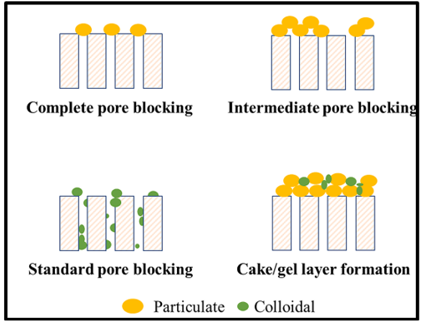
The Hermia model is a classic theoretical approach employed for analyzing membrane fouling under pressure-driven filtration operations. Four major fouling modes have been considered using this method as shown in Figure 2 and briefly presented in Table 2, namely, pore plugging mode, pore plugging mode type I, pore plugging mode type II, and cake buildup mode. The Hermia fouling modes are generally determined through correlating experimental flux or filtrate data against the Hermia equations. Despite the fact that the Hermia model was developed for traditional filtration techniques [93], this modeling technique has been extensively used for ENMs due to their porous nature, highly connected pore system, and significant surface area. It is possible for fouling to develop via several mechanisms in ENM filtration, such as organic deposition, bacterial attachment and biofouling, inorganic scaling, and particle deposition on the nanofibrous structures. The use of this technique by Liu et al. [70] on electrospun PAN membranes suggests that fouling could develop via the normal or intermediate pore blocking mechanisms at first but would increasingly involve cake layer formation. Later on, Sanaei and Cummings combined the principles of both pore-blocking and cake formation to enhance the use of the Hermia-type model to describe filtration through fibrous and nanofibrous membranes [96].
Figure 2. Main fouling types [99]
Table 2. Fouling mechanism description [100, 101]
|
Mechanism |
Model Order (n) |
Description |
|
Complete blocking |
2 |
Each particle blocks a pore completely. |
|
Standard blocking |
1.5 |
Particles enter pores and deposit along walls. |
|
Intermediate blocking |
1 |
Some particles block pores; others deposit randomly. |
|
Cake filtration |
0 |
Particles accumulate on the membrane surface, forming a cake layer. |
Due to the good permeability and controllability of the ENMs, it seems that their high accessibility to water could make them vulnerable to fouling. Biofouling, organic fouling, and inorganic scaling could clog their pores, thus increasing hydraulic resistance and decreasing permeation rates. Studies conducted using experimental methods as well as simulations have indicated the need to modify Hermia-type models to describe more accurately the decline in membrane flux due to fouling [88, 97].
Under constant pressure filtration, Hermia’s general fouling equation can be expressed as:
$\frac{d^2 t}{d V^2}=K\left(\frac{d t}{d V}\right)^n$
where, t is the filtration time, V is the filtrate volume, K is the fouling constant, and n is the fouling index, which characterizes the nature of the prevailing fouling mechanism. The fouling index n is generally set as n = 2 for complete blocking, n = 1.5 for standard blocking, n = 1 for partial blocking, and n = 0 for cake formation [84, 98].
Considering the decrease in permeate flux at constant pressure conditions, the four classical Hermia models can be stated as their usual linearized equations in the following form:
where, J denotes the permeate flux at time t, J0 represents the initial permeate flux, while Kb, Ks, Ki, and Kc represent the apparent fouling constants for complete blocking, standard blocking, intermediate blocking, and cake filtration, respectively. The fouling constants depend on the properties of the membrane, the composition of the feed solution, the applied pressure, and the nature of the interaction between the foulant and membrane.
ENMs are extensively studied due to their high porosity, interconnected pores, and high specific surface area [98]. In addition, such membranes can easily get fouled by feed solution components due to their porous nature. As a result, the Hermia model analysis technique is frequently used to determine the fouling rate, predict the predominant fouling mechanisms, and evaluate the performance of anti-fouling membranes.
Nevertheless, generally speaking, the Hermia model presents a valuable theoretical basis for the analysis of fouling in ENMs; however, the application of such a model requires consideration of the structure complexity of nanofibrous membranes. Factors, like fiber diameter, pore size distribution, tortuosity, surface wettability, surface charge, and functionalization of membranes, can affect the fouling process and its flux reduction behavior. Hence, some modifications of the Hermia model could be necessary to predict fouling successfully [97, 101].
Water purification employing ENMs still encounters many problems, including efficiency, sustainability, and scalability issues. Firstly, the growing number of emerging contaminants, including pharmaceuticals, microplastics, and per- and polyfluoroalkyl substances (PFAS), is becoming increasingly challenging to deal with through traditional methods. These pollutants might harm human health and the environment while remaining tough to remove from drinking water sources. Although the traditional membrane-based technology, reverse osmosis, is useful for removing most pollutants, it tends to be susceptible to fouling and scaling problems. As a result, the flux declines, reducing the effectiveness of the process and raising the cost of operation.
Other advanced treatments, such as advanced oxidation processes (AOPs), ultraviolet radiation disinfection, and nanomaterial-based technologies, can help address the problem of persistent pollutants. Nevertheless, they require excessive amounts of energy, making them expensive and impractical, especially in poor areas. The deterioration of the water supply network in rural or low-income communities due to aging infrastructure contributes to increased water loss and contamination. Moreover, climate change challenges, such as droughts and floods, combined with the lack of clear regulations, might exacerbate water quality management problems. In these types of situations, no real-time detection of water quality in the water body limits the detection/response to fast-moving pollution events. Addressing these multidimensional issues will require a systemic, comprehensive strategy:
With such approaches, water purification technology can be resilient, efficient, and sustainable. The aim of future work is to focus on next-generation technology for purification that is sustainable, cost-effective, and that addresses both well-established and novel non-conventional contaminants. Important themes include;
Up to this time, electrospinning has been recognized as a highly reliable and versatile form of nanofiber membrane fabrication for water purification. It has the benefit of very small fibers with a high surface-to-volume ratio and an intercommunicating network, which can promote the efficiency of the filtration and separation of the membrane. Unsurprisingly, the efficiencies are closely linked to their inner structure. The structure of these pores, fiber diameter, pore size, and interconnectivity of these pores can affect water permeability and the pollutant removal performance at the physical level. Many physical models, including Darcy's law, the Hagen–Poiseuille equation and theories of flow in porous materials serve to illustrate the phenomenon of fluid movement through this type of membrane. These modeling approaches could be utilized to illustrate the flow resistance and predict the behavior of membranes while in operation in order to estimate the resistance to flow. The optimization of membrane performance is very closely related to control of the electrospinning parameters, and the choice of the polymer, as it influences the final shape and behavior of a membrane. Despite their great capability for removing diverse organic and inorganic impurities, electrospun membranes require more experimental work, particularly in terms of mechanical strength, fouling resistance, and long-term operational stability before they can be utilized as reliable industrial water treatment devices.
[1] Yadav, S.C. (2024). Water pollution: The problems and solutions. Science Insights, 44(2): 1245-1251. https://doi.org/10.15354/si.24.re905
[2] Saleh, T.A., Mustaqeem, M., Khaled, M. (2022). Water treatment technologies in removing heavy metal ions from wastewater: A review. Environmental Nanotechnology, Monitoring & Management, 17: 100617. https://doi.org/https://doi.org/10.1016/j.enmm.2021.100617
[3] Shabeeb, K.M., Noori, W.A., Abdulridha, A.A., Majdi, H.S., et al. (2023). Novel partially cross-linked nanoparticles graft co-polymer as pore former for polyethersulfone membranes for dyes removal. Heliyon, 9(11): e21958. https://doi.org/10.1016/j.heliyon.2023.e21958
[4] Samal, K., Mahapatra, S., Ali, M.H. (2022). Pharmaceutical wastewater as Emerging Contaminants (EC): Treatment technologies, impact on environment and human health. Energy Nexus, 6: 100076. https://doi.org/https://doi.org/10.1016/j.nexus.2022.100076
[5] Nasir, A.M., Adam, M.R., Kamal, S.N.E.A.M., Jaafar, J., et al. (2022). A review of the potential of conventional and advanced membrane technology in the removal of pathogens from wastewater. Separation and Purification Technology, 286: 120454. https://doi.org/https://doi.org/10.1016/j.seppur.2022.120454
[6] Oleiwi, A.H., Jabur, A.R., Alsalhy, Q.F. (2025). Electrospinning technology in water treatment applications: Review article. Desalination and Water Treatment, 322: 101175. https://doi.org/10.1016/j.dwt.2025.101175
[7] Al-Hassani, E.S., Jabur, A.R., Al-Tuhafi, R.M. (2021). Preparation and characterization of NiTi/PVA nanofibers by electrospinning. Engineering and Technology Journal, 39(11): 1674-1680. https://doi.org/10.30684/etj.v39i11.2272
[8] Alazzawi, A.H., Abed, M.S., Al-Tamimi, B.H. (2024). Green synthesis of nano silver-modified date syrup 3D graphene for adsorptive removal of heavy metals from wastewater and its antibacterial efficiency. Journal of Physics: Conference Series, 2857(1): 012048. https://doi.org/10.1088/1742-6596/2857/1/012048
[9] Ma, H., Shen, M., Tong, Y., Wang, X. (2023). Radioactive wastewater treatment technologies: A review. Molecules, 28(4): 1935. https://doi.org/10.3390/molecules28041935
[10] Hong, P.A., Xiao, T. (2013). Treatment of oil spill water by ozonation and sand filtration. Chemosphere, 91(5): 641-647. https://doi.org/10.1016/j.chemosphere.2013.01.010
[11] Panagopoulos, A., Michailidis, P. (2025). Membrane technologies for sustainable wastewater treatment: Advances, challenges, and applications in zero liquid discharge (ZLD) and minimal liquid discharge (MLD) systems. Membranes, 15(2): 64. https://doi.org/10.3390/membranes15020064
[12] Hammadi, A.F., Oleiwi, A.H., Abbas, A.T., Al-Obaidi, A.J. (2023). Effect of alumina particles on the mechanical and physical properties of polypropylene whisker reinforced lamination 80:20 resin composite. Revue des Composites et des Matériaux Avancés-Journal of Composite and Advanced Materials, 33(1): 7-12. https://doi.org/10.18280/rcma.330102
[13] Foorginezhad, S., Zerafat, M.M., Ismail, A.F., Goh, P.S. (2025). Emerging membrane technologies for sustainable water treatment: A review on recent advances. Environmental Science: Advances, 4(4): 530-570. https://doi.org/10.1039/d4va00378k
[14] Garg, R., Gonuguntla, S., Sk, S., Iqbal, M.S., Dada, A.O., Pal, U., Ahmadipour, M. (2024). Sputtering thin films: Materials, applications, challenges and future directions. Advances in Colloid and Interface Science, 330: 103203. https://doi.org/10.1016/j.cis.2024.103203
[15] Tripathy, D.B., Gupta, A. (2023). Nanomembranes-affiliated water remediation: chronology, properties, classification, challenges and future prospects. Membranes, 13(8): 713. https://doi.org/10.3390/membranes13080713
[16] Oleiwi, A.H., Jabur, A.R., Alsalhy, Q.F. (2023). Morphology of polystyrene nano-fiber membranes reinforced with copper oxide and zirconium oxide nanoparticles as a sulfur absorbent materials. AIP Conference Proceedings, 2769(1): 020065. https://doi.org/10.1063/5.0129144
[17] Oleiwi, A.H., Jabur, A.R., Alsalhy, Q.F. (2021). Polystyrene/Mwcnts nanofiber membranes characterizations in reducing sulfur content in crude oil. Key Engineering Materials, 886: 86-96. https://doi.org/10.4028/www.scientific.net/KEM.886.86
[18] Jabur, A.R. (2020). Multiwall carbon nanotube/polyvinyl alcohol nanofibers film, electrical conductivity improvement. Engineering and Technology Journal, 38: 430-438. https://doi.org/10.30684/etj.v38i3A.530
[19] Chen, H., Huang, M., Liu, Y., Meng, L., Ma, M. (2020). Functionalized electrospun nanofiber membranes for water treatment: A review. Science of the Total Environment, 739: 139944. https://doi.org/10.1016/j.scitotenv.2020.139944
[20] Oleiwi, A.H., Jabur, A.R., Alsalhy, Q.F., Zeinedini, A. (2025). Crude oil desulfurization by polystyrene/graphene nanocomposite membranes. Periodica Polytechnica Chemical Engineering, 69(1): 1-10. https://doi.org/10.3311/PPch.38227
[21] Oleiwi, A.H. (2022). Study some properties for UPS composites reinforced by sunflower husk ash. AIP Conference Proceedings, 2437(1): 020028. https://doi.org/10.1063/5.0092290
[22] Nishu, Kumar, S. (2023). Smart and innovative nanotechnology applications for water purification. Hybrid Advances, 3: 100044. https://doi.org/10.1016/j.hybadv.2023.100044
[23] Jain, K., Patel, A.S., Pardhi, V.P., Flora, S.J.S. (2021). Nanotechnology in wastewater management: A new paradigm towards wastewater treatment. Molecules, 26(6): 1797. https://doi.org/10.3390/molecules26061797
[24] Moosa, S., Jabur, A., Al-Hassani, E., Al-Shammari, A. (2022). Evaluation of PCL electrospun scaffolds concentration on metformin hydrochloride release ratio. Engineering and Technology Journal, 40(12): 1671-1682. https://doi.org/10.30684/etj.2021.131990.1079
[25] Al-Araji, D., Al-Ani, F., Alsalhy, Q. (2022). The permeation and separation characteristics of polymeric membranes incorporated with nanoparticles for dye removal and interaction mechanisms between polymer and nanoparticles: A mini review. Engineering and Technology Journal, 40(11): 1399-1411. https://doi.org/10.30684/etj.2022.132572.1129
[26] Gray, N.F. (2014). Chapter thirty-five - Filtration methods. In Microbiology of Waterborne Diseases, pp. 631-650. https://doi.org/10.1016/B978-0-12-415846-7.00035-4
[27] Kandjou, V., Nkwe, D.O. (2024). Analysing the quality of Botswana's surface waters in terms of microbial contamination and postulating feasible treatment and removal means. Ecohydrology & Hydrobiology, 24(1): 217-225. https://doi.org/10.1016/j.ecohyd.2023.09.005
[28] Cescon, A., Jiang, J.Q. (2020). Filtration process and alternative filter media material in water treatment. Water, 12(12): 3377. https://doi.org/10.3390/w12123377
[29] Ghannam, A., Chehade, A., Generous, M.M., Alazzam, A., Kleinstreuer, C., Ahmadi, G., Abu-Nada, E. (2025). A comprehensive review of particle-laden flows modeling: Single/multiphase modeling approaches, benchmarks, heat transfer, intermolecular interactions, recent advances and future directions. Physics Reports, 1118-1120: 1-96. https://doi.org/10.1016/j.physrep.2025.03.001
[30] Renkin, E.M. (1954). Filtration, diffusion, and molecular sieving through porous cellulose membranes. The Journal of General Physiology, 38(2): 225.
[31] Badalyan, A., You, Z., Aji, K., Bedrikovetsky, P., Carageorgos, T., Zeinijahromi, A. (2014). Size exclusion deep bed filtration: Experimental and modelling uncertainties. Review of Scientific Instruments, 85(1): 015111. https://doi.org/10.1063/1.4861096
[32] Ottenhall, A., Henschen, J., Illergård, J., Ek, M. (2018). Cellulose-based water purification using paper filters modified with polyelectrolyte multilayers to remove bacteria from water through electrostatic interactions. Environmental Science: Water Research & Technology, 4(12): 2070-2079. https://doi.org/10.1039/C8EW00514A
[33] Maiyo, J.K., Dasika, S., Jafvert, C.T. (2023). Slow sand filters for the 21st century: A review. International Journal of Environmental Research and Public Health, 20(2): 1019. https://doi.org/10.3390/ijerph20021019
[34] Alkhaldi, H., Alharthi, S., Alharthi, S., AlGhamdi, H.A., et al. (2024). Sustainable polymeric adsorbents for adsorption-based water remediation and pathogen deactivation: A review. RSC Advances, 14(45): 33143-33190. https://doi.org/10.1039/D4RA05269B
[35] Yousef, R., Qiblawey, H., El-Naas, M.H. (2020). Adsorption as a process for produced water treatment: A review. Processes, 8(12): 1657. https://doi.org/10.3390/pr8121657
[36] Osman, A.I., El-Monaem, E.M.A., Elgarahy, A.M., Aniagor, C.O., et al. (2023). Methods to prepare biosorbents and magnetic sorbents for water treatment: a review. Environmental Chemistry Letters, 21(4): 2337-2398. https://doi.org/10.1007/s10311-023-01603-4
[37] Jibril, A., Bukhari, M.M., Giwa, A., Ibrahim, H.D. (2024). Effect of pH, temperature and concentration on the adsorption of reactive dye from textile effluent. Nigerian Journal of Science, 54(1): 77-83.
[38] Bernal, V., Giraldo, L., Moreno-Piraján, J.C. (2018). Physicochemical properties of activated carbon: Their effect on the adsorption of pharmaceutical compounds and adsorbate-adsorbent interactions. C, 4(4): 62. https://doi.org/10.3390/c4040062
[39] Satyam, S., Patra, S. (2024). Innovations and challenges in adsorption-based wastewater remediation: A comprehensive review. Heliyon, 10(9): e29573. https://doi.org/10.1016/j.heliyon.2024.e29573
[40] Zhang, T., Payne, K., Zhang, J., Purswani, P., Karpyn, Z., Wang, M. (2024). Hybrid ion exchange and biological processes for water and wastewater treatment: A comprehensive review of process applications and mathematical modeling. Reviews in Environmental Science and Bio/Technology, 23(1): 163-188. https://doi.org/10.1007/s11157-023-09677-w
[41] Berrios, M., Siles, J.A., Martín, M.A. (2013). Ion exchange. In Separation and Purification Technologies in Biorefineries, pp. 149-165. https://doi.org/10.1002/9781118493441.ch6
[42] Strathmann, H., Grabowski, A., Eigenberger, G. (2013). Ion-exchange membranes in the chemical process industry. Industrial & Engineering Chemistry Research, 52(31): 10364-10379. https://doi.org/10.1021/ie4002102
[43] Chauhan, M.S., Rahul, A.K., Shekhar, S., Kumar, S. (2023). Removal of heavy metal from wastewater using ion exchange with membrane filtration from Swarnamukhi river in Tirupati. Materials Today: Proceedings, 78(Part 1): 1-6. https://doi.org/10.1016/j.matpr.2022.08.280
[44] Fu, Z.J., Jiang, S.K., Chao, X.Y., Zhang, C.X., et al. (2022). Removing miscellaneous heavy metals by all-in-one ion exchange-nanofiltration membrane. Water Research, 222: 118888. https://doi.org/10.1016/j.watres.2022.118888
[45] Jin, L., Sun, X., Ren, H., Huang, H. (2023). Biological filtration for wastewater treatment in the 21st century: A data-driven analysis of hotspots, challenges and prospects. Science of the Total Environment, 855: 158951. https://doi.org/10.1016/j.scitotenv.2022.158951
[46] Rittmann, B.E. (1990). Analyzing biofilm processes used in biological filtration. Journal‐American Water Works Association, 82(12): 62-66. https://doi.org/10.1002/j.1551-8833.1990.tb07068.x
[47] Ganta, A., Bashir, Y., Das, S. (2022). Dairy wastewater as a potential feedstock for valuable production with concurrent wastewater treatment through microbial electrochemical technologies. Energies, 15(23): 9084. https://doi.org/10.3390/en15239084
[48] Abonyi, M.N., Obi, C.C., Nwabanne, J.T., Aniagor, C.O. (2024). Emerging and ecofriendly biological methods for agricultural wastewater treatment. Environmental Systems Research, 13(1): 45. https://doi.org/10.1186/s40068-024-00373-4
[49] Kato, S., Kansha, Y. (2024). Comprehensive review of industrial wastewater treatment techniques. Environmental Science and Pollution Research, 31(39): 51064-51097. https://doi.org/10.1007/s11356-024-34584-0
[50] Tandon, P.K., Singh, S.B. (2016). Redox processes in water remediation. Environmental Chemistry Letters, 14(1): 15-25. https://doi.org/10.1007/s10311-015-0540-4
[51] Galangashi, M.A., Kojidi, S.F.M., Pendashteh, A., Souraki, B.A., Mirroshandel, A.A. (2021). Removing iron, manganese and ammonium ions from water using greensand in fluidized bed process. Journal of Water Process Engineering, 39: 101714. https://doi.org/10.1016/j.jwpe.2020.101714
[52] Al-Asheh, S., Bagheri, M., Aidan, A. (2021). Membrane bioreactor for wastewater treatment: A review. Case Studies in Chemical and Environmental Engineering, 4: 100109. https://doi.org/10.1016/j.cscee.2021.100109
[53] Jha, P.K., Tripathi, P. (2021). Arsenic and fluoride contamination in groundwater: A review of global scenarios with special reference to India. Groundwater for Sustainable Development, 13: 100576. https://doi.org/10.1016/j.gsd.2021.100576
[54] Tabatabaeefar, A., Penn, C., Comeau, Y., Claveau-Mallet, D. (2025). Clogging of reactive filters for phosphorus removal–A review. Journal of Environmental Management, 376: 124386. https://doi.org/10.1016/j.jenvman.2025.124386
[55] Brenner, A., Persson, K.M., Russell, L., Rosborg, I., et al. (2020). Technical and mineral level effects of water treatment, corrosion control. In Drinking Water Minerals and Mineral Balance: Importance, Health Significance, Safety Precautions, pp. 127-148. https://doi.org/10.1007/978-3-030-18034-8_6
[56] Jung, S., An, J., Na, H., Kim, J. (2019). Surface energy of filtration media influencing the filtration performance against solid particles, oily aerosol, and bacterial aerosol. Polymers, 11: 935. https://doi.org/10.3390/polym11060935
[57] Keirouz, A., Wang, Z., Reddy, V.S., Nagy, Z.K., et al. (2023). The history of electrospinning: Past, present, and future developments. Advanced Materials Technologies, 8(11): 2201723. https://doi.org/10.1002/admt.202201723
[58] Bölgen, N., Demir, D., Aşık, M., Sakım, B., Vaseashta, A. (2022). Introduction and fundamentals of electrospinning. In Electrospun Nanofibers: Principles, Technology and Novel Applications, pp. 3-34. https://doi.org/10.1007/978-3-030-99958-2_1
[59] Oleiwi, A.H., Jabur, A.R., Alsalhy, Q.F. (2021). Preparation of polystyrene/polyacrylonitrile blends by electrospinning technique. Journal of Physics: Conference Series, 1879(2): 022065. https://doi.org/10.1088/1742-6596/1879/2/022065
[60] Mishra, R.K., Mishra, P., Verma, K., Mondal, A., Chaudhary, R.G., Abolhasani, M.M., Loganathan, S. (2019). Electrospinning production of nanofibrous membranes. Environmental Chemistry Letters, 17(2): 767-800. https://doi.org/10.1007/s10311-018-00838-w
[61] Chinnappan, B.A., Krishnaswamy, M., Xu, H., Hoque, M.E. (2022). Electrospinning of biomedical nanofibers/nanomembranes: Effects of process parameters. Polymers, 14(18): 3719. https://doi.org/10.3390/polym14183719
[62] Li, Y., Zhu, J., Cheng, H., Li, G., et al. (2021). Developments of advanced electrospinning techniques: A critical review. Advanced Materials Technologies, 6(11): 2100410. https://doi.org/10.1002/admt.202100410
[63] Joy, N., Anuraj, R., Viravalli, A., Dixit, H.N., Samavedi, S. (2021). Coupling between voltage and tip-to-collector distance in polymer electrospinning: Insights from analysis of regimes, transitions and cone/jet features. Chemical Engineering Science, 230: 116200. https://doi.org/10.1016/j.ces.2020.116200
[64] Sivan, M., Madheswaran, D., Hauzerova, S., Novotny, V., et al. (2022). AC electrospinning: Impact of high voltage and solvent on the electrospinnability and productivity of polycaprolactone electrospun nanofibrous scaffolds. Materials Today Chemistry, 26: 101025. https://doi.org/10.1016/j.mtchem.2022.101025
[65] Oleiwi, A.H., Dalfi, H.K. (2025). A comprehensive review on electrospinning: Mechanisms, functional modifications and the importance of nanofiber systems. International Journal of Nanoscience, 24(6): 2530002. https://doi.org/10.1142/S0219581X25300020
[66] Tang, Y., Cai, Z., Sun, X., Chong, C., Yan, X., Li, M., Xu, J. (2022). Electrospun nanofiber-based membranes for water treatment. Polymers, 14(10): 2004. https://doi.org/10.3390/polym14102004
[67] Zhou, R., Swisher, M.M., Deshmukh, A., Sun, C., Lienhard, J.H., Hadjiconstantinou, N.G. (2024). Dense fluid transport through nanoporous graphene membranes in the limit of steric exclusion. Physical Review Fluids, 9(4): 044202. https://doi.org/10.1103/PhysRevFluids.9.044202
[68] Shuvo, A.A., Paniagua-Guerra, L.E., Choi, J., Kim, S. H., Ramos-Alvarado, B. (2025). Hydrodynamic slip in nanoconfined flows: A review of experimental, computational, and theoretical progress. Nanoscale, 17(2): 635-660. https://doi.org/10.1039/D4NR03697B
[69] Govindarajan, S.K., Pavan, T.N.V., Devarapu, S.R., Kumar, G. (2025). Critical review on challenges in the application of Darcy’s law for multi-phase fluid flow in petroleum reservoirs. Discover Applied Sciences, 7(3): 201. https://doi.org/10.1007/s42452-025-06632-y
[70] Liu, Z., Wang, Y., Guo, F. (2021). An investigation into hydraulic permeability of fibrous membranes with nonwoven random and quasi-parallel structures. Membranes, 12(1): 54. https://doi.org/10.3390/membranes12010054
[71] Zhang, Z., Li, S., Mi, B., Wang, J., Ding, J. (2020). Surface slip on rotating graphene membrane enables the temporal selectivity that breaks the permeability-selectivity trade-off. Science advances, 6(34): eaba9471. https://doi.org/10.1126/sciadv.aba9471
[72] Song, S., Rong, L., Dong, K., Liu, X., Le-Clech, P., Shen, Y. (2022). Pore-scale numerical study of intrinsic permeability for fluid flow through asymmetric ceramic microfiltration membranes. Journal of Membrane Science, 642: 119920. https://doi.org/10.1016/j.memsci.2021.119920
[73] Uematsu, I., Naka, T., Tokuno, Y., Nakagawa, Y., Matsumoto, H. (2019). Organic liquid impregnation behavior into nanofibrous membranes: Quantitative analysis of the effects of structural parameters. ACS omega, 4(14): 15856-15861. https://doi.org/10.1021/acsomega.9b01738
[74] Kok, M.D., Gostick, J.T. (2015). Transport properties of electrospun fibrous membranes with controlled anisotropy. Journal of Membrane Science, 473: 237-244. https://doi.org/10.1016/j.memsci.2014.09.017
[75] Mustakeem, M., Soukane, S., Saqib Nawaz, M., Ghaffour, N. (2022). Desalination by membrane distillation. In Distillation Processes - From Solar and Membrane Distillation to Reactive Distillation Modelling, Simulation and Optimization. https://doi.org/10.5772/intechopen.101457
[76] Lee, M., Wu, Z., Li, K. (2015). Advances in ceramic membranes for water treatment. In Advances in Membrane Technologies for Water Treatment, pp. 43-82. https://doi.org/10.1016/B978-1-78242-121-4.00002-2
[77] Wu, K., Chen, Z., Li, J., Li, X., Xu, J., Dong, X. (2017). Wettability effect on nanoconfined water flow. Proceedings of the National Academy of Sciences, 114(13): 3358-3363. https://doi.org/10.1073/pnas.1612608114
[78] Beauchamp, M.D., Schure, M.R. (2019). Simulation and theory of open-tube dispersion in short and long capillaries with slip boundaries and retention. Journal of Chromatography A, 1588: 85-98. https://doi.org/10.1016/j.chroma.2018.12.040
[79] Neves, F., Soares, A.A., Rouboa, A. (2022). Forced convection heat transfer of nanofluids in turbulent flow in a flat tube of an automobile radiator. Energy Reports, 8: 1185-1195. https://doi.org/10.1016/j.egyr.2022.07.087
[80] Kumar, P.B., Suripeddi, S. (2021). A note on the pulsatile flow of hydromagnetic Eyring–Powell nanofluid through a vertical porous channel. The European Physical Journal Special Topics, 230(5): 1465-1474. https://doi.org/10.1140/epjs/s11734-021-00057-5
[81] Mahanta, C., Sharma, R.P. (2025). Dynamics of bioconvection-driven fluid flow through Riga plates in presence of triple stratifications and multiphase slip effects. Journal of Molecular Liquids, 427: 127421. https://doi.org/10.1016/j.molliq.2025.127421
[82] Rogers, B.J., Wei, B., Wirth, M.J. (2012). Ultra high efficiency protein separations with submicrometer silica using slip flow. LC GC North America, 30(10): 890-897.
[83] Lee, S., Bui-Vinh, D., Baek, M., Kwak, D.B., Lee, H. (2023). Modeling pressure drop values across ultra-thin nanofiber filters with various ranges of filtration parameters under an aerodynamic slip effect. Scientific Reports, 13(1): 5449. https://doi.org/10.1038/s41598-023-32765-4
[84] Azimian, M., Naderi, M., Soltani, P., Cheng, L., Naderi, K., Linden, S., Wiegmann, A. (2024). Experimental and CFD analysis of fluid flow through nanofiber filter media. Scientific Reports, 14(1): 16128. https://doi.org/10.1038/s41598-024-67066-x
[85] Rapp, B.E. (2017). Chapter 9 - Fluids. In Microfluidics: Modelling, Mechanics and Mathematics, pp. 243-263. https://doi.org/10.1016/B978-1-4557-3141-1.50009-5
[86] Ali, S.B., Ghasemi, H., Ahmadi, R., Ghaffari, A. (2021). Recent progresses in dry gas polymeric filters. Journal of Energy Chemistry, 62: 103-119. https://doi.org/10.1016/j.jechem.2021.03.008
[87] Aminpour, M., Galindo Torres, S.A., Scheuermann, A., Li, L. (2021). Slip-flow regimes in nanofluidics: A universal superexponential model. Physical Review Applied, 15(5): 054051. https://doi.org/10.1103/PhysRevApplied.15.054051
[88] Kwak, D.B., Lee, S., Pan, Z., Liang, Y., Lee, H., Pui, D.Y. (2023). Semi-empirical equation for determining the pressure drop of nanofibers. Separation and Purification Technology, 324: 124585. https://doi.org/10.1016/j.seppur.2023.124585
[89] Zhou, P., Qin, D., Zhang, J., Li, T. (2022). Aerodynamic characteristics of the evacuated tube maglev train considering the suspension gap. International Journal of Rail Transportation, 10(2): 195-215. https://doi.org/10.1080/23248378.2021.1885514
[90] Li, Z., Li, J., Yan, G., Galindo-Torres, S., Scheuermann, A., Li, L. (2019). Mesoscale investigations of fluid-solid interaction: Liquid slip flow in a parallel-plate microchannel. arXiv preprint arXiv:1906.06664. https://doi.org/10.48550/ARXIV.1906.06664
[91] Li, R., Wang, J., Xia, G. (2021). Theoretical and numerical study of nanoporous evaporation with receded liquid surface: Effect of Knudsen number. Journal of Fluid Mechanics, 928: A9. https://doi.org/DOI: 10.1017/jfm.2021.817
[92] Akhavan-Mahdavi, S., Mirbagheri, M.S. (2024). Perspective chapter: Characterization methods for nanofibers. In Advances in Nanofiber Research-Properties and Uses. https://doi.org/10.5772/intechopen.1006179
[93] Fashandi, H., Karimi, M. (2012). Characterization of porosity of polystyrene fibers electrospun at humid atmosphere. Thermochimica Acta, 547: 38-46. https://doi.org/10.1016/j.tca.2012.08.003
[94] Ávila, J., Pagalo, J., Espinoza-Andaluz, M. (2022). Evaluation of geometric tortuosity for 3D digitally generated porous media considering the pore size distribution and the A-star algorithm. Scientific Reports, 12(1): 19463. https://doi.org/10.1038/s41598-022-23643-6
[95] Zhang, Y., Yang, B., Li, K., Hou, D., Zhao, C., Wang, J. (2017). Electrospun porous poly (tetrafluoroethylene-co-hexafluoropropylene-co-vinylidene fluoride) membranes for membrane distillation. RSC Advances, 7(89): 56183-56193. https://doi.org/10.1039/C7RA09932K
[96] Sanaei, P., Cummings, L.J. (2019). Membrane filtration with multiple fouling mechanisms. Physical Review Fluids, 4(12): 124301. https://doi.org/10.1103/PhysRevFluids.4.124301
[97] Pereira, G.L.D., Cardozo-Filho, L., Jegatheesan, V., Guirardello, R. (2023). Generalization and expansion of the Hermia model for a better understanding of membrane fouling. Membranes, 13(3): 290. https://doi.org/10.3390/membranes13030290
[98] Oleiwi, A., Jabur, A., Alsalhy, Q., Bakar, S.A., et al. (2024). Morphology characterization of electrospun polystyrene membranes. Journal of Applied Sciences and Nanotechnology, 4(1): 1-8. https://doi.org/10.53293/jasn.2023.7010.1225
[99] Sandoval-García, V., Ruano, M.V., Alliet, M., Brepols, C., et al. (2025). Modeling MBR fouling: A critical review analysis towards establishing a framework for good modeling practices. Water Research, 268: 122611. https://doi.org/10.1016/j.watres.2024.122611
[100] Xu, H., Xiao, K., Yu, J., Huang, B., et al. (2020). A simple method to identify the dominant fouling mechanisms during membrane filtration based on piecewise multiple linear regression. Membranes, 10(8): 171. https://doi.org/10.3390/membranes10080171
[101] Jang, H., Kang, S., Kim, J. (2024). Identification of membrane fouling with greywater filtration by porous membranes: Combined effect of membrane pore size and applied pressure. Membranes, 14(2): 46. https://doi.org/10.3390/membranes14020046