Parea R. Rangan | Yohans Sunarno | Yulieanti S. Mapiley | Miswar Tumpu*
© 2025 The authors. This article is published by IIETA and is licensed under the CC BY 4.0 license (http://creativecommons.org/licenses/by/4.0/).
OPEN ACCESS
The main goal of this study is to investigate the effect of fly ash (FA) and bottom ash (BA) ratios on the water absorption characteristics of geopolymer paving blocks. The growing need for sustainable construction materials has encouraged the utilization of industrial waste, particularly FA and BA, which are collectively referred to as FA and BA, in geopolymer applications. This study examines the water absorption of geopolymer paving blocks made with different FA and BA ratios: 45% FA:55% BA, 50% FA:50% BA, and 55% FA:45% BA. The blocks, each measuring 20 × 10 × 8 cm, were tested after 28 days of curing following standard procedures. Results showed that the 50:50 mix had the lowest water absorption at 7.75%, indicating better density and lower porosity. The 45:55 mix had the highest absorption at 10.75%, while the 55:45 mix was in between, at 9.47%. These findings suggest that the FA and BA ratio significantly affects the block’s porosity and water resistance. The 50:50 mix proved to be the most durable and water-resistant, making it a strong candidate for eco-friendly construction. This research supports the development of greener building materials by demonstrating the potential of FABA in geopolymer technology.
geopolymer, fly ash, bottom ash, water absorption, paving block
The construction industry is one of the largest contributors to environmental degradation due to its high consumption of natural resources and reliance on Portland cement, which emits significant amounts of CO₂ during production. In response to increasing environmental concerns, researchers and industry practitioners have explored the use of alternative, eco-friendly construction materials. Among these, geopolymer technology has emerged as a promising solution due to its ability to utilize industrial by-products such as fly ash (FA) and bottom ash (BA) as binding agents, offering both environmental and technical benefits [1, 2].
FA and BA, the two main by-products of coal combustion in thermal power plants, have long been viewed as waste materials with limited application. However, both possess pozzolanic properties, meaning they contain reactive silica (SiO₂) and alumina (Al₂O₃) that can chemically react with alkaline activators to form binding compounds. In geopolymer systems, these oxides dissolve under alkaline conditions and undergo polycondensation reactions, producing a three-dimensional aluminosilicate network that provides strength and durability. While FA typically exhibits higher reactivity due to its finer particle size and higher amorphous content, BA, though less reactive, contributes to particle packing, internal curing, and reduction of shrinkage, thereby enhancing the overall performance of geopolymer composites [3-6].
Paving blocks are an ideal application for geopolymer materials, particularly in non-structural and semi-structural functions, as they allow for the large-scale incorporation of industrial waste without compromising durability. Geopolymer paving blocks not only help reduce the environmental footprint but also demonstrate improved resistance to chemical attacks and high temperatures [7]. However, durability is not only defined by compressive strength but also by the material’s ability to resist water absorption, which is directly linked to long-term performance, especially in outdoor applications exposed to rainfall and groundwater [8].
Water absorption in paving blocks is a critical parameter that reflects porosity, permeability, and overall durability. Higher water absorption typically indicates a more porous matrix, which may result in faster deterioration due to freeze-thaw cycles, efflorescence, and chemical penetration. Previous studies have shown that geopolymer composites with optimized ratios of aluminosilicate precursors tend to exhibit lower water absorption [9]. However, the interaction between FA and BA in varying proportions and its specific impact on water absorption in geopolymer paving blocks remains underexplored.
Several researchers have attempted to identify the optimal mix for FA and BA in geopolymer composites. For example, Abed et al. [10] found that using a higher proportion of FA resulted in better workability and lower permeability, while BA improved internal curing and reduced drying shrinkage. Nonetheless, much of this research has focused on compressive strength and setting time rather than water absorption. There is a lack of systematic studies that analyze how variations in the FA:BA ratio specifically affects water uptake behavior in paving blocks.
The increasing demand for sustainable construction materials has driven research toward the utilization of industrial by-products as eco-friendly alternatives to conventional cement-based products. Among these by-products, FA and BA, generated from coal-fired power plants, have attracted significant attention due to their pozzolanic properties and potential use in geopolymer technology. Previous studies have highlighted the mechanical performance and durability of geopolymer materials; however, limited research has focused specifically on the water absorption characteristics of paving blocks incorporating varying FA and BA proportions. Water absorption is a critical parameter because it directly influences material porosity, density, and long-term durability in construction applications. Therefore, this study seeks to answer the research question: How do different proportions of FA and BA affect the water absorption behavior of geopolymer paving blocks? Based on previous findings, we hypothesize that a balanced proportion of FA and BA will yield the lowest water absorption due to improved matrix densification and reduced porosity. By testing different mix ratios, this study aims to provide insights into optimizing FA and BA utilization in geopolymer paving blocks as a step toward greener and more durable construction materials.
This research gap highlights the need for a focused investigation into the relationship between FA and BA proportions and the water absorption performance of geopolymer paving blocks. While prior studies have successfully characterized mechanical properties and microstructure, fewer have correlated these findings with water absorption performance in a standardized paving block form and curing age. Moreover, many of these studies have not addressed the behaviour of geopolymer blocks with FA–BA mixes within the 45:55 to 55:45 range, leaving room for more refined composition optimization.
Therefore, the significance of this research lies in its contribution to the development of sustainable, durable paving materials by utilizing abundant industrial by-products. The findings may inform practical applications for municipal infrastructure and green building projects, particularly in regions with access to coal combustion waste. The objective of this study is to investigate the water absorption characteristics of geopolymer paving blocks incorporating different ratios of FA and BA (45:55, 50:50, and 55:45) at 28 days of curing, in order to identify the composition that offers the lowest water uptake and therefore the best durability performance.
2.1 Physical properties of fine aggregate
The results obtained from the fine aggregate characterization tests conducted at the Civil Engineering Laboratory of Christian University Indonesia Toraja are presented in Table 1. Firstly, the average moisture content was found to be 2.53%. The bulk density in both compacted and loose conditions was obtained from the average results of the bulk density test, with the loose bulk density recorded at 1.311 g/cm³ and the compacted bulk density at 1.792 g/cm³. The saturated surface-dry (SSD) specific gravity was determined from the specific gravity and absorption tests of the fine aggregate, yielding a value of 2.358. The apparent specific gravity was also obtained from the same test and recorded at 2.540. The water absorption value, derived from the specific gravity and absorption tests, was found to be 3.519%.
The results of the fine aggregate characterization indicate that the material possesses properties suitable for use in geopolymer paving block production. The moisture content of 2.53% suggests a relatively dry aggregate, which is advantageous in maintaining consistent mix proportions. The bulk density values—1.311 g/cm³ (loose) and 1.792 g/cm³ (compacted)—reflect the aggregate’s packing ability and influence the workability and compaction of the mix. The SSD specific gravity of 2.358 and apparent specific gravity of 2.540 are within the typical range for natural fine aggregates, indicating stable mineral composition and good quality. Notably, the water absorption value of 3.519% is relatively high, suggesting a porous structure that may increase water demand in the mix. This characteristic should be carefully considered in mix design, as it may affect the geopolymer’s final porosity and water absorption performance. Overall, the aggregate shows adequate performance criteria, but the high absorption warrants attention to prevent adverse effects on durability and strength. This highlights the importance of adjusting the liquid-to-solid ratio in the geopolymer mix to compensate for the aggregate's absorption capacity. Proper pre-wetting or saturation of the aggregate before mixing may also be necessary to ensure consistent curing and to prevent undesired reductions in mechanical performance.
Table 1. Physical properties of fine aggregate
|
No. |
Types of Testing |
Test Results |
Specification |
Information |
|
1 |
Water Content |
2.530 |
2%-6% |
Fulfil |
|
2 |
Content Weight |
|||
|
Loose Fill |
1.311 |
1.2-1.9 |
Fulfil |
|
|
Solid Content |
1.792 |
1.2-1.9 |
Fulfil |
|
|
3 |
Mud Level |
3.200 |
0.2%-6.0% |
Fulfil |
|
4 |
Bulk Specific Gravity |
2.241 |
1.6-3.1 |
Fulfil |
|
5 |
SSD Specific Gravity |
2.358 |
1.6-3.2 |
Fulfil |
|
6 |
Apparent Specific Gravity |
2.540 |
1.6-3.3 |
Fulfil |
|
7 |
Water Absorption |
3.519 |
0.2%-5.0% |
Fulfil |
2.2 Sieve analysis of fine aggregate
The sieve analysis of fine aggregate is a crucial test to determine the particle size distribution, which significantly influences the workability, compaction, and overall performance of concrete or geopolymer mixtures. By analyzing the gradation of fine aggregate, it is possible to assess whether the material meets standard requirements for use in paving block production. Well-graded aggregates contribute to a denser packing, reduced void content, and improved mechanical properties of the final product. The following data presents the results of the sieve analysis conducted at the Christian University Indonesia Toraja in Table 2, providing insight into the suitability of the fine aggregate for use in geopolymer paving block mixtures.
Table 2. Sieve analysis of fine aggregate
|
Sieve Size (mm) |
Retained Weight (grams) |
Percentage Retained (%) |
Cumulative Retained (%) |
Cumulative Passed (%) |
|
38.1 |
0 |
0 |
0 |
100 |
|
25.4 |
0 |
0 |
0 |
100 |
|
19.2 |
0 |
0 |
0 |
100 |
|
12.7 |
0 |
0 |
0 |
100 |
|
9.52 |
0 |
0 |
0 |
100 |
|
4.75 |
0 |
0.0 |
0.0 |
100 |
|
2.36 |
32 |
3.2 |
3.2 |
96.8 |
|
1.18 |
118 |
11.8 |
15.0 |
85.0 |
|
0.6 |
379 |
37.9 |
52.9 |
47.1 |
|
0.3 |
298 |
29.8 |
82.7 |
17.3 |
|
0.15 |
151 |
15.1 |
97.8 |
2.2 |
|
0.075 |
13 |
1.3 |
99.1 |
0.9 |
|
Pan |
9 |
0.9 |
100 |
0 |
|
Total |
1000 |
100 |
350.7 |
|
|
$F M=\frac{350,7}{100}=3.51$ |
||||
The sieve analysis results indicate that the fine aggregate has a fineness modulus (FM) of 3.51, which classifies it as coarse for a fine aggregate, nearing the upper limit of acceptable FM values for mortar and concrete applications. The particle size distribution shows that the majority of the material passes through the 0.6 mm sieve (37.9%) and 0.3 mm sieve (29.8%), while finer particles below 0.15 mm make up a relatively smaller proportion. This gradation suggests that the aggregate is well-graded but leans toward the coarser side, which can enhance the workability and reduce the water demand of the geopolymer mix. However, an excessively coarse fine aggregate could reduce paste-aggregate bonding, especially in geopolymer systems where microstructure and particle interaction are critical. The low percentage of material passing the 0.075 mm sieve (0.9%) also indicates minimal clay or dust content, which is favorable as it minimizes the risk of interference with the alkali activation process. Overall, the aggregate’s gradation appears suitable for geopolymer paving blocks, though careful adjustment of binder content may be necessary to ensure optimal compaction and surface finish.
2.3 Mix design geopolymer paving block
The mix design of geopolymer paving blocks plays a crucial role in determining the material's mechanical properties and durability performance. In this study, the mix design was formulated using FA and (BA) as the primary aluminosilicate sources, combined with an alkaline activator solution consisting of sodium hydroxide (NaOH) and sodium silicate (Na₂SiO₃). The alkaline activator ratio and curing conditions were kept constant to focus the analysis on the influence of FABA composition. Three variations of FA:BA ratios were used to evaluate their effect on the water absorption behavior of the paving blocks, namely 45% FA: 55% BA, 50% FA: 50% BA, and 55% FA: 45% BA. The mix proportion for each variation was designed to ensure consistent workability and unit volume. The complete mix design for each variation is shown in Table 3 below.
Table 3. Mixtures design of geopolymer paving block
|
Materials |
Variations Geopolymer Paving Block/Weight |
||
|
FABA 45:55 |
FABA 50:50 |
FABA 55:45 |
|
|
FA |
388.60 |
431.80 |
475.00 |
|
BA |
238.70 |
217.00 |
195.30 |
|
NaOH |
77.42 |
77.42 |
77.42 |
|
Na2SiO3 |
193.56 |
193.56 |
193.56 |
|
Fine aggregate |
2150.40 |
2150.40 |
2150.40 |
|
Water |
161.30 |
161.30 |
161.30 |
The mix design data in Table 3 shows the material proportions used for each variation of the geopolymer paving block, emphasizing the effect of varying FA and BA ratios while maintaining constant amounts of alkaline activators, fine aggregate, and water. As the proportion of FA increases from 388.60 g in the FABA 45:55 mix to 475.00 g in the FABA 55:45 mix, the corresponding amount of BA decreases proportionally from 238.70 g to 195.30 g. The consistent quantities of sodium hydroxide (77.42 g), sodium silicate (193.56 g), and water (161.30 g) across all mixes ensure that the variation in performance can be attributed primarily to the FABA composition. The use of a fixed fine aggregate weight (2150.40 g) helps maintain uniformity in the granular matrix, allowing for comparative analysis of binder efficiency and pore structure development. This composition strategy facilitates the evaluation of how different FA-BA ratios influence the geopolymerization process and, subsequently, the water absorption and durability characteristics of the paving blocks. Notably, the increasing FA content is expected to enhance the reactivity of the mix due to the higher availability of amorphous silica and alumina, potentially leading to a denser microstructure and reduced porosity.
2.4 Water absorption test
The water absorption test is a standard procedure used to evaluate the porosity and durability of paving blocks by measuring their capacity to absorb water. In this study, the test followed procedures outlined in SNI 03-0691-1996 and ASTM C140. The paving block specimens, cast in the standard dimensions of 20 cm × 10 cm × 8 cm, were first cured for 28 days before testing. The test involves oven-drying the specimens at a constant temperature of 105℃ until they reach a constant mass (dry weight), which is then recorded as Wdry.
After cooling to room temperature, the blocks are fully submerged in water for 24 hours to allow for maximum absorption. Once removed from the water, the surface of each specimen is wiped gently to remove excess water without drawing moisture from the interior, and then the saturated weight (Wwet) is recorded. The water absorption percentage is calculated using Eq. (1).
Water absorption (%): $\frac{W_{\text {Wet }}-W_{\text {Dry }}}{W_{\text {Dry }}} \times 100 \%$ (1)
This value reflects the total volume of open pores within the material that are accessible to water. The importance of this test lies in its direct relationship with the durability performance of paving blocks, particularly in outdoor environments exposed to rainfall, freeze-thaw cycles, and chemical attack. High water absorption may indicate excessive porosity, which can compromise the block’s structural integrity over time. In geopolymer applications, the water absorption result also reflects the efficiency of the geopolymerization process and the compatibility between the binder and aggregates. Therefore, the test outcomes provide critical insight into optimizing the mix design, especially in relation to FA and BA proportions, to produce paving blocks with enhanced resistance to moisture and extended service life. Figure 1 shows the water absorption test in the laboratory.
Figure 1. Water absorption test
Figure 2. Volumetric properties
In this study, the water absorption test serves not only as an indicator of durability but also as a comparative evaluation tool for the different FABA (Fly Ash–Bottom Ash) mix ratios used in the geopolymer paving blocks. The test results revealed noticeable differences in absorption rates among the three variations, indicating that the proportion of FA and BA significantly influences the internal pore structure and density of the hardened matrix. A lower water absorption value implies a denser, more cohesive geopolymer network, likely due to a more effective geopolymerization reaction. Consequently, the water absorption test becomes a practical and reliable method for assessing the performance of geopolymer binders and guiding the selection of optimal mix proportions in the development of sustainable and durable paving products.
The results of the water absorption test are closely linked to the mechanical performance of geopolymer paving blocks, particularly in terms of compressive strength and long-term durability. A lower absorption rate generally correlates with reduced porosity, which contributes to improved load-bearing capacity and resistance to crack propagation under pressure. In geopolymer systems, the extent of polymerization and the formation of a dense aluminosilicate gel network are influenced by the mix composition and curing conditions, both of which directly affect water permeability and mechanical integrity. Therefore, the variation in water absorption observed across different FABA ratios not only reflects differences in pore structure but also provides insight into the internal strength development of the blocks. Selecting a mix with optimal absorption characteristics can thus enhance the overall structural performance of the paving blocks, ensuring better resistance to environmental stressors and traffic loads in real-world applications. Figure 2 shows the volumetric properties.
3.1 Water absorption
The analysis of water absorption results provides valuable insight into the durability and pore structure behavior of geopolymer paving blocks made with varying ratios of FA and BA. This section presents a comparative evaluation of each FABA composition to determine how the balance of aluminosilicate materials influences the ability of the paving blocks to resist water penetration. Since water absorption is directly related to the density, porosity, and potential mechanical performance of the blocks, understanding these results is essential for assessing the long-term serviceability and suitability of the geopolymer mix designs. The findings discussed below offer critical data to support the selection of the most effective FABA ratio for producing paving blocks with enhanced resistance to moisture ingress. Table 4 shows the water absorption test results.
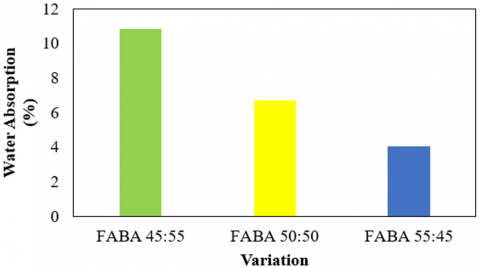
The results of the water absorption test presented in Table 4 demonstrate notable differences among the three FABA mix variations. The FABA 50:50 mixture yielded the lowest average water absorption at 7.75%, followed by FABA 55:45 at 9.47%, and FABA 45:55, showing the highest absorption rate at 10.75%. These variations indicate that the balance between FA and BA plays a critical role in determining the pore structure and matrix density of geopolymer paving blocks. The 50:50 mix appears to offer the most favorable performance in terms of water resistance, suggesting a more optimal polymerization and particle. Figure 3 shows the average water absorption.
The superior performance of the 50:50 composition can be attributed to the synergistic effect between FA and BA at this balanced ratio. FA, being finer and more reactive due to its high silica and alumina content, promotes a denser and more cohesive geopolymer gel when adequately activated [11]. Meanwhile, BA, though coarser and less reactive, contributes positively by improving internal curing and reducing shrinkage through its porous structure [12]. This balance at 50:50 likely enhances microstructural integrity and reduces the interconnected pore pathways responsible for capillary water ingress. Studies by Rangan [13] also support this, showing that a moderate addition of BA to FA-based geopolymers can improve matrix packing and reduce water permeability.
Table 4. Water absorption test results
|
Code |
Dry Weight (grams) |
Wet Weight (grams) |
Water Absorption (%) |
Average Water Absorption (%) |
|
45:55-S1 |
2752 |
3085 |
12.10 |
10.75 |
|
45:55-S2 |
2881 |
3201 |
11.11 |
|
|
45:55-S3 |
3085 |
3364 |
9.04 |
|
|
50:50-S1 |
3229 |
3544 |
9.76 |
7.75 |
|
50:50-S2 |
3367 |
3611 |
7.25 |
|
|
50:50-S3 |
3406 |
3619 |
6.25 |
|
|
55:45-S1 |
3066 |
3459 |
12.82 |
9.47 |
|
55:45-S2 |
3159 |
3358 |
6.30 |
|
|
55:45-S3 |
3092 |
3379 |
9.28 |
Figure 3. Average water absorption
In contrast, the 45:55 FABA composition displayed the highest water absorption, with individual sample values reaching up to 12.10%, indicating a more porous and less consolidated structure. This can be attributed to the higher proportion of BA, which has a rougher texture and lower reactivity, leading to insufficient geopolymer gel formation and increased void content. The findings align with the work of Rangan [13], who noted that excessive use of coarse or low-reactivity materials in geopolymer mixtures could hinder gel development and increase permeability. Consequently, the 45:55 mix may be less suitable for applications where water resistance and long-term durability are critical.
Interestingly, while the 55:45 mixture contains a higher FA content and is expected to perform better, its average absorption (9.47%) is slightly higher than that of the 50:50 mix. This may be due to the overdominance of fine FA particles, which, if not well-balanced with sufficient coarse material, can lead to poor particle packing and microcracking during curing due to shrinkage. Khan et al. [14] have reported that although increased FA improves reactivity, it can also increase shrinkage and lead to micro voids if not compensated by an appropriate aggregate or filler balance. Thus, the performance of the 55:45 mix, while better than the 45:55 variation, may still suffer from internal porosity due to microstructural instability.
Overall, the optimal performance of the 50:50 FABA mixture confirms the importance of a balanced blend between reactivity (from FA) and physical structure enhancement (from BA) in geopolymer systems. This ratio appears to produce the most compact matrix with fewer capillary pores, thus minimizing water absorption and potentially enhancing long-term mechanical strength and durability. These findings are consistent with international studies, including Siddiqui, Khan and Akhtar, 2025, which emphasize that the control of water absorption in geopolymer concrete is critical to achieving durable and weather-resistant construction materials [15]. Therefore, in the context of geopolymer paving block production, the 50:50 mix offers a promising formulation for practical implementation in sustainable infrastructure.
The water absorption test results provide important insights into the durability and pore structure of geopolymer paving blocks with different FA and BA ratios. Since water absorption directly reflects porosity and long-term serviceability, it serves as a key parameter for evaluating the suitability of FA–BA geopolymer mixes in paving block applications. The results show that the 50:50 mix achieved the lowest absorption (7.75%), while the 45:55 and 55:45 mixes recorded higher values of 10.75% and 9.47%, respectively. These findings highlight the significant role of FA–BA proportion in controlling pore connectivity and water ingress, directly addressing the study’s objective of identifying the most durable mix design.
The superior performance of the 50:50 mix can be explained by the complementary roles of FA and BA. FA, with its fine particles and high reactivity, enhances gel formation and densifies the matrix, while BA, despite its lower reactivity, contributes to internal curing and structural stability. At this balanced ratio, the two materials synergize to produce a compact microstructure with fewer capillary pores, reducing water penetration. In contrast, the higher BA content in the 45:55 mix results in insufficient gel formation and greater porosity, while the 55:45 mix, though richer in FA, may experience microcracking and poor packing due to particle imbalance.
Overall, the 50:50 ratio proved to be the most effective in minimizing water absorption, making it the best candidate for durable geopolymer paving blocks. This finding reinforces the importance of optimizing FA–BA proportions, not only for mechanical performance but also for enhancing moisture resistance, which is essential for long-term durability in outdoor applications.
3.2 Semi-quantitative analysis of geopolymer paving blocks
Semi-quantitative analysis of geopolymer paving blocks refers to the interpretive evaluation of their physical and chemical behavior based on indirect indicators, such as water absorption, texture, bonding integrity, and visual surface quality [16]. While quantitative metrics like compressive strength and exact porosity require advanced instruments, semi-quantitative insights can still provide valuable understanding, particularly in field-ready assessments and material development trials [17]. In this study, water absorption was used as the principal semi-quantitative indicator, supported by visual inspections and weight-based measurements before and after immersion.
The observed differences in water absorption among the three FABA mixtures suggest variations in microstructural compactness and pore continuity, which can be inferred as semi-quantitative representations of binder performance and internal matrix formation [18, 19]. For instance, the 50:50 FABA composition, which demonstrated the lowest water absorption, likely formed a more homogeneous aluminosilicate gel network with fewer interconnected capillary pores. This indicates better geopolymerization and polymer matrix stability, which are critical for the long-term durability of the material.
Conversely, the higher water absorption in the 45:55 mix implies incomplete or disrupted geopolymer formation due to a higher BA content. BA, while beneficial in controlling shrinkage and providing internal curing, has a relatively low reactive silica-alumina content compared to FA. Its irregular shape and coarser texture can lead to uneven matrix bonding and the formation of micro voids, which semi-quantitatively manifests as increased water uptake. This observation aligns with the findings, who noted that excessive BA disrupts gel formation [20, 21].
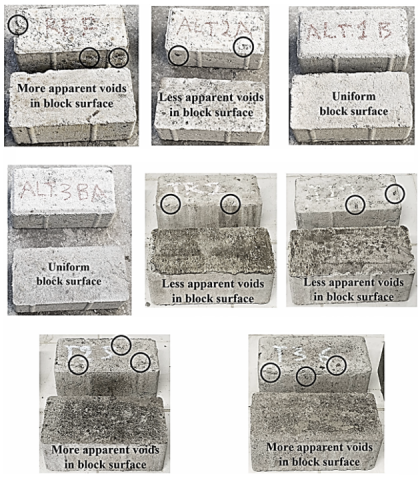
In terms of surface quality, specimens from the 50:50 mix appeared smoother, denser, and showed fewer visible surface pores or cracks compared to the other mixes. This visual attribute, though not measured instrumentally, serves as a semi-quantitative indicator of surface consolidation and microstructural integrity. The smoother finish indicates effective binder-aggregate interaction and possibly better curing consistency, contributing to reduced ingress of water and other deteriorative agents.
Another semi-quantitative factor observed is weight gain after immersion, which correlates with the total volume of absorbable voids within each specimen. The smallest weight gain in the 50:50 group further supports the hypothesis of improved matrix packing and lower open porosity. These weight-based differences, while not providing absolute pore volume values, provide comparative insight into pore system development in geopolymer structures, consistent with the absorption percentage findings.
Shrinkage behavior, though not quantitatively measured in this study, can also be semi-quantitatively inferred from the surface conditions of the cured blocks. The 55:45 mix, which contains a higher percentage of FA, exhibited minor surface microcracking in some samples. This suggests that while high FA content increases reactivity, it may also contribute to autogenous shrinkage, especially in low-water mixes without enough coarse material to mitigate internal stress during curing—a phenomenon well-documented [22, 23].
The tactile hardness and resistance to manual pressure applied during sample handling also differed among the mixtures, with the 50:50 blocks exhibiting the most solid and dense feel. Although subjective, such physical inspection can serve as a semi-quantitative indicator, especially in field applications where sophisticated testing equipment is unavailable. This aligns with field practices where hardness and surface resilience are often used as proxies for compressive strength in masonry and pavement units.
Chemical integrity, inferred from the absence of efflorescence or discoloration on the surface after 28 days of curing, further supports the stable chemical behavior of the 50:50 mix. Efflorescence, often resulting from incomplete reaction of alkaline solutions or migration of soluble salts, was notably absent or minimal in these samples, indicating balanced activator usage and complete reaction of aluminosilicate sources. This observation is consistent with studies such as, which linked visual clarity and absence of white residue to optimal geopolymer chemistry [24, 25].
In terms of dimensional stability, all paving blocks retained their original shape after curing and immersion, with no visible signs of expansion, warping, or surface delamination [26]. However, the FABA 45:55 group showed slightly rougher edges and some minor surface flaking, which may reflect weaker interparticle bonding or higher porosity. These observations, while not quantifiable in this study, provide semi-quantitative insight into structural resilience under wetting and drying conditions—an essential factor in outdoor applications.
In conclusion, semi-quantitative analysis complements the water absorption test by providing holistic, practical insight into the material behavior of geopolymer paving blocks. Through a combination of physical observation, weight change analysis, and tactile and visual assessments, this approach allows researchers and practitioners to infer the quality and suitability of geopolymer mixtures even in resource-limited contexts. Among the variations studied, the 50:50 FABA composition consistently exhibited favorable semi-quantitative indicators, including low water uptake, smooth surface finish, dense matrix, and absence of surface defects—suggesting it as the most effective blend for durable and sustainable geopolymer paving applications. Table 5 shows the summary of semi-quantitative indicators of geopolymer paving blocks.
The summary presented in Table 5 provides a comprehensive comparison of the semi-quantitative performance indicators across the three FABA geopolymer paving block compositions. Among the three, the FABA 50:50 mixture shows the most favorable performance, particularly in terms of water absorption, surface texture, and matrix density. The lower water absorption (7.75%) observed in this mix is consistent with a denser and less porous microstructure, suggesting more complete geopolymerization and stronger bonding between FA and BA particles. This level of compactness is further supported by the smooth surface finish and low weight gain after soaking, which are strong indicators of reduced permeability [27].
Table 5. Summary of semi-quantitative indicators of geopolymer paving blocks
|
Indicator |
FABA 45:55 |
FABA 50:50 |
FABA 55:45 |
|
Average Water Absorption (%) |
High (10.75%) |
Low (7.75%) |
Moderate (9.47%) |
|
Surface Texture |
Rough, porous |
Smooth, dense |
Moderately smooth |
|
Weight Gain After Soaking |
High |
Low |
Moderate |
|
Microcracking (Visual) |
None observed |
None observed |
Minor observed |
|
Tactile Hardness |
Moderate |
High |
Moderate |
|
Edge and Corner Integrity |
Slight flaking |
Sharp and clean |
Slight erosion |
|
Efflorescence Presence |
Minimal |
Absent |
Slight trace |
|
Perceived Matrix Density |
Porous |
Compact |
Moderately compact |
|
Dimensional Stability |
Stable |
Stable |
Stable |
|
Overall Performance (Visual + Tactile) |
Low to moderate |
High |
Moderate |
In contrast, the FABA 45:55 mix, which contains a higher proportion of BA, performed the weakest across most indicators. The rough surface texture, high water absorption (10.75%), and visible signs of flaking at the edges suggest a more porous and loosely bound matrix [28]. This may be attributed to the lower reactivity and coarser particle size of BA, which, when used in excess, can hinder the formation of a homogeneous geopolymer gel. Although BA provides structural skeletons and internal curing benefits, its excessive use appears to compromise compaction and durability, as reflected in the semi-quantitative indicators.
The FABA 55:45 composition yielded intermediate results. While it benefited from a higher FA content—which improved reactivity and reduced efflorescence—it also showed minor microcracks on the surface, likely due to shrinkage during curing. These microcracks, though small, indicate potential weaknesses in dimensional stability and long-term weathering resistance. Additionally, its moderate water absorption (9.47%) and tactile hardness suggest that while the matrix is denser than the 45:55 variant, it may still suffer from internal voids due to insufficient particle interlocking or imbalance in aggregate-binder interaction [29].
One key insight from this comparison is that semi-quantitative indicators can serve as practical tools for evaluating geopolymer block performance, especially in settings with limited access to advanced testing equipment. Attributes such as surface condition, tactile hardness, and efflorescence presence offer immediate, visual feedback on material quality and can help identify potential weaknesses early in the production process. These indicators are especially valuable for small-scale producers or pilot projects where rapid quality assessment is needed before full-scale testing [30].
In conclusion, Table 5 demonstrates that the balance between FA and BA is critical in achieving optimal geopolymer paving block performance. The 50:50 mix offers the best combination of physical stability, moisture resistance, and visual integrity, making it the most promising candidate for practical application. Semi-quantitative evaluation supports the broader findings of this study by validating that mix design choices directly affect observable material characteristics, and that these indicators can reliably reflect underlying chemical and structural performance. Further integration of such approaches into quality control practices can enhance the production of consistent, durable, and sustainable geopolymer-based products. This highlights the potential of semi-quantitative analysis as a complementary method to conventional laboratory testing, especially in early-stage material selection or in low-resource settings. By combining empirical data with practical observations, decision-makers can more confidently determine the most effective mix design for field application and long-term durability.
This study has successfully investigated the water absorption characteristics and semi-quantitative performance of geopolymer paving blocks made from varying proportions of FA and BA. The results revealed that the FABA 50:50 mixture exhibited the lowest water absorption rate (7.75%), denser surface texture, and superior semi-quantitative indicators such as smooth finish, tactile hardness, and minimal efflorescence. In contrast, the 45:55 mix showed the highest absorption (10.75%) and several signs of poor compaction, while the 55:45 mix performed moderately but was slightly affected by minor surface cracking. These variations highlight the critical role of FA–BA balance in optimizing the geopolymer matrix, affecting both durability and structural integrity.
The semi-quantitative analysis further supported the water absorption findings by providing insight into observable material behaviors such as surface condition, weight gain after immersion, and matrix compactness. Through visual, tactile, and indirect measurement methods, the study demonstrated that semi-quantitative indicators can serve as practical, cost-effective tools to evaluate material performance when laboratory instrumentation is limited. The FABA 50:50 mix emerged as the most promising composition due to its stable physical structure, compact microtextured, and consistent results across all indicators. This suggests an effective geopolymerization process and optimal interaction between FA’s reactivity and BA’s granular structure.
Based on these findings, it is recommended that future production of geopolymer paving blocks for infrastructure or urban applications prioritize a 50:50 FA–BA ratio to ensure both performance and sustainability. Further research is encouraged to integrate compressive strength, microstructural (SEM/XRD) analysis, and long-term durability tests such as freeze–thaw and sulphate resistance, to validate the observed trends in broader environmental conditions. In practical terms, incorporating semi-quantitative evaluation into routine quality control processes will empower manufacturers to detect defects early, reduce variability, and promote the widespread adoption of eco-friendly, high-performance geopolymer paving solutions.
The authors would like to express their sincere gratitude to the laboratory staff at the Civil Engineering Department for their assistance in conducting the experiments. Appreciation is also extended to the research team members and technical support personnel who contributed to the data collection and analysis. Special thanks go to the institution and research center that provided the FA and BA materials for this study. The authors acknowledge the constructive feedback from peer reviewers which significantly improved the quality of this paper. This research was conducted without any specific grant from funding agencies in the public, commercial, or not-for-profit sectors.
[1] Megasari, S.W., Suryanita, R., Antonius. (2025). Optimization of coconut fiber geopolymer mortar: Mechanical performance and predictive modeling. Annales de Chimie - Science des Matériaux, 49(4): 331-347. https://doi.org/10.18280/acsm.490401
[2] Davidovits, J. (2015). False values on CO2 emission for geopolymer cement/concrete published in scientific papers. Technical Paper, 24: 1-9.
[3] Rangan, P.R., Tumpu, M., Arrang, A.T., Yunianta, A., Rachim, F. (2024). Effect of curing time and liquid alkaline activators on compressive strength development of fly ash and bamboo leaf ash-based geopolymer concrete. GEOMATE Journal, 27(119): 112-119. https://geomatejournal.com/geomate/article/view/3974.
[4] Cui, H., Qin, Q.Y. (2023). Morphological distribution and phase composition of rare earth elements in waste incineration fly ash. Acadlore Transactions on Geosciences, 2(3): 167-176. https://doi.org/10.56578/atg020304
[5] Naji, Z.H., Mubarak, H.M., Ibrahim, A.M. (2025). The effect of height replacement fly ash on properties of mortar. Annales de Chimie - Science des Matériaux, 49(1): 43-48. https://doi.org/10.18280/acsm.490106
[6] Zhang, P., Wang, W., Guo, J., Zheng, Y. (2025). Abrasion resistance and damage mechanism of hybrid fiber-reinforced geopolymer concrete containing nano-SiO₂. Journal of Cleaner Production, 494: 144971. https://doi.org/10.1016/j.jclepro.2025.144971
[7] Darhamsyah, Tumpu, M., Samawi, M.F., Anda, M., Abas, A., Satria, M.Y. (2025). Reducing embodied carbon of paving blocks with landfill waste incineration ash: An eco-cement life cycle assessment. Engineering, Technology & Applied Science Research, 15(2): 21913-21917. https://doi.org/10.48084/etasr.10050
[8] Almeida, F., Fernández-Jiménez, A., Vieira, C.S., Cristelo, N., Moreira, A.T., de Lurdes Lopes, M. (2025). Greener concrete paving blocks with hybrid alkaline cements and recycled aggregates. Journal of Materials in Civil Engineering, 37(2): 04024503. https://doi.org/10.1061/JMCEE7.MTENG-18753
[9] Mohammed, T.U., Joy, J.A., Zahid, C.Z.B., Rafid, M.Z. (2025). Efficiency of clay-burnt brick fines as an internal curing agent for enhancing mechanical and durability properties of high-strength concrete. Journal of Materials in Civil Engineering, 37(5): 04025121. https://doi.org/10.1061/JMCEE7.MTENG-19519
[10] Abed, F.H., Zareei, S.A., Kurdi, N.H., Emami, A. (2024). Enhancing geopolymer binder reactivity and performance via mechanochemical activation: A comprehensive study of rheological, mechanical, and microstructural properties. Construction and Building Materials, 430: 136456. https://doi.org/10.1016/j.conbuildmat.2024.136456
[11] Rodríguez-Álvaro, R., González-Fonteboa, B., Seara-Paz, S., Hossain, K.M. (2020). Internally cured high performance concrete with magnesium based expansive agent using coal bottom ash particles as water reservoirs. Construction and Building Materials, 251: 118977. https://doi.org/10.1016/j.conbuildmat.2020.118977
[12] Wongsa, A., Boonserm, K., Waisurasingha, C., Sata, V., Chindaprasirt, P. (2017). Use of municipal solid waste incinerator (MSWI) bottom ash in high calcium fly ash geopolymer matrix. Journal of Cleaner Production, 148: 49-59. https://doi.org/10.1016/j.jclepro.2017.01.147
[13] Rangan, B.V. (2009). Engineering properties of geopolymer concrete. Geopolymers, 211-226. https://doi.org/10.1533/9781845696382.2.211
[14] Khan, A.Q., Muhammad, S.G., Raza, A., Chaimahawan, P., Pimanmas, A. (2025). Advanced machine learning techniques for predicting compressive strength of ultra-high performance concrete. Frontiers of Structural and Civil Engineering, 19(4): 503-523. https://doi.org/10.1007/s11709-025-1169-4
[15] Siddiqui, A.R., Khan, R., Akhtar, M.N. (2025). Sustainable concrete solutions for green infrastructure development: A review. Journal of Sustainable Construction Materials and Technologies, 10(1): 108-141. https://doi.org/10.47481/jscmt.1667793
[16] Mohajerani, A., Suter, D., Jeffrey-Bailey, T., Song, T., Arulrajah, A., Horpibulsuk, S., Law, D. (2019). Recycling waste materials in geopolymer concrete. Clean Technologies and Environmental Policy, 21(3): 493-515. https://doi.org/10.1007/s10098-018-01660-2
[17] Temuujin, J., Rickard, W., Lee, M., van Riessen, A. (2011). Preparation and thermal properties of fire resistant metakaolin-based geopolymer-type coatings. Journal of Non-Crystalline Solids, 357(5): 1399-1404. https://doi.org/10.1016/j.jnoncrysol.2010.09.063
[18] Annisa, R.W.R., Wahab, A.W., Tumpu, M., Demmalino, E.B., Caronge, M.A. (2025). Overcoming heavy metal pollution from nickel mining wastewater in Indonesia using green chemistry activated rice husk biochar for sustainable remediation. Ecological Engineering & Environmental Technology (EEET), 26(9): 278-292.
[19] Tombeg, B.A., Tumpu, M., Lonan, T.P., Sumajouw, J.A.J. (2025). Environmental performance evaluation of geopolymer concrete utilizing industrial by-products and recycled aggregates under variable thermal conditions. Ecological Engineering & Environmental Technology (EEET), 26(9): 293-303. https://doi.org/10.12912/27197050/209444
[20] Silva, W.B., Barroso, S.H., Cabral, A.E.B., Stefanutti, R., Picado-Santos, L.G. (2023). Assessment of concrete road paving blocks with coal bottom ash: Physical and mechanical characterization. Case Studies in Construction Materials, 18: e02094. https://doi.org/10.1016/j.cscm.2023.e02094
[21] Nguyen, D.T., Le, T.H. M., Huynh, T.P. (2025). Performance of high-volume coal combustion residual-based concrete pavement: An experimental evaluation of engineering properties, durability, microstructure, cost, and environmental impacts. Construction and Building Materials, 493: 143128. https://doi.org/10.1016/j.conbuildmat.2025.143128
[22] Kaewpikul, D., Pangdaeng, S., Wongsa, A., Ekprasert, J., Sata, V., Chindaprasirt, P. (2025). Polyvinyl chloride (PVC) waste in pressed geopolymer concrete: Analyzing properties and feasibility application considerations. Construction and Building Materials, 468: 140372. https://doi.org/10.1016/j.conbuildmat.2025.140372
[23] Embong, R. (2025). Transforming coal bottom ash into a high-performance pozzolan: Effects of acid treatment on material properties. Innovative Infrastructure Solutions, 10(7): 313. https://doi.org/10.1007/s41062-025-02110-x
[24] Vembu, P.R.S., Ammasi, A.K. (2024). Magnesite mine waste as a sustainable binder for low-fines self-compacting concrete: engineering property and ecological impact. Global Nest Journal, 26(6): 1-12. https://doi.org/10.30955/gnj.06124
[25] Prasetia, I., Syauqi, M., Aini, A.S. (2021). Application of central Kalimantan coal ash as a sustainable construction material. IOP Conference Series: Earth and Environmental Science, 758(1): 012011. https://doi.org/10.1088/1755-1315/758/1/012011
[26] Rathee, M., Singh, N. (2022). Durability properties of copper slag and coal bottom ash based I-shaped geopolymer paver blocks. Construction and Building Materials, 347: 128461. https://doi.org/10.1016/j.conbuildmat.2022.128461
[27] Uygunoğlu, T., Topcu, I.B., Gencel, O., Brostow, W. (2012). The effect of fly ash content and types of aggregates on the properties of pre-fabricated concrete interlocking blocks (PCIBs). Construction and Building Materials, 30: 180-187. https://doi.org/10.1016/j.conbuildmat.2011.12.020
[28] Satria, M.Y., Samawi, M.F., Tumpu, M. (2025). Semi quantitative analyses of eco-cement made from landfill waste burning ash and portland composite cement. International Journal of Environmental Impacts, 8(2): 259-267. https://doi.org/10.18280/ijei.080206
[29] Ganjian, E., Jalull, G., Sadeghi-Pouya, H. (2015). Using waste materials and by-products to produce concrete paving blocks. Construction and Building Materials, 77: 270-275. https://doi.org/10.1016/j.conbuildmat.2014.12.048
[30] Sheng, Z., Zhu, B., Cai, J., Han, J., Zhang, Y., Pan, J. (2024). Influence of waste glass powder on printability and mechanical properties of 3D printing geopolymer concrete. Developments in the Built Environment, 20: 100541. https://doi.org/10.1016/j.dibe.2024.100541