G. Surya Prakash Rao | G. Guru Mahesh | Naseeruddin Mohammed | M. Dora Babu | P. Kumar | Mousumi Bhanja*
© 2025 The authors. This article is published by IIETA and is licensed under the CC BY 4.0 license (http://creativecommons.org/licenses/by/4.0/).
OPEN ACCESS
This study uses stir casting to produce hybrid metal matrix composites using AA7075. These composites have been reinforced with different weights (2%, 4%, and 6%) of silicon carbide (SiC) and titanium carbide (TiC). The microstructural and mechanical properties of these composites are examined to determine their characteristics. Comprehensive characterization was performed using SEM-EDS, XRD, tensile, hardness, and porosity tests. SEM/EDS and XRD analyses confirmed a homogeneous dispersion of SiC and TiC particles within an equiaxed α-Al matrix, with distinct carbide peaks emerging at higher loadings. Increasing the reinforcement content led to progressive grain refinement through Zener pinning, with the 6 wt% composite exhibiting the finest microstructure and the lowest porosity. The tensile testing revealed an increase in ultimate strength from 95 MPa for the unreinforced alloy to approximately 219 MPa at a 6 wt% loading, representing a 40% improvement, although accompanied by a modest reduction in ductility.
hybrid matrix composites, stir casting, microstructure, XRD, mechanical properties
Stir casting is a prevalent and economical liquid-phase method for producing metal matrix composites (MMCs). AA7075 is a high-strength aluminum alloy widely used in aerospace, automotive, and defense sectors due to its excellent strength-to-weight ratio, fatigue resistance, and machinability. However, its relatively low wear resistance and limited thermal stability restrict its performance in demanding applications. To overcome these shortcomings, the alloy is often reinforced with ceramic particles to form metal matrix composites (MMCs) [1]. Silicon carbide (SiC) is selected as a reinforcement because of its exceptional hardness, high elastic modulus, low density, and superior wear resistance. Its incorporation is expected to improve the composite’s hardness, stiffness, and resistance to abrasion. Titanium carbide (TiC), on the other hand, offers high melting temperature, chemical stability, and strong interfacial bonding with aluminum. TiC additions are particularly beneficial for enhancing load-bearing capacity, thermal stability, and resistance to deformation at elevated temperatures [2, 3].
During this procedure, ceramic reinforcing particles, typically silicon carbide (SiC) and titanium carbide (TiC), are physically agitated into the molten aluminium matrix to improve the composite's mechanical and tribological characteristics. Stir casting (liquid metallurgy) remains the most economical and scalable method for producing particulate-reinforced aluminum composites. In a typical procedure, AA7075 is melted (660-780℃), ceramic powders are preheated (300-500℃) to remove moisture and improve wettability, and then introduced into a vortex generated by a graphite or ceramic impeller (200-600 rpm, 10-15 min). Inert gas degassing or fluxes are applied to minimize porosity before pouring into preheated molds [4].
Prabu et al. [5] investigated the influence of stirring speed and preheating temperature on particle dispersion in Al-SiC composites, concluding that preheating reinforcements to 400-500℃ and stirring at 500 rpm for 10 minutes yielded optimal results. These insights also apply to AA7075-SiC/TiC systems. Silicon carbide (SiC) is widely used due to its high hardness, thermal stability, and good interface bonding with aluminum alloys. Rajan et al. [6] investigated the mechanical behavior of AA7075 reinforced with varying percentages of SiC using the stir casting process. They reported significant improvements in hardness, tensile strength, and wear resistance, particularly at 5-10 wt% SiC. Ficici [7] fabricated AA7075-SiC composites (SiC 5-20 wt%) via stir casting and reported a nearly uniform particle distribution. Enhanced hardness and wear resistance were observed, with optimal performance at 10 wt% SiC. SR and Suresh [8] produced AA7075-5 wt% SiC by stir casting. SEM showed homogeneous SiC scattering, and the composite exhibited 15% higher tensile strength and ~30% higher hardness than the unreinforced alloy.
A recent work [9] on AA7075 + (2.5, 5 wt%) TiC reported that 5 wt% TiC yielded a 25% increase in hardness and 30% reduction in wear rate, with a minor effect on corrosion resistance (polarization current 8%). Incorporating TiC particles into the AA7075 matrix transforms the microstructure from a dendritic to a more equiaxed morphology. This transformation is attributed to TiC particles acting as potent nucleation sites during solidification, leading to finer grains and enhanced mechanical properties. Similarly, adding SiC particles results in a uniform dispersion within the aluminum matrix, contributing to grain refinement. The extent of refinement depends on the particle size and weight percentage of SiC used. A modified stir casting study produced AA7075 + 5 wt% SiC + 5 wt% TiC plates. Compared to base AA7075 (UTS = 116 MPa, BHN = 95), the hybrid composite achieved UTS = 155 MPa (+34%) and BHN = 229 (+141%). The addition of SiC/TiC also increased yield strength and moderately decreased toughness [10]. A two-step stir casting route varied SiC/TiC total volume up to 15 vol%. Tensile strength increased linearly up to ~10 vol% reinforcing particles before plateauing, attributed to particle clustering at higher loadings [11].
Combining SiC and TiC as hybrid reinforcements in AA7075 has been explored to leverage the benefits of both particles. Such hybrid composites exhibit improved mechanical properties due to the combined effects of grain refinement, enhanced load transfer, and increased resistance to dislocation movement. However, it's important to note that while strength and hardness are improved, there may be a trade-off with ductility and impact resistance, necessitating a balanced approach in reinforcement selection and processing parameters. Nano-SiC (0.3 vol%) by Stir-Squeeze Casting & Cold Forging (2023) AA7075 + 0.3 vol% nano-SiC exhibited a refined, equiaxed grain structure with SiC well-dispersed at grain boundaries. Ballistic impact strength improved from 5 J to 7.7 J, linked to crack-arresting by SiC networks [12]. Microstructure and Thermal Properties (2023) AA7075 + 5-15 wt% SiC, produced by semi-solid stir casting, exhibited a homogeneous dispersion of SiC particles, 20-30 µm in size, and a 16.5% increase in thermal conductivity. Grain size reduced by 25% compared to the base alloy [13]. The ternary hybrid MMC (AA7075 + SiC + TiC), as fabricated by Khan et al. [14], consists of AA7075 reinforced with 3 wt% SiC and 2 wt% TiC via conventional stir casting. Fine, equiaxed grains; SiC at grain boundaries; TiC finely dispersed in matrix, and UTS increased by 34% (to 155 MPa), hardness doubled (225 BHN), but elongation dropped 15% due to increased particle-matrix interfaces. Reinforced AA7075 Composites summarizes the mechanical, tribological, and corrosion behaviour across Al-7075 MMCs with various ceramic particulates. It highlights that stir-casting remains the most industrially viable route but requires tight control of degassing and fluxing to avoid porosity and particle clustering [15]. In another reported study on Al7075 reinforced via stir casting with SiC, TiC, TiB₂, and others [16]. It identifies key microstructural features, including grain refinement through particle-induced nucleation, modification of intermetallic precipitates, and agglomeration limits, that govern the improvements in hardness and strength [17]. By combining SiC and TiC, the hybrid reinforcement approach leverages the stiffening and wear resistance imparted by SiC along with the grain refinement and interfacial stability introduced by TiC.
The hybrid use of SiC and TiC in AA7075 is intended to combine the advantages of both reinforcements. While SiC contributes to improved hardness and wear resistance, TiC strengthens interfacial bonding and enhances thermal and mechanical stability. Together, these reinforcements are expected to produce a composite with superior mechanical strength, wear resistance, and durability compared to AA7075 reinforced with a single ceramic phase.
The available data consists of limited reports on hybrid particle systems in aluminum alloys; systematic studies on AA7075 reinforced simultaneously with SiC and TiC remain limited. Most of the available work addresses either SiC or TiC alone, or hybrid combinations with other ceramics (TiB₂, Gr, B₄C), but fails to comprehensively evaluate how the complementary strengthening mechanisms of SiC and TiC interact when used together in AA7075. Furthermore, the correlation between microstructural refinement, uniform dispersion, porosity reduction, and their direct impact on tensile strength, hardness, and fracture behaviour has not been thoroughly established for such hybrid systems.
This work introduces a hybrid reinforcement strategy (SiC + TiC, 2-6 wt%) in AA7075, utilizing the stir-casting method, which consciously combines the high hardness and wear resistance of SiC with the grain-refining and strong interfacial bonding capability of TiC. Unlike prior single-particle studies, our approach ensures homogeneous dispersion, minimized porosity, and Zener pinning-induced grain refinement, resulting in a marked improvement in ultimate tensile strength and hardness, with acceptable trade-offs in ductility.
In this study, the specific objectives are explicitly defined as follows:
•Fabricate AA7075-(SiC+TiC) hybrid composites at 0, 2, 4, and 6 wt% using a controlled stir-casting route and standardized specimen preparation.
•Establish phase constitution and confirm particle retention using X-ray diffraction across all reinforcement levels.
•Quantify microstructural evolution (grain size, particle dispersion, and porosity) using optical microscopy and SEM/EDS, and relate these to reinforcement fraction.
•Tensile strength of the fabricated parts, behavior, and map their dependence on reinforcement content.
•Correlate microstructure-property relationships to identify the dominant strengthening contributions.
•Characterize fracture mechanisms via SEM fractography to track the ductile-to-brittle transition with increasing ceramic content.
The AA7075 alloy, characterized by an average particle size of 40 μm, functioned as the matrix material in this investigation. Table 1 presents data on the concentrations of the received powder composition. Powder particles composed of SiC and TiC were used as reinforcements due to their superior properties, including high hardness, stiffness, and refractoriness. The mean diameter of these powder particles was 30 μm. Table 2 presents the comprehensive mechanical properties of the AA7075 alloy, SiC, and TiC. Four sets of Al/SiC/TiC composites were fabricated by varying the SiC and TiC content in volume percentage, and the compositions are shown in Table 3. Initially, SiC was included in the AA7075 matrix material at 1%, 2%, and 3% weight percentages. Ball milling processes were devised and employed to ensure the uniform distribution of reinforcements throughout the matrix material. After establishing the requisite weight percentage of SiC for the AA7075 secondary reinforcements, TiC was subsequently included in the composite material comprising AA7075 and SiC. The TiC concentration varied to 1, 2, and 3 wt%.
Table 1. Chemical composition of base materials
|
Material |
Si |
Fe |
Cu |
Mn |
Cr |
Mg |
Zn |
Ti |
Al |
|
Al7075 |
0.40 |
0.50 |
2.00 |
0.30 |
0.28 |
2.90 |
6.10 |
0.20 |
Bal |
Table 2. Mechanical properties of AA7075 SiC and TiC
|
Properties |
AA7075 |
SiC |
TiC |
|
Density(g/cc) |
2.81 |
3.22 |
4.94 |
|
Poisson's Ratio |
0.33 |
0.35 |
0.11 |
|
Hardness |
87 |
32 |
31 |
|
Melting Point (℃) |
477 |
2830 |
3140 |
|
Tensile Strength (MPa) |
280 |
240 |
258 |
Table 3. Composition of mixtures for each composite
|
S.No |
Matrix Al (%) |
Reinforcement-1 SiC (%) |
Reinforcement-2 TiC (%) |
|
1 |
100 |
0 |
0 |
|
2 |
98 |
1 |
1 |
|
3 |
96 |
2 |
2 |
|
4 |
94 |
3 |
3 |

Figure 1. (a) Stir casting furnace (d-e) Samples with reinforcement of SiC + TiC
The specimen was produced using the traditional stir-casting technique. The criteria for the stir casting process include a stirring duration of 20 minutes, a stirrer blade angle of 30 degrees, a stirrer speed of 600 RPM, and a melting temperature of 850℃. Figure 1 illustrates the experimental configuration utilized in this research. Each sample was produced by melting 1,000 grams of aluminum into a graphite crucible within an electric furnace at 600℃. Magnesium, present in AA7075 and often added in small amounts during processing, significantly improves this solid adhesion. It lowers the surface tension of molten aluminum and disrupts the stable oxide film (Al₂O₃) that usually forms at the melt surface, thereby allowing direct contact with the reinforcement. Additionally, magnesium can react at the particle matrix interface to form a thin spinel (MgAl₂O₄) layer, which promotes chemical bonding with ceramic particles such as SiC and TiC. Magnesium (2 wt%) was added to the molten metal to enhance the adhesion between the matrix alloy and the reinforcements. Magnesium is regarded as an outstanding adhesion agent for silicon carbide (SiC). The TiC particles were heated for 3-4 hours at 2000℃ to facilitate surface oxidation. The heated powder was integrated into the molten metal at a uniform feed rate utilizing SiC. This guaranteed an even dispersion of the powder throughout the metal. The hybrid composite was allowed to dry at room temperature before being extracted from the mould and undergoing mechanical tests. Samples comprising 2%, 4%, and 6% (SiC + TiC) were generated utilizing the same technique.
To conduct metallurgical analysis of the lateral surfaces across all stir-cast parts with different reinforcement, the cast parts in their as-fabricated condition were sectioned to the required dimensions. Specimen preparation followed standard metallographic procedures, beginning with grinding using a series of emery papers of progressively finer grit sizes, and concluding with fine polishing on a double-disc polisher using an Al₂O₃ slurry to achieve a mirror-like finish. After polishing, etching was performed by using the Kellers reagent. Microscopic examination was conducted using an Olympus GX51M metallurgical microscope, operating at magnifications ranging from 50× to 500×, to evaluate the macrostructural and microstructural features of the cast parts. For high-resolution imaging and elemental analysis, scanning electron microscopy (SEM) coupled with energy-dispersive X-ray spectroscopy (EDS) was conducted on a Carl Zeiss Sigma 300 operated at 15 kV. Secondary electrons were collected using the SE2 detector to capture detailed surface morphology and microstructural features of the fabricated parts.
Vickers microhardness testing was conducted in accordance with ASTM E384-16 to evaluate the effect of SiC/TiC reinforcement on the matrix hardness. A load of 1 kg was applied with an indentation dwell time of approximately 8 s. For each specimen, six indentations were made, and the mean value of the hardness (HV) was reported. Tensile specimens were prepared following ASTM E8M standards. They were sectioned perpendicular to the weld line using an electrical discharge machine (EDM) to achieve high dimensional accuracy. Tensile tests were then conducted on a universal testing machine (UTM) at a constant crosshead speed of 2 mm/min to evaluate the mechanical behavior of the fabricated composites.
Figure 2(a) shows a coarse-grained structure typical of an unreinforced aluminum alloy. Large dendritic α-Al grains are visible. The absence of any particulate reinforcement leads to a relatively unrefined microstructure and no observable secondary phase. Figure 2(b) shows that the Introduction of 2 wt% SiC and TiC results in grain refinement. Small, dark-phase particles (SiC and TiC) are beginning to appear along grain boundaries. Improved grain boundary definition suggests partial pinning by reinforcement particles. The composite is still relatively coarse compared to higher reinforcement cases. Further grain refinement is visible in Figure 2(c) (AA7075 + 4% SiC and TiC). Reinforcement particles are more densely and uniformly distributed across the matrix. The boundaries are more refined and well-defined, indicating improved interfacial bonding and Zener pinning. Fewer signs of agglomeration, suggesting good dispersion at this reinforcement level. Figure 2(d) (AA7075 + 6% SiC and TiC) shows the finest microstructure among all samples. Dense dispersion of SiC and TiC particles effectively impedes grain growth during sintering. Particles are uniformly distributed with minimal porosity. Likely to correspond to the maximum mechanical performance, as also seen in related test results.

Figure 2. Microstructure of composite (a) AA7075 Pure, (b) AA7075 with 2% SiC and TiC, (c) AA7075 with 4% SiC and TiC, and (d) AA7075 with 6% SiC and TiC
Figures 3(a)-(d) provide microstructural and elemental distribution insights into how hybrid reinforcement (SiC + TiC) affects the morphology and composition of AA7075 alloy. In all the images, (a) shows the SEM structure and (b) shows the EDS analysis. The SEM image, as shown in Figure (a), displays a relatively smooth surface with large, uniform aluminum grains lacking any second-phase particles or reinforcements. EDS spectrum is expected to show high peaks of aluminum, with minor signals of Mg, Zn, or Cu (inherent alloying elements of AA7075). The smooth matrix confirms the absence of ceramic particles, and the microstructure is dominated by α-Al grains, with possibly a few intermetallics present. In Figure 3-sample 2(a), SEM reveals the initial distribution of dark contrast particles, like SiC and TiC. These particles mostly appear along grain boundaries. In Figure 3, sample 2(b), EDS analysis would show characteristic elemental peaks for Si, Ti, and C, in addition to Al, Mg, and Zn. SiC and TiC particles begin to play their role as nucleation centers during sintering, initiating Zener pinning. In Figure 3, sample 3(a), with 4 wt% SiC and TiC, significantly refines the matrix, creating a denser microstructure. Darker particles are well-embedded and appear in both intra- and inter-granular regions. EDS reveals stronger signals of Si and Ti, suggesting higher reinforcement density. In Figure 3, sample 4(a), AA7075 + 6 wt% SiC & TiC, SEM shows a dense network of reinforcement particles, uniformly distributed throughout the matrix, with a well-refined structure. EDS mapping should show pronounced peaks for Si and Ti, along with Al and matrix elements.

(a) Sample -1

(b) Sample -2

(c) Sample -3

(d) Sample -4
Figure 3. As-fabricated SEM/EDS analysis (a) Sample-1 AA7075 pure, (b) Sample -2 AA7075+ 2% SiC and TiC, (c) Sample -3 AA7075 + 4% SiC and TiC, and (d) Sample -4 AA7075+ 6% SiC and TiC
Figure 4 presents the X-ray diffraction (XRD) patterns of (a) pure AA7075 and AA7075 reinforced with (b) 2 wt%, (c) 4 wt%, and (d) 6 wt% hybrid SiC + TiC combinations. All four patterns, Aluminium Matrix (α-Al), exhibit the characteristic FCC aluminium diffraction peaks at roughly 2θ = 38.4° (111), 44.7° (200), 65.1° (220), and 78.2° (311), confirming retention of the primary AA7075 phase without transformation. In reinforced Silicon Carbide (SiC) samples, weak peaks at 35.6° and 60.0° correspond to the (111) and (220) planes of cubic SiC, indicating successful incorporation of SiC particles without decomposition. The addition of Titanium Carbide (TiC) low-intensity peaks around 41.8° and 73.7° matches the (111) and (220) reflections of TiC, indicating that TiC remains stable and well-distributed during sintering. The relative intensity of the α-Al peaks gradually decreases from (a) to (d) as reinforcement content increases. As SiC + TiC content rises, the corresponding carbide peaks become more pronounced, most notably in the 6 wt% sample, confirming higher phase volume and good particle retention without significant dissolution.

Figure 4. XRD of as-fabricated samples
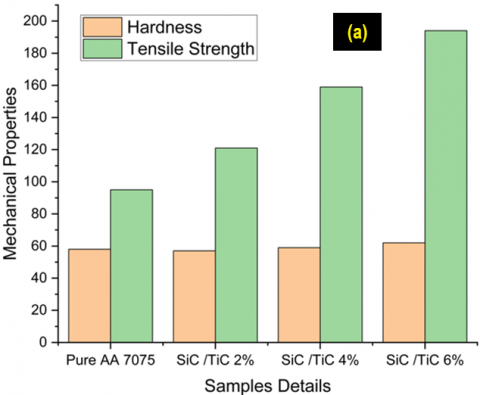
Hybrid (SiC + TiC) reinforced composites exhibit higher hardness than the unreinforced matrix, and this hardness generally increases with the reinforcement weight fraction. Prior investigations [18] have demonstrated that introducing hard particles enhances matrix hardness and resistance to plastic deformation by hindering dislocation motion [19]. In our results, the overall gain from 0 to 6 wt.% is modest (~ +9 %) because many micro-indentations still probe the aluminum matrix predominantly; additionally, very low additions (≈ 2 wt.%) can introduce slight inhomogeneity that temporarily depresses the measured hardness.
As shown in Figure 5(a), hardness increases steadily up to a total (SiC + TiC) content of 6 wt.%. At higher particle number densities, reduced inter-particle spacing and occasional clustering can lessen the effective contribution of the SiC and TiC to the measured hardness [20]. Overall, a 6 wt.% hybrid reinforcement yields hardness and corresponding tensile strength superior to the unreinforced alloy. Aluminium is an ideal option for aviation and automotive applications due to its lower density than other materials. The diminished strength and stiffness of aluminium alloys limit their potential uses. The tensile strength parameters of Al7075 hybrid metal matrix composites enhanced with SiC and TiC are shown in Figure 5(b). Hybrid composites made with Al7075 exhibit a tensile strength significantly higher than that of the base metal. The primary factor contributing to the subsequent strengthening effect in the composites is the incorporation of rigid reinforcing particles. The uniform distribution of ceramic particles, such as SiC and TiC, within the aluminum alloy matrix effectively hinders dislocation motion, thereby enhancing the material's strength and reducing its susceptibility to fracture.
The use of ceramic particles significantly improves the tensile and fracture strength of the composite material. In this manner, stress is transmitted from the ductile aluminium matrix to the brittle reinforcing particles. Murali et al. [21] elucidated this phenomenon as the Orowan mechanism, which enables a dislocation to circumvent substantial obstacles when constrained by a particle. This graph is central to understanding mechanical performance. Figure 5(a) shows that pure AA7075 (Base Metal) has a tensile strength of 95 MPa, whereas with reinforcement (2%, 4%, and 6%), the tensile strength is 121 MPa, 159 MPa, and 194 MPa, respectively. Sample 4 had a maximum strength of 194 MPa, reflecting an increase of approximately 30 MPa. The tensile performance improves significantly with increasing hybrid reinforcement, reaching a peak at 6 wt% SiC + TiC. The sharp edges of the hard ceramic particles in samples 2 and 3 provide a nucleation site, resulting in the observed decrease in strength of these samples. Figure 5(c) shows that the failure tensile samples, where fracture will inevitably occur due to the concentration of stress at the nucleation point [22, 23].

Figure 5. (a) Tensile strength of as-fabricated samples, (b) Tensile specimens before testing, (c) Tensile samples post-fracture
The SEM fractographs illustrate the tensile failure behaviour of stir-casted AA7075 composites with increasing SiC and TiC reinforcement. Figure 6(a), the unreinforced alloy, shows large, deep dimples characteristic of ductile fracture via microvoid coalescence. In Figure 6(b) with 2 wt% reinforcement, large dimples and emerging cleavage facets suggest a mixed ductile-brittle mode. Figure 6(c), containing 4 wt%, displays grain refinement and particle-induced microcracks, with evidence of particle pull-out and fracture initiating at reinforcement-matrix interfaces. Figure 6(d), with 6 wt% reinforcement, exhibits dominant brittle fracture features such as flat facets and minimal dimpling, indicating crack propagation through a rigid ceramic network. The progression from ductile to brittle fracture reflects the increasing constraint on plastic deformation and stress concentration due to ceramic particles.

Figure 6. SEM fractography of tensile failure of stir-cast AA7075 samples
This study successfully fabricated AA7075 composites reinforced with varying proportions (2 wt%, 4 wt%, and 6 wt%) of hybrid SiC and TiC ceramic particles using the stir casting process. A systematic evaluation of their microstructural and mechanical properties led to the following conclusions:
•SEM and EDS analysis revealed uniform dispersion of SiC and TiC reinforcements, with no significant clustering. Increasing the ceramic content promoted grain refinement due to Zener pinning, and the 6 wt% hybrid composite displayed the most refined and homogeneous microstructure.
•X-ray diffraction confirmed the presence of α-Al matrix and distinct peaks corresponding to SiC and TiC, especially prominent at 6 wt%, indicating stable phase formation without deleterious intermetallics.
•Hardness increased with reinforcement, from 58 HB in the base alloy to 62 HB at 6 wt%, demonstrating improved resistance to localized plastic deformation due to the harder ceramic particles.
•Ultimate tensile strength improved significantly from 95 MPa (unreinforced AA7075) to approximately 219 MPa with 6 wt% reinforcement, a 40% increase. However, ductility is slightly reduced, a typical trade-off in ceramic-reinforced systems.
•These results confirm that 6 wt% SiC-TiC hybrid reinforcement offers the best balance between strength and manufacturability, making it a strong candidate for applications in automotive, defense, and aerospace industries where high strength-to-weight ratios and wear resistance are critical.
[1] Sivasankaran, S. (2018). Influence of TiC addition on the surface roughness during turning of AA 7075 alloy processed through stir-casting. AIMS Materials Science, 5(4), 699-710. https://doi.org/10.3934/matersci.2018.4.699
[2] Venkatrao, S., Vinod, B., Baburao, P., Ravindraiah, R., Vemanaboina, H., Paramasivam, P. (2024). Assessment of mechanical and tribological behavior of Mg-4Zn-1RE-0.7Zr alloy: Novel mixture of Si3N4/TiC/MoS2 utilizing casting technique. Composites and Advanced Materials, 33: 26349833241279311. https://doi.org/10.1177/26349833241279311
[3] Vemanaboina, H., Padamurthy, A., Gandla, P.K., Muppa, L. R., Lakshmi Kala, K. (2024). Microstructure, wear and residual stresses of selective laser melting AlSi10Mg solid cylinder. Proceedings of the Institution of Mechanical Engineers, Part E: Journal of Process Mechanical Engineering. https://doi.org/10.1177/09544089241272825
[4] Kumar, R., Bairwa, K.N., Vemanaboina, H., Naidu, B.V., Shoush, K.A., Pushkarna, M., Tuka, M.B., Ghoneim, S.S. (2024). Enhancing wear resistance of aluminum 6061 composites with fly ash: A sustainable approach for industrial applications. Advances in Mechanical Engineering, 16(10). https://doi.org/10.1177/16878132241290913
[5] Prabu, S.B., Karunamoorthy, L., Kathiresan, S., Mohan, B. (2005). Influence of stirring speed and stirring time on distribution of particles in cast metal matrix composite. Journal of Materials Processing Technology, 171(2): 268-273. https://doi.org/10.1016/j.jmatprotec.2005.06.071
[6] Rajan, T., Pillai, R., Pai, B., Satyanarayana, K., Rohatgi, P. (2007). Fabrication and characterisation of Al-7Si-0.35Mg/fly ash metal matrix composites processed by different stir casting routes. Composites Science and Technology, 67(15-16): 3369-3377. https://doi.org/10.1016/j.compscitech.2007.03.028
[7] Ficici, F. (2020). Evaluation of surface roughness in drilling particle-reinforced composites. Advanced Composites Letters, 29. https://doi.org/10.1177/2633366x20937711
[8] SR, S.A., Suresh, P.M. (2022). Fabrication and micro structural characterization of Al 7075 reinforced with various proportions of SiC. Materials Today: Proceedings, 49: 638-643. https://doi.org/10.1016/j.matpr.2021.05.162
[9] Sundaramoorthy, S., Gopalan, R., Thulasiram, R. (2024). Microstructural characterization, tribological and corrosion behavior of AA7075 -TiC composites. China Foundry, 21(4): 334-342. https://doi.org/10.1007/s41230-024-3070-5
[10] Vijayanandh, R., Manivel, R., Prakash, R.A., Raffik, R., Kumar, G.R., Darshan Kumar, J., Vemanaboina, H. (2023). Comprehensive thermal characteristic investigations on various lightweight materials under higher thermal load through fluid-thermal interaction analysis. International Conference on Sustainable Materials Science, Structures, and Manufacturing, 2869: 040030. https://doi.org/10.1063/5.0168308
[11] Sambathkumar, M., Navaneethakrishnan, P., Ponappa, K., Sasikumar, K. (2017). Mechanical and corrosion behavior of AL7075 (Hybrid) metal matrix composites by two step stir casting process. Latin American Journal of Solids and Structures, 14(2): 243-255. https://doi.org/10.1590/1679-78253132
[12] Adityawardhana, Y., Syahrial, A.Z., Adjiantoro, B. (2023). Characteristic of AA 7075-Reinforced Nano-SIC composites produced by stir-squeeze casting and open die cold forging as an armor material candidate. Evergreen, 10(2): 722-730. https://doi.org/10.5109/6792821
[13] Kumaraswamy, J., Anil, K.C., Canbay, C.A., Shivakumar, N.D. (2023). Electro-whirling stir casting: A novel approach for fabricating Al7075/SiC MMCs with enhanced thermal characteristics. Silicon, 16(1): 295-306. https://doi.org/10.1007/s12633-023-02678-y
[14] Khan, A.H., Shah, S.A.A., Umar, F., Noor, U., Gul, R.M., Giasin, K., Aamir, M. (2022). Investigating the microstructural and mechanical properties of novel ternary reinforced AA7075 hybrid metal matrix composite. Materials, 15(15): 5303. https://doi.org/10.3390/ma15155303
[15] Sambathkumar, M., Gukendran, R., Mohanraj, T., Karupannasamy, D.K., Natarajan, N., Christopher, D.S. (2023). A systematic review on the mechanical, tribological, and corrosion properties of Al 7075 metal matrix composites fabricated through stir casting process. Advances in Materials Science and Engineering, 2023(1): 5442809. https://doi.org/10.1155/2023/5442809
[16] Mahmoud, H.M., Satishkumar, P., Rao, Y.S., Chebolu, R., Capangpangan, R.Y., Alguno, A.C., Gopal, M., Firos, A., Saravana, M.C. (2022). Investigation of mechanical behavior and microstructure analysis of AA7075/SiC/B4C-based Aluminium hybrid composites. Advances in Materials Science and Engineering, 2022(1): 2411848. https://doi.org/10.1155/2022/2411848
[17] Konduru, J., Kumar, G.R., Reddy, G.V., Ahilan, C., Rajesh, R., Vemanaboina, H., Goud, R.R. (2023). An experimental investigation and comparison of mechanical properties of Al7075-SiC-Al2O3-ZrO2 composites of automotive applications. International Conference on Sustainable Materials Science, Structures, and Manufacturing, 2869: 020008. https://doi.org/10.1063/5.0172793
[18] Kumar, R., Mondal, S. (2025). Effects of inorganic reinforcements on microstructural, mechanical, tribological, and machining characteristics of stir cast Al7075 composite: A review. Proceedings of the Institution of Mechanical Engineers, Part C: Journal of Mechanical Engineering Science, 239(12): 4687-4725. https://doi.org/10.1177/09544062251324344
[19] Ajithkumar, J., Xavior, M.A. (2019). Cutting force and surface roughness analysis during turning of AL 7075 based hybrid composites. Procedia Manufacturing, 30: 180-187. https://doi.org/10.1016/j.promfg.2019.02.026
[20] Matharou, G.S., Bhuyan, B.K. (2021). Hybrid metal matrix composite development by stir casting and environmental concerns. In Advances in Engineering Materials, pp. 377-386. https://doi.org/10.1007/978-981-33-6029-7_35
[21] Murali, M., Sambathkumar, M., Saravanan, M. (2014). Micro structural and mechanical properties of AA 7075/TiO2 in Situ composites. Universal Journal of Materials Science, 2(3): 49-53. https://doi.org/10.13189/ujms.2014.020301
[22] Raja, S., Anbumalar, V. (2023). Mechanical and wear characteristics of (Al7075/SiC/Gr/Zr) hybrid metal matrix composites using ultrasonic assisted stir casting process. International Journal of Advanced Technology and Engineering Exploration, 10(102): 660. https://doi.org/10.19101/ijatee.2021.876468
[23] Bhushan, R.K., Kumar, S. (2010). Influence of SIC particles distribution and their weight percentage on 7075 Al alloy. Journal of Materials Engineering and Performance, 20(2): 317-323. https://doi.org/10.1007/s11665-010-9681-6