Sri Hartati Dewi* | Dicky Payendra | Harmiyati | Heri Ahmadi | Roza Mildawati | Sy Sarah Alwiyah
© 2025 The authors. This article is published by IIETA and is licensed under the CC BY 4.0 license (http://creativecommons.org/licenses/by/4.0/).
OPEN ACCESS
Concrete is one of the most essential construction materials in the building industry. This study investigates the use of petrified wood as a partial and full substitute for coarse aggregate in concrete mixtures, exploring its potential as an environmentally friendly alternative. Petrified wood, formed from fossilized remains of trees preserved over long periods, is lightweight and possesses physical characteristics that may benefit concrete performance. The experimental work employed cylindrical specimens, with petrified wood substitution levels of 0%, 50%, 75%, and 100% by total coarse aggregate weight. Each variation included three samples. The concrete mix design followed SNI 7656-2012, and compressive strength tests were conducted at 28 days of curing. Results showed that increasing the proportion of petrified wood led to a gradual decrease in slump value, attributed to its smooth surface texture, which enhances concrete flowability. Compressive strength also decreased with higher substitution levels, with recorded values of 28.40 MPa (0%), 23.40 MPa (50%), 22.93 MPa (75%), and 19.34 MPa (100%). Despite this decline, all mixtures met the minimum design requirement of 19 MPa, indicating that petrified wood can be considered a viable coarse aggregate alternative for sustainable concrete production.
concrete, petrified wood, coarse aggregate substitution, compressive strength, sustainable materials, slump test
Concrete is a composite material composed of cement, water, and fillers, which include both fine and coarse aggregates [1-2]. It is one of the most widely used construction materials globally due to its strength, durability, and availability. Many efforts have been made to improve the quality of concrete [3-7]. The performance of concrete is strongly influenced by the quality and proportion of its constituent materials, with coarse aggregates serving as a primary structural component. Extensive research has been conducted on replacing coarse aggregate with other materials [8-16]. However, the continuous exploitation of natural coarse aggregates—such as crushed stone and river gravel—has raised significant environmental concerns. Excessive extraction of these materials can lead to riverbank erosion, habitat destruction, and the depletion of non-renewable resources.
In response to these concerns, the search for alternative aggregate materials has become increasingly important. One such potential material is petrified wood, a fossilized form of tree remains formed through long-term geological processes. During fossilization, organic components such as cellulose and lignin are gradually replaced by minerals—typically silica compounds like quartz—while retaining the wood’s original anatomical structure. This transformation results in a material with stone-like properties, including high density, good compressive strength, and distinctive surface patterns due to mineralization.
Compared to conventional coarse aggregates, petrified wood differs in both origin and physical characteristics. Conventional aggregates are mechanically crushed from natural rocks and tend to have consistent shapes and textures. In contrast, petrified wood possesses a unique texture and mineral composition, which may affect the mechanical behavior of the concrete mix. Despite its slightly lower workability, petrified wood remains within acceptable slump values for structural concrete, indicating its potential as a viable alternative.
However, the use of petrified wood as a coarse aggregate substitute is not without challenges. As a naturally formed fossil material, it can vary in density, porosity, and mineral content, which may affect consistency and performance. Moreover, its limited availability and non-renewable nature raise concerns about long-term sustainability. The lack of standardized technical guidelines for incorporating petrified wood into concrete mix designs presents an additional obstacle to widespread adoption. These factors underscore the need for comprehensive research to evaluate the feasibility, advantages, and limitations of using petrified wood as a replacement for conventional coarse aggregates in concrete applications.
Petrified wood, also known as fossilized wood, is a type of fossil formed when the organic material of wood is gradually replaced by minerals—typically silica compounds such as quartz—while retaining its original anatomical structure [17]. The fossilization processes of Costa Rica's petrified wood have been examined using SEM and XRD methods [17]. The term petrified originates from the Greek word petro, meaning “stone,” reflecting the transformation of wood into stone over a prolonged geological process.
This transformation occurs when wood becomes buried beneath layers of sediment and is exposed to mineral-rich groundwater. Over time, the cellulose and lignin decompose and are replaced by dissolved minerals, resulting in a dense, stone-like material. The initial permineralization often involves amorphous silica precipitation within the wood cell walls, followed by further replacement into crystalline forms like chalcedony and quartz under specific geochemical conditions [18].
Mineral analysis shows that fossil wood and bones from the Maadi Petrified Forest are mainly composed of quartz and francolite, suggesting complex diagenesis linked to groundwater and volcanic influence. This supports a better understanding of fossilization and reinforces the site's paleontological importance [19].
Petrified wood is identified as a naturally derived composite material, produced via mineral substitution processes controlled by geochemical and environmental parameters. The observed mineral assemblages, including calcite, quartz, and francolite, indicate that fossilization occurred through multiple diagenetic stages. These findings offer valuable contributions to current models of silicification and permineralization and support further exploration of fossil structures for innovative biomimetic applications [20].
Studies in Indonesia have shown that silicified wood typically contains high levels of silica (SiO₂), mainly quartz and opal CT, reflecting the influence of local geology and sediment lithology on mineral content and crystallinity [21].
Given its unique mineral composition and mechanical characteristics, petrified wood presents a promising coarse aggregate substitute. Using it in concrete could reduce reliance on natural stone, offering a sustainable alternative in construction materials.
This study aims to investigate the mechanical performance of concrete mixtures using petrified wood as a partial or full replacement for coarse aggregates, focusing on parameters such as compressive strength and concrete workability.
2.1 Materials
2.2 Specimen preparation
Concrete specimens were prepared using cylindrical molds with dimensions of 150 mm in diameter and 300 mm in height, in accordance with SNI 7656:2012 [21]. A total of 12 specimens were cast for testing, with three specimens prepared for each mix variation. The substitution levels of petrified wood for coarse aggregate were set at 0% (control mix) (BTN N), 50% (BTN F1), 75% (BTN F2), and 100% by weight (BTN F3).
All dry materials (cement, sand, coarse aggregate/petrified wood) were mixed uniformly before adding water. Mixing was conducted manually until a homogeneous mix was achieved. The fresh concrete was poured into cylindrical molds in three layers, each compacted using a tamping rod. After 24 hours, the specimens were demolded and cured by immersion in clean water for 28 days under standard conditions.
2.3 Testing procedures
The implementation of this study was divided into several stages, as follows [22]:
The compressive strength test was conducted in accordance with ASTM C39 and SNI 1974:2011 [22] standards using cylindrical concrete specimens measuring 150 mm in diameter and 300 mm in height. The fresh concrete mixture was poured into the molds in three equal layers, each compacted using a tamping rod to eliminate trapped air and ensure uniform density. After 24 hours, the specimens were demolded and then cured in water at room temperature until the designated testing ages of 28 days.
Prior to testing, the surface of each specimen was wiped to remove excess moisture. The specimens were then placed vertically in a compression testing machine. A uniform load was applied at a controlled rate of approximately 0.25 MPa/s until the specimen failed. The maximum load was recorded, and the compressive strength was calculated using the formula:
$f_c=\frac{P}{A}$ (1)
where, fc is the compressive strength in MPa, P is maximum load in Newtons (N), A is the cross-sectional area of the specimen in mm2. The final compressive strength value was determined as the average of three specimens for each testing age.
3.1 Gradation analysis (sieve analysis)
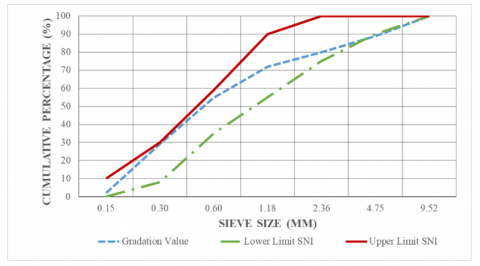
Gradation analysis of fine aggregate is conducted by determining the percentage of aggregate retained on the No. 4 sieve. Based on the test results, the fine aggregate falls within Zone II.
Figure 1 shows the results of the fine aggregate gradation analysis, indicating the percentage of aggregate particles and the defined gradation limits. Based on the gradation test, the fine aggregate meets the criteria with a fineness modulus (FM) value of 2.73, which complies with the SNI 7656:2012 standard range of 2.4 to 3.
Figure 1. Fine aggregate sieve analysis
3.2 Specific gravity and water absorption of the aggregate material
The examination of specific gravity and water absorption of the aggregate material was conducted to determine the values of apparent specific gravity, oven-dry bulk specific gravity, and saturated surface-dry (SSD) specific gravity, as well as to assess the water absorption capacity of the aggregate.
Table 1. Physical properties of coarse aggregate, fine aggregate, and petrified wood
|
Property |
Coarse Aggregate |
Fine Aggregate |
Petrified Wood |
|
Oven-dry bulk specific gravity (g/cm³) |
2.69 |
2.62 |
2.45 |
|
Saturated surface-dry (SSD) (g/cm³) |
2.72 |
2.64 |
2.52 |
|
Apparent specific gravity (g/cm³) |
2.76 |
2.69 |
2.62 |
|
Water absorption (%) |
0.91 |
0.70 |
2.64 |
From Table 1, it can be seen that the physical properties of petrified wood differ noticeably from those of conventional coarse and fine aggregates. The oven-dry bulk specific gravity of petrified wood was recorded at 2.45 g/cm³, which is lower than that of coarse aggregate (2.69 g/cm³) and fine aggregate (2.62 g/cm³). This trend is consistent across the saturated surface-dry (SSD) and apparent specific gravity values, indicating that petrified wood is generally lighter and less dense than natural stone materials. Additionally, the water absorption capacity of petrified wood was significantly higher, measured at 2.64%, compared to 0.91% for coarse aggregate and 0.70% for fine aggregate. This elevated absorption is likely due to the porous nature of the fossilized material, which results from mineral replacement over geological time while preserving the original wood structure.
The higher porosity and water absorption of petrified wood may affect the workability and water demand of concrete mixtures, potentially requiring adjustments in the mix design. However, its lower density could contribute to producing lighter concrete, which may be beneficial in certain structural or non-structural applications. These findings suggest that while petrified wood exhibits suitable physical characteristics as a coarse aggregate substitute, its highwater absorption must be carefully considered to ensure mix consistency and achieve the desired performance.
3.3 Bulk density test of aggregate
The bulk density test was conducted to determine the mass of aggregate per unit volume, which reflects its compactness and packing efficiency in a concrete mix. In this test, both loose and compacted conditions were evaluated to compare how particle arrangement affects the overall density. The loose bulk density was measured by allowing the aggregate to fall freely into a container without any compaction, while the compacted bulk density was obtained by rodding or tamping the aggregate in layers to simulate field compaction.
Table 2 displays the bulk density values for the three aggregate types—fine aggregate, coarse aggregate, and petrified wood—under compacted and loose conditions. Fine aggregate had the highest compacted bulk density at 1.74 g/cm³, followed by coarse aggregate at 1.59 g/cm³, and petrified wood at 1.48 g/cm³. A similar pattern was observed in loose condition measurements, with values of 1.66 g/cm³, 1.42 g/cm³, and 1.29 g/cm³, respectively. These results indicate that petrified wood has the lowest bulk density among the tested materials, reflecting its lower specific gravity and porous internal structure. The reduced density can lead to a lighter overall concrete mix, which is advantageous for applications where reduced dead load is desired. However, the higher void content associated with lower density materials may require additional cement paste to maintain workability and strength, potentially influencing the cost and performance of the mix. The findings emphasize the importance of adjusting mix proportions when incorporating petrified wood as a coarse aggregate substitute. With proper mix design considerations, its use can support sustainable construction practices by reducing reliance on natural stone while still achieving acceptable mechanical properties.
Table 2. Physical bulk density of aggregates
|
Material |
Compacted Bulk Density (g/cm³) |
Loose Bulk Density (g/cm³) |
|
Fine Aggregate |
1.74 |
1.66 |
|
Coarse Aggregate |
1.59 |
1.42 |
|
Petrified Wood |
1.48 |
1.29 |
3.4 Moisture content test
The moisture content test was conducted to determine the percentage of water present in the aggregates when in a saturated surface-dry (SSD) condition. Table 3 presents the moisture content values for fine aggregate, coarse aggregate, and petrified wood when measured under saturated surface-dry (SSD) conditions. The results indicate that the fine aggregate had the highest moisture content at 4.84%, followed by coarse aggregate at 1.87%, and petrified wood at only 0.41%.
Table 3. Moisture content test results
|
Material |
Moisture Content (%) |
SNI |
|
Fine Aggregate |
4.84 |
< 5% |
|
Coarse Aggregate |
1.87 |
< 2% |
|
Petrified Wood |
0.41 |
< 2% |
These values are well within acceptable ranges for concrete production, with fine aggregate remaining below the general 5% threshold and both coarse aggregate and petrified wood staying under the 2% limit. The relatively low moisture content of petrified wood suggests a limited capacity to retain surface water, despite its high internal water absorption rate recorded in earlier tests. This contrast may be attributed to the porous internal structure of the petrified wood, which readily absorbs water internally but does not retain as much free water on its surface. Understanding moisture content is critical in concrete mix design, as excess surface moisture in aggregates can alter the effective water-to-cement (w/c) ratio, leading to reduced strength and workability inconsistencies. Therefore, accurately accounting for these moisture values ensures the proper adjustment of mixing water, particularly when incorporating alternative materials like petrified wood. These findings support the controlled use of petrified wood as a coarse aggregate substitute while maintaining concrete performance and consistency.
3.5 Fine particles (silt) content test
The fine particles (silt) content test is conducted to determine the amount of silt present in the aggregate material. This test involves sieving the aggregates and measuring the portion that passes through the No. 200 sieve (0.075 mm). Table 4 presents the silt content results for fine aggregate, coarse aggregate, and petrified wood, determined by measuring the percentage of particles passing through the No. 200 sieve (0.075 mm). The test results showed that fine aggregate had a silt content of 1.94%, while coarse aggregate and petrified wood recorded lower values of 0.45% and 0.36%, respectively.
Table 4. Fine particles (silt) content test results
|
Material |
Moisture Content (%) |
SNI Standard |
|
Fine Aggregate |
1.94 |
< 5% |
|
Coarse Aggregate |
0.45 |
< 1% |
|
Petrified Wood |
0.36 |
< 1% |
According to most concrete standards, the acceptable maximum silt content is typically 5% for fine aggregates and 1% for coarse aggregates. The results confirm that all three materials fall well within these limits, indicating their suitability for use in concrete production. Notably, the petrified wood aggregate had the lowest silt content among the tested materials, which may contribute positively to the overall cleanliness and bonding efficiency in the concrete mix. Excessive silt in aggregate can interfere with the bond between cement paste and aggregate particles, weakening the hardened concrete. Therefore, the low silt content found in petrified wood supports its potential as a reliable alternative to natural coarse aggregate. These findings reinforce the feasibility of incorporating petrified wood into structural concrete applications without compromising durability or strength due to fine contaminants.
3.6 Abrasion test
The abrasion test for coarse aggregate was conducted using the Los Angeles abrasion machine, following the procedures outlined in applicable standard specifications.
Table 5. Fine particles (silt) content test results
|
Material |
Aggregate Abrasion (%) |
SNI |
|
Coarse Aggregate |
18.13 |
< 40% |
|
Petrified Wood |
18.96 |
< 40% |
Based on Table 5, the abrasion value for coarse aggregate was 18.13%, while the petrified wood aggregate recorded a slightly higher value of 18.96%. Both results fall well below the maximum allowable limit of 40% as specified in standard guidelines. Therefore, the tested samples of coarse aggregate and petrified wood meet the required criteria for use in concrete production in terms of durability and resistance to abrasion.
3.7 Slump test results
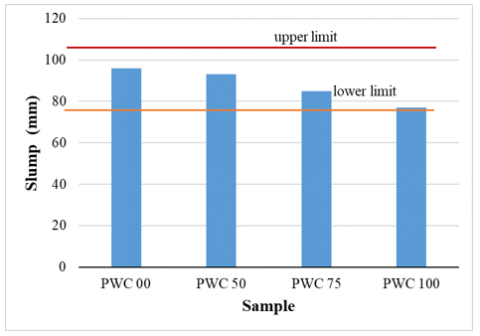
The slump test is conducted to evaluate the workability, consistency, and water content of the fresh concrete mix in accordance with established standards. The slump value also provides an indication of the expected strength and quality of the concrete. Based on the results presented in Table 6, the slump test shows a decreasing trend in slump values as the proportion of petrified wood increases.
This section analyzes and discusses the test outcomes obtained during field testing. As presented in Table 6 and Figure 1, the slump test results demonstrate that the use of petrified wood as a partial and full substitute for coarse aggregate in concrete mixtures affects workability.
Table 6. Slump test results
|
ID |
Slump Value (mm) |
SNI Standard Range (mm) |
|
PWC 00 |
96 |
75 – 100 |
|
PWC 50 |
93 |
75 – 100 |
|
PWC 75 |
85 |
75 – 100 |
|
PWC 100 |
77 |
75 – 100 |
The graphical representation of slump test results is shown in Figure 2 below:
Figure 2. Slump test results
The slump value for the control mix (0% substitution) was measured at 9.6 cm. When 50% of the coarse aggregate was replaced with petrified wood, the slump decreased to 9.3 cm, representing a 3.23% reduction. A 75% replacement yielded a slump value of 8.5 cm (a 9.41% decrease), while 100% substitution resulted in a slump of 7.7 cm, reflecting a total reduction of 10.49% compared to the control. The declining slump values indicate that higher proportions of petrified wood reduce the workability of the concrete mix. This reduction is likely due to the smoother and less angular surface texture of petrified wood particles, which alters the internal friction and reduces the cohesiveness of the mixture. Nevertheless, all slump values remain within the acceptable range for structural concrete applications (75–100 mm), suggesting that petrified wood, despite slightly decreasing slump, can be used without compromising the minimum workability standards required for proper placement and compaction.
3.8 Compressive strength test results
The compressive strength test was conducted using a Compression Testing Machine on cylindrical concrete specimens measuring 15 cm × 30 cm. A total of 12 samples were used for this test, with three specimens for each mixture variation consisting of 0%, 50%, 75%, and 100% petrified wood as coarse aggregate replacement. The testing was performed after the concrete had undergone a 28-day curing process through water immersion and maintenance.
Table 7. Compressive strength test results of concrete
|
ID |
Compressive Strength (MPa) |
|
PWC 00 |
28.40 |
|
PWC 50 |
23.40 |
|
PWC 75 |
22.93 |
|
PWC 100 |
19.34 |
Figure 3. Compressive strength
Table 7 and Figure 3 presents the results of the compressive strength tests conducted after 28 days of curing. The normal concrete (PWC 00), with no petrified wood substitution, recorded the highest compressive strength at 28.40 MPa. When 50% of the coarse aggregate was replaced with petrified wood (PWC 50), the strength decreased to 23.40 MPa, indicating a 17.61% reduction. At a 75% replacement level (PWC 75), the compressive strength slightly declined to 22.93 MPa, representing a 19.27% reduction. The lowest strength was observed at 100% substitution (PWC 100), which reached 19.34 MPa, showing a significant 31.90% decrease compared to normal concrete. The gradual decline in compressive strength can be attributed to the physical characteristics of petrified wood, including its lower density and higher porosity compared to natural coarse aggregate. These properties may lead to increased water absorption, which alters the effective water-to-cement (w/c) ratio and potentially weakens the concrete matrix. Additionally, the smooth surface texture of petrified wood may reduce the mechanical bond between the aggregate and cement paste, thus contributing to the decrease in strength. Despite this reduction, all concrete mixtures, including the one with 100% petrified wood substitution, still satisfy the minimum compressive strength requirement of 19 MPa for K-225 concrete, based on relevant national standards. This finding suggests that petrified wood is a viable alternative coarse aggregate, particularly for lightweight or non-structural applications, as long as proper mix design and proportion adjustments are implemented to maintain performance.
4.1 Conclusions
Based on the experimental investigation conducted on the substitution of coarse aggregate with petrified wood in K-225 grade concrete, the following conclusions can be drawn:
4.2 Recommendation
Although full substitution (100%) of coarse aggregate with petrified wood is feasible for non-structural applications, partial replacement levels (up to 50%) are recommended for maintaining better mechanical performance while still achieving environmental benefits. Future research should focus on optimizing mix design, incorporating chemical admixtures, and investigating long-term durability aspects of petrified wood concrete under various environmental conditions.
[1] Neville, A.M. (2011). Properties of Concrete (5th ed.). Pearson Education Limited. https://www.scirp.org/reference/referencespapers?referenceid=1855282.
[2] Mindess, S., Young, J.F., Darwin, D. (2003). Concrete (2nd ed.). Pearson Education. https://www.rexresearch1.com/ConcreteCementLibrary/ConcreteMindess.pdf.
[3] Dewi, S.H., Mildawati, R., Perdana, T. (2019). The benefits of adding corn stalk ash as a substitution of some cement against of compressive strength concrete. Journal of Geoscience, Engineering, Environment, and Technology, 4(3): 208-216. https://doi.org/10.25299/jgeet.2019.4.3.2966
[4] Choudhary, S., Gupta, R., Jain, A., Chaudhary, S. (2021). Experimental investigation of rubberized functionally graded concrete. Revue des Composites et des Matériaux Avancés-Journal of Composite and Advanced Materials, 31(1): 1-11. https://doi.org/10.18280/rcma.310101
[5] Harmiyati, H., Dewi, S.H., Junaid, J. (2021). The effect of tire ash to the compressive strength of concrete. IOP Conference Series: Earth and Environmental Science, 737(1): 012045. https://iopscience.iop.org/article/10.1088/1755-1315/737/1/012045/pdf.
[6] Subandi, Yatnikasari, S., Damaiyanti, M., Azzahra, R., Vebrian. (2019). Effect of additional fiberglass fiber on concrete performance. Annales de Chimie - Science des Matériaux, 43(5): 287-292. https://doi.org/10.18280/acsm.430502
[7] Zulkarnain, F., Ichwan, M.T., Siregar, Z., Muthusamy, K. (2025). The use of coconut shell fragments and Sikament-NN as a variation of concrete mix composition on the compressive strength of concrete. Journal of Physics: Conference Series, 2989: 012019. https://doi.org/10.1088/1742-6596/2989/1/012019
[8] Xie, W., Yuan, D.K., Li, S.S. (2012). Influence of aggregate gradation of coarse aggregates on concrete strength. Applied Mechanics and Materials 238: 147-149. http://doi.org/10.4028/www.scientific.net/AMM.238.147
[9] Pardo, K.J., Cereno, F.A., Cereno, V.J., Malaluan, M.L., Villafuerte, N. (2024). Abrasion resistance of coarse aggregate and compressive strength of concrete in Camarines Norte. Journal of Engineering and Emerging Technologies, 3(1): 16-26. http://doi.org/10.52631/jeet.v3i1.281
[10] Nirupama, G., Ganta, J.K. (2024). An experimental study on strength characteristics concrete by partial replacement of coarse aggregate with Bethamcherala waste stone. International Research Journal on Advanced Engineering Hub (IRJAEH), 2(5): 1193-1199. https://doi.org/10.47392/IRJAEH.2024.0164
[11] SujanKhadka, Mishra, A.K., BinodAryal. (2022). Analysis of coarse aggregate sources effects on compressive strength of cement concrete. Efflatounia, 5(2): 2988-3000. https://doi.org/10.5281/zenodo.6538105
[12] Petrified wood. https://www.britannica.com/science/petrified-wood.
[13] Parvin, R., Ahmed, M.T., Nahid, N., Abdul Jalil, M.A., Babar, S.A. (2024). Effects of size of coarse aggregates on the compressive strength of concrete. International Journal for Multidisciplinary Research, 6(4). https://doi.org/10.36948/ijfmr.2024.v06i04.23070
[14] Lukas, A.Y., Rafael, J.W., Making, M.Y., Wuwur, D.A. (2025). Investigation of the compressive strength of coral aggregate concrete using coralline limestone as coarse aggregate. Jurnal Pensil: Pendidikan Teknik Sipil, 14(2): 237-255. http://doi.org/10.21009/jpensil.v14i2.54385
[15] Salain, I.M.A.K. (2021). Effect of water/cement and aggregate/cement ratios on consistency and compressive strength of concrete using volcanic stone waste as aggregates. Civil Engineering and Architecture, 9(6): 1900-1908. http://doi.org/10.13189/cea.2021.090621
[16] Mildawati, R. (2023). Pengaruh pemanfaatan limbah abu fiber kelapa sawit terhadap kuat tekan beton mutu K-125. Jurnal TeKLA, 5(1): 1-7. https://doi.org/10.35314/tekla.v5i1.3070
[17] Mustoe, G.E. (2025). Mineralization of fossil wood with macrocrystalline quartz: A microscopic investigation. Minerals, 15(3): 225. https://doi.org/10.3390/min15030225
[18] Salama, A., Mustoe, G. (2023). Mineralogy of Oligocene fossil wood, bone and associated sediments from the Petrified Forest protected area, New Cairo, Egypt. Lethaia, 56(3): 1-15. https://doi.org/10.18261/let.56.3.6
[19] Nowak, J., Florek, M., Kwiatek, W., Lekki, J., et al. (2005). Composite structure of wood cells in petrified wood. Materials Science and Engineering: C, 25(2): 119-130. https://doi.org/10.1016/j.msec.2005.01.018
[20] Harbowo, D.G., Aswan, Zaim, Y., Chaerun, S.K., Chaerun, R.I., Astuti, W., Sato, T. (2024). Microanalytical approaches on the silicification process of wood fossil from Jasinga, West Java, Indonesia, Scientific Reports, 14(1): 19101. https://doi.org/10.1038/s41598-024-69681-0
[21] BSN. (2012). SNI 7656:2012. Persyaratan Beton Struktural Untuk Bangunan Gedung. Jakarta: Badan Standarisasi Nasional. https://www.scribd.com/presentation/413606337/SNI-7656-Rancangan-Beton.
[22] BSN. (2011). SNI 1974:2011. Cara Uji Kuat Tekan Beton Dengan Benda Uji Silinder. Jakarta: Badan Standarisasi Nasional. https://binamarga.pu.go.id/index.php/nspk/detail/sni-19742011-tentang-cara-uji-kuat-tekan-beton-dengan-benda-uji-silinder.