
Syarif Hidayatullah* | Muchamad Bachtiar | Marsetio | Agus Adriyanto | Priyanto Suharto
© 2026 The authors. This article is published by IIETA and is licensed under the CC BY 4.0 license (http://creativecommons.org/licenses/by/4.0/).
OPEN ACCESS
Large-scale coastal-protection interventions, such as sea walls, polders, land reclamation and integrated flood-protection programmes, are intrinsically multi-actor, yet whether collaborative governance improves their effectiveness remains contested. A Scopus-based review, reported following PRISMA 2020, and a case-survey meta-analysis were conducted on 23 studies (2012–2026) retained from 226 screened records under a protection-focused scope rule. Governance intensity (GI) and effectiveness were coded ordinally (0–3) under a large-language-model-assisted protocol with verification by the first author, and their association was estimated as a Spearman correlation with bias-corrected and accelerated (BCa) bootstrap confidence intervals and permutation p-values. The pooled association was positive but not statistically significant (r = +0.39, 95% BCa CI [−0.19, +0.74], permutation p = .076), so the hypothesised positive association (H1) was not supported, and the estimate depended on individual cases. GI was severely range-restricted (15 of 23 cases at GI = 2, one at GI = 3, none at GI = 0), which attenuates the correlation and renders subgroup contrasts uninformative; the apparent planning-phase and legitimacy associations are therefore reported descriptively only. Effectiveness coding showed moderate run-to-run reliability (weighted κ = 0.59), and certainty of evidence was rated very low. The published case evidence does not establish that collaborative governance strengthens coastal-protection effectiveness; it identifies the conditions a confirmatory synthesis requires, with implications for coastal megaprojects such as the Jakarta Giant Sea Wall.
collaborative governance, coastal protection, flood resilience, megaproject governance, case-survey meta-analysis, range restriction
Low-lying coastal cities have become the front line of climate adaptation. Rising seas, land subsidence and intensifying tidal flooding now threaten dense concentrations of population, ports and critical infrastructure, and the dominant policy response has been the construction of large-scale coastal-protection interventions: giant sea walls, integrated polders, storm-surge barriers and reclamation-cum-protection schemes. These interventions are not merely engineering artefacts; they are multi-year, multi-billion undertakings that mobilise national and subnational governments, state enterprises, private financiers, donors and coastal communities, and are increasingly framed as instruments of territorial resilience rather than as isolated defences [1, 2].
Jakarta Bay is a paradigmatic case. Subsidence of 7–10 cm per year in North Jakarta far outpaces the global sea-level rise of 3–4 mm per year, exposing the country's most economically strategic coastline to systemic risk and prompting the Giant Sea Wall (National Capital Integrated Coastal Development) programme. Because such programmes span planning, construction and operation phases and cross jurisdictional and sectoral boundaries, their success is widely presumed to hinge not only on hydraulic design but on how the many actors involved are governed.
A substantial public-administration literature offers grounds for that presumption. Collaborative-governance scholarship argues that structured, multi-actor arrangements improve the quality, coordination and legitimacy of environmental decisions, and identifies design features (power delegation, institutional formalisation, communication intensity and facilitative leadership) that condition their effects [3-6]. Related work on network and polycentric governance suggests that distributing authority across coordinated units can enhance adaptive capacity in complex, cross-scale systems [7].
Yet a countervailing literature counsels caution. Megaproject scholarship documents that large projects fail systematically through optimism bias, governance fragmentation and commitment escalation, and that favourable outcomes depend on control and assurance mechanisms (stage-gating, independent review, accountability) rather than on collaboration per se [8, 9]. Whether, and under what conditions, collaboration actually strengthens the performance and resilience outcomes of coastal megaprojects therefore remains an open empirical question.
Recent syntheses show that the question remains unresolved. A review of 650 empirical coastal-adaptation studies found little research on the implementation phase and weak contextualisation within coastal-governance arrangements [10]; a systematic review of 60 cases of collaborative marine and coastal governance found power still concentrated in the state and called for standardised outcome evaluation [11]; and reviews of participation and co-production found outcomes dominated by knowledge generation and power often reproduced rather than redistributed [12, 13]. Empirical studies of United States coastal regions report that the link between collaboration and resilience policy is more complex than presumed and that collaboration is driven by a core of high-capacity actors [14, 15], while Indonesian evidence from Jakarta, Semarang and Demak identifies fragmented institutions, inconsistent facilitation and a national emphasis on mega-infrastructure as barriers [16, 17]. None of these studies aggregates case evidence to estimate the direction and strength of the association between collaborative-governance intensity (GI) and protection effectiveness, so the gap persists in the 2022–2026 evidence.
The evidence needed to answer the question is fragmented. Primary findings are dispersed across single-case studies, after-action reports and single-country investigations, and no meta-analytic synthesis has integrated them to estimate the magnitude of the governance–effectiveness relationship, the conditions that moderate it, or the mechanisms through which it operates. Because this literature is dominated by qualitative case studies, conventional effect-size pooling is infeasible; a case-survey meta-analysis was therefore adopted, which codes qualitative case evidence into ordinal variables suitable for quantitative synthesis [18, 19]. Two research questions were addressed: (RQ1) how strongly, and in what direction, is collaborative-GI associated with coastal-protection effectiveness? and (RQ2) do project phase, outcome family and national context moderate that association? Because the evidence base proved small and range-restricted, the article also examines what the available case evidence can and cannot support. The remainder of the article develops a theoretical framework and hypotheses, describes the review and synthesis methods, reports the pooled and moderator results together with their limitations, and discusses their implications for coastal megaproject governance.
2.1 Collaborative governance regimes
The collaborative-governance regime (CGR) framework theorises collaborative performance as emerging from three interacting components: principled engagement (the deliberative processes through which actors define problems and options), shared motivation (trust, mutual understanding and legitimacy), and the capacity for joint action (institutional arrangements, resources and leadership) [4]. Building on Ansell and Gash's contingency model, this tradition holds that collaboration is neither uniformly effective nor uniformly futile; its outcomes depend on starting conditions, institutional design and facilitative leadership [3]. For synthesis purposes, these ideas translate into codable dimensions of a governance-intensity construct: the degree of power-sharing, the formalisation of joint bodies, the intensity of communication, and the presence of dedicated facilitation [20].
2.2 Network and polycentric governance
Complementary literatures specify how multi-actor governance is structured. Provan and Kenis distinguish modes of network governance (shared, lead-organisation and network-administrative-organisation), each with distinct effectiveness conditions, implying that the mere presence of collaboration matters less than its structural form [5]. Polycentric-governance theory further argues that multiple, semi-autonomous decision centres operating under overarching rules can improve responsiveness and adaptive capacity in complex resource systems [7]. These perspectives caution that GI and governance effectiveness are analytically distinct, and that dense collaborative structures can, under some conditions, ossify rather than adapt [21, 22].
2.3 Megaproject governance and the life-cycle condition
Megaproject theory supplies the moderating logic. Because large infrastructure projects are prone to optimism bias and escalation, their governance needs vary across the life-cycle. Upstream, collaboration shapes problem framing, option generation and social licence; downstream, delivery depends on control mechanisms (stage-gating, independent assurance and contractual accountability) [8, 9]. This implies that the governance–effectiveness relationship is phase-contingent, and that collaboration and control are complements distributed across planning, construction and operation rather than substitutes [23].
2.4 Socio-ecological resilience as a multidimensional outcome
Resilience theory frames the outcome side. Territorial resilience is not the physical integrity of a barrier but a multidimensional capacity to resist, absorb, adapt and transform [1, 2]. This matters for synthesis because governance may relate differently to ‘hard’ resilience outcomes, which are capital- and capacity-intensive, than to process outcomes such as coordination quality and legitimacy that collaboration more directly produces [24].
2.5 Hypotheses
Integrating these lenses yields four directional hypotheses. First, because collaboration improves coordination, information-sharing and legitimacy, a positive overall association between GI and effectiveness is expected (H1). Second, because collaboration most directly produces shared understanding and acceptance, whereas hard resilience additionally requires material capacity, the association is expected to be stronger for legitimacy/process outcomes than for resilience (H2). Third, following the life-cycle logic of megaproject governance, the association is expected to concentrate in the planning/design phase and to weaken at operation (H3). Fourth, given institutional voids in lower-income settings, a larger marginal association in Global-South contexts is tentatively expected and treated as exploratory (H4).
2.6 Conceptual framework
The framework thus positions collaborative-GI as the exposure, coastal-protection effectiveness (performance, resilience, legitimacy) as the outcome, and project phase, outcome family and national context as moderators, with control mechanisms and adaptive capacity as theorised, though not directly pooled, mediators. This structure guides both the coding scheme and the pre-specified subgroup analyses reported below.
3.1 Design and synthesis paradigm
A Scopus-based review was conducted and reported following the PRISMA 2020 items applicable to a single-database search [25], complemented by Meta-Analysis of Economics Research Network (MAER-NET) and meta-analysis of observational studies in epidemiology (MOOSE) reporting conventions for meta-analysis and observational syntheses, and grading of recommendations, assessment, development and evaluations (GRADE) and GRADE-CERQual were used to appraise certainty. Because only one bibliographic database was searched and grey literature was not searched, the review does not meet the multi-database standard of a full systematic review and is described throughout as a Scopus-based review. The primary synthesis followed the case-survey meta-analytic tradition, which codes qualitative case evidence into ordinal variables for quantitative pooling [18, 19]. A prespecified decision tree governed route selection: conventional meta-analysis required at least fifteen studies reporting extractable effect sizes with adequate moderator-cell coverage, whereas case-survey meta-analysis required at least fifteen combined quantitative-plus-codable studies. Because studies reporting directly extractable effect sizes numbered approximately one, whereas codable studies numbered twenty-three, the case-survey route was activated.
3.2 Search strategy
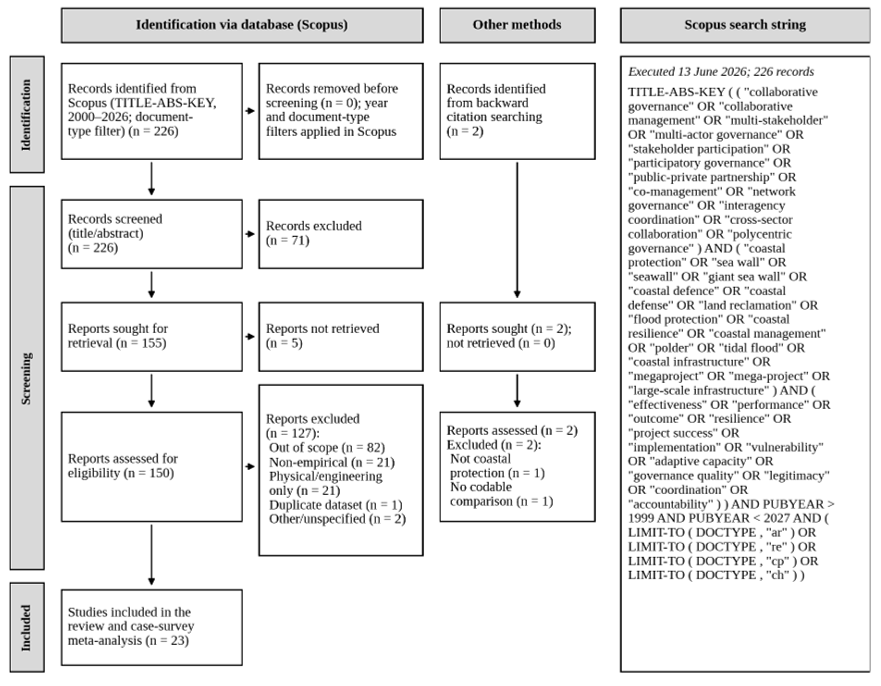
A single bibliographic database, Scopus, was searched on 13 June 2026, querying titles, abstracts and keywords (TITLE-ABS-KEY). The Boolean search combined three concept blocks, joined by AND: collaborative-governance terms, coastal-protection terms and effectiveness terms, restricted to 2000–2026 and to articles, reviews, conference papers and book chapters, with no language limit. The verbatim string is reproduced in Figure 1, and the export file is provided in Supplementary File S1. Web of Science was not available through the authors’ institutional subscription, and no grey-literature sources were searched. Supplementary backward citation searching of the included studies identified two further records, both of which were excluded at full text (Figure 1). Retrieval is therefore bounded by Scopus coverage, which is a principal limitation of the review (Section 5.6).
Figure 1. PRISMA 2020 flow diagram of the Scopus-based review, including records identified by citation searching and the verbatim Scopus search string
3.3 Study selection
After the publication-year and document-type filters were applied within Scopus, the search returned 226 records. Of these, 71 were excluded at title and abstract and 155 were sought for retrieval; five could not be obtained (paywalled conference papers and one non-English article). Of 150 reports assessed in full text, 127 were excluded with reasons: the governance object fell outside the protection-focused scope (e.g., fisheries, marine protected areas, blue economy or transport; n = 82), the work was non-empirical (n = 21), or it was purely physical or engineering in nature (n = 21), with one duplicate dataset (n = 1) and two other/unspecified (n = 2). Twenty-three studies were included (Figure 1). The roles of the language model and of the human reviewer at each stage are specified in Section 3.6.
3.4 Eligibility criteria and scope rule
Applying a population, intervention, comparator, outcome, study design (PICOS) framework (Table 1), empirical studies were included whose primary focus was collaborative or multi-actor governance in coastal flood or storm-surge protection, land reclamation and defence, or protection-oriented integrated coastal management, and which reported at least one measurable or codable effectiveness outcome (project performance, territorial resilience, or coordination/legitimacy). To resolve boundary ambiguity, an explicit protection-focused scope rule excluded governance whose primary object was fisheries or marine-resource harvest, pollution or water quality, biodiversity conservation, blue-economy or tourism development, urban-waterfront regeneration, inland, forest or agricultural systems, or transport infrastructure; borderline studies were included only where a protection or resilience outcome was separately reported or codable. On re-examination for this revision, four included studies (S1, S7, S18 and S20; see Section 4.1) were found to concern riverine or inland flood protection, which the scope rule lists as out of scope. To preserve the locked dataset they were retained in the primary analysis, and their influence is examined in a sensitivity analysis (Section 4.4).
Table 1. Eligibility criteria (population, intervention, comparator, outcome, study design (PICOS) framework)
|
Element |
Specification |
|
P |
Coastal flood/storm-surge protection, land reclamation and defence, or protection-oriented integrated coastal management (multi-year, multi-actor programmes) |
|
I |
Collaborative/multi-actor governance mechanisms: co-management, public-private partnership, multi-stakeholder boards, network or polycentric governance |
|
C |
Absence or low intensity of collaboration; top-down/hierarchical governance; cross-case variation in collaboration intensity |
|
O |
Project-delivery performance; territorial resilience/adaptive capacity; coordination quality and legitimacy/acceptance |
|
S |
Empirical designs: qualitative comparative or single-case (codable), mixed-methods, or quantitative |
3.5 Data extraction and coding
Each study's dominant case was coded on two ordinal constructs. GI ranged from top-down or absent collaboration (0), through consultative arrangements (1) and collaborative arrangements with shared decisions or a formal multi-stakeholder body (2), to delegated co-governance in which substantive authority was devolved to non-state actors (3). Effectiveness ranged from failure or negative outcome (0), through weak (1) and moderate (2), to strong positive achievement of stated objectives (3). Moderators comprised outcome family, national context and project phase. National context was re-verified study by study for this revision: the earlier label “ASEAN/Global South” was replaced by three categories (Global North, Global South and multi-country), because only one included study is located in an ASEAN country and two studies compare countries across both groups (Section 4.1). Risk of bias was appraised with reference to ROBINS-I domains adapted for observational governance evidence [26].
3.6 Role of the language model and human oversight
Large language model (LLM) assistance was used at three stages: title-and-abstract screening, full-text eligibility assessment, and ordinal coding of the included cases. Table 2 specifies, for each stage, the function performed by the model, the number of independent runs, the human checkpoint and the proportion of decisions decided by a human. All human verification was performed by a single reviewer, the first author; no second independent human screener or coder participated. Every reliability coefficient reported in this article (full-text eligibility κ = 0.685; GI weighted κ = 0.72; effectiveness weighted κ = 0.59) is an LLM run-to-run agreement statistic; no human–machine agreement coefficient was computed. The model family was recorded only for the adjudication and audit passes (Claude Opus); model versions, verbatim prompts and decoding settings were not retained, so the decisions are auditable record by record (Supplementary Files S2, S3 and S5) but not exactly re-executable.
Table 2. Role of the language model and human checkpoints at each stage
|
Stage |
LLM Function |
Runs |
Human Checkpoint |
Human Verification |
|
Title/abstract screening (226) |
Include/maybe/exclude with criterion-mapped rationale |
1 |
First author reviewed model decisions |
Single-reviewer check |
|
Full-text eligibility (145 aligned) |
Two differently framed runs; third pass on 37 disagreements; audit of 39 agreed inclusions |
2 + 2 |
First author decided 37 disagreements and 24 audit flags |
61 of 145 (42%) |
|
Coding (23 studies) |
Two passes coding GI, OUT, moderators |
2 + 1 |
First author ratified 9 adjudicated cases |
9 of 23 (39%) |
Three validity risks follow. First, run-to-run agreement measures consistency, not accuracy: runs of the same model family can share systematic errors that κ cannot detect, and LLM agreement in review tasks can be inflated by chance agreement and class imbalance [27]. Second, GI and effectiveness were coded in the same pass from the same text, permitting halo or common-source dependence; the two codes were identical in 15 of 23 cases (65%) and in 12 of 14 planning-phase cases (86%). Third, the loss of prompts and settings limits reproducibility. The “independent blind reassessment” reported in the earlier version is therefore withdrawn, because it was a further LLM pass rather than human coding, and the strength of all conclusions is downgraded accordingly.
3.7 Statistical analysis
The association between GI and effectiveness was estimated as a Spearman rank correlation pooled across cases. Because Fisher-z intervals approximate rank correlations poorly in small, tied samples [28], 95% confidence intervals were obtained by the bias-corrected and accelerated (BCa) bootstrap (10,000 resamples) [29] and two-sided p-values by permutation (20,000 permutations). Pre-specified subgroup analyses examined outcome family, region and project phase; cells with fewer than five studies, zero variance or a degenerate estimate (|r| = 1 from identical codes) were reported descriptively, and subgroup differences were tested by label permutation as exploratory analyses. Range restriction in GI was assessed from its distribution and number of distinct values; because the unrestricted variance of GI is unknown, no correction was applied [30]. Robustness was assessed through leave-one-out influence diagnostics and two sensitivity analyses (exclusion of the single GI = 3 case and of the four riverine or inland studies). Because single-case data lack within-study standard errors, a conventional funnel/Egger test is not defined and was not attempted. Certainty of evidence was rated per outcome family using GRADE. Analyses were run in Python (SciPy) with a fixed seed; the script is supplied with the supplementary materials.
4.1 Characteristics of included studies
The 23 included studies, published between 2012 and 2026, comprised 17 Global-North, 4 Global-South (Bangladesh, Belize, China and Indonesia) and 2 multi-country cases; 14 addressed the planning or design phase and 9 the operation phase; and 12 concerned resilience outcomes, 7 legitimacy and 4 project performance (Table 3). GI was concentrated at a single value: 15 studies were coded GI = 2, 7 were coded GI = 1, one was coded GI = 3 (S22) and none GI = 0 (SD = 0.54). Effectiveness was similarly compressed (OUT = 1, n = 8; OUT = 2, n = 12; OUT = 3, n = 3; none at 0). The region codes of six studies were corrected relative to the earlier version (S3, S4, S5, S9, S16 and S19). Each row of Table 3 is mapped one-to-one to its full reference, and the 23 included studies appear as a contiguous, labelled block in the reference list.
Table 3. Characteristics and ordinal coding of the 23 included studies
|
No. |
Included Study [Ref.] |
Country/Setting |
Region |
Phase |
Outcome Family |
GI |
OUT |
|
S1 |
Ishiwatari and Tokuoka [31] |
Japan |
GN |
Operation |
Performance |
2 |
3 |
|
S2 |
Cornejo et al. [32] |
Canada |
GN |
Planning |
Legitimacy |
2 |
2 |
|
S3 |
Yu et al. [33] |
China |
GS |
Operation |
Resilience |
1 |
2 |
|
S4 |
Dong and Lin [34] |
NL, US, JP, ID |
MC |
Planning |
Resilience |
2 |
2 |
|
S5 |
Swarnokar et al. [35] |
Bangladesh |
GS |
Operation |
Resilience |
1 |
1 |
|
S6 |
Avoyan et al. [36] |
Netherlands |
GN |
Planning |
Performance |
2 |
2 |
|
S7 |
Andráško et al. [37] |
Czech Republic |
GN |
Planning |
Legitimacy |
2 |
2 |
|
S8 |
Sweetman et al. [38] |
USA |
GN |
Planning |
Resilience |
2 |
2 |
|
S9 |
Rusadi et al. [39] |
Indonesia (ASEAN) |
GS |
Operation |
Legitimacy |
2 |
1 |
|
S10 |
Ismael et al. [40] |
USA |
GN |
Planning |
Resilience |
2 |
2 |
|
S11 |
Matos et al. [41] |
Portugal |
GN |
Planning |
Resilience |
2 |
2 |
|
S12 |
Hemmerling et al. [42] |
USA |
GN |
Planning |
Resilience |
2 |
3 |
|
S13 |
Eaton et al. [43] |
USA |
GN |
Planning |
Resilience |
2 |
2 |
|
S14 |
Walsh [44] |
Wadden Sea (DE, NL, DK) |
GN |
Planning |
Legitimacy |
1 |
1 |
|
S15 |
Ota [45] |
Japan |
GN |
Operation |
Legitimacy |
1 |
1 |
|
S16 |
Obraczka et al. [46] |
USA and Brazil |
MC |
Operation |
Performance |
2 |
2 |
|
S17 |
Lagzdiņa et al. [47] |
Latvia |
GN |
Planning |
Resilience |
2 |
2 |
|
S18 |
Fliervoet et al. [48] |
Netherlands |
GN |
Operation |
Performance |
2 |
1 |
|
S19 |
Verutes et al. [49] |
Belize |
GS |
Planning |
Resilience |
2 |
3 |
|
S20 |
Mees et al. [50] |
Belgium |
GN |
Planning |
Legitimacy |
1 |
1 |
|
S21 |
Kūle et al. [51] |
Latvia |
GN |
Operation |
Resilience |
1 |
2 |
|
S22 |
Mostert [52] |
Netherlands |
GN |
Operation |
Resilience |
3 |
1 |
|
S23 |
van der Plank [53] |
United Kingdom |
GN |
Planning |
Legitimacy |
1 |
1 |
4.2 Primary synthesis
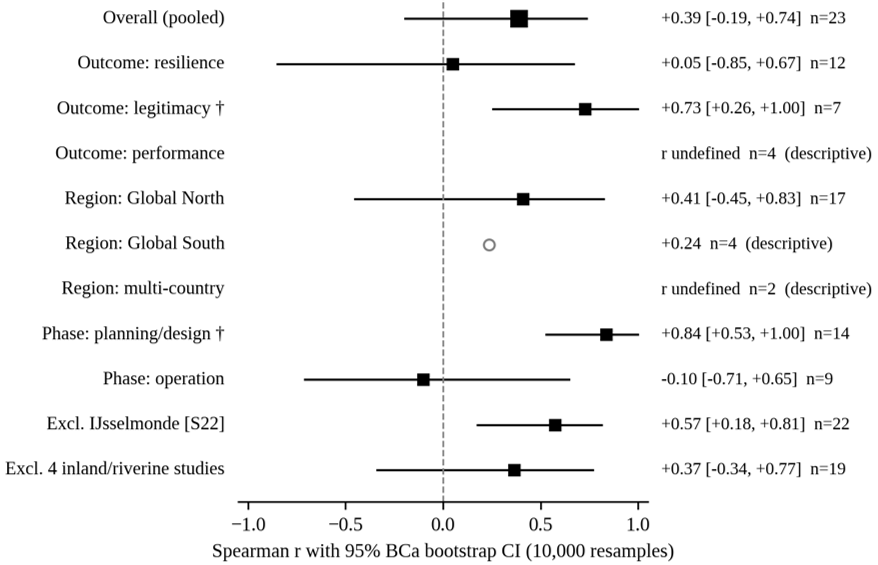
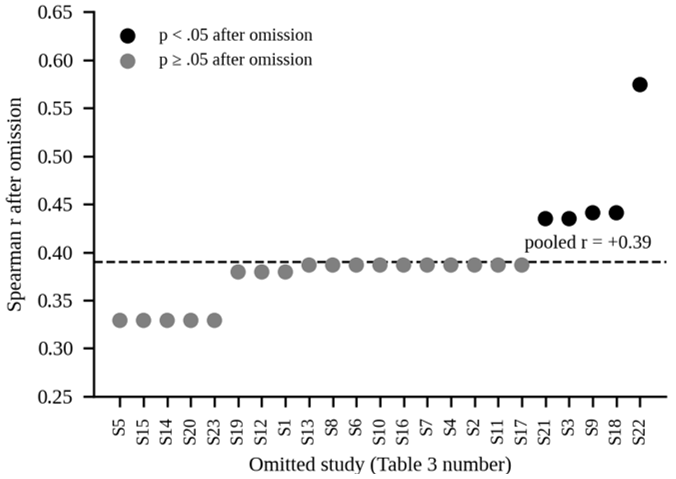
Across the 23 cases, GI was positively but not statistically significantly associated with effectiveness (Spearman r = +0.39, 95% BCa CI [−0.19, +0.74], permutation p = .076; asymptotic p = .066; Figure 2). H1 is therefore not supported. The estimate was also unstable: leave-one-out values ranged from +0.33 to +0.57, and five of the 23 single-study deletions moved the asymptotic p-value below .05 (Figure 3). The largest shift followed the removal of S22, the only case coded GI = 3, which combines the highest GI with weak effectiveness; without it, r = +0.57 (95% BCa CI [+0.18, +0.81], permutation p = .011). The direction of the pooled estimate is consistently positive, but its magnitude and significance depend on individual cases, and the earlier description of the estimate as stable is withdrawn.
Figure 3. Leave-one-out influence diagnostic: pooled Spearman r after omitting each study (labels follow Table 3; shading by asymptotic p)
4.3 Range restriction and moderator analyses
With 15 of 23 cases tied at GI = 2 and only three distinct values, rank correlations are attenuated toward zero relative to a sample spanning the full 0–3 range [30]. The restriction is more severe within subgroups (Table 4): the planning phase contains only two GI values; in the planning × resilience cell (n = 8) every case is coded GI = 2, so r is undefined; and in the planning × legitimacy cell (n = 5) GI and OUT are identical in every case, which forces r = +1.
Consequently, the planning-phase estimate (r = +0.84, 95% BCa CI [+0.53, +1.00]) and the operation-phase estimate (r = −0.10, [−0.71, +0.65]) do not provide an informative test of H3: the planning estimate is produced mainly by cases in which the two codes coincide (12 of 14), and the label-permutation test of the phase difference (p = .046) is reported as exploratory only. The contrast between legitimacy (r = +0.73, [+0.26, +1.00], n = 7) and resilience (r = +0.05, [−0.85, +0.67], n = 12) was not statistically distinguishable (label-permutation p = .23), so H2 is not supported. Performance outcomes (n = 4, all GI = 2), the Global-South subgroup (n = 4) and the multi-country subgroup (n = 2) fall below the N-checkpoint and are described only, so H4 could not be tested. The Global-North subgroup (n = 17) mirrored the pooled estimate (r = +0.41, [−0.45, +0.83], permutation p = .096).
Table 4. Pooled, subgroup and sensitivity associations (Spearman r, 95% BCa bootstrap CI, two-sided permutation p)
|
Analysis |
n |
r |
95% BCa CI |
p |
|
Overall |
23 |
+0.39 |
[−0.19, +0.74] |
.076 |
|
Outcome: performance ‡ |
4 |
— |
— |
— |
|
Outcome: resilience |
12 |
+0.05 |
[−0.85, +0.67] |
.743 |
|
Outcome: legitimacy † |
7 |
+0.73 |
[+0.26, +1.00] |
.141 |
|
Region: Global North |
17 |
+0.41 |
[−0.45, +0.83] |
.096 |
|
Region: Global South ‡ |
4 |
+0.24 |
— |
— |
|
Region: multi-country ‡ |
2 |
— |
— |
— |
|
Phase: planning/design † |
14 |
+0.84 |
[+0.53, +1.00] |
.003 |
|
Phase: operation |
9 |
−0.10 |
[−0.71, +0.65] |
.881 |
|
Excluding S22 (GI = 3) |
22 |
+0.57 |
[+0.18, +0.81] |
.011 |
|
Excluding S1, S7, S18, S20 |
19 |
+0.37 |
[−0.34, +0.77] |
.092 |
4.4 Influence and sensitivity analyses
Figure 3 shows the leave-one-out distribution. Excluding the four riverine or inland studies (S1, S7, S18 and S20) left the estimate essentially unchanged (r = +0.37, 95% BCa CI [−0.34, +0.77], permutation p = .092, n = 19), as did additionally excluding the blue-carbon-oriented Changdao case (S3; r = +0.42, permutation p = .087, n = 18). Because single-case data lack within-study standard errors, small-study and publication effects could not be assessed formally and are carried into the certainty appraisal; the resampling precision plot shown in the earlier version has been removed because it did not constitute a test of these effects.
4.5 Certainty of evidence
Certainty was rated very low for the overall estimate and for every outcome family (Table 5), reflecting methodological constraints, indirectness, imprecision and range restriction; the low ratings previously assigned to the legitimacy outcome and the planning-phase effect have been withdrawn.
Table 5. GRADE summary of findings (revised)
|
Outcome Family |
k |
r [95% BCa CI] |
Certainty |
Main Considerations |
|
Overall |
23 |
+0.39 [−0.19, +0.74] |
Very low |
MCN, IND, IMP, RR |
|
Performance |
4 |
Descriptive |
Very low |
IMP; GI constant |
|
Resilience |
12 |
+0.05 [−0.85, +0.67] |
Very low |
MCN, IMP, RR |
|
Legitimacy/process |
7 |
+0.73 [+0.26, +1.00] |
Very low |
MCN, IMP; degenerate cell |
|
Planning-phase effect |
14 |
Not rated |
— |
Uninformative (GI = OUT in 12/14) |
5.1 An inconclusive association under restricted range
The case evidence does not establish that collaborative governance strengthens coastal-protection effectiveness. The pooled association is positive in direction, consistent with the collaborative-governance literature [3, 4] and with recent coastal syntheses [11], but its interval includes zero, its significance depends on single cases, and it rests on a predictor that barely varies. The reviewed literature mostly compares collaborative with consultative arrangements; it contains no top-down comparators and one case of delegated co-governance, so it cannot show what happens across the full range of GI that the theory addresses. The null result is therefore better described as a failure of the evidence base to test the hypothesis than as evidence against it.
5.2 What the phase and outcome patterns can and cannot show
The earlier version interpreted a strong planning-stage association and a near-null operation-stage association as support for the life-cycle logic of megaproject governance [8, 9]. Under re-analysis this interpretation cannot be sustained: the planning estimate arises from cases in which governance and effectiveness received the same code, and the operation estimate is too imprecise to distinguish from zero. The same caution applies to the legitimacy–resilience contrast. Both patterns remain theoretically plausible, since collaboration is expected to act most directly on shared understanding and acceptance [3, 4], and fsQCA evidence from Dutch flood-protection collaboratives links output performance to connective leadership and resources rather than to collaboration as such [36]. They should, however, be treated as hypotheses generated by the synthesis, to be tested with designs that measure governance and outcomes independently.
5.3 The governance–resilience decoupling
The IJsselmonde case [52], characterised by dense polycentric governance yet by ‘petrification’ and slow adaptation, illustrates how elaborate collaborative structures can ossify, decoupling governance form from adaptive outcome, consistent with cautions in the polycentric-governance literature [5, 7]. Its statistical role reinforces this reading: as the only case of delegated co-governance, it is also the case that most depresses the pooled estimate (Section 4.2), so that a single historical case carries the upper end of the governance scale. Such cases direct attention to adaptive capacity and institutional flexibility as the mediators that convert collaborative intensity into resilience, and warn against equating the presence of collaboration with its effectiveness.
5.4 Theoretical integration and contribution
The study makes three bounded contributions. Empirically, it provides an aggregate estimate of the governance–effectiveness association for coastal-protection interventions and shows that the published case evidence cannot yet support a confident conclusion. Theoretically, it identifies range restriction in GI, rather than an absence of effect, as the main obstacle to testing collaborative-governance theory in this domain. Methodologically, it shows that run-to-run agreement does not validate LLM-assisted case-survey coding, that coding governance and outcomes in the same pass invites dependence, and that independent human coding is required before such syntheses can support inferential claims.
5.5 Implications for coastal megaproject governance
Analytically generalised to focal cases such as the Jakarta Giant Sea Wall, the evidence supports only cautious guidance. Front-loading collaborative arrangements into planning and design remains a reasonable design principle on theoretical grounds and is consistent with Indonesian evidence on the costs of fragmented facilitation [16, 17], but it is not demonstrated by the present synthesis. Pairing collaboration with explicit stage-gating and independent assurance during construction and operation, and investing in adaptive capacity, remain prudent hedges under this uncertainty. Because the evidence base is weighted toward Global-North settings and contains a single ASEAN case, the applicability of these prescriptions to Global-South institutional contexts should be established through context-specific investigation.
5.6 Limitations and directions for future research
The findings are bounded in five ways: retrieval was limited to Scopus without Web of Science, grey literature or forward citation searching; screening and coding relied on an LLM verified by a single human reviewer, so reliability coefficients reflect run-to-run consistency only; effectiveness coding was only moderately reliable (weighted κ = 0.59); GI is severely range-restricted; and four included studies concern riverine or inland flood protection. Future work should (i) extend retrieval to Web of Science, ProQuest and grey literature with forward and backward citation searching; (ii) recode the studies by at least two independent human coders blind to each other and to the LLM output, with governance and outcome coded in separate passes; (iii) disaggregate GI into sub-dimensions (power delegation, formalisation, communication and facilitative leadership) to recover variance; and (iv) seek primary comparative studies in ASEAN settings, including Jakarta, that report extractable effect sizes.
Synthesising 23 studies through a Scopus-based review and case-survey meta-analysis, this article finds a positive but statistically non-significant and unstable association between collaborative-GI and coastal-protection effectiveness (r = +0.39, 95% BCa CI [−0.19, +0.74]). H1 is not supported, and the apparent concentration of the association in the planning phase and in legitimacy outcomes cannot be distinguished from artefacts of a range-restricted predictor and moderately reliable outcome coding. The evidence therefore does not justify presenting collaboration as a demonstrated driver of protection effectiveness. Its value lies in identifying what a confirmatory synthesis requires: multi-database retrieval, independent human coding with governance and outcomes coded separately, and primary studies spanning the full range of GI. For coastal megaprojects such as the Jakarta Giant Sea Wall, the question of when and for what purpose to collaborate remains open, and collaboration should be treated as a reasonable but unproven investment to be evaluated prospectively.
This study is a secondary synthesis of previously published literature. It involved no human participants, no primary data collection and no identifiable personal data. Institutional ethics approval and informed consent were therefore not required.
LLM assistance was used for screening, eligibility assessment and provisional coding as specified in Section 3.6 and Table 2. The authors reviewed and verified all model output and take full responsibility for the content of this article.
Syarif Hidayatullah: conceptualisation, methodology, investigation, formal analysis, data curation, writing – original draft. Muchamad Bachtiar: methodology, validation, writing – review and editing. Marsetio: supervision, conceptualisation, writing – review and editing. Agus Adriyanto: supervision, validation, writing – review and editing. Priyanto Suharto: investigation, resources, writing – review and editing. All authors read and approved the final manuscript.
The authors declare that they have no known competing financial interests or personal relationships that could have appeared to influence the work reported in this article.
The coded dataset for the included studies, the search string with date and yield, the screening and reliability logs, and the re-analysis script are deposited in the Open Science Framework repository and are openly available at https://osf.io/2qn8p/. No restrictions apply.
The authors thank the Doctoral Program, Department of Defense Sciences, Defense University, Bogor, for institutional support, and the lecturers and colleagues who provided input and insight during the preparation of this article.
|
BCa |
bias-corrected and accelerated (bootstrap confidence interval) |
|
CGR |
collaborative governance regime |
|
CI |
confidence interval |
|
GI |
governance intensity, ordinal scale 0–3 |
|
GN |
Global North (region code) |
|
GRADE |
grading of recommendations, assessment, development and evaluations |
|
GS |
Global South (region code) |
|
IMP |
imprecision (GRADE domain) |
|
IND |
indirectness (GRADE domain) |
|
LLM |
large language model |
|
MAER-NET |
Meta-Analysis of Economics Research Network |
|
MC |
multi-country (region code) |
|
MCN |
methodological constraints (GRADE domain) |
|
MOOSE |
meta-analysis of observational studies in epidemiology |
|
n |
number of studies |
|
OUT |
coastal-protection effectiveness, ordinal scale 0–3 |
|
p |
probability value (permutation-based unless stated otherwise) |
|
PICOS |
population, intervention, comparator, outcome, study design |
|
PRISMA |
preferred reporting items for systematic reviews and meta-analyses |
|
r |
Spearman rank correlation coefficient |
|
RR |
range restriction (GRADE domain) |
|
S1–S23 |
identifiers of the 23 included studies |
|
SD |
standard deviation |
|
κ |
Cohen’s kappa |
|
κw |
quadratic-weighted Cohen’s kappa |
[1] Adger, W.N. (2000). Social and ecological resilience: Are they related? Progress in Human Geography, 24(3): 347-364. https://doi.org/10.1191/030913200701540465
[2] Folke, C., Biggs, R., Norström, A.V., Reyers, B., Rockström, J. (2016). Social-ecological resilience and biosphere-based sustainability science. Ecology and Society, 21(3): 41. https://doi.org/10.5751/ES-08748-210341
[3] Ansell, C., Gash, A. (2008). Collaborative governance in theory and practice. Journal of Public Administration Research and Theory, 18(4): 543-571. https://doi.org/10.1093/jopart/mum032
[4] Emerson, K., Nabatchi, T., Balogh, S. (2012). An integrative framework for collaborative governance. Journal of Public Administration Research and Theory, 22(1): 1-29. https://doi.org/10.1093/jopart/mur011
[5] Provan, K.G., Kenis, P. (2008). Modes of network governance: Structure, management, and effectiveness. Journal of Public Administration Research and Theory, 18(2): 229-252. https://doi.org/10.1093/jopart/mum015
[6] Bryson, J.M., Crosby, B.C., Stone, M.M. (2006). The design and implementation of cross-sector collaborations: Propositions from the literature. Public Administration Review, 66(s1): 44-55. https://doi.org/10.1111/j.1540-6210.2006.00665.x
[7] Ostrom, E. (2010). Beyond markets and states: Polycentric governance of complex economic systems. American Economic Review, 100(3): 641-672. https://doi.org/10.1257/aer.100.3.641
[8] Flyvbjerg, B. (2014). What you should know about megaprojects and why: An overview. Project Management Journal, 45(2): 6-19. https://doi.org/10.1002/pmj.21409
[9] Miller, R., Lessard, D.R., Michaud, P., Floricel, S. (2001). The Strategic Management of Large Engineering Projects: Shaping Institutions, Risks, and Governance. MIT Press. https://doi.org/10.7551/mitpress/6478.001.0001
[10] Cabana, D., Rölfer, L., Evadzi, P., Celliers, L. (2023). Enabling climate change adaptation in coastal systems: A systematic literature review. Earth's Future, 11(8): e2023EF003713. https://doi.org/10.1029/2023EF003713
[11] Asio, M.V.S., Cvitanovic, C., Lau, J., Diedrich, A. (2026). Collaborative governance in marine and coastal management: A systematic review. Ocean & Coastal Management, 272: 108020. https://doi.org/10.1016/j.ocecoaman.2025.108020
[12] Sartorius, J.V., Geddes, A., Gagnon, A.S., Burnett, K.A. (2024). Participation and co-production in climate adaptation: Scope and limits identified from a meta-method review of research with European coastal communities. Wiley Interdisciplinary Reviews: Climate Change, 15(3): e880. https://doi.org/10.1002/wcc.880
[13] Parsons, M., Godden, N.J., Henrique, K.P., et al. (2025). Participatory approaches to climate adaptation, resilience, and mitigation: A systematic review. Ambio, 54(12): 2005-2020. https://doi.org/10.1007/s13280-025-02202-z
[14] Meerow, S., Hannibal, B., Woodruff, S.C., Roy, M., Matos, M., Gilbertson, P.C. (2024). Urban flood resilience networks: Exploring the relationship between governance networks, networks of plans, and spatial flood resilience policies in four coastal cities. Annals of the American Association of Geographers, 114(8): 1866-1876. https://doi.org/10.1080/24694452.2023.2284299
[15] Vantaggiato, F., Lubell, M., Nowlin, M.C., Yusuf, J.E., Shafiee-Jood, M. (2026). Sea-level rise adaptation and collaboration in polycentric governance: A comparison of three regions. Public Administration Review. https://doi.org/10.1111/puar.70117
[16] Dwirahmadi, F., Barnes, P., Wibowo, A., Amri, A., Chu, C. (2023). Linking disaster risk reduction and climate change adaptation through collaborative governance: Experience from urban flooding in Jakarta. Geosciences, 13(11): 353. https://doi.org/10.3390/geosciences13110353
[17] Nurhidayah, L., Davies, P., Alam, S., Saintilan, N., Triyanti, A. (2022). Responding to sea level rise: Challenges and opportunities to govern coastal adaptation strategies in Indonesia. Maritime Studies, 21(3): 339-352. https://doi.org/10.1007/s40152-022-00274-1
[18] Larsson, R. (1993). Case survey methodology: Quantitative analysis of patterns across case studies. Academy of Management Journal, 36(6): 1515-1546. https://doi.org/10.2307/256820
[19] Newig, J., Challies, E., Jager, N.W., Kochskaemper, E., Adzersen, A. (2018). The environmental performance of participatory and collaborative governance: A framework of causal mechanisms. Policy Studies Journal, 46(2): 269-297. https://doi.org/10.1111/psj.12209
[20] Emerson, K., Nabatchi, T. (2015). Evaluating the productivity of collaborative governance regimes: A performance matrix. Public Performance & Management Review, 38(4): 717-747. https://doi.org/10.1080/15309576.2015.1031016
[21] Ostrom, E. (2009). A general framework for analyzing sustainability of social-ecological systems. Science, 325(5939): 419-422. https://doi.org/10.1126/science.1172133
[22] Bodin, Ö. (2017). Collaborative environmental governance: Achieving collective action in social-ecological systems. Science, 357(6352): eaan1114. https://doi.org/10.1126/science.aan1114
[23] Denicol, J., Davies, A., Krystallis, I. (2020). What are the causes and cures of poor megaproject performance? A systematic literature review and research agenda. Project Management Journal, 51(3): 328-345. https://doi.org/10.1177/8756972819896113
[24] Folke, C. (2006). Resilience: The emergence of a perspective for social–ecological systems analyses. Global Environmental Change, 16(3): 253-267. https://doi.org/10.1016/j.gloenvcha.2006.04.002
[25] Page, M.J., McKenzie, J.E., Bossuyt, P.M., et al. (2021). The PRISMA 2020 statement: An updated guideline for reporting systematic reviews. BMJ, 372: n71. https://doi.org/10.1136/bmj.n71
[26] Sterne, J.A., Hernán, M.A., Reeves, B.C., et al. (2016). ROBINS-I: A tool for assessing risk of bias in non-randomised studies of interventions. BMJ, 355: i4919. https://doi.org/10.1136/bmj.i4919
[27] Khraisha, Q., Put, S., Kappenberg, J., Warraitch, A., Hadfield, K. (2024). Can large language models replace humans in systematic reviews? Evaluating GPT-4's efficacy in screening and extracting data from peer-reviewed and grey literature in multiple languages. Research Synthesis Methods, 15(4): 616-626. https://doi.org/10.1002/jrsm.1715
[28] Bonett, D.G., Wright, T.A. (2000). Sample size requirements for estimating Pearson, Kendall and Spearman correlations. Psychometrika, 65(1): 23-28. https://doi.org/10.1007/BF02294183
[29] Efron, B. (1987). Better bootstrap confidence intervals. Journal of the American Statistical Association, 82(397): 171-185. https://doi.org/10.1080/01621459.1987.10478410
[30] Sackett, P.R., Yang, H. (2000). Correction for range restriction: An expanded typology. Journal of Applied Psychology, 85(1): 112-118. https://doi.org/10.1037/0021-9010.85.1.112
[31] Ishiwatari, M., Tokuoka, S. (2026). Transdisciplinary approaches to urban flood risk and green infrastructure: Lessons from Asahata Reservoir in Shizuoka, Japan. Journal of Disaster Research, 21(2): 399-406. https://doi.org/10.20965/jdr.2026.p0399
[32] Cornejo, L., Sherren, K., Lundholm, J., van Proosdij, D., Bennett, E.M. (2025). Using a causal conceptual model of managed dyke realignment as a boundary object promotes multi-stakeholder collaboration and co-production. Nature-Based Solutions, 8: 100253. https://doi.org/10.1016/j.nbsj.2025.100253
[33] Yu, H., Xing, Y., Zhang, H., Liu, Z., Hou, Y. (2025). Stratified community resilience and governance in a zero-carbon island: Evidence from Changdao, China. Journal of Sea Research, 208: 102645. https://doi.org/10.1016/j.seares.2025.102645
[34] Dong, W., Lin, G. (2025). Comparison of coastal resilience policies: A perspective on effective global governance strategies. E3S Web of Conferences, 617: 01019. https://doi.org/10.1051/e3sconf/202561701019
[35] Swarnokar, S.C., Mou, S.I., Sharmi, S.D., Iftikhar, A., Jesmin, S. (2025). Climate-induced risks, adaptation, and mitigation responses: A comparative study on climate-stressed coastal communities. Frontiers in Climate, 7: 1553579. https://doi.org/10.3389/fclim.2025.1553579
[36] Avoyan, E., Kaufmann, M., Lagendijk, A., Meijerink, S. (2024). Output performance of collaborative governance: Examining collaborative conditions for achieving output performance of the Dutch flood protection program. Public Performance & Management Review, 47(2): 291-322. https://doi.org/10.1080/15309576.2023.2301409
[37] Andráško, I., Duží, B., Martinát, S. (2024). A dam or a polder? Stakeholders’ dispute over the “right” flood-protection measure in the Czech Republic. Ambio, 53(10): 1505-1521. https://doi.org/10.1007/s13280-024-02022-7
[38] Sweetman, B.M., Dean, C., Auermuller, L., et al. (2024). User needs for coastal inundation at climate time scales: A multi-sectoral case study in the coproduction of knowledge. Journal of the American Water Resources Association, 60(6): 1162-1174. https://doi.org/10.1111/1752-1688.13230
[39] Rusadi, S., Mulyawan, R., Suwaryo, U., Yuningsih, N.Y. (2024). Implementing good environmental governance to manage coastal abrasion in Bengkalis regency, Indonesia. International Journal of Sustainable Development & Planning, 19(5): 1911-1919. https://doi.org/10.18280/ijsdp.190529
[40] Ismael, D., Hutton, N., Erten-Unal, M., et al. (2024). Community-centric approaches to coastal hazard assessment and management in Southside Norfolk, Virginia, USA. Atmosphere, 15(3): 372. https://doi.org/10.3390/atmos15030372
[41] Matos, F.A., Alves, F., Coelho, C., Lima, M., Vizinho, A. (2022). Participatory approach to build up a municipal strategy for coastal erosion mitigation and adaptation to climate change. Journal of Marine Science and Engineering, 10(11): 1718. https://doi.org/10.3390/jmse10111718
[42] Hemmerling, S.A., DeMyers, C.A., Carruthers, T.J. (2022). Building resilience through collaborative management of coastal protection and restoration planning in Plaquemines Parish, Louisiana, USA. Sustainability, 14(5): 2974. https://doi.org/10.3390/su14052974
[43] Eaton, M.J., Johnson, F.A., Mikels-Carrasco, J. (2021). Cape Romain Partnership for coastal protection. Open-File Report 2021-1021, U.S. Geological Survey, Reston, Virginia, USA. https://doi.org/10.3133/ofr20211021
[44] Walsh, C. (2019). Integration of expertise or collaborative practice?: Coastal management and climate adaptation at the Wadden Sea. Ocean & Coastal Management, 167: 78-86. https://doi.org/10.1016/j.ocecoaman.2018.10.004
[45] Ota, S. (2018). Key factors in handling conflicts in the Isahaya Bay land reclamation project, Japan: A case study focusing on social aspects. Irrigation and Drainage, 67(s1): 96-104. https://doi.org/10.1002/ird.2202
[46] Obraczka, M., Beyeler, M., Magrini, A., Legey, L.F. (2017). Analysis of coastal environmental management practices in subregions of California and Brazil. Journal of Coastal Research, 33(6): 1315-1332. https://doi.org/10.2112/JCOASTRES-D-15-00239.1
[47] Lagzdiņa, Ē., Kudreņickis, I., Ernšteins, R., Lontone, A. (2017). Municipal coastal governance towards rural community resilience development: Scenarios and tools. WIT Transactions on Ecology and the Environment, 226: 297-309. https://doi.org/10.2495/SDP170261
[48] Fliervoet, J.M., van den Born, R.J., Meijerink, S.V. (2017). A stakeholder’s evaluation of collaborative processes for maintaining multi-functional floodplains: A Dutch case study. International Journal of River Basin Management, 15(2): 175-186. https://doi.org/10.1080/15715124.2017.1295384
[49] Verutes, G.M., Arkema, K.K., Clarke-Samuels, C., et al. (2017). Integrated planning that safeguards ecosystems and balances multiple objectives in coastal Belize. International Journal of Biodiversity Science, Ecosystem Services & Management, 13(3): 1-17. https://doi.org/10.1080/21513732.2017.1345979
[50] Mees, H., Tempels, B., Crabbé, A., Boelens, L. (2016). Shifting public-private responsibilities in Flemish flood risk management. Towards a co-evolutionary approach. Land Use Policy, 57: 23-33. https://doi.org/10.1016/j.landusepol.2016.05.012
[51] Kūle, L., Briede, A., Kļaviņŝ, M., Eberhards, G., Loĉmanis, A. (2013). Adaptation to floods in Riga, Latvia: Historical experience and change of approaches. In Climate Change Adaptation in Practice: From Strategy Development to Implementation, Wiley, Chichester, UK, pp. 65-81. https://doi.org/10.1002/9781118548165.ch6
[52] Mostert, E. (2012). Water management on the island of IJsselmonde 1000 to 1953: Polycentric governance, adaptation, and petrification. Ecology and Society, 17(3): 12. https://doi.org/10.5751/ES-04956-170312
[53] van der Plank, S. (2024). Policy priorities to enable engaged and transformational adaptation on the coast: Learning from practitioner experiences in England. Environmental Science & Policy, 159: 103806. https://doi.org/10.1016/j.envsci.2024.103806