
Ika Bagus Priyambada* | Bimastyaji Surya Ramadan | Nandha Kharisma Susilo Putri | Zarkisy Abriliya | Mochamad Arief Budihardjo | Annisa Sila Puspita
© 2026 The authors. This article is published by IIETA and is licensed under the CC BY 4.0 license (http://creativecommons.org/licenses/by/4.0/).
OPEN ACCESS
The Semarang City Jatibarang landfill has been operational since 1992. It is located on 46.183 hectares of land. It is facing critical overcapacity, receiving around 700-900 tons per day. This study presents a preliminary engineering planning and feasibility assessment of landfill mining for Refuse-Derived Fuel (RDF) production at Jatibarang Landfill. The landfill’s risk index (RI; 300–600) indicates that the site is still suitable for rehabilitation. This is aimed at reducing the old waste while producing RDF. The assessment of passive zones 1–4 indicated a potential composition of 73.52 wt.% combustible material, 19.36 wt.% non-combustible waste, and 7.12 wt.% soil-like material. The waste sample had a calorific value of 6,664.82 kcal/kg after drying. The sample also met the SNI 9313:2024 standards for moisture, ash, sulfur, and chlorine, as well as mercury, for the cement industry. This indicates that the sample is still viable as RDF. Landfill mining could process 470.08 tons of waste per day, from which 345.60 tons/day of combustible material were recovered and further processed to produce 224.58 tons/day of RDF after drying. The total budget for the project is estimated at IDR 14.5 billion and would involve collaboration with Semen Grobogan, located approximately 38.8 km away. There is a 6,785 m² integrated waste management facility expected to be built. These findings provide a preliminary basis for technical and economic planning of landfill mining and RDF production at Jatibarang Landfill, while further detailed engineering, environmental assessment, regulatory approval, and off-taker confirmation are required before full-scale implementation.
landfill mining, Refuse-Derived Fuel, passive zone, Jatibarang Landfill, solid waste management
Rapid urban development and increasing municipal solid waste generation continue to place substantial pressure on waste-management systems in Indonesia. In 2024, Indonesia generated approximately 34.63 million tons of waste, of which Central Java contributed approximately 3.53 million tons [1]. Semarang City generated approximately 434,243.97 tons/year, with food waste, plastics, and paper/cardboard constituting the major waste fractions. Despite ongoing waste-reduction and recycling initiatives, a substantial proportion of municipal waste is still transported to final disposal facilities, increasing pressure on landfill capacity.
Jatibarang Landfill has served as the main final disposal facility for Semarang City since 1992 and continues to receive a substantial amount of municipal solid waste [2-5]. According to operational records from UPT TPA Jatibarang, the landfill received an average of approximately 816.9 tons/day of municipal solid waste in 2024. Jatibarang Landfill is located in Kedungpane Village, Mijen District, Semarang City, and occupies a total area of 46.183 ha, including approximately 27.7098 ha used for waste disposal and 18.4738 ha for supporting infrastructure [6-8]. In this study, the quantity of previously deposited waste is distinguished from the landfill design and remaining disposal capacity. Based on field-derived landfill volumes and measured waste density, the existing waste stock in passive Zones 1–4 is estimated at approximately 1.82 million tons. This value represents the estimated existing passive-zone stock and should not be interpreted as the landfill design capacity or remaining disposal capacity.
Based on data on the amount of waste that enters the Jatibarang Landfill, it shows that waste management in Semarang City has not been maximized [9-13]. The amount of waste that is thrown into landfills is still too much and has the potential to be recycled [14-17]. The more garbage enters the landfill every day, causing the life of the landfill to be shorter, so it is necessary to reuse waste through waste management with landfill mining. In addition, conventional landfill systems also have the potential to cause pollution due to water movement and transport of pollutants through cracks in the ground cover and protective layers, so a more sustainable management approach is needed [18]. Landfill mining can be a new way of repurposing resources and material resources so that these resources and materials can be reused [19-21].
Landfill mining is an approach to waste management that involves re-excavating materials from landfills that are no longer in use [22, 23]. This concept originated from the practice of landfilling or hoarding municipal waste into the ground. In landfill mining, waste that has decomposed or decayed in the old landfill will be mined. The material obtained is then processed for recycling. As a result, the landfill land can be rehabilitated and reused, effectively enabling the repeated use of a landfill site and extending its function for environmental purposes [21]. In the practice of landfill mining, the material that has been extracted from the landfill will go through a series of stages of sorting and screening. This classification is carried out based on the size and composition parameters of the material to isolate recyclable fractions, for example, ferrous and non-ferrous metals, plastics, and glass. These materials are valuable as potential secondary resources to replace the use of primary natural resources, which is in line with the concept of "waste to material". Materials that cannot be utilized as secondary resources will be directly processed through advanced transformation technology. This process allows the conversion of materials into thermal energy (waste to energy), composting, leaving a technically inert final residue [22].
Recent studies have shown that the feasibility of landfill mining is strongly influenced by the characteristics and heterogeneity of aged waste. Waste composition may vary according to landfill age, disposal history, depth, moisture conditions, and sampling location, resulting in substantial variability in combustible, recyclable, inert, and soil-like fractions [24]. Such variability directly affects the quantity and quality of materials that can be recovered for Refuse-Derived Fuel (RDF) production. In addition, landfill excavation involves potential risks associated with slope instability, landfill gases, leachate exposure, contaminated materials, and heavy-equipment operations [24]. Recent experimental evidence also demonstrated that pressure release associated with landfill mining can substantially increase hydrogen sulfide (H2S) emissions, highlighting the need for appropriate gas monitoring and operational controls during excavation [25]. Therefore, site-specific waste characterization and excavation-risk assessment are necessary before designing a landfill-mining recovery system.
Previous studies have demonstrated the potential of landfill mining and RDF utilization at Jatibarang Landfill. Budihardjo et al. [26] evaluated the technical, environmental, and financial feasibility of RDF production using waste from passive landfill zones, while Syafrudin et al. [27] investigated the recovery of fine fractions from landfill-mined waste for granular organic fertilizer production. Building on these studies, further engineering assessment is required to address the current characteristics of aged waste across the passive zones and to integrate fuel-quality characterization with landfill-risk assessment, material-flow analysis, processing-facility sizing, transportation planning, and updated project-cost estimation within a single planning framework. Therefore, the present study extends previous Jatibarang assessments by developing a preliminary integrated engineering plan for recovering combustible fractions from landfill-mined waste as RDF.
However, RDF production from landfill-mined waste is strongly influenced by feedstock characteristics. Studies of landfill-mined materials in Indonesia have shown variations in combustible fractions, moisture content, calorific value, ash content, and chlorine content, with moisture reduction and material composition playing important roles in determining RDF quality [28, 29]. Differences in feedstock composition consequently affect RDF yield, fuel performance, preprocessing requirements, and compliance with industrial fuel specifications [29]. Moreover, the quantity and quality of RDF are directly linked to potential revenue and project financial performance [30]. Landfill-mining economics are also sensitive to the management and utilization of recovered combustibles and fine residues, treatment and disposal requirements, and prevailing market conditions [31]. Therefore, technical planning and economic assessment should be developed together rather than evaluated independently.
Given the condition of the Jatibarang Landfill, which is close to maximum capacity, and the high potential for heat-related materials in its waste heaps, this research is crucial to address the challenges of the landfill crisis in Semarang City. Therefore, this study presents a preliminary engineering planning and feasibility assessment of landfill mining for RDF production at Jatibarang Landfill. The assessment integrates field sampling, RDF characterization, landfill risk evaluation, material-flow analysis, facility planning, transportation planning, and preliminary economic analysis. This research is a form of implementation of the concept of landfill mining and waste-to-energy, which is expected to provide strategic solutions to significantly reduce the volume of waste, extend the useful life of landfills, turn waste into valuable alternative energy sources, and support the national energy transition strategy towards sustainable energy [32].
2.1 Study area and research design
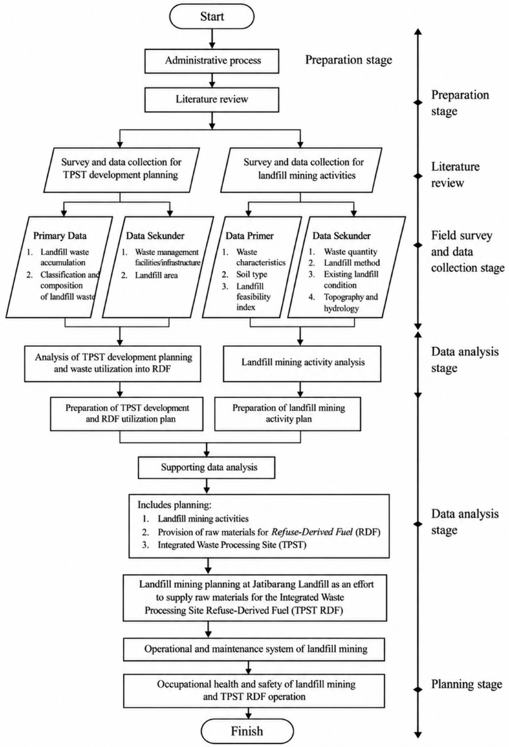
This research was carried out at the Jatibarang Landfill situated in Kedungpane Subdistrict, Mijen District, Semarang City, Central Java, Indonesia. The Jatibarang Landfill was one of the most appropriate locations for the study, considering its considerable size and the presence of passive landfill zones with waste of sufficient age that can be excavated and used as RDF. The study spans four months, from August 2025 to November 2025, and includes the preliminary study, collection of field data, laboratory testing of analytes, and technical and financial planning. The research framework of landfill mining and RDF Integrated Waste Processing Facility (IWPF) planning is shown in Figure 1.
A methodology roadmap was designed to center the Landfill Mining Planning and Design of RDF IWPF on technical viability, environmental soundness, and economic worth, with an integrative approach to field study, waste analysis, laboratory work, material balance computation, and engineering design.
2.2 Data collection
Both Primary and secondary data were collected and analyzed to understand the technology, the environment, and the institutions, the former being collected by means of direct field observations, interviews with institutions, and sample excavations at inactive landfill sites. The field observations focused on the geometry of landfill, cover conditions, waste distribution, soil profile and waste management structures, and the soil profile. Interviews with stakeholders from the Environmental Agency and the regional planning institutions were intended to acquire qualitative data about the Operational, Legal, and Regulatory history, as well as the framework and the future of the agency/planning institution.
Figure 1. Research framework of landfill mining and Refuse-Derived Fuel Integrated Waste Processing Facility (RDF IWPF) planning
The secondary data were collected from three official institutions: the regional development planning agency, the environmental agency, and the statistical bureau. The documents collected include the waste generation data, the design documents of the landfill, the spatial plans, the demographic data, the soil data, and the regional cost data. The combination of both data types allows for the technical planning to be in line with the field reality and the regulations.
Landfill risk was assessed using the Risk Index (RI) method specified in Appendix V of the Regulation of the Minister of Public Works No. 03 of 2013. The assessment comprised 27 parameters grouped into landfill-site criteria, waste characteristics, and leachate characteristics. For each parameter, the risk contribution was calculated as RIᵢ = Wᵢ × Sᵢ, where Wᵢ is the assigned parameter weight and Sᵢ is the corresponding sensitivity index. The total RI for each passive zone was obtained by summing the contributions of all 27 parameters. The parameter values were derived from field measurements, laboratory analysis, interviews, and spatial measurements, as documented in the corresponding assessment table.
2.3 Landfill mining sampling procedure
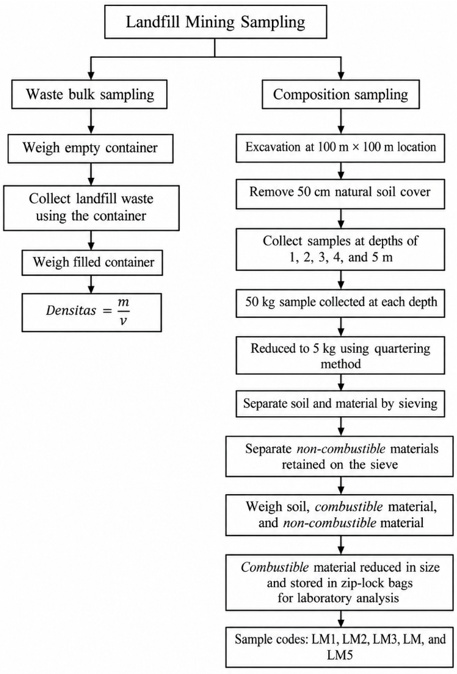
Trench excavation was conducted at one sampling location selected according to field accessibility and safety conditions. Excavation was performed using heavy equipment to a maximum depth of approximately 5 m. Five separate depth-specific samples were collected, corresponding to nominal depths of 1, 2, 3, 4, and 5 m. Approximately 50 kg of landfill-mined material was initially collected at each depth. Each depth-specific bulk sample was then homogenized and reduced by the quartering method to approximately 5 kg for subsequent sorting and analysis. The approximately 5 kg retained sample represented a subsample of the material collected at that specific depth and was not an average of multiple replicate samples. The five depth-specific samples were maintained separately and coded as LM1, LM2, LM3, LM4, and LM5, corresponding to depths of 1, 2, 3, 4, and 5 m, respectively. Soil-like material was separated by sieving, while combustible and non-combustible fractions were subsequently sorted and weighed. No independent replicate samples were collected at the same depth; therefore, the resulting dataset represents a preliminary depth-specific characterization rather than statistically replicated spatial characterization of the passive landfill zones as seen in Figure 2.
Figure 2. Trench excavation method for landfill mining sampling
2.4 Refuse-Derived Fuel production and laboratory analysis
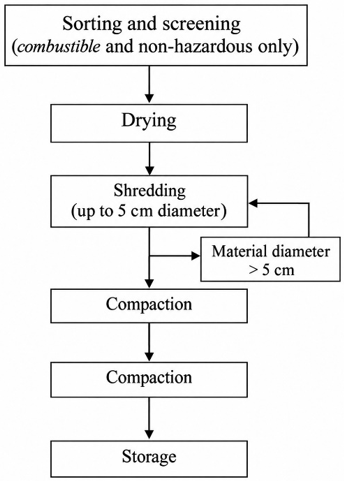
The landfill-mining material was manually and mechanically sorted to separate soil-like, non-combustible, and hazardous fractions. For laboratory characterization, the remaining combustible material was dried by direct sun drying and subsequently shredded to approximately ≤5 cm. For the proposed full-scale RDF IWPF facility, mechanical drying using a rotary dryer was selected, while screening was performed using a 10-mm opening to separate fine soil-like material. Combustible material from each sampling depth was maintained separately under the corresponding sample code (LM1–LM5) before laboratory testing, as seen in Figure 3.
Laboratory analyses were conducted on five independently identified landfill-mining samples (LM1–LM5). The tested parameters included moisture content, gross calorific value, ash content, total sulfur, chlorine, and mercury. The analytical methods followed the applicable SNI and ASTM standards specified for each parameter. The samples were prepared from the combustible fraction obtained after manual sorting and were analyzed separately for each sample. The results were then measured against the established quality criteria for RDF in order to assess the potential to recover energy in an environmentally compliant manner.
Figure 3. Process flow of Refuse-Derived Fuel (RDF) from landfill mining waste
2.5 Integrated Waste Processing Facility Refuse-Derived Fuel facility planning
The layouts of the RDF IWPF were made with respect to the material balance analysis obtained from the recovery rates from landfill mining. This analysis has been factored into the estimated waste throughput, percentage of combustible fraction, and residue produced. The design for the layout of the facility was done to fit the respective receiving and sorting, drying, screening and shredding, RDF and residue storage units. The storage units were reconfigured based on requirements to fit the landfill operational efficiency.
2.6 Cost estimation
Cost estimation was done using quantity take-off and unit price analysis methods. The estimation considers the costs of excavation, procurement of equipment, construction of processing facilities, operational costs, and the payment of labor. The unit prices were obtained from the standards of construction costs in the region, the local minimum wages, and the price of equipment in the market. The budget estimate provides an overview of the economic feasibility of the landfill mining and the RDF IWPF construction.
3.1 Landfill and landfill zones
The Jatibarang Landfill has a total area of 46.183 ha, with around 27.71 ha used as a garbage collection area, and the rest is supporting infrastructure such as leachate ponds. The existing passive-zone waste stock was estimated independently from the landfill design and remaining disposal capacity. Based on the calculated landfill volumes and measured waste density, the estimated stocks were 1,106,302.03 tons in Zones 1–2, 455,133.76 tons in Zone 3, and 259,006.55 tons in Zone 4, corresponding to a total estimated passive-zone stock of approximately 1.82 million tons. These values represent the estimated quantity of previously deposited waste and should not be interpreted as the landfill design capacity or remaining disposal capacity. Based on operational conditions, the landfill area consists of four passive zones, namely zones that have stopped receiving waste and have a long enough lifespan to allow landfill mining activities to be carried out. Landfill mining activities are planned to be carried out in stages based on the age of the pile and ease of operation, starting from zone 4, then zone 3, and finally zones 1–2. Passive Zones 1 and 2. The volume of the reservoir in zones 1 and 2 is estimated at 1,491,975 m³. Based on the measurement of field waste density of 741.5 kg/m³, the total mass of the landfill reached around 1.11 million tons. Taking into account the operating capacity of the equipment and working time, mining activities in this zone are projected to last longer than in other zones, at about 9 years of operation. Zone 3 has a landfill volume of 550,880 m³ corresponding to approximately 408 thousand tons of waste based on the measured field density of 741.5 kg/m³. However, for the material fraction estimation presented in Table 1, the available passive-zone stock scenario was applied, resulting in an estimated Zone 3 waste stock of 455,133.76 tons. The age of the pile and the stability of the slope conditions allow landfill mining activities to be carried out after Zone 4 is completed, with an estimated operation duration of about 4 years. Based on the passive-zone stock scenario presented in Table 1, the total waste stock potentially available for landfill mining is estimated at approximately 1.82 million tons. Using the sampled composition as a preliminary planning assumption, the potential material fractions in the passive-zone waste stock were estimated. Because zone-specific composition data were not independently available for all passive zones, these values should be interpreted as preliminary scenarios, as presented in Table 1.
The total material that has the potential to become RDF reaches around 1.34 million tons, while the decomposed soil material reaches around 129 thousand tons, which has the potential to be reused as landfill cover material. The large availability of these materials shows that landfill mining activities not only function as land rehabilitation, but also as a source of alternative energy raw materials in the long term.
3.2 Landfill risk index
The landfill-mining risk assessment was conducted using 27 parameters specified in Appendix V of the Regulation of the Minister of Public Works No. 03 of 2013, comprising landfill-site criteria, waste characteristics, and leachate characteristics. For each parameter, the partial risk score was calculated as $R I_i=W_i \times S_i$, where $W_i$ is the assigned parameter weight and $S_i$ is the corresponding sensitivity index. The total RI for each passive zone was obtained by summing the partial scores of all 27 parameters. The detailed assessment is presented in Table 2.
Table 1. Preliminary scenario of material fractions in the passive-zone waste stock
|
Composition |
Percentage |
Zone 1–2 (ton) |
Zone 3 (ton) |
Zone 4 (ton) |
|
RDF |
73.52% |
813,325.71 |
334,603.01 |
190,415.17 |
|
Residue (non-combustible) |
19.36% |
214,228.00 |
88,133.61 |
50,154.89 |
|
Sand |
7.12% |
78,748.32 |
32,397.14 |
18,436.49 |
Table 2. Detailed landfill risk index (RI) assessment for the passive zones of Jatibarang Landfill
|
No. |
Parameter |
Wi |
Zone 1-2 Si |
Sub-score |
Zone 3 Si |
Sub-score |
Zone 4 Si |
Sub-score |
|
I. Landfill Site Criteria |
||||||||
|
1 |
Distance to nearest water source (m) |
69 |
0.25 |
17.25 |
0.25 |
17.25 |
0.25 |
17.25 |
|
2 |
Waste filling depth (m) |
64 |
0.50 |
32.00 |
0.50 |
32.00 |
0.50 |
32.00 |
|
3 |
Landfill area (ha) |
61 |
0.50 |
30.50 |
0.25 |
15.25 |
0.25 |
15.25 |
|
4 |
Groundwater depth (m) |
54 |
0.75 |
40.50 |
0.75 |
40.50 |
0.75 |
40.50 |
|
5 |
Soil permeability ($1 \times 10^{-6} \mathrm{~cm} / \mathrm{s}$) |
54 |
1.00 |
54.00 |
1.00 |
54.00 |
1.00 |
54.00 |
|
6 |
Groundwater quality |
50 |
0.25 |
12.50 |
0.25 |
12.50 |
0.25 |
12.50 |
|
7 |
Distance to habitat (wetland/conservation forest) (km) |
46 |
0.75 |
34.50 |
0.75 |
34.50 |
0.75 |
34.50 |
|
8 |
Distance to nearest airport (km) |
46 |
0.75 |
34.50 |
0.75 |
34.50 |
0.75 |
34.50 |
|
9 |
Distance to surface water (m) |
41 |
1.00 |
41.00 |
1.00 |
41.00 |
1.00 |
41.00 |
|
10 |
Subsoil type (% clay) |
41 |
0.25 |
10.25 |
0.25 |
10.25 |
0.25 |
10.25 |
|
11 |
Site life for future use (years) |
36 |
0.00 |
0.00 |
0.00 |
0.00 |
0.00 |
0.00 |
|
12 |
Waste type (municipal/residential waste) |
30 |
0.75 |
22.50 |
0.75 |
22.50 |
0.75 |
22.50 |
|
13 |
Total waste disposed (tons) |
30 |
0.75 |
22.50 |
0.50 |
15.00 |
0.50 |
15.00 |
|
14 |
Waste disposed per day (tons/day) |
24 |
0.75 |
18.00 |
0.75 |
18.00 |
0.75 |
18.00 |
|
15 |
Distance to nearest settlement in the dominant wind direction (m) |
21 |
0.25 |
5.25 |
0.50 |
10.50 |
0.50 |
10.50 |
|
16 |
Flood return period (years) |
16 |
0.25 |
4.00 |
0.25 |
4.00 |
0.25 |
4.00 |
|
17 |
Annual rainfall (cm/year) |
11 |
0.50 |
5.50 |
0.50 |
5.50 |
0.50 |
5.50 |
|
18 |
Distance to city (km) |
7 |
0.75 |
5.25 |
0.75 |
5.25 |
0.75 |
5.25 |
|
19 |
Public acceptance |
7 |
1.00 |
7.00 |
1.00 |
7.00 |
1.00 |
7.00 |
|
20 |
Ambient air quality, $\mathrm{CH}_4$ (%) |
3 |
0.75 |
2.25 |
0.75 |
2.25 |
0.75 |
2.25 |
|
II. Waste Characteristics |
||||||||
|
21 |
Hazardous waste content (%) |
71 |
0.25 |
17.75 |
0.25 |
17.75 |
0.25 |
17.75 |
|
22 |
Biodegradable waste fraction (%) |
66 |
0.75 |
49.50 |
0.75 |
49.50 |
0.75 |
49.50 |
|
23 |
Waste filling age (years) |
58 |
0.25 |
14.50 |
0.25 |
14.50 |
0.25 |
14.50 |
|
24 |
Landfill waste moisture content (%) |
26 |
1.00 |
26.00 |
1.00 |
26.00 |
1.00 |
26.00 |
|
III. Leachate Characteristics |
||||||||
|
25 |
Leachate BOD (mg/L) |
36 |
0.75 |
27.00 |
0.75 |
27.00 |
1.00 |
36.00 |
|
26 |
Leachate COD (mg/L) |
19 |
0.75 |
14.25 |
0.75 |
14.25 |
0.75 |
14.25 |
|
27 |
Leachate TDS (mg/L) |
13 |
0.75 |
9.75 |
0.75 |
9.75 |
0.75 |
9.75 |
|
|
Total Risk Index (RI) |
|
|
558.00 |
|
540.50 |
|
549.50 |
|
|
Risk category |
|
|
Medium |
|
Medium |
|
Medium |
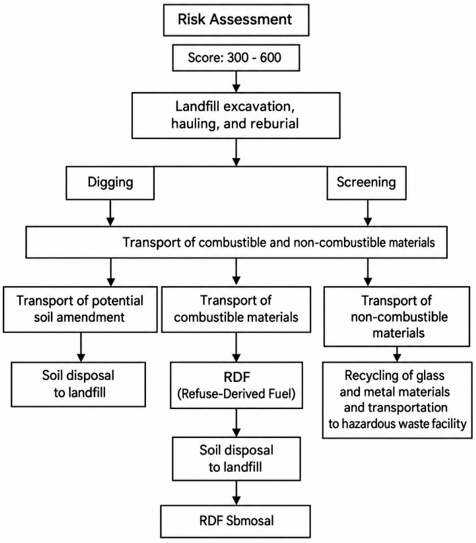
The resulting total risk indices were 558.0 for Zones 1–2, 540.5 for Zone 3, and 549.5 for Zone 4. All three values fall within the 300–600 range and are therefore classified as medium risk under the applied regulatory framework. This classification indicates that the passive zones may be considered for rehabilitation subject to appropriate management and control measures. However, the medium-risk classification should not be interpreted as evidence that landfill-mining activities are inherently safe or that environmental risks are low. Site-specific controls are therefore required to address slope stability, landfill-gas accumulation, leachate exposure, groundwater protection, and heavy-equipment operations. The planned operational flow of landfill mining based on the risk assessment is shown in Figure 4. Excavated material is subsequently separated into combustible, non-combustible, and soil-like fractions. The combustible fraction is directed to RDF production, recyclable non-combustible materials are recovered where feasible, and the soil-like fraction is considered for reuse as landfill cover material.
The risk assessment should therefore be interpreted together with operational controls. Slope stability requires controlled excavation geometry, work-zone restriction, and continuous observation of potentially unstable waste slopes. Landfill-gas hazards require gas monitoring before and during excavation, particularly for methane (CH4), hydrogen sulfide (H2S), and oxygen deficiency. Leachate exposure requires controlled handling and appropriate personal protective equipment (PPE), while groundwater protection requires maintaining control of leachate pathways and monitoring potential contamination. These controls are particularly important because the risk-index score represents a screening-level assessment rather than a direct measurement of excavation safety.
Figure 4. Landfill mining operational scheme based on risk index (RI) assessment results
Rehabilitation decisions are made in stages, in the order of Zone 4, Zone 3, and Zones 1–2, to minimize operational disruptions and consider the life of the stockpile and the stability of the land.
3.2.1 Composition of landfill waste
The material characteristics of landfill mining products were analyzed through manual sorting of five samples at different depths. Each sample was separated into three main fractions, namely combustible, non-combustible material, and decomposed soil-like material. The recapitulation of the sorting results is presented in Table 3.
The sampling dataset consisted of five depth-specific samples obtained from a single trench, with one sample representing each nominal depth from 1 to 5 m. Because no replicate samples were collected at the same depth and no independent zone-specific sampling was conducted, the dataset was not intended to statistically characterize the spatial heterogeneity of all passive landfill zones. The results are therefore used as a preliminary characterization to support engineering planning and scenario estimation. The combined analysis of the five depth-specific samples resulted in 73.52% combustible material, 19.36% non-combustible material, and 7.12% soil-like material. These values represent the composition of the sampled material. Because the available sampling data do not provide independent zone-specific samples for all passive zones, these composition values are treated as a preliminary characterization rather than a statistically representative composition of the entire passive-zone stock. The dominance of combustible materials shows that most of the old waste still has a fairly high energy content even though it has undergone a degradation process in the landfill. The existence of non-combustible fractions is mainly derived from inorganic materials such as glass, metals, and other inert materials that do not contribute to the calorific value, but still have the potential to be separated and recycled. Meanwhile, the soil-like material fraction is the result of long-term decomposition of organic matter that can be reused as cover soil in landfill rehabilitation activities. The composition indicates that the waste pile in the passive zone of the Jatibarang Landfill has a high potential for the use of recovery materials, especially as raw materials for RDF, because the proportion of flammable fractions is much larger than inert residues. These results form the basis for the fuel quality analysis at the next stage.
Table 3. Composition of the sampled landfill-mining material
|
Sample |
Depth (m) |
Combustible (kg) |
Non-Combustible (kg) |
Soil-Like Material (kg) |
Total (kg) |
|
LM1 |
1 |
4.17 |
0.99 |
0.55 |
5.71 |
|
LM2 |
2 |
4.06 |
1.05 |
0.13 |
5.23 |
|
LM3 |
3 |
4.88 |
0.84 |
0.09 |
5.81 |
|
LM4 |
4 |
4.02 |
0.67 |
0.32 |
5.01 |
|
LM5 |
5 |
2.86 |
1.72 |
0.86 |
5.43 |
|
Total |
19.99 |
5.26 |
1.94 |
27.18 |
|
|
Percentage |
73.52% |
19.36% |
7.12% |
||
Table 4. Characteristics and variability of Refuse-Derived Fuel (RDF) from landfill-mining samples compared with SNI 9313:2024
|
Parameter |
Unit |
Mean ± SD |
Range |
SNI 9313:2024 |
|
Moisture content before drying |
wt.% |
38.65 ± 4.99 |
33.65–45.93 |
Max. 22 |
|
Moisture content after drying |
wt.% |
5.59 ± 0.39 |
5.16–6.17 |
Max. 22 |
|
Gross calorific value before drying |
kcal/kg |
4,377.40 ± 1,354.41 |
2,397.27–6,162.51 |
Min. 3,000 |
|
Gross calorific value after drying |
kcal/kg |
6,664.82 ± 1,766.20 |
4,179.20–8,896.25 |
Min. 3,000 |
|
Ash content |
wt.% |
14.61 ± 2.80 |
11.51–19.06 |
<20 |
|
Total sulfur |
wt.% |
0.053 ± 0.009 |
0.0407–0.0623 |
≤0.5 |
|
Chlorine |
wt.% |
0.0369 ± 0.0062 |
0.0295–0.0451 |
≤0.5 |
|
Mercury |
mg/kg |
0.00353 ± 0.00118 |
0.00208–0.00511 |
≤1.0 |
3.3 Quality of waste as a landfill
The characteristics of landfill mining RDF raw materials were analyzed to evaluate their suitability as an alternative fuel for the cement industry. The parameters tested included moisture content, calorific value, ash content, total sulfur, chlorine, and mercury, and were then compared to the SNI 9313:2024 standard. The laboratory results in Table 4 were obtained from five separately identified samples (LM1–LM5), corresponding to the sampled depth intervals, rather than from a single composite sample. The reported values therefore represent the arithmetic mean of the five samples (n = 5).
The calorific value obtained in this study was also compared with values reported for landfill-mined and MSW-derived RDF. Prihartanto et al. [28] reported calorific values of 18.75–20.88 MJ/kg for the coarse combustible fraction of landfill-mined waste, while a previous study at Jatibarang Landfill reported approximately 2,980 kcal/kg (12.47 MJ/kg) after treatment [26]. Following further quality improvement, landfill-mined RDF with optimized combustible composition reached approximately 25.23 MJ/kg [29]. The post-drying gross calorific value obtained in the present study, 6,664.82 kcal/kg (approximately 27.90 MJ/kg), is therefore relatively high for landfill-mined RDF but remains within the upper range reported for MSW-derived RDF.
The relatively high calorific value is primarily attributed to feedstock selection and moisture reduction. The sampled material contained a high combustible fraction (73.52%), while soil-like and non-combustible materials were removed before RDF preparation. In addition, drying reduced the mean moisture content from 38.65% to 5.59%, substantially increasing the energy content per unit mass. The age of the landfill may also have contributed indirectly because prolonged degradation preferentially reduces readily biodegradable organic matter, leaving a relatively larger proportion of persistent combustible materials such as plastics and textiles. However, landfill age alone should not be interpreted as the direct cause of the high calorific value, as waste composition, contamination with soil-like material, and moisture conditions also strongly influence fuel quality.
The five depth-specific samples showed measurable between-sample variability. Moisture content before drying ranged from 33.65 wt.% to 45.93 wt.%, whereas after drying it decreased to a narrower range of 5.16 wt.% to 6.17 wt.%. Gross calorific value showed greater variation, ranging from 2,397.27 to 6,162.51 kcal/kg before drying and from 4,179.20 to 8,896.25 kcal/kg after drying. Ash content ranged from 11.51 wt.% to 19.06 wt.%, while sulfur, chlorine, and mercury remained consistently below the SNI 9313:2024 limits across all five samples. The observed variability, particularly in calorific value, reflects the heterogeneous characteristics of landfill-mined material across sampling depths and should be considered when estimating RDF quality and full-scale process performance.
3.4 Mass balance of landfill mining
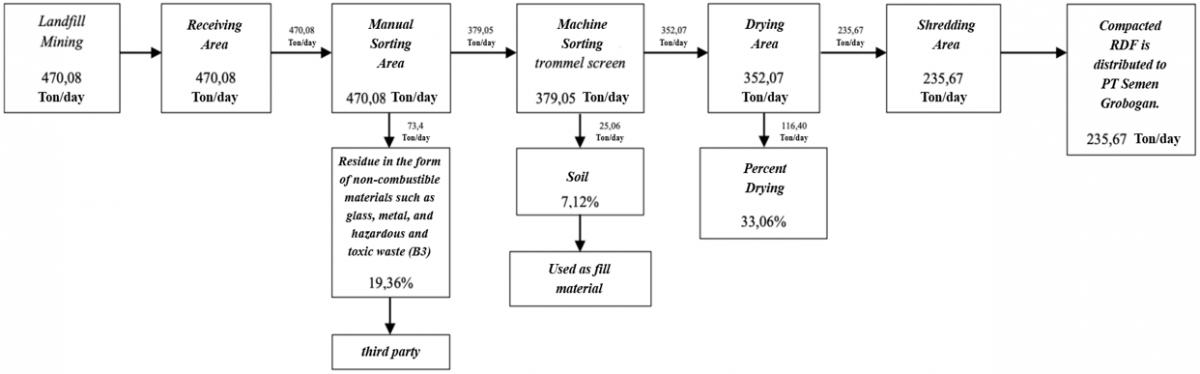
The mass balance analysis was carried out to evaluate the distribution of material flows at each stage of processing landfill-mined waste into RDF at the RDF IWPF Jatibarang facility. The calculation was based on the planned daily operating capacity during the operational period. The processing flow includes material reception, sorting and separation, drying, shredding, and compaction until the final RDF product is obtained. The calculated input and output mass flows for each processing stage are summarized in Figure 5. The mass flow distribution is shown in Figure 5.
Figure 5. Mass balance
The material from landfill mining entering the facility was 470.08 tons/day. Based on the measured composition of the sampled landfill-mining material presented in Table 3, the incoming material consisted of 73.52 wt.% combustible material, 19.36 wt.% non-combustible material, and 7.12 wt.% soil-like material. The measured combustible fraction of 73.52 wt.% was used as the preliminary combustible recovery fraction in the mass-balance calculation. Screening efficiency was not experimentally measured; therefore, no additional dry-solid loss due to screening was assumed in the preliminary mass balance. Accordingly, the initial separation stage produced approximately 345.60 tons/day of combustible material, 91.01 tons/day of non-combustible material, and 33.47 tons/day of soil-like material. Therefore, the mass balance at this stage satisfies the conservation relationship: 470.08 = 345.60 + 91.01 + 33.47 tons/day. The combustible fraction of 345.60 tons/day was subsequently directed to the drying process. The drying mass balance was recalculated on a conserved dry-solids basis using the measured moisture contents of 38.65% before drying and 5.59% after drying. The dry-solid mass entering the dryer was calculated as 345.60 × (1 − 0.3865) = 212.03 tons/day. Assuming that the drying process removes only moisture and does not cause a significant loss of dry solids, the mass of material leaving the dryer was calculated as 212.03/(1 − 0.0559) = 224.58 tons/day. Therefore, approximately 121.02 tons/day of water is removed through evaporation during drying. The dried material of 224.58 tons/day is subsequently transferred to the shredding and compaction stages. No significant material loss was assumed during these mechanical processes because they primarily modify particle size and bulk density. Accordingly, the final RDF production is estimated at 224.58 tons/day under the stated material-composition and moisture assumptions.
Based on the corrected RDF production capacity of 224.58 tons/day, annual RDF production was calculated using 260 effective operating days per year. The remaining days were allocated for scheduled maintenance, equipment inspection, operational downtime, and non-operating periods. Accordingly, the annual RDF production is estimated at 58,390.80 tons/year. This annual production value is used consistently throughout the material balance, revenue analysis, cash-flow calculation, and financial-feasibility assessment.
3.5 Capacity planning
Planning the capacity of the RDF IWPF facility begins with a material balance analysis to determine the amount of waste flow at each stage of the process. This data is the basis for determining the capacity and number of equipment units, as well as the dimensions of the required building.
3.5.1 Landfill mining yield transportation capacity
Transportation of excavated material from the landfill-mining area to the RDF IWPF facility was evaluated separately from the transportation of the final RDF product to the cement plant. The landfill-mining operation generates approximately 470.08 tons/day of material that must be transferred to the RDF IWPF facility. Two dump trucks are planned for this internal transportation stage, each with a nominal payload capacity of 25 tons per loaded trip. Therefore, the minimum number of loaded trips required is 470.08/25 = 18.80, rounded up to 19 loaded trips/day in total. With two operating trucks, this corresponds to approximately 9–10 loaded trips per truck per day.
The actual transport capacity depends on the one-way haul distance between the excavation area and the RDF IWPF facility, travel speed, loading and unloading time, queuing time, and operational availability. These parameters are therefore considered in determining the truck cycle time and standby requirement.
3.5.2 Processing capacity at Integrated Waste Processing Facility Refuse-Derived Fuel
The waste that arrives at the RDF IWPF then goes through a series of processing processes. The calculation of the capacity of each stage is carried out sequentially by considering the material reduction factor in each process. A recapitulation of the input and output capacities in each processing area is presented in Table 5.
3.5.3 Determination of number of equipment units
The equipment requirements were reassessed based on the corrected material flow and the available operating capacity of each processing unit. The RDF IWPF is designed with four parallel processing lines. Following the corrected mass balance, the total material entering the shredding stage is 224.58 tons/day, corresponding to approximately 56.15 tons/day per production line.
Each production line is equipped with one Double Shaft Shredder with a rated capacity of 10 tons/hour. At the previously assumed operating time of 5.5 hours/day, the available capacity would be only 55 tons/day per unit, which is insufficient for the required load of 56.15 tons/day. Therefore, the effective operating schedule of the shredder was 6.0 hours/day. Under this operating schedule, each shredder provides a rated daily capacity of 60 tons/day, corresponding to a utilization rate of approximately 93.6% and an available capacity margin of approximately 6.4%.
Table 5. Mass flow in each Refuse-Derived Fuel Integrated Waste Processing Facility (RDF IWPF) processing area
|
Processing Area |
Input (tons/day) |
Output (tons/day) |
Residue (tons/day) |
Remarks |
|
Reception |
470.08 |
470.08 |
0 |
Landfill-mined material is received as the initial process feed. |
|
Material Separation |
470.08 |
345.60 |
124.48 |
The incoming material is separated into 345.60 tons/day of combustible material, 91.01 tons/day of non-combustible material, and 33.47 tons/day of soil-like material. Mass balance: 470.08 = 345.60 + 91.01 + 33.47. |
|
Drying |
345.60 |
224.58 |
121.02 |
Mass reduction occurs through water evaporation. The calculation is based on a reduction in moisture content from 38.65% to 5.59%, while dry-solid mass is conserved. |
|
Shredding |
224.58 |
224.58 |
≈0 |
No significant mass reduction is assumed; the process primarily reduces particle size. |
|
RDF Compaction |
224.58 |
224.58 |
≈0 |
No significant mass reduction is assumed; the process primarily increases bulk density. |
|
Final RDF Product |
224.58 |
224.58 |
— |
Final RDF production under the stated material-balance and moisture assumptions. |
Four shredders are therefore required for normal operation, one for each processing line. No dedicated standby shredder is included in the preliminary design; therefore, temporary equipment failure may reduce plant throughput. Preventive maintenance and planned downtime are incorporated into the annual operating schedule. The shredder represents one of the potential bottlenecks because its operating utilization is higher than 90%; therefore, its actual throughput should be verified during detailed engineering and commissioning.
The capacities and power requirements of the trommel screen, rotary dryer, shredder, compactor, and supporting equipment are evaluated against their respective process loads. The total electrical supply requirement should be determined from the simultaneous connected load of all electrically driven equipment, including appropriate motor starting and power-factor allowances, rather than from the nominal plant capacity alone.
3.5.4 Calculation of area requirements
The RDF IWPF facility is planned within a building footprint of approximately 147.5 m × 46 m, corresponding to a total operational area of 6,785 m2. The facility area was determined from the space requirements of the main processing zones, material-storage areas, internal vehicle circulation, equipment access, safety separation, and environmental-control facilities.
The area requirement for each processing zone was determined from the daily material throughput, estimated bulk volume, storage or retention period, allowable pile height, equipment footprint, and additional maneuvering space. For example, the reception area was calculated based on a material volume of approximately 158.49 m3/day per line, a storage height of 2 m, one day of temporary retention, and approximately 40.96 m2 of additional operational space, resulting in a calculated requirement of approximately 120.21 m² per line. For preliminary design purposes, this value was rounded to 150 m² per line.
The facility layout distinguishes the waste-reception and temporary-storage zone, material-separation area, drying area, shredding and RDF-compaction area, RDF-product storage, residue storage, hazardous-material temporary storage, leachate collection and drainage facilities, and supporting operational areas. Separate internal truck circulation routes are provided to reduce interference between incoming landfill-mining material and outgoing RDF-product transportation.
Safety provisions are incorporated into the preliminary layout by maintaining separation between material-storage and thermal-processing areas, providing emergency access routes, and preventing obstruction of vehicle and personnel circulation. Dust-generating processing areas, particularly screening and shredding, are designated for local dust-control and ventilation systems. Drainage from waste-reception and residue-handling areas is directed toward the leachate-collection system rather than being discharged directly to the surrounding ground.
The layout and area allocations presented in this study represent a preliminary engineering design. Final fire-separation distances, ventilation rates, drainage dimensions, hazardous-material storage requirements, and emergency-access dimensions should be verified during detailed engineering in accordance with the applicable fire-safety, occupational-safety, environmental, and building regulations.
3.6 Cost Budget Plan analysis
The cost analysis in the planning of the RDF IWPF aims to provide an overview of the funding needs, both for the construction stage and for operations and maintenance during the project period. The Cost Budget Plan (RAB) is prepared by grouping costs into two main components, namely initial investment costs and variable costs. Furthermore, an analysis of potential income and calculation of financial feasibility indicators were carried out to assess the profitability of the project.
3.6.1 Initial investment costs
The initial investment cost includes all expenses required before the facility can operate, including the cost of building construction, procurement of basic equipment and fleet, and the provision of PPE for workers. The recapitulation of initial investment costs is presented in Table 6.
Construction costs. The calculation of construction costs for the development of the 6,785 m² RDF IWPF refers to the 1st edition of the Central Java Provincial Construction Work Unit Price (MAS PETRUK) of 2025. The construction works include site preparation, foundation works, drainage construction, building structure, wall installation, roofing, and electrical works, with a total estimated cost of IDR 7,001,485,252.70. The construction period is preliminarily estimated at six months. A detailed construction schedule and S-curve would be developed during the detailed engineering design phase.
Table 6. Recapitulation of the initial investment cost of Refuse-Derived Fuel Integrated Waste Processing Facility (RDF IWPF)
|
No. |
Remarks |
Quantity (IDR) |
|
1 |
Construction Costs of IWPF Construction |
7,001,485,252.70 |
|
2 |
Cost of Basic Equipment and Fleet |
7,464,064,640.00 |
|
3 |
Cost of Personal Protective Equipment (PPE) |
79,873,200.00 |
|
Total |
14,545,423,092.70 |
Equipment, fleet, and personal protective equipment costs. The next initial investment component is the procurement of main equipment for the processing process at IWPF and a fleet for landfill mining and distribution activities, with a total cost of Rp 7,464,064,640.00. In addition to equipment, the investment also includes the provision of PPE for 99 workers with a total cost of IDR 79,873,200.00.
3.6.2 Variable costs
Variable costs are costs incurred on a regular basis during the life of the plant, the amount of which can change over time. Variable cost components include operational costs and maintenance costs.
Operating cost. Operating costs were recalculated using the corrected RDF production and operating assumptions. Fuel and electricity requirements were linked to equipment operating hours, drying requirements, and transportation activities, while maintenance and labor costs were adjusted according to the annual operating schedule. Operational costs include the need for electricity, fuel, labor salaries, and consumables (RDF straps). The calculation of operational costs is carried out by taking into account various assumptions, such as the base price and annual escalation. Electricity demand, based on the Determination of Electricity Tariff Adjustment for 2025, is calculated based on the total power and operating hours of all electrical equipment, with the basic electricity tariff for 6,600 VA – 200 kVA power of IDR 1,444.70 per kWh. Electricity consumption is calculated for each electrically driven processing unit from its rated motor power, number of operating units, effective operating hours, and assumed load factor. The total daily electricity demand is obtained by summing the energy consumption of the trommel screens, shredders, compactors, conveyors, and auxiliary electrical equipment. The corresponding maximum simultaneous electrical demand is also used to verify the adequacy of the proposed electrical supply capacity. Fuel Costs: Fuel needs are calculated for transportation fleets and heavy equipment, with the base price of diesel in 2027 projected at IDR 15,745 per liter (assuming an escalation of 7.6% per year from the price in 2024 [26]. The use of rotary dryers uses industrial biodiesel (B40) at different prices. Labor Costs: The needs of 99 workers with various qualifications, ranging from heavy equipment operators, sorters, to factory heads, are allocated salary costs based on the Semarang City Unit Price Standard (Semarang City Mayor No. 12 of 2025). The total salary cost per year is estimated to reach IDR 3,289,920,000.00. Cost of Consumables: RDF products that have been compacted into bales require a strap. With dimensions of 1.2 m × 1.2 m × 1.2 m and a weight of 10 tons, the need for rope per bale is 32 meters, with a total cost of IDR 416,000.00 per bale.
Maintenance costs and depreciation of tools. Maintenance costs are allocated to maintain the optimal performance of all machines and machines throughout their lifetime. This cost is calculated based on a certain percentage of the purchase price of the tool, which is 5–15% [33], with specific values adjusted based on the capacity and function of each tool. In addition to routine maintenance costs, the depreciation (depreciation) of the equipment is also calculated. Depreciation is calculated using the straight-line method, referring to the AHSP PUPR (Permen PUPR No. 1 of 2022) with a residual value percentage of 10% and the economic life of the tool of 15 years. Although it is not a cash expense, the value of depreciation is important for further financial analysis such as tax calculations and net cash flow.
Recapitulation of variable costs and escalation. Variable costs are not fixed and will increase every year due to inflation and other factors. The escalation rate assumptions used in this analysis are as follows:
•Electricity requirement: 0.10% per year
•Fuel needs: 7.6% per year [26]
•Officer's salary: 2% per annum
•Maintenance fee: 1.22% per year
The escalation-adjusted variable costs from the first year of operation (2027) to the 15th year (2041) were incorporated into the cash flow analysis to evaluate the financial feasibility of the RDF IWPF facility.
3.6.3 Integrated Waste Processing Facility income analysis
The income of RDF IWPF comes from two main sources, namely the sale of RDF products and the sale of sorted glass and metal materials. RDF production is estimated at 58,390.80 tons/year, based on a corrected daily RDF output of 224.58 tons/day and 260 effective operating days per year. This production value is used consistently in the subsequent revenue and financial analyses. Glass and metal materials that can be sold are 23,667.21 tons per year. The base-case RDF selling price of IDR 450,000/ton was adopted from the reported RDF price range of approximately IDR 300,000–500,000/ton [34]. This value represents a planning assumption rather than a confirmed contract price with the intended off-taker, assuming an average price increase of 1.22% per year following changes in the rupiah exchange rate. The recapitulation of IWPF income is presented in Table 7.
3.6.4 Financial feasibility analysis
The financial feasibility analysis is carried out by compiling the balance of income and cash flow during the life of the project (2026–2041), as well as calculating feasibility indicators such as Net Present Value (NPV), Internal Rate of Return (IRR), and Payback Period. The uncertainty associated with the RDF selling price and feedstock characteristics was evaluated through the sensitivity analysis presented in this section.
Profit and Loss Balance. The income statement describes net income after deducting variable costs each year. Income before tax is obtained from the difference between total income and total variable costs.
Table 7. Recapitulation of Refuse-Derived Fuel Integrated Waste Processing Facility (RDF IWPF) income in 2027-2041
|
Year |
RDF (t) |
Recyclables (t) |
Selling Price (IDR /t) |
RDF Revenue (×10⁶ IDR) |
Recyclables Revenue (×10⁶ IDR) |
Total Income (×10⁶ IDR) |
|
2027 |
58,390.80 |
23,667.21 |
450,000 |
26,275.86 |
10,650.24 |
36,926.10 |
|
2028 |
58,390.80 |
23,667.21 |
455,490 |
26,596.43 |
10,780.18 |
37,376.60 |
|
2029 |
58,390.80 |
23,667.21 |
461,047 |
26,920.90 |
10,911.70 |
37,832.60 |
|
... |
... |
... |
... |
... |
... |
... |
|
2041 |
58,390.80 |
23,667.21 |
533,263 |
31,137.63 |
12,620.84 |
43,758.47 |
Table 8. Cash flow of the Refuse-Derived Fuel Integrated Waste Processing Facility (RDF IWPF)
|
Year |
Cash In (IDR) |
Cash Out (IDR) |
Accumulated Net Cash Flow (IDR) |
|
2026 |
14,545,423,093 |
14,545,423,093 |
-14,545,423,093 |
|
2027 |
29,932,652,746 |
17,234,817,051 |
-1,847,587,398 |
|
2028 |
30,296,391,353 |
18,032,091,113 |
10,416,712,842 |
|
2029 |
30,664,567,571 |
18,883,526,263 |
22,197,754,150 |
|
... |
... |
... |
... |
|
2041 |
35,449,199,979 |
35,140,031,242 |
81,146,407,076 |
Cash flow. Cash flow analysis considers all cash flows in and out over the life of the project. Cash in comes from the initial investment, net profit, and depreciation of the tool (added back because it's not a cash outlay). Cash outflow consists of initial investment costs and annual operating costs. The results of the cash flow analysis are presented in Table 8.
Financial Feasibility Indicators. Based on the analysis of cash flows with a certain discount rate, the following financial feasibility indicators are obtained: NPV shows the present net value of all cash flows over the life of the project. The project is declared feasible if the NPV > 0. IRR indicates the project's IRR. A project is declared eligible if the IRR > a set discount rate. Payback Period indicates the period of time it takes to return the entire initial investment. It can be seen that the accumulated net cash flow will start to have a positive value in 2028, which indicates that the payback period occurs in less than 2 years after operations begin. This shows that the RDF IWPF project at the Jatibarang Landfill has good financial feasibility prospects and is feasible to be realized.
The robustness of the financial results was further evaluated through sensitivity testing of the main technical and economic assumptions. The assessed variables included RDF selling price, combustible fraction of landfill-mined material, initial moisture content, fuel cost, annual operating rate, and discount rate. Changes in these parameters affect RDF yield, drying and transportation costs, annual revenue, and the present value of project cash flows. The sensitivity assessment was used to identify the parameters with the greatest influence on NPV, IRR, and payback period and to clarify the uncertainty associated with the preliminary financial-feasibility results.
A one-at-a-time scenario analysis was conducted for three key parameters: RDF selling price, combustible fraction, and initial moisture content. All other parameters were held at their base-case values. The RDF selling price was varied by ±10% from the base value of IDR 450,000/ton, while combustible fraction and initial moisture content were varied according to the observed ranges of the landfill-mining samples. The resulting changes in RDF production and annual gross RDF revenue are presented in Table 9.
The results indicate that RDF production is particularly sensitive to the combustible fraction and initial moisture content of the excavated waste. Within the observed sample range, annual RDF production varied from approximately 41,832 to 66,709 tons/year due to changes in combustible fraction, while moisture variation resulted in approximately 51,462–63,150 tons/year. A ±10% change in RDF selling price produced a proportional ±10% change in gross RDF revenue without affecting RDF production. These results highlight the importance of feedstock variability and market price in the preliminary technical-economic assessment.
Table 9. Sensitivity analysis of key Refuse-Derived Fuel (RDF) production parameters
|
Parameter |
Scenario |
Input Value |
RDF Production (ton/day) |
Annual RDF Production (ton/year) |
Annual RDF Revenue (Billion IDR/year) |
|
RDF selling price |
-10% |
405,000 IDR/t |
224.58 |
58,391 |
23.65 |
|
Base |
450,000 IDR/t |
224.58 |
58,391 |
26.28 |
|
|
+10% |
495,000 IDR/t |
224.58 |
58,391 |
28.90 |
|
|
Combustible fraction |
Observed minimum |
52.67% |
160.89 |
41,832 |
18.82 |
|
Base |
73.52% |
224.58 |
58,391 |
26.28 |
|
|
Observed maximum |
83.99% |
256.57 |
66,709 |
30.02 |
|
|
Initial moisture content |
Observed minimum |
33.65% |
242.88 |
63,150 |
28.42 |
|
Base |
38.65% |
224.58 |
58,391 |
26.28 |
|
|
Observed maximum |
45.93% |
197.93 |
51,462 |
23.16 |
3.7 Feasibility study
3.7.1 Technical aspects
The technical feasibility of landfill mining activities at the Jatibarang Landfill was reviewed based on the system's ability to handle waste heaps in passive Zones 1–4. The processing capacity is planned to be 470.08 tons/day, which is obtained from the productivity of excavators and the suitability of the capacity of the processing unit (bag opener, trommel screen, rotary dryer, shredder, and other supporting units). From the planned landfill-mining feed capacity of 470.08 tons/day, approximately 345.60 tons/day is estimated to constitute the combustible fraction based on the sampled material composition. After drying from an initial moisture content of 38.65% to 5.59%, the resulting dried material is estimated at approximately 224.58 tons/day. Assuming no significant mass loss during shredding and compaction, the corresponding RDF production capacity is approximately 224.58 tons/day. This capacity meets the minimum RDF processing requirements of 100 tons/day according to the Minister of Public Works Regulation No. 03 of 2013. Landfill mining activities are planned to last for 15 years (2027–2041). The duration is calculated based on the total recoverable stockpile, effective operating hours of mining (±3 hours/day), mechanical efficiency of the equipment, and routine maintenance time.
Facilities are designed with support:
•Electrical power: 150 kVA
•RDF storage area
•Leachate control system
•Operational area of 6,785 m2
The electrical supply capacity must be verified against the simultaneous connected load of the trommel screens, shredders, compactors, conveyors, auxiliary systems, and other electrically driven equipment. The previously stated 150 kVA supply is therefore treated as a preliminary design assumption pending verification of the complete equipment load, motor starting requirements, power factor, and operational diversity. The preliminary RDF IWPF layout occupies approximately 6,785 m2 within the available 4.21-ha site. The layout provides designated areas for waste reception and temporary storage, processing equipment, RDF-product storage, separated residue storage, hazardous-material temporary storage, truck circulation, emergency access, and leachate collection. Dust- and ventilation-control provisions are incorporated in the screening, drying, and shredding areas, while fire separation is provided between thermal-processing and combustible-material storage zones. Detailed dimensions, storage capacities, and retention periods for each functional zone are presented in the facility-layout plan and area-allocation table.
The intended RDF off-taker is PT Semen Grobogan, located approximately 38.8 km from the proposed RDF IWPF facility based on the planned road-transport route. Two dump trucks with a nominal payload capacity of 30 tons each were considered. Based on the corrected RDF production of 224.58 tons/day, approximately 7.49 loaded trips/day are required in total, corresponding to approximately four loaded trips per truck per operating day.
3.7.2 Environmental feasibility
Based on the Environmental RI analysis using the Integrated Risk-Based Approach (IRBA), the Jatibarang Landfill is classified as having a moderate hazard level and is recommended for gradual rehabilitation to reduce the risk of landslides. The landfill has experienced overcapacity, which increases the potential for waste pile instability, greenhouse gas emissions (CH4, CO2, and H2S), gas explosion hazards, and groundwater and surface water contamination. The implementation of landfill mining combined with the production and utilization of RDF is expected to provide several environmental benefits. These include the potential for reducing methane emissions by preventing prolonged anaerobic decomposition in the landfill, lowering the potential for leachate pollution, and decreasing fossil fuel consumption in the cement industry through coal substitution (approximately 10–40%), thereby contributing to energy system decarbonization through the use of non-recyclable waste as an alternative energy source [35]. However, these environmental benefits should be interpreted as expected effects rather than directly quantified outcomes, because this study did not conduct a life-cycle assessment (LCA), greenhouse-gas calculation, transport-emission analysis, dryer-fuel emission assessment, or comparative carbon-footprint analysis.
Additionally, this approach is expected to support the circular economy concept through energy recovery. Although RDF contains a plastic fraction with chlorine content that requires high-temperature combustion, the actual environmental implications depend on RDF composition, drying-energy demand, transportation requirements, coal-substitution rate, and cement-kiln operating conditions. These factors were not quantitatively evaluated in this study. Potential emissions associated with RDF utilization, including dioxins, metals, and other combustion-related pollutants, require verification under actual cement-kiln operating conditions. No direct cement-kiln emission testing was conducted in this study. The tested RDF samples met the reported SNI 9313:2024 parameters evaluated in this study; however, this result alone does not establish full environmental safety or cement-kiln suitability. Actual environmental performance requires confirmation through broader contaminant characterization, cement-plant-specific acceptance criteria, and emission monitoring under operating conditions. The proposed system may provide environmental benefits; however, its environmental performance requires confirmation through site-specific emission, life-cycle, and operational assessments.
3.7.3 Financial aspects
The financial analysis was based on a 15-year operating period from 2027 to 2041, with annual RDF production calculated from the corrected production capacity of 224.58 tons/day and 260 effective operating days per year, equivalent to 58,390.80 tons/year. The base-case RDF selling price was assumed at IDR 450,000/ton. The base-case RDF selling price of IDR 450,000/ton was adopted from the reported RDF price range of IDR 300,000–500,000/ton and was treated as a preliminary market-based assumption because no binding purchase agreement with the off-taker was available. Because no binding long-term purchase agreement with the RDF off-taker was available at the time of the study, the selling price and sales volume were treated as preliminary market assumptions. Land acquisition cost was excluded under the assumption that the facility would be developed within the existing Jatibarang Landfill area. Equipment residual value was assumed at 10% of the acquisition cost at the end of the 15-year economic life. The analysis was conducted on a project basis without a specific debt-equity financing structure, while working-capital requirements were treated as part of the operational funding requirement.
Table 10. Eligibility indicator
|
Indicator |
Value |
|
NPV |
IDR 73.971.033.167 |
|
IRR |
8.30% |
|
Discount Rate |
5% |
|
Payback Period |
2 years 2 months |
Financial aspects are evaluated using investment costs, cash flows, and economic feasibility indicators. Investment Recapitulation: Total initial investment is IDR 14,545,423,092.70. The largest component comes from the procurement of equipment and fleet. Operations will begin in 2027 and generate positive cash flow from the first year of operation. The return on investment occurs in 2028. The financial feasibility indicators obtained from the cash flow analysis are summarized in Table 10.
3.8 Job Safety Analysis
Job Safety Analysis (JSA) is developed as an integral component of occupational safety management to ensure that all landfill mining activities and RDF IWPF operations at the Jatibarang Landfill are conducted safely and systematically. The primary objective of this analysis is to identify potential hazards, assess associated risk levels, and determine appropriate control measures prior to the commencement of work. The JSA covers two main categories of activities, namely landfill mining operations and the operation of the RDF IWPF processing facility. Its implementation involves permit-to-work procedures, verification of worker readiness, mandatory use of PPE, and comprehensive control of mechanical, biological, and chemical hazards to minimize workplace risks.
3.8.1 Job Safety Analysis for landfill mining activities
The risk-index assessment provides a screening-level basis for rehabilitation planning, while detailed excavation safety is addressed through JSA. A 5 × 5 likelihood–severity matrix was applied, with likelihood and severity each scored from 1 to 5. Risk scores were classified as Low (1–4), Moderate (5–9), High (10–16), and Extreme (17–25). Initial risk was assessed before control measures, whereas residual risk was reassessed after engineering, administrative, and PPE controls were implemented. High- and Extreme-risk activities were not permitted to proceed until the reassessed residual risk was reduced to an acceptable level.
The major hazards associated with landfill mining include landfill gases (CH4, H2S, and CO2), slope failure, trapped-gas explosions, heavy-equipment operations, leachate and biological exposure, and injuries from sharp objects. Atmospheric monitoring is required before and during excavation, and work must be stopped when methane reaches 10% of the lower explosive limit (LEL), oxygen concentration falls outside 19.5–23.5%, or H2S reaches the specified alarm level. Excavation risks classified as Extreme are reduced through gas monitoring, controlled benching, work-zone restriction, and stop-work criteria. These controls reduce the likelihood of occurrence, and the residual risk is classified as Moderate when the reassessed score falls within the 5–9 range.
Excavation may proceed only after the waste slope has been inspected and no visible signs of instability are identified. Controlled benching should be applied without undercutting the waste face, and work must be suspended if tension cracks, localized collapse, excessive settlement, uncontrolled leachate discharge, sudden gas release, or visible slope movement occurs. Emergency evacuation routes and assembly points must also remain clearly marked and accessible throughout operations. Sharp objects and suspected medical waste must be isolated from the RDF stream and handled using appropriate tools and puncture-resistant containers. Any sharps-related injury must be immediately reported and followed by first aid, medical evaluation, and incident documentation.
3.8.2 Job Safety Analysis operational RDF IWPF
The operation of the RDF IWPF involves ±95 workers with sequential process stages ranging from material receipt to RDF storage. The main risks come from rotating engines, dust, noise, heat, and internal vehicle traffic. Work readiness checks are carried out at the beginning of every shift to ensure that workers are in good health and not exposed to landfill gas.
The same likelihood severity risk-ranking approach is applied to RDF IWPF operations. Initial risk is assessed before implementation of control measures, while residual risk is evaluated after the specified engineering, administrative, and PPE controls are applied. Activities with uncontrolled high or extreme residual risk must not proceed until additional controls are implemented. For RDF IWPF operations, Extreme risks such as shredder entanglement are reduced through machine guarding, LOTO, and controlled access, with residual risk reassessed after implementation of these controls. The identified hazards, initial risk levels, control measures, and residual risks for landfill mining activities are summarized in Table 11. The JSA results for the operational activities of the RDF IWPF facility are presented in Table 12.
Table 11. Summary Job Safety Analysis (JSA) landfill mining
|
Work Stage |
Hazard |
Initial Risk |
Control / Stop-Work |
Residual Risk |
|
Preparation |
Gas, explosion, slope failure |
H |
Gas test, barricade; stop at gas alarm/slope movement |
M |
|
Toolbox meeting |
Miscommunication |
M |
Safety and evacuation briefing |
L |
|
Worker check |
Infection, bioaerosol |
H |
PPE and health check |
M |
|
Equipment operation |
Collision, rollover |
H |
Certified operator, spotter |
M |
|
Excavation |
Gas, landslide |
E |
Gas monitoring, benching; stop at cracks/gas alarm |
M |
|
Sorting |
Sharps, biological waste |
H |
PPE, sharps container, waste segregation |
M |
|
Transport |
Collision, rollover |
H |
Speed limit, designated route |
M |
|
Leachate handling |
Chemical/biological exposure |
H |
PPE, closed handling |
M |
|
Emergency |
Fire, gas, injury |
E |
Emergency Response Plan (ERP), extinguisher, evacuation route |
M |
|
Housekeeping |
Residual hazards |
M |
Final inspection |
L |
Table 12. Summary of Job Safety Analysis (JSA) Refuse-Derived Fuel Integrated Waste Processing Facility (RDF IWPF) operations
|
Process |
Hazard |
Initial Risk |
Control / Stop-Work |
Residual Risk |
|
Work permit |
Invalid permit |
M |
Permit verification |
L |
|
Briefing |
Incorrect procedure |
M |
Toolbox meeting |
L |
|
Inspection |
Mechanical hazard |
H |
Daily inspection; stop if unsafe |
L |
|
Transport |
Collision |
H |
Traffic lanes, signs |
M |
|
Reception |
Loader collision |
H |
Radio, exclusion zone |
M |
|
Sorting |
Cuts, dust |
H |
PPE, ventilation |
M |
|
Sieving |
Pinch/caught-in |
H |
Machine guarding |
M |
|
Drying |
Heat, dust |
H |
Respirator, work rotation |
M |
|
Shredding |
Entanglement |
E |
Guarding, LOTO |
M |
|
Compaction |
Crush/pinch |
H |
Operator safe zone |
M |
|
Storage |
Pile collapse |
H |
Max. pile height 1.5 m |
M |
|
Housekeeping |
Slip/trip |
M |
Housekeeping each shift |
L |
|
Emergency |
Fire/injury |
E |
ERP, evacuation route |
M |
The Jatibarang Landfill example integrates landfill mining with RDF production and shows good promise with regard to technical, environmental, and economic feasibility. In order to improve sustainable development and the usefulness of future research, suggestions are provided. First, an emphasis on optimizing future studies on the quality of RDF is suggested. The remaining challenges consist of the ongoing variability of waste with regard to combustible fuels. This is important even though the calorific value is in compliance with SNI 9313:2024. In order to effectively incorporate a reduction in the energy expenditure associated with the operational drying, advanced preprocessing techniques are a target. These techniques include a bio-drying system and an automated sorting and NIR (near-infrared) plastic separation system. These techniques are a target in order to achieve a cohesive combustible fuel stream. Blending of landfill-mined waste with other sources of waste, e.g. municipal solid waste or biomass, is also an important variable that deserves further study in order to improve the overall quality of the fuel with regard to the stability and the quality of the fuel with regard to the combustion performance in cement kilns. Second, research focusing on environmental assessment is expanded to include long-term assessments. Future studies should include assessment of greenhouse gas emissions, including methane emissions, and assessment of emissions through the use of life cycle assessment (LCA) to ascertain the deductive potential of carbon credits. Assessments of the integration of landfill mining and carbon credits are a good way to improve the economic feasibility of the project. It also meets the current carbon trade targets established by the country of Indonesia. The long-term assessment studies are important in improving the assessment of post-excavation land rehabilitation. These studies should evaluate all remaining aspects necessary to improve the evaluation of recovery of the land to a rehabilitated pre-excavation use. This includes monitoring the groundwater and soil prior to post-excavation land rehabilitation.
Third, the integration of circular economies in the management of landfills should be prioritized. Other recovered materials, in addition to producing RDF, which is the capture of soil fragments, metals, and glass, can be used in additional ways. After going through soil stabilization and geotechnical approval, stabilized soil fractions can be used as construction materials, landfill cover materials, or for land reclamation. Future studies can pursue the recovery of rare earth elements or the recovery of microplastics from aged landfill materials. Recovering microplastics and rare earth elements from landfills can provide other opportunities for higher-value material recovery, in contrast to recovering energy. Fourth, landfill management should incorporate digitalization and smart technologies. GIS, drone mapping, and real-time gas monitoring can be used to improve excavation planning and monitoring to promote slope stability and improve occupational safety. Operational risks and costs can also be minimized by the excavation sequence of the waste, along with the use of predictive models of waste composition using machine learning. Fifth, the social and policy aspects require deeper exploration. Long-term collaboration of stakeholders, community acceptance, and the readiness of institutions are critical for the success of implementation. Future research should include public perception studies, the design of participatory waste supply chains, and the establishment of policy incentives, such as revised tipping fees, renewable energy certificates, and the integration of extended producer responsibility (EPR) in waste management systems. Finally, scalability studies are needed. The case of Jatibarang can be used as a model for other landfills in Indonesia that are almost at the point of being filled to capacity.
In order to formulate national standards for landfill mining-based waste-to-energy systems, comparative analysis will be needed between cities that differ in waste profiles, climatic factors, and economic conditions. In general, additional research will be required on the feasibility of the systems, and that research will need to focus on optimization and the potential for replication. With the support of technology, environmental innovation, circular economy models, and policy, the combination of landfill mining and RDF production will be able to transition from a waste management approach to a national sustainable resource recovery strategy.
The preliminary assessment of landfill mining at Jatibarang Landfill indicates that the sampled landfill-mining material consisted of 73.52% combustible fraction, 19.36% non-combustible material, and 7.12% soil-like material. Based on the parameters evaluated according to SNI 9313:2024, the tested landfill-mining samples had a calorific value of 4,377.40 kcal/kg before drying and 6,664.82 kcal/kg after drying, with moisture contents of 38.65% and 5.59%, respectively. The ash content was 14.61%, total sulfur 0.05%, chlorine 0.04%, and mercury 0.0035 mg/kg. The tested samples met the reported SNI 9313:2024 parameters evaluated in this study, indicating their preliminary potential as RDF feedstock.
The landfill-mining risk assessment resulted in risk-index values of 558 for Zones 1–2, 540.5 for Zone 3, and 549.5 for Zone 4, placing the three passive zones within the medium-risk category under the applied regulatory classification. This classification supports consideration of rehabilitation planning subject to appropriate operational controls and does not by itself establish that excavation activities are low-risk or safe.
However, the findings should be interpreted with several limitations. The sampling dataset was limited and did not provide independent zone-specific representation of all passive landfill zones. Therefore, the reported waste composition and recoverable-material estimates should be regarded as preliminary planning scenarios and may vary according to waste age, depth, location, and batch characteristics. Equipment downtime, operational efficiency, moisture variability, and changes in RDF and fuel prices may also affect production capacity and financial performance. In addition, the environmental assessment was based on expected environmental effects rather than direct LCA, greenhouse-gas quantification, transport-emission analysis, or cement-kiln emission testing. Potential emissions from RDF utilization, including dioxins, heavy metals, particulate matter, acid gases, and other combustion-related pollutants, were not directly measured and therefore require confirmation through emission testing under actual cement-kiln operating conditions.
Overall, the results indicate the preliminary potential of landfill mining and RDF utilization at Jatibarang Landfill and provide an initial basis for technical and economic planning. Full-scale implementation requires broader representative and zone-specific sampling, detailed engineering design, further fuel-quality and environmental verification, environmental and regulatory approval, operational validation, and confirmation of the RDF off-take agreement.
[1] Ministry of Environment/Environmental Impact Management Agency. (2024). Satu Data Menuju Indonesia Asri. https://sipsn.kemenlh.go.id/.
[2] Daeni, M., Rizqi, H. (2021). Implementation of waste management policy in Semarang city. Public Service and Governance Journal, 2(1): 96-107. http://doi.org/10.56444/psgj.v2i01.1969
[3] Ivana, R. (2025). Analysis of the compliance of waste management at the Jatibarang Semarang Landfill by the city environmental agency against legal obligations based on Semarang City Regional Regulation Number 6 of 2012 concerning waste management. Jurnal Hukum Lex Generalis, 5(11). https://rewangrencang.com/ojs/index.php/JHLG/article/view/1318.
[4] Tia Arfani, S.R, Lestari, H. (2021). The effectiveness of waste management in achieving a clean Semarang City (Case study: Waste management at the Jatibarang Landfill). Journal of Management and Public Policy, 10(3): 491-499. https://www.academia.edu/download/95325711/31472-68156-1-SM.pdf.
[5] Viantikasari, M., Purwanto, P., Budihardjo, M.A. (2019). Evaluation of waste final processing site (TPA) management regarding service life at the Sukoharjo TPA, Pati Regency. Master thesis. Diponegoro University. https://eprints.undip.ac.id/82145/.
[6] Yaashikaa, P.R., Kumar, P.S., Nhung, T.C., et al. (2022). A review on landfill system for municipal solid wastes: Insight into leachate, gas emissions, environmental and economic analysis. Chemosphere, 309: 136627. https://doi.org/10.1016/j.chemosphere.2022.136627
[7] Ghosh, A., Kumar, S., Das, J. (2023). Impact of leachate and landfill gas on the ecosystem and health: Research trends and the way forward towards sustainability. Journal of Environmental Management, 336: 117708. https://doi.org/10.1016/j.jenvman.2023.117708
[8] Zhang, Z., Chen, Z., Zhang, J., et al. (2024). Municipal solid waste management challenges in developing regions: A comprehensive review and future perspectives for Asia and Africa. Science of the Total Environment, 930: 172794. https://doi.org/10.1016/j.scitotenv.2024.172794
[9] Putri, N.S., Febriyanti, N.S., Noor, S.A. (2025). The effectiveness of Semarang City regional policy in supporting waste banks as an instrument for sustainable waste management. Jurnal Ilmu Sosial dan Humaniora, 3(4): 635-648. https://doi.org/10.57248/jishum.v3i4.611
[10] Datta, M.G. (2022). Household solid waste management in a developing world: An overview. Asian Journal of Water, Environment and Pollution, 19(3): 97-102. https://doi.org/10.3233/AJW220045
[11] Maalouf, A., Agamuthu, P. (2023). Waste management evolution in the last five decades in developing countries – A review. Waste Management & Research, 41(9): 1420-1434. https://doi.org/10.1177/0734242X231160099
[12] Vinti, G., Vaccari, M. (2022). Solid waste management in rural communities of developing countries: An overview of challenges and opportunities. Clean Technologies, 4(4): 1138-1151. https://doi.org/10.3390/cleantechnol4040069
[13] Sarc, R., Seidler, I.M., Kandlbauer, L., Lorber, K.E., Pomberger, R. (2019). Design, quality and quality assurance of solid recovered fuels for the substitution of fossil feedstock in the cement industry – Update 2019. Waste Management & Research: The Journal for a Sustainable Circular Economy, 37(9): 885-897. https://doi.org/10.1177/0734242X19862600
[14] Makarichi, L., Jutidamrongphan, W., Techato, K.A. (2018). The evolution of waste-to-energy incineration: A review. Renewable and Sustainable Energy Reviews, 91: 812-821. https://doi.org/10.1016/j.rser.2018.04.088
[15] Tonini, D., Albizzati, P.F., Astrup, T.F. (2018). Environmental impacts of food waste: Learnings and challenges from a case study on UK. Waste Management, 76: 744-766. https://doi.org/10.1016/j.wasman.2018.03.032
[16] Zhou, H., Meng, A.H., Long, Y.Q., Li, Q.H., Zhang, Y.G. (2014). Classification and comparison of municipal solid waste based on thermochemical characteristics. Journal of the Air & Waste Management Association, 64(5): 597-616.
[17] Zeng, H., Chen, X., Xiao, X., Zhou, Z. (2017). Institutional pressures, sustainable supply chain management, and circular economy capability: Empirical evidence from Chinese eco-industrial park firms. Journal of Cleaner Production, 155: 54-65. https://doi.org/10.1016/j.jclepro.2016.10.093
[18] Puspita, A.S., Budihardjo, M.A., Samadikun, B.P. (2024). Desiccation and crack behavior of modified waste materials–clay mixture as landfill liner: A systematic review. International Journal of Environmental Science and Technology, 21: 5231-5246. https://doi.org/10.1007/s13762-023-05425-3
[19] Masi, S., Caniani, D., Grieco, E., Lioi, D.S., Mancini, I.M. (2014). Assessment of the possible reuse of MSW coming from landfill mining of old open dumpsites. Waste Management, 34(3): 702-710. https://doi.org/10.1016/j.wasman.2013.12.013
[20] Quaghebeur, M., Laenen, B., Geysen, D., et al. (2013). Characterization of landfilled materials: Screening of the enhanced landfill mining potential. Journal of Cleaner Production, 55: 72-83. https://doi.org/10.1016/j.jclepro.2012.06.012
[21] Jones, P.T., Geysen, D., Tielemans, Y., et al. (2013). Enhanced Landfill Mining in view of multiple resource recovery: A critical review. Journal of Cleaner Production, 55: 45-55. https://doi.org/10.1016/j.jclepro.2012.05.021
[22] Zhou, Z., Zhao, W., Chen, X., Zeng, H. (2017). MFCA extension from a circular economy perspective: Model modifications and case study. Journal of Cleaner Production, 149: 110-125. https://doi.org/10.1016/j.jclepro.2017.02.049
[23] Kaartinen, T., Sormunen, K., Rintala, J. (2013). Case study on sampling, processing and characterization of landfilled municipal solid waste in the view of landfill mining. Journal of Cleaner Production, 55: 56-66. https://doi.org/10.1016/j.jclepro.2013.02.036
[24] Jain, M., Kumar, A., Kumar, A. (2023). Landfill mining: A review on material recovery and its utilization challenges. Process Safety and Environmental Protection, 169: 948-958. https://doi.org/10.1016/j.psep.2022.11.049
[25] Zhou, H.M., Jia, J., Tang, L., Shen, D.S., Hu, L.F., Long, Y.Y. (2024). Risk of hydrogen sulfide pollution from pressure release resulting from landfill mining. Journal of Hazardous Materials, 477: 135405. https://doi.org/10.1016/j.jhazmat.2024.135405
[26] Budihardjo, M.A., Yohana, E., Ramadan, B.S., Puspita, A.S., Adhana, S.N., Rizkiana, J.N. (2022). Study of potential refuse derived fuels as renewable alternative energy from a Jatibarang Landfill. Polish Journal of Environmental Studies, 31(4): 3013-3020. https://doi.org/10.15244/pjoes/145614
[27] Syafrudin, S., Hadiwidodo, M., Sutrisno, E., et al. (2023). Feasibility study for mining waste materials as sustainable compost raw material toward enhanced landfill mining. Polish Journal of Environmental Studies, 32(3): 2323-2335. https://doi.org/10.15244/pjoes/158780
[28] Prihartanto, P., Trihadiningrum, Y., Kholiq, M.A., Bagastyo, A.Y., Warmadewanthi, I.D.A.A. (2023). Characterization of landfill-mined materials as a waste-to-energy source at integrated solid waste treatment facilities of Jakarta Province, Indonesia. Journal of Material Cycles and Waste Management, 25: 3872-3884. https://doi.org/10.1007/s10163-023-01810-9
[29] Prihartanto, P., Trihadiningrum, Y., Kholiq, M.A., Warmadewanthi, I.D.A.A., Bagastyo, A.Y. (2024). Quality improvement of refuse-derived fuel from landfill mining. Journal of Ecological Engineering, 25(12): 298-313. https://doi.org/10.12911/22998993/194840
[30] Hibino, K., Miftahadi, M.F., Situmorang, K.D.H., Nugroho, S.B., Iseki, N. (2025). Trade-offs between potential revenue and environmental impacts for refuse-derived fuel production: A simulation study based on the composition of fresh and mining waste in South Tangerang City, Indonesia. Energy for Sustainable Development, 89: 101835. https://doi.org/10.1016/j.esd.2025.101835
[31] Esguerra, J.L., Laner, D., Svensson, N., Krook, J. (2021). Landfill mining in Europe: Assessing the economic potential of value creation from generated combustibles and fines residue. Waste Management, 126: 221-230. https://doi.org/10.1016/j.wasman.2021.03.013
[32] Ramadan, B.S., Budihardjo, M.A., Puspita, A.S., et al. (2024). Successful energy transition—Case study in Indonesia. In Decarbonization Strategies and Drivers to Achieve Carbon Neutrality for Sustainability, Elsevier, pp. 391-408. https://doi.org/10.1016/B978-0-443-13607-8.00014-6
[33] Wattimena, M., Witjaksana, B. (2023). Cost and time analysis of heavy equipment use in excavation and emblem works in the South Ring Road and bridge construction project in Sampang Regency. Jurnal Ilmiah Teknik dan Manajemen Industri, 3(1): 534-547. https://doi.org/10.46306/tgc.v3i1.107
[34] Jatmiko, S.W., Chaniago, A., Misno. (2024). Analysis of the processing waste into RDF fuel business based on productive WAQF in Bogor city. ALAMIAH: Jurnal Muamalah dan Ekonomi Syariah, 5(2): 57-70. https://doi.org/10.56406/alamiahjurnalmuamalahdanekonomisyariah.v5i02.447
[35] Chegenizadeh, A., Budihardjo, M.A., Puspita, A.S., Haumahu, S.A.Q., Kurniatama, D.V.P. (2024). The significant role of waste to energy on decarbonization. In Decarbonization Strategies and Drivers to Achieve Carbon Neutrality for Sustainability, Elsevier, pp. 323-344. https://doi.org/10.1016/B978-0-443-13607-8.00006-7