
Mohamed Amine Zegmout* | Asmae El Kassiri | Asmaâ Retbi | Samir Bennani
© 2026 The authors. This article is published by IIETA and is licensed under the CC BY 4.0 license (http://creativecommons.org/licenses/by/4.0/).
OPEN ACCESS
Artificial intelligence (AI) has increasingly been integrated into knowledge management (KM) practices, yet evidence regarding its actual contribution to public administration remains fragmented, particularly regarding organizational adoption and implementation maturity. This study presents an evidence-based review of AI-augmented KM in public-sector environments by systematically identifying AI capabilities, KM functions, and levels of empirical maturity. Searches were conducted in Scopus, Web of Science Core Collection, and IEEE Xplore using complementary search strategies, resulting in 6,868 retrieval occurrences and 5,448 unique records. After staged screening, source verification, and evidence refinement, 170 direct-evidence units were retained for analysis. The results show that retrieval, access, and question-answering functions represent the most frequently studied KM applications (54.1%), followed by decision support (42.9%). Natural-language processing (NLP) (33.5%), large language models (LLMs) (30.6%), and retrieval-augmented generation (RAG) (17.6%) were identified as the dominant AI capability categories. However, 68.2% of the evidence remains at the prototype or experimental stage, while only 16.5% demonstrates pilot or operational deployment. Based on these findings, an evidence taxonomy is developed by integrating KM functions, AI capabilities, and implementation maturity. The review highlights that current public-sector AI-KM research has progressed substantially in technical exploration but still requires stronger empirical evaluation of organizational adoption, governance mechanisms, multilingual deployment, and long-term administrative impact.
artificial intelligence, knowledge management, public administration, public sector AI, evidence taxonomy, implementation maturity, retrieval-augmented generation
Public administrations are knowledge-intensive organizations. Their services depend on procedures, precedents, records, policy interpretations, and the accumulated expertise of public employees. Knowledge management (KM) provides mechanisms for creating, storing, sharing, and applying this institutional knowledge [1-3]. Yet public-sector KM is constrained by fragmented information systems, staff turnover, hierarchical structures, legal accountability, and uneven incentives for knowledge sharing [2, 4]. Artificial intelligence (AI) can address parts of this problem by classifying documents, extracting structured information, retrieving organizational knowledge, supporting decisions, and mediating access to complex repositories. The relevant question is therefore not whether AI is entering public administration, but which KM functions it actually augments, under what organizational conditions, and with what level of empirical maturity.
Existing reviews illuminate only parts of this intersection. Public-sector AI reviews describe applications and governance challenges but do not organize evidence around KM functions [5-7]. AI-KM reviews, by contrast, identify machine-learning, natural-language-processing, and generative-AI techniques across organizational settings, but their empirical base is mainly enterprise-oriented and does not distinguish public-sector prototypes from organizational deployments [8-12]. This separation matters because a model evaluated on government documents is not equivalent to a system owned, used, or evaluated by a public organization. It also matters because technical accuracy does not establish adoption, accountability, sustained use, or public value.
This review addresses that gap through a structured and auditable synthesis of direct public-sector AI-KM evidence. It asks two questions: RQ1, which AI capabilities are being applied to which KM functions in public-sector settings, and how mature is the supporting evidence? RQ2, which implementation and governance conditions distinguish experimental AI-KM systems from systems evaluated or used in operational public administration? The contribution is an evidence taxonomy with three analytical dimensions: KM function, AI capability, and implementation maturity. The review also develops a research agenda centered on organizational evaluation, governance-by-design, multilingual and resource-constrained deployment, and the transition from technical prototypes to sustained administrative use. Morocco and the wider Middle East and North Africa (MENA) are treated as an important research context rather than as evidence of mature deployment unless an identifiable public organization is shown to own, use, or evaluate the system.
2.1 Search strategy and scope
The review followed a structured literature-review protocol informed by Preferred Reporting Items for Systematic Reviews and Meta-Analyses (PRISMA) 2020 reporting principles [13]. It was designed for evidence mapping and thematic synthesis rather than effect-size aggregation. Searches were rerun on 17 August 2026 in Scopus, Web of Science Core Collection, and IEEE Xplore. Four complementary streams were used: A, direct AI-KM plus public sector; B, public-sector AI knowledge work; C, Morocco/MENA public-sector AI; and D, Morocco/MENA public-sector KM baseline. The primary publication window was 2015–2026. Scopus retained articles, conference papers, and reviews in English or French; Web of Science retained articles, review articles, and proceedings papers in English or French; IEEE Xplore retained journals, conferences, and Early Access articles, with language assessed during screening. The ACM Digital Library Basic interface was tested on 23 August 2026 but was used diagnostically only because reproducible publication-date and content-type filtering required Premium access. ACM results were therefore not included in the formal identification count. Complete database-specific Boolean strings are provided in Supplementary Appendix S1. Table 1 summarizes the database-specific search protocol and retrieval counts.
Table 1. Core database search protocol and retrieval counts
|
Database |
Search Field |
Streams |
Window / Eligible Types |
Language |
Retrieved |
|
Scopus |
TITLE-ABS-KEY |
A-D |
2015–2026; Article, Conference Paper, Review |
English/French |
2,627 |
|
Web of Science Core Collection |
TS (Topic) |
A-D |
2015-2026; Article, Review Article, Proceedings Paper |
English/French |
974 |
|
IEEE Xplore |
All Metadata |
A-D |
2015–2026; Journals, Conferences, Early Access Articles |
Screening stage |
3,267 |
2.2 Screening, evidence stratification, and consistency check
All 6,868 retrieval occurrences were merged before screening. Deduplication removed 1,420 occurrences: 247 by native database identifier, 1,109 by exact DOI, 55 by normalized title plus year, and 9 through manual metadata review. This produced 5,448 unique records for title-and-abstract screening. Records were excluded when they lacked a substantive AI capability, a KM or knowledge-work function, or a relevant public-sector context. The first screening stage excluded 2,993 records and broadly retained 2,455. The retained set was then stratified into direct evidence (D, n = 917), general/technical evidence (G, n = 824), governance/context evidence (C, n = 560), and public-sector KM baseline evidence without substantive AI (B, n = 154). Table 2 summarizes the evidence-stratification rules used at this stage.
Table 2. Evidence-stratification rules used during screening
|
Class |
Operational Definition |
Role in the Review |
Initial n |
|
D-Direct |
Identifiable AI capability + substantive KM/knowledge-work function + explicit public-sector organization/workflow |
Candidate pool for direct-evidence refinement |
917 |
|
G-General/technical |
AI-KM or technical evidence without explicit public-administration implementation/workflow |
Technical comparison and background |
824 |
|
B-KM baseline |
Public-sector KM/information-system evidence without substantive AI |
Public-sector KM context |
154 |
|
C-Governance/context |
Public-sector AI governance, readiness, adoption, strategy, or organizational context |
Context only; not direct implementation evidence |
560 |
Screening and coding were performed by one reviewer. To quantify internal decision stability without misrepresenting it as inter-rater reliability, all 514 initially uncertain records and a reproducible random 10% sample of excluded records (n = 300) were rechecked after the initial pass. The 814 rechecked decisions produced no changes in inclusion decision or evidence code. This intra-reviewer consistency check reduces, but does not remove, the selection-bias risk associated with single-reviewer screening.
2.3 Source verification, coding, and analytical synthesis
The 917 provisional D records underwent a stricter direct-evidence refinement. A record had to show an identifiable AI capability, a substantive knowledge/document/retrieval/decision-support function, and an explicit public-sector organizational setting; evidence of a concrete system or evaluation strengthened eligibility. This narrowed the set to 363 candidates. Source-level verification retained 193 direct reports. A conservative publication-family audit consolidated three overlapping reports, leaving 190 primary evidence units. A final source-level consistency passes demoted 20 units whose governmental connection was limited to a dataset, document corpus, application label, or general context. The final direct-evidence corpus therefore contained 170 units.
Each final unit was coded on a multi-label basis for AI capability and KM function. AI categories included natural-language processing (NLP), large language models (LLMs), retrieval-augmented generation (RAG), knowledge graphs/semantic AI, deep learning/transformers, classical machine learning (ML), rule-based reasoning, agentic systems, and OCR/computer vision. KM categories included capture/extraction, codification/structuring, storage/repository, retrieval/access/question answering, sharing/service delivery, application/decision support, governance/compliance/audit, and learning/evolution/tacit knowledge. Each unit was also assigned one empirical-maturity category: prototype/experiment, conceptual/framework, pilot, operational deployment, or policy/governance analysis. Additional fields recorded real administrative data, public-sector user involvement, human oversight, reported outcomes, limitations, and evidence strength. Categories were assigned from title/abstract metadata plus verified source-level evidence; where full text was unavailable, claims were limited to what the accessible source could establish. Figure 1 summarizes the complete selection sequence from identification to final validation.
Figure 1. Preferred Reporting Items for Systematic Reviews and Meta-Analyses (PRISMA)-informed identification, screening, verification, and final evidence-selection process
3.1 Evidence maturity: A large corpus, but limited organizational deployment
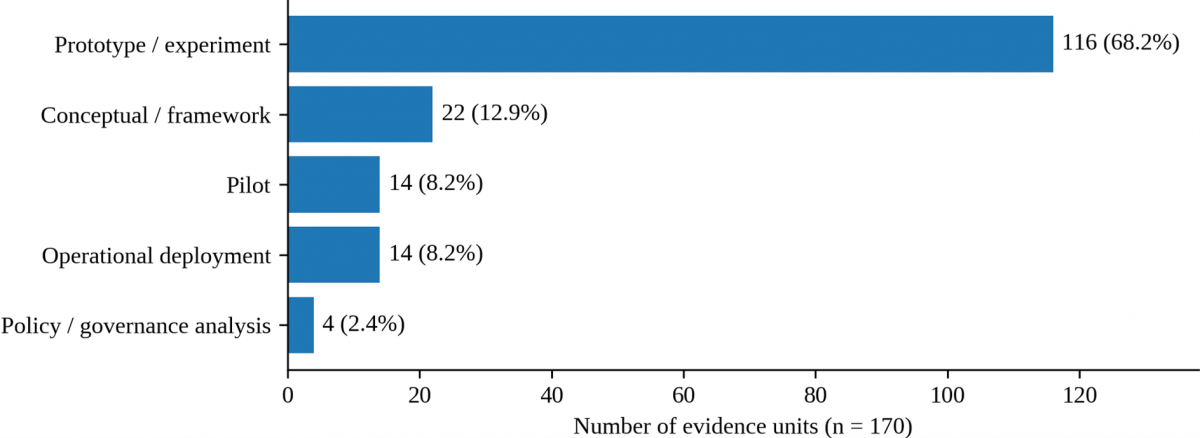
The updated evidence base changes the interpretation of the field. Rather than a small literature dominated by reviews and policy sources, the final synthesis contains 170 source-validated direct evidence units. However, the expansion in corpus size does not imply comparable expansion in organizational maturity. Prototypes and experiments account for 116 units (68.2%), while 22 (12.9%) are conceptual or framework studies. Only 14 units (8.2%) are pilots, and 14 (8.2%) are operational deployments; four (2.4%) are policy/governance analyses that still meet the direct organizational-evidence rule. Thus, only 28 of 170 units (16.5%) provide pilot or operational evidence. The dominant empirical pattern is technical feasibility, not sustained administrative use. The empirical-maturity distribution is shown in Figure 2.
Figure 2. Empirical maturity of the 170 validated public-sector artificial intelligence-knowledge management (AI-KM) evidence units
The operational cases are nevertheless informative. The Library of the National Congress of Chile reports AI-supported linked legislative data, NLP tagging, and machine-learning services used in parliamentary knowledge work [14]. PandemIQ Llama is linked to a platform serving more than 100 governmental and multilateral public-health organizations, with reports being integrated into the World Health Organization's EIOS environment [15]. A regional-administration case in Italy reports productivity and work-redesign effects from generative-AI use, while retaining human validation requirements [16]. Conversely, the government-hospital ChatAI case shows that deployment is not equivalent to sustainability: sociotechnical misalignment, infrastructure change, regulation, and evolving work practices eventually contributed to discontinuation [17]. These cases make organizational fit a central analytical variable rather than an afterthought.
3.2 Artificial intelligence capabilities and knowledge management functions are concentrated rather than lifecycle-wide
The corpus is multi-label, so one evidence unit may involve several AI capabilities and KM functions. NLP/information extraction is the most common AI family (57 units; 33.5%), followed by LLM/generative AI (52; 30.6%), RAG (30; 17.6%), knowledge-graph/semantic AI (27; 15.9%), deep-learning/transformer models (25; 14.7%), and classical ML (18; 10.6%). Agentic or multi-agent approaches appear in only nine units (5.3%). This distribution does not support a claim that public administration has broadly progressed from classical ML to autonomous agents. Older and newer capability families coexist, and the more agentic end of the spectrum remains comparatively small.
The KM distribution is similarly uneven. Retrieval/access/question answering appears in 92 units (54.1%), application/decision support in 73 (42.9%), codification/structuring in 51 (30.0%), sharing/service delivery in 49 (28.8%), capture/extraction in 48 (28.2%), and governance/compliance/audit in 41 (24.1%). Storage/repository functions appear in 13 units (7.6%), while learning/evolution/tacit-knowledge functions appear in only nine (5.3%). The evidence therefore supports a narrower conclusion than the previous manuscript: AI is most visible in document- and retrieval-centered knowledge work, decision support, structuring, extraction, service delivery, and compliance. Evidence for the full KM lifecycle, especially tacit-knowledge development and organizational learning, remains limited. Table 3 summarizes these multi-label AI-capability and KM-function profiles.
Table 3. Artificial intelligence (AI)-capability and knowledge management (KM)-function profile of the final direct-evidence corpus
|
AI Capability |
n |
% |
KM Function |
n |
% |
|
NLP/information extraction |
57 |
33.5 |
Retrieval/access/QA |
92 |
54.1 |
|
LLM/generative AI |
52 |
30.6 |
Application/decision support |
73 |
42.9 |
|
RAG / grounded generation |
30 |
17.6 |
Codification/structuring |
51 |
30.0 |
|
Knowledge graph/semantic AI |
27 |
15.9 |
Sharing/service delivery |
49 |
28.8 |
|
Deep learning/transformer |
25 |
14.7 |
Capture/extraction |
48 |
28.2 |
|
Classical ML/statistical learning |
18 |
10.6 |
Governance/compliance/audit |
41 |
24.1 |
|
Rule-based/expert reasoning |
12 |
7.1 |
Storage/repository |
13 |
7.6 |
|
Agentic/multi-agent |
9 |
5.3 |
Learning/evolution/tacit knowledge |
9 |
5.3 |
|
OCR/computer vision |
6 |
3.5 |
Other/not explicit |
2 |
1.2 |
|
Other/unspecified AI |
26 |
15.3 |
|
|
|
3.3 Recurring artificial intelligence-knowledge management interaction patterns
The co-occurrence matrix in Figure 3 reveals several recurring patterns. NLP is broadly distributed across capture, codification, retrieval, decision support, and governance. This reflects a mature class of public-sector tasks in which unstructured administrative text must be transformed into routable or analyzable information. Examples include a Serbian e-government question-answering system over public-administration documents [18] and a BERT-based Chinese government issue-handling system trained on 812,322 citizen inquiries to classify, characterize, and route cases to departments [19]. These systems are less visible than recent LLM assistants, but their organizational task is concrete, and their dependence on clearly bounded classification or retrieval functions can simplify validation.
Figure 3. Co-occurrence of major artificial intelligence (AI) capabilities and knowledge management (KM) functions in the validated direct-evidence corpus
Knowledge graphs and semantic AI are more closely associated with codification and retrieval, while LLMs and RAG are strongly associated with retrieval, decision support, and governance-oriented knowledge access. Public-service crowdsourcing work shows how AI-assisted processing can support collective KM and systems change [20]. In Austria, explainable AI was used to transform legal text into computational logic in a Ministry of Finance case, with domain experts involved in validation [21]. CaltransGPT illustrates the RAG pattern in transportation-agency institutional repositories [22]. DataGovAI applies multi-agent RAG to data-retention compliance for Utah state-government employees, with a supervisor agent validating cited responses [23]. A U.S. Air Force policy and logistics prototype similarly uses RAG over regulatory publications and includes evaluation by an Air Force officer [24]. These examples show why the unit of analysis should be the administrative knowledge task and organizational setting, not the novelty of the model alone.
3.4 Capability gains must be evaluated against governance and implementation risks
The field is often narrated as a technological progression from ML to LLMs, RAG, and agents. The evidence supports a different interpretation: each capability family changes the balance between flexibility and control. Classical classifiers can be narrow but comparatively easy to benchmark. Knowledge graphs improve explicit structure and traceability but require ontology and data-maintenance effort. LLMs broaden natural-language access but introduce hallucination, prompt sensitivity, privacy, and evaluation problems. RAG can ground generation in organizational sources [25], but retrieval error, stale or unauthorized documents, embedding leakage, and privacy attacks remain material risks [26]. Agentic systems add orchestration and task execution, which can improve workflow coverage but also increase the number of decisions, tools, and state transitions that must be governed.
The implementation indicators reinforce this point. Real administrative data were present in 110 units (64.7%), but public-sector users were explicitly involved in only 39 (22.9%); another 66 units described intended or mixed user involvement. Human oversight was explicit or clearly retained in 130 units (76.5%). These figures suggest that the literature is comparatively good at demonstrating AI on realistic public-sector information but much weaker at evaluating how public employees use, contest, correct, or institutionalize the systems. The evidence therefore does not justify a universal prescription for sovereign, on-premise, or agentic deployment. Data location, compute architecture, model openness, and automation level should instead be treated as context-dependent design choices shaped by sensitivity, law, service criticality, connectivity, and organizational capability. Table 4 summarizes these implementation indicators, while Table 5 compares the main capability-risk trade-offs.
Table 4. Implementation indicators in the final direct-evidence corpus
|
Dimension |
Category |
n |
% of 170 |
|
Empirical maturity |
Prototype/experiment |
116 |
68.2 |
|
Empirical maturity |
Conceptual / framework |
22 |
12.9 |
|
Empirical maturity |
Pilot |
14 |
8.2 |
|
Empirical maturity |
Operational deployment |
14 |
8.2 |
|
Empirical maturity |
Policy/governance analysis |
4 |
2.4 |
|
Real administrative data |
Yes |
110 |
64.7 |
|
Public-sector users |
Yes |
39 |
22.9 |
|
Human oversight evidence |
Explicit / clearly retained |
130 |
76.5 |
Table 5. Capability-risk comparison for public-sector artificial intelligence-knowledge management (AI-KM)
|
Capability Family |
Primary KM Strengths |
Principal Limitations/Governance Issues |
Evidence Interpretation |
|
Classical ML/NLP |
Classification, extraction, routing, bounded prediction |
Label quality, drift, limited contextual flexibility, bias in training data |
Substantial prototype evidence; often easier to benchmark against defined tasks |
|
Knowledge graph/semantic AI |
Codification, semantic retrieval, explicit relationships and provenance |
Ontology design/maintenance, integration cost, incomplete or stale graphs |
Useful where traceability and structured institutional knowledge are priorities |
|
LLM/RAG |
Natural-language access, synthesis, grounded QA, decision support |
Hallucination, retrieval failure, privacy/access control, source freshness, compute cost |
Rapidly growing evidence, but organizational evaluation lags technical evaluation |
|
Agentic/multi-agent |
Workflow decomposition, tool use, validation/orchestration roles |
Error propagation, authorization, state control, auditability, accountability |
Small evidence base (5.3%); should not be treated as the field's prevailing maturity stage |
3.5 Technical feasibility is ahead of organizational and public-value evidence
A central result of the review is the separation between technical performance and organizational evidence. Many prototypes report accuracy, retrieval, relevance, or generation metrics, yet fewer examine changes in work quality, service time, accountability, adoption, sustained use, or public value. The Thai People Map and Analytics Platform conversational agent translates natural-language questions into database queries for government analytics, but remains a bounded prototype [27]. CaltransGPT reports grounding and citation-oriented evaluation on a small query set [22]. DataGovAI compares RAG configurations for compliance support [23]. These are meaningful technical results, but none should be described as evidence that the corresponding organization has achieved mature, routine, organization-wide AI-KM.
The most valuable operational studies therefore do more than report model performance. They show integration with work, users, institutional repositories, or governance arrangements [14-17]. The hospital ChatAI case is particularly important because discontinuation itself is evidence: successful technical functionality did not prevent later sociotechnical misalignment [17]. Future evaluations should consequently report at least four layers: technical quality; human-task performance; organizational adoption and workflow effects; and governance/public-value outcomes. Without this separation, review conclusions risk rewarding technically sophisticated prototypes while overlooking simpler systems that have stronger institutional fit.
3.6 Morocco and Middle East and North Africa: Research context, not demonstrated maturity
The Morocco/MENA search streams were included to prevent a geographically generic evidence map from being mistaken for a universal one. Previous work by the authors identified adoption challenges, guidelines, and success factors for KM systems in Moroccan public administration [28, 29]. More recent Moroccan research demonstrates relevant technical capability, including NLP and LLM classification of Darija requests for administrative documents [30]. However, the final source-level validation demoted that study from direct public-sector implementation evidence because no Moroccan administration was shown to own, deploy, or organizationally evaluate the proposed chatbot. This distinction is deliberate. Strategy, technical readiness, language resources, and public-service motivation are important context, but they are not substitutes for implementation evidence.
The revised conclusion for Morocco is therefore more cautious and more useful. The available evidence supports a research opportunity at the intersection of multilingual public-service knowledge, KM capability, governance, and constrained infrastructure; it does not support a claim that Moroccan administrations have already converged on a mature AI-KM deployment model. Priority studies should identify specific administrative workflows, involve public employees, evaluate Arabic/Darija/French knowledge access under realistic data-governance constraints, and measure sustained organizational outcomes.
3.7 Positioning against prior reviews
The evidence taxonomy differs from earlier reviews in three ways. First, public-sector KM reviews established organizational and knowledge-governance issues before the current generative-AI wave [4]. Second, public-sector AI reviews mapped application areas and adoption constraints without using KM functions as the principal analytical structure [5-7, 31]. Third, AI-KM reviews examined technique-process relationships across organizations but did not apply a strict organizational public-sector evidence rule or a maturity distinction between prototype, pilot, and operation [8-12, 32-34]. The present review therefore adds more than a geographic filter: it links AI capability to KM function while independently coding whether the evidence represents technical experimentation or actual administrative use. That additional dimension changes the substantive conclusion from "AI is diffusing across KM" to "AI is concentrated in a subset of public-sector knowledge functions, and deployment maturity is much lower than technical activity suggests."
3.8 Research agenda and limitations
Five priorities follow from the evidence. First, the field needs longitudinal implementation studies that track use, correction, abandonment, and institutionalization rather than only benchmark performance. Second, evaluations should connect model metrics to administrative outcomes such as case-processing time, consistency, auditability, knowledge reuse, employee workload, and service quality. Third, governance should be evaluated as an implemented control system: access-aware retrieval, provenance, logging, human decision rights, update governance, and responsibility should be tested rather than merely recommended. Fourth, multilingual and resource-constrained administrations require dedicated evidence on local-language retrieval, offline or hybrid operation, model maintenance, and data-residency constraints. Fifth, comparative studies should examine when narrower NLP, rule-based, or semantic systems outperform generative or agentic alternatives on cost, reliability, explainability, and organizational fit.
The review has limitations. Screening and coding were conducted by a single reviewer; the 814-record consistency check measures intra-reviewer stability, not inter-rater reliability. Source verification was not uniformly based on full text because access varied across publications, so the final claims are limited to what could be verified at source level. English and French dominated the formal screening, which may underrepresent local-language public-sector work. Finally, the field is changing rapidly, and the August 2026 search is a time-bounded snapshot. The analytical categories should therefore be treated as an evidence map that can be updated rather than as a fixed maturity model.
This review finds a public-sector AI-KM field that is broader than the earlier manuscript suggested but less mature than its technological visibility implies. Across 170 validated direct-evidence units, activity is concentrated in retrieval and question answering, decision support, document structuring, extraction, service delivery, and compliance. NLP and LLM-based systems are prominent, RAG is increasingly important, and agentic approaches remain a small minority. Most evidence is still experimental, while pilot and operational studies together account for only 16.5%.
For public administrators and KM managers, the practical implication is to begin with a defined knowledge problem and evidence requirement rather than a preferred AI architecture. A system should be evaluated simultaneously for technical quality, workflow fit, user behavior, governance controls, and public value. For researchers, the principal gap is no longer the absence of prototypes; it is the shortage of longitudinal, user-centered, and governance-aware evidence on sustained administrative use. For Morocco and similar contexts, the strongest contribution will come from carefully evaluated implementations in real public organizations rather than from extrapolating national strategy or technical prototypes into claims of deployment maturity.
During the preparation of this manuscript, the authors used a generative AI assistant to support drafting, language refinement, and editorial revision. All AI-assisted text was reviewed, edited, and validated by the authors, who take full responsibility for the accuracy, interpretation, references, and final content of the article.
Appendix S1
Exact Search Protocol, Selection Audit, and Coding Rules
S1.1 Search dates, databases, and filters
The formal academic search was rerun on 17 August 2026 in Scopus, Web of Science Core Collection, and IEEE Xplore. Four complementary streams were used in each database: A, direct AI-KM plus public sector; B, public-sector AI knowledge work; C, Morocco/MENA public-sector AI; and D, Morocco/MENA public-sector KM baseline. The ACM Digital Library Basic interface was checked on 23 August 2026 as a diagnostic source only; its results were excluded from the formal identification pool because reproducible publication-date and content-type filtering required Premium access.
|
Database |
Stream |
Raw |
2015–2026 |
Eligible Type(s) |
Language Stage |
Final Export |
|
Scopus |
A |
446 |
362 |
289 |
275 |
275 |
|
Scopus |
B |
3451 |
2703 |
2315 |
2245 |
2245 |
|
Scopus |
C |
119 |
119 |
90 |
89 |
89 |
|
Scopus |
D |
26 |
21 |
18 |
18 |
18 |
|
Web of Science |
A |
119 |
108 |
106 |
102 |
102 |
|
Web of Science |
B |
919 |
856 |
850 |
832 |
832 |
|
Web of Science |
C |
30 |
30 |
29 |
29 |
29 |
|
Web of Science |
D |
14 |
12 |
11 |
11 |
11 |
|
IEEE Xplore |
A |
705 |
635 |
618 |
Not available |
618 |
|
IEEE Xplore |
B |
2857 |
2640 |
2523 |
Not available |
2523 |
|
IEEE Xplore |
C |
109 |
106 |
104 |
Not available |
104 |
|
IEEE Xplore |
D |
32 |
22 |
22 |
Not available |
22 |
S1.2 Scopus - exact Advanced Search strings
Field code: TITLE-ABS-KEY. Filters after each raw query: publication years 2015-2026; document type Article, Conference Paper, or Review; language English or French.
Search A - direct AI-KM + public sector
TITLE-ABS-KEY(
(
"knowledge management" OR "knowledge management system*" OR "knowledge sharing" OR "knowledge transfer" OR "knowledge capture" OR "knowledge retrieval" OR "organizational knowledge" OR "institutional knowledge"
)
AND
(
"artificial intelligence" OR "machine learning" OR "natural language processing" OR "generative AI" OR "generative artificial intelligence" OR "large language model*" OR LLM OR "retrieval augmented generation" OR RAG OR "agentic AI" OR "AI agent*"
)
AND
(
"public administration" OR "public sector" OR government* OR "government agenc*" OR ministr* OR municipal* OR "civil service" OR "public service*" OR "digital government" OR "e-government" OR egovernment
)
)
Search B - public-sector AI knowledge work
TITLE-ABS-KEY(
(
"artificial intelligence" OR "machine learning" OR "natural language processing" OR "generative AI" OR "generative artificial intelligence" OR "large language model*" OR LLM OR "retrieval augmented generation" OR RAG OR "agentic AI" OR "AI agent*"
)
AND
(
"public administration" OR "public sector" OR government* OR "government agenc*" OR ministr* OR municipal* OR "civil service" OR "public service*" OR "digital government" OR "e-government" OR egovernment
)
AND
(
"document retrieval" OR "information retrieval" OR "document management" OR "records management" OR "knowledge base*" OR "institutional memory" OR "decision support" OR "question answering" OR chatbot* OR "intelligent assistant*" OR "virtual assistant*" OR "conversational agent*" OR "document automation" OR "case management"
)
)
Search C - Morocco/MENA public-sector AI
TITLE-ABS-KEY(
(
"artificial intelligence" OR "machine learning" OR "natural language processing" OR "generative AI" OR "generative artificial intelligence" OR "large language model*" OR LLM OR "retrieval augmented generation" OR RAG OR "agentic AI" OR chatbot* OR "intelligent assistant*"
)
AND
(
"public administration" OR "public sector" OR government* OR "digital government" OR "e-government" OR "administration publique" OR "secteur public" OR gouvernement* OR ministère*
)
AND
(
Morocc* OR Maroc OR Maghreb OR MENA OR "Middle East and North Africa" OR "North Africa"
)
)
Search D - Morocco/MENA public-sector KM baseline
TITLE-ABS-KEY(
(
"knowledge management" OR "knowledge management system*" OR "knowledge sharing" OR "knowledge transfer" OR "organizational knowledge" OR "institutional knowledge" OR "gestion des connaissances" OR "management des connaissances" OR "partage des connaissances" OR "transfert des connaissances"
)
AND
(
"public administration" OR "public sector" OR government* OR "administration publique" OR "secteur public" OR gouvernement* OR ministère*
)
AND
(
Morocc* OR Maroc OR Maghreb OR MENA OR "Middle East and North Africa" OR "North Africa"
)
)
S1.3 Web of Science Core Collection - exact Topic strings
Search field: Topic (TS), which searches title, abstract, author keywords, and Keywords Plus in the interface used. Filters: 2015-2026; Article, Review Article, or Proceedings Paper; English or French. The Scopus lexical expressions were retained, with the field wrapper changed from TITLE-ABS-KEY(...) to TS=(...).
Search A
TS=(
(
"knowledge management" OR "knowledge management system*" OR "knowledge sharing" OR "knowledge transfer" OR "knowledge capture" OR "knowledge retrieval" OR "organizational knowledge" OR "institutional knowledge"
)
AND
(
"artificial intelligence" OR "machine learning" OR "natural language processing" OR "generative AI" OR "generative artificial intelligence" OR "large language model*" OR LLM OR "retrieval augmented generation" OR RAG OR "agentic AI" OR "AI agent*"
)
AND
(
"public administration" OR "public sector" OR government* OR "government agenc*" OR ministr* OR municipal* OR "civil service" OR "public service*" OR "digital government" OR "e-government" OR egovernment
)
)
Search B
TS=(
(
"artificial intelligence" OR "machine learning" OR "natural language processing" OR "generative AI" OR "generative artificial intelligence" OR "large language model*" OR LLM OR "retrieval augmented generation" OR RAG OR "agentic AI" OR "AI agent*"
)
AND
(
"public administration" OR "public sector" OR government* OR "government agenc*" OR ministr* OR municipal* OR "civil service" OR "public service*" OR "digital government" OR "e-government" OR egovernment
)
AND
(
"document retrieval" OR "information retrieval" OR "document management" OR "records management" OR "knowledge base*" OR "institutional memory" OR "decision support" OR "question answering" OR chatbot* OR "intelligent assistant*" OR "virtual assistant*" OR "conversational agent*" OR "document automation" OR "case management"
)
)
Search C
TS=(
(
"artificial intelligence" OR "machine learning" OR "natural language processing" OR "generative AI" OR "generative artificial intelligence" OR "large language model*" OR LLM OR "retrieval augmented generation" OR RAG OR "agentic AI" OR chatbot* OR "intelligent assistant*"
)
AND
(
"public administration" OR "public sector" OR government* OR "digital government" OR "e-government" OR "administration publique" OR "secteur public" OR gouvernement* OR ministère*
)
AND
(
Morocc* OR Maroc OR Maghreb OR MENA OR "Middle East and North Africa" OR "North Africa"
)
)
Search D
TS=(
(
"knowledge management" OR "knowledge management system*" OR "knowledge sharing" OR "knowledge transfer" OR "organizational knowledge" OR "institutional knowledge" OR "gestion des connaissances" OR "management des connaissances" OR "partage des connaissances" OR "transfert des connaissances"
)
AND
(
"public administration" OR "public sector" OR government* OR "administration publique" OR "secteur public" OR gouvernement* OR ministère*
)
AND
(
Morocc* OR Maroc OR Maghreb OR MENA OR "Middle East and North Africa" OR "North Africa"
)
)
S1.4 IEEE Xplore - structured Advanced Search
IEEE Xplore was searched through the structured Advanced Search interface. Each conceptual block was entered in a separate row with the field set to All Metadata; rows were joined with AND. The lexical content of each row matched the blocks below. The year range was then restricted to 2015-2026 and eligible publication content types were Journals, Conferences, and Early Access Articles where available. No language facet was available.
IEEE Search A
Row 1 - KM block
"knowledge management" OR "knowledge management system*" OR "knowledge sharing" OR "knowledge transfer" OR "knowledge capture" OR "knowledge retrieval" OR "organizational knowledge" OR "institutional knowledge"
Row 2 - AI block
"artificial intelligence" OR "machine learning" OR "natural language processing" OR "generative AI" OR "generative artificial intelligence" OR "large language model*" OR LLM OR "retrieval augmented generation" OR RAG OR "agentic AI" OR "AI agent*"
Row 3 - public-sector block
"public administration" OR "public sector" OR government* OR "government agenc*" OR ministr* OR municipal* OR "civil service" OR "public service*" OR "digital government" OR "e-government" OR egovernment
IEEE Search B
Row 1 - AI block
"artificial intelligence" OR "machine learning" OR "natural language processing" OR "generative AI" OR "generative artificial intelligence" OR "large language model*" OR LLM OR "retrieval augmented generation" OR RAG OR "agentic AI" OR "AI agent*"
Row 2 - public-sector block
"public administration" OR "public sector" OR government* OR "government agenc*" OR ministr* OR municipal* OR "civil service" OR "public service*" OR "digital government" OR "e-government" OR egovernment
Row 3 - knowledge-work block
"document retrieval" OR "information retrieval" OR "document management" OR "records management" OR "knowledge base*" OR "institutional memory" OR "decision support" OR "question answering" OR chatbot* OR "intelligent assistant*" OR "virtual assistant*" OR "conversational agent*" OR "document automation" OR "case management"
IEEE Search C
Row 1 - AI block
"artificial intelligence" OR "machine learning" OR "natural language processing" OR "generative AI" OR "generative artificial intelligence" OR "large language model*" OR LLM OR "retrieval augmented generation" OR RAG OR "agentic AI" OR chatbot* OR "intelligent assistant*"
Row 2 - public-sector block
"public administration" OR "public sector" OR government* OR "digital government" OR "e-government" OR "administration publique" OR "secteur public" OR gouvernement* OR ministère*
Row 3 - regional block
Morocc* OR Maroc OR Maghreb OR MENA OR "Middle East and North Africa" OR "North Africa"
IEEE Search D
Row 1 - KM block
"knowledge management" OR "knowledge management system*" OR "knowledge sharing" OR "knowledge transfer" OR "organizational knowledge" OR "institutional knowledge" OR "gestion des connaissances" OR "management des connaissances" OR "partage des connaissances" OR "transfert des connaissances"
Row 2 - public-sector block
"public administration" OR "public sector" OR government* OR "administration publique" OR "secteur public" OR gouvernement* OR ministère*
Row 3 - regional block
Morocc* OR Maroc OR Maghreb OR MENA OR "Middle East and North Africa" OR "North Africa"
S1.5 Deduplication and screening audit
|
Stage |
Records Remaining |
Removed / Changed |
|
Raw retrieval occurrences |
6,868 |
- |
|
After native database-ID deduplication |
6,621 |
247 removed |
|
After exact DOI deduplication |
5,512 |
1,109 removed |
|
After exact normalized title + year |
5,457 |
55 removed |
|
After manual metadata-duplicate review |
5,448 |
9 removed |
|
Title/abstract screening |
2,455 retained |
2,993 excluded |
|
Evidence stratification |
917 D; 824 G; 560 C; 154 B |
Broadly retained set coded |
|
Strict D refinement |
363 |
554 provisional D records not retained in strict direct set |
|
Source verification |
193 direct reports |
170 candidates demoted/excluded from direct core |
|
Publication-family consolidation |
190 primary units |
3 overlapping reports consolidated |
|
Final source-level validation |
170 direct evidence units |
20 demoted: 17 to G; 3 to C |
Title/abstract exclusion reasons were recorded using the following mutually exclusive primary codes:
|
Code |
Primary Exclusion Reason |
n |
|
E1 |
AI absent or incidental |
478 |
|
E2 |
KM/substantive knowledge-work function absent or incidental |
979 |
|
E3 |
Neither sufficiently public-sector relevant nor useful AI-KM evidence |
1504 |
|
E4 |
Wrong publication/evidence type |
15 |
|
E5 |
Outside language criterion |
0 |
|
E6 |
Clearly unrelated despite keyword match |
17 |
|
E7 |
Duplicate/earlier version detected during screening |
0 |
S1.6 Screening exclusion and evidence-class decision rules
|
Rule |
Operational Decision |
|
AI relevance |
The study had to identify a substantive AI capability or AI-based system; generic digitalization without AI was not direct evidence. |
|
KM/knowledge-work relevance |
The AI had to perform capture, extraction, codification, storage, retrieval/QA, sharing/service, decision support, governance/compliance/audit, or organizational learning/tacit-knowledge work. |
|
Public-sector relevance |
A public organization, public-service workflow, or identifiable public-administration implementation/evaluation had to be explicit for direct D evidence. |
|
Government-data-only rule |
Government documents, legislation, portals, or public datasets used only as research material did not by themselves establish public-sector organizational implementation; these records were coded G or C as appropriate. |
|
Governance/context rule |
Readiness, policy, strategy, adoption, governance, and digital-transformation studies without direct AI-KM implementation were coded C. |
|
KM baseline rule |
Public-sector KM studies without substantive AI were coded B. |
|
Duplicate/publication-family rule |
Substantially overlapping reports from the same underlying study were consolidated conservatively; distinct technical extensions were retained only when they represented separate evidence units. |
S1.7 Coding codebook for the final direct-evidence corpus
Coding was multi-label for AI capability and KM function, and single-label for empirical maturity. A unit could therefore contribute to more than one AI or KM count, but only one maturity category.
|
Dimension |
Categories / Decision Rule |
|
AI capability |
NLP/information extraction; LLM/generative AI; RAG/grounded generation; knowledge graph/semantic AI; deep learning/transformer; classical ML/statistical learning; rule-based/expert reasoning; agentic/multi-agent; OCR/computer vision; other/unspecified AI. |
|
KM function |
Capture/extraction; codification/structuring; storage/repository; retrieval/access/QA; sharing/service delivery; application/decision support; governance/compliance/audit; learning/evolution/tacit knowledge; other/not explicit. |
|
Empirical maturity |
Prototype/experiment: bounded technical evaluation. Conceptual/framework: architecture/model without field implementation. Pilot: limited field/organizational trial. Operational deployment: system integrated into real organizational service/workflow. Policy/governance analysis: direct organizational evidence centered on governance or implementation effects. |
|
Real administrative data |
Yes; No; Mixed/unclear, based on whether operational/public-administration records or data were used rather than only synthetic/research data. |
|
Public-sector users |
Yes; No; Mixed/target users only, based on explicit involvement of public employees or organizational users in use/evaluation. |
|
Human oversight |
Coded from explicit source evidence that people retained validation, decision, review, correction, or responsibility roles; absence of evidence was not interpreted as autonomous operation. |
S1.8 Single-reviewer procedure and consistency check
Title/abstract screening and analytical coding were performed by one reviewer. This limitation is reported explicitly in the manuscript. To assess internal decision stability, all 514 initially uncertain records and a reproducible random 10% sample of excluded records (n = 300; seed 30401) were rechecked after the initial screening pass. The resulting 814 rechecks produced zero changes in inclusion decision or evidence code. This is reported as an intra-reviewer consistency check and is not presented as inter-rater reliability or Cohen's kappa.
S1.9 Final quantitative coding summary
|
Measure |
Count |
Share of n = 170 |
|
Prototype/experiment |
116 |
68.2% |
|
Conceptual/framework |
22 |
12.9% |
|
Pilot |
14 |
8.2% |
|
Operational deployment |
14 |
8.2% |
|
Policy/governance analysis |
4 |
2.4% |
|
Real administrative data - Yes |
110 |
64.7% |
|
Public-sector users - Yes |
39 |
22.9% |
|
Human oversight explicit/clearly retained |
130 |
76.5% |
[1] Alavi, M., Leidner, D.E. (2001). Knowledge management and knowledge management systems: Conceptual foundations and research issues. MIS Quarterly, 25(1): 107-136. https://doi.org/10.2307/3250961
[2] Wiig, K.M. (2002). Knowledge management in public administration. Journal of Knowledge Management, 6(3): 224-239. https://doi.org/10.1108/13673270210434331
[3] International Organization for Standardization. (2018). ISO 30401:2018 Knowledge management systems - Requirements. Geneva: ISO.
[4] Massaro, M., Dumay, J., Garlatti, A. (2015). Public sector knowledge management: A structured literature review. Journal of Knowledge Management, 19(3): 530-558. https://doi.org/10.1108/JKM-11-2014-0466
[5] Wirtz, B.W., Weyerer, J.C., Geyer, C. (2019). Artificial intelligence and the public sector—Applications and challenges. International Journal of Public Administration, 42(7): 596-615. https://doi.org/10.1080/01900692.2018.1498103
[6] De Sousa, W.G., de Melo, E.R.P., Bermejo, P.H.D.S., Farias, R.A.S., Gomes, A.O. (2019). How and where is artificial intelligence in the public sector going? A literature review and research agenda. Government Information Quarterly, 36(4): 101392. https://doi.org/10.1016/j.giq.2019.07.004
[7] Maragno, G., Tangi, L., Gastaldi, L., Benedetti, M. (2023). Exploring the factors, affordances and constraints outlining the implementation of Artificial intelligence in public sector organizations. International Journal of Information Management, 73: 102686. https://doi.org/10.1016/j.ijinfomgt.2023.102686
[8] Mohammad, A., Zahrawi, M., Al-Emran, M., Shaalan, K. (2022). A systematic review on the relationship between artificial intelligence techniques and knowledge management processes. In Recent Innovations in Artificial Intelligence and Smart Applications, pp. 67-83. https://doi.org/10.1007/978-3-031-14748-7_4
[9] Thakuri, S., Bon, M., Cavus, N., Sancar, N. (2024). Artificial intelligence on knowledge management systems for businesses: A systematic literature review. TEM Journal, 13(3): 2146-2155. https://doi.org/10.18421/TEM133-42
[10] Nakash, M., Bolisani, E. (2024). Knowledge management meets artificial intelligence: A systematic review and future research agenda. European Conference on Knowledge Management, 25(1): 544-552. https://doi.org/10.34190/eckm.25.1.2443
[11] Alavi, M., Leidner, D., Mousavi, R. (2024). Knowledge management perspective of generative artificial intelligence (GenAI). Journal of the Association for Information Systems, 25(1): 1-12. https://doi.org/10.17705/1jais.00859
[12] Karakurt, E., Akbulut, A. (2025). Retrieval-augmented generation (RAG) and large language models (LLMS) for enterprise knowledge management and document automation: A systematic literature review. Applied Sciences, 16(1): 368. https://doi.org/10.3390/app16010368
[13] Page, M.J., McKenzie, J.E., Bossuyt, P.M., et al. (2021). The PRISMA 2020 statement: An updated guideline for reporting systematic reviews. BMJ, 372: n71. https://doi.org/10.1136/bmj.n71
[14] Cifuentes-Silva, F., Astudillo, H., Gayo, J.E.L. (2025). Transforming parliamentary libraries: Enhancing processes delivering new services with artificial intelligence. IFLA Journal, 51(3): 814-835. https://doi.org/10.1177/03400352251315844
[15] Yang, J., Talaei, M., Lassmann, B., Bhadelia, N., Paschalidis, I.C. (2026). PandemIQ Llama: A domain-adapted foundation model for enhanced pandemic intelligence. In Proceedings of the AAAI Conference on Artificial Intelligence, pp. 39504-39512. https://doi.org/10.1609/aaai.v40i46.41301
[16] Frieri, F.R., Orelli, R.L. (2026). Governing generative AI in public administration: Productivity, work redesign and reflective human–AI collaboration. Public Money & Management, 1-11. https://doi.org/10.1080/09540962.2026.2703173
[17] Yeow, A., Cleland, J., Soh, C., Balete, C. (2026). Sociotechnical misalignments in hospital AI system implementation: Qualitative case study. Journal of Medical Internet Research, 28: e87534. https://doi.org/10.2196/87534
[18] Nedeljković, S., Nikolić, V., Čabarkapa, M., Mišić, J., Ranđelović, D. (2019). An advanced quick-answering system intended for the e-government service in the republic of Serbia. Acta Polytechnica Hungarica, 16(4): 153-174. https://doi.org/10.12700/APH.16.4.2019.4.8
[19] Fang, K., Xu, C.K. (2026). Improve issue-handling efficiency in government QA systems: An automatic issue classification and distribution system. Journal of Management Analytics, 13(1): 1-16. https://doi.org/10.1080/23270012.2025.2568494
[20] Ulmanen, S., Hirvonen, M., Tattersall, P., et al. (2024). Description of crowdsourcing and AI-based tool for knowledge management and systems change in public services. International Journal of Innovation and Technology Management, 21(4): 2450027. https://doi.org/10.1142/S0219877024500275
[21] Bertl, M., Price, S., Draheim, D. (2026). Transforming legal texts into computational logic: Enhancing next generation public sector automation through explainable AI decision support. International Journal of Cognitive Computing in Engineering, 7(1): 40-57. https://doi.org/10.1016/j.ijcce.2025.07.003
[22] Lekhi, R., Desai, A., Mahto, R., Sharma, D. (2026). CaltransGPT using retrieval-augmented large language models in transportation agencies. In 2026 IEEE World AI IoT Congress (AIIoT), Seattle, USA, pp. 0307-0312. https://doi.org/10.1109/AIIoT68874.2026.11569521
[23] Memari, M., Rudolph, G., Burns, B., Howlett, E., Bramwell, C., Mcewan, G. (2026). DataGovAI: A multi-agent RAG system for government data retention compliance with privacy-preserving evaluation. In 2026 Intermountain Engineering, Technology and Computing (IETC), Provo, USA, pp. 1-6. https://doi.org/10.1109/IETC69527.2026.11568649
[24] Mahawar, V., Bhalla, S., McKee, J., Boicu, M. (2025). A retrieval-augmented generation-powered chatbot for air force policy and logistics compliance. In 2025 IEEE MIT Undergraduate Research Technology Conference (URTC), Cambridge, USA, pp. 1-5. https://doi.org/10.1109/URTC68753.2025.11533029
[25] Lewis, P., Perez, E., Piktus, A., et al. (2020). Retrieval-augmented generation for knowledge-intensive NLP tasks. Advances in Neural Information Processing Systems, 33: 9459-9474.
[26] Zeng, S., Zhang, J., He, P., et al. (2024). The good and the bad: Exploring privacy issues in retrieval-augmented generation (RAG). In Findings of the Association for Computational Linguistics: ACL 2024, pp. 4505-4524. https://doi.org/10.18653/v1/2024.findings-acl.267
[27] Simud, T., Ruengittinun, S., Surasvadi, N., Sanglerdsinlapachai, N., Plangprasopchok, A. (2020). A conversational agent for database query: A use case for Thai people map and analytics platform. In 2020 15th International Joint Symposium on Artificial Intelligence and Natural Language Processing (iSAI-NLP), Bangkok, Thailand, pp. 1-6. https://doi.org/10.1109/ISAI-NLP51646.2020.9376833
[28] Zegmout, M.A., El Kassiri, A., Retbi, A., Bennani, S. (2024). Moroccan public administration: Which challenges and guidelines for an efficient KMS? In 2024 IEEE/ACIS 27th International Conference on Software Engineering, Artificial Intelligence, Networking and Parallel/Distributed Computing (SNPD), Beijing, China, pp. 290-295. https://doi.org/10.1109/SNPD61259.2024.10673964
[29] Zegmout, M.A., El Kassiri, A., Retbi, A., Bennani, S. (2024). Strategic implementation of knowledge management systems in Moroccan public administration: Guidelines and key success factors. In 2024 IEEE/ACIS 9th International Conference on Big Data, Cloud Computing, and Data Science (BCD), Kitakyushu, Japan, pp. 103-108. https://doi.org/10.1109/BCD61269.2024.10743105
[30] Zaidani, H., Koulali, R., Maizate, A., Ouzzif, M. (2025). Augmentation and classification of requests in Moroccan dialect to improve quality of public service: A comparative study of algorithms. Future Internet, 17(4): 176. https://doi.org/10.3390/fi17040176
[31] Reis, J., Santo, P.E., Melão, N. (2019). Impacts of artificial intelligence on public administration: A systematic literature review. In 2019 14th Iberian Conference on Information Systems and Technologies (CISTI), Coimbra, Portugal, pp. 1-7. https://doi.org/10.23919/CISTI.2019.8760893
[32] Anshari, M., Syafrudin, M., Tan, A., Fitriyani, N.L., Alas, Y. (2023). Optimisation of knowledge management (KM) with machine learning (ML) enabled. Information, 14(1): 35. https://doi.org/10.3390/info14010035
[33] Gelashvili-Luik, T., Vihma, P., Pappel, I. (2025). Navigating the AI revolution: Challenges and opportunities for integrating emerging technologies into knowledge management systems. Systematic literature review. Frontiers in Artificial Intelligence, 8: 1595930. https://doi.org/10.3389/frai.2025.1595930
[34] Panda, M., Puri, R. (2026). Understanding the role of artificial intelligence in knowledge management systems: A systematic review using the antecedent, consequences and intervention framework. Journal of Work-Applied Management, 18(1): 81-94. https://doi.org/10.1108/JWAM-05-2025-0082