Wael H. Hamdon* | Marwan A. Abdulhameed | Majid S. M. Al-Hafidh
© 2026 The authors. This article is published by IIETA and is licensed under the CC BY 4.0 license (http://creativecommons.org/licenses/by/4.0/).
OPEN ACCESS
Demand-side management (DSM) can achieve a variety of objectives, such as lowering the peak-to-average ratio (PAR), reducing peak load, and decreasing overall energy costs. The Iraqi electrical power system is facing critical challenges, particularly a concerning shortage of electrical generation. This shortage forces the government to implement power cuts for many consumers during peak load times. To address this problem, demand must be managed from the consumer side. This can reduce peak electrical loads. In Iraq, electrical loads are divided into several sectors. The residential sector is the largest consumer of electrical energy. Therefore, managing demand in this sector can greatly reduce pressure during peak load periods. However, the current residential electricity tariff in Iraq depends on total monthly consumption. It does not depend on the time of use. This limits the motivation of consumers to shift their electricity use away from peak hours. This research proposes a new demand response program for the residential sector. A home energy management system (HEMS) is designed, and the tree topology is used to manage the home loads and redistribute the available energy among the homes to reduce electricity use during peak hours. Simulation results indicate that the proposed framework has the potential to improve demand balancing under the available generation constraints.
demand-side management, home energy management system, residential load scheduling, demand response, smart grid, tree topology, Iraqi residential power system
The residential sector is one of the main sources of electricity demand. This is because most daily activities depend on electricity. These activities include cooling, heating, lighting, cooking, and operating home appliances. Globally, buildings consume about 40% of total energy and may use up to 65% of electricity demand [1]. In the United States, household appliances alone account for nearly 42% of residential energy use [2]. This shows that better control of appliance use can reduce residential electricity demand, especially during peak hours. In Europe, buildings are responsible for nearly 40% of total energy use [3]. In Libya, the housing sector accounts for about 39% of electricity demand [4]. Iraq follows the same trend. The residential sector consumes more than 50% of the country’s total electricity [5].
Several demand-side management (DSM) strategies have been proposed in previous studies [6-18]. These programs usually depend on incentives to guide consumer behavior. Their main objectives are to reduce peak load, lower the peak-to-average ratio (PAR), and decrease total energy cost. They also reduce the delay in operating household appliances. At the same time, they preserve user comfort. Several studies have investigated the use of renewable energy in power grids [10-12]. These studies focused on clean sources such as photovoltaic panels, solar thermal collectors, and wind turbines. Such sources are commonly installed in local power networks, which are known as microgrids [13]. Recently, energy storage systems have become more important [14, 15]. The growing use of DC devices has also increased interest in hybrid AC/DC power systems [14, 15].
In many systems, electricity tariffs vary based on usage duration. There are several time-based pricing methods, with the most well-known being Time-of-Use Pricing (TOU), Critical Peak Pricing (CPP), Real-Time Pricing (RTP), Inclining Block Rates (IBR), Flat Rate Pricing (FRP), and Dynamic Pricing (DP) [16-17].
The problem is framed as a mathematical optimization challenge, and various heuristic algorithms are employed to find a solution. These algorithms include the Genetic Algorithm (GA), Binary Particle Swarm Optimization (BPSO), Mixed-Integer Linear Programming (MILP), Bacterial Foraging Optimization (BFO), Grey Wolf Optimization (GWO), Wind-Driven Optimization (WDO), and the Clonal Selection Algorithm (CSA), among others [18]. Several simulation tools for smart microgrids have been proposed and utilized. Among these, the most notable tools include GridLAB-D, Analogic, Repast, RAPSim, Aprem, Open DSS, and EnergyPlus [19].
One of the key components of DSM is the installation of smart meters in homes. A smart meter, equipped with a bidirectional internal display, communicates with smart home appliances based on the power management software installed within it. This bidirectional communication between the system and the smart meter can occur through various methods, including wired connections like Ethernet and Power Line Communication, as well as wireless options such as Wi-Fi and ZigBee, or even cellular networks like mobile communications [20-23].
Household appliances can be classified in several ways, which are generally similar across categories. Loads can be categorized by their run time or the nature of user-initiated events. Household appliances are further divided into removable or fixed loads. Load appliances are classified as either controlled or uncontrolled. Furthermore, appliances can be organized into three groups based on their operational features [12, 17, 24]: 1) interruptible appliances, 2) uninterruptible appliances, and 3) inflexible appliances.
The Smart Grid (SG) integrates smart networks (SN), communication technologies, and information technologies (ICT) with traditional energy networks. It includes various measures for power management and operations, such as intelligent devices, smart meters, and energy efficiency resources. One of the key components of the Smart Grid is the home energy management system (HEMS), which improves energy efficiency in the power infrastructure of residential areas [10-25].
1.1 Research gap and motivation
Recent advances in residential DSM have focused on intelligent appliance scheduling, Internet of Things (IoT)-based HEMS, renewable energy integration, and optimization-based energy management [10-25]. To better highlight the differences between representative studies and the proposed framework, Table 1 summarizes the main characteristics, limitations, and research gaps addressed by this work.
Table 1. Comparison of existing residential demand-side management (DSM) methods and the proposed home energy management system (HEMS) framework
|
Study |
Main Method |
Limitation |
Proposed Improvement |
|
Javaid et al. [10] |
Renewable-energy HEMS |
Requires Photovoltaic (PV) generation |
Operates using existing grid |
|
Ajao et al. [11] |
Distributed renewable management |
Renewable dependent |
No renewable installation required |
|
Elyas et al. [12] |
Solar PV optimization |
PV availability required |
Suitable for conventional residential grids |
|
Silva et al. [17] |
Appliance scheduling |
Individual home only |
Coordinates multiple neighboring homes |
|
Proposed work |
Tree-topology HEMS |
Iraqi residential sector |
Real-time energy redistribution under generation constraints |
As shown in Table 1, most existing studies focus on optimization-based scheduling, renewable energy integration, or price-driven demand response. In contrast, the proposed framework is specifically designed for the Iraqi residential sector, where electricity tariffs are fixed, and generation shortages require real-time coordination of available electrical capacity rather than price-based load shifting.
These approaches have demonstrated considerable improvements in reducing peak demand and improving energy efficiency. Nevertheless, most existing methods assume the availability of dynamic electricity tariffs, local renewable generation, or energy storage systems that enable consumers to respond economically to electricity price variations.
Such assumptions are difficult to implement in the Iraqi residential electricity sector because electricity tariffs are determined according to monthly energy consumption rather than time-varying pricing, while generation shortages frequently require scheduled power interruptions [5, 24]. Consequently, there remains a need for a practical residential energy management framework capable of coordinating household electricity consumption according to available generation capacity rather than market-driven pricing mechanisms.
The proposed tree topology-based HEMS addresses this research gap by enabling real-time coordination among residential consumers through hierarchical communication between smart meters and distribution stations, allowing unused electrical capacity to be redistributed among neighboring households without modifying the existing electricity tariff policy [5, 10-25].
Electrical systems share certain similarities but also have key differences. The best solution for one system may not be the most effective for another. Therefore, each power system should be studied separately. This helps identify the most suitable solution for its operating conditions.
In Iraq, the residential electricity tariff depends on the total amount of energy consumed. It does not depend on the time of use. As a result, many consumers use electricity at the same time. This increases peak demand and places extra stress on the power system. The current tariff structure increases stress on the power system. It encourages many consumers to use electricity at the same time. This raises peak demand and weakens system reliability. The monthly tariff structure for residential electrical energy is illustrated in Figure 1 (Exchange rate: 1 US $ = 1320 I.D.).

Figure 1. Monthly electrical tariff and consumption for Iraqi residential consumers
The Iraqi electric power system has faced a long-standing shortage in generation capacity, making it difficult to supply full loads. As a result, consumers often rely on private on-site generators to provide electricity during power outages. These generators are subscribed to at the minimum capacity needed to meet essential energy demands. However, the cost of energy from these private generators is significantly higher compared to the official electricity rates. The average payment to private generators is 10, 000 (US\$7.6) per 1 Amp per month (8 hours per day) or IQD 132, 000 (US\$100) per-6 Amps for the entire day [25].
One of the proposals implemented by the electricity distribution company to solve the problem of outages during peak time was to limit the amount of energy supplied to consumers by installing mechanical circuit breakers with a predetermined value that cannot be changed. However, this solution did not meet the consumers' needs for energy throughout the day. In addition, if the consumer exceeds the amount specified by the supplier, the supply will be cut off, and he will have to manually restart the breaker. Therefore, this proposal was rejected by the consumers, and they returned to the programmed power cut.
On the other hand, the solution to discourage the use of private generators, which are expensive and often problematic, is to focus on the management of residential energy loads. A better solution is to coordinate residential demand with the available generation capacity. This can reduce electricity costs and improve grid stability. It can also give consumers more flexibility in using electricity throughout the day.
Although numerous DSM techniques have been proposed for residential power systems, most existing approaches rely on dynamic electricity pricing, distributed renewable generation, or computationally intensive optimization algorithms to modify consumer behavior [6, 10-18]. These assumptions are not directly applicable to the Iraqi electrical power system, where residential electricity tariffs depend only on total monthly energy consumption rather than time-of-use pricing, while electricity generation remains insufficient to continuously satisfy consumer demand [5, 25]. Consequently, conventional price-based demand response programs have limited effectiveness under Iraqi operating conditions.
To address this limitation, this paper proposes a tree topology-based HEMS that coordinates residential electricity consumption according to the available generation capacity rather than electricity price signals. The proposed framework dynamically redistributes unused electrical capacity among neighboring households through hierarchical communication between smart meters and distribution stations. Unlike conventional DSM strategies, the proposed method does not require modifications to the existing tariff policy and is therefore better suited to the operational characteristics of the Iraqi residential electricity network. MATLAB simulations are performed to evaluate the effectiveness of the proposed strategy in reducing residential peak demand while maintaining continuous electricity supply within the available generation capacity.
The components of residential load were identified in a previous study [26]. That study presented the monthly distribution of household loads throughout the year. Another study examined the rational use of these loads and evaluated the possibility of using renewable energy, especially solar energy, to supply residential demand [27]. The concept of zero-energy houses in Iraq was also discussed in the study [28].
Residential consumption is significantly influenced by the standard of living, which is often determined by the economic situation. Several indicators reflect the standard of living; one of the key indicators is the size of the residential unit [9]. Typically, neighborhoods (or residential areas) exhibit similar characteristics in terms of area and standard of living. Thus, neighborhoods can serve as a basis for classifying electrical consumption. Residential consumption can be categorized into three levels: low, medium, and high.
A field survey was conducted to assess residential electricity consumption in Mosul City in Iraq following a significant increase in usage after 2003 [29, 30]. Three areas were selected to represent different levels of consumption: The first area, which reflects low consumption, consists of homes that range in size from 100 to 200 m². These homes do not have high-energy appliances, such as air conditioners, electric heaters, or water heaters, and typically contain only a few small electrical devices. The second region represents medium consumption, which ranges from 200 to 350 m². Their homes are equipped with several high-consumption appliances.
The third region is characterized by high consumption levels. The average area in this region is 400 m², although it can decrease to as little as 300 m² or increase to 700 or even 800 m² in some cases. Most consumers are connected to a three-phase power source, with a few exceptions. The homes in this area are equipped with various appliances and devices, many of which consume a significant amount of electricity. Figure 2 illustrates the daily load curves for normal working hours across these three areas.

Figure 2. Daily load curves of the three areas
Load patterns can vary significantly, leading to unexpected daily load curves on different days of the week. Fridays are holidays for both government offices and markets, whereas Saturdays are only holidays for government offices. Figure 3 illustrates the daily load curves for these different days of the week for a low-consumption area.

Figure 3. Daily load curves of different days of the week
The variations in daily load curves result in the absence of a specific maximum load value or a designated time for peak load occurrence and its duration. Consequently, accurately determining a specific peak load period or its perset value is not feasible. However, effective load management can be achieved by understanding the daily load in advance. The average daily load value can be calculated, with load values that exceed this average classified as peak loads, along with the corresponding times when these loads occur, known as peak times. Conversely, load values that fall below the average are categorized as off-peak loads, and the times they occur are referred to as off-peak load times.
One approach is to align with the shape of the daily load curve, taking into account the needs and values of the available electrical energy. The load is coordinated with the energy resources available for a group of consumers. This method is being used in the current research.
The proposed demand response management program limits the maximum allowable energy consumption for each customer. Since customer demand varies over time, this consumption ceiling can be adjusted dynamically according to the overall available energy and the actual demand of neighboring households. Accordingly, the program will always check the overall consumption versus the availability of energy from the distributor and update the consumption ceiling for the customer. Demand flexibility is more than a technical solution. It represents a new form of cooperation between electricity producers, consumers, and grid operators. Through this cooperation, each party can gain economic and environmental benefits. To explain the proposed program, it is necessary to identify the types of household appliances, their operating times, and the main steps used to run the program.
3.1 Home appliances
The residential load dataset used in this study was obtained through a structured questionnaire conducted among 100 households in Mosul City, Iraq. The survey methodology was based on previous investigations of Iraqi residential electricity consumption and appliance ownership [26-30]. The questionnaire collected information regarding residential floor area, number of occupants, electrical supply type, appliance ownership, appliance rated power, and typical daily operating schedules, as presented in Appendix A. The collected data were verified to eliminate incomplete responses and then classified into three representative residential consumption categories (low, medium, and high) according to the methodology described in Section 2. Representative household load profiles were subsequently generated and used as inputs for the MATLAB simulation model [26-30].
The objective of the questionnaire was not to simulate every surveyed household individually but to obtain representative residential load characteristics for the proposed DSM framework. Consequently, five representative households exhibiting different electricity consumption patterns were selected to form one management group. This simplification enables verification of the proposed control strategy while maintaining reasonable computational complexity. Because the proposed tree topology is hierarchical, the same control algorithm can be directly extended to larger residential communities by increasing the number of household groups without modifying the decision-making process [24, 26, 29].
Residential loads differ in their current consumption. Air conditioners usually draw high current. Lighting, fans, televisions, and some kitchen appliances consume less current. Other appliances fall between these two levels. Based on the appliance ratings listed in Appendix A, the selected current levels were 5 A, 7 A, and 10 A. An additional backup value of 5 A was assigned to essential loads, such as lighting, fans, televisions, and similar devices.
3.2 Analysis time
The analysis was carried out over a full daily cycle. The 24-hour period was used as the main simulation interval. During this period, the proposed simulation model was applied to residential energy loads. This analysis can be performed for different days using the same approach, provided that the relevant information for each new day is input. Furthermore, the time frame for monitoring changes in device operation is determined by recording residential energy loads over short intervals, specifically every few minutes. To study fluctuations in household energy consumption, a 5-minute period is used.
3.2.1 Data processing
The collected questionnaire data were processed to generate representative daily residential load profiles for simulation. Household appliances were classified according to their rated current, operating duration, and user priority. Daily appliance schedules were converted into five-minute time intervals to represent changes in residential electricity demand throughout the day. This time resolution was selected because it provides sufficient accuracy for residential load management while maintaining acceptable computational efficiency. The processed load profiles were then imported into MATLAB, where the proposed HEMS performed real-time energy allocation during each sampling interval [24].
3.3 Proposed real-time system
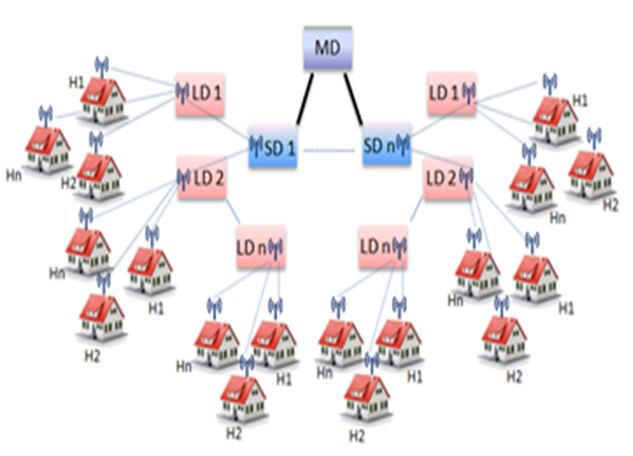
To consistently monitor and control energy usage, a tree network topology is employed as a hierarchical structure to enable communication between homes and the main power plant. Households are organized into groups; each household needs a smart device and smart meter. These smart meters connect to local distribution stations (LDS) via wireless connections in order to receive a signal representing the value of the maximum consumption. The LDS communicate with secondary distribution stations (SDS) using wireless connections as well. In turn, groups of secondary stations are linked to the main distribution station (MDS) through wireless connections. Finally, the MDS communicates wirelessly with the main power station, as illustrated in Figure 4.
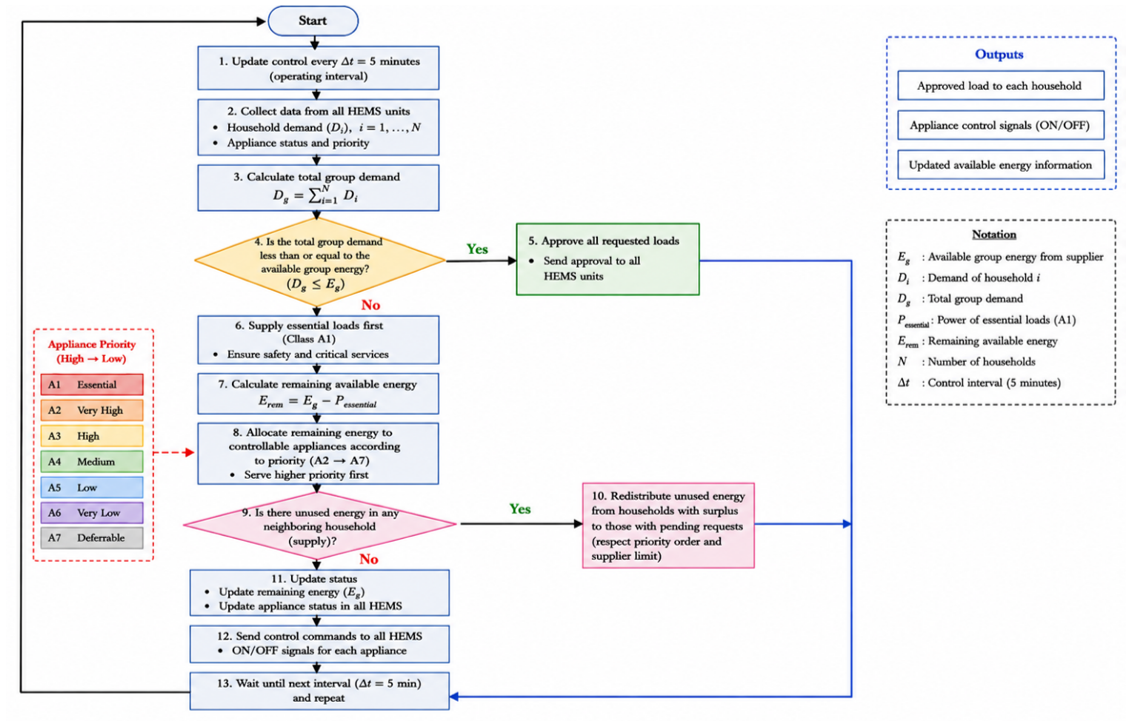
The proposed control strategy follows a hierarchical decision-making procedure similar to previously reported Home Energy Management Systems [10, 11, 17, 24]. Every five minutes, each HEMS sends the current household demand to the LDS through the wireless communication network. The local controller calculates the total group demand and compares it with the available electrical capacity allocated by the supplier. If sufficient energy is available, all requested household loads are accepted. Otherwise, essential household appliances are supplied first, followed by controllable appliances according to their predefined priority classes (A1–A7). When surplus electrical capacity becomes available from neighboring households, the controller dynamically redistributes this energy among households requesting additional power.
Figure 4. Tree network topology
In order to monitor and manage electrical usage at regular intervals, each must have a bidirectional smart meter, HEMS and smart appliances; these devices communicate via a Wi-Fi network. Consumers can prioritize which home devices are activated first using the HEMS.
To verify the communication capability of the proposed HEMS, a laboratory-scale communication experiment was implemented using five laptop computers connected through a wireless TCP/IP network developed in MATLAB. One computer operated as the LDS controller (server), while the remaining computers represented residential HEMS units. Every five minutes, each HEMS transmitted its instantaneous household demand to the LDS controller. The present study assumes reliable wireless communication between residential households and the LDS. Communication latency, packet loss, synchronization errors, and cybersecurity issues were not explicitly modeled because the primary objective of this work was to evaluate the proposed energy management strategy. Nevertheless, these communication factors may influence practical implementations and should be investigated in future work using secure smart-grid communication protocols and advanced IoT-based communication platforms [20-23].
The intelligent power system model is shown in Figure 5. This model consists of a group of consumers within the proposed smart network scenario. Each home transmits its load value to the LDS using a wireless bidirectional communication link. The LDS aggregates the load values from all homes to calculate the total load and compares it with the available load according to the defined algorithm.
As a result, the household receives a notification from the LDS regarding its load status. The intelligent power system continuously provides updates on the household load every 5 min. Figure 5 illustrates the communication architecture of the proposed HEMS, whereas Figure 6 presents the internal control strategy executed by the HEMS. The controller calculated the aggregated residential demand, executed the proposed HEMS control algorithm, and transmitted updated control commands indicating the allowable household loads. This experiment was intended solely to validate the communication framework. The residential DSM performance presented in this work was evaluated using MATLAB simulations rather than through a full-scale hardware implementation.
During each five-minute control interval, the HEMS receives the available electrical capacity allocated by the distribution station together with the instantaneous electrical demand requested by all households within the management group. The controller evaluates the aggregated demand, compares it with the available supply, determines the operating priority of household appliances, and redistributes any unused electrical capacity among neighboring households whenever surplus energy is available. The complete decision-making procedure adopted by the proposed controller is illustrated in Figure 6 [10, 11, 17, 24].
As illustrated in Figure 6, the proposed HEMS executes a hierarchical control strategy during every five-minute operating interval. Initially, the controller receives the available electrical capacity allocated by the supplier together with the demand requested by all households within the management group. The aggregated residential demand is calculated and compared with the available electrical capacity. When the total demand remains within the available supply, all requested household loads are approved. Otherwise, the controller first supplies the essential household appliances (Class A1) and subsequently allocates the remaining electrical capacity to controllable appliances according to their predefined priority classes (A2–A7). If unused electrical capacity exists within neighboring households, the controller dynamically redistributes this surplus energy to consumers requesting additional power while ensuring that the supplier's maximum generation limit is not exceeded. After updating the operating status of all appliances, the HEMS transmits new control commands to all households and repeats the same procedure every five minutes. [10, 11, 17, 18, 24].

Figure 5. Communication architecture of the proposed home energy management system (HEMS) showing information exchange between residential households, local distribution stations (LDS), and the control server
Figure 6. Flowchart of the proposed home energy management system (HEMS) control algorithm for real-time residential energy allocation and appliance priority scheduling
When multiple households simultaneously request additional electrical power exceeding the available generation capacity, the proposed controller resolves the conflict using the predefined appliance priority levels illustrated in Figure 6. Essential appliances are always supplied first to preserve minimum household operating requirements. The remaining electrical capacity is then allocated sequentially to controllable appliances according to their assigned priority classes. Whenever surplus energy becomes available within the management group, it is immediately redistributed among households with pending energy requests. This priority-based allocation mechanism improves energy utilization while maintaining fairness among residential consumers and preventing unnecessary load interruption [10, 17, 24].
3.3.1 Mathematical formulation of the proposed home energy management system
The proposed HEMS follows a rule-based energy allocation strategy in which the available electrical capacity is dynamically distributed among residential consumers according to appliance priorities. The controller operates during every five-minute control interval and determines the allowable household loads while ensuring that the available electrical capacity is not exceeded.
The proposed HEMS follows a rule-based energy allocation strategy.
$D_g=\sum_{i=1}^N D_i$ (1)
where,
$D_g$ is the total electrical demand of the residential group.
$D_i$ is electrical demand of household $i$, $N$ is number of households.
$D_g \leq E_g$ (2)
where, $E_g$ is the available electrical energy assigned to the residential group.
$E_{\text {rem }}=E_g-P_{\text {essential }}$ (3)
where, $P_{\text {essential }}$ is the power required by essential appliances (Class A1).
If the total residential demand is less than or equal to the available electrical capacity, all requested household loads are supplied. Otherwise, essential household appliances (Class A1) are supplied first, and the remaining electrical capacity is allocated to controllable appliances according to the predefined priority classes (A2–A7). Whenever surplus electrical capacity exists within neighboring households, the proposed controller redistributes this energy among households requesting additional power while maintaining the supplier's generation limit [10, 11, 17, 18, 24].
The proposed HEMS was implemented in MATLAB to evaluate the proposed DSM strategy under representative residential operating conditions. The electrical power distribution network follows a hierarchical tree topology in which the available electrical energy is sequentially distributed from the MDS to SDS, then to LDS, and finally to individual households. The total electrical energy supplied by the MDS is expressed as
$E_t=\sum_{i=1}^j E_{l_i}$ (4)
where, $E_t$ is the total electrical energy supplied by the MDS and $E_{l_i}$ is the electrical energy allocated to the $i^{\text {th }} \mathrm{SDS}$. The electrical energy assigned to each SDS is subsequently distributed among the connected local distribution groups according to
$E_l=\sum_{i=1}^m E_{g_i}$ (5)
where, $E_l$ represents the electrical energy available at a SDS and $E_{g_i}$ denotes the electrical energy allocated to the $i^{\text {th }}$ local distribution group.
The electrical energy allocated to each local distribution group is then distributed among the participating households as
$E_g=\sum_{i=1}^n E_i$ (6)
where, $E_g$ is the total electrical energy available for one residential management group, $E_i$ is the electrical energy assigned to household $i$, and $n$ is the number of households within the group. Initially, the available electrical energy is equally divided among all households according to
$E_s=\frac{E_g}{n}$ (7)
where, $E_s$ represents the initial electrical energy allocation for each household.
The initial energy allocation given by Eq. (7) represents an equal distribution of the available electrical capacity among all households within the management group. During operation, however, the proposed HEMS dynamically modifies this allocation according to the real-time household demand and appliance priority classes described in Figure 6. Therefore, the final energy allocated to each household may differ from the initial equal allocation while ensuring that the total group demand remains within the available electrical capacity [10, 17, 24].
Figure 7 illustrates the power distribution scheme used in the MATLAB implementation of the proposed HEMS. The main station receives energy from the total available source and then allocates it to several secondary stations. The main station determines the energy distribution for each secondary station based on factors such as the population density of the area it serves and the previous energy consumption of that station. Each secondary station subsequently distributes its allocated energy to local distributors organized into groups. From each secondary station, two signals are transmitted to each group: the specific amount of energy assigned to that group, Egs and the difference between the group's consumption and the available energy Ega.

Figure 7. Power distribution scheme used in the proposed home energy management system (HEMS) implementation
In this study, each group is made up of five homes. This number has been selected for simplicity, but any appropriate number can be used. For each home two signals are sent to the HEMS for each household. The first signal reports the specific energy consumption for each household (Es), as provided by the local distributor. The second signal indicates the additional available energy (Ea), which reflects the difference in energy usage among the homes in the group. The microcontroller for the group calculates the energy consumption for each home after determining the respective values.
Figure 8 illustrates an example of the connection between HEMS and the appliances for one home in a group and also shows the incoming and outgoing signals between the HEMS and the group manager.

Figure 8. Signals of the home energy management system (HEMS) for one home
There are two input signals that enter: the first is the specified energy determined by the supplier (Es) and the second is the surplus energy available within the group that can be utilized (Ea). From the HEMS, several signals are sent out to control the operation of various home appliances. Based on their energy consumption (current draw), these appliances are categorized into seven classes. The unshiftable loads (like lighting, TV, refrigerator … etc.), classified as A1, draw a current of 5 amps. A variable load, classified as A7, can draw between 0 and 5 amps, allowing for the utilization of all available energy. The other loads are categorized as follows: A2 draws 5 amps, A3 draws 5 amps, and A4 draws 10 amps, while A5 and A6 draw 10 and 15 amps, respectively for high-consumption loads like air conditioning and water heaters. These devices operate according to the availability of energy.
Home appliances are designed to work according to user-defined priorities, ensuring optimal performance and energy efficiency. The HEMS follows a priority-based control strategy. Essential loads are supplied first because they represent the minimum operating requirement of the house. In this study, these loads require 5 A. After the essential load is supplied, the remaining current is checked. If enough current is available, the HEMS activates one appliance from A2, A3, or A4. These appliances are treated as controllable loads. If further surplus current remains, it is then allocated to A7. Appliances A5 and A6 operate according to the available energy level. Their operation is adjusted to make better use of the supplied power. The energy difference of the group, denoted by Ea, is used as the main control signal.
When Ea is positive, surplus energy is available. In this case, more appliances can be operated. When Ea is negative, the available energy is not sufficient. Therefore, the number of operating appliances must be reduced to avoid power shortage. Meanwhile, when Ea is zero, your current devices can continue to operate smoothly. Embrace this intelligent energy management system for seamless and efficient home appliance performance.
The current is collected, and energy consumption is calculated based on a duration of operation of five minutes for home appliances. The data regarding energy usage at home is sent back to the HEMS, which determines which devices can be operated during the next period. The energy, when some consumers use less than the allocation provided by the local station, can be redistributed to those who require more energy based on their specific demands. This redistribution can be performed without compromising the overall energy supply.
The proposed HEMS was implemented in MATLAB to evaluate the effectiveness of the proposed DSM strategy under Iraqi residential operating conditions. The simulation compares residential electricity consumption before and after applying the proposed HEMS control algorithm described in Figure 6. The main objective is to verify that the controller maintains the total residential demand within the available electrical capacity while dynamically redistributing surplus energy among neighboring households according to appliance priority. The simulation results presented in Figures 9 and 10 demonstrate the performance of the proposed control strategy under representative residential load conditions.

Figure 9. Daily energy curves for total and 5 homes without management

Figure 10. Daily energy curves for total and 5 homes with management
Without the HEMS, Figure 9(a) illustrates the total consumption of the group (GACE) compared to total available energy denoted by the supplier (GAE), while Figures 9(b)–(f) show the actual consumption of each home (HACE) compared to the limit set by the supplier (HAE). It is evident from the curves that, in the uncontrolled scenario, the total consumption will exceed the supplier's limit. This situation may require the supplier to cut off service to certain sectors to maintain overall supply; otherwise, the system may fail.
Figure 10 presents the results after using the HEMS. The curve in Figure 10(a) illustrates the total actual energy consumption of the five homes, while Figures 10(b)–(f) show the individual energy consumption of each home. As demonstrated by these curves, although each home may consume more energy than what was planned by the power provider, the total actual consumption of these homes aligns with the control signal that indicates the available power from the power distributor.
Consumers' commitment to staying within the established upper and lower supply limits means that there is no need to disconnect the power source. When electricity is continuously provided from the main source, private generators are unnecessary for power supply, which can be an expensive alternative.
This paper proposed a tree topology-based HEMS for residential DSM under the operating conditions of the Iraqi electrical power system. The proposed framework coordinates household electricity consumption according to the available generation capacity through hierarchical communication between smart meters and LDS. MATLAB simulation results demonstrated that the proposed controller successfully maintained residential electricity demand within the available electrical capacity while dynamically redistributing surplus energy according to appliance priority. Consequently, the proposed approach provides a practical DSM framework suitable for residential electricity networks operating under fixed electricity tariffs and generation constraints.
For future work, we will study the impact of adding renewable energy sources on the system's performance. This will involve integrating these sources into several homes and exploring the best methods for their incorporation with the existing energy supply.
The authors would like to thank the University of Mosul for their assistance with this work.
Appendix A
|
Device Current |
Rated Power |
No. |
|
|
Home land area |
|
|
1 |
|
Number of rooms (bedroom, sitting, reception, bathroom, etc.) |
|
|
2 |
|
Number of individuals |
|
|
3 |
|
Electrical supply (single-phase, three-phase) |
|
|
4 |
|
Tungsten lamps |
Lighting |
A |
5 |
|
fluorescent lamps |
B |
||
|
Other |
C |
||
|
Audiovisual devices (recorder, radio, TV, etc.) |
Household appliance |
A |
6 |
|
Kitchen appliances (washing machine, dishwasher, vacuum cleaner, water pump ... etc.) |
B |
||
|
Food preservation devices (refrigerator, freezer, water cooler. etc) |
C |
||
|
Fan (roof, vertical ... etc.) |
Cooling devices |
A |
7 |
|
Air cooler |
B |
||
|
Air conditioner /cooling |
C |
||
|
Electric heater |
Heating devices |
A |
8 |
|
Cooking heater, oven . . . etc. |
B |
||
|
Air conditioner /heating |
C |
||
|
Electric bath |
Water heating |
|
9 |
[1] Ożadowicz, A. (2017). A new concept of active demand side management for energy efficient prosumer microgrids with smart building technologies. Energies, 10(11): 1771. https://doi.org/10.3390/en10111771
[2] Ullah, I., Javaid, N., Khan, Z.A., Qasim, U., Khan, Z.A., Mehmood, S.A. (2015). An incentive-based optimal energy consumption scheduling algorithm for residential users. Procedia Computer Science, 52: 851-857. https://doi.org/10.1016/j.procs.2015.05.142
[3] Antonopoulos, C.P., Kapsalis, V., Hadellis, L. (2012). Optimal scheduling of smart homes’ appliances for the minimization of energy cost under dynamic pricing. In Proceedings of IEEE 17th International Conference on Emerging Technologies & Factory Automation, Krakow, Poland. https://doi.org/10.1109/ETFA.2012.6489708
[4] Kassem, M.A., Elahwil, A.A. (2015). Power load management techniques and methods in electric power system. International Research Journal of Engineering and Technology, 2(9): 2459-2466. https://irjet.net/archives/V2/i9/IRJET-V2I9301.pdf.
[5] Sultan, A.F. (2019). Determine the electrical energy saving in residential sector of Iraq. American Scientific Research Journal for Engineering, Technology, and Sciences, 58(1): 1-11. https://asrjetsjournal.org/American_Scientific_Journal/article/view/4975.
[6] Islam, F., Ahmed, I., Mihet-Popa, L. (2025). Demand-side management in residential buildings: Load shifting and cost savings via a cloud-based IoT-BEMS. In 51st Annual Conference of the IEEE Industrial Electronics Society, Madrid, Spain, pp. 1-7. https://doi.org/10.1109/IECON58223.2025.11221160
[7] Khan, I. (2019). Energy saving behavior as a demand-side management strategy in the developing world: The case of Bangladesh. International Journal of Energy and Environmental Engineering, 10(4): 493-510. https://doi.org/10.1007/s40095-019-0302-3
[8] Singh, M., Jha, R.C. (2019). Object-oriented usability indices for multi-objective demand side management using teaching learning based optimization. Engineers, 12(3): 370. https://doi.org/10.3390/en12030370
[9] Mishra, K., Basu, S. (2025). A classification framework for demand side management in residential smart grids. International Journal of Data Science and Analytics, 20: 4177-4192. https://doi.org/10.1007/s41060-025-00735-w
[10] Javaid, N., Ullah, I., Akbar, M., Iqbal, Z., Ali Khan, F., Alrajeh, N., Alabed, M.S. (2017). An intelligent load management system with renewable energy integration for smart homes. IEEE Access, 5: 13587-13600. https://doi.org/10.1109/ACCESS.2017.2715225
[11] Ajao, A., Luo, J., Liang, Z., Alsafasfeh, Q.H., Su, W. (2017). Intelligent home energy management system for distributed renewable generators, dispatchable residential loads and distributed energy storage devices. In 2017 8th International Renewable Energy Congress, Amman, Jordan, pp. 1-6. https://doi.org/10.1109/IREC.2017.7926040
[12] Elyas, S.H., Sadeghian, H., Alwan, H.O., Wang, Z. (2017). Optimized household demand management with local solar PV generation. In North American Power Symposium, Morgantown, WV, USA, pp. 1-6. https://doi.org/10.1109/NAPS.2017.8107411
[13] Anvari-Moghaddam, A., Guerrero, J.M., Vasquez, J.C., Monsef, H., Rahimi Kian, A. (2017). Efficient energy management for a grid-tied residential microgrid. IET Generation, Transmission & Distribution, 11(11): 2752-2761. https://doi.org/10.1049/iet-gtd.2016.1129
[14] Pilz, M., Al-Fagih, L. (2020). A dynamic game approach for demand side management: Scheduling energy storage with forecasting errors. Dynamic Games and Applications, 10: 897-929. https://doi.org/10.1007/s13235-019-00309-z
[15] Hafeez, G., Javaid, N. (2018). Optimal residential load scheduling under utility and rooftop photovoltaic units. Energies, 11(3): 611. https://doi.org/10.3390/en11030611
[16] Li, T., Xu, Q., Li, W., Wang, X., Liu, Z. (2025). Optimization method of time of use electricity price considering losses in distributed photovoltaic access distribution network. Frontiers in Energy Research, 12: 1486478. https://doi.org/10.3389/fenrg.2024.1486478
[17] Silva, B.N., Khan, M., Han, K. (2018). Load balancing integrated least slack time-based appliance scheduling for smart home energy management. Sensors, 18(3): 685. https://doi.org/10.3390/s18030685
[18] Zafar, A., Shah, S., Khalid, R., Hussain, S.M., Rahim, H., Javaid, N. (2017). A meta-heuristic home energy management system. In 31st International Conference on Advanced Information Networking and Applications Workshops, Taipei, Taiwan, pp. 244-250. https://doi.org/10.1109/WAINA.2017.118
[19] Ghaemi, S., Schneider, S. (2013). Potential analysis of residential demand response using GridLAB-D. In IECON 2013 - 39th Annual Conference of the IEEE Industrial Electronics Society, Vienna, Austria, pp. 8039-8045. https://doi.org/10.1109/IECON.2013.6700477
[20] Hemapala, K.T.M.U., Kulasekera, A.L. (2012). Demand side management for microgrids through smart meters. In Proceedings of the IASTED Asian Conference on Power and Energy Systems, Phuket, Thailand, pp. 248-254. https://doi.org/10.2316/P.2012.768-060
[21] Dambrauskas, P., Syed, M.H., Blair, S.M., et al. (2017). Impact of realistic communications for fast-acting demand side management. In Proceedings of 24th International Conference and Exhibition on Electricity Distribution, Glasgow, UK, pp. 1813-1817. https://doi.org/10.1049/oap-cired.2017.1162
[22] Mahmood, A., Javaid, N., Razzaq, S. (2015). A review of wireless communications for smart grid. Renewable and Sustainable Energy Reviews, 41: 248-260. https://doi.org/10.1016/j.rser.2014.08.036
[23] Kounev, V., Tipper, D. (2013). Advanced metering and demand response communication performance in Zigbee based HANs. In IEEE Conference on Computer Communications Workshops, Turin, Italy, pp. 31-36. https://doi.org/10.1109/INFCOMW.2013.6562904
[24] Hartono, B.S., Mursid, S.P., Prajogo, S. (2018). Review: Home energy management system in a smart grid scheme to improve the reliability of power systems. IOP Conference Series: Earth and Environmental Science, 105(1): 012081. https://doi.org/10.1088/1755-1315/105/1/012081
[25] Istepanian, H.H. (2020). Towards Sustainable Energy Efficiency in Iraq. Friedrich-Ebert-Stiftung, Berlin, Germany.
[26] Al-Nama, M.A., Al-Hafidh, M.S.M., Al-Fahadi, A.S. (2017). Determination of residential electrical load components in Iraqi North Region. Iraqi Journal for Electrical and Electronic Engineering, 13(2): 161-165. https://doi.org/10.37917/ijeee.13.2.2
[27] Al-Fahadi, A.S., Al-Hafidh, M.S.M., Al-Nama, M.A. (2017). Utilization of solar water heaters to reduce residential electrical load. UHD Journal of Science and Technology, 1(1): 23-26. https://doi.org/10.21928/uhdjst.v1n1y2017.pp23-26
[28] Al-Hafidh, M.S.M., Ibrahem, M.H. (2014). Zero energy house in Iraq. International Journal of Inventive Engineering and Sciences, 2(7): 1-4.
[29] Al-Hafidh, M.S.M., Al-Nama, M.A., Al-Fahadi, A.S. (2011). Estimation of the consumer peak load for the Iraqi distribution system using intelligent methods. Iraqi Journal of Electrical and Electronic Engineering, 7(2): 180-184. https://doi.org/10.37917/ijeee.7.2.15
[30] Al-Hamadani, S. (2020). Solar energy as a potential contributor to help bridge the gap between electricity supply and growing demand in Iraq: A review. Journal of Advances in Applied Sciences, 9(4): 302-312. https://doi.org/10.11591/ijaas.v9.i4.pp302-312