Baraa Y. Yaqoob* | Ali N. Hamoodi | Laith A. Mohammed
© 2026 The authors. This article is published by IIETA and is licensed under the CC BY 4.0 license (http://creativecommons.org/licenses/by/4.0/).
OPEN ACCESS
This paper aims to present the control strategies of boost converters that help improve the operational efficiency of solar photovoltaic (PV) systems in relation to the variation of the different operating conditions, such as solar irradiance, temperature, partial shading of the PV system, and load disturbances, in a structured and systematic manner. The methods that have been reviewed have been classified into three categories: (i) classical control (example: Proportional-Integral/Proportional-Integral-Derivative (PI/PID) with traditional maximum power point tracking (MPPT)), (ii) intelligent control (example: fuzzy logic, Artificial Neural Network (ANN), Adaptive Neuro-Fuzzy Inference System (ANFIS), and adaptive control), and (iii) hybrid and optimization-aided controllers (example: Particle Swarm Optimization (PSO), Grey Wolf Optimizer (GWO), and Model Predictive Control (MPC)-based methods). The purpose of this synthesis is to consolidate, for the various control methods in the three categories, the most relevant literature, and to compare, for each of the methods, the MPPT tracking efficiency, the convergence/response time, steady-state oscillations, output-voltage ripple, and the control methods’ robustness and stability in a fast-changing environment. The synthesis concludes that although classical control methods are appealing because of their simplicity in control and low implementation cost, intelligent control and hybrid control methods tend to be superior as they can converge more quickly and lower the output ripple, especially for partial shading conditions and for highly dynamic irradiance conditions. The review also provides practical selection criteria and future research pertinent to the next generation PV power conditioning systems and further emphasizes the balance that must be made between the complexity of the control, the needed sensing and/ computing, and the performance that can be attained.
solar photovoltaic, maximum power point tracking, boost converter, controller strategies, hybrid optimization
One of the most innovative solutions to level off the oscillations is to deploy power electronic converters, most notably DC-DC boost converters, to raise the output voltage of the photovoltaic (PV) modules to the desired level for load or grid use. Boost converters are readily integrated into PV systems due to their high efficiency, ease of use, and overall simplicity of the device. Boost converters are operated by varying the duty cycle of the switching device using Pulse Width Modulation, enabling the PV to track the maximum power point tracking (MPPT) as closely as possible even under varying conditions [1]. In PV applications, the performance and effectiveness of the boost converter are directly linked to the control method and strategy used. Historically, control approaches focused on classical systems, relying on the use of Proportional-Integral (PI) and Proportional-Integral-Derivative (PID) controllers primarily because of their ease of use. However, they are sometimes ineffective under the rapidly changing conditions of the environment. In an attempt to optimize performance, enhancement of systems using MPPT, or maximum power point tracking, using the Perturb and Observe (P&O) and Incremental Conductance (INC) techniques was developed. While MPPT techniques work to improve energy capture, the number of oscillations around the point of maximum power, as well as the overall responsiveness, tends to remain [2]. Meanwhile, intelligent control methods have started to emerge, incorporating Artificial Intelligence and Soft Computing to tackle the nonlinear and time-varying dynamics of PV systems. Controllers like Model Reference Adaptive Control (MRAC), Fuzzy Logic Controller (FLC), and even Adaptive Neuro-Fuzzy Inference System (ANFIS) tend to outperform traditional methods, especially in terms of accuracy and response time during worst-case (partial shading) scenarios. In recent years, new optimization-based hybrid controllers have been combining traditional or intelligent algorithms with optimization methods, fine-tuning each control parameter for the best performance. Controllers such as Improved Grey Wolf Optimizer (IGWO), Particle Swarm Optimization (PSO), BFOA, and PID with PID-SMC (Sliding Mode Control) have shown outstanding performance in controlled simulations and real-life applications. For example, the hybrid GWO-P&O and the GWO-PO combined have displayed efficiencies exceeding 99.84%, impressive convergence rates, and minimal steady state ripple [3]. In almost all comparative studies, the intelligent methods, or hybrid, are shown to be superior than traditional methods with, or more, faster convergence and lower or suppressed ripple. steady-state control, and more robustness to environmental changes. This adds to the reliability, increased energy generation, and longevity for next-generation PV systems, making them essential [4]. With the complexity control systems have, the lack of in-depth analysis on them makes it crucial to perform a systematic comparative review of the performance. This study should not only meet the requirements but also analyse other essential qualities, such as overall efficiency, the time needed for convergence, the stability of the system, the control needed with varying systems in place, and adaptability. This work targets these goals and provides the necessary information to aid researchers, engineers, and system designers to optimize the performance, complexity, and cost control methods be derived or designed [5]. This study focuses on providing a systematic comparative analysis of control strategies pertaining to boost converters within PV systems. Special consideration is given to the operational, implementation, and adaptability aspects of the control strategies with respect to changing environmental conditions. A primary objective of this work is the analysis of traditional, intelligent, and hybrid control strategies and the development of empirical findings, with a view to guiding researchers and system developers, derived from the analysis of performance metrics, including, but not limited to, tracking efficiency, response time, voltage ripple, robustness, and implementation complexity.
1.1 Research gap and novelty
The literature on MPPT algorithms of PV shows that significant innovations have been made, and the literature on boost converters shows that some innovations have been made as well. Nonetheless, there are still gaps, and the literature shows the following. Most of the available literature uniquely focuses on a few techniques of MPPT and/or a few classes of control techniques and lists the efficiency of the tracking systems as the main measure of performance. However, in the case of a PV boost converter, a multi-faceted control performance is warranted, rather than efficiency, such as, but not limited to, the speed of the system response to the disturbance, the system’s output voltage steadiness, the system’s response to changes in the environment, destabilizing and fluctuating, the system’s ability to adapt to a changing environment, including the phenomenon of partial shading, the system’s control performance, and last but not least, the difficulty of implementing the control system. Also, most publications tend to examine, in isolation, the conventional control, the intelligent control, and the optimization-based control, which makes the direct comparison needed for the control selection in a practical system quite complex for researchers and system designers. This review offers a solution to the problem by providing a comprehensive comparative review of control techniques for boost converters used in PV systems, covering conventional, intelligent, and hybrid optimization-based control techniques.
This review contains:
This review will be organized to show the relevant studies on control strategies for boost converters within PV systems and how the control strategies have been published and organized on a timeline. Studies published between the years 2000 and 2025 are reviewed from the databases of IEEE Xplore, ScienceDirect, SpringerLink, MDPI, and Google Scholar.
The inclusion or exclusion of a study goes through a selection process comprised of three main stages.
2.1 Identification stage
Study publications were located using the following keywords: 'boost converter', 'MPPT control', 'PV control strategies', 'intelligent MPPT', and 'hybrid optimization controllers'.
2.2 Screening stage
Any articles that did not relate to control of the DC-DC boost converter, or articles that did not include metrics for evaluating the performance of converters, were neglected for review.
2.3 Eligibility and selection
Of the preliminary review of over 120 studies, 47 were deemed to be most relevant based on the following criteria.
The focus studies were divided into three primary categories:
The studies were evaluated according to the most common Key Performance Indicators (KPIs) of the studies, which include tracking efficiency, time to convergence, voltage ripple, stability, and overall performance when subjected to dynamic changes within the environment. The accepted review methodology sets the parameters for identifying, categorizing, and assessing studies. Using this sort of methodology, the next sections provide a rationale for advanced boost converter control in PV systems, as well as describe the main control strategies found in the literature. Essentially, the current research is a comparative review of published literature as opposed to an empirical study. Consequently, the method is based on systematic collection, description, and comparison of previously reported control strategies and assessment of their reported performance, implementation, and applicability in different conditions of operation.
The accelerating shift towards renewable energy has facilitated the growth of solar PV technologies as a leading sustainable option for electricity generation. While having its advantages, PV output is susceptible to environmental situational conditions such as irradiance and temperature, which vary constantly, and can cause drastic changes to the output power [6]. Energy harvesting efficiency is low due to the variability of power conditioning, or advanced control solutions not being exercised. The power output of PV cells and the ability to track the MPPT can be tracked using DC-DC boost converters, which are among the most efficacious controller solutions on the market. The focus is not on the device within the PV module. Converters can be optimized, and the control strategy can be tuned for the environment. Simplistic controllers, for example, PID or PI controllers, can be implemented. Such dispreferred solutions are of low relevance to actual market conditions. It lacks sophisticated control functionalities and therefore suffers from high convergence times, excessive voltage ripples, and subsequently low efficiency for rapidly changing conditions [7]. To overcome the cited disadvantages, various MPPT algorithms have been implemented, including INC and P&O, as well as its more sophisticated iterations, M-P&O and MINC, all of which are designed with the aforementioned disadvantages in mind. While there is no disputing the benefit of enhancement in tracking precision, oftentimes these solutions lack the requisite level of responsiveness for rapidly changing atmospheric conditions or partial shading [8]. Systems of control are therefore lacking, which sustains the paradigm of swift action in the field of accuracy with optimal stability. The most recent technical advancements have developed intelligent and hybrid controllers, including MRAC, FLC, and optimization techniques like IGWO with PID-SMC. The results have been astonishing, like with the Hybrid GWO-PO, which achieved 99.84% optimum efficiency, and MRAC with a stunning 0.0032-second convergence time with minimum voltage ripple [9]. The techniques, however, lack a cohesive comparison, which makes it difficult for engineers and researchers to easily find the right option for a particular PV application. To fill this void, the present research offers an in-depth boost converter-based control technique and juxtaposes the techniques on the basis of convergence time, efficiency, voltage ripple, and stability. Synthesizing various studies, this work offers practical design approaches for the control of PV systems, targeting enhanced reliability and energy yield in the field [10].
The definition of MPPT comes from the electrical circuit principle of merging the output and load impedances for the maximum power transfer from the PV cell. With this setup, the system achieves the highest power output. Control techniques—MPPT—try to keep the system working at this “most optimal” level. These algorithms automate the modification of system variables to consider things like temperature and solar irradiance, which greatly impact the location of the maximum power point. The current-voltage (I-V) characteristic of a PV module, as in Figure 1, is non-linear, and the MPPT is the point on the curve at which the power is at its highest.
Figure 1. Typical current–voltage (I–V) characteristic of a photovoltaic (PV) cell illustrating the maximum power point operating region
While the theory seems simple, issues such as the presence of multiple local maxima as well as oscillations around the true maximum power point prove troubling in practice. This is a consequence of the PV array voltage power characteristics´ non-linearity and time variation because of changing atmospheric and load conditions. The primary goal of MPPT is to change the PWM controlling the power converter to the duty cycles of the load.
5.1 System overview
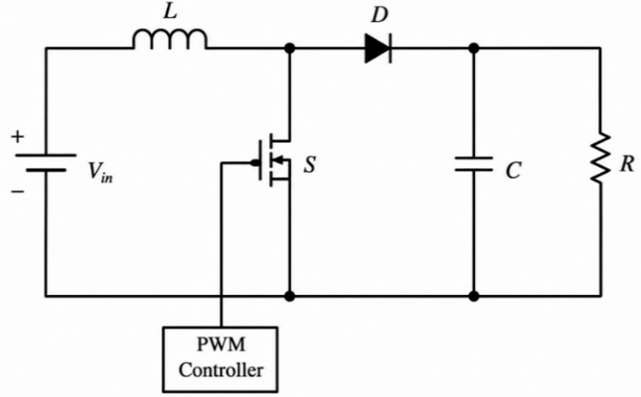
Figure 2 shows the diagram of a booster converter system's basic model. It consists of a boost converter PV cell functioning as the source, stationed at the DC input voltage level $V_in$, a controllable MOSFET switch, an inductor $L$, a capacitor $C$, a load resistor $R$, and a PWM block. The output voltage across the capacitor is termed $V_o$, while IL is the current flowing through the inductor. The PWM block controls the converter's functionality by changing the duty cycle on the switch $D$. When the MOSFET is in the ON state, the diode $D 1$ is reverse-biased, permitting the inductor to derive the power that will later be used as a boost input. The power is then released to the resistor $R$, where the switch is ideal, and the losses in the inductor and capacitor are ignored. The MOSFET is turned OFF, allowing the diode to conduct. This form of analysis is known as the inductor's energy dump. The relation of input voltage to output voltage in a boost converter is expressed mathematically in the following way.
$\frac{{{\text{V}}_{\text{O}}}}{{{\text{V}}_{\text{in}}}}\text{ }\!\!~\!\!\text{ }=\text{ }\!\!~\!\!\text{ }\frac{1}{\left( 1-\text{D} \right)}$ (1)
Figure 2. Simplified configuration of the DC-DC boost converter used in photovoltaic (PV) power conditioning systems
The primary objective of control algorithms for boost converters is to ensure reliable output-voltage regulation in the presence of input or load disturbances. These boost converters provide efficient power conversion and control rapid dynamic response by regulating the switching duty cycle. Performance improvement, accuracy, and system stability can be achieved using algorithms based on conventional, intelligent, and optimization approaches.
The examined control strategies represent a wide spectrum of operational principles and computational and implementation complexities. Traditional methods are usually grounded in straightforward control laws and direct perturbative decision methods. In contrast, intelligent methods apply adaptive inference or learning-based methods for nonlinear response behaviour. The hybrid optimization methods combine heuristic optimization and either traditional or intelligent control system methods. They offer enhancements for parameter adjustment, convergence, and system stability under varying operating environments.
6.1 Particle Swarm Optimization
The PSO Strategy draws parallels with the behaviours of birds flying in a flock and fish swimming in a school. Think of PSO in the context of optimizing the position of a particle in a multidimensional space. PSO derives its intelligence from the imitation of the social governing movements of animal groups. The swarm collaborates by virtue of its position within the particle cloud, and the entire swarm sifts ‘intelligently’ through the solutions of a given problem to approximate an optimal answer [11].
6.2 Genetic Algorithm
Complex and nonlinear issues utilize heuristic systems known as Genetic Algorithms (GAs), based on selection and reproduction. There might be multiple hypotheses, but the most optimal is used for further enhancement. There is, as a rule, a gradual increase and improvement in performance and adaptation in subsequent generations. GAs, which are part of a broad class of algorithms known as evolutionary algorithms (EAs), work with selection, crossover or recombination, and genetic mutations, and inheritance to produce actual results from perceived non-solutions over a period [12].
6.3 Fuzzy logic framework
Fuzzy logic is a sophistication within mathematics that attempts to cope with inadequate information and wider-than-usual reasoning. This allows logical systems to operate even when confronted with information that is vague or imprecise. In the 1960s, Lotfi Zadeh proposed fuzzy logic to be incorporated in classical logic, which integrated binary systems with true or false states. In fuzzy logic, systems and functions of logic do not work with only binary states of zero and one. There is the potential of considering the two extreme values 0 and 1, which now represent different ranges of truth or falsity. Fuzzy logic is thus more useful in systems with multidimensionality and complex structuring [13].
6.4 Perturb and Observe
In the case of the P&O method, the system reconfigures the PV unit’s working voltage at tiny steps and cascade actions, noting the power variation for each change. When power increases, the algorithm continues perturbing in the same direction. If power decreases, the algorithm changes direction. This process iteratively draws power to the maximum power point. Directly correlating perturbed power and MPPT responds to rapidly changing sunlight and can result in power tracking errors that oscillate instead of stabilizing [14].
6.5 Adaptive Neuro-Fuzzy Inference System
ANFIS is an Adaptive Neuro-Fuzzy Inference System that utilizes artificial intelligence in the interface of a neural net and fuzzy logic. This is about the duality of the two technologies, and ANFIS is a testimony of the profound relationships between the two. The self-learning neural attributes of a neural network and the logic of fuzzy logic are consolidated for the purpose of structuring ANFIS. Nonlinear systems are particularly difficult to work with because of the nature of the relationships involved and the unpredictability of the behaviour of the system. Fuzzy logic has the unique ability to reason within a sufficiently complex system, which neural logic is unable to do. And fuzzy logic is used to enhance the reasoning level of the system [15].
6.6 Adaptive reference Proportional-Integral controller
Consider the word adaptive reference PI controller as a more sophisticated version of a standard PI controller descriptor. Like the latter, the former also attempts to change the reference parameters that are used to set the current contextual conditions of the system. Such is the value of the adaptive reference PI controller that it enables the use of a PI controller in modular systems in power electronics, renewable energy systems, and grid-connected PV systems, which all need to improve control, stability, and flexibility [16].
6.7 Grey Wolf Optimize
The GWO is a metaheuristic algorithm inspired by the leadership hierarchy and the hunting style of grey wolves. It uses the motivational steps of prey encirclement and hunting, followed by attacking the prey. It refines the search with the best solutions. GWO exhibits excellent global optimization capabilities and has outperformed other methods in MPPT applications under partial shading [17].
6.7.1 Comparative performance analysis
Table 1 summarizes the performance metrics of various boost converter control strategies applied to PV systems found in the research literature. Based on the information provided, there are notable differences in the operational behavior of techniques classified as conventional, intelligent, and hybrid optimization-based approaches. The use of PI, P&O, and INC techniques is classified as ‘conventional’ control techniques. These techniques tend to exhibit a tolerable performance level when systems are operating in a stable environment. This is primarily due to the simplicity and ease of use of these techniques. At the same time, these techniques tend to demonstrate poorer performance in terms of speed of response, the level of voltage ripple, and the robustness of the control system in environments where inputs to the system are rapidly changing. Compared to conventional control techniques, intelligent control techniques historically outperform in the areas of control system response time, control system level performance, ease of control, and reduction of control system output oscillation. These approaches account for the dynamic and unpredictable behavior of a nonlinear PV system and/or surrounding external disturbances. Hybrid optimization-based control techniques tend to have the best performance of all control techniques reviewed. The use of flexible control techniques along with the use of adaptive parameter optimization tends to improve system performance in terms of control system-level output, reduction of control system output oscillation, and improvement of control system output convergence behavior. At the same time, these techniques tend to be complex in terms of implementation and require intensive computational efforts. The information provided tends to indicate that when choosing control strategies, it is important to consider the environment control is operating, the level of control robustness necessary, and the level of control complexity acceptable, in addition to the peak control performance.
To facilitate a quantitative evaluation of the reviewed control strategies, Table 1 summarizes their reported performance in terms of voltage ripple, response time, and efficiency based on the referenced studies. To provide a clearer understanding of the characteristics of the reviewed control strategies, Table 2 presents a qualitative comparison of their strengths, limitations, dynamic robustness, implementation complexity, and typical PV applications.
Table 1. Performance evolution of various advanced methods for boost converter
|
Research |
Controller Techniques |
Performance Metric |
Results |
|
[18] |
Proposed MRAC |
|
|
|
INC |
|
|
|
|
P&O |
|
|
|
|
[19] |
P&O |
|
|
|
INC |
|
|
|
|
FLC |
|
|
|
|
ANN |
|
|
|
|
[20] |
FLC |
|
|
|
[21] |
FLC |
|
|
|
P&O |
|
|
|
|
[22] |
FLC |
|
|
|
[23] |
PI |
|
|
|
FLC |
|
|
|
|
ANN |
|
|
|
|
[24] |
PI – P&O |
|
|
|
[25] |
Classical Methods |
|
|
|
Intelligent Method (Fuzzy, ANN, GA) |
|
|
|
|
[26] |
P&O |
|
|
|
INC |
|
|
|
|
FLC |
|
|
|
|
[27] |
FLC |
|
|
|
[28] |
P&O |
|
|
|
INC |
|
|
|
|
ANN |
|
|
|
|
[29] |
Hybrid GWO-P&O |
|
|
|
GWO |
|
|
|
|
PSO+P&O |
|
|
|
|
[30] |
FLC |
|
|
|
[31] |
INC |
|
|
|
[32] |
MPC+ PSO |
|
|
|
[33] |
PI |
|
|
|
[34] |
PI |
|
|
|
[35] |
FLC |
|
|
|
[36] |
IGWO |
|
|
|
[37] |
GWO |
|
|
|
[38] |
PI |
|
|
|
[39] |
INC
|
|
|
|
[40] |
PSO |
|
|
|
[41] |
MINC |
|
|
|
[42] |
P&O |
|
|
|
[43] |
P&O |
|
|
|
[44] |
PI-PSO |
|
|
|
[45] |
PSO |
|
|
|
[46] |
EGWO |
|
|
|
[47] |
GA |
|
|
|
[48] |
PID-SMC |
|
|
|
[49] |
PSO-ANFIS |
|
|
|
[50] |
P&O - INC |
|
|
|
[51] |
GWO |
|
|
|
WOA |
|
|
|
|
[52] |
P&O |
|
|
|
INC |
|
|
|
|
FLC |
|
|
|
|
ANN |
|
|
|
|
[53] |
INC |
|
|
|
[54] |
FLC |
|
|
|
[55] |
PI |
|
|
|
[56] |
AFLC |
|
|
Note: MRAC = Model Reference Adaptive Control; INC = Incremental Conductance; P&O = Perturb and Observe; FLC = Fuzzy Logic Controller; ANN = Artificial Neural Network; PI = Proportional-Integral; PID = Proportional-Integral-Derivative; GA = Genetic Algorithm; GWO = Grey Wolf Optimizer; Hybrid GWO-P&O = Hybrid Grey Wolf Optimizer–Perturb and Observe; PSO = Particle Swarm Optimization; MPC = Model Predictive Control; IGWO = Improved Grey Wolf Optimizer; MINC = Modified Incremental Conductance; EGWO = Enhanced Grey Wolf Optimizer; SMC = Sliding Mode Control; ANFIS = Adaptive Neuro-Fuzzy Inference System; WOA = Whale Optimization Algorithm; AFLC = Adaptive Fuzzy Logic Controller.
Table 2. Qualitative comparison of boost converter control strategies for photovoltaic (PV) systems
|
Control Strategy |
Strengths |
Limitations |
Dynamic Robustness |
Implementation Complexity |
Typical Applications |
|
PI/PID |
Simple implementation, low computational demand |
Limited adaptability, slower response |
Low |
Low |
Small PV systems |
|
P&O |
Easy implementation, low cost |
Oscillation around MPPT, slower under rapid changes |
Low |
Low |
Residential PV |
|
INC |
Improved tracking over P&O |
Complexity slightly higher than P&O |
Moderate |
Low–Moderate |
Standard PV applications |
|
FLC |
Fast response, nonlinear adaptability |
Requires tuning expertise |
High |
Moderate |
Dynamic PV systems |
|
ANN |
High accuracy, adaptive learning capability |
Training complexity, computational demand |
High |
High |
Advanced intelligent PV control |
|
ANFIS |
Combines fuzzy reasoning and learning |
Model complexity |
High |
High |
Nonlinear PV environments |
|
PSO / GWO |
Strong optimization capability |
Computational burden |
High |
High |
Partial shading applications |
|
MPC |
Excellent dynamic control performance |
Model dependency, high computation |
High |
High |
Grid-connected advanced PV systems |
|
Hybrid controllers |
Superior efficiency and robustness |
Highest implementation complexity |
Very High |
Very High |
Large-scale advanced PV applications |
Note: PI = Proportional-Integral; PID = Proportional-Integral-Derivative; P&O = Perturb and Observe; INC = Incremental Conductance; FLC = Fuzzy Logic Controller; ANN = Artificial Neural Network; ANFIS = Adaptive Neuro-Fuzzy Inference System; PSO = Particle Swarm Optimization; GWO = Grey Wolf Optimizer; MPC = Model Predictive Control.
6.7.2 Performance under dynamic environmental conditions
Rapidly changing environmental conditions, such as fluctuating irradiance and temperature, partial shading, and load disturbances, pose challenges for PV systems. Under such conditions, the responsiveness and stability of the control strategy become very important. Some traditional control methods, such as PI, P&O, and INC, can be deemed sufficient under relatively stable conditions. However, under rapidly changing conditions, the deterministic control of these methods may lead to slow adaptation, increased oscillations about the maximum power point, and decreased performance. The use of intelligent control methods, such as FLC controllers, ANN methods, and ANFIS methods, can improve adaptability to nonlinear conditions and reduce overall control response time. These aspects can improve system stability and enhance the tracking performance under environmental disturbances. Enhanced search and optimization capabilities of the Hybrid control methods make them the most adaptive and robust to rapidly changing operating conditions. In rapidly changing shading and irradiance environments, these methods can outperform traditional control methods, which may result in degraded performance. Based on the above considerations, the dynamic operating behavior of the boost converter control methodology must be considered for photovoltaic applications.
From an analysis of thirty-nine different reviewed control techniques of boost converter-based PV systems, it was noted that there was significant variation in performance, which was attributed to the design and execution of the algorithms.
Among all techniques, it was particularly noted that the use of intelligent and hybrid controllers substantially improved performance in all measures of efficiency, turnaround time, and reduction in voltage ripple when compared to the other, more traditional techniques. From recent studies, the ANN controller demonstrated superior overall performance due to its 99.5% efficiency, 0.5 V voltage ripple, and 0.15-second response time. Compared to traditional techniques such as INC and P&O, this is a significantly better performance, as their efficiencies range from 95% to 97.5%, and they considerably lag in dynamic response time. The other controller, the FLC, was also very competitive as it was demonstrated to have 99% efficiency, 0.6 V voltage ripple, and 0.18 second response time, showing that it is very robust and flexible with operating circumstances. Also, very rewarding were hybrid optimization techniques. The hybrid GWO-PO achieved 99.84% efficiency and very low voltage ripple, although response-time reporting was limited in some studies. Unlike other methodologies, PI and P&O were the oldest controllers, but still underperformed under dynamic and partially shaded environments. Such techniques feature more voltage ripple, slower response times, and less responsive tracking accuracy, which makes them poorer suited to top-of-the-range PV systems that sustain changes from the surrounding conditions. Based on the comparative analysis presented in this review, Table 3 summarizes the top three performing boost converter control techniques and highlights their response time, efficiency, and voltage ripple characteristics
Table 3. Summary of the top three performing techniques identified in this review
|
Technique |
Response Time |
Efficiency (%) |
Voltage Ripple |
|
Hybrid GWO-P&O |
0.12 S |
99.84% |
0.2 V |
|
E-GWO |
0.1 S |
99.00% |
0.1 V |
|
ANN |
0.15 S |
99.5% |
0.5 V |
The table lists the most appropriate technologies for use in boost converters, along with the needed degradation time and the respective voltage waveform. These advanced smart algorithms optimize performance with respect to converter size, variable-frequency drive, and voltage stability. This, in turn, boosts the control efficiency and operational reliability of the system.
Performance metrics are helpful for technical comparison, but when it comes to real-life applications, decisions are based on other factors. Some of these factors include operating costs, planting and equipment costs, time, and ambient conditions. This next section will supply guidelines for real-world control selection.
Based on this review’s analysis, practical recommendations for selecting control methodologies for boost-converter–based PV systems can be established.
1. Cost-sensitive Small-scale PV Solution:
For the case of small-scale, low-cost PV systems, the classical control paradigms of PI, P&O, and INC control retain relevance due to the low computation, ease of implementation, and low hardware needs. These control methods are suitable for small residential or standalone PV systems, under moderate, stable conditions, where the environmental variations can be stabilized.
2. Rapidly Changing Environmental Conditions:
For the rapidly evolving environmental conditions, where there are rapid variations of irradiance and temperature, control methods of these categories, ANFIS, FLC, and ANN, yield better performance. These methods substantially diminish steady-state oscillations and improve the accuracy of the control methods.
3. High Partial Shading and High Yield Applications:
For high-yielding PV plant applications, control methods of PSO, GWO, and MPC are hybrid optimization-based methods and offer better speed of convergence and associated robustness. These control methods are primarily recommended for grid-connected, large-scale PV plants.
4. Implementation Considerations:
Although intelligent and hybrid methods yield better performance, they offer heavy demand for computational power, calibration of parameters, control systems, and greater accuracy in modeling control systems. Thus, the selection of the control systems should reflect a compromise between the desired superior performance and the complexity of implementation.
5. Coming Innovations in PV Technology:
Research on newer PV systems is centered on developing controllers that are adaptive and/or learning so that they can perform/tasks such as real-time optimization, self-tuning, and compatible operation with other systems as well as Smart Grids.
The review provided a comparison of different strategies used for controlling boost converters in PV systems. Emphasis was given to control strategies such as Intelligent, Conventional, and Control strategies based on hybrid optimization. From the analysis, in most cases, Conventional control strategies may still be desirable as implementation and computational costs would be relatively low for most stable operating environments. However, these controls are likely to be less effective as environmental conditions and/or operating conditions change quickly due to rapidly changing irradiance and for scenarios involving partial shading. Intelligent control strategies provide better adaptability and improved characteristics for controlling and responding to non-linear conditions. Therefore, they would be appropriate for the dynamic operating conditions typically present in a PV system. Among the available control strategies, Control Hybrid Strategies provide better effectiveness in terms of tracking, faster convergence, and improved robustness. However, the costs of implementation would be relatively high for each of these strategies. Control strategies in systems should be designed not only for efficiency, but also for the practical side of implementation, the environmental operating conditions, and the specific requirements that the application demands. Developing adaptive and intelligent control strategies that would focus on reducing the demands on processing and control within a structured framework would be advantageous for highly changing environmental conditions and would also offer improved robustness and integration with the next generation of grid-connected PV systems.
|
PV |
Photovoltaic |
|
MRAC |
Model Reference Adaptive Control |
|
INC |
Incremental Conductance |
|
M P&O |
Modified Perturb and Observe |
|
P&O |
Perturb and Observe |
|
E- GWO |
Enhanced Grey Wolf Optimizer |
|
PI |
Proportional–Integral Controller |
|
IGWO |
Improved Grey Wolf Optimizer |
|
MINC |
Modified Incremental Conductance |
|
PID-SMC |
Proportional-Integral-Derivative combined with Sliding Mode Control |
|
MPC |
Model Predictive Control |
|
PSO |
Particle Swarm Optimization |
|
GA |
Genetic Algorithm |
|
FLC |
Fuzzy Logic Controller |
|
ANFIS |
Adaptive Neuro-Fuzzy Inference System |
|
PWM |
Pulse Width Modulation |
|
BFOA |
Bacterial Foraging Optimization Algorithm |
|
GWO |
Grey Wolf Optimizer |
|
AFLC |
Adaptive Fuzzy Logic Controller |
|
ANN |
Artificial Neural Network |
|
WOH |
Whale Optimization Algorithm |
[1] Eltamaly, A.M., Almutairi, Z.A. (2025). Synergistic coordination between PWM inverters and DC-DC converters for power quality improvement of three-phase grid-connected PV systems. Sustainability, 17(8): 3748. https://doi.org/10.3390/su17083748
[2] Boubaker, O. (2023). MPPT techniques for photovoltaic systems: A systematic review in current trends and recent advances in artificial intelligence. Discover Energy, 3: 9. https://doi.org/10.1007/s43937-023-00024-2
[3] Rezk, H., Fathy, A., Abdelaziz, A.Y. (2017). A comparison of different global MPPT techniques based on meta-heuristic algorithms for photovoltaic systems subjected to partial shading conditions. Renewable and Sustainable Energy Reviews, 74: 377-386. https://doi.org/10.1016/j.rser.2017.02.051
[4] Wong, S.Y., Li, J.W. (2025). Enhancing efficiency in photovoltaic hydrogen production: A comparative analysis of MPPT and electrolysis control strategies. MethodsX, 14: 103220. https://doi.org/10.1016/j.mex.2025.103220
[5] Abidi, H., Sidhom, L., Chihi, I. (2023). Systematic literature review and benchmarking for photovoltaic MPPT techniques. Energies, 16(8): 3509. https://doi.org/10.3390/en16083509
[6] Subudhi, B., Pradhan, R. (2013). A comparative study on maximum power point tracking techniques for photovoltaic power systems. IEEE Transactions on Sustainable Energy, 4(1): 89-98. https://doi.org/10.1109/TSTE.2012.2202294
[7] Eltawil, M.A., Zhao, Z.M. (2010). Grid-connected photovoltaic power systems: Technical and potential problems—A review. Renewable and Sustainable Energy Reviews, 14(1): 112-129. https://doi.org/10.1016/j.rser.2009.07.015
[8] Femia, N., Petrone, G., Spagnuolo, G., Vitelli, M. (2005). Optimization of perturb and observe maximum power point tracking method. IEEE Transactions on Power Electronics, 20(4): 963-973. https://doi.org/10.1109/TPEL.2005.850975
[9] Esram, T., Chapman, P.L. (2007). Comparison of photovoltaic array maximum power point tracking techniques. IEEE Transactions on Energy Conversion, 22(2): 439-449. https://doi.org/10.1109/TEC.2006.874230
[10] Endiz, M.S., Gökkuş, G., Coşgun, A.E., Demir, H. (2025). A review of traditional and advanced MPPT approaches for PV systems under uniformly insolation and partially shaded conditions. Applied Sciences, 15(3): 1031. https://doi.org/10.3390/app15031031
[11] Wang, D.S., Tan, D.P., Liu, L. (2018). Particle swarm optimization algorithm: An overview. Soft Computing, 22: 387-408. https://doi.org/10.1007/s00500-016-2474-6
[12] Mirjalili, S. (2019). Genetic algorithm. In Evolutionary Algorithms and Neural Networks, pp. 43-55. https://doi.org/10.1007/978-3-319-93025-1_4
[13] Hájek, P. (1998). Metamathematics of Fuzzy Logic. Springer Dordrecht, Netherlands. https://doi.org/10.1007/978-94-011-5300-3
[14] Hussein, K.H., Muta, I., Hoshino, T., Osakada, M. (1995). Maximum photovoltaic power tracking: An algorithm for rapidly changing atmospheric conditions. IEE Proceedings - Generation, Transmission and Distribution, 142(1): 59-64. https://doi.org/10.1049/ip-gtd:19951577
[15] Jang, J.S.R. (1993). ANFIS: Adaptive-network-based fuzzy inference system. IEEE Transactions on Systems, Man, and Cybernetics, 23(3): 665–685. https://doi.org/10.1109/21.256541
[16] Alhejji, A., Mosaad, M.I. (2021). Performance enhancement of grid-connected PV systems using adaptive reference PI controller. Ain Shams Engineering Journal, 12(1): 541-554. https://doi.org/10.1016/j.asej.2020.08.006
[17] Millah, I.S., Chang, P.C., Teshome, D.F., Subroto, R.K., Lian, K.L., Lin, J.F. (2022). An enhanced grey wolf optimization algorithm for photovoltaic maximum power point tracking control under partial shading conditions. IEEE Open Journal of the Industrial Electronics Society, 3: 392-408. https://doi.org/10.1109/OJIES.2022.3179284
[18] Manna, S., Singh, D.K., Akella, A.K., Kotb, H., AboRas, K.M., Zawbaa, H.M., Kamel, S. (2023). Design and implementation of a new adaptive MPPT controller for solar PV systems. Energy Reports, 9: 1818-1829. https://doi.org/10.1016/j.egyr.2022.12.152
[19] Kumar, B.M.K., Indira, M.S., Rao, S.N. (2021). Performance analysis of multiple gain boost converter with hybrid maximum power point tracker for solar PV connected to grid. Clean Energy, 5(4): 655-672. https://doi.org/10.1093/ce/zkab037
[20] Yilmaz, U., Kircay, A., Borekci, S. (2018). PV system fuzzy logic MPPT method and PI control as a charge controller. Renewable and Sustainable Energy Reviews, 81: 994-1001. https://doi.org/10.1016/j.rser.2017.08.048
[21] Du, Y., Lu, D.D.C. (2011). Battery-integrated boost converter utilizing a distributed MPPT configuration for photovoltaic systems. Solar Energy, 85(9): 1992-2002. https://doi.org/10.1016/j.solener.2011.05.008
[22] Hamdi, H., Regaya, C.B., Zaafouri, A. (2019). Real-time study of a photovoltaic system with boost converter using the PSO–RBF neural network algorithms in a MyRio controller. Solar Energy, 183: 1-16. https://doi.org/10.1016/j.solener.2019.02.064
[23] Cheng, Z., Zhou, H., Yang, H. (2010). Research on MPPT control of PV system based on PSO algorithm. In Proceedings of the 2010 Chinese Control and Decision Conference (CCDC), Xuzhou, China, pp. 887-892. https://doi.org/10.1109/CCDC.2010.5498097
[24] Kabalci, E., Gokkus, G., Gorgun, A. (2015). Design and implementation of a PI-MPPT based Buck-Boost converter. In Proceedings of the 2015 7th International Conference on Electronics, Computers and Artificial Intelligence (ECAI), Bucharest, Romania, pp. SG-23–SG-28. https://doi.org/10.1109/ECAI.2015.7301194
[25] El Telbany, M.E., Youssef, A., Zekry, A.A. (2014). Intelligent techniques for MPPT control in photovoltaic systems: A comprehensive review. In 2014 4th International Conference on Artificial Intelligence with Applications in Engineering and Technology, Kota Kinabalu, Malaysia, pp. 17-22. https://doi.org/10.1109/ICAIET.2014.13
[26] Errouissi, R., Al-Durra, A., Muyeen, S.M. (2016). A robust continuous-time MPC of a DC–DC boost converter interfaced with a grid-connected photovoltaic system. IEEE Journal of Photovoltaics, 6(6): 1619-1629. https://doi.org/10.1109/JPHOTOV.2016.2598271
[27] Yousef, A.M., El-Saady, G., Abu-Elyouser, F.K. (2016). Fuzzy logic controller for a photovoltaic array system to AC grid connected. In Proceedings of the 2016 Saudi Arabia Smart Grid (SASG), Jeddah, Saudi Arabia, pp. 1-8. https://doi.org/10.1109/SASG.2016.7849676
[28] Ahmed, R., Mohonta, S.C. (2020). Comprehensive analysis of MPPT techniques using boost converter for solar PV system. In 2020 2nd International Conference on Sustainable Technologies for Industry 4.0 (STI), Dhaka, Bangladesh, pp. 1-6. https://doi.org/10.1109/STI50764.2020.9350398
[29] Mohanty, S., Subudhi, B., Ray, P.K. (2017). A grey wolf assisted perturb & observe MPPT algorithm for a PV system. IEEE Transactions on Energy Conversion, 32(1): 340-347. https://doi.org/10.1109/TEC.2016.2633722
[30] Veerachary, M., Senjyu, T., Uezato, K. (2003). Neural-network-based maximum-power-point tracking of coupled-inductor interleaved-boost-converter-supplied PV system using fuzzy controller. IEEE Transactions on Industrial Electronics, 50(4): 749-758. https://doi.org/10.1109/TIE.2003.814762
[31] Irfan, M.M., Malaji, S., Patsa, C., Rangarajan, S.S., Collins, R.E., Senjyu, T. (2021). Online learning-based ANN controller for a grid-interactive solar PV system. Applied Sciences, 11(18): 8712. https://doi.org/10.3390/app11188712
[32] Boubii, C., El Kafazi, I., Bannari, R., El Bhiri, B., Mobayen, S., Zhilenkov, A., Bossoufi, B. (2023). Integrated control and optimization for grid-connected photovoltaic systems: A model-predictive and PSO approach. Energies, 16(21): 7390. https://doi.org/10.3390/en16217390
[33] Kwon, J.M., Kwon, B.H., Nam, K.H. (2008). Three-phase photovoltaic system with three-level boosting MPPT control. IEEE Transactions on Power Electronics, 23(5): 2319-2327. https://doi.org/10.1109/TPEL.2008.2001906
[34] Raj, T.A.B., Ramesh, R., Maglin, J.R., Vaigundamoorthi, M., Christopher, I.W., Gopinath, C., Yaashuwanth, C. (2014). Grid-connected solar PV system with SEPIC converter compared with parallel boost converter based MPPT. International Journal of Photoenergy, 2014: 385720. https://doi.org/10.1155/2014/385720
[35] Rajavel, A., Prabha, N.R. (2020). Fuzzy logic controller-based boost and buck-boost converter for maximum power point tracking in solar system. Transactions of the Institute of Measurement and Control, 43(4): 945-957. https://doi.org/10.1177/0142331220938211
[36] Guo, K., Cui, L.C., Mao, M.X., Zhou, L., Zhang, Q.J. (2020). An improved gray wolf optimizer MPPT algorithm for PV system with BFBIC converter under partial shading. IEEE Access, 8: 103476-103490. https://doi.org/10.1109/ACCESS.2020.2999311
[37] Jegha, A.D.G., Subathra, M.S.P., Kumar, N.M., Subramaniam, U., Padmanaban, S. (2020). A high-gain DC-DC converter with grey wolf optimizer-based MPPT algorithm for PV fed BLDC motor drive. Applied Sciences, 10(8): 2797. https://doi.org/10.3390/app10082797
[38] Anil, G., Murugan, N., Ubaid, M. (2013). PI controller based MPPT for a PV system. IOSR Journal of Electrical and Electronics Engineering, 6(5): 10-15. https://scispace.com/pdf/pi-controller-based-mppt-for-a-pv-system-3qe1dekr38.pdf.
[39] Siddique, M.A.B., Asad, A., Asif, R.M., Rehman, A.U., Sadiq, M.T., Ullah, I. (2023). Implementation of incremental conductance MPPT algorithm with integral regulator by using boost converter in grid-connected PV array. IETE Journal of Research, 69(6): 3822-3835. https://doi.org/10.1080/03772063.2021.1920481
[40] Hayder, W., Ogliari, E., Dolara, A., Abid, A., Hamed, M.B., Sbita, L. (2020). Improved PSO: A comparative study in MPPT algorithm for PV system control under partial shading conditions. Energies, 13(8): 2035. https://doi.org/10.3390/en13082035
[41] Taha, S.A., Al-Sagar, Z.S., Abdulsada, M.A., Alruwaili, M., Ibrahim, M.A. (2025). Design of an efficient MPPT topology based on a grey wolf optimizer–particle swarm optimization (GWO–PSO) algorithm for a grid-tied solar inverter under variable rapid-change irradiance. Energies, 18(8): 1997. https://doi.org/10.3390/en18081997
[42] Belghith, O.B., Sbita, L., Bettaher, F. (2016). MPPT design using PSO technique for photovoltaic system control comparing to fuzzy logic and P&O controllers. Energy and Power Engineering, 8(11): 349-366. https://doi.org/10.4236/epe.2016.811031
[43] Hussein, H.A., Mahdi, A.J., Abdul-Wahhab, T.M. (2021). Design of a boost converter with MPPT algorithm for a PV generator under extreme operating conditions. Engineering and Technology Journal, 39(10): 1473-1480. https://doi.org/10.30684/etj.v39i10.1888
[44] Kacimi, N., Idir, A., Grouni, S., Boucherit, M.S. (2023). Improved MPPT control strategy for PV connected to grid using IncCond–PSO–MPC approach. CSEE Journal of Power and Energy Systems, 9(3): 1008-1019. https://doi.org/10.17775/CSEEJPES.2021.08810
[45] Abdulkadir, M., Yatim, A.H.M., Yusuf, S.T. (2014). An improved PSO-based MPPT control strategy for photovoltaic systems. International Journal of Photoenergy, 2014(1): 818232. https://doi.org/10.1155/2014/818232
[46] Silaa, M.Y., Barambones, O., Bencherif, A., Rahmani, A. (2023). A new MPPT-based extended grey wolf optimizer for stand-alone PV system: A performance evaluation versus four smart MPPT techniques in diverse scenarios. Inventions, 8(6): 142. https://doi.org/10.3390/inventions8060142
[47] de Oliveira, F.M., Brandt, M.H.M., Salvadori, F., Izquierdo, J.E.E., Cavallari, M.R., Ando Junior, O.H. (2024). Development of an MPPT-based genetic algorithm for photovoltaic systems versus classical MPPT techniques in scenarios with partial shading. Inventions, 9(3): 64. https://doi.org/10.3390/inventions9030064
[48] Belhadj, S.M., Meliani, B., Benbouhenni, H., Zaidi, S., Elbarbary, Z.M.S., Alammar, M.M. (2025). Control of multi-level quadratic DC-DC boost converter for photovoltaic systems using type-2 fuzzy logic technique-based MPPT approaches. Heliyon, 11(3): e42181. https://doi.org/10.1016/j.heliyon.2025.e42181
[49] Kumar, S.S., Balakrishna, K. (2024). A new wide input voltage DC-DC converter for solar PV systems with hybrid MPPT controller. Scientific Reports, 14: 10639. https://doi.org/10.1038/s41598-024-61367-x
[50] Salim, J.A., Alwan, M.S., Albaker, B.M. (2021). A conceptual framework and a review of AI-based MPPT techniques for photovoltaic systems. Journal of Physics: Conference Series, 1963: 012168. https://doi.org/10.1088/1742-6596/1963/1/012168
[51] Zemmit, A., Loukriz, A., Belhouchet, K., Alharthi, Y.Z., Alshareef, M., Paramasivam, P., Ghoneim, S.S.M. (2025). GWO and WOA variable step MPPT algorithms-based PV system output power optimization. Scientific Reports, 15: 7810. https://doi.org/10.1038/s41598-025-89898-x
[52] Basha, C.H., Rani, C. (2020). Different conventional and soft computing MPPT techniques for solar PV systems with high step-up boost converters: A comprehensive analysis. Energies, 13(2): 371. https://doi.org/10.3390/en13020371
[53] Kim, J.S., Kwon, J.M., Kwon, B.H. (2017). High-efficiency two-stage three-level grid-connected photovoltaic inverter. IEEE Transactions on Industrial Electronics, 65(3): 2368-2377. https://doi.org/10.1109/TIE.2017.2740835
[54] Lal, V.N., Singh, S.N. (2017). Control and performance analysis of a single-stage utility-scale grid-connected PV system. IEEE Systems Journal, 11(3): 1601-1611. https://doi.org/10.1109/JSYST.2015.2408055
[55] Gali, V., Varaprasad, M.V.G., Gupta, S.K., Gupta, M. (2025). Performance investigation of multifunctional grid-connected PV interleaved inverter with power quality enhancement. Energy Systems, 16: 1093-1115. https://doi.org/10.1007/s12667-021-00465-5
[56] Patcharaprakiti, N., Premrudeepreechacharn, S. (2002). Maximum power point tracking using adaptive fuzzy logic control for grid-connected photovoltaic system. In 2002 IEEE Power Engineering Society Winter Meeting. Conference Proceedings (Cat. No.02CH37309), New York, NY, USA, pp. 372-377. https://doi.org/10.1109/PESW.2002.985022