Zainab S. Idan | Ahmed Ali Talib Al-Khazaali* | Hussein Akeel Hussein Alaasam | Hussein Alrammahi | Yahya Mahdi Hadi Al-Mayali
© 2026 The authors. This article is published by IIETA and is licensed under the CC BY 4.0 license (http://creativecommons.org/licenses/by/4.0/).
OPEN ACCESS
Wireless Sensor Networks (WSNs) play a vital role in healthcare, industrial automation, and environmental monitoring, yet data aggregation in dynamic environments remains challenging due to unreliable links, redundant transmissions, and energy constraints. This paper proposes a Fuzzy-Controlled Equilibrium Optimizer (FCEO) framework for reliable multi-level data aggregation. The framework employs a multi-layered aggregation structure in which fuzzy logic evaluates data quality, node energy, and reliability to select optimal aggregator nodes. The Equilibrium Optimizer is enhanced with fuzzy-controlled parameter tuning to adaptively balance exploration and exploitation while avoiding premature convergence. Simulation results demonstrate that FCEO outperforms existing methods such as Fuzzy-Low Energy Adaptive Clustering Hierarchy (LEACH) and Enhanced Equilibrium Optimizer (EEO) in terms of packet delivery ratio (PDR), total energy consumption, number of alive nodes, and average energy. These findings highlight the effectiveness of integrating fuzzy intelligence with Equilibrium Optimizer (EO) to achieve adaptive, reliable, and energy-efficient data aggregation in dynamic WSN environments.
Wireless Sensor Networks, multi-level data aggregation, fuzzy-controlled optimization, Equilibrium Optimizer, energy efficiency, reliability
Wireless Sensor Networks (WSNs) appeared as a critical technology for real-life observing and monitoring in a wide apps’ range such as healthcare systems, military surveillance, environmental observation, and industrial automation [1]. Such networks include spatially distributed sensor nodes that collaboratively sense, process, and transmit data to a sink node/base station. Despite their versatility, WSNs are constrained by limited energy resources, redundant data transmission, and unstable wireless communication, which significantly affect network lifetime and performance. In addition, ensuring network security has become a critical challenge, motivating the use of intelligent approaches such as machine learning-based intrusion detection systems [2]. So, effective methods of data aggregation are important for reducing the use of energy, communication overhead, and developing the reliability of data beyond the network [3].
Traditional protocols of data aggregation, like Low Energy Adaptive Clustering Hierarchy (LEACH) [4, 5], Power Efficient Gathering in Sensor Information Systems (PEGASIS) [6], and Hybrid Energy Efficient Distributed (HEED) [7], have laid the foundation for WSNs’ clustering and routing. Although such algorithms basically depend on cluster heads’ static clustering/probabilistic selection, this makes them inappropriate for active and large-scale networks. Also, sometimes they neglect contextual parameters like data quality, node reliability, and residual energy, causing network instability and premature node death. Accordingly, algorithms of developed optimization and intelligent decision-making have been broadly investigated to consider such restrictions.
In the last few years, metaheuristic optimization mechanisms like Particle Swarm Optimization (PSO) [8], Grey Wolf Optimizer (GWO) [9], Firefly Algorithm (FA) [10], and Whale Optimization Algorithm (WOA) [11] have been used for WSN clustering and data aggregation issues. Such mechanisms effectively look for optimum solutions in complicated spaces; however often suffer from entrapment and convergence to premature local optima, particularly under active situations of a network where levels of node energy and topology change over time. So, obtaining a balance between local exploitation and global exploration is a main issue in designing strong optimization-based aggregation models.
Equilibrium Optimizer (EO) [12], inspired by models of control volume mass balance, has recently drawn attention as a robust metaheuristic with quick convergence and robust exploration ability. Against the traditional swarm-driven mechanisms, EO keeps an active equilibrium pool, which helps candidate solutions to global optima while maintaining diversity. However, its performance in active and resource-limited WSN areas could degrade when its parameters are weakly tuned/fixed.
To consider such issues, the present article presents a new Fuzzy-Controlled Equilibrium Optimizer (FCEO) framework for reliable and multi-level data aggregation in active WSNs. The offered framework combines fuzzy logic with the EO to adaptively monitor parameters of the algorithm and develop its convergence theory. The fuzzy system assesses hybrid contextual agents like communication distance, residual energy, and data reliability for choosing optimum aggregator nodes at every network level. The EO guarantees global cluster formation and routing ways’ optimization through keeping a balance between exploitation and exploration. This hybrid model not only avoids premature convergence but also guarantees effective and energy-aware data aggregation.
Also, the offered multi-level aggregation structure lets sensor data be progressively filtered and aggregated via hierarchical layers of gateways, sensor nodes, and cluster heads before reaching the node of the sink. This model decreases extra transmissions and considerably improves energy efficiency and network scalability. Simulation outcomes show that FCEO consistently performs better than popular baseline mechanisms, such as Fuzzy-LEACH, LEACH, and Enhanced Equilibrium Optimizer (EEO) [13], in terms of total network energy, packet delivery ratio (PDR), alive nodes, and medium residual energy. Fuzzy-controlled intelligence and equilibrium-driven optimization integration make the system able to actively adapt to topology shifts and keep high reliability under network situations’ fluctuation.
Briefly, this study's basic contributions include:
1. A fuzzy-controlled optimization framework that combines fuzzy logic with the EO for enabling aggregator nodes’ intelligent selection and adaptive parameter tuning.
2. A multi-level data aggregation scheme that improves communication reliability and energy efficiency also balances residual energy among nodes in active WSNs.
3. The broad performance assessment compares the offered technique of FCEO with state-of-the-art algorithms, such as Fuzzy-LEACH, LEACH, and Firefly-driven strategies, showing greater performance in the case of PDR, alive nodes, total lifetime of network moderate energy, and entire network energy.
This study’s remainder is structured as follows: Part 2 shows relevant work and reviews present strategies for aggregating data in WSNs. Part 3 details the offered method of FCEO, such as the EO-driven optimization process, fuzzy decision model. Part 4 discusses the experimental setup, performance outcomes, and presents an in-depth results discussion. Part 5 concludes the study with further study directions.
WSNs became a cornerstone technology for real-life control and data collection in different fields like smart cities, industrial automation, environmental sensing, and healthcare. In spite of their broad adoption, WSNs face some crucial issues like restricted sources of energy, extra data transmission, unreliable network connectivity, and high communication costs. For considering such issues, methods of data aggregation have been broadly investigated as a means to decrease extra energy use, and data extraction also extends the lifetime of the network. In addition, previous study trends focus on energy-effective, multi-level, and safe algorithms of aggregation that leverage smart mechanisms like reinforcement learning, fuzzy logic, and metaheuristic optimization.
The offered safe hybrid star–tree aggregation (SHSDA) technique network that is geographically partitioned, and every node transfers data to a parent node applying light symmetric encryption [14]. The approach develops throughput, flexibility, packet delivery when decreasing delay, and uses of energy usage. Although the technique does not contain adaptive algorithms for active shifts of topology/multi-level aggregation.
Described a Perceptually Important Points-based Data Aggregation (PIP-DA) method for removing extra data before transmission [15]. When it approaches 93% energy savings in comparison to the last techniques, it basically concentrates on data reduction and does not consider routing/multi-hop aggregation.
Improved the Continuous Hybrid Energy-efficient Secure Data Aggregation (CHESDA) mechanism, which applies fuzzy logic and slice-mixing for preserving privacy [16]. CHESDA balances data integrity, energy efficiency, and security also describe computational overhead because of its main fuzzy decision-making and control processes.
Provided GEADAMS, a geographical framework of energy-aware data aggregation applying mobile sinks to actively choose rendezvous points, decreasing congestion and latency when developing throughput [17]. However efficient, GEADAMS might not effectively scale in highly active areas.
Developed Ant Colony Optimization (ACO) with mobile factors for optimum way selection that develops energy efficiency and lifetime of the network [18]. ACO still suffers from local minima and higher computational costs in wide networks.
Offered a sink-originated multiple clustering and routing mechanism applying spatio-temporal correlation as well as the ability of the node [19], obtaining high quality of aggregation and decreased routing overhead; although centralized decision-making might cause delays in broad networks.
Offered a safe 3-step fuzzy aggregation combining fuzzy modelling [20], Dragonfly Optimization for light encryption, and aggregation tree formation. This strategy guarantees network lifetime and high security; however, it could experience premature convergence in high-dimensional search spaces.
Described a Q-learning-driven aggregation-aware routing mechanism that takes data aggregation potential into consideration while choosing routes [21], actively adapting to energy and topology shifts. In spite of developing a lifetime of network, reinforcement learning needs considerable time for training and overhead in large-scale networks.
The FAJIT mechanism, which applies fuzzy logic for parent node selection in heterogeneous networks, improves energy efficiency and decreases control overhead [22]; however, it does not provide an algorithm of optimization for preventing suboptimal fuzzy decisions under active situations.
At last, Abood et al. [23] improved HPSO-ILEACH, a multiple strategy integrating Particle Swarm Optimization with an improved LEACH protocol for cluster head selection. The techniques decrease the usage of energy and prolong the lifetime of the network; however, they remain prone to local minima and do not have strength under quickly shifting topologies.
In spite of such developments, the reviewed papers show some persistent issues. Most metaheuristic-driven mechanisms, such as Dragonfly Optimization, PSO, and ACO, are prone to premature convergence and might not be successful in adapting active/big-scale networks. Also, trade-offs among delay, energy efficiency, and reliability are not completely taken; also, a lot of techniques do not have the combined multi-level aggregation architecture, which integrates smart decision-making with global optimization. Accordingly, a robust demand exists for an energy-aware, strong, optimization, and adaptive strategy able to actively control multi-level aggregation in real-life.
To consider such gaps, the present paper offers a FCEO framework for reliable and multi-level data aggregation in active WSNs. EO proposes robust abilities of global exploration, decreasing the local optima risk faced in traditional mechanisms. By combining fuzzy logic, the offered architecture tunes aggregation and transmission parameters adaptively, obtaining a balance among communication overhead, energy efficiency, and reliability. This scalable and smart strategy guarantees a prolonged lifetime of the network, high data accuracy, and adaptability to active situations of the network, presenting considerable development beyond the present technique of aggregation. The results of simulation show that the offered framework improves residual energy preservation, network lifetime, and PDR under the considered simulation scenarios. Table 1 presents a general analysis of present data aggregation methods in WSNs, highlighting their main restrictions, attributes, and benefits.
Table 1. Comparative analysis of existing data aggregation techniques in Wireless Sensor Networks (WSNs)
|
Ref. |
Year |
Method/Algorithm |
Key Features |
Advantages |
Limitations |
|
[14] |
2021 |
SHSDA (Secure Hybrid Star–Tree Aggregation) |
Hybrid star–tree structure, lightweight encryption |
Improves packet delivery, throughput, and low energy consumption |
No adaptive mechanism for dynamic topology; limited multi-level aggregation |
|
[15] |
2022 |
PIP-DA (Perceptually Important Points Data Aggregation) |
Reduces redundant transmissions, dataset-driven evaluation |
Up to 93% energy savings; reduces sensor node overhead |
Focuses mainly on data reduction; lacks routing optimization |
|
[16] |
2021 |
CHESDA (Continuous Hybrid Energy-efficient Secure Data Aggregation) |
Fuzzy logic, slice-mixing, privacy preservation |
Balances energy efficiency and security; high data integrity |
Computational overhead due to fuzzy decisions and key management |
|
[17] |
2025 |
GEADAMS |
Mobile sinks, geographical energy-aware routing |
Reduces latency, congestion, improves throughput, and network lifetime |
Limited scalability in highly dynamic environments |
|
[18] |
2025 |
ACO-based aggregation with mobile agents |
Ant Colony Optimization for path selection |
Improved energy efficiency and node lifetime |
Prone to local optima; high computational cost for large networks |
|
[19] |
2021 |
Sink-originated hybrid clustering & routing |
Node capability & spatio-temporal correlation |
High aggregation quality; reduced routing overhead |
Centralized decisions may cause delays in large networks |
|
[20] |
2021 |
Fuzzy + Dragonfly Optimization |
Fuzzy scheduling, DA for aggregation tree, RNS+ encryption |
High security, extended network lifetime, and low delay |
DA can prematurely converge in high-dimensional search spaces |
|
[21] |
2021 |
Q-learning aggregation-aware routing |
Reinforcement learning for path & aggregation optimization |
Adapts dynamically to energy and topology; prolongs lifetime |
High training time; computational overhead in large-scale networks |
|
[22] |
2021 |
FAJIT (Fuzzy Attribute-based Joint Integrated Tree Formation) |
Fuzzy logic for parent node selection |
Improves energy efficiency; reduces control overhead |
Lacks global optimization to avoid suboptimal fuzzy decisions |
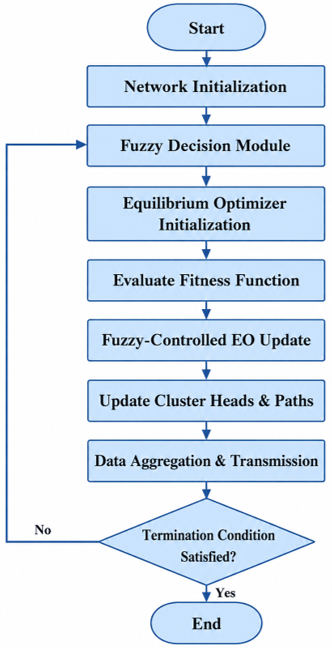
This section provides the offered FCEO framework for reliable and multi-level data aggregation in active WSNs. The technique is structured into 4 basic elements (Figure 1): multi-level aggregation structure, fuzzy decision module, network model, and assumptions, as well as a combination with the EO.
Figure 1. Flowchart of the proposed method
3.1 Network model and assumptions
WSN is schemed as a network of N sensor nodes randomly deployed within a geographical environment of size A × A. Every node is equipped with sensing, operating, processing, communication, and computational abilities under the restricted energy of a battery. Nodes communicate with cluster heads applying single/multi-hop links based on the topology of the network. Here, the dynamics of network basically arise from node failures as well as progressive energy depletion made by exhaustion of battery than physical node mobility. Accordingly, active nodes’ set changes over time, causing the dynamic cluster formation as well as routing decisions via simulation. Basically, whole nodes are assumed to be homogeneous in terms of abilities of communication, energy, and range of sensing.
Efficiency of energy refers to the crucial issue in WSNs, and to the scheme usage of energy for receiving and transmitting data, the first-order radio energy model is adopted. Particularly, the energy needed for transmitting a k-bit message beyond distance d is described as [24]:
$E_{t x}(k, d)=E_{\text {elec}} \cdot k+\varepsilon_{\text {amp}} \cdot k \cdot d^2$ (1)
That Etx(k,d) (J) shows the energy of transmission needed to send a k-bit packet over a distance d (m), Eelec (J/bit) shows the energy used by the transmitter and receiver electronic circuitry, εamp (J/bit/m2) refers to the transmit amplifier energy coefficient. Here, the model of free-space propagation model (d2) is used because the distance of communication among nodes of sensor is relatively short. The energy needed to obtain the k-bit message is computed as [25]:
Fitness $=w_1 \cdot$ EnergyConsumption + $w_2 \cdot$ Delay $+w_3 \cdot(1-$ Reliability$)$ (2)
Erx(k) (J) shows the energy needed to get a k-bit packet. As the reception of packet does not include signal amplification, just the electronic circuitry uses energy in this process.
Data aggregation is hierarchically carried out, beginning from sensor nodes to cluster heads, after that, gateways, and finally, the sink node. Channels of communication are taken to be error-prone, and light encryption is developed to ensure the safety of data. This network model basic aim is to decrease total usage of energy usage, extend the lifetime of the network, and guarantee safe and reliable data transmission over the network.
Against the WSN models based on mobility, the offered framework uses static locations of node via the simulation. Nonetheless, the network remains dynamic because node failures made by depletion of energy modify the topology of network, needing adaptive routing updates as well as periodic cluster-head reselection continuously.
3.2 Multi-level aggregation structure
To improve energy efficiency and reduce redundant transmissions, the proposed FCEO framework adopts a three-level hierarchical aggregation structure, as described below. The offered FCEO framework adopts a three-level hierarchical aggregation structure. At the first level, nodes of sensor gather environmental data and transmit them to their related cluster heads. At the second level, every cluster head does the local data aggregation and forwards the aggregated packets to a node of gateway. At last, the gateway runs a second-step process of aggregation and transmits the last aggregated data to the node of sink. Such strategy of hierarchical communication effectively balances consumption of network energy, develop scalability, and decreases extra transmissions. The whole the proposed multi-level aggregation framework way is briefed in Algorithm 1.
|
Algorithm 1: Multi-Level Data Aggregation using Fuzzy-Controlled Equilibrium Optimizer (FCEO) |
|
Input: Sensor nodes N Output: Aggregated data at sink 1. Deploy N sensor nodes. 2. Form clusters using EO optimization. 3. Select Cluster Heads (CHs). 4. Compute ASS for each CH using the fuzzy system. 5. Select the best aggregation node. 6. Aggregate data inside each cluster. 7. Forward aggregated packets to Gateway. 8. Gateway performs second-level aggregation. 9. Transmit aggregated data to sink. 10. Repeat for each communication round. |
3.3 Fuzzy Decision Module
The Fuzzy Decision Module (FDM) is modelled for recognizing the most appropriate nodes for data aggregation at every level by taking hybrid variables at the same time, such as data reliability, residual energy, and distance to cluster heads. To obtain this, fuzzy logic is developed for controlling these parameters’ inherent uncertainty and variability, making a single Aggregation Suitability Score (ASS) for every node. This score could be mathematically stated as:
$A S S_i=f\left(E_i, D_i, R_i\right)$ (3)
The parameter Ri reliability is described as the node I communication reliability that is computed as the rate of successfully delivered packets to the total transmitted packets among the node and its related cluster head:
$R_i=\frac{P_i^{\text {success}}}{P_i^{\text {sent}}}, 0 \leq R_i \leq 1$ (4)
Ei shows node i's residual energy, Di shows the distance from the node to its cluster head, and Ri shows the reliability of communication described by Eq. (4). The outcome ASSi ranges from 0–1, where higher values show more appropriate nodes of aggregation. $P_i^{\text {success}}$ shows the number of successfully delivered packets and $P_i^{\text {sent}}$ shows the whole number of transmitted packets. A higher Ri value shows a more reliable link of communication and develops the related node’s aggregation priority. Nodes with higher residual energy, shorter distance to their cluster heads, as well as higher reliability of data, are determined to have higher ASS amounts, making them more probable to be chosen as nodes of aggregation. Conversely, nodes with lower energy/weak connectivity obtain lower scores.
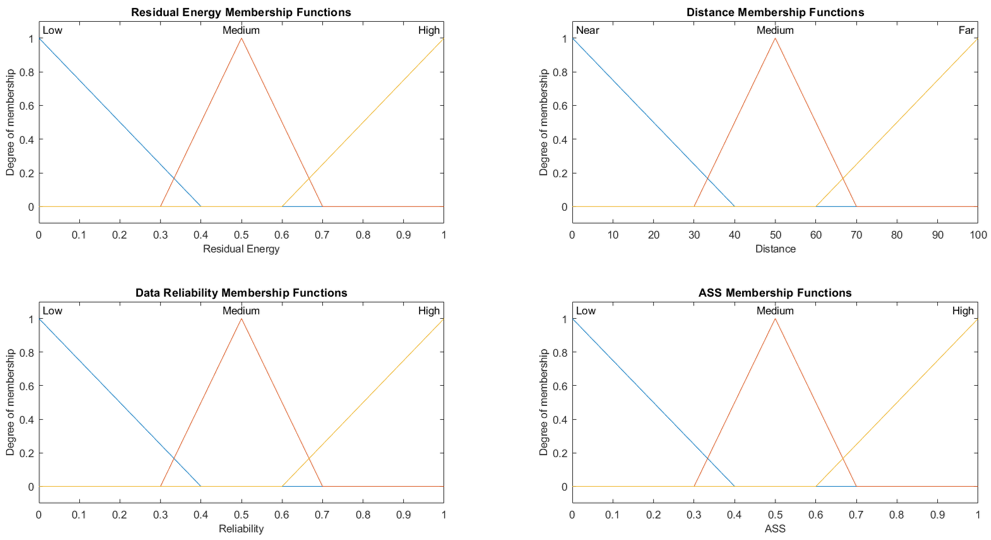
In the proposed FCEO framework, the fuzzy inference system applies 3 variables of input such as distance to the cluster head (Di), data reliability (Ri), and residual energy (Ei). Every variable of input is shown by 3 linguistic terms (Low, Medium, and High) applying triangular membership functions. The related membership functions are shown in Figure 2. ASS is the fuzzy system output that shows every candidate node’s aggregation priority.
Figure 2. Membership functions of fuzzy inputs and Aggregation Suitability Score (ASS) output
The process of fuzzy decision pursues the Mamdani inference algorithm. A Mamdani-type fuzzy inference system was used due to its intuitive rule representation and suitability for decision-making issues in WSNs. In the process of inference, the min operator was applied for assessing every rule antecedent situation, while the max operator was used for aggregating all activated rules’ outcomes.
At last, the aggregated fuzzy output was transferred into a crisp ASS by applying the Centroid defuzzification technique that calculates the aggregated membership function gravity center.
The fuzzy rules assess the integrated effect of data reliability, communication distance, energy level. The fuzzy inference system uses 27 IF–THEN rules obtained from expert knowledge by considering whole feasible 3 linguistic input variables (Residual Energy, Distance, and Data Reliability) integrations. The whole fuzzy rule base is shown in Table 2. For instance, a node with short distance, high data reliability and high residual energy gets a high ASS value, when nodes with long distance, low communication reliability and low energy get lower aggregation priority. The final crisp ASS value is obtained using the centroid defuzzification method. The generated ASS is combined into the Equilibrium Optimizer Adaptive Selection (AS) Strategy approach. The gathered score dynamically impacts the candidate aggregation nodes’ selection probability and sets the process of optimization through developing the balance among exploration and exploitation. In the basic iterations of optimization, the approach keeps higher exploration ability to search different solutions of aggregation when in later iterations, exploitation is focused to refine the optimum aggregation structure.
Table 2. Fuzzy rule base for aggregation node selection
|
Rule |
Energy |
Distance |
Reliability |
ASS |
|
R1 |
Low |
Far |
Low |
Very Low |
|
R2 |
Low |
Far |
Medium |
Low |
|
R3 |
Low |
Far |
High |
Low |
|
R4 |
Low |
Medium |
Low |
Low |
|
R5 |
Low |
Medium |
Medium |
Medium |
|
R6 |
Low |
Medium |
High |
Medium |
|
R7 |
Low |
Near |
Low |
Medium |
|
R8 |
Low |
Near |
Medium |
Medium |
|
R9 |
Low |
Near |
High |
High |
|
R10 |
Medium |
Far |
Low |
Low |
|
R11 |
Medium |
Far |
Medium |
Medium |
|
R12 |
Medium |
Far |
High |
Medium |
|
R13 |
Medium |
Medium |
Low |
Medium |
|
R14 |
Medium |
Medium |
Medium |
Medium |
|
R15 |
Medium |
Medium |
High |
High |
|
R16 |
Medium |
Near |
Low |
Medium |
|
R17 |
Medium |
Near |
Medium |
High |
|
R18 |
Medium |
Near |
High |
High |
|
R19 |
High |
Far |
Low |
Medium |
|
R20 |
High |
Far |
Medium |
Medium |
|
R21 |
High |
Far |
High |
High |
|
R22 |
High |
Medium |
Low |
High |
|
R23 |
High |
Medium |
Medium |
High |
|
R24 |
High |
Medium |
High |
Very High |
|
R25 |
High |
Near |
Low |
High |
|
R26 |
High |
Near |
Medium |
Very High |
|
R27 |
High |
Near |
High |
Very High |
The fuzzy system lets the network actively adapt to shifting situations, guaranteeing that aggregation decisions balance communication cost, data reliability, and energy efficiency in a combined and context-aware manner.
3.4 Integration with Equilibrium Optimizer
EO [12] is a physics-inspired metaheuristic that presents strong abilities of global search to optimize routing ways, multi-level data aggregation, and cluster formation in WSNs. In the offered FCEO framework, fuzzy-generated ASS are applied to actively set EO exploration and exploitation parameters, helping the search process to more reliable and energy-efficient solutions. Basically, candidate solutions’ population showing assignments of cluster head and routing ways is made. Every candidate solution is assessed by applying a function of fitness which combines the usage of energy, data reliability, and communication delay that could be stated as:
Fitness $=w_1 \cdot$ Energy Consumption + $w_2 \cdot$ Delay $+w_3 \cdot(1-$ Reliability$)$ (5)
That w1, w2, and w3 refer to weight coefficients reflecting every metric's relative significance. EC shows the normalized energy usage, Delay shows the normalized communication delay, Reliability is the packet delivery reliability, and w1 + w2 + w3 = 1. Here, the weights were experimentally chosen as w1 = 0.5, w2 = 0.2, and w3 = 0.3. The mechanism of EO updates the candidate solutions iteratively by moving them to optimum equilibrium situations while keeping diversity of population, so as to prevent premature convergence. By combining fuzzy logic with EO, the FCEO framework obtains the balanced trade-off among global exploration and local exploitation, guaranteeing that multi-level aggregation decisions and cluster head selection are reliable and energy-efficient under active situations of network situations. The radio energy model parameters’ values utilized in the simulations are briefed in Table 3.
Table 3. Notation used in Eqs. (1)-(5)
|
Symbol |
Description |
Unit |
|
k |
Packet size |
bits |
|
d |
Transmission distance |
m |
|
Eelec |
Electronic energy |
J/bit |
|
εamp |
Amplifier energy |
J/bit/m² |
|
Ei |
Residual energy |
J |
|
Di |
Distance to CH |
m |
|
Ri |
Data reliability |
- |
|
ASS |
Aggregation Suitability Score |
- |
|
EC |
Energy consumption |
J |
|
Delay |
Communication delay |
ms |
|
w1, w2, w3 |
Weight coefficients |
- |
3.5 Algorithmic flow
The total FCEO framework starts with initializing a network that nodes of sensor nodes are used, and basic energy levels and data status are adjusted. The fuzzy decision module computes the Aggregation Suitability Score for every node, helping the cluster heads and aggregator nodes’ selection. Candidate solutions are made for EO that assesses every fitness of a solution given the data reliability, usage of energy, and delay. EO parameters are actively set by applying fuzzy scores to develop convergence to the global optimum. The best solutions assign the last cluster head assignments and multi-level aggregation ways. Data is aggregated and transmitted via a hierarchical network structure, and the process repeats iteratively till a termination situation, like max rounds’ number/exhaustion of network energy, is obtained. This combined strategy guarantees that the offered framework is energy-aware, adaptive, scalable able to present reliable data aggregation in active WSNs.
This section shows and discusses the simulation outcomes achieved from assessing the offered FCEO framework for reliable and multi-level data aggregation in active WSNs. The offered technique is compared with present protocols of clustering and routing, such as Fuzzy-LEACH, LEACH, and EEO, to confirm its strength and efficiency. Main metrics of performance, such as average energy, PDR, node survival (alive nodes), and sum network energy, are analyzed to present the general system’s manner understanding under active situations of the network.
The outcomes show that the offered FCEO technique efficiently decreases total usage of energy by smartly choosing energy-efficient nodes for aggregation and optimizing routing ways via equilibrium-driven search algorithms. The adaptive fuzzy decision module lets the system actively respond to variations in levels of node energy, data reliability, and distances, which causes better load balancing over the network. Accordingly, the active nodes stay higher for a longer duration, showing a considerable development in the lifetime of the network in comparison with conventional strategies.
In addition, the developed strategy of FCEO shows developed communication efficiency and network stability, causing a higher PDR in comparison with Fuzzy LEACH, LEACH, and EEO. The offered model keeps a higher average, more alive nodes, and the sum energy across the lifetime of the network. Totally, the comparative outcomes validate that the FCEO framework presents a balanced trade-off between reliability and efficiency of energy, making it an appropriate solution for large-scale and active areas of WSN.
4.1 Simulation findings
The offered FCEO framework was made and simulated in the MATLAB (R2021b) simulator to assess its efficiency in reliable and multi-level data aggregation in active WSNs. The simulation setup took a network region of 100 × 100 m² with N = 80 developed sensor nodes randomly. Every node was launched with equal energy, sink node was positioned at the network center. The model of radio energy pursued the first-order radio model, which usage of energy for data transmission and reception based on the two distances and the size of the message among nodes.
The FCEO framework was compared with popular mechanisms like Fuzzy-LEACH [24], EEO [13], and LEACH [4, 5] to show its superiority in energy reliability and efficiency. Simulations were performed for hybrid rounds of network till the last node died, every test was repeated 10 times independently applying various random seeds, and the reported outcomes related to the mean ± standard deviation of all runs and medium outcomes were computed beyond some independent runs to guarantee statistical validity. EO parameters such as equilibrium pool size, control coefficients, and search factors were experimentally fine-tuned to obtain the best trade-off between convergence speed and solution quality. Likely, parameters of the fuzzy system were described, given the thresholds of energy and distance, to efficiently help the optimization process.
Across the simulation, some crucial parameters like average residual energy, PDR, alive nodes, and total energy- were controlled continuously. The outcomes of the simulation showed that the offered FCEO performed better than baseline mechanisms consistently in the case of communication reliability and energy preservation. Nodes taking part in aggregation were chosen more effectively, causing decreased extra transmissions and balanced energy usage beyond the network. These results validate that fuzzy logic combination with equilibrium optimization considerably develops WSN data aggregation processes’ adaptability and scalability under active and actual situations of the network.
The parameters of simulation adopted via the tests are briefed in Table 4. Whole competing mechanisms were assessed under identical network adjustments to guarantee a fair and stable comparison.
Table 4. Simulation parameters
|
Parameter |
Value |
|
Simulation area |
100 × 100 m² |
|
Number of sensor nodes |
80 |
|
Sink location |
(50, 50) |
|
Initial energy per node |
0.5 J |
|
Packet size |
4000 bits |
|
Number of simulation rounds |
200 |
|
Eelec |
50 nJ/bit |
|
εamp |
100 pJ/bit/m² |
|
Eproc |
5 nJ/bit |
|
Cluster-head ratio |
5% |
|
Number of cluster heads |
4 |
|
Transmission model |
First-order radio model |
|
MATLAB version |
R2021b |
|
Equilibrium Optimizer (EO) population size |
30 |
|
EO iteration limit |
100 |
4.2 Performance parameters
To generally assess the offered FCEO framework efficiency and reliability, 4 main performance parameters were taken in simulation: average energy, PDR, alive nodes, and sum energy. These metrics present the holistic algorithm’s treatment understanding under various scenarios of the network, taking the two WSNs’ communication reliability and energy efficiency natures.
Alive nodes as the first parameter reflects operational nodes beyond simulation rounds, showing the sustainability of the network and how evenly energy is shared among nodes. A slower decline in alive nodes offers more balanced energy usage. Average energy, as the second parameter, scales the whole nodes’ mean residual energy at every round, presenting a perspective into energy use efficiency. Higher average energy shows that the mechanism efficiently decreases unimportant transmissions and prolongs the lifetime of the node. Sum Energy was controlled for assessing the whole energy remaining in the network, reflecting the offered technique in energy resources’ preservation. At last, PDR was analyzed to evaluate the reliability of communication, where higher PDR amounts show more successful delivery of data to the node of sink node.
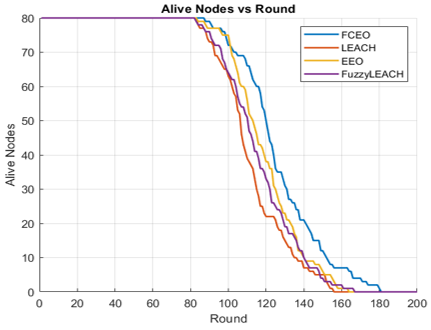
To generally assess the offered FCEO framework efficiency and reliability, 4 main parameters of performance were analysed in the simulation: average energy, PDR, alive nodes, and total energy. These metrics present the obvious mechanisms for treating understanding under various network scenarios, taking the two WSN nature’s energy efficiency and communication reliability. Alive nodes: Operational nodes over simulation rounds reflect the sustainability and energy sharing of the network. As illustrated in Figure 3, the FCEO keeps a higher alive node in comparison with Fuzzy-LEACH, LEACH, and EEO across the simulation. It shows more balanced usage of energy, extending network lifetime, and delaying node death.
Figure 3. Comparison of the number of alive nodes over simulation rounds
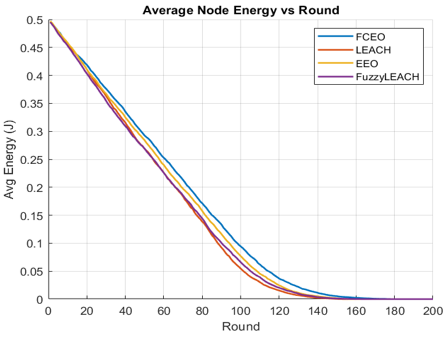
Average energy: whole nodes’ medium residual energy each round presents a perspective into the efficiency of energy. Figure 4 shows that FCEO protects higher average energy levels consistently, showing that unimportant transmissions are reduced and node lifetime is extended in comparison with mechanisms of baseline mechanisms.
Figure 4. Comparison of the average residual energy over simulation rounds
Figure 5. Comparison of the total residual energy over simulation rounds
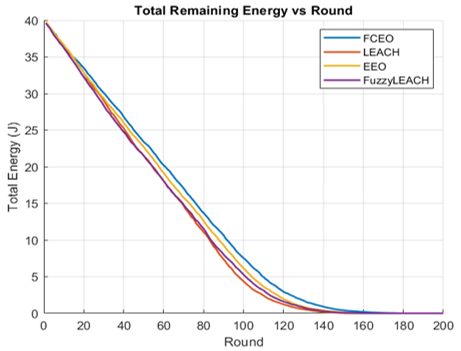
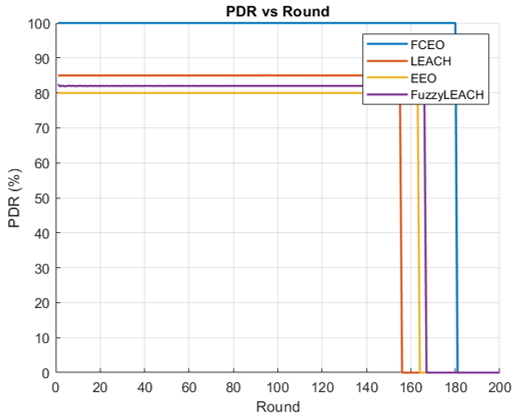
Total energy: Controlling total energy usage improves the overall network efficiency in utilizing its limited energy resources. As shown in Figure 5, FCEO retains higher total network energy throughout the rounds, demonstrating better energy management than Fuzzy-LEACH, LEACH, and EEO. PDR measures communication reliability by calculating the proportion of packets successfully delivered to the sink. Figure 6 illustrates that FCEO achieves the highest PDR among all tested mechanisms, indicating improved data delivery and reliable communication links under dynamic network conditions. The comparative results, summarized in Table 5, confirm that the FCEO framework provides a balanced trade-off between communication reliability and energy efficiency, outperforming traditional clustering and optimization strategies in WSN environments. Table 5 shows the average performance of the assessed mechanisms over the entire simulation period (200 rounds). AvgAlive indicates the average number of sensor nodes that remain alive in each simulation round. AvgEnergy (J) indicates the average residual energy of the sensor nodes during the simulation. TotalEnergy (J) indicates the average total residual energy of all nodes over the simulation rounds. AvgPDR (%) indicates the average packet delivery rate, calculated as the percentage of packets successfully delivered to the sink out of all packets transmitted during the simulation.
Figure 6. Comparison of the packet delivery ratio (PDR) over simulation rounds
Table 5. Comparative performance metrics of Fuzzy-Controlled Equilibrium Optimizer (FCEO) and baseline algorithms
|
Algorithm |
Avg. Alive (nodes) |
Avg. Energy (J) |
Total Energy (J) |
Avg. PDR (%) |
|
FCEO |
50.90 ± 0.38 |
0.1553 ± 0.0018 |
12.424 ± 0.086 |
90.00 ± 0.42 |
|
LEACH |
45.13 ± 0.71 |
0.1391 ± 0.0032 |
11.124 ± 0.154 |
65.88 ± 1.03 |
|
EEO |
48.05 ± 0.59 |
0.1471 ± 0.0026 |
11.770 ± 0.137 |
65.20 ± 0.94 |
|
Fuzzy-LEACH |
46.69 ± 0.66 |
0.1401 ± 0.0029 |
11.209 ± 0.145 |
68.06 ± 0.88 |
The simulation outcomes show that the proposed FCEO framework improves network performance under the considered simulation settings by maintaining a higher number of alive nodes, preserving both average and total residual energy, and achieving a higher PDR compared with Fuzzy-LEACH, LEACH, and EEO. The integration of fuzzy logic with the EO enables adaptive cluster head selection and efficient multi-level routing, resulting in improved energy utilization and enhanced communication reliability throughout the network lifetime. These results are based on the MATLAB simulation outcomes achieved under the particular network configuration and show the proposed approach's efficiency in the assessed scenarios. Later research will concentrate on developing the FCEO framework to dynamic topology conditions, heterogeneous WSNs, mobility-aware areas, larger network scenarios. Additionally, experimental validation in real-life WSN and IoT developments will be conducted to later evaluate the proposed framework's practicality and scalability.
[1] Fahmy, H.M.A. (2021). WSNs applications. In Concepts, Applications, Experimentation, and Analysis of Wireless Sensor Networks. Signals and Communication Technology. Springer, Cham, pp. 67-232. https://doi.org/10.1007/978-3-030-58015-5_3
[2] Fares, H., Vibhute, A.D., Mouniane, Y., Bouijij, H. (2025). Intrusion detection system in wireless sensor networks using machine learning. Procedia Computer Science, 252: 912-921. https://doi.org/10.1016/j.procs.2025.01.052
[3] Zolfagharipour, L., Kadhim, M.H. (2025). A technique for efficiently controlling centralized data congestion in vehicular ad hoc networks. International Journal of Computer Networks and Applications (IJCNA), 12(2): 267-277. https://doi.org/10.22247/ijcna/2025/17
[4] Rajaram, V., Pandimurugan, V., Rajasoundaran, S., et al. (2025). Enriched energy optimized LEACH protocol for efficient data transmission in wireless sensor network. Wireless Networks, 31: 825-840. https://doi.org/10.1007/s11276-024-03802-5
[5] Marhoon, H.A., Alamiery, A., Shaker, L.M. (2025). A PEGASIS RP based-wireless sensor network-enabled smart contact lens for real time ocular monitoring. Results in Engineering, 26: 105285. https://doi.org/10.1016/j.rineng.2025.105285
[6] Amit, Hanji, G. (2025). An enhanced HEED clustering algorithm for increased reliability and network lifetime of wireless sensor networks. Engineering, Technology & Applied Science Research, 15(5): 27947-27953. https://doi.org/10.48084/etasr.13636
[7] Wang, D.S., Tan, D.P., Liu, L. (2018). Particle swarm optimization algorithm: An overview. Soft Computing, 22: 387-408. https://doi.org/10.1007/s00500-016-2474-6
[8] Faris, H., Aljarah, I., Al-Betar, M.A., Mirjalili, S. (2018). Grey wolf optimizer: A review of recent variants and applications. Neural Computing and Applications, 30: 413-435. https://doi.org/10.1007/s00521-017-3272-5
[9] Yang, X.S., Slowik, A. (2020). Firefly algorithm. In Swarm Intelligence Algorithms, CRC Press, pp. 163-174.
[10] Nasiri, J., Khiyabani, F.M., Yoshise, A. (2018). A whale optimization algorithm (WOA) approach for clustering. Cogent Mathematics & Statistics, 5(1): 1483565. https://doi.org/10.1080/25742558.2018.1483565
[11] Al-Betar, M.A., Abu Doush, I., Makhadmeh, S.N., Al-Naymat, G., Alomari, O.A., Awadallah, M.A. (2024). Equilibrium optimizer: A comprehensive survey. Multimedia Tools and Applications, 83: 29617-29666. https://doi.org/10.1007/s11042-023-16764-1
[12] Liu, Y.T., Ding, H.W., Wang, Z.S., Dhiman, G., Yang, Z.J., Hu, P. (2023). An enhanced equilibrium optimizer for solving optimization tasks. Computers, Materials and Continua, 77(2): 2385-2406. https://doi.org/10.32604/cmc.2023.039883
[13] Naghibi, M., Barati, H. (2021). SHSDA: Secure hybrid structure data aggregation method in wireless sensor networks. Journal of Ambient Intelligence and Humanized Computing, 12: 10769-10788. https://doi.org/10.1007/s12652-020-02751-z
[14] Saeedi, I.D.I., Al-Qurabat, A.K.M. (2022). Perceptually important points-based data aggregation method for wireless sensor networks. Baghdad Science Journal, 19(4): 875-886. https://doi.org/10.21123/bsj.2022.19.4.0875
[15] Hajian, R., Erfani, S.H. (2021). CHESDA: Continuous hybrid and energy-efficient secure data aggregation for WSN. The Journal of Supercomputing, 77: 5045-5075. https://doi.org/10.1007/s11227-020-03455-z
[16] Bharathi, S.D., Veni, S. (2025). Geographical energy-aware data aggregation using mobile sinks (GEADAMS) algorithm in wireless sensor networks to minimize latency. International Journal of Performability Engineering, 21(5): 288-297. https://doi.org/10.23940/ijpe.25.05.p6.288297
[17] Kaur, A., Bansal, M., Kumar, D. (2025). Mobile agent and ACO based data aggregation for wireless sensor networks. SN Computer Science, 6: 77. https://doi.org/10.1007/s42979-024-03583-w
[18] Dhanaraj, R.K., Lalitha, K., Anitha, S., Khaitan, S., Gupta, P., Goyal, M.K. (2021). Hybrid and dynamic clustering based data aggregation and routing for wireless sensor networks. Journal of Intelligent & Fuzzy Systems, 40(6): 10751-10765. https://doi.org/10.3233/JIFS-201756
[19] Yousefpoor, E., Barati, H., Barati, A. (2021). A hierarchical secure data aggregation method using the dragonfly algorithm in wireless sensor networks. Peer-to-Peer Networking and Applications, 14: 1917-1942. https://doi.org/10.1007/s12083-021-01116-3
[20] Yun, W.K., Yoo, S.J. (2021). Q-learning-based data-aggregation-aware energy-efficient routing protocol for wireless sensor networks. IEEE Access, 9: 10737-10750. https://doi.org/10.1109/ACCESS.2021.3051360
[21] Bhushan, S., Kumar, M., Kumar, P., Stephan, T., Shankar, A., Liu, P. (2021). FAJIT: A fuzzy-based data aggregation technique for energy efficiency in wireless sensor networks. Complex & Intelligent Systems, 7: 997-1007. https://doi.org/10.1007/s40747-020-00258-w
[22] Sharmin, S., Ahmedy, I., Noor, R.M. (2023). An energy-efficient data aggregation clustering algorithm for wireless sensor networks using hybrid PSO. Energies, 16(5): 2487. https://doi.org/10.3390/en16052487
[23] Abood, B., Hussien, A., Li, Y., Wang, D.S. (2016). Energy efficient clustering in wireless sensor networks using fuzzy approach to improve LEACH protocol. International Journal of Management and Information Technology, 11(2): 2641-2656. https://doi.org/10.24297/ijmit.v11i2.4856
[24] Heinzelman, W.R., Chandrakasan, A., Balakrishnan, H. (2000). Energy-efficient communication protocol for wireless microsensor networks. In Proceedings of the 33rd Annual Hawaii International Conference on System Sciences, Maui, HI, USA, p. 10. https://doi.org/10.1109/HICSS.2000.926982
[25] Mamdani, E.H. (1974). Application of fuzzy algorithms for control of simple dynamic plant. Proceedings of the Institution of Electrical Engineers, 121(12): 1585-1588. https://doi.org/10.1049/piee.1974.0328