Anita Susanti* | Kusuma R. Haratama | Ari Widayanti | R. Endro Wibisono | Adhelia Syahada Annindya Lukito
© 2026 The authors. This article is published by IIETA and is licensed under the CC BY 4.0 license (http://creativecommons.org/licenses/by/4.0/).
OPEN ACCESS
Container flow at Terminal Petikemas Surabaya (TPS) increased by 9.3% to 1,584,774 TEUs, creating pressure on internal transport, yard access, and loading–unloading performance. This study evaluates the potential use of an Automated Guided Vehicle (AGV) system to support more responsive container movement within the terminal. A simulation-based framework integrates Particle Swarm Optimization (PSO) for task scheduling and AGV assignment with the A-star (A*) algorithm for route planning. Ten simulation runs were conducted to examine route variability under different traffic-density and obstacle conditions. The framework reached the destination in 9 of 10 runs; the best run required 40 steps, 1.04 minutes, and 1.75% occupancy, while one run failed due to an unresolved obstacle condition. The findings indicate that the PSO–A* framework can provide a structured basis for AGV route planning and may support faster container transfer in a controlled simulation environment. However, reductions in vessel waiting time, operational cost, and terminal delay should be interpreted as expected operational implications rather than field-validated outcomes. The study contributes an integrated scheduling–routing simulation for AGV-based container transport and identifies practical requirements for future implementation in smart port operations.
Automated Guided Vehicles, Terminal Petikemas Surabaya, Particle Swarm Optimization, A* algorithm, port operational performance
Indonesia’s maritime geography gives its ports a strategic role in national and international logistics because a large share of global shipping routes passes through Indonesian waters [1, 2]. Tanjung Perak Port is one of the country’s major gateways for domestic and international cargo flows, and Terminal Petikemas Surabaya (TPS) serves as a key container-handling facility within this system [3-5]. As containerized trade increases, port competitiveness increasingly depends not only on quay capacity but also on the reliability of internal terminal transport, yard access, and the coordination of loading and unloading activities [6, 7].
Recent operational data show that container throughput at TPS reached 1,584,774 TEUs by the end of 2024, representing a 9.3% increase from the previous year [8]. International container movement increased by 9.65%, while domestic container flow rose by 3.14%. Although the observed loading and unloading performance of 54 boxes/ship/hour is above the national standard of 48 boxes/ship/hour [9], continued growth can intensify congestion, extend internal transfer time, and reduce service reliability if yard transport and route management are not improved [10-13].
Smart port development provides an operational pathway for addressing these challenges by integrating equipment automation, centralized control, digital monitoring, and data-driven management into container-terminal operations [14]. Automated Guided Vehicles (AGVs) are particularly relevant to container terminals because they can move containers between quay cranes, transfer points, and container yards with lower dependence on manual head trucks [15-19]. From a transportation-system perspective, AGVs should therefore be evaluated not only as robotic vehicles but also as components of an integrated terminal transport network that affects flow continuity, vehicle interaction, queue formation, and service time [20, 21].
Previous studies have examined AGV deployment from different perspectives. Research on smart warehouses and automated terminals has discussed AGV architecture, collision avoidance, path planning, resilient scheduling, charging strategy, and simulation-based evaluation [22-27]. Other studies have shown that mechanical dynamics, multi-vehicle coordination, and terminal operating rules may influence the practical performance of AGV systems [28]. However, much of the existing work emphasizes either algorithmic path search or high-level terminal efficiency, while fewer studies connect scheduling decisions, local route planning, and terminal-specific transport constraints in one simulation framework.
The research gap addressed in this paper is therefore the limited integration between AGV task allocation and route planning under container-terminal operating conditions. In particular, previous approaches often treat scheduling and routing as separate problems or evaluate them in simplified environments that do not explicitly represent traffic density, obstacle conditions, and the quay–yard movement pattern of a specific terminal. This study responds to that gap by combining Particle Swarm Optimization (PSO), which is suitable for assignment and scheduling optimization, with the A* algorithm, which is suitable for shortest-path search in a node-based environment [29-33].
The selection of PSO and A* is based on their complementary functions. PSO is used to search for efficient AGV task allocation and movement sequencing, while A* translates the selected origin–destination movement into a feasible path by calculating travel cost and estimated distance to the destination. This combination differs from studies that rely only on routing heuristics, charging-aware scheduling, or predefined dispatching rules because it explicitly links scheduling output with route generation for AGV movement in the TPS case environment. This paper provides insights for the following:
This article is structured into five main chapters that are integrated to provide a systematic discussion flow. The first chapter is the Introduction. The second chapter discusses Materials and Methods. The third chapter presents the Research Results. The fourth chapter is the Discussion. The final chapter is the Conclusion, which summarizes the main findings of the study and emphasizes the contribution of the PSO and A* algorithm integration in supporting AGV route planning at the Surabaya Container Terminal.
2.1 PSO algorithm
PSO is one of the most widely used metaheuristic algorithms for solving complex optimization problems. Inspired by the collective behavior of natural swarms such as birds or fish, PSO operates by initializing a population of candidate solutions, referred to as particles, which iteratively update their positions and velocities based on three key components: inertia, cognitive learning (personal best), and social learning (global best) [34]. These updates are governed by mathematical equations that incorporate stochastic elements to maintain population diversity and prevent premature convergence [35]. Numerous studies have demonstrated the effectiveness of PSO across various domains, particularly in solving complex scheduling and load-balancing problems in automated port terminals—applications that are crucial for enhancing operational efficiency and promoting sustainability [36]. PSO offers several advantages, including algorithmic simplicity, fast convergence, and minimal parameter tuning, making it especially suitable for real-time optimization in systems such as AGVs. However, it also faces challenges, such as local optima entrapment, which can be addressed by hybridizing with other algorithms or by structural enhancements to its optimization process [36].
As a representative of the broader class of metaheuristic algorithms, PSO exemplifies the strength of these approaches in solving complex problems that conventional methods struggle with. Metaheuristics are high-level search methods used to address complex optimization problems, particularly when the search environment is large, partially known, or computationally demanding. In vehicle path planning, these methods can accommodate obstacle conditions and balance solution quality against computational complexity [37, 38].
2.2 A-star algorithm
The A-star (A*) algorithm is a widely used pathfinding and graph traversal algorithm that efficiently finds the shortest path between nodes by combining the strengths of Dijkstra’s algorithm and heuristic search. It employs a best-first search strategy guided by an evaluation function as in Eq. (1).
$f(n)=g(n)+h(n)$ (1)
where, $g(n)$ represents the cost from the start node to the current node. $n$ and $h(n)$ is a heuristic estimate of the cost from n to the goal node. This balance enables A* to find optimal paths with less computational effort than uninformed search methods.
In the context of AGVs in container terminals, the A* algorithm has been adapted and refined to address challenges such as dynamic obstacles, complex environment layouts, and the need for smooth, collision-free routing. For example, Hu et al. [39] proposed an improved A* algorithm that incorporates a steering cost estimation function and a multi-AGV occupancy-aware program to optimize path planning and conflict avoidance. This approach reduces computational complexity and increases operational efficiency, making it suitable for upgrading traditional container terminals at low cost while maintaining universality for various industrial applications. Further advancements involve integrating a kinematically constrained A* algorithm, as demonstrated in this study [40]. This approach facilitates efficient global path planning with smooth transitions and dynamically executable routes. The use of B-spline interpolation for path smoothing significantly reduces sharp directional changes, thereby enhancing AGV stability and improving operational efficiency in dynamic industrial settings [40]. Recent studies also emphasize the importance of conflict-free path planning in multi-AGV systems to improve energy efficiency and scheduling performance. Zhong et al. [41] developed an integrated scheduling model that incorporates conflict-free path planning based on A* principles, achieving substantial reductions in energy consumption and operational delays in container terminals. Overall, the A* algorithm and its variants offer a robust, adaptable framework for AGV path planning in automated container terminals, thereby supporting sustainable port transportation by improving operational performance and reducing energy consumption.
2.3 AGVs system planning analysis
Based on the analysis of loading and unloading activities at TPS, which still relies on manual head trucks for container handling, the implementation of innovations such as AGVs is necessary to improve port operational performance and anticipate the annual increase in container flow. These AGVs will serve as an efficient internal transportation mode, moving containers between the dock and the container yard. This AGV system uses visual guidance-based navigation, enabling vehicles to operate autonomously by detecting objects and obstacles with cameras, thereby avoiding collisions and ensuring safe travel. In planning AGV system innovation, the first step is to prepare a flow diagram that describes the workflow or system activities, which will serve as a reference for the coding process. The flow diagram of the activities in the system planning process to be used is shown in Figure 1.
Figure 1. Flowchart of AGVs fastest path search
The flowchart above outlines the stages of AGV navigation system planning. The process begins with installing the layout and obstacles, followed by robot simulation to reach the destination 10 times. This aims to find the shortest path or fastest route from a starting point to the destination node. This approach enables the terminal to minimize the risk of human error, improve the accuracy of container movements, and achieve smarter, more sustainable operations.
2.4 AGVs route planning analysis
In AGV route planning, PSO and A* are used sequentially rather than independently. PSO first evaluates candidate task-allocation and movement-sequence solutions, where each particle represents a possible assignment of AGV movements between the quay and container yard. The candidate solution is assessed using operational indicators such as travel time, number of steps, route feasibility, and occupancy level. The best PSO output is then passed to A*, which searches the shortest feasible route for the assigned origin–destination movement by minimizing the total path cost. This structure ensures that scheduling decisions guide the routing process, while A* verifies whether the selected movement can be executed in the terminal layout. The sequential interaction between PSO and A* in the proposed AGV framework is summarized in Algorithm 1. The PSO and A* algorithms perform complementary functions in the proposed AGV system, with PSO supporting route-assignment optimization and A* determining the shortest feasible path. Their respective mechanisms and applications are summarized in Table 1.
|
Algorithm 1. Integrated PSO–A* pseudocode |
|
(1) initialize the terminal grid, start–destination nodes, AGV capacity, and obstacle layout; (2) generate candidate AGV task sequences and movement assignments using PSO; (3) evaluate particles based on route feasibility, step count, travel time, and occupancy; (4) send the best PSO assignment to A* as the origin–destination routing task; (5) apply A* using f(n) = g(n) + h(n) to identify the shortest feasible path; and (6) record success/failure, steps, occupancy, and travel time for each simulation run. |
Table 1. Algorithm mechanism and performance
|
Algorithm |
Mechanism |
Application |
|
PSO Algorithm |
Using a meta-heuristic approach inspired by the behavior of bird groups. Particles in a group share information to find the optimal solution. |
The PSO algorithm is used to optimize vehicle distribution routes, especially in complex combinatorial and route assignment problems. |
|
A-star (A*) Algorithm |
Using a heuristic-based search method that calculates the shortest path by considering the travel cost and estimated distance to the destination. |
The A* algorithm is used in the AGVs route search system to determine the fastest path from the starting point to the destination. |
2.5 Container flow productivity analysis
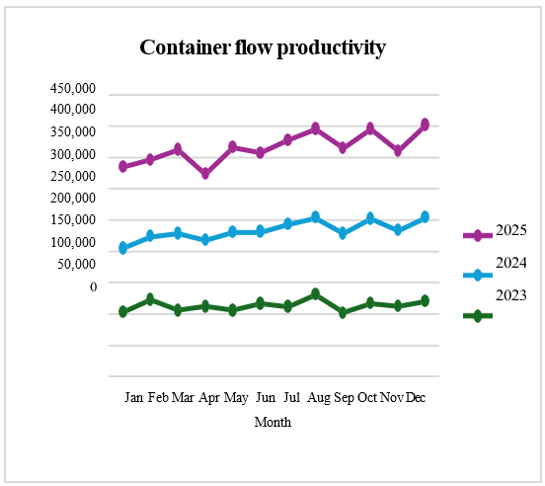
Container flow data include the daily arrivals of import containers unloaded from ships at the dock and export containers entering through the gates of TPS, which are temporarily stored in the stacking yard before being loaded onto ships. This data is used to analyze the growth of international and domestic container flows, as shown in Figure 2.
Figure 2. Container flow productivity graph
2.6 Port operational performance analysis
Port operational performance is an indicator of the level of success of port services for users, both ships and containers. This indicator can be assessed through Container Loading and Unloading performance (B/M). Calculation of container loading and unloading performance, expressed as Box/Crane/Hour (B/C/H), includes analysis of the performance for 2023-2025 and its calculation for the same period using the formula in Eq. (2).
$B/M = \left( \frac{{Number \,of \,containers\, unloaded/loaded}}{{Number \,of \,effective \,hours} \times {Number \,of \,working\,tools}} \right)$ (2)
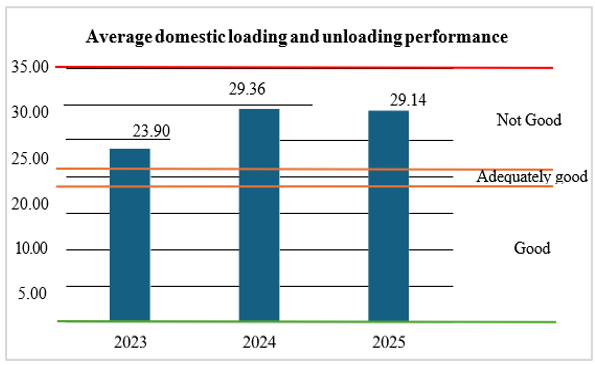
Eq. (2) can be used to determine the performance of domestic and foreign container loading and unloading in 2023-2025. Figure 3 is the average result of the calculation of domestic container loading and unloading performance.
According to Figure 3, the average domestic container loading and unloading performance over the last 3 years (2023-2025) is classified as poor, with a range of 23.90% to 29.36%. This assessment is based on the 2025 port operational service performance standard, which is 19% for domestic services, which has been successfully met during that period. Figure 4 is the average result of the calculation of international container loading and unloading performance for the same period.
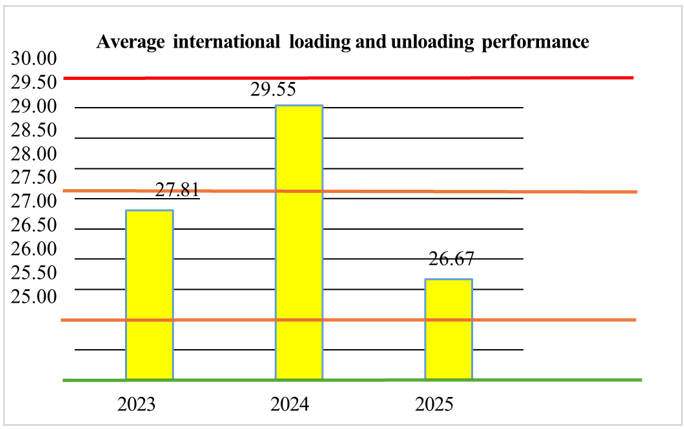
According to Figure 4, the average assessment of international container loading and unloading performance for the last three years (2023-2025) is classified as quite good to poor, with a percentage ranging from 26.67% to 29.55%. This assessment is based on the 2025 port operational service performance standard, which is 26% for international services, which has been successfully met during that period. In response to the less-than-optimal domestic and international container loading and unloading performance, optimization efforts are needed, including the planning and implementation of AGVs to accelerate loading and unloading.
Figure 3. Average domestic loading and unloading performance
Figure 4. Average international loading and unloading performance
This study employs a simulation-based methodology to design and evaluate an AGV routing framework for container movement at Surabaya Container Terminal [25, 40]. The simulation focuses on horizontal transport between the quay and container yard, where delays may arise from route conflicts, inefficient vehicle assignment, and obstacle conditions. The terminal layout is represented as a simplified movement network, while AGV operations are assessed through repeated route-search attempts.
The methodological framework integrates two algorithmic layers. The first layer uses PSO to support task allocation and movement sequencing by comparing candidate solutions according to route efficiency indicators. The second layer uses A* to translate the selected assignment into an executable path. This hierarchical structure is used because scheduling and routing are interdependent in AGV operations: a good assignment may still fail if the route is blocked, while a short route may not be operationally useful if the vehicle sequence is inefficient.
The A* component applies a cost function based on accumulated travel cost and estimated distance to the destination. In the simulation, this enables the AGV to choose a path that minimizes travel steps while avoiding unavailable nodes. When an obstacle cannot be bypassed within the simplified route network, the system records the attempt as failed. This condition is important because it shows that route feasibility depends on both algorithmic search and the completeness of the terminal network representation.
The proposed framework leverages the complementary strengths of PSO and A* to evaluate AGV movement within a controlled terminal simulation. The framework does not directly measure vessel waiting time or operational cost; rather, it evaluates routing indicators that are expected to influence those operational outcomes if implemented in a real terminal. The main simulation settings are stated below to improve reproducibility and clarify the assumptions used in the experiment.
Simulation settings and assumptions: the case location is TPS, Tanjung Perak Port; the platform is a Python-based route-search simulation using a simplified terminal layout; the model is tested in 10 attempts; the AGV role is quay/dock–container yard transport; the capacity assumption is a maximum of two containers per AGV trip; PSO is used for scheduling and A* for shortest-path routing; the indicators are steps, occupancy, travel time, and success/failure status; and obstacle treatment is represented through static layout constraints, with one run affected by an unresolved obstacle condition.
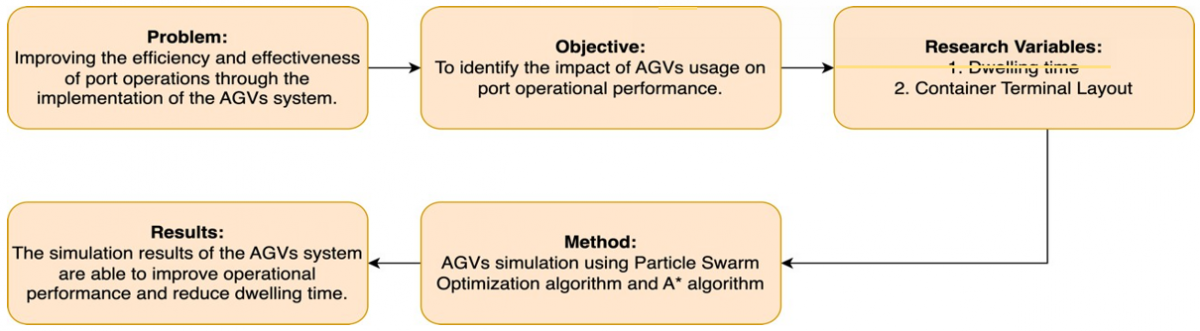
The overall research framework, including the problem definition, research objective, variables, simulation method, and expected results, is summarized in Figure 5.
Figure 5. Framework of thinking
4.1 AGVs system simulation
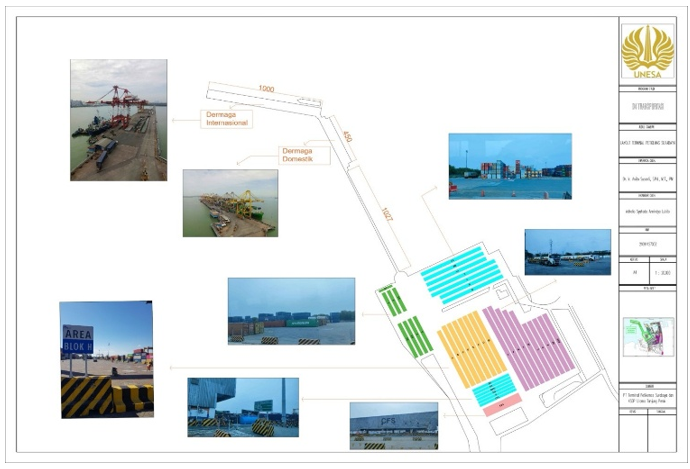
A simulation of the AGVs system was conducted to analyze the stability and effectiveness of the PSO and A* algorithms. In this simulation, historical data of container flow and terminal operational conditions are combined to create a more realistic model. Figure 6 presents a terminal layout to provide a clear picture of the TPS.
Figure 6. TPS layout used as the simulation base, showing the quay–yard interface and internal transport corridor for AGV movement
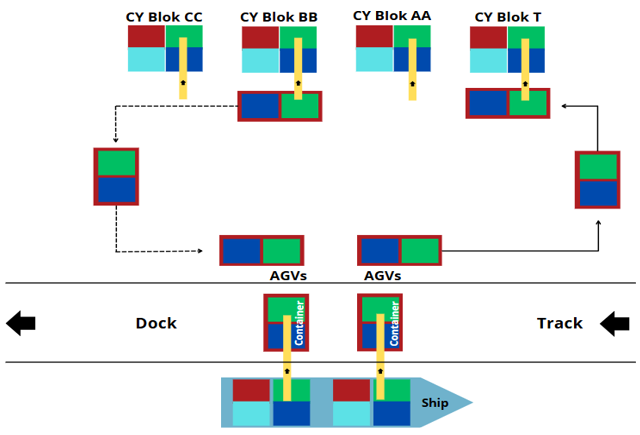
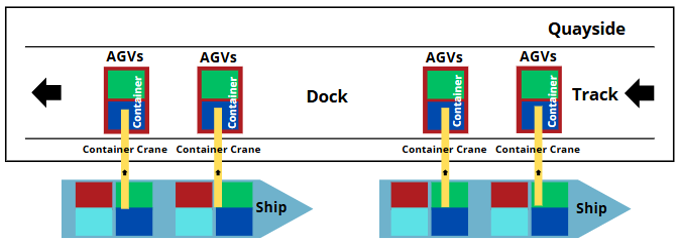
In the simulation of AGVs, several key assumptions have been established to accurately represent the movement flow and operational dynamics of these vehicles within the terminal environment. These assumptions serve as essential parameters that guide the behavior, interactions, and constraints of AGVs throughout the simulation process. The following outlines the main assumptions considered in this study:
Figure 7. AGVs' movement flows from the pier to the container yard and vice versa
Figure 8. AGVs flow in container loading and unloading
4.2 Simulation performance and implementation implications
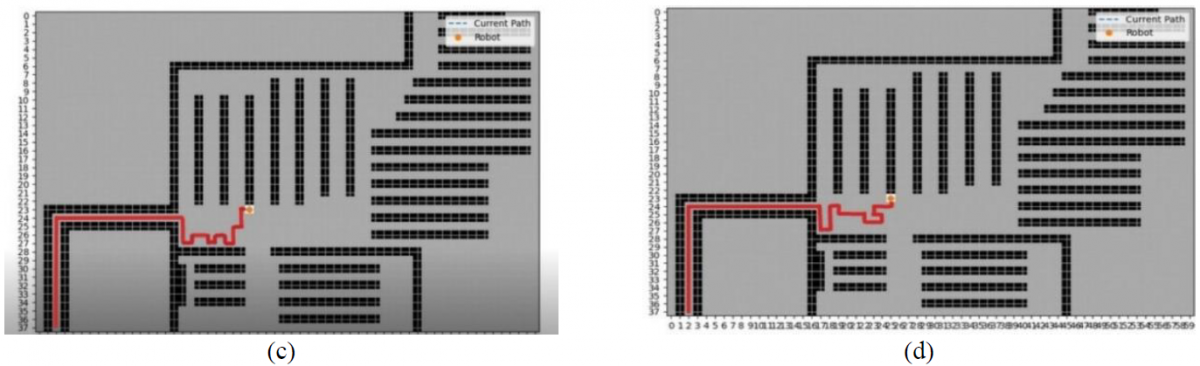
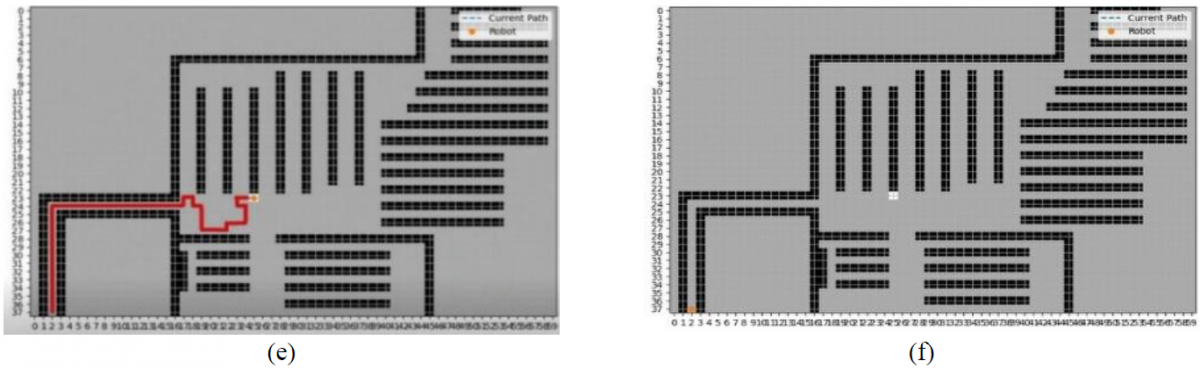
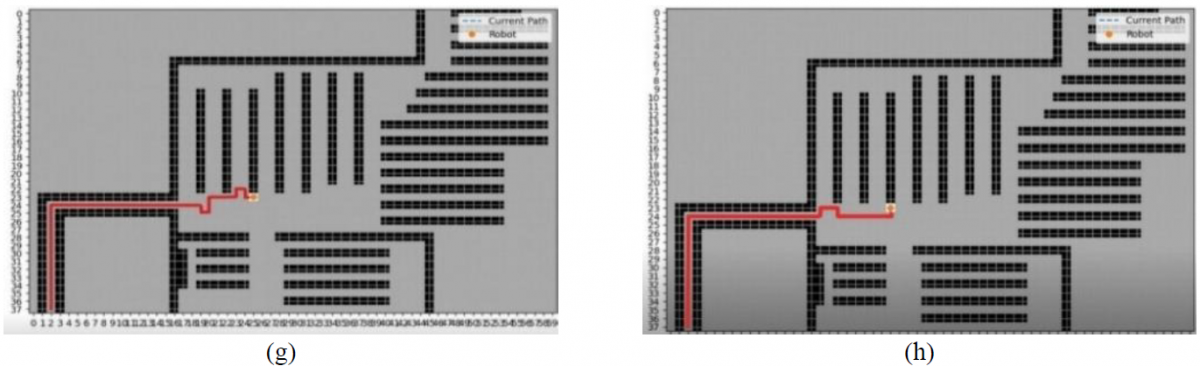
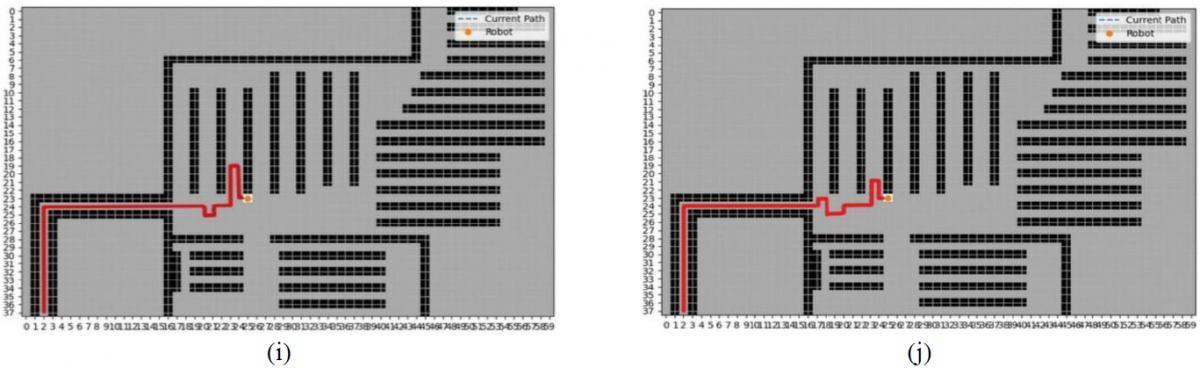
The AGVs' simulation was run 10 times to provide a visual depiction of each method's effectiveness in managing routes and travel time. Figure 9 presents the results of the AGV simulation, illustrating the performance of both algorithms in optimizing AGV paths.
Figure 9. AGV simulation runs: (a) Experiment 1, (b) Experiment 2, (c) Experiment 3, (d) Experiment 4, (e) Experiment 5, (f) Experiment 6, (g) Experiment 7, (h) Experiment 8, (i) Experiment 9, and (j) Experiment 10. Each subfigure represents a route-search attempt under different path and obstacle conditions
The simulations show temporal and step-dependent variations, influenced by factors such as traffic density and route changes, indicating that the system responds differently depending on the situation. Table 2 shows the variation in the simulation data.
Table 2. AGV system simulation results
|
Attempts |
Number of Steps |
Occupancy |
Time |
Results |
|
Attempt 1 |
49 |
2.51% |
1.28 |
Success |
|
Attempt 2 |
40 |
1.75% |
1.04 |
Success |
|
Attempt 3 |
48 |
2.11% |
1.25 |
Success |
|
Attempt 4 |
50 |
2.19% |
1.21 |
Success |
|
Attempt 5 |
48 |
2.11% |
1.20 |
Success |
|
Attempt 6 |
0 |
0% |
0 |
Failed |
|
Attempt 7 |
42 |
1.84% |
1.14 |
Success |
|
Attempt 8 |
41 |
1.80% |
1.05 |
Success |
|
Attempt 9 |
49 |
2.15% |
1.19 |
Success |
|
Attempt 10 |
46 |
2.02% |
1.17 |
Success |
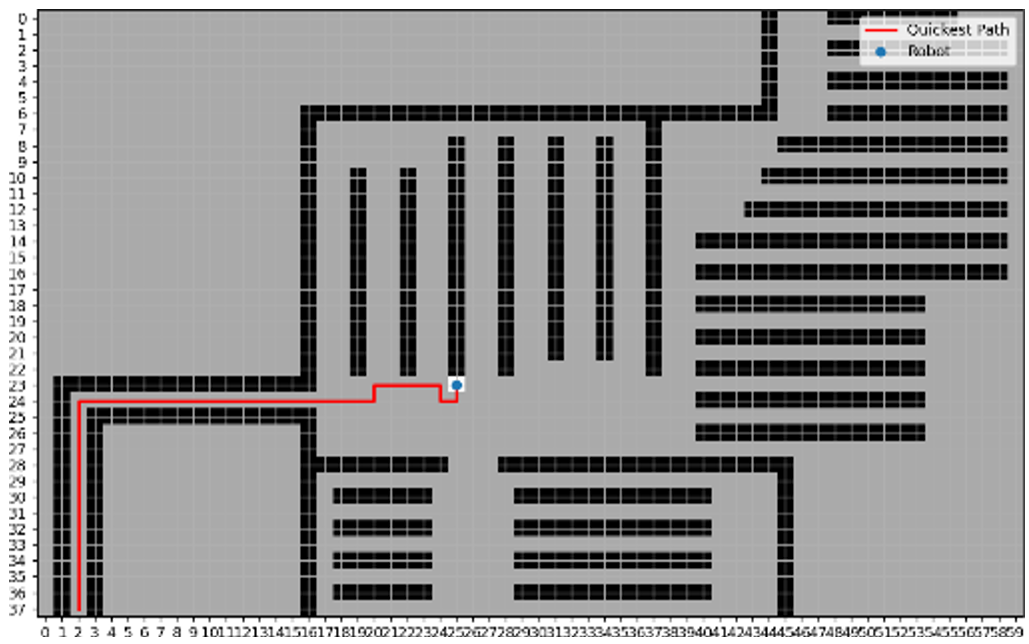
Based on the AGV simulation data, the integrated PSO–A* framework completed 9 of 10 route-search attempts successfully, giving a simulation success rate of 90%. Excluding the failed run, the average route required 45.89 steps, with an average travel time of 1.17 minutes and an average occupancy value of 2.05%. The fastest performance was recorded in Experiment 2, which required 40 steps, 1.04 minutes, and 1.75% occupancy. These indicators suggest that the framework can generate stable routes under most simulated conditions, although its performance remains sensitive to obstacle placement and route availability.
The failure in Experiment 6 is an important result rather than an anomaly that should be ignored. In that run, the route-search process could not reach the destination because the available path was blocked by an unexpected obstacle condition. This indicates a limitation of the current simulation setting: the A* layer can identify the shortest feasible path only when the movement network provides an available alternative route. If the graph representation is too constrained or if dynamic obstacles are not followed by real-time re-planning, the AGV may fail to complete its task. Therefore, the failure reflects both the constraint of the simulated traffic environment and the need to incorporate dynamic re-routing or conflict-resolution logic in future development.
Compared with routing-only methods, the PSO–A* framework offers the advantage of connecting task sequence and route search. However, it is still narrower than more comprehensive automated terminal models that incorporate crane assignment, vehicle charging strategy, energy consumption, fleet balancing, and real-time terminal operating system feedback [24, 25, 27, 41, 42]. The framework should therefore be interpreted as an early-stage planning model for evaluating AGV route feasibility, not as a complete operational control system for full terminal automation.
From an implementation perspective, several requirements must be addressed before the simulation can be translated into practice. AGV deployment requires high initial investment, dedicated communication infrastructure, reliable positioning and sensing systems, safety zones, maintenance capability, and integration with the existing terminal management system. The terminal operator would also need to evaluate charging or battery-exchange strategy, cybersecurity, emergency response procedures, and compatibility between AGV movements, quay cranes, yard cranes, and manual truck operations. These factors may determine whether the expected improvements in loading and unloading performance can be achieved in actual operations.
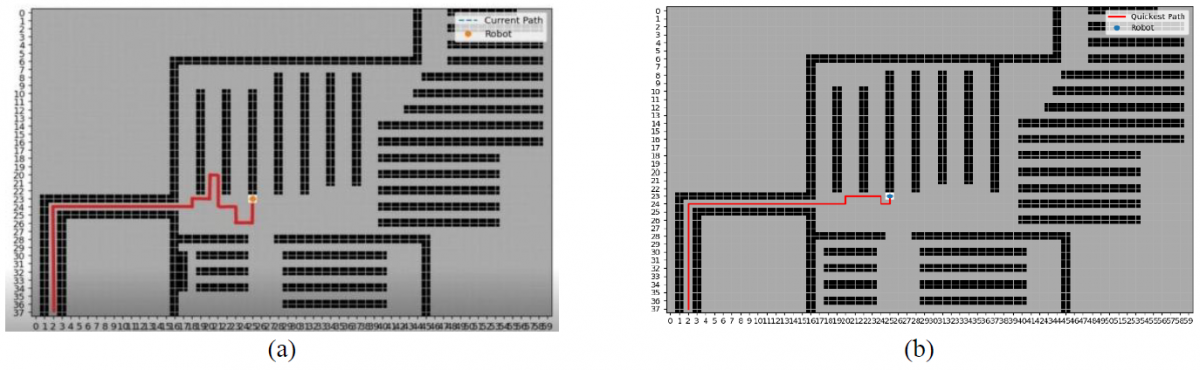
Figure 10. Fastest AGV route obtained in experiment 2, with 40 steps, 1.04 minutes, and 1.75% occupancy
Figure 10 illustrates the best route produced by the simulation. The result should be interpreted as evidence that the proposed framework can identify an efficient route under controlled conditions. Nevertheless, the observed travel time and step reduction do not directly prove reductions in vessel waiting time, terminal cost, or overall productivity because those indicators were not measured through field implementation. They represent expected operational implications that require additional validation using larger fleets, actual traffic data, and real-time terminal control integration.
Table 3 summarizes the operational advantages and disadvantages of the AGV system. The advantages are mainly related to consistency, automation, and the potential for continuous operation, while the disadvantages are associated with investment cost, system dependency, infrastructure readiness, and maintenance capability. In the TPS context, these disadvantages are particularly relevant because a simulation model cannot capture all field constraints, including equipment interaction, labor transition, safety certification, communication failure, and operational disruption during system migration.
Table 3. Advantages and disadvantages of AGV systems
|
Advantages |
Disadvantages |
|
Increase terminal efficiency and productivity. |
High initial investment cost. |
|
Minimizes accident risk. |
Potential disruption in the event of a system failure. |
|
High accuracy in transportation. |
Requires detailed terminal layout planning. |
|
24/7 automatic operation without breaks. |
Requires expert personnel for maintenance. |
Based on the simulation results, the integration of PSO and A* algorithms provide a feasible framework for planning AGV movement at Surabaya Container Terminal. The model completed 9 of 10 route-search attempts successfully, with the best result obtained in Experiment 2 at 40 steps, 1.04 minutes, and 1.75% occupancy. These results indicate that the proposed framework can support structured AGV task allocation and route search within a controlled simulation environment.
The conclusions of this study should be interpreted with caution. The simulation indicates potential improvements in internal container transport, but reductions in vessel waiting time, operating cost, and overall terminal efficiency have not yet been verified through field deployment. The study is limited by simplified operating conditions, a small number of simulation runs, limited representation of dynamic traffic, and the absence of direct validation using real-time AGV operations at the terminal. Future research should test larger AGV fleets, dynamic obstacle handling, conflict-free multi-AGV scheduling, charging strategy, integration with the terminal management system, and cost–benefit analysis under more complex terminal environments.
[1] Hadiningrat, K.S.S., Wiradanti, B., Umar, Y.F. (2024). Transformation of Indonesian sea transportation and maritime logistics to realize the vision of Golden Indonesia 2045. Journal of Intellectual Power, 1(1): 89-107. https://doi.org/10.63786/jipower.v1i1.6
[2] Ramadhani, A.W., Hanafi, M.I., Mulawarman, Amalia, D.R. (2025). Peran diplomasi maritim Indonesia sebagai poros maritim dunia. Amandemen: Jurnal Ilmu Pertahanan, Politik dan Hukum Indonesia, 2(1): 47-65. https://doi.org/10.62383/amandemen.v2i1.663
[3] Khaeruddin, M.R., Achmadi, T. (2023). Evaluation of container terminal system performance in Tanjung Perak Surabaya Port in increasing customer satisfaction using binary logistics regression. Journal of Marine-Earth Science and Technology, 4(2): 53-58. https://doi.org/10.12962/j27745449.v4i2.1058
[4] Siahaan, R.N., Hasugian, S., Nofandi, F., Khaqiqi, A.S., Pratama, R.A. (2024). Analysis of the utilization of the harbor area at the port of Tanjung Perak. Meteor STIP Marunda, 17(1): 70-79.
[5] Winarno, A., Setyorini, P.D., Mulyawan, R.K., Sugianto, E. (2024). Emission analysis due to port activity at Tanjung Perak Port Surabaya using system dynamics methods. MATEC Web of Conferences, 402: 01005. https://doi.org/10.1051/matecconf/202440201005
[6] Afpriyanto, A., Putra, I.N., Jupriyanto, J., Sari, P. (2023). Critical role of maritime infrastructure in Indonesian defense logistics management towards the world maritime axis. International Journal of Humanities Education and Social Sciences, 3(3): 1215-1224. https://doi.org/10.55227/ijhess.v3i3.657
[7] Sajidin, M., Litak, H.N.L., Ningrum, F.C. (2024). Analysis of Indonesia’s maritime infrastructure and connectivity development strategy. Jurnal Ilmu Hubungan Internasional LINO, 4: 23-32. https://doi.org/10.31605/lino.v4i1.3742.
[8] Lintang, Y.M., Nugraha, B., Gupron, A.K. (2024). Analisis faktor yang mempengaruhi standar waktu pelayanan truck round time PT terminal peti kemas surabaya. Jurnal Bintang Pendidikan Indonesia, 2(4): 241-263. https://repository.poltekpel-sby.ac.id/id/eprint/646.
[9] Wiryawan, T.S.R. (2024). Analisis pelayanan bongkar muat petikemas yang optimal pada terminal petikemas surabaya. Jurnal Media Publikasi Terapan Transportasi, 2(2): 222-229. https://doi.org/10.26740/mitrans.v2n2.p222-229
[10] Carboni, A., Deflorio, F., Caballini, C., Cangelosi, S. (2025). Advances in terminal management: Simulation of vehicle traffic in container terminals: A. Carboni et al. Maritime Economics & Logistics, 27(3): 500-524. https://doi.org/10.1057/s41278-024-00300-5
[11] Gouabou, A.C.F., Al-Kharaz, M., Hakimi, F., Khaled, T., Amzil, K. (2024). Forecasting empty container availability for vehicle booking system application. Procedia Computer Science, 246: 3103-3112. https://doi.org/10.1016/j.procs.2024.09.362
[12] Yasuda, K., Shibasaki, R., Yasuda, R., Murata, H. (2024). Terminal congestion analysis of container ports using satellite images and AIS. Remote Sensing, 16(6): 1082. https://doi.org/10.3390/rs16061082
[13] Shuaibu, A.S., Mahmoud, A.S., Sheltami, T.R. (2025). Last-mile delivery optimization: Recent approaches and advances. Transportation Research Procedia, 84: 299-306. https://doi.org/10.1016/j.trpro.2025.03.076
[14] Lu, H.J., Zhang, B., Hou, L.K. (2024). Design and implementation of a digital twin system for monitoring automated container terminal equipment. Mechatronics and Intelligent Transportation Systems, 3(1): 55-72. https://doi.org/10.56578/mits030105
[15] Chen, Y., Shi, S., Chen, Z., Wang, T., Miao, L., Song, H. (2023). Optimizing port multi-AGV trajectory planning through priority coordination: Enhancing efficiency and safety. Axioms, 12(9): 900. https://doi.org/10.3390/axioms12090900
[16] Chu, L., Gao, Z., Dang, S., Zhang, J., Yu, Q. (2024). Optimization of joint scheduling for automated guided vehicles and unmanned container trucks at automated container terminals considering conflicts. Journal of Marine Science and Engineering, 12(7): 1190. https://doi.org/10.3390/jmse12071190
[17] Zhao, N., Li, R., Yang, X. (2025). AGV scheduling and energy consumption optimization in automated container terminals based on variable neighborhood search algorithm. Journal of Marine Science and Engineering, 13(4): 647. https://doi.org/10.3390/jmse13040647
[18] Zhou, S., Liang, T., Liao, Q., Song, X., Pang, R., Ma, D. (2023). Joint scheduling optimization model for yard cranes and AGVs considering running routes. Marine Development, 1(1): 10. https://doi.org/10.1007/s44312-023-00012-z
[19] Zhang, X., Hong, Z., Xi, H., Li, J. (2024). Optimizing multiple equipment scheduling for U-shaped automated container terminals considering loading and unloading operations. Computer-Aided Civil and Infrastructure Engineering, 39(20): 3103-3124. https://doi.org/10.1111/mice.13275
[20] Zhang, Q., Li, W., Guo, L., Qi, X. (2025). Collaborative transport strategy for dual AGVs in smart ports: Enhancing docking accuracy in no-load formations. Journal of Marine Science and Engineering, 13(1): 81. https://doi.org/10.3390/jmse13010081
[21] Puška, A., Bosna, J., Petrovic, N., Markovic, S. (2024). Optimising AGV routing in container terminals: Nearest neighbor vs. Tabu search. Mechatronics and Intelligent Transportation Systems, 3(4): 203-211. https://doi.org/10.56578/mits030401
[22] Zhang, Z., Chen, J., Guo, Q. (2022). Application of automated guided vehicles in smart automated warehouse systems: A survey. CMES-Computer Modeling in Engineering and Sciences, 134(3): 1529-1563. https://doi.org/10.32604/cmes.2022.021451
[23] Kubasakova, I., Kubanova, J., Benco, D., Kadlecová, D. (2024). Implementation of automated guided vehicles for the automation of selected processes and elimination of collisions between handling equipment and humans in the warehouse. Sensors, 24(3): 1029. https://doi.org/10.3390/s24031029
[24] Chen, X., Chen, C., Wu, H., Postolache, O., Wu, Y. (2025). An improved artificial potential field method for multi-AGV path planning in ports. Intelligence & Robotics, 5(1): 19-33. https://doi.org/10.20517/ir.2025.02
[25] Song, X., Chen, N., Zhao, M., Wu, Q., Liao, Q., Ye, J. (2024). Novel AGV resilient scheduling for automated container terminals considering charging strategy. Ocean & Coastal Management, 250: 107014. https://doi.org/10.1016/j.ocecoaman.2023.107014
[26] Chen, Q.Y. (2023). The impact of AGV application on port operating efficiency. Theoretical and Natural Science, 18(1): 19-29. https://doi.org/10.54254/2753-8818/18/20230278
[27] Carvalho, C.C., de Sousa, J.P., Santos, R., Marques, C.M. (2025). A simulation tool for container operations management at seaport terminals. Transportation Research Procedia, 86: 604-611. https://doi.org/10.1016/j.trpro.2025.04.076
[28] Liu, S.L., Wang, Y. (2023). Study on dynamic simulation of differential driving cargo transport vehicle. Journal of Intelligent Management Decision, 2(1): 38-45. https://doi.org/10.56578/jimd020105
[29] Hong, C., Guo, Y., Wang, Y., Li, T. (2023). The integrated scheduling optimization for container handling by using driverless electric truck in automated container terminal. Sustainability, 15(6): 5536. https://doi.org/10.3390/su15065536
[30] Xin, J., Li, Z., Zhang, Y., Li, N. (2024). Efficient real-time path planning with self-evolving particle swarm optimization in dynamic scenarios. Unmanned Systems, 12(02): 215-226. https://doi.org/10.1142/S230138502441005X
[31] Ajayi, O.O., Umar, A., Ibrahim, I., Olugbenga, L.A., Abiola, A.A. (2025). Mathematical modelling of truck platoon formation based on a dynamic string stability. Vokasi Unesa Bulletin of Engineering, Technology and Applied Science, 2(2): 112-126. https://doi.org/10.26740/vubeta.v2i2.34941
[32] Sejdiu, L., Tollazzi, T., Shala, F., Demolli, H. (2024). Analysis of traffic safety factors and their impact using machine learning algorithms. Civil Engineering Journal, 10(9): 2859-2869. http://doi.org/10.28991/CEJ-2024-010-09-06
[33] Seng, K.C., Razak, S.A., Yogarayan, S. (2024). Vehicle safety application through the integration of flood detection and safe overtaking in vehicular communication. Civil Engineering Journal, 10(9): 2997-3010. http://doi.org/10.28991/CEJ-2024-010-09-015
[34] Isiekwene, C.C., Azeez, N.A., Akinboro, S.A., Sennaike, O. (2026). Machine learning models for DDoS attack detection: A systematic literature review. Vokasi UNESA Bulletin of Engineering, Technology and Applied Science, 3(2): 389-411. https://doi.org/10.26740/vubeta.v3i2.40146
[35] Guo, J., Jiang, Z., Ying, J., Feng, X., Zheng, F. (2024). Optimal allocation model of port emergency resources based on the improved multi-objective particle swarm algorithm and TOPSIS method. Marine Pollution Bulletin, 209: 117214. https://doi.org/10.1016/j.marpolbul.2024.117214
[36] Qi, Y., Luo, H., Huang, G., Hou, P., Jin, R., Luo, Y. (2024). Mother–daughter vessel operation and maintenance routing optimization for offshore wind farms using restructuring particle swarm optimization. Biomimetics, 9(9): 536. https://doi.org/10.3390/biomimetics9090536
[37] Mbah, O., Zeeshan, Q. (2023). Optimizing path planning for smart vehicles: A comprehensive review of metaheuristic algorithms. Journal of Engineering Management and Systems Engineering, 2(4): 231-271. https://doi.org/10.56578/jemse020405
[38] Aribowo, W. (2022). Comparison study on economic load dispatch using metaheuristic algorithm. Gazi University Journal of Science, 35(1): 26-40. https://doi.org/10.35378/gujs.820805
[39] Hu, M., Jiang, S., Zhou, K., Cao, X., Li, C. (2025). Improved exponential and cost-weighted hybrid algorithm for mobile robot path planning. Sensors, 25(8): 2579. https://doi.org/10.3390/s25082579
[40] Yin, X., Cai, P., Zhao, K., Zhang, Y., Zhou, Q., Yao, D. (2023). Dynamic path planning of AGV based on kinematical constraint A* algorithm and following DWA fusion algorithms. Sensors, 23(8): 4102. https://doi.org/10.3390/s23084102
[41] Zhong, Z., Guo, Y., Zhang, J., Yang, S. (2023). Energy-aware integrated scheduling for container terminals with conflict-free AGVs. Journal of Systems Science and Systems Engineering, 32(4): 413-443. https://doi.org/10.1007/s11518-023-5563-y
[42] Li, T., Dong, Q., Sun, X. (2024). Integrated scheduling of handling equipment in automated container terminal considering quay crane faults. Systems, 12(11): 450. https://doi.org/10.3390/systems12110450