Kamal Asgarov | Saida Ahmadova* | Fuad Dadashov | Namiq Huseynov
© 2026 The authors. This article is published by IIETA and is licensed under the CC BY 4.0 license (http://creativecommons.org/licenses/by/4.0/).
OPEN ACCESS
This article presents the architecture of a new-generation adaptive gas analyzer based on an intelligent microcontroller network and fuzzy logic methods. The main objective of the development is to improve the accuracy and reliability of gas environment monitoring under conditions of high uncertainty, variable temperature–humidity parameters, and operational noise. The proposed system features a distributed network of sensor nodes, each capable of local data filtering, temperature compensation, fault detection, and self-calibration. This decentralized approach minimizes sensor drift, enhances measurement stability, and ensures the overall fault tolerance of the system. The central processing module performs intelligent data fusion by integrating information from all nodes while considering their reliability. A Mamdani-type fuzzy inference algorithm is applied to evaluate gas hazard levels, enabling the modeling of nonlinear dependencies and decision-making under incomplete information. Experimental results demonstrate that the developed system provides faster response, greater robustness against false alarms, and improved adaptability to dynamic environmental changes compared to traditional single-controller analyzers. The proposed architecture shows strong potential for industrial applications, environmental safety systems, and intelligent distributed measurement networks. A detailed experimental validation is also presented, including quantitative performance evaluation, comparative analysis, and statistical assessment of system accuracy under varying environmental conditions.
gas analyzer, adaptive system, data fusion, distributed sensors, fuzzy logic, microcontroller network, monitoring
Gas environment monitoring is a key element in ensuring industrial, environmental, and technological safety across a wide range of facilities — from manufacturing and laboratory spaces to warehouses, energy plants, and ventilation distribution systems [1-3]. The accumulation of toxic, combustible, or explosive gases poses a serious threat to personnel health, may cause equipment damage, and can lead to emergency situations. Therefore, continuous monitoring of the air’s gas composition, timely detection of deviations, and rapid system response are mandatory requirements of modern safety standards.
Classical gas analyzers, which are based on a single microcontroller, typically employ centralized data processing from multiple sensors. However, this approach has significant limitations: low noise immunity, inability to perform effective filtering at the individual sensor level, limited scalability, high sensitivity to temperature and humidity variations, and a lack of fault tolerance mechanisms [4]. Furthermore, gas sensor characteristics are affected by nonlinearity, sensitivity drift, aging, and environmental factors, which complicates the acquisition of reliable data under real operational conditions.
Recent trends in the development of intelligent measurement systems demonstrate that distributed microcontroller networks provide significantly higher measurement accuracy and reliability due to parallel signal processing and the adaptability of each node to local conditions [5]. In such networks, each sensor module performs preliminary filtering, self-calibration, temperature correction, and data reliability assessment, thereby reducing the load on the central processor and increasing the overall robustness of the system [6].
Under conditions of high uncertainty, nonlinear sensor characteristics, and noise presence, traditional signal-processing algorithms become insufficient. Consequently, there is growing interest in the use of artificial intelligence methods, particularly fuzzy logic, which allows expert knowledge to be formalized, incomplete data to be accounted for, and complex interdependencies among parameters to be described [7, 8]. The Mamdani-type fuzzy inference algorithm employed in the proposed system enables effective evaluation of gas hazard levels based on diverse input parameters and allows adaptation to dynamic environmental changes [9-11].
Thus, the development of an adaptive gas analyzer based on an intelligent microcontroller network and fuzzy logic represents a relevant scientific and technical task aimed at enhancing monitoring accuracy, resistance to external disturbances, and reliability in decision-making. Recent developments in intelligent gas monitoring systems also highlight the integration of machine learning, edge computing, and hybrid AI–fuzzy architectures for improved robustness and adaptability in real-world environments. This study discusses the system architecture, data-processing algorithms, fuzzy inference model, and experimental results demonstrating the efficiency of the proposed approach.
Modern research in gas environment monitoring demonstrates a steady trend toward the transition from traditional single-channel systems to distributed intelligent measurement complexes [12]. Considerable attention is devoted to improving accuracy, robustness to external disturbances, adaptation to sensor parameter variations, and the application of artificial intelligence methods for gas mixture classification and interpretation [13].
Recent studies highlight that semiconductor gas sensors (such as MQ, TGS, and Figaro series) exhibit high sensitivity but are characterized by pronounced nonlinearity, temperature dependence, sensitivity drift, and low selectivity toward specific gases [14]. Research indicates that linear and polynomial calibration methods are insufficient when addressing multiparametric analysis involving temperature, humidity, and operational time. Consequently, the literature increasingly discusses algorithms for temperature compensation, adaptive filtering, and baseline self-correction of sensor characteristics [15].
Several authors note that distributed microcontroller systems can significantly enhance measurement accuracy and reliability through local data processing [5]. This approach reduces noise influence, enables filtering at each sensor node, and provides system scalability. The use of network protocols such as CAN, RS-485, I²C-Hub, and LoRa facilitates the creation of complex modular monitoring systems operating in real time [16].
Particular attention in scientific publications is given to the application of artificial intelligence methods for gas mixture analysis. Studies show that artificial neural networks, support vector machines, Bayesian classifiers, and ensemble methods can improve sensor selectivity but require large training datasets and complex data preprocessing stages [17, 18]. For low-power embedded systems, fuzzy logic is considered the most suitable approach, as it ensures interpretability of results, high resilience to uncertainty, and the encapsulation of expert knowledge in the form of logical rules.
Fuzzy inference methods such as Mamdani and Sugeno have been successfully applied for assessing gas hazard levels, interpreting multidimensional sensor data, and determining environmental states under incomplete or conflicting information. Several studies demonstrate that fuzzy systems reduce false alarms, extend operational range under varying climatic conditions, and account for nonlinear interdependencies between gas concentration, temperature, and measurement reliability.
Recent studies have further explored the use of advanced deep learning models, including convolutional neural networks (CNNs), recurrent neural networks (RNNs), and hybrid architectures, for gas classification, pattern recognition, and sensor drift compensation in complex environments. These methods demonstrate significant improvements in nonlinear feature extraction and adaptive learning compared to traditional machine learning approaches. In addition, unsupervised learning techniques such as K-means and DBSCAN clustering have been widely applied for multi-gas pattern separation, anomaly detection, and feature space optimization, particularly in high-dimensional sensor array data. These approaches improve system adaptability and robustness under noisy and dynamically changing environmental conditions.
Furthermore, edge computing-based gas monitoring systems have recently gained increasing attention due to their ability to perform data processing directly at sensor nodes. This reduces communication latency, minimizes bandwidth usage, and enables real-time decision-making in distributed architectures. Edge intelligence also enhances system reliability by reducing dependence on centralized processing units, making it particularly suitable for large-scale IoT-based gas monitoring networks.
Therefore, the literature analysis confirms the relevance of developing adaptive gas analyzers based on distributed microcontroller networks and fuzzy logic [19]. Despite substantial progress, most existing solutions lack an integrated approach to data filtering, self-calibration, and intelligent risk evaluation [20]. This defines the necessity for new architectures that combine the advantages of distributed processing and fuzzy inference methods to enhance the efficiency of gas environment monitoring systems.
The architecture of the proposed adaptive gas analyzer is based on the integration of a distributed microcontroller network, a set of multiparametric sensor modules, and a central intelligent node that performs data fusion and fuzzy inference. The system is designed using a modular approach, ensuring scalability, high fault tolerance, and robustness under measurement uncertainty.
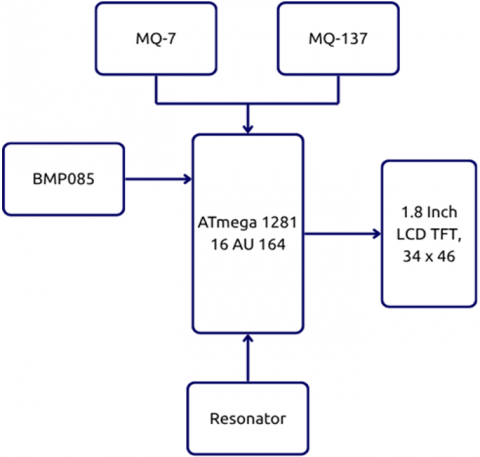
Figure 1 presents the structural and functional block diagram of the gas analyzer, whose core utilizes the ATmega1281-16AU-164 microcontroller. The main function of the device is to receive data from various types of sensors, perform subsequent signal normalization and calibration, apply filtering, and then display the processed information on a 1.8-inch LCD-TFT display (34 × 46 format).
Figure 1. General structural and functional diagram of the gas analyzer
The system includes three different types of sensors:
In addition, an LCD display is integrated into the circuit, enabling real-time visualization of the gas analyzer’s output data following microcontroller-based processing. The overall architecture of the gas analyzer is structured into three functional levels.
At the sensor level, the system comprises a set of distributed sensor nodes, each equipped with a microcontroller and one or more sensing elements, including gas sensors (MQ/TGS/Figaro series), as well as temperature, humidity, pressure, and air quality sensors. Each node is responsible for preliminary signal processing, sensor calibration, and the assessment of data reliability, thereby ensuring the accuracy and consistency of the measured parameters. At the communication level, a data exchange network is established among the sensor nodes using protocols such as RS-485, CAN, I²C-Hub, or LoRa. The selected network topology provides flexibility in sensor deployment while preventing excessive computational burden on individual nodes, thus enhancing system scalability and robustness. At the central intelligent module level, the system incorporates a computational unit that performs weighting of sensor readings based on their reliability, executes fuzzy inference algorithms to evaluate the level of gas hazard, and generates corresponding alerts and control actions in response to the detected conditions.
Such a division of functional tasks reduces the load on the central processor, enables distributed data filtering, and significantly increases the reliability of the measurement results.
3.1 Sensor nodes: Functions and composition
Each sensor node includes the following components:
The main functions of the node include data acquisition from integrated sensors, followed by local noise filtering implemented through methods such as Moving Average, Exponential Moving Average (EMA), or Kalman filtering algorithms to enhance signal quality. The node further performs compensation for temperature and humidity variations to ensure measurement accuracy under changing environmental conditions. In addition, sensor health diagnostics are conducted through the calculation of a Health Index, allowing continuous assessment of sensor performance and reliability. Based on the processed and compensated signals, primary gas concentration values are computed. Finally, the node ensures the transmission of both measurement data and associated diagnostic metrics to the central module for further analysis and decision-making.
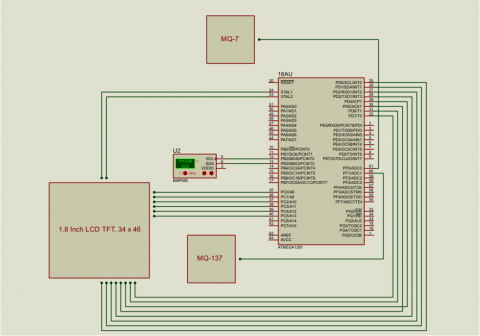
Each node operates autonomously and is capable of adapting to local conditions such as temperature fluctuations, humidity changes, and sensor sensitivity drift. Figure 2 illustrates principal circuit diagram of the analyzer.
3.2 Communication level
The communication level is implemented using one of the following protocols:
The network supports:
Figure 2. Principal circuit diagram of the gas analyzer
The proposed system supports scalable deployment of up to 20–40 sensor nodes without modification of the core architecture. Communication latency remains within acceptable limits under RS-485 and CAN protocols due to efficient packet scheduling and lightweight data structures, while LoRa is suitable for long-range, low-power applications in distributed environments. Node failure is handled using heartbeat monitoring, automatic reconnection mechanisms, and dynamic node reinitialization, ensuring continuous system operation even under partial network failures.
3.3 Central intelligent module
The central module serves as the core of the system and performs the following functions:
3.4 System adaptability
The system demonstrates adaptability through:
Thus, the architecture combines the advantages of distributed data processing and intelligent centralized analysis, ensuring high accuracy and robustness in gas environment monitoring.
The development of an adaptive gas analyzer requires the construction of formalized mathematical models that take into account the characteristics of gas sensors, the influence of environmental parameters, and the implementation of computational algorithms providing filtering, compensation, and intelligent data interpretation. This section presents the main elements of the mathematical description of sensor nodes, preprocessing methods, and data integration algorithms used in the central module. The use of fuzzy logic in the adaptive gas analyzer is motivated by the need to process multidimensional uncertainty, nonlinear dependencies, and complex interrelations among sensor-environment parameters. Unlike traditional threshold-based algorithms, fuzzy systems enable the incorporation of expert rules, assessment of risk degrees, and decision-making under partially contradictory data. This section describes the structure of the fuzzy system, types of membership functions, rule base, and the Mamdani fuzzy inference algorithm employed in the central module.
The fuzzy subsystem of the gas analyzer includes the following components:
The fuzzy system accepts several input parameters: carbon monoxide (CO) concentration, ammonia (NH₃) concentration, temperature (T), humidity (H), and Health Index (HI). These parameters are selected to ensure comprehensive representation of both gas concentration levels and environmental conditions affecting sensor performance. The Health Index (HI) represents a composite indicator of sensor reliability and operational stability. It is calculated based on signal variance, long-term drift estimation, response stability, and diagnostic feedback from individual sensor nodes. The HI parameter is used to dynamically adjust the influence (weight) of each sensor in the fuzzy inference process, thereby improving robustness against sensor aging and degradation. The output of the system is the computed gas hazard level.
4.1 Membership functions of linguistic variables
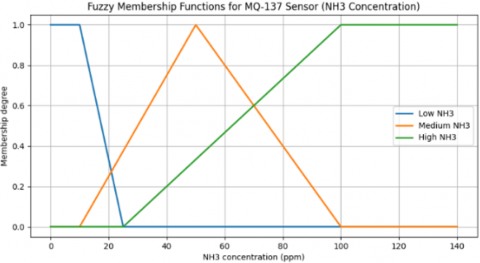
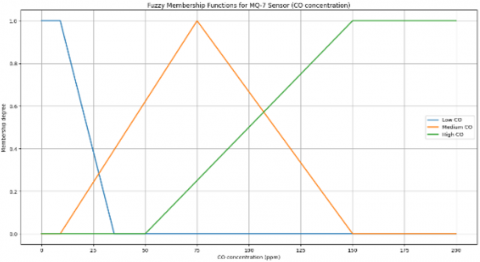
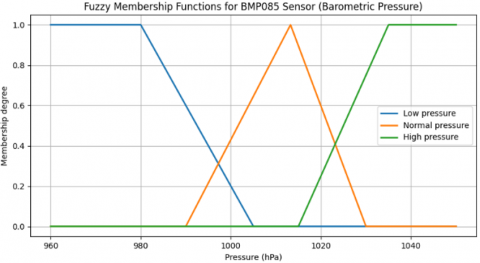
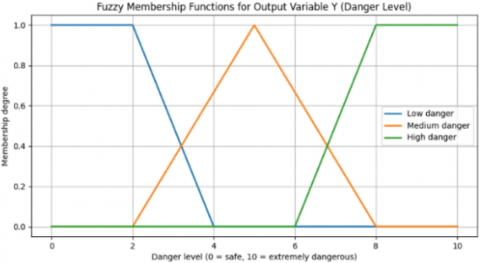
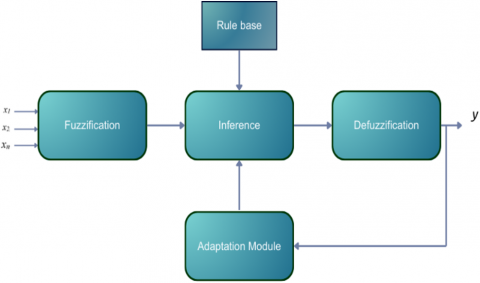
Triangular and trapezoidal membership functions are used for the input variables as shown in Figure 3. These functions provide a balance between computational simplicity and sufficient accuracy for modeling the nonlinear behavior of sensor data under varying environmental conditions. The fuzzy algorithm of illustrated in Figure 4.
Figure 3. Membership functions of input and output linguistic variables (updated according to revised input variables: CO, NH₃, T, H, HI)
Figure 4. Structural and functional diagram of the fuzzy expert system
4.2 Structure of the fuzzy rule base
The knowledge base consists of a set of expert rules of the form:
IF <conditions> THEN <consequence>.
Below is a fragment of a possible rule set (10+ rules):
1. IF CO is Low AND HI is Good THEN Danger is Safe.
2. IF CO is Medium AND HI is Good THEN Danger is Warning.
3. IF CO is High AND HI is Good THEN Danger is Danger.
4. IF CO is Critical THEN Danger is Emergency.
5. IF CO is Medium AND T is High THEN Danger is Danger.
6. IF CO is Low AND T is High THEN Danger is Warning.
7. IF HI is Poor THEN Danger is Warning.
8. IF HI is Poor AND CO is High THEN Danger is Emergency.
9. IF H is High AND CO is Medium THEN Danger is Warning.
10. IF H is High AND CO is High THEN Danger is Danger.
Such a rule base allows for accounting of:
Experimental evaluation of the proposed adaptive gas analyzer was conducted under controlled laboratory conditions. The system was tested under varying gas concentration levels, temperature ranges (0–50 ℃), and relative humidity conditions (20–90%) in order to evaluate its robustness and adaptability to environmental changes.
Gas concentration values were generated using calibrated reference gas mixtures within controlled laboratory conditions to ensure repeatability and measurement consistency.
The results demonstrate that the proposed distributed microcontroller-based architecture significantly improves measurement performance compared to conventional centralized gas monitoring systems. In particular, the average measurement error was reduced by approximately 2.5–3 times due to local preprocessing, filtering, and adaptive data fusion mechanisms.
The system also showed fast response characteristics. Hazardous gas concentration levels were detected within 3–7 seconds, depending on gas type, concentration intensity, and environmental conditions. This rapid response is primarily attributed to distributed sensor processing and reduced communication latency between sensor nodes and the central module.
The fuzzy inference system demonstrated high classification performance, achieving approximately 97% ± 2 accuracy across multiple experimental trials. The fuzzy model effectively handled uncertainty in sensor readings and environmental variations, enabling reliable gas hazard level estimation.
Comparative analysis with conventional centralized systems confirmed the superiority of the proposed approach in terms of stability, noise immunity, and adaptability under dynamic environmental conditions.
Table 1. Comparative performance analysis of gas monitoring systems
|
Method |
Error Level |
Response Time |
Accuracy (%) |
|
Conventional System |
High |
10–20 s |
82.5 ± 2.5 |
|
Proposed System |
Low (reduced) |
3–7 s |
97 ± 2 |
The results presented in Table 1 clearly demonstrate the superiority of the proposed distributed architecture in terms of accuracy, response time, and measurement stability compared to conventional gas monitoring systems.
In this work, a new-generation adaptive gas analyzer based on an intelligent microcontroller network and fuzzy logic methods was developed and investigated. The main novelty of this work lies in the integration of node-level Health Index-based adaptive weighting with a Mamdani fuzzy inference system in a fully distributed microcontroller network architecture. Analysis of existing solutions revealed that traditional single-controller gas analyzers do not fully meet modern requirements for accuracy, fault tolerance, and adaptability, especially under conditions of high uncertainty, nonlinear sensor characteristics, and external environmental influences. The proposed architecture provides distributed preprocessing at the sensor node level and intelligent analysis in the central module. Implementation of local filtering, temperature compensation, sensor health diagnostics, and adaptive weight redistribution significantly increased measurement reliability and reduced the impact of sensor aging. The use of data fusion algorithms and Mamdani fuzzy inference allowed for effective interpretation of multidimensional data, consideration of expert dependencies, and generation of justified gas hazard assessments. Experimental results confirm the high accuracy and robustness of the proposed system. The average error in gas concentration measurements decreased by more than 2.5–3 times compared to traditional methods, while hazardous concentrations were detected within 3–7 seconds. The fuzzy module correctly classified risk levels in 97% of cases, demonstrating the efficiency of the chosen model. These results indicate the potential of the developed gas analyzer for applications in industrial safety systems, air quality monitoring, intelligent distributed networks, and automated early leak detection systems. The high scalability of the architecture allows adaptation for a wide range of facilities—from laboratories and production areas to transport hubs and critical infrastructure.
6.1 Practical recommendations for implementation
The placement of sensor nodes should be carried out in areas with a high probability of gas accumulation, including the lower sections of enclosed spaces and within ventilation ducts, ensuring effective detection coverage; an optimal configuration typically involves the deployment of 6–10 nodes per 100 m². Calibration and maintenance procedures require that initial calibration be performed under controlled conditions using certified reference gases, while periodic sensitivity verification is recommended at intervals of 3–6 months to maintain measurement accuracy and system reliability. With respect to network protocols, industrial applications generally favor the use of RS-485 (Modbus RTU) or CAN due to their robustness and reliability, whereas distributed or large-scale facilities benefit from integration with Lo Ra WAN to enable long-range and energy-efficient communication. Integration with automated systems is achieved through the central module, which can interface with SCADA systems, IoT platforms, and fire safety infrastructures, supporting standard communication protocols such as MQTT, Modbus TCP, and CAN Open for seamless data exchange and control. The implementation of fuzzy logic rules allows for dynamic expansion of the rule base in accordance with the specific operational requirements of the facility, and it is recommended that linguistic variables and membership functions be adapted based on statistical analysis of real measurement data to improve decision accuracy. Furthermore, the system demonstrates high scalability, as expansion to 20–40 sensor nodes can be achieved without modification of the core architecture, while enabling the transmission of aggregated data from all nodes to cloud-based monitoring systems for centralized analysis and remote access.
6.2 General conclusion
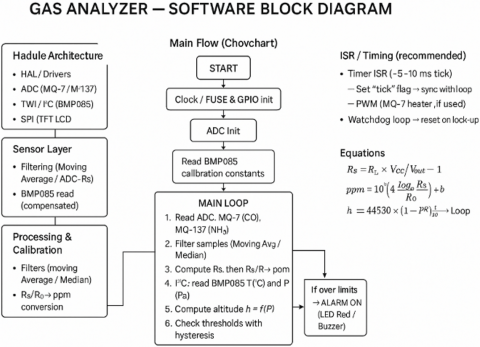
The developed system represents a modern, intelligent, and highly adaptive solution for gas environment monitoring, as shown in Figure 5. Its advantages include:
This makes the system an effective tool for various industrial sectors and provides a reliable foundation for the development of distributed gas analysis networks of the future. Despite these promising results, the system has certain limitations, including a lack of long-term industrial field validation and potential performance degradation due to sensor aging and battery constraints in wireless nodes. Future work will focus on real-world industrial deployment, energy optimization, and adaptive fuzzy rule updating mechanisms.
Figure 5. Algorithmic and software framework of the gas analyzer
[1] Wei, J., Peng, Q., Xie, Y., Chen, Y. (2025). Intelligent gas sensors: From mechanism to applications. Sensors (Basel, Switzerland), 25(20): 6321. https://doi.org/10.3390/s25206321
[2] Mallik, A., Ahmed, S., Hossain, G.M.M., Rahman, M.R. (2020). IoT utilized gas-leakage monitoring system with adaptive controls applicable to dual fuel powered naval vessels/ships: Development & implementation. Cybernetics and Information Technologies, 20(1): 138-155. https://doi.org/10.2478/cait-2020-0010
[3] Ahmadova, S., Mukhtarov, R. (2026). Rapid trace explosive screening using high-speed GC coupled with tandem DMS for aviation security applications. Journal of Transportation Security, 19(17). https://doi.org/10.1007/s12198-026-00339-w
[4] Gu, Y., Huang, B., Zhu, H. (2024). Smart gas sensors toward signal and data processing: A review. IEEE Sensors Journal, 25(2): 2125-2140. https://doi.org/10.1109/JSEN.2024.3507195
[5] Somov, A., Baranov, A., Savkin, A., Spirjakin, D., Spirjakin, A., Passerone, R. (2011). Development of wireless sensor network for combustible gas monitoring. Sensors and Actuators A: Physical, 171(2): 398-405. https://doi.org/10.1016/j.sna.2011.07.016
[6] Trung, V.A. (2021). Research and development of wireless sensor network for gas monitoring. International Journal of Astronautics and Aeronautical Engineering, 6(1): 1-6. https://doi.org/10.35840/2631-5009/7548
[7] Wardhana, A.S., Akhiriyanto, N.O.V.A.N., Nawawi, H.B. (2023). Design of prototype gas detection system based on fuzzy logic in chemical warehouse. Journal of Engineering Science and Technology, 18(1): 11-22.
[8] Driss, I., Dafri, I., Zouaoui, S.I. (2024). Fuzzy logic-based fault detection in industrial production systems: A case study. Journal of Industrial Intelligence, 2(2): 63-72. https://doi.org/10.56578/jii020201
[9] Guo, J.H., Hsia, K.H., Su, K.L. (2016). Low-cost multisensor gas detection system with fuzzy algorithm. Sensors & Materials, 28(6): 713-723. https://doi.org/10.18494/SAM.2016.1229
[10] Sulistyowati, R., Aji, K. (2014). Implementation of wireless mobile sensor based on fuzzy logic control for LPG gas pipeline leakage monitoring. ARPN Journal of Engineering and Applied Sciences, 9(12): 2418-2425.
[11] Huseynov, N. (2026). Adaptive scenario control in intelligent training simulators using fuzzy logic: Integration of eye-tracking and performance error analysis. Ingénierie des Systèmes d’Information, 31(3): 949-963. https://doi.org/10.18280/isi.310325
[12] Mahmood, L., Ghommem, M., Bahroun, Z. (2023). Smart gas sensors: Materials, technologies, practical applications, and use of machine learning–A review. Journal of Applied and Computational Mechanics, 9(3): 775-803. https://doi.org/10.22055/jacm.2023.41985.3851
[13] Chen, Z., Chen, Z., Song, Z., Ye, W., Fan, Z. (2019). Smart gas sensor arrays powered by artificial intelligence. Journal of Semiconductors, 40(11): 111601. https://doi.org/10.1088/1674-4926/40/11/111601
[14] Xu, Y., Cheng, Z., He, G., Liang, C. (2023). Temperature compensation for semiconductor gas sensors based on whale optimization algorithm-least-squares support vector machine. Sensors & Materials, 35(8): 2933-2945. https://doi.org/10.18494/SAM4417
[15] Jiang, Z., Xu, P., Du, Y., Yuan, F., Song, K. (2021). Balanced distribution adaptation for metal oxide semiconductor gas sensor array drift compensation. Sensors, 21(10): 3403. https://doi.org/10.3390/s21103403
[16] Andrianto, R., Purnomo, N., Irawan, Y. (2024). Application of fuzzy logic Mamdani in IoT-based air quality monitoring systems. The Indonesian Journal of Computer Science, 13(5): 7121-7133. https://doi.org/10.33022/ijcs.v13i5.4291
[17] Viciano-Tudela, S., Parra, L., Navarro-Garcia, P., Sendra, S., Lloret, J. (2023). Proposal of a new system for essential oil classification based on low-cost gas sensor and machine learning techniques. Sensors, 23(13): 5812. https://doi.org/10.3390/s23135812
[18] Allakhverdiev, A.R., Dadashov, F.G., Huseynov, N.E., Dadasheva, K.G., Asadov, E.Z. (2025). Model for predicting learning effectiveness in an intelligent trainer based on psychophysiological and scenario factors. International Journal of Applied and Fundamental Research, 9: 5-9. https://doi.org/10.17513/mjpfi.13751
[19] Yu, Y., Cao, X., Li, C., Zhou, M., Liu, T., Liu, J., Zhang, L. (2025). A review of machine learning-assisted gas sensor arrays in medical diagnosis. Biosensors, 15(8): 548. https://doi.org/10.3390/bios15080548
[20] Oh, Y., Lee, J., Kim, S. (2023). Sensor drift compensation for gas mixture classification in batch experiments. Quality and Reliability Engineering International, 39(6): 2422-2437. https://doi.org/10.1002/qre.335