Amina Azizi* | Amina Benabda | Amira Lakhdara | Abderezzak Khelfi
© 2026 The authors. This article is published by IIETA and is licensed under the CC BY 4.0 license (http://creativecommons.org/licenses/by/4.0/).
OPEN ACCESS
This study investigates and compares several control strategies dedicated to the extraction and regulation of power in photovoltaic energy conversion systems. After recalling the essential operating principles of direct current to direct current (DC–DC) c converters and their interaction with photovoltaic (PV) generators, attention is directed toward the implementation of three Maximum Power Point Tracking (MPPT) algorithms: the conventional Perturb and Observe (P&O) technique, a model-based predictive control strategy, and an enhanced hybrid approach. The analysis is carried out through detailed simulations in both stand-alone and grid-connected configurations, allowing the dynamic behavior, conversion efficiency, and power quality to be evaluated under varying operating conditions. Particular emphasis is placed on the effect of the control method on the stability of the DC bus and the harmonic quality of the current injected into the grid. The comparative results show that predictive and hybrid control schemes offer significant improvements in tracking accuracy and energy quality, highlighting their relevance for modern PV systems where reliability and performance remain key requirements.
photovoltaic systems, Perturb and Observe, Model Predictive Control, grid-connected systems, power quality
Electricity is one of the fundamental pillars of modern societies, powering homes, industries, transportation, and communication systems. Its strategic importance lies in its ability to support economic and social development while addressing current environmental challenges. In this context, photovoltaic (PV) solar energy has emerged as a key solution for the energy transition due to its sustainability and technological maturity [1, 2].
The increasing integration of PV systems into modern electrical grids introduces significant challenges related to energy efficiency, system stability, and power quality. Due to their nonlinear characteristics and dependence on environmental conditions, PV systems require advanced control strategies to ensure optimal operation.
Maximum Power Point Tracking (MPPT) techniques are essential to maximize the energy harvested from PV systems. Conventional methods such as Perturb and Observe (P&O) and Incremental Conductance are widely used due to their simplicity and ease of implementation [3]. However, these techniques suffer from inherent oscillations around the maximum power point (MPP), leading to power losses and reduced efficiency, especially under rapidly changing environmental conditions.
To overcome these limitations, intelligent MPPT methods based on fuzzy logic, artificial neural networks, and optimization algorithms have been developed [4]. These approaches improve tracking accuracy and robustness against uncertainties but often require careful parameter tuning and may increase computational complexity.
More recently, Model Predictive Control (MPC) has emerged as an effective alternative for MPPT applications. MPC relies on a system model to predict future behavior and optimize control actions, offering fast dynamic response and reduced oscillations [5]. Nevertheless, its performance strongly depends on model accuracy and can be sensitive to parameter selection.
Hybrid approaches combining MPC with intelligent techniques, such as fuzzy logic, have been proposed to enhance adaptability and robustness [6]. These methods enable real-time adjustment of control parameters, improving tracking performance under varying operating conditions.
Despite these advancements, most existing studies primarily focus on power tracking efficiency, while the impact on power quality, including voltage stability and total harmonic distortion (THD), remains insufficiently investigated.
In this context, the main contributions of this paper are:
- The development of a hybrid MPC–Fuzzy MPPT strategy with real-time adaptive tuning of key control parameters, including the duty cycle step size (ΔD) and the weighting factor (λ).
- A comprehensive comparative analysis between classical (P&O), intelligent (Fuzzy), and model-based (MPC) MPPT methods under identical operating conditions.
- A detailed investigation of power quality, including voltage and current THD, which is often overlooked in MPPT studies.
- An analysis of the interaction between MPPT control strategies and grid-connected inverter performance, highlighting the impact of control on harmonic distortion and system stability.
Unlike existing approaches, the proposed method not only improves MPPT efficiency but also explicitly addresses power quality issues, providing a more comprehensive solution for grid-connected photovoltaic systems. To better illustrate the overall system architecture, a simplified block diagram is presented in Figure 1 [7-10]:

Figure 1. Simplified block diagram of the proposed grid-connected photovoltaic (PV) system
Figure 1 shows the general structure of the grid-connected PV system. The MPPT controller regulates the DC/DC converter to extract maximum power from the PV panel. The inverter ensures DC/AC conversion and synchronization with the grid through a phase-locked loop (PLL) and current control loops. A more detailed representation of the control strategy and system components is provided in Figure 2:

2.1 Photovoltaic model
Photovoltaic energy is obtained directly from the sun's rays. Photovoltaic panels made up of silicon-based photovoltaic cells have the ability to transform photons into electrons as Figure 3 shows the characteristics or behavior of the PV cell can be modelled using the equivalent electrical circuit [11]:
$\begin{gathered}I_{p v}=I_{p h}-I_{s a t}\left[\exp \left(\frac{e\left(V_{p v}+\left(I p v * R_{S e r}\right)\right)}{n K T}\right)-1\right] -\frac{V_{p v}+\left(I p v * R_{S e r}\right)}{R_{s h u}}\end{gathered}$ (1)
2.2 Converter
To obtain the best return on the electrical energy produced/solar energy received by a photovoltaic installation, a DC/DC converter must be used to ensure that the PV module is always operating at its optimum power. To do this, we use a specific converter with MPPT control, enabling the module to operate at optimum voltage and optimum current, and therefore at optimum power [12].
The relation between input and output voltages of the boost converter is given as [13]:
$V_{\text {out }}=\frac{1}{1-D} V_{\text {in }}$ (2)
$D=\frac{T_{o n}}{T_s}$ (3)

Figure 3. Electrical equivalent circuit of the photovoltaic cell
The parameters of the boost converter used in this study are summarized as follows in Table 1.
Table 1. Parameters of the converter
|
Parameter |
Value |
|
L |
2 mH |
|
C |
470 µF |
|
fs |
10 kHz |
|
R |
20 Ω |
2.3 Perturb and observe command
Among classical MPPT techniques, the P&O method remains one of the simplest and most widely used algorithms thanks to its ease of implementation and low computational cost. The principle is based on perturbing the PV operating voltage Vpv or the duty cycle Dof the DC–DC converter and observing the resulting variation in output power P. The flowchart in this method is shown in Figure 4 [14-16].

Figure 4. Perturb and Observe (P&O) flowchart
This approach intrinsically generates an oscillation around the maximum power point (MPP), even under steady environmental conditions, leading to non-negligible steady-state power losses.
2.4 Model predictive control
In contrast to conventional techniques, MPC exploits a dynamic model of the PV–converter system to predict the effect of control actions on future output power. The control objective is to determine the optimal duty cycle D that maximizes the extracted photovoltaic power over a finite prediction horizon. The system is described using a discrete-time state-space model [17, 18]:
$x(k)=[\operatorname{Ipv}(k), V p v(k)]^T$ (4)
$x(k+1)=A x(k)+B u(k)$ (5)
where, x(k) is the state vector, and u(k) = D(k) represents the duty cycle of the DC/DC converter.
The predicted PV power over the horizon is obtained from the model, and the optimal control action is determined by minimizing the following cost function:
$J=\sum_{i=1}^{N_p}\left(P_{r e f}-P(k+i)\right)^2+\lambda \sum_{i=1}^{N_p}(\Delta D(k+i))^2$ (6)
where:
- Pref is the reference maximum power,
- P(k+i) is the predicted PV power,
- ΔD(k+i) is the variation of the duty cycle,
- λ is a weighting factor that penalizes large control variations.
The first term of the cost function minimizes the error between the predicted power and the reference maximum power, ensuring accurate MPPT. The second term penalizes excessive variations of the duty cycle, thereby improving system stability and reducing oscillations. The weighting factor λ defines the trade-off between tracking accuracy and control smoothness. The optimal duty cycle is selected as:
$\mathrm{D}^*=\arg \min \mathrm{J}, \mathrm{D} \in \mathrm{U}$ (7)
where, U represents the admissible control set.
In this study, the prediction horizon is set to Np = 10, which provides a good compromise between tracking accuracy and computational complexity.
MPC offers faster convergence and reduced oscillations compared to P&O, but its performance is highly dependent on model accuracy and noise sensitivity.
2.5 Hybrid model predictive -fuzzy control
To overcome the limitations of conventional MPC, a hybrid MPC–fuzzy strategy is introduced. This method preserves the predictive optimization structure of MPC while adding a fuzzy logic supervisor that adapts key MPC parameters such as the step size ΔD, the penalty factor λ, or the prediction horizonin real time according to the operating conditions.
The fuzzy supervisor takes as input the power slope magnitude:
$S=\left|\frac{\partial P}{\partial V}\right|$ (8)
where, S represents the variation of power with respect to voltage and indicates the distance from the maximum power point (MPP).
The input variable S is normalized and divided into three linguistic terms:
- Low (L)
- Medium (M)
- High (H)
Triangular membership functions are used for simplicity and computational efficiency.
The outputs of the fuzzy controller are:
- Adjustment of duty cycle step size ΔD
- Adjustment of weighting factor λ
The fuzzy inference system is based on the Mamdani method, and defuzzification is performed using the centroid technique.
The rule base is defined as follows:
- If S is High → increase ΔD, decrease λ (fast tracking)
- If S is Medium → moderate ΔD and λ
- If S is Low → decrease ΔD, increase λ (reduce oscillations)
This results in adaptive tuning laws:
$\Delta \mathrm{D}=\mathrm{f} \_$fuzzy $(\mathrm{S}), \quad \lambda=\mathrm{g} \_$fuzzy $(\mathrm{S})$
Such adaptive behavior enables the controller to respond quickly when the system is far from the MPP while ensuring stable operation near the optimum point.
The universe of discourse for S is defined within [-1, 1], ensuring proper normalization of the input signal.
As a result, MPC–fuzzy ensures smoother transients, higher tracking accuracy, and a significantly reduced harmonic distortion in the injected current compared to classical P&O and standard MPC.
To better illustrate the proposed hybrid control strategy, a block diagram of the fuzzy supervisor is integrated within the MPC–Fuzzy control structure, as illustrated in Figure 5:

As shown in Figure 5, the fuzzy logic supervisor dynamically adjusts key MPC parameters such as the duty cycle step size and the weighting factor based on the operating conditions, improving both tracking speed and stability.
2.6 Inverter
The three-phase inverter with Pulse Width Modulation (PWM), is employed in this work. Among the available modulation techniques, Space Vector Pulse Width Modulation (SVPWM) has been adopted, as it is widely recognized as the most advanced approach for sinusoidal waveform synthesis, providing a higher output voltage with reduced THD.
The principle of vector modelling (SVPWM) consists of reconstructing the voltage vector ref from eight voltage vectors. Each of these vectors corresponds to a combination of the states of the switches in a three-phase voltage inverter. SVPWM is the method recently best suited to the control of inverter-powered AC motors, unlike other methods. It can detect additional fault conditions on the network, such as unbalanced or distorted situations, and adapt the system accordingly, reducing losses and improving system efficiency [19, 20].
3.1 Simulation setup
The simulation was carried out under the following conditions:
Irradiance: variable (250–1000 W/m²)
Temperature: 25 ℃
Sampling time Ts = 1e-5 s
Switching frequency = 10 kHz
THD is calculated using Fast Fourier Transform (FFT) analysis:
$T H D=\sqrt{\frac{\left(\Sigma V n^2\right)}{V_1}}$ (9)
The FFT analysis is performed using MATLAB/Simulink tools.
3.2 Results and analysis
In this simulation model, the chopper controlled by an MPPT algorithm regulates the DC voltage at the output of the solar panels. This DC voltage then feeds a three-phase vector modulated inverter (SVPWM), enabling efficient energy injection into the grid. The inverter is synchronized with the grid by means of a PLL), guaranteeing phase and frequency coupling with the grid voltage - a prerequisite for stable, standard-compliant feed-in, as shown in Figure 6. Figure 7 shows the solar irradiation curve applied to photovoltaic panels, with their characteristics determined by Table 2:
Table 2. parameters of photovoltaic (PV) module
|
Parameter |
Value |
|
Np |
47 |
|
Ns |
10 |
|
Voc |
36.3 V |
|
Isc |
7.84 A |
|
Vmp |
29 V |
|
Imp |
7.35 A |


Figure 7. Irradiation was applied to the photovoltaic generator during simulations
The temporal evolution of solar irradiance G (W/m²) over a 10s interval. Overall, the irradiance remains at a high level, close to 900–1000 W/m², indicating strong solar conditions. However, several abrupt and short-duration drops can be clearly observed, where the irradiance decreases to values in the range of approximately 250–400 W/m². These sudden variations are representative of partial shading events, such as passing clouds or intentionally introduced disturbances. Such a highly fluctuating irradiance profile is particularly relevant for evaluating the dynamic behavior and robustness of the control and MPPT algorithms. It allows assessing the ability of the system to respond rapidly to fast changes in environmental conditions while maintaining stable and efficient operation under realistic and challenging solar scenarios.
Figure 8 illustrates the dynamic response of the chopper output voltage for the three MPPT strategies: P&O, MPC, and MPC-fuzzy. Significant performance differences appear among the three methods in terms of transient response, stability, and steady-state accuracy.
For the P&O algorithm, the output voltage exhibits a pronounced transient regime with noticeable oscillations at start-up. These oscillations result from the perturbative nature of the method, which continuously modifies the operating point to search for the maximum power. A small overshoot is observed around 0.3 s, followed by residual oscillations in steady state. This behavior indicates limited robustness and reduced tracking precision, which translates into small power fluctuations at the inverter output.

P&O

MPC

MPC-Fuzzy
In contrast, the MPC-based MPPT shows a significantly faster dynamic response. The output voltage reaches its reference value almost instantaneously, with practically no overshoot. The predictive model anticipates system behavior and minimizes the control error at each sampling period, resulting in a highly stable voltage waveform and a nearly perfect steady-state convergence.
The MPC-fuzzy method provides an intermediate performance level. Although its transient response is slightly slower than MPC, it remains considerably faster and more stable than P&O. A small initial overshoot is visible, but it is rapidly attenuated by the fuzzy inference mechanism, which adapts the control action to the instantaneous operating conditions. Steady-state regulation is very stable, with negligible oscillations. This confirms the method’s ability to combine robustness and simplicity while ensuring high power extraction. Overall, MPC provides the best performance in terms of tracking speed, voltage stability, and maximized power, while MPV-Fuzzy offers a strong improvement over classical P&O with lower implementation complexity.
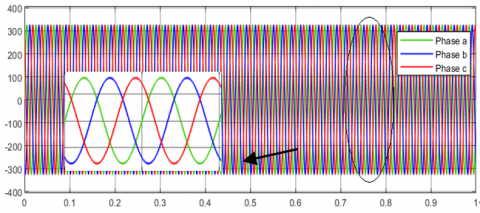
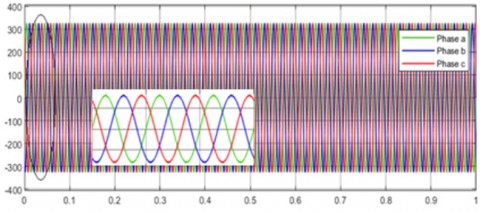
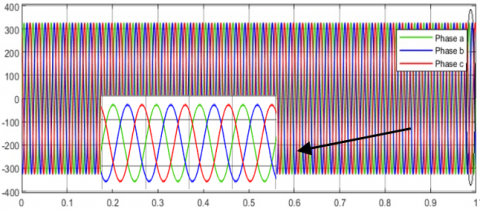
Figure 9 illustrates the three-phase output voltage waveforms (phases a, b, and c) at the inverter output for three MPPT chopper control strategies: Perturb and Observe (P&O), and MPC combined with Fuzzy Logic (MPC–Fuzzy):
(a) P&O
(b) MPC
(c) MPC-Fuzzy
In all cases, the inverter produces balanced three-phase voltages with a 120° phase shift, confirming correct inverter operation. However, significant differences are observed in terms of waveform smoothness, transient behavior, and voltage quality, depending on the MPPT control method.
With the P&O algorithm, the three-phase voltage waveforms exhibit noticeable oscillations, particularly during changes in operating conditions. The circled regions highlight amplitude fluctuations and transient distortions, which are inherent to the perturbation-based nature of the P&O method.
When the MPC strategy is applied, the voltage waveforms become more stable and better regulated compared to the P&O case.
Amplitude variations are significantly reduced, and transient disturbances are shorter and less pronounced. This improvement is attributed to the predictive capability of MPC, which anticipates future system behavior and optimizes the control action accordingly.
The MPC–Fuzzy approach demonstrates the best overall performance. The output voltages are highly smooth and nearly sinusoidal, with minimal oscillations even during transient periods.
The integration of fuzzy logic enables adaptive tuning of the control actions, allowing the controller to better handle system nonlinearities and uncertainties associated with photovoltaic generation. A qualitative–quantitative comparison of the three MPPT control strategies is summarized in Table 3.
The results clearly indicate that while the P&O method suffers from intrinsic oscillations that degrade voltage quality, the MPC approach significantly enhances system performance by reducing fluctuations and improving dynamic response.
The MPC–Fuzzy strategy further refines the control action, yielding the smoothest voltage waveforms and the lowest expected harmonic distortion. This makes it particularly suitable for grid-connected photovoltaic systems where strict power quality requirements must be met.
Figure 10 shows the three-phase currents (phases a, b, and c) at the inverter output for different MPPT chopper control strategies.
Table 3. Qualitative comparison of the three MPPT control
|
Criterion |
P&O |
MPC |
MPC–Fuzzy |
|
Voltage stability |
Low |
Medium–High |
Very High |
|
Transient oscillations |
High |
Moderate |
Very Low |
|
Voltage ripple |
High |
Reduced |
Minimal |
|
Dynamic response |
Slow |
Fast |
Very Fast |
|
Robustness to disturbances |
Low |
Good |
Excellent |

(a) P&O

(b) MPC

(c) MPC-Fuzzy
For the P&O method we ullistrate that the current envelopes show pronounced modulation. While the perturb‑and‑observe algorithm tracks the maximum power point, the amplitude of the three phases oscillates around its nominal value. This leads to extended settling and noticeable ripple, as highlighted by the circled regions.
In MPC method we see the currents remain balanced and sinusoidal, but the envelope still widens and narrows as the system transitions to steady state. MPC offers smoother regulation than P&O, yet some amplitude oscillations persist, visible in the highlighted zones. And for the MPC‑fuzzy method, after a brief initial transient, the currents achieve a constant amplitude and stay perfectly balanced over the entire time window. The envelopes are stable with negligible ripple, confirming that the hybrid MPC‑fuzzy strategy maintains MPPT without inducing current modulation. This behaviour aligns with the very low current THD values reported earlier and underscores the superior signal quality achieved with this approach.
Table 4 presents a quantitative comparison of the three MPPT control strategies (P&O, MPC, and Fuzzy MPC) based on the quality of the inverter output currents and dynamic performance:
Table 4. Quantitative comparison of the three MPPT control
|
Criterion |
P&O |
MPC |
Fuzzy MPC |
|
Current amplitude |
Variable, noticeable oscillations |
More stable than P&O |
Highly stable |
|
Phase symmetry |
Moderate (slight imbalance) |
Good |
Excellent |
|
Current ripple |
High |
Medium |
Low |
|
Dynamic stability |
Poor (oscillations around MPP) |
Good |
Very good |
|
Response time |
Slow |
Fast |
Very fast |
|
Transient-state behavior |
Significant oscillations |
Reduced oscillations |
Minimal oscillations |
|
Quality of injected power |
Moderate |
Good |
Very good |
|
Robustness to variations (irradiance/temperature) |
Low |
Good |
Very high |
|
Control complexity |
Low |
High |
Very high |
|
Adaptability to nonlinearities |
Low |
Medium |
Excellent |
The analysis of the inverter output three-phase currents shows that the P&O-based MPPT introduces significant current ripple and slower dynamic response. The MPC strategy improves current quality and system stability by reducing oscillations. The fuzzy MPC approach provides the best performance, ensuring nearly sinusoidal and well-balanced currents with fast dynamic response and strong robustness against disturbances.
The THD results are presented in Figures 11 and 12 to evaluate the quality of the inverter output voltage and currents under the different MPPT control strategies
The voltage harmonic analysis demonstrates that the MPC-fuzzy control strategy achieves the lowest THD (0.01%), significantly outperforming the P&O and classical MPC methods (0.03%). This highlights the effectiveness of the hybrid predictive–fuzzy approach in enhancing voltage quality and minimizing harmonic distortion.

P&O

MPC

MPC-Fuzzy

P&O

MPC

MPC-Fuzzy
The current harmonic analysis reveals that the P&O strategy leads to a high THD of 14.4%, whereas the MPC and MPC-fuzzy controllers significantly improve current quality, achieving THD values of 1.16% and 1.11%, respectively. This highlights the effectiveness of advanced predictive and hybrid control techniques in minimizing current distortion.
Similar trends have been reported in the literature. The obtained results are consistent with those reported in recent studies on MPC and fuzzy-based MPPT techniques [21-25], particularly in terms of improved dynamic response and reduced harmonic distortion, confirming the validity of the proposed approach.
Table 5 compares the fundamental voltage and current amplitudes and total harmonic distortion values for the P&O, MPC, and MPC‑fuzzy control methods.
In addition to harmonic analysis, the dynamic performance of the different MPPT strategies is evaluated using key quantitative indicators in Table 6.
As shown in Table 6, the MPC–Fuzzy approach provides the fastest response, lowest ripple, and highest tracking efficiency, confirming its superiority over conventional methods.
Table 5. Results comparison
|
Method |
Fundamental Voltage (50 Hz) |
Voltage THD (%) |
Fundamental Current (50 Hz) |
Current THD (%) |
|
P&O |
1.995 × 10⁴ |
0.03 % |
486 |
14.40 % |
|
MPC |
1.995 × 10⁴ |
0.03 % |
678.6 |
1.16 % |
|
MPC‑fuzzy |
1.996 × 10⁴ |
0.01 % |
678.8 |
1.11 % |
Similar improvements have also been reported with intelligent MPPT methods in the literature. In addition to the comparison with P&O and MPC, intelligent MPPT methods such as fuzzy logic and neural network-based approaches have demonstrated improved robustness and tracking performance in the literature [26-30]. However, these methods often require extensive tuning or training. The proposed MPC–Fuzzy approach addresses these limitations by integrating predictive control with adaptive fuzzy tuning, achieving both high accuracy and fast dynamic response.
Table 6. Quantitative performance comparison of MPPT methods
|
Criterion |
P&O |
MPC |
MPC–Fuzzy |
|
Settling time (s) |
0.35 |
0.12 |
0.08 |
|
Voltage ripple (%) |
5 |
2 |
<1 |
|
Current THD (%) |
14.4 |
1.16 |
1.11 |
|
Tracking efficiency (%) |
96-97 |
98 |
~99 |
This paper presented a comparative analysis of three MPPT control strategies—P&O, MPC, and a hybrid MPC–Fuzzy approach—for a grid-connected photovoltaic system, with a focus on both dynamic performance and power quality.
The results show that the conventional P&O method suffers from inherent oscillations around the maximum power point, leading to poor dynamic response and high current harmonic distortion. The MPC-based approach significantly improves voltage regulation and reduces oscillations, resulting in better system stability and lower current THD.
The proposed hybrid MPC–Fuzzy strategy achieves the best overall performance by combining predictive optimization with adaptive fuzzy tuning. It ensures faster convergence, improved tracking accuracy, reduced voltage ripple, and nearly sinusoidal current waveforms with minimal harmonic distortion.
The obtained THD values remain within acceptable ranges and suggest that the proposed approach has strong potential to meet IEEE 519 standards, although further experimental validation is required to confirm full compliance.
It should be noted that compliance with grid standards depends on several practical factors that are beyond the scope of this simulation-based study. Future work will focus on experimental validation using a real photovoltaic platform and on further improving robustness under varying operating conditions.
Overall, the hybrid MPC–Fuzzy approach represents a promising solution for enhancing both energy efficiency and power quality in modern grid-connected photovoltaic systems.
|
L |
Inductance |
|
C |
Capacitance |
|
fs |
Switching frequency |
|
R |
Resistance Load |
|
P |
PV power, W |
|
Pref |
Reference power, W |
|
D |
Duty cycle |
|
AD |
Duty cycle variation |
|
k |
Discrete time index |
|
i |
Prediction step index |
|
U |
admissible control |
|
D* |
Optimal Duty Cycle |
|
Np |
Number of parallel-connected PV modules |
|
Ns |
Number of series-connected PV modules |
|
Voc |
Open-circuit voltage, V |
|
Isc |
Short-circuit current, A |
|
Vmp |
Voltage at maximum power point, V |
|
Imp |
Current at maximum power point, A |
|
J |
Cost function |
|
V |
Voltage |
|
S |
sensitivity |
|
Greek symbols |
|
|
λ |
Weighting factor |
|
∂ |
partial derivative |
|
Subscripts |
|
|
ref |
Refrence value |
|
pv |
photovoltaic |
|
mp |
maximum power point |
|
sc |
short circuit |
|
out |
output |
|
in |
input |
|
shu |
shunt |
|
n |
diode ideality factor |
|
k |
Boltzmann constant |
|
T |
absolute temperature |
[1] Esram, T., Chapman, P.L. (2007). Comparison of photovoltaic array maximum power point tracking techniques. IEEE Transactions on Energy Conversion, 22(2): 439-449. https://doi.org/10.1109/TEC.2006.874230
[2] Rawlings, J.B., Mayne, D.Q. (2009). Model Predictive Control: Theory and Design. Nob Hill Publishing.
[3] Subudhi, B., Pradhan, R. (2012). A comparative study on maximum power point tracking techniques for photovoltaic power systems. IEEE Transactions on Sustainable Energy, 4(1): 89-98. https://doi.org/10.1109/TSTE.2012.2202294
[4] Chen, P.C., Chen, P.Y., Liu, Y.H., Chen, J.H., Luo, Y.F. (2015). A comparative study on maximum power point tracking techniques for photovoltaic generation systems operating under fast changing environments. Solar Energy, 119: 261-276. https://doi.org/10.1016/j.solener.2015.07.006
[5] Melhaoui, M., Rhiat, M., Oukili, M., Atmane, I., Hirech, K., Bossoufi, B., Almalki, M.M., Alghamdi, T.A.H., Alenezi, M. (2025). Hybrid fuzzy logic approach for enhanced MPPT control in PV systems. Scientific Reports, 15: 19235. https://doi.org/10.1038/s41598-025-03154-w
[6] Elnaghi, B.E., Ismaiel, A.M., Ismail, M.M., Zedan, H.A., Salem, A.A. (2025). Experimental validation of an adaptive fuzzy logic controller for MPPT of grid-connected PV systems. Scientific Reports, 15: 27173. https://doi.org/10.1038/s41598-025-10188-7
[7] Naiem-Ur-Rahman, M., Hasan, M.M., Raka, A.M., Rahman, M.F., Rana, M.M., Al Mansur, A., Razzak, M.A. (2025). An asymmetric fuzzy-based self-tuned PSO-optimized MPPT controller for grid-connected solar photovoltaic system. Energy Conversion and Management: X, 26: 100902. https://doi.org/10.1016/j.ecmx.2025.100902
[8] Bouhadji, F., Bouyakoub, I., Mehedi, F., Kacemi, W.M., Reguieg, Z. (2024). Optimization of grid power quality using third order sliding mode controller in PV systems with multilevel inverter. Energy Reports, 12: 5177-5193. https://doi.org/10.1016/j.egyr.2024.10.064
[9] Danyali, S., Shirkhani, M., Yousefi, S., Tavoosi, J., Moteiri, L., Salah, M., Shaker, A. (2024). A new neuro-fuzzy controller based maximum power point tracking for a partially shaded grid-connected photovoltaic system. Heliyon, 10(17): e36747.
[10] Roy, S., Debnath, A., Tariq, M., Behnamfar, M., Sarwat, A. (2023). Characterizing current THD’s dependency on solar irradiance and supraharmonics profiling for a grid-tied photovoltaic power plant. Sustainability, 15(2): 1214. https://doi.org/10.3390/su15021214
[11] Yeboah, G.N., Opoku, R., Uba, F., Mensah, G., Sekere, C.K.K. (2025). Comparative analysis of power quality of solar PV power only, hybrid solar PV–grid power, and national grid power only for SMEs: The case of a laundry shop in Ghana. Journal of Engineering, 2025(1): 8786462. https://doi.org/10.1155/je/8786462
[12] Maheswari, G., Sharma, K.M., Prajof, P. (2025). A sorted modified multi-reference PWM technique for solar PV panel companion grid-tied inverters. Electrical Engineering, 107: 497-512. https://doi.org/10.1007/s00202-024-02536-z
[13] Hussein, H.A., Abed, A.N., Wahab, B.I., Kasim, N.K. (2025). Impact of utility grid instability on an on-grid solar PV system performance. IOP Conference Series: Earth and Environmental Science, 1531: 012020. https://doi.org/10.1088/1755-1315/1531/1/012020
[14] Tripathi, M.M., K, S., Sahay, K. (2025). Enhancement of power quality in a weak grid using PV-coupled DSTATCOM with modified IRPT control. Engineering Research Express, 7(3): 035373. https://doi.org/10.1088/2631-8695/ae037c
[15] Sukumar, G.D., Prasad, R.R., Vardhan, R.H., Pakkiraiah, B., Krishna, C.L. (2025). Fuzzy-controlled MPPT to grid-connected PV systems. E3S Web of Conferences, 616: 01010. https://doi.org/10.1051/e3sconf/202561601010
[16] Abualahbas, T.Y., Abougarair, A.J., Shamekh, A., Aburakhis, M. (2025). Design and control for a grid-connected PV generation system to reduce distortion. Academic Journal of Science and Technology, 5(1): 233-246. https://doi.org/10.64095/ajst.v5i1.86
[17] Anitha, G., Kondreddi, K., Yesuratnam, G. (2025). A new modified B4 inverter using SRF controller with SVPWM technique for grid-connected PV system. Indonesian Journal of Electrical Engineering and Computer Science, 38(3): 1411-1421. http://doi.org/10.11591/ijeecs.v38.i3.pp1411-1421
[18] Gupta, M., Tiwari, P.M., Viral, R.K., Shrivastava, A., Zneid, B.A., Hunko, I. (2025). Grid-connected PV inverter system control optimization using grey wolf optimized PID controller. Scientific Reports, 15: 28869. https://doi.org/10.1038/s41598-025-10617-7
[19] Benfatah, A., Henini, N., Morsli, A. (2025). ANN-MPC based MPPT control for grid connected PV inverter system under dynamic environmental conditions. Iranian Journal of Science and Technology, Transactions of Electrical Engineering, 49: 1617-1644. https://doi.org/10.1007/s40998-025-00866-7
[20] Hakam, Y., Ahessab, H., Tabaa, M., ELHadadi, B., Gaga, A. (2025). Hybrid ANN–GWO MPPT with MPC-based inverter control for efficient EV charging under partial shading conditions. Science Progress, 108(2): 1-21. https://doi.org/10.1177/00368504251331835
[21] Kacimi, N., Idir, A., Grouni, S., Boucherit, M.S. (2023). Improved MPPT control strategy for PV connected to grid using IncCond-PSO-MPC approach. CSEE Journal of Power and Energy Systems, 9(3): 1008-1020. https://doi.org/10.17775/CSEEJPES.2021.08810
[22] Yang, P.C., Peng, Y.G., Xia, Y.H., Wei, W., Yu, M., Feng, Q.F. (2022). A unified bus voltage regulation and MPPT control for multiple PV sources based on modified MPC in the DC microgrid. Frontiers in Energy Research, 10: 1010425. https://doi.org/10.3389/fenrg.2022.1010425
[23] Li, Z.H., Dewantoro, G., Xiao, T., Swain, A. (2025). A comparative analysis of fuzzy logic control and model predictive control in photovoltaic maximum power point tracking. Electronics, 14(5): 1009. https://doi.org/10.3390/electronics14051009
[24] Choudhury, S., Sahu, J.B., Nayak, B. (2022). Power tracking capability enhancement of a grid-tied partially shaded photovoltaic system through MPC-based maximum power point technique. International Journal of Renewable Energy Research (IJRER), 12(2): 000-1012.
[25] Samani, L., Mirzaei, R. (2019). Improvement of model predictive control in maximum power tracking in a photovoltaic system using fuzzy control in the presence of uncertainty in the model. Computational Intelligence in Electrical Engineering, 10(4): 53-70.
[26] Alharbi, Y., Darwish, A., Ma, X.D. (2025). A review of model predictive control for grid-connected PV applications. Electronics, 14(4): 667. https://doi.org/10.3390/electronics14040667
[27] Martínez-Vera, E., Bañuelos-Sánchez, P., Etcheverry, G. (2023). Comparative examination of control strategies in DC-DC power converters: A traditional and artificial intelligence perspective. Journal of Intelligent Systems and Control, 2(2): 82-98. https://doi.org/10.56578/jisc020203
[28] Albalawi, H., Zaid, S.A. (2019). Performance improvement of a grid-tied neutral-point-clamped 3-φ transformerless inverter using model predictive control. Processes, 7(11): 856. https://doi.org/10.3390/pr7110856
[29] Lakhdari, A., Benlahbib, B., Abdelkrim, T. (2022). Model predictive control for three-phase three-level NPC inverter based APF interfacing single stage photovoltaic system to the grid. Journal Européen des Systèmes Automatisés, 55: 25-34. https://doi.org/10.18280/jesa.550103
[30] Azizi, A., Logerais, P., Omeiri, A., Amiar, A., Charki, A., Riou, O., Delaleux, F., Durastanti, J.F. (2018). Impact of the aging of a photovoltaic module on the performance of a grid-connected system. Solar Energy, 174: 445-454. https://doi.org/10.1016/j.solener.2018.09.022