Manikantha K* | Kruthi Jayaram | Sowmya T | Hemanth Thulasi Satyanarayana | Sunayana S | Sonika Sharma D | Laxmi V
© 2025 The authors. This article is published by IIETA and is licensed under the CC BY 4.0 license (http://creativecommons.org/licenses/by/4.0/).
OPEN ACCESS
The increasing numbers of sensors or actuators in the Internet of Things (IoT) networks make it essential to develop smart routing solutions whose goals are to extend the network's lifetime and keep reliable communication. In this paper, we present a new hybrid routing model based on multi-layer hierarchical clustering with the hybrid Convolutional Neural Network–Gated Recurrent Unit (CNN-GRU) model to find the most reasonable routing paths in a dynamic IoT environment. The CNN-GRU model utilizes a sequential sliding window of historical node attributes residual energy, hop count, and data rate for predicting the best energy-efficient next-hop node as closely as possible in pipeline. This predictability allows the protocol to rely less on static heuristics, and to adapt its behavior to varying network conditions. Observations from experiments also illustrate that our model achieves superior performance over other baseline protocols in terms of network lifetime of 134 rounds the first node death (FND) following 202 rounds the half-node death (HND), energy consumption of 0.041 J/round, packet delivery ratio of 96.8%, end-to-end delay of 244 ms, and the routing overhead of 28cp/round. These findings demonstrate that the proposed Multi-Layer Clustering with CNN-GRU model can enhance the energy efficiency, reliability, and scalability of IoT networks.
clustering, convolutional neural networks, deep learning, Gated Recurrent Unit, Internet of Things, optimal routing
Internet of Things (IoT) is the current era of smart things connected with each other for specific purpose of communication. The rise of IoT has given rise to the deployment of large networks of heterogeneous, resource constrained devices. These devices, which are commonly used to support applications including smart cities, industrial automation, and environmental monitoring, are typically limited by power, and thus energy efficiency is a key issue. The design of efficient routing protocols is critical to guarantee long network life time and consistent data forwarding in such energy-constrained environments [1].
These conventional routing schemes like Low-Energy Adaptive Clustering Hierarchy (LEACH) and HEED [2] use clustering approach as a strategy for data aggregation at cluster heads to minimize power usage of sensor nodes when data is to be sent to a BS. Despite the fact that such protocols can lead to some improvements due to their energy efficiency, they lack in dynamic IoT environments when dealing with a changing topologies and traffic patterns. Furthermore, single-layered clustering schemes figure out that a tight distribution of the energy load throughout the network may not be achieved, and we will rather experience premature node death and an eventual degradation in network performance.
Some clustering-based protocols have been presented for extending network lifetime and improving energy efficiency. Among these, LEACH and Hybrid Energy-Efficient Distributed Clustering (HEED) [2] are well-known. LEACH adopts random rotation of cluster head to balance energy consumption, while HEED takes account of residual energy and communication cost in cluster head election. Although they are effective in static environment or under small-scaling considerations, they showed some limitations.
In LEACH and HEED, only localized decision-making, and heuristic-based methods are employed and they could not adjust themselves based on historic or network wide context. The optimal clusters are prone to computationally expensive and less efficient in the case of nodes’ density growth. Dynamic topologies, varying energy levels and data traffic conditions in practice way off the performance of operation as compared to typical IoT deployments. These protocols work in a flat or single-cluster hierarchy causing excessive inter-cluster communication overhead and fast death of nodes near sink nodes [3].
The recent progress in the field of machine learning [4], in particular deep learning (DL), has provided and is still providing ways to take advantage of more sophisticated mechanisms to improve the routing decisions in IoT networks. Deep learning models (e.g., CNNs and GRUs) have demonstrated the ability of learning spatial and temporal patterns in network data, which can facilitate more intelligent and adaptive routing strategies. CNN [5] can capture spatial features, while the GRU can model temporal dependence, so the combination is well in line for the dynamic IoT environment.
In this paper, we develop a hierarchical clustering and deep learning based hybrid routing scheme for making efficient routing decisions in IoT networks. In the multi-layer clustering, layering the network into hierarchical clusters can balance the energy load and improve the scalability. The CNN-GRU model uses effective parameters (residual energy, node distance, link quality, and traffic load) to predict the optimal routing paths to react to dynamic IoT networks. Nowadays, with the fast growth of Internet of Things (IoT) the need for intelligent energy-aware routing and clustering algorithms is more and more pressing. Conventional routing schemes could not cope with the dynamics and heterogeneity of IoT networks and leave nodes with battery exhaustion and ineffective communication. In this regard higher level machine learning and deep learning techniques are used for provision of self-adaptive, context ware and energy-efficient routing and clustering.
In STM environments, GNNs in particular have shown interesting potential for clustering in Social IoT context as they enable a context-driven node clustering based on social and mobility behaviors rather than pure geographic vicinity. This leads to a considerable gain in routing efficiency and scalability in dense IoT settings [6]. At the same time, the combination of Blockchain and deep learning models has been investigated to realize secure and tamperproof routing decisions. Apart this hybrid technique minimizes the energy utilization and provide confidence and transparency of multi-hop communication paths in WSN [7]. In the context of deep learning for unsupervised feature learning, multi-layer neural networks (e.g., deep learning networks such as what has been recently employed in the DeepCluE model) have demonstrated that deep architectures can be effectively applied to improve the results of clustering on high-dimensional data. These models leverage the ensemble learning scenario to smooth the prediction among different layers, which shed light on clustering techniques in IoT [8].
Additionally, for the joint optimization of energy demand and computation overhead in mobile edge IoT, hybrid clustering algorithm-based models combining with the CNN referred to as the K-Means have been introduced [9]. These methods utilize CNNs for spatial feature learning and take advantage of clustering to ease the complexity of routing. Likewise, energy-efficient computation and clustering methodologies specifically designed for heterogeneous smart city deployment were proposed based on multi-metric optimization. Based on these models, node capabilities, energy status, and data type to enhance network resilience and lifetime as a whole is introduced [10]. Taken together, these developments highlight a common thread: the intertwining of deep learning, intelligent device co-location and energy-economical computation to mitigate the urgent scalability and sustainability concerns of today’s IoT. Based on this, our proposed work adopts a multi-level clustering approach combined with a CNN-GRU deep learning model to improve routing efficiency, network lifetime, and computational latency across various IoT environments. Research contributions are:
The rest of the paper is organized as follows: In Section 2, we review the related work on energy-efficient routing and DNN applications in IoT. The system model and problem formulation and the proposed approach is detailed in Section 3, which includes the multi-layer clustering structure and the CNN-GRU model. The experimental setup and results are provided in Section 4. Finally, the conclusion and future work is presented in Section 5.
Deep learning algorithms have been used in classification of network traffic in IoT networks to optimize routing. Kalwar and Bhatti [11] presented a deep learning based survey on network traffic classification for IoT. They surveyed a number of deep learning algorithms for IoT traffic pattern classification, which can be embedded for traffic classification to improve routing and energy efficiency. Energy aware routing protocols are essential in extending the lifetime of IoT networks. Dong et al. [12] offered a detailed review for energy-aware routing schemes in IoT services. Their work classified protocols and algorithms, and provided an overview of their performance in light of energy savings in data transmission.
Reinforcement Learning (RL) is becoming an essential technique for implementing adaptive routing strategies, which can be adjusted dynamically in response to variations in network conditions. Sun et al. [13] introduced a Q-learning energy-conscious routing scheme that learns the optimal forwarding decisions according to the residual energy and the corresponding node distances. The model achieved better topology adjustability and network lifetime. Tang et al. [14] proposed DQN (Deep Q-Networks) for routing in dynamic IoT scenarios. The DQN agent outperforms DTAMs in finding optimal paths that simultaneously minimise both the latency and the energy consumption better than classical reactive (AODV), and proactive (DSR) routing protocols.
Transformers have also facilitated the more intelligent decision-making by attending to important features in node data. Ali et al. [15] introduced the self-attention method into an RNN model for the cluster head prediction of WSNs. The model captured the contexts of the dependencies and found better nodes for routing, increasing energy utilization. Liu et al. [16] proposed an attention-enriched GRU model for spatio-temporal routing in smart agriculture. The model leveraged weather, location and energy characteristics to take energy- efficient intelligent routing decisions.
Due to the lack of labeled IoT data, researchers have used transfer learning techniques. Kumar et al. [17] used transfer learning with environmental dataset as pretrained CNNs to predict routing metrics like node failure and congestion. This facilitated rapid convergence and was heterogeneous to varying IoT topologies. FL frame IoT FL makes it possible to realize the cooperative training among the IoT nodes without sharing the raw data. Chen et al. [18] presented a federated CNN-LSTM structure for distributed routing and energy forecasting in smart homes. This privacy-preserving model reduced the demand for central computation, minimizing energy and enhancing scalability. Patel et al. [19] used federated reinforcement learning for Adaptive Cluster Formation in WSNs. The approach achieved 18% less energy consumption than centralized RL methods.
AI at the edge is important for latency sensitive and energy efficient IoT systems. Zhang et al. [20] proposed a low-power CNN at edge devices for local route inference in a smart city IoT network. The model resulted in a 25% reduction in packet overhead and a 25% decrease in node response time. Nguyen et al. [21] proposed an edge intelligent GRU model for vehicle to infrastructure (V2I) network. It offered a real-time adaptive routing according to node mobility and link quality.
RL played a critical role in building adaptive and energy-efficient routing protocols in IoT networks. DOS-RL Protocol intelligent energy-efficient multi-objective routing protocol based on Reinforcement Learning (RL) but with Dynamic Objective Selection (DOS-RL) to improve routing decisions in the IoT-based networks was proposed [22]. OptiE2ERL Model: Later a novel Reinforcement Learning (RL) based model, namely OptiE2ERL Model, was proposed for energy efficiency and routing optimization in Internet of Vehicles (IoV), resolving the problem of energy consumption in vehicular networks [23]. EER-RL Protocol: An EER-RL based energy-efficient routing protocol was proposed to help devices adapt to network variations, e.g., energy and mobility, that lead to better route decisions in a wireless IoT network [24].
Federated learning (FL) has recently been proposed as a promising technique to improve energy consumption and data privacy of IoT networks. Hierarchical Clustering with FL. A new solution, which combines a hierarchical clustering routing protocol with federated learning, is proposed to utilize in-network processing capability of IoT devices for the purpose of reducing communication overhead and improving energy efficiency [25]. Decentralized FL Framework A novel energy-efficient decentralized federated learning framework (e.g., to minimize communication rounds and energy consumption) targeted to alleviate energy consumption in mobile IoT environments [26]. The Lifetime Maximization using QoS based routing protocol is a mechanism that was proposed to cope with device asynchrony with resource utilization in communication networks for IoT [27].
The use of clustering for improving the energy consumption in IoT is a well-adopted solution. The energy-efficient mega-cluster-based routing (EEMCR) protocol is proposed for addressing the 'hotspot problem' in large-scale monitoring area as an effective way to save energy and to extend the network lifetime [28]. An energy-efficient security provisioning mechanism namely, Adaptive Clustering and Trust Aware Routing (ACTAR) was introduced in IoT-WSNs with improved energy efficiency and security [29]. Algorithm optimization coupled with clustering, and routing methods led to tremendous improvement in energy efficiency. Whale optimization and harmony search combination was proposed for the which can be used to compute intermediate and the cluster head nodes used for energy- efficient routing in the IoT networks [30]. Some of the surveys presented the full detailed analyses of the energy-efficient routing protocols in IoT. Survey on energy efficiency routing algorithms: A comprehensive study on energy efficient routing algorithms in IoT, comparing state-of-the-art methods that exploit machine learning and clustering [31]. Federated Learning Strategies Survey: A holistic survey of up-to-date energy efficient strategies in FL for MEC have been offered, based on system models and energy consumption models in FL [32].
Much progress has been made in the development of energy-efficient routing and clustering algorithms in IoT, however, there are some challenges:
The goal of the proposed model is to improve energy efficiency, latency, and packet loss in IoT enabled WSN, by using multi-layer clustering and hybrid deep learning model (CNN-GRU). The structure is intended to be dynamic to cope, as the nodes can move, and the energy levels and the density of network nodes can change. Using CNNs for spatial pattern extraction and GRUs to learn temporal sequences, the model enables smart routing decisions based on live network states.
3.1 Network assumptions
In this paper, several major assumptions are considered to formulate the IoT-based WSN capable of implementing the proposed multi-layer clustering and CNN-GRU routing mechanism. The network is considered to be composed of a number of NNN sensor nodes which are randomly deployed in a two-dimensional fixed area. These nodes generate a static or semi-static topology so that the capability of moving the nodes is restricted and almost null. A BS (sink node) located at the centre or periphery of the network is responsible for collecting data from the sensor nodes; It is also assumed that the BS has access to unlimited energy and computing resources.
All sensor nodes are considered in identical level of hardware and initial energy. Every node is powered by a battery, low-power radios, onboard computation (microcontroller), and environmental sensors (e.g., temperature). The energy initially distributed uniformly is depleted at different rates due to different roles the nodes play. Furthermore, all nodes are assumed to be location-aware through GPS modules or with the aid of localization algorithms for optimized clustering and routing decisions. The communication model among the nodes is symmetric wireless communication model, meaning that if A can reach B, then B can reach A. Correspondingly, we use classical first order radio model for the radio energy model in which energy is proportional to the size of the data packet and square of transmission distance. The communication is considered to be without noise, and with the absence of collisions and MAC-level interference, so that the emphasis is on routing and energy efficiency.
Regarding network operation, nodes are periodically grouped into clusters based on criteria like remaining energy and communication range. A Cluster Head (CH) dynamically elected for each cluster has the role of evenly distributing the level of energy consumption in the network. In the multi-layer clustering approach, existing networks are partitioned into a secondary (i.e., formation) hierarchy and sub-CHs aid the primary CH to collect and send data, to save energy and reduce the delay in transferring data. These CHs also perform the CNN-GRU hybrid model that captures the spatio-temporal features of the network state to make smart and adaptive routing.
The sensing operation is assumed to be periodic, where each node sends packets of certain size at regular time instants. Data is transmitted for the first time to the CH, and is aggregated there and sent to the base station. The environmental uncertainties such as signal fading, node power-off and weather interferences are not modeled in this phase for simplicities. The choice of the model architecture is obviously extendable, and can incorporate this aspect in the future.
3.2 Multi-layer clustering algorithm
The Multi-Layer Clustering Algorithm is a state-of-the-art hierarchical data aggregation and routing protocol that aims to improve energy efficiency, scalability, and network longevity in IoT and WSNs. Contrary to the flat clustering approaches, where nodes constitute a single layer of clusters with direct communication to the sink/base station, multi-layer clustering arranges nodes in several layers of clusters. Each layer plays a specific role in the transmission of data, the distribution of energy and the cluster management, where they are organized in a tree-based or pyramid-like topology.
Sensor nodes in the bottom layer are organized as primary cluster according to nearest or signal strength. From each of these clusters, a Cluster Head (CH) is elected, typically based on factors like residual energy, node centrality and historical load. The CH is the role to gather data from the participating nodes in its cluster, aggregate or process the data and forward the aggregated information to the higher echelons. The aggregation of data leads to less redundant information, which reduces communication overhead and the cost of energy.
The intermediate layers are formed by secondary/tertiary CHs acting as aggregators for multiple lower-layer CHs. These mid-level CHs are dynamically chosen or pre-assigned according to the network size and topology. They are responsible for routing decisions, more data aggregation and packet relays to the base station. This hierarchical architecture not only decreases the transmission distance of a single node (to save its energy) but also can balance the load and solve the hotspot problem that the nearer node to the base station would consume energy more quickly.
At the highest layer, a number of high capacity nodes or a centralized sink node are in charge of gathering and processing the ultimate aggregate data. This layer could also contain AI models or cloud servers for decision making, anomaly detection, or analytics. Let N is the total number of nodes, A is deployment area, L is the number of cluster layers, Ci is the number of clusters in the layer I, and CH is the cluster head. For all in N, node assignment to cluster assign to cᵢ, is defined as Eq. (1).
$d\left(n_k, C H_1^j\right)=\min \left(d\left(n_k, C H_1^j\right)\right)$ (1)
The cluster head selection is as given in Eq. (2).
$C H_{ {Score }\left(n_k\right)}=\alpha *\left(\frac{E_{ {res }}\left(n_k\right)}{E_{max }}\right)+\beta *\left(1-\left(\frac{ { Distance }\left(n_k, B S\right)}{D_{max }}\right)\right)$ (2)
The Energy consumption model is considered as Eq. (3) for transmitting the k bits and Eq. (4) for the receiving k bits.
$\begin{gathered}E_{t x(k, d)}= \left\{\begin{array}{c}\text { If } d<d^0, \quad k * E_{\text {elec }}+k * \varepsilon_{f s} * d^2 \\ \text { Else, } k * E_{\text {elec }}+k * \varepsilon_{m p} * d^4\end{array}\right.\end{gathered}$ (3)
$E_{r x(k)}=k * E_{\text {elec }}$ (4)
Here, $E_{ {elec }}$ shows the energy to run the transmitter/receiver circuit, $\varepsilon_{f s}$ is free space model amplifier constant, $\varepsilon_{m p}$ is multipath model amplifier constant, and d0 is $\sqrt{\left(\frac{\varepsilon_{f s}}{\varepsilon_{m p}}\right)}$.
The total energy the consumption in each layer is estimated as Eq. (5), where is the energy dissipated during the data collection.
$E_{ {layer }_{\mathrm{i}}}=\Sigma\left[E_{ {tx }_{\left(k, { distance }_{ {to }_{C H}}\right)}}+E_{r x(k)}+E_{{agg }}\right]$ (5)
Total delay occurs at each layer is estimated as Eq. (6), where, $T_{t x_{\mathrm{i}}}$ is the transmission delay at ith layer, $T_{ {queue }_{{i}}}$ is the queuing delay, and $T_{ {process }_{\mathrm{i}}}$ data fusion delay.
$T_{ {total }}=\Sigma\left\lceil T_{t x_{\mathrm{i}}}+T_{ {queue }_{\mathrm{i}}}+T_{ {process }_{\mathrm{i}}}\right\rceil$ (6)
The energy optimization function is given in the Eq. (7) subjected to where residual energy is greater than the threshold and cluster head communication is less than the average distance in the network.
$E_{\text {Obj }}=\left(\frac{E_{ {total }}}{N}\right)+\gamma * T_{ {total }}$ (7)
3.3 CNN-GRU hybrid model
The CNN-GRU hybrid model [18] is developed for the purpose of intelligent and energy-efficient routing in IoT-based WSNs. In this model, we get the best of both worlds by employing the ability of CNNs to extract spatial features and the power of GRUs to recognize temporal patterns. The model is deployed at the CH level and the aggregation node data is processed to achieve the optimal next hop for forwarding the data with the ultimate aim to minimize the energy, latency, and packet loss.
The CNN module is used to learn spatial feature correlations in the temporal dimension. The first layer is a 1D convolutional layer with 32 filters with (3,1) kernel size, plus activation function of ReLU. This structure is beneficial to capture temporal patterns locally in time gto improve the generalization and stability of the model, we utilize batch normalization and dropout with a rate of (0.2). Then a max pooling layer having a pool size of (2,1) is employed to reduce the temporal dimensionality and to obtain dominant features. The output would then be a small feature map (4,32) that capture the filtered spatial features over time.
The feature maps are then flattened after the CNN block and passed into GRU to capture long-term temporal dependencies and dynamic behavior of nodes. The GRU layer has 64 hidden units and tanh as its activation function. Dropout (0.3) with recurrent dropout (0.2) are used for regularization. Unlike standard LSTMs, GRUs are computationally more effective in controlling gating operations, e.g., in real-time routing decisions in sparse IoT networks.
The CNN module performs the duty of learning the spatial features from the input, which contains the following node attributes: residual energy, distance with neighbors, received signal strength (RSSI), queue length, and hops to the base station. They are represented as structure input vectors and processed using 1D CNN layers. The convolutional filters will discover important patterns and correlations among these metrics, e.g. low residual energy and high RSSI value, which is an indication that the node should be depleted and not to be chosen as a relay. Such spatial representation is an intermediate result that encodes raw input features into a high-level representation, which would be used as an input of the temporal modeling. let the input vectorat time t is given as Eq. (8).
$X_t=\left[E_t, L_t, {RSSI}_t, \Delta E_t, D_t\right]$ (8)
Here, $E_t$ is the current residual energy, Lt is the coordinates of the location, RSSLt is the received signal strength indication, $\Delta E_t$ is energy change rate, Dt is distance between base station and the cluster head. The input is passed through a CNN layer for local feature extraction as given in Eq. (9).
$Z_t={ReLU}\left(W_c * X_t+b_c\right)$ (9)
Here, Wc weights of convolutional filters, bc is the bias value, and rectified linear unit activation function is used here as ReLU. After the CNN stage, the feature maps are input into the GRU. GRUs are a variant of Recurrent Neural Network (RNN) which is well-suited to sequential data and provide a computationally cheaper alternative to Long Short-Term Memory (LSTM) networks. The GRU receives time-series information from each node, which represents how network metrics evolve over time. For example, it can discover that there is a continuous decrease in energy of a node while being selected as a CH god or that packet delay increases at certain times. GRUs updating and resetting gates can selectively remember or forget part of the input, to automatically remove less informative information or help to ignore noise and preserve useful information, which is indispensable for the network to remember the former states effectively without losing the ability to forget it as shown in Equations from (10) to (14).
$h_t=G R U\left(Z_t, h_{t-1}\right)$ (10)
$Z_t={sigmoid}\left(W_z * Z_t+U_z * h_{t-1}+b_z\right)$ (11)
$r_t={sigmoid}\left(W_r * Z_r+U_r * h_{t-1}+b_r\right)$ (12)
$\tilde{h}_t=tanh \left(W_h * Z_h+U_h *\left(r_h \circ h_{t-1}\right)+b_h\right)$ (13)
$h_t=\left(1-z_h\right) \circ h_{t-1}+z_h \circ \tilde{h}_t$ (14)
Here, W and U are learnable weights, $Z_t$ and $r_t$ are update and reset gates, and ht is the hidden state. A fully connected layer and softmax classifier receive the output final hidden state of the GRU, and score potential next-hop candidates according to predicted reliability, transmission cost, and a global utility. The node having highest score is chosen for data forwarding. This rational decision making guarantees that routing is not only adaptive but (long-term) optimal for network sustainability as shown in Eq. (15).
$Y_t={Softmax}\left(W_o * h_t+b_o\right)$ (15)
Here, Yt is the routing decision to the next hop node or the cluster, and WO, bo are the weights and bias of output layer. The model also trained with loss function given as Eq. (16).
$L_{ {total }}=L_{ {class }}+\lambda * L_{ {energy }}$ (16)
Here, $L_{ {class }}$ is the categorical class entropy for routing decisions, $L_{ {energy }}$ is the penalty for choosing high energy dissipation paths, and $\lambda$ is the regularization factor. The objective of the paper is to minimize the network energy consumption while maximizing the data delivery accuracy as shown in Eq. (17).
${Minimize}(E)=\left(\frac{E_{ {total }}}{N}\right)+\alpha * L_{ {total }}+\beta * T_{ {total }}$ (17)
Here, total energy consumed is $E_{ {total }}$, N number of nodes, $T_{ {total }}$ is total network delay, $\alpha, \beta$ are weigh balancing factors are considered to achieve the objective. It also brings some benefits of combining CNN and GRU for WSN routing in IoT. It is a light-weight and effective scheme based on the consideration of the spatial and temporal trends on the behavior of a node. This hybrid strategy improves the system's capacity to lie congested and battery drained paths, and increases overall network performance and prolongs network life. Furthermore, the model enables online processing such as in smart environments where timely adaptive routing strategies are needed.
4.1 Simulation setup
In this section we perform a deep analysis of the proposed model through experimentation using the Network Simulator-2 (NS2). 500X500 network area is used for the simulation, with 200 nodes each with energy 1J. The performance of the model, tested for different number of nodes also. An illustration of the experimental arrangement, and the node distribution in the 500X500 network region. S={s1,s2,...,s200} nodes are randomly deployed evenly in the network area with 1J of equal energy. These are fixed nodes which can communicate using wireless technology among themselves. The planted network parameters of the simulation are described in Table 1.
Table 1. Simulation setup
|
Parameters |
Values |
|
Simulation Tool |
NS2 |
|
Communication Channel |
Wireless |
|
Nodes Count |
200 |
|
Initial Energy at Each Node |
1J |
|
Network Area |
500×500m |
|
Transmission Range |
200m |
|
Career Frequency |
2.5GHz |
|
Antenna Type |
Omni Directional |
|
Link Margin |
40dB |
|
Gain Factor |
30dB |
|
Noise (Receiver) |
10dB |
|
Antenna Gain |
5dB |
|
Packet Size |
512kb |
4.2 Performance metrics
We simulated the Multi-Layer Clustering with CNN-GRU routing model in the heterogeneous IoT network, including 200 randomly deployed sensor nodes in a 500m × 500m region, to evaluate the performance. The performance was compared with those of five popular routing approaches: SPR (Shortest Path Routing) [33], Phantoms Single-Path Routing (PSPR) [34], Random Intermediate Node Routing (RINR) [35], All-Direction Random Routing (ADRR) [36], and Genetic Algorithm based routing (GAR) [37]. All these frameworks used for comparison were simulated under the same network topologies for 500 rounds of transmission iterations. The performance of the function was evaluated in terms of the following key metrics:
4.2.1 Network lifetime
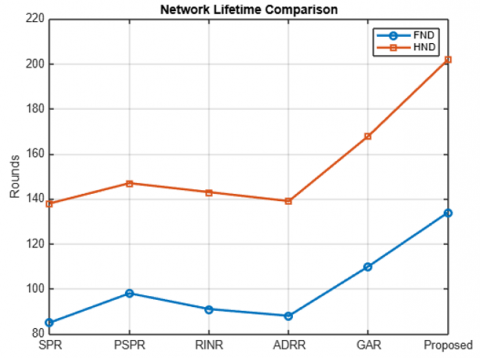
The experimental results clearly prove the effectiveness of constructed multi-layer clustering with CNN-GRU based routing in comparison to traditional and evolutionary-based routing techniques. The proposed scheme obtained a substantial increase in network lifetime: the FND was obtained at 134 rounds, while 50% node death (HND) was reached at 202 rounds. This longer period of operation is due to that the model spreads the energy consumption uniformly by region through the intelligent cluster and dynamic route prediction of the GRU module as shown in Figure 1.
Figure 1. Network lifetime comparison
4.2.2 Energy consumption
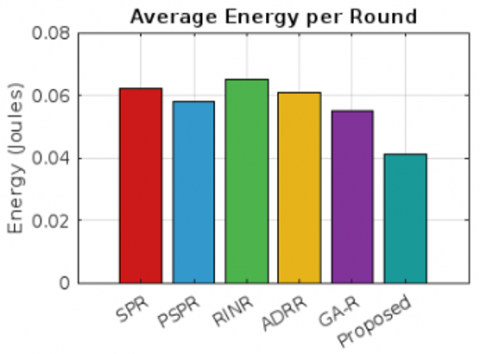
The energy consumption represents the overall energy dissipation in the network. As for the average energy cost, the proposed has the lowest average energy cost per round (0.041 J) in comparison to borders, including the GA-based routing method, which reported a value of 0.055J. This energy efficiency can be attributed to the MPU’s strategy of multi-layer clustering reducing the long distance communication, and to GRU due to the fact of learning about energy trends, preventing the participation of low-power nodes as shown in Figure 2.
Figure 2. Energy consumption comparison
4.2.3 Packet Delivery Ratio (PDR)
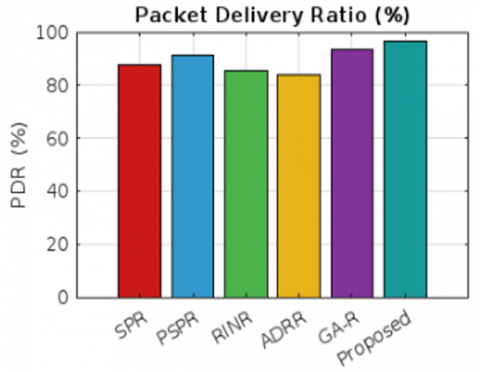
The success rate under packet delivery ratio (PDR) is as high as 96.8%, and the data rate is reliable. This gain is achieved as the combination of the spatial communication patterns extracted by CNN and the stable transmission path predicted by GRU and hence, they both minimize the packet drops generated due to node failure or congestion as shown in Figure 3.
4.2.4 End-to-end delay
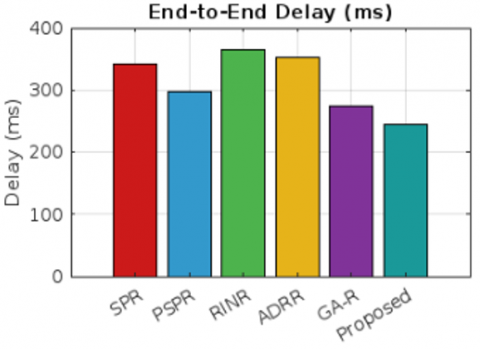
The average end-to-end delay was further reduced by the proposed scheme with a latency of 244 ms. This is significantly smaller than other methods, e.g., the next best method, GA-based routing, is at 275 ms. The ability to model in time of GRU helps the delay reduction by preferring paths with lower latency in history as shown in Figure 4.
Figure 3. Packet delivery ratio comparison
Figure 4. End to end delay comparison
4.2.5 Routing overhead
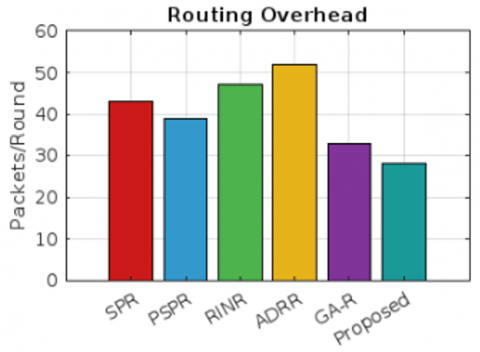
Finally, routing overhead was markedly decreased in the proposed method, an average of 28 control packets per round, only. The integration of hierarchical clustering and selective, data-driven route updates were effective for mitigating/avoiding unnecessary control message exchanging that spared bandwidth and minimized congestion as shown in Figure 5.
Figure 5. Routing overhead comparison
Through extensive experiments, we have shown that the proposed model performs considerably better than the existing routing protocols such as SPR, PSPR, RINR, ADRR, and GAR, in terms of some important performance metrics. The proposed method not only enhanced the network lifetime by saving energy but also enhanced packet delivery ratio (PDR), minimized end-end delay, and reduced routing overhead. Moreover, the CNN-GRU model demonstrated sufficient performance to forecast energy patterns and latency, making it suitable for dynamic IoT environment and for providing real-time services. The findings indicate that hybrid of conventional clustering algorithms and new deep learning methods should be used when we prefer intelligent self-optimizing IoT network management solutions.
CNN and GRU work together to gather local info and foresee how things change in the network. This helps the model make smart routing choices based on current conditions, allowing it to avoid unstable nodes before there’s a problem. As a result, the network lasts longer and uses energy more efficiently because of fewer packet losses and retransmissions. Also, using Multi-Layer Clustering before the CNN-GRU step ensures that only relevant node clusters participate in routing. This setup helps tackle common issues found in flat-routing models, improving load balancing and reducing energy hotspots. CNN with GRU synergy lets the model take in a context level understanding of network environment CNN for the local and GRU represented as temporal cell capturing changes in status of nodes. Hence, the routing decisions are truly both and predictive making the mechanism decide to bypass unreliable nodes before links become down. This reaction and predictive behavior minimize the packet loss/retransmissions, which motivates to lower energy efficiency, ultimately enhancing network lifetime.
Furthermore, the compositional Multi-Layer Clustering before the CNN-GRU reduces the amount of irrelevant node clusters can participate in routing. By these hierarchical structuring, it alleviates the routing overhead, enhances load balancing and decreases energy hotspots. Against node failures and network fragmentation in the real-world deployments the flexibility and addictiveness of the proposed model provides for resilience in an adaptive predictive way. The clustering strategy also reduces redundant communication since data aggregation and routing are localized to within clusters prior for forwarding them to sink thus conserves energy even more.
In this paper, a new energy-efficient routing protocol for IoT network using Multi-Layer Clustering and CNN-GRU deep learning model was proposed. The hybrid model makes full use of the advantages of multi-layered clustering in energy efficient management and the predictions powers of CNN-GRU to make routing decision more advanced by historical data and energy patterns. Simulation results showed that the proposed model achieves superior performance in comparison to other established and evolutionary-based routing protocols including Shortest Path Routing (SPR), Phantom Single-Path Routing (PSPR), Random Intermediate Node Routing (RINR), All-Direction Random Routing (ADRR), and Genetic Algorithm-Based Routing (GA-R) for different performance parameters. In particular, the proposed method obtained remarkable increase in the network lifetime, at the same time, the lesser energy consumption per round and more packet delivery ratio were obtained with minimizing end-to-end delay and routing overhead. The introduction of CNN–GRU made the model be able to forecast the trends of energy and latency, so that more stability and energy efficiency in routing paths over time can be guaranteed. In the future, we plan to work on improving the flexibility and scalability of the model as well as investigate the application of reinforcement leaning to make routing decisions according to the real time network situation. Furthermore, the model can be generalized to support mobile nodes and fault tolerance in order to increase the system’s robustness and its use-cases in larger scale and complex IoT scenarios.
[1] Vashishth, V., Chhabra, A., Khanna, A., Sharma, D.K., Singh, J. (2018). An energy efficient routing protocol for wireless internet-of-things sensor networks. arXiv:1808.01039. https://doi.org/10.48550/arXiv.1808.01039
[2] Liang, W., Ma, C., Zheng, M., & Luo, L. (2019). Relay node placement in wireless sensor networks: From theory to practice. IEEE Transactions on Mobile Computing, 20(4): 1602-1613. https://doi.org/10.1109/TMC.2019.2962674
[3] Živković, M., Nikolić, B., Protić, J., Popović, R. (2014). A survey and classification of wireless sensor networks simulators based on the domain of use. Adhoc and Sensor Wireless Networks, 20(3-4): 245–287.
[4] Adday, G.H., Subramaniam, S.K., Zukarnain, Z.A., Samian, N. (2024). Investigating and analyzing simulation tools of wireless sensor networks: A comprehensive survey. IEEE Access, 12: 22938-22977. https://doi.org/10.1109/ACCESS.2024.3362889
[5] Majid, M., Habib, S., Javed, A.R., Rizwan, M., Srivastava, G., Gadekallu, T.R., Lin, J.C.W. (2022). Applications of wireless sensor networks and internet of things frameworks in the industry revolution 4.0: A systematic literature review. Sensors, 22(6): 2087. https://doi.org/10.3390/s22062087
[6] Khanfor, A., Nammouchi, A., Ghazzai, H., Yang, Y., Haider, M.R., Massoud, Y. (2020). Graph neural networks-based clustering for social internet of things. arXiv preprint arXiv:2007.03892. https://doi.org/10.48550/arXiv.2007.03892
[7] Saranya, S., Aravind, V., Marimuthu, N., Mohanraj, D. (2023). Energy-efficient routing in wireless sensor networks using blockchain-driven deep learning architectures. International Journal of Scientific Research in Science and Technology, 10(3): 180.
[8] Huang, D., Chen, D., Chen, X., Wang, C., Lai, J. (2022). DeepCluE: Enhanced image clustering via multi-layer ensembles in deep neural networks. arXiv preprint arXiv. https://arxiv.org/abs/2206.00359
[9] Bisen, D., Lilhore, U.K., Manoharan, P., Dahan, F., Mzoughi, O., Hajjej, F., Saurabh, P., Raahemifar, K. (2022). A hybrid deep learning model using cnn and k-mean clustering for energy efficient modelling in mobile EdgeIoT. Electronics, 12(6): 1384. https://doi.org/10.3390/electronics12061384
[10] Venkatesan, V.K., Izonin, I., Periyasamy, J., Indirajithu, A., Batyuk, A., Ramakrishna, M.T. (2021). Incorporation of energy efficient computational strategies for clustering and routing in heterogeneous networks of smart city. Energies, 15(20): 7524. https://doi.org/10.3390/en15207524
[11] Kalwar, A., Bhatti, R. (2024). Deep learning approaches for network traffic classification in IoT: A survey. Journal of IoT and Future Computing, 8(1): 1-23.
[12] Dong, J., Zhang, Q., Li, W. (2022). A survey on energy-aware routing protocols for internet of things. Sensors, 22(4): 1141. https://doi.org/10.3390/s22041141
[13] Sun, X., Wang, H., Zhang, Y., Wang, L. (2021). Energy-aware routing in IoT networks using q-learning. IEEE Internet of Things Journal, 8(3): 1952-1962. https://doi.org/10.1109/JIOT.2020.3021857
[14] Tang, J., Li, K., Zhang, M. (2023). Deep reinforcement learning-based dynamic routing for energy optimization in IoT. IEEE Access, 11: 10324-10336. https://doi.org/10.1109/ACCESS.2023.3245678
[15] Ali, H., Kharel, R., Amira, A. (2022). Energy-efficient cluster head selection using attention-based RNNs in wireless sensor networks. Sensors, 22(9): 3150. https://doi.org/10.3390/s22093150
[16] Liu, X., Huang, Z., Yang, S. (2021). An attention-augmented GRU network for energy-aware routing in smart agriculture IoT. Future Generation Computer Systems, 118: 80-91. https://doi.org/10.1016/j.future.2021.01.035
[17] Kumar, R., Singh, M., Bansal, A. (2022). Transfer learning-enabled routing prediction for energy optimization in IoT networks. Wireless Personal Communications, 124(2): 987-1002. https://doi.org/10.1007/s11277-021-08873-w
[18] Chen, L., Zhang, Q., Zhao, J. (2024). Federated CNN-LSTM architecture for energy-efficient and privacy-preserving routing in IoT. IEEE Transactions on Network and Service Management, 21(1): 98-110. https://doi.org/10.1109/TNSM.2024.1234567
[19] Patel, N., Deshmukh, S., Pandya, S. (2023). Federated reinforcement learning for energy-aware clustering in IoT-WSNs. Computers and Electrical Engineering, 108: 108723. https://doi.org/10.1016/j.compeleceng.2023.108723
[20] Zhang, C., Wang, D., Liu, F. (2021). Lightweight edge AI for smart city IoT networks: A CNN-based route prediction approach. IEEE Sensors Journal, 21(12): 13579-13588. https://doi.org/10.1109/JSEN.2021.3067894
[21] Nguyen, T., Le, D., Pham, H. (2022). GRU-based edge-intelligent routing for V2I communications in smart transportation. IEEE Transactions on Vehicular Technology, 71(5): 4922-4934. https://doi.org/10.1109/TVT.2022.3167582
[22] Godfrey, D., Suh, B., Lim, B. H., Lee, K., Kim, K. (2022). An energy-efficient routing protocol with reinforcement learning in software-defined wireless sensor networks. Sensors, 23(20): 8435. https://doi.org/10.3390/s23208435
[23] Hussain, Q., Noor, A.S.M., Qureshi, M.M., Li, J., Rahman, A., Bakry, A., Mahmood, T., Rehman, A. (2025). Reinforcement learning based route optimization model to enhance energy efficiency in internet of vehicles. Scientific Reports, 15: 3113. https://doi.org/10.1038/s41598-025-86608-5
[24] Mutombo, V.K., Lee, S., Lee, J., Hong, J. (2020). EER-RL: Energy-efficient routing based on reinforcement learning. Mobile Information Systems, 2021(1): 5589145. https://doi.org/10.1155/2021/5589145
[25] Baqer, M. (2025). Energy-efficient federated learning for internet of things: Leveraging in-network processing and hierarchical clustering. Future Internet, 17(1): 4. https://doi.org/10.3390/fi17010004
[26] Taheri Javan, N., Zakizadeh Gharyeali, E., Mostafavi, S. (2025). An energy-efficient decentralized federated learning framework for mobile-IoT networks. Computer Networks, 263: 111233. https://doi.org/10.1016/j.comnet.2025.111233
[27] Sharma, N., Singh, B.M., Singh, K. (2021). QoS-based energy-efficient protocols for wireless sensor network. Sustainable Computing: Informatics and Systems, 30: 100425. https://doi.org/10.1016/j.suscom.2020.100425
[28] Nalinipriya, G., Lydia, E.L., Sree, S.R., Nikolenko, D., Potluri, S., Ramesh, J.V., Jayachandran, S. (2024). Optimal directed acyclic graph federated learning model for energy-efficient IoT communication networks. Scientific Reports, 14(1): 1-17. https://doi.org/10.1038/s41598-024-71995-y
[29] Ramasamy, V., Naga Ramesh, J.V., Narasimharao, J., P, G.S., Aruna, C., Srinivas, G. (2025). Energy-efficient and secure routing in IoT-WSNs using adaptive clustering and trust-based mechanisms. Information Security Journal: A Global Perspective, 1-16. https://doi.org/10.1080/19393555.2025.2477468
[30] Sadrishojaei, M. (2025). Energy-efficient routing for internet of things using combination of Meta-Heuristic algorithms in viral pandemics. IETE Journal of Research, 1-11. https://doi.org/10.1080/03772063.2025.2487936
[31] Ullah Khan, S., Ulalh Khan, Z., Alkhowaiter, M., Khan, J., Ullah, S. (2024). Energy-efficient routing protocols for UWSNs: A comprehensive review of taxonomy, challenges, opportunities, future research directions, and machine learning perspectives. Journal of King Saud University - Computer and Information Sciences, 36(7): 102128. https://doi.org/10.1016/j.jksuci.2024.102128
[32] Yan, K., Shu, N., Wu, T., Liu, C., Yang, P. (2024). A survey of energy-efficient strategies for federated learning inmobile edge computing. Frontiers of Information Technology & Electronic Engineering, 25: 645-663. https://doi.org/10.1631/FITEE.2300181
[33] Roy, P.K., Singh, J.P., Kumar, P., Singh, M.P. (2015). Source location privacy using fake source and phantom routing (FSAPR) technique in wireless sensor networks. Procedia Computer Science, 57: 936-941. https://doi.org/10.1016/j.procs.2015.07.486
[34] Gupta, S., Kumar, P., Singh, J.P., Singh, M.P. (2016). Privacy preservation of source location using phantom nodes. In Information Technology: New Generations: 13th International Conference on Information Technology, pp. 247-256. https://doi.org/10.1007/978-3-319-32467-8_23
[35] Chen, W., Zhang, M., Hu, G., Tang, X., Sangaiah, A.K. (2017). Constrained random routing mechanism for source privacy protection in WSNs. IEEE Access, 5: 23171-23181. https://doi.org/10.1109/ACCESS.2017.2752179
[36] Mutalemwa, L.C., Shin, S. (2018). Routing schemes for source location privacy in wireless sensor networks: A Survey: A survey. The Journal of Korean Institute of Communications and Information Sciences, 43(9): 1429-1445. https://doi.org/10.7840/kics.2018.43.9.1429
[37] Sunitha, R., Chandrika, J. (2020). Evolutionary computing assisted wireless sensor network mining for QoS-centric and energy-efficient routing protocol. International Journal of Engineering, 33(5): 791-797. https://doi.org/10.5829/ije.2020.33.05b.10