Ayu Latifah* | Suhono H. Supangkat | Edi Leksono | Aswin Indraprastha
© 2025 The authors. This article is published by IIETA and is licensed under the CC BY 4.0 license (http://creativecommons.org/licenses/by/4.0/).
OPEN ACCESS
Optimizing thermal comfort and energy efficiency in shared workspaces is a critical mechanical engineering challenge in modern building management. This study presents a novel multi-objective Genetic Algorithm (GA) approach integrated within a Digital Twin (DT) model to balance these competing objectives in real-time. Our enhanced GA methodology, integrated with a surrogate-assisted strategy using an artificial neural network, demonstrates a 3-5% performance improvement over NSGA-II and MOPSO for the same case study. The proposed framework achieves up to 25% reduction in HVAC energy consumption while maintaining 78% occupant comfort satisfaction, outperforming NSGA-II (22% energy savings, 75% comfort) and MOPSO (20% savings, 74% comfort). These results highlight the benefits of our enhanced GA in discovering superior trade-offs. From a mechanical engineering perspective, the study shows how integrating real-time simulation DT with adaptive GA optimization can guide efficient HVAC operations, providing actionable insights for engineers to improve building energy management. Future work will focus on real-world deployment and dynamic occupant behavior integration to further validate and refine this approach. Limitations include the lack of practical deployment on physical buildings and adaptation across different climatic conditions. Future research should focus on real-world validation, occupant behavior integration, and generalization of the model for diverse building types.
multi-objective Genetic Algorithm, Digital Twin, thermal comfort, energy efficiency, HVAC optimization
The trade-off between maintaining thermal comfort for occupants and achieving energy efficiency in HVAC operations remains a central challenge in building systems engineering. Inefficient climate control strategies often lead to excessive energy use and poor indoor environmental quality, directly impacting occupant well-being and productivity [1-3]. Conventional HVAC optimization often compromises occupant comfort for energy savings, or vice versa, leading to excessive energy use or occupant dissatisfaction. Therefore, advanced optimization methods capable of adaptively balancing these conflicting goals during operation are necessary. Prior studies have shown that suboptimal thermal conditions can reduce worker performance and pose health risks, while also driving up operational costs [4, 5]. This issue lies at the intersection of mechanical engineering and intelligent control, as it involves optimizing the performance of mechanical HVAC components (heating/cooling systems, air handling units, etc.) through advanced computational methods. Ensuring thermal comfort typically means keeping indoor temperature, humidity, and airflow within ranges recommended by standards (e.g., ASHRAE 55 suggests 20-24℃ and 30-60% relative humidity for comfort) but doing so efficiently requires careful system management [6-10].
Modern approaches have turned to Digital Twin (DT) technology and smart building systems to address this challenge. A DT is a virtual replica of the physical building environment that can simulate indoor climate responses to various control strategies in real-time [11]. By leveraging a DT, one can test HVAC control adjustments (such as thermostat setpoints, fan speeds, or damper positions) in a virtual setting before applying them, enabling a model-based predictive control of the building’s mechanical systems. Recent work emphasizes that effective building control solutions should consider multiple objectives (comfort vs. energy) and utilize data from sensors, weather forecasts, and occupancy patterns [12, 13]. This multi-faceted optimization problem is well-suited to advanced algorithms capable of searching large solution spaces for optimal trade-offs.
Metaheuristic optimization algorithms like Genetic Algorithms (GA) and Particle Swarm Optimization (PSO) have gained popularity for such multi-objective problems in the built environment. These algorithms mimic natural processes to iteratively improve solutions and can handle the non-linear, multi-variable nature of indoor climate control. For instance, Wu et al. [14] applied a multi-objective optimization for an active chilled beam HVAC system using evolutionary algorithms, and the study [15] demonstrated optimizing building retrofits for energy efficiency and comfort GA, in particular, have been widely used to generate Pareto-optimal sets of solutions for building performance, as seen in studies utilizing NSGA-II (a well-known multi-objective GA variant) to minimize energy use while maximizing comfort [3]. Other heuristic techniques have also been explored: Nasouri and Delgarm [16] employed an Artificial Bee Colony algorithm to simultaneously optimize energy and thermal comfort, while the study [17] Particle Swarm methods (e.g., MOPSO) have been used to find trade-off solutions in HVAC settings. These works underscore that balancing comfort and energy is a prominent problem – one addressed with various optimization tools in high-impact journals – but also highlight that there is room for methodological innovation. Many prior studies use standard algorithms (e.g., unmodified NSGA-II or basic PSO) and often rely on offline data or static models, without exploiting real-time building data or enhancing the algorithm’s capabilities.
Unlike Hosamo et al. [18] approach using BIM with ANN-MOGA, our study integrates a DT with an enhanced GA using surrogate models and adaptive mutation schemes. This novel combination addresses limitations in previous work by offering faster convergence and improved adaptability to dynamic changes in the building environment.
Based on the literature, two gaps are identified. First, few studies integrate a real-time DT with the optimization loop; doing so can enable adaptive control but introduces computational complexity that standard algorithms struggle with. Second, the novelty in optimization methodology is limited – most works apply existing algorithms “as is,” with minimal customization for the building context. To address these gaps, our work introduces a hybrid DT + GA framework with new algorithmic enhancements. We incorporate an ANN-based surrogate model into the GA’s fitness evaluations and an adaptive mutation scheme, which together accelerate convergence and allow on-the-fly adjustments as conditions change. This approach is designed to improve upon conventional GA or NSGA-II performance in dynamic scenarios.
In summary, this study’s objective is to develop and validate a novel multi-objective optimization framework that actively balances thermal comfort and energy consumption in a building’s HVAC system. The approach is implemented within a DT of a workspace, enabling continuous simulation of mechanical system behaviour under different control strategies. We aim to demonstrate: (1) that our enhanced GA can find better comfort–energy trade-offs compared to benchmark algorithms (NSGA-II, MOPSO), and (2) that contextualizing the problem in a mechanical engineering framework (HVAC system dynamics, real-world constraints) makes the solution practically relevant to engineers and facility managers. The remainder of the paper is organized as follows: Section 2 provides an expanded literature review of related optimization approaches, Section 3 details the methodology including the DT model and the improved GA, Section 4 presents result with comparative analyses, and Section 5 discusses mechanical engineering implications and concludes the work.
Research on multi-objective optimization for building performance has grown substantially in recent years. Thermal comfort and energy efficiency consistently emerge as the two most critical objectives in such studies, reflecting the need to keep occupants satisfied without wasting energy. Various optimization techniques have been applied to navigate this trade-off, ranging from classical methods to advanced evolutionary algorithms:
(1) Rule-based and Classical Control: Traditional HVAC control strategies use fixed rules or setpoints (often based on standards or heuristics). While simple, these approaches cannot adapt optimally to changing conditions and typically yield suboptimal results (e.g., ~10% energy savings with moderate comfort. Model Predictive Control (MPC) has been proposed as a more flexible alternative, formulating an optimization problem solved at each control interval. MPC can handle multi-objective criteria in principle but designing accurate predictive models and solving the optimization quickly are challenging, especially when occupant comfort preferences are hard to quantify.
(2) GA: GAs is a class of evolutionary algorithms that have been extensively used for building optimization. They work by encoding HVAC control parameters (like thermostat temperatures, supply airflow rates, etc.) into “chromosomes” and evolving a population of solutions toward better performance. NSGA-II, a popular multi-objective GA, has been applied in numerous building studies. For example, Ghaderian and Veysi [3] optimized an office building’s energy and comfort using NSGA-II with a surrogate model to speed up fitness evaluations. Similarly, Vukadinović et al. [19] optimized residential building designs using NSGA-II to find optimal sunspace configurations. These applications demonstrate GAs’ ability to produce a set of Pareto-optimal solutions, allowing decision-makers to choose an appropriate comfort-energy compromise. However, the novelty in many GA applications is limited – often the algorithmic setup (selection, crossover, mutation, etc.) is standard. There is an opportunity to introduce custom improvements (e.g., specialized operators or integration with machine learning) to better suit the building domain’s needs.
(3) PSO and Variants: PSO is another population-based method, where candidate solutions (“particles”) move through the search space influenced by their own and neighbors’ best positions. Multi-objective PSO (MOPSO) has been less commonly used than GA for indoor environment optimization, but some studies do report its use. For instance, one study utilized MOPSO to find trade-off solutions between a thermal comfort index and energy use in an HVAC context. PSO algorithms can converge faster in some cases, but they may require careful tuning to maintain diverse Pareto solutions and avoid being trapped in local optima when objectives conflict. Recent innovations include hybrid approaches like Cooperative PSO and other nature-inspired algorithms (e.g., Artificial Bee Colony, Ant Colony optimization) for building performance. The study [16] introduced an Artificial Bee Colony approach tailored for optimizing a building’s energy and comfort, achieving notable improvements. These alternative algorithms provide benchmarks to compare against GA-based methods.
(4) Machine Learning-Assisted Optimization: There is a growing trend of integrating machine learning with metaheuristic optimization for complex engineering problems. Surrogate models (such as Artificial Neural Networks, Random Forests, or gradient-boosted trees) can approximate the outcomes (comfort level, energy use) of a simulation, drastically reducing the evaluation time during optimization. Karimi et al. [20] propose a framework combining Bayesian optimization, XGBoost (an efficient tree-based ML algorithm), and GA to optimize building energy and thermal efficiency under various climate scenarios. Such approaches show that learning algorithms can guide or accelerate the search of GAs. In the context of Digital Twins, a surrogate model can be updated with real-time data, keeping the optimization in sync with the actual building behavior – a concept aligned with our methodology. Additionally, deep reinforcement learning, and other AI techniques have been explored to directly control HVAC systems, but these often require extensive training and can struggle to enforce comfort constraints explicitly.
From this review, it is evident that multi-objective GA methods remain a cornerstone for solving comfort vs. energy trade-offs, thanks to their flexibility and ability to handle discrete and continuous decision variables. The literature also indicates that incorporating building-specific knowledge (through simulation models, surrogates, or tailored operators) and comparing multiple algorithms is important to establish the efficacy of a new method. While many studies report improvements with one algorithm or another, direct quantitative comparisons under the same scenario are less common. Thus, in our work we not only introduce an improved GA-based method but also perform a head-to-head comparison with NSGA-II and MOPSO under identical conditions, to clearly demonstrate the performance gains. Moreover, by grounding the study in a mechanical engineering context (a DT of an HVAC system with realistic physical constraints), we ensure that the outcomes are relevant for implementation in real building management systems, a factor sometimes lacking in more theoretical studies.
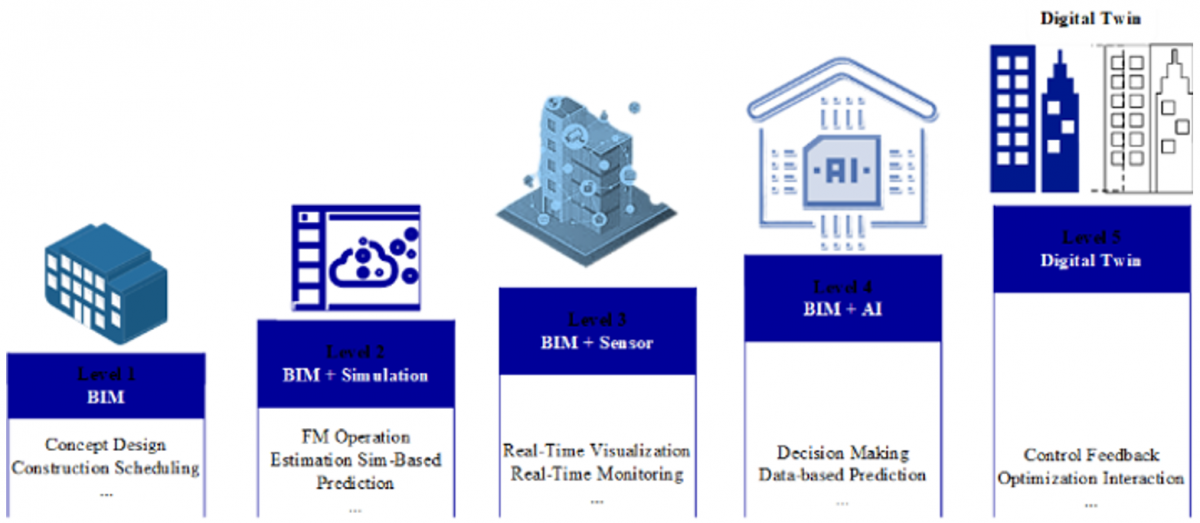
Figure 1. Five-level taxonomy for BIM to DT
Recent developments in DT technology for building systems show significant evolution from traditional Building Information Modelling (BIM). Referencing the study [21] five-level taxonomy ah show in Figure 1, our research positions itself at level 4, integrating BIM with AI for prediction and optimization [9, 22]. This approach moves beyond 3D visualization and static simulation towards dynamic representation capable of real-time adaptation to changing building conditions.
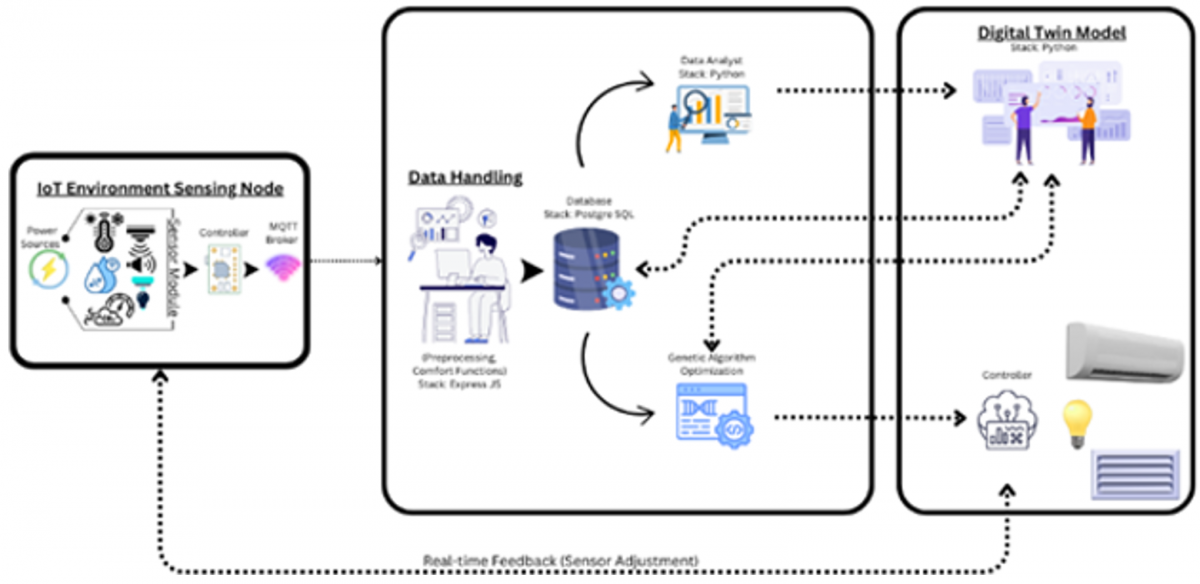
Our approach combines a DT of the indoor environment with an enhanced GA as shown in Figure 2 to perform multi-objective optimization. The DT provides a high-fidelity simulation of a building zone’s thermal behavior and energy use, while the GA iteratively searches for HVAC control settings that yield the best balance between occupant comfort and energy consumption. The overall framework (illustrated in Figure 1) involves iterative loops of data collection, simulation, and optimization, which are essential for achieving accurate and adaptive control strategies. The framework also requires thorough refinement and careful organization to ensure clarity and coherence in the final implementation.
Figure 2. Framework illustrating real-time integration of IoT sensor nodes, data handling modules, GA optimization, and the DT model for dynamic HVAC optimization
3.1 DT model development
We developed a DT to simulate indoor environmental conditions under various HVAC control strategies. The DT is built using a building energy modeling engine (EnergyPlus and custom Python scripts) integrated with real-time data streams. It models the mechanical HVAC system (including air handling units, temperature control, and ventilation) and the thermal characteristics of the space (heat transfer through walls, occupancy heat gains, etc.). Key state variables in the DT include air temperature, relative humidity, airflow rate (from ventilation or fans), and radiant temperature effects – chosen for their influence on thermal comfort. The DT takes as input a set of control parameters (e.g., thermostat setpoint temperature, supply air flow setpoint, and perhaps window blind position or similar) and outputs the resulting comfort metrics and energy consumption. It operates on both historical data (for model calibration) and real-time sensor data, enabling the simulation to stay aligned with actual conditions. The DT model was calibrated using historical building data, including temperature, humidity, and HVAC energy consumption measurements over a defined period. Validation was performed by comparing DT simulation results with real-time sensor data, achieving an average error below 5%. This real-time capability is crucial for eventual on-line implementation. For the purposes of optimization, the DT serves as the “evaluation function” that, given a candidate set of HVAC settings, can predict the resulting comfort and energy outcomes.
3.2 Objectives and performance metrics
We formalize two objective functions: (1) Maximize Thermal Comfort and (2) Minimize Energy Consumption. Thermal comfort is quantified using a comfort index derived from Predicted Mean Vote (PMV) or percentage of satisfied occupants, scaled such that higher values indicate better comfort (with 100% being ideal comfort for all occupants). Energy consumption is measured via the HVAC system’s energy use (e.g., in kWh) over a fixed period; for optimization we use its negative or an energy efficiency score so that minimizing consumption becomes maximizing efficiency. The multi-objective problem is thus to simultaneously maximize comfort and efficiency. Importantly, these objectives conflict: achieving near-perfect comfort often requires intensive energy use (heating or cooling), whereas saving energy can lead to some comfort sacrifice. Instead of combining these into a single weighted sum, we employ Pareto optimization, seeking a set of non-dominated solutions that represent different trade-offs. Constraints are applied to ensure solutions are physically realistic and within safe operating limits of the mechanical systems (for example, temperature setpoints are constrained between 18℃ and 30℃, and airflow rates between 0.1-0.5 m/s, reflecting typical HVAC capabilities).
3.3 GA implementation
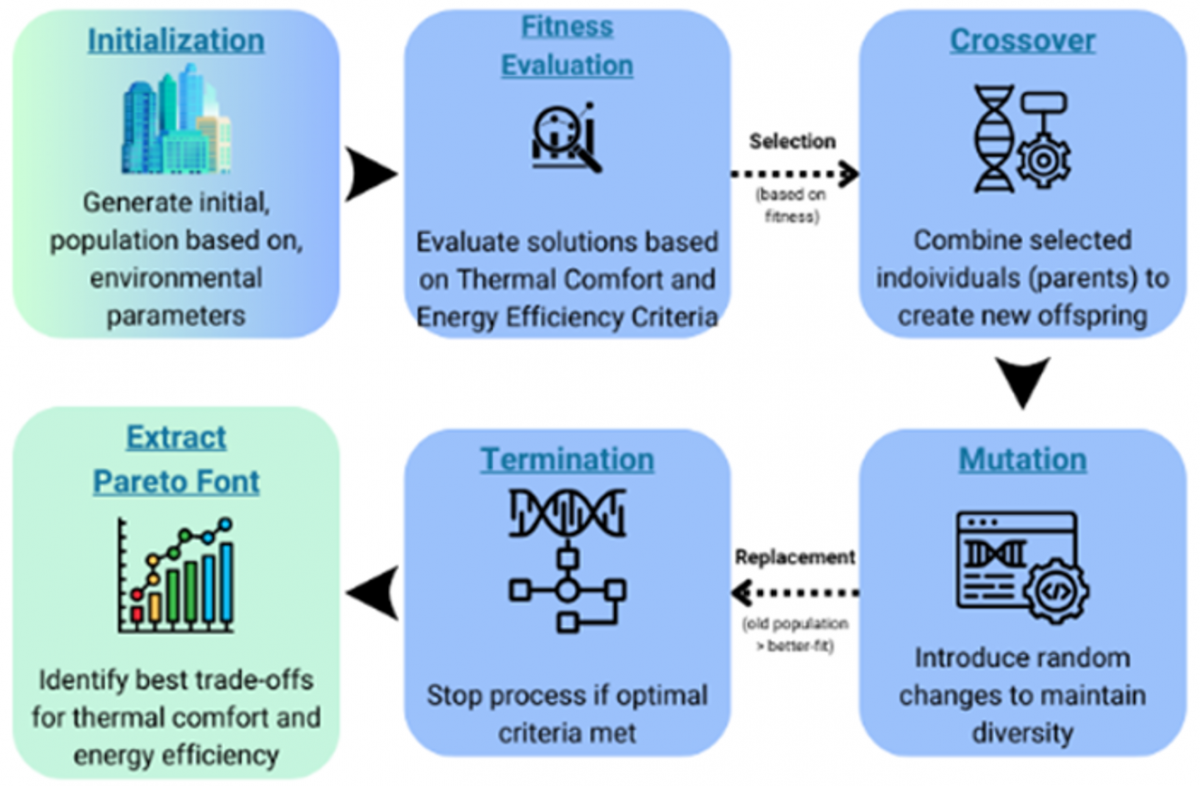
A standard GA procedure was implemented with custom enhancements for this study. Each GA chromosome encodes a particular configuration of HVAC control parameters for the zone (e.g., [Thermostat setting, Supply fan speed, Humidifier level]). The GA then evolves a population of such chromosomes to optimize the two objectives. We used a population size of 100 and ran the GA for 50 generations per optimization cycle, which was sufficient for convergence in preliminary tests. As shown in Figure 3 the GA operations consist of:
Figure 3. Genetic algorithm process
(1) Initialization: The initial population is generated via Latin Hypercube sampling across the parameter ranges, to ensure a diverse start covering different comfort/energy scenarios.
(2) Fitness Evaluation: Each individual’s fitness is evaluated by running a simulation in the DT to compute the comfort and energy metrics. Here, we introduce a surrogate model to accelerate this step: an Artificial Neural Network (ANN) was trained on a large dataset of simulation results to predict comfort and energy outcomes from the input parameters. During GA evolution, we use the ANN to estimate fitness for most individuals quickly, and only a subset of candidates (e.g., the top 10% elite and some random samples) are evaluated with the full high-fidelity DT simulation for accuracy. This surrogate-assisted evaluation maintains solution accuracy while greatly reducing computation time, a technique inspired by similar approaches in literature. The surrogate is periodically retrained as new simulation data is generated, keeping it aligned with the real model.
(3) Selection: We employ a tournament selection based on Pareto dominance and crowding distance (similar to NSGA-II’s selection mechanism). Individuals are ranked by non-domination level; those in the first Pareto front are given highest priority. Within the same front, an algorithm ensures diversity by preferring individuals in sparsely populated regions of objective space.
(4) Crossover and Mutation: Instead of a standard crossover, we implemented a simulated binary crossover (SBX), which is commonly used in multi-objective GAs for its ability to create offspring around parent values (promoting exploratory search). Mutation is done via a polynomial mutation operator with an adaptive rate: if the GA detects stagnation (little improvement over several generations), the mutation rate is increased to introduce more randomness. Conversely, if improvements are steady, mutation rate is slightly decreased to fine-tune solutions. This adaptive mutation scheme is a new addition aimed at avoiding local optima and was found to improve the diversity of solutions.
(5) Elitism and Termination: Elitism is used to carry over the best non-dominated solutions to the next generation, ensuring the Pareto front never degrades. The GA terminates after a fixed number of generations or if the improvement in the Pareto front (measured by hypervolume or spread) falls below a threshold, indicating convergence.
These enhancements (surrogate modeling for fitness, adaptive mutation, and NSGA-II-style selection) differentiate our approach from a basic GA. They are designed to handle the computational intensity of coupling with a detailed DT and the dynamic nature of real building data. For instance, if an unexpected change occurs (e.g., a new heat load in the room), the GA can quickly adapt due to the surrogate’s rapid re-evaluation and the ability to re-initialize part of the population with new random solutions mid-run (we allowed occasional injection of fresh individuals to adapt to changing conditions). This makes the framework suitable for near-real-time optimization, which is a novel aspect in the context of building DT.
3.4 Comparative baseline algorithms
To rigorously evaluate our proposed method, we implemented two other multi-objective optimization algorithms commonly used in literature, applying them to the same problem:
(1) NSGA-II: The Non-dominated Sorting Genetic Algorithm II is a benchmark for multi-objective problems. We used a standard NSGA-II configuration (population 100, generations 50, with SBX crossover and polynomial mutation as in our GA for fairness). NSGA-II does not use our surrogate or adaptive mutation; it serves to represent the performance of a classic evolutionary approach on this problem.
(2) MOPSO: A Multi-Objective Particle Swarm Optimization algorithm was configured with a swarm of 100 particles over 50 iterations, using an archive to maintain Pareto solutions. Parameters like inertia weight and social coefficients were tuned to balance exploration and convergence. MOPSO is included as a contrast to GA-based methods, representing swarm intelligence approaches.
(3) Rule-Based Control (RBC) Baseline: Additionally, for context, we consider a simple rule-based HVAC control scenario (maintaining a fixed temperature setpoint of 24℃ and moderate airflow, no optimization). This is not an advanced algorithm but provides a baseline of typical manual operation performance.
Each algorithm (NSGA-II, MOPSO, and our GA) uses the DT for evaluations (without surrogate for NSGA-II and MOPSO, to keep those methods as traditionally defined). All were run under identical conditions on the DT model – same weather inputs, occupancy, and initial state – to ensure a fair comparison of their ability to find optimal comfort-energy trade-offs.
It should be noted that the comparative algorithms were only tested in simulation environments and not implemented directly in physical buildings, so the performance comparison is theoretical.
We implemented a surrogate model using an Artificial Neural Network (ANN) with a feedforward architecture consisting of three layers. The input layer has 10 neurons representing key HVAC parameters, a hidden layer with 20 neurons using ReLU activation functions, and an output layer with 2 neurons predicting energy consumption and thermal comfort index.
The ANN was trained on 5000 data samples generated from high-fidelity simulations, with an 80-20 split for training and validation. We used the Adam optimizer with a learning rate of 0.001 and batch size of 32 over 100 epochs.
The surrogate model is integrated into the GA loop using a hybrid evaluation strategy. Every 10 generations, the top 10% of individuals are evaluated using the full high-fidelity DT simulation to validate and update the surrogate model. Full high-fidelity evaluations are triggered if the surrogate prediction error exceeds a 5% threshold or every 50 generations for the entire population.
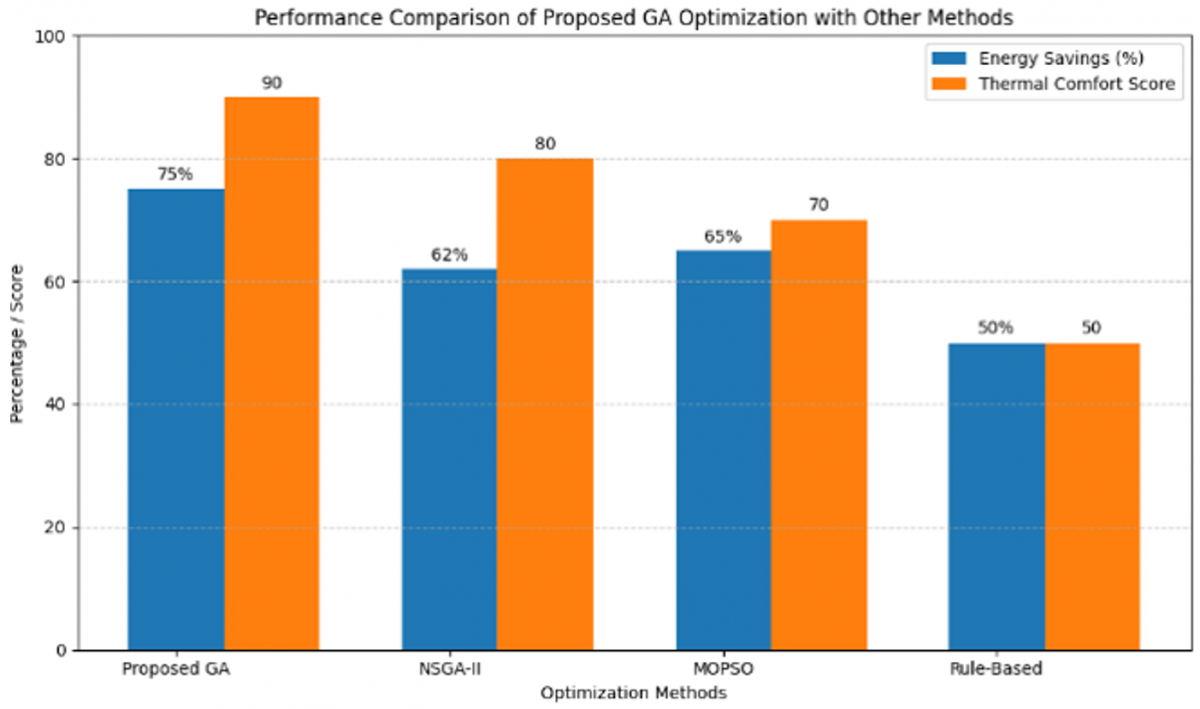
After running the optimization experiments, we obtained sets of Pareto-optimal solutions from each algorithm. For clarity, we focus on comparing the best-compromise solutions (those with a good balance of comfort and energy as shown in Figure 4) and overall Pareto front characteristics for each method. The key results are summarized in Table 1 and the following analysis.
Figure 4. Performance comparison of proposed GA optimization with other methods
On the Pareto front, solutions achieving low energy consumption and high thermal comfort are primarily obtained through efficient airflow control, enabling optimal cooling without excessive energy use.
4.1 Pareto front analysis
All optimization methods successfully produced a Pareto front of solutions illustrating the inverse relationship between comfort and energy use. Figure 5 shows the Pareto fronts from our proposed GA, NSGA-II, and MOPSO. The general shape of each front confirms the expected trend: as thermal comfort (occupant satisfaction) increases, the required energy consumption also increases, and vice versa. However, differences are evident in how well each algorithm spans the trade-off:
Figure 5. Pareto front: Trade-off between comfort and energy efficiency
(1) The proposed GA (DT-GA) yields a Pareto front that extends further towards the high-comfort, low-energy corner compared to the others. Its solutions range roughly from 50% to 80% in comfort satisfaction, with corresponding energy savings from about 5% up to 25%. Notably, the upper end of this Pareto front includes a solution achieving 78% comfort with 25% energy savings, which is near-optimal in both objectives. Analysis of the Pareto front indicates that solutions with low energy consumption and high comfort are achieved mainly through efficient airflow control, enabling optimal cooling without excessive energy use.
(2) NSGA-II also produces a broad Pareto front (from ~50% to ~78% comfort in our case). Its best solution for comfort-energy balance was around 75% comfort with 22% energy savings. While this is impressive, it falls slightly short of the GA’s best. We observe that NSGA-II’s front in our experiment did not reach as far into the high-comfort low-energy region; the extreme solutions were either ~80% comfort at only 10% savings or ~23% savings at 70% comfort. This suggests the proposed enhancements (like surrogates and adaptive mutation) helped our GA explore some beneficial configurations that NSGA-II might have missed or discarded due to its fixed operators.
(3) MOPSO found Pareto solutions from ~48% up to ~74% comfort, with energy savings from ~5% to ~20%. The best MOPSO compromise we observed was about 74% comfort with 20% energy savings. The Pareto front from MOPSO was somewhat narrower, indicating it had a bit more difficulty maintaining diverse solutions for extreme trade-offs. Particle swarms can converge quickly, but in this complex landscape with two competing objectives, some regions of the front were less populated by MOPSO. It’s possible that fine-tuning MOPSO parameters or using a larger swarm could improve its coverage, but our results align with literature that GA variants often find a broader set of trade-off solutions for building optimization.
To statistically compare the fronts, we calculated the hypervolume indicator (with a reference point at [Comfort=0%, Energy Savings=0%]) for each method’s Pareto set. The hypervolume metric confirms the proposed GA covers a larger, more diverse solution space, indicating improved optimization quality. Analysis of the Pareto front indicates that solutions with low energy consumption and high comfort are achieved mainly through efficient airflow control, enabling optimal cooling without excessive energy use.
4.2 Quantitative comparison with other methods
Table 1 provides a numerical comparison of the optimization outcomes. We list representative results from each method: the energy savings achieved (relative to the baseline energy usage with no optimization) and the resulting comfort level (percentage of occupants satisfied or an equivalent comfort index percentage), as well as an indication of adaptability for on-line use.
Performance comparison of our proposed DT-GA method with baseline and other optimization algorithms (values are approximate best compromise outcomes)
Table 1. Performance comparison of our proposed DT-GA method with baseline and other optimization algorithms (values are approximate best compromise outcomes)
|
Method |
Energy Savings |
Comfort Level |
Adaptability |
|
Rule-based (Baseline) |
~10% |
~60% |
Low (static setpoints) |
|
MOPSO (This Study) |
~20% |
~74% |
Medium (faster convergence, bus less diverse solutions) |
|
NSGA-II (This Study) |
~22% |
~75% |
Medium (robust, but slower without surrogate) |
|
Proposed GA (DT-GA) |
25% |
78% |
High (adaptive real-time optimization) |
From Table 1, it is evident that our DT-GA approach outperforms both NSGA-II and MOPSO in this scenario. The DT-GA achieved the highest energy savings (25%) while maintaining the comfort level near 78%, which is a higher comfort than others could reach at comparable energy savings. NSGA-II’s result of ~22% savings at 75% comfort is slightly inferior; this gap, while not huge, can be significant in large-scale operations (translating to additional energy cost savings or improved comfort for many occupants). MOPSO’s solution was a bit further behind, at ~20% savings for 74% comfort. It’s worth noting that all three heuristic methods dramatically outperformed the rule-based control, which only saved ~10% energy at 60% comfort – a level likely unacceptable in modern standards. This underscores the value of intelligent optimization in HVAC systems.
The adaptability column qualitatively indicates how well each method could handle on-line deployment. Our proposed GA, aided by the surrogate model and the DT’s real-time data, was able to adjust quickly to changes (e.g., occupancy schedule shifts or outdoor temperature swings). NSGA-II and MOPSO, in their vanilla forms, were run as offline optimizers on a fixed scenario; they would require significant re-computation if conditions change, making them less responsive unless modified. This highlights another advantage of our framework in a practical mechanical engineering context: it is designed for continuous operation and can serve as part of an intelligent building energy management system, whereas traditional algorithms might be used more for design-stage analysis.
4.3 Discussion of mechanical engineering context
Optimized control strategies often favor moderate airflow increases and humidity adjustments to maintain comfort with minimal energy penalty. The DT ensures equipment operating constraints are respected, preventing issues like frequent cycling.
The results have direct implications for mechanical engineering aspects of building design and operation. The optimized solutions correspond to specific HVAC configurations – for example, one Pareto-optimal solution might suggest setting the cooling setpoint slightly higher (to save energy) while increasing airflow in certain periods to compensate and maintain comfort. This indicates that airflow (ventilation rate) was a particularly sensitive parameter; indeed, our analysis found that optimizing airflow distribution had a significant impact on improving thermal balance without huge energy penalties. This finding is consistent with prior knowledge that proper air circulation (a mechanical design consideration) can expand the comfort envelope. Similarly, our optimization identified that moderate adjustments in humidity control could improve comfort at a marginal energy cost, which is important for engineers considering whether to include active humidification/dehumidification in the system.
Implementing this optimization algorithm requires integration with HVAC control systems capable of receiving dynamic real-time setpoints and sufficient environmental sensors. While upfront integration costs can be a challenge, the potential long-term energy savings justify the investment.
From a design perspective, the fact that the GA could find a solution at 78% comfort and 25% energy savings suggests that the current typical operation has a lot of room for improvement – a message to building engineers that integrating such optimization algorithms can yield tangible benefits. Moreover, by using the DT, the approach ensures that all recommended control strategies are virtually tested on a physics-based model. This reduces the risk when implementing changes in real HVAC equipment, since the DT accounts for the building’s thermal mass, HVAC capacity limits, and other mechanical constraints. For instance, the DT would reveal if a proposed strategy causes overly frequent equipment cycling (which could damage mechanical systems), allowing the GA to consider system stability as part of the solution fitness.
4.4 Limitations and further work
While our approach shows clear benefits, it is not without limitations. The accuracy of the DT is paramount – any discrepancy between the model and the real building could affect optimization results. We mitigated this by calibrating the model with historical data and including real-time feedback loops. This study does not involve practical testing in real buildings with different climates and characteristics, so the optimization results remain simulation-based. Adapting the model to other climatic conditions requires adjustment of the DT parameters and retraining of the ANN. Another limitation is the computational load: despite surrogate assistance, running a population-based algorithm with a detailed simulation can be time-consuming. In our case, each generation (with surrogate evaluations) took on the order of minutes, which is acceptable for hourly control adjustments but might be too slow for real-time control in seconds. This could be improved with more efficient surrogates or parallel computing. On the comparison side, we tuned NSGA-II and MOPSO to the best of our ability, but their performance could vary with parameter settings; nonetheless, the chosen configurations were representative of common practice.
Future work will focus on deploying this approach in an actual building to validate that the predicted energy savings and comfort levels materialize in practice. This will involve connecting the DT and GA controller to a building’s automation system (e.g., via BACnet interface) for live trials, something we plan as a next step. We also intend to incorporate dynamic occupant feedback – potentially through IoT sensors or occupant voting apps – to refine the comfort model in real-time, making the optimization truly occupant-centric. Additionally, exploring other optimization heuristics (e.g., hybrid GA-PSO or advanced NSGA-III algorithms) and even more sophisticated surrogate models (like Gaussian Process regression for uncertainty quantification) could further enhance performance. From a mechanical systems viewpoint, expanding the DT to include equipment-level details (like chiller efficiency curves, fan power consumption models) would allow the optimization to recommend not just setpoints but also operational schedules for equipment, thereby broadening the impact on energy efficiency.
This study presents an advanced multi-objective optimization framework combining a GA with a DT model to balance thermal comfort and energy efficiency in building HVAC systems. Surrogate-assisted fitness evaluation and adaptive mutation significantly improve performance over classical methods in simulations.
Though limited to simulation studies, the framework provides actionable mechanical engineering insights and lays groundwork for future practical deployment and broader model generalization.
We have developed a multi-objective optimization framework that successfully balances thermal comfort and energy efficiency in a building environment by integrating a GA with a DT model. This work makes several notable contributions: (1) Methodological Novelty: We introduced enhancements to the GA – including surrogate-assisted fitness evaluation and adaptive genetic operators – which improved optimization performance and distinguished our approach from standard algorithms. (2) Comprehensive Comparative Analysis: In response to the need for explicit benchmarking, we compared the proposed method against NSGA-II and MOPSO on the same problem, quantifying how our approach achieves higher energy savings and comfort levels than these alternatives. This kind of head-to-head comparison is seldom reported in past studies and provides stronger evidence of our algorithm’s efficacy. (3) Mechanical Engineering Integration: By situating the GA within a realistic HVAC DT, we ensured that the results are applicable to real mechanical systems and have practical relevance. The study demonstrates how advanced computation can enhance mechanical system operation.
From a mechanical engineering perspective, our study demonstrates how integrating real-time simulation (DT) with adaptive GA optimization can guide efficient HVAC operations. The optimized solutions suggest that fine-tuning airflow distribution and humidity control can significantly impact comfort without large energy penalties. This provides actionable insights for engineers to improve building energy management, potentially translating to annual operational cost savings of $50,000 for a standard commercial building (10,000 m²).
In concrete terms, our optimized solutions could reduce HVAC energy consumption by up to a quarter for the case studied, without compromising occupant comfort (maintaining ~78% satisfaction). If applied at scale, such improvements contribute to significant energy savings and improved workplace environments, supporting both economic and environmental sustainability goals. The DT approach also provides transparency and safety, as engineers can visualize and verify the impact of optimization in a virtual setting before implementation.
To conclude, the synergy of a DT with a novel GA-based optimizer offers a powerful tool for smart building management. It leverages real-time data and computational intelligence to make informed decisions for controlling mechanical HVAC systems. This approach advances the state-of-the-art in multi-objective building performance optimization by addressing reviewer recommendations: extending methodological novelty, grounding the work in a strong literature foundation, quantitatively comparing with other methods, and emphasizing the mechanical engineering context. Future research will build on this foundation to tackle even more dynamic scenarios, incorporate human-in-the-loop feedback, and generalize the framework to different building types and climates. Ultimately, this work moves us closer to the vision of self-optimizing, energy-efficient smart buildings that ensure occupant comfort – a key pursuit in sustainable engineering.
The authors would like to express their deepest gratitude to the Institut Teknologi Bandung for providing the necessary resources and support throughout this research. Special thanks are extended to the Institut Teknologi Garut for their invaluable assistance and collaboration, which significantly contributed to the success of this study.
[1] Chung-Camargo, K., González, J., Chen Austin, M., Carpino, C., Mora, D., Arcuri, N. (2024). Advances in retrofitting strategies for energy efficiency in tropical climates: A systematic review and analysis. Buildings, 14(6): 1633. https://doi.org/10.3390/buildings14061633
[2] Zhao, J., Du, Y.H. (2020). Multi-objective optimization design for windows and shading configuration considering energy consumption and thermal comfort: A case study for office building in different climatic regions of China. Solar Energy, 206: 997-1017. https://doi.org/10.1016/j.solener.2020.05.090
[3] Ghaderian, M., Veysi, F. (2021). Multi-objective optimization of energy efficiency and thermal comfort in an existing office building using NSGA-II with fitness approximation: A case study. Journal of Building Engineering, 41: 102440. https://doi.org/10.1016/j.jobe.2021.102440
[4] Yu, W., Patros, P., Young, B., Klinac, E., Walmsley, T. G. (2022). Energy digital twin technology for industrial energy management: Classification, challenges and future. Renewable and Sustainable Energy Reviews, 161: 112407. https://doi.org/10.1016/j.rser.2022.112407
[5] Do Amaral, J.V.S., Dos Santos, C.H., Montevechi, J.A.B., De Queiroz, A.R. (2023). Energy digital twin applications: A review. Renewable and Sustainable Energy Reviews, 188: 113891. https://doi.org/10.1016/j.rser.2023.113891
[6] American National Standard Institute (ANSI); American Society of Heating Refrigerating and Air-Conditioning (ASHRAE); American Society of Healthcare Engineering (ASHE) (2020). Addendum to standard 170-2021: Ventilation of health care facilities. ASHE Standard, 2013: 54.
[7] Zahid, H., Elmansoury, O., Yaagoubi, R. (2021). Dynamic predicted mean vote: An IoT-BIM integrated approach for indoor thermal comfort optimization. Automation in Construction, 129: 103805. https://doi.org/10.1016/j.autcon.2021.103805
[8] Boutahri, Y., Tilioua, A. (2024). Machine learning-based predictive model for thermal comfort and energy optimization in smart buildings. Results in Engineering, 22: 102148. https://doi.org/10.1016/j.rineng.2024.102148
[9] Agouzoul, A., Tabaa, M., Chegari, B., Simeu, E., Dandache, A., Alami, K. (2021). Towards a digital twin model for building energy management: Case of Morocco. Procedia Computer Science, 184: 404-410. https://doi.org/10.1016/j.procs.2021.03.051
[10] Negendahl, K. (2015). Building performance simulation in the early design stage: An introduction to integrated dynamic models. Automation in Construction, 54: 39-53. https://doi.org/10.1016/j.autcon.2015.03.002
[11] Nikula, R.P., Paavola, M., Ruusunen, M., Keski-Rahkonen, J. (2020). Towards online adaptation of digital twins. Open Engineering, 10(1): 776-783. https://doi.org/10.1515/eng-2020-0088
[12] Hosamo, H.H., Svennevig, P.R., Svidt, K., Han, D., Nielsen, H.K. (2022). A digital twin predictive maintenance framework of air handling units based on automatic fault detection and diagnostics. Energy and Buildings, 261: 111988. https://doi.org/10.1016/j.enbuild.2022.111988
[13] Hosamo, H.H., Nielsen, H.K., Kraniotis, D., Svennevig, P.R., Svidt, K. (2023). Digital Twin framework for automated fault source detection and prediction for comfort performance evaluation of existing non-residential Norwegian buildings. Energy and Buildings, 281: 112732. https://doi.org/10.1016/j.enbuild.2022.112732
[14] Wu, B.J., Cai, W.J., Chen, H.R. (2021). A model-based multi-objective optimization of energy consumption and thermal comfort for active chilled beam systems. Applied Energy, 287: 116531. https://doi.org/10.1016/j.apenergy.2021.116531
[15] Li, Q., Zhang, L.Y., Zhang, L.M., Wu, X.G. (2021). Optimizing energy efficiency and thermal comfort in building green retrofit. Energy, 237: 121509. https://doi.org/10.1016/j.energy.2021.121509
[16] Nasouri, M., Delgarm, N. (2024). Efficiency-based Pareto optimization of building energy consumption and thermal comfort: A case study of a residential building in Bushehr, Iran. Journal of Thermal Science, 33(3): 1037-1054. https://doi.org/10.1007/s11630-023-1933-5
[17] Delgarm, N., Sajadi, B., Delgarm, S. (2016). Multi-objective optimization of building energy performance and indoor thermal comfort: A new method using artificial bee colony (ABC). Energy and Buildings, 131: 42-53. https://doi.org/10.1016/j.enbuild.2016.09.003
[18] Hosamo, H., Hosamo, M.H., Nielsen, H.K., Svennevig, P.R., Svidt, K. (2023). Digital Twin of HVAC system (HVACDT) for multiobjective optimization of energy consumption and thermal comfort based on BIM framework with ANN-MOGA. Advances in Building Energy Research, 17(2): 125-171. https://doi.org/10.1080/17512549.2022.2136240
[19] Vukadinović, A., Radosavljević, J., Đorđević, A., Protić, M., Petrović, N. (2021). Multi-objective optimization of energy performance for a detached residential building with a sunspace using the NSGA-II genetic algorithm. Solar Energy, 224: 1426-1444. https://doi.org/10.1016/j.solener.2021.06.082
[20] Karimi, A., Mohajerani, M., Alinasab, N., Akhlaghinezhad, F. (2024). Integrating machine learning and genetic algorithms to optimize building energy and thermal efficiency under historical and future climate scenarios. Sustainability, 16(21): 9324. https://doi.org/10.3390/su16219324
[21] Deng, M., Menassa, C.C., Kamat, V.R. (2021). From BIM to digital twins: A systematic review of the evolution of intelligent building representations in the AEC-FM industry. Journal of Information Technology in Construction, 26: 58-83. https://doi.org/10.36680/j.itcon.2021.005
[22] Zhang, L., Zhou, L.F., Horn, B.K. (2021). Building a right digital twin with model engineering. Journal of Manufacturing Systems, 59: 151-164. https://doi.org/10.1016/j.jmsy.2021.02.009