Prasanna Sutar | Ravi Sekhar* | Sukrut Thipse | Sandeep Rairikar | Shailesh Sonawane | Debjyoti Bandyopadhyay
© 2025 The authors. This article is published by IIETA and is licensed under the CC BY 4.0 license (http://creativecommons.org/licenses/by/4.0/).
OPEN ACCESS
This study investigates the effect of hydrogen enrichment on combustion stability in a CNG-fueled multi-cylinder spark-ignition engine. Hydrogen was blended into CNG at 0%, 18%, 25%, and 30% by volume, and the blends were tested under constant-speed, full-load conditions. Combustion stability was assessed using the coefficient of variation (CoV) of peak cylinder pressure (Pmax), mass burn fraction at 50% (MBF50), and heat release rate (HRR). A correlation matrix analysis was employed to examine interrelationships between these stability parameters. Results indicated that the 18% HCNG blend provided the best overall improvement, achieving the lowest CoV values for MBF50 and HRR, and significantly reducing CoV_Pmax compared to pure CNG. Increasing hydrogen content to 25% maintained stability but introduced minor irregularities, while 30% hydrogen further improved Pmax consistency yet adversely impacted MBF50 and HRR stability. Correlation analysis highlighted a strong positive relationship between MBF50 and HRR stability, emphasizing the critical role of combustion phasing control. The study concludes that hydrogen enrichment in the range of 18–25% optimally enhances combustion stability without inducing combustion irregularities. These findings offer valuable insights for optimizing HCNG blends to achieve cleaner and more efficient future engine designs.
Coefficient of Variation (CoV), combustion stability, cycle-to-cycle variations, HCNG blends, Heat Release Rate (HRR), in-cylinder pressure analysis, Mass Burn Fraction (MBF50)
1.1 Need for cleaner fuels and the rise of HCNG
The increasing issues related to environmental pollution, the depletion of fossil fuel resources, and global climate change has accelerated the search for alternative, cleaner fuels that could be suitable for automotive applications [1-3]. The increase in greenhouse gas emissions and decline of urban air quality from the combustion of fossil fuels like gasoline and diesel [4, 5]. The transportation sector accounts for nearly 24% of global CO₂ emissions, thus indicating the need for decarbonization [6].
Natural gas, primarily composed of methane, provides a promising alternative as it has a lower carbon-to-hydrogen ratio than petroleum-based fuels [7]. Compressed natural gas (CNG) vehicles have decreased particulate matter and NOₓ emissions; however, the fundamental challenges of CNG, such as lower flame speed and limited flammability, can limit combustion efficiency in the lean-burn conditions [8-10].
Hydrogen-enriched compressed natural gas (HCNG) has emerged as a significant transitional fuel on the path towards a hydrogen economy. HCNG fuel blends provide the best aspects of compressed natural gas (CNG) while addressing the disadvantages of CNG with the combustion properties of hydrogen. These combustion properties include superior laminar flame speed, broader flammability limits and cleaner-burning combustion products [11-14]. HCNG can be utilized with relatively little modification to existing CNG engine platforms, allowing some ease and lower cost for the transition [15].
Recent advancements in technology and experimental studies suggest that HCNG fueling improves engine thermal efficiency, lowers engine-out emissions and enhances lean combustion stability, a viable transitional option for sustainable transportation solutions today and in the future [16-18].
1.2 Potential benefits of HCNG blends in engines
In essence, the incorporation of hydrogen vapour into CNG greatly alters the kinetics of combustion. The introduction of hydrogen only accelerates the laminar flame speed, thereby shortening the length of the combustion process and encouraging faster energy release [7, 12]. This increases the overall efficiency of engines when they operate lean-burn where CNG experiences challenges due to potential flame quenching.
In addition, hydrogen offers a wider flammability range that permits engines to operate at ultra-lean equivalence ratios that significantly lower combustion temperatures and consequently reduces NOₓ production [13, 19]. Experimental studies showed that hydrogen incorporation leads to a meaningful decrease in cycle-to-cycle variations (CCVs), improved ignition stability, and decreased misfire rates when operating in lean conditions [20, 21].
It's crucial to optimize the hydrogen fraction. While moderate hydrogen enrichment (18–25% by volume) provides significant advantages, excessive hydrogen levels (greater than 30%) can lead to combustion instabilities, including pre-ignition, backfire, and increased thermal loading [7, 22].
Therefore, a systematic evaluation of HCNG blends, with a specific focus on combustion stability metrics such as the Coefficient of Variation (CoV) of key combustion parameters, is crucial for determining the optimal blending strategy.
1.3 Comparative fuel properties of diesel, CNG, and HCNG
A comparative evaluation of fuel properties between diesel, CNG, and 30HCNG (30% H₂ by volume) is presented in
Table 1 highlighting the significant influence of hydrogen enrichment on combustion behaviour.
Table 1. Comparative fuel properties of diesel, CNG, and 30HCNG [7, 8, 10-13, 22]
|
Property |
Diesel |
CNG |
HCNG (30% H₂) |
|
Lower Heating Value (MJ/kg) |
42–45 |
47–50 |
~41– 42 |
|
Flame Speed (cm/s) |
~40 |
~45–50 |
~90–120 |
|
Auto-ignition Temperature (℃) |
210 |
540 |
590 |
|
Stoichiometric Air-Fuel Ratio |
14.5:1 |
17.2:1 |
21.5:1 |
|
Flammability Limits (vol%) |
0.6–5.5 |
5–15 |
4–63 |
|
CO₂ Emissions (g/MJ) |
High |
Medium |
Lower than CNG |
|
NOₓ Emissions |
High |
Medium |
Higher at stoichiometric conditions (due to elevated temperatures) |
|
Storage Method |
Liquid |
Compressed Gas (200–250 bar) |
Compressed Gas (200–250 bar) |
The analysis exemplifies that HCNG offered a distinct beneficial combustion advantages including a greater flame speed, larger flammability limits, and lower CO2 emissions; and provided a compelling alternative for engine operation, more environmentally beneficial and efficient than CNG. The key will be the optimization of the hydrogen content to maximize those benefits without endangering engine longevity and safety.
2.1 Hydrogen-Enriched Compressed Natural Gas (HCNG) as a transitional fuel
Hydrogen-enriched compressed natural gas (HCNG) has been well documented as a possible transitional fuel for the clean mobility solutions. HCNG offers a synergistic opportunity with the existing CNG infrastructure, while also improving the combustion characteristics. This improvement is attributed to the high diffusivity, low ignition energy, and elevated flame speed of hydrogen [5, 23, 24].
Verhelst and Wallner conducted a thorough review of hydrogen-fueled engines. They concluded that adding hydrogen reduces ignition delay, promotes earlier growth of the flame kernel, and accelerates the combustion process [11]. Zareei et al. [12] reported that the addition of hydrogen into CNG significantly improved thermal efficiency and reduced carbon monoxide emissions under lean operating conditions. Moreover, the use of HCNG significantly lowers carbon dioxide emissions, which is a crucial benefit in light of global decarbonization goals [17, 25].
The flexibility to retrofit existing CNG engines with minimal modifications further enhances the feasibility of HCNG adoption [14]. However, the optimal hydrogen fraction must be carefully selected to balance the gains in combustion efficiency with the risks associated with pre-ignition and NOₓ formation [7].
2.2 Combustion characteristics of CNG and HCNG blends
CNG combustion provides the advantage of lower carbon-to-hydrogen ratios, resulting in reduced CO₂ emissions when compared to diesel and gasoline engines. However, CNG combustion also experiences lower flame speeds and higher ignition energy requirements, which contributes to increased cycle-to-cycle variations (CCVs) [8].
Hydrogen addition addresses these shortcomings. Banapurmath et al. [13] conducted experiments that revealed a hydrogen volume fraction of 20-30% in CNG significantly enhances peak pressure, improves brake thermal efficiency, and shortens combustion duration. Similarly, Ma et al. [22] demonstrated that hydrogen-enriched compressed natural gas (HCNG) blends lead to faster combustion and reduce combustion duration by 15-20% compared to standard CNG.
Papagiannakis and Hountalas conducted a comparison of dual-fuel operations using diesel and CNG, emphasizing the enhanced lean combustion capability of CNG, particularly when supplemented with hydrogen [8]. Furthermore, research by Oh et al. [26] demonstrated that HCNG blends facilitate stable engine operation at ultra-lean air-fuel ratios, a level of stability that conventional CNG cannot consistently achieve.
However, the challenges include managing the significant rise in combustion temperature and NOₓ emissions with increased hydrogen fractions [20, 27].
2.3 Impact of hydrogen fraction on engine performance and emissions
The relationship between hydrogen concentration and engine performance is complex and non-linear. In their research, Zareei et al. [12] revealed that using low to moderate hydrogen concentrations—ranging from 18% to 25% by volume—can lead to substantial improvements in engine efficiency. Specifically, these hydrogen levels contribute to a marked increase in brake thermal efficiency, which measures how effectively the engine converts fuel into useful work. Additionally, they help minimize cycle-to-cycle variations, ensuring smoother and more consistent engine operation. Importantly, this optimization occurs without resulting in excessive nitrogen oxide (NOₓ) emissions, allowing for a balance between performance and environmental impact.
Karim indicated that hydrogen concentrations exceeding 30% may result in knocking and pre-ignition phenomena due to the low ignition energy associated with hydrogen [10]. Furthermore, Nitnaware and Suryawanshi [28] supported the assertion that a blend containing approximately 25% hydrogen represents the optimal compromise among combustion stability, efficiency improvements, and emissions control.
Recent studies by Duan et al. [19] also indicated that hydrogen enrichment not only stabilizes flame propagation but reduces CCVs substantially in lean-burn natural gas engines, supporting the potential of HCNG for modern SI engines.
2.4 Use of Coefficient of Variation (CoV) for combustion stability assessment
The Coefficient of Variation (CoV) of combustion parameters characterized a common metric, to characterize the stable combustion process [15, 29, 30]. The main parameters analyzed were peak cylinder pressure, which is sometimes reported as Pmax, the mass burn fraction at 50%, commonly referred to as MBF50%, and peak heat release rate (HRR). The use of CoV as a combustion stability metric has been well documented in engine research. CoV of peak pressure (CoV_Pmax), CoV of mass burn fraction (CoV_MBF50%), and CoV of heat release rate (CoV_HRR) are particularly sensitive to variations in fuel reactivity, air-fuel mixing, and ignition quality [17, 31].
Hora and Agarwal [16] applied CoV analysis to HCNG blends and discovered that the addition of hydrogen consistently reduced the CoV of Pmax and MBF50%, resulting in enhanced engine smoothness and reliability. Prasad and Agarwal adapted this methodology for HRR analysis, demonstrating that CoV_HRR is especially sensitive to blend instability and serves as an effective early diagnostic tool [17].
Research conducted by Heffel [32] and Oh et al. [26] has provided compelling evidence that hydrogen enrichment significantly enhances the uniformity of combustion. This process not only creates more consistent burning of the fuel-air mixture, but reduces misfires, to those situations where the engine is not able to ignite the fuel as designed. The presence of hydrogen reduces variability in performance between combustion cycles, even in ultra-lean mixtures, with high air-to-fuel ratios. This combination of benefits contributes to improved engine efficiency and reliability.
Hence, CoV analysis is a vital and reliable approach for evaluating HCNG blend optimization from a combustion stability standpoint.
3.1 Engine specifications and test facility
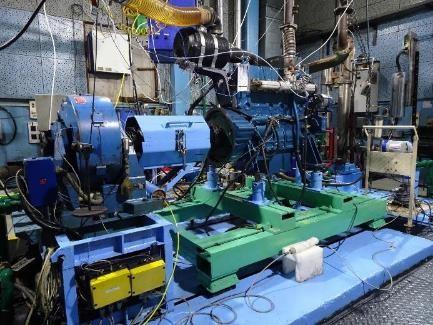
The experimental investigations were conducted on a six-cylinder, water-cooled, spark-ignition (SI) multi-cylinder engine designed for CNG fueling. The engine specifications are provided in Table 2. A full-load control eddy current dynamometer (SAJ AG 150) was used to apply load and maintain constant engine speed during testing. The actual experimental test setup is shown in Figure 1.
The use of a single-speed, full-load steady-state condition ensures that observed combustion variations are attributable primarily to changes in fuel properties rather than operating condition fluctuations, consistent with methodologies described by Heywood and Turns [7, 33].
Table 2. Engine specifications
|
No. of Cylinders |
06 - Inline |
|
Displacement |
6500 cm3 |
|
Aspiration |
Naturally Aspirated |
|
Compression Ratio |
17.5:1 |
|
Rated Power |
64 kW |
|
Rated Speed |
1500 RPM |
|
Fuel System |
CNG with electronic mixer |
|
Ignition System |
Electronic spark ignition |
The air-fuel ratio (AFR) was meticulously maintained in close proximity to stoichiometric levels ($\lambda \approx 1$) through the implementation of Bosch LSU 4.9 wideband oxygen sensors, ensuring precise real-time monitoring.
Figure 1. Test engine experimental setup
3.2 Instrumentation and Data Acquisition
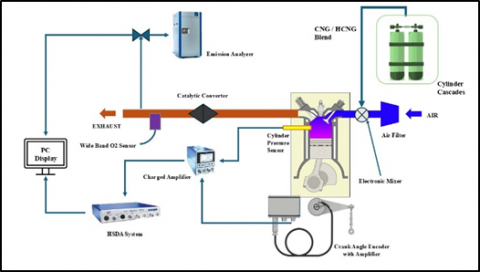
Accurate measurement of in-cylinder pressure is of paramount importance for the analysis of combustion processes. To enhance this process, a piezoelectric pressure transducer (AVL Sensor GH15D) was strategically installed in the cylinder head, ensuring precise alignment with the combustion chamber to effectively capture real-time data on cylinder pressure. The transducer's output was connected to a charge amplifier (AVL FI Piezo), which was then linked to a High-Speed Data Acquisition (HSDA) system capable of sampling at a resolution of 0.1° of crank angle. The experimental test setup is shown in Figure 2, and the instrument details are given in Table 3.
In addition to monitoring in-cylinder pressure, the crankshaft position was continuously tracked using an optical encoder to synchronize pressure measurements with engine cycle events. The recorded pressure data were processed to calculate:
Coefficient of Variation (CoV) of peak pressure (Pmax),
Mass Burn Fraction at 50% combustion (MBF50%),
Coefficient of Variation of Heat Release Rate (HRR).
To ensure statistical reliability, each experimental data point was calculated as the average of 300 consecutive engine cycles.
Figure 2. Experimental test setup with HSDA system for in-cylinder combustion analysis
Table 3. Details of instruments used
|
Equipment |
Make |
|
Engine Steady State Dynamometer |
SAJ, AG-150 |
|
Test Cell Automation System |
iASYS, ORBIT-e |
|
Conditioned Unit for Air Handling |
KS_ENG_IACU3000 |
|
Fuel Flow Meter |
Krohne-Marshall CFM 01 |
|
Air Flow Meter |
ABB Sensyflow, SFI-02 |
|
Combustion Data Measurement System |
AVL Indi Micro |
|
Emissions Analyzer |
AVL AMA i60-01 |
3.3 Test procedure
The engine was operated at a steady speed of 1500 rpm under full load for each fuel blend. To maintain consistency throughout the experiments, the spark timing was kept constant, thereby eliminating it as a potential source of variability. Furthermore, the cooling water temperature, air temperature, and pressure were carefully monitored and maintained within ± 2% of their target values. In this study, the spark timing was intentionally fixed across all test conditions to isolate the impact of hydrogen blending on combustion stability, specifically to analyze CoV-related metrics under controlled ignition conditions. This approach provides a consistent baseline for comparing the cyclic variability effects of different HCNG blends without the confounding influence of spark advance adjustments. However, the fixed ignition timing may not be optimal for hydrogen-enriched fuels. Due to hydrogen’s high flame speed and low ignition energy, higher HCNG blends tend to advance the combustion phasing (e.g., MBF50) relative to CNG at the same spark timing, potentially resulting in earlier peak pressures and increased knocking tendency [34, 35]. It is further reported that unoptimized spark timing can exaggerate or suppress the beneficial effects of hydrogen blending on thermal efficiency and emissions [36]. Therefore, while the fixed spark timing is methodologically justified for comparative CoV analysis, future studies should consider adaptive spark timing strategies to capture combustion behavior under optimal phasing conditions.
Prior to Data Acquisition, the engine was allowed to reach thermal steady-state conditions. For each blend, the following procedure was followed:
Stabilization of engine parameters for ~10 minutes,
Data collection for 300 continuous combustion cycles,
Post-processing and validation of recorded pressure data,
Calculation of combustion parameters and CoV metrics.
This approach ensured uniformity across all tested blends and minimized the influence of transient phenomena.
4.1 Overview
The primary objective of the experimental analysis was to evaluate the combustion stability of HCNG blends by conducting a statistical analysis of in-cylinder combustion data. The parameters chosen for stability assessment were:
Peak In-cylinder Pressure (Pmax),
Mass Burn Fraction at 50% (MBF50%),
Peak Heat Release Rate (HRR).
The Coefficient of Variation (CoV) for each parameter was calculated to quantify cycle-to-cycle variability. Lower CoV values indicate more consistent combustion and, hence, better fuel stability characteristics.
4.2 Data Acquisition and cycle selection
In-cylinder pressure data were recorded for 300 consecutive engine cycles for each HCNG blend under steady-state operating conditions. The crank angle resolution was maintained at 0.1°CA, enabling high-fidelity combustion event tracking. Data for each cycle was post-processed to extract:
Peak cylinder pressure,
Crank angle corresponding to MBF50%,
Peak HRR.
Outlier rejection criteria were applied: any cycle exhibiting a deviation greater than three standard deviations from the mean pressure curve was discarded to maintain data quality [37].
The in-cylinder combustion pressure data were recorded for 300 cycles to understand the cyclic variation in the combustion at the engine full load condition.
To ensure statistical robustness and account for inherent cycle-to-cycle fluctuations, each test condition was repeated across three independent trials, each comprising 300 consecutive engine cycles. The coefficients of variation (CoV) for Pmax, MBF50, and HRR were calculated individually for each trial and then averaged to obtain the final reported values. This approach minimized the influence of random variability, isolated systematic combustion trends, and confirmed the repeatability of observed results. The trial-wise CoV values showed minimal deviation, affirming that the measured combustion stability parameters were consistently reproducible across all HCNG blends. The CoV of Pmax for three repeated trials across different HCNG blends, showing excellent repeatability and low variability, is shown in Table 4. The close agreement across trials reinforces the reliability of the data and strengthens the conclusions drawn from the comparative analysis.
Table 4. CoV of Pmax for three repeated trials across different HCNG blends
|
Fuel Blend |
Trial 1 CoV (%) |
Trial 2 CoV (%) |
Trial 3 CoV (%) |
Avg. CoV (%) |
Std Dev CoV (%) |
|
CNG |
4.53 |
4.571 |
4.564 |
4.555 |
0.043 |
|
18HCNG |
4.019 |
3.986 |
4.014 |
4.006 |
0.048 |
|
25HCNG |
4.291 |
4.245 |
4.301 |
4.279 |
0.047 |
|
30HCNG |
3.614 |
3.665 |
3.595 |
3.625 |
0.044 |
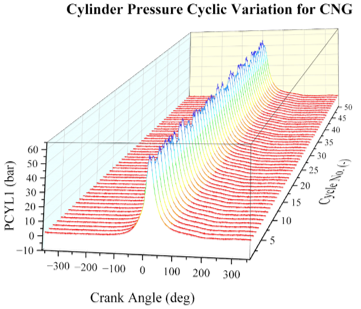
Figure 3. Cyclic variation of cylinder pressure for CNG
The sample data of the cyclic variation for 50 cycles for CNG fuel is shown in Figure 3. The dataset comprising 300 cycles is substantial, making it unsuitable for a graphical representation due to its complexity. Consequently, a sample of data from 50 cycles is presented for analysis. Notably, the CoV has been calculated using the complete dataset of 300 cycles.
From Figure 3, it can be seen that for the constant engine speed, load and spark timing, the peak firing pressures for CNG are fluctuating. This fluctuation for the maximum cylinder pressures (Pmax) is considered to calculate the CoV.
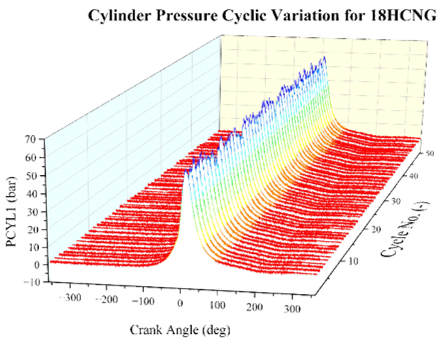
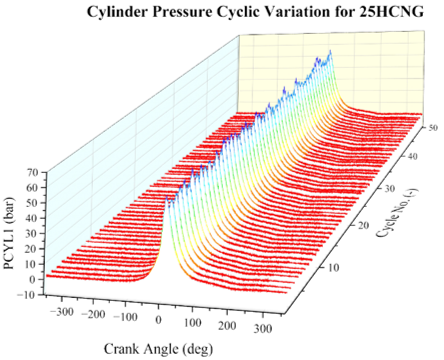
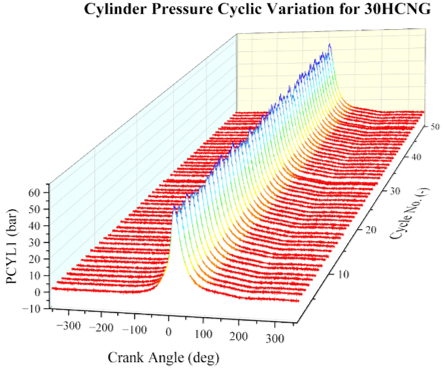
Similarly, the cyclic variation data for 18HCNG, 25HCNG and 30HCNG blends is shown in Figure 4, Figure 5, and Figure 6, respectively.
Figure 4. Cyclic variation of cylinder pressure for 18HCNG
Figure 5. Cyclic variation of cylinder pressure for 25HCNG
The graphical representation of the data does not allow us to accurately assess the magnitude of fluctuations in Pmax. Consequently, calculating the CoV of Pmax offers enhanced insights into the stability of the combustion process.
The average data of 300 cycles for all the fuel blends for combustion pressure is plotted and represented in Figure 7.
Figure 7 illustrates the variation of cylinder pressure with crank angle for pure CNG and HCNG blends containing 18%, 25%, and 30% hydrogen by volume. It is observed that during the compression stroke, all curves overlap, indicating a negligible impact of hydrogen enrichment on pre-ignition compression behaviour. However, post-ignition, HCNG blends exhibit a steeper pressure rise and higher peak cylinder pressures compared to CNG. Notably, the 30HCNG blend achieves the highest peak pressure, followed by 25HCNG and 18HCNG, demonstrating the influence of hydrogen on enhancing combustion rates. The pressure peaks occur slightly earlier for higher hydrogen blends, suggesting an advancement in combustion phasing. These results confirm that hydrogen addition promotes faster and more complete combustion, which can potentially improve thermal efficiency. However, to extract the maximum potential from HCNG blends necessitates optimization of ignition timing to prevent knock and manage peak pressure loads.
Figure 6. Cyclic variation of cylinder pressure for 30HCNG
Figure 7. Average combustion pressure curve of 300 cycles for CNG and HCNG blends
4.3 Calculation of Mass Burn Fraction (MBF50%)
The Mass Burn Fraction (MBF) at each crank angle position was calculated by integrating the Heat Release Rate (HRR) curve derived from the in-cylinder pressure traces using the first-law thermodynamic method, following the procedures described by Heywood and Turns [7, 33].
$H R R=\frac{\gamma}{\gamma-1} \cdot p \cdot \frac{d V}{d \theta}+\frac{1}{\gamma-1} \cdot V \cdot \frac{d p}{d \theta}$ (1)
where:
p = in-cylinder pressure,
V = instantaneous cylinder volume,
θ = crank angle,
γ = specific heat ratio, assumed constant as 1.34 based on typical combustion gas properties [38]
The MBF50% is the crank angle at which 50% of the total cumulative heat release has occurred in the cycle.
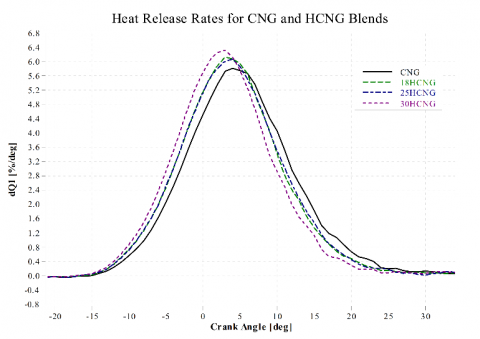
The instantaneous HRR (dQ1), which is calculated as explained in Eq. (2) above, is recorded for 300 cycles, and the average data is plotted against the engine crank angle (CA). The HRR for CNG and HCNG blends is shown in Figure 8. In this study, γ is treated as a constant (1.34) for simplification, which is a common practice in spark ignition engine studies, however, γ decreases with increasing in-cylinder temperature during combustion. While this assumption is acceptable for relative comparisons among HCNG blends, a temperature-dependent γ should be considered for absolute HRR calibration in future studies. The assumption of a constant γ = 1.34, although commonly used, can introduce non-negligible errors in HRR estimation. Literature confirms that a 4–5% deviation in γ may result in HRR variations of 10–15%, particularly during peak combustion phases [39, 40]. A temperature-dependent γ should be adopted for absolute combustion diagnostics.
The HRR curves for CNG and HCNG blends, shown in Figure 8, demonstrate significant trends with increasing hydrogen content. The baseline CNG fuel exhibited a relatively broad combustion profile, with the HRR peak occurring at approximately 5°CA after TDC. With hydrogen enrichment to 18% and 25% by volume, the HRR peaks advance closer to TDC and increase in magnitude, indicating faster flame propagation and enhanced combustion intensity. The 25% HCNG blend produced the highest and sharpest HRR peak, suggesting an optimal balance between combustion speed and stability.
Figure 8. Average Heat Release Rate (HRR) curves of 300 cycles for CNG and HCNG blends
As the hydrogen fraction increased, combustion duration reduced noticeably, resulting in a narrower HRR profile. This behavior is attributed to hydrogen's high diffusivity, low ignition energy, and high laminar flame speed, which promote rapid flame kernel development and quicker energy release. However, the 30% HCNG blend, while exhibiting an even earlier HRR peak, displayed minor irregularities in the post-peak decay region. This suggests the potential onset of combustion instabilities due to excessive reactivity and faster-than-optimal flame speeds.
Overall, hydrogen enrichment up to 25% significantly improves combustion phasing, reduces ignition delay, and enhances cycle-to-cycle consistency. Beyond this level, particularly at 30% HCNG, the advantages plateau and minor stability concerns emerge. These observations are consistent with earlier studies by Verhelst and Wallner, and Banpurmath et al., reinforcing the need for computing the CoV of HRR to find the optimal blend for achieving maximum combustion stability and efficiency in spark-ignition (SI) engines [11, 13].
4.4 Coefficient of Variation (CoV) computation
For each combustion parameter, CoV was calculated using:
$\operatorname{CoV}(\%)=\frac{\sigma}{\mu} \times 100$ (2)
where:
σ = standard deviation over 300 cycles,
μ = mean value over 300 cycles.
CoV analysis enables quantitative assessment of cyclic combustion stability, as previously validated in HCNG engine studies [15, 16, 34].
4.5 Comparative assessment and blend selection
The blends were ranked according to their average CoV values for three parameters: Pmax, MBF50%, and HRR. Blends that consistently exhibited low CoV values were deemed superior in terms of combustion stability, in line with the methodologies established by Hora and Agarwal and Verma et al. [16, 34].
5.1 Coefficient of variation of peak pressure (CoV_Pmax)
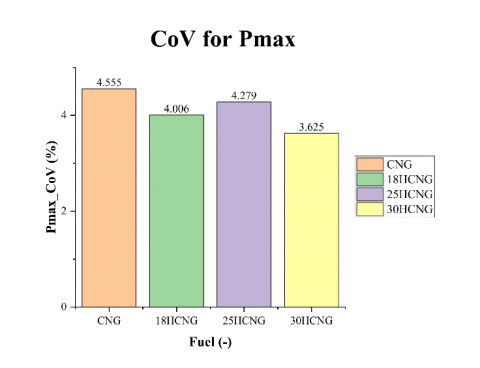
The CoV of the peak cylinder pressure (Pmax) for CNG and HCNG blends is presented in Figure 9. It is observed that the baseline CNG fuel exhibits the highest CoV_Pmax value of 4.555%, indicating greater cycle-to-cycle variability and lower combustion stability.
Upon enriching the fuel with 18% hydrogen (18HCNG), the CoV_Pmax value drops significantly to 4.006%. This improvement in combustion stability can be attributed to the enhanced flame propagation speed and improved mixture reactivity imparted by hydrogen. Hydrogen addition facilitates faster ignition kernel development and early flame growth, reducing the sensitivity of combustion to in-cylinder flow field variations and thus minimizing cyclic pressure fluctuations.
However, at 25% hydrogen enrichment (25HCNG), the CoV_Pmax value increases slightly to 4.279% compared to 18HCNG. This slight deterioration in stability is likely due to the onset of excessively fast combustion, leading to increased sensitivity to local mixture variations, turbulence, and potential flame front irregularities. Such behaviour has been previously reported by Verhelst and Wallner [11], who noted that beyond moderate hydrogen fractions, combustion may become prone to slight instabilities.
Interestingly, further enrichment to 30% hydrogen (30HCNG) results in the lowest CoV_Pmax value of 3.625% among all tested blends. The larger hydrogen fraction enhances flame stability even further, possibly due to improved combustion homogeneity and a more complete combustion process within a narrower crank angle window. The faster flame propagation at this hydrogen level reduces ignition delay, enhances thermal energy release uniformity, and consequently lowers cycle-to-cycle variations.
Figure 9. CoV calculation for peak cylinder pressure (Pmax)
In summary, moderate hydrogen addition (18–30%) effectively improves combustion stability in CNG engines by lowering CoV_Pmax values. However, the non-linear trend observed between 18% and 25% HCNG highlights the delicate balance between beneficial flame acceleration and potential onset of flame instabilities at intermediate hydrogen levels.
5.2 Coefficient of variation of mass burn fraction 50% (CoV_MBF50%)
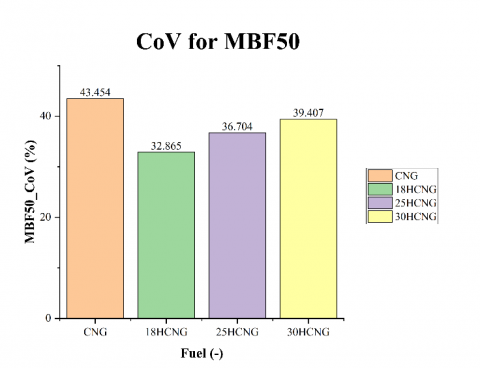
The CoV of the crank angle corresponding to 50% mass fraction burned (MBF50) for different HCNG blends is shown in Figure 10.
Figure 10. CoV calculation for Mass Burn Fraction 50% (MBF50%)
The baseline CNG fuel exhibited the highest CoV_MBF50 value of 43.454%, indicating substantial variability in combustion phasing across cycles.
The introduction of hydrogen at 18% by volume (18HCNG) significantly reduced the CoV_MBF50 to 32.865%, representing a notable improvement in combustion timing consistency. This behaviour is attributed to hydrogen's superior combustion characteristics, including faster flame initiation and higher diffusivity, which stabilize the location and timing of the main heat release phase. Enhanced combustion propagation reduces cycle-to-cycle fluctuations in MBF50 occurrence.
Upon increasing hydrogen enrichment to 25% (25HCNG), the CoV_MBF50 marginally increased to 36.704% compared to 18HCNG. This trend suggests that while hydrogen improves combustion speed, excessively fast flame fronts at higher hydrogen fractions can lead to slightly irregular flame propagation across cycles, introducing phasing variability. Such effects have been highlighted by Verhelst and Wallner [11], who observed that excessive flame acceleration could make combustion highly sensitive to local flow field disturbances.
Interestingly, at 30% hydrogen (30HCNG), the CoV_MBF50 increased further to 39.407%, nearing the instability levels of pure CNG combustion. This observation indicates that although hydrogen enhances burning speed, very high concentrations (≥30%) may introduce adverse effects, such as premature combustion initiation, localized hotspots, and unstable flame fronts, thereby deteriorating combustion phasing consistency.
In conclusion, the addition of hydrogen up to 18% significantly improves combustion phasing stability but further increases in hydrogen content can slightly deteriorate MBF50 stability due to combustion irregularities associated with ultra-fast flame propagation. Thus, pressing the need to optimize the spark timings and gas exchange process for higher Hydrogen blends in CNG.
5.3 Coefficient of Variation of Heat Release Rate (CoV_HRR)
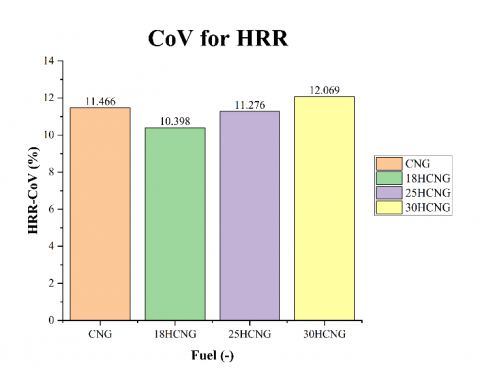
The coefficient of variation (CoV) of the maximum heat release rate (HRR) for CNG and HCNG blends is presented in Figure 11. The baseline CNG fuel shows a CoV_HRR value of 11.466%, indicating noticeable cycle-to-cycle variation in the peak combustion energy release.
The addition of hydrogen at 18% by volume (18HCNG) results in a reduction of CoV_HRR to 10.398%, highlighting an improvement in combustion consistency. This behavior is explained by hydrogen’s superior flame speed and diffusivity, which promote faster and more homogeneous energy release during combustion, thus reducing fluctuations in the peak HRR between cycles.
Figure 11. CoV calculation for Heat Release Rate (HRR)
When the hydrogen enrichment is increased to 25% (25HCNG), the CoV_HRR value rises slightly to 11.276%, marginally higher than the 18HCNG case but still lower than the baseline CNG. This slight increase can be attributed to the excessively rapid combustion at higher hydrogen fractions, leading to a heightened sensitivity of the combustion process to in-cylinder turbulence, air-fuel mixture heterogeneities, and local ignition delays.
At 30% hydrogen enrichment (30HCNG), the CoV_HRR further increases to 12.069%, exceeding even the baseline CNG value. This indicates that at very high hydrogen concentrations, the combustion becomes extremely fast but also more unstable. The ultra-high flame propagation rates can cause non-uniformity in the combustion event across cycles, resulting in increased variability in the peak heat release rate. Premature ignition phenomena and localized high-temperature regions at high hydrogen fractions further contribute to the observed instability, as previously reported in the literature by Verhelst and Wallner [11].
In conclusion, moderate hydrogen enrichment (up to 18%) improves the uniformity of the combustion energy release, as seen from the reduced CoV_HRR. However, combustion irregularities reappear beyond 18% hydrogen content, particularly at 30%, due to excessively fast and potentially unstable flame propagation dynamics. Table 5 presents a comprehensive comparison of the CoV values for Pmax, MBF50, and HRR across different fuel blends. The baseline CNG fuel exhibited the highest CoV values in all three combustion parameters, indicating significant cycle-to-cycle variability and lower combustion stability.
Hydrogen enrichment at 18% (18HCNG) resulted in the lowest CoV for MBF50 and HRR and a substantial reduction in CoV_Pmax, highlighting the optimal improvement in combustion stability. The 25% HCNG blend demonstrated intermediate stability, with slightly increased CoV values compared to 18HCNG, particularly for MBF50 and HRR. Notably, while the 30% HCNG blend achieved the lowest CoV_Pmax (3.625%), it exhibited a deterioration in CoV_MBF50 and CoV_HRR, suggesting potential instability associated with excessively rapid flame propagation.
These observations further solidify the argument that moderate hydrogen enrichment (18-25%) is optimal for stabilizing combustion without any undesirable flame front variability. Excessive amounts of hydrogen (≥30%) may increase sensitivity to in-cylinder turbulence, leading to localized pre-ignition events. Excessive hydrogen also potentially increases variability in combustion phasing and energy release.
Therefore, considering CoV analysis of Pmax, MBF50 and HRR, it can be recommended that a hydrogen enrichment level near 18-25% is the best possible number for stable combustion in CNG-fueled spark-ignition engines.
Table 5. Final CoV comparison for Pmax, MBF50, and HRR
|
Fuel Blend |
CoV_Pmax (%) |
CoV_MBF50 (%) |
CoV_HRR (%) |
|
CNG |
4.555 |
43.454 |
11.466 |
|
18HCNG |
4.006 |
32.865 |
10.398 |
|
25HCNG |
4.279 |
36.704 |
11.276 |
|
30HCNG |
3.625 |
39.407 |
12.069 |
5.4 Effect of hydrogen blends on emissions
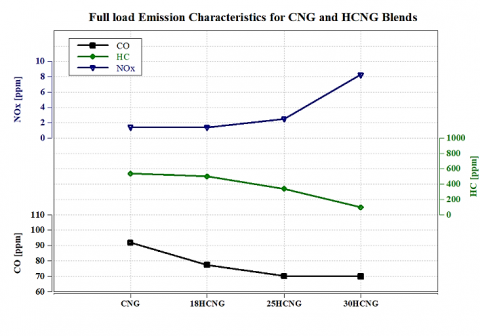
The emission results of the trials were recorded and are represented in Figure 12. The emission characteristics of various HCNG blends under full load conditions demonstrate a clear influence of hydrogen enrichment on combustion behavior. Carbon monoxide (CO) and unburnt hydrocarbons (HC) exhibited a consistent decline with increasing hydrogen content, indicating enhanced combustion efficiency and reduced quenching losses. Notably, CO dropped by approximately 24% and HC by over 80% from CNG to 30HCNG. Hydrogen’s high diffusivity and fast flame speed enhance combustion completeness, reducing partial oxidation products like CO [41]. Even under fixed spark timing, HCNG fuels burn cleaner with lower CO emissions due to reduced quenching and improved flame propagation. In contrast, nitrogen oxide (NOx) emissions remained relatively low for CNG and 18HCNG but increased sharply for higher blends, peaking at 8.25 ppm for 30HCNG. This rise in NOx is attributed to elevated in-cylinder temperatures and accelerated flame propagation associated with hydrogen-rich mixtures. Overall, the results highlight a trade-off between reduced carbon-based emissions and increased NOx at higher hydrogen concentrations, suggesting a need for combustion phasing or EGR strategies to mitigate NOx in future optimization.
Figure 12. Full load emission characteristics for CNG and HCNG blends
5.5 Correlation matrix
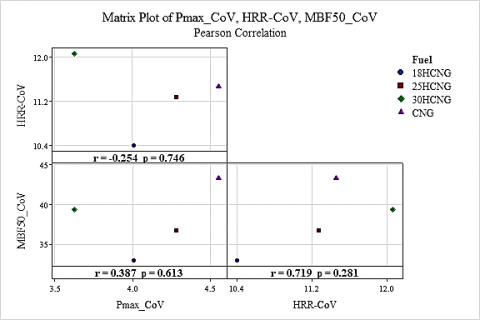
The correlation matrix is a statistical representation of the strength and direction of linear relationships among a number of variables using Pearson’s coefficients of correlation. In combustion studies, a great deal of insight can be gained from examining correlations between important stability metrics, as they can help uncover underlying interactions between combustion parameters [37]. For the current study, a correlation matrix was constructed to assess the interplay between the coefficients of variation (CoV) of peak pressure (Pmax), mass burned fraction at 50% (MBF50), and heat release rate (HRR) on a number of HCNG blends. The correlation matrix indicated a strong positive correlation between CoV_MBF50 and CoV_HRR, suggesting that the stability of combustion phasing tightly governs the uniformity of the energy release. Moderate or weak correlations were observed between CoV_Pmax and the other two parameters, suggesting that peak pressure stability alone does not comprehensively represent combustion uniformity. In this way, the correlation analysis provided more in-depth insight into combustion behavior and indicated the significance of MBF50 phasing stability for consistent, more reliable HCNG combustion, as per methods presented in combustion statistical analysis literature [11, 33].
The matrix plot in Figure 13 shows that CoV_MBF50 and CoV_HRR have a positive correlation (r = 0.719 and p=0.281), indicating that stability of combustion phasing largely governs uniformity of energy release. In contrast, CoV_Pmax displayed weak correlations with both MBF50 and HRR, indicating that peak pressure variability alone may not reliably predict overall combustion consistency.
Figure 13. Matrix plot of CoV_Pmax, CoV_HRR and CoV_MBF50 (Pearson Correlation and p-values)
5.6 Results summary
The comparative analysis of combustion stability based on CoV of Pmax, MBF50, and HRR for various fuel blends reveals consistent trends with hydrogen enrichment. Pure CNG operation exhibited the highest variability across all combustion parameters, highlighting the inherent instability of methane-dominant combustion under the tested conditions.
Moderate hydrogen enrichment, particularly at 18%, significantly improved combustion stability, as evidenced by the lowest CoV values for MBF50 (32.865%) and HRR (10.398%), and a substantial reduction in CoV_Pmax (4.006%). This improvement is attributed to enhanced flame propagation speed, better mixture reactivity, and shorter ignition delays provided by hydrogen addition.
At 25% hydrogen enrichment, although combustion stability remained superior to pure CNG, a slight increase in CoV_MBF50 and CoV_HRR were observed. This indicates that beyond a certain enrichment level, ultra-fast combustion can introduce cycle-to-cycle sensitivity to local mixture non-uniformities and flow field disturbances.
Interestingly, the 30% HCNG blend resulted in the lowest CoV_Pmax (3.625%), suggesting improved peak pressure consistency. However, the accompanying rise in CoV_MBF50 (39.407%) and CoV_HRR (12.069%) implies a deterioration in combustion phasing and heat release uniformity, likely due to the onset of rapid combustion instabilities. While hydrogen enrichment improves flame speed and thermal diffusivity, enabling quicker and more complete combustion, excessively high hydrogen fractions (30HCNG in this case) introduce complex instability mechanisms inside the combustion chamber. This results in a lower coefficient of variation (CoV) for Pmax, but paradoxically higher CoV values for MBF50 and HRR. The dominant causes are given below:
Localized Hotspots and Stratified Combustion
Hydrogen’s high diffusivity and low ignition energy cause earlier ignition kernels and highly reactive flame fronts. At 30% enrichment, this reactivity is no longer evenly distributed, especially under real turbulent conditions in multi-cylinder engines . This leads to localized hotspots, where combustion initiates faster in some regions than others. These uneven burn fronts distort the consistency of MBF50 timing and lead to non-uniform heat release, hence higher CoV_MBF50 and CoV_HRR.
Turbulence-Flame Interaction at High Laminar Flame Speeds
Hydrogen increases laminar flame speed, which in theory improves combustion. However, beyond 25–30%, the interaction between fast flames and turbulent eddies can lead to flame front distortion, quenching, or localized acceleration. Hence, flame kernel evolution becomes erratic . Despite high peak pressures (hence low CoV_Pmax), the timing and shape of the heat release curve fluctuates, increasing CoV_HRR
Ultra-Lean Pockets and Partial Flame Propagation
At 30% hydrogen, the global mixture remains stoichiometric, but local mixtures within the cylinder can vary due to hydrogen’s high diffusivity and mixing anomalies. This can result in ultra-lean or rich zones, especially in corners or near walls. These zones fail to ignite properly or ignite too slowly . Thus, fluctuating combustion phasing and slower or incomplete burning cause increased variability in MBF50 and HRR.
Overall, hydrogen addition in the range of 18–25% by volume was found to offer the most balanced improvement in combustion stability across all evaluated metrics. Excessive hydrogen enrichment (30%) may lead to undesirable combustion behavior, underlining the importance of optimizing the hydrogen fraction for practical HCNG engine operation.
The present investigation analyzed the combustion stability of a CNG-fueled multi-cylinder spark-ignition engine enriched with varying levels of hydrogen (0%, 18%, 25%, and 30% by volume). Combustion stability was assessed based on the CoV of peak cylinder pressure (Pmax), mass fraction burned at 50% (MBF50), and heat release rate (HRR), supported by correlation matrix analysis.
The experimental results demonstrated that hydrogen enrichment significantly influenced combustion stability. The baseline CNG operation exhibited the highest CoV values across all metrics, indicating greater cycle-to-cycle variability. The addition of 18% hydrogen led to the most notable improvement in combustion stability, with the lowest CoV values for MBF50 (32.865%) and HRR (10.398%), and a considerable reduction in CoV_Pmax (4.006%). Increasing hydrogen content to 25% maintained better stability compared to CNG but introduced slight irregularities, as reflected by a moderate increase in CoV values. The 30% HCNG blend achieved the lowest CoV_Pmax (3.625%) but showed deterioration in MBF50 and HRR stability, suggesting the onset of combustion irregularities at higher hydrogen fractions.
The correlation matrix analysis revealed a strong positive relationship between CoV_MBF50 and CoV_HRR (r = 0.719), emphasizing that combustion phasing stability significantly governs the uniformity of heat release. Weak correlations were observed between CoV_Pmax and the other parameters, indicating that peak pressure variability alone is not a comprehensive indicator of overall combustion stability.
Overall, the study concludes that hydrogen enrichment in the range of 18–25% offers the best balance between improving combustion stability and avoiding instability risks. Excessive hydrogen levels (≥30%) may adversely impact combustion uniformity despite improving pressure stability. Notably, hydrogen concentrations above ~20% by volume can trigger hydrogen embrittlement in high-strength steels and standard alloys used in fuel lines and injector components. The adoption of embrittlement-resistant materials, including austenitic stainless steels, aluminium alloys, and polymer-lined composite tanks, is essential in automotive systems [44], [45]. Furthermore, to enhance safety and mitigate the risks of fire and explosions in high-pressure storage environments, it is important to implement measures such as hydrogen sensors, overpressure relief valves, and leak detection systems. For safe deployment, hydrogen-compatible sealing technologies and regulatory-compliant refuelling protocols must also be developed alongside combustion optimisation.
In India, the real-world implementation of HCNG presents both challenges and immense potential. Currently, the country primarily produces "grey hydrogen" from natural gas, which limits the ability to scale up in a cost-effective and sustainable manner. However, the necessary infrastructure—such as on-site hydrogen generation, compression, and blending units—requires investment and innovation [46]. The absence of a national HCNG blending standard, certified protocols for engine retrofitting, and limited supply-chain support for safe hydrogen handling are hurdles to overcome. Yet, the journey toward making HCNG viable beyond pilot projects inspires to pursue coordinated policy incentives, develop decentralized hydrogen hubs, and establish clear regulatory frameworks.
Future work should focus on optimizing the hydrogen fraction under varying load and speed conditions and further investigating combustion noise and emission characteristics associated with HCNG operation.
This study provides vital insights into HCNG combustion behavior and highlights the critical role of balanced hydrogen enrichment for achieving stable, efficient, and future-ready engine performance.
While this study establishes a strong foundation for understanding combustion stability in HCNG-fueled engines under constant speed and load conditions, several opportunities exist for further research. Future investigations should extend to varying engine loads and speeds to assess the robustness of the optimal hydrogen fraction across a wider operating range. The impact of hydrogen enrichment on combustion noise, knock propensity, and engine vibration characteristics also warrants detailed examination to ensure smooth engine performance.
Moreover, a comprehensive analysis of exhaust emissions, particularly NOx formation behavior at higher hydrogen concentrations, is essential to ensure regulatory compliance and environmental sustainability. The integration of computational fluid dynamics (CFD) simulations could offer valuable insights into flame development, heat release, and turbulence-flame interactions in HCNG combustion. Finally, exploring the long-term durability impacts of hydrogen-enriched combustion on engine components such as pistons, valves, and injectors would provide a holistic understanding of HCNG technology viability for commercial adoption.
|
18HCNG |
18% Hydrogen in CNG by volume |
|
25HCNG |
25% Hydrogen in CNG by volume |
|
30HCNG |
30% Hydrogen in CNG by volume |
|
AFR |
Air-Fuel Ratio |
|
CA |
Crank Angle, deg |
|
CCVs |
Cycle-to-Cycle Variations |
|
CFD |
Computational Fluid Dynamics |
|
CNG |
Compressed Natural Gas |
|
CO |
Carbon Monoxide |
|
CO2 |
Carbon dioxide Emissions |
|
CoV |
Coefficient of Variation |
|
EGR |
Exhaust Gas Recirculation |
|
HC |
Hydrocarbon Emissions |
|
HCNG |
Hydrogen-enriched Compressed Natural Gas |
|
HRR |
Heat Release Rate |
|
HSDA |
High Speed Data Acquisition |
|
MBF50 |
Mass Burn Fraction at 50% |
|
NOx |
Nitrogen Oxide Emissions |
|
Pmax |
Maximum/Peak Cylinder Pressure, bar |
|
RPM |
Revolutions per Minute |
|
SI |
Spark Ignition |
|
TDC |
Top Dead Center |
|
Greek symbols |
|
|
p |
in-cylinder pressure, bar |
|
θ |
crank angle, |
|
γ |
specific heat ratio |
|
σ |
standard deviation |
|
μ |
mean value |
[1] IEA, Global Energy Review: CO2 Emissions in 2021, 2021. https://www.iea.org/reports/global-energy-review-2021.
[2] BP p.l.c, BP Energy Outlook., 2023. https://www.bp.com/content/dam/bp/business-sites/en/global/corporate/pdfs/energy-economics/energy-outlook/bp-energy-outlook-2023.pdf.
[3] National Research Council, Division on Engineering, Physical Sciences, Board on Energy, Environmental Systems, Committee on Alternatives, & Strategies for Future Hydrogen Production. (2004). The Hydrogen Economy: Opportunities, Costs, Barriers, and R&D Needs. National Academies Press. https://doi.org/10.2172/882095
[4] Change, C. (2022). Mitigation of Climate Change, Working Group III contribution to the Sixth Assessment Report of the Intergovernmental Panel on Climate Change (AR6). https://doi.org/10.1017/9781009157926
[5] United Nations Environment Programme (UNEP). (2020). Transport and Environment 2020 Global Status Report.
[6] IEA (International Energy Agency), Tracking Transport, 2022. https://www.iea.org/energy-system/transport#tracking.
[7] No, S., Gu, J., Moon, H., Lee, C., Jo, Y. (2011). An Introduction to Combustion Concepts and Applications. McGraw-Hill Korea.
[8] Papagiannakis, R.G., Hountalas, D.T. (2004). Combustion and exhaust emission characteristics of a dual fuel compression ignition engine operated with pilot diesel fuel and natural gas. Energy Conversion and Management, 45(18-19): 2971-2987. https://doi.org/10.1016/j.enconman.2004.01.013
[9] Ma, F., Ding, S., Wang, Y., Wang, Y., Wang, J., Zhao, S. (2008). Study on combustion behaviors and cycle-by-cycle variations in a turbocharged lean burn natural gas SI engine with hydrogen enrichment. International Journal of Hydrogen Energy, 33(23): 7245-7255. https://doi.org/10.1016/j.ijhydene.2008.09.016
[10] Karim, G.A. (2003). Hydrogen as a spark ignition engine fuel. International Journal of Hydrogen Energy, 28(5): 569-577. https://doi.org/10.1016/S0360-3199(02)00150-7
[11] Verhelst, S., Wallner, T. (2009). Hydrogen-fueled internal combustion engines. Progress in Energy and Combustion Science, 35(6): 490-527. https://doi.org/10.1016/j.pecs.2009.08.001
[12] Zareei, J., Yusoff Ali, H., Abdullah, S., Wan Mahmood, W.M.F. (2012). Comparing the effects of hydrogen addition on performance and exhaust emission in a spark ignition fueled with gasoline and CNG. Applied Mechanics and Materials, 165: 120-124. https://doi.org/10.4028/www.scientific.net/AMM.165.120
[13] Banapurmath, N.R., Gireesh, N.M., Basavarajappa, Y.H., Hosmath, R.S., Yaliwal, V.S., Pai, A., Navale, K.P., Jog, P., Tewari, P.G. (2015). Effect of hydrogen addition to CNG in a biodiesel-operated dual-fuel engine. International Journal of Sustainable Engineering, 8(6): 332-340. https://doi.org/10.1080/19397038.2014.963001
[14] Agarwal, A.K., Agarwal, R.A., Gupta, T., Gurjar, B.R. (Eds.). (2017). Biofuels: Technology, Challenges and Prospects. Springer Singapore. https://doi.org/10.1007/978-981-10-3791-7
[15] Prasad, R.K., Agarwal, A.K. (2021). Development and comparative experimental investigations of laser plasma and spark plasma ignited hydrogen enriched compressed natural gas fueled engine. Energy, 216: 119282. https://doi.org/10.1016/j.energy.2020.119282
[16] Hora, T.S., Agarwal, A.K. (2016). Effect of varying compression ratio on combustion, performance, and emissions of a hydrogen enriched compressed natural gas fuelled engine. Journal of Natural Gas Science and Engineering, 31: 819-828. https://doi.org/10.1016/j.jngse.2016.03.041
[17] Sagar, S.M.V., Agarwal, A.K. (2017). Experimental investigation of varying composition of HCNG on performance and combustion characteristics of a SI engine. International Journal of Hydrogen Energy, 42(18): 13234-13244. https://doi.org/10.1016/j.ijhydene.2017.03.063
[18] Baratta, M., D'Ambrosio, S., Misul, D.A. (2013). Performance and emissions of a turbocharged spark ignition engine fuelled with CNG and CNG/hydrogen blends (No. 2013-01-0866). SAE Technical Paper. https://doi.org/10.4271/2013-01-0866
[19] Duan, X., Deng, B., Liu, Y., Zou, S., Liu, J., Feng, R. (2020). An experimental study the impact of the hydrogen enrichment on cycle-to-cycle variations of the large bore and lean burn natural gas spark-ignition engine. Fuel, 282: 118868. https://doi.org/10.1016/J.FUEL.2020.118868
[20] Heffel, J.W. (2003). NOx emission reduction in a hydrogen fueled internal combustion engine at 3000 rpm using exhaust gas recirculation. International Journal of Hydrogen Energy, 28(11): 1285-1292. https://doi.org/10.1016/S0360-3199(02)00289-6
[21] Lee, S.W., Lee, H.S., Park, Y.J., Cho, Y.S. (2011). Combustion and emission characteristics of HCNG in a constant volume chamber. Journal of Mechanical Science and Technology, 25: 489-494. https://doi.org/10.1007/s12206-010-1231-5
[22] Ma, F., Wang, Y., Liu, H., Li, Y., Wang, J., Ding, S. (2008). Effects of hydrogen addition on cycle-by-cycle variations in a lean burn natural gas spark-ignition engine. International Journal of Hydrogen Energy, 33(2): 823-831. https://doi.org/10.1016/j.ijhydene.2007.10.043
[23] IEA (International Energy Agency), Global Hydrogen Review 2023, 2023. https://www.iea.org/reports/global-hydrogen-review-2023.
[24] Bandyopadhyay, D., Sutar, P.S., Sonawane, S.B., Rairikar, S., Thipse, S.S., Jadhav, A. (2024). Hydrogen as a Carbon Neutral ICE Fuel for Future India (No. 2024-26-0177). SAE Technical Paper. https://doi.org/10.4271/2024-26-0177
[25] Bandyopadhyay, D., Sutar, P.S., Sonawane, S.B., Rairikar, S., Thipse, S.S., Tule, S., Aghav, Y., Lakshminarasimhan, K., Singh, S., Mishra, S.K., Bera, T., Badhe, R. (2025). Hydrogen-Enriched compressed natural gas transition for Low-Emission operation in stationary genset engines. Journal of Sustainability for Energy, 4(1): 1–17. https://doi.org/10.56578/jse040101
[26] Oh, S., Kim, C., Lee, Y., Yoon, S., Lee, J., Kim, J. (2019). Experimental investigation of the hydrogen-rich offgas spark ignition engine under the various compression ratios. Energy Conversion and Management, 201: 112136. https://doi.org/10.1016/j.enconman.2019.112136
[27] Mustafi, N.N., Agarwal, A.K. (2019). Combustion and emission characteristics, and emission control of CNG fueled vehicles. In: Singh, A., Sharma, Y., Mustafi , N., Agarwal, A. (eds) Alternative Fuels and Their Utilization Strategies in Internal Combustion Engines. Energy, Environment, and Sustainability. Springer, Singapore. https://doi.org/10.1007/978-981-15-0418-1_12
[28] Nitnaware, P.T., Suryawanshi, J.G. (2016). Effects of MBT spark timing on performance emission and combustion characteristics of SI engine using hydrogen-CNG blends. International Journal of Hydrogen Energy, 41(1): 666-674. https://doi.org/10.1016/j.ijhydene.2015.11.074
[29] Gupta, S.K., Mittal, M. (2018). Effect of compression ratio on the performance and emission characteristics, and cycle-to-cycle combustion variations of a spark-ignition engine fueled with bio-methane surrogate. Applied Thermal Engineering, 148: 1440-1453. https://doi.org/10.1016/j.applthermaleng.2018.11.057.
[30] Baratta, M., d’Ambrosio, S., Misul, D., Spessa, E. (2012). Effects of H2 addition to CNG blends on cycle-to-cycle and cylinder-to-cylinder combustion variation in an SI engine. Internal Combustion Engine Division Spring Technical Conference, 44663: 189-202. https://doi.org/10.1115/ICES2012-81187
[31] Nguyen, Q.T., Le, M.D. (2022). Effects of compression ratios on combustion and emission characteristics of si engine fueled with hydrogen-enriched biogas mixture. Energies, 15(16): 5975. https://doi.org/10.3390/en15165975.
[32] Heffel, J.W. (2003). NOx emission and performance data for a hydrogen fueled internal combustion engine at 1500rpm using exhaust gas recirculation. International Journal of Hydrogen Energy, 28(8): 901-908. https://doi.org/10.1016/S0360-3199(02)00157-X
[33] Heywood, J.B Internal Combustion Engine Fundamentals, 2nd Edition. McGraw-Hill Education, 2018.
[34] Verma, G., Prasad, R.K., Agarwal, R.A., Jain, S., Agarwal, A.K. (2016). Experimental investigations of combustion, performance and emission characteristics of a hydrogen enriched natural gas fuelled prototype spark ignition engine. Fuel, 178: 209-217. https://doi.org/10.1016/j.fuel.2016.03.022
[35] Bhasker, J.P., Porpatham, E. (2017). Effects of compression ratio and hydrogen addition on lean combustion characteristics and emission formation in a Compressed Natural Gas fuelled spark ignition engine. Fuel, 208: 260-270. https://doi.org/10.1016/j.fuel.2017.07.024
[36] Alrazen, H.A., Ahmad, K.A. (2018). HCNG fueled spark-ignition (SI) engine with its effects on performance and emissions. Renewable and Sustainable Energy Reviews, 82: 324-342. https://doi.org/10.1016/j.rser.2017.09.035
[37] Montgomery, D.C., Runger, G.C. (2010). Applied Statistics and Probability for Engineers. John Wiley & Sons.
[38] Ferguson, C.R., Kirkpatrick, A.T. (2015). Internal Combustion Engines: Applied Thermosciences. John Wiley & Sons.
[39] Ebrahimi, R. (2011). Effect of specific heat ratio on heat release analysis in a spark ignition engine. Scientia Iranica, 18(6): 1231-1236. https://doi.org/10.1016/j.scient.2011.11.002
[40] Brunt, M.F., Platts, K.C. (1999). Calculation of heat release in direct injection diesel engines. SAE Transactions, 161-175. https://doi.org/10.4271/1999-01-0187
[41] Bandyopadhyay, D., Sutar, P., Sonawane, S., Rairikar, S., Thipse, S., Sale, O. (2025). Raw Emissions Determination and Calculations for Blended Fuel–HCNG: Paper No.: 2025-AC-10. ARAI Journal of Mobility Technology, 5(1): 1490-1501. https://doi.org/10.37285/ajmt.5.1.10
[42] Prasad, R.K., Agarwal, A.K. (2021). Effect of hydrogen enrichment of compressed natural gas on combustible limit and flame kernel evolution in a constant volume combustion chamber using laser ignition. Fuel, 302: 121112. https://doi.org/10.1016/j.fuel.2021.121112
[43] Zhou, L., Zhong, L., Liu, Z., Wei, H. (2023). Toward highly-efficient combustion of ammonia–hydrogen engine: Prechamber turbulent jet ignition. Fuel, 352: 129009. https://doi.org/10.1016/j.fuel.2023.129009
[44] Basso, G.L., Pastore, L.M., Sgaramella, A., Mojtahed, A., de Santoli, L. (2024). Recent progresses in H2NG blends use downstream Power-to-Gas policies application: An overview over the last decade. International Journal of Hydrogen Energy, 51: 424-453. https://doi.org/10.1016/J.IJHYDENE.2023.06.141
[45] Narayanan, D., Vinithkrishna, N., Rajkumar, S., Thangaraja, J., Sivagaminathan, M., Devarajan, Y., Varuvel, E.G. (2023). Techno-economic review assessment of hydrogen utilization in processing the natural gas and biofuels. International Journal of Hydrogen Energy, 48(55): 21294-21312. https://doi.org/10.1016/J.IJHYDENE.2022.09.101
[46] N.A. MNRE, Draft National Hydrogen Energy Mission, 2021. https://niti.gov.in/sites/default/files/2021-11/Draft-National-Hydrogen-Energy-Mission.pdf.