
Ibrahim Moussa Mahamat* | Hayatou Oumarou | Kolyang
© 2026 The authors. This article is published by IIETA and is licensed under the CC BY 4.0 license (http://creativecommons.org/licenses/by/4.0/).
OPEN ACCESS
Business rules represent essential organizational knowledge embedded within modern information systems, yet their extraction remains challenging because such rules are often distributed across heterogeneous sources, including legacy code, databases, documentation, and execution traces. This study presents a systematic literature review of hybrid business rule extraction (BRE) approaches that integrate multiple extraction and validation mechanisms to address the limitations of single-technique methods. Following a Preferred Reporting Items for Systematic Reviews and Meta-Analyses (PRISMA)-aligned review protocol, 320 records retrieved from IEEE Xplore, ACM Digital Library, SpringerLink, and ScienceDirect were screened, resulting in 58 studies selected for qualitative synthesis. A taxonomy of hybrid BRE approaches is developed by analyzing the combinations of extraction techniques, evidence sources, traceability mechanisms, and validation strategies. Five major categories are identified: static analysis combined with symbolic reasoning, dynamic analysis combined with machine learning (ML), data mining combined with human validation, Natural Language Processing (NLP)/document analysis combined with symbolic linking, and Large Language Model (LLM)-assisted pipelines combined with symbolic verification. The review further proposes a comparative evaluation framework based on precision, recall, source coverage, traceability, scalability, automation, and formalization quality. The findings indicate that hybrid approaches provide broader support for heterogeneous information environments, while challenges remain regarding evaluation standardization, benchmark availability, implementation complexity, and reliable validation of AI-assisted extraction. Future research directions are discussed, including LLM-symbolic integration, business rule ontologies, distributed system extraction, and explainable validation mechanisms.
business rule extraction, hybrid approaches, systematic literature review, taxonomy, software modernization, traceability, Large Language Models, knowledge extraction
Business rules encode organizational constraints, decisions, and policies that determine how software-intensive systems behave in practice. In legacy environments, these rules are rarely centralized. They may be distributed across source code, database logic, interface behavior, procedural documentation, and operational traces. This dispersion makes business rule extraction (BRE) an important activity for modernization, compliance checking, migration, and knowledge preservation [1, 2].
Classical BRE approaches usually rely on a single family of techniques such as static analysis, dynamic observation, data mining, or natural-language processing. Each family contributes important evidence, but none is sufficient on its own. Static analysis provides strong traceability yet misses runtime-dependent behavior; dynamic analysis reveals executed behavior but depends on scenario coverage; data mining scales to large event collections but may uncover correlations rather than deterministic rules; and documentation-driven methods can recover explicit business intent but struggle when documentation is incomplete or inconsistent [3-5].
Hybrid BRE methods have therefore emerged as a practical answer to multi-source environments. Their value lies not only in combining extraction techniques, but also in integrating different evidence types, validation mechanisms, and traceability links. The paper distinguishes hybridization at three levels: source fusion, validation fusion, and orchestration fusion. This distinction helps explain why superficially similar pipelines can differ substantially in practical applicability [6, 7]. This article addresses three research questions:
RQ1: How can hybrid BRE methods be classified?
RQ2: What are the strengths and limitations of each category of hybrid BRE in terms of coverage, accuracy, traceability, and scalability?
RQ3: What are the open challenges and future research directions for hybrid BRE methods?
The remainder of the paper is organized as follows. Section 2 presents the background on business rules, extraction processes, the rationale for hybrid approaches, related work, and positions our contribution within the existing literature. Section 3 describes our research methodology, including the search strategy, selection criteria, and data extraction procedures. Section 4 presents our taxonomy of hybrid methods, along with a detailed analysis of each category. Section 5 introduces the comparative analysis of the studies. Section 6 presents the Unified evaluation framework as a coding scaffold for synthesis. Section 7 proposes practical deployment and validation examples. Section 8 presents the discussion. Section 9 outlines future directions for BRE, and Section 10 concludes with a summary of the contributions and implications for future research.
Business rules may be represented as decision rules, constraints, derivation rules, or event-condition-action rules [8-10]. They can be formalized as decision tables, production rules, Decision Model and Notation (DMN) artefacts, or rule-engine representations [11-13]. For BRE, however, the representation problem is closely linked to the source problem because technical implementations rarely correspond to business semantics on a one-to-one basis [14, 15].
Earlier reviews on business knowledge extraction established the relevance of reverse engineering for modernization, but they did not isolate hybrid BRE as a distinct object of analysis. In particular, prior surveys typically emphasized either legacy-code recovery, structural rule discovery from databases, or documentation analysis in isolation. Our review extends that literature by centering on the integration mechanisms that connect heterogeneous evidence sources [16-18].
Normantas and Vasilecas [9] conducted an extensive review of business knowledge extraction techniques, analyzing 47 studies published between 2000 and 2013. Their review identified that the most effective approaches combine multiple techniques, noting that “the majority of the reviewed studies propose using a combination of techniques to obtain more accurate results.” However, their analysis did not provide a systematic framework for understanding hybrid approaches or their relative effectiveness.
These reviews nonetheless concentrate on single-source extraction; our contribution lies in the integration mechanisms that connect heterogeneous evidence sources [16]. Their work emphasized the importance of traceability between the extracted rules and the source code, but also observed the limited adoption of standardized rule representation formats.
More recently, Castellanos et al. [11] examined BRE in the context of digital transformation initiatives, highlighting the growing importance of hybrid approaches, but without providing technical details on specific methodologies.
Compared with earlier surveys, the present review contributes a more explicit classification logic. The novelty of the taxonomy lies not simply in naming five categories, but in comparing them across integration locus, dominant evidence source, traceability mechanism, required human participation, and deployment context. This comparative angle is what makes the taxonomy operational for both researchers and practitioners as shown in Table 1.
Table 1. Comparison of this review with related studies
|
Study |
Period Covered |
Primary Focus |
Treatment of Hybrid BRE |
Main Gap Left Open |
|
Normantas and Vasilecas [9] |
2000–2013 |
Business knowledge extraction from existing systems |
Recognized but not isolated as a dedicated class |
No operational taxonomy for hybrid methods |
|
Castellanos et al. [11] |
1996–2021 |
Code- or data-centric extraction |
Usually partial and technique-specific |
Limited multi-source comparison |
|
This review |
1996–2025 |
Hybrid BRE methods across heterogeneous sources |
Central object of analysis |
Adds synthesis, deployment guidance, and a PRISMA-aligned method section |
This review follows a PRISMA-aligned protocol and reports the study-selection process explicitly. The protocol was organized around the three research questions, the target publication venues, the search string, inclusion and exclusion criteria, the data items extracted from each study, and the qualitative synthesis procedure. The review scope covered January 1996 to December 2025 and focused on peer-reviewed work discussing methods that combine at least two extraction or validation mechanisms for recovering business rules from software or organizational artefacts [19].
The electronic search was performed in IEEE Xplore, ACM Digital Library, SpringerLink, and ScienceDirect using the following query: ("business rule*" OR "business logic" OR "decision rule*") AND ("extract*" OR "mining" OR "discover*" OR "identify*") AND ("hybrid" OR "combined" OR "multi*" OR "integrate*" OR "fusion"). Manual backward checking of key studies was used only to confirm interpretation, not to alter the final sample size reported in the study [19].
Table 2. Eligibility criteria
|
Criterion |
Included When… |
Excluded When… |
|
Topic |
The paper addressed business-rule or business-logic extraction. |
The paper focused only on generic reverse engineering or mining unrelated to Business rule extraction (BRE). |
|
Method |
At least two extractions, linking, or validation mechanisms were combined. |
Only one extraction family was used. |
|
Evidence |
The method or framework was described with evaluable details. |
The study was purely conceptual or too brief for coding. |
|
Outcome |
The study reported outputs, examples, metrics, or deployment evidence. |
No empirical or illustrative evidence was available. |
In Eligibility criteria in Table 2, studies were included when they:
(i) addressed business-rule or business-logic extraction,
(ii) combined at least two techniques or evidence sources,
(iii) described a method, framework, or evaluated pipeline,
(iv) reported enough detail to support comparative coding.
Studies were excluded when they focused only on general reverse engineering without a BRE contribution, discussed single-technique extraction, or lacked methodological detail. Ambiguous cases were resolved by consensus rather than by unilateral judgment [19].
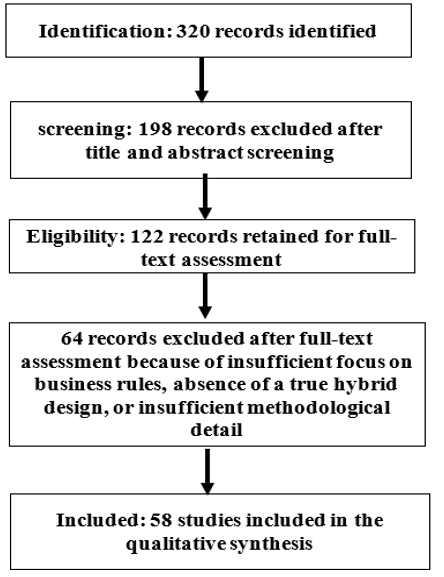
Study selection proceeded in three stages. First, 320 records were identified. Second, title and abstract screening removed clearly irrelevant studies and retained 122 records for full-text assessment. Third, full-text evaluation resulted in 58 studies being included in the final qualitative synthesis. The most common exclusion reasons at the full-text stage were absence of a true hybrid design, insufficient focus on business rules, and lack of evaluable methodological detail [19]. Synthesis strategy. Because the primary studies used heterogeneous datasets, different definitions of rule validity, unequal reporting granularity, and incomparable metrics, we did not compute a pooled effect size. Instead, we used a structured narrative synthesis supported by normalized comparison dimensions and careful identification of study-reported ranges.
To ensure methodological rigor, transparency, and reproducibility, the study selection process was conducted in accordance with the PRISMA guidelines. The corresponding flow diagram (Figure 1) details the different phases, including identification, screening, eligibility assessment, and final inclusion of the selected studies.
Figure 1. Preferred Reporting Items for Systematic Reviews and Meta-Analyses (PRISMA)-style flow diagram of study selection
The 58 selected studies were organized into five categories: (1) static analysis + symbolic reasoning, (2) dynamic analysis + machine learning (ML), (3) data mining + human validation, (4) Natural Language Processing (NLP)/document analysis + symbolic linking, and (5) Large Language Model (LLM)-assisted pipelines with symbolic verification. This categorization remains useful because it reflects dominant combinations found in the literature, but we interpret each category through a richer comparative lens.
•Specifically, the taxonomy evaluates each category according to five discriminating properties: primary evidence source, integration locus, traceability mechanism, expected human intervention, and deployment fit. This makes the taxonomy a decision aid for choosing methods under real-world constraints.
•Static analysis + symbolic reasoning: strongest when source-code traceability is the dominant requirement, especially in legacy modernization contexts. The seminal work of Huang et al. [20] through their classification and program-slicing approach for COBOL systems.
•Dynamic analysis + ML: useful when behavior must be inferred from execution evidence, logs, or sensor streams, provided that scenario coverage is adequate. The work of Bemthuis et al. [21] is a representative example in the context of intelligent IoT systems. Their approach applies decision trees to sensor data and reports accuracies of 97.5% and 97.6% for the decision-tree models, against 95% for the SVM baseline.
•Data mining + human validation: attractive in transaction-rich environments where pattern discovery is valuable but expert confirmation remains essential. Thirumaran et al. [22] developed a banking rule-mining architecture in which candidate rules are filtered by domain experts.
•NLP/document analysis + symbolic linking: appropriate when business logic is explicitly described in policies, requirements, contracts, or regulatory documents and must be linked back to technical artefacts. Winter et al. [23] addressed this setting by assessing the compliance of business process models with regulatory documents, which requires linking textual provisions to process elements. Liu et al. [24] learned first-order logic representations of application programming interface (API) directives, an approach that shows how textual prescriptions can be translated into formal, linkable rule statements. Biletskiy and Ranganathan [25] proposed a semantic framework for business-domain software systems, in which rule statements are anchored to a shared domain ontology.
•LLM-assisted pipelines with symbolic verification: promising for heterogeneous evidence landscapes, but still dependent on verification, cost control, and trust mechanisms.
Yang et al. [26] developed a comprehensive framework for LLM-based BRE that represents the state of the art in this category. Their “Business as Rulesual” framework proposes systematic approaches for process engineering, symbolic verification, and comparative evaluation of LLM-based BRE. The framework was evaluated using multiple metrics. Qian et al. [27] studied how multi-agent LLM collaboration scales, which is the architecture behind the division of labour between code analysis, document processing, and validation agents.
Cheng et al. [28] industrialized this orchestration with Prompt Sapper, a production tool for composing AI chains, which illustrates the engineering effort that LLM-assisted extraction requires.
This section compares representative methods on common dimensions rather than presenting them as isolated examples.
Table 3. Structured comparison of representative hybrid business rule extraction (BRE) families
|
Category |
Typical Sources |
Main Strength |
Main Limitation |
Best-Fit Context |
Evidence Type |
|
Static + symbolic |
Code, configuration |
High traceability and auditability. |
May miss runtime-dependent rules |
Legacy modernization and code governance |
Repeated support in legacy-code studies |
|
Dynamic + ML |
Logs, traces, sensor data |
Captures actual behavior and hidden execution patterns. |
Sensitive to workload coverage |
Runtime-intensive systems |
Case studies with domain-specific datasets |
|
Data mining + human validation |
Transactions, event histories |
Scales to large data volumes. |
Manual confirmation remains costly |
Data-intensive enterprise systems |
Operational and transactional case studies |
|
NLP + symbolic linking |
Policies, requirements, manuals |
Recovers explicit business intent. |
Depends on document quality and terminology control |
Compliance and documentation-rich domains |
Document-analysis experiments and prototypes |
|
LLM + symbolic verification |
Mixed artefact sets |
Flexible multi-source reasoning |
Trust, cost, and consistency must be controlled |
Heterogeneous or rapidly changing environments |
Emerging prototypes and recent experimental studies |
Across the literature, static-symbolic methods consistently provide the strongest source-level traceability and are easier to justify in audits (Table 3). Dynamic-ML pipelines tend to improve behavioral coverage when execution traces are available, but their quality depends on representative workloads. Data-mining approaches scale well and surface latent decision patterns, although they often require substantial manual validation to distinguish true business rules from data regularities. Documentation-centered pipelines help recover policy intent but are highly sensitive to terminology quality and document maintenance. LLM-assisted methods improve flexibility across artefact types, yet their industrial value depends on symbolic guards, provenance tracking, and careful validation.
The numerical improvements often cited in the literature (such as 15–40% better coverage or 20–35% better precision than mono-technique approaches) should be interpreted cautiously. In the paper, these numbers are explicitly reported as ranges observed in individual primary studies or category-level comparisons, not as pooled estimates from a formal meta-analysis.
To reduce the comparability problem across studies, this review uses seven recurring dimensions: precision, recall, source coverage, traceability, scalability, automation, and formalization quality. Not all primary studies report all dimensions, and definitions vary. For that reason, the framework should be read as a coding scaffold for synthesis rather than as a substitute for common benchmarks [16].
We explicitly explain why direct metric aggregation is difficult. Different studies operationalize “accuracy,” “coverage,” and even “business rule” differently; therefore, the framework normalizes interpretation instead of forcing false numerical equivalence [19].
Three patterns emerge from this unified reading. First, source diversity and traceability are usually in tension: the broadest methods often need stronger validation layers to remain explainable. Second, human intervention does not disappear in advanced pipelines; it moves from extraction to validation, curation, and exception handling. Third, practical value depends on deployment fit more than on headline accuracy. A method with slightly lower recall but stronger traceability may be preferable in regulated settings.
Practical deployment requires four coordinated decisions: which sources can be trusted, which validation mechanism is acceptable, how extracted rules will be represented, and how much expert effort the organization can allocate. In practice, organizations rarely choose a method because it has the highest reported metric. They choose the method that best fits source availability, governance requirements, and acceptable validation cost [20, 23, 26].
Table 4. Deployment-oriented interpretation of the method-selection matrix
|
Use Case |
Dominant Source Pattern |
Method Family |
Why It Fits |
Validation Implication |
|
Legacy modernization |
Code + configuration, limited documentation |
Static + symbolic |
Maximizes traceability and supports audit trails |
Expert review focuses on borderline cases and hidden runtime rules |
|
Regulatory compliance |
Policies, manuals, legal text |
NLP + symbolic linking |
Preserves explicit intent and supports formalization |
Terminology and contradiction checks are critical |
|
Behavior-driven systems |
Execution logs, traces, sensor events |
Dynamic + ML |
Captures runtime conditions that static analysis cannot see |
Scenario coverage must be monitored |
|
Transaction-rich operations |
Large operational datasets |
Data mining + human validation |
Scales well to recurring decision patterns |
Human validation filters spurious patterns |
|
Heterogeneous enterprise ecosystems |
Mixed artefacts with uneven quality |
LLM + symbolic verification |
Offers flexible source fusion |
Verification and provenance controls are non-negotiable |
•Illustrative scenario A: legacy COBOL modernization. When the dominant requirement is traceability from extracted rules back to code and configuration artefacts, a static-symbolic pipeline is the most defensible first option. If documentation is sparse but modernization deadlines are tight, an LLM-assisted pipeline may serve as a complementary triage mechanism, provided that symbolic validation and expert review remain mandatory before deployment [20, 26].
•Illustrative scenario B: regulatory compliance review. When policies, procedures, and regulatory documents are rich and frequently updated, NLP/document analysis with symbolic linking is usually preferable because it preserves the semantics of explicit business statements and can be aligned with DMN or policy models. LLM support may accelerate extraction, but only if document provenance and contradiction checks are explicit [23, 26]. Table 4 summarizes the recommended method families for these and other deployment contexts, together with their source requirements and validation considerations.
This systematic literature review shows that hybrid BRE has become the most credible strategy for recovering business logic from heterogeneous software environments. The main reason is that business rules are rarely stored in a single artefact: they are dispersed across source code, databases, configuration files, execution traces, and natural-language documents. In such settings, single-technique approaches remain useful but insufficient, whereas hybrid methods improve the completeness and interpretability of extracted rules by combining complementary evidence [16].
8.1 Key findings
Five recurrent categories structure the field: static analysis plus symbolic reasoning, dynamic analysis plus ML, data mining plus human validation, NLP or document analysis plus symbolic linking, and LLM-based pipelines plus symbolic verification. Together, these categories confirm that hybridization is not simply a technical refinement; it is a methodological response to source fragmentation. The review also indicates that hybrid methods generally provide broader coverage and stronger validation capacity than mono-technique approaches, although the reported improvements should be interpreted as study-level ranges rather than pooled meta-analytic effects because primary studies use heterogeneous datasets, metrics, and ground-truth definitions.
8.2 Strengths of hybrid business rule extraction approaches
One important advantage of hybrid BRE is complementary coverage. A rule that is only partially visible in code may become clearer when it is linked to documentation or runtime traces. A second advantage is cross-validation. When several techniques provide consistent evidence for the same rule, confidence can increase and expert validation can focus on fewer ambiguous cases. A third advantage is traceability, particularly in approaches that preserve explicit links between rules and source artefacts. This property is important in regulated sectors, where extracted knowledge must remain auditable and maintainable. Hybrid BRE is also adaptable because different combinations can be selected according to project goals, source availability, and governance constraints.
8.3 Limitations
Despite these benefits, hybrid BRE still faces important limitations. First, implementation complexity can be high because multi-technique pipelines require orchestration, intermediate representations, and conflict-resolution mechanisms. Second, the empirical evidence base is uneven: many studies rely on proprietary datasets or domain-specific experiments that are difficult to reproduce. Third, human validation remains necessary for ambiguous or borderline cases, so full automation is not yet realistic in many contexts. Fourth, advanced pipelines, particularly those involving LLMs, may introduce substantial computational costs and consistency risks [26-28].
8.4 Challenges
The literature identifies several unresolved challenges. Standardization remains limited for both rule representations and evaluation criteria. Public multi-source benchmarks are also scarce, which limits reproducibility and fair comparison. Another challenge concerns validation under uncertainty: hybrid systems must not only extract rules but also communicate confidence, provenance, and supporting evidence in a form that domain experts can assess. In addition, contemporary architectures such as microservices, APIs, and event-driven systems make rule extraction more complex because business logic is increasingly distributed across interacting services rather than embedded in a single code base.
8.5 Implications for researchers
For researchers, an important priority is to strengthen methodological rigor. Future work should emphasize shared benchmarks, explicit annotation procedures, standardized reporting, and comparative protocols that distinguish syntactic extraction, semantic correctness, traceability quality, and practical usefulness. Research on LLM-based BRE should also examine integration with symbolic verification, provenance tracking, and human-in-the-loop validation rather than relying solely on isolated performance claims [26-28].
8.6 Implications for practitioners
For practitioners, the review suggests that BRE outcomes depend on the alignment between the extraction strategy and the organizational context. In legacy modernization, traceability-oriented pipelines can address the need for links to source artefacts. In compliance-oriented settings, document-centered approaches can support the recovery of explicitly stated business intent. In heterogeneous environments, LLM-assisted pipelines can accelerate discovery when strong validation controls are in place. More broadly, organizations can treat BRE as an iterative governance activity rather than a one-time recovery task. Its long-term value includes recovering hidden business rules and making business logic more visible, explainable, and maintainable over time [20, 23, 26].
Our systematic analysis identifies seven research directions for hybrid BRE methods. Each addresses a gap identified in the reviewed literature.
•LLM + symbolic verification architectures: build reference pipelines that expose prompts, intermediate rule candidates, symbolic checks, and failure-recovery loops.
•Interoperability ontologies: define mappings between textual rules, decision tables, DMN elements, and executable rule-engine artefacts.
•Public benchmarks: release multi-source corpora pairing code, documents, logs, and gold-standard rule annotations under reusable licensing conditions.
•Active-learning validation: prioritize uncertain rules for expert review so that validation cost decreases without sacrificing confidence.
•Modern distributed architectures: extend BRE to microservices, APIs, event streams, and infrastructure-as-code artefacts.
•Temporal rule extraction: detect how business rules evolve across versions, releases, and regulatory changes.
•Explainability and trust: standardize provenance reports, calibrated confidence indicators, and auditable evidence trails for extracted rules.
These directions define tangible research outputs, including reference architectures, ontologies, benchmark datasets, uncertainty-driven validation workflows, distributed-system extractors, temporal tracking methods, and provenance mechanisms, rather than general calls for further research.
BRE remains a challenging task for organizations seeking to understand, modernize, and govern complex information systems. Because business logic is rarely centralized in a single source, effective extraction requires methods capable of integrating evidence from source code, databases, documentation, configuration artefacts, and execution traces. In this context, the present systematic literature review examined the evolution of hybrid BRE approaches and their contributions to software modernization and the recovery of organizational knowledge.
Following a PRISMA-aligned review strategy, this study screened 320 records from four major digital libraries and retained 58 relevant studies for qualitative synthesis. The review identified five major categories of hybrid BRE methods: static analysis combined with symbolic reasoning; dynamic analysis combined with ML; data mining combined with human validation; NLP or document analysis combined with symbolic linking; and LLM-based extraction pipelines combined with symbolic verification. This classification provides a structured overview of the field and indicates that hybridization has become an important design principle for BRE.
The findings indicate that hybrid methods offer advantages over single-technique approaches when business rules are fragmented across heterogeneous artefacts. Their main strengths include broader source coverage, stronger cross-validation, improved traceability, and greater flexibility in handling incomplete or inconsistent sources. However, the review also highlights several limitations: evaluation protocols remain heterogeneous, public benchmarks are scarce, implementation complexity can be high, and human validation remains essential for resolving ambiguity and ensuring semantic correctness. Thus, although hybrid BRE has practical value, methodological maturity remains uneven across the field.
This study makes four main contributions. First, it presents a focused taxonomy of hybrid BRE approaches and clarifies the rationale behind their combinations of techniques. Second, it compares the reviewed approaches using common dimensions, including coverage, traceability, automation, scalability, and formalization quality. Third, it examines the growing relevance of AI-assisted and LLM-based pipelines while emphasizing the continuing need for symbolic verification and explainable validation. Fourth, it outlines a research agenda focused on benchmark construction, interoperability standards, active-learning-based validation, extraction in distributed architectures, temporal rule evolution, and trust-oriented explainability.
Overall, the review indicates that hybrid BRE can support the large-scale recovery of business logic, particularly in legacy-system modernization, compliance analysis, and heterogeneous enterprise environments. Further progress, however, depends on reproducible benchmarks, shared evaluation practices, standardized rule representations, and robust human-in-the-loop validation mechanisms. Strengthening these foundations could help move BRE beyond project-specific reverse-engineering activities toward more systematic approaches to software governance and the preservation of business knowledge.
[1] Ross, R.G. (2003). Principles of the Business Rule Approach. Addison-Wesley Professional, Boston, MA, USA. https://dl.acm.org/doi/book/10.5555/582500.
[2] Von Halle, B., Goldberg, L. (2006). The Business Rule Revolution: Running Business the Right Way. Happy About.
[3] Huang, J.C. (1979). Detection of data flow anomaly through program instrumentation. IEEE Transactions on Software Engineering, SE-5(3): 226-236. https://doi.org/10.1109/TSE.1979.234184
[4] Han, J., Kamber, M., Pei, J. (2011). Data Mining: Concepts and Techniques. Amsterdam: Elsevier, pp. 383-466. https://www.sciencedirect.com/book/monograph/9780123814791/data-mining-concepts-and-techniques.
[5] Jurafsky, D., Martin, J.H. (2014). Speech and Language Processing: An Introduction to Natural Language Processing, Computational Linguistics, and Speech Recognition. London: Pearson. https://sandiway.arizona.edu/ling538-23/1.pdf.
[6] Canfora, G., Di Penta, M. (2007). New Frontiers of Reverse Engineering. In Future of Software Engineering (FOSE '07), Minneapolis, MN, USA, pp. 326-341. https://doi.org/10.1109/FOSE.2007.15
[7] Zhang, S., Roller, S., Goyal, N., et al. (2022). OPT: Open pre-trained transformer language models. arXiv preprint arXiv:2205.01068. https://doi.org/10.48550/arXiv.2205.01068
[8] Moher, D., Liberati, A., Tetzlaff, J., Altman, D.G. (2009). Preferred reporting items for systematic reviews and meta-analyses: The PRISMA statement. Annals of Internal Medicine, 151(4): 264-269. https://doi.org/10.7326/0003-4819-151-4-200908180-00135
[9] Normantas, K., Vasilecas, O. (2013). A Systematic review of methods for business knowledge extraction from existing software systems. Baltic Journal of Modern Computing, 1(1–2): 29-51. https://www.lu.lv/fileadmin/user_upload/lu_portal/projekti/bjmc/Contents/1_1-2_3_Normantas.pdf.
[10] Škerl, T., Danenas, P., Butleris, R. (2018). Extracting SBVR business vocabularies and business rules from UML use case diagrams. Journal of Systems and Software, 141: 111-130. https://doi.org/10.1016/j.jss.2018.03.061
[11] Castellanos, M., Casati, F., Dayal, U., Shan, M.C. (2004). A comprehensive and automated approach to intelligent business processes execution analysis. Distributed and Parallel Databases, 16(3): 239-273. https://doi.org/10.1023/B:DAPD.0000031635.88567.65
[12] Business Rules Group. (2000). Defining Business Rules ~ What Are They Really? Final Report, Revision 1.3, July 2000. https://www.businessrulesgroup.org/first_paper/BRG-whatisBR_3ed.pdf.
[13] Object Management Group (OMG). (2019). Semantics of Business Vocabulary and Business Rules (SBVR), Version 1.5. OMG Specification, document formal/19-10-02. https://www.omg.org/spec/SBVR/1.5/PDF.
[14] Ross, R.G. (1997). The Business Rule Book: Classifying, Defining and Modeling Rules. Business Rule Solutions, Houston, TX, USA. https://cir.nii.ac.jp/crid/1971149384873085462.
[15] Object Management Group (OMG). (2021). Decision Model and Notation (DMN), Version 1.3. OMG Specification, document formal/2021-01-01. https://www.omg.org/spec/DMN/1.3/PDF.
[16] Vanthienen, J., Wets, G. (1994). From decision tables to expert system shells. Data & Knowledge Engineering, 13(3): 265-282. https://doi.org/10.1016/0169-023X(94)00020-4
[17] Forgy, C.L. (1982). Rete: A fast algorithm for the many pattern/many object pattern match problem. Artificial Intelligence, 19(1): 17-37. https://doi.org/10.1016/0004-3702(82)90020-0
[18] von Halle, B., Goldberg, L. (2009). The decision model: A business logic framework linking business and technology. Auerbach Publications. https://www.routledge.com/Model-Based-Enterprise-Achieving-Lasting-Value-with-MBD-and-MBE/R-Fischer/p/book/9781420082814.
[19] Paton, N.W., Díaz, O. (1999). Active database systems. ACM Computing Surveys, 31(1): 63-103. https://doi.org/10.1145/311531.311623
[20] Huang, H., Tsai, W.T., Bhattacharya, S., Chen, X.P., Wang, Y., Sun, J. (1996). Business rule extraction from legacy code. In Proceedings of the 20th International Computer Software and Applications Conference (COMPSAC ’96), Seoul, South Korea, pp. 162-167. https://doi.org/10.1109/CMPSAC.1996.544158
[21] Bemthuis, R., Wang, W., Iacob, M.E., Havinga, P. (2023). Business rule extraction using decision tree machine learning techniques: A case study into smart returnable transport items. Procedia Computer Science, 220: 446-455. https://doi.org/10.1016/j.procs.2023.03.057
[22] Thirumaran, M., Dhavachelvan, P., Sahoo, T.R. (2009). An evaluation of business rule mining architecture for e-business applications. Data Mining and Knowledge Engineering, 1(6). https://www.ciitresearch.org/dl/index.php/dmke/article/view/DMKE092009002.
[23] Winter, K., van der Aa, H., Rinderle-Ma, S., Weidlich, M. (2020). Assessing the compliance of business process models with regulatory documents. International Conference on Conceptual Modeling, 12400: 189-203. https://doi.org/10.1007/978-3-030-62522-1_14
[24] Liu, M., Peng, X., Marcus, A., et al. (2021). Learning-based extraction of first-order logic representations of API directives. In Proceedings of the 29th ACM Joint European Software Engineering Conference and Symposium on the Foundations of Software Engineering, Athens, Greece, pp. 491-502. https://doi.org/10.1145/3468264.3468618
[25] Biletskiy, Y., Ranganathan, G.R. (2010). A semantic approach to a framework for business domain software systems. Computers in Industry, 61(8): 750-759. https://doi.org/10.1016/j.compind.2010.05.004
[26] Yang, C., Xu, R., Li, R., Cao, B., Fan, J. (2026). Business as rulesual: A benchmark and framework for business rule flow modeling with LLMs. In Proceedings of the 64th Annual Meeting of the Association for Computational Linguistics (Volume 1: Long Papers), pp. 35198-35220. https://doi.org/10.18653/v1/2026.acl-long.1625
[27] Qian, C., Xie, Z., Wang, Y., et al. (2024). Scaling large-language-model-based multi-agent collaboration. arXiv preprint arXiv:2406.07155. https://doi.org/10.48550/arXiv.2406.07155
[28] Cheng, Y., Chen, J., Huang, Q., Xing, Z., Xu, X., Lu, Q. (2024). Prompt sapper: A LLM-empowered production tool for building AI chains. ACM Transactions on Software Engineering and Methodology, 33(5): 124. https://doi.org/10.1145/3638247