
Souhila Zerdoudi | Houda Tadjer | Yacine Lafifi* | Zohra Mehenaoui | Amira Chemmakh
© 2026 The authors. This article is published by IIETA and is licensed under the CC BY 4.0 license (http://creativecommons.org/licenses/by/4.0/).
OPEN ACCESS
Online collaborative learning environments generate abundant behavioral data that can provide valuable information for understanding students’ participation patterns. However, existing learning analytics approaches mainly focus on monitoring learners or delivering feedback directly to students, while limited attention has been given to using behavioral information to support teachers’ intervention decisions. This study proposes a learning analytics-driven framework that integrates behavioral trace analysis, balanced k-means grouping, and automated feedback generation to support teacher interventions in online collaborative learning. Students’ digital traces were collected from an online collaborative learning system and transformed into behavioral engagement indicators covering contribution, availability, social interaction, and collaboration. Based on these indicators, a balanced k-means algorithm was applied to form groups with similar engagement profiles while maintaining comparable group sizes. Automated feedback was then generated according to group-level engagement patterns and provided to teachers to guide targeted interventions. The proposed approach was evaluated through two quasi-experimental studies involving 46 university students in computer science-related courses. The experimental results showed significant improvements in several behavioral engagement indicators and academic performance in the intervention condition. The findings indicate that integrating learning analytics with teacher-oriented automated feedback can provide practical support for monitoring group dynamics and adapting pedagogical interventions in online collaborative learning environments.
learning analytics, digital traces, behavioral engagement, balanced k-means clustering, automated feedback, teacher intervention, online collaborative learning
The rapid development of online learning environments has profoundly transformed teaching and learning practices, offering new opportunities for interaction, collaboration, and access to educational resources [1, 2]. However, these environments also introduce significant challenges, particularly in maintaining student engagement, which is often associated with increased risks of disengagement and dropout [3, 4]. Among the different dimensions of engagement, the behavioral dimension plays a crucial role, as it is directly reflected in students’ observable actions within online learning environments. These actions are captured as digital traces [5-7], providing a rich and objective source of data on students’ behavior. The analysis of these traces enables the identification and assessment of behavioral engagement through relevant indicators, making it possible to characterize distinct engagement profiles among students.
In parallel, automated feedback has been widely investigated and applied in the literature as a means to support students’ behavioral engagement through various approaches [8, 9]. At the same time, the role of the teacher in orchestrating the pedagogical process is well established [10, 11].
Despite this, existing learning analytics approaches mainly use students’ behavioral data to monitor and assess engagement, while automated feedback is predominantly delivered directly to students [12, 13]. Consequently, behavioral engagement information is not systematically exploited to provide teachers with actionable feedback for adapting their pedagogical interventions. In particular, limited attention has been given to linking students’ behavioral engagement profiles with group formation and subsequently using group-level engagement to generate different types of feedback for teachers. This point constitutes the research gap addressed in this study.
To address this research gap, this study examines several research questions: How can homogeneous groups of students be formed based on their behavioral engagement? How can automated feedback be generated to effectively support teachers in adapting their pedagogical interventions?
To answer these questions, this study introduces an intervention approach grounded in the exploitation of students’ digital traces collected from an online collaborative learning environment. The proposed approach relies on machine learning techniques to automatically form homogeneous groups of students according to their level of behavioral engagement. Based on these groupings, the system generates automated feedback for teachers, with the aim of supporting pedagogical decision-making and guiding targeted interventions.
This approach integrates digital traces analysis (learning analytics), behavior-based grouping, and automated feedback mechanisms to provide teachers with actionable insights into group dynamics and students’ engagement levels. Additionally, it seeks to reduce teachers’ workload by facilitating the monitoring of student engagement and enabling the early identification of groups requiring specific support.
To evaluate the effectiveness of the proposed approach, two quasi-experimental studies were conducted independently, each involving a distinct sample of students from different academic contexts. The first study aimed to assess the impact of the proposed system on supporting teachers’ interventions through automated feedback, particularly in terms of enhancing both students’ behavioral engagement and academic performance. The second study was conducted to validate the robustness and generalizability of the approach in a different setting.
This paper is structured as follows. Section 2 is devoted to presenting a literature review on student behavioral engagement, group formation, and automated feedback. The proposed approach is presented in the third section. It is based on a new group formation technique and takes into account automated feedback provided to teachers for improving students’ behavioral engagement and academic performance. Section 4 is reserved to present the results and discussion of the experiments carried out at a higher educational institution using the proposed approach. The study's findings and future work are presented in the conclusion of this paper.
2.1 Behavioral engagement in online learning environments
It is commonly known that students’ learning and wellness are at stake when they disengage from online learning. Ecological momentary assessment was used to look at online course engagement and activities, and two-level regression models were used to look into the relationship between them [14]. Another study focuses on analyzing literature that covers three areas: technology and student engagement, online/distance learning and student engagement, and gamification and student engagement [15]. Other researchers developed contextualized curricula that are tailored to current socioeconomic difficulties and implement interactive and inquiry-based pedagogies that are necessary to address these problems.
Some researchers created a questionnaire based on the Online Student Engagement (OSE) indicator to gauge student involvement. Also, other researchers employed an objective test to gauge academic performance [16]. Others employed interactive learning media as learning tools or resources. The purpose is to investigate how instructional media can raise student engagement and academic achievement by applying the method of Systematic Literature Review (SLR). Another study pinpoints the main elements affecting how students behave when they are learning online. An evaluation framework encompassing sixteen distinct indicators and five aspects (participation, concentration, interaction, challenge, and self-assessment) was created using the Delphi technique of expert consultation [17].
2.2 Group formation in collaborative learning environments
Several methods have been proposed to address the issue of group formation in collaborative learning environments. In these environments, students collaborate in groups of two or more to solve problems and share ideas and information [18]. Group problem-solving helps people digest new information and activate pertinent past knowledge [19]. Indeed, one of the factors contributing to the success of collaboration is the establishment of a shared understanding of the actions undertaken and, therefore, the sharing of knowledge resulting from the contributions of each member of the working group [20]. Furthermore, students collaborate in small groups to promote discussions [21].
There are several reasons for grouping students, including social isolation of participants caused by insufficient interaction between students [22], decreased motivation or even complete demotivation of students [23], and a lack of appropriate follow-up due to the great number of participants [24]. Furthermore, according to Hmelo-Silver [25], students collaborate in groups to determine what they need to learn to solve a problem.
Another study proposed a dynamic method for grouping students, based on multi-label classification within a social learning network. This approach used behavioral characteristics derived from students' actions, such as communication, engagement, and participation styles, to assign multiple labels to each student [26].
Another study presented Heterogeneous Interaction Network Analysis (HINA), an innovative framework for analyzing multilevel learning that allows the modeling of complex learning processes involving diverse entities, such as students, behaviors, artificial intelligence (AI) agents, and task designs. This research illustrates the value of HINA through a case study of AI-assisted collaborative learning in small groups, highlighting the interaction profiles of students with their peers in relation to the AI. From these interactions, specific engagement patterns emerge, as well as particular forms of educational behavior (such as asking questions) oriented toward the AI rather than the peers. By converting process data into heterogeneous interaction networks (HINs), HINA introduces a new approach to modeling learning processes and offers the multilevel analysis methods essential for understanding them [27].
Finally, a study proposed a Dynamic Deep Group Learning Model (DDGLM) that dynamically acquires latent group structures for users and articles within an integrated neural architecture. The model uses a temperature-weighted softmax function to assign groups probabilistically, based on user- and article-specific logits. The model handles a wide range of recommendation configurations by acquiring both personalized and collective-level representations without relying on fixed group definitions. The results indicate that the proposed method effectively captures the hidden dynamics of groups and consistently outperforms traditional benchmarking techniques that account for groups in various recommendation scenarios [28].
2.3 Using automated feedback in collaborative learning
A qualified tutor is someone who specifically guides, supports, and advises a student or group of students to achieve an educational goal. Tutors are responsible for sharing their knowledge with a student, supervising their work, and regularly assessing their progress, either in-person or remotely, "to optimize student learning through human intervention" [29]. One type of tutor is teachers, who have greater knowledge and experience than the students seeking tutoring. They provide tutoring services as part of their day-to-day activities or as overtime [30]. According to Deng et al. [31], a new perspective has been suggested on how to implement the intelligent tutoring process in human learning systems in general, and specifically in Massive Open Online Courses (MOOCs).
Regarding teachers’ interventions, a study is proposed to evaluate the impact of these interventions during collaborative problem solving in pairs and small groups. In this study, teachers’ interventions involved a high degree of control. These high-control interventions included “explaining,” “instructing,” and “giving feedback” [32]. Aisy et al. [33] proposed an approach that is based on teachers' practical recommendations for designing interesting and productive learning experiences in online classrooms.
Through another study, asynchronous online interactions for teachers’ interventions resulted in more pertinent feedback and time savings. As a result, comments made by students on the platform (remotely) were more instructive than those made in person. Additionally, the authors discovered that because of asynchronous online interactions, the majority of students can leave comments at any time and from any location [34].
Regarding automated feedback generation, a study was proposed to automatically generate informative textual feedback on the dialogue process during Computer-Supported Collaborative Learning (CSCL) forums in an introductory teacher training course, focusing on communication within students’ groups. This feedback was generated using various discourse cues to recognize students' developing roles. This research demonstrated that students preferred the feedback generated by this technique [35].
Another research project aims to create an intelligent educational system that provides adaptive feedback to student leaders participating in collaborative activities on high-precision simulators. The results highlight the importance of adopting a multimodal learning analysis method to gather information on how students collaboratively engage in their activities, to create feedback that can support their learning paths [36].
Concerning the use of AI, a study analyzes the comparative effectiveness of automated feedback from AI-based language assessment tools and traditional human feedback for optimizing language learning outcomes. As AI becomes increasingly integrated into educational technologies, understanding its impact on supporting language students is crucial. The results demonstrate that both feedback approaches significantly improved language skills. Human feedback proved more effective at improving pronunciation and contextual understanding, while AI-based feedback excelled at identifying and correcting grammatical errors [37].
In the same context, a research study aimed to analyze the multidimensional impacts of AI-powered feedback in collaborative, student-centered educational settings among university students. The study employed two collaborative learning groups: one receiving AI-based feedback and the other receiving feedback from a human expert. According to the data, the group receiving human expert feedback demonstrated the greatest progress in creative problem-solving, intrinsic and extrinsic motivation, and critical thinking. The use of AI in collaborative learning environments to provide feedback facilitated the maximum development of cognitive skills [38].
Teachers’ interventions have many advantages. Indeed, they may influence students’ engagement by acting as motivational, affective, and cognitive levers. An engaged, enthusiastic, and creative teacher motivates students to participate actively. Furthermore, teachers’ interventions are not limited to the transmission of knowledge; they shape the students’ relationship to learning and their desire to invest themselves in it over the long term.
Overall, the existing literature provides valuable contributions to the measurement of behavioral engagement, learner grouping, and automated feedback, but important limitations remain regarding their integration into a single pedagogical process. Studies on behavioral engagement mainly focus on identifying or measuring students’ participation and interaction patterns, while group-formation approaches generally aim to organize learners according to selected characteristics without systematically using group engagement levels to guide subsequent pedagogical actions. Similarly, automated feedback studies have demonstrated the potential of providing timely information, but the feedback is often directed toward learners rather than generated from group-level behavioral engagement to support teachers’ intervention decisions. These limitations motivate the need for an integrated approach in which students’ digital traces are first transformed into behavioral engagement indicators; these indicators are then used to form homogeneous groups, and the resulting group-level engagement scores are subsequently used to generate differentiated automated feedback for teachers. The proposed framework addresses this gap by establishing this explicit link between behavioral engagement, engagement-based group formation, group-level scoring, and teacher-oriented automated feedback.
This research aims to propose an approach to improve students’ behavioral engagement on one side and their academic performance on the other side. To do this, all the actions carried out by the students are saved as traces to be used for extracting their behavioral engagement levels that can be used to form homogeneous groups. Based on group engagement, automated feedback is generated to support the teachers in their pedagogical interventions. To validate this approach, we have developed a collaborative learning system that adopts all its principles.
In other words, the proposed approach is designed to support teachers in adapting their pedagogical interventions according to students’ behavioral engagement in online collaborative learning. It integrates behavioral traces analysis, engagement-based group formation, group-level engagement assessment, and teacher-oriented automated feedback within a unified intervention-support process.
A distinctive methodological aspect is the use of students’ behavioral engagement profiles, derived from four dimensions: contribution, availability, social interaction, and collaboration, as the basis for forming relatively homogeneous and balanced groups. The behavioral engagement of each resulting group is then assessed and used to generate different automated feedback for the teacher. Unlike feedback-generation systems that primarily provide feedback directly to learners, the proposed process uses group-level behavioral engagement as a decision-support mechanism for the teacher, enabling the identification of groups requiring attention and supporting the selection of appropriate pedagogical interventions.
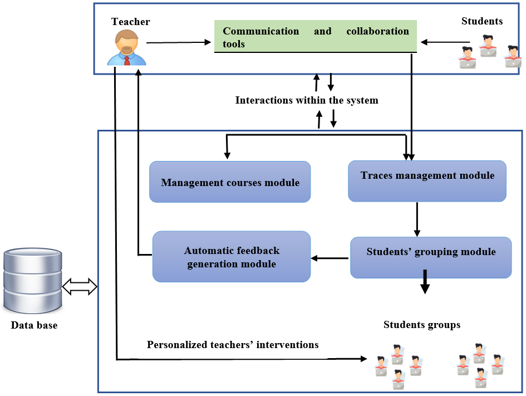
Therefore, the specific contribution does not lie in digital traces analysis, clustering, or automated feedback considered independently, but in linking engagement-based homogeneous group formation with group-level behavioral assessment and teacher-oriented automated feedback within the same pedagogical process. This process establishes a sequential pathway from students’ observable behaviors to targeted teacher intervention. The architecture implementing this process is presented in Figure 1, while its different stages are detailed in the following subsections.
Figure 1. Architecture of the proposed system
Before we present these principles in detail, we present the architecture of the proposed system in Figure 1. It consists of the following elements:
1. Management courses module: It is the module that manages learning resources. The student can pursue several subjects; each one is composed of a set of learning objects.
2. Traces management module: It collects students’ traces and calculates indicators that support group learning, and then evaluates each student's behavioral engagement level.
3. Student grouping module: The proposed grouping algorithm explained in the next section (balanced k-means) is used by this module to assign students to groups with homogeneous engagement profiles.
4. Automated feedback generation module: This module is employed to produce feedback after group formation based on group engagement measures.
The proposed system follows a data flow in which the behavioral engagement indicators calculated from students’ traces are used to form homogeneous groups, and the resulting group-level engagement measures are then used to generate contextualized automated feedback. The feedback is sent to the teacher on a weekly basis and indicates the engagement level of each group, providing information that can support the selection of appropriate pedagogical interventions.
The system also provides students with communication and collaboration tools and services such as messaging, forums, posting or sharing a publication, and proposing an idea.
In this environment, all students’ interactions with their peers are collected as traces. These are used to measure the students’ behavioral engagement levels through a set of indicators. Then, the system groups the students using this level of behavioral engagement. To create homogeneous groups, a balanced k-means clustering algorithm is used to ensure that all groups have approximately equal sizes.
In other words, students are grouped into homogeneous groups based on their level of behavioral engagement with the aim of generating automated feedback contextualized to each group's behavior and intended for the teacher. Based on the feedback, many strategies can be implemented: less engaged groups can receive additional encouraging messages, while more engaged groups can receive positive reinforcement. Recommendations for targeted actions, such as reminders, are also provided to improve engagement in less active groups. This approach helped the teacher to offer personalized instruction.
Figure 2. Steps of the proposed approach
The proposed approach has followed the following steps (Figure 2):
1. Collection of students’ digital traces.
2. Measurement of students’ behavioral engagement levels.
3. Formation of homogeneous groups based on students’ behavioral engagement levels.
4. Generation of automated feedback to support the teachers in their interventions.
3.1 Collecting students’ digital traces
During this step, the digital traces of all students is collected during their interactions with their peers in order to assess their behavioral engagement. Then, these traces are divided into four categories (Table 1): contribution traces, availability traces, social interaction traces and collaboration traces.
Table 1. Indicators related to students’ traces
|
Category of Digital Traces |
Example of Actions |
|
Contribution |
|
|
Availability |
|
|
Collaboration |
|
|
Social interaction |
|
3.2 Measurement of students’ behavioral engagement
In our system, we measure each student's behavioral engagement level based on their collected digital traces. To do this, we used mathematical formulas.
Therefore, Eq. (1) was applied to determine the behavioral engagement level of each student for each category.
$B E L_{-} C a t_c\left(S_i\right)=\sum_{i=1}^n A C_{j c i} / n$ (1)
where,
BEL_Catc(Si): The behavioral engagement level of the student Si regarding the category c of traces.
ACjci: Action/Traces j for an engagement according to the category number c (c = 1 – 4) of the student i.
n: The amount of actions/traces.
Within each traces category, student actions are treated equally, with no additional weighting. The indicators were operationally defined from observable digital traces in the learning environment but have not undergone independent psychometric validation.
So, each student Si is represented by a quadruplet (BEL_contci, BEL_AVci, BEL_SIci, BE_Collci).
Therefore, the categories of traces associated with contribution, availability, social interaction, and collaboration are represented by the behavioral engagement levels BEL_cont, BEL_AV, BEL_SI, and BEL_Coll, respectively. A data scale ranging from 0 to 1 was used to standardize these levels. This normalization changes all values to be in the interval [0, 1] while maintaining the original value distribution. Min-max normalization is used for this [39], and the following Eq. (2) yields the new normalized value BEL_Catc(Si)':
BEL_Cat $_c\left(S_i\right)^{\prime}=\frac{\text {BEL_Catc}\left(S_i\right)-\text {min}(\text {BEL_Catc})}{\max (\text {BEL_Catc})-\min (\text {BEL_Catc})}$ (2)
where,
min(BEL_Catc): The minimum of behavioral engagement levels of all students regarding the category of traces.
max(BEL_Catc): The maximum of behavioral engagement levels of all students regarding the category of traces.
3.3 Formation of homogeneous groups
In our system, a homogeneous grouping based on behavioral engagement is adopted in order to limit the heterogeneity of behaviors within groups, which promotes a better characterization of engagement profiles and, consequently, an improvement in the accuracy and effectiveness of the generated educational feedback.
The grouping is based on each student’s behavioral engagement level. The group formation process is a structured dynamic that allows a collection of individuals to become a cohesive and high-performing team. To do this, we propose an algorithm based on the balanced k-means technique (Algorithm 1), that optimizes the size of the groups, where the sizes of all the groups are equal, and forms homogeneous groups.
In this algorithm, for selecting the number of groups (k) in a balanced k-means distribution, we adapt the classical criteria while taking into account the constraint of equal group size. To do this, we use operational objectives analysis; in other words, we define k according to the desired target size for each group (e.g., if we have S students and want groups of size 4, then k = S / 4).
We then determine the optimal number of groups as follows: we randomly select four students as centers. Then, we calculate the maximum group size. After that, the distance between the student and each center is calculated. The centers are then sorted by ascending distance, and for each sorted center, the group size is compared to the maximum group size. Each student is assigned to a group. If a student doesn't have a group (groups are full or there are other students waiting to compare the smallest distance to them), the student in question is added to the waiting list. Students in the waiting list are then assigned using the same procedure if all others have been processed. This procedure is repeated until convergence, i.e., the new centers equal the old centers (i.e., the centers remain unchanged). Finally, all remaining students in the waiting list are assigned in the same way as the first assignment, except if the group size is less than the maximum group size plus one. In that case, the group is opened, and the student is added to it. And the maximum group size in our case becomes four or five. This is the procedure that determines how to obtain the optimal number of groups.
To evaluate the quality of a balanced k-means clustering (which imposes similar cluster sizes), we measured both the internal cohesion of the groups, their external separation, and adherence to the balance constraint.
To make this evaluation more convincing, a comparison with standard k-means is necessary. For example, the balanced k-means algorithm adds a constraint of equal size to each group, unlike standard k-means, which allows clusters to vary in size. The former guarantees uniform groups at the expense of inertial distance, while the latter optimizes only compactness.
|
Algorithm 1. Group formation algorithm (based on distance) |
|
Input: Dataset of S students (lines of the data matrix), where each student Si is represented by (BEL_contci, BEL_AVci, BEL_SIci, BEL_Collci) Output: M Groups of students: Group [M] Begin Initialize Randomly select 4 students as Centers [1..4] Initialize Groups [1..4] ← empty Initialize Waiting_List ← empty Calculate S = (Number_of_Students – Number_of_Students % 4) / 4 //S Maximum size of a group. // % is Modulo operator.
//First Assignment For each Student a in S do For i =1 to 4 do Calculate Distance_i between Student a and Center[i] End For Sort Center[i] by ascending distance Assigned ← False For each Center[i] sorted do If size (Group[i]) < S then Add Student a to Group[i] Assigned ← True Break End If End For If Assigned = False then Add Student a to Waiting List End If End For
//Assignment of Waiting List (Assignment of pending students (if all others have been processed)) For each Student b in Waiting_List do For i = 1 to 4 do Calculate Distance_i between Student b and Center[i] End For Sort Centers by Distance For each Center[i] do If size (Group[i]) < S then Add Student b to Group[i] Break End If End For End For
//Repeat until convergence Convergence ← False While Convergence = False do Copy Centers → Older_Centers For i = 1 to 4 do If Group[i] ≠ empty then Center[i] ← average (BEL_cont1, BEL_AV2, BEL_SI3, BEL_Coll4) End If End For If Centers = Old_Centers then Convergence ← True Else Reset Groups and Waiting_List Reassign all Students (as First Assignment) End If End While
//Final Assignment For each Student c remaining in Waiting_List do Calculate distances to centers Sort Centers For each Center[i] do If size (Group[i]) < S + 1 then Add Student c to Group[i] Break End If End For End For End |
3.4 Generated automated feedback to support the teachers in their interventions with each group
Teachers’ interventions are structured sets of actions aimed at transforming students’ behavior and fostering their learning process. In this work, we propose to support the teacher in the implementation of appropriate pedagogical interventions, enabling them to provide students with personalized feedback, encouragement, and reminders.
After forming homogeneous groups, each group engages collaboratively in the assigned learning activities on the online platform (our developed system). Using the stored traces, the system calculates the behavioral engagement level of each group for the different categories (contribution, availability, social interaction, and collaboration). This is done by calculating the average engagement of the members of each group for each category.
$B E L_{-} \operatorname{Cat}_c\left(G_m\right)=\sum_{i=1}^n \frac{B E L_{-} C a t_c(\mathrm{Si})}{n}$ (3)
BEL_Catc(Gm): The behavioral engagement level of the group Gm regarding the behavioral engagement category of their members.
n: The number of students in the group Gm.
Based on our previous work [5, 12], we propose three operational levels: low engagement (<0.5), intermediate engagement (0.5,0.8), and high engagement (≥0.8).
In this work, we used two types of feedback (Table 2): the first one is generated according to the group's engagement level (F1, F2, and F3), and the second is for the students’ progress level (F4 and F5).
According to the obtained behavioral engagement level of the group Gm regarding the behavioral engagement category of its members, our system generates the following feedback F1, F2, and F3 at the end of the first stage, and F4 and F5 at the end of the next stage. The feedback is sent to help teachers to make the appropriate intervention. F1, F2 and F3 are generated in accordance with the following rules:
•If BEL_Catc(Gm) < 0.5 then the system will send the feedback F1
•If 0.5 ≤ BEL_Catc(Gm) < 0.8 then the system will send the feedback F2
•If BEL_Catc(Gm) ≥ 0.8 then the system will send the feedback F3
The feedback items (F1, F2, or F3) are sent to teachers to make the appropriate intervention.
In the following stage, the system calculates the difference between the current behavioral engagement level and the previous one of the groups using the following formula:
$X=B E L_{-}\operatorname{Cat}_c\left(G_m\right) t_n-B E L_{-} \operatorname{Cat}_c\left(G_m\right) t_{n-1}$ (4)
where,
tn: the current stage.
tn-1: the previous stage.
If the difference X is positive, the system generates the feedback F4; otherwise, if it is negative, the system will generate the feedback F5.
Table 2. Example of generated feedback
|
Generated Feedback |
|
|
F1 |
Group Gm shows low behavioral engagement in this phase; Intervention is advised as soon as possible. |
|
F2 |
Group Gm shows moderate behavioral engagement, but personalized follow-up is recommended and may help maintain progress. |
|
F3 |
Group Gm maintains a high behavioral engagement; try to encourage them to continue in this way. |
|
F4 |
There has been an improvement for this group; please try to encourage it. |
|
F5 |
A decrease in engagement has been detected in this group. Please consider an appropriate educational intervention. |
To evaluate our proposal, we conducted two quasi-experiments (quasi-experiment 1 and quasi-experiment 2) with students at the University of Guelma in the department of computer science in two different learning contexts. These experiments were carried out under varying conditions, including differences in the academic level of the students and the teachers. Each experiment was analyzed separately. The first one, the core of this research, aimed to study the effect of automated feedback on improving students' behavioral engagement and their academic performance.
The second experiment was conducted as a complementary experiment in a different instructional context. Given the differences in students’ populations, academic level, course, and teaching conditions, it was not intended as an equivalent control or direct validation condition for the first experiment.
This experiment aims to address the following two questions:
RQ1. Does automated feedback based on a homogeneous grouping according to behavioral engagement improve that engagement?
RQ2. To what extent does automated feedback provided to the teacher on the behavioral engagement of a group of students influence their academic performance?
4.1 Participants and study design procedure
This study was conducted with 46 computer science students, divided between two separate quasi-experiments (Figure 3). For the first experiment, there are about twenty-seven (n = 27) third-year undergraduate students overall, such as 13 females and 14 males. For the second experiment, there are nineteen (n = 19) first-year engineering students, with 12 females and 7 males. Students are asked to respond to the activities (actions) that the developed system proposed through these experiments. These activities are related to behavioral engagement indicators.
Figure 3. Experimental process
The proposed approach was adapted into an online collaborative learning system. The latter provides the students with a set of tools that make it easier to carry out the various educational activities remotely, such as learning, assessment, communication, and collaboration. Furthermore, the developed system offers some tools for the teachers to create the content of the courses and the evaluation exercises. In addition, the system provides the students with more tools to facilitate collaboration among the groups.
These experiments are conducted during the second semester of the 2024–2025 academic year. In these experiments, two teachers created two courses. The first one is dedicated to the third-year students (license degree) where the students are asked, through the process of experiment 1, to engage in an online course: the "scientific writing" subject, while the second is devoted to the first-year students (engineer), where the students are required to take a course regarding the "computer architecture" subject. Like any online learning system, each student must enroll before using its services.
Before grouping students based on their behavioral engagement, an initial phase of interaction with the platform is implemented. During this phase, students complete various learning activities (viewing content, participating in discussions, etc.), thus generating learning data. This behavioral data is then collected and analyzed to assess each student's level of engagement. This step is essential, as it provides the information necessary to create homogeneous groups based on behavioral engagement level.
In the second phase of the learning process (after the grouping), each group is involved in a structured collaborative activity aimed at accomplishing the tasks assigned by the teacher on the studied subject, over a period of two weeks.
In each of the two experiments, students took a test designed to assess their academic performance. This assessment was conducted by distributing multiple choice questionnaires (MCQs) to students. These questionnaires were administered in person, with a set time limit for completion. For each course, two questionnaires were used: the first was administered after the second phase (pre-test), and the second was administered at the end of the third phase, during which an intervention was applied (post-test).
The pre-test was designed to assess students’ initial knowledge of the corresponding course, whereas the post-test assessed the acquired learning outcomes at a higher level of difficulty. Both tests were designed and evaluated by the teacher responsible for the corresponding course. Academic performance changes were assessed independently within each experiment by comparing the pre-test and post-test scores of the same population of students, rather than by comparing scores across the two experiments.
Academic performance assessment consistency. For each experiment, academic performance was assessed using two course-specific multiple-choice questionnaires: a pre-test administered before the teacher intervention and a post-test administered after the intervention. The assessments were developed according to the learning content and objectives of the corresponding course and were administered in person under a predefined time limit. Both questionnaires were evaluated by the teacher responsible for the course using the course-specific scoring procedure. The pre-test and post-test were therefore intended to provide a within-course measure of students’ change in academic performance. However, the study did not include a formal psychometric procedure to establish strict equivalence of item difficulty between the two questionnaires, nor a formal inter-rater reliability analysis. Consequently, we do not claim that the pre-test and post-test forms were psychometrically equivalent; rather, the results are interpreted as within-experiment changes based on the assessment procedures applied consistently within each course.
Regarding the teacher’s intervention in the first experiment, it is applied after receiving automated feedback based on the behavioral engagement of each group, which is generated by the system at regular intervals (each week) in order to inform the teacher about the group behavior and support the implementation of appropriate pedagogical interventions. In the second experiment, the teacher implemented a standard teaching intervention, corresponding to usual teaching practice, without resorting to automated feedback based on students' behavioral engagement.
4.2 Data collection and measurement
In this study, traces of students’ interactions were collected via the developed system and stored in its database. After data collection, four quantitative measures were performed to indicate the level of student behavioral engagement for each category before (pre-test behavioral engagement) and after the intervention (post-test behavioral engagement). These categories of behavioral engagement were: contribution, availability, social interaction, and collaboration.
Given the quantitative nature of the data from the pre-tests and post-tests, a parametric test was chosen.
A paired t-test was used to test the research hypotheses, using XLSTAT software. To complement the statistical significance results, Cohen’s dz effect sizes were calculated for the paired pre-test/post-test comparisons. These effect sizes provide additional information about the magnitude of the observed changes beyond statistical significance. In addition, 95% confidence intervals (CIs) were calculated for the mean pre-test/post-test differences to assess the precision of the observed changes. The corresponding 95% CIs are reported in Tables 3–6 and provide complementary information to the paired t-test results.
The four behavioral engagement dimensions (availability, contribution, social interaction, and collaboration) were defined a priori as distinct indicators, with a separate hypothesis for each dimension, and were therefore analyzed separately. No multiple-comparison adjustment was applied, and individual p-values were interpreted within the corresponding behavioral engagement dimension. The paired t-tests were used to assess pre-test/post-test changes within the same student population.
Table 3. t-test results for Sample 1
|
Indicators |
Situation |
N |
Mean |
Standard Deviation |
Difference |
t-Score |
p-Value |
Cohen’s dz |
95% Confidence Intervals (CIs) of Mean Difference |
|
Availability |
Before |
27 |
0.1070 |
0.26792 |
−0.24111 |
−5.763 |
<0.0001 |
1.11 |
[0.0010, 0.2130] |
|
After |
27 |
0.3481 |
0.26167 |
[0.2446, 0.4517] |
|||||
|
Contribution |
Before |
27 |
0.1033 |
0.25351 |
−0.16407 |
−2.174 |
0.039 |
0.42 |
[0.0030, 0.2036] |
|
After |
27 |
0.2674 |
0.28796 |
[0.1535, 0.3813] |
|||||
|
Social interaction |
Before |
27 |
0.0526 |
0.19901 |
−0.13778 |
−2.234 |
0.034 |
0.43 |
[–0.0261, 0.1313] |
|
After |
27 |
0.1904 |
0.29954 |
[0.0719, 0.3089] |
|||||
|
Collaboration |
Before |
27 |
0.07 |
0.267 |
−0.13963 |
−2.082 |
0.047 |
0.40 |
[–0.03, 0.18] |
|
After |
27 |
0.2137 |
0.30322 |
[0.093, 0.3337] |
Table 4. t-test results for Sample 2 (first-year students)
|
Indicators |
Situation |
N |
Mean |
Standard Deviation |
Difference |
t-Score |
p-Value |
Cohen’s dz |
95% Confidence Intervals (CIs) of Mean Difference |
|
Availability |
Before |
19 |
0.137 |
0.2241 |
−0.0105 |
−0.168 |
0.868 |
0.04 |
[0.029, 0.245] |
|
After |
19 |
0.147 |
0.2653 |
[0.019, 0.275] |
|||||
|
Contribution |
Before |
19 |
0.1300 |
0.30752 |
0.06579 |
0.707 |
0.488 |
0.16 |
[–0.0182, 0.2782] |
|
After |
19 |
0.0642 |
0.22838 |
[–0.0459, 0.1743] |
|||||
|
Social interaction |
Before |
19 |
0.05 |
0.229 |
−0.0263 |
−0.325 |
0.749 |
0.07 |
[–0.06, 0.16] |
|
After |
19 |
0.079 |
0.2507 |
[–0.042, 0.200] |
|||||
|
Collaboration |
Before |
19 |
0.079 |
0.2507 |
−0.00632 |
−0.079 |
0.938 |
0.02 |
[–0.042, 0.200] |
|
After |
19 |
0.0853 |
0.23232 |
[–0.0276, 0.1982] |
Table 5. t-test results for Sample 1 (cf. third-year students)
|
Situation |
N |
Mean |
Standard Deviation |
t-Score |
p-Value |
Cohen’s dz |
95% Confidence Intervals (CIs) of Mean Difference |
|
Before |
27 |
7.519 |
6.5332 |
−3.893 |
0.001 |
0.75 |
[4.934, 10.103] |
|
After |
27 |
8.96 |
8.031 |
[5.79, 12.14] |
Table 6. t-test results for Sample 2 (cf. first-year students)
|
Situation |
N |
Mean |
Standard Deviation |
t-Score |
p-Value |
Cohen’s dz |
95% Confidence Intervals (CIs) of Mean Difference |
|
Before |
19 |
13.079 |
2.3110 |
−3.041 |
0.007 |
0.70 |
[11.965, 14.193] |
|
After |
19 |
14.711 |
1.8052 |
[13.840, 15.581] |
4.3 Results
This study is based on two distinct quasi-experiments, each of which was conducted in a different context.
4.3.1 Students’ behavioral engagement results
One of the main objectives of this study was to evaluate the effectiveness of automated feedback provided to the teacher to support the implementation of appropriate educational interventions with homogeneous groups of students formed according to their level of behavioral engagement. To this end, a paired t-test was applied to calculate the difference in the value of each behavioral engagement indicator before and after the teachers’ interventions.
The teacher in experiment 1 followed an intervention based on automated feedback according to the behavioral engagement of the groups of students. Whereas, the teacher in experiment 2 followed a standard intervention corresponding to usual teaching practice, without using automated feedback based on the behavioral engagement of groups of students.
The results of the two experiments are presented separately, although they are based on common hypotheses.
Accordingly, changes in behavioral engagement and academic performance were assessed independently within each experiment by comparing pre-test and post-test measures for the same student population, rather than by directly comparing the two experiments.
These hypotheses were tested across the different behavioral engagement categories.
H01: Automated feedback provided to the teacher cannot enhance the students’ engagement for the availability indicator.
H02: Automated feedback provided to the teacher cannot enhance the students’ engagement for the contribution indicator.
H03: Automated feedback provided to the teacher cannot enhance the students’ engagement for the social interaction indicator.
H04: Automated feedback provided to the teacher cannot enhance the students’ engagement for the collaboration indicator.
The alternative hypotheses are:
H11: Automated feedback provided to the teacher can enhance the students’ engagement for the availability indicator.
H12: Automated feedback provided to the teacher can enhance the students’ engagement for the contribution indicator.
H13: Automated feedback provided to the teacher can enhance the students’ engagement for the social interaction indicator.
H14: Automated feedback provided to the teacher can enhance the students’ engagement for the collaboration indicator.
(1). Results for experiment 1 (third-year undergraduate students)
Table 3 displays the findings for each indicator for the average Sample 1 (experiment 1). The mean of the students before and after the intervention based on automated feedback differs significantly, according to the paired t-test table. For example, for the availability indicator, there is a significant difference between the students' mean before intervention (mean = 0.1070; standard deviation (SD) = 0.26792) and the mean after intervention (mean = 0.3481; SD = 0.26167).
This test reveals a significant difference for the four indicators: availability, contribution, social interaction, and collaboration. Since the calculated p-value is below the significance level of alpha = 0.05, we must reject the null hypotheses H01, H02, H03, and H04 and accept the alternative hypotheses.
In addition to statistical significance, the effect-size analysis showed differences of varying magnitude across the four behavioral engagement dimensions. Cohen’s dz values were 1.11 for availability, 0.42 for contribution, 0.43 for social interaction, and 0.40 for collaboration. These results provide additional information about the magnitude of the observed pre-test/post-test changes.
(2). Results for experiment 2 (first-year students)
Table 4 displays the findings for each indicator for the average Sample 2 (experiment 2). The mean of the students before and after grouping differs significantly, according to the paired t-test table. For example, for the availability indicator, there is no significant difference between the students' mean before grouping (mean = 0.137; SD = 0.2241) and the mean after grouping (mean = 0.147; SD = 0.2653).
Regarding the availability, contribution, social interaction, and collaboration indicators, since the calculated p-value was greater than the significance threshold of alpha = 0.05 (p > 0.05), we cannot reject the null hypotheses H01, H02, H03, and H04. Therefore, these indicators did not show any significant improvement (no improvement was observed).
The effect-size analysis further showed that the changes in behavioral engagement were small in experiment 2. Cohen’s dz values were 0.04 for availability, 0.16 for contribution, 0.07 for social interaction, and 0.02 for the collaboration dimension. These small effect sizes are consistent with the absence of statistically significant improvements and provide additional information about the magnitude of the observed changes.
4.3.2 Academic performance results
Regarding academic performance, pre-test and post-test scores were used to determine whether there was a statistically significant difference. We use the following research hypothesis to evaluate the results of the test of our system:
Null hypothesis H0: Automated feedback based on a homogeneous grouping of students cannot improve the academic performance of students.
Alternative hypothesis H1: Automated feedback based on a homogeneous grouping of students can improve the academic performance of students.
(1). Results for experiment 1
The academic performance level differences among students are computed within the same group to test our hypothesis for Sample 1 (cf. third-year undergraduate students). We got the following results after using the paired t-test. At 95% confidence (α = 0.05), a significant effect was detected (t-score = −3.893, p-value = 0.001). Furthermore, the pre-test mean (mean = 7.519, SD = 6.5332) and the post-test mean (mean = 8.96, SD = 8.031) were shown to differ significantly.
As a result, the difference was statistically significant. The null hypothesis H0 is rejected in favor of the alternative hypothesis H1, as the computed p-value is lower than the significance level of α = 0.05. The effect-size analysis indicated a Cohen’s dz of 0.75, providing additional information about the magnitude of the observed pre-test/post-test change in academic performance. These results indicate a statistically significant change in academic performance after the intervention.
(2). Results for experiment 2
Similarly, we computed the academic performance level differences among students in the same group to test our hypothesis for Sample 2 (cf. first-year engineers). We got the following results after using the paired t-test. At 95% confidence (α = 0.05), a significant effect was detected (t-score = −3.041, p-value = 0.007). Furthermore, the pre-test mean (mean = 13.079, SD = 2.3110) and the post-test mean (mean = 14.711, SD = 1.8052) were shown to differ significantly.
As a result, the difference was statistically significant. The null hypothesis H0 is rejected in favor of the alternative hypothesis H1, as the computed p-value is lower than the significance level of α = 0.05. The effect-size analysis indicated a Cohen’s dz of 0.70, providing additional information about the magnitude of the observed pre-test/post-test change in academic performance. These results are consistent with the improvement observed in academic performance and provide complementary evidence regarding the magnitude of this change.
4.4 Discussion
Our study aimed to examine the impact of automatically generated feedback sent to the teacher on group behavioral engagement in online collaborative environments, as well as on students' academic performance. This section presents the results in relation to the research questions formulated.
RQ1. Does automated feedback based on a homogeneous grouping according to behavioral engagement improve that engagement?
When investigating our first research question, we found in the first experiment that students showed an improvement in behavioral engagement across different categories in an online learning context, suggesting that the intervention based on automated feedback had a positive impact on their behavior. This improvement may be due to the fact that this feedback was generated for homogeneous groups and provided regularly, which fostered better behavioral regulation in a digital environment often characterized by a risk of disengagement. Furthermore, this may allow teachers to better adapt their interventions throughout the learning activities.
In contrast, the second experiment, with a teacher who used a usual pedagogical intervention method, did not show a significant improvement in behavioral engagement. This result may indicate that traditional teaching practices, when transposed online without specific adaptation, are not always sufficient to stimulate or maintain student engagement in an online environment. Indeed, the absence of targeted feedback mechanisms or personalized monitoring can limit the impact of the intervention on engagement behaviors.
In this context, the results also highlight the value of the proposed approach as a decision-making tool for teachers. Indeed, the system provides an indication of the group's level of engagement, which can help teachers better understand group’s dynamics and adapt their interventions accordingly. This ability to diagnose the group's state is a significant lever for proposing more targeted and appropriate teaching strategies.
Overall, these results suggest that structured interventions guided by engagement indicators are more effective than typical online teaching practices. They also highlight the importance of providing teachers with decision-making tools to better tailor their interventions to students' actual needs.
Concerning the second research question:
RQ2. To what extent does automated feedback provided to the teacher on the behavioral engagement of a group of students influence their academic performance?
Although Sample 1 benefited from the teacher’s interventions supported by automated feedback regarding the group's behavioral engagement, a significant improvement in performance was also observed in Sample 2. Therefore, the results do not demonstrate that the performance improvement depends on the use of automated feedback. Thus, the direct influence of automated feedback on academic performance cannot be clearly established.
The results suggest that automated feedback has a positive effect on students' behavioral engagement. However, no significant difference was observed in academic performance between the two experiments, with performance improving in both conditions. These findings highlight the value of integrating automated feedback mechanisms not only to enhance student engagement but also as a decision-making tool for teachers. By providing indicators of group engagement levels, the system allows teachers to adapt their teaching interventions based on the identified needs of students, which is particularly relevant in online learning environments.
Online learning platforms are of significant interest today. However, their use lacks effective engagement when carrying out the required activities. Therefore, researchers are seeking methods and techniques to improve students' engagement in distance learning courses. This study proposes an approach designed to support teachers’ pedagogical interventions through automated feedback based on students’ behavioral engagement in online collaborative learning. The approach relies on the automated generation of feedback based on group behavioral engagement, enabling teachers to identify groups requiring attention and to adapt their pedagogical interventions accordingly. Student groups are formed using the balanced k-means algorithm, based on four dimensions of behavioral engagement: availability, contribution, social interaction, and collaboration.
To evaluate the effectiveness of this approach, two quasi-experimental studies were conducted. The first quasi-experiment constituted the main evaluation of the proposed approach and involved 27 third-year computer science students using a pre-test/post-test design. The second quasi-experiment, involving 19 first-year engineering students in a different instructional context, was conducted as a complementary study to strengthen the robustness and external validity of the findings.
The results showed an improvement in behavioral engagement and academic performance among third-year students. Among first-year students, no significant improvement in behavioral engagement was observed, but an improvement in their academic performance was noticed. These findings suggest that the proposed approach has the potential to support teachers in monitoring and addressing students’ behavioral engagement within the evaluated online collaborative learning contexts. However, the improvement in academic performance cannot be directly attributed to automated feedback, as performance also improved in the second experimental context.
The findings should therefore not be generalized beyond the investigated contexts. This study opens several directions for further research:
First, we plan to conduct a controlled experiment, including an appropriate control group and random assignment of students, to more rigorously confirm the causal effect of automated feedback on student engagement and academic performance.
Second, larger and more diverse samples across different academic levels and multiple institutions, along with longer intervention periods and longitudinal evaluations, should be considered to assess the generalizability and persistence of the observed effects.
Third, teacher-related outcomes, including the quality of pedagogical decisions and perceived workload, should also be examined.
|
ACjci |
Action/Trace j for an engagement according to the category number c (c= 1...4) of the student i |
|
AI |
Artificial intelligence |
|
BEL_Catc(Gm) |
The behavioral engagement level of the group Gm regarding the behavioral engagement category of their members |
|
BEL_Catc(Si) |
The behavioral engagement level of the student Si regarding the category c of traces |
|
max(BEL_Catc) |
The maximum of behavioral engagement levels of all students regarding the category of traces |
|
MCQ |
Multiple choice questions |
|
min(BEL_Catc) |
The minimum of behavioral engagement levels of all students regarding the category of traces |
|
tn |
The current stage |
|
tn-1 |
The previous stage |
|
X |
The difference between the current level and the previous level of the group |
[1] Liu, Y.Y., Liu, Z.J., Wu, H.F., Yao, J.J., Manalo, E. (2026). Exploring the occurrence processes and behavioural patterns of socially shared regulation during online collaborative L2 learning. Learning and Motivation, 93: 102222. https://doi.org/10.1016/j.lmot.2025.102222
[2] Das, M., Ramalingam, M., Priyadarshini, S., Agrawal, M., Goyal, K. (2026). Thriving in disruption: Enhancing satisfaction through collaborative engagement. Global Business and Organizational Excellence, 45(2): 189-204. https://doi.org/10.1002/joe.70014
[3] Abola, P. (2026). Predictors of student disengagement in fully online higher education programs. PUPIL: International Journal of Teaching, Education and Learning, 10(1): 1-19. https://doi.org/10.20319/pijtel.2026.101.0119
[4] Fabian, A., Stein, X., Berens, F., et al. (2026). Investigating motivational fluctuation and dropout among talented primary school children in a self-paced online mathematics course. ZDM-Mathematics Education, 58(4): 727-739. https://doi.org/10.1007/s11858-026-01772-w
[5] Tadjer, H., Lafifi, Y., Seridi-Bouchelaghem, H., Gülseçen, S. (2022). Improving soft skills based on students’ traces in problem-based learning environments. Interactive Learning Environments, 30(10): 1879-1896. https://doi.org/10.1080/10494820.2020.1753215
[6] Yan, N., Au, O.T.S. (2019). Online learning behavior analysis based on machine learning. Asian Association of Open Universities Journal, 14(2): 97-106. https://doi.org/10.1108/AAOUJ-08-2019-0029
[7] Adam, M., Benlian, A. (2026). Leveraging digital trace data in teaching to improve students’ technology use and well-being. In Digital Trace Data Research in Information Systems, Cham: Springer Nature Switzerland, pp. 299-323. https://doi.org/10.1007/978-3-032-05497-5_13
[8] Alsahil, A., Abdel Latif, M.M., Alsuhaibani, Z. (2026). Exploring EFL learner engagement with different teacher feedback modes. Computer Assisted Language Learning, 39(1-2): 336-363. https://doi.org/10.1080/09588221.2024.2374785
[9] Zhang, Y., Hashemifardnia, A. (2026). Real-time AI-mediated peer feedback in L2 writing: a mixed-methods study of learner engagement and accuracy development. Computer Assisted Language Learning, 1-28. https://doi.org/10.1080/09588221.2026.2613722
[10] Al-Jarf, R. (2026). Collaborative learning and teaching in digital environments: A systematic review of two decades of research. Journal of Computer Science and Technology Studies, 8(4): 25-40. https://doi.org/10.32996/jcsts.2026.8.4.2
[11] Supriatna, U., Hoerudin, C.W., Kartika, I., Arifudin, O. (2026). The role of teachers in improving the quality of learning in Madrasah Tsanawiyah. International Journal of Science Education and Technology Management (IJSETM), 5(1): 45-56. https://doi.org/10.28301/ijsetm.v5i1.51
[12] Tadjer, H., Mehenaoui, Z., Lafifi, Y., Chemmakh, A. (2024). Improving temporal behavior based on students' traces in online-based learning environments. Journal of Universal Computer Science (JUCS), 30(10): 1371-1388. https://doi.org/10.3897/jucs.110356
[13] Lau, C. S., Erdmann, N., Mikkilä-Erdmann, M. (2026). Exploring real-time feedback seeking in an online learning task: A Clustering analysis. Eleed-e-Learning and Education, 1(se2026). https://doi.org/10.57813/eleed.v1ise2026.261
[14] Vilhunen, E., Vesterinen, V.M., Äijälä, M., et al. (2025). Promoting university students' situational engagement in online learning for climate education. The Internet and Higher Education, 65: 100987. https://doi.org/10.1016/j.iheduc.2024.100987
[15] Balalle, H. (2024). Exploring student engagement in technology-based education in relation to gamification, online/distance learning, and other factors: A systematic literature review. Social Sciences & Humanities Open, 9: 100870. https://doi.org/10.1016/j.ssaho.2024.100870
[16] Suartama, I.K., Sudarma, I.K., Sudatha, I.G.W., Sukmana, A.I.W.I.Y., Susiani, K. (2024). Student engagement and academic achievement: The effect of gamification on case and project-based online learning. Journal of Education and Learning (EduLearn), 18(3): 976-990. https://doi.org/10.11591/edulearn.v18i3.21349
[17] Wang, Y.H., Zuo, M.Z., He, X.C., Wang, Z.F. (2025). Exploring students online learning behavioral engagement in university: Factors, academic performance and their relationship. Behavioral Sciences, 15(1): 78. https://doi.org/10.3390/bs15010078
[18] Jagadish, D. (2014, April). Grouping in collaborative e-learning environment based on interaction among students. In 2014 International Conference on Recent Trends in Information Technology, Chennai, India, pp. 1-5. https://doi.org/10.1109/ICRTIT.2014.6996170
[19] Schmidt, H.G., De Volder, M.L., De Grave, W.S., Moust, J.H., Patel, V.L. (1989). Explanatory models in the processing of science text: The role of prior knowledge activation through small-group discussion. Journal of Educational Psychology, 81(4): 610. https://doi.org/10.1037//0022-0663.81.4.610
[20] Barkley, E.F., Major, C.H., Cross, K.P. (2014). Collaborative Learning Techniques: A Handbook for College Faculty. John Wiley & Sons.
[21] Ng, M.L., Bridges, S., Law, S.P., Whitehill, T. (2014). Designing, implementing and evaluating an online problem-based learning (PBL) environment–A pilot study. Clinical Linguistics & Phonetics, 28(1-2): 117-130. https://doi.org/10.3109/02699206.2013.807879
[22] Karsenti, T., Bugmann, J. (2016). Sustaining the motivation of MOOC participants: What are the effects of gamification, mobility, and the social dimension? International Journal of Technologies in Higher Education, 13(2-3): 133-149. https://doi.org/10.18162/ritpu-2016-v13n23-09
[23] Alonso-Mencía, M.E., Alario-Hoyos, C., Maldonado-Mahauad, J., Estévez-Ayres, I., Pérez-Sanagustín, M., Delgado Kloos, C. (2020). Self-regulated learning in MOOCs: Lessons learned from a literature review. Educational Review, 72(3): 319-345. https://doi.org/10.1080/00131911.2019.1566208
[24] Zhang, J. (2016). Can MOOCs be interesting to students? An experimental investigation from regulatory focus perspective. Computers & Education, 95: 340-351. https://doi.org/10.1016/j.compedu.2016.02.003
[25] Hmelo-Silver, C.E. (2004). Problem-based learning: What and how do students learn? Educational Psychology Review, 16(3): 235-266. https://doi.org/10.1023/B:EDPR.0000034022.16470.f3
[26] Gouasmi, N., Lamia, M., Lafifi, Y. (2026). A multi-label classification-based approach for dynamic learner grouping in social learning environments. Ingénierie des Systèmes d’Information, 31(1): 233-241. https://doi.org/10.18280/isi.310122
[27] Feng, S.H., He, B.Y., Gasevic, D., Kirkley, A. (2026). Heterogeneous interaction network analysis (HINA): A new learning analytics approach for modelling, analyzing, and visualizing complex interactions in learning processes. arXiv preprint arXiv:2601.06771. https://doi.org/10.48550/arXiv.2601.06771
[28] Busireddy, N.R., Kagita, V.R., Kumar, V. (2026). Group learning in recommendation systems: Towards adaptive and implicit group modeling. Scientific Reports, 16(1). https://doi.org/10.1038/s41598-026-36356-x
[29] Price, L., Richardson, J.T., Jelfs, A. (2007). Face-to-face versus online tutoring support in distance education. Studies in Higher Education, 32(1): 1-20. https://doi.org/10.1080/03075070601004366
[30] De Metz, N., Bezuidenhout, A. (2018). An importance–competence analysis of the roles and competencies of e-tutors at an open distance learning institution. Australasian Journal of Educational Technology, 34(5). https://doi.org/10.14742/ajet.3364
[31] Deng, Y., Ren, Z., Zhang, A., Chua, T.S. (2025). Towards goal-oriented intelligent tutoring systems in online education. ACM Transactions on Information Systems, 43(6): 1-26. https://doi.org/10.1145/3760401
[32] Liu, Y.X., Cao, Y.M. (2025). Teacher intervention during collaborative problem solving in mathematics classrooms in Mainland China. Behavioral Sciences, 15(3): 377. https://doi.org/10.3390/bs15030377
[33] Aisy, G.R., Imani, A., Kurniawati, N., Sulaeman, D., Rohaedi, T. (2025). Interactive teaching strategies for online English speaking classes: Engaging primary students. JELITA, 6(1): 193-203. https://doi.org/10.56185/jelita.v6i1.672
[34] Astrid, A., Rukmini, D., Fitriati, S.W., Syafryadin. (2021). Experiencing the peer feedback activities with teacher’s intervention through face-to-face and asynchronous online interaction: The impact on students’ writing development and perceptions. Journal of Language and Education, 7(2): 64-77. https://doi.org/10.17323/jle.2021.10585
[35] Menzel, L., Gombert, S., Weidlich, J., Fink, A., Frey, A., Drachsler, H. (2023). Why you should give your students automatic process feedback on their collaboration: Evidence from a randomized experiment. In Responsive and Sustainable Educational Futures, Cham: Springer Nature Switzerland, pp 198-212. https://doi.org/10.1007/978-3-031-42682-7_14
[36] Sellberg, C., Sharma, A. (2024). The automation of feedback in collaborative learning: A design ethnography of maritime simulation. Research Square. https://doi.org/10.21203/rs.3.rs-3993280/v1
[37] Aliakbari, M., Barzan, P., Sayyadi, M. (2025). Automated feedback vs. human feedback: A study on AI-driven language assessment. AI and Tech in Behavioral and Social Sciences, 3(2): 113-126. https://doi.org/10.61838/kman.aitech.3.2.9
[38] YildizDurak, H., Onan, A. (2026). A multidimensional comparative analysis of human expert vs. AI-driven feedback approaches on learner-centered and collaborative groups. Interactive Learning Environments, 34(7): 5194-5221. https://doi.org/10.1080/10494820.2026.2617987
[39] Dziechciarz, J.Z., Strahl, D., Walesiak, M. (1999). Data set normalisation for reference boundary system. Akademia Ekonomiczna Wroclaw, 915: 21-32. https://ssrn.com/abstract=2312433.