Rima Benfredj* | Farid Nouioua | Abderraouf Bouziane
© 2025 The authors. This article is published by IIETA and is licensed under the CC BY 4.0 license (http://creativecommons.org/licenses/by/4.0/).
OPEN ACCESS
In innovation adoption, individuals' decision-making process is shaped by innovation’s attributes and is primarily affected by their unique personality traits, which have a bearing on their perception levels. This current study introduces a novel personality-driven innovation adoption model that combines Rogers’ diffusion theory with the OCEAN (Openness, Conscientiousness, Extraversion, Agreeableness, and Neuroticism) personality model. Our approach accounts for the significant influence of individual differences in adoption decisions by using personalized features. We analyze ChatGPT adoption using a dataset of 38,939 tweets and user metadata after preprocessing. A BERT-Random Forest model predicts users' Big Five traits, which help refine innovation attributes such as relative advantage, uncertainty, and acceptability, ensuring the adoption process aligns with psychological factors. This proposed framework holds significant potential for forecasting individual adoption behaviors by acknowledging the relevance of individual psychological traits in the decision-making process. Furthermore, we compare our personality prediction approach with baseline models including LSTM + Random Forest, BiLSTM + Random Forest, and RoBERTa + Random Forest, and show that BERT + RF achieves the most realistic personality feature estimates. Incorporating personality-driven and recalculated perceived innovation attributes enhances the model's ability to simulate real-world adoption patterns, providing a deeper understanding of how innovations diffuse in social networks.
innovation adoption, Rogers’ diffusion theory, OCEAN, ChatGPT, BERT, Random Forest, agent-based simulation
In this increasingly interconnected world, the spread of innovation crosses borders and cultures, becoming a critical component in addressing broad issues and sustaining economic advancement. The rapid diffusion of technological innovations and novel approaches has the potential to significantly enhance healthcare, education, and environmental sustainability, among other fields. Understanding the mechanisms and conditions that drive global innovation dissemination allows policymakers, businesses, decision-makers, as well as societies to better leverage the potential of new ideas to encourage economic integration, increase competitiveness, and promote societal advancement.
Innovation diffusion theory is a crucial framework for understanding how new concepts, projects, and technologies are adopted and spread through society over time. This theory posits that the rate of adoption and diffusion is influenced by a range of factors, including innovation characteristics, communication channels used to promote it, the adopters’ characteristics, and the social system in which the innovation is being diffused. It simplifies the understanding of the various phases an innovation goes through, the different types of adopters involved, and the various factors influencing the diffusion process. The Diffusion of Innovation (DOI) has proven helpful for describing how innovations spread; however, it has substantial limitations in capturing the complexities of human adoption behaviors and decision-making processes due to its lack of focus on psychological dimensions.
Recent academic research highlights a growing interest in understanding the individual-level factors that influence innovation adoption, particularly the role of individual personality traits. Personality traits affect individuals' thoughts, behaviors, and decision-making [1]. One area of research [2-4] has investigated the openness to experience and neuroticism traits influence the adoption of e-technologies, mobile banking, and e-learning environments. Moreover, others have explored the concept of personal innovation which reflects an individual's openness to new experiences, risk-taking behavior, willingness to experiment with new technologies [5, 6], and extraversion [7]. Another area of research has focused on the role of risk-taking behavior in innovation adoption. Studies the adoption of blockchain technology [5] and cryptocurrencies [8] found that these traits is a key factor in innovation adoption.
While existing DOI models have provided foundational insights into how innovations spread, they frequently use aggregate perspectives (as in mathematical models) or structural factors as communication channels and adopter categories. These classic models, including the Bass and Logistic models, usually presume homogeneity among adopters and constant external factors, limiting their ability to capture individuals’ complex decision-making processes by ignoring individual heterogeneity and social network effects. Even more recent individual-centered approaches such as threshold and cascade models, account for individual-level dynamics and social network effects in which they tend to simplify decision-making processes.
Although some studies have begun to investigate the role of individual traits in innovation adoption, like openness, extraversion, or neuroticism, these investigations are usually restricted to specific technologies (e.g., e-learning, mobile banking), may be inapplicable to other contexts and fail to provide a generalizable framework. Critically, these research investigations frequently study personality in isolation, focusing solely on individual-level factors while ignoring other important elements of diffusion theory such as innovation characteristics, communication dynamics, and social system structure. This fragmentation emphasizes the need for a more comprehensive, personality-driven diffusion model that incorporates psychological variety with the fundamental features of innovation diffusion theory.
This study introduces two key contributions to the field of innovation diffusion research. Globally, we develop a novel personality-driven diffusion model that is designed to simulate the diffusion of innovation in a network or community of agents by incorporating all the elements of the innovation diffusion theory that led to the influence of the diffusion process, in addition to individual-level factors, such as personality traits.
The main contribution consists in combining the OCEAN personality model with Rogers’ model; as a theoretical model; with the main objective is to offer a personality-driven innovation diffusion model by highlighting the relevance of individual psychological traits in individual decision-making process.
We chose Agent-based simulation as key modeling approach given that it accurately represents individual-level heterogeneity, simulates social interaction with the complex and dynamic nature of real-world diffusion processes, and provides flexibility in modeling complex decision-making processes. Individuals are depicted as agents in this modeling approach, each one has a unique set of characteristics, such as perceived innovation attributes and Big five personality traits. Innovation defined with its five characteristics; relative advantage, complexity, compatibility, trialability, and observability. To explore the effect of these psychological features within multiple scenarios, we generate random values for agents' attributes such as personality traits, perceived innovation characteristics, and innovation attributes. This allows for a broader simulation of adoption behaviors, providing additional perspectives into how personality factors influence diffusion dynamics.
The second contribution is the application of this model to the case of ChatGPT adoption. We develop a hybrid model that leverages the contextual power of BERT with the decision-making strength of the Random Forest model, and using ChatGPT-related tweets and user metadata we predict the agents' Big Five personality traits. BERT is designed to capture nuanced meanings from text data, whereas Random Forest handles structured metadata. These predicted personality traits are subsequently used to recalculate perceived innovation qualities, which are incorporated into the simulation of our proposed model. Simulating the proposed model with these predicted values illustrates its ability to reproduce real-world adoption behaviors in social networks. Collectively, these contributions offer a more detailed perspective on the role of psychological qualities in innovation diffusion, allowing for more effective modeling of adoption behaviors across multiple contexts.
The rest sections of the paper are organized as follows, Section 2 provides a concise literature review, explaining the essential concepts of innovation diffusion theory and its models. The motivation and our contribution are subsequently highlighted in Section 3. Section 4 explores our work’ background, giving a thorough review of the OCEAN personality model and agent-based simulation. Section 5 expands on the proposed model by combining the Rogers and OCEAN models, followed by a presentation of the proposed innovation decision-making process in Section 6. In Section 7, we discuss the implementation and experimentation issues, along with a comprehensive analysis of the obtained results. Section 8 presents an empirical application of our novel personality-driven innovation adoption model on ChatGPT-related tweets dataset. Finally, in Section 9 we illustrate conclusions and future perspectives for further research.
2.1 Innovation diffusion theory
The concept of Diffusion of Innovation (DOI) is a theory that explains the adoption process of an innovation by modeling its entire life cycle in terms of communication and human information interactions. The study of new innovation adoption has been an area of research for several years [9], and Everett Rogers, a renowned American communication theorist and sociologist, was the most prominent researcher in the field of diffusion. In his book "Diffusion of Innovation Theory", Rogers explored all the factors and elements that affect the diffusion process and explained how, why, and at what rate new innovations spread through a social system. The theoretical adoption model (1962, 2003) gained widespread popularity and has been used as a framework in various fields of research such as medicine, agriculture, sociology, marketing, economics, and epidemiology [10].
The diffusion of innovation [11], “is the process through which an innovation is communicated over time among the members of a social system through certain channels”. This process involves four key components: innovation, communication channels, time, and social system [9].
(1) The notion of innovation relates to anything perceived as new by the potential adopters.
(2) According to Rogers [11], communication is “a process in which participants create and share information in order to reach a mutual understanding”. This communication occurs through channels between sources [9], the communication channels are the medium whereby the message is carried and exchanged [10].
(3) The time dimension is a key factor because whatever the innovation contribution, it diffuses slowly in the population. Thus, it takes a time from its availability to its diffusion [10, 12].
(4) The social system is a set of interrelated units that engage together to achieve a common goal.
The term adoption means “full use of an innovation as the best course of action available”, while rejection means “not to accept an innovation” [11]. Furthermore, the rate of adoption is defined as the number of individuals who adopt an innovation over some time [9], it reflects the population's level of innovation adoption as a function of time [12]. Originally, the diffusion rate increased gradually. Then, as time passes, it climbs, resulting in a period of rapid adoption from the initial period to saturation. It draws an S-shaped curve that diffusion models must adhere to [12].
Moreover, there are five significant predictors of adoption rate, which are called by the perceived innovation attributes, these following keys may influence an individual’s adoption decision.
Relative advantage is the perception level to which an innovation is perceived as better than other alternatives, which it supersedes [10, 13]. This factor is considered a prerequisite for adoption [14], and the higher the perceived relative advantage, the faster the adoption process is likely to occur [11].
However, relative advantage alone does not guarantee widespread adoption. Diffusion also requires that the innovation be compatible with the values, beliefs, history, and current needs of potential adopters.
Compatibility is defined as “the degree to which an innovation is perceived as consistent with the existing values, past experiences, and needs of potential adopters” [11]. Accordingly, with an incompatible innovation, it may take a long time and a lot of discussion before it becomes socially acceptable [10].
Complexity refers to the degree to which an innovation is perceived as difficult to understand and use [9]. The more complex an innovation is, the more challenging it can be for potential adopters to integrate it into their lives. Therefore, an innovation should be meaningful and clear to potential adopters to increase the likelihood of adoption [10]. Simplicity plays a crucial role in the adoption process, and innovations that are perceived as simpler are more likely to be adopted quickly [11].
Trialability is the degree of an innovation to be experimented with on a limited basic without significant losses, or having the ability of trying partially with the objective to eliminate the ambiguity. It is likely that the more an innovation is tried, the faster its adoption is [10].
Observability refers to how visible an innovation is to others. If a potential adopter notices others in his vicinity choosing a certain innovation, he will be compelled to talk about it and will regularly ask for evaluation information. As a result, observability can speed up the diffusion process. If the adoption and its comparable benefits are readily visible, the chances of adoption increase [10]. In summation, [11] suggested that innovation with more relative advantage, compatibility, simplicity, trialability, and observability will be diffused more quickly than others.
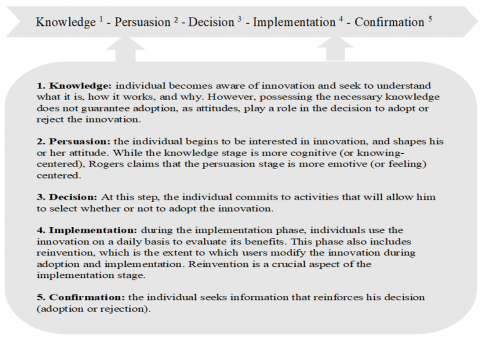
The decision to accept, adopt, and use the innovation does not have to be made immediately, rather, it does take time. Hence, time is a central notion for studying the innovation-decision process [13]. Rogers describes the adoption decision as a five-phase decision-making process [10] that begins with initial exposure to innovation until its adoption or rejection, as shown in Figure 1.
Figure 1. The innovation-decision process
2.2 Innovation diffusion models
Diffusion of innovation theory aims to expand our understanding of how and why the spread of innovations occurs by highlighting the influential factors that dictate the adoption rate of novel concepts, items, or technological advancements, ultimately, providing insight into the prediction of adoption [12]. Unlike the Technology Acceptance Model (TAM) and the Unified Theory of Acceptance and Use of Technology (UTAUT), innovation diffusion theory focuses on the context in which adoption decisions are made. As per this theory, people adopt innovations through diverse patterns that vary based on users’ characteristics [15].
Numerous models capturing the adoption of innovations have been proposed, with the diffusion of innovation theory serving as a theoretical framework. The study [16] divided the diffusion models into two categories: mathematical models and individual-centered models, or macro and micro models, respectively.
2.2.1 Mathematical models
In the first category, the best-known models are the Logistic family, the Gompertz, and the Bass model. These models are based on well-defined coefficients and centered on the adoption rate. They are clear and simple, making them easy to learn and implement, and have predictive value under stable conditions. However, these models have significant limitations. The stability of their parameters is frequently a worry, and they may fail to account for innovations that do not spread unless just a small number of potential adopters are assumed, despite the existence of a vast mass that cannot be reached through diffusion. Furthermore, these models imply that internal or external influences remain constant during the diffusion process, ignoring the effects of social networks and adopter heterogeneity [17]. Recent improvements have brought more sophisticated mathematical models that integrate dynamic parameters and the network effects to better reflect innovation diffusion complexity [18, 19].
2.2.2 Individual-centered models
More recent models have moved toward individual-oriented approaches that consider the social structure and communication channels involved in diffusion in order to address these shortcomings. Models for thresholds, epidemiology, and cascades are a few examples. According to the study [20], one of the fundamentals of the diffusion models at the individual level is population heterogeneity. These models have the benefits of considering population heterogeneity and the diverse behavior of individual adopters, as well as capturing the dynamic nature of the diffusion process. They include interactions from social networks, providing for a more sophisticated view. However, these models can be more complicated and computationally costly, needing specific data on people's behaviors and social networks, making accuracy and validation difficult.
Most significantly, the use of agent-based models (ABM) has shown to be quite successful in getting past many of the limitations of traditional diffusion models [21, 22]. ABMs allow for the representation of heterogeneous adopters and the dynamic nature of the diffusion process by simulating interactions between individuals (agents) inside social networks.
Innovation diffusion field has further benefited greatly from the advancement of social networks and social network analysis (SNA), which has made it easier for innovation sharing. SNA is a versatile and helpful tool since it can be used in conjunction with a variety of methodologies and theories to obtain pertinent network information for understanding the diffusion of innovation and evaluating the significance of various network actors [23, 24]. Recent research indicates the crucial significance of social network structures in affecting the rate and extent of innovation diffusion, highlighting network cohesiveness and the presence of key influencers [25]. Nevertheless, it challenges in term of data availability and collection.
3.1 Analysis of prior research
Although DOI has been useful in explaining how innovations spread, its lack of focus on psychological dimensions has severely limited its ability to capture the complexities of human adoption behaviors and decision-making processes. Despite advancements, a significant limitation of existing diffusion models is their neglect of innovation characteristics including relative advantage, compatibility, complexity, trialability, observability, and reinvention. These models illustrated that theoretically, but not explicitly, innovation exists in design.
Furthermore, the innovation adoption path is inherently a multi-step, complex process that updates individual's characteristics values at each stage. This process is frequently oversimplified by current diffusion models, which neglect the complex progression of decision-making processes. Diffusion models frequently rely on randomly selected early adopters, despite the fact that these individuals have certain characteristics and are not chosen at random in real social systems. To effectively diffuse innovation, opinion leaders with traits that match the innovation's features must be strategically selected. For that reason, a selection based on reasonable assessments is required, which are primarily based on the diverse personal characteristics of each category of adopters.
Individuals are naturally diverse, with a complex fabric of differences in social behaviors, interaction styles, and communication methods. Furthermore, people's decisions-making processes vary widely according to a variety of circumstances, including personality traits. This intrinsic variety adds richness and complexity to human relationships by emphasizing the uniqueness of each person's path within the fabric of social dynamics. However, current diffusion models ignore this aspect. They often depend on the principle that the decision to accept an innovation will be made because others neighbors have already done so, without personal evaluations, and individual choices in this case are influenced by social pressure.
Additionally, the most significant shortcoming lies in the social system used by the diffusion models in literature; the heterogeneity of the targeted population or potential adopters is inadequately represented due to substantial differences in the values of individual attributes. However, in diffusion modeling, it is critical to recognize that heterogeneity stems from the diversity of communication and interaction behaviors, perception phase, social influence and persuasion level, personal evaluation of the innovation, decision-making, and the range of values present within individual characteristics. Current diffusion models do not fully account for this complexity.
Likewise, the heterogeneity of the targeted population or potential adopters is inadequately represented, lacking to reflect the variety in communication and interactions behaviors, perception phases, social influence, personal evaluations of innovations, and decision-making processes. Current diffusion models do not fully account for this complexity.
3.2 Contribution
The field of innovation diffusion and adoption has seen significant advancements, highlighting that the success of an innovation is not only dependent on its intrinsic attributes but also deeply influenced by the characteristics of the individuals who adopt it. Traditional innovation diffusion models have mostly focused on external factors—like socioeconomic status, communication channels, and the attributes of the innovation itself—while have primarily overlooked the internal psychological factors that critically add a layer of realism and granularity to the diffusion model, capturing the psychological factors that drive the adoption decision. Specifically, personality characteristics play a pivotal role in shaping how individuals perceive, evaluate, and eventually adopt innovations. Psychological research demonstrates that individual differences, particularly those related to personality traits, directly affect behaviors and decision-making processes. This study aims to develop a novel personality-driven diffusion model that combines the OCEAN personality model with Rogers' diffusion theory. This model will include all the key elements of innovation diffusion theory as well as the individual personality trait as a significant psychological dimension.
Our approach departs from traditional models by explicitly relating individuals’ psychological factors to their perceptions of innovation traits (e.g., compatibility, complexity, uncertainty, and influence). For example, openness correlates with innovativeness, extraversion affects social relationships, and neuroticism is tied to uncertainty and influence. This level of integration provides a unique perspective on how individuals perceive and evaluate innovations based on their personality profile. Moreover, the time dimension in our model introduces the potential for changes in individuals’ perceptions and decisions over time, providing a more nuanced understanding of the diffusion process.
By integrating personality traits with key elements of diffusion theory—such as communication networks, social influence, and innovation characteristics—our model provides deeper insights into how different personality types drive communication, interaction, and decision-making. Importantly, this simulation framework presents a more heterogeneous and realistic depiction of the social system, including the classification of adopters (such as early adopters and opinion leaders) using psychological assessments, in contrast to existing diffusion models that typically treat adopters as homogeneous or segmented by simple demographic categories, which may overlook the complex psychological dynamics influencing adoption.
Agent-based simulation will be used to represent the dynamic and complex nature of real-world diffusion processes. The application of this model to ChatGPT adoption, which utilizing BERT and Random Forest to predict Big Five personality traits from ChatGPT-related tweets and user metadata, will provide a practical demonstration of the model's effectiveness. These predicted attributes will be used to calibrate perceived innovative qualities, which will then be incorporated into our simulation model.
To put together our research methodology, we required to focus on synthesizing existing literature models that form the foundation of our research. This section presents a helpful summary of agent-based modeling and simulation, as well as personality traits and models.
4.1 Agent-based simulation
In recent years, Agent-based modeling and simulation have emerged as promising approaches to overcoming the limitations of literature diffusion models and opening new research opportunities in diffusion studies.
Agent-based models prioritize theoretical development and incorporate individual heterogeneity [26-28], social influence [28-30], effectiveness of promotional strategies, and competitive diffusion [31] in the discussion of innovation diffusion. By analyzing real-world scenarios, this tool facilitates the development of theories and offers practical recommendations for management strategies and policies [27]. In the context of innovation diffusion is gaining popularity among researchers, by effectively modeling individual heterogeneity and interactions [32, 33]. The decision-making process is determined by a decision rule.
The ability of ABM to represent individual-level heterogeneity is one of its primary advantages, which encourages us to use it for our model. With this modeling approach, each agent is assigned a unique set of qualities (in our example, perceived innovation characteristics and the Big Five personality traits), reflecting the variety of manners in which people perceive and accept innovations. It enables a more realistic representation of real-world complexity, where no two people behave identically.
Moreover, ABM can simulate social interactions that are highly dynamic. Innovations are frequently adopted because of social influence as well as their attributes. Social influence is the result of contacts with peers, opinion leaders, and other influential individuals in the network. Using ABM, network effects can be simulated, representing the complex and dynamic nature of real-world processes of diffusion, where individuals' decisions may be influenced by their social connections. In contrast to traditional models that fail to capture this degree of detail, they often presume a static impact across the diffusion process.
ABM additionally offers opportunities for adaptability in modeling complex decision-making processes. According to our diffusion model, agents base their decisions on a combination of personality traits, perceived innovation characteristics, communication, and social impact, with individual adoption evolving over time. The possibility to model these behavioral dynamics makes ABM a valuable tool.
4.2 Personality model
Personality is a crucial aspect of human beings as it shapes their reactions and emotions to significant stimuli in their environment [31]. American psychologists, personality “is a stable and organized set of psychological traits and mechanisms that impact an individual's interactions and adaptations to their psychological, social, and physical surroundings” [31, 34].
According to psychoanalysis, an individual's personality develops throughout their life, with a critical period being the first eleven years. Shared experiences and interactions with others continue to shape the personality's development [31].
The literature offers many adjectives to describe personality, and various models have been proposed to categorize individuals based on these traits. In 1936, the groundwork for defining the fundamental aspects of personality was laid by compiling a list of 4,500 terms referring to personality traits [35]. Allport's list was later reduced to sixteen traits through component analysis [36]. Cattell's list was further investigated and condensed into five traits [37-40]. Goldberg's studies were expanded upon, confirming the validity of the model and resulting in the widely used "Big Five" personality model [40, 41].
The OCEAN model, known as the Five-Factor model (FFM), has become the standard for studying and analyzing personality [42]. The model includes five broad personality traits: Openness to experience, Conscientiousness, Extraversion, Agreeableness, and Neuroticism [34]. Each trait consists of several aspects or character traits.
Openness to experience (O) is associated with an appreciation for art, emotions, adventure, unusual ideas, curiosity, and imagination. As open individuals are more likely to seek out new experiences, in the diffusion of innovation field they are generally more receptive to novelty making them ideal innovators or early adopters in the diffusion process.
Conscientious (C) is related to self-discipline, compliance, goal-orientation, and organization rather than spontaneity. Conscientious individuals tend to thoroughly assess the practicality and long-term usefulness of innovations prior to adoption. This trait is especially important during the early and late majority stage, when adopters must be confident in the innovation's effectiveness and value.
Extraversion (E) is associated with energy, positive emotions, and a desire to be in the company of others—it is a go-getter. People with a high level of this feature are frequently active in social networks and communication, making them crucial participants in accelerating the diffusion of innovations. Their ability to influence others typically position them as early adopters who represent the innovation to their community.
Agreeableness (A) is the tendency to be compassionate and cooperative towards others rather than suspicious and antagonistic. Agreeable individuals usually behave later in the adoption cycle and are more willing to adopt innovations when they see others doing so because they are confident in their social networks' adoption and trust the recommendations of peers.
Neuroticism (N) is the polar opposite of emotional stability, characterized by a propensity to experience negative emotions such as anger, anxiety, or depression, as well as vulnerability [34]. Those with high levels of neuroticism tend to be risk-averse and resistant for adopting innovations, especially when there is ambiguity associated. Because of this, they are more likely to be laggard category, waiting the innovation will be well-established and the associated uncertainty have been minimized.
Each aspect of perceived personality is either equivalent (+) or diametrically opposed (-) [31, 34]. The OCEAN model examines people on five distinct personality traits independently of each other, not to categorize them into five groups, but to place them on five different scales, providing an overall picture of the person's character [31, 34].
5.1 Merging the diffusion and OCEAN model
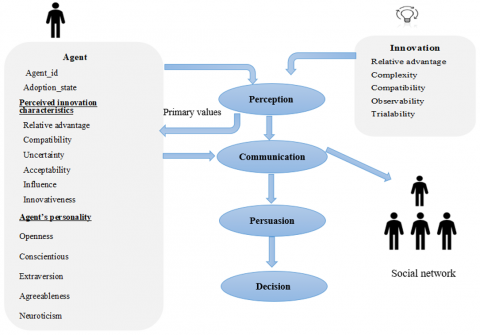
To achieve our research goals, two main models are successfully combined: Rogers’ and OCEAN model. More precisely, we proposed a novel personality-driven innovation diffusion model by merging the Rogers' innovation model as a theoretical model with the Big Five personality model, which reflects individual personality types. As illustrates the global architecture (Figure 2), the agent in its decision-making process goes through four phases; perception, communication, persuasion, and decision. The primary aim of this study is to emphasize that individual decision-making regarding the adoption or rejection of an innovation is not solely linked to individual and innovation characteristics. Rather, individual personality traits also play a crucial role in this process as expressed in Eq. (1).
$I D=f(I C, P I C, I P(B i g 5))$ (1)
where, the individual decision (ID) is a function (f) of three main factors: Innovation Characteristics (IC), Perceived Innovation Characteristics (PIC), and Individual Personality Traits (IP) based on the OCEAN model.
Figure 2. The global architecture of our model
Notice that IC comprises compatibility, complexity, trialability, observability, and relative advantage of the innovation, while IP include openness to new experience, conscientiousness, extraversion, agreeableness, and neuroticism.
As previously discussed, innovation is anything that potential adopters viewed as novel. Rogers identifies five key features that can be used to represent innovation. Similarly, our framework employs the following factors to characterize innovation:
5.1.1 Innovation five attributes
The fixed range chosen to reflect the innovation qualities depend on diffusion of innovation theory [11], agent-based modeling, and prior diffusion models [10]. Attributes like Complexity, Compatibility, and Trialability are represented as fixed real numbers within the [0,1] interval allowing for consistent interpretation—where 0 indicates the minimum presence of the attribute, and 1 indicates the maximum. Agent-based simulations frequently use [0,1] scales to facilitate the integration of attribute values into probabilistic decision rules. Relative Advantage is assigned as a random value that ranges from 1 to a ceiling to adjust agent-level heterogeneity in perceived benefit [10]. Observability is considered as an evolutionary attribute during agent communication, aligning with Rogers’ view that observability depends on social exposure [11]. These modeling approaches improve realism, enable flexible experimentation in simulating innovation diffusion.
5.1.2 Agent profile
The agent presents an individual, the majority of the necessary characteristics that define an individual are present in the following agent profile:
The value 0 indicates that the agent has not yet adopted the innovation, and 1 indicates that the agent has adopted it. This binary format facilitates the modeling of adoption dynamics, allowing for simple analyzing of adoption over time and accurate estimation of adoption rates across populations, it consistent with agent-based simulation processes.
Perceived innovation characteristics. After perceiving the innovation, the agent's perception of its characteristics is represented by the following values:
Agent’s personality. In this study, we utilized the Big Five model, to reflect an individual's personality. The model consists of five traits; Openness to Experience, Conscientiousness, Extraversion, Agreeableness, and Neuroticism; each assigned a value between 0 and 1 through random selection.
Agents possessing a high openness to experience value, for example, are inclined to actively seek out unusual experiences and encourage innovative ideas at an early stage. The extent of an agent's social network is correlated with extraversion; extraverted agents have more neighbors and engage in more social contacts. An agent's conscientiousness affects how carefully they assess innovation and look for information. Agreeableness influences an agent's susceptibility to social influence, increasing the likelihood that they would follow their peers' opinions; on the other hand, neuroticism is negatively correlated with adoption behaviors, decreasing an agent's social connectivity, hence, limiting their openness to innovation.
6.1 Perception
Humans display a diverse range of personality traits, which can influence their behavior. The existing literature highlights the favorable impact of the openness trait on innovativeness [44]; individuals who score higher on openness to experience trait are much more likely to come up with innovative product ideas. Furthermore, the studies [43, 45] discovered a substantial correlation between openness to experience and innovativeness in their studies. During the perception phase, our goal is to identify early adopter agents based on certain conditions. To determine the values of other personality traits, we use the openness to experience value as a reference point.
Procedure 1:
If (Openness to experience = maximum_value) then
// Openness to experience will take value in the interval [0.75,1] or [75%, 100%] we-use the two notations
Innovativeness $\leftarrow$ Innovativeness_ max
Acceptability $\leftarrow$ Acceptability_ max
Compatibility $\leftarrow$ Compatibility_ max
Non_Uncertainty $\leftarrow$Uncertainty_min
End If
If (Compatibility ≥ 90%) and (Acceptability > Uncertainty) then
Adoption_state $\leftarrow$ Adopter
We hypothesized that individuals with the highest openness value would demonstrate greater innovativeness, a stronger inclination towards accepting and participating in new experiences, and increased tolerance for ambiguity and risk-taking. These individuals would consider uncertainty as a routine aspect of life and would hold a significant appreciation for novelty and adaptation [43]. As a result, their compatibility with the new will be a great value.
The used numerical thresholds are based on Rogers' qualitative theories [11]. The Compatibility > 90% threshold, for example, indicates great consistency with user values and low perceived complexity to adoption. Similar procedural thresholds have been used in prior modeling work [10], where compatibility above 0.9 and Acceptability > Uncertainty indicated a strong match between an individual and the innovation.
6.2 Communication
As widely understood, novelty is often accompanied by uncertainty, given the lack of comprehensive information available. One of the most effective ways to diminish uncertainty is through communication. Communication involves direct interaction between individuals, thereby encouraging individuals to try new innovations [46]. In this study, through the communication phase, agents may increase the perceived innovation relative advantage and decrease its uncertainty, which might encourage adoption. Agents obtain more information by communicating to others about the innovation that helps in evaluating its relative advantage, compatibility with their values, and complexity. Communication contributes to the agents’ making decisions about adoption in this way.
6.2.1 Agent neighborhood and communication network
By default, we used the Moore neighborhood type metaphorically representing each individual's social environment, representing the individuals they can interact with. However, during our analysis the precise number of neighbors and the nature of relationships can differ due to the individual's personality traits, we specify the number of agent neighbors to be related to three personality traits; openness to experience, extraversion, and neuroticism; within the range of [0,8]. These characteristics influence an agent's propensity for social contact and, consequently, the size of their communication network.
Individuals with high levels of openness and extraversion tend to have excellent communication skills and are more likely to be talkative, conversational, curious, and prefer the company of others. On the other hand, people who are highly neurotic may have difficulties communicating with others effectively due to their emotional instability [47].
Procedure 2:
If (Openness to experience ≥ 0.75) or (Extraversion ≥ 0.75) then
number_agent_neighbors $\leftarrow$ 8
If (Neuroticism ≥ 0.75) then
number_agent_neighbors $\leftarrow$ random.choice [0,2]
Else
number_agent_neighbors $\leftarrow$ random.choice [3,7]
End If
End If
6.3 Persuasion
Peoples vary in their interpersonal relationships, and they tend to communicate with others in ways that reflect their personality and character. Ultimately, they may either impact their environment or be influenced by it.
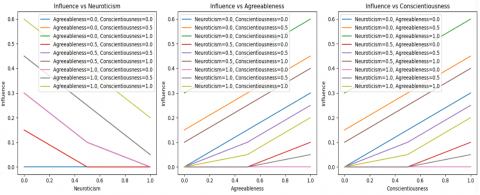
In social psychology, the relationship between personality traits and the susceptibility to social influence is still being addressed [48]. Personality is additionally viewed as a significant piece of knowledge in building effectiveness persuasive systems due to people's reactions to persuasive stimuli may differ depending on their personalities [48]. In this study, we aim to analyze the effect of personality traits particularly neuroticism, conscientious and agreeableness on social influence and persuasion value. After interacting with their neighbors, the agent gains a certain level of influence, which varies depending on the values of their personality traits.
Procedure 3:
While (number_agent_neighbors ≠ 0) then
If (Neuroticism ≥ 75%) then
Influence $\leftarrow$ Influence_ min
// the attribute influence will take the min value in the range [0, 0.2]
Else
If (Conscientious ≥ 75%) or (Agreeableness ≥ 75%) then
Influence $\leftarrow$ Influence_ max
Observability $\leftarrow$ 1
Uncertainty $\leftarrow$ Uncertainty – Trialability
Relative advantage $\leftarrow$ Relative advantage + Influence
End While
Individuals who are agreeable tend to be more inclined to agree with others' opinions, making them more likely than others to follow social norms. Conscientious individuals tend to exhibit goal-directed behavior, including planning, organization, and adherence to rules and norms [42]. Therefore, individuals who are more inclined to conform to social norms and rules are likely to be more susceptible to influence from others.
6.4 Decision
At the end of the process, the agents acquire a comprehensive understanding of the innovation, along with the essential values that enable agents to make their final decision. Agents, in our modeling, have a binary decision between adopting or rejecting the innovation. The decision significantly driven by the relative advantage, compatibility, and uncertainty values. Adoption is considered a final, one-time decision; partial adoption, discontinuous or reversed decision are not supported.
Procedure 4:
If (Compatibility ≥ 90%) and (Uncertainty ≤ 10%) then
Adoption_state $\leftarrow$ Adopter
Else
If (Acceptability ≥ 75%) and (Uncertainty < 20%) and (Relative advantage > 0) then
Compatibility $\leftarrow$ Compatibility_max
End If
The final decisions conditions (e.g., Compatibility > 90% and Uncertainty < 10%) aim to identify agents who perceive the innovation as highly compatible and low-risk. Although these thresholds are commonly used in diffusion models [10].
We have performed a number of scenarios which are described down. We changed the system settings in these scenarios in order to see how the simulation results vary.
Initial scenario.
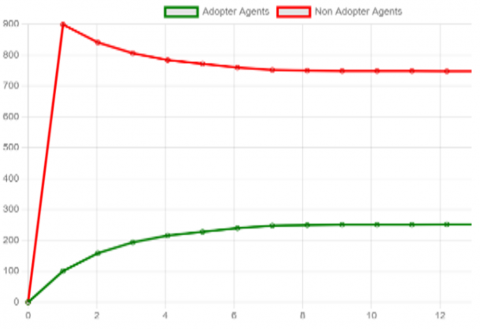
For this run, we selected a population of 1000 agents, each equipped with a list of randomly generated attributes. To start the simulation, we assigned 25% of the agents as initial adopters to represent an early, yet non-negligible, phase of diffusion (agents that have already adopted the innovation). This percentage was chosen as a modeling assumption to ensure the simulation starts with a sufficiently active base of adopters to enable examining subsequent diffusion dynamics in the network. While the remaining 75% represented non-adopter agents.
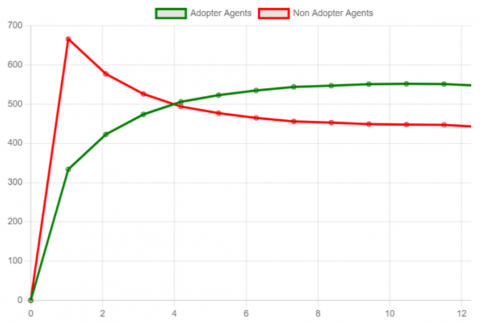
As we observe the adoption curve from t = 0 to t = 6, shown in Figure 3 (in which adoption rate presented with green curve and non-adopter agents with red curve), we witness a steady increase. At t = 0, only a fraction of agents had embraced the innovation. However, as time passed, the adoption rate increased significantly, reaching an interesting inflection point around t = 6. This increase in adoption indicates that a critical mass of agents understands the benefits or value proposition of the innovation. Following that, at t = 7, we noticed a stabilization in the adoption curve, indicating a saturation point where the bulk of potential adopters had already integrated the innovation into their daily routines. Notably, our basic model, which excludes complex influences like individual personality traits, converges on a 50% adoption rate. This finding underscores the logical and consistent flow of our basic model.
Figure 3. The result of the basic algorithm
Scenario 1.
The selection of opinion leaders’ group in literature models is done at random; this step necessitates reasonable evaluations. Selecting opinion leaders for successfully disseminating an innovation requires examining their personality traits and strategically matching them to the innovation's attributes to increase the adoption rate.
An opinion leader is described in our model as an agent who has already adopted the innovation and whose primary responsibility is to exert a sizable degree of influence within their network, including the ability to influence the opinions of their neighbors. Beyond that, we have added supplementary personality factors to this category. Determining the personality traits of opinion leaders is dependent on the innovation itself; what type is it? Its characteristics, and in which context and field?
To illustrate the effect of opinion leaders' personalities on the influence of peer opinions and decisions, as well as to ensure the validity of our proposition. We simulate the following scenario.
With a population of 1000 individuals, we assigned 75% as non-adopters and 25% as opinion leaders (as we assigned above in Initial scenario to show the difference in results). In this case, opinion leader is adopter agent who is also extraverted individual. Opinion leaders with high extraversion are energetic, socially inclined, and enjoy the company of others. They thrive and feel at ease in relationships, and they frequently maintain a happy and engaging manner.
Comparing the resulting adoption rate (Figure 4) of this scenario to the curve of the preceding scenario (the initial scenario) where such considerations are absent, demonstrates that strategically choosing opinion leaders through logical examination improves and increases the adoption rate, supporting our proposition. Note that in both scenarios, we used the same population and sub-division. This demonstrates that extraverted opinion leaders are more likely to drive adoption rates for innovations requiring for social interaction, community engagement, and frequent user interaction. Their persuasive communication style and propensity for thriving in social situations enable them to persuade others to adopt the innovation. The findings of this case study illustrate that the diffusion process can be greatly accelerated by selecting opinion leaders based on innovation features, especially when the innovation is driven by social factors.
Figure 4. The innovation adoption rate with a population of 1000 agents, 25% opinions leaders and 75% non-adopter agents
Scenario 2.
This scenario aims to evaluate the factor of the openness to new experiences society. As we just indicated, our goal is to examine how the five personality qualities affect people decisions. For this experiment, we assume that 75% of agents have the highest level of openness trait.
Individuals with high openness character are innovative personalities and more likely to immerse themselves in unusual experiences.
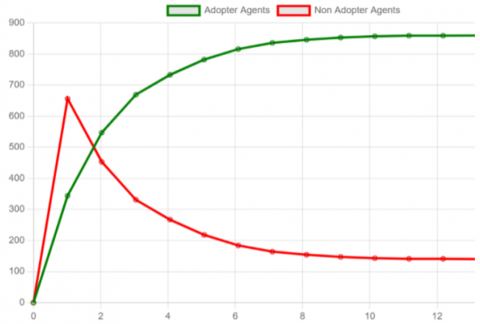
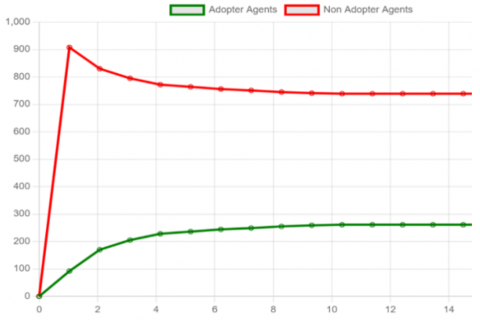
Figure 5. Openness to experience situation
Following the code's execution, the results, as depicted in Figure 5, suggest a significant correlation between openness to new experience and innovation adoption. The adoption rate curve increased and stabilized at t = 11, indicating that the highest adoption percentage was achieved at that point in time.These findings support our earlier suggestion that societies with greater openness to new experiences tend to be more innovative and adaptable. Individuals with high openness traits may be more willing to take risks and embrace new innovation. This propensity towards novelty and innovation not only promotes a more dynamic and innovative society, but it also raises the adoption rates of innovations.
Furthermore, these results underscore the crucial importance of nurturing a culture of openness within a society, as it appears to be a key driver of innovation and adaptability. In conclusion, the relationship between openness to new experiences and innovation adoption is dynamic one, offering valuable insights into the factors that influence a society's acceptability of innovations. Therefore, the early adopter category is absolutely linked to the trait of openness to new experiences.
Scenario 3.
In contrast to the last scenario (scenario 2), this scenario assumed that the population being studied had reached the highest level of neuroticism, which is characterized by erratic emotions and difficulty in communicating with others.
The findings gleaned from this scenario, as illustrated in (Figure 6), when compared to prior scenarios, such as Scenario 2, where openness to new experiences significantly increased adoption rates, we notice a clear contrast: neuroticism leads to less peer influence and a lack of exposure to new ideas, resulting in a longer and lower overall adoption rate.
Figure 6. Neurotic situation
The findings of this scenario reveal a substantial correlation between high levels of neuroticism and lower rates of innovation adoption. Individuals with high neuroticism frequently exhibit unstable emotions and have fewer social relationships, limiting their exposure to innovation. Their unwillingness to participate in social networks, as well as their predisposition to reject external influences, particularly those from opinion leaders, limit their opportunity to get informed about novel innovations. The lack of social connection and exposure considerably reduces their readiness to adopt innovations.
Scenario 4.
The findings of this experiment offer valuable insights into the importance of incorporating personality traits, specifically neuroticism, conscientiousness, and agreeableness when examining persuasive dynamics. Our study aimed to understand how these traits might affect an individual's susceptibility to persuasion and social influence. Initially, we hypothesized that individuals with high levels of conscientiousness and agreeableness would increase susceptibility to persuasion value, whereas neuroticism would reduce it.
Concerning the impact of conscientiousness and agreeableness on persuasion, the results, as represented in (Figure 7), showed no significant influence on the adoption curve. These findings are consistent with previous research [42], which suggests that these traits alone may not be sufficient to explain differences in levels of persuasion.
Figure 7. Conscientious, agreeableness, and neuroticism environment
In contrast, our hypothesis regarding the influence of neuroticism finds empirical validation. The results reveal that individuals with high neuroticism scores demonstrated a limited ability for social influence and exhibited ineffective communication skills. This suggests that neuroticism may indeed play a pivotal role in resistance to persuasive efforts. It is noteworthy that these results align with the results of the recent scenario (Scenario 3) that found individuals high in neuroticism had weak peer influence and ineffective communication skills.
In conclusion, this scenario shows that, although agreeableness and conscientiousness may not directly influence adoption behaviors, neuroticism poses a significant obstacle to the adoption of innovations since it decreases social engagement and increases resistance to persuasion. These findings highlight the intricate role that personality qualities play in shaping adoption behaviors and imply that persuasive strategies aimed at emotionally stable individuals may work better.
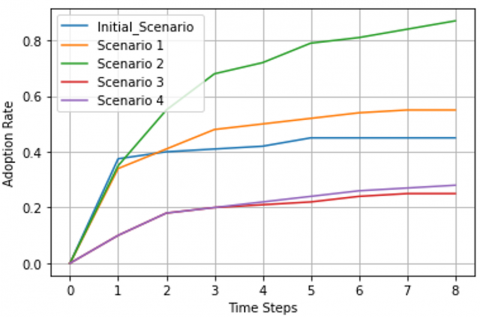
Examining the combined adoption rate curves across various scenarios reveals the impact of personality factors on innovation adoption. Each scenario reflects a unique combination of personality traits, and analyzing their combined effect highlights how individual variances influence the adoption rate. The combined adoption rate curves (Figure 8) presented below demonstrate that peak adoption rates vary across scenarios, explaining how personality traits influence the rate at which individuals accept innovation.
Figure 8. The adoption rate of innovations across scenarios
In this section, we undertake to evaluate the performance of our suggested personality-driven innovation adoption model. Previously, we generated agent profiles with random values. Subsequently, for a more robust assessment, we are currently applying the model on a real social network. We rely on a hybrid model of BERT and Random Forest to forecast Big Five personality traits from ChatGPT-related tweets and user metadata. The perceived innovation attributes are subsequently processed and regenerated using sigmoid, mean, or weighted functions.
The original dataset for this study included ChatGPT-related tweets and user metadata, such as username, user description, followers, and hashtags. The dataset is freely available on the study [49]. This dataset was selected due to its relevance to our study focus on ChatGPT adoption and its complete inclusion of user information, which allows for personality trait evaluation.
It is critical to recognize the dataset biases. Twitter users do not represent the broader population; previous research has indicated that Twitter demographics turn towards younger and male users [50, 51]. This demographic imbalance may have an impact on the generalizability of our findings, particularly in terms of adoption behaviors that vary by age and gender group. Therefore, precaution is required when extending these results to larger or older groups.
8.1 Data preprocessing
The preprocessing phase requires several steps to ensure data quality and relevance
8.2 Data analysis techniques
8.2.1 Model choices for OCEAN prediction
Given that the original dataset contained both textual data and structured data, we developed various compositional models of BERT and Random Forest (BERT-RF), LSTM and Random Forest (LSTM-RF), BiLSTM and Random Forest (BiLSTM-RF), and RoBERTA and Random Forest (RoBERTA-RF) to achieve accurate and reliable predictions of users' Big Five personality traits.
Table 1. Predictive model performance: Variance, range, and stability
|
OCEAN Traits |
LSTM_RF |
BiLSTM_RF |
RoBERTa_RF |
BERT_RF |
|
Variance of Personality Traits |
||||
|
Openness |
0.014574 |
0.014524 |
0.037718 |
0.070848 |
|
Conscientiousness |
0.013968 |
0.014960 |
0.045071 |
0.067071 |
|
Extraversion |
0.014474 |
0.014423 |
0.037827 |
0.009494 |
|
Agreeableness |
0.013609 |
0.015288 |
0.039206 |
0.010071 |
|
Neuroticism |
0.013630 |
0.014934 |
0.009764 |
0.009936 |
|
Range of Personality Traits (Max - Min): |
||||
|
Openness |
0.871856 |
0.894430 |
0.955645 |
0.992629 |
|
Conscientiousness |
0.970149 |
0.907778 |
0.970631 |
0.982802 |
|
Extraversion |
0.844633 |
0.939326 |
0.967033 |
0.500000 |
|
Agreeableness |
0.810405 |
0.971067 |
0.934661 |
0.728520 |
|
Neuroticism |
0.844237 |
0.866604 |
0.500000 |
0.500000 |
|
Predictive Stability Across Multiple Runs: |
||||
|
Openness |
0.975363 |
0.976520 |
0.990528 |
0.999783 |
|
Conscientiousness |
0.975470 |
0.976543 |
0.990560 |
0.999791 |
|
Extraversion |
0.975519 |
0.976571 |
0.990627 |
0.999779 |
|
Agreeableness |
0.975745 |
0.976332 |
0.990677 |
0.999789 |
|
Neuroticism |
0.975640 |
0.976618 |
0.990544 |
0.999798 |
8.2.2 Personality traits prediction using BERT-RF model
Our hybrid model combines the strengths of BERT, as pre-trained language model adept at capturing contextual information and nuances in language by generating embeddings from preprocessed tweets and user metadata. BERT embeds the input text into a high-dimensional vector space reflecting the contextual relationships among words. For user metadata, a metadata vector is preprocessed to normalize numerical features and encode categorical features. These features can subsequently be fed into a Random Forest classifier; a machine learning algorithm, which succeeds at performing high-dimensional data and identifying complex relationships between features and personality traits. By combining these two components, our model can take advantage of each's strengths to make accurate personality characteristic predictions. Combining the steps, the overall model function can be written as follows.
$\begin{gathered}P_i=\text { Random Forest } \\ \left(\left[\operatorname{BERT}\left(\operatorname{Tokenize}\left(T_i\right) ; \operatorname{Normilaze}\left(M_i\right)\right)\right]\right)\end{gathered}$ (2)
Textual features (Ti) are processed through BERT. Metadata (Mi) is normalized. The outputs are fused and passed to the Random Forest for personality prediction. (Pi) = [pO,pC,pE,pA,pN], predicted scores for the Big Five personality traits: Openness, Conscientiousness, Extraversion, Agreeableness, and Neuroticism.
The resulting new dataset includes both the original user ChatGPT-related tweets, user metadata, and predicted personality trait values (Openness, Conscientiousness, Extraversion, Agreeableness, and Neuroticism), which were used as inputs in the personality traits-driven innovation diffusion model.
8.2.3 Perceived innovation attributes processing
In this part, we rely on predicted personality traits to derive the perceived innovation characteristics values, which include relative-advantage, acceptability, uncertainty, compatibility, influence, and innovativeness.
$\begin{gathered}\text { Relative - advantage }= \\ \min (10, \text { max }(0,(\text { Relative_advantage } \times \\ \left.\text { weight }_{\text {Relative-advantage }}\right)+(\text { Openness } \times 10 \times \\ \left.\left.\left.\text { weight }{ }_{\text {Openness }}\right)\right)\right)\end{gathered}$ (3)
$\begin{gathered}\text { Acceptability }= \\ \text { mean(Extraversion, Agreeableness) }+\epsilon\end{gathered}$ (4)
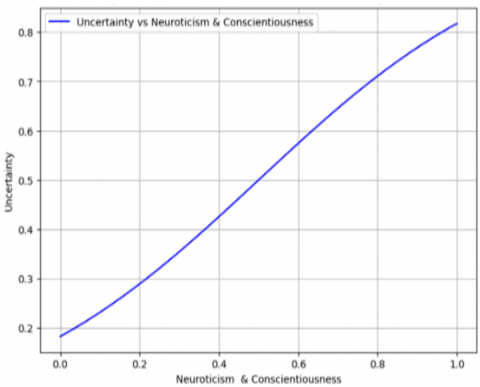
$\begin{gathered}\text { Uncertainty }=\sigma(\alpha \cdot \text { Neuroticism }-\beta \cdot \\ \text { Conscientious }+ \text { offset }+ \text { external_factors })\end{gathered}$ (5)
where:
The curve (Figure 9) depicts the typical behavior of the sigmoid function.
$\begin{gathered}\text { Compatibility }=\min \left(\max \left(0,\left(\text { weight }_{\text {Openness }} \cdot\right.\right.\right. \\ \text { Openness }+ \text { weight }_{\text {Conscientious }} \cdot \\ \text { Conscientiousness }+ \text { weight }_{\text {Agreeableness }} \cdot \\ \text { Agreeableness })), 1)\end{gathered}$ (6)
$\begin{gathered}\text { Influence }=\min \left(\max \left(0,\left(\text { weight }_{\text {Neuroticism }} \cdot\right.\right.\right. \\ \text { Neuroticism }+ \text { weight }_{\text {Agreealeness }} \cdot \\ \text { Agreeableness }+ \text { weight }_{\text {Conscientious }} \cdot \\ \text { Conscientious }+), 1)\end{gathered}$ (7)
$\begin{gathered}\text { Innovativeness }=\min \left(\max \left(0,\left(\text { weight }_{\text {Openness }} \cdot\right.\right.\right. \\ \text { Openness }+ \text { random_factor })), 1)\end{gathered}$ (8)
Figure 9. Sigmoid function curve
Figure 10. Influence curve derived from neuroticism, agreeableness, and conscientious
8.3 Application of the proposed model: Results and discussion
This subsection describes the application of our personality-driven innovation diffusion model to forecast the user adoption behavior of ChatGPT. As input, we utilized the original dataset combined with the regenerated perceived innovation traits and predicted OCEAN values (Openness, Conscientiousness, Extraversion, Agreeableness, and Neuroticism).
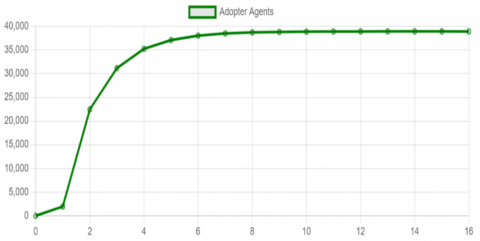
We examined the influence of different personality qualities on the adoption process by combining these real data sources. Our methodology included the aforementioned four main phases of our proposed individual decision-making model perception, communication, persuasion, and decision (see 6. The proposed innovation-decision process section). We assessed the user's adoption of the innovation based on their personality qualities by evaluating compatibility, acceptability, uncertainty, and social influence level. Then, we analyzed how these influence user adoption behavior and decisions over time. Subsequently, identified the state of adoption (Adopter or Non-Adopter). This application yielded a predicted adoption rate curve for ChatGPT (Figure 11), providing insights into how different personality factors, perceived innovation qualities, social interaction, and influence affect adoption behavior.
Figure 11. ChatGPT adoption rate curve
The resulting ChatGPT adoption rate curve follows a pattern similar to the S-curve commonly seen in innovation diffusion models. This curve begins with a small number of early adopters, and then accelerates as more users adopt the innovation, finally reaching saturation. These stages highlight the importance of personality factors and perceived innovation qualities for determining adoption behavior.
During the initial phase, early adopters with specific personality attributes (such as high Openness, innovativeness, and in some cases high extraversion) rapidly accepted ChatGPT. Understanding these characteristics can assist target marketing efforts and initial implementation strategies aimed at attract this category.
As the innovation obtains awareness and credibility, its adoption rate accelerates, owing to social interaction and influence impact. Communication and word-of-mouth raise innovation relative-advantage, reduces uncertainty value, and ultimately increases the adoption rate. This stage corresponds to the steepest phase of the S-curve. Social networks and providing positive user experiences can significantly increase adoption rate during this stage.
Finally, the adoption rate curve becomes saturated, indicating that the majority of potential users have already used ChatGPT. This pattern demonstrates the dynamic interaction of individual personality traits, perceived innovation characteristics, and social influences in shaping the adoption rate. Strategies should focus on maintaining user engagement and looking into new features or enhancements to keep users interested.
Although the adoption curve is similar to the classic S-curve, the integration of unique factors such as personality traits, perceived innovation characteristics, and the proposed personality-driven decision-making model provides an in-depth comprehension of user adoption behaviors in this context.
8.3.1 Misclassified adopters
In our simulation, misclassified adopters are agents whose adoption decisions depart from predicted outcomes based on their personality profiles and estimated influence factors. For example, agents who have high level of neuroticism or low openness occasionally adopted early, but some with high extraversion did not adopt completely. These scenarios are not fundamentally rather highlight the complexities and heterogeneity of human behavior. Furthermore, random variables in agent-based simulation and social influence can contribute to such results. Addressing these misclassifications is significant since it demonstrates the model's realism in simulation and probabilistic human decisions. Future improvements could include more external factors to eliminate this variation.
In this work, we initially propose a novel personality-driven innovation diffusion model for predicting individual adoption behaviors, merging Rogers' innovation diffusion model with the OCEAN personality model (Openness, Conscientiousness, Extraversion, Agreeableness, and Neuroticism). This integration provides a sufficiently comprehensive framework that considers all factors influencing an individual's evaluation of an innovation, including its characteristics, communication channels, social influence and persuasion, and the influence of personality traits on an individual's communication behavior and decision-making.
We developed our model as a general framework that consists of four core methods: perception, communication, persuasion, and decision, with the main focus on individual personality traits, using the OCEAN model to ensure that personality differences were considered. Furthermore, we explored the impact of personality traits on communication behaviors and the decision-making process when encountering a new innovation. We simulated individual decision-making in a network or community using agent-based modeling. To ensure unbiased results, we generated random values for agent attributes, which were divided into intervals. The combination of these attributes with specific values had a certain probability of launching a specific outcome.
Our findings validate prior researches, and align with our initial hypotheses. Specifically, Openness to new experiences was found to positively correlate with the adoption rate, while neuroticism had a negative impact. Moreover, Conscientiousness and agreeableness were neutral and did not have a significant influence, but they were associated with communication behavior. Finally, extraversion was linked with predicting agent neighborhood dynamics. Early adopters and opinion leaders are treated and selected more realistically, based on logical and reasonable assessments.
In the second contribution of this study, we successfully validated our proposed personality-driven innovation diffusion model performance using real data. We accurately predicted personality traits with the BERT-RF prediction model, which combines the strengths of BERT and Random Forest. The predicted personality values were subsequently utilized to regenerate perceived innovation qualities through sigmoid, mean, and weighted functions. Finally, we applied our model to predict user adoption behavior for ChatGPT, we explored how personality traits influence user engagement with ChatGPT over time. The resulting adoption rate curve, which follows the classic S-curve, emphasizes the importance of individual personality traits, perceived innovation qualities, and social influence in determining adoption patterns. These findings shed light on the dynamics of ChatGPT adoption and indicate the effectiveness of integrating personality variables into innovation diffusion models. The validation procedure of our proposed model using real data not only adds credibility to our findings, but it also gives concrete evidence of the model's applicability and generality across various industries and societal contexts.
This study validates prior research and supports the initial hypotheses. It emphasizes the significance of merging personality traits to innovation diffusion models in order to acquire a deeper understanding of individual adoption behaviors. The suggested model fills gaps in existing theories by integrating personality-driven factors into traditional innovation diffusion factors. Importantly, the proposed personality-driven innovation adoption model can be expanded to different innovation in which apply the model to other emerging technological and non-technological innovations. Moreover, our model offers practical implications for organizations and policymakers seeking to promote innovation adoption. By understanding how these traits influence behavior and decision-making, organizations and policymakers can tailor more effective strategies to better align with differences in preferences, for instance, organizations can design and develop products or services with features that tailored to specific personality traits. Furthermore, policymakers might create incentive programs that take into account the impact of personality factors on innovation adoption. Incentives can be designed to appeal to people with various characteristics. For instance, conscientious individuals may respond well to structured, goal-oriented incentives. Nevertheless, it is indispensable to understand the study's limitations. The use of social media data involves biases that may influence the findings accuracy. Social media users’ demographics might differ from the wider population. Furthermore, user engagement influence the content posted on social media, which may result in overrepresentation of certain themes or opinions. Furthermore, the results have limited cross-cultural applicability. Social media usage varies greatly among cultures, an innovation considered normal or acceptable in one may not be in another. Consequently, the findings of this research may not be applicable for different cultural contexts.
Despite its limitations, this study adds greatly to our understanding of how personality factors influence innovation adoption. Organizations, for example, can create tailored marketing campaigns using personality insights. If research confirms that people with high level of openness to new experience trait are more willing to accept new technologies, novel innovation should be designed to display the innovative and creative characteristics. Similarly, for those with high conscientiousness, marketing activities can highlight innovation's dependability and efficiency in enhancing productivity. Furthermore, extroverted users may favor more dynamic and engaging interfaces. As a result, organizations can offer training programs that are tailored to individual' personality traits and preferences. This personalizing can improve the user experience and raise its probability of adoption of technology like ChatGPT and other AI-driven innovations.
Future study should overcome these limitations. As this study relies heavily on quantitative data and simulations, future research could benefit from integrating qualitative perspectives. Conducting user interviews or case studies could offer a more complete and nuanced perspective on the adoption process. These qualitative approaches would augment the quantitative findings by offering more detailed insights into individual experiences, perceptions, and motivations for adopting innovation. Moreover, the proposed personality-driven innovation adoption model can be enhanced by testing alternative personality prediction models. Likewise, explore whether the personality prediction remains stable across various social media. The proposed model can further be extended to more different contextual and cultural factors, for instance cross-cultural studies, economic, political, regional, and demographic differences to provide insights into how these factors modify the dynamics of innovation adoption. These future directions improve the prediction accuracy, and address theoretical and practical implications.
I would like to extend my heartfelt appreciation to Dr. Laifa Meriem University of Bordj Bou Arreridj for their invaluable guidance and unwavering support throughout the research process. Their motivational words and constructive feedback were instrumental in overcoming challenges and achieving the objectives of this study.
I am truly fortunate to have had the privilege to work under their supervision, and I am grateful for the opportunities they have provided me to grow both academically and professionally. I am immensely grateful to Dr. Laifa Meriem.
[1] Stroh, T., Mention, A.L., Duff, C. (2022). How do psychological factors affect innovation and adoption decisions? International Journal of Innovation Management, 26(9): 2240026. https://doi.org/10.1142/S1363919622400266
[2] Zhu, Y., Jiang, H., Zhou, Z. (2022). Information adoption behavior in online healthcare communities from the perspective of personality traits. Frontiers in Psychology, 13: 973522. https://doi.org/10.3389/fpsyg.2022.973522
[3] Peng, M.H., Dutta, B. (2022). Impact of personality traits and information privacy concern on E-learning environment adoption during COVID-19 Pandemic: An Empirical Investigation. Sustainability, 14(13): 8031. https://doi.org/10.3390/su14138031
[4] Bhatt, K. (2023). Adoption of online streaming services: Moderating role of personality trait. International Journal of Retail & Distribution Management, 50(4): 437-457. https://doi.org/10.1108/IJRDM-08-2020-0310
[5] Chen, C.H. (2023). Extending the technology acceptance model: A new perspective on the adoption of blockchain technology. Human Behavior and Emerging Technologies, 2023(1): 4835896. https://doi.org/10.1155/2023/4835896
[6] Matsepe, N.T., Van der Lingen, E. (2022). Determinants of emerging technologies adoption in the South African financial sector. South African Journal of Business Management, 53(1): 2493.
[7] Donmez-Turan, A., Zehir, C. (2021). Personal innovativeness and perceived system quality for information system success: The role of diffusability of innovation. Technical Gazette, 28(5): 1717-1726. https://doi.org/10.17559/TV-20200415165146
[8] Abbasi, G.A., Tiew, L.Y., Tang, J., Goh, Y.N., Thurasamy, R. (2021). The adoption of cryptocurrency as a disruptive force: Deep learning-based dual stage structural equation modelling and artificial neural network analysis. Plos One, 16(3): e0247582. https://doi.org/10.1371/journal.pone.0247582
[9] Guo, Q., Huang, W. (2024). Analyzing the diffusion of innovations theory. Scientific and Social Research, 6(12): 95-98. https://doi.org/10.26689/ssr.v6i12.8947
[10] Chikouche, S., Bouhouita-Guermech, S.E., Bouziane, A., Mostefai, M. (2019). New evolutionary adoption model for innovation diffusion. Journal of Information Technology Research (JITR), 12(2): 115-133. https://doi.org/10.4018/JITR.2019040107
[11] Rogers, E.M. (2003). Diffusion of Innovations (5th ed.). Free Press. New York.
[12] Mbatha, B. (2024). Diffusion of innovations: How adoption of new technology spreads in society. In Information, Knowledge, and Technology for Teaching and Research in Africa: Human Machine Interaction and User Interfaces, pp. 1-18. Cham: Springer Nature Switzerland. https://doi.org/10.1007/978-3-031-60267-2_1
[13] Greenhalgh, T., Robert, G., Macfarlane, F., Bate, P., Kyriakidou, O. (2004). Diffusion of innovations in service organizations: Systematic review and recommendations. The Milbank Quarterly, 82(4): 581-629. https://doi.org/10.1111/j.0887-378X.2004.00325.x
[14] Rogers, E.M. (1983). Diffusion of Innovations (3th ed.). Glencoe, IL: The Free Press.
[15] Alamri, J.M. (2025). Antecedents of generative artificial intelligence technology adoption: Extended innovation of diffusion model with cultural dimensions and risks perceptions. Journal of Ecohumanism, 4(1): 1718-1738. https://doi.org/10.62754/joe.v4i1.5992
[16] Chikouche, S., Bouziane, A., Bouhouita-Guermech, S.E., Mostefai, M., Gouffi, M. (2018). Innovation diffusion in social networks: A survey. In Computational Intelligence and Its Applications: 6th IFIP TC 5 International Conference, CIIA 2018, Oran, Algeria, pp. 173-184. https://doi.org/10.1007/978-3-319-89743-1_16
[17] Balash, V., Balash, O., Faizliev, A., Krylova, M., Sidorov, S. (2020). Comparative analysis of innovation diffusion models: Empirical results and predictive performance on Russian mobile phone propagation data. Journal of Physics: Conference Series, 1564(1): 012027. https://doi.org/10.1088/1742-6596/1564/1/012027
[18] Sidorov, S., Faizliev, A., Balash, V., Balash, O., Krylova, M., Fomenko, A. (2021). Extended innovation diffusion models and their empirical performance on real propagation data. Journal of Marketing Analytics, 9: 99-110. https://doi.org/10.1057/s41270-021-00106-x
[19] Kumar, A., Singh, O., Anand, A., Kapur, P.K. (2024). Studying innovation adoption using different distribution functions. International Journal of System Assurance Engineering and Management, 15(5): 1900-1907. https://doi.org/10.1007/s13198-023-02204-8
[20] Cadavid, L., Díez-Echavarría, L.F., Valencia-Arias, A. (2022). Does heterogeneity operationalization matter to model the diffusion phenomena. IEEE Latin America Transactions, 20(4): 599-607. https://doi.org/10.1109/TLA.2022.9675465
[21] Zhang, H., Vorobeychik, Y. (2019). Empirically grounded agent-based models of innovation diffusion: A critical review. Artificial Intelligence Review, 52: 707-741. https://doi.org/10.1007/s10462-017-9577-z
[22] Rand, W., Stummer, C. (2021). Agent-based modeling of new product market diffusion: An overview of strengths and criticisms. Annals of Operations Research, 305(1): 425-447. https://doi.org/10.1007/s10479-021-03944-1
[23] El Amrani, M., Beni Houd, Y. (2022). Social Network Analysis: A useful tool for studying Innovation diffusion processes. Economia Agro-Alimentare: XXIV, 1, 2022, 1-59.
[24] Guerrero-Ocampo, S.B., Díaz-Puente, J.M. (2023). Social network analysis uses and contributions to innovation initiatives in rural areas: A review. Sustainability, 15(18): 14018. https://doi.org/10.3390/su151814018
[25] Zino, L., Ye, M., Cao, M. (2022). Facilitating innovation diffusion in social networks using dynamic norms. PNAS Nexus, 1(5): 1-19. https://doi.org/10.1093/pnasnexus/pgac229
[26] Zhang, H., Zhu, P., Yao, Z. (2023). An agent-based model to simulate the diffusion of new energy vehicles. Complexity, 2023(1): 6773087. https://doi.org/10.1155/2023/6773087
[27] Hughes, H.P., Clegg, C.W., Robinson, M.A., Crowder, R.M. (2012). Agent-based modelling and simulation: The potential contribution to organizational psychology. Journal of Occupational and Organizational Psychology, 85(3): 487-502. https://doi.org/10.1111/j.2044-8325.2012.02053.x
[28] Kaufmann, P., Stagl, S., Franks, D.W. (2009). Simulating the diffusion of organic farming practices in two New EU Member States. Ecological Economics, 68(10): 2580-2593. https://doi.org/10.1016/j.ecolecon.2009.04.001
[29] Schwarz, N., Ernst, A. (2009). Agent-based modeling of the diffusion of environmental innovations—An empirical approach. Technological Forecasting and Social Change, 76(4): 497-511. https://doi.org/10.1016/j.techfore.2008.03.024
[30] Sopha, B.M., Klöckner, C.A., Hertwich, E.G. (2013). Adoption and diffusion of heating systems in Norway: Coupling agent-based modeling with empirical research. Environmental Innovation and Societal Transitions, 8: 42-61. https://doi.org/10.1016/j.eist.2013.06.001
[31] SAIFI, L., Boubetra, A., Nouioua, F. (2016). An approach for emotions and behavior modeling in a crowd in the presence of rare events. Adaptive Behavior, 24(6): 383-397. https://doi.org/10.1177/1059712316674784
[32] Vinyals, M., Sabbadin, R., Couture, S., Sadou, L., Thomopoulos, R., Chapuis, K., Lesquoy, B., Taillandier, P. (2023). Toward AI-designed innovation diffusion policies using agent-based simulations and reinforcement learning: The case of digital tool adoption in agriculture. Frontiers in Applied Mathematics and Statistics, 9: 1000785. https://doi.org/10.3389/fams.2023.1000785
[33] Ilagan, J.B., Ilagan, J.R., Rodrigo, M.M. (2023). An agent-based modeling and simulation tool as a learning aid for diffusion of innovations. In International Conference on Computers in Education.
[34] Gerlach, M., Farb, B., Revelle, W., Nunes Amaral, L.A. (2018). A robust data-driven approach identifies four personality types across four large data sets. Nature Human Behaviour, 2(10): 735-742. https://doi.org/10.1038/s41562-018-0419-z
[35] Allport, G.W., Odbert, H. (1936). Trait-names: A psycho-lexical study. Psychological Monographs, 47(1): i-171. https://psycnet.apa.org/doi/10.1037/h0093360
[36] Cattell, R.B. (1943). The description of personality: Basic traits resolved into clusters. The Journal of Abnormal and Social Psychology, 38(4): 476-506. https://doi.org/10.1037/h0054116
[37] Fiske, D.W. (1949). Consistency of the factorial structures of personality ratings from different sources. The Journal of Abnormal and Social Psychology, 44(3): 329-344. https://doi.org/10.1037/h0057198
[38] Norman, W.T. (1963). Toward an adequate taxonomy of personality attributes: Replicated factor structure in peer nomination personality ratings. The Journal of Abnormal and Social Psychology, 66(6): 574-583. https://psycnet.apa.org/doi/10.1037/h0040291
[39] Goldberg, L.R. (1981). Language and individual differences: The search for universals in personality lexicons. Review of Personality and Social Psychology, 2(1): 141-165.
[40] McCrae, R.R., Costa, P.T. (1987). Validation of the five-factor model of personality across instruments and observers. Journal of Personality and Social Psychology, 52(1): 81-90. https://doi.org/10.1037/0022-3514.52.1.81
[41] Shireesha, K., Sanghavi, E., Krishnateja, I., Kumar, M. S. (2023). Assessment of personality traits of agricultural graduates. Research Journal of Agricultural Sciences, 14(5): 1623-1626.
[42] Busic-Sontic, A., Fuerst, F. (2015). Does your personality shape your reaction to your neighbours’ behaviour? A spatial study of the diffusion of solar panels. Energy and Buildings, 158: 1275-1285. https://doi.org/10.1016/j.enbuild.2017.11.009
[43] Ali, I. (2019). Personality traits, individual innovativeness and satisfaction with life. Journal of Innovation & Knowledge, 4(1): 38-46. https://doi.org/10.1016/j.jik.2017.11.002
[44] Stock, R.M., von Hippel, E., Gillert, N.L. (2016). Impacts of personality traits on consumer innovation success. Research Policy, 45(4): 757-769. https://doi.org/10.1016/j.respol.2015.12.002
[45] Nguyen, C.T.P., Nguyen, D.T., Nguyen, H.T. (2023). Personality traits and firm innovation performance: The mediation effect of entrepreneurial innovativeness. Journal of Entrepreneurship in Emerging Economies, 15(1): 113-132. https://doi.org/10.1108/JEEE-04-2021-0170
[46] Chikouche, S. (2019). Analyse des comportements d'individus sur les réseaux sociaux. Doctoral dissertation, Université Mohamed El Bachir El Ibrahimi de Bordj Bou Arréridj.
[47] Saifi, L. Numérisation des émotions de la foule. Doctoral dissertation, Université de Bordj Bou Arréridj-Mohamed Bachir El Ibrahimi.
[48] Lepri, B., Staiano, J., Shmueli, E., Pianesi, F., Pentland, A. (2016). The role of personality in shaping social networks and mediating behavioral change. User Modeling and User-Adapted Interaction, 26: 143-175. https://doi.org/10.1007/s11257-016-9173-y
[49] Marila, P. (2022). ChatGPT tweets [Data set]. https://www.kaggle.com/code/mpwolke/chatgpt-tweets/input.
[50] Mosleh, M., Rand, D.G. (2024). Who is on Twitter (“X”)? Identifying demographic of Twitter users [Working paper]. OSF. https://osf.io/wxfcz/download.
[51] Sloan, L. (2017). Who tweets in the United Kingdom? Profiling the Twitter population using the British social attitudes survey 2015. Social Media+ Society, 3(1): 2056305117698981. https://doi.org/10.1177/2056305117698981