
Muhammad Fajar Wahyudi Rahman* | Sri Gunani Partiwi | Retno Widyaningrum
© 2026 The authors. This article is published by IIETA and is licensed under the CC BY 4.0 license (http://creativecommons.org/licenses/by/4.0/).
OPEN ACCESS
This research is motivated by the increasing attention to psychosocial factors as a crucial aspect influencing worker safety in high-risk construction environments, particularly in the oil and gas sector. The objective of this study is to examine the influence between psychosocial positive, psychosocial negative, Total Quality Management (TQM), and construction workers' safety performance. The research employed a quantitative approach using Partial Least Squares Structural Equation Modeling (PLS-SEM) with SmartPLS 3. The study sample consisted of 154 construction workers involved in a specific Tank Modification Project in Indonesia, and was determined using purposive sampling based on predefined respondent criteria. The results indicate that psychosocial positive is positively and significantly associated with both TQM and safety performance. Negative psychosocial aspects are negatively associated with TQM and safety performance. Furthermore, TQM has a positive and significant effect on safety performance and significantly mediates the influence between psychosocial factors and safety performance. Through the Job Demands-Resources (JD-R) theory framework, this study provides originality by distinguishing psychosocial factors into positive and negative aspects and examining the mediating role of TQM in improving construction workers' safety performance. The findings provide practical guidance for construction managers and policymakers to integrate psychosocial risk management with quality management practices to improve occupational safety performance.
Job Demands-Resources theory, psychosocial factors, Total Quality Management, safety performance, construction workers
The construction industry has a high accident rate. This is because the construction industry is complex and dynamic in nature, making it known as the industry with the highest risk in the world [1, 2]. However, according to various studies, this high accident rate can be prevented [3]. Most related studies focus on the physical demands of the work, including manual material handling and non-ergonomic work postures, while psychosocial factors are discussed less frequently [4]. Psychosocial factors encompass social, environmental, or cultural aspects that can influence an individual’s health and behavior. This is because these factors are a combination of psychological and social factors [5]. Therefore, psychosocial factors require serious attention in efforts to improve the safety performance of construction workers [6].
Psychosocial factors are categorized into two levels: the organizational level (interpersonal conflict and social support) and the individual level (work stress, role ambiguity, work-family conflict, and autonomy). These factors influence psychological well-being and workplace safety performance [7-9]. Following the Job Demands-Resources (JD-R) theory, these psychosocial factors can be classified into psychosocial positive, including role clarity, job autonomy, and social support, and psychosocial negative, including work stress, work-family conflict, and interpersonal conflict [10-12]. Positive psychosocial aspects act as job resources, which enhance employee motivation and performance. In contrast, negative psychosocial aspects represent job demands, which may reduce employees' physical and psychological capacity to perform their work safely.
Nevertheless, previous findings on the interaction between psychosocial aspects and workplace safety perfomance remain inconsistent. While several studies demonstrate adverse effects on occupational safety [6, 13], others report insignificant or context-dependent relationships depending on organizational conditions and management systems [14, 15]. Although previous studies have examined the relationship between psychosocial factors and occupational safety performance [16-18], empirical evidence focusing on construction workers, particularly in developing countries such as Indonesia, remains limited [19]. Therefore, further empirical investigation is required to explain how psychosocial factors influence construction workers' safety performance.
The relationship between psychosocial factors and Total Quality Management (TQM) also requires clearer theoretical explanation. TQM practices depend not only on formal procedures but also on workers' willingness to participate in teamwork, report quality problems, follow process controls, engage in training, and support continuous improvement [20, 21]. Supportive psychosocial factors may strengthen these organizational behaviors, whereas excessive work stress, interpersonal conflict, and work-family conflict may weaken teamwork, communication, and procedural discipline. Previous research by Ehigie and Akpan demonstrated that psychosocial factors significantly influence TQM implementation through psychological and organizational mechanisms [22]. Likewise, the studies [23-25] confirmed that effective quality management practices contribute positively to organizational performance and safety outcomes.
The JD-R theory conceptualizes psychosocial factors comprising job resources and job demands that influence organizational performance, including employee behavior. This theory also provides a solid framework for understanding the relationship between safety performance, TQM, and psychosocial factors.
The role of TQM as a mediator between psychosocial factors and safety performance has not yet been extensively studied. Furthermore, empirical evidence regarding simultaneous analyses of safety performance, TQM, and psychosocial variables remains limited, particularly in high-risk projects in Indonesia. This study addresses the following research questions:
•RQ1. Do psychosocial factors affect safety performance of construction workers?
•RQ2. Do psychosocial factors affect TQM?
•RQ3. Does TQM mediate the influences between psychosocial factors and construction workers' safety performance?
The novelty of this study lies in the development of an integrated research model that examines the influence of negative and positive psychosocial aspects on construction worker safety, with TQM serving as a mediator. Previous studies generally examined TQM, safety performance, and psychosocial factors separately. However, this study distinguishes between positive and negative psychosocial factors and examines their direct and indirect effects in the context of a specific oil and gas tank modification project in Indonesia. This study aims to identify the psychosocial aspects that contribute to improved safety performance specifically, to examine whether positive and negative psychosocial aspects affect safety performance and to analyze the role of TQM in supporting construction workers’ safety performance, and to examine the role of TQM in the relationship between safety performance and psychosocial factors.
This research is grounded in the JD-R Theory. The JD-R Theory [10] posits that every occupation is distinguished by two categories of job characteristics: job demands and job resources. Job demands are defined as the physical, psychological, social, or organizational aspects of work that require sustained physical or psychological effort and are therefore associated with psychological costs [26]. In contrast, job resources refer to the physical, psychological, social, or organizational aspects of work that support the achievement of work goals, mitigate the adverse effects of job demands, and promote personal growth, learning, and development [11, 27]. The determination of organizational outcomes is influenced by two fundamental processes: the health-impairment process, in which excessive job demands result in the depletion of employees' physical and psychological resources, and the motivational process, in which job resources promote employee engagement, motivation, and performance [11].
Within the parameters of this study, the JD-R theory provides the theoretical foundation for elucidating the relationships among psychosocial factors, TQM, and safety performance. Psychosocial positive, represented by role clarity, job autonomy, and social support, functions as job resources that enhance employees' motivation and support safer work behaviors. Conversely, psychosocial negative, including work stress, work-family conflict, and interpersonal conflict, represents job demands that may impair employees' physical and psychological capacity, thereby reducing safety performance. Furthermore, TQM serves as an organizational resource by providing structured management practices, including teamwork, standardized procedures, continuous improvement, and employee training, which strengthen organizational capabilities and facilitate the translation of psychosocial factors into improved safety performance. Consequently, the JD-R theory offers a comprehensive theoretical framework for elucidating the direct and indirect relationships examined in this study.
3.1 Psychosocial positive and safety performance
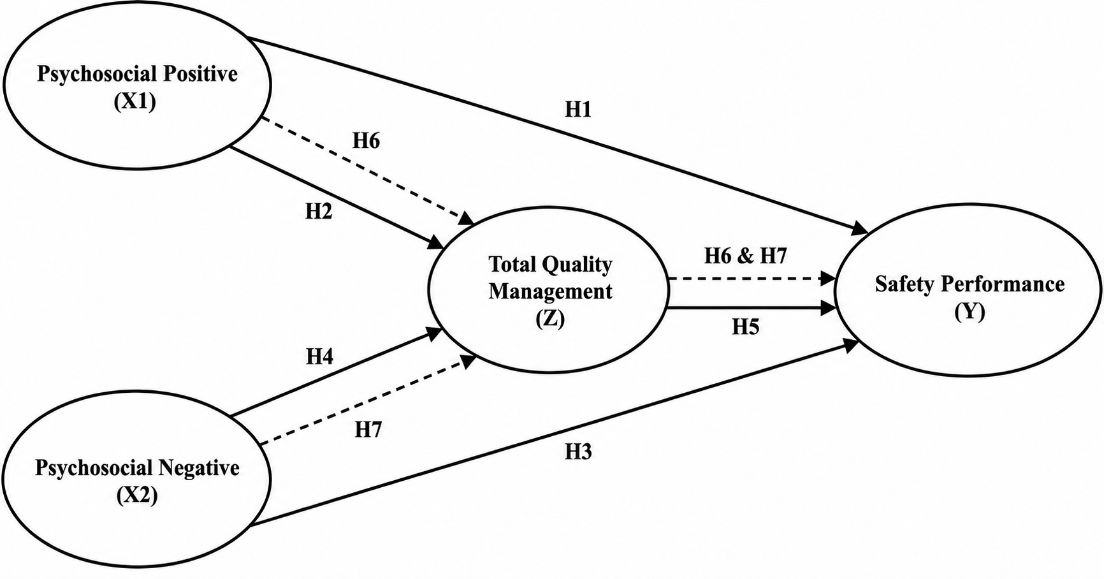
Psychosocial factors consist of both organizational and individual aspects that influence employees' psychological well-being and work behavior [6-9]. In this study, psychosocial positive comprises role clarity, job autonomy, and social support, which represent job resources within the JD-R theory. Role clarity enables employees to understand their responsibilities and safety procedures, job autonomy encourages workers to make appropriate decisions in hazardous situations, and social support strengthens communication and cooperation among coworkers [28, 29]. These favorable psychosocial factors enhance employees' motivation and facilitate safe work behaviors, thereby improving safety performance [6, 7]. Therefore, the following hypothesis is proposed:
H1. Psychosocial positive positively influences safety performance.
3.2 Psychosocial positive and Total Quality Management
Besides influencing safety performance, positive psychosocial aspects are expected to strengthen the implementation of TQM. Employees who experience role clarity, job autonomy, and social support tend to participate in teamwork, adhere to standardized procedures, communicate effectively, and engage in continuous improvement activities. Previous research by Ehigie and Akpan [22] demonstrated that psychosocial factors significantly influence TQM practices through psychological and organizational mechanisms. Likewise, the studies [1, 22] reported that supportive organizational conditions and employee involvement contribute positively to quality improvement initiatives. Accordingly, the following hypothesis is proposed:
H2. Psychosocial positive positively influences TQM.
3.3 Psychosocial negative and safety performance
Psychosocial negative represents job demands that consist of work stress, work-family conflict, and interpersonal conflict. According to the JD-R theory, excessive job demands consume employees' physical and psychological resources, leading to reduced work performance [11]. Occupational stress may result in emotional exhaustion and fatigue [30, 31], whereas work-family conflict reduces employees' concentration and increases psychological strain [32, 33]. Likewise, interpersonal conflict contributes to absenteeism, reduced work motivation, and unsafe work behavior [34]. Consequently, unfavorable psychosocial factors are expected to decrease construction workers' safety performance. Therefore, the following hypothesis is proposed:
H3. Psychosocial negative negatively influences safety performance.
3.4 Psychosocial negative and Total Quality Management
Psychosocial negative may also negatively influence the implementation of TQM. High levels of psychosocial demands, such as excessive work stress, work-family conflict, and interpersonal conflict, can damage team cohesion, impair communication, and complicate the execution of process controls and continuous improvement initiatives [34]. Workers burdened by conflict and stress are less likely to participate effectively in quality procedures, as successful TQM heavily relies on employee well-being and active involvement [21, 22]. Therefore, the following hypothesis is proposed:
H4. Psychosocial negative negatively influences TQM.
3.5 Total Quality Management and safety performance
Recently, researchers have increasingly focused on the human factors indicator of TQM and its influence on organizational performance [35]. The efficacy of TQM implementation is contingent not solely on the utilization of quality control techniques, but also on the incorporation of employee involvement, teamwork, leadership commitment, continuous improvement, and organizational learning [21, 36]. Previous studies have consistently indicated that the implementation of quality improvement practices is associated with enhanced organizational performance and improved safety outcomes [37, 24]. In construction projects, effective TQM implementation supports systematic work processes, enhances communication, and promotes compliance with safety procedures, thereby enhancing safety performance. Therefore, the following hypothesis is proposed:
H5. TQM positively influences safety performance.
3.6 The mediating role of Total Quality Management
According to the JD-R theory, organizational resources can strengthen the positive effects of job resources while mitigating the adverse effects of job demands [11]. In this study, TQM functions as an organizational mechanism linking psychosocial factors with organizational outcomes, including safety performance [24]. Positive psychosocial factors may improve safety performance through stronger TQM implementation. Conversely, psychosocial negative is expected to impair TQM practices, which in turn reduces safety performance, creating a negative indirect effect. Based on these arguments, the following hypotheses are proposed:
H6. TQM positively mediates the relationship between psychosocial positive and safety performance.
H7. TQM negatively mediates the relationship between psychosocial negative and safety performance.
Figure 1 presents the conceptual framework of this study. This research examines the mediating role of TQM in the influence of psychosocial factors (positive and negative) on safety performance, using data from construction sector workers in Indonesia.
Figure 1. Conceptual framework
4.1 Design and data collection
This study adopted a quantitative research design to investigate the interrelationships among psychosocial factors, TQM, and safety performance within an oil and gas construction project in Indonesia. Primary data were obtained through offline questionnaires distributed directly in paper format to ensure accessibility and accuracy.
Specifically, the research was conducted in the Oil and Gas Civil Engineering Construction sector (KBLI: 42915; Code: BS013), with the study site concentrated in the RDMP Tank Modification Project Area of RU V Balikpapan, managed by PT Pertamina Maintenance & Construction, Indonesia.
The study population comprised construction workers actively engaged in the Tank Modification Project Area Package-1 within the RDMP RU V Balikpapan Project. The sample was selected using a purposive sampling technique, based on population characteristics aligned with the research objectives. Data collection was carried out over a six-month period, from April to September 2025.
4.2 Respondent profile
Following the procedures [38], minimum sample size was assessed using both the inverse square root and gamma-exponential methods. Assuming a significance level of 0.05, statistical power of 0.80, and a minimum expected path coefficient $(\beta \min )$ of 0.20 [6], the inverse square root method was calculated as $N>$ $\left(2.486 /\left|\beta_{\text {min }}\right|\right)^2$, resulting in $N>(2.486 / 0.20)^2=154.50$; which corresponds to a minimum requirement of 155 observations after rounding upward.
As a refinement of the inverse square root method, the gamma-exponential approach [38] was also applied using $\left|\beta_{\text {min }}\right| \sqrt{N} \exp \left[e\left|\beta_{\text {min }}\right| / \sqrt{N}\right]>2.486$. Substituting $\beta \min =0.20$ into this equation and solving iteratively for the smallest positive integer that satisfies the inequality yields a minimum sample size of 141 observations.
In addition, an a priori power analysis using G*Power for a linear multiple regression with a fixed model and R² deviation from zero was conducted for the endogenous construct of safety performance, which has three predictors (psychosocial positive, psychosocial negative, and TQM). Assuming a medium effect size (f² = 0.15), α = 0.05, and statistical power of 0.80, the analysis indicated a minimum sample size of 77 observations.
The final dataset comprised 154 valid observations, which exceeds the requirements of the gamma-exponential method (141 observations) and the a priori power analysis (77 observations). Although the final sample is one observation below the inverse square root estimate of 155, the sample-size adequacy is supported by the gamma-exponential method and the independent a priori power analysis. These results support the adequacy of the sample size under the gamma-exponential method and the independent a priori power analysis.
The sample consisted of 124 males (80.52%) and 30 females (19.48%). For age, 65 respondents (42.21%) were 21-30 years, 62 (40.26%) were 31-40 years, and 27 (17.53%) were more than 40 years. Regarding construction experience, 52 respondents (33.77%) had 3-5 years of experience, 48 (31.17%) had 6-10 years, 29 (18.83%) had 11-13 years, and 25 (16.23%) had more than 13 years. In terms of employment status, 131 respondents (85.06%) were contract/temporary workers and 23 (14.94%) were permanent employees. Project tenure comprised 68 respondents (44.16%) with less than 6 months, 71 (46.10%) with 6-12 months, and 15 (9.74%) with more than one year. These detailed characteristics provide a comprehensive profile of the workforce, capturing vital variations that may influence their psychosocial factors and safety performance.
4.3 Measurement
The questionnaire measured four latent constructs using a total of 32 items. Psychosocial factors were conceptualized as two higher-order constructs consisting of psychosocial positive and psychosocial negative. Psychosocial positive was measured using three dimensions, namely role clarity, individual autonomy, and social support, whereas psychosocial negative was measured using three dimensions, namely work stress, work-family conflict, and interpersonal conflict. All items measuring the psychosocial constructs were drawn entirely from a previously developed instrument [6]. For TQM, four dimensions were employed, namely teamwork, process control and improvement, job design and quality system improvement, and training and education, based on established instruments [24, 39]. Meanwhile, three dimensions were used to capture safety performance, consisting of safety compliance, safety participation, and occupational health [40]. All items were measured using a five-point Likert scale ranging from 1 (strongly disagree) to 5 (strongly agree), following an established measurement approach [41].
4.4 Data analysis
The collected data were then subjected to analysis using Partial Least Squares-Structural Equation Modeling (PLS-SEM) with the assistance of SmartPLS 3 software. The selection of PLS-SEM was predicated on its suitability for concurrent evaluation of intricate relationships among latent variables, encompassing both the measurement and structural models [42, 43].
The data analysis proceeded in two sequential phases. The first stage involved the evaluation of the measurement model to ensure the quality of the instruments used, encompassing the examination of convergent validity, discriminant validity, indicator reliability, internal consistency reliability, collinearity, and predictive relevance. Convergent validity was determined based on outer loading values and Average Variance Extracted (AVE), while internal consistency reliability was examined throught Cronbach's Alpha (CA) and Composite Reliability (CR) coefficient. Discriminant validity was established using the Fornell-Larcker criterion and the Heterotrait-Monotrait Ratio (HTMT).
Second, the structural model was examined through the evaluation of the coefficient of determination (R²), effect size (f²), predictive relevance (Q²), variance inflation factor (VIF), and hypothesis testing through the bootstrapping procedure. The significance of both direct and indirect relationships were established based on path coefficients, t-statistics, and p-values obtained from the bootstrapping analysis.
4.5 Common method variance
To reduce the risk of Common Method Bias (CMB), procedural remedies that are supported by the study protocol were retained, including respondent anonymity and the use of clearly worded, previously validated scale items [44]. Statistically, CMB was assessed using a full-collinearity assessment [45]. In addition to the ordinary inner VIF values used to assess structural-model collinearity, a full-collinearity VIF was obtained for each higher-order construct by treating each construct in turn as the dependent variable and the remaining constructs as predictors. A VIF value above 3.3 was used as the conservative threshold for potential CMB [45]. Based on the research findings indicate that CMB is not a serious concern in this study and does not appear to inflate the estimated relationships.
5.1 Measurement model assessment
The present study employed a second-order measurement model, estimated using the embedded two-stage approach. This approach is appropriate for hierarchical constructs composed of multiple dimensions. The embedded two-stage method provides greater parsimony and reduces model complexity by avoiding indicator inflation at the higher-order level when compared to the repeated indicator approach [42]. The evaluation of the measurement model was conducted in two stages. In the initial stage of the study, an evaluation was conducted to ascertain the reliability and validity of the first-order constructs. In the second stage, the second-order constructs were estimated using the latent variable scores obtained from the first stage.
The measurement model was first evaluated to assess the validity and reliability of the proposed constructs before examining the structural relationships among variables. In accordance with the guidelines [46], convergent validity was assessed by examining the outer loadings and the AVE. The internal consistency reliability was evaluated using CA and CR. Subsequently, discriminant validity was examined through the Fornell-Larcker criterion and the HTMT. Finally, collinearity among predictor constructs was assessed using the VIF.
As illustrated in Table 1, the measurement model was estimated using the embedded two-stage approach appropriate for the higher-order reflective constructs specified in this study. At the first-order (item) level, the outer loadings of all items were above the recommended threshold of 0.70, with values ranging from 0.854 (process control and improvement 2) to 0.934 (occupational health 1 and occupational health 2), confirming that each item adequately represents its corresponding first-order dimension.
Table 1. Convergent validity
|
Construct / Dimensions / Items |
Loadings |
AVE |
CR |
CA |
|
|
Psychosocial Positive |
|
|
0.727 |
0.949 |
0.937 |
|
Role Clarity |
|
0.964 |
|
|
|
|
I have clear authority at work |
0.885 |
|
|
|
|
|
I have clear and well-planned goals and objectives for the job |
0.871 |
|
|
|
|
|
I understand my work responsibilities |
0.891 |
|
|
|
|
|
Individual Autonomy |
|
0.945 |
|
|
|
|
I feel free to express my ideas and opinions in this work |
0.916 |
|
|
|
|
|
I feel free to do the work in the best possible way |
0.921 |
|
|
|
|
|
Social Support |
|
0.935 |
|
|
|
|
My supervisor supports me with the human resources needed for the assignment |
0.901 |
|
|
|
|
|
My superiors support me with the necessary equipment while I am on duty |
0.897 |
|
|
|
|
|
Psychosocial Negative |
|
|
0.726 |
0.960 |
0.953 |
|
Work Stress |
|
0.960 |
|
|
|
|
I often feel tense or anxious while working |
0.888 |
|
|
|
|
|
I feel unsafe at work |
0.878 |
|
|
|
|
|
I usually feel under a lot of pressure when working |
0.916 |
|
|
|
|
|
Work-Family Conflict |
|
0.949 |
|
|
|
|
I have to sacrifice time with my family because so much time is spent on work responsibilities |
0.900 |
|
|
|
|
|
No matter how well I perform at work, it doesn't help me become a better parent or partner |
0.897 |
|
|
|
|
|
Because I am often stressed by family responsibilities, I find it difficult to concentrate on work |
0.894 |
|
|
|
|
|
Interpersonal Conflict |
|
0.954 |
|
|
|
|
There are many emotional conflicts among members in the workplace |
0.896 |
|
|
|
|
|
Colleagues often have differences of opinion regarding the work being performed |
0.889 |
|
|
|
|
|
There are many conflicts among members regarding differences in field methods |
0.878 |
|
|
|
|
|
Total Quality Management |
|
|
0.702 |
0.959 |
0.953 |
|
Teamwork |
|
0.949 |
|
|
|
|
Our company formed a team to solve the problem |
0.891 |
|
|
|
|
|
Our company has a cross-functional team |
0.855 |
|
|
|
|
|
Our company has several QC circles (within a single function) |
0.885 |
|
|
|
|
|
Process Control and Improvement |
|
0.942 |
|
|
|
|
Project equipment is well-maintained in accordance with the maintenance plan |
0.899 |
|
|
|
|
|
Our company effectively implements various inspections (incoming, in-process, and final) |
0.854 |
|
|
|
|
|
Our company uses equipment that supports QC for quality control and improvement |
0.899 |
|
|
|
|
|
Job Design and Quality System Improvement |
|
0.920 |
|
|
|
|
Our company's quality system is continuously improved, utilizing ISO 9001 as a guideline for establishing the quality system |
0.908 |
|
|
|
|
|
Our company has clear procedure documents and work instructions |
0.922 |
|
|
|
|
|
Training and Education |
|
0.923 |
|
|
|
|
Specialized job skills training is provided to all employees |
0.930 |
|
|
|
|
|
Quality awareness training is provided to employees |
0.916 |
|
|
|
|
|
Safety Performance |
|
|
0.775 |
0.954 |
0.942 |
|
Safety Compliance |
|
0.949 |
|
|
|
|
I use all safety equipment necessary to do the job |
0.920 |
|
|
|
|
|
I use the correct safety procedures to perform the work |
0.921 |
|
|
|
|
|
Safety Participation |
|
0.954 |
|
|
|
|
I am providing information about the company's safety program |
0.918 |
|
|
|
|
|
I remind my colleagues to focus on safety while working |
0.915 |
|
|
|
|
|
Occupational Health |
|
0.956 |
|
|
|
|
I stop working when I am unable to focus |
0.934 |
|
|
|
|
|
My company provides first aid kits and medical personnel at the workplace |
0.934 |
|
|
|
|
Note: AVE = Average Variance Extracted; CR = Composite Reliability; CA = Cronbach's Alpha.
At the second-order level, the loadings of the first-order dimensions on their respective higher-order constructs-psychosocial positive (role clarity, social support, and individual autonomy), psychosocial negative (interpersonal conflict, work-family conflict, and work stress), TQM (job design and quality system improvement, process control and improvement, teamwork, and training and education), and safety performance (safety compliance, occupational health, safety participation)-were likewise well above 0.70, ranging from 0.920 (job design and quality system improvement) to 0.964 (role clarity). Since all item- and dimension-level loadings exceeded the minimum recommended value, no measurement items were removed from the analysis. These findings confirm satisfactory reliability at both levels of the hierarchical measurement model.
The convergent validity assessment, as presented in Table 1, lends further confirmation to the adequacy of the measurement model. All higher-order constructs achieved AVE values ranging from 0.702 (TQM) to 0.775 (safety performance), thereby exceeding the recommended threshold of 0.50. Internal consistency reliability was likewise satisfactory, with CA ranging from 0.937 to 0.953 and CR ranging from 0.949 to 0.960 across the four higher-order constructs. These results demonstrate that each latent construct accounts for more than half of the variance in its associated items, confirming adequate convergent validity and reliability. Following the establishment of the structural model, the discriminant validity of the constructs was assessed to verify that each represented a distinct concept within the proposed model.
Discriminant validity was assessed using the Fornell-Larcker criterion and the HTMT, as recommended in PLS-SEM [46, 47]. Under the Fornell-Larcker criterion, the square root of the AVE for each construct should exceed its correlations with other constructs, while HTMT values should remain below the recommended threshold of 0.90. Table 2 shows that all constructs met both the Fornell-Larcker and HTMT criteria, confirming satisfactory discriminant validity. Therefore, the measurement model was deemed suitable for subsequent structural model assessment.
Following the assessment of convergent validity, discriminant validity was evaluated using the Fornell-Larcker criterion and the HTMT at the level of the four higher-order constructs-psychosocial positive, psychosocial negative, TQM, and safety performance-to verify that each construct reflected a distinct concept within the proposed model. As noted [46], the square root of the AVE for each construct ought to be greater than its correlations with other constructs, whereas HTMT values should stay below the recommended threshold of 0.90. As demonstrated in Table 2, all constructs satisfied both criteria. The square root of AVE for each construct ranged from 0.838 to 0.880, exceeding its correlations with the other three constructs, while all HTMT values ranged from 0.071 to 0.771, remaining well below the recommended threshold. These results verify satisfactory discriminant validity, suggesting that each construct is empirically distinct and properly measures its intended concept. Consequently, the measurement model was deemed suitable for subsequent structural model evaluation.
Table 2. Discriminant validity (Fornell-Larcker criterion and Heterotrait-Monotrait Ratio (HTMT))
|
Construct |
Safety Performance |
Psychosocial Negative |
Psychosocial Positive |
Total Quality Management |
|
Fornell Larcker Criterion |
||||
|
Safety Performance |
0.880 |
|
|
|
|
Psychosocial Negative |
-0.445 |
0.852 |
|
|
|
Psychosocial Positive |
0.456 |
-0.053 |
0.853 |
|
|
Total Quality Management |
0.730 |
-0.449 |
0.461 |
0.838 |
|
Heterotrait Monotrait Ratio |
||||
|
Safety Performance |
|
|
|
|
|
Psychosocial Negative |
0.469 |
|
|
|
|
Psychosocial Positive |
0.484 |
0.071 |
|
|
|
Total Quality Management |
0.771 |
0.470 |
0.488 |
|
5.2 Structural model assessment
Following the procedure [46], the structural model assessment consisted of four stages. First, collinearity among predictor constructs was assessed using the VIF. Second, the explanatory power of the model was evaluated using the coefficient of determination (R²). Third, the effect size of each exogenous construct was examined through Cohen's effect size (f²). Fourth, the predictive relevance of the structural model was evaluated using the Stone-Geisser predictive relevance (Q²).
The assessment of structural-model collinearity and full-collinearity were treated as separate diagnostics. The inner VIF values in Table 3 assess collinearity among predictors of the endogenous constructs, whereas the full-collinearity VIF values in Table 4 assess whether each latent variable can be explained excessively by all remaining latent variables in the model. For the structural model, all inner VIF values ranged from 1.003 to 1.647, indicating no problematic multicollinearity. For the full-collinearity assessment, the VIF values ranged from 1.381 to 2.393 and were all below the conservative 3.3 threshold proposed by the study [45]. Thus, neither structural collinearity nor full-collinearity indicates a serious CMB concern.
Subsequently, the explanatory power of the proposed model was evaluated using the coefficient of determination (R²). According to the study [46], R² values of approximately 0.75, 0.50, and 0.25 indicate substantial, moderate, and weak explanatory power, respectively. As demonstrated in Table 5, the proposed model accounts for 57.7% of the variance in safety performance (R² = 0.577), while the remaining 42.3% is explained by other variables outside the proposed model. This result indicates a moderate-to-substantial level of explanatory power, suggesting that psychosocial positive, psychosocial negative, and TQM jointly provide a meaningful explanation of employees’ safety performance.
Table 3. Inner variance inflation factor (VIF) values
|
Construct |
Safety Performance |
Psychosocial Negative |
Psychosocial Positive |
Total Quality Management |
|
Safety Performance |
|
|
|
|
|
Psychosocial Negative |
1.301 |
|
|
1.003 |
|
Psychosocial Positive |
1.319 |
|
|
1.003 |
|
Total Quality Management |
1.647 |
|
|
|
Table 4. Full-collinearity variance inflation factor (VIF) values
|
Construct |
Full-Collinearity VIF |
|
Safety Performance |
2.363 |
|
Psychosocial Negative |
1.381 |
|
Psychosocial Positive |
1.403 |
|
Total Quality Management |
2.393 |
Table 5. R2
|
Construct |
R2 |
R2 Adjusted |
|
Total Quality Management |
0.393 |
0.385 |
|
Safety Performance |
0.577 |
0.568 |
In addition, the model accounts for 39.3% of the variance in TQM (R² = 0.393), suggesting that psychosocial positive and psychosocial negative factors collectively explain nearly two-fifths of the variation in TQM implementation. Although additional organizational factors may also influence TQM practices, the obtained R² value suggests that psychosocial factors-in both a resource-building and a resource-depleting direction-contribute substantially to explaining variations in TQM within the observed organizations.
To complement the evaluation of the structural model, the contribution of each exogenous construct was assessed using Cohen’s effect size (f²). According to the studies [47-49], 0.02, 0.15, and 0.35 represent small, medium, and large effect sizes, respectively. As demonstrated in Table 6, psychosocial factors exhibited a medium-to-large effect on TQM (f² = 0.315), indicating that positive psychosocial factors make a substantial contribution to strengthening TQM implementation. Likewise, psychosocial negative demonstrated a medium effect on TQM (f² = 0.297); however, unlike psychosocial positive, this effect operates in the negative direction, indicating that psychosocial risk factors meaningfully erode, rather than strengthen, organizational quality management practices.
Regarding safety performance, TQM exhibited by far the largest contribution (f² = 0.452, a large effect), followed by psychosocial positive (f² = 0.063) and psychosocial negative (f² = 0.061), both representing small effect sizes. These findings suggest that although both psychosocial positive and psychosocial negative significantly influence safety performance, organizational quality management practices contribute far more substantially to improving employees’ safety performance than either psychosocial factor alone.
The Stone-Geisser Q2 statistic obtained through the blindfolding procedure was used to assess the predictive relevance of the structural model. For the endogenous constructs, predictive relevance is indicated when Q² values exceed zero [46]. As presented in Table 7, both endogenous constructs achieved positive Q² values. Safety Performance obtained a Q² value of 0.440, whereas TQM achieved a Q² value of 0.271. Since both values exceed zero, the findings confirm that the proposed structural model possesses satisfactory predictive relevance and is capable of predicting the endogenous constructs beyond mere chance.
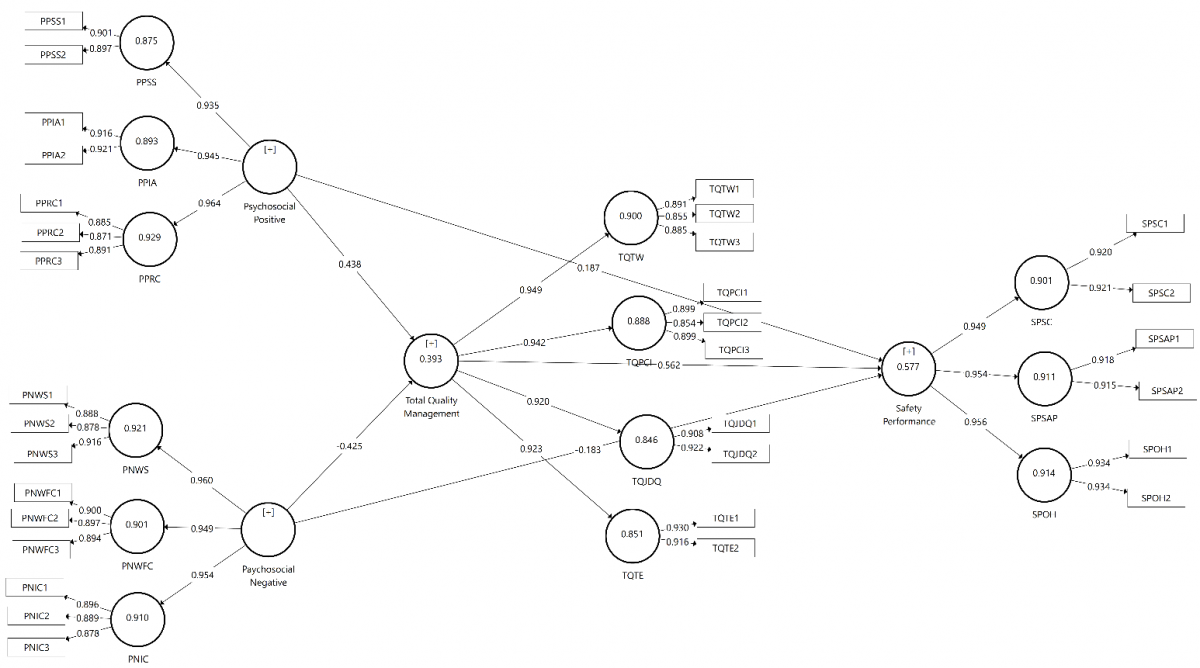
Following confirmation that the structural model demonstrated satisfactory explanatory power and predictive relevance, hypothesis testing was performed through the bootstrapping procedure. Figure 2 illustrates the estimated structural model, displaying the path coefficients for the influences among psychosocial positive, psychosocial negative, TQM, and safety performance.
Following confirmation that the structural model demonstrated satisfactory explanatory power [46], a structural relationship is considered statistically significant when the t-statistic exceeds 1.96 and the p-value is below 0.05. Bootstrapping was used to assess both direct and indirect effects. In addition to β, t-statistics, and p-values, 95% bootstrap confidence intervals should be reported because an interval that excludes zero provides direct evidence of statistical significance. The bootstrapping outcomes displayed in Table 8 reveal that all proposed direct relationships demonstrate statistical significance and align with the hypothesized direction.
The bootstrapping results provide further evidence for all seven hypothesized effects. Psychosocial positive exhibited a significant positive effect on safety performance (β = 0.187; t = 3.102; p = 0.002; 95% CI [0.073, 0.305]), thereby supporting H1. Psychosocial positive also demonstrated a significant positive effect on TQM (β = 0.438; t = 7.000; p < 0.001; 95% CI [0.313, 0.552]), supporting H2. Psychosocial negative exerted a significant negative effect on safety performance (β = −0.183; t = 2.982; p = 0.003; 95% CI [−0.306, −0.062]), supporting H3. Psychosocial negative also exerted a significant negative effect on TQM (β = −0.425; t = 7.273; p < 0.001; 95% CI [−0.536, −0.312]), supporting H4. TQM had a significant positive effect on safety performance (β = 0.562; t = 8.148; p < 0.001; 95% CI [0.424, 0.678]), supporting H5. The mediation analysis further showed that TQM significantly mediated the relationship between psychosocial positive and safety performance through a positive indirect effect (β = 0.246; t = 5.014; p < 0.001; 95% CI [0.154, 0.344]), supporting H6. Similarly, TQM significantly mediated the relationship between psychosocial negative and safety performance through a negative indirect effect (β = −0.239; t = 4.961; p < 0.001; 95% CI [−0.331, −0.151]), supporting H7. Importantly, none of the 95% bootstrap confidence intervals included zero, providing additional evidence that all seven hypothesized effects were statistically significant.
The VAF calculation (Table 9) further shows the VAF value for psychosocial positive → TQM → safety performance is 56.81%, indicating partial mediation, while the VAF value for psychosocial negative → TQM → safety performance is 56.64%, indicating partial mediation. These findings strengthen the acceptance of H6 and H7 and clarify that the mediation classification is based not only on the significance of the direct and indirect effects, but also on the VAF statistic.
Table 6. f2
|
Construct |
Safety Performance |
Psychosocial Negative |
Psychosocial Positive |
Total Quality Management |
|
Safety Performance |
|
|
|
|
|
Psychosocial Negative |
0.061 |
|
|
0.297 |
|
Psychosocial Positive |
0.063 |
|
|
0.315 |
|
Total Quality Management |
0.452 |
|
|
|
Table 7. Stone-Geisser criterion (Q2)
|
Construct |
SSO |
SSE |
Q2 |
|
Safety Performance |
924.000 |
517.158 |
0.440 |
|
Psychosocial Negative |
1386.000 |
1386.000 |
|
|
Psychosocial Positive |
1078.000 |
1078.000 |
|
|
Total Quality Management |
1540.000 |
1123.052 |
0.271 |
Note: SSO = Sum of Squares of Observations; SSE = Sum of Squares of Prediction Errors.
Figure 2. Structural model
Table 8. Hypothesis testing
|
Construct |
β |
T Statistics |
P Values |
95% Bootstrap CI |
Result |
|
Direct Relationships |
|||||
|
Psychosocial Positive → Safety Performance |
0.187 |
3.102 |
0.002 |
[0.073, 0.305] |
H1 Supported |
|
Psychosocial Positive →Total Quality Management |
0.438 |
7.000 |
0.000 |
[0.313, 0.552] |
H2 Supported |
|
Psychosocial Negative → Safety Performance |
-0.183 |
2.982 |
0.003 |
[−0.306, −0.062] |
H3 Supported |
|
Psychosocial Negative →Total Quality Management |
-0.425 |
7.273 |
0.000 |
[−0.536, −0.312] |
H4 Supported |
|
Total Quality Management→ Safety Performance |
0.562 |
8.148 |
0.000 |
[0.424, 0.678] |
H5 Supported |
|
Indirect Relationships |
|||||
|
Psychosocial Positive →Total Quality Management→ Safety Performance |
0.246 |
5.014 |
0.000 |
[0.154, 0.344] |
H6 Supported |
|
Psychosocial Negative →Total Quality Management→ Safety Performance |
-0.239 |
4.961 |
0.000 |
[−0.331, −0.151] |
H7 Supported |
Table 9. Variance accounted for (VAF) statistic
|
Construct |
Direct Effect |
Indirect Effect |
Total Effect |
VAF Calculation |
VAF |
Mediation Classification |
|
H6 |
0.187 |
0.246 |
0.433 |
0.246 / 0.433 × 100 |
56.81% |
Partial Mediation |
|
H7 |
-0.183 |
-0.239 |
-0.422 |
-0.239 / -0.422 × 100 |
56.64% |
Partial Mediation |
Note: VAF was calculated by dividing the indirect effect by the total effect; A VAF value below 20% indicates no mediation, a value between 20% and 80% indicates partial mediation, and a value above 80% indicates full mediation.
6.1 Discussion
This study explored the relationships between psychosocial factors, TQM, and safety performance among construction workers. Collectively, the findings reveal that psychosocial factors contribute importantly to employees' safety performance, both directly and indirectly, via the implementation of TQM. Specifically, psychosocial positive was found to positively relate to both TQM implementation and safety performance, whereas psychosocial negative showed a negative association with safety performance and TQM. Furthermore, TQM significantly enhanced safety performance and mediated the relationships between psychosocial factors and safety performance. The findings draw attention to the critical role of integrating psychosocial work environments and organizational quality management practices in promoting better occupational safety outcomes within construction projects.
The significant positive influence of psychosocial positive on safety performance supports H1, indicating that construction workers who experience greater role clarity, job autonomy, and social support tend to exhibit safe work behaviors. This finding aligns with the JD-R theory, which posits that job resources enhance employee motivation and performance [11, 50]. Previous studies have also identified positive psychosocial conditions as important determinants of construction workers’ safety performance [6, 7]. Likewise, supportive work environments have been found to strengthen employees’ safety behavior [14, 51, 52]. Therefore, fostering positive psychosocial factors is essential for improving safety performance in construction projects.
The findings reveal that psychosocial positive has a significant positive influence on TQM, supporting H2. This result indicates that positive psychosocial conditions, such as role clarity, job autonomy, and social support, encourage employees to participate more actively in quality improvement activities and organizational development initiatives. Supportive organizational conditions and appropriate job design have been reported to significantly improve employee commitment and organizational performance [1]. Likewise, soft organizational factors, including employee involvement and supportive work environments, positively influence quality improvement practices [37, 52]. Human factors also play a significant role in enhancing organizational performance through quality improvement practices [24]. Similarly, employee involvement strengthens organizational partnerships and operational performance, which are fundamental elements of successful TQM implementation [35]. Therefore, organizations should create supportive psychosocial work environments to maximize the effectiveness of TQM practices.
Psychosocial negative exerts a significant negative effect on safety performance. This result indicates that elevated levels of work stress, work-family conflict, and interpersonal conflict diminish employees’ capacity to comply with safety procedures, thereby supporting H3. As explained by the JD-R Theory, excessive job demands deplete employees’ physical and psychological resources, leading to lower work performance [11]. This result is consistent with previous findings that psychosocial hazards increase accident risk and reduce safety performance among construction workers [3, 13, 40]. Therefore, organizations should minimize psychosocial risks to maintain employees’ safety performance.
The results reveal that psychosocial negative exerts a significant negative effect on TQM, thus supporting H4. This result suggests that organizations encountering elevated levels of work stress, work-family conflict, and interpersonal conflict face significant challenges in implementing quality management practices [22]. Excessive psychosocial demands deteriorate team cohesion and communication, which are fundamental soft elements required for successful TQM implementation [21]. Workers overwhelmed by negative psychosocial conditions have a reduced capacity to engage in continuous improvement initiatives and comply with strict quality procedures. This aligns with the health-impairment pathway of the JD-R theory, confirming that unmanaged job demands not only affect individuals but also degrade organizational systems and hinder effective managerial practices [11].
The significant positive effect of TQM on safety performance provides support for H5, indicating that organizations with better teamwork, continuous improvement, quality control, and employee training tend to achieve higher safety performance. This result indicates that organizations implementing effective quality management practices through teamwork, continuous process improvement, quality control, and employee training tend to achieve higher levels of safety performance. This result aligns with the quality management perspective, which argues that effective TQM implementation enhances organizational performance by improving operational processes and employee involvement [20, 53]. Likewise, both soft and hard indicators of TQM contribute significantly to organizational performance by strengthening employee commitment and process quality [21, 54]. Within the occupational safety context, effective safety management practices enhance employees’ safety knowledge and motivation, which in turn lead to better safety behavior [55]. Similarly, strong organizational commitment to quality and safety management plays a crucial role in improving construction safety performance [23]. Consequently, reinforcing TQM implementation can serve as an effective managerial strategy for enhancing workplace safety performance.
The results of the mediation analysis provide support for H6, demonstrating that TQM significantly mediates the relationship between psychosocial positive and safety performance. This finding indicates that positive psychosocial conditions, including role clarity, job autonomy, and social support, directly contribute to employees’ safety performance while also reinforcing the implementation of TQM practices, which in turn improve workplace safety. Quality improvement practices can serve as an important mechanism linking human factors to organizational performance [24]. Similarly, effective TQM implementation enhances organizational outcomes through employee involvement, teamwork, continuous improvement, and process management [20]. Supportive organizational environments also facilitate quality improvement initiatives, which ultimately contribute to better organizational performance [37]. Therefore, the present finding indicates that favorable psychosocial factors create an environment that enables organizations to implement TQM more effectively, thereby improving employees’ safety performance.
Finally, H7 is supported, indicating that TQM plays a significant negative mediating role in the relationship between psychosocial negative and safety performance. This demonstrates a negative domino effect within the organization: higher levels of work stress, work-family conflict, and interpersonal conflict not only directly compromise individual safety behaviors but also deteriorate the organization's TQM systems [24]. The impairment of these critical quality management practices subsequently leads to a further decline in safety performance. This implies that psychosocial risks strip away the organizational safety net provided by TQM. Therefore, proactive mitigation of negative psychosocial risks is essential for construction managers, not only to protect worker well-being but also to preserve the integrity of organizational quality systems and ensure optimal workplace safety [13, 34].
6.2 Theoretical implications
This study offers several theoretical contributions to the existing body of knowledge on TQM, and safety performance. First, the results provide empirical support for the JD-R theory by showing that psychosocial factors influence safety performance through both direct and indirect mechanisms [50]. Psychosocial positive, represented by role clarity, individual autonomy, and social support, enhances safety performance directly and indirectly through TQM, whereas psychosocial negative reduces safety performance and TQM. These results indicate that psychosocial factors should not be regarded merely as antecedents of employee behavior but rather also as factors influencing organizational management practices.
Second, the current study broadens the application of the JD-R theory by positioning TQM as an organizational resource that translates psychosocial factors into improved safety performance. Teamwork, process control, continuous improvement, and employee training provide structured managerial mechanisms that strengthen employees' ability to maintain safe work behaviors. Therefore, this research adds to the literature by showing that quality management practices serve a strategic role in linking psychosocial factors with occupational safety performance, particularly within high-risk construction environments.
6.3 Practical implications
The findings of this study provide several practical implications for construction companies. First, organizations should integrate psychosocial factors into their quality management and safety management systems rather than managing them as separate organizational initiatives. Improving role clarity, individual autonomy, and social support while reducing work stress, work-family conflict, and interpersonal conflict can strengthen both TQM implementation and safety performance.
Second, construction companies should reinforce TQM practices by promoting teamwork, continuous process improvement, employee training, and effective communication. These management practices have been shown to enhance operational quality and foster a supportive organizational environment that motivates employees to adhere to safety procedures and actively engage in workplace safety initiatives [20, 56].
Third, organizations should implement regular psychosocial risk assessments as part of their occupational safety management systems. Early identification of work stress, interpersonal conflict, and work-family conflict enables management to design appropriate organizational interventions before these psychosocial risks negatively affect safety performance.
Finally, managers should strengthen employee development programs through stress management, leadership development, and continuous safety training. The integration of psychosocial risk management with TQM has been demonstrated to enhance safety performance while sustaining operational effectiveness and long-term organizational sustainability.
6.4 Limitations and future directions
The present study is not without its limitations. First, the cross-sectional research design imposes limitations on the capacity to establish causal relationships among the research variables. Second, the study's focus on construction workers within a particular construction project in Indonesia may constrain the extent to which its findings can be extrapolated to other industrial sectors or countries exhibiting distinct organizational characteristics. Third, while the proposed model explains a considerable portion of safety performance, other organizational factors, including safety climate, leadership, and organizational culture, may also exert influence on employees' safety behavior.
Future research is advised to adopt longitudinal research designs to gain a deeper understanding of the causal relationships among psychosocial factors, TQM, and safety performance. Researchers may also consider adding other mediating or moderating variables, such as safety climate, organizational culture, leadership, or digital maturity, to strengthen the explanatory power of the model. Considering Multi-Group Analysis (MGA) [49, 57]. It is also possible to use a sample of workers situated within different organizational or project structures (cross-level analysis) [58]. Multilevel analysis is much more precise than just plain OLS regression or one-level PLS-SEM [59, 60]. Furthermore, comparative studies across industries and countries are recommended to validate the present findings and expand their applicability in different organizational contexts.
This study examined the influences between psychosocial factors, TQM, and safety performance among construction workers involved in a specific tank modification project in Indonesia. The findings demonstrate that psychosocial positive significantly improves both TQM implementation and safety performance, whereas psychosocial negative negatively affects safety performance and TQM. In addition, TQM positively affects safety performance and significantly mediates the relationships between psychosocial positive, psychosocial negative, and safety performance.
These findings highlight the important role of quality management practices in translating psychosocial factors into improved occupational safety outcomes. From a theoretical perspective, the study extends the JD-R theory by identifying TQM as an organizational resource that strengthens the relationship between psychosocial factors and safety performance. Practically, the findings suggest that construction companies should integrate psychosocial risk management with quality management practices to improve workplace safety and organizational performance.
[1] Raharjo, K., Nurjannah, N., Solimun, S., Fernandes, A.A.R. (2018). The influence of organizational culture and job design on job commitment and human resource performance. Journal of Organizational Change Management, 31(7): 1346-1367. https://doi.org/10.1108/JOCM-07-2017-0286
[2] Li, Z., Lv, X.F., Zhu, H.M., Sheng, Z.H. (2018). Analysis of complexity of unsafe behavior in construction teams and a multiagent simulation. Complexity, 2018(1): 1-15. https://doi.org/10.1155/2018/6568719
[3] Namian, M., Taherpour, F., Ghiasvand, E., Turkan, Y. (2021). Insidious safety threat of fatigue: Investigating construction workers’ risk of accident due to fatigue. Journal of Construction Engineering and Management, 147(12): 04021178. https://doi.org/10.1061/(ASCE)CO.1943-7862.0002180
[4] Sobeih, T.M., Salem, O., Daraiseh, N., Genaidy, A., Shell, R. (2006). Psychosocial factors and musculoskeletal disorders in the construction industry: A systematic review. Theoretical Issues in Ergonomics Science, 7(3): 329-344. https://doi.org/10.1080/14639220500090760
[5] Pikhart, H., Pikhartova, J. (2015). The relationship between psychosocial risk factors and health outcomes of chronic diseases: A review of the evidence for Cancer and cardiovascular diseases. WHO Regional Office for Europe, Copenhagen, pp. 1-29. https://eprints.soton.ac.uk/id/eprint/380263/1/The_20relationship_20between.pdf.
[6] Tong, R.P., Wang, L.L., Cao, L.X., Zhang, B.L., Yang, X.Y. (2023). Psychosocial factors for safety performance of construction workers: Taking stock and looking forward. Engineering, Construction and Architectural Management, 30(2): 944-962. https://doi.org/10.1108/ECAM-09-2021-0786
[7] Rahman, M.F.W., Partiwi, S.G., Widyaningrum, R. (2024). Psychosocial factors issues in construction workers: A systematic review and future research directions. International Journal of Safety and Security Engineering, 14(1): 171-183. https://doi.org/10.18280/ijsse.140117
[8] Nwaogu, J.M., Chan, A.P., Hon, C.K., Darko, A. (2020). Review of global mental health research in the construction industry: A science mapping approach. Engineering, Construction and Architectural Management, 27(2): 385-410. https://doi.org/10.1108/ECAM-02-2019-0114
[9] Rodriguez, F.S., Spilski, J., Hekele, F., Beese, N.O., Lachmann, T. (2020). Physical and cognitive demands of work in building construction. Engineering, Construction and Architectural Management, 27(3): 745-764. https://doi.org/10.1108/ECAM-04-2019-0211
[10] Bakker, A.B., Demerouti, E. (2014). Job demands-resources theory. In Wellbeing: A Complete Reference Guide, Volume III, Work and Wellbeing. Wiley-Blackwell. https://doi.org/10.1002/9781118539415.wbwell019
[11] Bakker, A.B., Demerouti, E. (2017). Job demands-resources theory: Taking stock and looking forward. Journal of Occupational Health Psychology, 22(3): 273-285. https://doi.org/10.1037/ocp0000056
[12] Demerouti, E., Veldhuis, W., Coombes, C., Hunter, R. (2019). Burnout among pilots: Psychosocial factors related to happiness and performance at simulator training. Ergonomics, 62(2): 233-245. https://doi.org/10.1080/00140139.2018.1464667
[13] Naji, G.M.A., Isha, A.S.N., Mohyaldinn, M.E., et al. (2021). Impact of safety culture on safety performance; mediating role of psychosocial hazard: An integrated modelling approach. International Journal of Environmental Research and Public Health, 18(16): 8568. https://doi.org/10.3390/ijerph18168568
[14] Clarke, S. (2006). The relationship between safety climate and safety performance: A meta-analytic review. Journal of Occupational Health Psychology, 11(4): 315-327. https://doi.org/10.1037/1076-8998.11.4.315
[15] Karatepe, O.M. (2013). The effects of work overload and work-family conflict on job embeddedness and job performance: The mediation of emotional exhaustion. International Journal of Contemporary Hospitality Management, 25(4): 614-634. https://doi.org/10.1108/09596111311322952
[16] Chen, Y.T., McCabe, B., Hyatt, D. (2018). A resilience safety climate model predicting construction safety performance. Safety Science, 109: 434-445. https://doi.org/10.1016/j.ssci.2018.07.003
[17] Schonfeld, I.S. (2018). ccupational health psychology. In Oxford Bibliographies in Psychology. Oxford University Press. https://doi.org/10.1093/OBO/9780199828340-0211
[18] Pirzadeh, P., Lingard, H. (2021). Working from home during the covid-19 pandemic: Health and well-being of project-based construction workers. Journal of Construction Engineering and Management, 147(6). https://doi.org/10.1061/(ASCE)CO.1943-7862.0002102
[19] Mohammadi, A., Tavakolan, M., Khosravi, Y. (2018). Factors influencing safety performance on construction projects: A review. Safety Science, 109: 382-397. https://doi.org/10.1016/j.ssci.2018.06.017
[20] Kaynak, H. (2003). The relationship between total quality management practices and their effects on firm performance. Journal of Operations Management, 21(4): 405-435. https://doi.org/10.1016/S0272-6963(03)00004-4
[21] Fotopoulos, C.B., Psomas, E.L. (2009). The impact of "soft" and "hard" TQM elements on quality management results. International Journal of Quality & Reliability Management, 26(2): 150-163. https://doi.org/10.1108/02656710910928798
[22] Ehigie, B.O., Akpan, R.C. (2005). Psycho-social factors influencing practice of total quality management in some Nigerian organizations. Journal of Managerial Psychology, 20(5): 355-379. https://doi.org/10.1108/02683940510602932
[23] Huang, X.Y., Hinze, J. (2006). Owner's role in construction safety. Journal of Construction Engineering and Management, 132(2): 164-173. https://doi.org/10.1061/(ASCE)0733-9364(2006)132:2(164)
[24] Habtoor, N. (2016). Influence of human factors on organisational performance. International Journal of Productivity and Performance Management, 65(4): 460-484. https://doi.org/10.1108/IJPPM-02-2014-0016
[25] Temtime, Z.T., Solomon, G.H. (2002). Total quality management and the planning behavior of SMEs in developing economies. The TQM Magazine, 14(3): 181-191. https://doi.org/10.1108/09544780210425900
[26] Demerouti, E., Bakker, A.B., Nachreiner, F., Schaufeli, W.B. (2001). The job demands-resources model of burnout. Journal of Applied Psychology, 86(3): 499-512. https://doi.org/10.1037/0021-9010.86.3.499
[27] Bakker, A.B., Demerouti, E. (2007). The job demands-resources model: State of the art. Journal of Managerial Psychology, 22(3): 309-328. https://doi.org/10.1108/02683940710733115
[28] Malinowska, D., Tokarz, A., Wardzichowska, A. (2018). Job autonomy in relation to work engagement and workaholism: Mediation of autonomous and controlled work motivation. International Journal of Occupational Medicine and Environmental Health, 31(4): 445-458. https://doi.org/10.13075/ijomeh.1896.01197
[29] Grill, M., Nielsen, K. (2019). Promoting and impeding safety–A qualitative study into direct and indirect safety leadership practices of constructions site managers. Safety Science, 114: 148-159. https://doi.org/10.1016/j.ssci.2019.01.008
[30] Ng, S.T., Skitmore, R.M., Leung, T.K.C. (2005). Manageability of stress among construction project participants. Engineering, Construction and Architectural Management, 12(3): 264-282. https://doi.org/10.1108/09699980510600125
[31] Yang, F., Li, X.D., Zhu, Y.M., Li, Y.L., Wu, C.L. (2017). Job burnout of construction project managers in China: A cross-sectional analysis. International Journal of Project Management, 35(7): 1272-1287. https://doi.org/10.1016/j.ijproman.2017.06.005
[32] Greenhaus, J.H., Beutell, N.J. (1985). Sources of conflict between work and family role. Academy of Management Review, 10(1): 76-88. https://doi.org/10.5465/amr.1985.4277352
[33] Chan, A.P.C., Chiang, Y.H., Wong, F.K.W., Liang, S., Abidoye, F.A. (2020). Work–life balance for construction manual workers. Journal of Construction Engineering and Management, 146(5). https://doi.org/10.1061/(ASCE)CO.1943-7862.0001800
[34] Zhang, L.Y., Huo, X.Y. (2015). The impact of interpersonal conflict on construction project performance: A moderated mediation study from China. International Journal of Conflict Management, 26(4): 479-498. https://doi.org/10.1108/IJCMA-09-2014-0072
[35] Vanichchinchai, A. (2012). The relationship between employee involvement, partnership management and supply performance: Findings from a developing country. International Journal of Productivity and Performance Management, 61(2): 157-172. https://doi.org/10.1108/17410401211194662
[36] Motwani, J.G., Mahmoud, E., Rice, G. (1994). Quality practices of indian organizations: An empirical analysis. International Journal of Quality & Reliability Management, 11(1): 38-52. https://doi.org/10.1108/02656719410049493
[37] Abdullah, M.M.B., Uli, J., Tarí, J.J. (2008). The influence of soft factors on quality improvement and performance: Perceptions from managers. The TQM Journal, 20(5): 436-452. https://doi.org/10.1108/17542730810898412
[38] Kock, N., Hadaya, P. (2018). Minimum sample size estimation in PLS-SEM: The inverse square root and gamma-exponential methods. Information Systems Journal, 28(1): 227-261. https://doi.org/10.1111/isj.12131
[39] Flynn, B.B., Schroeder, R.G., Sakakibara, S. (1994). A framework for quality management research and an associated measurement instrument. Journal of Operations Management, 11(4): 339-366. https://doi.org/10.1016/S0272-6963(97)90004-8
[40] Yi, T., Dong, Y., Li, J.Z. (2022). Influence of job insecurity on coal miners’ safety performance: The role of emotional exhaustion. Chinese Management Studies, 16(5): 1254-1270. https://doi.org/10.1108/CMS-10-2020-0455
[41] Sekaran, U., Bougie, R. (2016). Research Methods for Business: A Skill-Building Approach (Seventh Ed). John Wiley & Sons.
[42] Hair Jr, J.F., Risher, J.J., Sarstedt, M., Ringle, C.M. (2019). When to use and how to report the results of PLS-SEM. European Business Review, 31(1): 2-24. https://doi.org/10.1108/EBR-11-2018-0203
[43] Rahman, M.F.W., Kistyanto, A., Surjanti, J. (2022). Does cyberloafing and person-organization fit affect employee performance? The mediating role of innovative work behavior. Global Business and Organizational Excellence, 41(5): 44-64. https://doi.org/10.1002/joe.22159
[44] Podsakoff, P.M., MacKenzie, S.B., Lee, J.Y., Podsakoff, N.P. (2003). Common method biases in behavioral research: A critical review of the literature and recommended remedies. Journal of Applied Psychology, 88(5): 879-903. https://doi.org/10.1037/0021-9010.88.5.879
[45] Kock, N. (2015). Common method bias in PLS-SEM: A full collinearity assessment approach. International Journal of e-Collaboration (IJeC), 11(4): 1-10. https://doi.org/10.4018/ijec.2015100101
[46] Hair, J., Alamer, A. (2022). Partial least squares structural equation modeling (PLS-SEM) in second language and education research: Guidelines using an applied example. Research Methods in Applied Linguistics, 1(3): 100027. https://doi.org/10.1016/j.rmal.2022.100027
[47] Fornell, C., Larcker, D.F. (1981). Evaluating structural equation models with unobservable variables and measurement error. Journal of Marketing Research, 18(1): 39-50. https://doi.org/10.1177/002224378101800104
[48] Cohen, J. (2013). Statistical Power Analysis for the Behavioral Sciences (2nd ed.) . Routledge.
[49] Rahman, M.F.W., Peerzadah, S.A., Durman, T.Y., Widianto, S. (2025). Game on for innovation: A cross-country study on how eSports drive knowledge sharing and innovative behavior. Global Knowledge, Memory and Communication. https://doi.org/10.1108/GKMC-07-2024-0430
[50] Tyas, I.W., Munawir, A.A., Zaika, Y., Yusainy, C., Widjaksono, E.T. (2026). Psychosocial safety climate as a mediator between safety culture and perceived safety performance in East Java Mid-Rise construction projects. International Journal of Safety & Security Engineering, 16(5): 1157-1168. https://doi.org/10.18280/ijsse.160520
[51] Rahman, M.F.W., Partiwi, S.G., Widyaningrum, R. (2025). Measuring item validity and reliability psychosocial factor with human-computer interaction. In International Conference on Digital Business Innovation and Technology Management (ICONBIT), 1(2). https://proceeding.unesa.ac.id/index.php/iconbit/article/view/7516.
[52] Indrayana, D.V., Pribadi, K.S., Marzuki, P.F., Iridiastadi, H. (2023). Safety leadership and performance in Indonesia's Construction Sector: The role of project owners' marurity. International Journal of Safety & Security Engineering, 13(4): 635-646. https://doi.org/10.18280/ijsse.130405
[53] Alghaseb, M., Alshmlani, T. (2022). OSH performance within TQM application in construction companies: A qualitative study in Saudi Arabia. International Journal of Environmental Research and Public Health, 19(19): 12299. https://doi.org/10.3390/ijerph191912299
[54] Alawag, A.M., Alaloul, W.S., Liew, M.S., Musarat, M.A., Baarimah, A.O. (2023). Implementation of total quality management (TQM) in malaysian industrialized building system (IBS) projects. Revista De La Construcción, 22(1): 74-86. https://doi.org/10.7764/rdlc.22.1.74
[55] Vinodkumar, M.N., Bhasi, M. (2010). Safety management practices and safety behaviour: Assessing the mediating role of safety knowledge and motivation. Accident Analysis & Prevention, 42(6): 2082-2093. https://doi.org/10.1016/j.aap.2010.06.021
[56] Psychogios, A.G., Priporas, C.V. (2007). Understanding total quality management in context: Qualitative research on managers' awareness of TQM aspects in the Greek service industry. The Qualitative Report, 12(1): 40-66.
[57] Kistyanto, A., Rahman, M.F.W., Budiono, B., Indawati, N., Ramadhani, B.Y.A., Nihaya, I.U. (2025). Digital social capital on career success in digital natives and digital immigrant employees. Journal of Theoretical and Applied Information Technology, 103(2): 761-772.
[58] Zhao, W., Li, S.Q. (2024). How does psychosocial safety climate affect safety behavior in the construction industry? A cross-level analysis. Frontiers in Public Health, 12: 1473449. https://doi.org/10.3389/fpubh.2024.1473449
[59] Widianto, S., Abdul Sahib, H.M., Rahman, M.F.W. (2024). Task interdependence, team identity and team performance: A bottom-up multilevel model. Sage Open, 14(1). https://doi.org/10.1177/21582440241237874
[60] Yu, M., Su, Q.Q., Li, J.Z., Qin, W.J. (2026). The impact of psychosocial safety climate on construction workers’ safety citizenship behavior: A multilevel chain mediating model. Work, 84(2): 538-550. https://doi.org/10.1177/10519815251408492