Sara Innocenzi* | Dario Lippiello
© 2026 The authors. This article is published by IIETA and is licensed under the CC BY 4.0 license (http://creativecommons.org/licenses/by/4.0/).
OPEN ACCESS
Exposure to whole-body vibration (WBV) represents a significant occupational hazard in quarry activities, where operators use heavy equipment in a hostile environment. Considering the increasing focus on electrification to reduce the environmental impact of construction and mining machinery, this study evaluates the impact of hybrid on-board energy storage systems on WBV exposure. To this end, two different sampling campaigns were carried out to collect a specific dataset. Measurements were performed on both diesel and hybrid excavators operating in two quarries of different rock types. Following ISO 2631-1, the study focused on the intensity and frequency of the vibrations transmitted during each working phase. Statistical analyses were conducted to compare vibration levels between hybrid and internal combustion engine (ICE) excavators. Results show that hybrid excavators, when the diesel engine is off, produce a significant reduction in WBV values, up to 30%, during specific operational phases (rotation), thus confirming the positive effect of the hybrid system in energy recovery and assist modes. However, due to the predominant influence of loading and unloading phases, these improvements translate into a more limited reduction of daily exposure A(8). These findings highlight the importance of distinguishing between phase-specific vibration mitigation and overall daily exposure levels.
whole-body vibration, hybrid excavator, quarrying activities, sustainability in mining, vibration analysis, physical agents
Whole-body vibration (WBV) exposure is widely recognized as an important occupational health concern. Long-term exposure has been associated with a series of health problems for operators, including low-back pain, spinal degeneration, and musculoskeletal disorders [1]. Scientific evidence [2] from systematic reviews and meta-analyses consistently shows that WBV exposure significantly increases the risk of low back pain (LBP) and sciatica. However, recent systematic reviews [3] focusing on chronic LBP suggest that while the evidence for singular WBV exposure is low, the highest risk is found for combined mechanical exposures, thereby emphasizing the multifactorial origin of LBP in the occupational setting. Furthermore, the effects are often chronic and cumulative, but even more recent evidence [4] also indicates possible acute functional impairments following WBV exposure, such as deterioration of postural stability and alterations in cognitive performance.
Exposure limits and evaluation methods have been established globally, notably in the European Directive 2002/44/EC [5] and the ISO2631-1:1997 standard [6].
This study was developed in typical quarrying plants, where operational conditions imply significant risks for occupational diseases. Recent literature has highlighted that a substantial portion of occupational risks in industrial and mining processes is directly linked to the use of production equipment and suboptimal technological processes [7].
This sector also faces a significant prevalence of work-related musculoskeletal disorders, including those affecting the hand-arm and those related to WBV exposure. In this context, Nuruldaeva et al. [8] confirm that WBV, often combined with noise and dust exposure, remains a critical physical hazard across mineral extraction and processing activities.
The known complications of WBV exposure are particularly relevant in the large and labor-intensive mining sector, where work-related musculoskeletal disorders are highly prevalent [9]. Several occupational groups are exposed to WBV, including professional drivers, agricultural workers, and heavy machinery operators. Among these, operators of mining and quarrying equipment, such as dump trucks, wheel loaders, and excavators, are considered a high-risk category due to prolonged exposure to harsh and irregular terrains. Epidemiological studies on professional drivers [10] confirm an increased risk of work related low-back pain and musculoskeletal disorders, often correlated with the 8-hour equivalent exposure value, A(8).
WBV is generated because these vehicles constantly operate on unpaved surfaces. Studies on these machines, including dumper trucks, have recorded a maximum average acceleration value of 1.12 m/s2 on the seat surface with the Z axis as the dominant axis during the haulage phase [11].
Excavators represent a significantly under-researched category of heavy machinery within the mining sector, despite the broad body of scientific literature dedicated to WBV [12]. However, comparable field studies on these machines, often applied in other demanding environments, document high levels of vibration transmitted to the operator. For example, a study conducted in Brazil on hydraulic excavators used for soil preparation for forest plantations recorded an average WBV exposure value of 0.7 m/s² over the course of an 8-hour workday, thus exceeding the regulatory limit [13]. Similarly, another field study on excavators equipped with pneumatic hammers for rock crushing found acceleration values ranging from 0.87 to 2.2 m/s², further highlighting the significant vibration exposure in these machines [14].
The vibrations transmitted depend on several factors, including the vehicle’s type and specific operational task [15]. Vibration levels are also dictated by the machinery’s service life; older units often exhibit greater vibration due to the mechanical degradation over [16]. Moreover, the physical attributes of the driver, such as stature and body mass, represent additional variables that must be accounted for [17]. Additionally, the point of measurement [18], the terrain’s conditions [19, 20], and the vehicle’s speed [21] all influence the transmitted vibrations. Thus, scientific literature suggests that a confluence of factors must be considered to conduct a correct analysis of WBV in a challenging environment like the extractive sector.
To mitigate the environmental impact and high operational costs associated with traditional heavy machinery, the construction and mining sectors are moving toward electrification and the adoption of hybrid powertrain solutions. The adoption of hybrid machines is becoming increasingly relevant due to stringent regulations aimed at reducing carbon emissions [22]. The sector for construction equipment featuring electric and hybrid propulsion is undergoing a phase of swift expansion. In particular, hybrid excavators are projected to experience a substantial surge in market presence over the coming years [23, 24].
While the adoption of hybrid heavy machinery represents a significant step toward sustainability, offering benefits like reduced unit cost of freight transport and lower emissions compared to diesel dumper [25], it avoids major infrastructure challenges associated with fully electric vehicles [26, 27].
However, the issue of vibration in these new systems requires attention. Scientific evidence regarding the transmission of WBV in hybrid heavy-duty vehicles is notably insufficient; the current state of the art highlights a clear need for further field studies to assess the occupational risks associated with these new systems [26]. While research has addressed vibration in electric and hybrid road vehicles [28], showing, for instance, that hybrid vehicles experience vibration issues, especially during transitions between electric and engine combustion modes [29], this issue has not been adequately addressed in large machinery.
Despite the advantages offered by hybrid technology, WBVs generated by such machines remain an under-explored topic. Therefore, this study aims to fill the knowledge gap by analyzing the effectiveness of hybridization in reducing operator vibration exposure during key working phases typical of quarry operations. Specifically, the investigation aims to quantify and compare the WBV profiles of traditional and hybrid excavators. This research expands and refines the preliminary findings reported in the previous study [30]. While the earlier case study was limited to two excavators and presented some data anomalies regarding the hybrid system, the current work provides a validated and broader dataset. Specifically, this study transitions to a multi-site analysis involving five different excavators across two distinct geological settings. To ensure a robust assessment, all machines were tested during similar quarrying activities and on comparable terrains. The findings provide empirical evidence to support risk assessment and promote the safe and sustainable integration of hybrid heavy machinery in the mining sector.
2.1 Study sites and machine features
The study was conducted in two quarries located in central Italy, characterized by different rock types: a basalt quarry and a limestone aggregate quarry.
The first part of the study was carried out in the basalt quarry, a rock with a density ranging between 1900 and 2000 kg/m³. Three different types of tracked excavators were analyzed:
• Excavator 1: Liebherr 945, equipped with an internal combustion engine (ICE) (see Figure 1(a)).
• Excavator 2: Caterpillar 345D LME, equipped with an ICE (see Figure 1(b)).
• Excavator 3: Komatsu Hybrid HB365LC (see Figure 1(c)). The hybrid system is a full hybrid and consists of a conventional diesel engine and an electric motor-generator. Its operation is based on recovering kinetic energy during the braking phases (slewing) of the excavator’s upper structure, which is then stored in a capacitor and reused to assist the diesel engine during subsequent acceleration phases of the upper structure. The hybrid system does not intervene in the movement of the excavator's tracks.

(a) Liebherr 945

(b) Caterpillar 345D LME

(c) Komatsu Hybrid HB365LC
Figure 1. Excavator models in the basalt quarry
Table 1. Technical specifications of the excavators used in the basalt quarry
|
Excavator Model |
Liebherr 945 |
CAT 345D LME |
Komatsu Hybrid HB365LC |
|
Year |
2021 |
2009 |
2016 |
|
Operating weight |
48250 kg |
49265 kg |
36400 kg |
|
Bucket capacity |
3.00 m3 |
3.00 m3 |
2.70 m3 |
|
Engine model |
4-stroke diesel D944 A7-25 |
4-stroke diesel C13 ACERT |
4-stroke diesel SAA6D114E-6 |
|
Engine position |
Rear part of the super-structure |
Rear part of the super-structure |
Rear part of the super-structure |
|
Engine orientation |
Transversal |
Longitudinal |
Longitudinal |
|
Number of cylinders |
4 in-line |
6 in-line |
6 in-line |
|
Seat suspension |
Pneumatic |
Pneumatic |
Pneumatic |
Table 2. Technical specifications of the excavators used in the limestone quarry
|
Excavator Model |
CAT 352 F |
Caterpillar 336EH Hybrid |
|
Year |
2015 |
2015 |
|
Operating weight |
52000 kg |
37250 kg |
|
Bucket capacity |
3.00 m3 |
2.50 m3 |
|
Engine model |
4-stroke diesel C13 ACERT |
4-stroke diesel Cat C9.3 |
|
Engine position |
Rear part of the super-structure |
Rear part of the super-structure |
|
Engine orientation |
Longitudinal |
Longitudinal |
|
Number of cylinders |
6 in-line |
6 in-line |
|
Seat suspension |
Pneumatic |
Pneumatic |
The technical characteristics and operational parameters for the three excavators utilized in the basalt quarry are summarized in Table 1.
The second part of the investigation, carried out in the limestone quarry, focused on two additional excavators under comparable operating conditions.
The extracted material, of calcareous nature, has a lower density than basalt, approximately 1500 kg/m3. In this quarry, two different excavators were analyzed and compared: one equipped with a traditional diesel engine and one featuring a hybrid powertrain.
• Excavator 1: Caterpillar 352F, equipped with an ICE (see Figure 2(a)).
• Excavator 2: Caterpillar 336EH, featuring a full hybrid system operating on a principle like that of the Komatsu hybrid excavator described earlier (see Figure 2(b)).

(a) Caterpillar 352F

(b) Caterpillar 336EH Hybrid
Figure 2. Excavator models in the limestone quarry
The main technical characteristics of the excavators operating in the limestone quarry are reported in Table 2.
All excavators were equipped with the same pneumatic seat suspension systems, which represent a typical configuration for heavy duty machinery. This choice allowed us to compare WBV data that would otherwise have been affected by different seat suspension conditions.
2.2 Operator characteristics
In the basalt quarry, all measurements conducted on excavator 1 (Liebherr 945), excavator 2 (CAT 345D LME), and excavator 3 (Komatsu Hybrid HB365LC) were carried out by the same operator. This choice ensured a high level of consistency, allowing the comparison between the three machines to focus solely on the mechanical and operational differences rather than on variability introduced by the operator’s physical characteristics. The operator involved in the tests measured 190 cm in height and 120 kg in weight.
In the limestone quarry, by contrast, operational constraints required the use of two different operators. Consequently, the measurements were collected by operators with different anthropometric profiles: the diesel excavator was driven by an operator measuring 180 cm and 96 kg, while the hybrid excavator was operated by an individual measuring 178 cm and 85 kg.
This anthropometric variability will be critically discussed in Section 3.
2.3 Data acquisition
The assessment of WBV was conducted following the ISO 2631-1 standard. The data acquisition system was configured with a sampling rate of 1000 Hz to capture vibration components up to 400 Hz.
Environmental conditions were stable and comparable during each specific sampling campaign to minimize external variability.
For each excavator, working cycles were recorded, each consisting of four distinct operational phases:
1. Loading phase: Collecting material with the bucket.
2. Rotation phase (loaded): Rotating the excavator's cabin and arm by 90° with a loaded bucket.
3. Unloading phase: Discharging the material into the dumper.
4. Rotation phase (unloaded): Rotating the excavator's cabin and arm by 90° with an empty bucket.
For data analysis, any working cycle was selected according to a sampling frequency of 1000 Hz. A fixed temporal frame was established to characterize each operational phase consistently. Specifically, 60 complete working cycles were recorded and analyzed for each excavator in the basalt quarry, while 20 complete cycles were used for the limestone quarry. From these cycles, one analysis window was extracted for each of the two rotation phases. The duration of these windows was fixed at 4 seconds for the loaded rotation phase and 4 seconds for the unloaded rotation phase, ensuring a consistent time frame for the calculation of the root mean square (RMS) acceleration.
Among the four operational phases, only the two rotation phases were analyzed in this study, as these are the moments when the hybrid system is active. During the loaded rotation phase, the kinetic energy generated by the upper structure’s decelerations is recovered and stored in the capacitor; in the subsequent unloaded rotation phase, this energy is reused to assist the diesel engine during acceleration, as illustrated in Figure 3.

Figure 3. Rotation phases in which the hybrid system intervenes
All excavators were tested in stationary conditions during the rotation phases of the upper structure, while the movement of the tracks over uneven terrain was not included. This approach allowed assessment of the effect of hybrid powertrain activation on WBV during specific operational cycles.
Vibration data were collected using a model 356B40 PCB tri-axial accelerometer. The sensor was placed directly on the seat cushion, specifically at the interface between the operator and the seat surface. This placement was chosen after evaluating signal repeatability and aligns with numerous previous field studies in the mining sector [15, 17]. The orientation of the accelerometer axes, as shown in Figure 4, was set as follows:
• Z axis: Oriented along the operator's spine to measure vertical vibrations.
• X axis: Was oriented in the longitudinal direction to detect radial vibrations.
• Y axis: Was set laterally to capture transverse vibrational components.

Figure 4. Configuration of the measurement system
The sensitivities of the accelerometers used are provided in Table 3.
The accelerometer signal was recorded using a portable data acquisition device. The collected raw data were subsequently transferred and processed using dedicated signal analysis software.
Table 3. Technical specifications of the accelerometer used
|
Accelerometer Model |
Sensitivity X Axis |
Sensitivity Y Axis |
Sensitivity Z Axis |
|
Tri-axial PCB model 356B40 |
10.640 mV/(m·s-2) |
10.600 mV/(m·s-2) |
10.420 mV/(m·s-2) |
2.4 Data analysis
The collected vibration data were analyzed in accordance with ISO 2631-1, which provides guidance for evaluating WBV exposure and defines aw as the frequency-weighted acceleration. The measured vibrations were then post processed, providing a comprehensive assessment of the operators' exposure to WBV vibrations throughout the entire operational cycle.
The acceleration data for the rotation phases were combined. The following definition was used to derive the resultant acceleration vector across the three analyzed axes:
$a_{w, { sum }}=\sqrt{1.4 \cdot a_x^2+1.4 \cdot a_y^2+1 \cdot a_z^2}$ (1)
where,
ax: Acceleration along the x-axis;
ay: Acceleration along the y-axis;
az: Acceleration along the z-axis.
Coefficient 1.4 is the weighting factor applied to the x and y axes, while coefficient 1.0 is the weighting factor for the vertical axis. These coefficients are weighting factors defined by the ISO 2631-1 standard for WBVs.
The adoption of the resultant frequency-weighted acceleration. aw,sum, was chosen to provide a robust and comprehensive assessment, aligning with the primary objective of this study: to assess the overall vibrational behavior of the machinery and the hybrid system’s effectiveness in providing a comprehensive reduction across all axes. A detailed analysis of the axis-specific data (as further discussed in Section 3.3) indicated that the dominant axis varied between the quarry types and operational phases. Therefore, the use of the resultant vector aw,sum was necessary to capture the holistic impact of the new hybrid configuration, rather than relying on a single, consistently dominant axis.
The acceleration for each working period was evaluated through its RMS value, determined in accordance with the formula presented below:
$a_{w, r m s}=\sqrt{\frac{1}{N} \cdot \sum_{i=1}^N a[i]_w^2}$ (2)
where, the total sample count is indicated by the parameter N.
The analysis was focused on the RMS value, as this metric is recommended by ISO 2631-1 for continuous or stationary vibration exposure, which characterized the rotational phases. Given the controlled, quasi-stationary nature of the test (stationary rotation only), parameters typically used for impulsive or non-stationary signals, such as Vibration Dose Value (VDV) and Crest Factor, were excluded from the analysis as they were not deemed appropriate for the comparative assessment of the hybrid system’s effect.
To evaluate the effect of the powertrain's configuration on WBV exposure, a Welch’s t-test was applied to the acceleration data recorded during the two rotation phases: loaded and unloaded rotations, in which the hybrid system is active. The test was performed exclusively to compare the WBV exposure between the hybrid model and each traditional excavator within the same specific phase, and it was chosen due to preliminary analysis indicating unequal variances between the hybrid and diesel groups, a condition for which the Welch’s test is robust.
The analysis was conducted by comparing each traditional excavator with the hybrid model. The p-value was used to assess the presence of statistically significant differences between the excavators, considering a significance level of α = 0.05.
Furthermore, the effect size was evaluated using Cohen’s d. This standardized measure was employed to assess the magnitude of the vibration reduction and its practical relevance. The effect size was calculated as the difference between the means of the two groups divided by the pooled standard deviation:
$d=\frac{\bar{x}_{{diesel }}-\bar{x}_{{hybrid }}}{s_p}$ (3)
where, $\bar{x}$ represents the mean frequency weighted acceleration and sp is the pooled standard deviation, calculated as:
$s_p=\sqrt{\frac{s_{ {diesel }}^2+s_{ {hybrid}}^2}{2}}$ (4)
Following Cohen’s convention, the effect size was interpreted as small (d = 0.2), medium (d = 0.5) or large (d > 0.8).
Finally, the daily exposure to WBV, expressed as A(8), was calculated to evaluate the overall effect of hybridization on the operator’s vibration exposure throughout a typical working day. The daily exposure value A(8) was calculated using all four operational phases for a typical workday cycle. According to ISO 2631-1, A(8) represents the frequency weighted RMS acceleration normalized to an 8-hour reference period and is defined as:
$A(8)=\sqrt{\sum_{i=1}^n a_{w, { sum } i}^2 \frac{T_i}{T_0}}$ (5)
where,
i = 1...n corresponds to each individual work phase within all cycles performed in a working day;
aw,sum: Frequency-weighted acceleration recorded for every single phase of a cycle;
Ti: Duration of a specific phase;
T0: Reference duration of 8 hours (28800 seconds).
3.1 Analysis of confounding factors
Before presenting the experimental results, it is necessary to acknowledge the inherent constraints of this field of study. In real-world quarrying operations, maintaining identical conditions across different machinery is often unfeasible. Table 4 summarizes the main confounding factors identified and their potential directional bias on the vibration measurements.
As shown in Table 4, factors such as machine age and rock density could lead to an overestimation of the vibration levels in diesel models. Conversely, the lower operator weight in the limestone hybrid test might penalize the hybrid model by reducing seat isolation effectiveness. While these variables limit a strict causal attribution solely to the hybrid on-board energy storage systems, the fact that significant vibration reductions occur exclusively during the rotation phases, specifically where the hybrid system is active, strongly suggests that this technology is the primary driver of the observed improvements.
Table 4. Summary of potential confounding factors and directional bias in whole-body vibration (WBV) comparisons
|
Confounding Factor |
Observed Difference |
Potential Directional Bias on WBV |
|
Rock density |
Basalt (~2000 kg/m3) vs. Limestone (~1500 kg/m3) |
Higher density increases mechanical impedance, potentially overestimating exposure in basalt [19]. |
|
Machine age |
In a basalt quarry: Diesel (2009) vs. Hybrid model (2016) |
Older machines may show higher vibrations due to wear, overestimating the hybrid’s benefit [15]. |
|
Operating weight |
Diesel (48-52 t) vs. Hybrid model (36-37 t) |
Mass differences alter the machine’s inertial response and terrain interaction [1, 14]. |
|
Operator weight |
In limestone quarry: Diesel (96 kg) vs. Hybrid (85 kg) |
Lower weight reduces seat damping, potentially underestimating the hybrid’s benefit [16]. |
3.2 Basalt quarry
For the basalt quarry, the following excavator pairs were analyzed:
• Caterpillar 345D LME vs. Hybrid Komatsu.
• Liebherr 945 vs. Hybrid Komatsu.
The Welch’s t-test revealed statistically significant differences (p < 0,05) between the diesel excavators and the hybrid excavator during the rotation phases, with lower mean assume values for the hybrid model in both rotation phases.
In the Caterpillar vs. Hybrid Komatsu comparison, the acceleration during the loaded rotation was reduced by 31%, while the unloaded rotation showed a reduction of 17%. In the Liebherr vs. Hybrid Komatsu comparison, the reductions were 23% and 17% for the loaded and unloaded rotation phases, respectively.
Table 5 reports the mean frequency-weighted acceleration values for the Cater-pillar 345D LME vs. Hybrid Komatsu comparison, while Table 6 presents the data for the Liebherr 945 vs. Hybrid Komatsu comparison. Both tables also include the sample size (N), standard deviation (SD), the percentage difference between the machines, the 95% confidence interval, and the p-value of Welch’s t-test.
To further evaluate the practical significance of the observed vibration reductions beyond the p-value analysis, the effect size was calculated using Cohen’s d. This standardized measure provides an estimate of the magnitude of the technological impact, where values above 0.50 indicate a medium effect and values above 0.80 represent a large effect.
As summarized in Table 7, all analyzed rotation phases in the basalt quarry yielded medium to large effect sizes, confirming the robust performance of the hybrid system regardless of the diesel benchmark used.
Table 5. Comparison – Caterpillar 345D LME vs. Hybrid Komatsu
|
Phase |
Excavator Type |
aw,sum [m/s2] |
N |
SD |
%Δ |
95% CI |
P-Value |
|
Loaded rotation |
Caterpillar 345D LME |
0.69 |
60 |
0.21 |
-31% |
[-0.28; -0.14] |
< 0.0001 |
|
Komatsu Hybrid HB365LC |
0.47 |
60 |
0.19 |
||||
|
Unloaded rotation |
Caterpillar 345D LME |
0.41 |
60 |
0.13 |
-17% |
[-0.11; -0.03] |
0.0017 |
|
Komatsu Hybrid HB365LC |
0.34 |
60 |
0.10 |
|
Table 6. Comparison – Liebherr 945 vs. Hybrid Komatsu
|
Phase |
Excavator Type |
aw,sum [m/s2] |
N |
SD |
%Δ |
95% CI |
P-Value |
|
Loaded rotation |
Liebherr 945 |
0.62 |
60 |
0.30 |
-23% |
[-0.23; -0.05] |
0.0019 |
|
Komatsu Hybrid HB365LC |
0.47 |
60 |
0.19 |
||||
|
Unloaded rotation |
Liebherr 945 |
0.41 |
60 |
0.10 |
-17% |
[-0.10; -0.03] |
< 0.001 |
|
Komatsu Hybrid HB365LC |
0.34 |
60 |
0.10 |
|
Table 7. Summary of effect sizes (Cohen's d) for the vibration reduction during loaded and unloaded rotation (basalt quarry)
|
Comparison |
Phase |
Cohen’s d |
Effect |
|
Caterpillar 345D LME vs. Komatsu Hybrid HB365LC |
Loaded rotation |
1.10 |
Large |
|
Unloaded rotation |
0.60 |
Medium |
|
|
Liebherr 945 vs. Komatsu Hybrid HB365LC |
Loaded rotation |
0.60 |
Medium |
|
Unloaded rotation |
0.70 |
Medium |
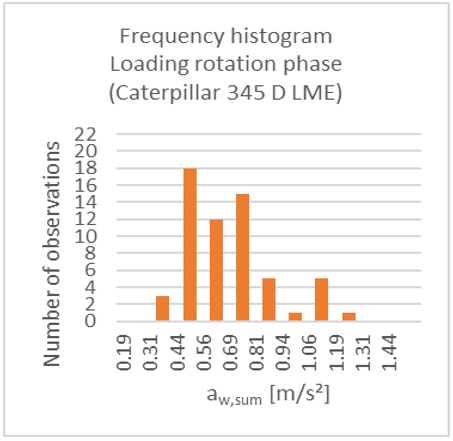
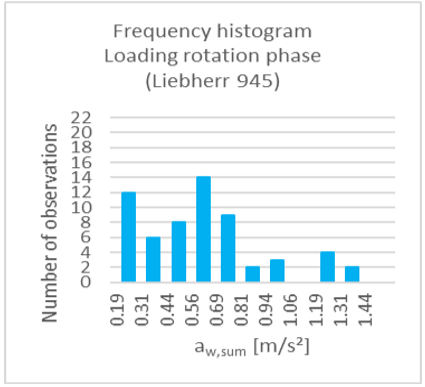
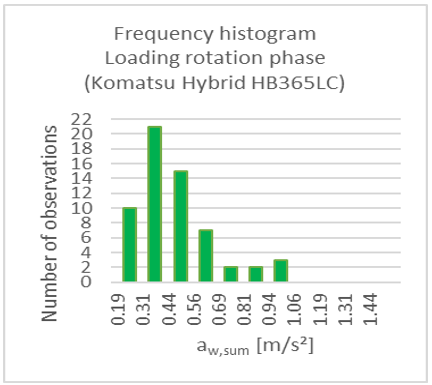
The frequency histograms shown in Figure 5(a) for the Caterpillar model, Figure 5(b) for the Liebherr model, and Figure 5(c) for the hybrid model indicate that, during the loaded phase, the hybrid excavator Komatsu HB365LC recorded lower weighted acceleration values more frequently than the two diesel models.
The data distribution for the hybrid excavator appears more concentrated around lower classes, whereas the diesel machines display a broader and more dispersed distribution, with a higher frequency of larger acceleration values.
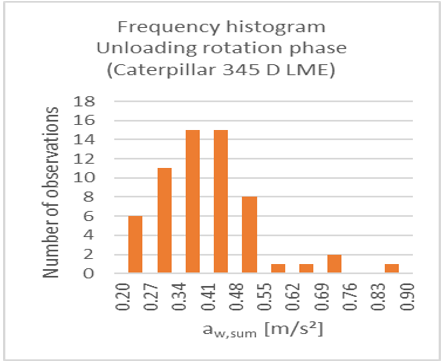
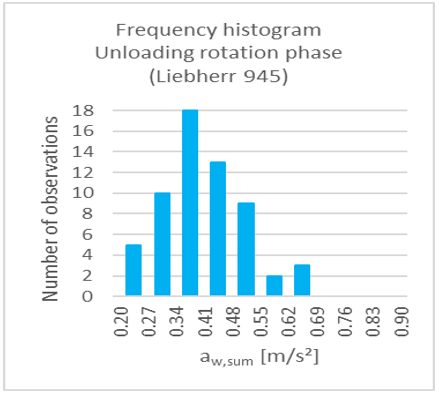
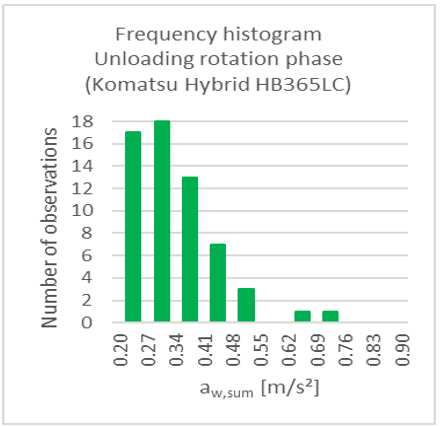
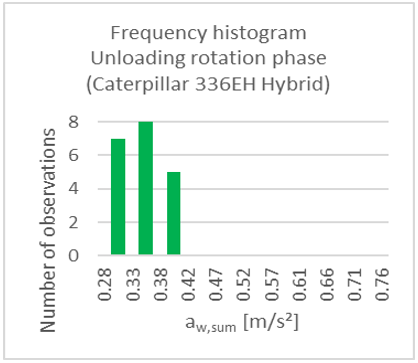
The frequency histograms shown in Figure 6(a) for the Caterpillar 345D LME model, Figure 6(b) for the Liebherr 945, and Figure 6(c) for the Hybrid Komatsu HB365LC illustrate the distribution of weighted acceleration values during the unloaded rotation phase. As observed during the loaded rotation phase, the hybrid excavator shows a higher number of observations falling within the lower acceleration ranges compared to the diesel models and exhibits the lowest variability among the three.
The daily exposure value A(8), calculated using all four operational phases for a standard 8-hour working day in the analyzed quarry context, showed an average reduction of 4% for the hybrid excavator compared to the diesel models. The mean A(8) values were 0.76 m/s2 for the diesel excavators and 0.73 m/s2 for the hybrid model.
(a) Caterpillar 345D LME
(b) Liebherr 945
(c) Komatsu Hybrid HB365LC
Figure 5. Frequency histograms of aw,sum recorded during the loaded rotation phase – basalt quarry
(a) Caterpillar 345D LME
(b) Liebherr 945
(c) Komatsu Hybrid HB365LC
Figure 6. Frequency histograms of aw,sum recorded during the unloaded rotation phase – basalt quarry
Table 8 provides a detailed contribution breakdown of each operational phase, including the specific duration of each phase in seconds (Ti) and the corresponding frequency weighted acceleration (aw,i).
These results are particularly reliable because the measurements taken between diesel excavators and Hybrid Komatsu were performed by the same operator across all machines. This uniformity allowed the vibration differences to be attributed directly to the machine’s powertrain configuration and the hybrid system characteristics, effectively neutralizing the influence of anthropometric factors. The significant WBV reduction was achieved despite notable pre-existing differences in the operating weight and age between the models compared (detailed in Table 1).
Table 8. Contribution breakdown of operational phases and durations – basalt quarry
|
Phase |
Duration Ti [s] |
Caterpillar 345D LME aw,i [m/s2] |
Liebherr 945 aw,i [m/s2] |
Komatsu Hybrid HB365LC aw,i [m/s2] |
|
Loading |
5 |
1.14 |
1.17 |
1.17 |
|
Loaded rotation |
4 |
0.69 |
0.62 |
0.47 |
|
Unloading |
3 |
0.26 |
0.31 |
0.33 |
|
Unloaded rotation |
4 |
0.41 |
0.41 |
0.34 |
3.3 Limestone quarry
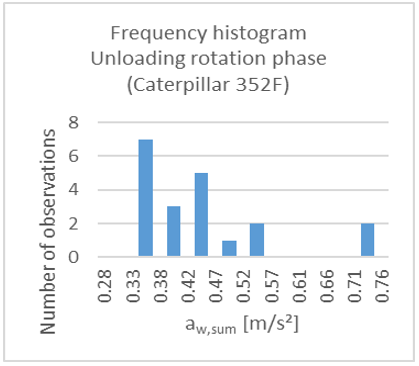
In the limestone aggregate quarry, the comparison was conducted between the Caterpillar 352F diesel excavator and the Caterpillar 336EH Hybrid excavator. The Welch’s t-test revealed statistically significant differences (p = 0,003) only during the unloaded rotation phase, where the acceleration vector showed a 22% reduction for the hybrid model. Conversely, the 16% reduction observed during the loaded rotation phase was not statistically significant.
Table 9 presents the comparison data obtained in the limestone aggregate quarry.
In the limestone quarry, the analysis of effect sizes provides essential context for interpreting the vibration reductions in the rotation phases. As summarized in Table 10, the loaded rotation phase exhibited a medium effect size (d = 0,60), while the unloaded rotation phase showed a large effect size (d = 1,12). These measures confirm that the hybrid system has a substantial practical impact during these phases. Even when the diesel machine’s high variability affects the formal p-value, the medium to large sizes prove that the vibration reductions are consistent and technologically significant.
Table 9. Comparison – Caterpillar 352F vs. Caterpillar 336EH Hybrid
|
Phase |
Excavator Type |
aw,sum [m/s2] |
N |
SD |
%Δ |
95% CI |
P-Value |
|
Loaded rotation |
Caterpillar 352 F |
0.68 |
20 |
0.24 |
-16% |
[-0.23; -0.02] |
0.08 |
|
Caterpillar 336EH Hybrid |
0.57 |
20 |
0.10 |
||||
|
Unloaded rotation |
Caterpillar 352 F |
0.45 |
20 |
0.12 |
-22% |
[-0.16; -0.04] |
0.003 |
|
Caterpillar 336EH Hybrid |
0.35 |
20 |
0.04 |
Table 10. Summary of effect sizes (Cohen's d) for the vibration reduction during loaded and unloaded rotation (limestone quarry)
|
Comparison |
Phase |
Cohen’s d |
Effect |
|
Caterpillar 352 F vs. Caterpillar 336 EH Hybrid |
Loaded rotation |
0.60 |
Medium |
|
Unloaded rotation |
1.12 |
Large |
(a) Caterpillar 352F
(b) Caterpillar 336EH Hybrid
Figure 7. Frequency histograms of aw,sum recorded during the loaded rotation phase – limestone quarry
(a) Caterpillar 352F
(b) Caterpillar 336EH Hybrid
Figure 8. Frequency histograms of aw,sum recorded during the unloaded rotation phase – limestone quarry
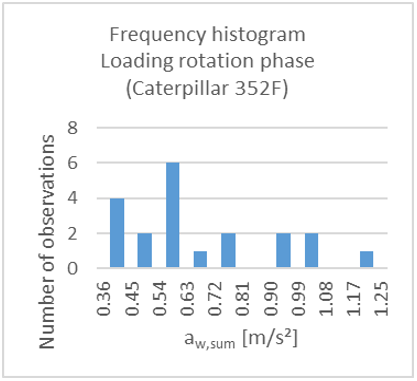
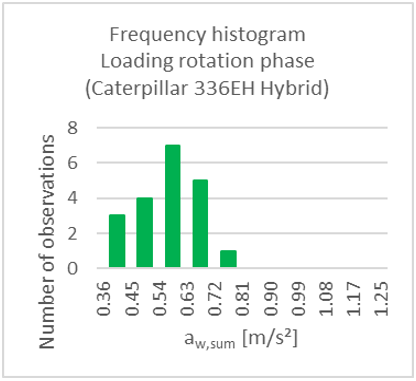
The frequency histograms shown in Figure 7(a) for the Caterpillar 352F model and Figure 7(b) for the Caterpillar 336EH Hybrid illustrate the distribution of aw,sum values during the loaded rotation phase. The hybrid excavator shows a higher number of observations falling within the lower acceleration ranges compared to the diesel model, indicating lower variability.
Similarly, the frequency histograms shown in Figure 8(a) for the Caterpillar model and Figure 8(b) for the hybrid Caterpillar illustrate the distribution of aw,sum values during the unloaded rotation phase. As in the loaded rotation phase, the hybrid excavator exhibits lower acceleration values compared to the diesel counterpart and a more compact distribution ranging approximately between 0.28 m/s2 and 0.42 m/s2, indicating lower variability.
In the comparison between the Caterpillar 352F and the Caterpillar 336EH Hybrid, the machines were of the same age (2015). Although the diesel operator was heavier (96 kg vs. 85 kg), a factor that, according to the literature, tends to dampen vibration transmissions, the statistically significant reduction of 22% observed in the hybrid model suggests that the efficiency of the hybrid system is a dominant factor sufficient to overcome the potential confounding effect of operator anthropometry.
Table 11. Contribution breakdown of operational phases and durations – limestone quarry
|
Phase |
Duration Ti [s] |
Caterpillar 352F aw,i [m/s2] |
Caterpillar 336EH Hybrid aw,i [m/s2] |
|
Loading |
5 |
0.80 |
0.86 |
|
Loaded rotation |
4 |
0.68 |
0.57 |
|
Unloading |
3 |
0.31 |
0.32 |
|
Unloaded rotation |
4 |
0.45 |
0.35 |
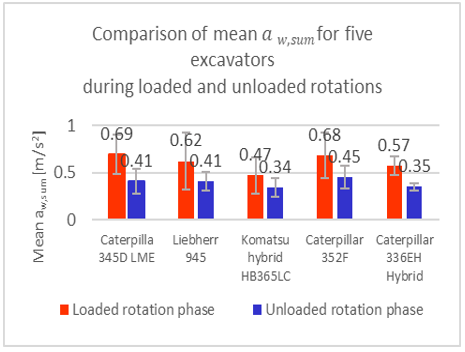
Figure 9. Comparison of mean aw,sum for five excavators during loaded and unloaded rotations
In the limestone quarry, the A(8) values were lower compared to those obtained in the basalt quarry. The diesel excavator recorded an A(8) value of 0.62 m/s2, whereas the hybrid model reached 0.60 m/s2, resulting in a 3,2% reduction in daily vibration exposure for the hybrid excavator.
Table 11 illustrates the contribution breakdown of each operational phase for the limestone quarry.
In conclusion, Figure 9 provides a comprehensive comparison of the mean weighted acceleration for all five excavators during the loaded and unloaded rotation phases, facilitating the interpretation of differences between diesel and hybrid machines as well as between operational phases. The hybrid excavators (Komatsu HB365LC and Caterpillar 336EH) exhibit lower mean acceleration values compared to the diesel models in both phases. Their lower variability is evident from the smaller standard deviations.
3.4 Axis–specific analysis
This section provides empirical evidence to support the methodological choice of using the resultant frequency weighted acceleration, aw,sum, for comparative assessment. The primary objective was to analyze the hybrid system’s effectiveness in providing a general vibrational reduction pattern. Therefore, understanding the multi-axial contribution to the total exposure.
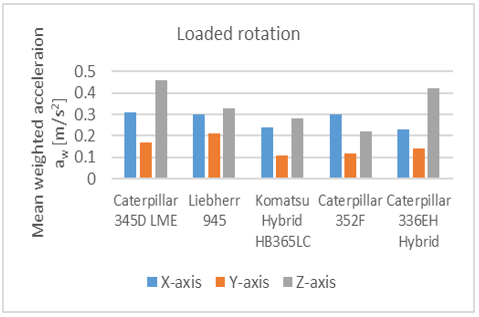
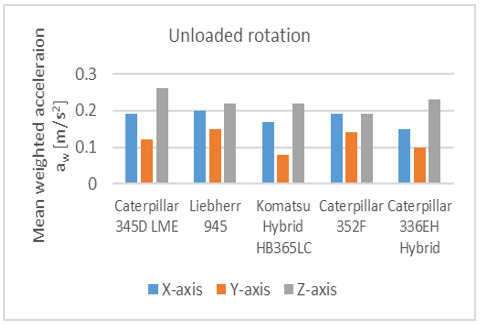
Figure 10 presents the mean weighted acceleration across the X, Y, and Z axes for all five excavators during the loaded rotation phase. Similarly, Figure 11 illustrates the axis-specific distribution during the unloaded rotation phase.
These figures demonstrate that, while the Z-axis (vertical) frequently exhibits the highest numerical values in the analyzed operational phases, all three axes contribute significantly to the overall vibrational load.
Figure 10. Mean weighted acceleration per axis during loaded rotation phase
Figure 11. Mean weighted acceleration per axis during the unloaded rotation phase
The data highlights both the comprehensive benefits and the complex interaction of the hybrid system. For the basalt quarry comparisons, the hybrid excavator (Komatsu HB365LC) consistently showed a reduction in weighted acceleration across all three axes compared to the diesel counterparts, confirming a full-spectrum benefit.
However, an important complexity emerged in the limestone quarry during the loaded rotation phase: while significant reductions were observed in the X and Y axes, the Z-axis acceleration registered a slight increase compared to the diesel model.
However, the localized Z-axis increase found during loaded rotation in the limestone quarry can be plausibly attributed to the confounding factor of the operator’s lower weight on the hybrid excavator (85 kg vs. 96 kg), as suggested by studies on the influence of anthropometric characteristics on WBV exposure [16].
Although robust statistical analysis could not entirely separate the operator’s anthropometric effect from the machine’s performance due to sampling constraints, the consistency observed in the basalt quarry (with a single operator) supports the conclusion that the Z-axis anomaly is anthropometrically linked.
This localized increase in the Z-axis, likely linked to machine dynamics during load handling in the energy recovery phase or differences in machine configuration/weight, was effectively mitigated by the substantial reductions in the X and Y axes.
The overall trend, as reflected by the calculated aw,sum values reported in Section 3.1 and Section 3.2, shows that the efficiency of the hybrid system in reducing the horizontal components (X and Y) or achieving multi-axial reduction outweighs these specific axis increases. This collective reduction confirms the validity of using the resultant vector as the most appropriate metric for validating holistic performance improvement provided by hybrid technology.
This study, conducted in two quarries characterized by different rock types (basalt and limestone), analyzed WBV transmitted to operators during material handling activities, comparing two hybrid excavators with three conventional diesel models. The results show that the hybrid system allows a noticeable reduction of vibrations transmitted to the operator during the rotation phases, when the energy recovery and release system is active. In the basalt quarry, a mean reduction of 27% in frequency-weighted acceleration was observed during the loaded rotation phase (representing a 31% and 23% reduction compared to the two conventional diesel models, respectively), while in the limestone quarry, the reduction was smaller, at 16%. In the unloaded rotation phase, the hybrid excavator showed a consistent reduction in acceleration, with a 17% reduction in the basalt quarry and 22% in the limestone quarry.
The dominance of the hybrid system’s effect suggests that the new powertrain configuration is the primary driver for improved vibration performance during rotation. These consistent phase-specific reductions were observed despite significant differences in the machines’ operating weights and age, and potential confounding anthropometric factors, as detailed in the discussion section.
However, although these reductions are substantial at the phase level, they resulted in a limited decrease in daily exposure A(8) (4% in the basalt quarry and 3,2% in the limestone quarry). This outcome is due to the predominant influence of the loading phase on the overall exposure; this phase exhibits the highest vibration intensities and, as shown in the contribution breakdown (Tables 8 and 11), it mathematically buffers the gains achieved during rotation.
While site-specific factors such as rock density likely contribute to the higher overall A(8) values recorded in basalt quarry (0.76-0.73 m/s2) compared to limestone (0.62-0.60 m/s2), it is important to note that the loading phase is the only operational segment involving direct mechanical interaction between the bucket and the material. Consequently, the significantly lower vibration levels recorded during loading in the limestone quarry can be attributed to the lower resistance and density of the rock compared to basalt, which requires greater penetration force and thus generates higher vibrational energy. This confirms that the hybrid system’s impact remains localized to the rotation segments where it can effectively decouple from the engine’s load.
In conclusion, considering the increasing concern about the environmental impact of heavy machinery used in the mining sector, it is important to address the current knowledge gap regarding WBV transmitted by these machines. Future research should also include other types of hybrid equipment commonly used in quarry operations, such as wheel loaders, dumpers, and haul trucks, to evaluate their overall influence on daily vibration exposure within the production cycle. Unlike hybrid excavators, where the hybrid on-board energy storage system operates during specific phases such as rotation, these machines may function continuously in hybrid mode and therefore be less affected by engine-related vibration transmission.
As a result, a greater reduction in daily exposure values could be expected for such equipment. Expanding the analysis to a broader range of machines and quarry contexts would contribute to a more comprehensive and generalizable understanding of vibration phenomena, supporting the adoption of safer and more sustainable technologies in the heavy equipment industry.
|
A(8) |
Equivalent continuous acceleration for an 8-hour period, m·s-2 |
|
LBP |
Low back pain |
|
RMS |
Root mean square acceleration, m·s-2 |
|
WBV |
Whole-body vibration |
[1] Kia, K., Fitch, S.M., Newsom, S.A., Kim, J.H. (2020). Effect of whole-body vibration exposures on physiological stresses: Mining heavy equipment applications. Applied Ergonomics, 85: 103065. https://doi.org/10.1016/j.apergo.2020.103065
[2] Bergström, L., Nilsson, T., Wahlström, J. (2015). Whole-body vibration and the risk of low back pain and sciatica: A systematic review and meta-analysis. International Archives of Occupational and Environmental Health, 88(4): 403-418. https://doi.org/10.1007/s00420-014-0971-4
[3] Jahn, A., Andersen, J.H., Christiansen, D.H., Seidler, A., Dalbøge, A. (2023). Occupational mechanical exposures as risk factor for chronic low-back pain: A systematic review and meta-analysis. Scandinavian Journal of Work, Environment & Health, 49(7): 453-465. https://doi.org/10.5271/sjweh.4114
[4] Halmai, B., Hollygrove, T.P., Vine, S.J., Harris, D.J., Williams, G.K.R. (2024). The after-effects of occupational whole-body vibration on human cognitive, visual, and motor function: A systematic review. Applied Ergonomics, 118: 104264. https://doi.org/10.1016/j.apergo.2024.104264
[5] The European Parliament and the Council of the European Union. (2002). DIRECTIVE 2002/44/EC of 25 June 2002 on the minimum health and safety requirements regarding the exposure of workers to risks arising from physical agents (vibration). Official Journal of the European Union, L 177/13, 06.07.2002.
[6] International Organization for Standardization (ISO). (1997). Mechanical vibration and shock — Evaluation of human exposure to whole-body vibration — Part 1: General requirements (ISO 2631-1:1997). Geneva, Switzerland.
[7] Grafkina, M.V., Sviridova, E.Y., Goryacheva, E.V. (2023). Reducing occupational risks in industrial processes: Analysis and recommendations for improving safety in production equipment and facilities. International Journal of Safety and Security Engineering, 13(5): 781-788. https://doi.org/10.18280/ijsse.130502
[8] Nuruldaeva, G. Isakhanova, A., Kumar, D., Kumar, B. (2025). Occupational hazards in mineral ore crushing and grinding: A literature review. International Journal of Safety and Security Engineering, 15(3): 415-426. https://doi.org/10.18280/ijsse.150302
[9] Sen, A., Sanjog, J., Karmakar, S. (2020). A comprehensive review of work-related musculoskeletal disorders in the mining sector and scope for ergonomics design interventions. IISE Transactions on Occupational Ergonomics and Human Factors, 8(3): 113-131. https://doi.org/10.1080/24725838.2020.1843564
[10] Bovenzi, M., Rui, F., Negro, C., D’Agostin, F., et al. (2006). An epidemiological study of low back pain in professional drivers. Journal of Sound and Vibration, 298(3): 514-539. https://doi.org/10.1016/j.jsv.2006.06.001
[11] Jeripotula, S.K., Manglapady, A., Mandela, G.R. (2020). Evaluation of whole body vibration (WBV) of dumper operators based on job cycle. Mining, Metallurgy & Exploration, 37(2): 761-772. https://doi.org/10.1007/s42461-019-00140-5
[12] Upadhyay, R., Kumar, A., Bhattacherjee, A. (2025). A Comprehensive Review of Whole‑Body Vibration Exposure Assessment Among Heavy Earthmoving Equipment Operators in the Mining Industry. Mining, Metallurgy & Exploration, 42: 1389-1420. https://doi.org/10.1007/s42461-025-01242-z
[13] Dos Santos, L.C., Lopes, E.D.S., Martins, A.B., Rodrigues, C.K. (2021). Operators exposure to whole-body vibration while performing forest soil preparation by bulldozer and hydraulic excavators. Revista Floresta, 51(4): 962-970. https://doi.org/10.5380/rf.v51i4.74797
[14] Alphin, M.S., Sankaranarayanasamy, K., Sivapirakasam, S.P. (2010). Experimental evaluation of whole body vibration exposure from tracked excavators with hydraulic breaker attachment in rock breaking operations. Journal of Low Frequency Noise, Vibration and Active Control, 29(2): 101-110. https://doi.org/10.1260/0263-0923.29.2.101
[15] Alfaro Degan, G., Coltrinari, G., Lippiello, D., Pinzari, M. (2018). A comparison between methods for assessment of whole-body vibration exposure: A case study in a limestone quarry. International Journal of Safety and Security Engineering, 8(1): 90-97. https://doi.org/10.2495/SAFE-V8-N1-90-97
[16] Erdem, B., Dogan, T., Duran, Z. (2020). Assessment of whole-body vibration exposure of mining truck drivers. Journal of the Southern African Institute of Mining and Metallurgy, 120(9): 547-559. https://doi.org/10.17159/2411-9717/1146/2020
[17] Alfaro Degan, G., Lippiello, D., Pinzari, M. (2018). Assessment of occupational risk in workers in the extractive sector due to exposure to whole body vibrations: A case study on the influence of the anthropometric characteristics on the measured vibration dose. Geoingegneria Ambientale e Mineraria, 3: 115-124. https://www.geam-journal.org/docs/1634045692475geam1552018rivista116.pdf.
[18] Kumar, S. (2004). Vibration in operating heavy haul trucks in overburden mining. Applied Ergonomics, 35(6): 509-520. https://doi.org/10.1016/j.apergo.2004.06.009
[19] Mayton, A.G., Porter, W.L., Xu, X.S., Weston, E.B., Rubenstein, E.N. (2018). Investigation of human body vibration exposures on haul trucks operating at U.S. surface mines/quarries relative to haul truck activity. International Journal of Industrial Ergonomics, 64: 188-198. https://doi.org/10.1016/j.ergon.2017.05.007
[20] Chaudhary, D.K., Bhattacherjee, A., Patra, A.K., Chau, N. (2015). Whole-body vibration exposure of drill operators in iron ore mines and role of machine-related, individual, and rock-related factors. Safety and Health at Work, 6(4): 268-278. https://doi.org/10.1016/j.shaw.2015.06.004
[21] Marin, L.S., Rodriguez, A., Rey, E., Barrero, L.H., Dennerlein, J., Johnson, P.W. (2016). Influence of speed in whole body vibration exposure in heavy equipment mining vehicles. Proceedings of the Human Factors and Ergonomics Society Annual Meeting, 60(1): 919-922. https://doi.org/10.1177/1541931213601211
[22] European Parliament and Council of the European Union. (2016). Regulation (EU) 2016/1628 of 14 September 2016 on requirements relating to gaseous and particulate pollutant emission limits and type-approval for internal combustion engines for non-road mobile machinery, amending Regulations (EU) No 1024/2012 and (EU) No 167/2013, and repealing Directive 97/68/EC. Official Journal of the European Union, L 252: 53-117. https://eur-lex.europa.eu/eli/reg/2016/1628/oj/eng.
[23] Dimension Market Research. (2023). Electric and hybrid construction equipment market. https://dimensionmarketresearch.com/report/electric-and-hybrid-construction-equipment-market/, accessed on Oct. 29, 2025.
[24] Verified Market Reports. (2025). Hybrid excavators market size, growth analysis & forecast [2034]. https://www.verifiedmarketreports.com/product/hybrid-excavators-market/, accessed on Oct. 29, 2025.
[25] Glazyrin, S.A., Varlamov, G.B., Zhumagulov, M.G., Sultanov, T.T., Talipov, O.M. (2024). Improving the efficiency and environmental friendliness of diesel engines of mining dump trucks by installing hybrid gas-diesel fuel systems. In Digital Transformation: What are the Smart Cities Today?, pp. 295-303. https://doi.org/10.1007/978-3-031-49390-4_21
[26] Lajunen, A., Suomela, J., Pippuri, J., Tammi, K., Lehmuspelto, T., Sainio, P. (2016). Electric and hybrid electric non-road mobile machinery – present situation and future trends. World Electric Vehicle Journal, 8(1): 172-183. https://doi.org/10.3390/wevj8010172
[27] Halim, A., Lööw, J., Johansson, J., Gustafsson, J., Van Wageningen, A., Kocsis, K. (2022). Improvement of working conditions and opinions of mine workers when battery electric vehicles (BEVs) are used instead of diesel machines — Results of field trial at the Kittilä Mine, Finland. Mining, Metallurgy & Exploration, 39(2): 203-219. https://doi.org/10.1007/s42461-021-00506-8
[28] Krishna, K., Mahesha, G.T., Hegde, S., Shenoy, B.S. (2023). A Review on Vibrations in Electric and Hybrid Electric Vehicles. Journal of The Institution of Engineers (India): Series C, 104(2): 423-438. https://doi.org/10.1007/s40032-023-00930-3
[29] Fang, Z., Li, Q., Yao, L., Hu, X. (2025). Stiffness optimization for hybrid electric vehicle powertrain mounting system in the context of NSGA II for vibration decoupling and dynamic reaction minimization. World Electric Vehicle Journal, 16(3): 131. https://doi.org/10.3390/wevj16030131
[30] Alfaro Degan, G., Antonucci, A., Coltrinari, G., Innocenzi, S., Lippiello, D. (2025). Comparing whole-body vibration exposure between two excavators in an Italian quarry: A case study. Revista Minelor – Mining Revue, 31(2): 16-24. https://doi.org/10.2478/minrv-2025-0013