Zainab Ali Dheyab* | Sadiq A. Mehdi
© 2025 The authors. This article is published by IIETA and is licensed under the CC BY 4.0 license (http://creativecommons.org/licenses/by/4.0/).
OPEN ACCESS
Given the ongoing need for data security and the ongoing developments that have led to the transmission of sensitive images in various fields, such as the military, forensic image analysis, and medical, the need arose to design this algorithm, which consists of several encryption steps. Design a new hyper-chaotic four-dimensional (4D) system and use it to create a substitution box (S-box) to do substitution and encrypt the color channels by applying different sequence values with XOR for each channel. Also, a second-order fuzzy differential equation is used to generate the final encryption key, which is then XORed with the original image to produce an encrypted color image, thereby enhancing diffusion and confusion. The algorithm showed high accuracy results in examining tests such as entropy value reach 7.999, Histogram, Number of Pixels Change Rate (NPCR), Peak Signal-to- Noise Ratio (PSNR) above than 99.60 percent, Time speed less than 1.07 sec, Unified Average Changing Intensity (UACI) close to 33 percent, Mean Squared Error (MSE), Correlation coefficient test less than (0.001), for the three directions: vertical, horizontal, and diagonal. Confirms the algorithm’s ability to withstand brute-force exploration, statistical analysis, and differential cryptanalysis, ensuring a high level of security and preserving the transmitted image from tampering.
S-box, second-order fuzzy differential, encryption algorithm, 4D hyper chaotic system, color image
The widespread use of multimedia, particularly images, across fields such as geology, biology, medicine, and the military has enabled technological progress that has also enabled attacks, resulting in the theft or falsification of information [1, 2]. The possibility of hiding information within them or preventing the leakage of essential images exists, as does the presence of open networks for communication between people, which expose data to danger. Therefore, it is crucial to maintain the security of information and the safety of images sent over the internet [3-6]. From this standpoint, the focus has shifted to encrypting images and developing algorithms that are highly secure while also restoring them to full resolution without data loss. Scientists and researchers are compelled to build and innovate algorithms to enhance security [7-10]. One of the techniques used is the substitution box (S-box) generated from chaotic systems, which disperses pixel correlations as a preliminary step before encryption [11, 12].
These chaotic systems have initial values that generate non-periodic, sensitive-to-change random numbers, making them a type of complex, non-linear system. Also, multiple steps or rounds can be used for encryption, enhancing security. Also, two stages are used: configuration and diffusion. Encryption is of two types: block encryption, which treats data and images as blocks of bits or bytes, and stream encryption, which treats data bit by bit or byte by byte [13-16].
In 2022, Abdallah et al. [17] generate a 16 × 16 S-box using a chaotic map based on a 2D Henon map, thereby enhancing diffusion and minimizing pixel correlation. Also used random sequences to perform the diffusion and configuration steps via X-OR operations, generating random values from the Logistic, Henon, and Lorenz systems.
In 2023, Shakir et al. [18] encrypted a color image using an S-box for substitution and sequences generated from a new four-dimensional (4D) chaotic system that invests the sequence output values, then permuted to eliminate correlations. After it, split the color bands, and for each band, there is a sequence of values to be scrambled. By applying the S-box and utilising other operations, such as DNA, XORing, additions, and subtraction, we can further encrypt the image.
In 2025, Al-Dayel et al. [19] utilised a 4D system to encode color images, leveraging its high randomness, non-linearity, and discrete properties. To enhance these properties, the Langton's Ant was incorporated as a second layer of encoding, which has several rules, and they were used for encoding, as shown in the table in the research paper and the diagram as well, so that these rules lead to unexpected and non-linear patterns, and they are applied iteratively.
Create the new 4D hyper chaotic system, a mathematical model containing thirteen parameters, non-linear terms are obtained as:
$\begin{gathered}\frac{d x}{d t}=a y z-b x-c w+b \sin (y) \\ \frac{d y}{d t}=d x z+e x-y-b x \operatorname{Exp}(z) \\ \frac{d z}{d t}=f x y-g z+h y^2-i \operatorname{Sin}(w) \\ \frac{d w}{d t}=j y z+k x z-l w+m z \operatorname{Exp}(x)\end{gathered}$ (1)
where, value of initial conditions are x(0) = 0.5, y(0) = 0.4, z(0) = 1.5, w(0) = 0.6, and thirteen initial parameters are a = 5.8, b = 3, c = 0.5, d = 0.8, e = 17, f = 29, g = 2.4, h = 9, i = 5, j = 15, k = 4, l = 2.1 and m = 2.
Lyapunov Exponent and fixed points
The Lyapunov Exponent values are L.E1 = 2.88108, L.E2 = 0.0828833, L.E3 = -2.48959, and L.E4 = -25.0176, There are two positive values this mean hyper chaotic system The new hyper chaotic system have two fixed points are E0 {x = 0, y = 0, z = 0, w = 0} and E1 {x = 0.178759, y = 0.266214, z = 1.72831, w = 5.84311}, and the new hyper chaotic system instable in fixed point.
Phase portraits
The system exhibits complex, chaotic behavior, as shown in the phase diagram. Figures 1 and 2 show the three and two-dimensional strange attractors. Numerical simulations were performed using Mathematica. The generated shape in the phase resembles the flapping of a butterfly's wings, hence the term "butterfly effect," and because even a small change can cause a significant change in the results.

Figure 1. Three-dimensional view of chaotic attractors

Figure 2. Chaotic attractors of 2D x-y phase
Bifurcation diagram
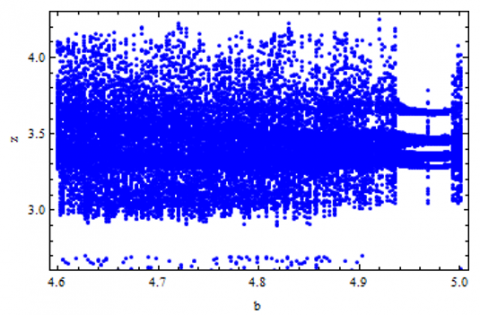
To understand what happens to a small number of $b$ values within a large range $\mathrm{b} \in[4.9,5]$. The bifurcation diagram in Figure 3 shows that as $b$ values increase, a cyclic doubling occurs in the region $4.9 \leq b \leq 5$.
Figure 3. The bifurcation diagram of $b \in[4.9,5]$
Sensitivity to initial conditions
One of the most important characteristics of a system is its extreme sensitivity to even the slightest change in values. No matter how close the values of two different initial conditions may seem, they will eventually diverge. Therefore, there will come a time when the system's state becomes unpredictable. Figure 4 illustrates that the evolution of the chaotic path is highly sensitive to the initial conditions. The solid line is (x(0) = 0.5, y(0) = 0.4, z(0) = 1.5, w(0) = 0.6) and the value change is (x(0) = 0.5, y(0) = 0.4, z(0) = 1.5, w(0) = 0.60000000000001) for the dashed line.

Figure 4. Sensitivity tests of the of the trajectory w(t)
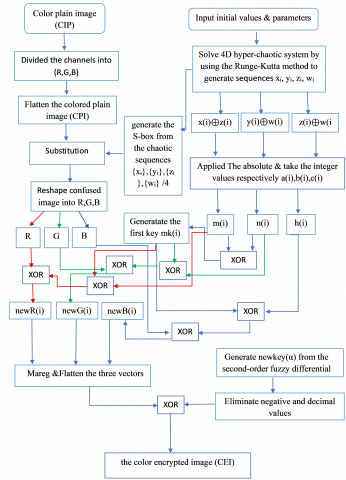
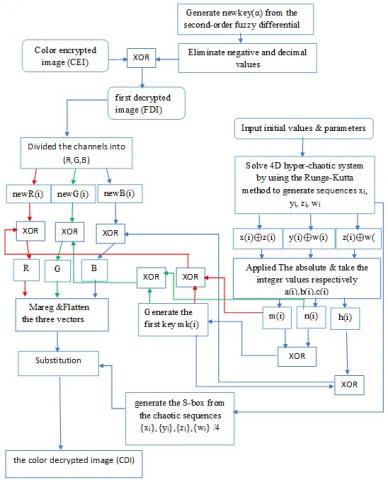
The algorithm uses several encryption phases, each strengthening the encryption. In the first phase, S-boxes are generated using a hyper-chaotic system, while in the second phase, random sequences are generated to encrypt the image using XOR. In the final phase, a key is generated using a second-order fuzzy differential equation. These steps are illustrated through a block diagram in Algorithm 1 and Figure 5. The inverse of these steps represents the decryption algorithm. The decryption process begins with the fuzzy equation key, followed by reversing the XOR operations, and then applying the substitution operation using the S-box, as shown in Algorithm 2 and the block diagram in Figure 6.
|
Algorithm 1: Encryption |
|
|
Input: |
Color plain image (CPI), parameters: a, b, c, d, e, f, g, h, i, j, k, l, m, initial |
|
|
w0, z0, y0, x0 from the new hyper chaotic system (1). |
|
Output: |
Color encrypt image (CEI). |
|
Step 1: |
Read the colored plain image (CPI). |
|
Step 2: |
Split the channels into three components (red (R), green (G), and blue (B)). |
|
Step 3: |
for i = 0 to image size / 4 |
|
|
Solve the new hyper-chaotic system (1) by using the Runge-Kutta method to get four chaotic sequences $\left\{\left\{\mathrm{x}_{\mathrm{i}}\right\},\left\{\mathrm{y}_{\mathrm{i}}\right\},\left\{\mathrm{z}_{\mathrm{i}}\right\},\left\{\mathrm{w}_{\mathrm{i}}\right\}\right\}$. |
|
Step 4: |
Generate the S-box from the chaotic sequences $\left\{\left\{\mathrm{x}_{\mathrm{i}}\right\},\left\{\mathrm{y}_{\mathrm{i}}\right\},\left\{\mathrm{z}_{\mathrm{i}}\right\},\left\{\mathrm{w}_{\mathrm{i}}\right\}\right\}$by apply the equation below, |
|
|
for j = 1 to 256; |
|
Step 5: |
$S-box(j)=\left(\left\{\mathrm{x}_{\mathrm{j}}\right\},\left\{\mathrm{y}_{\mathrm{j}}\right\},\left\{\mathrm{z}_{\mathrm{j}}\right\},\left\{\mathrm{w}_{\mathrm{j}}\right\} \times 10^{14}\right)$ mod 256. |
|
|
Flatten the colored plain image (CPI) and iterate the S-box to operate on each pixel’s substitution to get a confused image as a confusion state. |
|
|
S-box( |
|
Step 6: |
Generate three sequence values from the new hyper chaotic system (1) |
|
|
for i = 0 to image size, |
|
|
$a(i)=x(i) \oplus z(i)$, |
|
|
$b(i)=y(i) \oplus w(i)$, |
|
|
$c(i)=z(i) \oplus w(i)$. |
|
Step 7: |
Generate the first key from the sequences, |
|
|
for i = 0 to image_size,ol |
|
|
$\mathrm{m}(\mathrm{i})=\mathrm{abs}\left(\mathrm{a}(\mathrm{i}) \times 10^{14}\right) \bmod 256$, |
|
|
$\mathrm{n}(\mathrm{i})=\mathrm{abs}\left(\mathrm{b}(\mathrm{i}) \times 10^{14}\right) \bmod 256$, |
|
|
$h(i)=\operatorname{abs}\left(c(i) \times 10^{14}\right) \bmod 256$, |
|
Step 8: |
Diffuse the pixels of the confusion state by using a key generated from Step 6 that matches the input image size |
|
|
for i = 0 to image_size |
|
|
$(\mathrm{mk}(\mathrm{i}) \oplus \mathrm{m}(\mathrm{i})) \oplus \mathrm{R}(\mathrm{i})= newR (\mathrm{i})$, |
|
|
$(m k(i) \oplus n(i)) \oplus G(i)=n e w G(i)$, |
|
|
$(m k(i) \oplus h(i)) \oplus B(i)=newB(i)$ . |
|
Step 9: |
Combine the three vectors (newR(i), newG(i), newB(i)) to obtain the first encrypted image (FEI). |
|
Step 10: |
Use the first encrypted image (FEI) generated in the previous steps to apply a second state of encryption. |
|
Step 11: |
Generate a second key from the second-order fuzzy differential equation, |
|
|
for α = 0 to 1 step 100001, x = 0.5, |
|
|
$\operatorname{key}(\alpha)=\left((1-\alpha)\left(1+x-\frac{1}{2} x^2\right)\right)$ |
|
Step 12: |
Eliminate negative and decimal values from the resulting values of the second-order fuzzy differential equation, |
|
|
newkey $(\alpha)=\operatorname{abs}\left(\operatorname{key}(\alpha) \times 10^{14}\right) \bmod 256$. |
|
Step 13: |
Apply the XOR on newkey with the first encrypted image (FEI), |
|
|
newkey (α) ⊕ (FEI) = CEI. |
|
Step 14: |
Save the color encrypted image (CEI). |
|
Step 15: |
End. |
Figure 5. The three-phase encryption algorithm block diagram
|
Algorithm 2: Decryption |
|
|
Input: |
color encrypt image (CEI) and the second key. |
|
Output: |
color decrypt image (CDI). |
|
Step 1: |
Read the color encrypt image (CEI). |
|
Step 2: |
Generate a second key from the second-order fuzzy differential equation for α = 0 to 1 step 100001, x = 0.5, |
|
|
$\operatorname{key}(\alpha)=\left((1-\alpha)\left(1+x-\frac{1}{2} x^2\right)\right)$ |
|
Step 3: |
Eliminate negative and decimal values from the resulting values of the second-order fuzzy differential equation, newkey (α) = abs(key(α) * 1014) mod 256. |
|
Step 4: |
Apply the XOR on newkey with the color encrypt image (CEI) to get the first decrypted image (FDI), newkey(α) ⊕ (CEI) = FDI. |
|
Step 5: |
Use the first decrypted image (FDI) generated in the previous steps to apply a second state of decryption. |
|
Step 6: |
Split the channels of the first decrypted image (FDI) into three vectors (newR(i), newG(i), newB(i)). |
| Step 7: |
for i = 0 to image size, Solve the new hyper-chaotic system (1) by using the Runge-Kutta method to get four chaotic sequences {{xi},{yi},{zi},{wi}}. |
| Step 8: |
Generate three sequence values from the new hyper chaotic system (3.1) a(i) = x(i) ⊕ z(i), b(i) = y(i) ⊕ w(i), c(i) = z(i) ⊕ w(i). |
|
Step 9: |
Generate the first key from the sequences, for i = 0 to image_size, m(i) = abs( a(i) *1014) mod 256, n(i) = abs( b(i) *1014) mod 256, h(i) = abs( c(i)*1014) mod 256, mk(i) = m(i) ⊕ n(i). |
|
Step 10: |
Diffuse the pixels of the confusion state by using a key generated from Step 9 that matches the input image size for i = 0 to image_size R(i) = newR(i) ⊕ (mk(i) ⊕ m(i)), G(i) = newG(i) ⊕ (mk(i) ⊕ n(i)), B(i) = newB(i) ⊕ (mk(i) ⊕ h(i)). |
|
Step 11: |
Use the first decrypted image (FDI) that was generated in the previous steps to apply the final step of substitution. |
|
Step 12: |
Generate the inverse S-box, for j = 1 to 256; S-box-1(j) = ({xi}, {yi}, {zi}, {wi}*1014) mod 256. |
|
Step 13: |
Iterates the inverse S-box to cover the Flatten image that operates on each pixel's substitution to get the color decrypted image (CDI), |
|
|
S-box-1(j)= image |
|
Step 14: |
Save the color decrypted image (CDI). |
|
Step 15: |
End. |
Figure 6. The three-phase decryption algorithm block diagram
Table 1. S-box is generated from the new 4D hyper-chaotic system
|
|
0 |
1 |
2 |
3 |
4 |
5 |
6 |
7 |
8 |
9 |
A |
B |
C |
D |
E |
F |
|
0 |
64 |
78 |
139 |
185 |
120 |
183 |
9 |
212 |
71 |
15 |
174 |
118 |
8 |
75 |
193 |
55 |
|
1 |
162 |
40 |
49 |
111 |
186 |
175 |
236 |
217 |
198 |
90 |
27 |
241 |
134 |
19 |
223 |
13 |
|
2 |
85 |
169 |
155 |
50 |
67 |
249 |
91 |
205 |
202 |
157 |
105 |
70 |
150 |
3 |
206 |
46 |
|
3 |
144 |
211 |
204 |
133 |
79 |
106 |
224 |
84 |
176 |
87 |
61 |
4 |
188 |
167 |
48 |
41 |
|
4 |
45 |
30 |
243 |
146 |
137 |
251 |
44 |
165 |
96 |
154 |
131 |
108 |
179 |
191 |
252 |
195 |
|
5 |
18 |
159 |
253 |
227 |
97 |
47 |
192 |
69 |
170 |
247 |
141 |
219 |
80 |
215 |
218 |
245 |
|
6 |
92 |
66 |
238 |
199 |
37 |
1 |
102 |
32 |
31 |
177 |
233 |
187 |
234 |
38 |
20 |
56 |
|
7 |
7 |
152 |
126 |
5 |
200 |
231 |
43 |
81 |
22 |
158 |
82 |
148 |
254 |
128 |
136 |
73 |
|
8 |
60 |
99 |
147 |
14 |
196 |
52 |
220 |
109 |
164 |
104 |
98 |
171 |
39 |
16 |
140 |
29 |
|
9 |
190 |
122 |
77 |
10 |
239 |
149 |
65 |
72 |
184 |
11 |
142 |
235 |
222 |
160 |
83 |
166 |
|
A |
124 |
242 |
101 |
225 |
100 |
230 |
208 |
58 |
125 |
180 |
114 |
143 |
0 |
178 |
68 |
153 |
|
B |
2 |
88 |
26 |
246 |
21 |
94 |
240 |
132 |
173 |
129 |
145 |
255 |
214 |
209 |
63 |
229 |
|
C |
103 |
207 |
248 |
161 |
42 |
110 |
203 |
172 |
53 |
135 |
116 |
117 |
197 |
194 |
12 |
115 |
|
D |
95 |
107 |
163 |
228 |
156 |
182 |
25 |
93 |
24 |
244 |
123 |
35 |
86 |
74 |
168 |
237 |
|
E |
151 |
36 |
232 |
201 |
226 |
121 |
213 |
17 |
62 |
250 |
119 |
57 |
33 |
138 |
51 |
59 |
|
F |
89 |
181 |
34 |
112 |
54 |
130 |
28 |
113 |
23 |
210 |
127 |
6 |
76 |
221 |
189 |
216 |
4.1 Dynamic S-box phase based on the new 4D hyper-chaotic system
From the new 4D hyper-chaotic system, which is solved using the Runge-Kutta method, a new S-box, as shown in Table 1, is built to be applied to the image before the two encryption phases. The size of the new S-box (16 × 16) provides 256 unique values for substitution. The substitution is applied to all three channels (red, green, blue). The robustness and sensitivity of the hyper-chaotic system (1) are directly proportional to the robustness and sensitivity of the S-box.
4.2 Encryption second phase based on the new 4D hyper-chaotic system
In this phase, new values are assigned by performing an XOR between the various system sequences. Generate a key from the sequences, then XOR it with the new values generated by the new hyper-chaotic system, and apply the result to the image after applying the S-box, as described in the encryption algorithm and block diagram.
4.3 Encryption final phase based on the second-order fuzzy differential equation
As the final phase, apply the second-order fuzzy differential equation to generate a second key, then perform the XOR operation. The fuzzy equation selects fuzzy input values that change constantly during this step, for α = 0 to 1, with a step size of 100001. These steps explain how the equation was generated. Table 2 shows NIST test was performed on the key generated from this equation, and it passed all tests.
Table 2. NIST test result for the sequence generated by a fuzzy
|
NIST Test Name |
P-Value of Concatenate |
Final Results |
|
Frequency (Monobit) |
0.3173105078 |
√ |
|
Frequency-test within- a Block (m = 128) |
0.4795001221 |
√ |
|
Run |
0.4795225386 |
√ |
|
(Longest-run) of ones in a block |
0.254925402280664 |
√ |
|
Rank of Binary-matrix |
0.0391046157 |
√ |
|
Discrete-Fourier-Transformation |
0.6463551955 |
√ |
|
Non-Overlapping Template |
0.0381950649 |
√ |
|
Overlapping Template |
0.4328750525 |
√ |
|
Linear Complexity Test |
0.2519033436 |
√ |
|
Serial-1 |
0.9999999496 |
√ |
|
Serial-2 |
0.9999947013 |
√ |
|
Approximate Entropy |
0.8886599723 |
√ |
|
Cumulative sums |
0.54073062317 |
√ |
|
Random Excursion |
0.0156999496 |
√ |
|
Random Excursions Variant |
0.0030673968 |
√ |
$\begin{gathered}\frac{\partial^2 \widetilde{w}(x, y)}{\partial x^2}=\beta \\ \widetilde{w}(x, 0)=\frac{\partial \widetilde{w}(x, 0)}{\partial y}=[\underline{w}(0, y, \alpha), \underline{w}(0, y, \alpha)]= {[\alpha-1,1-\alpha],} \\ \beta=[\alpha-1,1-\alpha], \quad \forall \alpha \in[0,1] .\end{gathered}$
$\widetilde{w}(x, y)$ is differentiable and $\frac{\partial \widetilde{w}(x, y)}{\partial x}$ is differentiable:
$\begin{aligned} \underline{w}(x, y, \alpha)= & (1-\alpha)\left(1+x-\frac{1}{2} x^2\right), \underline{w}(x, y, \alpha)= (\alpha-1)\left(1+x-\frac{1}{2} x^2\right)\end{aligned}$
for α = 0 to 1 step 100001, x = 0.5,
$\operatorname{key}(\alpha)=\left((1-\alpha)\left(1+x-\frac{1}{2} x^2\right)\right)$ (2)
Using different color image diminution with varying types of extensions, the Lake image (1024 × 1024 .jpg file), boat image (512 × 512 .png file), and Peppers image (256 × 256 .tiff file) were tested. The algorithm was simulated using Python 3.9.7-amd64 and Visual Studio 2022. The numerous tests conducted yielded excellent results, including a histogram analysis. The results demonstrated that this method is robust, as evidenced by its appearance in various attack analyses, including Number of Pixels Change Rate (NPCR) and Unified Average Changing Intensity (UACI). It is difficult to hack or break, making it highly suitable for encrypting color images. Also, when decrypting the generated image, it matches the original one exactly, with no errors or missing values, as shown in the Peak Signal-to- Noise Ratio (PSNR) and Mean Squared Error (MSE).
5.1 Histogram analysis
Table 3 illustrates histogram analysis, a crucial statistic for measuring encryption quality. We observe that images in section b show increases and decreases in frequency, representing the repetitions within the image that reveal its content. In contrast, images in section d exhibit a stable distribution, lacking statistical similarity in visual appearance.
Table 3. Encryption results (a) org-imgs, (b) enc-imgs, (c) enc-histogram, (d) dec-imgs, (e) dec-histogram
|
Original image |
Size |
Extension |
Original Histogram |
Encrypted |
Encrypted Histogram |
Decrypted |
|
|
1024 × 1024 |
.jpg |
|
|
|
|
|
|
512 × 512 |
.png |
|
|
|
|
|
|
256 × 256 |
.tiff |
|
|
|
|
|
(a) |
|
|
(b) |
(c) |
(d) |
(e) |
5.2 Information entropy analysis
In Table 4, a higher entropy value, close to 8, is obtained using the Shannon entropy measure, indicating higher security when calculating the frequency of image pixels. It is a perfect result that repels statistical attacks. The entropy image value is shown in the table below.
Table 4. Entropy of encrypted and original images
|
Image Type |
Entropy Original |
Entropy Encrypted |
|
Peppers 256 × 256.tiff |
7.7031 |
7.9990 |
|
Sailboat 512 × 512.png |
7.7393 |
7.9990 |
|
Lake 1024 × 1024.jpg |
7.1197 |
7.9991 |
5.3 Correlation coefficient analysis
A coefficient value approaching zero indicates stronger encryption performance, as it implies minimal statistical similarity between the two images. In such cases, the encrypted image lacks discernible visual patterns, making it extremely difficult to interpret or reconstruct without possession of the correct decryption key [20]. Table 5 presents the results evaluating the robustness of the proposed image encryption method, explicitly using the correlation coefficient between the encrypted and original images.
Table 5. Correlation coefficient test for the three directions: (V, H, and D) for the encrypted and original images of the three images 'Peppers', 'Sailboat', and 'Lake'
|
Image |
Original |
Encrypted |
||||
|
Vertical |
Horizontal |
Diagonal |
Vertical |
Horizontal |
Diagonal |
|
|
Peppers |
0.9712 |
0.9643 |
0.9381 |
0.0037 |
0.0005 |
-0.0021 |
|
Sailboat |
0.9568 |
0.9583 |
0.9288 |
0.0026 |
0.0004 |
-0.0044 |
|
Lake |
0.9000 |
0.9022 |
0.8407 |
-0.0020 |
0.0041 |
-0.0010 |
5.4 Security differential attack test
One important test for evaluating the algorithm's efficiency is differential attack testing. The algorithm must prevent attacks on the encryption. The algorithm must ensure that any slight change in the original image results in a change in the encrypted image. This is measured using NPCR, where accuracy is above 99%, and UACI, where it is around 33%. Table 6 shows the results of the differential tests.
Table 6. NPCR and UACI results
|
Name |
Size |
NPCR |
UACI |
|
Peppers |
256 × 256 |
99.60% |
32.11% |
|
Sailboat |
512 × 512 |
99.62% |
31.96% |
|
Lake |
1024 × 1024 |
99.61% |
35.07% |
5.5 Execution and complexity analysis of time
Table 7 contains the execution times for encrypting and decrypting the image, and the values are off by 1 second or a few parts. When using a specific encryption algorithm or designing a new one, time is one of the most important factors to consider. Therefore, based on previous tests that demonstrated its strength and the inability to decode it, the encryption time values clearly support the findings of the research. used Python 3.9, Visual Basic 2022, 16GB of RAM, and Windows 11. Table 8 illustrates the time allocation for each operation in the algorithm. The execution time increases with increasing input size and the number of pixels in the image. The time complexity depends entirely on the image size and the operations performed on the image during encryption to generate keys and perform the encryption.
Table 7. Time speed of three different image sizes
|
Image |
Size |
Encryption Time in sec. |
Decryption Time in sec. |
|
Peppers |
256 × 256 |
1.0402 sec |
0.9794 sec |
|
Sailboat |
512 × 512 |
1.0709 sec |
1.0521 sec |
|
Lake |
1024 × 1024 |
1.0340 sec |
1.0075 sec |
Table 8. The execution time of the algorithm
|
Process |
Time [unit: sec] |
|
Chaotic system keys |
0.9578 |
|
S-box |
0.00014 |
|
First encryption |
0.283692 |
|
Second encryption |
0.24491 |
5.6 Analysis of MSE and PSNR ratio
Two essential metrics for evaluating decryption quality are PSNR and MSE. The current algorithm returns zero, indicating a perfect match between the decrypted image and the original, as shown in Table 9.
5.7 Key space analysis
One of the important properties of algorithms is the size of the key space. The key space represents the number of possible keys generated in the system. The larger the space, the greater the ability to repel attacks, as the key used cannot be predicted. Based on the system's equations, the space is $(10^{14})^{17} =10^{238} \simeq 2^{757}$, which is larger than (2128), making it resistant to brute-force attacks.
5.8 Comparison results with other encryption methods
In Table 10, the work is compared with previously published works [2, 18], where better results were obtained, especially in entropy, as well as differences in the values reported in the previous studies [2, 18]. The Sailboat image was initially used at a small size, but in this work, it was used at 512 × 512. This resulted in better performance in terms of Entropy, NPCR, and UACI, with close correlations. As for comparing the Pepper image with the study by Shakir et al. [18], it is the same size, but in this work, it is colored, which means more complexity, and the results also show our work, especially in entropy.
Table 9. PSNR and MSE for plain and decrypted images
|
Image |
Size |
PSNR |
MSE |
|
Peppers |
256 × 256 |
Inf dB |
0.000 |
|
Sailboat |
512 × 512 |
Inf dB |
0.000 |
|
Lake |
1024 × 1024 |
Inf dB |
0.000 |
Table 10. Proposed algorithm comparison results with other encryption methods for the Sailboat and Pepper images
|
Image |
Size |
Entropy |
NPCR |
UACI |
Original |
Encrypted |
||||
|
V |
H |
D |
V |
H |
D |
|||||
|
Sailboat ours |
512 × 512 |
7.9990 |
99.62% |
31.96% |
0.9568 |
0.9583 |
0.9288 |
0.0026 |
0.0004 |
-0.0044 |
|
Ref. [2] |
256 × 256 |
7.9975 |
99.60% |
33.4% |
- |
- |
- |
- |
- |
- |
|
Ref. [18] |
256 × 256 |
7.9989 |
99.61% |
34.02% |
0.9644 |
0.9679 |
0.9504 |
-0.0012 |
-0.0012 |
-0.0009 |
|
Pepper ours |
256 × 256 color |
7.9990 |
99.60% |
32.11% |
0.9712 |
0.9643 |
0.9381 |
0.0037 |
0.0005 |
-0.0021 |
|
Ref. [2] |
256 × 256 gray |
7.9974 |
99.60% |
33.46% |
0.9654 |
0.9680 |
0.9443 |
0.0003 |
0.0005 |
-0.0400 |
A new algorithm was generated for a 4D hyperchaotic system, which provides robust encryption. An S-box was generated from the new system. A key was generated from the fuzzy logic equation, yielding optimal results. The correlation coefficient and perfect values of entropy, NPRC, and UACI were all close to perfection. The tables in the research also show many values obtained by encrypting a set of images with different extensions and sizes. It uses a high-strength algorithm, making it difficult to decrypt or hack. In future work, consider incorporating artificial intelligence methods to reduce the time.
This work gratefully acknowledges the support and assistance provided by Mustansiriyah University (https://www.uomustansiriyah.edu.iq) which played a vital role in the completion of this work.
[1] Jasim, S.H., Hoomod, H.K., Hussein, K.A. (2024). Image encryption based on hybrid parallel algorithm: DES-present using 2D-chaotic system. International Journal of Safety and Security Engineering, 14(2): 633-646. https://doi.org/10.18280/ijsse.140229
[2] Sheng, Y., Li, J., Di, X., Li, X., Xu, R. (2022). An image encryption algorithm based on complex network scrambling and multi-directional diffusion. Entropy, 24(9): 1247. https://doi.org/10.3390/e24091247
[3] Yan, S., Li, L., Zhao, W., Gu, B. (2023). Design of a new four-dimensional chaotic system and its application to color image encryption. Non-linear Dynamics, 111(18): 17519-17545. https://doi.org/10.1007/s11071-023-08726-x
[4] Shakir, H.R., Mehdi, S.A., Hattab, A.A. (2023). A new method for color image encryption using chaotic system and DNA encoding. Mustansiriyah Journal of Pure and Applied Sciences, 1(1): 68-79. https://doi.org/10.47831/mjpas.v1i1.9
[5] Enayatifar, R., Abdullah, A.H., Lee, M. (2013). A weighted discrete imperialist competitive algorithm (WDICA) combined with chaotic map for image encryption. Optics and Lasers in Engineering, 51(9): 1066-1077. https://doi.org/10.1016/j.optlaseng.2013.03.010
[6] Zghair, H.K., Mehdi, S.A., Sadkhan, S.B. (2020). Design and analytic of a novel seven-dimension hyper chaotic systems. Proceedings of the 2020 1st Information Technology to Enhance e-Learning and Other Application (IT-ELA), Baghdad, Iraq, pp. 77-81. http://doi.org/10.1109/IT-ELA50150.2020.9253077
[7] Zghair, H.K., Mehdi, S.A., Sadkhan, S.B. (2021). Speech scrambler based on discrete cosine transform and novel seven-dimension hyper chaotic system. Journal of Physics: Conference Series, 1804(1): 012048. https://doi.org/10.1088/1742-6596/1804/1/012048.
[8] Alghamdi, Y., Munir, A., Ahmad, J. (2022). A lightweight image encryption algorithm based on chaotic map and random substitution. Entropy, 24(10): 1344. https://doi.org/10.3390/e24101344
[9] Kuffi, E.A., Mehdi, S.A., Mansour, E.A. (2022). Color image encryption based on new integral transform SEE. Journal of Physics: Conference Series, 2322(1): 012016. http://doi.org/10.1088/1742-6596/2322/1/012016
[10] Alshekly, T.K., Albahrani, E.A., Lafta, S.H. (2022). 4D chaotic system as random substitution-box. Multimedia Tools and Applications, 81(11): 15793-15814. http://doi.org/10.1007/s11042-022-11928-x
[11] Zghair, H.K., Mehdi, S.A., Sadkhan, S.B. (2020). Analysis of novel seven-dimension hyper chaotic by using SDIC and waveform. In Proceedings of the 2020 3rd International Conference on Engineering Technology and Applications (IICETA), Najaf, Iraq, pp. 95-99. http://doi.org/10.1109/IICETA50496.2020.9318940
[12] Dimitrov, M.M. (2020). On the design of chaos-based S-boxes. IEEE Access, 8: 117173-117181. https://doi.org/10.1109/ACCESS.2020.3004526
[13] Jasem, N.N., Mehdi, S.A. (2023). Multiple random keys for image encryption based on sensitivity of a new 6D chaotic system. International Journal of Intelligent Engineering and Systems, 16(5): 576-585. http://doi.org/10.22266/ijies2023.1031.49
[14] Al-Maadeed, T.A., Hussain, I., Anees, A., Mustafa, M.T. (2021). An image encryption algorithm based on chaotic Lorenz system and novel primitive polynomial S-boxes. Multimedia Tools and Applications, 80(16): 24801-24822. https://link.springer.com/article/10.1007/s11042-021-10695-5
[15] Abduljabbar, Z.A., Abduljaleel, I.Q., Ma, J., Al Sibahee, M.A., Nyangaresi, V.O., Honi, D.G., Abdulsada, A.I., Jiao, X. (2022). Provably secure and fast color image encryption algorithm based on S-boxes and hyperchaotic map. IEEE Access, 10: 26257-26270. https://doi.org/10.1109/ACCESS.2022.3151174
[16] Alexan, W., Elkandoz, M., Mashaly, M., Azab, E., Aboshousha, A. (2023). Color image encryption through chaos and KAA map. IEEE Access, 11: 11541-11554. https://doi.org/10.1109/ACCESS.2023.3242311
[17] Abdallah, A.A., Farhan, A.K. (2022). A new image encryption algorithm based on multi chaotic system. Iraqi Journal of Science, 63(1): 324-337. https://doi.org/10.24996/ijs.2022.63.1.31
[18] Shakir, H.R., Mehdi, S.A., Hattab, A.A. (2023). A new four-dimensional hyper-chaotic system for image encryption. International Journal of Electrical and Computer Engineering, 13(2): 1744-1756. http://doi.org/10.11591/ijece.v13i2.pp1744-1756
[19] Al-Dayel, I., Nadeem, M.F., Khan, M.A., Abraha, B.S. (2025). An image encryption scheme using 4-D chaotic system and cellular automaton. Scientific Reports, 15(1): 19499. https://doi.org/10.1038/s41598-025-95511-y
[20] Jasim, O.A., Amer, S.R., Hussein, S.F., Mehdi, S.A. (2024). Enhanced image encryption using a novel chaotic system and scramble dithering technique. International Journal of Safety & Security Engineering, 14(5): 1465-1476. https://doi.org/10.18280/ijsse.140514
 ) = image