Vinicio Rodríguez-Fiallos* | Lady Bravo-Montero | Gricelda Herrera-Franco
© 2025 The authors. This article is published by IIETA and is licensed under the CC BY 4.0 license (http://creativecommons.org/licenses/by/4.0/).
OPEN ACCESS
Petroleum extraction involves work-related hazards such as thermal stress and ergonomic problems, which affect workers' health. According to the International Labour Organisation (ILO), 2.78 million people die each year from work-related accidents or occupational diseases. The case study in this research focuses on an oil company in Ancón parish, Santa Elena, Ecuador. The objective of this article is to assess the risk of thermal stress and ergonomic factors using three methods (Wet Bulb Globe Temperature (WBGT) index, Rapid Entire Body Assessment (REBA), and Occupational Repetitive Action (OCRA)) for the proposal of preventive measures in the oil industry. The methodology consisted of three phases: i) Identification of the work environment; ii) Assessment of occupational risks using methods (WBGT, REBA, and OCRA); iii) Proposal for occupational safety management guidelines using Strengths, Weaknesses, Opportunities, Threats (SWOT) analysis. A very high risk of heat stress was identified in the morning shift (WBGT = 34.6℃) due to high solar radiation (600 W/m²), while in the afternoon shift, the risk was minimal (WBGT = 27.8℃). The REBA method indicated a high ergonomic risk in manual compaction activities (REBA = 9) due to forced postures and in painting (REBA = 8) due to repetitive movements. A high ergonomic risk was also evident in excavation activities (OCRA = 13.3) and mixture preparation (OCRA = 11.1), caused by repetitive movements. The proposed strategic guidelines focus on implementing scheduled breaks and enhancing the working environment. This would enable companies to reduce occupational risks, absenteeism costs, and medical care costs by 50%.
ergonomic analysis, oil industry, SWOT analysis, thermal stress
Globally, occupational safety is linked to the growth of the labour market [1]. However, this leads to an increase in occupational risks. In 2024, 395 million workplace accidents were recorded [2]. The leading causes of death are associated with exposure to hazardous substances and diseases such as asbestosis [3]. For example, 578 deaths were recorded in the mining industry in Turkey [4], and 5,486 work-related deaths occurred in the United States in 2022 [5]. In Jordan, 35.9% of workplace accidents occurred in the manufacturing sector [6].
According to Ncube and Kanda [7], developed countries promote and protect workers' health through occupational services that range from 20% to 50%, whereas in emerging countries, this rate is between 5% and 10%. Therefore, it is essential to contribute to research on occupational health and safety [8] and ensure a safer future in terms of workplace protection in industrialised countries [9].
According to statistics from the Ecuadorian Social Security Institute (IESS, acronym in Spanish), 20,597 workplace accidents were recorded in 2023 [10]. The manufacturing sector in Ecuador leads in accidents (26.15%) due to falls and repetitive movements, while construction (17.47%) leads due to falls and electrical contacts [11]. The Guayas, Santa Elena, Manabí, and Pichincha provinces accounted for 73% of workplace accidents, with manufacturing industries responsible for 23.74% of these incidents [12].
The regulatory framework for occupational safety encompasses Resolution 957:2008 and ISO 45001:2018, which focus on enhancing safety, mitigating occupational risks, and fostering a safe and healthy work environment [13]. In the oil sector, the International Standard for Occupational Health and Safety Management is the most widely applied, as it protects the integrity of workers through an occupational safety management system [14].
In the oil industry, particularly in the operation and maintenance of oil and gas pipelines, ergonomic risks are associated with awkward postures and repetitive movements that can lead to musculoskeletal disorders, such as back pain, tendinitis, or chronic fatigue [15]. In Ecuador, ergonomic and physical risks, which affect 90% and 40% of workers, respectively, are associated with a high rate of workplace accidents [2, 16]. Psychosocial risks, such as work-related stress, affect 22% of workers in the European Union [17]. In addition, 3% correspond to biological risks, related to outbreaks of food poisoning due to poor hygiene in the workplace [18].
The oil industry poses a significant risk of workplace accidents due to exposure to high temperatures and fatigue resulting from prolonged working hours [19]. In Iran's oil industry, a region with a hot and dry climate, it has been demonstrated that exposure to heat increases physical stress on workers, reducing safe working time and necessitating adjustments to work schedules to prevent thermal risks [20]. In Ecuador, there are an estimated 2,200 cases of injuries and 5,114 cases of occupational diseases, which is why greater support and regulation are needed within the legislative framework [21].
In Santa Elena province, 259 workplace accidents have been reported [10], corresponding to companies in the manufacturing and service sectors. This highlights the need to implement preventive measures such as the use of personal protective equipment (PPE), adequate safety protocols, and ongoing training for workers [22]. Research in the oil sector in this province focuses on the vulnerability of oil wells [23] and the development of geomatic models for efficient management in urban areas near oil fields [24]. These initiatives represent a baseline of knowledge of the local context of this study. In a hot and dry climate oil industry, exposure to heat has been shown to increase physical stress on workers, reducing safe working time and necessitating adjustments to work schedules to prevent thermal risks [20].
Thermal stress is defined as a symptom experienced by workers due to the thermal load to which they are exposed at work [25]. Over the last decade, the Wet Bulb Globe Temperature (WBGT) index in outdoor work environments has risen from 26.6℃ to almost 30℃ [26]. It indicates that workers are becoming increasingly exposed to heat, highlighting the need for strengthened occupational health and safety measures.
Generally, research evaluates thermal and ergonomic stress risks without considering their combined impact on work performance in the oil industry. For example, a study conducted at a petrochemical refinery in Iran assessed the adverse effects of thermal stress on operators' cognitive functions [27]. On the other hand, a study in the Malaysian oil industry assessed postural load and detected physical discomfort among drilling personnel, a physically demanding area within the oil sector [28].
The lack of comprehensive studies limits the implementation of effective preventive measures. Therefore, this research selected the parish of San José de Ancón, in the province of Santa Elena, as a case study, as it has environmental conditions where high temperatures (above 30ºC), high relative humidity (70-80%) at certain times of the year [29] and long working hours exceeding eight hours create a physically and physiologically demanding environment for workers in the oil sector. Therefore, it is necessary to analyse thermal risks using the WBGT index and to analyse ergonomic risks using the Rapid Entire Body Assessment (REBA) and Occupational Repetitive Action (OCRA) methods. This integration of methodologies provides a more complete and realistic view of working conditions in this high-risk sector. In this context, the following research question was posed: How do thermal stress and ergonomic risk factors influence the work performance of workers in the oil sector?
The objective of this study is to analyse the risk of thermal stress and ergonomic risk factors by recording humidity and temperature using the WBGT mobile application. Additionally, the worker's posture during their activities will be evaluated (REBA and OCRA methods). Finally, surveys of oil industry workers will be used to develop a Strengths, Weaknesses, Opportunities, Threats (SWOT) analysis to identify the impacts on occupational health and establish a proposal with strategic guidelines.
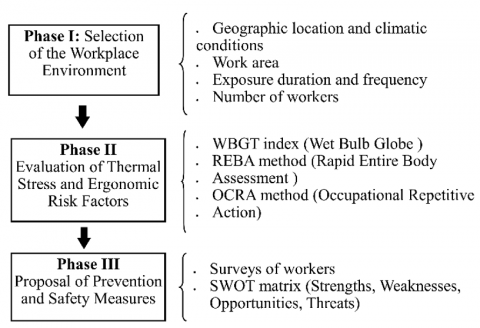
This study employed four methods: WBGT, REBA, OCRA, and SWOT analysis to assess thermal stress and ergonomic risks among oil industry workers in the parish of San José de Ancón, Province of Santa Elena. In addition, reference surveys were conducted with oil company operators, and with the entire process mentioned above, strategies were developed to mitigate these problems. The methodological process (Figure 1) included the use of the WBGT index to assess thermal conditions and the REBA and OCRA tools to analyse ergonomic risks, such as postures and repetitive movements. In addition, SWOT surveys were conducted with workers from two contracting companies to develop an occupational safety management framework, identify risks, and establish measures to reduce accidents and improve safety.
Figure 1. Scheme of the methodological phases of the case study
2.1 Selection of the work environment
The study focused on an oil field located in San José de Ancón parish, in the province of Santa Elena (Figure 2), where contractor companies provide services. The oil industry, a key sector for the economic development of the area, is the main activity in this area, which has a population of 7,918 inhabitants [30]. The criteria used to select the work area were as follows:
Figure 2. Geographical map of the study area
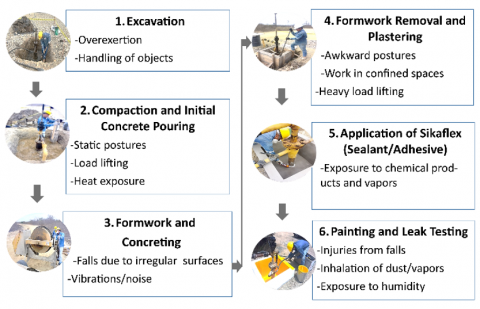
One of the activities within the civil engineering field is the construction of oil counter wells, a process illustrated in the diagram (Figure 3).
Figure 3. Identification of ergonomic and thermal risks in the construction of oil counter wells
2.2 Assessment of thermal stress and ergonomic risk factors
In this phase, three methods (WBGT, REBA, OCRA) were employed to assess the risks associated with working in environments characterised by high temperatures and significant physical exertion. This assessment is essential for determining the level of risk and preventing serious injuries [31].
2.2.1 Calculation of the WBGT index
WBGT is an environmental indicator that quantifies the level of heat stress to which people are exposed in work environments with heat exposure [32]. Two data sources were used to calculate the WBGT index: first, daily satellite meteorological data from the ‘Santa Elena’ station (code M1170), provided by the National Institute of Meteorology and Hydrology (INAMHI, acronym in Spanish) [33]. Second, in situ measurements obtained through the WBGT mobile application (version 2.0), developed by the company Everade [34]. Both measurements were taken in March, with one set taken in the morning and another in the afternoon.
The WBGT required three primary parameters: natural wet bulb temperature (Tnwb), which reflected the influence of heat and humidity. Black globe temperature (Tg), which measures the thermal radiation of the environment. Air temperature (Ta), which represented ambient heat without humidity or radiation [35]. The case study was conducted in the oil industry, where activities were carried out outdoors. Therefore, Eq. (1) proposed by Gourzoulidis et al. [36] was used, which allows the WBGT to be evaluated in outdoor environments.
$\mathrm{WBGT} _{\text {outdoor }}=0.7 \mathrm{~T}_{\mathrm{nwb}}+0.2 \mathrm{~T}_{\mathrm{g}}+0.1 \mathrm{~T}_{\mathrm{a}}$ (1)
where,
Tnwb = Natural wet bulb temperature.
Tg = Globe temperature.
Ta = Air temperature.
This study did not include direct measurements of globe temperature (Tg); therefore, it was estimated using Eq. (2) [37].
$\begin{gathered}\mathrm{T}_{\mathrm{g}}=0.009624(\mathrm{SR})+1.102\left(\mathrm{T}_{\mathrm{a}}\right)-0.00404(\mathrm{RH}) -2.2776\end{gathered}$ (2)
where,
RH = Relative Humidity.
SR = Solar Radiation.
Ta = Air temperature.
To estimate Tnwb without a specialized instrument, the following Eq. (3) was used.
$\mathrm{T}_{\mathrm{nwb}}=\mathrm{T_\mathrm{pwb}}+0.25\left(\mathrm{T}_{\mathrm{g}}-\mathrm{T}_{\mathrm{a}}\right)+\mathrm{e}$ (3)
where,
Tpwb = Psychrometric wet bulb temperature.
e = Measurement error or correction.
Ta = Air temperature.
Tg = Globe temperature.
Once the WBGT value was calculated, it was compared with the limits set out in ISO 7243 [38]. Table 1 classifies the WBGT index into five risk levels. At less critical levels (low, minimal, and moderate), monitoring and hydration were required. However, at high and very high levels, immediate measures such as breaks, reduced workload, and continuous monitoring were taken to prevent thermal stroke.
Table 1. WBGT reference values source [36]
|
Category |
Risk Level |
WBGT (℃) |
|
1 |
Low |
< 26.6 |
|
2 |
Minimum |
26.7-29.4 |
|
3 |
Moderate |
29.5-31.1 |
|
4 |
High |
31.2-32.2 |
|
5 |
Very High |
> 32.3 |
2.2.2 Calculation of the REBA method
The REBA method consisted of groups A and B, which analysed different parts of the body to calculate the ergonomic risk. Group A evaluated the positions of the worker's trunk, neck, and legs, assigning scores to each of these parts. These scores were correlated to obtain the A value, to which the load handled by the worker was added, resulting in the final score that measured the total physical effort involved in the work tasks. The components of group A are described below:
Group B evaluated the movements of the arm, forearm, and wrist, assigning scores to each part. The B value was obtained by correlating the scores for the upper limbs, reflecting the interaction between these parts. The final score was calculated by adding the B value and the type of grip, thus measuring the physical effort associated with upper limb movements. The components evaluated in this group are detailed below:
The C score was obtained by combining the values of the A and B scores. An additional point was added to this score if significant muscular effort was identified, such as prolonged immobility, repetitive movements, or unstable postures. This yielded the final REBA score (Table 2), which allowed for the classification of risk levels and the establishment of necessary corrective actions: the higher the score, the greater the identified risk.
Table 2. REBA score source [39]
|
Level |
Rating |
Risk |
Action |
|
0 |
1 |
Negligible |
None |
|
1 |
2-3 |
Low |
Can be implemented |
|
2 |
4-7 |
Medium |
Implement |
|
3 |
8-10 |
High |
Implement as soon as possible |
|
4 |
11-15 |
Very high |
Implement now |
2.2.3 Calculation of the OCRA method
The OCRA method was used to assess exposure to risk from repetitive movements in the upper limbs [40]. The OCRA method was calculated as the ratio between Actual Technical Actions (ATA) and Recommended Technical Actions (RTA). To determine ATA [41], workers' activities were directly observed to identify and count technical actions. Then, the frequency per minute and the duration of repetitive work were calculated, and finally, the ATA was obtained by multiplying both values. To calculate the RTA value, the following Eq. (4) was used [42]:
$R T A=\left[C F \times\left(F_f \times F_p \times F_a\right) \times D\right] \times F_r$ (4)
where,
CF = Standard frequency constant (30 actions/min).
Ff = Force factor applied during the task.
Fp = Posture factor adopted during the task.
Fa = Additional factors (physical conditions such as vibration or use of tools).
D = Duration of the repetitive task (min).
Fr = Recovery multiplier factor (considers breaks and rest periods).
The quantification of the physical load perceived by the worker was performed using the force factor (Ff), derived from the Borg scale [43]. This scale, with a range from 0.5 (low effort) to 5 (maximum effort), indicates that the greater the effort, the lower the Ff value. In the work tasks (manual excavation, removal of wood from the formwork, preparation of the mixture, and application of the plaster), three representative levels of effort were selected:
The posture factor (Fp) assessed the left and right upper limbs, considering the movements of the shoulders, elbows, wrists, and fingers [44]. Postures were classified into three effort ranges: 4-7 (Fp = 0.70, moderate effort), 8-11 (Fp = 0.60, high effort), and 12–15 (Fp = 0.50, very high effort). As the ranges increased, the posture became more forced, and the Fp decreased, indicating a greater physical effort and increased risk of injury. This factor enabled the quantification of postural load and the identification of physical risks associated with forced postures. Additional factors (Fa) represented risks, such as the use of vibrating tools and lifting or pushing loads. When the assigned value was 0 (Fa = 1, no impact), no additional effect on risk was considered. In contrast, a value of 4 (Fa = 0.7, indicating a moderate impact) suggests that one or more additional factors had a significant effect. The higher the assigned value, the lower the Fa, indicating a greater effect of these factors on the risk. This factor allowed the assessment to be adjusted according to additional physical conditions.
Table 3. Risk assessment and recommended actions based on the method OCRA [41]
|
OCRA |
Risk Level |
Recommended Actions |
|
≤ 1.5 |
Optimal |
No action required |
|
1.6-2.2 |
Acceptable |
|
|
2.3-3.5 |
Uncertain |
Further analysis or job improvement recommended |
|
3.6-4.5 |
Mildly unacceptable |
Job improvement, medical supervision, and training are recommended |
|
4.6-9 |
Moderately unacceptable |
|
|
> 9 |
Highly unacceptable |
The recovery factor (Fr) was assigned according to the number of hours without adequate rest. If the worker had no rest hours, their factor was 1. As the hours without rest increased, the Fr decreased, reflecting a lack of recovery. This study focused on the range of 6 hours without adequate rest (Fr = 0.25, high risk), which indicated a high level of fatigue and a significant reduction in the worker's performance capacity.
Table 3 presents the risk levels based on the values obtained using the OCRA method to assess workload. Based on these values, the risk level and recommended actions are defined, as detailed above.
2.3 Proposed prevention and safety measures
Surveys were conducted among a population of 10 workers from two contracting companies in the oil sector. The survey enabled the collection of suggestions to propose strategic guidelines aimed at improving working conditions. The survey consisted of 12 questions: 11 multiple-choice and one open-ended (Table S1), which addressed aspects related to posture, repetitive movements, and exposure to thermal. This type of mixed survey is valuable for obtaining quantitative and qualitative data [45].
The SWOT analysis identified internal and external factors related to ergonomics and thermal stress in the work environment. Regarding internal factors, the strengths evaluated included knowledge of good practices, use of protective equipment, and working conditions (questions #1, #3, #5, #6, and #11). The weaknesses identified focused on the lack of active breaks (questions #2, #4, and #7). In terms of external factors, the threats included exposure to high temperatures and poor posture (questions #8, #9, and #10).
3.1 Surveys as a tool for analysing working conditions
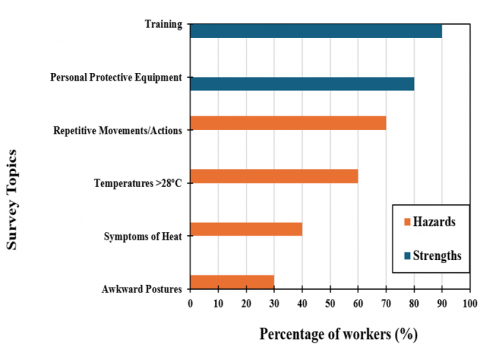
Figure 4 presents the results of surveys conducted among oil sector workers, which were divided into conditions perceived as positive (strengths) and negative (risks) in the context of ergonomic and heat stress risk factors. Although companies demonstrated sound management in prevention, with 90% of staff trained in occupational risks and 80% satisfied with their work clothing, workers faced high exposure to direct risks. A study in the oil industry suggested that ergonomic design and training to address risks such as repetitive movements, heavy loads, and uncomfortable postures [46].
Figure 4. Analysis of risks and strengths in the oil industry for the case study
In terms of ergonomic risks, 70% (n = 7) of workers performed repetitive movements for more than two hours per day, and 30% (n = 3) regularly adopted uncomfortable postures. Regarding the risk of heat stress, 60% (n = 6) of respondents reported experiencing temperatures above 28℃, which affected their productivity and caused fatigue. Forty per cent (n = 4) of participants experienced heat symptoms throughout the day. These results show that companies have initiatives in place to provide preventive resources.
For future action, this study proposes guidelines focused on mitigating the risks inherent in tasks and the working environment to improve workers' health and safety. For instance, the inclusion of 15-20-minute breaks, passive breaks, and talks on ergonomic postures. This finding aligns with research indicating that a 15-minute break after working continuously at a temperature of 28.9℃ is optimal [47]. In summary, these suggestions underscore the importance of a healthy work environment that incorporates rest, proper posture, and optimal thermal conditions to promote the well-being of workers.
3.2 Risk assessments of thermal stress and ergonomic factors
3.2.1 Environmental measurements for thermal stress analysis
The environmental conditions at locations L1 to L4 (Table 4) indicated that solar radiation was 37% higher in the morning (with an average of 749 W/m²). At the same time, the temperature decreased by an average of 2.5℃ in the afternoon. Significant variations in wind speed were observed: at L1, it decreased by 84%, and at L2, it tripled in the afternoon. L1 and L3 recorded temperatures above 31℃ and high morning radiation (820 W/m²), which increased thermal stress.
Table 4. Weather conditions in the case study
|
L |
RH (%) |
SR (W/m2) |
AT (℃) |
WS (m/s) |
||||
|
M |
A |
M |
A |
M |
A |
M |
A |
|
|
L1 |
74 |
75 |
815 |
512 |
31.4 |
29.5 |
0.94 |
0.15 |
|
L2 |
78 |
76 |
715 |
408 |
30.9 |
28.9 |
0.24 |
0.81 |
|
L3 |
74 |
71 |
823 |
459 |
33.7 |
30.4 |
0.69 |
0.7 |
|
L4 |
89 |
79 |
642 |
501 |
32.5 |
29.5 |
0.3 |
0.5 |
Notes: RH = Relative Humidity; SR = Solar Radiation; AT = Air Temperature; WS = Wind Speed; M = Morning; A = Afternoon; L = Location.
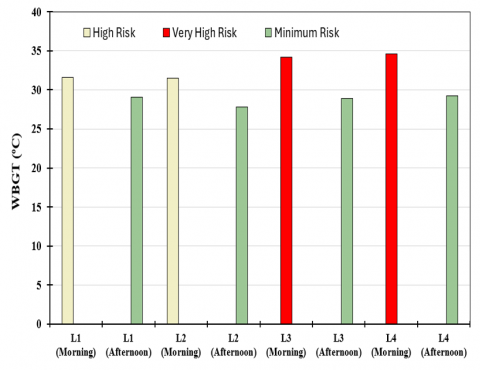
Figure 5. Comparison of WBGT index in morning and afternoon work shifts
The WBGT index assessment enabled the quantification of the risk of thermal stress in outdoor work, such as the construction of counter wells (Figure 5). The results showed that, during the morning, the risk of thermal stress was high, with an average WGBT value of 33℃, especially at locations L1 and L2, where temperatures exceeded 31℃. At locations L3 and L4, extreme temperatures above 34℃ were recorded. In the afternoon, the WGBT index decreased at all locations, with an average of 28.8℃, representing a 13% reduction, reflecting safer conditions for workers.
3.2.2 Ergonomic risk analysis for forced postures
The ergonomic assessment of posture during counterweight activities quantified the demands on each part of the body, revealing differences between the Lead Mason (LM) and the Assistants (A1 and A2) (Table 5). The LM and A2 had high postural demands on the trunk (value 4), while A1 had a value of 2, i.e., 50% lower demands compared to the other two workers. These efforts required ergonomic attention to prevent injuries. The results obtained coincided with Perrons et al. [45], who found that tasks involving high physical effort and forced postures increased the risk of injury in construction.
Table 5. Ergonomic assessment of postures, load, and grip in counter-formwork construction activities (groups A and B)
|
JP |
Task |
PA |
LA |
PA |
GSA |
||||
|
Value A |
Value B |
||||||||
|
T |
N |
L |
A |
F |
W |
||||
|
LM |
Formwork assembly |
4 |
2 |
2 |
0 |
1 |
2 |
2 |
0 |
|
A1 |
Manual soil compaction |
2 |
2 |
2 |
2 |
3 |
2 |
1 |
1 |
|
A2 |
Counter-pit painting |
4 |
2 |
2 |
0 |
2 |
2 |
2 |
1 |
Notes: JP = Worker's Position; LM = Lead Mason; A = Assistant; PA = Posture Assessment; T = Trunk; N = Neck; L = Leg; LA = Load Assessment; A = Arm; F = Forearm; W = Wrist; GSA = Grip Strength Assessment.
In terms of ergonomic risk (Table 6), it was observed that the Assistant's score for manual soil compaction was approximately 28.6% higher than that of the Master Mason. In comparison, the score for painting was around 14.3% higher. These values indicated a higher risk of injury, especially to the upper extremities and lower back, for the assistants compared to the LM in the task evaluated.
Table 6. Risk level according to the REBA method
|
JP |
Task |
SA |
SB |
SC |
AC |
R |
RL |
|
LM |
Formwork assembly |
6 |
2 |
6 |
1 |
7 |
Medium |
|
A1 |
Manual soil compaction |
6 |
5 |
8 |
1 |
9 |
High |
|
A2 |
Counter-pit painting |
6 |
4 |
7 |
1 |
8 |
High |
Notes: JP = Worker's Position; LM = Lead Mason; A = Assistant; SA = Score A; SB = Score B; SC = Score C; AC = Activity; R = Rating; RL = Risk Level.
3.2.3 Ergonomic risk analysis for repetitive movements
The OCRA method was applied to a group of workers engaged in activities related to the construction of counter wells, with a working shift of 480 minutes. Of these, 105 minutes are allocated to breaks and 375 minutes are devoted to repetitive tasks. Table 7 quantified the repetitiveness and total number of technical actions, as well as the distribution of these actions between the left and right limbs for four specific tasks in the workplace. An overload was identified in the right limb in most tasks, indicating an asymmetrical distribution of effort and a greater ergonomic risk, except in plastering, where the workload was balanced.
Table 7. Distribution of tasks and technical actions in the workplace
|
Specific Tasks |
RA |
ATA |
||
|
LL |
RL |
LL |
RL |
|
|
Excavation with a pick or a crowbar |
5 |
7 |
1875 |
2625 |
|
Wood removal from formwork |
4 |
5 |
1500 |
1875 |
|
Mixture preparation |
3 |
5 |
1125 |
1875 |
|
Application of plaster |
6 |
6 |
2250 |
2250 |
Notes: RA = Repetitive Actions per minute; LL = Left Limb; RL = Right Limb; ATA = Actual Technical Actions.
Table 8 quantified the risk factors considered for calculating the RTA for each activity and for each limb, showing how these factors varied between tasks and between the left and right limbs. The duration of the repetitive task and the constant factor remained uniform across all assessments.
Table 8. Calculation of the RTA for each activity
|
ST |
Excavation |
Formwork Removal |
Mix Preparation |
Plastering |
||||
|
S |
LL |
RL |
LL |
RL |
LL |
RL |
LL |
RL |
|
CF |
30 |
30 |
30 |
30 |
30 |
30 |
30 |
30 |
|
Ff |
0.35 |
0.20 |
0.55 |
0.45 |
0.20 |
0.10 |
0.55 |
0.55 |
|
Fp |
0.60 |
0.50 |
0.70 |
0.60 |
0.70 |
0.60 |
0.70 |
0.70 |
|
Fa |
0.70 |
0.70 |
0.70 |
0.70 |
1 |
1 |
1 |
1 |
|
Fr |
0.25 |
0.25 |
0.25 |
0.25 |
0.25 |
0.25 |
0.25 |
0.25 |
|
D |
375 |
375 |
375 |
375 |
375 |
375 |
375 |
375 |
Notes: ST = Specific Tasks; LL = Left Limb; RL = Right Limb; S = Side: CF = Constant Factor; Ff = Force Factor; Fp = Postural Factor; Fa = F Additional Factor; Fr = Repetitive Factor; D = Duration of repetitive task.
A greater effort and load on the upper limbs, especially the right, were evident in tasks such as digging with a pick or crowbar and preparing the mixture, which generated high levels of ergonomic risk (Table 9). In contrast, activities with less repetitiveness and a more balanced load, such as applying plaster, presented an acceptable level of risk. On average, the OCRA index was 7.5 for the right limb and 2.9 for the left, reflecting an asymmetry in the physical demands of the tasks evaluated. These variations in risk levels are related to differences in physical load and repetitiveness, as also pointed out by Morales et al. [48].
Table 9. Calculation of the OCRA index
|
Specific Task |
ATA |
RTA |
OCRA |
|||
|
LL |
RL |
LL |
RL |
LL |
RL |
|
|
Excavation with pickaxe or crowbar |
1875 |
2625 |
413 |
197 |
4.5 |
13.3 |
|
Wood removal from formwork |
1500 |
1875 |
758 |
532 |
2 |
3.5 |
|
Mixture preparation |
1125 |
1875 |
394 |
169 |
2.9 |
11.1 |
|
Application of plaster |
2250 |
2250 |
1083 |
1083 |
2.1 |
2.1 |
Notes: LL = Left Limb; RL = Right Limb; ATA = Actual Technical Actions; RTA = Recommended Technical Actions.
3.3 Strategic guidelines for prevention and safety in the oil industry
The SWOT analysis applied to workers in the oil sector in the parish of San José de Ancón identified the factors affecting their performance and proposed strategies to improve their well-being and safety (Table 10). This analysis has proven effective in other contexts, such as the construction industry in China, where the implementation of strategies derived from SWOT analysis led to a reduction in accidents and promoted sustainable conditions [49].
Table 10. SWOT matrix for activities in the oil industry
|
Strengths (S) |
Weaknesses (W) |
|
S1: 90% of workers receive training in ergonomic risks. S2: Workers believe that breaks increase productivity. S3: 80% of workers consider their protective equipment to be adequate. S4: Workers have access to hydration points. |
W1: Thermal stress causes fatigue, dehydration, and reduced concentration, increasing the risk of accidents. W2: Workers suffer from symptoms of thermal stress, such as sweating and headaches. W3: Frequent poor posture increases the risk of musculoskeletal problems. W4: 70% of workers perform repetitive movements for more than two hours a day. |
|
Opportunities (O) |
Threats (T) |
|
O1: Scheduled breaks reduce fatigue and improve concentration and productivity. O2: Continuous training and external entities improve workplace safety. O3: New regulations and technologies improve thermal control at work. |
T1: Repetitive movements can cause arthritis, scoliosis, and lower back pain. T2: Temperatures above 32ºC increase the risk of thermal stroke and accidents. T3: The mortality rate from workplace accidents is 18.1 per 100,000 workers. T4: Not taking adequate breaks increases the risk of errors and injuries. |
Based on the analysis of the positive aspects, opportunities, areas for improvement, and risks, customised strategies are designed to address the specific requirements of the case study:
This study assessed thermal stress and ergonomic risk factors among workers engaged in outdoor activities at two oil companies. It was found that workers face a high risk of thermal stress, particularly in the area of well construction. This is due to prolonged periods of sun exposure associated with the type and duration of the tasks they perform. Similarly, according to Umar and Egbu [50], activities involving exposure to extreme thermal conditions have a profound impact on occupational health, exposing workers to physiological risks, injuries, and even occupational fatalities.
It was identified that, in the area of counter-well construction, workers faced high risks of thermal and ergonomic stress. It is due to prolonged periods of sun exposure associated with the type and duration of the tasks they perform. According to Benson et al. [18], this trend was confirmed in the oil and gas sector, with ergonomic risks (30%) identified as the most common, followed by physical risks (26%). Prolonged exposure to the sun and the physical demands of the tasks create an environment with multiple risks that can affect workers' health in both the short and long term [51].
In this study, WBGT values of up to 34.6℃ were recorded during the morning shift, exceeding the 29.76℃ reported at an oil terminal in Iran [52]. The difference observed between the two studies could be attributed to environmental factors, underscoring the need for thermal assessments tailored to specific regions and times of day [53]. These temperatures impact occupational health, necessitating measures such as breaks, hydration, and the proper use of protective equipment to mitigate risks in this vulnerable sector [54]. Additionally, heat stress poses a significant risk, particularly near heat tolerance limits [55].
The thermal stress assessment revealed that WBGT indices in the morning (31.6℃ to 34.6℃) were high due to the high solar radiation, low relative humidity, and low wind speed recorded at the site. This thermal behaviour coincides with that reported in a study conducted at an oil company in Indonesia, located in a tropical climate region, where WBGT values above 28℃ were recorded during the hours of highest solar radiation [56]. It demonstrates that heat stress is a recurring and well-documented challenge in the oil industry, highlighting the urgency of standardising mitigation strategies in these environments [57, 58].
This study evaluated ergonomic risks (REBA and OCRA methods) in activities such as formwork assembly, manual soil compaction, and painting. These activities indicated medium and high-risk levels, especially in the upper extremities and lower back, due to the adoption of forced postures. These findings align with those reported by Li et al. [59], who emphasise the importance of implementing occupational health and safety management in construction projects to reduce the incidence of musculoskeletal injuries. It is also recommended to improve job design, train staff, and implement measures to limit excessive loads, static postures, and prolonged exertion to reduce ergonomic risks in construction [60].
In the oil industry, research has demonstrated that repetitive tasks and poor posture pose a significant risk to workers' musculoskeletal health. For example, using the OCRA method, a study at an oil plant found that 72% of jobs presented a high ergonomic risk due to repetitive movements, resulting in frequent discomfort in the lower back and shoulders [61].
Manual soil compaction performed during counter-pit construction presented a high risk (REBA = 9) to workers. Similarly, a study conducted in other areas of the same oil industry reported a very high risk (REBA = 11) for lathe operators [62]. Despite differences in tasks and work environments, ergonomic risks are a constant challenge in the oil industry.
According to the survey, 70% of workers in the oil industry reported that repetitive tasks cause greater physical exhaustion, which in turn increases the risk of injury. These results are consistent with those reported by Wang et al. [15], who noted that musculoskeletal disorders associated with repetitive tasks significantly impact the health and well-being of operation and maintenance workers in this industry.
This study demonstrated that heat stress is a factor that intensifies ergonomic risks due to prolonged exposure to high temperatures. Additionally, this risk is triggered by factors such as fatigue and a reduction in the body's ability to maintain proper posture and perform controlled movements. These conditions contribute to an increased risk of musculoskeletal disorders in the workplace [63].
Occupational risk management proposals were developed based on input from workers and a SWOT analysis. For example, one risk factor is posture during the workday, especially in activities such as excavation or mixture preparation, as these involve greater physical effort. Additionally, the implementation of periodic ergonomic programmes that include active breaks adapted to the job is recommended, as well as optimising the work environment through assistive technologies (such as ergonomic hand tools). Preventive strategies must be adapted to each work environment, as working conditions, physical demands, and the tools used vary according to the different positions and characteristics of the workplace. This adaptation allows for the design of more precise and effective interventions to protect the health and well-being of workers [64].
This study identified the following lines of research: evaluating the relationship between thermal stress and ergonomic risks in various work sectors, considering variations in work environments, activities performed, and worker characteristics. Additionally, the implementation of prevention programs tailored to these factors could be crucial in improving both occupational health and safety and productivity. Finally, the influence of environmental factors on thermal stress.
This study evaluated the risk of thermal and ergonomic stress among workers at an oil company in Ancón Parish, utilising the WBGT, REBA, and OCRA methods. The results identified critical working conditions that compromise workers' health and well-being. Based on these findings, preventive strategies are proposed to implement regular breaks, adapt the work environment, and enhance health and safety management. This contribution provides a basis for contracting companies to adopt work practices that minimise both thermal and ergonomic risks, promoting safer and more sustainable working conditions in a highly exposed sector.
The analysis of thermal stress using the WBGT index showed that extreme weather conditions at the workplace increase the risk of thermal stroke and dehydration, especially during the first hours of the working day, when solar radiation is most intense. Using the REBA and OCRA methods, it was determined that workers are exposed to ergonomic risks resulting from improper posture (30%) and repetitive movements (70%), which increases the risk of musculoskeletal disorders.
It is essential to implement protective measures for both ergonomic and thermal risks. To mitigate ergonomic risks, it is recommended to enhance working conditions by designing ergonomic workstations and providing ongoing training in proper posture. Regarding thermal stress, it is recommended to increase the frequency of breaks, maintain constant hydration, and use appropriate PPE, especially during the hours of the most intense thermal exposure.
The following limitations were identified in this study: i) The composition of the focus group, which represents the number of workers from the two contractor companies analysed; ii) the measurement period (March 2025), to take advantage of the most favourable environmental conditions for data collection; and iii) the focus on the construction of counter wells, as this was the main activity where risks due to ergonomic factors and thermal stress were evident. However, for future research, it is proposed to expand the study population, extend the measurement period, and analyse other operational activities in the oil sector. Consideration should also be given to conducting interviews and focus groups for a better understanding of risk perceptions, as well as evaluating the effectiveness of preventive measures.
Table S1. Survey administered to workers in the oil extraction industry to assess their knowledge of the risks associated with heat stress and ergonomic factors in their work activities
|
Declaration of Consent: The Santa Elena Peninsula State University (UPSE) and the ESPOL Polytechnic University in Ecuador are conducting a study on: “Analysis of Thermal Stress and Ergonomic Risks in the Oil Industry in Ecuador”. We request your permission to participate in this research project, which aims to assess the risk of heat stress and ergonomic risk factors for workers at the oil extraction company in the Ancón Parish, using the Wet Bulb Globe Temperature (WBGT) Index and the Rapid Entire Body Assessment (REBA) and Occupational Repetitive Action (OCRA) methodologies to propose prevention and safety measures in the workplace. Your participation is entirely voluntary. You may withdraw from the study at any time. Your response is completely anonymous. Your contribution is vital and will help establish strategies and solutions to reduce occupational risks. If you have any questions, please do not hesitate to contact Vinicio Rodríguez-Fiallos at jose.rodriguezfiallos3844@upse.edu.ec. |
|
|
|
|
|
|
|
|
|
|
|
|
|
|
|
|
|
|
|
|
|
|
|
|
Justify your response............ |
|
|
|
|
|
|
|
|
|
|
|
|
|
|
|
|
|
|
|
|
|
|
|
|
|
|
|
|
|
|
|
|
|
|
|
|
|
|
|
|
|
|
|
|
|
|
Please specify............ |
|
[1] Pintor, M.P., Fumagalli, E., Suhrcke, M. (2024). The impact of health on labour market outcomes: A rapid systematic review. Health Policy, 143: 105057. https://doi.org/10.1016/j.healthpol.2024.105057
[2] International Labour Organization (ILO). (2024). Physical hazards and risks. https://www.ilo.org/topics/safety-and-health-work/physical-hazards-and-risks.
[3] Chen, H., Hou, C., Zhang, L., Li, S. (2020). Comparative study on the strands of research on the governance model of international occupational safety and health issues. Safety Science, 122: 104513. https://doi.org/10.1016/j.ssci.2019.104513
[4] Dursun, A.E. (2020). Statistical analysis of methane explosions in Turkey’s underground coal mines and some recommendations for the prevention of these accidents: 2010-2017. Natural Hazards, 104(1): 329-351. https://doi.org/10.1007/s11069-020-04170-x
[5] Khrais, S.K., Yared, T.E., Saifan, N.M., Al-Hawari, T.H., Dweiri, F. (2024). Occupational safety assessment for surface mine systems: The case in jordan. Safety, 10(2): 40. https://doi.org/10.3390/safety10020040
[6] Aljbour, S. (2022). Occupational accidents and work injuries in Jordan’s economic sectors between 2010 and 2019. Jordanian Journal of Engineering and Chemical Industries, 5(2): 32. https://doi.org/10.48103/JJECI562022
[7] Ncube, F., Kanda, A. (2018). Current status and the future of occupational safety and health legislation in low- and middle-income countries. Safety and Health at Work, 9(4): 365-371. https://doi.org/10.1016/J.SHAW.2018.01.007
[8] Wang, Y., Chen, H., Liu, B., Yang, M., Long, Q. (2020). A systematic review on the research progress and evolving trends of occupational health and safety management: A bibliometric analysis of mapping knowledge domains. Frontiers in Public Health, 8: 510123. https://doi.org/10.3389/fpubh.2020.00081
[9] Lindholm, M., Reiman, A., Väyrynen, S. (2020). On future occupational safety and health challenges: A systematic literature review. International Journal of Occupational and Environmental Safety, 4(1): 108-127. https://doi.org/10.24840/2184-0954_004.001_0009
[10] Instituto Ecuatoriano de Seguridad Social (IESS). (2025). Indicadores de Gestión del IESS. https://www.iess.gob.ec/.
[11] Paguay, M., Febres, J.D., Valarezo, E. (2023). Occupational accidents in Ecuador: An approach from the construction and manufacturing industries. Sustainability, 15(16): 12661. https://doi.org/10.3390/SU151612661
[12] Mónica, E.G., Juan, R.G., Carlos, S.P.J., Andrea, R.E. (2023). Evolution of occupational accident rates by geographic zone in Ecuador, period 2015-2021. In 2023 IEEE Seventh Ecuador Technical Chapters Meeting (ECTM), Ambato, Ecuador, pp. 1-5. https://doi.org/10.1109/ETCM58927.2023.10309014
[13] López, J.C.L., Espín, R.A.A. (2023). Industrial safety and occupational health strategies: The case of a water treatment plant in Ecuador. Journal of Business and Entrepreneurial Studies, 7(3). https://doi.org/10.37956/jbes.v7i3.341
[14] Alvarez, M.G.Z., Díaz, A.L.T., Guerrero, R.J.A. (2023). Propuesta de implantación de la norma ISO 45001: 2018 en “SEROVIQ SA”. Revista Social Fronteriza, 3(5): 234-253. https://doi.org/10.59814/resofro.2023.3(5)234-253
[15] Wang, Y., Zhang, Y., He, J., Tong, R. (2024). Risk assessment of work-related musculoskeletal disorders in typical positions, case study: Operation and maintenance employees of oil and gas pipeline. International Journal of Industrial Ergonomics, 104: 103662. https://doi.org/10.1016/J.ERGON.2024.103662
[16] Jara, O., Ballesteros, F., Carrera, E., Dávila, P. (2020). Ergonomic evaluation in the Ecuadorian workplace. Advances in Intelligent Systems and Computing, 970: 236-244. https://doi.org/10.1007/978-3-030-20145-6_23
[17] Bergh, L.I.V., Leka, S., Zwetsloot, G.I.J.M. (2018). Tailoring psychosocial risk assessment in the oil and gas industry by exploring specific and common psychosocial risks. Safety and Health at Work, 9(1): 63-70. https://doi.org/10.1016/J.SHAW.2017.05.001
[18] Benson, C., Dimopoulos, C., Argyropoulos, C.D., Varianou Mikellidou, C., Boustras, G. (2021). Assessing the common occupational health hazards and their health risks among oil and gas workers. Safety Science, 140: 105284. https://doi.org/10.1016/J.SSCI.2021.105284
[19] Coronel, G., Au, W., Izzotti, A. (2020). Public health issues from crude-oil production in the Ecuadorian Amazon territories. Science of the Total Environment, 719: 134647. https://doi.org/10.1016/J.SCITOTENV.2019.134647
[20] Afshari, D., Shirali, G.A. (2019). The effect of heat exposure on physical workload and maximum acceptable work duration (MAWD) in a hot and dry climate. Urban Climate, 27: 142-148. https://doi.org/10.1016/J.UCLIM.2018.11.008
[21] Gómez-García, A.R., Gutierrez-Álvarez, R., Chang-León, A.H., García-Arroyo, J.A. (2025). What activity is the most dangerous to work in? Estimation of the risk level of economic activities in Ecuador. Safety and Health at Work, 16(2): 172-179. https://doi.org/10.1016/j.shaw.2025.03.004
[22] Acheampong, T., Kemp, A.G. (2022). Health, safety and environmental (HSE) regulation and outcomes in the offshore oil and gas industry: Performance review of trends in the United Kingdom continental shelf. Safety Science, 148: 105634. https://doi.org/10.1016/j.ssci.2021.105634
[23] Herrera-Franco, G., Montalván, F.J., Velastegui-Montoya, A., Caicedo-Potosí, J. (2022). Vulnerability in a populated coastal zone and its influence by oil wells in Santa Elena, Ecuador. Resources, 11(8): 70. https://doi.org/10.3390/resources11080070
[24] Herrera-Franco, G., Escandón-Panchana, P., Montalván, F.J., Velastegui-Montoya, A. (2022). CLUE-S model based on GIS applied to management strategies of territory with oil wells—Case study: Santa Elena, Ecuador. Geography and Sustainability, 3(4): 366-378. https://doi.org/10.1016/j.geosus.2022.11.001
[25] Rachid, A., Qureshi, A.M. (2023). Sensitivity analysis of heat stress indices. Climate, 11(9): 181. https://doi.org/10.3390/CLI11090181
[26] Kakaei, H., Omidi, F., Ghasemi, R., Sabet, M.R., Golbabaei, F. (2019). Changes of WBGT as a heat stress index over the time: A systematic review and meta-analysis. Urban Climate, 27: 284-292. https://doi.org/10.1016/J.UCLIM.2018.12.009
[27] Rastegar, Z., Ghotbi Ravandi, M.R., Zare, S., Khanjani, N., Esmaeili, R. (2022). Evaluating the effect of heat stress on cognitive performance of petrochemical workers: A field study. Heliyon, 8(1): e08698. https://doi.org/10.1016/J.HELIYON.2021.E08698
[28] Asad, M.M., Hassan, R., Latif, K., Sherwani, F. (2019). Identification of potential ergonomic risk factors and mitigating measures for malaysian oil and gas drilling industries: A conceptual research proposition. IOP Conference Series: Materials Science and Engineering, 530: 012052. https://doi.org/10.1088/1757-899X/530/1/012052
[29] García-Garizábal, I., Romero, P., Jiménez, S., Jordá, L. (2017). Climate change effects on the climate dynamics of coastal Ecuador. DYNA, 84(203): 37-44. https://doi.org/10.15446/dyna.v84n203.59600
[30] Instituto Nacional de Estadística y Censos (INEC). (2022). Resultados - Censo Ecuador. https://www.censoecuador.gob.ec/resultados-censo/.
[31] Brimicombe, C., Gao, C., Otto, I.M. (2024). Vulnerable to heat stress: Gaps in international standard metric thresholds. International Journal of Biometeorology, 68: 2495-2506. https://doi.org/10.1007/s00484-024-02783-6
[32] Buzan, J. (2024). Implementation and evaluation of wet bulb globe temperature within non-urban environments in the Community Land Model version 5. Journal of Advances in Modeling Earth Systems, 16(2): e2023MS003704. https://doi.org/10.1029/2023MS003704
[33] Instituto Nacional de Meteorología e Hidrología (INAMHI). (2025). Visor de Estaciones. https://inamhi.gob.ec/info/visor.
[34] Everade. (2025). WBGT App. https://everade.co/.
[35] Bitencourt, D.P. (2019). Maximum wet-bulb globe temperature mapping in central–south Brazil: A numerical study. Meteorological Applications, 26(3): 385-395. https://doi.org/10.1002/MET.1769
[36] Gourzoulidis, G.A., Gofa, F., Ioannou, L.G., Konstantakopoulos, I., Flouris, A.D. (2023). Developing a feasible integrated framework for occupational heat stress protection: A step towards safer working environments. La Medicina del Lavoro, 114(5): e2023043. https://doi.org/10.23749/MDL.V114I5.14504
[37] Carter, A.W., Zaitchik, B.F., Gohlke, J.M., Wang, S., Richardson, M.B. (2020). Methods for estimating wet bulb globe temperature from remote and low-cost data: A comparative study in Central Alabama. GeoHealth, 4(5): e2019GH000231. https://doi.org/10.1029/2019GH000231
[38] Ahmed, H.O., Bindekhain, J.A., Alshuweihi, M.I., Yunis, M.A., Matar, N.R. (2020). Assessment of thermal exposure level among construction workers in UAE using WBGT, HSI and TWL indices. Industrial Health, 58(2): 170-181. https://doi.org/10.2486/indhealth.2018-0259
[39] Wibowo, A.H., Mawadati, A. (2021). The analysis of employees’ work posture by using rapid entire body assessment (REBA) and rapid upper limb assessment (RULA). IOP Conference Series: Earth and Environmental Science, 704(1): 012022. https://doi.org/10.1088/1755-1315/704/1/012022
[40] Gobbo, S., Bullo, V., Favro, F., Pavan, D., et al. (2025). Strength and perceived effort in repetitive upper-limb tasks: An OCRA method analysis of 900 workers. La Medicina del Lavoro, 116(4): 16856. https://doi.org/10.23749/mdl.v116i4.16856
[41] Colombini, D., Occhipinti, E. (2006). Preventing upper limb work-related musculoskeletal disorders (UL-WMSDS): New approaches in job (re)design and current trends in standardization. Applied Ergonomics, 37(4): 441-450. https://doi.org/10.1016/J.APERGO.2006.04.008
[42] Restuputri, D.P., Eriko, Masudin, I. (2019). The risk assessment of repetitive strain injury (RSI) disorder using occupational repetitive action (OCRA) index method. IOP Conference Series: Materials Science and Engineering, 598(1): 012029. https://doi.org/10.1088/1757-899X/598/1/012029
[43] Antonucci, A. (2019). Comparative analysis of three methods of risk assessment for repetitive movements of the upper limbs: OCRA index, ACGIH (TLV), and strain index. International Journal of Industrial Ergonomics, 70: 9-21. https://doi.org/10.1016/J.ERGON.2018.12.005
[44] Rhén, I.M., Forsman, M. (2020). Inter- and intra-rater reliability of the OCRA checklist method in video-recorded manual work tasks. Applied Ergonomics, 84: 103025. https://doi.org/10.1016/J.APERGO.2019.103025
[45] Perrons, R.K., Burgers, J.H., Newton, C. (2024). Individual-level innovation in the upstream oil & gas industry: Insights from a global survey. Geoenergy Science and Engineering, 235: 212692. https://doi.org/10.1016/J.GEOEN.2024.212692
[46] Kim, I.J. (2016). Ergonomic involvement for occupational safety and health improvements in the oil and gas industry. Journal of Ergonomics, 6(3): 154. https://doi.org/10.4172/2165-7556.1000e154
[47] Acharya, P., Boggess, B., Zhang, K. (2018). Assessing heat stress and health among construction workers in a changing climate: A review. International Journal of Environmental Research and Public Health, 15(2): 247. https://doi.org/10.3390/IJERPH15020247
[48] Morales, J., Córdova, M., Vega, V. (2021). Relationship between ergonomics and muscle skeletal disorders in the jean’s manufacturing area, case of the jean’s Ramos Llerena consortium. ConcienciaDigital, 4(1.2): 162-175. https://doi.org/10.33262/concienciadigital.v4i1.2.1586
[49] Qin, R., Cui, P., Muhsin, J. (2024). Research progress of automation ergonomic risk assessment in building construction: Visual analysis and review. Buildings, 14(12): 3789. https://doi.org/10.3390/BUILDINGS14123789
[50] Umar, T., Egbu, C. (2018). Heat stress, a hidden cause of accidents in construction. Proceedings of the Institution of Civil Engineers – Municipal Engineer, 173(1): 49-60. https://doi.org/10.1680/JMUEN.18.00004
[51] Lin, N.W., Ramirez-Cardenas, A., Wingate, K.C., King, B.S., et al. (2024). Risk factors for heat-related illness resulting in death or hospitalization in the oil and gas extraction industry. Journal of Occupational and Environmental Hygiene, 21(1): 58-67. https://doi.org/10.1080/15459624.2023.2268142
[52] Alimohamadi, A.S.I., Falahati, M., Farshad, A., Zokaie, M., Sardar, A. (2012). Evaluation and validation of heat stress indices in Iranian oil terminals. International Journal of Occupational Hygiene, 4(2): 21-25. https://ijoh.tums.ac.ir/index.php/ijoh/article/view/53.
[53] Heidari, H., Golbabaei, F., Shamsipour, A., Rahimi-Forushani, A. (2019). Occupational heat stress in outdoor settings considering the regional climate change in the future decades in Iran. Iran Occupational Health, 16(2): 33-47. http://ioh.iums.ac.ir/article-1-2447-en.html.
[54] Fatima, S.H., Rothmore, P., Giles, L.C., Bi, P. (2023). Impacts of hot climatic conditions on work, health, and safety in Australia: A case study of policies in practice in the construction industry. Safety Science, 165: 106197. https://doi.org/10.1016/J.SSCI.2023.106197
[55] Abidin, A.U., Munawaroh, A.L., Rosinta, A., Sulistiyani, A.T. (2025). Heat stress in landfill environments: Evaluating worker exposure and occupational risks. Case Studies in Chemical and Environmental Engineering, 11: 101097. https://doi.org/10.1016/J.CSCEE.2025.101097
[56] Rizkiyah, E., Prastawa, H., Purwaningsih, R., Susanto, N., et al. (2021). A field study of thermal comfort in indoor and semi-outdoor in oil and gas company Semarang Indonesia. In Proceedings of the Second Asia Pacific International Conference on Industrial Engineering and Operations Management, Surakarta, Indonesia, pp. 133-145. https://ieomsociety.org/sample-reference-paper-7.pdf.
[57] McDonald, O.F., Shanks, N.J., Fragu, L. (2008). Heat stress improving safety in the arabian gulf oil and gas industry. Professional Safety, 53(8): 31-36. https://onepetro.org/PS/article-abstract/33157/Heat-Stress-Improving-Safety-In-the-Arabian-Gulf.
[58] BinZiad, A., AlDughaither, A., Alshammari, F., Bukhari, F. (2024). Study on the efficacy of wearable biosensors and 4IR technologies in enhancing heat stress mitigation strategies in the oil and gas industry. In SPE International Health, Safety, Environment and Sustainability Conference and Exhibition, Abu Dhabi, UAE. https://doi.org/10.2118/220497-MS
[59] Li, Z., Yu, Y., Xia, J., Chen, X., et al. (2024). Data-driven ergonomic assessment of construction workers. Automation in Construction, 165: 105561. https://doi.org/10.1016/J.AUTCON.2024.105561
[60] Abinaya Ishwarya, G.K., Rajkumar, D. (2021). Analysis of ergonomic risk factors in construction industry. Materials Today: Proceedings, 37(Part 2): 2415-2418. https://doi.org/10.1016/J.MATPR.2020.08.269
[61] Arenas, G.N., Aguirre, J.D.P.U., Saraguro, R.V., Sánchez, E.J.I. (2020). Ergonomic risk by: Repetitive movements, in the operators of a crude oil production plant. Ergonomics International Journal, 4(4): 1-11. https://doi.org/10.23880/EOIJ-16000245
[62] Hj Abu Kasim, M.Z.H., Mohd-Taib, M.F. (2022). Ergonomics evaluation for turning machinists in oil and gas industry. International Journal of Integrated Engineering, 14(2): 55-61. https://doi.org/10.30880/ijie.2022.14.02.008
[63] Longo, F., Padovano, A., Gazzaneo, L., Frangella, J., Diaz, R. (2021). Human factors, ergonomics and Industry 4.0 in the Oil&Gas industry: A bibliometric analysis. Procedia Computer Science, 180: 1049-1058. https://doi.org/10.1016/j.procs.2021.01.350
[64] Li, H., Wang, Y., Chong, D., Rajendra, D., Skitmore, M. (2024). Fine-Kinney fuzzy-based occupational health risk assessment for workers in different construction trades. Automation in Construction, 168(Part A): 105738. https://doi.org/10.1016/j.autcon.2024.10573