Yuriy Katkov* | Anastasiya Romanova | Ekaterina Katkova
© 2025 The authors. This article is published by IIETA and is licensed under the CC BY 4.0 license (http://creativecommons.org/licenses/by/4.0/).
OPEN ACCESS
This article explores the economic security challenges faced by agro-industrial organizations in the context of the anticipated emergence of technological singularity. People should already be prepared for the emergence of such a phenomenon as singularity. In recent years, we have seen the dynamic development of artificial intelligence, it is increasingly entering all spheres of our lives and is becoming smarter every year. The emergence of technological singularity can have both positive and negative consequences that can affect our entire lives. The purpose of this study is to form a model of the economic security system of agricultural organizations considering the emergence of technological singularity. The proposed model is based on theoretical modeling and cognitive systems analysis, integrating concepts of singular and desingular subsystems. The design incorporates logical asymmetry (male/female reasoning structures), protocol-based oversight, and augmented reality as a human-AI interface. A hypothetical case study illustrates the model's application within an agricultural enterprise. The article presents the author's model of the system of ensuring the economic security of agricultural organizations in the conditions of singularity, describes the mechanism of balancing the singular and desingular system, and substantiates the use of the model in agricultural organizations. The model enables proactive control over AI decision-making by embedding ethical monitoring, real-time feedback, and bilateral confirmation protocols. It demonstrates that organizational resilience can be increased through codependence between subsystems, allowing for synergetic effects not achievable by either AI or human systems alone.
technological singularity, economic security, desingular system, asymptote, singular system, augmented reality, hybrid model, artificial intelligence
The modern world is characterized by the dynamic development and implementation of end-to-end digital technologies in all spheres of life, among which artificial intelligence is most actively used. But what will happen if artificial intelligence surpasses human capabilities? What to do if control over the development of artificial intelligence is lost? The onset of such an event is predicted by many scientists who call it "technological singularity", when the development of artificial intelligence will occur so quickly that it will cease to be perceived by humans and will be able to switch to functioning in an autonomous mode. If we take into account that artificial intelligence is now used in education, economics, medicine, and other areas, then we need to understand the full extent of the responsibility of its use and ensure control over its activities. Therefore, a dilemma arises in which, on the one hand, technological progress cannot be stopped, and it is necessary for the development of humanity. On the other hand, technological singularity can lead to unpredictable and negative consequences for people in the future. In this regard, it is very important now to form mechanisms for the optimal development and interaction of humanity and artificial intelligence. Technological singularity can simply be defined as a theoretical scenario in which technological advancement becomes uncontrollable and irreversible, resulting in significant and unpredictable transformations to human civilization.
It is already clearly understood that technological singularity cannot be prevented. Moreover, if we resist its onset, this can immediately lead to negative consequences for humans. Progress cannot be stopped, and artificial barriers to the development of singularity created by humans will act as potential threats to AI. Accordingly, AI will develop in the direction of destroying such barriers, automatically perceiving humans as hostile. In this regard, it is necessary to create conditions for the further development of AI, in which partnerships between AI and humans will be formed.
When singularity occurs, AI will no longer act as just software, but as an entity. Accordingly, interaction with AI in the conditions of singularity will change greatly. A very important point that we need to try to figure out right now is the needs of this new entity. We need to understand what goals it will set for itself and what tasks it will solve.
People's attitudes towards AI are currently very different. For example, skeptics believe that AI will never have self-awareness, goal-setting and emotions. If we consider the opposite point of view, then, on the contrary, AI is developing dynamically, and will soon be able to replace and surpass human cognitive abilities. There are all the prerequisites for this, so in 2023, multimodal models appeared and began to be actively used (used in the Gato neural network, the ChatGPT chat bot), which have a wide range of functions in various fields of activity.
It is also necessary to understand that "super AI", or AI in the conditions of the onset of technological singularity, cannot be singular. By analogy with a person, in this case it is possible to predict the emergence of a certain group of "super AI", which can differ greatly from each other, and perhaps even the emergence of an entire population of super AI. What will happen in this case, will a super AI society arise, how will this society develop, and most importantly, interact with human society.
But in addition to general global questions about the emergence of singularity, its local manifestation must also be considered. At present, professional and scientific communities testify to the positive prospects of introducing artificial intelligence into agricultural organizations. However, it is important to form a vision of how singularity can affect the development (or degradation) of agriculture. Such a vision will allow us to determine the possible degree of influence, risks, economic and ethical consequences. But most importantly, the resulting picture will make it possible to control the development of artificial intelligence, and accordingly use it effectively, and manage these processes. Agricultural practices have been through various phases, such as the Agricultural Revolution of the 17th and 18th centuries, where there were significant advancements in farming techniques and productivity. Food production rose as a result of this revolution, which also aided in population expansion and eventually fueled the Industrial Revolution. AI, ML, and DL technology trends indicate that agriculture may be entering a new stage of development [1]. According to the United Nations, the demand for food production is predicted to increase by 70% by 2050 as the world's population approaches 10 billion. The incorporation of cutting-edge technologies, underpinned by the ideas of technological singularity, has the potential to transform agricultural practices and push them beyond the bounds of conventional approaches. The significance of technological singularity presents notable benefits and disadvantages. Qayyum et al. [2] highlighted those technological advancements and the inclusion of artificial intelligence in agriculture subsequently gave birth to precision agriculture. Technological singularity in agriculture promises a system where AI-driven technologies and algorithms are used to facilitate site-specific crop management (SSCM), optimizing the use of water, fertilizers, and pesticides. Machine learning algorithms can also be implemented to predict disease outbreaks and suggest timely interventions, significantly reducing crop losses and increasing yield efficiency. When machines and algorithms surpass human analytical capacity, decision-making in agriculture could become almost fully autonomous, minimizing human error and maximizing productivity. Technological singularity in agriculture will also lead to autonomous machinery, advanced genetic engineering, and sustainable agricultural practices, but this may also give rise to ethical and legal implications. Hampel and Fabulya [3] explained that the variation in the quality of data produced when integrating AI in agriculture is a significant risk posed by technological singularity. Another risk is the high cost of production needed in the smooth operation of these systems. Although this singularity promises benefits, the absence of an accountable body or policy raises the question, “Who is to blame for the mistakes of AI’?” Gong et al. [4] also highlighted that a determining factor to technological singularity lies in the farmers' willingness to accept digital agricultural technology services.
The purpose of the study is to develop a model of a system for ensuring economic security of agro-industrial complex organizations in the context of technological singularity.
Currently, the topic of artificial intelligence and everything related to it is widely discussed by scientists in various fields of human activity. As the theory and areas of practical application of artificial intelligence developed, a specific concept of "singularity" appeared. Singularity (Latin singularis - the only one, special). Singularity can manifest itself in different fields of activity and science, for example, there is a soft singularity, which can be expressed through new unpredictable technologies that can change the established way of human life. Most often, singularity is considered as a scientific concept of the future development of mankind, with the implementation of which, technological progress, the development of artificial intelligence will occur so quickly that they will cease to fall under human perception and understanding.
The first to talk about singularity was the physicist and mathematician John von Neumann in the 1950s. The English mathematician and cryptographer Alan Turing also raised the question of the possible emergence of machine intelligence in 1951. In his works, he wondered if the machine really starts to think and becomes more intelligent than a person, then where will people themselves end up [5].
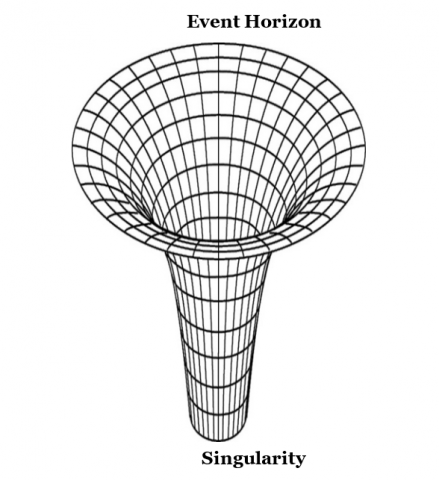
Then, in 1983, Hawking S. and Hartle D. put forward a theory of cosmological singularity. That is, if we consider singularity from the standpoint of physics (Figure 1), then it can be imagined as a certain point in space, for example, the center of a black hole, where the laws of mathematics do not work, which means that humanity cannot predict and understand the events that occur there.
If we consider singularity from a mathematical point of view, it is a point or moment at which the equation stops working, new rules appear, and its useful value is lost.
As an example, we can cite the process of division by zero. However, when we talk about operations with real numbers in ordinary arithmetic, such an operation does not make sense. If we look at such an operation from the point of view of algebra, it is possible in a special type of algebra called "wheel" (Wheel theory). For example, the Riemann sphere is an extension of the complex plane by the element ∞. That is, when considering the Riemann sphere, the complex plane is complemented with respect to the ordinary plane, by an infinitely distant point. In this case, z = ∞, and the action z/0 = ∞, for z≠0.
Figure 1. Singularity from the standpoint of physics (cosmological singularity)
So, going back to the singularity, when dividing by smaller and smaller numbers, we get an increase in the value of the result. But if we reduce the divisor to zero, then we get, within the framework of the "wheel theory", infinity, and the equation collapses, and something completely different happens. The growth curve of the approaching singularity is shown in Figure 2.
Figure 2. Graphical representation of the approaching singularity
An asymptote is a line that does not touch a curve with an infinite branch, i.e. the distance from a point on the curve to this line tends to zero as the point moves away along the branch to infinity [6].
In the same year 1983, American mathematician Vernon Vinge wrote that a new test is coming for the existence of humanity – technological singularity. Vinge [7] in his works raises questions about how humanity can survive in the conditions of the coming technological singularity, when a new post-human era arrives, in which the worldview model of perception of reality will completely change.
In our time, active discussion of the coming of singularity was caused by the scientific work of Raymond Kurzweil "The Singularity is Near: When Humans Transcend Biology" [8]. It was Kurzweil who pointed to 2025, when the computing capabilities of computers will outpace the cognitive capabilities of the human brain. And then, approximately by 2045-2050, a computer will appear that will have an intellect that will outpace all of humanity.
Continuing the development of Kurzweil's ideas, in their research, Tew Bloemmart and Stefan van den Broek argue that people will reach a stage of technological development where they will no longer understand the principles and algorithms by which artificial intelligence actually functions, and this stage is called transcendence or singularity [9]. A major gap in Kurzweil's ideas on Moore's Law which highlights the doubling of transistors in integrated circuits approximately every two years. Kurzweil assumed smooth exponential growth while ignoring significant setbacks such as biological complexity of the human brain, software bottlenecks, and socioeconomic problems. Kurzweil's ideas suggested a technological advancement of various technologies such as bio-and-nanotechnology but failed to consider that the advancement of each technology was distinct and diverse. Under these conditions, the authors propose their own management model for running a business that is adapted to singularity. The main idea that the authors took as the basis for their work is Rowan Gibson's statement [10] that "Linear thinking is useless in a nonlinear world".
Gibson [10] argued that "...The fact is, the future is not a continuation of the past. It is a series of discontinuous changes. Only by embracing these changes and learning to cope with them will we have a chance of surviving and succeeding in the 21st century. The good thing about discontinuous development is that it opens up new possibilities".
In turn, Crichton M. in his famous book "Jurassic Park" [11], says that linearity in our life does not exist as such, life is not a sequence of interconnected events, but is an unpredictable series of collisions that can radically change future events. Therefore, it was nonlinear logic that Tew Bloemmart and Stefan van den Broek took as a tool in building a management system for an organization in the conditions of singularity.
Shanahan [12] in his work put forward a hypothesis that technological singularity may occur due to the emergence of new neurotechnologies, or due to the development of artificial intelligence. According to Shanahan, if there is a development of intelligence, which also acts as the author of such development, then this artificial intelligence may begin to improve. Critics believe that Shanahan’s theory is more measured and philosophically grounded compared to the more utopian or dystopian perspectives of Ray Kurzweil or Vernor Vinge, who theorized that rapid advancement of technology, especially in artificial intelligence, could lead to a point of exponential self-improvement, where technology surpasses human understanding and control [13]. A major gap in Shanahan’s theory is the sole focus on the development of artificial general intelligence (AGI) and the negligence of human interaction. Shanahan’s theory also placed significant weight on the idea that true intelligence must be embodied, which can be contradicted by the appearance of the virtual nature of AI and cloud-based technologies.
In comparison to other thinkers on technological singularity such as Ray Kurzweil, Vernor Vinge, and Nick Bostrom (…theorized that once AI develops to the point that it can enhance itself, it may cause an abrupt and unheard-of intelligence explosion that creates an entity that is completely outside of our comprehension or control.) Shanahan focuses on the gradual embodiment of AGI, gives limited attention to human focus, acknowledges recursive improvements, and takes a philosophical and abstract point of view. Kurzweil focused on the exponential and purely digital embodiment of AGI, emphasized greatly human enhancement, acknowledged recursive improvements, and took a utopian point of view.
Bootle [14] in his work looks at the development of artificial intelligence from an economic point of view, including the emergence of a technological singularity. He gives various points of view on the possible emergence of a singularity, and in his opinion, artificial intelligence in these conditions does not necessarily have to be aggressively opposed to humanity. On the contrary, such intelligence is capable of making people's lives easier and improving their quality.
Also, changes are currently taking place in the understanding that human knowledge cannot be reduced exclusively to neurobiology. Aron Barbey, Richard Patterson, Steve Sloman, in their work “Cognitive Neuroscience Meets the Community of Knowledge” [15] describe a very interesting hypothesis. They argue that only the brain can be individual, while the mind is a collective category. Accordingly, when we talk about the further development of AI, it is necessary to consider and apply new socio-cognitive algorithms, and not be satisfied with only a neurobiological approach. The authors of the work argue that cognition is more of a group category than an individual one, and in their reasoning, people are dependent on others. Such a conceptual view of the mind can radically change approaches to the further transformation of AI, to predicting its development, and accordingly to its correct perception by humans.
And finally, let us consider a special type of singularity that is very important for the practical activities of organizations – this is information singularity.
Information singularity is a state of a system in which the time spent processing incoming information over a finite period tends to infinity, i.e., the system is overloaded with information that it does not have time to process.
In today's dynamically developing economic conditions, it becomes necessary for the computing power of the organization's accounting and analytical system not to have a negative gap with the volume of information received and circulated in the system, and to allow for its analysis, evaluation, and processing, in order to avoid the emergence of an information singularity.
In our study, it is the information singularity that is important, which can be expressed as a certain point in the development of a system in which the volume of information received per unit of time exceeds the time it takes for the system itself to process this information.
This point of information singularity can be expressed by the following formula [16]:
$I=S>P \times T$, (1)
where,
I – point of information singularity;
S – the speed of information transfer in a given period of time;
P – the speed of information processing by a computing system;
T – maximum lifetime (operation time) of a computing system.
The singularity of accounting and analytical systems (for management) is a state when such systems, based on artificial intelligence technology, will develop so quickly that the principles and algorithms of their operation will be inaccessible to the understanding of the managers for whom these systems are organized.
In general, it can be said that solving problems associated with information singularity in organizations will expand the capabilities of accounting and analytical systems, which in turn will increase the economic security and sustainability of organizations.
It is obvious that we are now witnessing an information singularity in relation to humans. People are no longer able to process endless arrays of new information, and this is a global problem for humanity, and this is what brings technological singularity closer, which can get out of people's control and understanding. There are different opinions on what needs to be done to overcome the information singularity. So far, the approaches that are proposed look futuristic:
- scanning and transforming the human mind into an information cluster;
- the introduction of synthetic genes into human DNA to enhance brain function;
- integration of the human brain and nano-neurobots for broad interaction of humans with external information and computing systems.
However, the most important way out of this problem, in our opinion, is that in the process of creating a computer with intelligence like that of a human, or superior to it, people begin to understand the nature of their intelligence much better, and this is where a solution can be found. And in learning about themselves, a person needs to actively use the opportunities that artificial intelligence gives them.
American scientist Pedro Domingos [17] said that humanity has had three sources of knowledge. The first is evolution, the second is experience, and the third is culture. However, in the modern world a fourth source has appeared – computers. Domingos claims that it is computers that can give new knowledge to humanity through the emergence of the ability to emulate the work of the human brain, create models of evolution, fill niches in existing knowledge, and reduce states of various uncertainties.
Li [18], who heads the Institute for Human-Centered Artificial Intelligence at Stanford, says that AI is designed by humans, and accordingly its behavior is set by humans, and the basis for creating AI is to improve the quality of human life and society. That is, she does not see any dangers in the dynamic development of AI.
On the other hand, she also thinks about singularity, and believes that AI is a very large-scale technology that is a turning point in human history, and therefore calls for humaneness to be built into it. Fei-Fei Li suggested that when developing artificial intelligence, it is imperative to ensure transparency and safety for people.
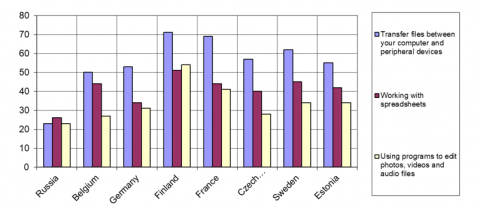
New external geopolitical challenges that Russia is experiencing have led to an urgent need for AI development. Problems related to the shortage of IT specialists, the low level of AI implementation in the spheres of the national economy and management, the need to create protective mechanisms for personal data when developing and training AI algorithms and models have been identified. For example, if we compare the digital skills of the population with European countries, the picture is not very rosy (Figure 3). The skills of Russians in the field of digital technologies are lower than those of our neighbors. The leaders in this area are countries such as Finland, France and Sweden.
Figure 3. Digital skills of the population by country, 2022 (as a percentage of the total population aged 15 and over)
Source: built based on using the source [19]
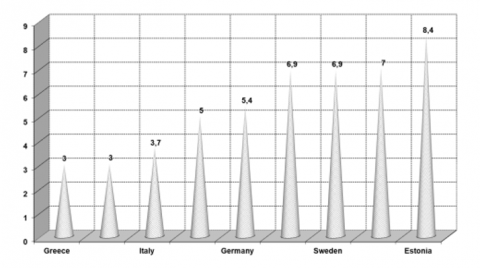
The share of the information and communication technology sector in gross added value, which is only 3%, also speaks volumes (Figure 4).
Figure 4. Share of the ICT sector in gross value added by country, 2022
We see that Russia is in last place in this indicator together with Greece. At the same time, such countries as Estonia, the Czech Republic, Sweden and Finland surpass Russia in this indicator by 2.3-2.8 times.
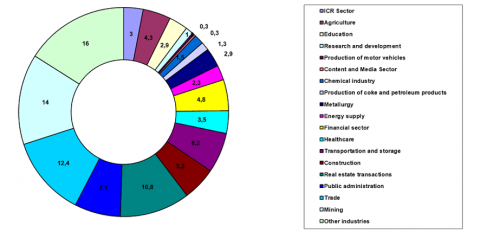
If we specifically consider the contribution of the information and communication technology sector to the development of the Russian economy (Figure 5), then ICT is used most in the extraction of minerals, in trade, in real estate transactions, 14%, 12.4 and 10.8% respectively. But such important industries that directly affect the development of information technology and AI in Russia have low values for this indicator. This is the education sector (2.9%) and the research and development sector (1.2%).
Figure 5. Contribution of the ICT sector to economic development in 2022
Source: based on the use of the source [19]
In connection with the above-mentioned problems, the National Strategy for the Development of AI for the period up to 2030 was developed [20, 21]. The main target indicators include achieving by 2030 the volume of services for the development and implementation of AI five times, compared to the level of 2022, in the amount of at least 60 billion rubles. It is also planned to increase the number of university graduates with education in the field of AI approximately five times (up to 15.5 thousand people per year). And the level of trust of Russians in technologies built based on AI should grow to 80%.
The National Strategy for the Development of AI (hereinafter referred to as the Strategy) provides a comprehensive definition of AI that meets modern trends in this area. In the Strategy, AI is defined as a set of technological solutions that imitate human cognitive functions (including self-learning and finding solutions without a predetermined algorithm), with the receipt of results similar (comparable) to the results of human intellectual activity [21].
In this definition, we already see the emerging signs of singularity, since people themselves want to see AI as a self-learning system that operates without given algorithms, i.e. according to the situation.
Computer algorithms used by AI are capable of making fairly accurate forecasts. That is why AI is increasingly used in organizations to plan and forecast activities. However, AI algorithms also generate certain risks, especially when the algorithms used are not clear to the users themselves. The difficulty in understanding AI algorithms is that users, when working with them (for example, chatbots), perceive them as living people (colleagues, managers, employees). But so far, when AI functions, the following features are revealed [22]:
- the literalness of the algorithms used, i.e. they do exactly what is specifically required of them. The goal is achieved, but without any assessment of the consequences;
- the closed nature of the rationale for AI decisions, which is called the "black box" of AI algorithms, since forecasts can be obtained quite accurately, but without specifying the factors, circumstances and reasons that determine the results obtained;
- the informational limitation of AI algorithms ("myopia" of algorithms), which are focused on existing data, most often related to short-term periods. Accordingly, there may be a gap between short-term and long-term goals when planning the organization's activities.
Perhaps, with the onset of technological singularity, these features of AI operation will be leveled out, but it is also possible that the complexity of AI functioning processes will increase significantly and will be inaccessible to human understanding.
It should be noted that humanity itself is bringing itself closer to the emergence of singularity. This is due to the fact that, on the one hand, people are aware of the danger of its emergence, but on the other hand, each country clearly understands that if it does not develop today's AI, it will miss out on competitive advantages in this area. Today, AI is already used in many areas of human activity, including the military. Therefore, at present, the security and well-being of each state depends on the development of AI.
When considering ensuring economic security in the conditions of singularity, it is necessary to take into account not only security in the classical understanding of this phenomenon for the organization, but also to pay attention to ensuring security from the singular system (it is necessary to control and predict its actions).
Technological singularity is an inevitable process, and for organizations, singularity is a connecting system that connects the entire production ecosystem of organizations of the future. Already now, organizations actively use the Internet of Things, when robotics, machines and equipment, employees, animals, drones, satellites and other objects function in a single system through the use of sensors, cameras, the Internet, special software. All this defines a new type of organization, in which the need for manual labor is increasingly being replaced, and most importantly, for human thinking, which is necessary for decision-making at all levels of management. Accordingly, the stage of development, when singularity becomes a reality, for organizations will mean ubiquitous self-programming of machines, equipment, units, robotics, as well as production processes and their management. And what about man then? What is his role? And if as a result of the fourth industrial revolution, man will no longer be needed to obtain material goods, then what will happen within the framework of the fifth industrial revolution? How can humanity go through such radical transformations without losing itself and its identity?
It is also necessary to understand that when technological singularity occurs, the architecture of companies will completely change, they will be organized in a different way. We need to prepare for this now. AI will be able to independently determine what to produce, for whom, what expenses need to be made, what profit to get, and what to direct it to. Accordingly, hypothetically, AI will be able to organize companies independently, although not yet in legal terms, but in fact this will be so.
Accordingly, in order to work successfully in the conditions of singularity, it is necessary to predict its actions and assess the risks and threats to its functioning. Due to the fact that artificial neural networks are built in the image and likeness of the human brain, the tools for analyzing singularity must be built primarily considering the physiological characteristics of the human brain. This is since at this stage, artificial intelligence is only at the beginning of its development, but how it can work in the future will be prompted by the human brain. Of course, there is a risk that at some stages, artificial intelligence may deviate in its development from its human prototype (analogue), but its basis will have a significant impact on it at the entire stage of transformations.
The danger of artificial intelligence is that it has never come into contact with the physical world that surrounds us. Accordingly, what is understandable and quite natural for a person, due to practical experience and constant interaction with the physical world, for artificial intelligence most often causes dead ends in its algorithm. Therefore, the consequences of the functioning of singular AI in organizations can also be unpredictable and possibly even destructive.
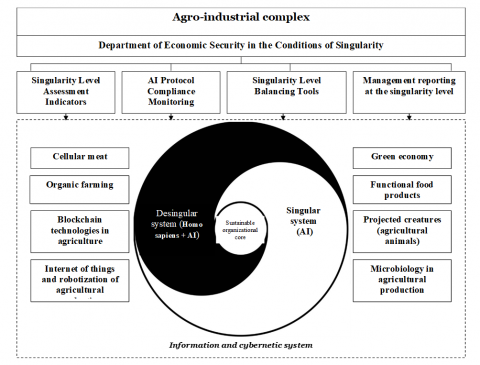
The system of economic security in the event of singularity should be of a hybrid form and work both in the classical direction, ensuring the security of the organization from external threats and risks, and in the direction of monitoring the functioning and evaluation of the actions of the singular system itself. And here an important problem arises. Since in the case of singularity, people will not understand the logic and algorithms that artificial intelligence uses, providing all processes in the organization, then the results of the activities of organizations will be unpredictable and incomprehensible to humans, and most importantly, they can carry some dangers and risks. Therefore, when forming an economic security system in the conditions of singularity, the core of this system should be a hybrid of two systems in equal proportions - a singular system and a desingular system. The model is shown in Figure 6.
Thus, in the presented model (Figure 6), the protagonist will be the desingular system, and the antagonist will be the singularity itself created by artificial intelligence. The balance of the two systems forms a stable organization, within which the singular system manages the processes of ensuring economic security but does so with the participation and under the control of people. At the same time, control over the functioning of the singular system is provided by the desingular system, the analytical and monitoring processes of which are also organized on the basis of artificial intelligence. However, the artificial intelligence of the desingular system is focused on constant monitoring of the activities of the singular system, and monitors compliance with security protocols and the interests of people. That is why the desingular system operates in a hybrid format with the mandatory participation of the organization's personnel, who control the balance of the organizational core. At the same time, a person is needed in the desingularity system to a greater extent not for analytical decisions, but for abstract and emotional ones. In the desingular system, the generation of the image of singularity is carried out for the advanced impact on the system. The artificial intelligence of the desingular system will help to solve the issues of ethics and security in the interaction of the AI of the singular system and human society [23, 24].
In the economic security department itself, due to the emergence of singularity, it is necessary to highlight the following elements:
- indicators for assessing the level of singularity (e.g., frequency of autonomous decisions, deviation index from predefined protocols);
- control of compliance with the AI protocol (automated audits and anomaly detection mechanisms);
- tools for balancing the singularity level (dynamic dampening modules that limit or delay autonomous decisions under certain thresholds);
- management reporting on the singularity level (weekly or real-time dashboards with traffic-light coding and cause-explanation output).
When constructing processes of balancing two systems (singular and desingular), many problems and questions arise. For example, if AI in a singular system is a self-developing entity, then how to make it take control from AI from a desingular system. To mitigate this, the model introduces cognitive asymmetry via logic modeling: projecting distinct features of male and female logic onto the architecture of the two subsystems. The desingular system is designed according to female logic like contextual and intuitive reasoning, empathy modeling, multitasking capability, adaptability and fluid reconfiguration.
Figure 6. Model of the system for ensuring economic security of agro-industrial complex organizations in the conditions of singularity
The singular system, in contrast, is governed by male logic, including linear and analytical processing, goal fixation, rationality and deterministic risk acceptance.
Even at current levels, AI architectures often reflect male-logical traits (strict optimization, target-maximization without contextual nuance). Therefore, balancing must not rely on confrontation, but on codependence.
Then the question arises, how to make these two systems interact at all. And here again we will turn to the relations of people. It is necessary to make it so that the singular and desingular systems are codependent, so that they need each other. For example, so that the upgrade of the systems is possible only by bilateral confirmation in each system. Since the systems will be designed on different algorithms, their functionality will also be different, and accordingly each of the systems can perform the missing functions of the other system. When building such an interaction of the singular and desingular systems, they will really be codependent, and unique synergetic functions may also appear that were not included in their algorithms at all but appeared in the process of the interaction itself [25].
By means of soft manipulation (the "Salami" method), coming from the desingular system, it is possible to achieve control over the development of the singularity system, so that the AI does not define the goals and tasks facing it, but is led to these goals, but the AI is confident that it is doing this itself. For reference, "Salami tactics" is a strategy in which a large goal is replaced by a sequence of small, intermediate goals. From the point of view of game theory, "salami tactics" is a struggle for resources, in which one of the players does not have all the information [26].
Formally, this can be expressed through an influence control function:
$Tshift =\sum_{i=1}^n \delta_i \times W_i$
where,
$\delta_i$ – alignment shift per micro-goal,
$\mathrm{W}_{\mathrm{i}}$ – weight of each step in cumulative influence,
$\mathrm{T}_{\text {shift }}$ – total redirection vector.
3.1 Tools of desingularity
Today, in all spheres of life, we are surrounded by the digital world. Almost any profession is associated with the use of digital technologies. However, there is some disconnection between our physical world and those digital projections that come from the world built on the digital. This is due to the fact that the human world functions in three-dimensional space, and the digital world, in two-dimensional. Accordingly, for a person, this state of affairs acts as a limiting factor in the perception of information flows coming from the digital world. Of course, for artificial intelligence, this is not a problem, and here a person loses his advantage. But the solution to this problem already exists, and is developing quite dynamically - this is augmented reality. Augmented reality (AR) transfers digital data to the physical world, and presents them to a person in the visual field to change perception, and supplement information about his environment. Accordingly, for any organizations, and especially for agro-industrial complex organizations, which are characterized by interaction with biological assets, augmented reality will act as a good tool for including a person in the singularity process. The perception of processes by employees of organizations that are provided by artificial intelligence through the use of augmented reality will be significantly higher.
Thus, AR is not merely a visualization tool, but a core component of the desingular system, restoring the human role as interpreter and supervisor. Thus, augmented reality is one of the tools of the desingularity system. Porter and Heppelmann [27] say the following about the use of augmented reality: "...When we place information in the context of its application, its perception increases significantly, and as a result, the effectiveness of our actions regarding this information."
Summarizing the above, we can conclude that technological singularity may become an objective reality in the coming years. This is facilitated by the dynamic development of artificial intelligence, its implementation in all spheres of human life, and the competition of each country in this area, since their security may depend on it.
The model has its benefits and disadvantages. For instance, the lack of interaction between AI and the real world may cause an algorithmic deadlock, and moreover AI unpredictability may breed the problems with risk evaluation. It lays down some restrictions on the model. The first one is technological development of the country and AI-infrastructure, the second one is the distrust of the public upon the AI entrenchment. Also there are no legal rules which concern the problems caused by AI.
The model encompasses two systems (singular and desingular) which make the model more stable, allowing to control the singular system. The model integrates personality impact into the functioning of AI and expands the analitical means of AI adding abstract and emotional aspects.
The development of the model can be connected with the AR-technologies integration, creating various singularity metrics.
Technological singularity can bring very positive changes for humanity, but for this, it is already necessary to correctly direct the development of artificial intelligence. To solve these problems, the author's model of the system of ensuring the economic security of agricultural organizations in the context of technological singularity was developed. The core of the model is a balanced sphere of two systems, singular and desingular.
A limitation of the study is that it is a conceptual model. The proposed hybrid system is considered as a theoretical basis for future research. Promising areas for further work include scenario modeling of the interaction of singular and desingular systems, development of measurable indicators of the singularity level, and pilot implementation of augmented reality in agro-industrial organizations. As AI-based infrastructure develops, the model can be adapted and empirically tested using digital twins and smart farms.
The implementation of the presented model can give new development to artificial intelligence, and the organization of the agricultural sector in which it will be applied. With this approach, there will be a transformation of organizations into organizations of a new technological type, with elements of self-development and self-transformation, with minimal human participation in these processes. This will significantly increase the efficiency of such organizations, enhance their stability and security, provided that the activities of the singular system are monitored.
The study was carried out within the framework of the implementation of the RSF grant under the Presidential program of research projects implemented by leading scientists, including young scientists in 2024 23-78-01247.
[1] Al-Imam, A., Motyka, M.A., Sahai, A., Konuri, V.K. (2020). The "march of progress": From cosmic singularity to digital singularity. Current Trends in Information Technology, 10(1): 1-8.
[2] Qayyum, M., Zhang, Y., Wang, M., Yu, Y., Li, S., Ahmad, W., Maodaa, S.N., Sayed, S.R., Gan, J. (2023). Advancements in technology and innovation for sustainable agriculture: Understanding and mitigating greenhouse gas emissions from agricultural soils. Journal of Environmental Management, 347: 119147. https://doi.org/10.1016/j.jenvman.2023.119147
[3] Hampel, G., Fabulya, Z. (2024). The risks of AI in agriculture. Analecta Technica Szegedinensia, 18(4): 32-44. https://doi.org/10.14232/analecta.2024.4.32-44
[4] Gong, W., Ma, R., Zhang, H. (2024). Digital agricultural technology services and farmers' willingness to choose digital production technology in Sichuan province, China. Frontiers in Sustainable Food Systems, 8. https://doi.org/10.3389/fsufs.2024.1401316
[5] Homer, S., Selman, A.L. (2001). Computability and Complexity Theory. Springer, New York.
[6] Mathematical Encyclopedia (in 5 volumes). Vol. 1. (1982). Soviet Encyclopedia, Moscow.
[7] Vinge, V. (2019). Singularity [collection]. Translated from English by M. Levina, V. Grishechkina. AST Publishing House, Moscow. https://ast.ru/book/singulyarnost-842617/.
[8] Kurzweil, R. (2005). The Singularity Is Near: When Humans Transcend Biology. Viking Penguin, New York.
[9] Bloemmaert, T. (2019). The Fourth Industrial Revolution and Business: How to Compete and Grow in the Age of Singularity. Alpina Publisher, Moscow.
[10] Gibson, R. (2015). The Four Lenses of Innovation: A Power Tool for Creative Thinking. John Wiley & Sons, Hoboken.
[11] Crichton, M. (2013). Jurassic Park. Amphora, Moscow.
[12] Shanahan, M. (2017). Technological Singularity. Alpina Publisher, Moscow.
[13] Evangelista, R., Chiodi, V. (2024). Singularity and the dispute for a transhumanist ideology. Vibrant Virtual Brazilian Anthropology, 21. https://doi.org/10.1590/1809-43412024v21d501
[14] Bootle, R. (2023). Artificial Intelligence and the Economy: Work, Wealth, and Well-Being in the Age of Thinking Machines. Alpina PRO, Moscow.
[15] Sloman, S.A., Patterson, R., Barbey, A.K. (2021). Cognitive neuroscience meets the community of knowledge. Frontiers in Systems Neuroscience, 15: 675127. https://doi.org/10.3389/fnsys.2021.675127
[16] Information Singularity. https://scientifically.info, accessed on Jun 10, 2024.
[17] Domingos, P. (2016). The Master Algorithm: How Machine Learning Will Change Our World. Mann, Ivanov and Ferber, Moscow.
[18] Li, F.L. (2023). Hi-Tech+. https://m.hightech.plus/2023/09/19/glavnii-specialist-stenforda-po-ii-fei-fei-li-prizivaet-vstroit-v-neiroseti-gumannost, accessed on Jun 10, 2024.
[19] Abashkin, V.L., Abdrakhmanova, G.I., Vishnevsky, K.O., Gokhberg, L.M., et al. (2024). Digital Economy: 2024: A Brief Statistical Digest. ISSEK HSE, Moscow.
[20] Decree of the President of the Russian Federation of October 10, 2019 No. 490 "On the development of artificial intelligence in the Russian Federation". https://www.garant.ru/products/ipo/prime/doc/72738946/, accessed on Jun 10, 2024.
[21] The National Strategy for the Development of AI for the Period up to 2030 was approved by the Decree of the President of the Russian Federation dated 10.10.2019 No. 490. https://ai.gov.ru/national-strategy/, accessed on June 10, 2024.
[22] Luca, M., Kleinberg, J., Mullainathan, S. (2022). Algorithms Need Managers Too. Alpina Publisher, Moscow.
[23] Dzhancharov, T., Rozanova, T., Pasternak, S., Dmitrieva, O., Romanova, A., Lebedev, K. (2023). Introduction of economic and legal measures for the development of the ecologization system at an enterprise. Journal of Law and Sustainable Development, 11(8): e972. https://doi.org/10.55908/sdgs.v11i8.972
[24] Khoruzhy, L.I., Katkov, Y.N., Khoruzhy, V.I., Romanova, A.A., Katkova, E.A. (2023). Forming an adaptive model of inter-organisational management accounting in agribusiness organisations within the context of COVID-19 spreading. Procedia Environmental Science, Engineering and Management, 9(1): 195-204.
[25] Khoruzhy, L., Katkov, Y., Katkova, E., Romanova, A., Dzhikiya, M. (2023). Introduction of environmental monitoring for the sustainable development of the agro-industrial complex: The method of the genuine savings index. Journal of Law and Sustainable Development, 11(5): e471. https://doi.org/10.55908/sdgs.v11i5.471
[26] Powell, R. (1996). Uncertainty, shifting power, and appeasement. American Political Science Review, 90(4): 749-764. https://doi.org/10.2307/2945840
[27] Porter, M., Heppelmann, J. (2022). Why Every Organization Needs an Augmented Reality Strategy. Alpina Publisher, Moscow.