Mohamed Eisa* | Mohamed Ali | Mustafa Abualreish | Safwa Yagoub | Lamiaa Amin | Gamal Khamis
© 2025 The authors. This article is published by IIETA and is licensed under the CC BY 4.0 license (http://creativecommons.org/licenses/by/4.0/).
OPEN ACCESS
This study investigates the levels and health implications of indoor and outdoor background gamma radiation in two university physics laboratories in Sudan University of Scienece and Technology, Sudan. Given the constant exposure to ionizing radiation from natural and artificial sources, including building materials and radioactive teaching aids, the study aimed to quantify radiation exposure risks to staff, students, and visitors. Using a Geiger-Müller (GM) tube and digital counter, radiation levels were measured at various points in and around the laboratories. Results showed that average indoor radiation doses were consistently higher than outdoor levels in both laboratories, with Lab 1 recording an average indoor dose of 150.92 nSv/h compared to 114.73 nSv/h outdoors, and Lab 2 showing 81.91 nSv/h indoors versus 71.42 nSv/h outdoors which is less than the global radiation threshold. Although some indoor readings approached established high-dose thresholds, none significantly exceeded them. The data suggest that indoor sources, possibly building materials or equipment, contribute to elevated exposure, though not at levels requiring immediate intervention. These findings support the need for continued monitoring and the establishment of safety guidelines to mitigate long-term exposure risks in educational laboratory environments.
physics laboratories, natural background radiation, annual effective dose, radiation survey, health risk assessment
As ionizing radiation is the most common form of exposure in the environment, determining the health risk of background gamma radiation is crucial in health physics [1, 2]. Human beings are inexorably presented to natural background radiation from cosmos [3], earth stratum, building materials, food, air, and even components that constitute their own body [4, 5]. Ionizing radiation from natural sources is constantly present in our environment. Natural background radiation is unavoidably present in our surroundings [6-8]. Health physicists find assessments of natural background radiations to be extremely important because, in addition to the fact that humans are continuously exposed [9, 10] to varying degrees of ionizing radiation from natural sources, over 90% of human radiation exposure originates from natural sources [11, 12]. Workers at the workplaces may be exposed to natural radiation from waste items.
The United Nations Scientific Committee on the Effects of Atomic Radiation (UNSCEAR) provides comprehensive guidelines and assessments on radiation exposure, including laboratory monitoring. While UNSCEAR doesn't issue specific laboratory protocols, its reports offer valuable insights into radiation safety practices. UNSCEAR's 2020/2021 report emphasizes the importance of timely and accurate radiation monitoring following nuclear incidents. It highlights the necessity of using both personal dosimetry and environmental measurements to assess exposure levels effectively. This approach ensures that radiation doses to workers and the public are accurately estimated, facilitating appropriate protective measures [13].
As a case study in Bangladesh, a study evaluated radiation levels around major hospitals in central and western regions. Radiation monitoring was performed using calibrated devices, with calibration traceable to international standards. This approach ensured the reliability of the measurements and supported the assessment of potential radiation risks to the public living near these facilities [14]. The functioning of these industrial workshops is typically uncontrolled, and there is no particular methodology for establishing guidelines about the natural radioactivity of waste products [15]. Considering both necessary and basic scientific grounds, health physics places a high value on the study and assessment of natural ambient radiation. Background radiation emerges from primordial, cosmogonic and anthropogenic sources [16]. Preliminaries are found across the world, including in the human body, and can be found in the crust of the earth [17, 18]. There are no individual radiation dose estimates or direct quantitative estimates of risk in relation to populations exposed to the environment [19, 20]. The body of scientific evidence indicates that there is no exposure threshold beyond which it can be shown that low doses of ionizing radiation are advantageous or safe. It is typically not evident that humans are continuously exposed to radiation since low quantities of ionizing radiation cannot be felt or seen [21-23].
The indoor background ionizing radiation comes from radioactive sources which used for teaching, and the staff and students spend more time in these laboratories, exposure to this background ionizing radiation. Naturally occurring radioactive nuclides are present in varying concentrations in all construction materials. The majority of uranium radionuclides found in materials made from rock and soil are naturally occurring. (U238) and thorium (Th232) series, and the radioactive isotope of potassium (K40). In order to ascertain the degree of risk that staff and students are exposed to, the background ionizing radiation levels in the physics laboratories and their surrounding areas are evaluated in this work. Injuries and clinical symptoms, such as chromosomal changes, cancer induction, and the creation of free radicals, may result from radiation exposure [24]. The injuries and clinical symptoms could be caused by both high doses and prolonged low dose exposure [25-27].
Building materials and radioactive sources provide indoor background ionizing radiation. Humans have been shown to be susceptible to cytogenetic damage from long-term exposure to even low doses and low dose rates of nuclear radiation from contaminated buildings [28-30]. It has been discovered that both hematopoietic and solid tumors exhibit dose-dependent increases in incidence and death. Cancers of the breast, thyroid, and lungs account for the majority of the increase. A growing body of research indicates that influenced by dose [31, 32]. The purpose of this study was to determine and evaluate the influence, background radiation in these two physics labs which including inside some radioactive sources and how to deal with results that affecting health of the workers inside the laboratories and the staff, students and visitors around them and in order to set safety guidelines protecting individuals from the risks posed by this background radiation.
This study was accomplished by selecting two physics laboratories, both are of areas 77 m2 which are in the center of the faculty of science and administrative offices nearby; however, this region is quite congested with students from all around the university. In addition, these laboratories are used to teach students of the Faculty of Science and some other faculties of the university as well as with around ten faculties, a student community of about 22,000, and over 3,000 staff members, the school welcomes visitors and students from both within and outside the globe [33-35]. In the chosen laboratories, background radiation was monitored both indoors and outdoors.
This was collected using an assembly combining a GM-tube (LD didactic GmbH 55901, Top 0000022) and (digital counter 57548, WA 00027063). The GM tube is particularly useful since it operates simply and produces a very powerful signal; It is a portable device, suitable for radiation level monitoring in the laboratory as well as in the field, it may be used with any type of ionizing radiation. The GM counter only counts particles and has a dead time of 200 to 300 μs [36].
The voltage applied to the GM-counter is 480 volts. Two target regions were identified for this study: physics laboratories 1 and 2, which were chosen for comparison purposes. Certified calibration sources such as Cs-137, Co-60 were used for the calibration of the GM before the measurements, and the background was subtracted from all the readings. To sufficiently cover the selected target areas, ten readings were taken in each location at Khartoum, Sudan, is specifically made to function as a low-level survey meter in both indoor and outdoor environments. In the designated areas, the ambient gamma absorbed dose rates were determined on-site. The measurements of gamma background radiation were conducted at various designated places within and outfacilities [17], both indoors and outdoors. In each location, 8–12 points were selected and at each point, 8–10 readings were recorded. Standard procedure was followed for taking the measurements [37], i.e., in the air at a distance of one meter above the ground [33, 34]. The arithmetic mean of the readings was taken as representative figure for location. The exposure rate in (R/cpm) which was obtained from the counter converted into absorbed dose rate (nSv/h) using the conversion factor of 1cpm = 5.019 nSv/h [9, 35].
The results presented in Tables 1 and 2 are indoors outdoor readings in the two physics laboratories 1 & 2 respectively obtained by GM-tube, which present the count rate in (R/cpm) and dose in (nSv/h), the readings were at 30℃.
Environmental Radiation Evaluation of Laboratory 1
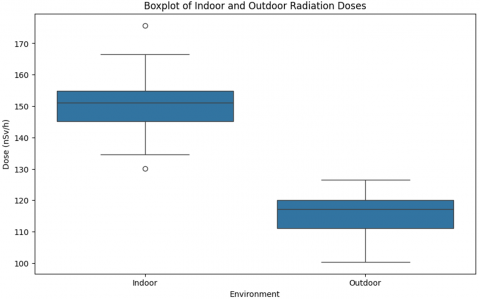
To obtain a general idea of the overall radiation levels in both environments, we computed average indoor and outdoor count rates and dosages using Python software package. The results are as follows: average indoor count rate: 30.2 R/cpm, average indoor dose: 150.9233 nSv/h, average outdoor count rate: 22.86 R/cpm, average outdoor dose: 114.729 nSv/h. These averages indicate that indoor radiation levels are higher than outdoor ones. To understand the variability of the measurements, we determined the standard deviation for the count rates and doses both indoors and outdoors. Standard deviation of indoor count rate is 2.5424 R/cpm standard deviation of indoor dose: 12.8362 nSv/h Standard Deviation of Outdoor Count Rate: 1.5901 R/cpm, standard deviation of outdoor dose: 7.9798 nSv/h. These standard deviations show that count rates and doses vary, with indoor measurements showing slightly higher variability than outdoor measurements. Table 1 presents the readings and comparison between the average indoor and outdoor doses, and Figure 1 presents Boxplot indoor out door radiation doses for laboratory 1.
Table 1. Indoor outdoor count rate (R), dose equivalent (D) in the physics laboratory 1 at 30℃
|
No. |
Indoor |
Outdoor |
||
|
Count rate (R/cpm) |
Dose (nSv/h) |
Count rate (R/cpm) |
Dose (nSv/h) |
|
|
1 |
30.4 |
151.722 |
22.6 |
113.42 |
|
2 |
33.4 |
166.552 |
23.7 |
118.95 |
|
3 |
30.2 |
150.581 |
20 |
100.38 |
|
4 |
29 |
144.877 |
20.3 |
101.88 |
|
5 |
29.2 |
146.018 |
23 |
115.43 |
|
6 |
27 |
134.61 |
24 |
120.45 |
|
7 |
35 |
175.678 |
25.2 |
126.47 |
|
8 |
31 |
155.144 |
23.7 |
118.95 |
|
9 |
26 |
130.047 |
22 |
110.41 |
|
10 |
30.8 |
154.004 |
24.1 |
120.95 |
|
Mean |
30.20 |
150.92 |
22.86 |
114.73 |
|
STD |
2.68 |
13.53 |
1.68 |
8.41 |
|
Min |
26 |
130.047 |
20 |
100.38 |
|
Max |
35 |
175.678 |
25.2 |
126.47 |
p-value < 0.05
T-test ≈ 7.18
Figure 1. Boxplot indoor outdoor radiation doses for lab 1
The environmental average dose of the indoor is (150.9233 nSv/h) and significantly higher than the average outdoor dose (114.729 nSv/h). This suggests that a radiation source within the buildings could contribute to higher indoor radiation levels. To identify specific locations with significantly higher doses, we calculated the threshold for high doses as the mean plus two standard deviations: which gave indoor dose threshold: (150.9233 + 2 × 12.8362 = 176.5957) nSv/h and outdoor dose threshold: (114.729 + 2 × 7.9798 = 130.6885) nSv/h. For example, location 7 has a dose of 175.678 nSv/h, which is close but does not exceed the threshold of 176.5957 nSv/h. However, no outdoor locations exceed the threshold of 130.6885 nSv/h.
This analysis indicates that while some indoor locations have higher doses, none exceed the threshold by a substantial margin. Therefore, while there are higher indoor radiation levels overall, there are no specific locations with extremely high doses that would warrant immediate concern based on this dataset [38-41]. To obtain a general idea of the overall radiation levels in both environments, we computed average indoor and outdoor count rates and dosages. The results are as follows: average indoor count rate: 16.36 R/cpm average indoor dose: 81.9051 nSv/h average outdoor count rate: 14.28 R/cpm average outdoor dose: 71.41548 nSv/h. These averages indicate that the indoor radiation levels are slightly higher than the outdoor levels.
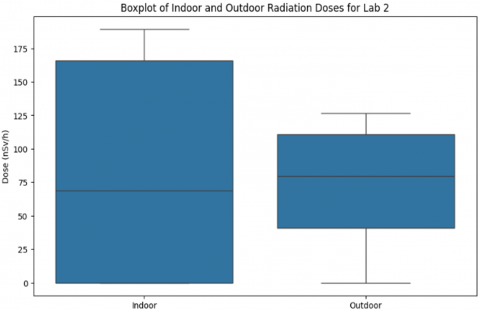
To understand the variability of the measurements, we calculated the standard deviation for the indoor and outdoor count rates and doses: standard deviation of indoor count rate: 17.4714 R/cpm standard deviation of indoor dose: 87.4841 nSv/h standard deviation of outdoor count rate: 9.8645 R/cpm standard deviation of outdoor dose: 49.1929 nSv/h. These standard deviations show significant variability in the count rates and doses, particularly for the indoor measurements. Table 2 presents the readings and the comparison between the average indoor and outdoor doses. Figure 2 presents Boxplot indoor out door radiation doses for laboratory 2.
Table 2. Indoor count rate (R), dose equivalent (D) in the physics laboratory 2 at 30℃
|
No. |
Indoor |
Outdoor |
||
|
Count rate (R/cpm) |
Dose (nSv/h) |
Count rate (R/cpm) |
Dose (nSv/h) |
|
|
1 |
29.2 |
146.018 |
25.2 |
126.47 |
|
2 |
27.6 |
138.033 |
20.7 |
103.89 |
|
3 |
0.0 |
0.0 |
7.8 |
39.14 |
|
4 |
0.0 |
0.0 |
0.0 |
0.0 |
|
5 |
34.6 |
173.39 |
20.3 |
101.88 |
|
6 |
37.8 |
189.36 |
22.5 |
112.92 |
|
7 |
0.0 |
0.0 |
11.5 |
57.71 |
|
8 |
34.4 |
172.25 |
25.6 |
125.97 |
|
9 |
0.0 |
0.0 |
0.0 |
0.0 |
|
10 |
0.0 |
0.0 |
9.2 |
46.1748 |
|
Mean |
16.36 |
81.91 |
14.28 |
71.42 |
|
STD |
17.47 |
87.48 |
9.86 |
49.19 |
|
Min |
0.0 |
0.0 |
0.0 |
0.0 |
|
Max |
37.8 |
189.36 |
25.6 |
126.47 |
Figure 2. Boxplot indoor and outdoor radiation doses for lab 2
Environmental average dose of indoor was (81.9051 nSv/h) is higher than the average outdoor dose (71.41548 nSv/h). This suggests that there could be a radiation source within the buildings contributing to higher indoor radiation levels. To identify specific locations with significantly higher doses, we calculated the threshold for high doses as the mean plus two standard deviations: indoor dose threshold: (81.9051 + 2 × 87.4841 = 256.8733) nSv/h outdoor dose threshold: (71.41548 + 2 × 49.1929 = 169.80128) nSv/h. No indoor locations exceed the threshold of 256.8733 nSv/h. No outdoor locations exceed the threshold of 169.80128 nSv/h. This analysis indicates that while some indoor locations have higher doses, none exceed the threshold by a substantial margin. Therefore, while there are higher indoor radiation levels overall, there are no specific locations with extremely high doses that would warrant immediate concern based on this dataset. However, the occupational exposure, ICRP and WHO recommends: 2281.5nSv/h, averaged over 5 years. 5703.8nSv/h in any single year (maximum). For public exposure: 1 mSv/year average which is greater than the readings we got.
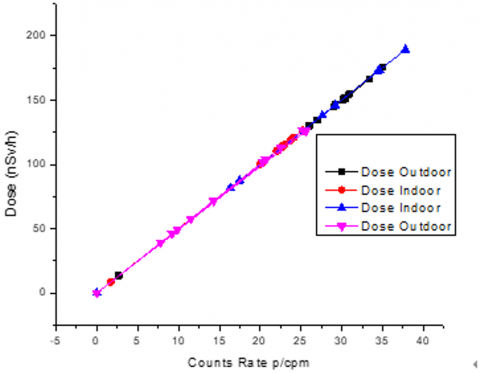
Figure 3 presents the relation between the indoor and outdoor radiation which shows straight line, this is indication that the two labs are close to each other in risk of background radiation that causes health effects.
Figure 3. Indoor and outdoor plot for the two physics labs
This study effectively assessed the background gamma radiation levels in Sudan University of Science and Technology's two physics labs. The results showed that, in both labs, indoor radiation doses were consistently higher than outside doses. This was probably because of the radioactive teaching aids and naturally radioactive construction materials. In spite of this, every measured result was still much below the WHO and ICRP's recommended international exposure limits for both public and occupational exposure. Students, employees, or visitors did not face any acute health hazards, and no particular measurement site surpassed the determined high-dose criteria. But the higher interior radiation levels than outdoor measurements show how important it is to regularly check radiation levels, particularly in educational settings where people may spend a lot of time. The study emphasizes the significance of creating regional radiation safety regulations, raising ionizing radiation awareness and training, and maintaining safe laboratory conditions by ongoing monitoring and adherence to radiation protection best practices.
The authors thank the Deanship of Scientific Research at Northern Border University, Arar, Kingdom of Saudi Arabia for funding this research work through project No.: NBU-FFR-2025-0052-02.
[1] Almisned, G., Zakaly, H.M.H.H., Issa, S.A.M.M., Ene, A., Kilic, G., Bawazeer, O., Almatar, A., Shamsi, D., Rabaa, E., Sideig, Z., Tekin, H.O. (2021). Study of gamma rays shielding parameters of some building materials used in Sudan. Radiation Physics and Chemistry, 4(3): 1269-1290. https://doi.org/10.21315/jps2017.28.3.9
[2] Ahmed, B., Shah, G.B., Malik, A.H., Aurangzeb, Rizwan, M. (2020). Gamma-ray shielding characteristics of flexible silicone tungsten composites. Applied Radiation and Isotopes, 155: 108901. https://doi.org/10.1016/j.apradiso.2019.108901
[3] Alghamdi, A.S., Aleissa, K.A., Al-Hamarneh, I.F. (2019). Gamma radiation and indoor radon concentrations in the western and southwestern regions of Saudi Arabia. Heliyon, 5(1): e01133. https://doi.org/10.1016/j.heliyon.2019.e01133
[4] Alghamdi, M.A.M. (2019). Suitability of quaternary sediments of Wadi Arar, Saudi Arabia, as construction materials: An environmental radioactivity approach. Engineering, Technology & Applied Science Research, 9(5): 4735-4740. https://doi.org/10.48084/etasr.3039
[5] Al-Zahrani, J. (2017). Materials gamma radiation hazards and risks associated with industrial wastes materials. Journal of Geoscience and Environment Protection, 5(4): 24-30. https://doi.org/10.4236/gep.2017.54003
[6] Anitha, M., Jayanthi, D.D., Maniyan, C.G. (2024). Indoor radon and thoron levels in some residences of Sri Renga Narayana Puram Village, Tirunelveli, India, using solid-state nuclear track detectors. Radiation Protection and Environment, 47(1): 53-56. https://doi.org/10.4103/rpe.rpe_11_23
[7] Appleton, J.D., Kendall, G.M. (2022). Gamma-radiation levels outdoors in Great Britain based on K, Th and U geochemical data. Journal of Environmental Radioactivity, 251-252: 106948. https://doi.org/10.1016/j.jenvrad.2022.106948
[8] Bashir, M., Suleiman, I.K., Kolo, M.T., Muhammad, A. (2023). Indoor radon concentration levels in some selected offices at Ibrahim Badamasi Babangida University, Lapai, Nigeria and its attendant annual effective dose. Science World Journal, 18(2): 223-230. https://doi.org/10.4314/swj.v18i2.9
[9] Buckner, C.A., Lafrenie, R.M., Dénommée, J.A., Caswell, J.M., Want, D.A., Gan, G.G., Leong, Y.C., Bee, P.C., Chin, E., Teh, A.K.H., Picco, S., Villegas, L., Tonelli, F., Merlo, M., Rigau, J., Diaz, D., Masuelli, M., Korrapati, S., Kurra, P., Puttugunta, S., Picco, S., Villegas, L., Tonelli, F., Merlo, M., Rigau, J., Diaz, D., Masuelli, M., Tascilar, M., de Jong, F.A., Verweij, J., Mathijssen, R.H.J. (2016). Relation of Trace Elements on Dental Health Chapter. Trace Elements - Human Health and Environment A, 11(tourism): 13.
[10] Davis, S. (2012). Health risks associated with environmental radiation exposures. Journal of Radiological Protection, 32(1): 5-10. https://doi.org/10.1088/0952-4746/32/1/N21
[11] Effects, H., Levels, L., Radiations, I., Effects, H., Levels, L., Radiations, I., Vii, B., Isbn, C., Pdf, T., Press, N.A., Press, N.A., Academy, N., Academy, N., Press, N.A. (1998). Health effects of exposure to low levels of ionizing radiations: Time for reassessment? Committee on Health Effects of Exposure to Low Levels of Ionizing Radiations (Beir VII), National Research Council.
[12] Okeyode, I.C., Oladotun, I.C., Alatise, O.O., Bada, B.S., Makinde, V., Akinboro, F.G., Mustapha, A.O., Al-Azmi, D. (2019). Indoor gamma dose rates in the high background radiation area of Abeokuta, South Western Nigeria. Journal of Radiation Research and Applied Sciences, 12(1): 72-77. https://doi.org/10.1080/16878507.2019.1594097
[13] Ichikawa, R. (1983). The 31st session of united nations scientific committee on the effects of atomic radiation. Japanese Journal of Health Physics, 18(1): 57-65. https://doi.org/10.5453/jhps.18.57
[14] James, I.U., Moses, I.F., Akueche, E.C., Kuwen, R.D. (2020). Assessment of indoor and outdoor radiation levels and human health risk in Sheda science and technology complex and its environ, Abuja, Nigeria. Journal of Applied Sciences and Environmental Management, 24(1): 13-18. https://doi.org/10.4314/jasem.v24i1.2
[15] Jindal, M.K., Sar, S.K., Baghel, T., Wadhwa, D.S. (2021). Statistical study of the factors affecting outdoor gamma dose rate and impact of season. Journal of the Geological Society of India, 97(1): 85-93. https://doi.org/10.1007/s12594-021-1629-y
[16] Kovler, K., Friedmann, H., Michalik, B., Schroeyers, W., Tsapalov, A., Antropov, S., Bituh, T., Nicolaides, D. (2017). Basic Aspects of Natural Radioactivity. 1st ed. Elsevier Ltd. https://doi.org/10.1016/B978-0-08-102009-8.00003-7
[17] Kuon, E., Birkel, J., Schmitt, M., Dahm, J.B. (2003). Radiation exposure benefit of a lead cap in invasive cardiology. Heart, 89(10): 1205-1210. https://doi.org/10.1136/heart.89.10.1205
[18] Kurnaz, A., Küçükömeroǧlu, B., Okumuşoǧlu, N.T., Yeşilbaǧ, Y.Ö. (2010). Indoor and outdoor gamma dose measurements for specific counties of Trabzon-Turkey. AIP Conference Proceedings, 1203: 379-381. https://doi.org/10.1063/1.3322471
[19] Gulan, L., Spasović, L. (2017). Outdoor and indoor ambient dose equivalent rates in Berane town, Montenegro. In RAD5 Proceeding of Fifth International Conference on Radiation and Applications in Various Fields of Research. RAD Association, 2: 137-140.
[20] Portaro, M., Rocchetti, I., Tuccimei, P., Galli, G., Soligo, M., Ciotoli, G., Longoni, C., Vasquez, D., Sola, F. (2024). Indoor radon surveying and mitigation in the case-study of Celleno Town (Central Italy) located in a medium geogenic radon potential area. Atmosphere, 15(4): 425. https://doi.org/10.3390/atmos15040425
[21] Mobbs, S.F., Muirhead, C.R., Harrison, J.D. (2011). Risks from ionising radiation: An HPA viewpoint paper for Safegrounds. Journal of Radiological Protection, 31(3): 289-307. https://doi.org/10.1088/0952-4746/31/3/R01
[22] Nations, U., Committee, S., Radiation, A. (2000). UNSCEAR 2000. The United Nations Scientific Committee on the Effects of Atomic Radiation., 79.
[23] Noh, E., Lee, D., Park, S., Seo, S. (2023). Personal dosimeters worn by radiation workers in Korea: Actual condition and consideration of their proper application for radiation protection. Journal of Radiation Protection and Research, 48(3): 162-66. https://doi.org/10.14407/JRPR.2023.00052
[24] O’Connor, M.K. (2017). Risk of low-dose radiation and the BEIR VII report: A critical review of what it does and doesn’t say. Physica Medica, 43: 153-58. https://doi.org/10.1016/j.ejmp.2017.07.016
[25] Okogbue, C., Nweke, M. (2018). The 226Ra, 232Th and 40K contents in the Abakaliki baked shale construction materials and their potential radiological risk to public health, southeastern Nigeria. Journal of Environmental Geology, 2(1): 13-19. https://doi.org/10.4172/2591-7641.1000012
[26] Oladele, B.B., Arogunjo, A.M., Aladeniyi, K. (2018). Indoor and outdoor gamma radiation exposure levels in selected residential buildings across Ondo state, Nigeria. International Journal of Radiation Research, 16(3): 363-370. https://doi.org/10.18869/acadpub.ijrr.16.2.363
[27] Pashazadeh, A.M., Aghajani, M., Nabipour, I., Assadi, M. (2014). Annual effective dose from environmental gamma radiation in Bushehr city. Journal of Environmental Health Science and Engineering, 12(1): 2-5. https://doi.org/10.1186/2052-336X-12-4
[28] Jafari, R., Zarghani, H. (2017). Estimation of outdoor and indoor effective dose and ex-cess lifetime cancer risk from Gamma dose rates in Gonabad, Iran. Brazilian Journal of Radiation Sciences, 5(3): 1-7. https://doi.org/10.15392/bjrs.v5i3.312
[29] Rahman, M.M., Rahman, M.S., Khan, M.H.R., Yeasmin, S. (2023). Assessment of radiation level and potential risk to public living around major hospitals in central and western Bangladesh. Heliyon, 9(9): e19774. https://doi.org/10.1016/j.heliyon.2023.e19774
[30] Rezaee Ebrahim Saraee, K., Abdi, M.R., Mokh-Tari, F., Hosseini, S.A., Assadolahzade, M. (2014). Indoor radon levels in selected houses in Isfahan, central Iran. Iran J Public Health, 43(2): 252-254.
[31] Sadiq, A.A., Agba, E.H. (2020). Background Radiation in Akwanga, Nigeria. Working and Living Environmental Protection, 8(1): 7-11.
[32] Sanusi, M.S.M., Ramli, A.T., Hassan, W.M.S.W., Lee, M.H., Izham, A., Said, M.N., Wagiran, H., Heryanshah, A. (2017). Assessment of impact of urbanisation on background radiation exposure and human health risk estimation in Kuala Lumpur. Malaysia. Environment International, 104: 91-101. https://doi.org/10.1016/j.envint.2017.01.009
[33] Sharma, S., Kumar, A., Mehra, R. (2017). Variation of ambient gamma dose rate and indoor radon/thoron concentration in different villages of Udhampur district, Jammu and Kashmir State, India. Radiation Protection and Environment, 40(3): 133. https://doi.org/10.4103/rpe.rpe_25_17
[34] Sharma, S., Kumar, A., Sharma, D. (2023). Variation of annual indoor and outdoor gamma dose rate in the lower Himalayan region of Reasi district of Jammu and Kashmir, India. Radiation Protection and Environment, 46(1): 46. https://doi.org/10.4103/rpe.rpe_32_22
[35] Srinivasa, E., Rangaswamy, D., Suresh, S., Reddy, Ku., Sannappa, J. (2018). Measurement of ambient gamma radiation levels and radon concentration in drinking water of Koppa and Narasimharajapura taluks of Chikmagalur district, Karnataka, India. Radiation Protection and Environment, 41(1): 20. https://doi.org/10.4103/rpe.rpe_15_18
[36] States, U., Regulatory, N., Official, C., Exhibit, H., Operations, E.N. (2006). Health risks from exposure to low levels of ionizing radiation. BEIR VII Phase 2. https://doi.org/10.17226/11340
[37] Sultan, D.A.O., Turhan, Ş., Kurnaz, A., Hançerlioğulları, A., Kamberli, A.K., Emeksizoğlu, B. (2020). Investigation of natural radionuclide and essential metal contents of ancient wheat einkorn (Triticum monococcum L.) grown in Turkey. Radiochim Acta, 108(12): 999-1007. https://doi.org/10.1515/ract-2020-0017
[38] Svoukis, E., Tsertos, H. (2007). Indoor and outdoor in situ high-resolution gamma radiation measurements in urban areas of Cyprus. Radiation Protection Dosimetry, 123(3): 384-390. https://doi.org/10.1093/rpd/ncl159
[39] Thomas, J.R., Sreejith, M.V., Aravind, U.K., Sahu, S.K., Shetty, P.G., Swarnakar, M., Takale, R.A., Pandit, G., Aravindakumar, C.T. (2022). Outdoor and indoor natural background gamma radiation across Kerala, India. Environmental Science: Atmospheres, 2(1): 65-72. https://doi.org/10.1039/d1ea00033k
[40] Tsoulfanidis, N., Landsberger, S. (2021). Measurement and Detection of Radiation. CRC Press.
[41] UNSCEAR. (2017). Sources, effects and risks of ionizing radiation. United Nations Scientific Committee on the Effects of Atomic Radiation., vol. I.