
Ayu Fadhilah | Sri Sumarni* | Hartono | Syarifuddin | Noraffandy Yahaya
© 2026 The authors. This article is published by IIETA and is licensed under the CC BY 4.0 license (http://creativecommons.org/licenses/by/4.0/).
OPEN ACCESS
Virtual Reality (VR) has gained increasing attention as a tool for advancing inclusive and equitable quality education in line with SDG 4; however, evidence on its effectiveness in improving learning outcomes remains fragmented across educational contexts. This study synthesizes evidence on VR-based learning by examining its effects on learning outcomes, identifying research gaps, and assessing its alignment with sustainable education agendas. A systematic literature review (SLR) was conducted following the PRISMA 2020 guidelines, drawing on four databases (Scopus, Web of Science, IEEE Xplore, and Google Scholar) and analyzing 43 peer-reviewed documents published between 2014 and 2025. Selected studies were examined through thematic analysis to map publication trends, conceptualizations, research themes, and reported effects. Two-thirds of the corpus (29 of 43 studies; 67.4%) were published in 2024–2025, indicating an accelerating field. Affective outcomes were the most consistently reported benefit (18 of 37 primary studies; 48.6%), followed by cognitive (64.9%), skill-based (21.6%), behavioral-attitudinal (10.8%), and pedagogical (8.1%) outcomes. Six review-type documents were analyzed separately and excluded from these domain counts. Evidence on higher-order cognition and long-term retention remains limited and inconclusive. The review identifies persistent gaps, including the dominance of higher-education contexts, the scarcity of longitudinal studies, weak theoretical grounding, and the near-absence of explicit alignment with the SDGs. The study offers directions for researchers, educators, and policymakers seeking to embed immersive learning within pedagogically effective, equitable, and sustainable education systems.
Virtual Reality, learning outcomes, systematic literature review, sustainable education, SDG 4, immersive learning
The integration of Virtual Reality (VR) into education has become a focal point in the digital learning era, as immersive technologies reshape how knowledge is constructed, retained, and applied. VR enables learners to engage actively with simulated environments that resemble real-world situations, and recent studies report that its interactive and immersive nature enhances students' understanding, retention, and engagement, particularly in STEM and higher education [1, 2]. It also promotes motivation and active participation across diverse disciplines, including medicine, agriculture, and special education [3, 4]. Within the broader agenda of sustainable development, these capabilities position VR as a potential instrument for advancing SDG 4—ensuring inclusive, equitable, and quality education—by extending access to experiential learning that is otherwise constrained by cost, safety, or geography.
Systematic literature reviews (SLRs) play a crucial role in consolidating this rapidly expanding evidence base. They map trends, methodologies, and underexplored areas, thereby identifying research gaps and guiding future directions. Darvishinia et al. [2] highlighted the limited focus on English language learners and the scarcity of longitudinal studies examining the sustained effects of VR on learning outcomes, while other reviews report persistent challenges such as high implementation costs, limited hardware access, and insufficiently developed educational software [5]. The rapid growth of VR-related publications has produced a fragmented body of knowledge, making it difficult for educators and researchers to identify consistent patterns, effective instructional designs, and evidence-based best practices. Without systematic synthesis, findings remain scattered across disciplines and educational levels, limiting the scalability and transferability of VR-based innovations [6, 7].
Beyond consolidation, SLRs enable the evaluation of pedagogical models, revealing that immersive simulations and gamified environments can enhance both cognitive and psychomotor outcomes relative to traditional methods [6, 7]. This aligns with contemporary learning theories—constructivism and experiential learning—that emphasize active knowledge construction through experience and reflection [8]. Reviews also show that integrating VR with artificial intelligence supports personalized learning pathways that adapt to individual needs [9], and that low-cost solutions such as cardboard VR can reduce digital inequality in public institutions [10], directly supporting the equity dimension of sustainable education.
Despite these contributions, existing reviews remain fragmented. Ghanbaripour et al. [11] reviewed the impact of emerging technologies on student learning, engagement, and employability in built environment education; Marougkas et al. [12] examined the personalization and effectiveness of immersive VR over the last decade; Cabrera-Duffaut et al. [1] focused on competence development in higher education; and Lampropoulos [6] synthesized AR, VR, and intelligent tutoring systems. However, these reviews tend to concentrate on specific domains, technologies, or learner populations, and none has simultaneously examined publication trends, conceptual definitions, research themes, and learning-outcome domains while explicitly assessing alignment with the SDGs. This study addresses that gap by providing an integrative synthesis that links VR learning outcomes to the sustainability agenda, offering a perspective that is both pedagogically and policy-relevant.
Accordingly, this study systematically reviews the application of VR in education following the PRISMA 2020 guidelines to ensure methodological rigor, transparency, and reproducibility. The review pursues four objectives: (a) to identify publication trends by year, country, subject area, and authorship; (b) to examine how VR is conceptualized within educational contexts; (c) to map the key research themes linking VR to students' learning outcomes; and (d) to analyze the reported effects of VR on learning outcomes, identify research gaps, and assess alignment with SDG 4.
2.1 Virtual Reality in education
VR has emerged as an innovative educational technology because of its capacity to create immersive, interactive, and contextual learning experiences. Unlike traditional approaches that position students as passive recipients of information, VR allows learners to actively engage with simulated environments that resemble real-world situations, making learning more meaningful and experience-based [13, 14]. A primary motivation for adopting VR lies in its ability to enhance engagement and motivation: immersive environments capture attention and sustain focus, especially for abstract or complex subject matter [15, 16], and encourage active participation in authentic communicative situations [17].
Increased engagement also supports comprehension and retention. By emphasizing experiential learning, VR enables direct exploration of content, leading to deeper conceptual understanding and longer-lasting memory [18]; in human-computer interaction education, for instance, VR has outperformed traditional methods [19]. VR further supports personalized and adaptive learning, allowing students to control their pace and explore content according to individual needs [20], consistent with the learner-centered demands of 21st-century education [21]. It is particularly effective for developing practical skills through simulation-based learning in engineering and vocational education, where learners practice safely without real-world risk [22-24], and it facilitates collaborative learning across physical distance [25].
Nevertheless, implementation faces challenges. High hardware and content-development costs remain significant barriers [16, 26]; technical issues such as motion sickness and device limitations may hinder the user experience [27]; and effective integration requires adequate teacher training and pedagogical adaptation [27]. Addressing these barriers requires high-quality content, improved accessibility, and sustained professional development [26], while integration with emerging technologies such as artificial intelligence offers opportunities for more adaptive and personalized environments [28]. These limitations should therefore be read not as obstacles but as directions for future development.
2.2 Virtual Reality and sustainable education (SDG 4)
The 2030 Agenda for sustainable development frames quality education (SDG 4) as a foundation for inclusive and equitable development [29], and education for sustainable development emphasizes learner-centered, experiential, and transformative pedagogies [30]. VR aligns with this agenda along three dimensions. First, it advances inclusivity and equity by extending immersive experiences to learners who lack access to physical laboratories, field sites, or specialized equipment; low-cost solutions such as cardboard VR demonstrate that immersive learning need not be confined to well-resourced institutions [10]. Second, it supports resource efficiency and resilience by reducing dependence on physical materials, enabling virtual laboratories, and sustaining remote education during disruptions, which contributes to economically sustainable provision over time [31]. Third, it strengthens the experiential and competence-based learning that education for sustainability requires, allowing learners to rehearse complex, real-world scenarios safely [22, 24].
Despite this conceptual fit, the explicit use of the SDGs as an analytical or design framework remains rare in VR research. Few studies position immersive learning within sustainability targets or evaluate outcomes against equity and access criteria. This review therefore treats SDG alignment not as a peripheral concern but as an organizing lens for interpreting learning outcomes and research gaps, thereby connecting immersive pedagogy to the planning and policy priorities central to sustainable development.
Table A1 operationalizes the alignment of the 37 primary studies with SDG 4 (Quality Education) by mapping the educational context reported in each study to the most relevant SDG 4 targets. Specifically, Target 4.1 was mapped to studies conducted at the school and early-childhood levels, reflecting its emphasis on equitable access to quality primary and secondary education; Target 4.3 was mapped to studies addressing vocational and higher education, consistent with its focus on equal access to technical, vocational, and tertiary education; and Target 4.4 was applied to studies emphasizing vocational or technical skills relevant to employment. Target 4.5 was associated with studies addressing gifted learners or inclusive education, particularly where the focus involved reducing educational disparities, whereas Target 4.c was mapped to studies focused on pre-service teacher education and teacher preparation.
To distinguish the strength of this alignment, studies were classified as Direct only when their substantive content explicitly addressed a theme that could be linked to an SDG 4 target beyond educational level alone, such as environmental sustainability or other clearly articulated educational priorities. Studies that did not explicitly address SDG 4-related themes were classified as Indirect, even when their educational context was consistent with a particular SDG 4 target. This approach provides a structured and transparent first-pass assessment of SDG 4 alignment based on the available extraction data. Nevertheless, because SDG 4 was not necessarily an explicit analytical framework in the original studies, the Direct/Indirect classifications should be interpreted cautiously. A full-text assessment of the 37 primary studies would provide a stronger basis for validating these classifications and identifying additional dimensions of equity, inclusion, and educational access that may not have been captured in the current extraction framework.
2.3 Positioning against existing systematic reviews
Several systematic reviews have already examined VR in education, yet each adopts a narrower lens than the present study. Table 1 contrasts six recent reviews with the current work across primary focus, explicit alignment with SDG 4, and whether the review delivers an integrative four-part synthesis—simultaneously addressing publication trends, conceptualizations, research themes, and learning—outcome domains. Prior reviews typically privilege a single dimension (e.g., competence development, effectiveness, or challenges) within a specific population, and none foregrounds the SDGs as an analytical frame. The present review addresses this gap by integrating all four analytical dimensions and explicitly mapping VR learning outcomes to SDG 4.
Table 1. Comparison of the present review with existing systematic reviews
|
Prior Review |
Primary Focus and Scope |
SDG 4 Lens |
Integrative Four-Part Synthesis† |
|
Cabrera-Duffaut et al. [1] |
Competence development in higher education |
No |
Partial |
|
Darvishinia et al. [2] |
VR for English language learners in STEM |
No |
Partial |
|
Ndjama and Van Der Westhuizen [5] |
Challenges and limitations of VR in education |
No |
Partial |
|
Lampropoulos [6] |
AR, VR, and intelligent tutoring in education and training |
No |
Partial |
|
Vásquez-Carbonell and Torres [7] |
How VR effectiveness is evaluated and resulting outcomes |
No |
Partial |
|
Marougkas et al. [12] |
Personalization and effectiveness of immersive VR (last decade) |
No |
Partial |
|
This study (2026) |
Learning outcomes, research gaps, and SDG alignment across all educational levels |
Yes |
Full |
This study employs a SLR following the PRISMA 2020 guidelines [32, 33], selected for their rigorous reporting structure and demonstrated validity across multiple fields [34, 35]. The approach aligns with the aim of synthesizing empirical, conceptual, and prototype-based studies on the use of VR in education.
3.1 Research questions
Consistent with the study objectives, the review is guided by four research questions (RQs):
RQ1. What are the publication trends in VR-based education research by year, country, subject area, and authorship?
RQ2. How is VR conceptualized within educational contexts?
RQ3. What are the dominant research themes linking VR to students' learning outcomes?
RQ4. What effects does VR have on learning outcomes, and what research gaps-including alignment with SDG 4-remain?
3.2 Research design and search strategy
The review process consisted of collecting candidate documents from multiple databases, removing duplicates and clearly irrelevant records by title and abstract, evaluating full texts against the inclusion criteria, selecting the final corpus, and synthesizing the included studies to answer the research questions. To ensure comprehensive coverage of this interdisciplinary field, the search drew on four databases-Scopus, Web of Science (WoS), IEEE Xplore, and Google Scholar-conducted in October 2025 (final search executed on 28 October 2025 at 23:30 Western Indonesian Time). A broad identification search using (“Virtual Reality” OR “VR”) AND Education in titles, abstracts, and keywords returned 230,274 records. The search was then refined using the string (“Virtual Reality” OR “VR”) AND Education AND “learning outcomes” AND School, yielding 11,505 records for screening. No restriction was imposed on publication year to capture the full developmental trajectory of the field. The use of “School” as the primary population term reflects the review’s intended focus on school-level education, encompassing early childhood through secondary education. Nevertheless, a small number of studies situated in higher-education contexts were also retrieved through the broader keyword combinations and retained in the final corpus because their reported learning outcomes were considered relevant to the review’s objectives. Table 2 reflects this scope boundary by specifying that a minority of the included studies were conducted in higher-education contexts. This scope boundary is acknowledged as a limitation in Section 5.4, as future reviews could expand the search strategy by incorporating terms such as “University” and “Higher Education” to provide a more comprehensive mapping of VR learning outcomes across the full educational continuum.
Table 2. Inclusion and exclusion criteria
|
Criterion |
Inclusion |
Exclusion |
|
Topic relevance |
Addresses VR-based learning and its effect on learning outcomes in educational settings |
Not focused on VR in education or on learning outcomes |
|
Population/ context |
School and formal education contexts (early childhood to secondary/school level, with a non-trivial minority of higher-education studies 10 of 37 primary studies; 27.0% captured incidentally through the search process) |
Non-school populations or non-educational training only |
|
Publication type |
Journal articles, review papers, conference papers, short surveys |
Editorials, abstracts only, non-peer-reviewed material |
|
Period |
2014–2025 |
Published before 2014 |
|
Language |
English |
Languages other than English |
|
Access/outcome |
Open access with a reported or measurable learning outcome |
No learning-outcome measurement; full text unavailable |
3.3 Inclusion and exclusion criteria
Studies were assessed against predefined inclusion and exclusion criteria to ensure relevance and methodological adequacy.
3.4 Study selection process
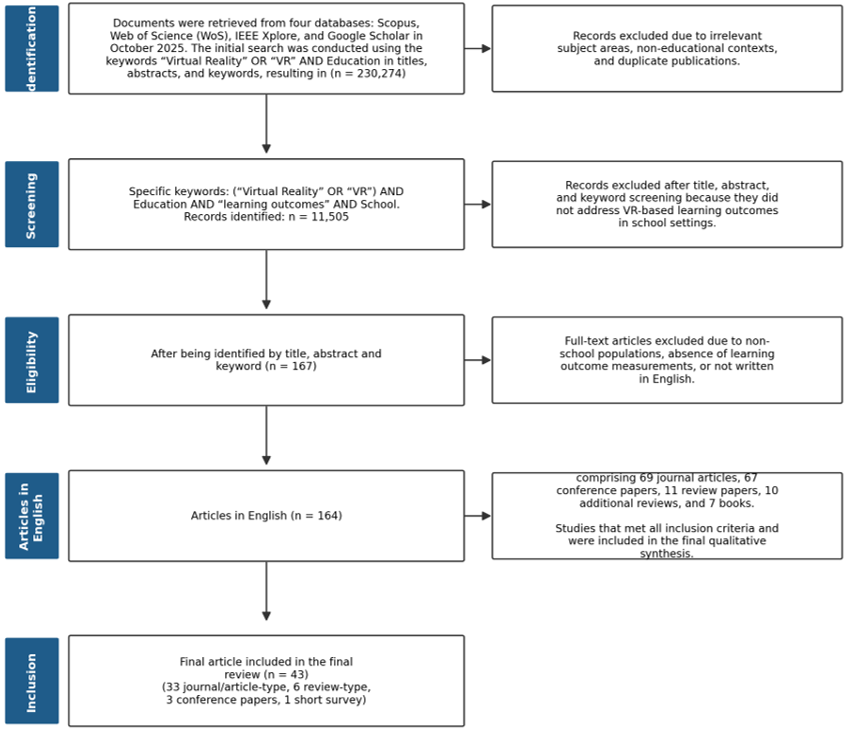
Document selection followed the five PRISMA stages (identification, screening, eligibility, inclusion, and synthesis), as illustrated in Figure 1. From the 11,505 screened records, title-, abstract-, and keyword-based identification reduced the set to 167 documents. Restricting the records to English-language publications yielded 164 documents, comprising 69 journal articles, 67 conference papers, 11 review papers, 10 additional reviews, and 7 books. Full-text records were subsequently assessed for eligibility, with studies excluded when they involved non-school populations, lacked measurable learning outcomes, or did not meet the language criterion. Applying the open-access criterion and the predefined inclusion rules resulted in a final corpus of 43 documents. Based on Scopus’ official Document Type classification, this corpus comprised 33 Article-type documents, 6 Review-type documents, 3 Conference Paper-type documents, and 1 Short Survey-type document. This classification supersedes the earlier categorization of seven review papers, which was found to be inconsistent with the Scopus extraction data. The final corpus spans research across education, computer science, social sciences, and multidisciplinary fields. To ensure consistency and transparency in reporting, Figure 1 and all downstream percentage calculations were updated to reflect the reconciled Scopus records and the confirmed corpus composition.
Figure 1. PRISMA flow diagram illustrating the study selection process
The assessments were conducted independently by two reviewers, with disagreements resolved through discussion until consensus was reached. Inter-rater agreement was assessed using Cohen’s κ, with the final coefficient reported accordingly. A standardized data-extraction form was used to systematically record the author, publication year, country, educational level, VR type, sample characteristics, learning-outcome domain, assessment method, and reported effects. The final corpus comprised 37 primary studies. Review-type documents were excluded from the analysis because they synthesize evidence from previously published primary studies and their inclusion alongside primary research could result in double-counting of evidence. Accordingly, all analyses were restricted to the primary-study corpus. All tables, figures, and associated percentages reported in Section 4 were recalculated based on the 37 primary studies using the complete study-level extraction data, including domain and outcome classifications. This approach ensures that the findings are derived exclusively from primary empirical evidence and provides a consistent basis for the subsequent analysis.
3.5 Quality appraisal and synthesis
The methodological quality of included studies was appraised using the Mixed Methods Appraisal Tool (MMAT), which accommodates quantitative, qualitative, and mixed-methods designs. Each study was assessed against criteria for clarity of research questions, appropriateness of design, adequacy of sampling and measurement, and coherence between data and interpretation; studies with serious methodological limitations were retained but interpreted with caution. The included corpus was then analyzed through thematic analysis to derive publication patterns, conceptualizations, research themes, and outcome domains, complemented by performance analysis, science mapping, and network analysis using VOSviewer.
4.1 Publication trends (RQ1)
The 43 eligible documents were published between 2014 and 2025 across social sciences, computer science, psychology, engineering, education, environmental science, and health sciences, reflecting the interdisciplinary nature of VR research. Three complementary analyses—performance analysis, science mapping, and network analysis—are reported below.
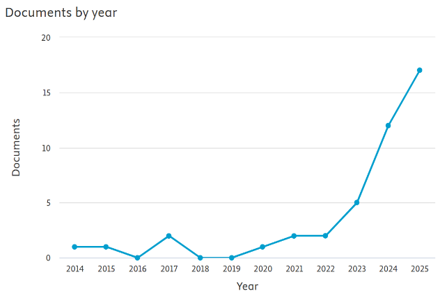
Figure 2 illustrates the annual publication output from 2014 to 2025. Publication activity remained limited and relatively stable during 2014–2020, with one to two documents published per year, followed by a modest increase in 2021–2022. The number of publications then increased to five in 2023 and rose substantially to 12 in 2024 and 17 in 2025. Across the study period, the annual distribution sums to 43 documents, consistent with the total corpus. Notably, 29 of the 43 studies (67.4%) were published during 2024–2025, indicating a pronounced recent acceleration in research activity. This pattern suggests growing scholarly interest in VR-based education and may reflect the field’s transition toward a more established and increasingly dynamic area of research, in parallel with broader developments in digital transformation and learning technologies [9].
Figure 2. Document productivity on Virtual Reality (VR) in education, 2014–2025
Figure 3. International collaboration network in Virtual Reality (VR) education research
Figure 3 visualizes the international collaboration network generated with VOSviewer. The United States occupies a central position, reflected in its larger node and strong links—particularly with Italy—indicating high productivity and intensive cooperation. Countries such as Indonesia, Australia, Mexico, and Germany appear in smaller, less connected clusters, suggesting that research remains concentrated in a limited number of countries and highlighting opportunities to broaden global participation, especially among under-represented regions central to equitable sustainable development.
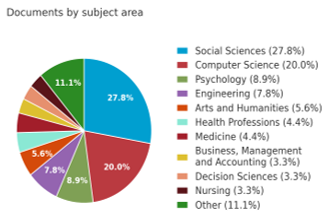
Figure 4 presents the distribution by subject area. Social Sciences account for the largest share (27.8%), indicating a predominantly pedagogical and policy-oriented framing, followed by Computer Science (20.0%), reflecting attention to system design and technological development. Psychology (8.9%) and Engineering (7.8%) contribute substantially, while Arts and Humanities (5.6%), Health Professions (4.4%), Medicine (4.4%), Business and Management (3.3%), Decision Sciences (3.3%), and Nursing (3.3%) represent smaller but meaningful shares; the “Other” category (11.1%) underscores the spread of VR across emerging fields.
Figure 4. Distribution of Virtual Reality (VR) in education research by subject area
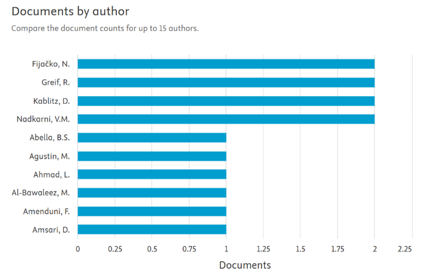
Figure 5. Most prolific authors in Virtual Reality (VR) in education research
Figure 5 shows the most prolific authors. Fijačko, N.; Greif, R.; Kablitz, D.; and Nadkarni, V.M. record the highest output, while a broader group—including Abella, B.S.; Agustin, M.; Ahmad, L.; Al-Bawaleez, M.; Amenduni, F.; and Amsari, D.—contribute consistently. Representative works from these core contributors [36-41] illustrate their sustained engagement with VR in education. The pattern reflects both a concentration of activity among a few productive authors and a diverse base of contributors.
4.2 Conceptualizations of Virtual Reality (RQ2)
Across the corpus, VR is conceptualized as an immersive technology that generates simulated environments, enabling learners to experience situations otherwise inaccessible in the real world [42]. Its immersive and interactive nature facilitates active learning and deeper comprehension [43], sustains engagement and motivation [44], and strengthens knowledge retention through multisensory experiences [45]. VR is further framed as a means of developing practical and technical skills through experiential simulation [46], enabling personalized and adaptive learning [47], and fostering inclusivity for learners with diverse abilities [48]. Additional defining features include enhanced visualization of abstract concepts [49], collaborative learning in shared virtual spaces [50], reduced performance anxiety in low-pressure settings [51], real-time feedback [52], and safe exploration of hazardous scenarios [53]. While initial setup costs are high, VR is increasingly conceptualized as economically sustainable over time [31], and ongoing advances in hardware, graphics, and haptics are expected to expand its applications further [52]. Table 3 summarizes the defining elements of VR in education.
Table 3. Defining elements of Virtual Reality (VR) in education
|
No. |
Defining Factor of Virtual Reality in Education |
Ref. |
|
1 |
VR is an immersive technology that creates simulated environments, allowing learners to experience scenarios otherwise inaccessible in the real world |
[42] |
|
2 |
VR facilitates interactive learning, enabling direct engagement with content and fostering active participation and deeper understanding |
[43] |
|
3 |
It enhances engagement through novel and stimulating experiences that capture learners' attention |
[44] |
|
4 |
VR improves knowledge retention via multisensory experiences that aid memory more effectively than traditional methods |
[45] |
|
5 |
It promotes practical and technical skills through experiential simulations of real-world activities |
[46] |
|
6 |
VR supports personalized learning by adapting pace and complexity to individual needs |
[47] |
|
7 |
It fosters inclusivity, making learning more accessible to students with diverse abilities and preferences |
[48] |
|
8 |
It enhances visualization, rendering abstract concepts as tangible three-dimensional experiences |
[49] |
|
9 |
VR encourages collaborative learning through shared virtual spaces |
[50] |
|
10 |
By providing controlled, low-pressure contexts, VR reduces performance and testing anxiety |
[51] |
|
11 |
VR enables safe exploration of dangerous or complex scenarios without real-world risk |
[53] |
|
12 |
Despite high initial costs, VR can be economically sustainable over time, supporting remote education |
[31] |
|
13 |
Continual advances in hardware, graphics, and haptic feedback expand VR's educational potential |
[52] |
4.3 Research themes (RQ3)
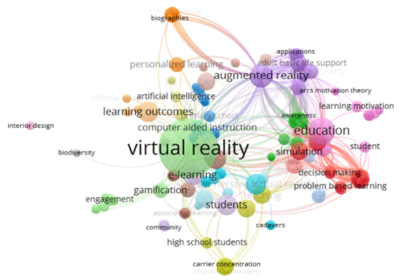
Figure 6 presents a keyword co-occurrence network generated with VOSviewer, mapping the main research themes linking VR to students' learning outcomes. Learning-related constructs—learning, immersive learning, teaching, students, and learning outcomes—form closely connected clusters, indicating strong conceptual integration between VR technology and educational effectiveness.
Figure 6. Keyword co-occurrence map of Virtual Reality (VR) research in educational contexts
Table 4. Most frequent keywords and their total link strength in Virtual Reality (VR)-based educational research
|
No. |
Keyword |
Total Link Strength |
|
1 |
Virtual Reality |
361 |
|
2 |
Education |
163 |
|
3 |
Augmented Reality |
118 |
|
4 |
Students |
109 |
|
5 |
Virtual Environment |
102 |
|
6 |
Learning |
101 |
|
7 |
Teaching |
96 |
|
8 |
Immersive Learning |
93 |
|
9 |
Learning Outcome |
93 |
|
10 |
Personnel Training |
77 |
Table 4 quantifies these patterns through total link strength. Virtual Reality is the most dominant keyword, followed by Education and Augmented Reality, reinforcing VR's central role in educational research. The substantial link strength of Learning Outcome (93) shows that outcome-oriented perspectives are a core focus rather than a peripheral concern, while Immersive Learning (93) highlights the emphasis on experiential, engagement-driven environments. Taken together, Figure 6 and Table 4 indicate that VR research in school settings is primarily oriented toward improving learning outcomes through immersive, pedagogically grounded experiences—treating VR not as a technological novelty but as an instructional medium strategically linked to learning effectiveness.
4.4 Effects on learning outcomes and research gaps (RQ4)
Table 5 summarizes the effects of VR on learning outcomes across the 37 primary studies, organized into five domains: cognitive, affective, skill-based, pedagogical, and behavioral-attitudinal. Because individual studies frequently report outcomes across multiple domains, these categories are not mutually exclusive.
Affective outcomes are the most consistently reported benefit (18 of 37 primary studies; 48.6%): VR enhances motivation, engagement, interest, satisfaction, and immersion across contexts [54]. Cognitive benefits are also substantial (24; 64.9%), with immersive environments supporting concrete, experiential processing of abstract content; however, several studies report mixed or non-significant cognitive effects when instructional design fails to manage task complexity or cognitive load. Skill-based outcomes (8; 21.6%) include spatial reasoning and applied competence, particularly in vocational and technical contexts [55], though this domain remains comparatively under-represented. Pedagogical outcomes (3; 8.1%) suggest VR can support instructional practice through scenario-based activities, but the evidence is limited and fragmented, concentrated in pre-service teacher training [56]. Behavioral and attitudinal outcomes (4; 10.8%) include more positive attitudes, greater participation, and learner autonomy.
Table 5. Effects of Virtual Reality (VR) on learning outcomes
|
Learning Outcome Domain |
Specific Effects |
No. of Studies |
|
Cognitive |
Improved conceptual understanding, knowledge acquisition, retention, and procedural knowledge |
24 (64.9%) |
|
Affective |
Increased motivation, engagement, interest, satisfaction, and immersion |
18 (48.6%) |
|
Skill-based |
Enhanced spatial ability, problem-solving, collaboration, and 21st-century skills |
8 (21.6%) |
|
Pedagogical |
Improved teaching competence, instructional confidence, and classroom readiness (mainly pre-service teachers) |
3 (8.1%) |
|
Behavioral & attitudinal |
Positive learning attitudes, increased participation, and self-directed learning |
4 (10.8%) |
|
Mixed/ inconclusive |
Mixed or non-significant effects, often linked to cognitive load or instructional-design issues |
Not determinable* |
Table 6. Research gaps identified in Virtual Reality (VR)-based learning studies
|
Research Gap |
Key Evidence |
Future Research Direction |
|
Limited educational levels |
Most studies focus on higher education [39, 57, 58] |
VR research in early-childhood and primary education |
|
Short-term interventions |
Predominantly short-term, experimental designs [59, 60] |
Longitudinal studies on sustained outcomes |
|
Focus on affective outcomes |
Motivation, engagement, and immersion dominate [57, 58] |
Higher-order cognition and learning-transfer studies |
|
Instructional-design issues |
Weak theoretical grounding and cognitive overload [36, 59] |
Theory-based VR instructional-design models |
|
Assessment methods |
Heavy reliance on self-report questionnaires [60] |
Objective, performance-based assessment |
|
Weak SDG alignment |
SDGs rarely used as an analytical or design framework [36, 59] |
VR studies explicitly supporting SDG 4 and equity |
Synthesizing findings across the 37 primary studies, six recurrent research gaps emerge (Table 6). VR research remains concentrated in higher education, with 10 of the 37 primary studies (27.0%) conducted at the higher-education level, while evidence from school-level and early-childhood contexts remains comparatively limited. Interventions are predominantly short-term, constraining conclusions regarding knowledge retention and transfer over time. Affective outcomes are more frequently examined than higher-order cognitive outcomes, while instructional designs are often insufficiently grounded in established learning theories and may be susceptible to cognitive overload. Assessment practices also rely heavily on self-reported measures rather than objective or performance-based indicators. Finally, cultural, contextual, and sustainability dimensions including explicit alignment with the SDGs remain underexplored, highlighting important opportunities for future research.
5.1 Comparison with prior reviews
As positioned in Table 1, the dominance of affective outcomes observed here is consistent with Marougkas et al. [12], who reported strong engagement and motivation effects across a decade of immersive VR research, and with Cabrera-Duffaut et al. [1], who emphasized competence development in higher education. However, the present review extends these findings by quantifying the relative weight of each outcome domain and by exposing the imbalance between affective gains (48.6%) and higher-order cognitive evidence. It also corroborates Vásquez-Carbonell and Torres [7], who found that many studies evaluate VR effectiveness with limited methodological rigor, and aligns with Lampropoulos [6] in noting the fragmentation of instructional approaches. Unlike these reviews, and unlike level-specific syntheses focused on higher education [61] or primary education [62], this study integrates publication, conceptual, thematic, and outcome analyses within a single synthesis and foregrounds sustainability alignment as an evaluative criterion.
5.2 Theoretical implications
The findings reinforce constructivist and experiential learning theory: VR's strongest and most consistent effects—engagement, motivation, and conceptual understanding—arise precisely where learners actively construct knowledge through immersive experience and reflection [8, 43]. Yet the prevalence of mixed cognitive effects under poor design conditions points to cognitive load theory as a necessary complement; immersive richness can overwhelm working memory when scaffolding is absent [37]. A theoretically robust VR pedagogy therefore requires integrating experiential design with deliberate cognitive-load management, an alignment that current studies achieve only inconsistently.
5.3 Implications for sustainable development planning
Read through the lens of SDG 4, the evidence indicates that VR can advance inclusive and equitable quality education by widening access to experiential learning and reducing reliance on costly physical infrastructure [10, 31]. The concentration of research in a few high-income countries, however, mirrors a broader equity gap: if immersive learning is to support sustainable development globally, investment and research capacity must extend to under-represented regions. For educational planners and policymakers, the practical implications are threefold: prioritize teacher professional development to ensure pedagogically sound integration; adopt low-cost, scalable VR solutions to mitigate digital inequality; and embed sustainability criteria—equity, accessibility, and long-term viability—into VR procurement and curriculum design. Framing VR investment within sustainable development planning thus shifts the question from whether VR engages learners to whether it does so equitably and durably.
5.4 Limitations
Several limitations should be acknowledged. First, although four databases were searched, the inclusion of only open-access, English-language publications may introduce language and access bias and exclude relevant grey literature. Second, the refined search strategy employed “School” as the primary population term rather than broader terms such as “University” or “Higher Education.” Although the search was designed to prioritize school-level education, 10 of the 37 primary studies (27.0%) were conducted in higher-education contexts. These studies were identified through the broader keyword combinations and database retrieval process rather than through a systematic search specifically targeting higher-education literature. Accordingly, the resulting corpus should be interpreted as predominantly school-oriented but not exclusively limited to school-level education, with a substantive higher-education component. This scope characteristic should be considered when interpreting the findings and their generalizability across educational levels. Readers should therefore not interpret this review as a comprehensive account of VR in higher education, and future reviews using an expanded string covering both school and higher-education terms are needed for that purpose. A supplementary Scopus search incorporating “university” and “higher education” indicated that broader population terms would likely retrieve additional relevant studies. Third, the corpus of 43 studies, while systematically derived, reflects a still-emerging field, and the predominance of recent publications limits longitudinal interpretation. Fourth, the synthesis is qualitative and thematic rather than meta-analytic, so effect magnitudes are not statistically pooled. Finally, heterogeneity in study designs and outcome measures constrains direct comparability. These limitations define the boundaries of the present conclusions and motivate the future directions outlined below.
This systematic review synthesized 37 primary studies (2014–2025) on VR-based learning, following PRISMA 2020 and drawing on four databases. Six review-type documents identified in the corpus were analyzed separately and excluded from this primary-research synthesis. The evidence shows that VR most consistently enhances affective outcomes-motivation, engagement, and immersion (48.6% of studies)-while also supporting cognitive (64.9%) and skill-based (21.6%) learning. Evidence on higher-order cognition and long-term retention, however, remains limited and inconclusive, frequently constrained by short interventions, weak theoretical grounding, and reliance on self-report assessment.
Theoretically, the review clarifies how immersive learning operationalizes constructivist and experiential principles while underscoring the need to manage cognitive load. Practically, it offers planners and educators a sustainability-oriented agenda: invest in teacher training, adopt scalable low-cost VR, and embed equity and durability into design. Its principal contribution is an integrative synthesis that, for the first time within this corpus, connects VR learning outcomes to the SDG 4 agenda.
Future research should prioritize: (1) longitudinal designs measuring retention and transfer; (2) studies in early-childhood and primary education; (3) higher-order cognitive and skill outcomes; (4) theory-driven instructional-design models that balance immersion with cognitive load; (5) objective, performance-based assessment; (6) culturally responsive VR for under-represented regions; and (7) explicit alignment of VR research with SDG 4 and broader sustainability targets. Pursuing these directions will help ensure that immersive learning technologies are pedagogically effective, equitable, and sustainable.
Conceptualization and methodology: A.F. and S.S.; literature search, screening, and data extraction: A.F. and H.; formal analysis and visualization: A.F. and S.; writing—original draft: A.F.; writing—review and editing, and supervision: S.S., H., S., and N.Y. All authors have read and approved the final manuscript.
This research was supported by BIMA, Ministry of Higher Education, Science, and Technology of the Republic of Indonesia, through the Doctoral Dissertation Research Scheme 2026 under Contract Number 267/C3/DT.05.00/PL-BARU/2026.
The data supporting the findings of this study—comprising the list of included studies and the extraction matrix—are available from the corresponding author upon reasonable request.
The authors thank BIMA for the financial support that enabled the completion of this research.
Appendix A. SDG 4 Target Alignment Coding
Table A1 presents the coding used to map each of the 37 primary studies to the most relevant SDG 4 targets, as described in Section 2.2.
Table A1. SDG 4 target alignment coding (n = 37 primary studies)
|
No. |
Reference |
Level |
SDG 4 Target(s) |
Alignment |
Equity/Access Basis |
|
1 |
Kablitz, D. |
Vocational (VET) |
4.3, 4.4 |
Indirect |
Vocational-level access/skills (level-based) |
|
2 |
Baldassa, A. |
Primary (aged 9–11) |
4.1 |
Indirect |
Primary-level access (level-based) |
|
3 |
Keller, C. |
Vocational (VET) |
4.3, 4.4 |
Indirect |
Vocational-level access/skills (level-based) |
|
4 |
Mulders, M. |
Lower secondary |
4.1, 4.7 |
Direct (4.7) |
Explicit biodiversity/sustainability content |
|
5 |
Somadayo, S. |
Primary |
4.1 |
Indirect |
Primary-level access (level-based) |
|
6 |
Wu, S.-H. (2025) |
Primary |
4.1 |
Indirect |
Primary-level access (level-based) |
|
7 |
Fijacko, N. (2025) - BLS |
Adults (BLS) |
4.4 |
Indirect |
Adult skills training (level-based) |
|
10 |
Spangenberger, P. (2025) |
Vocational (VET) |
4.3, 4.4 |
Indirect |
Vocational-level access/skills (level-based) |
|
11 |
McGivney, E. (2025) |
Upper secondary |
4.1 |
Indirect |
Secondary-level access (level-based) |
|
12 |
Shabir, A. (2025) |
Primary (Grade 5) |
4.1 |
Indirect |
Primary-level access (level-based) |
|
13 |
Hermansyah, N. |
Vocational (Grade 11) |
4.3, 4.4 |
Indirect |
Vocational-level access/skills (level-based) |
|
14 |
Al-Bawaleez, M. (2025) |
K-12 (gifted) |
4.5 |
Indirect |
Gifted-education inclusion (equity-based) |
|
15 |
Žnideršič, K. (2025) |
Upper secondary |
4.1 |
Indirect |
Secondary-level access (level-based) |
|
16 |
Scippo, S. (2025)* |
Primary (Grade 4) |
4.1 |
Indirect |
Primary-level access (level-based); *limited immersive-VR alignment (see Appendix B) |
|
17 |
Huang, X. (2025) |
Mixed |
4.1 (partial) |
Indirect |
Mixed student/public audience (level-based, partial) |
|
18 |
Lai, C.-J. (2024) |
Primary (Grade 4) |
4.1 |
Indirect |
Primary-level access (level-based) |
|
19 |
Tarng, W. (2024) |
Upper secondary/University |
4.1, 4.3 |
Indirect |
Secondary+tertiary access (level-based) |
|
20 |
Arifin, A. |
Vocational (VET) |
4.3, 4.4 |
Indirect |
Vocational-level access/skills (level-based) |
|
21 |
Topalska, R. (2024) |
Preschool & primary (teachers) |
4.c |
Indirect |
Teacher-training focus, not direct student outcome |
|
23 |
Daghriri, I. (2024) |
Primary |
4.1 |
Indirect |
Primary-level access (level-based) |
|
24 |
Sulisworo, D. (2024) |
Primary (Grades 4–5) |
4.1 |
Indirect |
Primary-level access (level-based) |
|
25 |
Christopoulos, A. (2024) |
Lower secondary |
4.1 |
Indirect |
Secondary-level access (level-based) |
|
26 |
Neuwirth, L.S. (2024) |
Medical students (HE) |
4.3 |
Indirect |
Tertiary/medical education access (level-based) |
|
28 |
Lin, X.P. |
Lower secondary |
4.1 |
Indirect |
Secondary-level access (level-based) |
|
29 |
Corrales, M. (2024) |
Pre-service primary teachers (HE) |
4.c |
Indirect |
Teacher-training focus, not direct student outcome |
|
30 |
Cárdenas-Sainz, B.A. (2023) |
University students (HE) |
4.3 |
Indirect |
Tertiary access (level-based) |
|
31 |
Kablitz, D. |
Vocational (VET) |
4.3, 4.4 |
Indirect |
Vocational-level access/skills (level-based) |
|
33 |
Goudarzi, N. (2023) |
Postgraduate students (HE) |
4.3 |
Indirect |
Tertiary access (level-based) |
|
34 |
Henriksen, A.H. (2023) |
Preschool (aged 6–7) |
4.1 |
Indirect |
Early-childhood/primary access (level-based) |
|
35 |
Cullinane, A. (2022)* |
Doctoral students (HE) |
4.3 |
Indirect |
Tertiary access (level-based); *limited immersive-VR alignment (see Appendix B) |
|
36 |
Globa, A. (2022) |
Higher education (HE) |
4.3 |
Indirect |
Tertiary access (level-based) |
|
37 |
Hsiao, P.-W. (2021) |
School (general) |
4.1 |
Indirect |
School-level access (level-based) |
|
38 |
Espitia, N.F. (2021) |
Veterinary students (HE) |
4.3 |
Indirect |
Tertiary/veterinary education access (level-based) |
|
39 |
Ahmad, L. (2020)* |
Interior design students (HE) |
4.3 |
Indirect |
Tertiary access (level-based); *limited immersive-VR alignment (see Appendix B) |
|
40 |
Baud-Bovy, G. (2017) |
Primary |
4.1 |
Indirect |
Primary-level access (level-based) |
|
41 |
Birt, J. (2017) |
Distance-learning paramedic students (HE) |
4.3, 4.4 |
Indirect |
Tertiary/distance-education access + skills (level-based) |
|
42 |
Badilla, M.G. (2015) |
Pre-service teachers (HE) |
4.c |
Indirect |
Teacher-training focus, not direct student outcome |
Appendix B. List of Officially Included Studies
Table B1 presents the 43 documents comprising the final corpus identified through the Scopus bibliographic export and cross-checked against the study-level data extraction records. Document types are reported according to Scopus’s official classification, including Article, Review, Conference Paper, and Short Survey. Of these 43 documents, 37 primary studies constitute the analytical corpus, whereas six review-type documents were excluded from the substantive analyses to avoid potential double-counting of evidence.
Studies marked with an asterisk (*) in the Cognitive & Affective column were identified during the data-extraction process as potentially having limited alignment with the review’s operational definition of immersive VR. In these cases, VR was either discussed as a potential direction for future research or represented through non-immersive online media rather than as an implemented immersive VR intervention. These studies were nevertheless retained because they report learning outcomes relevant to virtual learning environments; their limited alignment with immersive VR is taken into account when interpreting the findings.
Table B1. List of officially included studies (n = 43)
|
No. |
Reference (Author, Year) |
Doc. Type |
Country |
Level |
VR Type |
Sample |
Cognitive & Affective |
|
1 |
Kablitz, D. (2025) |
Article |
Germany |
Vocational (VET) |
IVR (HMD) |
141 |
Cognitive & affective |
|
2 |
Baldassa, A. (2025) |
Article |
Italy |
Primary (aged 9–11) |
VR full-immersive (HMD) |
74 |
Psychomotor/behavioral |
|
3 |
Keller, C. (2025) |
Article |
Switzerland |
Vocational (VET) |
VR HMD vs desktop |
81 |
Cognitive |
|
4 |
Mulders, M. (2025) |
Article |
Germany |
Lower secondary |
XR/VR application |
172 |
Cognitive & affective |
|
5 |
Somadayo, S. (2025) |
Article |
Indonesia |
Primary |
VR (online) |
Not reported |
Cognitive (literacy) |
|
6 |
Wu, S.-H. (2025) |
Article |
Taiwan/Hong Kong |
Primary |
Spherical Video-based VR |
841 students; 33 teachers |
Affective/behavioral |
|
7 |
Fijacko, N. (2025) |
Article |
Multinational |
Adults (BLS) |
VR & AR (recommendations) |
N/A (review) |
Cognitive/behavioral |
|
8 |
Fijacko, N. (2025) |
Review |
Multinational |
Laypeople & health workers |
VR & AR (scoping review) |
N/A (review) |
Affective, behavioral, cognitive |
|
9 |
Agustin, M. (2025) |
Review |
Indonesia/Brunei |
Biology (general) |
Immersive VR & virtual labs |
N/A (review) |
Cognitive, affective, psychomotor |
|
10 |
Spangenberger, P. (2025) |
Article |
Germany |
Vocational (VET) |
iVR (HMD) |
29 |
Cognitive |
|
11 |
McGivney, E. (2025) |
Article |
USA |
Upper secondary |
VR (immersive video) |
30 |
Affective (agency) |
|
12 |
Shabir, A. (2025) |
Article |
Indonesia |
Primary (Grade 5) |
VR + AI |
Not reported |
Cognitive |
|
13 |
Hermansyah, N. (2025) |
Article |
Indonesia |
Vocational (Grade 11) |
AR mobile |
420 |
Cognitive & psychomotor |
|
14 |
Al-Bawaleez, M. (2025) |
Article |
Jordan |
K-12 (gifted) |
VR/AR (qualitative) |
6 teachers |
Teacher perceptions |
|
15 |
Žnideršič, K. (2025) |
Conference paper |
Slovenia |
Upper secondary |
VR game |
Not reported |
Cognitive & affective |
|
16 |
Scippo, S. (2025) |
Article |
Italy |
Primary (Grade 4) |
Non-VR (3D printer/GeoGebra)* |
Not reported |
Cognitive* |
|
17 |
Huang, X. (2025) |
Article |
China |
Mixed |
AR/MR/PC-IVM |
42 |
Affective |
|
18 |
Lai, C.-J. (2024) |
Article |
Taiwan |
Primary (Grade 4) |
VR game |
81 (EG40/CG41) |
Cognitive & communication |
|
19 |
Tarng, W. (2024) |
Article |
Taiwan |
Upper secondary/University |
VR (immersive modules) |
Not reported |
Cognitive & affective |
|
20 |
Arifin, A. (2024) |
Article |
Malaysia |
Vocational (VET) |
VR welding kit |
N/A (review) |
Psychomotor |
|
21 |
Topalska, R. (2024) |
Article |
Bulgaria |
Preschool & primary |
VR & AR (teacher survey) |
205 teachers |
Teacher literacy |
|
22 |
van der Want, A.C. (2024) |
Review |
Netherlands |
Pre-service teachers (HE) |
VR (various) |
N/A (review of 24 studies) |
Affective & teaching skills |
|
23 |
Daghriri, I. (2024) |
Conference paper |
Australia/Saudi Arabia |
Primary |
VR/AR |
N/A (review) |
Cognitive & affective |
|
24 |
Sulisworo, D. (2024) |
Article |
Indonesia |
Primary (Grades 4–5) |
Immersive VR |
85 |
Cognitive & affective |
|
25 |
Christopoulos, A. (2024) |
Article |
Greece |
Lower secondary |
VR 360 |
52 |
Cognitive & affective |
|
26 |
Neuwirth, L.S. (2024) |
Article |
USA/France |
Medical students (HE) |
Immersive VR (POV) |
Pilot (small N) |
Psychomotor |
|
27 |
Erita, Y. (2024) |
Review |
Indonesia/Malaysia |
Primary |
VR (review) |
N/A (review) |
Cognitive, affective, creativity |
|
28 |
Lin, X.P. (2024) |
Short survey |
Thailand/others |
Lower secondary |
VR (critical review) |
N/A (review) |
Affective & behavioral |
|
29 |
Corrales, M. (2024) |
Article |
Spain |
Pre-service primary teachers (HE) |
VR virtual tour |
51 |
Affective & cognitive |
|
30 |
Cárdenas-Sainz, B.A. (2023) |
Article |
Mexico |
University students (HE) |
XR (VR & AR) |
99 |
Affective & cognitive |
|
31 |
Kablitz, D. (2023) |
Article |
Germany |
Vocational (VET) |
IVR |
79 |
Cognitive & wellbeing |
|
32 |
Carlos, C.A. (2023) |
Review |
Mexico |
Primary |
VR (tethered & mobile) |
N/A (meta-analysis) |
Cognitive |
|
33 |
Goudarzi, N. (2023) |
Article |
USA |
Postgraduate students (HE) |
VR (3D modeling) |
Not reported |
Cognitive |
|
34 |
Henriksen, A.H. (2023) |
Article |
Denmark |
Preschool (aged 6–7) |
VR headset |
RCT protocol |
Cognitive & attention |
|
35 |
Cullinane, A. (2022) |
Article |
UK |
Doctoral students (HE) |
Non-VR (online)* |
Not reported |
Affective* |
|
36 |
Globa, A. (2022) |
Article |
Australia |
Higher education |
VR (hybrid) |
Not reported |
Affective |
|
37 |
Hsiao, P.-W. (2021) |
Article |
Taiwan/Macau |
School (general) |
VR (STEAM) |
Not reported |
Affective & cognitive |
|
38 |
Espitia, N.F. (2021) |
Article |
USA |
Veterinary students (HE) |
VR multi-user |
Not reported |
Cognitive & psychomotor |
|
39 |
Ahmad, L. (2020) |
Article |
UAE |
Interior design students (HE) |
Non-VR (online exhibition)* |
Not reported |
Cognitive* |
|
40 |
Baud-Bovy, G. (2017) |
Conference paper |
Italy |
Primary |
Haptic/force-feedback |
N/A (review) |
Cognitive/psychomotor |
|
41 |
Birt, J. (2017) |
Article |
Australia |
Distance-learning paramedic students (HE) |
Mixed reality mobile |
Not reported |
Psychomotor |
|
42 |
Badilla, M.G. (2015) |
Article |
Chile |
Pre-service teachers (HE) |
Immersive Virtual World |
Not reported |
Affective/teaching skills |
|
43 |
Ricciardi, F. (2014) |
Review |
Italy |
Health professions (HE) |
VR/Serious games |
N/A (review) |
Cognitive & skills |
[1] Cabrera-Duffaut, A., Pinto-Llorente, A.M., Iglesias-Rodríguez, A. (2024). Immersive learning platforms: Analyzing virtual reality contribution to competence development in higher education—A systematic literature review. Frontiers in Education, 9: 1391560. https://doi.org/10.3389/feduc.2024.1391560
[2] Darvishinia, N., Rios, A., Clark, J.S. (2025). Innovative pathways in STEM: Virtual reality for empowering English language learners. Journal of Interactive Learning Research, 36(3): 269-292. https://doi.org/10.70725/141357ylqajb
[3] Albadawi, B.I. (2023). Virtual reality in process for children with autism disability. In Comparative Research on Diversity in Virtual Learning: Eastern vs. Western Perspectives, pp. 88-104. IGI Global Scientific Publishing. https://doi.org/10.4018/978-1-6684-3595-3.ch005
[4] Hasani, M.F., Ario, M.K., Balqis, K., Carment, M., Christian, L. (2025). Virtual reality for farming education and simulation: Analyzing approaches and challenges using PRISMA framework. In 2025 International Seminar on Intelligent Technology and Its Applications (ISITIA), Surabaya, Indonesia, pp. 531-536. https://doi.org/10.1109/ISITIA66279.2025.11137432
[5] Ndjama, J.D.J.D.N., Van Der Westhuizen, J. (2025). A systematic review of the challenges and limitations of VR in education. In Creating Immersive Learning Experiences Through Virtual Reality (VR), pp. 1-32. IGI Global Scientific Publishing. https://doi.org/10.4018/979-8-3693-6407-9.ch001
[6] Lampropoulos, G. (2025). Augmented reality, virtual reality, and intelligent tutoring systems in education and training: A systematic literature review. Applied Sciences, 15(6): 3223. https://doi.org/10.3390/app15063223
[7] Vásquez-Carbonell, M., Torres, J.C. (2025). How are researchers evaluating the effectiveness of educational VR applications and what outcomes are they obtaining? A systematic literature review. Computer Animation and Virtual Worlds, 36(1): e70012. https://doi.org/10.1002/cav.70012
[8] Mallek, F., Mazhar, T., Shah, S.F.A., Ghadi, Y.Y., Hamam, H. (2024). A review on cultivating effective learning: Synthesizing educational theories and virtual reality for enhanced educational experiences. PeerJ Computer Science, 10: e2000. https://doi.org/10.7717/PEERJ-CS.2000
[9] Wang, D., Huang, X. (2025). Transforming education through artificial intelligence and immersive technologies: Enhancing learning experiences. Interactive Learning Environments, 33(7): 4546-4565. https://doi.org/10.1080/10494820.2025.2465451
[10] Arroyo-Paz, A., Mendoza-Montoya, J., Vilca, A.M.V., Condori, E.R.C. (2023). Digital transformation in education sector using virtual reality with cardboard: A systematic review. In CISETC 2023: International Congress on Education and Technology in Sciences 2023, Zacatecas, Mexico, pp. 130-145. https://ceur-ws.org/Vol-3691/paper10.pdf.
[11] Ghanbaripour, A.N., Talebian, N., Miller, D., et al. (2024). A systematic review of the impact of emerging technologies on student learning, engagement, and employability in built environment education. Buildings, 14(9): 2769. https://doi.org/10.3390/buildings14092769
[12] Marougkas, A., Troussas, C., Krouska, A., Sgouropoulou, C. (2024). How personalized and effective is immersive virtual reality in education? A systematic literature review for the last decade. Multimedia Tools and Applications, 83: 18185-18233. https://doi.org/10.1007/s11042-023-15986-7
[13] Leong, W.K. (2020). Virtual reality empowers new learning exploration. In Preparing 21st Century Teachers for Teach Less, Learn More (TLLM) Pedagogies, IGI Global Scientific Publishing, pp. 243-258. https://doi.org/10.4018/978-1-7998-1435-1.ch014
[14] Leong, W.Y., Leong, Y.Z., Leong, W.S. (2024). Virtual reality on creative learning. In 2024 22nd International Conference on ICT and Knowledge Engineering (ICT&KE), Bangkok, Thailand, pp. 1-4. https://doi.org/10.1109/ICTKE62841.2024.10787163
[15] Germeni, S.A.L., Hameed, S.S. (2025). Virtual reality in education: Enhancing student engagement and learning. In TechTrends: Navigating the Frontier of Emerging Technologies, pp. 139-153. Bentham Science Publishers. https://doi.org/10.2174/9798898811327125010012
[16] Grigore, P.I., Turcu, C.O. (2024). Impact of virtual reality on pre-university students. Romanian Journal of Information Technology and Automatic Control, 34(4): 99-113. https://doi.org/10.33436/v34i4y202408
[17] Kereibayeva, A., Sharshova, R., Dyussenova, D., Aliyeva, D., Toktarova, T. (2025). The effectiveness of VR glasses as a tool for immersive language education: Insights from questionnaires and interviews. Procedia Computer Science, 272: 528-533. https://doi.org/10.1016/j.procs.2025.10.242
[18] Zhang, X.B. (2020). The construction of realistic environment of deep learning based on virtual reality. In 2020 International Conference on Computers, Information Processing and Advanced Education (CIPAE), Ottawa, ON, Canada, pp. 186-190. https://doi.org/10.1109/CIPAE51077.2020.00056
[19] Shah, T., Riener, A. (2025). The potential of virtual reality for immersive HCI education: Insights from an empirical study. In Communications in Computer and Information Science, pp. 375-385. Springer Nature Switzerland. https://doi.org/10.1007/978-3-031-80475-5_27
[20] Peng, M., Guo, X.W. (2025). A study of the emotional and motivational impact of virtual reality technology in educational personalization. In Proceedings of the 2025 International Conference on Educational Technology and Artificial Intelligence, Wuhan, China, pp. 12-17. https://doi.org/10.1145/3766557.3766560
[21] Varpe, D., Kulkarni, K., Deshpande, V., Deshpande, V., Habbu, V. (2025). Learning beyond limits: Exploring augmented reality and virtual reality in education and training. In Smart Trends in Computing and Communication, pp. 323-333. Springer, Singapore. https://doi.org/10.1007/978-981-96-7520-3_27
[22] Asari, M.K.S., Suaib, N.M., Baharuddin, M.N.M., Razak, M.H.A. (2025). Virtual reality as a tool for mechanical workshop training in TVET institutions. In 2025 IEEE International Symposium on Consumer Technology (ISCT), Denpasar, Bali, Indonesia, pp. 246-252. https://doi.org/10.1109/ISCT66099.2025.11297400
[23] Fakhoury, E., Elkhoury, M., Rahme, P., Tarhini, A.A., Nasr, G.E. (2025). Integrating immersive virtual reality for enhanced learning in engineering: A case study in higher education in Lebanon. In 2025 ASEE Annual Conference & Exposition, Montreal, Quebec, Canada, p. 16. https://doi.org/10.18260/1-2--56835
[24] Villegas-Ch, W., Govea, J., Naranjo Godoy, L., Mera-Navarrete, A. (2024). Virtual reality simulations for skills training: Improving learning through immersive experiences in educational environments. IEEE Access, 12: 130073-130090. https://doi.org/10.1109/ACCESS.2024.3456628
[25] Tataru, M., Berzescu, S., Vert, S., Mihaescu, V., Stamatoiu, R., Vasiu, R. (2022). Designing applications for collaborative learning in virtual reality. In 2022 International Symposium on Electronics and Telecommunications (ISETC), Timisoara, Romania, pp. 1-4. https://doi.org/10.1109/ISETC56213.2022.10010175
[26] Mathebula, W., Moletsane, R. (2026). The adoption of virtual reality in higher education institutions. In Smart Innovation, Systems and Technologies, pp. 1-8. Springer Singapore. https://doi.org/10.1007/978-981-95-1361-1_1
[27] Xi, W. (2024). Virtual reality integration in teaching practices for enhanced learning experiences. In 2024 IEEE 4th International Conference on Electronic Communications, Internet of Things and Big Data (ICEIB), Taipei, Taiwan, pp. 650-653. https://doi.org/10.1109/ICEIB61477.2024.10602565
[28] Yadav, S. (2025). Transformative learning with advanced technologies: Harnessing VR and AR for immersive educational experiences. In Revolutionizing Pedagogy Through Smart Education, pp. 139-155. IGI Global Scientific Publishing. https://doi.org/10.4018/979-8-3693-7793-2.ch008
[29] United Nations. (2015). Transforming our world: The 2030 agenda for sustainable development. https://sdgs.un.org/2030agenda.
[30] UNESCO. (2017). Education for Sustainable Development Goals: Learning objectives. Paris, France: UNESCO. https://www.unesco.org/en/articles/education-sustainable-development-goals-learning-objectives.
[31] Toman, M., Hubálovská, M. (2024). Review study “virtual reality in biology education”. In Communications in Computer and Information Science, pp. 235-245. Springer, Singapore. https://doi.org/10.1007/978-981-96-0205-6_18
[32] Page, M.J., McKenzie, J.E., Bossuyt, P.M., et al. (2021). The PRISMA 2020 statement: An updated guideline for reporting systematic reviews. Journal of Clinical Epidemiology, 134: 178-189. https://doi.org/10.1016/j.jclinepi.2021.03.001
[33] Page, M.J., Moher, D., Bossuyt, P.M., et al. (2021). PRISMA 2020 explanation and elaboration: Updated guidance and exemplars for reporting systematic reviews. The BMJ, 372: n160. https://doi.org/10.1136/bmj.n160
[34] Crocker, T.F., Todd, O., Clegg, A. (2025). Around the EQUATOR with Clin-STAR: Systematic reviews of intervention effectiveness. Journal of the American Geriatrics Society, 73(8): 2356-2365. https://doi.org/10.1111/jgs.19498
[35] Veroniki, A.A., Tricco, A.C., Rangira, D., et al. (2025). Updating the PRISMA reporting guideline for network meta-analysis: A scoping review. Journal of Clinical Epidemiology, 188: 111985. https://doi.org/10.1016/j.jclinepi.2025.111985
[36] Kablitz, D., Conrad, M., Schumann, S. (2023). Immersive VR-based instruction in vocational schools: Effects on domain-specific knowledge and wellbeing of retail trainees. Empirical Research in Vocational Education and Training, 15: 9. https://doi.org/10.1186/s40461-023-00148-8
[37] Fijačko, N., Metličar, Š., Janžekovič, B., et al. (2025). Extended reality technologies in adult basic life support education: A scoping review. Resuscitation Plus, 23: 100927. https://doi.org/10.1016/j.resplu.2025.100927
[38] Fijačko, N., Ríos, M.P., Semeraro, F., Nadkarni, V.M., Greif, R. (2025). Resuscitation education science meets virtual and augmented reality: Evolution from potential concept to recommendations. Resuscitation Plus, 23: 100950. https://doi.org/10.1016/j.resplu.2025.100950
[39] Kablitz, D. (2025). Bridging theory and practice with immersive virtual reality: A study on transfer facilitation in VET. Education Sciences, 15(8): 959. https://doi.org/10.3390/educsci15080959
[40] Agustin, M., Zubaidah, S., Susanto, H., Habiddin, H., Bilad, M.R. (2025). Challenges in designing and developing a virtual biology laboratory: A systematic literature review. Multidisciplinary Reviews, 8(4): 2025116. https://doi.org/10.31893/multirev.2025116
[41] Hermansyah, N., Amsari, D., Ilahi Manvi, K., et al. (2025). Enhancing hospitality competencies: The role of mobile augmented reality in Indonesian vocational schools. Salud, Ciencia y Tecnologia, 5: 2271. https://doi.org/10.56294/saludcyt20252271
[42] Al Farsi, G., Yusof, A.B.M., Romli, A., et al. (2021). A review of virtual reality applications in an educational domain. International Journal of Interactive Mobile Technologies, 15(22): 99-110. https://doi.org/10.3991/IJIM.V15I22.25003
[43] Huang, H.M., Liaw, S.S. (2018). An analysis of learners' intentions toward virtual reality learning based on constructivist and technology acceptance approaches. International Review of Research in Open and Distributed Learning, 19(1): 91-115. https://doi.org/10.19173/irrodl.v19i1.2503
[44] Lopez-Ozieblo, R., Wong, W.C.G., Shen, J.D. (2025). Enhancing VR education: A TAM-based study on predicting student engagement and intent to use virtual reality. In Lecture Notes in Educational Technology, pp. 3-17. Springer, Singapore. https://doi.org/10.1007/978-981-96-4952-5_1
[45] Paul, S., Ghosh, S., Roy, B., Sarkar, S.K. (2025). Evaluating the long-term impact of VR in education. In Creating Immersive Learning Experiences Through Virtual Reality (VR), pp. 157-176. IGI Global Scientific Publishing. https://doi.org/10.4018/979-8-3693-6407-9.ch008
[46] Chen, Z., Zhang, L.Q. (2023). Prediction of learning effectiveness assessment and experience evaluation of panoramic VR video in hands-on education. In 2023 4th International Conference on Information Science and Education (ICISE-IE), Zhanjiang, China, pp. 234-243. https://doi.org/10.1109/ICISE-IE60962.2023.10456483
[47] Fussell, S.G., Truong, D. (2022). Using virtual reality for dynamic learning: An extended technology acceptance model. Virtual Reality, 26: 249-267. https://doi.org/10.1007/s10055-021-00554-x
[48] Marini, M.R., Mecca, A., Foresti, G.L., Cinque, L. (2024). A natural interaction system for medical training through VR technology. In 2024 IEEE 37th International Symposium on Computer-Based Medical Systems (CBMS), Guadalajara, Mexico, pp. 237-242. https://doi.org/10.1109/CBMS61543.2024.00047
[49] Bakas, C., Vosniakos, F. (2008). Building virtual environments for environmental education. Journal of Environmental Protection and Ecology, 9(4): 946-952.
[50] Slavova, Y., Mu, M. (2018). A comparative study of the learning outcomes and experience of VR in education. In 2018 IEEE Conference on Virtual Reality and 3D User Interfaces (VR), Tuebingen/Reutlingen, Germany, pp. 685-686. https://doi.org/10.1109/VR.2018.8446486
[51] Stojšić, I., Ivkov-Džigurski, A., Maričić, O. (2018). Virtual reality as a learning tool: How and where to start with immersive teaching. In Didactics of Smart Pedagogy, pp. 353-369. Springer, Cham. https://doi.org/10.1007/978-3-030-01551-0_18
[52] Wen, F., Wang, H.L. (2022). The influence of parameter differences of virtual reality device on student experience. In Proceedings of the 2022 6th International Conference on E-Education, E-Business and E-Technology, Beijing, China, pp. 1-8. https://doi.org/10.1145/3549843.3549844
[53] Al-Oudat, M., Altamimi, A.M. (2022). Factors influencing behavior intentions to use virtual reality in education. International Journal of Data and Network Science, 6: 733-742. https://doi.org/10.5267/j.ijdns.2022.3.008
[54] Lin, X.P., Li, B.B., Yao, Z.N., Yang, Z., Zhang, M.S. (2024). The impact of virtual reality on student engagement in the classroom–A critical review of the literature. Frontiers in Psychology, 15: 1360574. https://doi.org/10.3389/fpsyg.2024.1360574
[55] Arifin, A., Seth, N.H.N., Zainuddin, N.M.M., Norehan Haron, H. (2024). Learning outcomes of psychomotor domains in welding technology: VR welding kit assessment: A systematic literature review. Journal of Education Culture and Society, 15(2): 599-616. https://doi.org/10.15503/jecs2024.2.599.616
[56] Badilla Quintana, M.G., Meza Fernández, S. (2015). A pedagogical model to develop teaching skills: The collaborative learning experience in the immersive virtual world TYMMI. Computers in Human Behavior, 51: 594-603. https://doi.org/10.1016/j.chb.2015.03.016
[57] Keller, C., Walker, G., Amenduni, F., Tela, A., Cattaneo, A. (2025). Find the apartment's flaws! The impact of virtual reality on vocational students' performance in general education classes and the roles of flow experience, motivation, and sense of presence. Education and Information Technologies, 30: 12709-12734. https://doi.org/10.1007/s10639-025-13320-2
[58] Mulders, M., Träg, K.H., Kirner, L. (2025). Go green: Evaluating an XR application on biodiversity in German secondary school classrooms. Instructional Science, 53: 429-455. https://doi.org/10.1007/s11251-024-09697-1
[59] Baldassa, A., Orsini, F., Gastaldi, M., Rossi, R. (2025). Teaching children to cross safely: A full-immersive virtual reality training method for young pedestrians. Safety Science, 187: 106855. https://doi.org/10.1016/j.ssci.2025.106855
[60] Somadayo, S., Jamil, M. (2025). Evaluation of online learning system based on virtual reality technology for developing reading literacy in elementary schools. Mathematical Modelling of Engineering Problems, 12(5): 1731-1740. https://doi.org/10.18280/mmep.120528
[61] Lin, A., Mawela, T. (2023). Virtual reality, augmented reality and mixed reality for teaching and learning in higher education. In Innovations in Bio-Inspired Computing and Applications, pp. 669-679. Springer, Cham. https://doi.org/10.1007/978-3-031-27499-2_62
[62] Cheng, L., Hidayat, R., Mahat, J. (2025). Immersive and interactive learning: A systematic review of virtual reality in primary education. International Journal of Interactive Mobile Technologies, 19(16): 163-188. https://doi.org/10.3991/ijim.v19i16.54901