
Thi Thanh Thao Nguyen | Hai Dang Nguyen* | Quang Anh Trinh | Khanh Ly Nguyen | Hoang Kim Le | Xuan Hung Nguyen
© 2026 The authors. This article is published by IIETA and is licensed under the CC BY 4.0 license (http://creativecommons.org/licenses/by/4.0/).
OPEN ACCESS
The purpose of this study is to explore the factors within the green marketing mix that influence the consumption intention of green agricultural products among citizens residing in Northern Vietnam. The research employs a quantitative approach based on 424 valid survey responses collected from Northern Vietnam. The findings indicate that green product, green place, and green promotion positively and significantly influence consumers’ attitude toward green agricultural products, with green product emerging as the strongest predictor. In contrast, green price was found to have no significant effect on attitude. Furthermore, both attitude and subjective norms significantly enhance purchase intention, with attitude exerting a slightly stronger influence. The results also reveal that green perceived risk does not significantly affect green purchase intention. Additionally, AT was found to exert a significant positive influence on both SN and GPR. Based on the findings, this study proposes several practical recommendations for regulatory bodies and businesses, including prioritizing product quality and certification standards, strengthening transparent communication to leverage social norms, and optimizing distribution networks to improve accessibility to green agricultural products, thereby contributing to a sustainable lifestyle in Northern Vietnam.
attitude toward green agricultural products, green marketing mix, green perceived risk, green purchase intention, subjective norms
Green agricultural consumption has become increasingly important in Vietnam as the country simultaneously pursues sustainable agricultural development and faces growing consumer concerns about food safety and environmental impacts. The National Green Growth Strategy for 2021-2030 identifies the development of modern, clean, organic, and sustainable agriculture as a national priority and also promotes more sustainable patterns of production and consumption [1]. At the consumer level, PwC Vietnam [2] found that 74% of Vietnamese consumers were highly concerned about ultra-processed foods and pesticides, 54% would choose pesticide-free products when considering sustainable food options, and 69% were willing to pay more for food that supports environmental outcomes. At the same time, 47% identified price as a primary factor in food purchasing decisions, indicating that sustainability preferences continue to coexist with economic considerations. These developments make green agricultural products an increasingly relevant consumption category in Northern Vietnam and highlight the need to understand what ultimately drives consumers’ purchase intention (PI).
Despite growing consumer interest, the adoption of green agricultural products in Vietnam remains constrained by several market-related barriers and perceived uncertainties. Previous studies have identified high prices and limited trust in organic labels as key barriers to organic food purchase in Vietnam [3]. Product availability has also been highlighted as an important concern, with Vietnamese consumers placing considerable value on access to organic food through supermarkets and grocery stores [4]. More recent research suggests that these challenges remain relevant, alongside unreliable supply, limited availability, unclear information about product origin and production processes, and consumer confusion caused by products marketed as “green” or “organic” without meeting corresponding standards [5]. Beyond these market barriers, green perceived risk (GPR) has also emerged as an important inhibitor of green purchasing. Nguyen and Dam [6] found that GPR negatively affected both green PI and green purchase behavior among consumers in Ho Chi Minh City, while Tran et al. [7] similarly reported that higher GPR reduced green PI among consumers in the Mekong Delta.
Existing research in Vietnam explains green PI from two major perspectives, but these perspectives have largely developed separately. One research stream focuses on consumers’ psychological mechanisms, particularly through the Theory of Planned Behavior (TPB), in which attitude, subjective norms (SN), and perceived behavioral control are used to explain green or organic PI. Recent Vietnamese evidence further shows that perceived behavioral control is itself influenced by antecedent factors such as environmental consciousness, SN, perceived marketplace influence, and health consciousness before affecting green PI [8]. A second stream examines firms’ green marketing activities. Vietnamese studies have demonstrated that green marketing elements have been shown to influence green purchase decisions [9], attitudes toward green food [10] and green PI through green product, place, and promotion [11]. However, limited research has integrated these firm-controlled marketing factors with consumer-level determinants to explain PI specifically toward green agricultural products in Northern Vietnam.
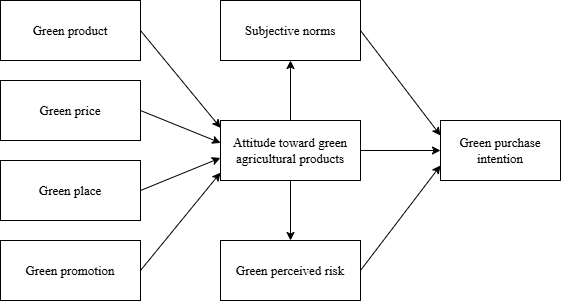
The present study addresses this gap by developing an integrative framework that connects green marketing activities with consumer-level determinants of PI toward green agricultural products. Green product (PD), green price (PC), green place (PA) and green promotion (PM) are examined as antecedents of consumers’ attitude, while attitude and SN represent the evaluative and social determinants of PI. GPR is further incorporated as a distinct risk-related determinant to capture consumers’ uncertainty regarding the credibility, quality, and expected performance of green agricultural products.
This study adopts a modified TPB, that retains attitude and SN as relevant consumer-level determinants. Perceived behavioral control is not included because the present study focuses on the effects of green marketing mix elements on attitude and on selected consumer-level determinants of PI. As perceived behavioral control represents consumers’ perceived control over performing the behavior, it is not among the focal relationships examined in the proposed model and is not replaced by PC, PA or GPR, which represent conceptually distinct marketing and risk-related constructs.
Accordingly, the proposed framework integrates two complementary perspectives: the green marketing mix explains how firm-controlled marketing activities are associated with consumers’ attitude, whereas selected TPB constructs and GPR explain consumer-level determinants of PI. This integration provides a context-specific framework for examining green agricultural PI in Northern Vietnam while maintaining clear conceptual distinctions among marketing, psychological, and risk-related factors.
2.1 Theory of Planned Behavior
The TPB provides the consumer-behavioral foundation for the modified framework employed in this study. TPB extends the Theory of Reasoned Action [12, 13] by introducing perceived behavioral control to account for situations in which behavioral performance is not entirely under individuals’ volitional control. Accordingly, behavioral intention is determined by attitude, SN, and perceived behavioral control [14]. TPB has continued to be widely applied and extended in recent green consumption research, including green food consumption [15], green purchasing behavior [16], sustainable fashion consumption [17], and green PI [8]. These studies demonstrate the continued relevance of TPB as a theoretical foundation for explaining environmentally responsible consumption intentions and behaviors.
Recent Vietnamese studies have examined perceived behavioral control in different contexts, including as a mediator between environmental corporate social responsibility and green PI [18], as being influenced by social influence in the context of green food purchasing [19], and with environmental consciousness, SN, perceived marketplace influence, and health consciousness examined as antecedents of perceived behavioral control [8]. These studies therefore focus on behavioral-control mechanisms and their antecedents, whereas the present study focuses on green marketing mix elements as determinants of attitude and on selected consumer-level determinants of PI.
Ajzen [14] noted that the relative importance of attitude, SN, and perceived behavioral control may vary across behaviors and situations, providing a theoretical basis for context-sensitive applications of TPB. Consistent with this principle, subsequent green-consumption studies have employed modified TPB frameworks by retaining or extending constructs according to their specific research context [20]. Accordingly, the present study adopts a modified TPB framework that retains attitude and SN in line with its research focus, while perceived behavioral control is not included in the proposed model. Importantly, perceived behavioral control is omitted rather than substituted by PC, PA or GPR. The proposed research model is presented in Figure 1.
2.2 Hypothesis development
2.2.1 Green product strategy has a positive effect on attitude
In the green marketing mix, PD plays a vital role in shaping marketing strategies and decisions related to environmentally friendly products [21]. According to Dangelico and Vocalelli [22], PD are understood as products that create more positive environmental and social outcomes throughout their life cycle, from production and consumption to disposal, compared with conventional products that are less environmentally friendly. A number of previous studies have reported a positive relationship between PD characteristics and consumers’ responses toward green consumption behavior. Mahmoud [23], Jaiswal and Kant [24] found that PD positively influences consumers’ perceptions and consumption intention. In addition, Karunarathna et al. [25] showed that the effect of PD on PI becomes stronger through consumers’ environmental attitude. These findings suggest that positive evaluations of PD characteristics can encourage consumers to develop a more favorable attitude toward purchasing green agricultural products. Based on these findings, the following hypothesis is proposed:
H1: Green product strategy has a positive effect on attitude.
2.2.2 Green price strategy has a positive effect on attitude
PC strategy refers to setting prices for environmentally friendly products by balancing production costs, environmental value, and consumer acceptance. In practice, green products are often priced higher than conventional products because they require stricter standards in materials, production processes, and environmental compliance [26]. According to Mahmoud [23], PC relies on a balance among the 3Ps: people, planet, and profit, while also paying attention to human health and sustainable development goals. Based on the TPB [14], consumers’ perceptions of product value and benefits can influence how they evaluate purchasing behavior, which in turn helps shape their attitude toward that behavior. Previous studies have suggested a meaningful link between PC and consumers’ evaluations of green consumption. From the human perspective, Dangelico and Vocalelli [22] found that in developed European countries, many consumers are willing to pay higher prices for green products when they recognize environmental benefits and product quality. Likewise, Zhao et al. [27] reported that consumers are willing to pay additional costs when products provide clear added value. Boztepe [28] also argued that, for some consumers, a higher price compared with competing products may be viewed as a sign of better quality and stronger environmental friendliness. In addition, Tan et al. [29] found that PC positively affects consumers’ perceptions during product evaluation. These findings suggest that when consumers see PC as reasonable and consistent with the value received, they are more likely to develop a positive attitude toward purchasing green agricultural products. Therefore, the following hypothesis is proposed:
H2: Green price strategy has a positive effect on attitude.
2.2.3 Green place strategy has a positive effect on attitude
PA strategy refers to managing distribution activities in an environmentally friendly way while ensuring the availability, convenience, and accessibility of green products in the market [30]. Based on the TPB, consumers’ perceptions of convenience and product accessibility can affect how they evaluate purchasing behavior, which in turn helps shape their attitude toward that behavior [31]. Previous studies have reported a link between PA strategy and consumers’ evaluations of green consumption. Gleim et al. [32] and Young et al. [33] suggested that most consumers prefer PD that are easy to find and easy to access rather than products that require extra effort to obtain from distant locations. As a result, product location and availability can influence consumers’ PI. Consistent with this argument, Karunarathna et al. [25] found that the availability of PD significantly affects consumers’ PI. In addition, Jayathilaka and De Silva [34] showed that PA strategy is positively related to consumers’ attitude toward green consumption behavior. These findings suggest that when consumers perceive PA strategy as convenient, accessible, and aligned with their shopping needs, they are more likely to develop a positive attitude toward purchasing green agricultural products. Therefore, the following hypothesis is proposed:
H3: Green place strategy has a positive effect on attitude.
2.2.4 Green promotion strategy has a positive effect on attitude
PM strategy refers to the use of communication and promotional activities to provide information about the environmental features of products while encouraging consumers to adopt more sustainable consumption choices [35]. According to the TPB, the information and beliefs consumers receive from marketing activities can influence how they evaluate purchasing behavior, which in turn helps shape their attitude toward that behavior [36]. Earlier studies have identified a relationship between PM and consumers’ evaluative responses toward green consumption behavior. Dangelico and Vocalelli [22] found that consumers often hold a positive attitude toward advertisements for environmentally friendly products, which can increase their tendency to engage in green purchasing. Likewise, Liao et al. [37] reported that persuasive advertising messages can strengthen consumers’ perceived value and attitude toward green consumption behavior. These findings suggest that when consumers receive green messages that are clear, credible, and consistent with their personal values, they are more likely to develop a positive attitude toward purchasing green agricultural products. Therefore, the following hypothesis is proposed:
H4: Green promotion strategy has a positive effect on attitude.
2.2.5 Attitude has a positive effect on purchase intention
Ajzen [14] stated that attitude refers to an individual’s positive or negative evaluation of performing a specific behavior. According to the TPB, attitude is considered one of the most important predictors of behavioral intention. Many previous studies have confirmed the role of attitude toward green agricultural products (AT) in shaping green agricultural product PI. In the context of green consumption, Magnusson et al. [38] found that consumers with a positive attitude toward organic food often view buying these products as a meaningful and appropriate choice. Similarly, Rana and Paul [39] showed that AT is a strong predictor of consumers’ intention to buy environmentally friendly products. In addition, Tang et al. [40] also found that a positive consumer AT helps strengthen PI in the context of green consumption. These findings suggest that when consumers have a positive view of buying green agricultural products, they are more likely to develop a stronger PI. Therefore, the following hypothesis is proposed:
H5: Attitude has a positive effect on PI.
2.2.6 Subjective norms have a positive effect on purchase intention
SN refers to an individual’s perception of social pressure from important people regarding whether to perform or avoid a behavior, and it also reflects normative beliefs and the willingness to follow these expectations [12, 14]. In the TPB, SN highlights the role of social influence in shaping behavioral intention, as individuals often consider the opinions and expectations of important others before making decisions. Many previous studies have confirmed the role of SN in shaping PI. Yadav and Pathak [41] found that SN has a positive effect on young consumers’ intention to buy organic food in India. In the same way, Roh et al. [42] based on a study of 251 consumers in China, showed that social pressure directly affects consumers’ intention to purchase organic food. In countries with collectivist cultures, social influence tends to play a stronger role in green consumption behavior. Dũng et al. [43] argued that social factors such as family and community are important in increasing Vietnamese consumers’ interest in PD. These findings suggest that when consumers receive support or positive expectations from important people around them, they are more likely to develop a stronger intention to purchase green agricultural products. Therefore, the following hypothesis is proposed:
H6: Subjective norms have a positive effect on purchase intention.
2.2.7 Green perceived risk has a negative effect on purchase intention
GPR refers to consumers’ subjective evaluation of the possible negative outcomes that may arise from purchasing or using environmentally friendly products [44]. In the context of green consumption, limited information and difficulties in evaluating products before purchase often increase consumers’ uncertainty about the quality, effectiveness, actual value, and credibility of green claims, especially when products are sold at higher prices [32]. From the TPB perspective, such perceptions can weaken behavioral intention when consumers believe that making a purchase involves a high level of risk. Previous studies have generally reported a negative relationship between GPR and green consumption intention. Chen and Chang [44] argued that a high level of perceived risk lowers consumers’ trust in PD. In the same way, Koehn [45] and Wu et al. [46] found that GPR negatively affects green PI and green consumption behavior. In addition, Tarabieh [47] showed that lower perceived risk is associated with stronger intention to purchase PD. Taken together, these findings suggest that consumers who perceive fewer risks when buying green agricultural products are more likely to develop stronger PI. Therefore, the following hypothesis is proposed:
H7: GPR has a negative effect on PI.
2.2.8 Attitude has a positive effect on subjective norms
Voon et al. [48], in their study of organic food purchasing in Malaysia, identified a positive effect of AT on SN in their revised structural model. Their findings indicate that a more favorable AT is associated with stronger SN. Similarly, Chabata and Senooane [49] reported a significant positive effect of AT on SN in the context of sustainable renewable energy consumption. Although these studies examine different consumption contexts, their findings provide a basis for investigating whether a more favorable AT is associated with stronger perceived social expectations regarding such purchases among Vietnamese consumers. Accordingly, the following hypothesis is proposed:
H8: Attitude has a positive effect on subjective norms.
2.2.9 Attitude has a negative effect on green perceived risk
Consumers’ AT may shape how they perceive the risks associated with purchasing these products. According to the affect heuristic, individuals rely partly on their overall affective evaluations when judging risks and benefits, with more favorable evaluations tending to be associated with lower perceived risk [50, 51]. In the context of organic food, Hilverda et al. [52] found that consumers with more positive initial attitudes reported lower risk perceptions following online interactions. Similarly, Hammitt [53] observed that organic-produce buyers perceived organically grown produce as less hazardous than conventional alternatives. These findings provide additional empirical support for the association between favorable consumer evaluations and lower GPR in organic food consumption. Building on these theoretical and empirical insights, consumers who hold more favorable AT are expected to perceive fewer risks associated with their purchase. Therefore, the following hypothesis is proposed:
H9: Attitude has a negative effect on green perceived risk.
3.1 Measurement
To empirically evaluate the conceptual framework, multi-item scales for all latent constructs were adapted from validated international literature and semantically adjusted to suit Northern Vietnam’s green agricultural market. The comprehensive baseline questionnaire evaluated 49 indicators distributed across eight latent constructs: PD (green product, 7 items), PC (green price, 6 items), PA (green place, 5 items), PM (green promotion, 10 items), AT (attitude toward green agricultural products, 8 items), SN (subjective norms, 4 items), GPR (green perceived risk, 5 items), and PI (purchase intention, 4 items). All indicators were quantified using a standardized 5-point Likert scale.
3.2 Population and sample
The target population for this research comprises consumers residing in Northern Vietnam who possess an awareness of green agricultural products and maintain purchasing autonomy. To overcome logistical barriers and minimize missing responses, a non-probability convenience sampling technique was utilized to administer a self-administered online survey via major social media networks. This online approach is highly compatible with the tech-savvy demographic groups who frequently interact with contemporary sustainable consumption and eco-friendly market movements.
Regarding sample size determination, this study complies with the traditional criteria established by Bollen [54], which suggests a minimum observation-to-variable ratio of 5:1. Given the structured measurement instrument containing 49 indicators, the minimum statistically acceptable threshold was computed at 245 respondents. During the fieldwork, 516 questionnaires were collected. Following a strict data-cleansing process, 92 responses exhibiting straight-lining patterns or other invalid answer patterns were eliminated. Consequently, a final pool of 424 valid responses was retained for structural equation modeling (SEM) analysis, safely satisfying the minimum requirements. The complete socio-demographic distribution of this final sample (N = 424) is detailed in Table 1.
Table 1. Sociodemographic profile of the final sample (N = 424)
|
Variable |
Category |
Frequency (n) |
Percentage (%) |
|
Gender |
Male |
206 |
48.58% |
|
Female |
218 |
51.42% |
|
|
Age group |
Under 25 years old |
204 |
48.11% |
|
25–30 years old |
51 |
12.03% |
|
|
31–35 years old |
40 |
9.43% |
|
|
36–40 years old |
33 |
7.78% |
|
|
41–45 years old |
38 |
8.96% |
|
|
46–50 years old |
42 |
9.91% |
|
|
Over 50 years old |
16 |
3.77% |
|
|
Education level |
Lower Secondary School |
7 |
1.65% |
|
Secondary School |
8 |
1.89% |
|
|
High School |
40 |
9.43% |
|
|
Bachelor’s / College Degree |
247 |
58.25% |
|
|
Postgraduate |
122 |
28.77% |
|
|
Monthly income / Allowance |
Below 5,000,000 VND |
150 |
35.38% |
|
5,000,000-under 7,500,000 VND |
54 |
12.74% |
|
|
7,500,000-under 15,000,000 VND |
63 |
14.86% |
|
|
15,000,000-under 30,000,000 VND |
115 |
27.12% |
|
|
Over 30,000,000 VND
|
42
|
9.91%
|
4.1 Data analysis and results
4.1.1 Data analysis
This study employed Partial Least Squares Structural Equation Modeling (PLS-SEM) using SmartPLS 4 to evaluate the hypothesized framework. PLS-SEM was selected over covariance-based alternatives due to its superior capacity for predictive modeling and its robustness in handling complex causal relationships with non-normal data distributions [55]. By prioritizing the maximization of explained variance (R2) for endogenous constructs, this approach effectively aligns with the exploratory and predictive objectives of the current research.
4.1.2 Common method bias
To minimize the risk of common method bias (CMB), several procedural remedies were implemented during the questionnaire design process. The questionnaire was designed to be concise and easy to follow, thereby reducing repetition and minimizing respondent fatigue. Moreover, participants were clearly informed that there were no right or wrong answers and that all responses would remain anonymous to encourage honest feedback.
To statistically examine the potential presence of CMB, two techniques were employed: Harman’s single-factor test and the variance inflation factor (VIF) assessment. First, Harman’s single-factor test was conducted by loading all items into an exploratory factor analysis. The results showed that the total variance explained by the single factor was 31.914%, which is below the threshold of 50% as suggested by Podsakoff et al. [56], indicating that no single factor emerged to account for the majority of the variance.
Furthermore, collinearity in the measurement model was assessed by examining the VIF values. According to Hair et al. [57], if the VIF values of the indicators are below 5, collinearity issues are not considered a major concern. The results indicate that all VIF values range from 1.370 to 3.925. Since all values remain below the recommended threshold of 5, it is concluded that multicollinearity among the indicators is not problematic. Consequently, the evidence from both the Harman’s test and VIF analysis suggests that CMB is unlikely to significantly influence the findings of this study.
4.1.3 Measurement model
The quality of the measurement model was assessed through the evaluation of indicator reliability, internal consistency reliability, convergent validity, and discriminant validity. Indicator reliability was first examined through outer loadings.
According to Hair et al. [57], indicator loadings should ideally be 0.708 or higher to demonstrate strong indicator reliability. Therefore, indicators with low outer loadings were removed from the measurement model to improve construct reliability and validity. Specifically, two items from PC (PC5 and PC6), two items from PD (PD3 and PD4), one item from PM (PM8) and two items from AT (AT3 and AT4) were excluded from further analysis. After removing these indicators, the measurement model was re-estimated, and the results showed that all remaining indicators achieved satisfactory outer loading values, meeting the recommended threshold and supporting indicator reliability.
Internal consistency reliability was first evaluated using Cronbach’s alpha (CA) and composite reliability (CR). As reported in Table 2, all CA and CR values exceeded the recommended threshold of 0.7, indicating satisfactory internal consistency reliability [57].
Convergent validity was then assessed through factor loadings and average variance extracted (AVE), with AVE values expected to exceed 0.50 [58]. As shown in Table 2, convergent validity was established, with factor loadings ranging from 0.707 to 0.914 and AVE values ranging from 0.537 to 0.777.
Discriminant validity was subsequently examined using the Fornell-Larcker criterion [58]. According to this criterion, the square root of the AVE for each construct must be greater than its correlations with all other constructs in the model. As presented in Table 3, the square root of the AVE for each construct exceeded its correlations with the other constructs, confirming adequate construct distinctiveness.
Finally, discriminant validity was further assessed using the Heterotrait-Monotrait ratio (HTMT), which provides a more reliable assessment of discriminant validity than traditional criteria such as the Fornell-Larcker criterion [59]. As presented in Table 4, all HTMT values were below the recommended threshold of 0.90. The highest HTMT value observed was 0.879, which remained within the acceptable range. Therefore, the HTMT results provide additional evidence that the constructs are sufficiently distinct from one another, further supporting the establishment of discriminant validity in this study.
Table 2. Results of the measurement model
|
Constructs |
Items |
Factor Loadings |
Cronbach’s Alpha |
Composite Reliability |
AVE |
|
Attitude toward green agricultural products |
AT1 |
0.737 |
0.861 |
0.896 |
0.590 |
|
AT2 |
0.786 |
||||
|
AT5 |
0.790 |
||||
|
AT6 |
0.756 |
||||
|
AT7 |
0.738 |
||||
|
AT8 |
0.798 |
||||
|
Green perceived risk |
GPR1 |
0.906 |
0.930 |
0.946 |
0.777 |
|
GPR2 |
0.914 |
||||
|
GPR3 |
0.856 |
||||
|
GPR4 |
0.893 |
||||
|
GPR5 |
0.837 |
||||
|
Green place |
PA1 |
0.721 |
0.784 |
0.853 |
0.537 |
|
PA2 |
0.707 |
||||
|
PA3 |
0.776 |
||||
|
PA4 |
0.714 |
||||
|
PA5 |
0.743 |
||||
|
Green price |
PC1 |
0.774 |
0.791 |
0.864 |
0.613 |
|
PC2 |
0.793 |
||||
|
PC3 |
0.774 |
||||
|
PC4 |
0.792 |
||||
|
Green product |
PD1 |
0.753 |
0.817 |
0.872 |
0.576 |
|
PD2 |
0.744 |
||||
|
PD5 |
0.764 |
||||
|
PD6 |
0.784 |
||||
|
PD7 |
0.751 |
||||
|
Purchase intention |
PI1 |
0.852 |
0.806 |
0.873 |
0.633 |
|
PI2 |
0.819 |
||||
|
PI3 |
0.792 |
||||
|
PI4 |
0.714 |
||||
|
Green promotion |
PM1 |
0.730 |
0.897 |
0.916 |
0.548 |
|
PM10 |
0.740 |
||||
|
PM2 |
0.739 |
||||
|
PM3 |
0.742 |
||||
|
PM4 |
0.756 |
||||
|
PM5 |
0.739 |
||||
|
PM6 |
0.733 |
||||
|
PM7 |
0.726 |
||||
|
PM9 |
0.755 |
||||
|
Subjective norms |
SN1 |
0.763 |
0.779 |
0.857 |
0.601 |
|
SN2 |
0.734 |
||||
|
SN3 |
0.813 |
||||
|
SN4 |
0.788
|
Table 3. Fornell-Larcker
|
AT |
GPR |
PA |
PC |
PD |
PI |
PM |
SN |
|
|
AT |
0.768 |
|||||||
|
GPR |
0.297 |
0.882 |
||||||
|
PA |
0.623 |
0.116 |
0.733 |
|||||
|
PC |
0.577 |
0.249 |
0.536 |
0.783 |
||||
|
PD |
0.681 |
0.233 |
0.565 |
0.699 |
0.759 |
|||
|
PI |
0.730 |
0.296 |
0.606 |
0.623 |
0.628 |
0.796 |
||
|
PM |
0.627 |
0.152 |
0.738 |
0.533 |
0.553 |
0.632 |
0.740 |
|
|
SN |
0.662 |
0.250 |
0.596 |
0.520
|
0.517
|
0.685
|
0.617
|
0.775
|
Table 4. Heterotrait-Monotrait ratio (HTMT) results
|
AT |
GPR |
PA |
PC |
PD |
PI |
PM |
SN |
|
|
AT |
||||||||
|
GPR |
0.311 |
|||||||
|
PA |
0.751 |
0.132 |
||||||
|
PC |
0.692 |
0.275 |
0.670 |
|||||
|
PD |
0.797 |
0.248 |
0.705 |
0.865 |
||||
|
PI |
0.869 |
0.326 |
0.761 |
0.772 |
0.765 |
|||
|
PM |
0.705 |
0.156 |
0.879 |
0.622 |
0.644 |
0.741 |
||
|
SN |
0.806 |
0.286 |
0.758 |
0.656
|
0.643
|
0.858
|
0.737
|
|
4.1.4 Structural model
After the measurement model had been validated, the structural model was assessed to examine the hypothesised relationships among PD, PC, PA, PM, AT, SN, GPR, and PI. The statistical significance of the path coefficients was examined using bootstrapping. In addition, the explanatory power of the model was evaluated using the coefficient of determination (R²), while the effect size of each predictor was assessed using f². The results of the structural model assessment are presented in Table 5.
Table 5. Results of structural model evaluation and hypotheses testing
|
Hypothesis |
Relationship |
β |
t-Value |
p-Value |
Result |
|
|
H1 |
PD → AT |
0.390 |
6.935 |
0.000 |
Supported |
|
|
H2 |
PC → AT |
0.080 |
1.517 |
0.129 |
Not supported |
|
|
H3 |
PA → AT |
0.192 |
2.026 |
0.043 |
Supported |
|
|
H4 |
PM → AT |
0.227 |
3.086 |
0.002 |
Supported |
|
|
H5 |
AT → PI |
0.477 |
9.186 |
0.000 |
Supported |
|
|
H6 |
SN → PI |
0.353 |
6.013 |
0.000 |
Supported |
|
|
H7 |
GPR → PI |
0.066 |
1.929 |
0.054 |
Not supported |
|
|
H8 |
AT → SN |
0.662 |
18.502 |
0.000 |
Supported |
|
|
H9 |
AT → GPR |
0.297
|
6.992
|
0.000
|
Not supported
|
|
The R2 values reported in Table 6 reflect moderate to substantial explanatory power for the primary endogenous constructs. Specifically, PD, PC, PA and PM explain 57.4% of the variance in consumer attitude (R2 = 0.574, adjusted R2 = 0.570), which subsequently combines with SN and GPR to account for 61.0% of the variance in purchase intention (R2 = 0.610, adjusted R2 = 0.607). In addition, AT accounts for 43.9% of the variance in SN (R2 = 0.439, adjusted R2 = 0.437), whereas its predictive capacity for GPR remains relatively low at 8.8% (R2 = 0.088, adjusted R2 = 0.086).
Table 6. Coefficient of determination (R²)
|
R-Square |
R-Square Adjusted |
|
|
AT |
0.574 |
0.570 |
|
GPR |
0.088 |
0.086 |
|
PI |
0.610 |
0.607 |
|
SN |
0.439 |
0.437
|
As shown in Table 7, the f² results further indicate the relative contribution of each predictor to its corresponding endogenous construct. For AT, PD has the largest effect size (f² = 0.162), followed by PM (f² = 0.051) and PA (f² = 0.036), whereas PC shows a negligible effect size (f² = 0.007). For PI, AT has the largest effect size (f² = 0.317), followed closely by SN (f² = 0.178). In addition, when assessing the outcomes of attitude, AT exhibits a substantial and large effect size on SN (f2 = 0.783), as well as a small effect size on GPR (f2 = 0.096). These results are generally consistent with the path coefficient estimates, suggesting that PD is the most important predictor of AT, while AT and SN are the key predictors of PI.
Table 7. Effect size (f²)
|
Relationship |
F-Square |
Effect Size |
|
AT → GPR |
0.096 |
Small |
|
AT → PI |
0.317 |
Medium |
|
AT → SN |
0.783 |
Large |
|
GPR → PI |
0.010 |
Negligible |
|
PA → AT |
0.036 |
Small |
|
PC → AT |
0.007 |
Negligible |
|
PD → AT |
0.162 |
Medium |
|
PM → AT |
0.051 |
Small |
|
SN → PI |
0.178
|
Medium
|
The hypothesis testing results indicate that six out of nine hypotheses are supported. Specifically, PD exerts a positive and significant influence on AT (β = 0.390, t = 6.935, p < 0.001), supporting H1. Similarly, PA has a statistically significant positive effect on AT (β = 0.192, t = 2.026, p = 0.043 < 0.05), confirming H3. Conversely, the relationship between PC and AT is not statistically significant (β = 0.080, t = 1.517, p = 0.129), meaning H2 is not supported.
Among the antecedents of AT, PD demonstrates the strongest impact (β = 0.390, t = 6.935, p < 0.001), followed by PM, which also displays a significant positive effect (β = 0.227, t = 3.086, p = 0.002 < 0.01). This evidence supports H4 and highlights that both PD and PM are the primary drivers in shaping AT.
Regarding the determinants of PI, AT has the strongest positive and statistically significant impact (β = 0.477, t = 9.186, p < 0.001), thereby supporting H5. SN also significantly influences PI in a positive direction (β = 0.353, t = 6.013, p < 0.001), confirming H6. In contrast, the direct effect of GPR on PI is not statistically significant at the 5% level (β = 0.066, t = 1.929, p = 0.054); consequently, H7 is not supported.
Considering the remaining structural paths, AT exerts a significant positive impact on SN (β = 0.662, t = 18.502, p < 0.001), supporting H8. Similarly, AT has a statistically significant positive effect on GPR (β = 0.297, t = 6.992, p < 0.001), meaning H9 is not supported.
Table 8 presents the 95% bootstrap confidence intervals for the path coefficients to validate the structural relationships in the model. Statistically significant positive direct impacts are confirmed for AT → PI (β = 0.477, 95% CI [0.371, 0.576]), SN → PI (β = 0.353, 95% CI [0.235, 0.464]), PD → AT (β = 0.390, 95% CI [0.277, 0.500]), PM → AT (β = 0.227, 95% CI [0.092, 0.382]), and PA → AT (β = 0.192, 95% CI [0.014, 0.371]), as their confidence bounds do not straddle zero. Additionally, entirely positive confidence intervals are observed for AT → SN (β = 0.662, 95% CI [0.590, 0.731]) and AT → GPR (β = 0.297, 95% CI [0.217, 0.381]). Conversely, the effect of PC on AT is not statistically significant (β = 0.080, 95% CI [-0.019, 0.191]) because its confidence interval includes zero. Similarly, the path from GPR to PI (β = 0.066, 95% CI [0.002, 0.136]) demonstrates a weak effect with lower bounds approaching zero.
Table 8. Bootstrap confidence intervals for path coefficients
|
Original Sample (O) |
Sample Mean (M) |
2.5% |
97.5% |
|
|
AT → GPR |
0.297 |
0.300 |
0.217 |
0.381 |
|
AT → PI |
0.477 |
0.477 |
0.371 |
0.576 |
|
AT → SN |
0.662 |
0.665 |
0.590 |
0.731 |
|
GPR → PI |
0.066 |
0.066 |
0.002 |
0.136 |
|
PA → AT |
0.192 |
0.188 |
0.014 |
0.371 |
|
PC → AT |
0.080 |
0.084 |
-0.019 |
0.191 |
|
PD → AT |
0.390 |
0.389 |
0.277 |
0.500 |
|
PM → AT |
0.227 |
0.233 |
0.092 |
0.382 |
|
SN → PI |
0.353 |
0.354
|
0.235
|
0.464
|
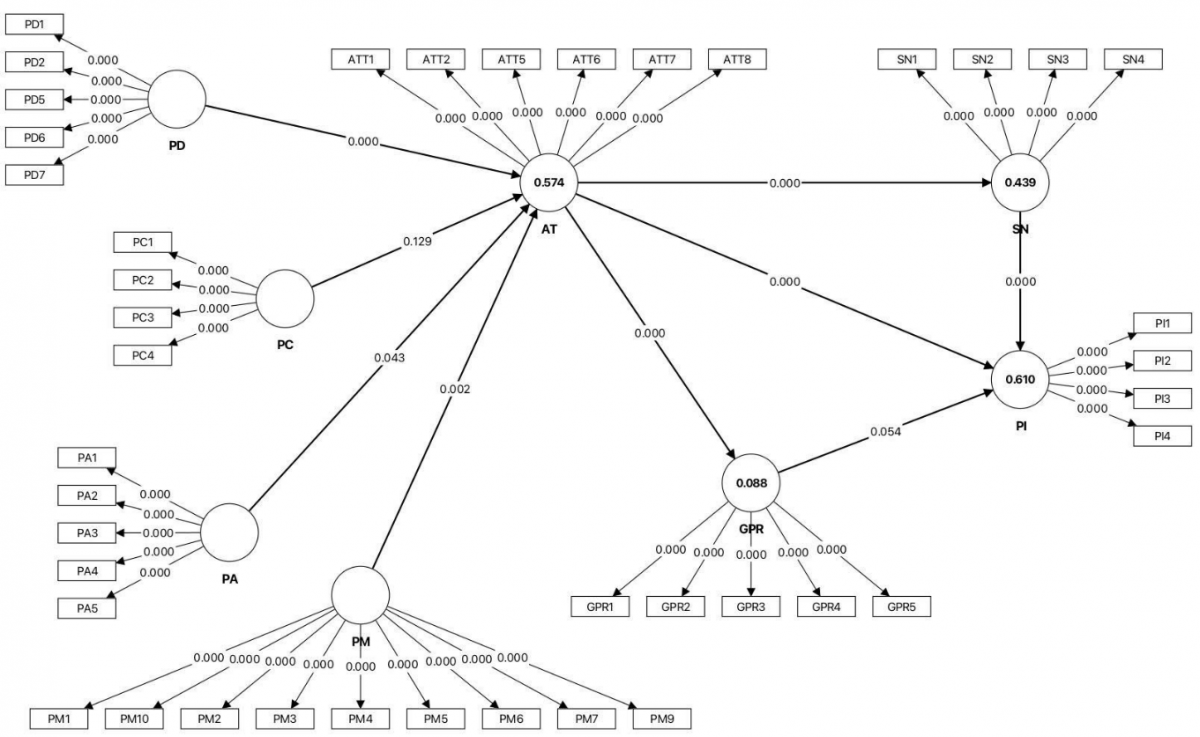
As depicted in Figure 2, the PLS-SEM structural results provide a visual overview of the path coefficients and hypothesis testing outcomes. Specifically, the diagram highlights both the direction of the direct relationships.
Overall, the structural model results suggest that PI is mainly explained by AT and SN, whereas AT is significantly influenced by PD, PA, and PM. Meanwhile, PC and GPR do not demonstrate statistically significant effects in the proposed model. The R² and f² results further support this interpretation, showing that the model explains a moderate proportion of variance in both AT (R² = 0.570) and PI (R² = 0.610), with the strongest practical contributions coming from PD, AT, and SN.
4.2 Discussions, implications and limitations
4.2.1 Discussions
This study examines consumers’ PI toward green agricultural products in Northern Vietnam using a modified TPB model. In the proposed model, PD, PC, PA and PM are examined as antecedents of AT, while AT, SN and GPR are examined as predictors of PI. The findings show that AT and SN significantly influence PI, whereas GPR does not. Among the green marketing mix factors, PD, PA and PM significantly influence AT, while PC does not show a significant effect.
The results indicate that PD has the strongest positive influence on AT (β = 0.390). Product-related attributes may foster favorable attitude by signaling product quality, safety, and environmental credibility, particularly because many production characteristics of agricultural products, such as production methods, product origin, and safety, cannot be directly observed before purchase Jiang et al. [60] found that product strategy positively influenced consumers’ attitude toward organic food, while Daraboina et al. [61] identified health, quality, and natural content among important attributes considered in organic food purchase decisions. In Northern Vietnam, product-related cues may be particularly important because consumers have shown positive valuations of certification and traceability information when evaluating agricultural products. Tran et al. [62] found that Vietnamese consumers were willing to pay premiums for VietGAP certification, EU and USDA organic certifications, private branding, and QR-based traceability. Similarly, Mai et al. [4] found that trust positively influenced attitude toward organic food and showed that reliable label information and certification were important in building consumer trust. These findings suggest that certification, traceability, and credible product information may serve as important signals of product quality and authenticity, thereby contributing to more favorable AT in Vietnam.
The findings also show that PA positively influences AT (β = 0.192). Greater availability and convenient access may reduce the effort required to obtain PD and contribute to more favorable consumer evaluations. This finding is consistent with Jiang et al. [60], who found that place strategy positively influenced consumers’ AT, with convenient locations and the availability of online delivery services being particularly relevant. In Northern Vietnam, recent studies highlight both physical availability and digital access as relevant aspects of agricultural product distribution. Mai et al. [4] found that the availability of organic food in supermarkets and grocery stores was highly valued by Vietnamese consumers. Hoang et al. [63] further showed that perceived usefulness and perceived ease of use significantly influenced consumers’ intention to purchase agricultural products through online retail platforms in Vietnam. Similarly, Minh and Nhan [64] found that facilitating conditions influenced consumers’ intention and behavior toward purchasing fresh agricultural products online in Ho Chi Minh City. These findings suggest that the role of place in Vietnam is increasingly associated not only with product availability at physical outlets but also with convenient access through digital distribution channels.
Regarding PC, the result does not support its influence on AT (β = 0.080). This finding contrasts with previous research identifying price as an important barrier to green consumption, as PD are often perceived to be more expensive than conventional alternatives [65], as well as more recent studies showing that price-related perceptions can significantly shape consumers’ AT [66]. Evidence from Vietnam, however, appears more mixed. While price perception has been found to significantly influence attitude toward organic beverages [5], Phan and Pham [67] found price did not have a significant effect. Recent evidence shows that Vietnamese consumers are willing to pay substantial premiums for agrifood products carrying trusted certification and traceability attributes, including VietGAP, USDA certification [68]. Therefore, price may become less decisive in shaping AT when a higher price is perceived as justified by product quality, safety, or credible assurance.
PM positively influences AT (β = 0.227). This finding is consistent with Jiang et al. [60] and Hu et al. [66], who found that PM and marketing communication positively influenced consumers’ attitude toward organic food. In Northern Vietnam, promotion may play an important informational role because consumers still face limited knowledge and uncertainty regarding organic and environmentally differentiated food products. Mai et al. [4] found that transparent information increased consumer trust, which subsequently strengthened attitude toward organic food, and highlighted the importance of communicating product information through social networks, television, magazines, and websites. Truong and Huong [5] similarly found that marketing and communication significantly influenced attitude toward organic beverages in Vietnam. These findings suggest that PM may be particularly effective when it communicates credible information about production methods, certification, product origin, and environmental benefits.
The findings confirm the important role of psychological factors in explaining consumers’ PI. AT has the strongest influence on PI (β = 0.477). This finding supports the TPB framework, which proposes that individuals’ evaluations of a behavior influence their behavioral intentions [14]. It is also consistent with previous studies showing that AT is one of the strongest predictors of green PI [36, 41]. In the context of green agricultural products, AT may represent consumers’ overall evaluation of these products, incorporating their perceptions of product quality, safety, environmental benefits, and trustworthiness. Such evaluation is particularly important because many attributes of green agricultural products, including production practices and environmental performance, cannot be directly verified before purchase.
SN significantly influence PI (β = 0.353). This finding indicates that social influence plays an important role in consumers’ decisions regarding green agricultural products. Previous studies have shown that SN are important predictors of green consumption, particularly in collectivist cultures where individuals consider opinions from family members, peers, and social groups when making consumption decisions [69]. This finding is also consistent with previous research on organic food consumption in Vietnam, which found that SN significantly influence consumers’ PI [70].
GPR does not significantly influence PI (β = 0.066). Finding contrasts with recent evidence showing that perceived risk negatively influences consumers’ intention to purchase green agricultural products. Xiao et al. [71] found that perceived risk significantly reduced urban consumers’ willingness to consume green agro-food, with functional, time, financial, and psychological risks all exerting negative effects. Evidence from Vietnam has also reported a negative effect of GPR on organic food PI [72]. However, Mai et al. [4] found that transparent information and knowledge about organic food significantly strengthened consumer trust, while trust positively influenced both attitude and PI. At the policy level, Vietnam has also increasingly promoted consumer awareness of organic and sustainable products. The national Organic Agriculture Development Project for 2020-2030 explicitly emphasizes communication, dissemination of organic standards, and consumer-awareness campaigns to strengthen consumer trust [73]. In parallel, the National Action Programme on Sustainable Production and Consumption set targets for widespread awareness-raising activities across provinces and cities [74]. Greater access to credible information from both market and institutional sources may therefore reduce uncertainty surrounding green agricultural products, potentially weakening the direct effect of GPR on PI.
The findings further show that AT positively influences SN. Rahayu et al. [75] similarly found a positive effect of consumer AT on SN in the context of green tissue products in Indonesia. This relationship may be explained by social projection, whereby individuals use their own AT to infer the beliefs and expectations of others [76]. In Vietnam, Le and Nguyen [77] highlighted the relevance of family members and significant others in organic food purchasing decisions. In this context, consumers with favorable AT may assume that these valued individuals share their positive evaluations, thereby perceiving stronger social approval of purchasing such products.
Finally, AT positively influences GPR, with a small effect size (f² = 0.096), contrasting with previous findings. This unexpected relationship may be understood in Vietnam's emerging organic food market, where Decision No. 885/QĐ-TTg [73] outlines government initiatives to promote organic agriculture and raise public awareness through 2030. Thuy et al. [78] further found that social media informativeness strengthened the relationships between health consciousness, food safety concerns, perceived knowledge, and organic food purchase intention. Nevertheless, My et al. [79] reported low consumer familiarity with organic certifications, while Mai et al. [4] identified limited knowledge of organic production practices and difficulties recognizing organic packaging and logos. Truong et al. [80] further showed that distrust in the broader food system could undermine confidence in organic and GAP certifications. These findings suggest that consumers may develop favorable AT while remaining uncertain about their authenticity and certification credibility, potentially contributing to higher GPR.
Overall, this study contributes to the understanding of green agricultural product consumption in Northern Vietnam by demonstrating the importance of both marketing and psychological factors. The findings show that consumers’ PI is mainly driven by attitude and SN, while green marketing factors contribute to shaping consumers’ AT.
4.2.2 Theoretical implications
This study offers three theoretical contributions to research on green consumer behavior in emerging markets. First, it extends the TPB [14] by positioning the four green marketing mix components-PD, PC, PA and PM-as antecedents of AT, which in turn, together with SN, drives PI. AT and SN emerged as strong and comparable predictors of intention. The strong role of SN is noteworthy, because several Vietnamese studies applying the TPB have reported SN to be weak or non-significant for green PI [81]; the present result suggests that, for a young and socially networked cohort purchasing a health-related category, perceived social pressure operates alongside personal evaluation rather than remaining secondary to it.
Second, the green marketing mix components differ markedly in how strongly they shape AT. Specifically, PD recorded the largest positive effect, followed by PM and PA, whereas PC showed no statistically significant effect. The positive influence of green marketing mix practices on green consumer outcomes aligns broadly with Mahmoud [23], who demonstrated the collective efficacy of the 4Ps, and with Saleh et al. [82], who showed that green marketing mix levers shape consumer evaluation and adoption intentions. However, the specific pattern of effects in this study provides an insightful contrast with Su and Li [83]. Examining consumers in China’s second- and third-tier cities, Su and Li [83] found that PD had no significant effect on environmental AT, whereas PC, PA and PM all significantly shaped AT. In contrast, for green agricultural products in Northern Vietnam, PD is the single strongest driver of AT, while PC is non-significant-with both studies agreeing on the positive impact of PM and PA. This divergence underscores that the salience of specific marketing mix components is highly category- and context-dependent: for credence-heavy and safety-sensitive categories such as agricultural products, intrinsic quality, certification, and safety attributes play a far more decisive role in forming positive consumer attitude than price considerations.
Third, by modeling GPR as a direct antecedent of intention and finding a non-significant effect, the study clarifies its boundary conditions. Rather than being universally restrictive, the direct impact of GPR appears to depend on market maturity, product category, and consumers’ access to risk-reducing signals such as institutional certifications and QR-code traceability. Taken together, the integrated model accounts for a substantial share of variance in both attitude and intention, demonstrating that combining the green marketing mix with the TPB provides stronger explanatory power for green agricultural consumption than relying on either framework in isolation.
4.2.3 Practical implications
The findings offer practical implications for green agricultural businesses, retailers, and policymakers in Vietnam.
First, because PD had the largest effect on AT, consistent with Karunarathna et al. [25], firms should prioritize improving and communicating the intrinsic quality of their products. Freshness, safety, taste, nutritional value, and consistent quality standards should be demonstrable and supported by credible evidence such as independent certification and transparent production information.
Second, although PM had a slightly smaller effect than PD, its significant influence on AT highlights the importance of credible and evidence-based communication. Firms should avoid generic “green” or “clean” claims and instead provide verifiable information through traceability, independent certification, transparent production processes, and clear eco-labeling. Such communication can reinforce consumers’ perceptions of product quality and sustainability.
Third, the smaller but significant effect of PA suggests that firms should develop convenient and reputable distribution systems to improve consumers’ access to green agricultural products. This includes expanding distribution through supermarkets, clean-food stores, and e-commerce platforms, where information on product origin, certification, and quality can be clearly presented. A well-developed distribution network can reduce access barriers and make green agricultural products more convenient for consumers to purchase.
Fourth, PC does not have a significant direct effect on AT. This suggests that price alone may not be a decisive factor in shaping AT once consumers trust the quality and certification of the products. Therefore, rather than relying primarily on price adjustments, firms should communicate the value embedded in the price by emphasizing product quality, safety, certification, and production standards.
Fifth, given the strong role of SN, consistent with Vietnam’s collectivist culture [84] and, in this study, stronger than in much prior Vietnamese evidence-policymakers and firms can mobilize social influence through trusted actors such as experts and local communities, but only on a credible foundation of standardized certification, traceability, transparent eco-labeling, and stricter monitoring of misleading claims. In practice, this can take the form of community-based demonstrations, farmer cooperatives, peer reviews, and key opinion consumers who visibly model green purchasing, since recommendations from trusted peers are likely to shift intention more effectively than firm-led messaging in a collectivist setting.
Sixth, GPR did not significantly affect PI within this sample. This result should not be interpreted as evidence that GPR is unimportant. Instead, it suggests that risk-related communication may not need to be treated as the sole focus of marketing efforts in the context examined. Firms could continue to reduce uncertainty by providing transparent and verifiable product information, while also communicating product quality, practical benefits, and consumer value.
Seventh, the strong positive effect of AT on SN suggests that fostering favorable AT may also strengthen consumers’ perceptions of social expectations surrounding their purchase. For Vietnamese businesses, this highlights the importance of building positive AT through tangible product benefits, particularly food safety, family health, and environmental protection, supported by transparent sourcing and credible quality certifications. These benefits could then be incorporated into family-oriented marketing campaigns that portray green agricultural purchasing as a responsible choice for household well-being. For instance, advertisements could feature everyday grocery decisions in which family members express their expectations for safe and environmentally responsible food choices. Such approaches may help consumers connect their favorable evaluations of green agricultural products with the expectations of significant others, thereby reinforcing subjective norms.
Finally, the positive effect of AT on GPR suggests that favorable AT does not necessarily reduce consumers’ concerns about product authenticity and reliability. In Vietnam, policymakers and local authorities should move beyond general campaigns promoting the benefits of green consumption toward practical consumer education. Community workshops, public information campaigns, and point-of-sale guidance could explain the meaning of organic and VietGAP certifications, how to recognize legitimate labels, and how to verify product origins through traceability systems. Businesses should complement these efforts with clear labeling and accessible certification information, helping consumers make informed purchasing decisions rather than relying solely on promotional claims.
4.2.4 Limitations and future research
Although this study provides useful insights into green agricultural product consumption in Northern Vietnam, several limitations should be acknowledged. First, the sample was not fully balanced across age, income, occupation, and region, and was concentrated among younger, urban consumers, which may limit generalizability; future studies should adopt stratified sampling and extend to rural and less-developed markets, or compare across Southeast Asian countries. Second, the cross-sectional design and self-reported data limit causal inference and may be affected by social desirability bias; longitudinal designs, experiments, or behavioral data would support stronger conclusions about how attitude and intentions evolve. Moreover, because all constructs were measured through a single self-reported questionnaire, CMB cannot be fully ruled out despite the validity checks; future studies could collect data from multiple sources or at several time points. Third, the model relies on the four basic components of the Green Marketing Mix; future research could add factors such as green trust, environmental concern, health consciousness, and perceived behavioral control, as well as expanded marketing-mix variables (people, process, physical evidence) that matter when trust in producers is critical. Fourth, the study measured consumption intention rather than actual behavior, leaving the attitude-intention-behavior gap unexamined; future work should track purchase behavior or transaction data to assess whether intention translates into action, and should note that findings centered on green agricultural products may not transfer directly to other green product types. Finally, during scale purification several proposed indicators were removed to meet reliability and validity criteria, which may have narrowed construct coverage; in particular, green price did not significantly predict attitude, possibly reflecting consumers' prioritization of health and safety over price considerations in the agricultural context or limitations in scale measurement. Future studies should develop richer measures of green place, green product, and green promotion adapted to the agricultural context.
This study examined the effect of the green marketing mix on Vietnamese consumers’ intention to consume green agricultural products by integrating green marketing into the TPB. Three of the four components significantly shaped AT –green PD and green PM exerting the strongest effects, followed by green PA – whereas green PC had no significant effect. Furthermore, AT exerted a significant positive impact on both SN and GPR. AT and SN emerged as strong and comparable drivers of intention, while GPR had no significant effect, suggesting its role depends on product characteristics, market development, and access to information. Overall, promoting green consumption in emerging markets depends not only on improving green attributes but also on communicating green value credibly and securing social endorsement. These findings advance understanding of sustainable consumption in Northern Vietnam and offer category-specific guidance for comparable emerging markets.
This research was funded by National Economics University, Hanoi, Vietnam. In addition, we would like to sincerely thank all respondents who generously took the time to participate in our survey, as well as Mr. Trung Duong Le for his valuable feedback.
[1] Office of the Prime Minister of Vietnam. (2021). Decision No. 1658/QĐ-TTg approving the National Strategy on Green Growth for the period 2021-2030, with a vision to 2050. Government of the Socialist Republic of Vietnam. http://vanban.chinhphu.vn/?docid=204226&pageid=27160.
[2] PricewaterhouseCoopers. (2025). Voice of the consumer survey 2025-Vietnam snapshot. PwC. https://www.pwc.com/vn/en/publications/vietnam-publications/voice-of-consumer-2025.html.
[3] Ha, T.M., Shakur, S., Pham Do, K.H. (2019). Rural-urban differences in willingness to pay for organic vegetables: Evidence from Vietnam. Appetite, 141: 104273. https://doi.org/10.1016/j.appet.2019.05.004
[4] Mai, N.T., Phuong, T.T.L., Dat, T.T., Truong, D.D. (2023). Determinants of organic food purchasing intention: An empirical study of local consumers in Da Nang city, Central Vietnam. Frontiers in Sustainable Food Systems, 7. https://doi.org/10.3389/fsufs.2023.1180612
[5] Truong, D.D., Huong, T.T.L. (2025). Mediator effects of customers' attitude on factors influencing intention to purchase organic beverages in Vietnam. Frontiers in Sustainable Food Systems, 9. https://doi.org/10.3389/fsufs.2025.1467497
[6] Nguyen, T.N.N., Dang, T.C. (2025). Factors determining green purchasing behavior: Extending the theory of planned behavior. Asian Journal of Economics and Banking, 234: 78-90. https://doi.org/10.63065/ajeb.vn.2025.234.119635
[7] Tran, C.T., Phan, T.T.X., Tran, H.T., et al. (2026). The impact of green packaging on green purchase intention: Evidence from the Mekong Delta. Heritage and Sustainable Development, 8(1): 463-484. https://doi.org/10.37868/hsd.v8i1.1964
[8] Hoang, D.V., Tung, L.T., Hoa, N.D. (2026). Exploring factors influencing green purchase intention in emerging markets: An integration of social cognitive theory and theory of planned behavior. Sage Open, 16(1). https://doi.org/10.1177/21582440251411603
[9] Dinh, K.C., Nguyen-Viet, B., Phuong Vo, H.N. (2023). Toward sustainable development and consumption: The role of the green promotion mix in driving green brand equity and green purchase intention. Journal of Promotion Management, 29(6): 824-848. https://doi.org/10.1080/10496491.2023.2165209
[10] Nguyen, H.L., Le, T.H., Nguyen, H.D. (2023). Influence of green marketing mix on purchase intention of Vietnamese consumers for green food. AIOR, 34-45. https://doi.org/10.31014/aior.1992.06.03.518
[11] Pham, K.A., Nguyen, P.M., Le, T.M., Vu, T.M.L. (2025). Does green marketing affect green purchase intention of consumers in Vietnam? In Advancing the SDGs in Developing and Emerging Economies, pp. 105-117. Springer Nature Switzerland, Cham. https://doi.org/10.1007/978-3-031-86500-8_8
[12] Fishbein, M., Ajzen, I. (1977). Belief, attitude, intention, and behavior: An introduction to theory and research. Philosophy and Rhetoric, 10(2): 130-132. https://philpapers.org/rec/FISBAI?all_versions=1.
[13] Ajzen, I. (1980). Understanding attitudes and predicting social behavior. Englewood Cliffs. https://cir.nii.ac.jp/crid/1572543024551612928.
[14] Ajzen, I. (1991). The theory of planned behavior. Organizational Behavior and Human Decision Processes, 50(2): 179-211. https://doi.org/10.1016/0749-5978(91)90020-t
[15] Phuong, N.V., Mai, N.T.N., Mergenthaler, M., Cuc, L.T., Quynh, P.N.H. (2024). The role of social media on green food consumption intention in Hanoi, Vietnam. Agris On-line Papers in Economics and Informatics, 16(2): 107-120. https://doi.org/10.7160/aol.2024.160208
[16] Ngo, Q.H., Nguyen, T.D., Phan, N.B. (2025). Exploring green purchasing intentions and behaviours among Vietnamese Generation Z: A perspective from the theory of planned behaviour. PLOS ONE, 20(5): e0323879. https://doi.org/10.1371/journal.pone.0323879
[17] Do, A.D., Ha, D.L., Phan, T.T.L., et al. (2025). Antecedents of Gen Z's green purchase intention in Vietnam's fashion industry with the moderating role of greenwash perception. PLOS ONE, 20(5): e0324923. https://doi.org/10.1371/journal.pone.0324923
[18] Vu, D.M., Ha, N.T., Ngo, T.V.N., Pham, H.T., Duong, C.D. (2021). Environmental corporate social responsibility initiatives and green purchase intention: An application of the extended theory of planned behavior. Social Responsibility Journal, 18(8): 1627-1645. https://doi.org/10.1108/SRJ-06-2021-0220
[19] Van Phuong, N., Mergenthaler, M., Quynh, P.N.H. (2025). Consumer transition: Analyzing the impact of environmental and health consciousness on green food choices in Vietnam. Discover Sustainability, 6(1): 415. https://doi.org/10.1007/s43621-025-01275-w
[20] Veas-González, I., Bernal-Peralta, J., Carrión-Bósquez, N., et al. (2026). Determinant factors that influence purchase intentions for skin products with sustainable packaging. Acta Psychologica, 266: 106759. https://doi.org/10.1016/j.actpsy.2026.106759
[21] Prothero, A. (1998). Environmental marketing management: Meeting the green challenge by Ken Peattie. Business Strategy and the Environment, 7: 52-53. https://doi.org/10.1002/(sici)1099-0836(199802)7:1%3C52::aid-bse136%3E3.0.co;2-3
[22] Dangelico, R.M., Vocalelli, D. (2017). "Green marketing": An analysis of definitions, strategy steps, and tools through a systematic review of the literature. Journal of Cleaner Production, 165: 1263-1279. https://doi.org/10.1016/j.jclepro.2017.07.184
[23] Mahmoud, T.O. (2018). Impact of green marketing mix on purchase intention. International Journal of Advanced and Applied Sciences, 5(2): 127-135. https://doi.org/10.21833/ijaas.2018.02.020
[24] Jaiswal, D., Kant, R. (2018). Green purchasing behaviour: A conceptual framework and empirical investigation of Indian consumers. Journal of Retailing and Consumer Services, 41: 60-69. https://doi.org/10.1016/j.jretconser.2017.11.008
[25] Karunarathna, A.K.P., Bandara, V.K., Silva, A.S.T., De Mel, W.D.H. (2020). Impact of green marketing mix on customers' green purchasing intention with special reference to Sri Lankan supermarkets.
[26] Peattie, K., Crane, A. (2005). Green marketing: Legend, myth, farce or prophesy? Qualitative Market Research: An International Journal, 8(4): 357-370. https://doi.org/10.1108/13522750510619733
[27] Zhao, L.M., Peng, J.X., Yu, S.B. (2023). Sustainable luxury and consumer purchase intention: A systematic literature review. Sage Open, 13(4): 21582440231216285. https://doi.org/10.1177/21582440231216285
[28] Boztepe, A. (2012). Green marketing and its impact on consumer buying behavior. European Journal of Economic & Political Studies, 5(1): 5.
[29] Tan, C.N.L., Fauzi, M.A., Harun, S.A.B. (2025). From perceived green product quality to purchase intention: The roles of price sensitivity and environmental concern. Marketing Intelligence Planning, 43(7): 1329-1348. https://doi.org/10.1108/mip-10-2024-0703
[30] Leonidou, C.N., Katsikeas, C.S., Morgan, N.A. (2013). "Greening" the marketing mix: do firms do it and does it pay off? Journal of the Academy of Marketing Science, 41(2): 151-170. https://doi.org/10.1007/s11747-012-0317-2
[31] Vermeir, I., Verbeke, W. (2006). Sustainable food consumption: Exploring the consumer "attitude-behavioral intention" gap. Journal of Agricultural and Environmental Ethics, 19(2): 169-194. https://doi.org/10.1007/s10806-005-5485-3
[32] Gleim, M.R., Smith, J.S., Andrews, D., Cronin, J.J., Jr. (2013). Against the green: A multi-method examination of the barriers to green consumption. Journal of Retailing, 89(1): 44-61. https://doi.org/10.1016/j.jretai.2012.10.001
[33] Young, W., Hwang, K., McDonald, S., Oates, C.J. (2010). Sustainable consumption: Green consumer behaviour when purchasing products. Sustainable Development, 18(1): 20-31. https://doi.org/10.1002/sd.394
[34] Jayathilaka, K.G.S.A., De Silva, J.H.R. (2018). Impact of green marketing on consumer attitudes and consumer purchase intention in Sri Lanka. In 15th International Conference on Business Management Research, Yogyakarta, pp. 774-794. https://dr.lib.sjp.ac.lk/server/api/core/bitstreams/2294e4af-052e-4982-9b46-c9da55959ecd/content.
[35] Shil, P. (2012). Evolution and future of environmental marketing. Asia Pacific Journal of Marketing and Management Review, 1(3): 74-81.
[36] Paul, J., Modi, A., Patel, J. (2016). Predicting green product consumption using theory of planned behavior and reasoned action. Journal of Retailing and Consumer Services, 29: 123-134. https://doi.org/10.1016/j.jretconser.2015.11.006
[37] Liao, Y.K., Wu, W.Y., Pham, T.T. (2020). Examining the moderating effects of green marketing and green psychological benefits on customers' green attitude, value and purchase intention. Sustainability, 12(18): 7461. https://doi.org/10.3390/su12187461
[38] Magnusson, M.K., Arvola, A., Koivisto Hursti, U., Åberg, L., Sjödén, P. (2001). Attitudes towards organic foods among Swedish consumers. British Food Journal, 103(3): 209-227. https://doi.org/10.1108/00070700110386755
[39] Rana, J., Paul, J. (2017). Consumer behavior and purchase intention for organic food: A review and research agenda. Journal of Retailing and Consumer Services, 38: 157-165. https://doi.org/10.1016/j.jretconser.2017.06.004
[40] Tang, Y.M., Wang, X.C., Lu, P.P. (2014). Chinese consumer attitude and purchase intent towards green products. Asia-Pacific Journal of Business Administration, 6(2): 84-96. https://doi.org/10.1108/apjba-05-2013-0037
[41] Yadav, R., Pathak, G.S. (2016). Young consumers' intention towards buying green products in a developing nation: Extending the theory of planned behavior. Journal of Cleaner Production, 135: 732-739. https://doi.org/10.1016/j.jclepro.2016.06.120
[42] Roh, T., Seok, J., Kim, Y. (2022). Unveiling ways to reach organic purchase: Green perceived value, perceived knowledge, attitude, subjective norm, and trust. Journal of Retailing and Consumer Services, 67: 102988. https://doi.org/10.1016/j.jretconser.2022.102988
[43] Dũng, V.A., Hiền, N.T., Ánh, N.T.N. (2012). Đánh giá nhận thức và hành vi tiêu dùng xanh: Trường hợp người tiêu dùng Hà Nội. Kinh tế & Phát triển, 184: 46-55. https://ktpt.neu.edu.vn/Uploads/Bai%20bao/2012/So%20184/372696.pdf.
[44] Chen, Y.S., Chang, C.H. (2012). Enhance green purchase intentions: The roles of green perceived value, green perceived risk, and green trust. Management Decision, 50(3): 502-520. https://doi.org/10.1108/00251741211216250
[45] Koehn, D. (2003). The Nature of and conditions for online trust. Journal of Business Ethics, 43(1-2): 3-19. https://doi.org/10.1023/A:1022950813386
[46] Wu, K.W., Vassileva, J., Noorian, Z., Zhao, Y.X. (2015). How do you feel when you see a list of prices? The interplay among price dispersion, perceived risk and initial trust in Chinese C2C market. Journal of Retailing and Consumer Services, 25: 36-46. https://doi.org/10.1016/j.jretconser.2015.03.007
[47] Tarabieh, S.M.Z.A. (2021). The impact of greenwash practices over green purchase intention: The mediating effects of green confusion, Green perceived risk, and green trust. Management Science Letters, 11(2): 451-464.
[48] Voon, T.J.P., Ngui, K.S., Agrawal, A. (2011). Determinants of Willingness to purchase organic food: An exploratory study using structural equation modeling. International Food and Agribusiness Management Review, 14(2): 103-120. https://doi.org/10.22004/AG.ECON.103989
[49] Chabata, T.T., Senooane, B.C. (2025). Consumption of sustainable renewable energy by Generation Z from a utilitarian perspective. Interdisciplinary Journal of Management Sciences, 2(1): a01. https://doi.org/10.38140/ijms-2025.vol2.1.01
[50] Finucane, M.L., Alhakami, A., Slovic, P., Johnson, S.M. (2000). The affect heuristic in judgments of risks and benefits. Journal of Behavioral Decision Making, 13(1): 1-17. https://doi.org/10.1002/(SICI)1099-0771(200001/03)13:1<1::AID-BDM333>3.0.CO;2-S
[51] Slovic, P., Finucane, M.L., Peters, E., MacGregor, D.G. (2007). The affect heuristic. European Journal of Operational Research, 177(3): 1333-1352. https://doi.org/10.1016/j.ejor.2005.04.006
[52] Hilverda, F., Kuttschreuter, M., Giebels, E. (2017). Social media mediated interaction with peers, experts and anonymous authors: Conversation partner and message framing effects on risk perception and sense-making of organic food. Food Quality and Preference, 56: 107-118. https://doi.org/10.1016/j.foodqual.2016.09.003
[53] Hammitt, J.K. (1990). Risk perceptions and food choice: An exploratory analysis of organic‐versus conventional‐produce buyers. Risk Analysis, 10(3): 367-374. https://doi.org/10.1111/j.1539-6924.1990.tb00519.x
[54] Bollen, K.A. (1989). A new incremental fit index for general structural equation models. Sociological Methods & Research, 17(3): 303-316. https://doi.org/10.1177/0049124189017003004
[55] Sarstedt, M., Hair, J.F., Nitzl, C., Ringle, C.M., Howard, M.C. (2020). Beyond a tandem analysis of SEM and PROCESS: Use of PLS-SEM for mediation analyses! International Journal of Market Research, 62(3): 288-299. https://doi.org/10.1177/1470785320915686
[56] Podsakoff, P.M., MacKenzie, S.B., Lee, J.Y., Podsakoff, N.P. (2003). Common method biases in behavioral research: A critical review of the literature and recommended remedies. Journal of Applied Psychology, 88(5): 879. https://doi.org/10.1037/0021-9010.88.5.879
[57] Hair, J.F., Risher, J.J., Sarstedt, M., Ringle, C.M. (2019). When to use and how to report the results of PLS-SEM. European Business Review, 31(1): 2-24. https://doi.org/10.1108/ebr-11-2018-0203
[58] Fornell, C., Larcker, D.F. (1981). Evaluating structural equation models with unobservable variables and measurement error. Journal of Marketing Research, 18(1): 39-50. https://doi.org/10.1177/002224378101800104
[59] Henseler, J., Ringle, C.M., Sarstedt, M. (2015). A new criterion for assessing discriminant validity in variance-based structural equation modeling. Journal of the Academy of Marketing Science, 43(1): 115-135. https://doi.org/10.1007/s11747-014-0403-8
[60] Jiang, Y., Abdullah, S.I.N.W., Lim, B.H.J., Wang, R., Phuah, K.T. (2023). The role of marketing stimuli and attitude in determining post-COVID buying decisions toward organic food products: Evidence from retail consumers in Beijing, China. Frontiers in Sustainable Food Systems, 7. https://doi.org/10.3389/fsufs.2023.1051696
[61] Daraboina, R., Cooper, O., Amini, M. (2024). Segmentation of organic food consumers: A revelation of purchase factors in organic food markets. Journal of Retailing and Consumer Services, 78: 103710. https://doi.org/10.1016/j.jretconser.2024.103710
[62] Tran, D., Broeckhoven, I., Hung, Y., Diem My, N.H., De Steur, H., Verbeke, W. (2022). Willingness to pay for food labelling schemes in Vietnam: A choice experiment on water spinach. Foods, 11(5): 722. https://doi.org/10.3390/foods11050722
[63] Hoang, D.L.T., Hoang, M.A., Vu, T.T., Dinh, T.G. (2024). Customer purchase intention towards agricultural products on Vietnam online retail platforms. VNU University of Economics and Business, 4(4): 65-65. https://doi.org/10.57110/vnu-jeb.v4i4.294
[64] Minh, H.T.P., Nhan, D.T. (2020). Determinants of consumers’ purchasing intentions toward organic foods: A study in Ho Chi Minh City, Vietnam. Hcmcoujs - Economics and Business Administration, 9(1). https://doi.org/10.46223/hcmcoujs.econ.en.9.1.178.2019
[65] Joshi, Y., Rahman, Z. (2015). Factors affecting green purchase behaviour and future research directions. International Strategic Management Review, 3(1-2): 128-143. https://doi.org/10.1016/j.ism.2015.04.001
[66] Hu, T., Al Mamun, A., Reza, M.N.H., Wu, M.L., Yang, Q. (2024). Examining consumers' willingness to pay premium price for organic food. Humanities and Social Sciences Communications, 11(1): 1249. https://doi.org/10.1057/s41599-024-03789-6
[67] Phan, T.A., Pham, N.B.T. (2023). Young adults' anti-consumption tendencies toward organic foods in Vietnam: The mediating role of self-efficacy. Sage Open, 13(4): 21582440231207703. https://doi.org/10.1177/21582440231207703
[68] Pham, C.A.T., Nguyen, T.M., Do, N.K., Dao, N.T. (2026). Unlocking Vietnamese consumers' willingness to pay for agrifood: Does traceability, safety certification or market outlet choices matter? Journal of Agribusiness in Developing and Emerging Economies, 16(3): 620-637. https://doi.org/10.1108/jadee-08-2024-0244
[69] Sreen, N., Purbey, S., Sadarangani, P. (2018). Impact of culture, behavior and gender on green purchase intention. Journal of Retailing and Consumer Services, 41: 177-189. https://doi.org/10.1016/j.jretconser.2017.12.002
[70] Nguyen, H.V., Nguyen, N., Nguyen, B.K., Lobo, A., Vu, P.A. (2019). Organic food purchases in an emerging market: The influence of consumers' personal factors and green marketing practices of food stores. International Journal of Environmental Research and Public Health, 16(6): 1037. https://doi.org/10.3390/ijerph16061037
[71] Xiao, J.Y., Wang, Q., Dai, J.J., Yang, B., Li, L. (2023). Urban residents' green agro-food consumption: perceived risk, decision behaviors, and policy implications in China. Sustainability, 15(13): 10505. https://doi.org/10.3390/su151310505
[72] Mai, T.D., Tam, N.T., Tran, G.T., et al. (2022). Consumers' decision-making mechanism differs under the presence of risk, habits, and past behavior for organic fisheries foods. Food Science and Technology, 42: e94022. https://doi.org/10.1590/fst.94022
[73] Prime Minister of Vietnam. (2020). Decision No. 885/QD-TTg dated June 23, 2020, approving the Organic Agriculture Development Project for 2020–2030 (In Vietnamese). https://faolex.fao.org/docs/pdf/vie211192.pdf.
[74] Prime Minister of Vietnam. (2020). Decision No. 889/QD-TTg dated June 24, 2020, approving the National Action Plan on Sustainable Consumption and Production for the period 2021–2030 (In Vietnamese). https://faolex.fao.org/docs/pdf/vie213439.pdf.
[75] Rahayu, S., Vedy, N.K., Gumanti, M. (2024). Green purchase intention towards consumer tissue: Empirical evidence from Indonesia. Talent: Journal of Economics and Business, 2(1): 27-32. https://doi.org/10.59422/jeb.v2i01.297
[76] Cho, H., Chung, S., Filippova, A. (2015). Perceptions of social norms surrounding digital piracy: The effect of social projection and communication exposure on injunctive and descriptive social norms. Computers in Human Behavior, 48: 506-515. https://doi.org/10.1016/j.chb.2015.02.018
[77] Le, M.H., Nguyen, P.M. (2022). Integrating the theory of planned behavior and the norm activation model to investigate organic food purchase intention: Evidence from Vietnam. Sustainability, 14(2): 816. https://doi.org/10.3390/su14020816
[78] Thuy, N.N., Saxena, G., Bhattarai, K., Anh, H.H. (2025). A quantitative study on the consumption of organic fruits and vegetables in Vietnam. Sage Open, 15(2). https://doi.org/10.1177/21582440251348843
[79] My, N.H.D., Rutsaert, P., Van Loo, E.J., Verbeke, W. (2017). Consumers’ familiarity with and attitudes towards food quality certifications for rice and vegetables in Vietnam. Food Control, 82: 74-82. https://doi.org/10.1016/j.foodcont.2017.06.011
[80] Truong, V.A., Conroy, D.M., Lang, B. (2021). The trust paradox in food labelling: An exploration of consumers’ perceptions of certified vegetables. Food Quality and Preference, 93: 104280. https://doi.org/10.1016/j.foodqual.2021.104280
[81] Duong, C.D., Doan, X.H., Vu, D.M., Ha, N.T., Dam, K.V. (2026). The role of perceived environmental responsibility and environmental concern on shaping green purchase intention. Vision: The Journal of Business Perspective, 30(1): 63-77. https://doi.org/10.1177/09722629221092117
[82] Saleh, Y., Assaf, R., Attar, H., Kanan, M. (2024). The impact of green marketing mix practices on customer's purchase intention of electric vehicles in Palestine: The mediating role of green perceived value. Engineering, Technology & Applied Science Research, 14(6): 18234-18244. https://doi.org/10.48084/etasr.8977
[83] Su, S.W., Li, Y.N. (2024). Exploring the impact of the green marketing mix on environmental attitudes and purchase intentions: Moderating role of environmental knowledge in China's emerging markets. Sustainability, 16(24): 10934. https://doi.org/10.3390/su162410934
[84] Hofstede, G. (2011). Dimensionalizing cultures: The Hofstede model in context. Online Readings in Psychology and Culture, 2(1): 8. https://doi.org/10.9707/2307-0919.1014