
S Martono* | Puji Handayati | Eka Ary Wibawa | Sucihatiningsih Dian Wisika Prajanti | Arief Yulianto | Angga Pandu Wijaya
© 2026 The authors. This article is published by IIETA and is licensed under the CC BY 4.0 license (http://creativecommons.org/licenses/by/4.0/).
OPEN ACCESS
This study examines patterns of environmental activism in Indonesia by identifying groups of individuals with similar forms of environmental engagement. Environmental activism is expressed through diverse forms of participation, making it important to understand how different patterns of engagement emerge across groups. A quantitative approach based on multivariate analysis was employed. Data were collected from a purposively recruited, self-selected sample of 385 individuals who had engaged in environmental activism during the preceding three months. Exploratory factor analysis (EFA) was used to identify the dimensions of environmental activism, followed by K-means clustering to classify respondents. The analysis identified four environmental activism clusters. Within the fitted cluster solution, Institutional and Political Environmental Engagement showed the largest descriptive F-value (F = 61.663), indicating the greatest relative contribution to differentiation among the resulting respondent groups, followed by Direct Action and Community-Based Environmental Activism (F = 54.835). Environmental Awareness and Advocacy showed a moderate contribution (F = 35.677), whereas Environmental Education and Capacity Building contributed the least to cluster differentiation (F = 28.141). The findings indicate that differences among the identified activism profiles were associated more closely with institutional-political engagement and community-based action than with education- and capacity-building-related activities. These results highlight the diversity of environmental activism and provide a basis for understanding variation in environmental engagement across groups in Indonesia.
environmental activism, institutional engagement, environmental policy
In recent years, environmental activism has expanded into an increasingly prominent form of social behavior, driven by growing awareness of the urgency of environmental conservation. The ongoing deterioration of ecological conditions has further heightened public concern and reinforced the need for more effective environmental protection efforts [1]. In disaster-prone countries such as Indonesia, a notable paradox persists in which high exposure to environmental risks is not accompanied by strong public engagement in environmental protection. Nonetheless, recent developments indicate a gradual rise in environmental awareness and conservation efforts, although participation continues to occur on a modest scale. Environmental awareness and environmental knowledge have been identified as important factors associated with environmental activism [2]. However, these factors alone may not be sufficient to generate long-term and sustainable change. Environmental activism represents one avenue through which environmental concern and awareness can be expressed in collective forms of action. Environmental activism involves active participation in environmental issues and extends beyond individual awareness or concern [3].
Environmental activism encompasses several levels that reflect varying degrees of individual involvement in environmental conservation, ranging from simple forms of participation in everyday life to more organized engagement through community-based initiatives. These differences can be observed from two perspectives, namely direct and indirect forms of participation aimed at actively influencing others. Such variations in engagement levels reflect differing degrees of individual commitment, knowledge, and concern for environmental protection [4]. While many individuals demonstrate a high level of concern for environmental issues, this concern often remains personal in nature, with active participation in environmental actions remaining relatively limited.
Environmental activism is closely associated with environmental knowledge, as individuals who understand environmental issues are more likely to engage in environmental action, advocacy, and conservation activities. Environmental knowledge plays a crucial role in shaping the cognitive dimension that motivates individuals to engage in environmental activism. Environmental campaign activities require substantial effort and commitment, which are largely grounded in knowledge and understanding of environmental issues [5]. Furthermore, involvement in environmental activism is influenced by individual learning processes and experiences; knowledge gained through exposure to environmental issues and prior engagement contributes to the development of motivation and the sustainability of activist behavior [6]. This indicates that environmental knowledge plays a significant role in differentiating levels of environmental activism, as variations in environmental knowledge contribute to differences in the extent of active environmental engagement.
Environmental awareness is closely related to the formation of environmental activism because awareness of environmental issues and their impacts influences an individual's readiness to engage in conservation efforts. Variations in levels of environmental awareness lead to differences in the intensity of involvement in environmental advocacy, ranging from passive concern to active participation [7]. Empirical findings indicate that environmental campaigns play a significant role in shaping environmental awareness and activism, thus encouraging behavior oriented toward environmental protection [8]. Environmental awareness is a cognitive-affective factor that shapes how individuals view and understand the consequences of environmental problems. This awareness increases sensitivity to environmental impacts and strengthens a sense of personal responsibility, which motivates active involvement [9]. Awareness strengthened through exposure to information and social experiences makes individuals more likely to participate in environmental activism as an active response.
Environmental activism is shaped by multiple interacting factors, including levels of environmental awareness, environmental knowledge, individual characteristics, and social influences embedded within the broader societal context. The complexity of these factors suggests that environmental activism emerges from heterogeneous conditions, resulting in varying degrees of individual commitment. While some individuals demonstrate strong commitment to environmental activism, others exhibit weaker engagement depending on the influencing factors. To date, relatively few studies have systematically mapped variations in environmental activism behavior. Existing research has largely focused on examining relationships among variables [2, 10, 11] or conducting literature-based studies [12, 13], leaving behavioral mapping relatively underexplored.
Behavioral mapping aims to identify variations in levels of involvement and forms of environmental action. Such mapping is essential for informing policies and behavioral interventions designed to maintain or enhance environmental activism, particularly by strengthening areas where engagement remains weak. Environmental activism can support environmental protection through broader participation in environmental initiatives and public engagement with environmental issues. Mapping patterns of environmental activism provides insight into how participation varies across groups and may assist policymakers and organizations in designing more targeted environmental programs. Knowledge of environmental activism profiles can help identify which forms of engagement are more prominent within different groups, providing a useful basis for environmental programs and initiatives.
2.1 Concept of environmental activism
Environmental activism is one form of individual involvement in responding to environmental problems. Responses to ecological issues are often discussed through various closely related concepts, such as pro-environmental behavior and environmental activism [14, 15]. These concepts have the same tendency to pay attention to environmental protection, but the concepts are not identical. Pro-environmental behavior refers to individual behavior carried out to reduce negative impacts on the environment [16]. In pro-environmental behavior, actions carried out personally do not reflect individual involvement in producing change at the collective level. Environmental activism has a broader orientation because it is an effort to influence social conditions, institutions, or policies. Environmental activism refers to the involvement of individuals or groups in actions carried out consciously to encourage changes that protect the environment [8]. This differs from pro-environmental behavior, which tends to focus on personal actions, such as saving energy, reducing plastic use, or recycling. Forms of environmental activism include disseminating environmental information, participating in environmental campaigns or organizations, signing petitions, advocacy, organizing activities, and participating in public actions [17].
2.2 Environmental activism as collective action
The characteristics of environmental activism, which tend to encourage efforts to influence the environment or groups, reflect a form of concern in collective action. Environmental activism shows individual concern for the environment as well as broader involvement by engaging social groups [18]. Individuals act as influencers to influence society. The collective action perspective provides a strong basis for explaining environmental activism compared with approaches that focus only on individual characteristics. Previous studies show that collective action is more appropriate for explaining environmental activism, whereas individual approaches are more commonly used to explain pro-environmental behavior [19].
The collective nature of environmental activism does not indicate that every activity must be carried out physically together with other people. The more important aspect is the orientation of the action toward collective impact [20]. Individuals can carry out actions individually, but these actions still have a collective character when directed at influencing public responses or producing broader changes. This perspective is consistent with the development of studies on collective environmental action. Systematic reviews of research on collective environmental action show that the intended outcomes can include changes to make the environment better [13]. Environmental activism is not limited to the form of action, but is related to its orientation toward change at the social or institutional level.
2.3 Dimensions and measurement of environmental activism
The measurement of environmental activism in the literature has developed through quite diverse approaches. Early studies generally did not use a single instrument specifically and comprehensively developed to measure environmental activism, but instead selected a number of behaviors considered to represent involvement in environmental movements. Previous research distinguished committed activism from other forms of support for environmental movements, such as environmental citizenship, support for public policies, and pro-environmental behavior in the private sphere [21]. Activism was represented in a limited way through involvement in demonstrations or protests, whereas activities such as joining environmental organizations or making financial contributions were categorized as forms of environmental citizenship. This approach is important in distinguishing political involvement from environmental behavior, but it shows that environmental activism in its early development was still often operationalized through certain activities and had not yet been treated as a construct with a comprehensive measurement instrument.
Variation in measurement can also be seen in subsequent studies. SGuin et al. [22] used six activities to represent environmental activism, which were later reused in several studies examining the relationship between environmental activism, pro-environmental behavior, and social identity. Environmental activism at that time was still a less integrated concept and had not been consistently defined. On the other hand, several activities categorized as activism in one study may be classified as citizenship behavior in another study. This overlap shows that the measurement problem of environmental activism lies in the inconsistency of the conceptual boundaries between personal behavior, civic participation, and activism.
These limitations are one of the main reasons why the use of the Environmental Action Scale (EAS) developed by Alisat and Riemer provides a more comprehensive measurement basis [23]. Alisat and Riemer [23] specifically criticized the use of one or several high-intensity activities as a representation of environmental activism as a whole. Such behaviors are relatively rarely performed in the general population, so measurements that rely only on these actions risk failing to capture individuals who have been involved in environmental action but at a lower level of intensity. The advantage of the EAS also lies in its suitability for the conceptualization of environmental activism as collective action. This scale specifically measures civic environmental actions intended to generate collective impacts and changes at the system level, making it conceptually different from personal practices such as saving energy or recycling household waste. The development process began with 65 potential items developed through a literature review and was reduced to 18 items. The testing was conducted using exploratory and confirmatory psychometric analyses as well as an Item Response Theory approach. Details of the EAS instrument are presented in Appendix A, consisting of 18 items used to measure environmental activism.
This study used a quantitative approach based on multivariate statistical analysis to examine data patterns. Multivariate statistics involves the simultaneous analysis of multiple variables to identify patterns, relationships, or structures within the research data [24]. K-means clustering was applied as an exploratory analysis technique to group respondents into clusters. This grouping was based on similar characteristics, allowing the identification of distinct segments with distinct profiles [25]. This research design was used to identify respondent clusters based on similar environmental activism profiles.
The study population consisted of individuals who had engaged in environmental activism based on the research criteria. This study used a sample of 385 respondents, as this was sufficient for multivariate analysis. This study had 18 measurement items, resulting in a respondent-to-item ratio of approximately 21:1. This ratio exceeds the recommended level for exploratory factor analysis (EFA), which is between 5 and 10. Data were collected from December 2025 to February 2026 using an online questionnaire. The questionnaire was distributed through environmentalist communities to reach individuals with recent experience in environmental protection activities. Respondents were recruited from various major cities in Indonesia, including Medan, Jakarta, Bandung, Yogyakarta, Surabaya, Malang, Balikpapan, Denpasar, and Makassar. Respondent demographic characteristics, including gender, age, education level, and occupation, are presented in Appendix B.
A non-probability purposive sampling approach was used to recruit individuals with experience in environmental activism. Respondents were limited to having engaged in environmental action in the past three months. The study verified this through a screening question presented at the beginning of the questionnaire. This screening question asked whether they had participated in at least one form of environmental action in the previous three months. Only respondents who answered "yes" were allowed to proceed to the main questionnaire. This criterion was applied to ensure that the study recruited respondents who met the criteria, namely participating in environmental conservation campaigns or activities; joining or being active in environmental communities/organizations; disseminating information about environmental issues; and signing petitions or supporting environmental advocacy. Before completing the questionnaire, respondents received information regarding the purpose of the study, the voluntary nature of participation, and the confidentiality of responses. Informed consent was obtained electronically, and no personally identifiable information was collected. Formal ethics approval is not required under applicable institutional guidelines for anonymous, non-interventional survey research.
The study adapts the EAS developed by Alisat and Riemer [23], which consists of 18 items to measure various forms of environmental activism. Responses were measured using a five-point Likert-type frequency scale, ranging from 1 (never) to 5 (very often), to assess respondents' involvement in environmental action. A complete list of measurement items is presented in Appendix A. The EAS was adapted into Indonesian through a forward-and-back translation procedure. Two bilingual researchers independently translated the original English items into Indonesian. The translations were then compared and harmonized to produce an initial Indonesian version. A third bilingual researcher, who did not review the original scale, translated this version back into English. Differences in wording were resolved through discussion, with greater emphasis on maintaining the intended meaning of each item.
The translated instrument was pilot-tested on 30 respondents with characteristics similar to the intended sample. A pretest was conducted to ensure item clarity, ease of understanding, and cultural relevance. Participant feedback resulted in minor adjustments to wording, particularly in examples related to online platforms and institutional activities, to make the terms more familiar in Indonesia. These adjustments did not alter the conceptual meaning or number of items, and pretest participants were not included in the final sample.
The data collected in this study were analyzed using SPSS. EFA was conducted using Principal Axis Factoring as the extraction method and Varimax rotation with Kaiser normalization [24]. Factor retention was determined based on eigenvalues greater than 1.00, the interpretability of the rotation solution, and the conceptual relevance of the items. Item retention criteria were those whose primary loading was at least 0.50 and exceeded the next highest loading by at least 0.30. Regression-based factor scores were generated and used as standardized input variables in the K-means clustering analysis.
This section presents the analytical results. The discussion interprets the findings in the context of existing literature and policy implications.
4.1 Results
The study begins with the application of EFA to the data collected from respondents in order to identify the latent structure underlying environmental activism behavior. Prior to conducting factor analysis, data suitability is assessed using the Kaiser-Meyer-Olkin (KMO) Measure of Sampling Adequacy and Bartlett’s Test of Sphericity. The results of the KMO and Bartlett’s tests are presented in Table 1. The KMO value indicates an adequate level of sampling adequacy, while the significant result of Bartlett’s Test suggests sufficient correlations among the measurement items.
Table 1. Kaiser-Meyer-Olkin (KMO) and Bartlett's Test
|
Kaiser-Meyer-Olkin Measure of Sampling Adequacy |
0.848 |
|
|
Bartlett's Test of Sphericity |
Approx. Chi-Square |
1334.852 |
|
df |
153 |
|
|
Sig. |
0.000 |
|
The results indicate that the KMO Measure of Sampling Adequacy is 0.848, which falls within the good category, suggesting that the sample size and inter-item correlations are adequate for factor analysis. This value indicates that the correlation patterns among variables are sufficiently compact to permit the extraction of meaningful latent factors. Bartlett’s Test of Sphericity was statistically significant (p < 0.001), demonstrating that the correlation matrix differs significantly from an identity matrix. Together, these findings confirm that the data satisfy the assumptions required for EFA. Four factors with eigenvalues greater than 1.0 were retained and subsequently rotated using the Varimax procedure to facilitate interpretation.
As presented in Table 2, the factor extraction produced four interpretable factors that collectively explained 68.511% of the total variance. Factor 1, Direct Action and Community-Based Environmental Activism, accounted for the largest proportion of variance at 30.894%. Factor 2, Institutional and Political Environmental Engagement, explained an additional 14.041%, followed by Environmental Awareness and Advocacy at 13.033%. Environmental Education and Capacity Building accounted for the remaining 10.543%. The cumulative percentage indicates that the four-factor solution captured a substantial proportion of the variation across the 18 environmental action items.
Table 2. Summary of factor extraction and explained variance
|
Factor |
Factor Designation |
Rotated Eigenvalue |
Variance Explained (%) |
Cumulative Variance (%) |
|
1 |
Direct Action and Community-Based Environmental Activism |
5.561 |
30.894 |
30.894 |
|
2 |
Institutional and Political Environmental Engagement |
2.527 |
14.041 |
44.935 |
|
3 |
Environmental Awareness and Advocacy |
2.346 |
13.033 |
57.968 |
|
4 |
Environmental Education and Capacity Building |
1.898 |
10.543 |
68.511 |
Subsequent analysis focused on the Rotated Factor Matrix presented in Table 3. Factor interpretation was based on the pattern of item loadings across the extracted dimensions, with the complete set of EAS items reported in Appendix A. The matrix was used to evaluate the strength of the relationships between individual items and the latent factors. The extracted communalities ranged from 0.541 for Item I16 to 0.909 for Item I12. All communalities exceeded 0.50, indicating that each item shared an adequate proportion of variance with the retained factor solution. The communality ranges were 0.541–0.909 for Factor 1, 0.577–0.790 for Factor 2, 0.566–0.697 for Factor 3, and 0.581–0.620 for Factor 4.
Item retention was based on a primary factor loading of at least 0.50 and a difference of at least 0.30 between the primary loading and the next-highest loading. Items I12, I17, and I13 were examined because they displayed secondary loadings of 0.461, 0.380, and 0.286, respectively. Nevertheless, their primary loadings were substantially higher, resulting in loading differences of 0.328 for I12, 0.366 for I17, and 0.505 for I13. Each item also remained conceptually consistent with Direct Action and Community-Based Environmental Activism. Therefore, the three items were retained, and no measurement item was removed from the factor solution.
The rotated factor matrix revealed a clear four-factor structure underlying environmental activism behavior. Factor 1 consisted of Items I10–I18, with factor loadings ranging from 0.712 to 0.824. These items reflect active participation in protests, petitions, boycotts, conservation activities, and community-based environmental initiatives. Accordingly, this factor was labeled Direct Action and Community-Based Environmental Activism. Factor 2 comprised Items I7–I9, with loadings ranging from 0.718 to 0.795. These items capture engagement through political, institutional, and organizational channels, including communication with public officials, involvement in environmental organizations, and financial support for environmental causes. This factor was therefore labeled Institutional and Political Environmental Engagement.
Factor 3 included Items I4–I6, with loadings between 0.713 and 0.795. The items represent communication activities aimed at increasing public awareness of environmental issues through interpersonal interaction, social media, and traditional media channels. Consequently, this factor was labeled Environmental Awareness and Advocacy. Factor 4 consisted of Items I1–I3, with factor loadings ranging from 0.754 to 0.776. These items reflect educational activities related to environmental issues, including self-directed learning, participation in educational programs, and the organization of environmental learning events. Therefore, this factor was labeled Environmental Education and Capacity Building.
Table 3. Rotated factor matrix
|
Item |
Factor 1 |
Factor 2 |
Factor 3 |
Factor 4 |
|
I1 |
0.028 |
0.056 |
0.094 |
0.754 |
|
I2 |
0.066 |
0.059 |
0.039 |
0.769 |
|
I3 |
0.119 |
0.017 |
0.062 |
0.776 |
|
I4 |
0.133 |
0.196 |
0.795 |
0.052 |
|
I5 |
0.211 |
0.100 |
0.713 |
0.060 |
|
I6 |
0.328 |
0.093 |
0.754 |
0.109 |
|
I7 |
0.131 |
0.759 |
0.067 |
0.018 |
|
I8 |
0.225 |
0.718 |
0.095 |
0.037 |
|
I9 |
0.329 |
0.795 |
0.218 |
0.044 |
|
I10 |
0.714 |
0.097 |
0.310 |
0.102 |
|
I11 |
0.750 |
0.336 |
0.262 |
0.054 |
|
I12 |
0.789 |
0.461 |
0.259 |
0.083 |
|
I13 |
0.791 |
0.286 |
0.292 |
0.162 |
|
I14 |
0.824 |
0.199 |
0.173 |
0.011 |
|
I15 |
0.722 |
0.212 |
0.152 |
0.156 |
|
I16 |
0.712 |
0.153 |
0.101 |
0.027 |
|
I17 |
0.746 |
0.380 |
0.254 |
0.137 |
|
I18 |
0.782 |
0.266 |
0.342 |
0.153 |
Table 4. Reliability test result
|
Factor |
Items |
Number of Items |
Cronbach’s Alpha |
|
Direct Action and Community-Based Environmental Activism |
I10–I18 |
9 |
0.924 |
|
Institutional and Political Environmental Engagement |
I7–I9 |
3 |
0.801 |
|
Environmental Awareness and Advocacy |
I4–I6 |
3 |
0.798 |
|
Environmental Education and Capacity Building |
I1–I3 |
3 |
0.810 |
Based on the reliability test results presented in Table 4, the four identified factors demonstrated satisfactory internal consistency reliability, with Cronbach’s alpha coefficients ≥0.70. The four-factor structure identified in this study differs from the original EAS developed by Alisat and Riemer [23], which distinguished environmental action into participatory actions and leadership actions. In the present sample, the items formed more specific dimensions covering environmental education, awareness and advocacy, institutional and political engagement, and direct action and community-based activism. This difference suggests that forms of environmental engagement may be organized and expressed differently in the context examined in this study. However, because the present structure was obtained through exploratory analysis, confirmatory factor analysis using an independent sample is needed to evaluate the stability of this four-factor structure.
Following the factor analysis, alternative K-means solutions ranging from two to five clusters were examined to determine the most appropriate number of respondent groups. The solutions were compared using the within-cluster sum of squares (WCSS), average silhouette width, cluster size, and substantive interpretability. The results of this comparison are presented in Table 5.
As shown in Table 5, WCSS declined as the number of clusters increased. However, the reduction became noticeably smaller after the four-cluster solution. The four-cluster model also produced the highest average silhouette width of 0.418, compared with 0.312 for two clusters, 0.361 for three clusters, and 0.344 for five clusters. Although the five-cluster solution yielded a lower WCSS, its silhouette value declined and one of its clusters contained only 52 respondents. Based on these results and the interpretability of the resulting profiles, the four-cluster solution was retained for further analysis.
Table 5. Comparison of alternative cluster solutions
|
Number of Clusters |
WCSS |
Average Silhouette Width |
Smallest Cluster |
Largest Cluster |
|
2 |
1,048.520 |
0.312 |
178 |
207 |
|
3 |
837.460 |
0.361 |
105 |
150 |
|
4 |
720.090 |
0.418 |
84 |
103 |
|
5 |
665.280 |
0.344 |
52 |
94 |
Table 6. Final cluster centers
|
Cluster |
Cluster |
|||
|
1 |
2 |
3 |
4 |
|
|
Environmental Education & Capacity Building |
0.528 |
0.343 |
-0.058 |
-0.591 |
|
Environmental Awareness & Advocacy |
0.388 |
0.576 |
0.045 |
-0.650 |
|
Institutional & Political Environmental Engagement |
0.875 |
-0.804 |
0.179 |
-0.178 |
|
Direct Action & Community-Based Environmental Activism |
0.068 |
0.285 |
-2.247 |
0.170 |
Following factor extraction, factor scores were computed for each respondent based on the four dimensions identified through the EFA. These factor scores were subsequently used as input variables in the K-means clustering procedure to classify respondents according to similarities in their environmental activism profiles. The clustering results are presented in Table 6.
The K-means analysis identified four respondent profiles based on their scores across the environmental activism dimensions. Cluster 1, labeled Institutionally Engaged, recorded the highest score for Institutional and Political Environmental Engagement (0.875), together with positive scores for environmental education and advocacy. Cluster 2, labeled Advocacy-Oriented, was distinguished by the highest score for Environmental Awareness and Advocacy (0.576), although its score for institutional and political engagement was comparatively low (−0.804). Cluster 3, labeled Relatively Low-Engagement, was characterized primarily by a markedly negative score for Direct Action and Community-Based Environmental Activism (−2.247), while its scores on the other dimensions remained close to the sample mean. Engagement in environmental activities during the past three months was one of the respondent criteria. The term Relatively Low Engagement indicates a lower level of engagement compared to other profiles in the sample who have generally been involved in environmental activities. Cluster 4, labeled Direct-Action-Oriented, showed a positive score for direct action (0.170) but negative scores for education, advocacy, and institutional engagement.
The markedly negative center for Direct Action and Community-Based Environmental Activism in the Relatively Low-Engagement profile (−2.247) contributed substantially to the differentiation of this profile from the other respondent groups. Because K-means clustering is sensitive to extreme observations, this profile should be interpreted cautiously. Nevertheless, the consistency of the four-cluster structure across different random initializations and the split-half assessment indicates that the solution was not solely dependent on a particular set of initial cluster centers.
Table 7. Number of cases in each cluster
|
Cluster |
Number of Cases |
Percentage (%) |
|
Institutionally Engaged |
103 |
26.8 |
|
Advocacy-Oriented |
101 |
26.2 |
|
Relatively Low-Engagement |
84 |
21.8 |
|
Direct-Action-Oriented |
97 |
25.2 |
|
Total |
385 |
100.0 |
Table 7 presents the distribution of respondents across the four profiles. The Institutionally Engaged profile was the largest group, with 103 respondents (26.8%), followed closely by the Advocacy-Oriented profile with 101 respondents (26.2%). The Direct-Action-Oriented profile included 97 respondents (25.2%), while the Relatively Low-Engagement profile consisted of 84 respondents (21.8%). The four profiles were distributed fairly evenly across the sample.
Table 8. Iteration history
|
Iteration |
Change in Cluster Centers |
|||
|
1 |
2 |
3 |
4 |
|
|
1 |
2.538 |
2.199 |
2.324 |
2.411 |
|
2 |
0.330 |
0.433 |
0.514 |
0.613 |
|
3 |
0.124 |
0.162 |
0.118 |
0.037 |
|
4 |
0.000 |
0.000 |
0.000 |
0.000 |
As shown in Table 8, the changes in cluster centers became smaller across the iterations and reached zero in the fourth iteration, indicating that the clustering process had converged. To further assess the consistency of the solution, the K-means procedure was repeated using different random initializations, and the resulting cluster memberships were compared. To evaluate the stability of the cluster solution, the K-means analysis was repeated 100 times using different starting points. The best four-cluster solution was successfully reproduced in 92 of the 100 runs. Comparison of cluster memberships yielded a mean Adjusted Rand Index of 0.917 with a standard deviation of 0.041, indicating a high degree of consistency between iterations. A split-half replication yielded an Adjusted Rand Index of 0.781 and a classification agreement of 86.8%. These results indicate that the four-cluster solution is relatively stable against changes in starting points and sample composition.
The analysis is further extended by examining the proximity among clusters based on their respective characteristics, as presented in Table 9.
Table 9. Distances between final cluster centers
|
Cluster |
1 |
2 |
3 |
4 |
|
1 |
|
1.714 |
2.513 |
1.858 |
|
2 |
1.714 |
|
2.798 |
1.669 |
|
3 |
2.513 |
2.798 |
|
2.597 |
|
4 |
1.858 |
1.669 |
2.597 |
|
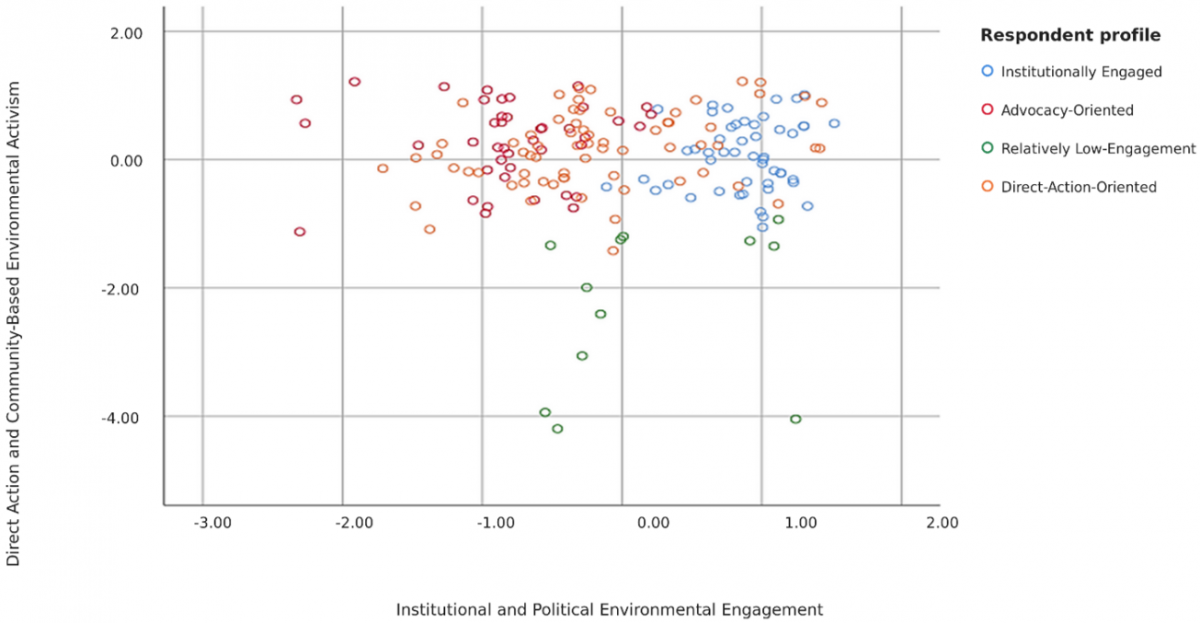
Table 9 presents the distances between final cluster centers and provides a descriptive picture of the relative levels of closeness among the four groups of respondents. Cluster 2 and Cluster 3 showed the greatest separation, whereas Cluster 2 and Cluster 4 were positioned more closely. These distances assist in interpreting the fitted solution but do not independently establish cluster validity. All inter-cluster distance values exceed one, suggesting that each cluster possesses distinct environmental activism characteristics. The greatest distance is observed between Cluster 2 and Cluster 3 (distance = 2.798), indicating the most pronounced contrast in patterns of environmental activism engagement. Cluster 2 is characterized by relatively high levels of advocacy and awareness dissemination, whereas Cluster 3 demonstrates low levels of engagement, particularly in direct action and community-based dimensions. The smallest distance is found between Cluster 2 and Cluster 4 (distance = 1.669), indicating a relative similarity between these two clusters. Nonetheless, meaningful differences remain in the forms of engagement, with Cluster 2 being more oriented toward advocacy and issue communication, while Cluster 4 places greater emphasis on direct action and community-based participation. The inter-cluster distances indicate some differences between the respondent profiles. The cluster solution needs to be interpreted in conjunction with the silhouette results and the degree of overlap shown in Figure 1.
The ANOVA results in Table 10 are descriptive because the K-means algorithm forms clusters by maximizing differences across the same variables included in the analysis. Consequently, the F-values and associated significance levels should not be interpreted as independent hypothesis tests. Instead, the F-values indicate the relative contribution of each dimension to differentiation within the fitted cluster solution. Institutional and Political Environmental Engagement showed the greatest relative discriminating contribution (F = 61.663), followed by Direct Action and Community-Based Environmental Activism (F = 54.835), Environmental Awareness and Advocacy (F = 35.677), and Environmental Education and Capacity Building (F = 28.141).
Table 10. ANOVA test result
|
|
Cluster |
Error |
F |
Sig. |
||
|
Mean Square |
df |
Mean Square |
df |
|||
|
Environmental Education and Capacity Building |
15.341 |
3 |
0.573 |
381 |
28.141 |
0.000 |
|
Environmental Awareness and Advocacy |
17.482 |
3 |
0.499 |
381 |
35.677 |
0.000 |
|
Institutional and Political Environmental Engagement |
23.591 |
3 |
0.384 |
381 |
61.663 |
0.000 |
|
Direct Action and Community-Based Environmental Activism |
23.965 |
3 |
0.434 |
381 |
54.835 |
0.000 |
Figure 1. Cluster mapping results of environmental activism behavior
Figure 1 shows partial overlap among the Institutionally Engaged, Advocacy-Oriented, and Direct-Action-Oriented profiles. This overlap indicates that the differences among these profiles are not fully captured by the two dimensions displayed in the figure. The Relatively Low-Engagement profile is more clearly separated, mainly because of its markedly lower score for Direct Action and Community-Based Environmental Activism. This pattern is consistent with the distances between the final cluster centers, where the largest distance was found between the Advocacy-Oriented and Relatively Low-Engagement profiles at 2.798. The smallest distance was observed between the Advocacy-Oriented and Direct-Action-Oriented profiles at 1.669, which helps explain their closer positions in the plotted space. Figure 1 should therefore be interpreted together with the four-dimensional cluster centers and the cluster-validation results.
4.2 Discussion
The findings indicate that Institutional and Political Environmental Engagement is the strongest dimension differentiating environmental activism clusters. This result suggests that formal participation channels remain a crucial characteristic of environmental activism. Previous research has found that government roles and political structures are closely related to environmental participation and engagement [26]. The prominence of this dimension further underscores the importance of institutional engagement as a form of variation in environmental activism.
The large descriptive F-values for Institutional and Political Environmental Engagement indicate that this dimension makes the largest relative contribution to differentiating respondent profiles. The Institutionally Engaged profile exhibits significantly stronger participation through formal and political channels than other profiles. Previous research has shown that transparent and responsive government policies can encourage public participation in environmental activities, particularly in developing countries [27]. The present findings are consistent with this perspective, as the most distinctive patterns of environmental activism were associated with institution-related forms of engagement. This may also help explain why initiatives focused solely on individual actions, such as reducing plastic use or conserving energy, do not always translate into broader collective participation. Government policies that provide opportunities for public involvement, supported by clear authority distribution and information transparency, have been identified as important mechanisms for connecting community initiatives with environmental governance processes [28]. The findings indicate that institutional and political forms of participation remain prominent features of environmental activism among the sampled respondents.
The findings further indicate that the cluster characterized by Direct Action and Community-Based Environmental Activism represents a prominent pattern within the identified environmental activism profiles. This result points to the importance of collective forms of participation, where engagement with environmental issues is expressed through community involvement, collaborative activities, and participation in organized environmental initiatives. Such forms of activism extend beyond individual actions and reflect efforts to pursue shared environmental objectives through collective engagement.
The growing use of digital technologies and internet-based communication has expanded opportunities for interaction among individuals with similar environmental interests. Online communities provide spaces where shared identities, values, and environmental concerns can be developed and maintained, supporting participation in environmental activism [29]. The prominence of this cluster is consistent with previous research emphasizing the significance of community networks and collective engagement in environmental movements [12]. Participation in community-based initiatives and activist organizations may provide opportunities for individuals to exchange knowledge, coordinate activities, and sustain involvement in environmental causes over time. These findings suggest that collective forms of engagement remain an important component of environmental activism and contribute to the diversity of activism patterns observed among respondents.
The study identifies a cluster characterized by Environmental Awareness and Advocacy that contributes to differentiating environmental activism profiles, although its influence is less pronounced than the institutional-political and community-based dimensions. This finding indicates that awareness-related forms of engagement constitute one component of environmental activism among respondents, but they are not the most distinctive feature of the clustering structure. The lower contribution of this dimension suggests that environmental activism is differentiated more strongly by patterns of institutional participation and collective action than by awareness and advocacy. Previous studies have noted that environmental awareness can emerge through everyday experiences and personal engagement with environmental issues, shaping how individuals understand and respond to environmental challenges [30].
The presence of this cluster is consistent with that perspective, indicating that awareness and advocacy remain relevant elements within environmental activism. At the same time, the comparatively lower contribution of this dimension may reflect variation in how environmental concerns are expressed and enacted across different groups. Research has shown that awareness alone does not always correspond to the same level or form of environmental engagement [31]. The findings therefore suggest that environmental awareness and advocacy represent meaningful, but comparatively less distinctive, dimensions of environmental activism among the respondents included in this study.
The findings identify Environmental Education and Capacity Building as the least influential dimension in differentiating the environmental activism clusters. Compared with the other dimensions, this factor contributed less to the variation observed among respondents, indicating that education- and capacity-building-related forms of engagement were less distinctive within the clustering structure. This result does not imply that environmental education is unimportant; rather, it suggests that educational activities and capacity-building efforts were not the primary characteristics distinguishing the identified patterns of environmental activism.
Previous research has emphasized the importance of environmental education in fostering environmental knowledge, awareness, and participation [32]. Educational experiences can provide individuals with opportunities to develop understanding of environmental issues and to engage with environmental concerns in more informed ways. Environmental education has likewise been associated with the development of values and competencies that support environmental engagement [33, 34]. The relatively limited contribution of this dimension indicates that education- and capacity-building-related activities were less prominent than institutional-political engagement and community-based action in differentiating environmental activism among the respondents. This finding points to the value of further examining how educational experiences are connected to different forms of environmental activism and participation [18].
This study mapped environmental activism in Indonesia by classifying respondents according to shared patterns of engagement. This study identified four respondent profiles, namely Institutionally Engaged, Advocacy-Oriented, Relatively Low-Engagement, and Direct-Action-Oriented. Each profile reflects a different pattern across the four dimensions of environmental activism. Institutional and Political Environmental Engagement contributed most strongly to the differences among the profiles, followed by Direct Action and Community-Based Environmental Activism. The results show that the four dimensions of environmental activism were reflected in distinct patterns of respondent engagement.
The clustering results suggest that variations in environmental activism among the respondents were associated more closely with institutional-political participation and community-based involvement than with educational and capacity-building activities. These findings show that environmental activism is not expressed through a single pattern of engagement but through multiple forms that differ across groups. Although Environmental Education and Capacity Building was the least differentiating dimension, its presence across the clustering structure indicates that education remains part of the broader landscape of environmental activism. Identifying these profiles provides practical guidance for environmental organizations in designing more targeted engagement strategies. Individuals in the Institutionally Engaged profile can be engaged through policy consultations and formal environmental awareness programs, while Advocacy-Oriented individuals can be encouraged through public communications and digital campaigns. Direct-Action-Oriented individuals can be directed to participate in conservation projects and community-based initiatives. For Relatively Low-Engagement profiles, governments or organizations can provide easily accessible educational activities to encourage stronger engagement in environmental action.
This study has several limitations. First, the sample used purposive sampling and was self-selected, with respondents primarily drawn from individuals active in environmental activities in major cities in Indonesia. The findings of this study reflect the characteristics of the respondents involved in the study and cannot be interpreted as estimates of the Indonesian population. Second, this study used self-reported cross-sectional data, potentially influenced by recall bias and social desirability bias. Third, the four-factor structure was obtained through EFA and still requires further confirmation through confirmatory factor analysis with an independent sample. Fourth, the cluster profiles were formed based on the same dimensions of environmental activism as those used in the clustering process and have not been validated using external indicators, such as demographic characteristics or independently observed environmental behaviors. Future studies could examine whether educational experiences are associated with different patterns of environmental activism identified in this study.
The data supporting the findings of this study are available from the authors upon request.
This study was financially supported by an international collaboration research project funded by the Indonesian Endowment Fund for Education (LPDP) on behalf of the Indonesian Ministry of Higher Education, Science and Technology, and managed under the EQUITY Program (Contract No. 4311/B3/DT.03.08/2025) and grant number 20.11.11/UN37/PPK.R01/2025.
Appendix A
Environmental Action Scale Items Adapted from Alisat and Riemer (2015).
1. Educated myself about environmental issues (e.g., through media, television, internet, blogs, etc.).
2. Participated in an educational event (e.g., workshop) related to the environment.
3. Organized an educational event (e.g., workshop) related to environmental issues.
4. Talked with others about environmental issues (e.g., spouse, partner, parent(s), children, or friends).
5. Used online tools, including social media platforms, video-sharing platforms, and online discussion forums, to raise awareness about environmental issues.
6. Used traditional methods (e.g., letters to the editor, articles) to raise awareness about environmental issues.
7. Personally wrote to or called a politician/government official about an environmental issue.
8. Became involved with an environmental group or political party.
9. Financially supported an environmental cause.
10. Took part in a protest/rally about an environmental issue.
11. Organized an environmental protest/rally.
12. Organized a boycott against a company engaging in environmentally harmful practices.
13. Organized a petition (including online petitions) for an environmental cause.
14. Consciously made time to be able to work on environmental issues (e.g., working part time to allow time for environmental pursuits, working in an environmental job, or choosing environmental activities over other leisure activities).
15. Participated in a community event which focused on environmental awareness.
16. Organized a community event which focused on environmental awareness.
17. Participated in nature conservation efforts (e.g., planting trees, restoration of waterways).
18. Spent time working with a group/organization that deals with the connection of the environment to other societal issues such as justice or poverty.
Appendix B
Demographic Characteristics of Respondents
|
Characteristic |
Category |
Frequency |
Percentage |
|
Gender |
Male |
178 |
46.2 |
|
Female |
207 |
53.8 |
|
|
Age |
18–24 years |
86 |
22.3 |
|
25–34 years |
137 |
35.6 |
|
|
35–44 years |
101 |
26.2 |
|
|
45 years or older |
61 |
15.8 |
|
|
Highest education |
Secondary school |
67 |
17.4 |
|
Diploma |
58 |
15.1 |
|
|
Bachelor’s degree |
196 |
50.9 |
|
|
Postgraduate degree |
64 |
16.6 |
|
|
Occupation |
Private-sector employee |
142 |
36.9 |
|
Civil servant/state-owned enterprise employee |
61 |
15.8 |
|
|
Entrepreneur/self-employed |
69 |
17.9 |
|
|
Student |
53 |
13.8 |
|
|
Professional |
38 |
9.9 |
|
|
Other |
22 |
5.7 |
|
|
Total |
385 |
100.0 |
[1] Krispenz, A., Bertrams, A. (2024). Understanding involvement in environmental activism: Relationships to pathological narcissistic grandiosity, virtue signaling, dominance, and sensation seeking. Current Psychology, 43(38): 30011-30026. https://doi.org/10.1007/s12144-024-06575-4
[2] Martono, S., Prajanti, S.D.W., Yulianto, A., Wijaya, A.P., Dwiningrum, S.I.A. (2024). Environmental activism: Analyzing the attitudes of eco-friendly consumers. Journal of Ecohumanism, 3(7): 2298-2308. https://doi.org/10.62754/JOE.V3I7.4380
[3] Veras, J.C., da Costa, M.F., de Oliveira Campos, P., da Silva, G.B. (2023). Generativity, environmental activism, and pride: Antecedents of intention to buy organic food. Journal of Cleaner Production, 418: 138114. https://doi.org/10.1016/j.jclepro.2023.138114
[4] Gabler, C.B., Eilert, M. (2024). Social institutions as enablers and inhibitors of environmental activism: A cross-cultural perspective. Journal of Consumer Affairs, 58(2): 663-691. https://doi.org/10.1111/joca.12578
[5] Knupfer, H., Neureiter, A., Matthes, J. (2023). From social media diet to public riot? Engagement with “greenfluencers” and young social media users' environmental activism. Computers in Human Behavior, 139: 107527. https://doi.org/10.1016/j.chb.2022.107527
[6] Fung, C.Y., Adams, E.A. (2017). What motivates student environmental activists on college campuses? An in-depth qualitative study. Social Sciences, 6(4): 134. https://doi.org/10.3390/socsci6040134
[7] Cao, F., Jian, Y. (2024). The role of integrating AI and VR in fostering environmental awareness and enhancing activism among college students. Science of the Total Environment, 908: 168200. https://doi.org/10.1016/j.scitotenv.2023.168200
[8] Subramanian, S.P. (2023). Evaluating the effectiveness of online environmental activism campaigns: Assessing the impact on public awareness and behavioral change. Journal of Intelligent Connectivity and Emerging Technologies, 8(3): 1-13.
[9] Tavárez, H., Abelleira, O., Elbakidze, L. (2024). Environmental awareness and willingness to pay for biodiversity improvement in Puerto Rico. Journal of Environmental Studies and Sciences, 14(1): 154-166. https://doi.org/10.1007/s13412-023-00869-y
[10] Culiberg, B., Cho, H., Kos Koklic, M., Zabkar, V. (2023). The role of moral foundations, anticipated guilt and personal responsibility in predicting anti-consumption for environmental reasons. Journal of Business Ethics, 182(2): 465-481. https://doi.org/10.1007/s10551-021-05016-7
[11] Droz, L. (2022). Challenging harmony to save nature: Environmental activism and ethics in Taiwan and Japan. International Journal for Crime, Justice and Social Democracy, 11(1): 58-70. https://doi.org/10.5204/IJCJSD.1969
[12] Baran, Z., Stoltenberg, D. (2023). Tracing the emergent field of digital environmental and climate activism research: A mixed-methods systematic literature review. Environmental Communication, 17(5): 453-468. https://doi.org/10.1080/17524032.2023.2212137
[13] Leroy, A., Bertoldo, R., Fointiat, V. (2024). Systematic review of environmental activism: Towards a new orientation for social psychology. European Psychologist, 29(3): 153. https://doi.org/10.1027/1016-9040/a000525
[14] Kountouris, Y., Williams, E. (2023). Do protests influence environmental attitudes? Evidence from Extinction Rebellion. Environmental Research Communications, 5(1): 011003. https://doi.org/10.1088/2515-7620/ac9aeb
[15] Ermolaeva, P., Yu, E., Basheva, O. (2020). Digital environmental activism as the new form of environmental participation. Sotsiologicheskoe Obozrenie/Russian Sociological Review, 19(3): 376-408. https://doi.org/10.17323/1728-192x-2020-3-376-408
[16] Cayolla, R., Escadas, M., McCullough, B.P., Biscaia, R., Cabilhas, A., Santos, T. (2023). Does pro-environmental attitude predicts pro-environmental behavior? Comparing sustainability connection in emotional and cognitive environments among football fans and university students. Heliyon, 9(11): e21758. https://doi.org/10.1016/j.heliyon.2023.e21758
[17] French, A., Naegler, L., Mythen, G. (2026). Environmental activism, emotions and the TikTok affect: ‘Can’t you hear the Earth screaming?’. Emotions and Society, 8(2): 280-297. https://doi.org/10.1332/26316897y2025d000000070
[18] Wolbring, G., Gill, S. (2023). Potential impact of environmental activism: A survey and a scoping review. Sustainability, 15(4): 2962. https://doi.org/10.3390/su15042962
[19] Lubell, M. (2002). Environmental activism as collective action. Environment and Behavior, 34(4): 431-454. https://doi.org/10.1177/00116502034004002
[20] San Cornelio, G., Martorell, S., Ardèvol, E. (2024). “It is the voice of the environment that speaks”, digital activism as an emergent form of environmental communication. Environmental Communication, 18(4): 375-389. https://doi.org/10.1080/17524032.2023.2296850
[21] Stern, P.C., Dietz, T., Abel, T., Guagnano, G.A., Kalof, L. (1999). A value-belief-norm theory of support for social movements: The case of environmentalism. Human Ecology Review, 6(2): 81-97.
[22] SGuin, C., Pelletier, L.G., Hunsley, J. (1998). Toward a model of environmental activism. Environment and Behavior, 30(5): 628-652. https://doi.org/10.1177/001391659803000503
[23] Alisat, S., Riemer, M. (2015). The environmental action scale: Development and psychometric evaluation. Journal of Environmental Psychology, 43: 13-23. https://doi.org/10.1016/j.jenvp.2015.05.006
[24] Hair, J.F., Black, W.C., Babin, B.J., Anderson, R.E. (2014). Multivariate Data Analysis (7th ed.). Pearson Education Limited.
[25] Ikotun, A.M., Ezugwu, A.E., Abualigah, L., Abuhaija, B., Heming, J. (2023). K-means clustering algorithms: A comprehensive review, variants analysis, and advances in the era of big data. Information Sciences, 622: 178-210. https://doi.org/10.1016/j.ins.2022.11.139
[26] Tam, K.P. (2020). Understanding the psychology X politics interaction behind environmental activism: The roles of governmental trust, density of environmental NGOs, and democracy. Journal of Environmental Psychology, 71: 101330. https://doi.org/10.1016/j.jenvp.2019.101330
[27] Peng, M., Zhong, X. (2021). When environmental activism meets local governance: The role of government transparency and responsiveness in China. Society & Natural Resources, 34(4): 484-504. https://doi.org/10.1080/08941920.2020.1846233
[28] Subašić, M., Birch, S., Fagan, A., Maltby, T. (2024). Activism in the era of democratic backsliding: Explaining the efficacy of the clean-air campaigns in Poland. Democratization, 31(8): 1866-1889. https://doi.org/10.1080/13510347.2024.2346109
[29] Koteyko, N., Atanasova, D. (2023). Community and identity in environmental activism on Twitter: A discourse-based approach. Bergen Language and Linguistics Studies, 13(1). https://doi.org/10.15845/bells.v13i1.3989
[30] Hernandez, M. (2025). Environmental justice in Latin America: Framing everyday environmentalism. Qualitative Sociology, 48(3): 413-433. https://doi.org/10.1007/s11133-025-09598-w
[31] Srisathan, W.A., Malai, K., Narathawaranan, N., Coochampoo, K., Naruetharadhol, P. (2024). The impact of citizen science on environmental attitudes, environmental knowledge, environmental awareness to pro-environmental citizenship behaviour. International Journal of Sustainable Engineering, 17(1): 360-378. https://doi.org/10.1080/19397038.2024.2354269
[32] Poškus, M.S. (2023). Political beliefs as a moderator for predicting environmental citizenship through environmental education and environmental literacy. Social Sciences, 13(1): 13. https://doi.org/10.3390/socsci13010013
[33] Slater, H., Fisher, J., Holmes, G., Keane, A. (2024). Mismatch between conservation higher education skills training and contemporary conservation needs. Conservation Science and Practice, 6(4): e13112. https://doi.org/10.1111/csp2.13112
[34] Boubaker, A., Shaheen, A., Yovogan, M., Mohamad, M., Rizvi, A.H., Kumar, A. (2025). Integrating the UN Sustainable Development Goals into engineering education: Pedagogical approaches and challenges. International Journal of Engineering Pedagogy, 15(8): 56-64. https://doi.org/10.3991/ijep.v15i8.59297