
Iyman Ouchouid* | Aicha El Alaoui
© 2026 The authors. This article is published by IIETA and is licensed under the CC BY 4.0 license (http://creativecommons.org/licenses/by/4.0/).
OPEN ACCESS
Climate change and low-carbon transitions have increased the importance of environmental taxation and clean energy technologies. This study systematically reviews research using Computable General Equilibrium (CGE) models to assess the environmental and economic effects of carbon taxation and green hydrogen, with particular relevance to Morocco. Following the PRISMA framework, a systematic search was conducted in Scopus and Web of Science (WoS), covering the period 2000–2026. After applying predefined inclusion and exclusion criteria, 43 records were retained, one of which was subsequently identified as a duplicate entry in the source export; the analysis is therefore based on 42 unique peer-reviewed studies. The findings indicate that carbon taxation generally reduces CO₂ emissions, although it can increase production costs and affect the competitiveness of some industries. Green hydrogen emerges as a promising pathway for decarbonization, energy-system transformation, and long-term competitiveness. However, outcomes depend on economic structures, policy design, and modelling assumptions. The review identifies limited evidence for developing countries and few studies integrating carbon taxation and green hydrogen within a single CGE framework, highlighting priorities for future research in Morocco.
carbon tax, Computable General Equilibrium model, green growth, green hydrogen, Morocco, systematic literature review
Climate change is among the most critical challenges facing contemporary economies. The continuous rise in greenhouse gas (GHG) emissions, driven primarily by intensive fossil fuel use, generates increasingly significant environmental, economic, and social consequences [1]. In response, the international community has strengthened its commitment to a low-carbon transition: the 2015 Paris Agreement set the objective of keeping the increase in global average temperature well below 2 ℃, pursuing efforts toward 1.5 ℃ above pre-industrial levels [2], and many countries have since adopted carbon neutrality strategies for the mid-twenty-first century [3].
Among the policy instruments designed to achieve these objectives, environmental taxation occupies a central position. Rooted in the Pigouvian principle of internalizing negative externalities [4], the carbon tax has become one of the most widely adopted carbon pricing mechanisms, imposing an explicit cost on CO₂ emissions and encouraging cleaner practices [5]. A growing body of literature suggests that carbon pricing can effectively reduce emissions while stimulating technological innovation [6], although its economic implications for competitiveness, employment, and growth remain widely debated.
Alongside these fiscal instruments, green hydrogen is increasingly recognized as a strategic technology for long-term decarbonization. Produced through water electrolysis powered by renewable electricity, it is considered a promising energy carrier for reducing emissions in hard-to-abate sectors such as heavy industry, freight transport, and fertilizer manufacturing [7, 8], and is also viewed as a catalyst for industrial competitiveness, energy security, and new global value chains [9].
Within this context, Morocco has emerged as a particularly proactive actor in the energy transition. Since its 2009 National Energy Strategy, the country has invested substantially in renewable energy, with large-scale solar and wind projects positioning it among regional leaders. More recently, the “Morocco Green Hydrogen Offer” has reinforced its ambition to become a regional and international hub for green hydrogen production and export, while the gradual introduction of carbon pricing instruments, particularly in response to the EU’s Carbon Border Adjustment Mechanism (CBAM), has increased the need to assess the combined effects of environmental taxation and green hydrogen on the Moroccan economy.
Despite the extensive literature on climate policies, important research gaps remain. Computable General Equilibrium (CGE) models have widely examined the impacts of carbon taxes and energy transition policies, but most studies treat environmental taxation and emerging technologies such as green hydrogen separately. Research incorporating both dimensions remains limited, especially in developing countries and the African context, making it difficult to assess their interactions within a single framework. This study therefore conducts a systematic literature review (SLR) of CGE-based research on environmental taxation and green hydrogen, guided by the question: How can evidence from CGE studies on environmental taxation and green hydrogen be synthesized to provide policy insights for green growth in Morocco?
A related review by Mueller and Gronau [10] examines CGE applications to hydrogen, covering 18 hydrogen-related and 27 aviation-focused studies, and identifies gaps partly overlapping with those raised here, notably the limited representation of green hydrogen, the scarcity of studies on hydrogen transport and storage, and the near-absence of Global South countries from country-level analyses. The present review differs in three respects: it is not restricted to aviation, reviewing 42 studies across all sectors where carbon taxation and green hydrogen interact; it centers explicitly on their joint treatment within CGE frameworks; and it extends the geographical diagnosis of Mueller and Gronau [10] into an explicit policy-oriented discussion of Morocco, a country pursuing both carbon pricing and large-scale green hydrogen development simultaneously.
This study thus contributes a systematic synthesis of CGE-based evidence on environmental taxation and energy transition strategies, identifies converging and diverging findings on their impacts, and draws insights to inform future CGE applications integrating carbon taxation and green hydrogen for green growth in Morocco.
Understanding the relationships among environmental taxation, green hydrogen, and green growth requires a conceptual framework that jointly captures the economic, energy, and environmental dimensions of the ecological transition. As climate change intensifies and more countries commit to carbon-neutrality objectives, policymakers increasingly combine economic instruments to reduce emissions with technological innovation to decarbonize production systems. CGE models provide a particularly suitable framework for examining the macroeconomic, sectoral, and environmental consequences of these transformations; this section reviews the theoretical foundations of environmental taxation, the strategic role of green hydrogen, and the contribution of CGE models, before proposing an integrated conceptual framework.
2.1 Theoretical foundations of environmental taxation and climate policies
Environmental taxation originates from the theory of externalities developed by Pigou and Aslanbeigui [4], who argued that social costs not reflected in market prices require public intervention to restore economic efficiency; GHG emissions represent such a negative externality [11, 12]. Carbon pricing has since emerged as one of the most important climate policy instruments, with the carbon tax occupying a central role by assigning an explicit cost to CO₂ emissions, altering relative prices, and generating adjustments in production, investment, and consumption that spread throughout the economy [5, 13, 14].
The literature has extensively examined these policies through the double-dividend hypothesis, whereby revenues from environmental taxes can be recycled to reduce other distortionary taxes, potentially delivering both environmental and economic benefits [15, 16]; however, the magnitude of these gains depends largely on institutional settings and the mechanisms used to redistribute revenues [6].
2.2 Green hydrogen in energy transition strategies
Alongside carbon pricing, green hydrogen is increasingly recognized as one of the most promising technologies for achieving climate neutrality. Produced through water electrolysis powered by renewable electricity, it offers a carbon-free energy carrier for sectors that are difficult to electrify directly, including steelmaking, chemicals, maritime transport, aviation, and fertilizer manufacturing [7, 8, 17], while also generating economic opportunities such as innovation, investment, job creation, and enhanced energy security [9]. Its deployment, however, depends heavily on the climate policy environment: by raising the relative cost of fossil fuels, carbon pricing improves the competitiveness of low-carbon alternatives and encourages their diffusion [18].
Despite its growing importance, explicit integration of green hydrogen into macroeconomic models remains limited: many studies aggregate it with other renewable technologies or treat it as exogenous, restricting the assessment of its specific economic impacts [19]. This limitation is particularly evident in developing countries, where research on the interactions between green hydrogen, climate policy, and economic development remains scarce [20].
2.3 Computable General Equilibrium models as a tool for climate policy assessment
CGE models are grounded in the neoclassical theory of general equilibrium developed by Arrow and Debreu [21], providing a coherent framework for representing interactions among households, firms, governments, and the rest of the world while ensuring simultaneous equilibrium across goods, services, and factor markets [22, 23]. Unlike partial equilibrium models, which focus on a single market, CGE models capture both direct and indirect effects of economic or regulatory shocks on production, consumption, income, employment, trade, and welfare [24, 25].
This feature makes CGE models particularly well suited for evaluating climate policies, since a carbon tax affects not only energy sectors but the entire economy through substitution effects among production factors and energy sources [26]. CGE models also allow researchers to assess the macroeconomic consequences of new energy technologies, green investment, and sectoral decarbonization strategies [27, 28], and despite certain modeling limitations, they remain among the most widely used tools for analyzing climate and energy policy.
2.4 Toward an integrated framework: Environmental taxation, green hydrogen, and green growth
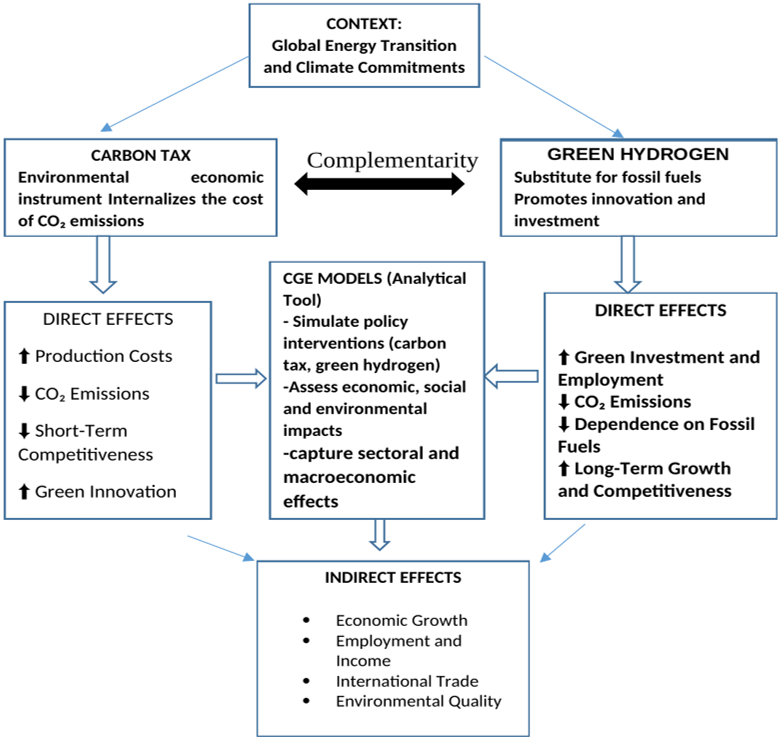
The transition toward a low-carbon economy relies on a combination of economic instruments and technological transformation, in which environmental taxation and green hydrogen act as complementary decarbonization drivers: carbon pricing alters market incentives by raising the relative cost of fossil fuels, while green hydrogen offers a technological alternative for transforming energy and industrial systems. CGE models are particularly well suited to analyzing this complementarity, as they can jointly incorporate fiscal instruments, energy technologies, and sectoral interactions to evaluate combined effects on growth, employment, investment, competitiveness, and emissions [23]. Nevertheless, relatively few studies examine environmental taxation and green hydrogen within a unified modeling framework, a gap that is especially important for emerging economies pursuing growth, energy security, and decarbonization simultaneously; a systematic synthesis is therefore needed to identify key lessons and support the development of CGE models tailored to the Moroccan context. Figure 1 summarizes this integrated framework and its links to environmental taxation, green hydrogen, and green growth in Morocco.
SLR was conducted to identify, classify, and synthesize evidence on the application of CGE models to the economic and environmental effects of carbon taxation and green hydrogen, and their contribution to green growth. This study follows the PRISMA 2020 guidelines, the international reference framework for conducting and reporting systematic reviews, ensuring a transparent, rigorous, and reproducible methodology that minimizes selection bias.
The literature search was conducted using the Scopus and Web of Science (WoS) databases, covering the period 2000–2026 through the end of July 2026 (so the 2026 figures reported below cover only the first seven months of that year). The following Boolean search query was applied:
("environmental tax" OR "carbon tax" OR "carbon pricing") AND ("green hydrogen" OR "hydrogen") AND ("computable general equilibrium" OR "CGE model")
The query was applied against the Title, Abstract and Keywords fields (Scopus’ TITLE-ABS-KEY; the equivalent Topic field in WoS), which is why several included studies focused primarily on carbon taxation are retrieved through a hydrogen-related keyword rather than a hydrogen-focused abstract. The search was restricted to peer-reviewed English-language journal articles published between 2000 and 2026 in the subject areas of Energy, Environmental Science, Economics, Econometrics, and Finance; the complete strategy is presented in Table 1.
Table 1. Literature search strategy
|
Item |
Description |
|
Databases |
Scopus; Web of Science (WoS) |
|
Search period |
2000–2026 |
|
Search query |
("environmental tax" OR "carbon tax" OR "carbon pricing") AND ("green hydrogen" OR "hydrogen") AND ("computable general equilibrium" OR "CGE model") |
|
Subject areas |
Energy; Environmental Science; Economics; Econometrics; Finance |
|
Document type |
Peer-reviewed journal articles |
|
Language |
English |
Table 2. Inclusion and exclusion criteria
|
Inclusion Criteria |
Exclusion Criteria |
|
Empirical research articles published in peer-reviewed academic journals |
Review articles |
|
Studies employing Computable General Equilibrium (CGE) models as the primary analytical framework |
Studies using modelling approaches other than Computable General Equilibrium (CGE) models |
|
Studies simultaneously addressing (i) at least one climate-related fiscal or pricing instrument (e.g., carbon tax, carbon pricing, ETS, CBAM) and (ii) at least one hydrogen-related term (in the title, abstract, or keywords), consistent with the three-term AND search strategy in Table 1; hydrogen need not be the study's primary focus |
Studies addressing only one of the two dimensions above — a climate-related fiscal or pricing instrument with no hydrogen-related term, or hydrogen/energy-transition content with no climate-related fiscal or pricing instrument |
|
Articles published within the selected study period (2000–2026) |
Articles published outside the selected study period |
Following identification, all records were exported and screened to remove duplicates, then assessed through title/abstract screening and full-text examination against predefined eligibility criteria. Studies were included only if they employed CGE models as the primary analytical framework and explicitly examined carbon taxation, carbon pricing, green hydrogen or related climate policy instruments; review papers, conference proceedings, editorials, book chapters, non-English publications, and non-CGE studies were excluded (Table 2).
The selection process followed the four PRISMA 2020 phases (identification, screening, eligibility, inclusion), illustrated in Figure 2.
4.1 Temporal distribution of Computable General Equilibrium studies on carbon taxation and green hydrogen
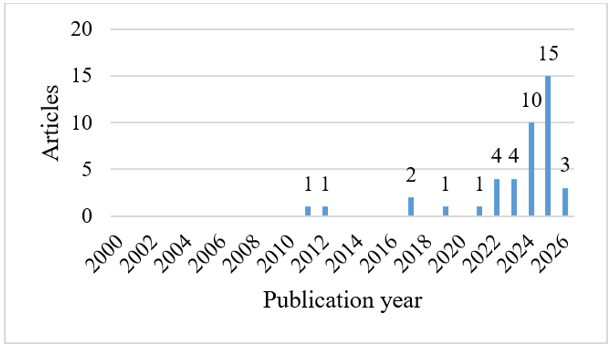
The temporal distribution of the 42 studies is shown in Figure 3. The earliest was published by Dai et al. [29], followed by Chan et al. [30]; publication activity remained limited through the following years, with only two studies in 2017 [31, 32] and one in 2019 [33], indicating that CGE applications to carbon taxation and green hydrogen were still at an early stage.
Publication activity increased gradually from 2021 [34], with four studies in both 2022 and 2023. The most significant growth occurred during 2024–2026, rising to 10 studies in 2024 and peaking at 15 in 2025, with three studies in the partial year 2026 (covering only January–July, when the search was conducted, and therefore not directly comparable to the complete annual totals for 2021–2025). Overall, these results reveal a rapidly growing interest in applying CGE models to carbon taxation, carbon pricing, and green hydrogen, although studies jointly examining both dimensions within a unified framework remain limited, particularly for Morocco.
4.2 Distribution of the selected Computable General Equilibrium studies by journal discipline
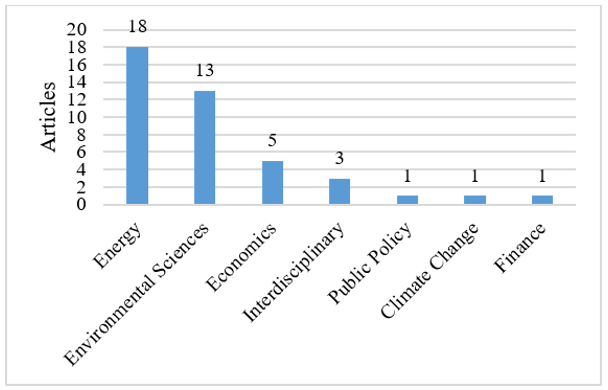
The 42 studies were published in 25 peer-reviewed journals, classified into seven disciplines: Energy, Environmental Sciences, Economics, Interdisciplinary Studies, Public Policy, Climate Change, and Finance. As shown in Figure 4, Energy journals account for the largest share (18 articles, 42.9%), followed by Environmental Sciences (13 articles, 31.0%); together these two disciplines represent nearly three-quarters of the sample, reflecting the dominant role of energy and environmental research in this literature.
Economics accounts for five articles (11.9%) and Interdisciplinary Studies for three (7.1%), with Public Policy, Climate Change, and Finance each represented by one article (2.4%). Research on carbon taxation and green hydrogen using CGE models therefore remains primarily concentrated in energy and environmental sciences, while gradually expanding into other fields.
4.3 Geographical distribution of the selected Computable General Equilibrium studies
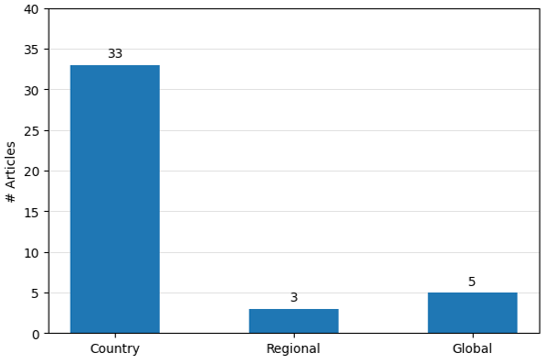
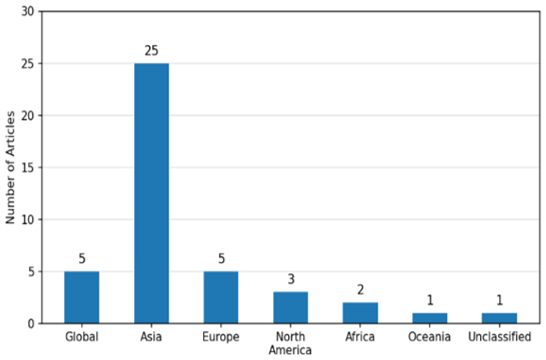
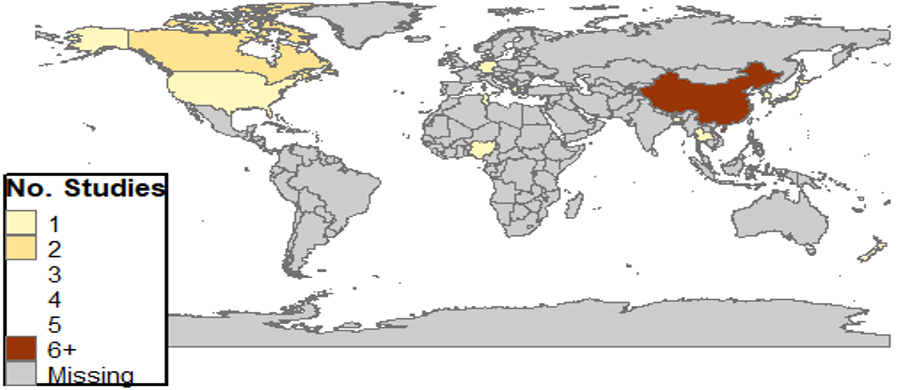
As illustrated in Figure 5, the geographical distribution of the 42 studies was examined at three levels: geographical scope (country, regional, or global; Figure 5(a)), continental focus (Figure 5(b)), and, for country-level studies, world-map distribution (Figure 5(c)).
Figure 5(a) shows that the literature is dominated by country-level analyses (33 of 42 studies, ~78.6%); only three studies adopt a regional perspective (mainly the EU and Zhejiang Province, China) and five use a global CGE framework. This predominance reflects the need to capture country-specific economic structures, energy systems, and policy environments when evaluating carbon taxation, emissions trading, and green hydrogen strategies.
(a) From country to global
(b) By continent
(c) For the 33 country-level studies
At the continental level (Figure 5(b)), Asia dominates with 25 studies, followed by global analyses and Europe (five each), North America (three), and Africa and Oceania (two and one, respectively). Chang [35] is not assigned to any continent or country: full-text verification confirms this study develops a purely theoretical game-theoretic model with no Social Accounting Matrix, Input–Output table or GTAP calibration, and is therefore excluded from the country-level count on structural grounds rather than by omission. Among the 33 country-level studies (Figure 5(c)), China dominates with 20 studies — the 18 explicitly stated in their abstracts plus two confirmed through full-text verification during this revision (Yu et al. [36], calibrated on China's SAM and 2018 Input–Output Table; Li et al. [37], on China's cement industry). Canada is represented by two studies, and the United States, Germany, Greece, the Netherlands, Japan, South Korea, Thailand, Bangladesh, Tunisia, Nigeria, and New Zealand by one each. Large parts of Latin America, the Middle East, and most African countries remain unexplored, and no study specifically investigates Morocco; this reflects the specific intersection targeted by the search strategy rather than an absence of Moroccan CGE research overall — the gap this review identifies is the absence of a CGE model jointly integrating carbon taxation with a dedicated green-hydrogen value chain for Morocco.
4.4 Characteristics of the Computable General Equilibrium models
The reviewed studies reveal a marked evolution in CGE model design for carbon neutrality and energy transition policies. Early studies mainly relied on static CGE models to assess short-term effects of carbon taxation [29, 38, 39], while recent research increasingly adopts recursive dynamic frameworks capturing capital accumulation, technological progress, and long-term structural adjustments [40-43]. Most models are calibrated using Social Accounting Matrices and Input–Output Tables, often complemented by the GTAP database for multi-regional analyses [34, 44, 45].
Several studies also move beyond conventional CGE models, integrating them with energy system optimisation, life cycle assessment (LCA), or engineering models to better represent emerging technologies such as renewable energy, carbon capture and storage (CCS), and green hydrogen [40, 46-48], reflecting a growing consensus that hybrid, dynamic CGE models offer a more comprehensive framework for assessing integrated climate policy portfolios.
4.5 Carbon policy instruments
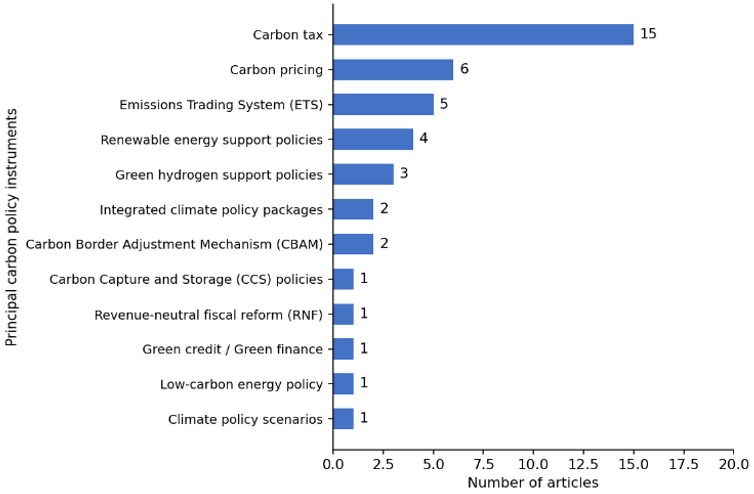
Carbon taxation remains the dominant instrument in CGE modelling, accounting for 15 of the 42 studies (35.7%) (Figure 6); these studies mainly examine its effectiveness in reducing emissions while maintaining growth, and several conclude that well-designed carbon taxes can significantly cut CO₂ emissions with limited adverse macroeconomic effects, particularly alongside complementary fiscal or technological measures [29, 38, 39, 49-51]. Market-based approaches are the second most common category: carbon pricing mechanisms account for 6 studies (14.3%) and Emissions Trading Systems (ETS) for 5 (11.9%), generally regarded as cost-effective for incentivizing cleaner production [31, 32, 34, 41, 44, 45]; several comparative studies find that combining carbon taxes with ETS outperforms single-policy approaches [38, 49].
Complementary climate policies are also prominent: renewable energy support (subsidies, FIT, RPS) accounts for 4 studies (9.5%) and green hydrogen support for 3 (7.1%) [40, 46, 52], while low-carbon energy and climate policy scenarios each account for one study (2.4%). More recent contributions incorporate integrated climate policy packages, CBAM, CCS, green finance, and revenue-neutral fiscal reforms (2.4–4.8% each), illustrating the ongoing evolution of CGE modelling toward more comprehensive, multidimensional climate policy frameworks.
4.6 Green hydrogen integration
Despite its growing recognition as a pillar of carbon neutrality strategies, the integration of green hydrogen into CGE models remains at an early stage: only a limited number of the 42 reviewed studies explicitly incorporate hydrogen production or hydrogen-related policies [40, 46, 52-54], typically modelling it as an emerging clean energy carrier supporting industrial decarbonization or fossil-fuel substitution in hard-to-abate sectors. Most authors focus on policy incentives, investment support, or technological progress rather than a full hydrogen value chain: Lee et al. [40] analysed hydrogen diffusion under alternative carbon tax scenarios, Wei [52] examined combined supply- and demand-side hydrogen policies, Koutsandreas and Keppo [46] emphasized hydrogen's contribution to long-term carbon neutrality, and Su et al. [54] showed hydrogen development becomes considerably more effective when combined with carbon pricing — suggesting hydrogen is generally treated as a complementary component of decarbonization strategies rather than a fully integrated economic sector.
The explicit representation of green hydrogen therefore remains a key methodological challenge: most studies assess its impacts through policy scenarios without modelling production processes, intermediate demand, sectoral interactions, or integration into the Social Accounting Matrix, a limitation particularly evident in developing and emerging economies where hydrogen-related activities are rarely represented in national calibration databases. Future research should move beyond policy simulations by incorporating dedicated hydrogen production sectors and value chains into climate-oriented CGE models, providing more robust evidence on the interactions between green hydrogen, carbon pricing, renewable electricity expansion, and structural economic transformation.
4.7 Main findings of the reviewed studies
The 42 reviewed studies provide consistent evidence that well-designed climate policies can reconcile environmental objectives with economic performance, although effectiveness depends on policy design, technological readiness, and country-specific conditions. Carbon taxation and broader carbon pricing remain the most widely investigated instruments, with most studies reporting substantial CO₂ reductions through changes in energy consumption, efficiency gains, and fuel substitution [29, 36, 39, 49]; however, environmental benefits can carry economic costs when carbon prices become excessive, and several authors argue that moderate prices combined with effective revenue recycling are more likely to achieve the double dividend [38, 44, 50]. A further key conclusion is that no single climate policy is sufficient for carbon neutrality: the literature increasingly advocates integrated portfolios combining carbon pricing or ETS with renewable incentives, technological innovation, CCS, efficiency measures, and public investment, which in most paired-scenario studies outperform isolated instruments by delivering larger emission reductions with lower adjustment costs [42, 45, 48, 49, 55]; the way carbon revenues are recycled also plays a decisive role in investment, employment, and social welfare, and thus in the political acceptability of climate policies [44, 45, 50].
Several studies provide direct quantitative support: in China, Wen and Jia [41] found that combining an ETS with an energy-efficiency policy yields an additional 1.2 percentage points of CO₂ reduction while cutting economic losses by 4.2% relative to either instrument alone; Xu and Liu [56] showed that, once complementary policies are combined, a carbon tax of only 25 CNY/tCO₂ cuts carbon intensity by over 90% — an outcome that a single-instrument regime only reaches above 250 CNY/tCO₂; and Shen and Zhao [38] reported that a moderate tax (10–30 CNY/t) combined with an operational trading scheme raises government revenue while limiting welfare and investment losses. Outside China, Suárez-Cuesta et al. [44] showed carbon pricing combined with capital-tax revenue recycling cuts U.S. CO₂ emissions by 6.2% with almost no GDP loss (versus 3.9% under subsidies alone), and Elberry et al. [47] found an integrated renewables-and-hydrogen transition raises Dutch GDP by 1.7% by 2050. Similar portfolio-dominance patterns are reported by Yang et al. [55], Shi et al. [57], Li et al. [37], Su et al. [54], Wang et al. [58], Zhou et al. [48], and Wen et al. [59], across instruments ranging from renewable-support schemes to multi-energy system optimisation.
Several studies address model uncertainty explicitly — Monte Carlo simulation [60], stochastic multi-stage programming [61], and sensitivity analysis on elasticities and learning rates [59, 62, 63]—though Liu et al. [43], evaluating 1,295 policy-scenario combinations for China, offer a counter-example: once interactions between carbon pricing, efficiency, renewables, and electrification are modelled explicitly, only renewable expansion paired with end-use electrification remains consistently synergistic, while several other combinations reduce pathways reaching carbon neutrality by 2060 by roughly 84%. Integrated portfolios thus tend to outperform isolated instruments, but conditionally on which instruments are combined and how their interactions are modelled. The review also highlights growing attention to technologies beyond renewable electricity—green hydrogen, sustainable aviation fuels, Power-to-Liquid, and CCS—for hard-to-abate sectors such as steel, chemicals, aviation, and heavy transport [40, 47, 52, 53, 64], though large-scale deployment depends on continued technological progress, supportive regulation, and infrastructure investment. Taken together, these findings suggest that the transition toward carbon neutrality is driven not by individual instruments but by the interaction between carbon pricing, technological innovation, and clean energy development, with coordinated policy packages offering the most balanced pathway for reducing emissions while preserving competitiveness and supporting sustainable development.
4.8 Implications for Morocco
Beyond the general lessons drawn from the reviewed literature, the findings carry specific implications for how a future CGE model of environmental taxation and green hydrogen should be designed for Morocco. Likely sensitive sectors: Morocco's exposure to carbon pricing and to the EU's CBAM is unevenly distributed across the economy. Energy-intensive manufacturing (cement, chemicals, basic metals), transport and logistics, the fertilizer value chain—where Morocco holds a globally significant position—and export-facing industries linked to European value chains (automotive components, textiles) are the segments most likely to face first-round cost increases and CBAM-related competitiveness pressure. A Morocco-focused CGE model should therefore disaggregate these sectors explicitly rather than treating industry as a single aggregate, consistent with this review's finding that sector-level results depend heavily on model disaggregation (Section 4.4).
Sequencing logic: the reviewed evidence on the double-dividend hypothesis and revenue recycling (Sections 2.1 and 4.7) indicates that the design and sequencing of carbon pricing instruments matter as much as their existence. For Morocco, a defensible sequencing would combine a gradually phased-in carbon price kept below the threshold at which adverse competitiveness effects appear; an explicit revenue-recycling mechanism (e.g., reduced labor taxation or targeted transfers to exposed households and firms) introduced concurrently with the carbon price; and hydrogen infrastructure investment (electrolysis capacity, renewable generation, port and pipeline infrastructure) timed to come online as carbon pricing begins to alter relative fuel prices, so the fiscal instrument and the technological alternative reinforce one another.
Priorities for a Moroccan CGE model: building on the methodological gaps identified in Sections 4.6 and 5, a first-generation model jointly integrating carbon taxation and green hydrogen should prioritize a dedicated hydrogen production sector rather than an exogenous shock or generic renewables aggregate; explicit trade linkages capturing both hydrogen exports and CBAM-exposed sectors; labor-market effects across skill levels, given Morocco's structural employment challenges; and a menu of fiscal-recycling options comparable within the same framework. Constructing a climate-oriented Social Accounting Matrix (Climate-SAM) that separately identifies hydrogen production and carbon-tax revenue flows is a necessary first step, consistent with the data gap identified in Section 5.
This systematic review synthesized the findings of 42 CGE studies investigating carbon pricing policies, climate change mitigation, and the transition toward carbon neutrality, showing growing academic interest in using CGE models to evaluate economy-wide climate policy impacts, particularly over the last decade. Most studies rely on recursive dynamic CGE models calibrated with Social Accounting Matrices and examine the effectiveness of carbon taxes, ETSs, and other market-based instruments in reducing emissions while maintaining economic performance; more recent contributions expand this scope by incorporating renewable energy deployment, CCS, and, to a lesser extent, green hydrogen. The review further demonstrates that integrated climate policy packages generally outperform individual instruments: rather than relying on carbon pricing alone, many recent studies emphasize combining carbon taxes or emissions trading with renewable energy support, technological innovation, and targeted public investment, providing greater emission reductions while limiting macroeconomic adjustment costs.
Despite these advances, important research gaps remain. Green hydrogen is rarely integrated into CGE models as a fully specified production sector rather than an emerging technology; climate-oriented Social Accounting Matrices (Climate-SAMs) remain uncommon; and the literature remains heavily concentrated on China, Europe, and other developed economies. In particular, while a smaller literature already applies CGE models to carbon taxation, cap-and-trade, and green fiscal policy in Morocco, none of the 42 reviewed studies integrates carbon taxation with a dedicated green-hydrogen value chain for the country — this joint integration, rather than the absence of Moroccan CGE research per se, is the defensible gap that Morocco's ambitious renewable energy, green hydrogen, and carbon-neutrality commitments make most urgent to fill. Future research should therefore develop more detailed, policy-oriented CGE frameworks that explicitly integrate green hydrogen value chains, climate-oriented SAMs, and emerging low-carbon technologies, providing more robust evidence to support coherent climate policies and Morocco's long-term sustainable development strategy.
The authors would like to express sincere thanks to Morocco's National Center for Scientific and Technical Research (CNRST) for its support through the PhD-Associate Scholarship (PASS) program, which contributed to the completion of this work. During the preparation of this manuscript, the author also used AI-assisted tools for language refinement and structural improvement. The author carefully reviewed and edited all AI-assisted outputs and takes full responsibility for the content of this publication.
[1] IPCC. (2023). Climate change 2023: Synthesis report. https://doi.org/10.59327/IPCC/AR6-9789291691647
[2] UNFCCC. (2015). The Paris agreement. https://unfccc.int/sites/default/files/resource/parisagreement_publication.pdf.
[3] IEA. (2021). Net zero by 2050: A roadmap for the global energy sector. International Energy Agency. https://doi.org/10.1787/c8328405-en
[4] Pigou, A.C., Aslanbeigui, N. (2017). The Economics of Welfare. Routledge. https://doi.org/10.4324/9781351304368
[5] Goulder, L.H., Schein, A.R. (2013). Carbon taxes versus cap and trade: A critical review. Climate Change Economics, 4(3): 1350010. https://doi.org/10.1142/S2010007813500103
[6] Parry, I., Veung, C., Heine, D. (2015). How much carbon pricing is in countries’ own interests? The critical role of co-benefits. Climate Change Economics, 6(4): 1550019. https://doi.org/10.1142/S2010007815500190
[7] IRENA. (2020). Green hydrogen: A guide to policy making. https://www.irena.org/publications/2020/Nov/Green-hydrogen.
[8] IEA. (2019). The future of hydrogen: Seizing today's opportunities. https://www.iea.org/reports/the-future-of-hydrogen.
[9] Ajanovic, A., Sayer, M., Haas, R. (2024). On the future relevance of green hydrogen in Europe. Applied Energy, 358: 122586. https://doi.org/10.1016/j.apenergy.2023.122586
[10] Mueller, T., Gronau, S. (2023). Fostering macroeconomic research on hydrogen-powered aviation: A systematic literature review on general equilibrium models. Energies, 16(3): 1439. https://doi.org/10.3390/en16031439
[11] Baumol, W.J., Oates, W.E. (1988). The Theory of Environmental Policy. Cambridge University Press. https://doi.org/10.1017/CBO9781139173513
[12] Azar, C. (1997). Book review: Managing the global commons: The economics of climate change. Environmental Values, 6(1): 106-108. https://doi.org/10.1177/096327199700600109
[13] Bovenberg, A.L., De Mooij, R.A. (1994). Environmental levies and distortionary taxation. The American Economic Review, 84(4): 1085-1089.
[14] Fullerton, D., Metcalf, G. (1997). Environmental taxes and the double-dividend hypothesis: Did you really expect something for nothing? National Bureau of Economic Research. https://doi.org/10.3386/w6199
[15] Goulder, L.H. (1995). Environmental taxation and the double dividend: A reader's guide. International Tax and Public Finance, 2(2): 157-183. https://doi.org/10.1007/BF00877495
[16] Bovenberg, A.L., Goulder, L.H. (1996). Optimal environmental taxation in the presence of other taxes: General-equilibrium analyses. The American Economic Review, 86(4): 985-1000.
[17] Staffell, I., Scamman, D., Velazquez Abad, A., et al. (2019). The role of hydrogen and fuel cells in the global energy system. Energy & Environmental Science, 12(2): 463-491. https://doi.org/10.1039/C8EE01157E
[18] Kriegler, E., Bauer, N., Popp, A., et al. (2018). Fossil-fueled development (SSP5): An energy and resource intensive scenario for the 21st century. Global Environmental Change, 42: 297-315. https://doi.org/10.1016/j.gloenvcha.2016.05.015
[19] Pfenninger, S., Hawkes, A., Keirstead, J. (2014). Energy systems modeling for twenty-first century energy challenges. Renewable and Sustainable Energy Reviews, 33: 74-86. https://doi.org/10.1016/j.rser.2014.02.003
[20] Popp, D., Newell, R.G., Jaffe, A.B. (2010). Energy, the environment, and technological change. In Handbook of the Economics of Innovation, pp. 873-937. Elsevier. https://doi.org/10.1016/S0169-7218(10)02005-8
[21] Arrow, K.J., Debreu, G. (1954). Existence of an equilibrium for a competitive economy. Econometrica, 22(3): 265-290. https://doi.org/10.2307/1907353
[22] Shoven, J.B., Whalley, J. (1992). Applying General Equilibrium. Cambridge University Press.
[23] Burfisher, M.E. (2011). Introduction to Computable General Equilibrium Models. Cambridge University Press. https://doi.org/10.1017/CBO9780511975004
[24] Böhringer, C., Rutherford, T.F. (2008). Combining bottom-up and top-down. Energy Economics, 30(2): 574-596. https://doi.org/10.1016/j.eneco.2007.03.004
[25] Wing, I.S. (2004). Computable general equilibrium models and their use in economy-wide policy analysis. Joint Program Technical Note No. 6.
[26] Dixon, P.B., Jorgenson, D. (Eds.) (2012). Handbook of Computable General Equilibrium Modeling. Elsevier.
[27] Aaheim, A., Amundsen, H., Dokken, T., Wei, T. (2012). Impacts and adaptation to climate change in European economies. Global Environmental Change, 22(4): 959-968. https://doi.org/10.1016/j.gloenvcha.2012.06.005
[28] Dellink, R., Lanzi, E., Chateau, J. (2019). The sectoral and regional economic consequences of climate change to 2060. Environmental and Resource Economics, 72(2): 309-363. https://doi.org/10.1007/s10640-017-0197-5
[29] Dai, H., Masui, T., Matsuoka, Y., Fujimori, S. (2011). Assessment of China's climate commitment and non-fossil energy plan towards 2020 using hybrid AIM/CGE model. Energy Policy, 39(5): 2875-2887. https://doi.org/10.1016/j.enpol.2011.02.062
[30] Chan, G., Reilly, J.M., Paltsev, S., Chen, Y.H.H. (2012). The Canadian oil sands industry under carbon constraints. Energy Policy, 50: 540-550. https://doi.org/10.1016/j.enpol.2012.07.056
[31] Lin, B., Jia, Z. (2017). The impact of emission trading scheme (ETS) and the choice of coverage industry in ETS: A case study in China. Applied Energy, 205: 1512-1527. https://doi.org/10.1016/j.apenergy.2017.08.098
[32] Li, W., Jia, Z., Zhang, H. (2017). The impact of electric vehicles and CCS in the context of emission trading scheme in China: A CGE-based analysis. Energy, 119: 800-816. https://doi.org/10.1016/j.energy.2016.11.059
[33] Morris, J.F., Reilly, J.M., Chen, Y.H.H. (2019). Advanced technologies in energy-economy models for climate change assessment. Energy Economics, 80: 476-490. https://doi.org/10.1016/j.eneco.2019.01.034
[34] Paltsev, S., Ghandi, A., Morris, J., Chen, H. (2022). Global electrification of light-duty vehicles. Economics of Energy & Environmental Policy, 11(1): 165-192. https://doi.org/10.5547/2160-5890.11.1.spal
[35] Chang, M.C. (2022). Carbon tax effect difference on net-zero carbon emissions target and social welfare level promotion. Carbon Management, 13(1): 581-593. https://doi.org/10.1080/17583004.2022.2144763
[36] Yu, J., Qi, L., Tao, M., Roubaud, D. (2025). Assessing the rebound effects of clean energy sectors and carbon tax on fossil fuels: A dynamic CGE-based analysis. Journal of Environmental Management, 392: 126622. https://doi.org/10.1016/j.jenvman.2025.126622
[37] Li, J., Li, Y., Sun, M., Guo, Y., Cheng, F., Gao, C. (2025). Studying the cement industry's policy incentives and the optimization path for carbon neutrality technology based on an integrated model. Environment, Development and Sustainability, 1-23. https://doi.org/10.1007/s10668-025-05991-1
[38] Shen, J., Zhao, C. (2022). Carbon trading or carbon tax? A computable general equilibrium–based study of carbon emission reduction policy in China. Frontiers in Energy Research, 10: 906847. https://doi.org/10.3389/fenrg.2022.906847
[39] Feng, K., Yang, Z., Zhuo, Y., Jiao, L., Wang, B., Liu, Z. (2024). Impact of carbon tax on renewable energy development and environmental–economic synergies. Energies, 17(21): 5347. https://doi.org/10.3390/en17215347
[40] Lee, H., Lee, J., Kang, S.W., Kim, D., Kim, I., Koo, Y. (2024). Effects of sector coupling on the decarbonization potential of the manufacturing sector–an integration of the power, hydrogen, and manufacturing sectors. Energy Strategy Reviews, 53: 101425. https://doi.org/10.1016/j.esr.2024.101425
[41] Wen, S., Jia, Z. (2024). Call for multi-policy approach: Synergistic effects of emissions trading scheme and energy efficiency policies. Journal of Environmental Management, 360: 121186. https://doi.org/10.1016/j.jenvman.2024.121186
[42] Rajbhandari, S., Winyuchakrit, P., Pradhan, B.B., Chaichaloempreecha, A., Pita, P., Limmeechokchai, B. (2024). Thailand’s net-zero emissions by 2050: Analysis of economy-wide impacts. Sustainability Science, 19(1): 189-202. https://doi.org/10.1007/s11625-023-01319-y
[43] Liu, Y., Du, M., Yang, L., et al. (2025). Mitigation policies interactions delay the achievement of carbon neutrality in China. Nature Climate Change, 15(2): 147-152. https://doi.org/10.1038/s41558-024-02237-2
[44] Suárez-Cuesta, D., Latorre, M.C., Yonezawa, H. (2024). A policy and quantitative analysis of US climate policy from a global perspective. Global Policy, 15: 21-33. https://doi.org/10.1111/1758-5899.13450
[45] Gavard, C., Voigt, S., Genty, A. (2022). Using emissions trading schemes to reduce heterogeneous distortionary taxes: The case of recycling carbon auction revenues to support renewable energy. Energy Policy, 168: 113133. https://doi.org/10.1016/j.enpol.2022.113133
[46] Koutsandreas, D., Keppo, I. (2025). On the macroeconomic and societal ramifications of green hydrogen policies—The case of Greek transport sector. Energy, 315: 134389. https://doi.org/10.1016/j.energy.2025.134389
[47] Elberry, A.M., Fragkiadakis, K., Paroussos, L., et al. (2026). Soft-linking a general equilibrium model and an energy system model: Towards a carbon–neutral economy by 2050. Energy Conversion and Management: X, 30: 101704. https://doi.org/10.1016/j.ecmx.2026.101704
[48] Zhou, J., Xu, Z., He, J., et al. (2025). Multi-energy synergy and deep carbon emission reduction mechanism for steel enterprises based on deep learning and dynamic computable general equilibrium model. Energy Conversion and Management, 344: 120336. https://doi.org/10.1016/j.enconman.2025.120336
[49] Hameed, A., Mao, G., Sheikh, A.A., Kouki, F. (2025). Bi-model optimization of a carbon tax for emission reduction. Cleaner and Responsible Consumption, 18: 100302. https://doi.org/10.1016/j.clrc.2025.100302
[50] Zaghdoud, O. (2025). Environmental fiscal policies and the double dividend hypothesis: A dynamic CGE-OLG analysis in Tunisia. Economics: Innovative and Economics Research Journal, 13(2): 25-53. https://doi.org/10.2478/eoik-2025-0029
[51] Okorie, D.I., Lin, B. (2024). Global shocks and fiscal stimulus: A tale of an oil-dependent-exporting country. Financial Innovation, 10(1): 26. https://doi.org/10.1186/s40854-023-00527-w
[52] Wei, T. (2024). Multiplier effect on reducing carbon emissions of joint demand and supply side measures in the hydrogen market. Energy, 305: 132110. https://doi.org/10.1016/j.energy.2024.132110
[53] Wei, T., Glomsrød, S. (2023). Cost reduction in low-carbon hydrogen: Effective but insufficient to mitigate carbon emissions. Discover Energy, 3(1): 2. https://doi.org/10.1007/s43937-023-00015-3
[54] Su, R., Xiao, Y., Hamza, F., Mamadiyarov, Z., Wahab, A. (2025). Scaling up green hydrogen in China: Economic opportunities and challenges. International Journal of Hydrogen Energy, 131: 60-69. https://doi.org/10.1016/j.ijhydene.2025.04.126
[55] Yang, X., Xiong, C., Han, W., Yang, Y. (2024). Analysis of the impacts of carbon neutral policy portfolios on the economy, environment, and residents' welfare based on computable general equilibrium models. Journal of Cleaner Production, 458: 142288. https://doi.org/10.1016/j.jclepro.2024.142288
[56] Xu, Q., Liu, K. (2024). Hero or devil: A comparison of different carbon tax policies for China. Energy, 306: 132340. https://doi.org/10.1016/j.energy.2024.132340
[57] Shi, B., Yuan, Y., Managi, S. (2023). Improved renewable energy storage, clean electrification and carbon mitigation in China: Based on a CGE analysis. Journal of Cleaner Production, 418: 138222. https://doi.org/10.1016/j.jclepro.2023.138222
[58] Wang, Z., Zhang, H., Li, H., Wang, B., Cui, Q., Zhang, B. (2022). Economic impact and energy transformation of different effort-sharing schemes to pursue 2℃ warming limit in China. Applied Energy, 320: 119304. https://doi.org/10.1016/j.apenergy.2022.119304
[59] Wen, S., Zhang, Y., Jia, Z. (2026). Revisiting instrument choices for low-carbon transitions: Carbon tax, emission trading, and resource tax. Energy Policy, 211: 115131. https://doi.org/10.1016/j.enpol.2026.115131
[60] Chen, G., Lim, M.K., Yeo, W.M., Zhong, C., Li, W. (2025). Revolution or trap? Long-term diffusion of bioplastics in China: Economic losses, health benefits, and policy pathways based on a multi-module CGE-LCA model. Journal of Environmental Management, 393: 127056. https://doi.org/10.1016/j.jenvman.2025.127056
[61] Chen, L., Huang, G. (2025). Role of small and micro modular nuclear reactors in Canada's low-carbon energy system transition: A stochastic optimization-driven general equilibrium model. Applied Energy, 399: 126532. https://doi.org/10.1016/j.apenergy.2025.126532
[62] Wang, Y., Guo, J., Wu, X., Wu, Y. (2025). The synergistic impact of the EU's provision of low-carbon technical assistance under the carbon border adjustment mechanism: A GTAP model-based study. Structural Change and Economic Dynamics, 75: 703-716. https://doi.org/10.1016/j.strueco.2025.10.011
[63] Shi, B., Keeley, A.R., Managi, S. (2026). Renewable energy vs. direct air capture and utilization at the macroeconomic level: A computable general equilibruim analysis in Japan. Journal of Cleaner Production, 541: 147536. https://doi.org/10.1016/j.jclepro.2026.147536
[64] Mueller, T., Winter, E., Grote, U. (2024). Economic impacts of power-to-liquid fuels in aviation: A general equilibrium analysis of production and utilization in Germany. Energy Conversion and Management: X, 23: 100632. https://doi.org/10.1016/j.ecmx.2024.100632