
Rian Hilmawan* | Hotsawadi | Yesi Aprianti | Bramantyo Adi Nugroho | Puput Wahyu Budiman | Zhikry Fitrian
© 2026 The authors. This article is published by IIETA and is licensed under the CC BY 4.0 license (http://creativecommons.org/licenses/by/4.0/).
OPEN ACCESS
This study examines the effect of Indonesian Sustainable Palm Oil (ISPO) certification on fresh fruit bunch (FFB) production among smallholder oil palm plantations in Indonesia. Using district-level data for 2023, the analysis considers two alternative samples comprising 125 and 197 districts with substantial oil palm cultivation. Data on ISPO-certified areas and smallholder FFB production are obtained from the Ministry of Agriculture, while information on smallholder plantation characteristics is drawn from the Indonesian Agricultural Census. The empirical strategy applies cross-sectional ordinary least squares (OLS) estimations, with and without province fixed effects, and quantile regression to assess whether certification effects differ across the production distribution. The results indicate that ISPO certification is positively associated with smallholder FFB production. In the fixed effect specification, a 1% increase in ISPO-certified area is associated with a 0.257% increase in FFB production, ceteris paribus. However, quantile regression results reveal heterogeneous effects across districts. The positive association is stronger at the 25th percentile and median of the production distribution, but weaker at the 75th percentile, where significance is observed only at the 10% level. These findings suggest that ISPO certification may enhance smallholder productivity, although its benefits appear less pronounced in dominant-producing districts.
palm oil fresh fruit bunch, Indonesian Sustainable Palm Oil, certification, farmers group, smallholders
Indonesia is the world’s largest producer of palm oil, with oil palm production in 2023 recorded at 43 million metric tons. According to the United States Department of Agriculture (USDA), Indonesia accounts for approximately 57.01% of global palm oil production, confirming its dominant position in the world palm oil market. Nevertheless, despite having around 13.5 million hectares of harvested oil palm area, Indonesia’s annual oil palm yield has remained dynamic and fluctuating, with USDA estimates indicating an average downward trend of 3.7% over the past decade. This situation raises important concerns regarding the long-term sustainability of production and the competitiveness of Indonesian palm oil in the global market.
From a socioeconomic perspective, several empirical studies have shown that the presence of oil palm plantations contributes to poverty reduction in rural areas [1-3]. However, environmental impacts associated with land expansion, land tenure insecurity, and land-use conflicts remain major challenges to the sustainability of the Indonesian palm oil sector. For instance, oil palm expansion into forest areas can reduce the value of key forest ecosystem services [4]. Using cost-benefit analysis in a case study of Papua, they demonstrated that the economic benefits generated from oil palm plantations were lower than the original benefits provided by forest ecosystem services. Similarly, the expansion of oil palm plantations in rural areas in Riau Province, Indonesia, tends to exploit weaknesses in land-right recognition through Surat Keterangan Tanah (SKT), or land ownership letter issued at the village level [5]. This situation has, in turn, contributed to land ownership conflicts between local communities and oil palm plantation companies.
In response to both the opportunities and risks associated with the palm oil sector, Government of Indonesia introduced the Indonesian Sustainable Palm Oil (ISPO) certification scheme to strengthen the competitiveness of Indonesian palm oil while minimizing its negative impacts through the adoption of good agricultural and plantation management practices. The ISPO policy is regulated under Presidential Regulation No. 44 of 2020 concerning the Sustainable Palm Oil Plantation Certification System and Minister of Agriculture Regulation No. 38 of 2020 concerning the Implementation of Sustainable Palm Oil Plantation Certification. For plantation companies, the ISPO standard requires audits based on seven key principles: (a) legal compliance and legality; (b) good plantation practices; (c) environmental management, natural resource management, and biodiversity conservation; (d) labor responsibility; (e) social responsibility and community empowerment; (f) transparency and supply-chain traceability; and (g) continuous business improvement. For independent smallholders, the audit process is relatively simpler, focusing mainly on land and business legality, good agricultural practices, environmental management, transparency in the sale and pricing of fresh fruit bunches (FFB), and continuous business improvement.
A growing body of literature has examined the adoption of sustainable palm oil certification. However, only limited attention has been given to the impact of certification on production performance. Previous studies have largely concentrated on the Roundtable on Sustainable Palm Oil (RSPO). Majid et al. [6], through a systematic literature review of 50 articles published between 2004 and 2019 in Scopus and Web of Science-indexed journals, found that most prior studies on palm oil certification focused on RSPO and were commonly classified into environmental, social, and economic dimensions. Up to 2026, empirical studies directly examining the impact of ISPO certification on production, productivity, or smallholder welfare remain scarce. More recent empirical studies include Richartz and Abdulai [7], who analyzed the effects of RSPO certification on farmer welfare and environmental outcomes in Ghana; Furumo et al. [8], who examined the impact of RSPO certification on good agricultural practices and smallholder welfare in Colombia; and De Vos et al. [9], who focused on the prospects of RSPO certification for smallholder plantations in Indonesia. Against this background, the present study addresses an important research gap by examining the relatively less explored issue of ISPO certification in Indonesia and its implications for oil palm production. This focus is particularly relevant for contributing to the national policy debate on sustainable palm oil governance.
This study is motivated by the need to provide empirical evidence on the effects of sustainable palm oil certification, with specific attention to the impact of ISPO certification on palm oil FFB production in Indonesia by applying district-level data. Since 2022, the Indonesia Government has made ISPO certification mandatory for all palm oil business actors [10]. Given Indonesia’s dominant role as the world’s largest palm oil producer, this study has important implications for broader debates on the effectiveness and consequences of sustainability certification. Specifically, this study aims to analyze the effect of ISPO certification on oil palm yield performance at the macro level using within-country data. It contributes to the literature by providing empirical evidence on the real effects of a nationally mandated sustainability certification scheme for oil palm plantation management, while also offering an alternative perspective to the internationally based RSPO certification framework.
The remainder of this paper is organized as follows. The next chapter reviews the relevant literature studies that examine the relationship between certification and palm oil FFB production performance. Chapter 3 describes the data and methodology. Chapter 4 presents and discusses the descriptive and econometric results. Chapter 5 concludes the study, limitations and recommendation for future research.
2.1 Sustainable palm oil certification and oil palm production
Sustainability certification has increasingly been positioned as an instrument for improving production practices, strengthening market credibility, and promoting more responsible palm oil governance. In the Indonesian context, empirical studies examining the production effects of ISPO certification remain relatively limited. Nevertheless, existing evidence suggests that ISPO may contribute to production performance when certification requirements are translated into improved plantation management and good agricultural practices.
Ernah et al. [11] provided one of the earliest empirical analyses of ISPO-related practices in Indonesia. Using household-level data from nine districts across provinces in Sumatra and applying a random-effects regression model, they found that the number of ISPO practices adopted by smallholder households was positively associated with oil palm production per hectare. Rahutomo et al. [12] similarly found, through qualitative evidence from 20 ISPO-certified smallholder institutions, that certified smallholders recorded higher average production than non-certified farmers. This improvement was attributed to the adoption of good plantation practices, which acted as a catalyst for higher FFB yields.
Extending this discussion, Rahutomo et al. [12] and Sugianto et al. [13] further showed that ISPO-and RSPO-certified smallholder institutions placed strong emphasis on Good Agricultural Practices, particularly crop maintenance, as a key mechanism for improving land productivity. Arifandy et al. [14] also found that the implementation of ISPO certification at the Sungai Galuh palm oil mill in Riau Province was followed by an increase in crude palm oil FFB production. In addition, Sugianto et al. [13] showed that improved plantation management practices among independent smallholders in several Indonesian provinces could substantially increase oil palm FFB and farmer profits.
As limited empirical literature found associated with ISPO, the broader literature on international certification schemes, particularly the RSPO, also provides relevant evidence on the potential production benefits of sustainability certification. Brandi et al. [15] found that RSPO certification generated economic benefits for smallholders in Sumatra through improved harvest performance, reflected in both the number and total weight of FFB. Morgans et al. [16] similarly reported that the proportion of RSPO-certified concession areas in Kalimantan was positively associated with FFB production. Renner et al. [17, 18] found that RSPO certification was positively correlated with land productivity and farm profits among smallholders in Jambi.
De Vos et al. [19] also found that RSPO-certified smallholders in Central Kalimantan tended to achieve higher FFB yields than non-certified farmers across most tree-age categories. At the same time, the literature provides some cautionary findings. Veriasa et al. [20], using district-level panel data from Riau during 2012–2021, found that RSPO-certified plantation area had a positive but statistically insignificant effect on oil palm productivity. Shahimi et al. [21] further showed that certification does not necessarily improve financial performance, particularly when compliance costs are high and market incentives are limited. Purnama et al. [22] also emphasized that certification should be viewed as one component of a broader sustainability strategy, requiring technological innovation, improved production practices, and stronger market incentives.
Several studies further suggest that the effects of certification are shaped by adoption constraints, institutional readiness, and market incentives. Adiprasetyo et al. [23] examined the determinants of smallholder participation in ISPO certification in Bengkulu, while Reich and Musshoff [24] investigated smallholders’ willingness to participate in certification programs in Jambi. Watts et al. [25] identified weak land legality and institutional capacity as major barriers to certification adoption in Central Kalimantan. De Vos et al. [9] similarly emphasized that pre-existing farmer organization and clear land legality improve the likelihood of successful certification.
Apriani et al. [26] found that financial incentives, access to credit, better market access, and improved FFB production outcomes motivated smallholders to maintain RSPO certification, while Hutabarat [27] noted that traditional plantation management, weak farmer groups, weak land legality, and poor documentation practices continue to constrain certification adaptation among Indonesian smallholders. Majid et al. [6], in a systematic review of RSPO, MSPO, and ISPO studies, concluded that empirical evidence on the direct economic and productivity effects of ISPO remains limited, although farmer organizations associated with certification may generate positive outcomes. Taken together, these studies suggest that certification may be positively associated with palm oil FFB production. Therefore, we develop the following hypothesis:
H1: Sustainable palm oil certification has a positive association with palm oil FFB production, and the effect persists across districts under different quartiles.
2.2 Fertilizer use and oil palm production
Fertilizer use is one of the most important agronomic inputs in oil palm cultivation because oil palm is a nutrient-demanding crop whose productivity depends heavily on adequate and timely nutrient application. Several studies indicate that low fertilizer use remains a major constraint on smallholder oil palm productivity in Indonesia. De Vos et al. [28] emphasized that adequate fertilizer application and proper seed management are essential for improving productivity. De Vos et al. [28] similarly found that low fertilizer use among Indonesian oil palm smallholders contributed to lower FFB production per hectare. Their findings further indicate that limited fertilizer application is associated with financial constraints, logistical barriers, poor infrastructure, and inadequate fertilizer supply. These constraints may prevent smallholders from applying fertilizer at the recommended level, thereby reducing their potential yield.
Other evidence reinforces the importance of fertilizer use in supporting palm oil FFB production. Research in Bengkulu Province shows that fertilizer use, particularly organic fertilizer, has a positive effect on oil palm production [29]. In addition, plantation area, fertilizer use, and institutional arrangements have been identified as important supporting factors for improving FFB production [30]. Renner et al. [17] also found that RSPO certification was associated not only with higher land productivity and farm profits but also with greater NPK fertilizer use, suggesting that certification may partly affect production through improved input application. This is consistent with the broader certification literature, which suggests that productivity gains are more likely when fertilizer use is embedded within good agricultural practices [12, 13, 19].
Accordingly, districts with a higher share of agricultural businesses using fertilizer are expected to record higher oil palm production. Fertilizer use may reflect both direct nutrient application and broader adoption of improved plantation practices. Based on this reasoning, we propose the following hypothesis:
H2: Fertilizer use is positively associated with oil palm production.
2.3 Farmer groups and oil palm production
Farmer groups are important institutional vehicles for improving oil palm production, particularly among smallholders who often face constraints in accessing knowledge, inputs, finance, extension services, and certification programs. The literature on certification adoption suggests that farmer organization is a key condition for successful participation in sustainability schemes. De Vos et al. [19] argued that certified smallholders often had stronger pre-existing group organization before certification, implying that part of the observed certification advantage may reflect prior institutional capacity. De Vos et al. [9] similarly found that pre-existing farmer organization and clear land legality improved the likelihood of successful certification and better plantation management. Majid et al. [6] also noted that farmer organizations associated with ISPO implementation may generate positive outcomes, suggesting that institutional arrangements can serve as a channel through which certification affects farm-level performance.
Several studies on certification adoption further highlight the role of farmer groups and collective organization. Adiprasetyo et al. [23] examined the factors influencing smallholder participation in ISPO certification in Bengkulu, while Reich and Musshoff [24] investigated the willingness of independent smallholders in Jambi to participate in certification programs. Watts et al. [25] found that weak institutional capacity was a major barrier to certification adoption in Central Kalimantan. Apriani et al. [26] showed that support programs facilitated by non-governmental organizations were important for helping smallholders maintain RSPO certification, while Hutabarat [27] identified the limited effectiveness of smallholder groups as one of the major constraints in adapting RSPO certification in Indonesia. These findings suggest that farmer groups may improve production indirectly by facilitating access to extension services, certification assistance, input markets, knowledge transfer, and collective learning.
Farmer groups may also strengthen palm oil FFB production performance by improving coordination among farmers, supporting the dissemination of good agricultural practices, and enhancing access to government or non-government support programs. Younger and less experienced farmers may also be more receptive to new knowledge and improved plantation management practices, which can be transmitted through farmer groups and extension networks [26]. Therefore, districts with more farmer groups are expected to have stronger palm oil FFB production capacity. Based on this argument, we propose:
H3: Farmer groups promote performance in oil palm production.
2.4 Institutional capacity, legal entities, and oil palm production
Institutional capacity and legal business status are central to improving oil palm production because they influence access to finance, formal markets, certification programs, technical assistance, and regulatory compliance. Several studies show that weak institutional structures and unclear legal status constrain certification adoption and production improvement among smallholders. Watts et al. [25] identified the lack of formal land ownership documentation and weak institutional capacity as major barriers to sustainability certification in Central Kalimantan. De Vos et al. [9] similarly emphasized that clear land legality and pre-existing farmer organization improve the likelihood of successful certification and better farm management. These findings suggest that formalization and institutional readiness are important foundations for improving production outcomes.
Widyatmoko [31] argued that ISPO certification can help address agrarian conflicts in oil palm plantations while accelerating the formalization of land ownership among smallholder producers. Such formalization may improve access to credit, markets, and institutional support, thereby strengthening production capacity. Majid et al. [6] also suggested that institutional arrangements associated with ISPO implementation may generate positive effects, even though direct evidence on ISPO’s productivity impact remains limited. Purnama et al. [22] further argued that certification initiatives such as ISPO need to be supported by technological innovation, better production practices, and stronger market incentives. This implies that certification and production improvement require not only technical compliance but also stronger institutional and business structures.
The broader literature also supports the importance of institutional and organizational arrangements. Apriani et al. [26] found that access to credit, market access, and financial incentives were important motivations for smallholders to maintain certification, while Hutabarat [27] noted that weak land legality and poor documentation practices constrain certification adaptation. Sugianto et al. [13] and Salmiyati et al. [30] further emphasized that good plantation management and institutional arrangements are important supporting factors for improving FFB production. In this study, the number of farming businesses with legal entities is used to capture the formal institutional and business dimension of oil palm production at the district level. Legally registered farming businesses are likely to have better access to finance, stronger managerial capacity, clearer administrative documentation, and greater ability to engage with formal markets and certification systems. Therefore, we propose:
H4: Agriculture businesses with legal entities are positively associated with oil palm production.
3.1 Data
The data used in this study were obtained from the Plantation Statistics published by the Directorate General of Plantations, Ministry of Agriculture of the Republic of Indonesia. In addition, district-level data of Indonesian Agricultural latest Census in 2023 by Statistics Indonesia were used as a source for several control variables. The analysis focuses on district-level observations across 24 provinces in Indonesia that recorded palm oil FFB production according to the Ministry of Agriculture database.
The key explanatory variable in this study is ISPO certification, measured by the total area of oil palm plantations certified under the ISPO standard in each district in hectare. This certified area includes plantations managed by smallholders within the respective districts and companies operating at district. The ISPO data were obtained from information released by the Ministry of Agriculture for the first quarter of 2024, reflecting the accumulated status of ISPO certification in Indonesia up to at least the end of 2023. Additionally, we also use binary variable to define ISPO-certified location (see the measurement definition in Table 1).
Table 1. Variable definitions
|
No. |
Name of Variable |
Definition |
Source of Data |
|
1 |
$(l\_production\_palmoil)_i$ |
Palm oil fresh fruit bunch (FFB) production by smallholders in 2023, transformed into logarithm |
Directorate General of Plantation, Ministry of Agriculture, Indonesia |
|
2 |
$(l\_area\_certif\_ispo)_i$ |
Total area of palm oil plantation (in hectare) certified by ISPO both organized by company and smallholder oil palm farmers |
Directorate General of Plantation, Ministry of Agriculture, Indonesia |
|
3 |
$(rat\_agricbus\_fert)_i$ |
Ratio of agriculture businesses using fertilizer at district i according to Census result in 2023 |
2023 Agricultural Census, BPS |
|
4 |
$(l\_farmgroup23\_beginner)_i$ |
Number of beginner farmer groups at district i according to Census result in 2023 |
2023 Agricultural Census, BPS |
|
5 |
$(l\_farmgroup23\_senior)_i$ |
Number of senior farmer groups at district i according to Census result in 2023 |
2023 Agricultural Census, BPS |
|
6 |
$(numb\_subdistrict)_i$ |
Number of subdistrict within district |
2023 Agricultural Census, BPS |
|
7 |
$(l\_agric\_comp\_law)_i$ |
Number of farming businesses that have legal entities at district i according to Census result in 2023 |
2023 Agricultural Census, BPS |
|
8 |
$dum\_area\_certif\_comp$ |
Dummy variable indicating whether a district has more than 3 hectares of ISPO-certified company-managed oil palm area; coded 1 if the threshold is met and 0 otherwise. |
Directorate General of Plantation, Ministry of Agriculture, Indonesia |
|
9 |
$dum\_area\_certif\_smallholder$ |
Dummy variable indicating 1 if district has more than 3 hectares of ISPO-certified smallholder-managed oil palm area; and 0 otherwise. |
Directorate General of Plantation, Ministry of Agriculture, Indonesia |
Source: The authors.
3.2 Empirical strategy
To address the research objectives, this study employs ordinary least squares (OLS) regression and quantile regression, with the area of oil palm plantations certified under the ISPO standard serving as the main variable of interest. Several control variables are included in the model: the share of farmer business using fertilizer in district i; the number of beginner-level farmer groups in district i, which is used to capture the potential role of farming experience and labor capacity; the number of sub-districts within each district, capturing differences in territorial scale; and the number of legally registered agricultural enterprises, which reflects management and institutional dimensions that may influence oil palm output. The econometric model is specified as follows:
$\begin{gathered}l_{{production }_{ {palmoil }_{i}}}=\alpha_1+\beta_1\left({ l\_area\_certif\_ispo}_i\right)+\beta_2( {rat\_agricbus\_fert})_i +\beta_3\left({ l\_farmgroup23}\_{beginner}\right)_i \\ +\beta_4\left( {l\_farmgroup23}\_{senior}\right)_i+\beta_5({numb\_subdistrict})_i +\beta_6({l\_agric\_comp\_law})_i+\varepsilon_i\end{gathered}$ (1)
To assess the robustness of the main variable of interest, Eq. (1) is further estimated by incorporating province fixed effects as we assume each district is similar in terms of culture, geographical, and unobserved factors within its province, and each province in Indonesia has different time-invariant characteristics as broad diversity of this nation. Our variable of interest is area with ISPO certified (l_area_certif_ispo), with parameter coefficient represented by $\beta_i$. In addition, this study employs an alternative measure of ISPO certification using a dummy variable. Specifically, district (i) is assigned a value of 1 if it has more than 3 hectares of ISPO-certified oil palm area, either under company-managed plantations or independent smallholder plantations, and 0 otherwise. To address heteroskedasticity problems, robust standard errors across all specifications are used. We have also checked that multicollinearity in our residual in OLS estimates does not exist given the VIF values were less than 5. Correlations between independent variables used in the model have also shown values less than 0.4-0.5, approximately.
3.3 Quantile regression analysis
To account for heterogeneity in district-level palm oil FFB production and to examine whether the effect of ISPO certification varies across the distribution of producing districts, this study also employs quantile regression, following the empirical approach adopted by Tabe-Ojong et al. [2].
In general, the econometric specification for the quantile regression follows Cameron and Trivedi [32] and is adapted to the objectives of this study as follows:
$\begin{gathered}Q_\tau\left( {palm}_{oilproduction} \mid { ISPO }_i, \mathrm{Z}_i\right) =\beta_{0 \tau}+\beta_{1 \tau} I S P O_i+\mathrm{Z}_i^{\prime} \varphi_\tau\end{gathered}$ (2)
where, $0<\tau<1$.
Given the limited number of observations, this study estimates the quantile regression model at the 25th percentile, the median, and the 75th percentile of the FFB production distribution. Accordingly, the econometric specification is estimated separately for each quantile as follows:
For the 25th percentile, the model captures the relationship between ISPO certification and palm oil FFB production among districts located in the lower segment of the production distribution.
$\begin{gathered}Q_{0.25}\left({ palm }_{{oil}{ }_{production}} \mid { ISPO }_i, {Z}_i\right)=\beta_{0,0.25}+\beta_{1 \tau} { ISPO }_i+{Z}_i^{\prime} \varphi_{0.25}\end{gathered}$ (3)
For the median, the model estimates the association between ISPO certification and palm oil FFB production among districts located at the central point of the production distribution.
$\begin{gathered}Q_{0.50}\left({ palm }_{{oil}{ }_{production}} \mid { ISPO }_i, {Z}_i\right)=\beta_{0,0.50}+\beta_{1 \tau} { ISPO }_i+{Z}_i^{\prime} \varphi_{0.50}\end{gathered}$ (4)
And for the 75th percentile:
$\begin{gathered}Q_{0.75}\left({ palm }_{{oil}{ }_{production}} \mid { ISPO }_i, {Z}_i\right)=\beta_{0,0.75}+\beta_{1 \tau} { ISPO }_i+{Z}_i^{\prime} \varphi_{0.75}\end{gathered}$ (5)
In the model $I S P O_i$ denotes the total area of oil palm plantations certified under the ISPO standard in district (i). Meanwhile, (Zi) represents a vector of control variables, including the share of farm households using fertilizer in district (i), the number of sub-districts in each district, the number of beginner-level farmer groups, the number of advanced-level farmer groups, and the number of oil palm farmers.
To ensure the validity of the estimated coefficients, the quantile regression is implemented using a bootstrap procedure. Following Cameron and Trivedi [32], bootstrapping involves repeatedly resampling observations from the original dataset to generate more reliable estimates of standard errors, t-statistics, p-values, and confidence intervals. In this study, the bootstrap procedure is conducted using 500 replications.
Table 2 presents two descriptive statistics, Model 1 and Model 2 for the study variables in their original units of measurement, prior to logarithmic transformation. In Model 1, average palm oil FFB production is 122,724.3 tons, with a relatively large standard deviation of 166,695 tons. This wide dispersion suggests considerable heterogeneity in production capacity across districts. The minimum recorded production is only 60 tons, while the maximum reaches 798,460 tons, indicating that the sample includes both marginal producing districts and major palm oil FFB production centers. Similarly, the average ISPO-certified area is 44,363.82 hectares, with a standard deviation of 54,363.97 hectares and a maximum value of 312,993.40 hectares. This pattern suggests that ISPO-certified plantation areas are unevenly distributed across districts, with certification concentrated in a relatively small number of large producing areas.
Table 2. Descriptive statistics
|
Name of Variable |
Unit |
Obs |
Mean |
Std. Dev. |
Min |
Max |
|
Descriptive Statistics for Model 1 |
||||||
|
Palm oil FFB production |
ton |
125 |
122,724.3 |
166,695 |
60 |
798,460 |
|
Area certif ISPO |
hectare (ha) |
125 |
44,363.82 |
54,363.97 |
11.43 |
312,993.4 |
|
Ratio of agric business using fertilizer |
ratio |
125 |
0.574 |
0.167 |
0.051 |
0.883 |
|
Number of sub district |
number |
125 |
14.272 |
6.356 |
4 |
42 |
|
Number of farmer groups (beginner) |
number |
125 |
1,214.48 |
783.563 |
223 |
4,729 |
|
Number of agriculture business with legal status |
number |
125 |
190.832 |
1,894.797 |
1 |
21,205 |
|
Descriptive Statistics for Model 2 |
||||||
|
Palm oil FFB production |
ton |
197 |
80,251.15 |
144,415.6 |
5 |
798460 |
|
Dummy_area_certif_company |
dummy |
197 |
0.152 |
0.360 |
0 |
1 |
|
Dummy_area_certif_smallholder |
dummy |
197 |
0.635 |
0.483 |
0 |
1 |
|
Ratio of agric business using fertilizer |
ratio |
197 |
0.578 |
0.207 |
0.046 |
0.968 |
|
Number of subdistrict |
number |
197 |
14.381 |
6.714455 |
4 |
42 |
|
Number of farmer groups (beginner) |
number |
197 |
1,139.919 |
845.104 |
9 |
5110 |
|
Number of agriculture business with legal status |
number |
197 |
124.5888 |
1,509.682 |
1 |
21205 |
Source: The authors.
The control variables also show meaningful cross-district variation. On average, 57.4 percent of agricultural businesses use fertilizer, although the ratio ranges from 0.051 to 0.98, indicating that fertilizer adoption within agricultural sector differs substantially across districts. The average number of subdistricts is 14.272, with a minimum of 4 and a maximum of 51, reflecting differences in administrative and territorial scale. The number of beginner-level farmer groups is also relatively high, with an average of 1,214 groups per district, but the large standard deviation of 783.56 indicates considerable variation in farmer organization across districts. Meanwhile, the number of agricultural businesses with legal status shows extreme dispersion, with an average of 190.83 but a maximum of 21,205. This suggests that formal agricultural business institutions are highly concentrated in only a few districts.
We also provide information of descriptive statistics in Model 2 (using 197 sample size), as it alternatively measures ISPO certification in dummy format (1 if district has ISPO certification area with no less than 3 ha, both for company-based and smallholder). The mean value of the company-based ISPO certification dummy is 0.152, indicating that only about 15.2 percent of districts have more than the specified threshold of ISPO-certified company-managed plantation area. By contrast, the mean value of the smallholder-level ISPO certification dummy is 0.635, suggesting that approximately 63 percent of districts have ISPO-certified independent smallholder areas. This contrast implies that smallholder-level certification is more widely distributed across districts than company-level certification. Overall, the descriptive statistics highlight substantial heterogeneity in FFB production, certification coverage, fertilizer use, farmer organization, and formal institutional capacity, justifying the use of econometric models that account for differences across districts and production distributions.
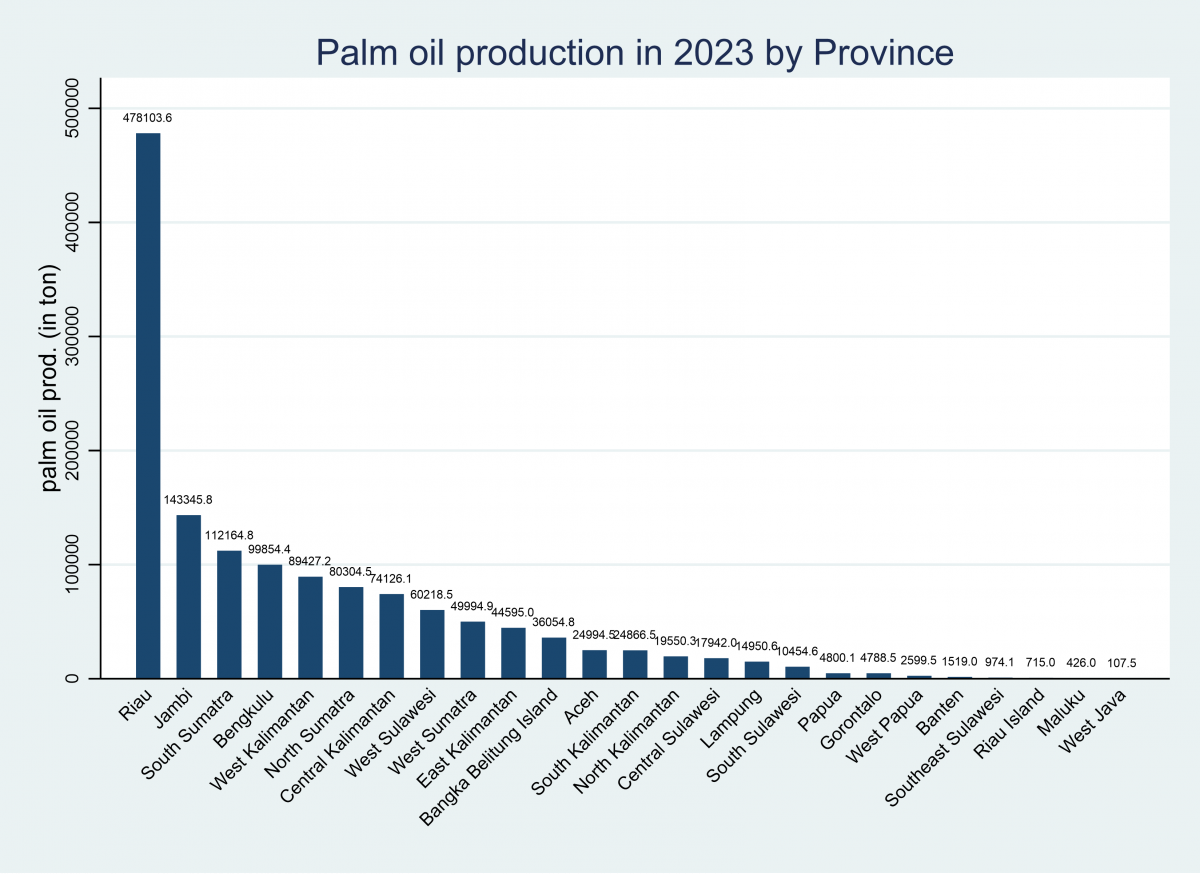
To briefly inform palm oil country-level data as reported by USDA [33] to provincial level, Figure 1 illustrates the 2023 provincial-level summary of oil palm FFB production in Indonesia. It shows that Riau Province recorded the highest production, with approximately 478 thousand tons, followed by Jambi with 143 thousand tons, South Sumatra with 112 thousand tons, and Bengkulu with around 99 thousand tons. These figures indicate the dominant role of Sumatra as Indonesia’s main center of palm oil FFB plantation production.
Figure 1. Palm oil fresh fruit bunch (FFB) production in 2023 by province
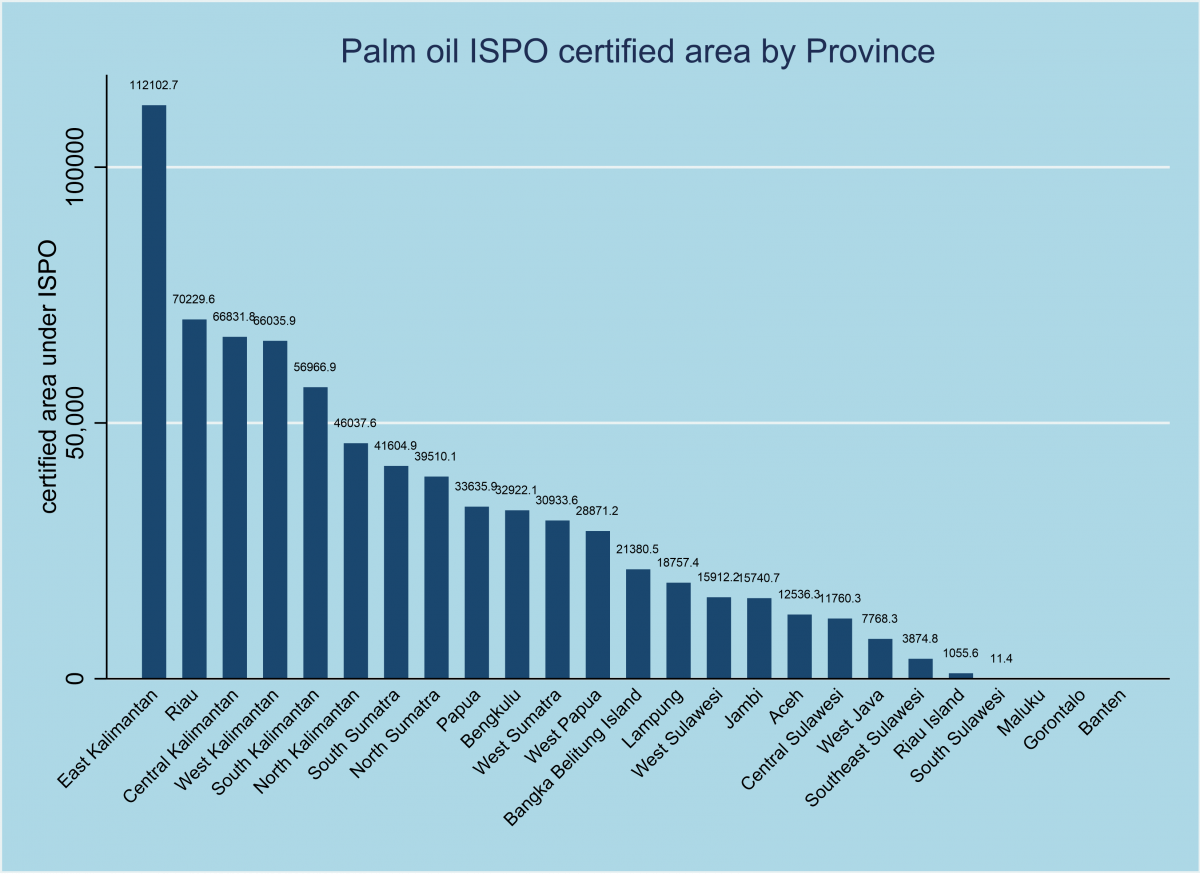
Figure 2 shows a different pattern in terms of ISPO-certified oil palm area. Districts in East Kalimantan Province account for the largest ISPO certified oil palm area, while districts in Riau Province, despite having the highest FFB production level, rank second in terms of accumulated ISPO-certified area. This descriptive evidence suggests that higher production is not necessarily linearly associated with a larger accumulated ISPO-certified area. Therefore, while certification may be positively related to FFB production performance, descriptive patterns alone indicate that the relationship is likely shaped by other factors, including plantation scale, productivity, management quality, institutional capacity, and regional production characteristics.
Figure 2. Palm oil area certified by Indonesian Sustainable Palm Oil (ISPO) (in ha) by province
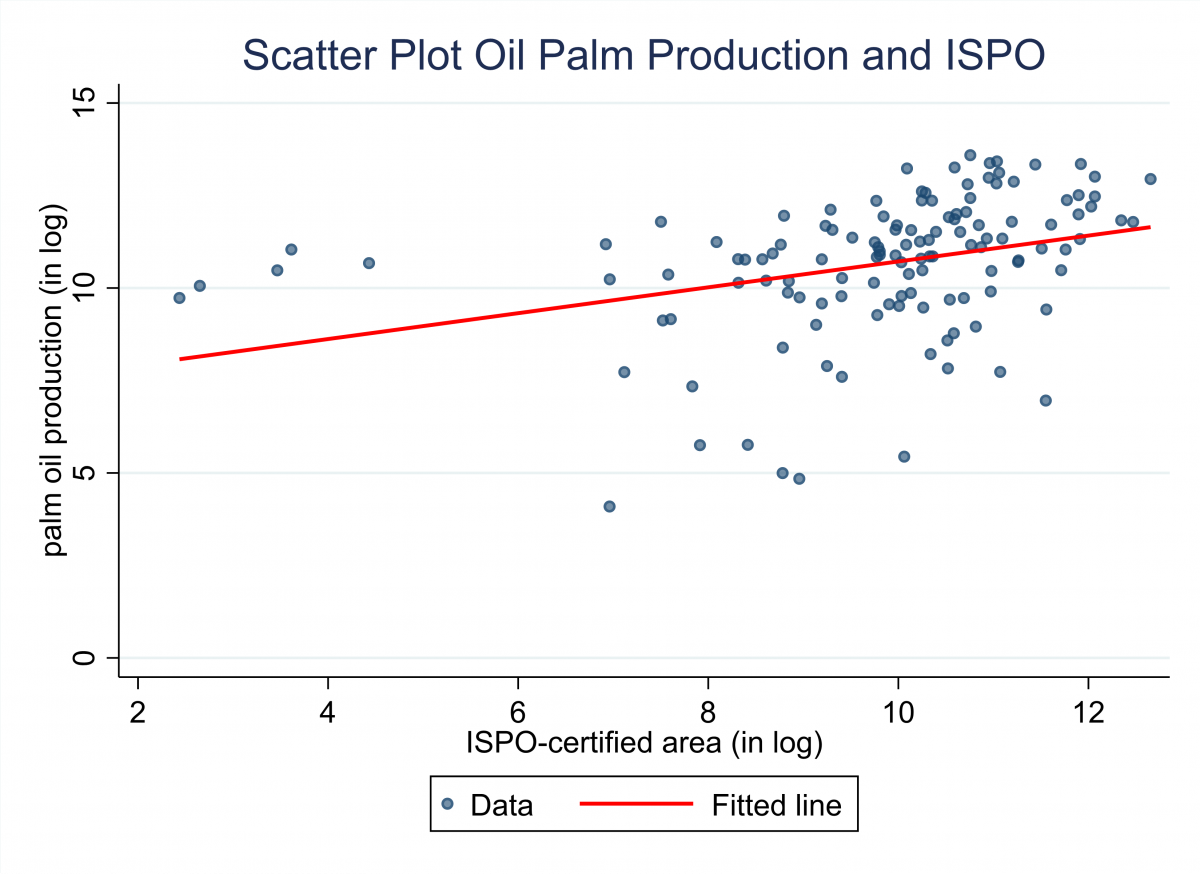
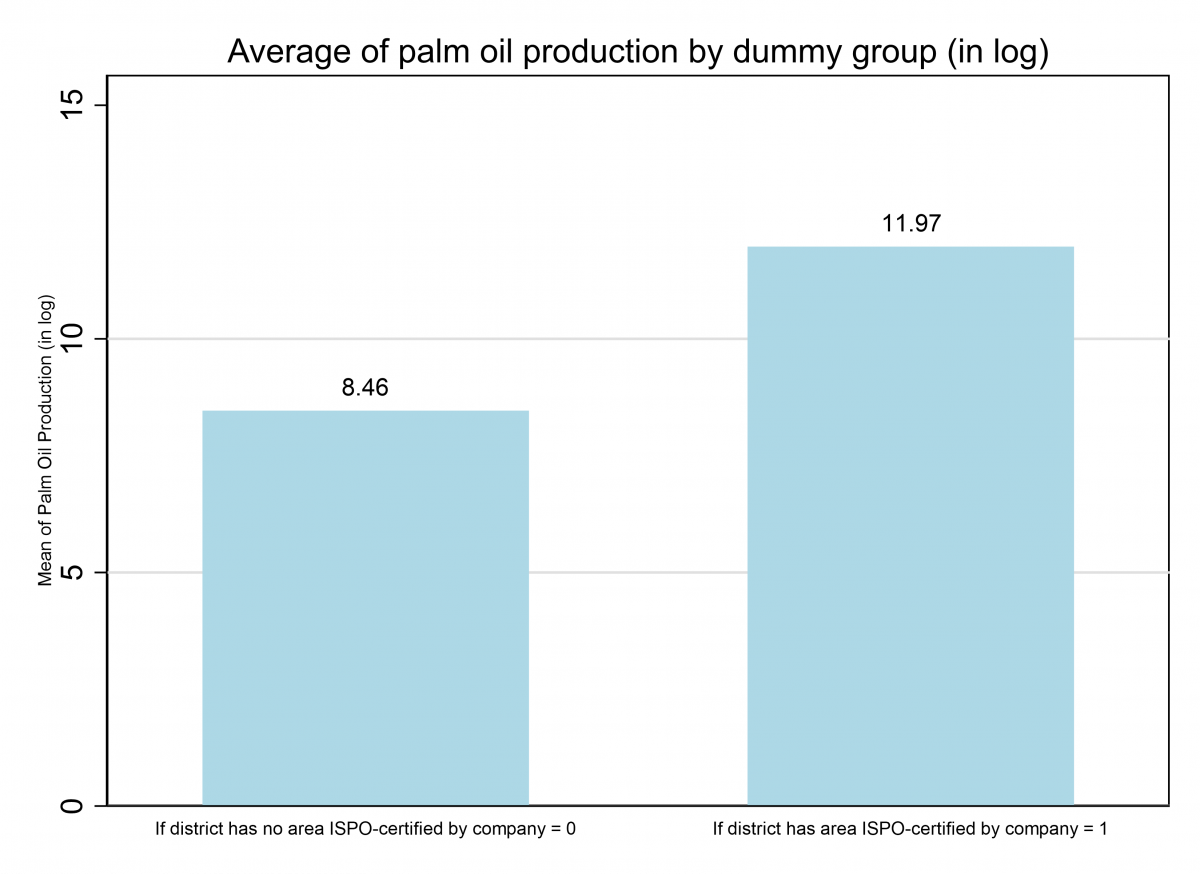
The scatter plot (Figure 3(a)) shows a positive association between ISPO-certified area and palm oil FFB production, both measured in logarithmic form. The fitted regression line slopes upward, indicating that districts with larger ISPO-certified oil palm areas tend to record higher levels of palm oil FFB production. The clustering of observations around higher ISPO-certified areas also indicates that certification is more commonly observed in districts with relatively established production systems. Furthermore, the bar chart in Figure 3(b) indicates a clear descriptive difference in average production between districts with and without company-level ISPO-certified areas. Districts without company-certified ISPO areas record an average log production value of 8.46, whereas districts with company-certified ISPO areas show a substantially higher average value of 11.97. This pattern tends to inform that higher production of palm oil FFB in districts with larger concentration of ISPO-certified area organized by company, though we cannot sure as the figure provided only for descriptive analysis.
Moving to Table 3 which reports the OLS estimates of the association between ISPO-certified oil palm area and district-level oil palm FFB production. The results show a consistently positive and statistically significant coefficient for ISPO-certified area across all specifications. In Column (1), the coefficient is 0.3514 and statistically significant at the 1 percent level, indicating that a 1 percent increase in ISPO-certified oil palm area is associated with an approximately 0.351 percent increase in oil palm FFB production, ceteris paribus. Comparatively, after the full set of control variables is included in Column (5), the coefficient declines to 0.2974 but remains statistically significant at the 1 percent level. This suggests that the positive association between ISPO certification and palm oil FFB production is robust, although part of the initial relationship is explained by fertilizer use, farmer organization, administrative scale, and farmer business with legal status.
Table 3. Ordinary least squares (OLS) estimate of the effects of certified Indonesian Sustainable Palm Oil (ISPO) on palm oil fresh fruit bunch (FFB) production
|
Dependent Variable: Oil Palm FFB Production (in Log) |
|||||
|
|
(1) |
(2) |
(3) |
(4) |
(5) |
|
l_area_certif_ispo |
0.3514*** |
0.4271*** |
0.4350*** |
0.4117*** |
0.2974*** |
|
|
(0.0979) |
(0.0936) |
(0.0877) |
(0.0859) |
(0.0905) |
|
rat_agricbus_fert |
|
3.4701*** |
2.5845** |
2.1686** |
1.7909* |
|
|
|
(1.2070) |
(1.0743) |
(0.9757) |
(0.9479) |
|
l_farmgroup_beginner |
|
|
0.6956** |
1.2519*** |
1.1450*** |
|
|
|
|
(0.2876) |
(0.2753) |
(0.2627) |
|
Numb_subdistrict |
|
|
|
-0.0954** |
-0.0968** |
|
|
|
|
|
(0.0407) |
(0.0401) |
|
l_agric_comp_law |
|
|
|
|
0.4130** |
|
|
|
|
|
|
(0.1900) |
|
Constant |
7.1933*** |
4.4575*** |
0.0754 |
-1.9455 |
-0.9910 |
|
|
(1.0162) |
(1.3392) |
(2.5219) |
(2.1993) |
(2.0832) |
|
Observations |
125 |
125 |
125 |
125 |
125 |
|
R-squared |
0.1151 |
0.2024 |
0.2460 |
0.3178 |
0.3647 |
Note: Robust standard errors in parentheses *** p < 0.01, ** p < 0.05, * p < 0.1.
The control variables also provide important insights into the determinants of palm oil FFB production. The ratio of agricultural farmer using fertilizer is positive across all specifications and remains statistically significant in the full model, although only at the range between 5 to 10 percent level. Since the dependent variable is expressed in logarithmic form and fertilizer use is measured as a ratio, the coefficient represents a semi-elasticity. In Column (5), for instance, a one-percentage-point increase in the share of agricultural businesses using fertilizer is associated with an approximately 1.79 percent increase in palm oil FFB production, holding other variables constant. Overall, the explanatory power of the model improves substantially as additional covariates are included, with the R-squared increasing from 0.1151 in Column (1) to 0.3647 in Column (5). This indicates that the full specification explains approximately 36.47 percent of the variation in district-level FFB production.
Table 4 reports OLS estimates controlling province fixed effects. Compared with Table 3, the coefficient of ISPO-certified oil palm area still remains positive and statistically significant at the 1 percent level across all specifications. However, its magnitude is slightly smaller after province fixed effects are included. In the full specification, the coefficient declines from 0.2974 in Table 3 to 0.2575 in Table 4. The reduction in coefficient size suggests that part of the relationship observed in Table 3 was explained by differences across provinces. Nevertheless, the persistence of a positive and highly significant coefficient confirms that the association between ISPO certification and palm oil FFB production remains robust after accounting for provincial heterogeneity.
Table 4. Ordinary least squares (OLS) estimates controlling province fixed-effect of the effects of certified Indonesian Sustainable Palm Oil (ISPO) on palm oil fresh fruit bunch (FFB) production
|
Dependent Variable: Oil Palm FFB Production (in Log) |
|||||
|
|
(1) |
(2) |
(3) |
(4) |
(5) |
|
l_area_certif_ispo |
0.3246*** |
0.3469*** |
0.3551*** |
0.3438*** |
0.2575*** |
|
|
(0.0967) |
(0.0933) |
(0.0854) |
(0.0890) |
(0.0794) |
|
rat_agricbus_fert |
|
2.5414** |
1.8302* |
1.7604* |
1.6376 |
|
|
|
(1.0248) |
(1.0656) |
(1.0286) |
(0.9928) |
|
l_farmgroup_beginner |
|
|
0.5909*** |
0.7463*** |
0.6301*** |
|
|
|
|
(0.1760) |
(0.2104) |
(0.2182) |
|
Numb_subdistrict |
|
|
|
-0.0275 |
-0.0349 |
|
|
|
|
|
(0.0279) |
(0.0260) |
|
l_agric_comp_law |
|
|
|
|
0.4075** |
|
|
|
|
|
|
(0.1836) |
|
Constant |
8.0908*** |
6.1150*** |
2.5369* |
2.0007 |
2.7880* |
|
|
(0.9141) |
(1.0127) |
(1.4066) |
(1.4237) |
(1.4361) |
|
Province Fixed Effect |
YES |
YES |
YES |
YES |
YES |
|
Observations |
125 |
125 |
125 |
125 |
125 |
|
R-squared |
0.6433 |
0.6726 |
0.6929 |
0.6963 |
0.7303 |
Note: Robust standard errors in parentheses *** p < 0.01, ** p < 0.05, * p < 0.1.
The inclusion of province fixed effects also changes the behavior of several control variables. The fertilizer-use ratio remains positive, but its statistical significance disappears in the fuller specifications, unlike in Table 3, where it remains significant at the 5-10 percent level in the full model. This suggests that the effect of fertilizer use may partly reflect province-level differences in input access, infrastructure, or agricultural support systems. The number of beginner-level farmer groups remains positive and statistically significant, although its coefficient declines from 1.1450 in Table 3 to 0.6301 in Table 3, indicating that farmer organization continues to be associated with higher FFB production but with a more moderate estimated effect after we control for province characteristics. Finally, the explanatory power of the model increases substantially, with the full specification R-squared rising from 0.3647 in Table 3 to 0.7303 in Table 4. This sharp improvement indicates that province-level factors explain a large share of the variation in district-level palm oil FFB production, while the main finding on ISPO certification remains stable and robust.
Table 5 reports the estimated association between ISPO certification (measured as dummy variables where if district has ISPO certification is given 1 if area is at least 3 ha, otherwise 0) and logged palm oil FFB production. Across all specifications, both districts with smallholder-level or company-level ISPO certification dummies are positive and statistically significant at the 1 percent level. This indicates that districts with ISPO-certified smallholder areas and districts with ISPO-certified company-managed areas tend to record substantially higher oil palm fruit yield than districts without such certification. The results are robust across the three estimation approaches: baseline OLS, OLS with province fixed effects, and OLS with clustered standard errors. The inclusion of province fixed effects reduces the estimated coefficients of both ISPO dummy variables, from 1.4217 to 1.1934 for smallholder certification and from 2.8595 to 2.4883 for company certification. This decline suggests that part of the observed association is explained by province-level characteristics. The clustered specification also confirms the statistical robustness of the main ISPO variables.
The magnitude of the coefficient is larger for company-level certification than for smallholder-level certification, suggesting that ISPO-certified company-managed plantations are more strongly associated with higher FFB production outcomes. Note here as dependent variable is expressed in logarithmic form, the percentage impact interpretation is, for example for Dummy_area certif_company coefficient in column (2), 100 ×[exp(2.4883)-1] = 1,104.1% higher than districts without having any ISPO certification, holding all else constant.
Table 5. Comparing impact of Indonesian Sustainable Palm Oil (ISPO) as dummy variables on palm oil fresh fruit bunch (FFB) production
|
|
OLS |
OLS_FE |
OLS_Cluster |
|
Dummy_area certif_smallholder |
1.4217*** |
1.1934*** |
1.4217*** |
|
|
(0.2813) |
(0.3133) |
(0.3123) |
|
Dummy_area certif_company |
2.8595*** |
2.4883*** |
2.8595*** |
|
|
(0.3839) |
(0.4047) |
(0.4140) |
|
rat_agricbus_fertilizer |
-0.3970 |
0.0063 |
-0.3970 |
|
|
(0.7589) |
(0.9447) |
(1.0566) |
|
l_farmgroup_beginner |
0.3342 |
0.4863** |
0.3342 |
|
|
(0.2584) |
(0.2249) |
(0.3006) |
|
Numb_subdistrict |
-0.0636** |
-0.0668*** |
-0.0636 |
|
|
(0.0292) |
(0.0221) |
(0.0384) |
|
l_agric_comp_law |
0.4321*** |
0.5532*** |
0.4321*** |
|
|
(0.1156) |
(0.1491) |
(0.1542) |
|
Constant |
5.0667*** |
4.7636*** |
5.0667*** |
|
|
(1.4561) |
(1.4361) |
(1.6778) |
|
Province Fixed Effect |
NO |
YES |
NO |
|
Cluster |
NO |
NO |
YES |
|
Observations |
197 |
197 |
197 |
|
R-squared |
0.5564 |
0.7149 |
0.5564 |
|
Bootest p-value (Dummy_area certif_smallholder) |
- |
- |
0.0024 |
|
Bootest p-value (Dummy_area certif_company) |
- |
- |
0.0000 |
Note: Robust standard errors in parentheses *** p < 0.01, ** p < 0.05, * p < 0.1.
To summarize, Table 5 provides strong evidence that ISPO certification, particularly company-level certification, is positively associated with logged oil palm FFB, while institutional formalization also appears to be an important supporting factor.
Finally, Table 6 presents the quantile regression estimates for oil palm FFB production across the 25th percentile, median, and 75th percentile of the FFB production distribution. Columns (1)–(3) use the logarithm of ISPO-certified oil palm area as the main explanatory variable, while Columns (4)–(6) use dummy variables for districts with ISPO-certified smallholder and company-managed plantation areas, respectively. The results indicate that ISPO-certified area is positively associated with palm oil FFB production across all quantiles. The coefficient is 0.3527 at the 25th percentile, 0.3542 at the median, and 0.1560 at the 75th percentile. This suggests that the association between ISPO-certified area and FFB production is stronger among lower-and middle-producing districts than among districts in the upper part of the FFB production distribution. The effect is positive across quantiles, although the evidence of Model 1 at the 75th quantile is weaker and only marginally significant at the 10% level.
Table 6. Quantile regression
|
Dependent Variable: Oil Palm FFB Production (in Log) |
||||||
|
Model |
Model 1 |
Model 2 |
||||
|
|
q25 |
q50 |
q75 |
q25 |
q50 |
q75 |
|
l_area_certif_ispo |
0.3527* |
0.3542*** |
0.1560* |
|
|
|
|
|
(0.2054) |
(0.1236) |
(0.0839) |
|
|
|
|
Dummy_area certif_smallholder |
|
|
|
1.2346** |
1.3644*** |
1.1635*** |
|
|
|
|
|
(0.4905) |
(0.3428) |
(0.3147) |
|
Dummy_area certif_company |
|
|
|
3.7224*** |
2.7391*** |
2.6782*** |
|
|
|
|
|
(0.6090) |
(0.6101) |
(0.3828) |
|
rat_agricbus_fert |
2.3771* |
2.5431* |
0.1608 |
-0.2095 |
0.2918 |
0.3652 |
|
|
(1.3635) |
(1.5070) |
(1.0000) |
(1.0133) |
(1.0968) |
(0.9670) |
|
l_farmgroup_beginner |
1.2666** |
1.0625*** |
0.9345*** |
0.6044* |
0.3969 |
0.1476 |
|
|
(0.5043) |
(0.3761) |
(0.2549) |
(0.3471) |
(0.2988) |
(0.2736) |
|
Numb_subdistrict |
-0.1311* |
-0.0348 |
-0.0463 |
-0.0924** |
-0.0297 |
-0.0012 |
|
|
(0.0671) |
(0.0435) |
(0.0340) |
(0.0421) |
(0.0382) |
(0.0253) |
|
l_agric_comp_law |
0.3186 |
0.3874 |
0.4642* |
0.4504** |
0.3681** |
0.3403*** |
|
|
(0.2355) |
(0.2594) |
(0.2451) |
(0.2256) |
(0.1568) |
(0.1294) |
|
Constant |
-2.9388 |
-1.9860 |
3.0477 |
1.6931 |
4.2747** |
6.6528*** |
|
|
(3.6448) |
(3.0609) |
(1.8979) |
(2.0404) |
(1.7327) |
(1.4425) |
|
R-squared (Pseudo) |
0.2217 |
0.1615 |
0.1991 |
0.4019 |
0.3750 |
0.3348 |
|
Bootstrapping frequency |
500 |
500 |
500 |
500 |
500 |
500 |
|
Observations |
125 |
125 |
125 |
197 |
197 |
197 |
Note: Bootstrapped standard errors in parentheses, based on 500 replication, *** p < 0.01, ** p < 0.05, * p < 0.1.
The dummy-variable specifications in Columns (4)–(6) further support the positive association between ISPO certification and palm oil FFB production. The dummy for district with ISPO-certified smallholder areas is positive and statistically significant across all quantiles, with the strongest coefficient observed at the median. This indicates that districts with ISPO-certified smallholder areas tend to record higher palm oil FFB production than districts without such certification, particularly around the central part of the FFB production distribution. The dummy for district with ISPO-certified company-managed areas is also positive and statistically significant at the 1 percent level across all quantiles, with the largest coefficient at the 25th percentile. This pattern suggests that company-level ISPO certification is strongly associated with higher FFB production, especially among lower-producing districts. However, because the dependent variable is in logarithmic form and the dummy coefficients are relatively large, these estimates should be interpreted primarily as log-point differences and as strong conditional associations rather than precise causal percentage effects.
The control variables show heterogeneous patterns across quantiles and model specifications. In Columns (1)–(3), the fertilizer-use ratio is positive and statistically significant at the 25th percentile and median, but not at the 75th percentile. Since fertilizer use is measured as a ratio while the dependent variable is in logarithmic form, its coefficient represents a semi-elasticity. The results imply that fertilizer use is more relevant for FFB production among lower- and middle-producing districts, whereas its independent association is weaker among higher-producing districts. The number of beginner-level farmer groups is also positive and statistically significant across all quantiles in Columns (1)–(3), suggesting that farmer organization may support FFB production through collective learning, extension access, and better adoption of plantation practices. However, its statistical significance weakens in the dummy-variable specifications, indicating that part of the farmer-group effect may overlap with certification status or other institutional characteristics.
The number of subdistricts has a negative coefficient in most specifications and is statistically significant mainly at the 25th percentile, suggesting that administrative or territorial dispersion may be more strongly associated with lower FFB production among districts in the lower segment of the FFB production distribution. By contrast, the number of agricultural businesses with legal status is positive across all specifications and becomes statistically significant particularly in the upper quantile of the continuous ISPO model and across all quantiles in the dummy-variable specifications. This finding reinforces the importance of formal institutional and business structures in supporting palm oil FFB production. Overall, the quantile regression results confirm that ISPO certification is positively associated with palm oil FFB production, but the magnitude of this association varies across the production distribution. The higher pseudo R-squared values in the dummy-variable specifications suggest greater explanatory power, although this comparison should be made cautiously because the number of observations differs between the continuous-area and dummy-based models.
The empirical results provide strong support for hypothesis proposed (H1), that promotes positive association between sustainability certification and palm oil FFB production. Across the baseline OLS estimates in Table 2, ISPO-certified oil palm area is consistently positive and statistically significant, even after controlling covariates. This relationship remains robust in Table 3 after province fixed effects exist, although the magnitude of the coefficient decreases. The dummy-variable estimates in Table 4 further reinforce this finding, showing that districts with ISPO-certified smallholder and company-managed plantation areas have significantly higher palm oil FFB production than non-certified districts. The quantile regression results in Table 5 also support H1 by showing a positive association across the production distribution, with the continuous ISPO-certified area variable exerting stronger effects at the lower and median quantiles. These findings are consistent with earlier evidence that certification may improve FFB production through better plantation management and good agricultural practices, as shown by Ernah et al. [11], Rahutomo et al. [12], Sugianto et al. [13], Arifandy et al. [14], Brandi et al. [15], Morgans et al. [16], Renner et al. [17], Renner et al. [18], and De Vos et al. [19]. However, they contrast with Veriasa et al. [20], who found a positive but statistically insignificant association between RSPO-certified area and productivity, suggesting that certification effects may depend on geographical coverage, model specification, and the type of certification indicator used.
The results provide partial support for H2, which expects fertilizer use to be positively associated with palm oil FFB production. In Table 2, the ratio of agricultural businesses using fertilizer is positive and statistically significant across several specifications. This finding is consistent with studies emphasizing the importance of fertilizer application for improving FFB yields, including De Vos et al. [19], De Vos et al. [28], and other evidence on fertilizer use in oil palm cultivation [29, 30]. The significance of fertilizer use, however, weakens after province fixed effects are included in Table 3 and becomes statistically insignificant in the dummy-based models in Table 4. The quantile regression results in Table 5 show that fertilizer use is significant only at the lower and median quantiles in the continuous ISPO specification, but not in the dummy-variable specification. These patterns suggest that fertilizer use matters for FFB production, but its effect is not fully robust once regional heterogeneity, certification status, and institutional characteristics are accounted for. This supports the view that fertilizer is important, but its productivity effect is likely conditional on complementary factors such as crop maintenance, soil management, input access, infrastructure, and broader plantation management practices.
The findings also provide partial support for H3 regarding the role of farmer groups in supporting smallholder palm oil FFB production. The number of beginner-level farmer groups is positive and statistically significant in the baseline OLS estimates in Table 2 and remains significant after controlling for province fixed effects in Table 3, although the coefficient becomes smaller. In Table 5, beginner-level farmer groups are also positively associated with FFB production across quantiles in the continuous ISPO specification, suggesting that farmer organization may be particularly relevant for knowledge diffusion, extension access, and the adoption of improved cultivation practices. The results are consistent with De Vos et al. [9, 19], Majid et al. [6], Apriani et al. [26], and Watts et al. [25], who emphasize that farmer organization and institutional capacity are important for certification adoption and better plantation management. Nevertheless, the evidence suggests that the effectiveness of farmer groups depends not only on their number, but also on their functionality, institutional quality, and connection to extension or certification support systems.
The strongest and most consistent support is found for H4, which proposes that institutional formalization, proxied by the number of agricultural businesses with legal status, is positively associated with smallholder palm oil FFB production. This finding reinforces the argument that formal institutional and business structures contribute to FFB production capacity by improving access to finance, markets, documentation, certification processes, and managerial practices. It is consistent with Widyatmoko [31], De Vos et al. [9], Watts et al. [25], Majid et al. [6], and Apriani et al. [26], who highlight the importance of land legality, organizational capacity, and institutional readiness in supporting certification and farm performance.
This study examined the association between sustainability certification and smallholder palm oil FFB production in Indonesia, with particular attention to ISPO-certified plantation area at the district level. The empirical findings provide consistent evidence that ISPO-certified oil palm area is positively and significantly associated with FFB production. This relationship remains robust across the baseline OLS models, specifications with province fixed effects, and quantile regression estimates. Although the magnitude of the coefficient declines after controlling for province-level heterogeneity, the positive and statistically significant association persists, suggesting that ISPO certification is not merely capturing broad regional differences but may reflect improved plantation practices, better management, and stronger compliance with FFB production standards.
Despite these contributions, this study has several limitations. First, the analysis relies on cross-sectional district-level data, which limits the ability to establish causal relationships between ISPO certification and palm oil FFB production in smallholder plantations. Second, the certification variable captures certified area but does not fully measure the quality, intensity, or duration of certification implementation. Third, district-level data may mask important differences between company-managed plantations, independent smallholders, and plasma smallholders. Future studies should therefore consider using panel data, household-or firm-level datasets, and quasi-experimental methods to better identify the causal effects of certification under ISPO. Further research may also examine the channels through which certification affects production, including fertilizer use, access to finance, extension services, land legality, farmer-group effectiveness, and market incentives. Such extensions would provide a deeper understanding of how sustainability certification can contribute not only to higher production, but also to more inclusive and environmentally responsible palm oil development.
[1] Santika, T., Wilson, K.A., Budiharta, S., et al. (2019). Does oil palm agriculture help alleviate poverty? A multidimensional counterfactual assessment of oil palm development in Indonesia. World Development, 120: 105-117. https://doi.org/10.1016/j.worlddev.2019.04.012
[2] Tabe-Ojong, M.P. Jr., Molua, E.L., Nanfouet, M.A., et al. (2023). Oil palm production, income gains, and off-farm employment among independent producers in Cameroon. Ecological Economics, 208: 107817. https://doi.org/10.1016/j.ecolecon.2023.107817
[3] Ayompe, L.M., Schaafsma, M., Egoh, B.N. (2021). Towards sustainable palm oil production: The positive and negative impacts on ecosystem services and human wellbeing. Journal of Cleaner Production, 278: 123914. https://doi.org/10.1016/j.jclepro.2020.123914
[4] Acosta, P., Curt, M.D. (2019). Understanding the expansion of oil palm cultivation: A case-study in Papua. Journal of Cleaner Production, 219: 199-216. https://doi.org/10.1016/j.jclepro.2019.02.029
[5] Afrizal, Putra, E.V., Elida, L. (2024). Palm oil expansion, insecure land rights, and land-use conflict: A case of palm oil centre of Riau, Indonesia. Land Use Policy, 146: 107325. https://doi.org/10.1016/j.landusepol.2024.107325
[6] Majid, N.A., Ramli, Z., Sum, S.M., Awang, A.H. (2021). Sustainable palm oil certification scheme frameworks and impacts: A systematic literature review. Sustainability, 13(6): 3263. https://doi.org/10.3390/su13063263
[7] Richartz, C., Abdulai, A. (2025). Impact of organic and RSPO certifications on smallholder palm oil farmers’ welfare and the environment in Ghana. Journal of Cleaner Production, 529: 146726. https://doi.org/10.1016/j.jclepro.2025.146726
[8] Furumo, P.R., Rueda, X., Rodríguez, J.S., Ramos, I.K.P. (2020). Field evidence for positive certification outcomes on oil palm smallholder management practices in Colombia. Journal of Cleaner Production, 245: 118891. https://doi.org/10.1016/j.jclepro.2019.118891
[9] De Vos, R.E., Suwarno, A., Slingerland, M., Van Der Meer, P.J., Lucey, J.M. (2023). Pre-certification conditions of independent oil palm smallholders in Indonesia. Assessing prospects for RSPO certification. Land Use Policy, 130: 106660. https://doi.org/10.1016/j.landusepol.2023.106660
[10] Oliphant, E., Simon, A.C. (2022). The cost of sustainable palm oil: Should an Indonesian smallholder pursue RSPO-certification? World Development Perspectives, 26: 100432. https://doi.org/10.1016/j.wdp.2022.100432
[11] Ernah, Parvathi, P., Waibel, H. (2016). Adoption of sustainable palm oil practices by Indonesian smallholder farmers. Journal of Southeast Asian Economies, 33(3): 291-316.
[12] Rahutomo, A.B., Karuniasa, M., Frimawaty, E. (2025). Enhancing farmers’ land productivity through sustainable palm oil certification: Strategies for promoting environmental and economic benefits in agricultural practices. Journal of Agrosociology and Sustainability, 2(2): 97-112. https://doi.org/10.61511/jassu.v2i2.2025.1131
[13] Sugianto, H., Donough, C.R., Monzon, J.P., et al. (2025). Improving yield and profit in smallholder oil palm fields through better agronomy. Agricultural Systems, 224: 104269. https://doi.org/10.1016/j.agsy.2025.104269
[14] Arifandy, M.I., Hariyadi, H., Adiwibowo, S. (2018). Analisis pengaruh adopsi ISPO terhadap perbaikan kinerja pengelolaan lingkungan dan perubahan sosial ekonomi masyarakat. Journal of Natural Resources and Environmental Management, 8(2): 199-206. https://doi.org/10.29244/jpsl.8.2.199-206
[15] Brandi, C., Cabani, T., Hosang, C., Schirmbeck, S., Westermann, L., Wiese, H. (2013). Sustainability Certification in the Indonesian Palm Oil Sector: Benefits and Challenges for Smallholders. Studies.
[16] Morgans, C.L., Meijaard, E., Santika, T., et al. (2018). Evaluating the effectiveness of palm oil certification in delivering multiple sustainability objectives. Environmental Research Letters, 13(6): 064032. https://doi.org/10.1088/1748-9326/aac6f4
[17] Renner, S., Ruml, A., Lakemann, T., et al. (2024). Smallholder RSPO certification, economic benefits and agrochemical use. Environmental Research Letters, 19(11): 114093. https://doi.org/10.1088/1748-9326/ad8367
[18] Renner, S., Ruml, A., Lay, J., et al. (2023). Socioeconomic and environmental effects of smallholder RSPO certification in Indonesia. https://doi.org/10.22004/AG.ECON.365903
[19] De Vos, R.E., Suwarno, A., Slingerland, M., Van Der Meer, P.J., Lucey, J.M. (2021). Independent oil palm smallholder management practices and yields: Can RSPO certification make a difference? Environmental Research Letters, 16(6): 065015. https://doi.org/10.1088/1748-9326/ac018d
[20] Veriasa, T.O., Nurrunisa, M., Fadhli, N. (2024). Revisiting the implications of RSPO smallholder certification relative to farm productivity in Riau, Indonesia. Forest and Society, 8(1): 123-139. https://doi.org/10.24259/fs.v8i1.26964
[21] Shahimi, S., BAM, H.S., SF, H. (2023). SustaInability practices and financial profitability: The case of the world’s top 20 crude palm oil producers. Sage Open, 13(4): 21582440231203832. https://doi.org/10.1177/21582440231203832
[22] Purnama, I., Mutamima, A., Aziz, M., et al. (2025). Environmental impacts and the food vs. fuel debate: A critical review of palm oil as biodiesel. GCB Bioenergy, 17(6): e70043. https://doi.org/10.1111/gcbb.70043
[23] Adiprasetyo, T., Irnad, I., Nusril, N. (2019). Perceived environment-economic benefits and factors influencing the adoption of Indonesian sustainable palm oil production system by smallholder farmers. IOP Conference Series: Earth and Environmental Science, 347(1): 012098. https://doi.org/10.1088/1755-1315/347/1/012098
[24] Reich, C., Musshoff, O. (2025). Oil palm smallholders and the road to certification: Insights from Indonesia. Journal of Environmental Management, 375: 124303. https://doi.org/10.1016/j.jenvman.2025.124303
[25] Watts, J.D., Pasaribu, K., Irawan, S., et al. (2021). Challenges faced by smallholders in achieving sustainable palm oil certification in Indonesia. World Development, 146: 105565. https://doi.org/10.1016/j.worlddev.2021.105565
[26] Apriani, E., Kim, Y.S., Fisher, L.A., Baral, H. (2020). Non-state certification of smallholders for sustainable palm oil in Sumatra, Indonesia. Land Use Policy, 99: 105112. https://doi.org/10.1016/j.landusepol.2020.105112
[27] Hutabarat, S. (2017). Tantangan keberlanjutan pekebun kelapa sawit rakyat di Kabupaten Pelalawan, Riau dalam perubahan perdagangan global. Masyarakat Indonesia, 43(1): 47-64. https://doi.org/https://doi.org/10.14203/jmi.v43i1.713
[28] De Vos, R.E., Lim, Y.L., Donough, C.R., et al. (2026). Fertilizer use in Indonesian oil palm smallholder systems: Agronomic and socio-economic constraints and opportunities. Environment, Development and Sustainability, 1-20. https://doi.org/10.1007/s10668-026-07687-6
[29] Indah, S.P., Hermansyah, H., Hasanudin, H., Marwanto, M. (2017). Effect of oil-palm-empty-fruit-bunch granular organic fertilizer on the yield 0f oil palm fruit. Akta Agrosia, 20(2): 61-65. https://doi.org/10.31186/aa.20.2.61-65
[30] Salmiyati, Heryansyah, A., Idayu, I., Supriyanto, E. (2014). Oil palm plantations management effects on productivity fresh fruit bunch (FFB). APCBEE Procedia, 8: 282-286. https://doi.org/10.1016/j.apcbee.2014.03.041
[31] Widyatmoko, B. (2019). The implementation of Indonesian sustainable palm oil certification (ISPO): Opportunity for inclusion of palm oil smallholder in Riau Province. Masyarakat Indonesia, 45(2): 219-228. https://doi.org/10.14203/jmi.v45i2.891
[32] Cameron, A.C., Trivedi, P.K. (2022). Microeconometrics Using Stata: Volume I: Cross-Sectional and Panel Regression Methods. Stata Press.
[33] U.S. Department of Agriculture. Production – Palm Oil. https://www.fas.usda.gov/data/production/4243000, accessed on Aug. 19, 2026.