
Rio Alfasyah* | Ali Maksum | Anif Fatma Chawa | Siti Kholifah
© 2026 The authors. This article is published by IIETA and is licensed under the CC BY 4.0 license (http://creativecommons.org/licenses/by/4.0/).
OPEN ACCESS
This qualitative, single-site study examines how Sakai Badikir practitioners describe ritual-material sourcing after forest conversion in Minas Subdistrict, Riau, Indonesia. It draws on twelve interview sessions with thirteen participants (n = 13) and village observation across four fieldwork periods (November 2025 to June 2026). Participants reported scarcer forest materials, longer searches, and occasional searches in an area they called hutan lindung (protected forest). Harvesting there, the area's official designation, a pre-conversion baseline, and ecological effects were not independently verified. One healer recalled obtaining thirty to forty kapau shoots for a preparation requiring about one hundred; requirements varied by treatment. These figures illustrate one account rather than a measured shortfall. Kapau's botanical identity was not established for this site. Coconut (Cocos nucifera) leaves sometimes replaced kapau in ritual weaving, with differing views on acceptability. Household accounts included unsuccessful transplanting and cultivation of other medicinal plants. The findings suggest possible changes in sourcing and selective adaptation. Botanical identification, mapped collection trips, and repeated harvest observations are proposed before ecological displacement or policy effectiveness is claimed.
Badikir, forest conversion, land-use planning, qualitative case study, ritual materials, Sakai
Riau Province has been among the most rapidly transformed forest landscapes in Southeast Asia. A national assessment estimated more than six million hectares of primary forest loss in Indonesia between 2000 and 2012 [1]. In Riau specifically, conversion to oil palm and industrial pulpwood plantations has restructured entire watersheds within a single generation [2], and the local effects of industrial tree plantations on adjacent communities have been shown to diverge sharply from the aggregate economic case made for them [3]. The dominant analytical response has been to quantify what conversion emits and what it removes: carbon released from cleared peat and biomass [4], forest area and configuration foregone [5], and the income streams that rural households lose when forest access contracts [6].
These indicators describe important effects of conversion, but they need not capture every material dependency involved in a cultural practice. Traditional medicinal knowledge is enacted through particular ingredients, techniques, and places, as well as through memory. A locally scarce material can therefore change how a practice is performed or where its materials are sought. Whether that change occurs, and with what ecological consequence, requires evidence beyond forest-cover statistics.
Research on traditional medicinal knowledge has examined political and economic restructuring [7] and unequal transmission under market integration [8]. The present case adds a narrower question: how do participants describe obtaining ritual and healing materials in a landscape they say has lost much of its former forest? Such accounts can identify a potential planning issue, although they cannot by themselves establish species loss or the amount harvested elsewhere.
Leakage analysis in land-use planning concerns pressure displaced from one area to another [9-11]. It offers a useful hypothesis for interpreting reports of longer material-collecting trips after land conversion. Demonstrating leakage, however, would require a defined source and receiving area, evidence of collection in each, and a comparison of pressure over time. Interviews alone cannot complete that test.
This study examines Badikir, a Sakai healing practice in Minas Subdistrict, Siak Regency. Participants described a landscape altered by industrial timber plantations, oil palm, and other land uses. We ask which locally named materials participants find difficult to obtain, where they report searching now, and how they describe cultivation and substitution. The study treats these as accounts of practice in one setting, not as measured botanical or protected-area outcomes.
The contribution is an empirically bounded account of material sourcing and selective ritual adaptation. It identifies a possible displacement pathway for future testing, clarifies where participant testimony ends and independent verification would begin, and proposes evidence-gathering steps relevant to land-use assessment.
2.1 Assessing the impacts of industrial forest conversion
Satellite and process-based studies document forest-cover change and emissions from plantation transitions in Indonesia [1, 4, 5]. Socioeconomic work shows the value of forest income to rural households [6]. These measures are essential, but material requirements of a specific practice may need to be elicited separately.
Cultural ecosystem services research has drawn attention to values that are difficult to express in tonnes, hectares, or currency [12]. Research in Riau and elsewhere has also described social capital and multidimensional vulnerability associated with environmental change [13-15]. For an assessment of ritual materials, the first task is more concrete: record local names, uses, perceived scarcity, and possible alternatives, while distinguishing interview statements from botanical identification.
Forest tenure and customary recognition in Indonesia have been shaped by long institutional histories and resource politics [16-18]. These studies motivate asking how practitioners navigate material access. They do not establish the legal status of any particular forest or the access rights of participants in Minas.
2.2 Traditional medicinal knowledge and its material base
Traditional ecological knowledge has been described as practice shaped by continued interaction with resources [19]. Studies of transmission, market integration, and medicinal-plant use show that change need not be simple abandonment [7, 8, 20, 21]. For Badikir, an especially important distinction is between materials used in the ritual core and leaves used for its woven apparatus; participants did not assign the same substitution rule to both.
Cultivation and substitution are possible responses to scarcity, not outcomes that can be assumed in advance. Ex situ conservation approaches vary by species and method [22]. A household account of a failed transplant is not a propagation experiment, and a reported substitute may be technically available yet ritually contested. Both kinds of evidence need to be reported at the level at which they were observed.
2.3 Leakage and displacement in land-use planning
Leakage studies ask whether an intervention reduces pressure or moves it beyond the assessed area [9]. Protected-area evaluations have addressed this problem for deforestation [10, 11], while management-effectiveness research warns against equating administrative indicators with ecological outcomes [23]. The same conceptual question may arise for the gathering of ritual materials, but an interview report of a search destination does not establish a change in harvest pressure.
Selective collection might escape canopy monitoring, which makes it worth examining where people obtain culturally important materials. In this case, no species inventory, harvest count, patrol record, or vegetation survey was available. Accordingly, leakage is used below as a hypothesis to test, not as an observed outcome.
2.4 Heritage recognition as a policy response
Cultural recognition may support the public standing of a practice, while other conditions for continuing it remain unresolved [24-30]. This distinction is relevant to Badikir because participants discussed both official attention to Sakai custom and difficulty obtaining certain materials. The present interviews do not constitute an audit of government programmes or forest-access rules.
Recognition and material access are therefore separate questions for investigation. A planning response would need to verify which materials are required, which are replaceable in practice, where they are obtained, and what assistance or access arrangements already exist.
These literatures frame the case: land-use assessment motivates attention to material requirements, traditional-knowledge research directs attention to adaptation, and leakage research suggests a possible spatial mechanism. The present study contributes interview evidence that can guide those next measurements; it does not measure ecological leakage.
3.1 Study area
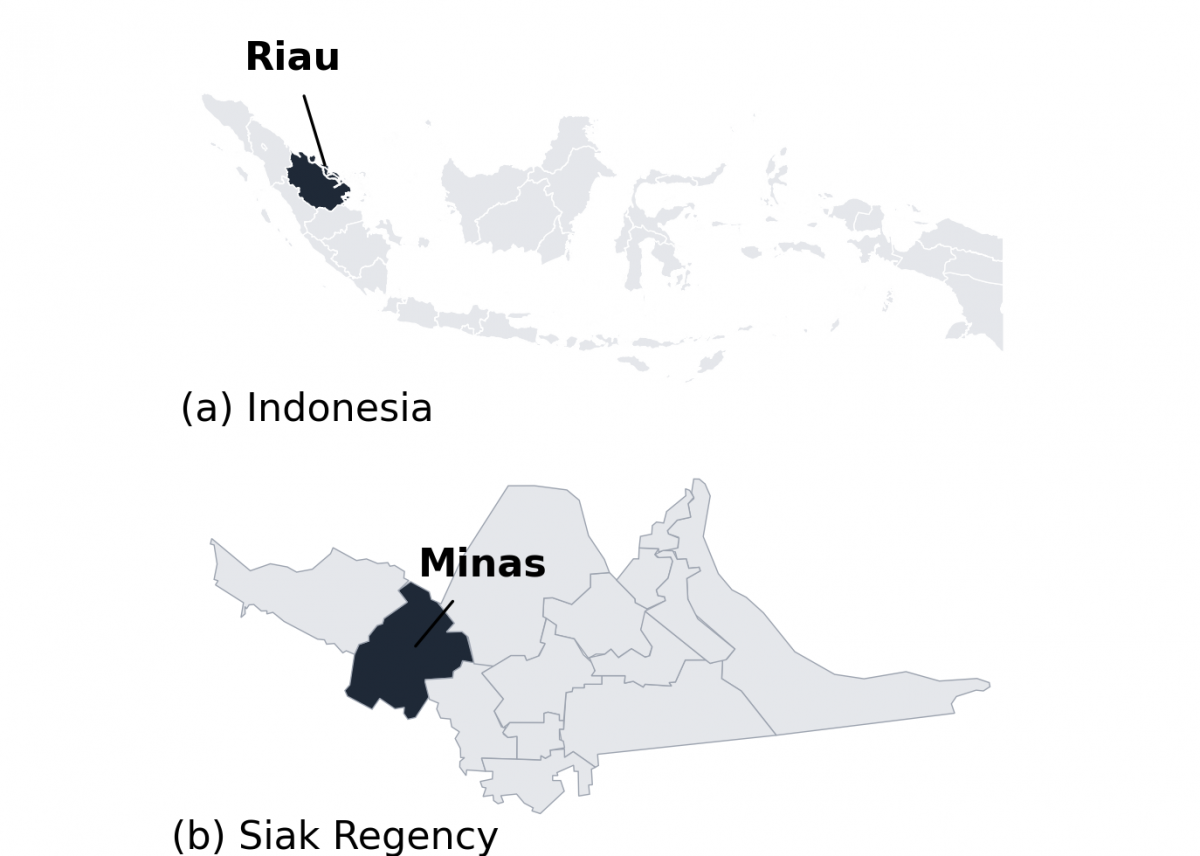
Minas Subdistrict lies in Siak Regency, Riau Province, in eastern Sumatra (Figure 1). Regional studies document forest conversion associated with plantations [2, 3]. Participants in this single-site study recalled a local landscape that changed through industrial timber operations, oil palm expansion, and other land uses. We did not reconstruct parcel-level land-cover change or map the forest areas named in the interviews.
Figure 1. Study area: (a) Riau Province in Indonesia, and (b) Minas Subdistrict in Siak Regency
Badikir combines recited invocation with preparation and application of materials. Participants named resins, beeswax, plant materials, and woven leaves, but described different rules for different ritual functions. Locally named plants were not sampled for taxonomic identification. Therefore, terms such as kapau and kelubi refer here to interview categories, not verified botanical species.
3.2 Research design and participants
A qualitative case study design was used to investigate a contemporary practice in its local context [31]. The aim was to describe how participants understood material availability and sourcing in one converted landscape. The design cannot estimate harvest prevalence across Riau, quantify change in a receiving forest, or attribute a particular trip to a particular land-use decision.
Thirteen participants were recruited through purposive sampling with snowball extension, an approach suited to populations that are small, dispersed, and reached through internal networks of trust [32]. Entry to the community was through the head of the Bathin Limo customary institution, who introduced the research and identified practitioners. Sampling covered four categories: holders of customary authority, ritual practitioners, senior residents who witnessed the pre-conversion landscape, and recipients of treatment. Participant characteristics are given in Table 1.
Table 1. Participant characteristics
|
Code |
Characteristics |
Category |
|
I1 |
Head of the Bathin Limo customary institution, 72 |
Customary authority |
|
I2 |
Most senior Badikir healer resident in the village, 64 |
Ritual practitioner |
|
I3 |
Badikir ritual practitioner and farmer, 55 |
Ritual practitioner |
|
I4 |
Badikir drummer, the only one remaining in the village, 57 |
Ritual practitioner |
|
I5 |
Senior woman resident, experienced the swidden period, 83 |
Witness with recall |
|
I6 |
Officer of the Bathin Limo customary institution, 44 |
Customary authority |
|
I7 |
Customary officeholder and healer, 71 |
Ritual practitioner |
|
I8 |
Senior male resident, 80, recalls the period before forest loss |
Witness with recall |
|
I9 |
Senior woman resident, witnessed preparation of ritual equipment, 37 |
Witness with recall |
|
I10 |
Village secretary, younger generation in local administration, 30 |
Younger generation in government |
|
I11 |
Sakai resident treated through Badikir, 62 |
Service recipient |
|
I12 |
Village officer of Minangkabau descent, not a practitioner of the tradition, 29 |
Neighbour outside the tradition |
|
I13 |
Sakai resident and farmer, 42, former Badikir patient |
Service recipient |
3.3 Data collection
Data were collected across four fieldwork periods between November 2025 and June 2026, comprising twelve recorded interview sessions with observation in the village and at the customary house. Interviews followed a topic guide covering the pre-conversion landscape, materials required for practice, current sourcing behaviour, attempts at cultivation or substitution, transmission to younger practitioners, and interaction with government. They were conducted in Indonesian and local Malay, audio-recorded with consent, and transcribed in full.
Fieldwork was distributed across periods rather than concentrated, which allowed provisional interpretations to be tested against later sessions. Data collection was concluded when accounts of materials, procedure, and sourcing had become repetitive across participants. Accounts concerning younger-generation involvement continued to yield new material into the final period, and this asymmetry is reported rather than smoothed, since it bears on the transmission findings below.
3.4 Analysis
Transcripts were analysed thematically through familiarisation, coding, theme review, and reporting [33]. This article draws on passages concerning material availability, search destinations, cultivation attempts, substitution, and institutional responses. For this revision, the passages behind the numerical account and the statements on planting and protected-forest searches were rechecked against the recorded interview transcripts. We distinguish the participant's own report from an observed harvest or a verified ecological effect.
3.5 Trustworthiness and ethical considerations
Credibility was supported by repeated fieldwork and comparison across participant categories [34, 35]. Accounts of general scarcity and longer searches appeared in more than one interview. The numerical example in Section 4.1, however, came from I2 alone and was not triangulated with harvest logs or field counts. No botanical voucher, diagnostic photograph, georeferenced collection record, or official map of the area called hutan lindung was collected for this analysis.
Participation was voluntary and based on informed consent obtained verbally and recorded, appropriate given variation in literacy among participants. Entry was negotiated through the customary institution as well as with individuals. Participants are identified by code in this article. Transcripts are not publicly deposited, since they contain identifying detail about a small community and specific information about healing practice that participants shared within a relationship of trust.
4.1 Recalled forest change and reported material scarcity
Participants contrasted the former mixed forest with the plantation landscape. I11 described that contrast in broad terms:
"In the past there was rattan, there was timber, forest timber, the gaharu tree. It was complete, whatever you looked for was there. Now there is nothing, only one kind left. Acacia, that is all."
This is a resident's recollection of changing access to diverse forest materials. It is not a botanical inventory of either landscape, but it helps explain why participants described some present searches as more difficult.
I1 also recalled the levelling of hills that carried ritual significance. The interview gives a perception of place loss, but this study did not independently map the site or establish the cause of the physical change:
"Bukit Keramat is finished. It has been flattened. There were three, that is why it was called the three sacred hills. Two are gone, one remains."
The account indicates perceived loss of a culturally important place. The cause and physical extent of that loss were not independently mapped in this study.
I2 described difficulty obtaining young kapau leaves for woven ritual apparatus and gave this example from a substantial preparation:
"The hardest thing now, with the forest gone, is looking for kapau leaves. That is the most difficult. For us, to make the medicine, we need at least one hundred stems. Sometimes from a hundred we only get forty. And that is on a good day; sometimes thirty."
In the same interview, I2 added that quantities vary by treatment and could be about twenty shoots for a smaller preparation. His thirty-to-forty and one-hundred figures are recollections, not repeated collection counts; they cannot support a site-wide percentage shortfall.
Kapau is a local name for a young weaving leaf that I2 described as similar to, but distinct from, coconut janur. A herbarium survey of another Sakai community identified its kopau as Borassus flabellifer [36]. Without a Minas specimen, that is only a comparison. Coconut (Cocos nucifera) leaves sometimes replace kapau in woven elements (Table 2). Neither a Minas taxon nor universal non-substitutability is established.
Table 2. Material accounts and their evidential limits
|
Item |
What the Interviews Say |
Evidential Boundary |
|
Kapau (local term) |
Young leaves used for woven ritual apparatus |
Duri study identifies kopau as Borassus flabellifer; Minas taxon unverified |
|
Amount for preparation |
I2 cited about 100 shoots for a substantial preparation and about 20 for a smaller one |
One healer's recollection; varies by treatment |
|
Amount gathered |
I2 recalled 30 to 40 on some occasions |
No repeated count or independent check |
|
Where sought |
I2 mentioned Rumbai; I11 described an area called hutan lindung |
Routes and formal land status not mapped |
|
Planting |
I4 reported a failed household transplant; I3 doubted kapau would grow locally |
Other plants reportedly grown; no controlled trial |
|
Replacement |
Coconut (Cocos nucifera) leaves used or considered for some woven parts |
Ritual acceptability differed among participants |
|
Other core materials |
Participants named resin, beeswax, and incense |
Biological sources not identified to taxon |
|
Ecological effect |
Not observed or measured |
No harvest, patrol, or vegetation monitoring |
I2 also described looking toward Rumbai for materials. I11 spoke about looking for medicine in a forest area called hutan lindung by participants:
"There is nothing left. Looking for medicine, there is really nothing left. At most I only look in the protected forest, that is all."
This is evidence of a reported search destination. The interview does not specify a mapped route, species, amount collected, or frequency of visits.
4.2 Reported searches toward a protected forest
Several participants associated the loss of nearby forest with longer searches. I11 described sometimes going as far as an area he called hutan lindung to look for leaves and other materials:
"It is difficult for people now. It is hard. Looking for medicine means going far. Sometimes it is there, sometimes not. Sometimes you go as far as the protected forest to look for the leaves, to look for whatever is needed. That is the difficulty of these times."
I3 also mentioned hutan lindung when asked where materials could now be sought. Neither account supplies a route map or a harvest record.
The accounts suggest a possible shift in sourcing beyond the former nearby forest. They do not establish how often people entered the area, whether material was collected there, how much was removed, or whether the locally named area matches an officially designated protected forest.
The reports are consistent with a possible displacement pathway as understood in land-use studies [9-11]. They do not demonstrate leakage: no pre-conversion harvesting baseline, observed collecting trip, receiving-area harvest measurement, or ecological survey was available. Whether the reported trips changed pressure on a protected area remains an open empirical question.
Table 3 contrasts earlier conditions as recalled by participants with current conditions as they described them. It intentionally omits claims about legal access, management failure, and ecological depletion, none of which this study independently assessed.
Table 3. Recalled and reported changes in ritual-material sourcing
|
Dimension |
Earlier Period as Recalled |
Current Practice as Reported |
|
Landscape context |
Mixed forest near settlement |
Plantations and remaining forest |
|
Material source |
Nearby forest described |
Farther searches, sometimes toward an area called hutan lindung |
|
Availability |
Diverse materials recalled |
Scarcity reported; no species inventory |
|
Search effort |
Local trips recalled |
I2 described travel toward Rumbai; no trip logs |
|
Ritual setting |
Forest or swidden setting recalled |
Settlement performances described |
|
Substitution |
Historical pattern not established |
Coconut leaves used or considered for kapau weaving |
|
Legal status and pressure |
Not assessed |
Official area status, permissions, and harvesting not verified |
4.3 Household planting attempts and selective substitution
Participants described different experiences with planting. I4 reported bringing one forest stem to a settlement plot for a medicinal rub and said it did not survive:
"It is not in the forest any more. There is a stem I use to make the rub. I brought it back from the forest. I planted it here, it would not live."
I4 repeated that account later in the interview. I3 expressed doubt that kapau could be grown in the settlement. Other interview passages describe some medicinal plants being cultivated near homes. The materials and growing conditions in these accounts were not systematically identified or compared.
The failed transplant is an informative household experience, not a controlled ex situ trial. It cannot show that the unidentified plant is physiologically non-cultivable. Nor does it negate the reported cultivation of other materials. Propagation would require taxonomic identification and a monitored test.
The substitution evidence is similarly differentiated. Participants distinguished kapau from coconut (Cocos nucifera) leaves and described the latter being used or considered in place of kapau for ritual weaving. Some accepted this adjustment as practical, whereas at least one healer questioned its ritual equivalence. This is a dispute about the role and meaning of a material, not proof that all plantation or garden plants are rejected.
Participants also described resin, beeswax, and other materials as important to the ritual core. Their biological sources were not established through specimens. Consequently, the evidence supports a distinction between more and less replaceable material roles in participant accounts, but not a botanical claim that a set of named species is non-substitutable.
For planning, the practical question is which materials are scarce, how each is used, and whether an alternative is technically and culturally acceptable. Answers require participant consultation together with botanical work; neither can be inferred from the two household planting accounts.
This variation also cautions against a single causal story in which scarcity automatically sends all gathering to a protected forest. Some materials may be grown, some substituted, and others searched for farther away. The relative importance of these responses was not measured.
4.4 Ritual setting and transmission
Participants described Badikir as historically associated with forest and swidden settings and as now also performed in settlements. The interview accounts establish a reported change in ritual setting; they do not locate or quantify every present performance.
Moving a performance and changing where materials are sought are different processes. This study did not observe a change from custodial to extractive forest behaviour, and it cannot infer one from a change of venue. A future study could examine whether altered material access affects customary rules for collection and care.
Some older participants worried that younger people were learning less about Badikir, while younger interviewees described other forms of interest and participation. The thirteen-person sample does not support a population-wide estimate of transmission. Material scarcity may interact with opportunities to learn through practice, but that relationship was not measured here [7, 8].
4.5 Cultural recognition and material concerns
Participants described official attention to Sakai custom and local plans to support performance. I2 spoke of encouragement to maintain the tradition; I6 described recognition of customary institutions. These interviews document how participants perceived those measures, not the scope of a verified Badikir-specific policy.
The same participants continued to describe difficulty finding materials. Their accounts raise the question of whether cultural programmes address material access, but this study did not review programme budgets, forest permits, or other government records. It cannot conclude that no such provision exists.
A distinction between recognition and material support is analytically useful [24-30]. In this case it should guide document review and dialogue with practitioners, rather than be presented as an established policy failure.
4.6 Planning questions for further testing
The findings support candidate steps for a subsequent assessment, summarised in Table 4. They are questions to test in Minas before any broader policy instrument is proposed.
Table 4. Candidate evidence-gathering steps before policy design
|
Candidate Next Step |
Purpose, Evidence and Intended Use |
|
Identify materials |
Resolve local names and ritual roles. Evidence: Voucher specimens or diagnostic images with consent. Use: Species-level assessment. |
|
Verify sourcing routes |
Test reported displacement. Evidence: Participatory maps, observed trips, official forest map. Use: Determine whether access shifted. |
|
Measure collection |
Estimate pressure, if any. Evidence: Repeated collection records and botanical plots. Use: Assess receiving-area effects. |
|
Test propagation and alternatives |
Assess feasibility and acceptance. Evidence: Monitored survival trials and practitioner consultation. Use: Avoid unsupported mitigation. |
|
Review institutional response |
Compare recognition and material support. Evidence: Policy records, managers, community interviews. Use: Identify locally appropriate options. |
First, a participatory inventory could record locally named materials, their ritual roles, and how practitioners obtain them. Botanical specimens or diagnostic images, collected with appropriate consent, would be needed before species-level scarcity or propagation claims are made.
Second, participatory mapping and official forest maps could test whether reported searches reach a legally designated protected area. Repeated collection records and botanical plots would then be needed to estimate any harvesting pressure. Only after that verification would it be possible to assess the relevance of co-management arrangements [37-39].
Third, a small propagation study could compare survival under specified conditions for identified plants, while interviews examine whether any substitute is acceptable for each ritual function. A document review could also establish what cultural and material support already exists. These steps are proposed for local testing; the present case cannot establish province-level effectiveness [40].
4.7 Limitations
The sample comprises thirteen people in one village landscape and cannot represent all Sakai communities or quantify regional harvesting. Earlier conditions were reconstructed from memory rather than a measured pre-conversion baseline. The thirty-to-forty versus one-hundred example came from one healer and varied by treatment; no harvest diary or independent count was available.
No voucher, diagnostic plant image, or taxonomist identification was available for kapau or other locally named plants. The published Duri name is a comparison, not identification of a Minas specimen. No collection trip in the area participants called hutan lindung was observed or georeferenced, and its official designation was not checked. No patrol, botanical, or repeated harvest data were collected. Thus the study cannot establish ecological leakage, population decline, legal exposure, or failure of cultivation.
This single-site qualitative study documents how thirteen participants describe changing access to materials used in Badikir. They report greater scarcity, longer searches, and occasional searches toward an area called hutan lindung. Those accounts identify a plausible spatial question for land-use assessment, not a measured transfer of harvest pressure.
The most prominent numerical example is one healer's variable recollection, and the locally named plants were not taxonomically verified. Household planting accounts cannot establish cultivation feasibility. Interview accounts also show selective replacement of woven leaves, contrary to a blanket claim of non-substitutability.
A useful next study would identify specimens, map actual sourcing trips against official land status, record repeated quantities collected, and survey the receiving vegetation. Those measures would allow the proposed displacement pathway and any ecological effect to be tested.
For now, the planning implication is procedural and local: ask what materials a cultural practice uses, which can be substituted, and where participants say they are obtained, then verify those accounts before designing access or conservation measures.
The authors thank the Bathin Limo customary institution of Minas for facilitating access, and the thirteen participants who gave their time and knowledge to this study.
|
n |
Number of interview participants (dimensionless) |
|
I1-I13 |
Interview participant codes |
[1] Margono, B.A., Potapov, P.V., Turubanova, S., Stolle, F., Hansen, M.C. (2014). Primary forest cover loss in Indonesia over 2000-2012. Nature Climate Change, 4(8): 730-735. https://doi.org/10.1038/nclimate2277
[2] Ramdani, F., Hino, M. (2013). Land use changes and GHG emissions from tropical forest conversion by oil palm plantations in Riau Province, Indonesia. PLoS ONE, 8(7): e70323. https://doi.org/10.1371/journal.pone.0070323
[3] Pirard, R., Petit, H., Baral, H. (2017). Local impacts of industrial tree plantations: An empirical analysis in Indonesia across plantation types. Land Use Policy, 60: 242-253. https://doi.org/10.1016/j.landusepol.2016.10.038
[4] Carlson, K.M., Curran, L.M., Asner, G.P., Pittman, A.M., Trigg, S.N., Adeney, J.M. (2012). Carbon emissions from forest conversion by Kalimantan oil palm plantations. Nature Climate Change, 3(3): 283-287. https://doi.org/10.1038/nclimate1702
[5] Gaveau, D.L.A., Sheil, D., Husnayaen, et al. (2016). Rapid conversions and avoided deforestation: Examining four decades of industrial plantation expansion in Borneo. Scientific Reports, 6: 32017. https://doi.org/10.1038/srep32017
[6] Angelsen, A., Jagger, P., Babigumira, R., et al. (2014). Environmental income and rural livelihoods: A global-comparative analysis. World Development, 64: S12-S28. https://doi.org/10.1016/j.worlddev.2014.03.006
[7] Aston Philander, L.E., Makunga, N.P., Platten, S.J. (2011). Local medicinal plant knowledge in South Africa preserved by apartheid. Human Ecology, 39(2): 203-216. https://doi.org/10.1007/s10745-011-9387-x
[8] Guest, G. (2002). Market integration and the distribution of ecological knowledge within an Ecuadorian fishing community. Journal of Ecological Anthropology, 6(1): 38-49. https://doi.org/10.5038/2162-4593.6.1.3
[9] Moffette, F., Gibbs, H.K. (2021). Agricultural displacement and deforestation leakage in the Brazilian Legal Amazon. Land Economics, 97(1): 155-179. https://doi.org/10.3368/le.97.1.040219-0045r
[10] Bebber, D.P., Butt, N. (2017). Tropical protected areas reduced deforestation carbon emissions by one third from 2000-2012. Scientific Reports, 7: 14005. https://doi.org/10.1038/s41598-017-14467-w
[11] Gaveau, D.L.A., Sloan, S., Molidena, E., et al. (2014). Four decades of forest persistence, clearance and logging on Borneo. PLoS ONE, 9(7): e101654. https://doi.org/10.1371/journal.pone.0101654
[12] Dickinson, D.C., Hobbs, R.J. (2017). Cultural ecosystem services: Characteristics, challenges and lessons for urban green space research. Ecosystem Services, 25: 179-194. https://doi.org/10.1016/j.ecoser.2017.04.014
[13] Suri, D.M., Amri, P., Rosmayani. (2026). Social capital and economic resilience: Perspectives of communities affected by deforestation in Pelalawan Regency. International Journal of Sustainable Development and Planning, 21(6): 2631-2639. https://doi.org/10.18280/ijsdp.210620
[14] Lee, Y.J. (2014). Social vulnerability indicators as a sustainable planning tool. Environmental Impact Assessment Review, 44: 31-42. https://doi.org/10.1016/j.eiar.2013.08.002
[15] Ross, H. (1990). Community social impact assessment: A framework for indigenous peoples. Environmental Impact Assessment Review, 10(1-2): 185-193. https://doi.org/10.1016/0195-9255(90)90018-U
[16] Peluso, N.L., Vandergeest, P. (2001). Genealogies of the political forest and customary rights in Indonesia, Malaysia, and Thailand. The Journal of Asian Studies, 60(3): 761-812. https://doi.org/10.2307/2700109
[17] Li, T.M. (2000). Articulating indigenous identity in Indonesia: Resource politics and the tribal slot. Comparative Studies in Society and History, 42(1): 149-179. https://doi.org/10.1017/S0010417500002632
[18] Arizona, Y., Cohen, M. (2024). The recognition of customary land rights at the Constitutional Court of Indonesia: A critical assessment of the jurisprudence. In Courts and Diversity. Brill, Leiden, pp. 173-194. https://doi.org/10.1163/9789004691698_008
[19] Berkes, F., Colding, J., Folke, C. (2000). Rediscovery of traditional ecological knowledge as adaptive management. Ecological Applications, 10(5): 1251-1262. https://doi.org/10.1890/1051-0761(2000)010[1251:ROTEKA]2.0.CO;2
[20] Eyssartier, C., Ladio, A.H., Lozada, M. (2008). Cultural transmission of traditional knowledge in two populations of north-western Patagonia. Journal of Ethnobiology and Ethnomedicine, 4(1): 25. https://doi.org/10.1186/1746-4269-4-25
[21] Navia, Z.I., Suwardi, A.B., Baihaqi, B. (2021). Ethnobotanical study of medicinal plants used by local communities in Sekerak Subdistrict, Aceh Tamiang, Indonesia. Biodiversitas Journal of Biological Diversity, 22(10): 4273-4281. https://doi.org/10.13057/biodiv/d221019
[22] Majumder, A., Roychowdhury, D., Ray, S. (2023). Biotechnological approaches for ex situ conservation of medicinal plants. In Sustainable Development and Biodiversity. Springer, Singapore, pp. 729-800. https://doi.org/10.1007/978-981-19-9936-9_26
[23] Munguia, S.M., Heinen, J.T. (2021). Assessing protected area management effectiveness: The need for a wetland-specific evaluation tool. Environmental Management, 68(6): 773-784. https://doi.org/10.1007/s00267-021-01527-1
[24] Bortolotto, C., Skounti, A. (2023). The rise of sustainable development in the Convention for the Safeguarding of the Intangible Cultural Heritage. In Intangible Cultural Heritage and Sustainable Development. Routledge, London. https://doi.org/10.4324/9781003244158-1
[25] MacCannell, D. (1973). Staged authenticity: Arrangements of social space in tourist settings. American Journal of Sociology, 79(3): 589-603. https://doi.org/10.1086/225585
[26] Tuyen, Q.D. (2023). Staging culture, selling authenticity: The commodification of the Cham community's traditions. In Global Vietnam: Across Time, Space and Community, Springer, Singapore, pp. 173-194. https://doi.org/10.1007/978-981-99-3350-1_8
[27] Lidiawati, Maksum, A., Daulay, H., Sukmana, O. (2024). Religion and the indigenous traditions trap: Islamic social construction of the existence of traditional rituals in Ngadas traditional tourism village, East Java, Indonesia. International Journal of Religion, 5(9): 1-9. https://doi.org/10.61707/fvp8wg59
[28] Maksum, A. (2015). Politik identitas masyarakat Tengger dalam mempertahankan sistem kebudayaan dari hegemoni Islam dan kekuasaan. el Harakah: Jurnal Budaya Islam, 17(1): 18-35. https://doi.org/10.18860/el.v17i1.3083
[29] Alfaqi, M.Z., Fadli, M., Wanto, A.H., Domai, T. (2026). From habitus to resilience: A spiral model of cultural reproduction in an Indonesian indigenous community. International Journal of Sustainable Development and Planning, 21(4): 1825-1832. https://doi.org/10.18280/ijsdp.210432
[30] Habib, M., Hasibuan, H.S., Kurniawan, K.R. (2023). Cultural space as sustainability indicator for development planning (Case study in Jakarta coastal area). Sustainability, 15(17): 13125. https://doi.org/10.3390/su151713125
[31] Baxter, P., Jack, S. (2008). Qualitative case study methodology: Study design and implementation for novice researchers. The Qualitative Report, 13(4): 544-559. https://doi.org/10.46743/2160-3715/2008.1573
[32] Sadler, G.R., Lee, H.C., Lim, R.S.H., Fullerton, J. (2010). Recruitment of hard-to-reach population subgroups via adaptations of the snowball sampling strategy. Nursing & Health Sciences, 12(3): 369-374. https://doi.org/10.1111/j.1442-2018.2010.00541.x
[33] Braun, V., Clarke, V. (2006). Using thematic analysis in psychology. Qualitative Research in Psychology, 3(2): 77-101. https://doi.org/10.1191/1478088706qp063oa
[34] Guba, E.G. (1981). Criteria for assessing the trustworthiness of naturalistic inquiries. Educational Communication and Technology Journal, 29(2): 75-91. https://doi.org/10.1007/BF02766777
[35] McKim, C. (2023). Meaningful member-checking: A structured approach to member-checking. American Journal of Qualitative Research, 7(2): 41-52. https://doi.org/10.66815/ajqr/12973
[36] Wulandari, Fitmawati, Sofiyanti, N. (2014). Eksplorasi pengetahuan tumbuhan obat etnis Sakai di Desa Petani, Duri-Riau. Ph.D. dissertation. Riau University.
[37] Cronkleton, P., Pulhin, J.M., Saigal, S. (2012). Co-management in community forestry: How the partial devolution of management rights creates challenges for forest communities. Conservation and Society, 10(2): 91-102. https://doi.org/10.4103/0972-4923.97481
[38] Selanno, H., Sakir, A.R. (2026). Local wisdom-based marine and fisheries resource management strategy through the "Sasi" system in the coastal area of Ambon Island. International Journal of Sustainable Development and Planning, 21(6): 2795-2808. https://doi.org/10.18280/ijsdp.210634
[39] Ichsan, A.C., Dipokusumo, B., Idris, M.H., Aji, I.M.L., Anwar, H., Amin, F.M. (2026). A multi-aspect sustainability approach to developing a sustainable social forestry model: Evidence from village forest in West Nusa Tenggara, Indonesia. International Journal of Sustainable Development and Planning, 21(7): 3167-3180. https://doi.org/10.18280/ijsdp.210721
[40] Maksum, A., Nugroho, A.B., Puspitosari, W.A., Susanti, A., Prastiwi, J.H. (2023). The urgency of social resource empowerment policies to reduce poverty inequality: The Indonesia-Timor Leste border investigations. Journal of Community Positive Practices, 23(2): 3-17. https://doi.org/10.35782/jcpp.2023.2.01