Othman Amin Othman | Amayrol Zakaria | Aminuddin Md Arof*
© 2026 The authors. This article is published by IIETA and is licensed under the CC BY 4.0 license (http://creativecommons.org/licenses/by/4.0/).
OPEN ACCESS
Port operational efficiency is central to maritime competitiveness, logistics performance, and sustainable economic development. This review examines the impact of port facilities on operational efficiency, drawing on 32 peer-reviewed studies published between 2020 and 2025. Port facilities are defined as encompassing physical infrastructure, cargo-handling equipment, digital and smart technologies, service quality, hinterland connectivity, and logistics support systems. The findings consistently demonstrate that improved port facilities reduce dwell time, increase throughput, and enhance technical efficiency. However, these impacts vary across regions, governance models, and levels of digitalisation. The review identifies key methodological trends and research gaps and proposes a conceptual framework linking port facility development to efficiency outcomes. The study underscores the role of efficient and resilient port infrastructure in advancing Sustainable Development Goal (SDG) 9 through innovation, infrastructure modernisation, and sustainable industrial growth.
port facilities, port operational efficiency, smart ports, Sustainable Development Goal 9
Over the years, ports have remained as important link in international trade by streamlining transportation, enhancing supply chains, and supporting national and regional economies. As central hubs within the transportation system, particularly between ocean and inland transport, ports continue to act as catalysts for trade competitiveness by providing reliable cargo services. Port operational efficiency can be generalised as an increase in the capacity of a port’s outputs, such as cargo throughput, vessel turnaround time, berth productivity, and service reliability, while optimally utilising available inputs, including infrastructure, labour, equipment, and technology. Conversely, inefficiency can cause congestion, increase transportation costs, and make port services less attractive to users such as logistics and shipping companies.
Among the important determinants of port operational efficiency are port facilities, which include general physical infrastructure, structures, technology, and other related services. These facilities comprise ship berths, terminals, storage facilities, cargo-handling equipment, digital and information systems that support port coordination and planning, and hinterland connection infrastructure linking ports to road, rail, and inland terminals, as well as service facilities that enable customs clearance, inspections, and logistics coordination [1, 2]. The adequacy, condition, and integration of these facilities directly shape operational processes and performance outcomes.
Due to rapid trade growth and increased competition among ports, most ports are investing in infrastructure, terminal automation, and other initiatives. Such investments are aimed at improving productivity, reducing dwell time, and enhancing operational transparency through digitalisation and advanced technologies [3, 4]. Despite these efforts, empirical evidence indicates that infrastructure expansion alone cannot translate into efficiency improvements. Previous studies show that inefficiencies occur when facilities are poorly utilised, when hinterland connectivity is weak, or when governance and institutional arrangements limit effective coordination [5, 6].
In this context, various empirical studies have examined the relationship between port facilities and the efficiency of port systems. However, the results remain inconclusive due to differences in infrastructure, methodological approaches, and geographical contexts. Therefore, this review collects empirical evidence from the Scopus database, Web of Science, Google Scholar, and ResearchGate to critically examine how various port facilities influence operational efficiency and to identify consistent patterns, contextual differences, and key gaps in the literature.
Despite their roles in logistics and trade, ports also appear to be among the most important contributors to infrastructure development under the Sustainable Development Goals (SDGs), particularly SDG 9 (Industry, Innovation and Infrastructure), which emphasises the development of quality infrastructure, industrial development, and innovation [7]. Port infrastructure, including physical infrastructure, cargo management systems, digital technologies, and hinterland connections, represents an important component of transport and logistics that supports international trade and industrial activities. Assessing the relationship between port facilities and operational efficiency provides valuable insights into how ports can contribute to SDG 9 by improving infrastructure, supporting innovation-driven production, and enhancing the efficiency of maritime transport systems.
1.1 Research gap and contribution
Existing review studies on port operational efficiency have mainly focused on smart ports, digital transformation, or port performance indicators (PPIs). Similarly, Data Envelopment Analysis (DEA) and Stochastic Frontier Analysis (SFA) based studies primarily evaluate and benchmark port efficiency rather than synthesising how different categories of port facilities influence operational performance. Consequently, the combined effects of physical infrastructure, cargo-handling facilities, hinterland connectivity, digital technologies, and service facilities have not been comprehensively reviewed within a single framework.
This review addresses this gap by synthesising empirical evidence published between 2020 and 2025 across multiple methodological approaches, including DEA, SFA, regression analysis, Structural Equation Modelling (SEM), and case studies. It provides an integrated understanding of how different port facilities influence operational efficiency, identifies contextual factors affecting efficiency outcomes, and proposes a conceptual framework linking port facilities, operational efficiency, and SDG 9.
This study adopts a systematic narrative literature review with content analysis to synthesise empirical evidence on the relationship between port facilities and operational efficiency. The review followed the Preferred Reporting Items for Systematic Reviews and Meta-Analyses (PRISMA 2020) guidelines to ensure a transparent and systematic literature selection process.
Relevant literature was identified through four major academic databases: Scopus, Web of Science, Google Scholar, and ResearchGate. The search strategy used combinations of the keywords port facilities, port infrastructure, cargo handling, smart port, and operational efficiency with Boolean operators (AND/OR) to maximise search coverage.
The inclusion criteria were: (i) peer-reviewed journal articles; (ii) published between 2020 and 2025; (iii) written in English; and (iv) empirical studies that explicitly examined the relationship between port facilities and operational efficiency. Conference papers, dissertations, book chapters, editorials, review articles (including systematic literature reviews), and studies not directly related to port facilities and operational efficiency were excluded.
After removing duplicate and irrelevant records through title, abstract, and full-text screening, 32 peer-reviewed journal articles met the inclusion criteria and were selected for analysis (Table A1). The selected studies employed diverse research methods, including DEA, SFA, regression analysis, SEM, qualitative case studies, and mixed-method approaches. This methodological diversity enabled a comprehensive synthesis of evidence across different geographical and operational contexts, providing a robust understanding of how port facilities influence operational efficiency.
3.1 Port infrastructure
The reviewed studies consistently indicate that port infrastructure development enhances operational efficiency by expanding capacity and reducing congestion. Infrastructure expansion, including berth construction and yard enlargement, improves throughput and overall port performance, as evidenced by studies on Dar es Salaam Port and other Tanzanian seaports [8]. Comparative evidence suggests that infrastructure influences operational efficiency through multiple mechanisms, including increased handling capacity, improved asset utilisation, and reduced operational bottlenecks. Although the reviewed studies consistently report positive relationships, they also indicate that the magnitude of these improvements depends on how effectively infrastructure resources are managed and utilised across different ports [9-12].
However, infrastructure investment alone does not guarantee optimal efficiency. Weak hinterland connectivity, particularly inadequate road and rail systems, and constrained cargo evacuation will limit the benefits of port-side improvements [13]. In contrast, integrated inland terminals and logistics corridors strengthen port–hinterland linkages and improve operational efficiency [14]. At the regional level, enhanced infrastructure connectivity is associated with improved port performance outcomes [15]. This observation is supported by Danladi et al. [16], who reported that differences in infrastructure utilisation contribute to variations in efficiency among container ports operating under similar economic conditions. Russo et al. [17] further demonstrated that integrated port systems significantly reduce vessel time in port, reinforcing the importance of connectivity and system coordination. Optimised port layouts and integrated design approaches also enhance maritime logistics efficiency, particularly in emerging and archipelagic economies [18, 19].
3.2 Cargo handling facilities
The findings indicate that cargo handling facilities directly affect port productivity, dwell time, and operational reliability. Inefficient loading and unloading systems significantly increase dwell time and reduce terminal efficiency, as demonstrated at Tanjung Priok Port [1]. Efficiency analyses under both normal conditions and external shocks show that ports with limited or underutilised handling facilities experience greater productivity losses during disruptions [6]. Additionally, cargo handling capacity is identified as a key determinant of port cargo throughput and overall operational outcomes [20]. Overall, the reviewed studies demonstrate that efficient cargo-handling facilities improve operational efficiency by reducing cargo dwell time, increasing loading and unloading productivity, and supporting more effective resource utilisation. These findings consistently highlight that modern equipment, combined with monitoring technologies and data-driven decision-making, strengthens operational performance and terminal competitiveness [10, 12, 21, 22].
3.3 Digitalisation, automation, and smart port facilities
Digitalisation and smart port technologies significantly improve operational efficiency by enhancing process integration and reducing administrative delays. The adoption of port community systems and electronic documentation improves performance outcomes [2]. Systematic evidence confirms that automation, Internet of Things (IoT), and analytics enhance resource allocation, equipment utilisation, and operational visibility [3]. However, efficiency gains depend on institutional readiness and stakeholder acceptance, as labour adaptation and governance structures influence automation outcomes [23]. The increasing dominance of automation in port development further reflects a global shift toward technology-driven efficiency [24]. The reviewed studies consistently demonstrate that digitalisation enhances operational efficiency by improving information sharing, process integration, equipment utilisation, and operational visibility. However, the effectiveness of smart port technologies varies across ports because successful implementation depends on institutional readiness, governance capacity, and stakeholder acceptance rather than technology adoption alone [10, 25, 26].
3.4 Service quality, environmental, and emerging facility functions
The findings indicate that service-related facilities significantly influence port operational efficiency by reducing delays and improving coordination among port users. Efficient customs clearance and logistics service facilities enhance operational performance, as shown in studies on service quality at Shuwaikh Port and Ngqura Port [27, 28]. Collectively, the reviewed studies suggest that improvements in terminal facilities, cargo-handling services, and Ro-Ro infrastructure enhance operational efficiency by strengthening service coordination, reducing operational delays, and improving customer satisfaction. These findings indicate that service-related facilities complement physical infrastructure by supporting more reliable and efficient port operations [21]. Environmental impacts associated with port facility development also affect operational efficiency. Research on new port construction shows that environmental changes can influence long-term operational conditions and sustainability [29]. The reviewed studies further indicate that environmentally sustainable and emerging port facilities, such as hydrogen infrastructure, influence operational efficiency by supporting long-term resilience and sustainable port development. However, these benefits involve trade-offs, as implementing environmentally oriented facilities requires substantial investment and may increase operational complexity during the transition period [26].
3.5 Operational efficiency and key sub-variables
Operational efficiency in port operations is a multidimensional concept assessed through a combination of performance and inefficiency indicators rather than a single measure, and it is commonly evaluated using methods such as DEA and SFA [9, 30]. Efficiency-related variables include throughput, productivity, service reliability, and turnaround performance. Throughput reflects the volume of cargo handled and remains a primary indicator of port performance [20]. Productivity relates to the rate of cargo handling operations, which can be significantly enhanced through smart port technologies [4]. Service reliability refers to the consistency of operations, supported by efficient service facilities [27], while turnaround performance captures the speed of vessel processing, which is often improved through digitalisation and automation [31]. Collectively, the reviewed studies indicate that infrastructure quality, digital technologies, and effective resource management are the main mechanisms that improve vessel turnaround performance and overall operational efficiency. Differences in operational efficiency across ports are therefore largely associated with variations in infrastructure utilisation, technological adoption, and management practices [16, 17].
In contrast, inefficiency variables include dwell time, congestion, delays, and underutilisation of facilities. Prolonged dwell time reflects operational bottlenecks and inefficiencies in cargo handling processes [1]. Congestion and delays indicate capacity constraints, particularly during disruptions [6], while underutilisation highlights inefficiencies in infrastructure use across ports [9]. Furthermore, differences in efficiency measurement approaches continue to influence performance evaluation across ports [30]. The reviewed studies further suggest that technological and managerial limitations, including weak operational coordination, ineffective facility management, and limited use of automation and data analytics, influence operational inefficiency. These factors reduce decision-making efficiency, constrain resource optimisation, and ultimately weaken overall port performance [22, 24, 32]. Overall, the reviewed evidence suggests that operational efficiency depends not only on the availability of port facilities but also on the effective integration of infrastructure, technology, and management practices. Consequently, both efficiency and inefficiency indicators should be considered when evaluating port performance across different operational contexts.
3.6 Port facilities, operational efficiency, and SDG 9
The findings of this review demonstrate that improvements in port facilities contribute to achieving several targets under SDG 9 (Industry, Innovation and Infrastructure). Investments in port infrastructure, including berth expansion, terminal development, cargo-handling equipment, and hinterland connectivity, support SDG Target 9.1 by improving reliable, resilient, and efficient transport infrastructure. Likewise, the adoption of smart port technologies, automation, and digital information systems advances SDG Target 9.5 by strengthening technological innovation and improving operational productivity, while investments in energy-efficient equipment and environmentally sustainable port infrastructure contribute to SDG Target 9.4, which promotes cleaner and more sustainable industrial infrastructure [7].
The reviewed studies indicate that these investments improve operational efficiency by increasing port capacity, reducing vessel turnaround and cargo dwell times, improving cargo throughput, and strengthening service reliability through physical infrastructure and digital technologies [8, 22]. However, achieving these benefits requires substantial investment, institutional capacity, and sustainable management to minimise environmental impacts associated with port development [26]. Overall, the findings suggest that achieving SDG 9 depends on balancing infrastructure development, technological innovation, operational efficiency, and environmental sustainability to support long-term port competitiveness and resilience.
Despite extensive research on port facilities and operational efficiency, several key gaps remain. First, there is a lack of longitudinal studies examining how port facility investments influence operational efficiency over time. Most studies adopt cross-sectional approaches, limiting understanding of dynamic efficiency changes and long-term investment impacts [4, 6, 30]. Ibeh [10] additionally noted that port performance studies largely rely on static indicators, highlighting the need for more dynamic evaluation approaches.
Second, the relationship between environmental sustainability and operational efficiency remains insufficiently integrated. These two dimensions are often treated separately, limiting understanding of how environmentally oriented port facilities influence operational performance [26, 29].
Third, the moderating roles of governance quality and stakeholder acceptance are still underexplored. Although institutional and behavioural factors influence port performance, their moderating effects on the relationship between port facilities and efficiency outcomes remain limited [23]. Similarly, Sirajuddin et al. [25] highlighted that organisational readiness and process adaptation are critical for successful digital transformation, yet their moderating influence is rarely empirically tested. Finally, empirical evidence remains limited for secondary and regional ports, as most studies focus on major hubs. This restricts the generalisability of findings across different port scales and operational contexts [4, 8, 9].
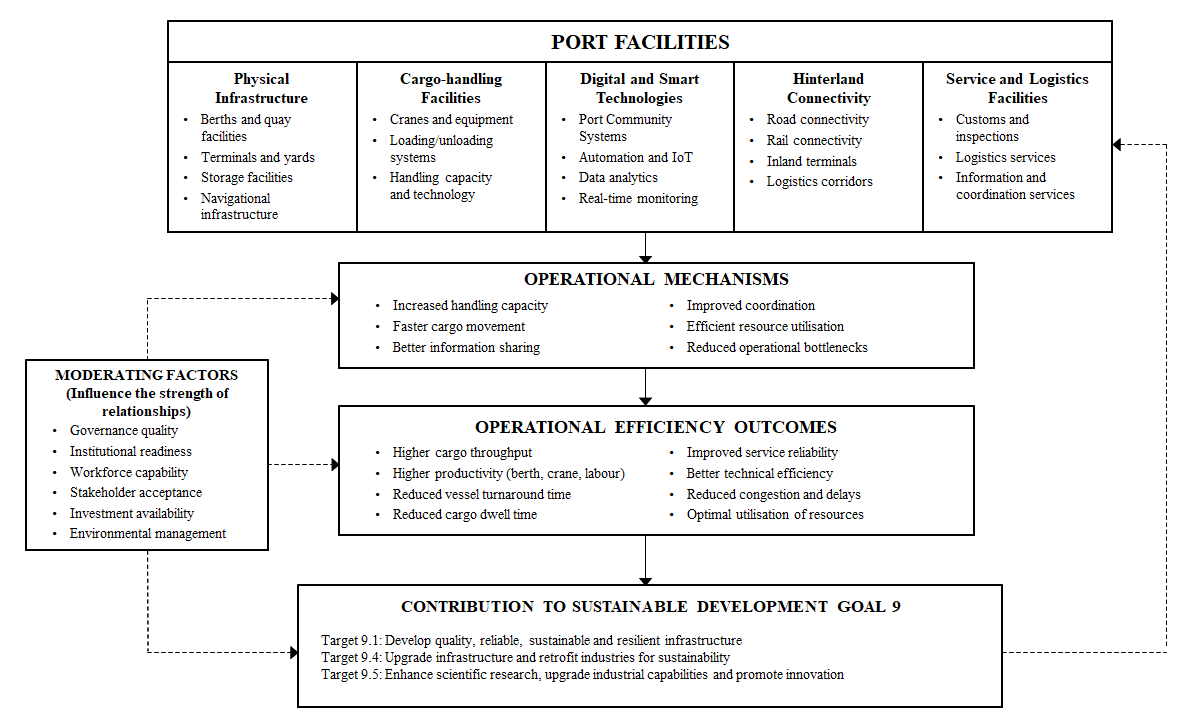
The conceptual framework positions SDG 9 as a guiding policy lens linking port facilities to operational efficiency. Port infrastructure, cargo-handling systems, digital technologies, and service facilities improve efficiency by enhancing resource utilisation, process integration, and coordination, leading to higher throughput, greater productivity, improved service reliability, and reduced dwell time. However, these benefits depend on governance quality, institutional readiness, and hinterland connectivity. The framework therefore demonstrates that operational efficiency results from the effective integration of infrastructure, technology, and management, supporting SDG 9 through resilient infrastructure, innovation, and sustainable industrial development (Figure 1).
Figure 1. Conceptual framework linking port facilities to operational efficiency and SDG 9
6.1 Align port facility investments with SDG 9 targets
Port authorities and policymakers should align infrastructure development with SDG 9 by prioritising investments that enhance resilience, technological innovation, and long-term efficiency. This includes developing climate-resilient port infrastructure, investing in smart port technologies, and promoting inclusive logistics systems that integrate ports with regional and global supply chains. For example, investments in automated terminals, digital platforms, and modern cargo-handling systems not only improve throughput and reduce dwell time but also contribute to sustainable industrialisation. Aligning port strategies with SDG 9 ensures that efficiency improvements are not only economic but also sustainable and innovation-driven, consistent with findings that infrastructure and digitalisation significantly enhance port performance.
6.2 Integrate digital and smart facilities with human capital development
While digitalisation, automation, and smart port technologies improve operational efficiency, their effectiveness depends heavily on workforce capability and institutional readiness. Port authorities should invest in continuous training programs, technical upskilling, and change management strategies to ensure that employees can effectively operate and manage advanced systems such as Terminal Operating Systems (TOS), IoT devices, and data analytics platforms. Studies show that stakeholder acceptance and organisational readiness significantly influence the success of automation initiatives. Therefore, combining technology adoption with human capital development is essential to realise efficiency gains fully.
6.3 Strengthening hinterland and inland terminal connectivity
Efficient port operations depend not only on port-side facilities but also on strong hinterland connectivity, including road, rail, and inland terminal networks. Poor connectivity leads to cargo congestion, longer dwell times, and underutilisation of port infrastructure. Port authorities should invest in multimodal transport systems, such as rail-linked dry ports and inland container depots, to facilitate faster cargo evacuation and distribution. Additionally, developing logistics corridors and integrated transport networks can significantly reduce bottlenecks and improve supply chain efficiency. Empirical studies highlight that inadequate hinterland connections constrain port performance, despite infrastructure improvements, while integrated inland terminals enhance cargo flow and reduce congestion [14].
6.4 Incorporate environmental sustainability in facility planning
Port development strategies should integrate environmental considerations to ensure long-term sustainability and regulatory compliance. This includes adopting green port initiatives such as energy-efficient equipment, shore power systems, emission reduction technologies, and environmentally friendly cargo-handling processes [33]. Environmental planning should also consider the impact of infrastructure development on marine ecosystems and surrounding communities. Studies indicate that port facility expansion can affect environmental conditions and operational sustainability, while emerging infrastructure such as hydrogen hubs introduces new sustainability and efficiency trade-offs. Integrating sustainability into facility planning ensures that efficiency gains are balanced with environmental responsibility.
6.5 Standardise efficiency measurement methods for benchmarking
To enable meaningful comparison of port performance across regions and time, there is a need to standardise efficiency measurement and benchmarking approaches. Currently, different studies use varying methods, making comparisons difficult [30]. Port authorities and researchers should adopt consistent benchmarking systems such as:
Standardising these methods will improve comparability, transparency, and decision-making, allowing policymakers to identify best practices and benchmark performance effectively across different ports.
This review demonstrates that port facilities are a critical determinant of port operational efficiency, influencing capacity utilisation, cargo flow, service reliability, and long-term competitiveness. Empirical evidence consistently shows that well-planned port infrastructure, efficient cargo-handling facilities, and strong hinterland connectivity are essential for reducing congestion, improving throughput, and enhancing operational performance. The findings further confirm that digitalisation, automation, and smart port facilities significantly improve coordination and resource utilisation, although their effectiveness depends on institutional readiness, governance quality, and human capital development. Viewed through the lens of SDG 9, port operational efficiency emerges not only as an economic objective but also as a sustainability-driven outcome. Efficient, resilient, and innovation-enabled port facilities contribute to sustainable industrialisation and infrastructure resilience at both national and regional levels. Addressing the identified research gaps, particularly those related to long-term investment impacts, sustainability integration, and performance measurement consistency, will be essential for advancing operational efficiency while supporting the broader global sustainability agenda.
Table A1. Empirical studies and systematic reviews on port facilities and operational efficiency
|
Author(s) |
Region |
Method Used |
Key Findings |
|
Alsalfiti and Notteboom [27] |
Kuwait |
Structural Equation Modeling (SEM) |
Service-related facilities enhance operational reliability and customer satisfaction, thereby improving efficiency. |
|
Amoah and Mlonzi [28] |
South Africa |
Factor analysis |
Facility adequacy is a critical driver of operational efficiency and service performance. |
|
Md Arof et al. [33] |
Malaysia |
Delphi and Analytic Hierarchy Process |
Water pollution management, environmental awareness and training, and air pollution management are important variables in ensuring sustainability of dry bulk terminal operations. |
|
Danladi et al. [16] |
Lower-middle-income countries |
Data Envelopment Analysis (DEA) |
Differences in infrastructure utilisation explain variations in port operational efficiency across container ports. |
|
Golubkov and Golubkov [29] |
Russia |
Environmental analysis |
Port facility construction affects operational sustainability by altering the balance between efficiency gains and environmental impacts. |
|
Guo et al. [20] |
China |
Geographically Weighted Regression (GWR) |
Infrastructure development is a key driver of cargo throughput and operational outcomes. |
|
Hidayat et al. [21] |
Indonesia |
User perception survey |
Adequate cargo handling and terminal facilities improve loading/unloading efficiency and customer satisfaction. |
|
Ibeh [10] |
West Africa |
DEA and Malmquist Productivity Index |
Infrastructure and technological improvements enhance port operational efficiency. |
|
Idris et al. [26] |
Indonesia |
SEM / empirical analysis |
Engineering infrastructure and smart port facilities significantly improve operational and environmental performance in container terminals. |
|
Ju et al. [3] |
China |
Panel regression analysis |
Competition and infrastructure investment improve port operational efficiency. |
|
Kakou et al. [12] |
Ivory Coast |
Empirical case study |
Port resources and infrastructure quality have a significant positive impact on operational performance. |
|
Kunambi and Zheng [9] |
Tanzania/Kenya |
Hybrid DEA |
Variations in infrastructure quality explain observed efficiency gaps between competing ports. |
|
Maemunah et al. [2] |
Indonesia |
SEM |
Ports that adopt digitalisation and maintain adequate facilities demonstrate continuous improvements in operational performance. |
|
Moshi and Meli [6] |
Tanzania |
DEA–Regression |
External shocks expose inefficiencies in facility utilisation, highlighting the importance of resilient infrastructure. |
|
Juma Mwendapole and Zhihong [13] |
Tanzania |
Qualitative analysis |
Inadequate hinterland facilities constrain port operational efficiency despite improvements in port-side infrastructure. |
|
Netirith and Ji [15] |
Thailand |
Fuzzy Exploratory Factor Analysis (EFA) |
Connectivity-related facilities significantly improve port operational performance. |
|
Ikeogu et al. [32] |
Nigeria |
Case study |
Operational and facility-related factors strongly influence seaport performance and efficiency outcomes. |
|
Notteboom et al. [23] |
Global |
Survey analysis |
Stakeholder acceptance of automation significantly influences efficiency outcomes in port operations. |
|
Pratama [18] |
Indonesia |
Design optimisation |
Integrated port facilities improve maritime logistics efficiency, particularly in archipelagic regions. |
|
Raphael et al. [8] |
Tanzania |
Moderated regression |
Port investments improve operational performance primarily by developing and upgrading port facilities. |
|
Rodrigue [19] |
Global |
System analysis |
Terminal layout design significantly affects cargo flow and operational efficiency. |
|
Rožić et al. [14] |
Europe |
Case study |
Inland terminal development enhances port–hinterland efficiency and reduces terminal congestion. |
|
Russo et al. [17] |
Italy / Global Port Systems |
Aggregate Function Calibration Analysis |
Efficient infrastructure and operational systems reduce ship turnaround time and improve port competitiveness. |
|
Sembiring et al. [1] |
Indonesia |
Regression |
Port facilities and cargo-handling efficiency significantly reduce dwell time, thereby improving terminal operational efficiency. |
|
Sirajuddin et al. [25] |
Indonesia |
Adaptive DMAIC 4.0 Framework Integrated with Lean Six Sigma |
Industry 4.0 technologies and process improvements enhance loading efficiency and reduce operational waste. |
|
Verbruggen et al. [11] |
Europe (multi-port) |
Benchmarking / performance analysis |
Efficient management of port assets (berths, quay walls, terminals) improves operational performance and reduces inefficiencies. |
|
Yap and Ho [22] |
Global |
Panel regression |
Data analytics facilities enhance port performance by enabling informed, data-driven decision-making. |
|
Yen et al. [31] |
Asia (Multiple Ports) |
DEA–Tobit |
Smart port design elements significantly improve port efficiency, with automation and digital facility integration positively influencing technical efficiency levels. |
|
Yenilmez [30] |
Turkey |
DEA & SFA |
Facility efficiency levels vary depending on the efficiency measurement method applied. |
|
Zakaria et al. [5] |
Malaysia |
Survey analysis |
Quality Ro-Ro facilities improve customer satisfaction and contribute to better service performance. |
|
Zhou and Suh [4] |
Korea |
DEA |
Smart port facilities significantly improve operational efficiency through automation and digital integration. |
|
Zou et al. [24] |
Global |
Bibliometric analysis |
Automated facilities have dominated recent innovation in port development and operations. |
[1] Sembiring, H.F.A., Sakti, R.F.J., Ghaisan, A., Rizqullah, R. (2024). Impact of port facilities and loading-unloading on dwell time at Tanjung Priok port. Advances in Transportation and Logistics Research, 7: 503-519. https://doi.org/10.51248/.v42i3.1632
[2] Maemunah, S., Rahmayanti, D., Iqbal Firdaus, M., Yuliantini, Y., Mudjiardjo, M., Indrawan, R. (2024). Accessibility, facilities and digitalization impact on port performance. Dinasti International Journal of Education Management and Social Science, 6(1): 501-507. https://doi.org/10.38035/dijemss.v6i1.3469
[3] Ju, S., Xie, J., Tang, H. (2023). The impact of competition on operational efficiency of ports: Empirical evidence from Chinese coastal port-listed companies. Research in Transportation Business & Management, 46: 100939. https://doi.org/10.1016/j.rtbm.2022.100939
[4] Zhou, L., Suh, W. (2024). A comprehensive study on static and dynamic operational efficiency in major Korean container terminals amid the smart port development context. Sustainability, 16(13): 5288. https://doi.org/10.3390/su16135288
[5] Zakaria, A., Md Arof, A., Ishak, I.C., Mukti, A.Q. (2020). Ro-Ro port facilities toward customer satisfaction: Evidence from Kuala Perlis terminal, Perlis, Malaysia. In Advancement in Emerging Technologies and Engineering Applications, pp. 299-303. https://doi.org/10.1007/978-981-15-0002-2_30
[6] Moshi, N.R., Meli, B.M. (2025). Container terminal efficiency under external shocks: A hybrid DEA-Regression analysis of Dar es Salaam port (2019–2023). Journal of Sustainable Development of Transport and Logistics, 10(2): 107-133. https://doi.org/10.14254/jsdtl.2025.10-2.7
[7] United Nations. Transforming our world: The 2030 agenda for sustainable development. https://sdgs.un.org/2030agenda, accessed on Mar. 2, 2026.
[8] Raphael, K., Mfanga, S., Mwakatage, F., et al. (2025). Assessment of the impact of port investments on port operational performance: A case study of major seaports in Tanzania, with a focus on the moderating role of improved port facilities. Global Scientific and Academic Research Journal of Multidisciplinary Studies, 4(9): 9-18.
[9] Kunambi, M.M., Zheng, H. (2024). Contextual comparative analysis of Dar es Salaam and Mombasa port performance by using a hybrid DEA (CVA) model. Logistics, 8(1): 2. https://doi.org/10.3390/logistics8010002
[10] Ibeh, F. (2025). Comparative analysis of container ports performance in West Africa. Journal of Shipping and Trade, 10(1): 13. https://doi.org/10.1186/s41072-025-00202-6
[11] Verbruggen, L.A.H., van Duin, J.H.R., Tavasszy, L., Schoenmaker, R., Cornelissen, S.C. (2022). Benchmarking port asset performance. International Journal of Transport Development and Integration, 6(3): 217-235. https://doi.org/10.2495/TDI-V6-N3-217-235
[12] Kakou, M.A., Houssaini, A., Mamad, M. (2022). Contribution to evaluating the impact of port resources on its operational performance: The case of Ivoirian seaports. Strategy Management Logistics, SMALOGresearch. https://revues.imist.ma/index.php/MLS/article/view/35754.
[13] Juma Mwendapole, M., Zhihong, J. (2020). Status, challenges and strategies of Dar es Salaam seaport-hinterland connectivity. MATEC Web of Conferences, 325: 04003. https://doi.org/10.1051/matecconf/202032504003
[14] Rožić, T., Božić, D., Bajor, I., Andrlić, B. (2025). The ambidextrous role of inland terminals in enhancing port–hinterland connectivity. Logistics, 9(1): 27. https://doi.org/10.3390/logistics9010027
[15] Netirith, N., Ji, M. (2024). Strategic enhancement infrastructure connectivity: A fuzzy exploratory factors analysis in Thailand’s regional ports within the RCEP framework. Maritime Business Review, 9(4): 369-390. https://doi.org/10.1108/MABR-04-2024-0031
[16] Danladi, C., Tuck, S., Tziogkidis, P., Tang, L., Okorie, C. (2024). Efficiency analysis and benchmarking of container ports operating in lower-middle-income countries: A DEA approach. Journal of Shipping and Trade, 9(1): 7. https://doi.org/10.1186/s41072-024-00163-2
[17] Russo, F., Peda, G., Musolino, G. (2022). Container ports in country systems: Calibration of the aggregate function for the time of the ship in port. International Journal of Transport Development and Integration, 6(4): 415-427. https://doi.org/10.2495/TDI-V6-N4-415-427
[18] Pratama, R.Y. (2025). Optimizing of integrated port infrastructure design to improve maritime logistics efficiency in eastern Indonesia. Journal of Maritime Policy Science, 2(3): 133-145. https://doi.org/10.31629/jmps.v2i3.7968
[19] Rodrigue, J.P. (2025). A systemic analysis of container terminal layouts. Journal of Shipping and Trade, 10(1): 4. https://doi.org/10.1186/s41072-025-00194-3
[20] Guo, R., Xiao, G., Zhang, C., Li, Q. (2025). A study on influencing factors of port cargo throughput based on multi-scale geographically weighted regression. Frontiers in Marine Science, 12: 1637660. https://doi.org/10.3389/fmars.2025.1637660
[21] Hidayat, A., Jinca, M.Y., Humang, W.P. (2024). Quality of container loading and unloading service at the Kariangau Container Terminal based on user perception. International Journal of Transport Development and Integration, 8(4): 613-624. https://doi.org/10.18280/ijtdi.080413
[22] Yap, W.Y., Ho, J. (2023). Port strategy and performance: Empirical evidence from major container ports and implications for role of data analytics. Maritime Policy & Management, 50(5): 608-628. https://doi.org/10.1080/03088839.2021.2017040
[23] Notteboom, T., Pallis, A.A., Knatz, G. (2025). Stakeholders’ attitudes toward container terminal automation. Maritime Economics & Logistics, 27(4): 752-785. https://doi.org/10.1057/s41278-025-00322-7
[24] Zou, Y., Xiao, G., Li, Q., Biancardo, S.A. (2025). Intelligent maritime shipping: A bibliometric analysis of internet technologies and automated port infrastructure applications. Journal of Marine Science and Engineering, 13(5): 979. https://doi.org/10.3390/jmse13050979
[25] Sirajuddin, S., Mukhtar, M., Trenggonowati, D.L., Ridwan, A., Yustiani, H.D. (2025). Optimizing dry bulk port performance: Development of adaptive DMAIC 4.0 framework integrated with Lean Six Sigma for Indonesian ports. International Journal of Transport Development and Integration, 9(4): 804-824. https://doi.org/10.56578/ijtdi090409
[26] Idris, Z.Y., Sitepu, G., Idrus, M., Indrabayu, I. (2025). Driving green port implementation: The role of engineering infrastructure and dual performance in Indonesian container terminals. International Journal of Transport Development and Integration, 9(4): 851-869. https://doi.org/10.56578/ijtdi090412
[27] Alsalfiti, A., Notteboom, T. (2025). The impact of port service quality on customer satisfaction: The case of clearing and forwarding agents in Kuwait Shuwaikh Port. Maritime Business Review, 10(1): 76-103. https://doi.org/10.1108/MABR-04-2024-0030
[28] Amoah, L.N.A., Mlonzi, A. (2025). Boosting efficiency: Factors influencing operation at the Port of Ngqura, Gqeberha. Journal of Transport and Supply Chain Management, 19: a1252. https://doi.org/10.4102/jtscm.v19i0.1252
[29] Golubkov, M., Golubkov, S. (2022). Impact of the construction of new port facilities on primary production of plankton in the Neva Estuary (Baltic Sea). Frontiers in Marine Science, 9: 851043. https://doi.org/10.3389/fmars.2022.851043
[30] Yenilmez, İ. (2025). Efficiency analysis of Turkish container ports: SFA or DEA? Verimlilik Dergisi, Productivity for Logistics, 105-118. https://doi.org/10.51551/verimlilik.1522007
[31] Yen, B.T.H., Huang, M.J., Lai, H.J., Cho, H.H., Huang, Y.L. (2023). How smart port design influences port efficiency–A DEA-Tobit approach. Research in Transportation Business & Management, 46: 100862. https://doi.org/10.1016/j.rtbm.2022.100862
[32] Ikeogu, V.N., Anyanwu, O.J., Ikeogu, C.C., Erumaka, O.P.F., Nwosu, E.N. (2025). The impact of operational factors on seaport performance: A case study of Lagos Port Complex, Nigeria. International Journal of Maritime and Interdisciplinary Research, 7(3): 182-204. https://ijmir.edu.ng/index.php/ijmir/article/view/10.
[33] Md Arof, A., Zakaria, A., Ishak, I.C., Rahman, N.S.F.A., Md Hanafiah, R. (2025). A Delphi-AHP analysis to identify key green port determinants for dry bulk terminals: A case study of Lumut Port. International Journal of Transport Development and Integration, 9(4): 973-985. https://doi.org/10.56578/ijtdi090419