Zainab Jawdat Kadhim | Amer Shakir Alkinani*
© 2026 The authors. This article is published by IIETA and is licensed under the CC BY 4.0 license (http://creativecommons.org/licenses/by/4.0/).
OPEN ACCESS
This study examines the concept of the third space as a schematic model that can be used to understand and analyze socio-spatial interaction in the contemporary urban context, especially in light of the growing separation between man and place as a result of rapid urban and social transformations. The study proceeds from the assumption that the third space does not represent a simple intermediate state between formal spaces and spaces of daily life, but rather a dynamic socio-spatial practice that consists of daily practices, sensory experience, and cultural connotations, thus contributing to the reconstruction of attachment to place and social relations. Study uses an analytical way that puts together theoretical foundations for concept of "third space" inside urban and social theory with an applied framework that comes from a conceptual model plus system of observable analytical indicators — these include spatial, social, and behavioral dimensions. A selected urban area got these indicators to look into manifestations of third space within urban structure by analysing daily use patterns, level of social interaction, and the nature of relationship between physical space and social practice.
third space, urban interaction, interstellar spaces, attachment to place, contemporary city
The concept of the third space has become an important concept in urban research, as it explains how social meanings are generated from people and their daily actions within the spaces used. This idea is particularly important in historic neighborhoods, where identity, memory, and informal uses continue to coexist within the same place even as the surrounding urban transformations occur. Iraqi cities are undergoing rapid changes that have weakened the link between planned spaces and spaces produced by society in its daily life. As a result, many of the small spaces between buildings remain not sufficiently invested in planning, although they continue to foster interaction between people and foster a sense of belonging. This study looks at Al-Adhamiya in Baghdad as a historic urban case to test the possibility of using the idea of a third space as a tool to measure how people and place interact together.
•Research problem: The main problem is the weak transformation of the theoretical concept into a practical tool that can be used in schematic analysis.
•Research hypothesis: The study assumes that linking the components of the third space with measurable indicators helps in reading small urban spaces as socially active places.
•The importance of the research: The importance of the study lies in narrowing the gap between theorizing and planning practice by providing a clear framework for reading the historical spaces of the city based on social interaction and a sense of belonging.
2.1 Concept of third space
The concept of the third space has become one of the main approaches to understanding space not as a fixed physical vessel, but as a socio-spatial state formed by everyday practice and the meanings that people give to the place. It is an interstitial and socio-spatial condition in which the formal and the informal, the physical and the symbolic, intersect, allowing rigid boundaries between spaces to be transcended, and make space a field for the production of meaning, dialogue, and negotiation [1, 2].
The diverse literature illustrates this shift in the understanding of space, as space is no longer seen as a physical entity independent of society, but rather as a structure produced by society itself. What is seen, what is perceived, and what is lived are inherently linked in the production of space [3], and Soja [2] then expanded this perception by presenting the third space as a social-spatial experience that combines physical form, mental representations, and everyday practices [4]. Bhabha [1] linked the concept to hybridization and the reshaping of identity through difference and cultural dialogue [5].
In contrast, Oldenburg [6] provided a direct social dimension by highlighting the importance of informal meeting spaces in everyday life as spaces that give people a sense of intimacy outside of home and work. Previous studies [7-9] also pointed out that the arrangement of space is never neutral, and that small or interstitial spaces may reveal tensions between control, difference, and social use. Accordingly, the third space in this study is not understood as a mere philosophical conception, but as a tool that helps to read how urban spaces acquire their meaning through use and collective life, which is doubly important in the historical fabrics where symbolic value, informal practices, and social encounters intersect. Hence, this concept represents a suitable starting point for the analysis of social interaction and memory in the Al-Adhamiya region.
In this study, the concept of third space is not used as a single theoretical term derived from one author, but as an integrative planning framework constructed from several related spatial concepts. Lefebvre's [10] theory of the production of space provides the basic foundation by explaining space as a social product shaped by perceived, conceived, and lived dimensions. Soja's [11] Thirdspace extends this view by emphasizing the simultaneity of material space, mental representations, and lived experience. Bhabha's [1] cultural third space contributes to understanding hybridity, negotiation, and the coexistence of difference within urban settings. Oldenburg's [6] third place provides the everyday social dimension of informal gathering outside home and work [12]. Foucault and Miskowiec's [8] heterotopia helps interpret spaces where formal order, difference, and alternative practices coexist. Finally, interstitial and in-between spaces provide the urban-morphological basis for reading small, adaptive, and semi-formal spaces within historic fabrics [13, 14]. Accordingly, these concepts are treated as complementary inputs used to build the three operational dimensions adopted in this study: social interaction, spatial and informal flexibility, and belonging and collective memory.
2.2 Third space and urban planning
At the level of urban planning, the third space is important because it reveals that social interaction does not result from physical form alone, but from how space intersects with everyday practices and social meanings. In this sense, interaction is not generated merely because of spatial convergence, but as a result of repeated use, survival, and communication within space, which is consistent with Lefebvre's [10] proposition about the centrality of lived experience in the production of the meaning of place [3]. This is also consistent with Soja's [2] conception of the third space as an open social–spatial sphere in which the formal meets what is lived daily [15]. The concept is therefore of clear use in historic urban areas whose daily lives are based on the constant overlap between formal regulation and informal practices. Oldenburg [6] has emphasized the value of spontaneous meeting spaces as spaces that support interaction and a sense of belonging outside of the living and working spaces [16]. At the same time, Foucault and Miskowiec [8] cautioned that space is not neutral; it allows for everyday use but also reflects patterns of organization and control [17]. The third space thus provides an appropriate approach to planning in order to understand how social interaction in historic neighborhoods is shaped by the relationship between freedom and control, and between what is planned and what is lived on a daily basis [13].
2.3 Third space, belonging, and collective memory
The significance of the concept of the third space also stems from its ability to explain how certain urban spaces acquire symbolic meaning related to memory, identity, and sense of place. The sense of familiarity and belonging does not result from physical composition alone, but from the repeated interaction between people and place, and from the meanings that are entrenched in the daily life of the city, which is related to Lefebvre's [10] proposition of living and symbolic space [3], as well as Soja's [2] view that the meaning of space is generated from the physical encounter with the imagined and lived experience, memory is particularly important in historic neighborhoods, because the meaning of a place is enhanced by continuity and social sharing of its knowledge. Some urban spaces are not limited to physical containers, but carry a common history and meanings [18, 19]. The strength of symbolic association is also heightened when individual experience overlaps with the collective narratives of place [20, 21]. On the other hand, Bhabha's [1] conception of the third space shows that identity is not fixed, but is shaped through difference, encounter, and cultural dialogue, which makes this concept suitable for interpreting the third space as a schematic framework that links social interaction with symbolic connection to the place [22]. In the case of Al-Adhamiya, this means that urban space is not limited to form or function but also serves to support diverse encounters and the continuity of collective memory and identity.
2.4 From theoretical concept to analytical diagnosis
Despite the theoretical depth of the concept of third space, its value for planning research depends on its ability to be translated into analytically usable components. In this study, this translation was carried out through a two-step process. First, the main conceptual contributions were identified according to their relevance to historic urban areas and everyday socio-spatial practices. Second, these contributions were reorganized into three operational dimensions: social interaction, spatial and informal flexibility, and belonging and collective memory. This process made it possible to move from abstract theoretical discussion to a measurable planning framework that could be tested through the questionnaire in Al-Adhamiya.
Table 1 clarifies that the analytical framework was not developed by mechanically transferring each theoretical concept into a single variable. Instead, concepts concerned with sociability were translated into social interaction indicators; concepts concerned with lived, negotiated, and adaptive space were translated into spatial and informal flexibility indicators; and concepts concerned with memory, identity, and emotional association were translated into belonging and collective memory indicators.
Table 1. Theoretical concepts and their operational contribution to the analytical framework
|
Theoretical Concept |
Contribution to This Study |
Operational Translation |
|
Production of Space |
Explains space as a social product formed through the interaction between physical form, representations, and lived practices. |
Links physical space with everyday use and social meaning. |
|
Thirdspace |
Interprets space as a combined material, imagined, and lived socio-spatial condition. |
Supports the integrated reading of social, spatial, and symbolic dimensions. |
|
Cultural Third Space |
Explains hybridity, negotiation, and the production of meaning through cultural encounter and difference. |
Supports indicators related to social diversity, openness, and negotiated interaction. |
|
Third Place |
Emphasizes informal public gathering spaces outside home and work as settings for sociability and community life. |
Supports indicators of unplanned meetings, ease of talking, gathering, and social vitality. |
|
Heterotopia |
Shows that space can contain difference, alternative practices, and tensions between order and everyday use. |
Supports indicators related to informal practices, negotiation with rules, and spatial freedom. |
|
Interstitial / in-between spaces |
Highlights the value of small, adaptive, transitional, and semi-formal spaces in everyday urban life. |
Supports indicators of flexibility, edge vitality, multi-use, and adaptive occupation. |
|
Collective memory and place attachment |
Explains how historic places acquire symbolic meaning through continuity, shared narratives, and emotional association. |
Supports indicators of identity value, memory, symbolic meaning, sense of loss, and belonging. |
2.5 Derivative analytical indicators for third space
Building from previous theoretical discussion, study derives a set of analytical dimensions and operational indicators that translate concept of third space into formula suitable for empirical examination. This step does not aim to reduce concept to a simplified list, but rather to identify dimensions where socio-spatial interaction can be observed and interpreted inside selected study area. The analytical structure adopted in this research is organized around three dimensions that are directly related with operational logic of fieldwork tool. Table 2 presents the derived analytical dimensions, their theoretical basis, and their operational significance in the context of this study, as well as the indicators adopted in the field questionnaire.
Table 2. Derived analytical dimensions and operational indicators of third space
|
Analytical Dimension |
Operational Meaning in This Study |
Indicator Resolution Function |
Measurement Method |
|
Social Interaction |
The extent to which the space supports meeting, communication, social openness, and frequent daily interaction. |
Unplanned meetings, ease of communication, acceptance of social diversity, encouragement of gathering, sense of security during interaction, social vitality. |
Five-point Likert scale |
|
Spatial and informal flexibility |
The extent to which space is able to accommodate multiple uses, informal practices, and adaptive daily occupation without losing its overall cohesion. |
Versatility; freedom of movement/use; informal activities; vibrancy of the edges; negotiating with rules; sense of spatial freedom. |
Five-point Likert scale |
|
Belonging and collective memory |
The extent to which space supports symbolic connection, identity recognition, emotional continuity, and connection to place through memory. |
Psychological comfort, the value of identity, attachment to memory and tradition, symbolic value, the sense of loss when changed, and the sense of community belonging. |
Five-point Likert scale |
Table 2 shows that the adopted analytical framework is not based on a direct transfer from each perspective to a corresponding empirical variable but rather reorganizes theoretical insights into dimensions that are based on a clear conceptual basis and at the same time are systematically manageable. This gives the study a more coherent methodological structure, since the dimensions on which the theoretical debate is based are the same as those that were later measured and analyzed in fieldwork. This framework thus serves as an intermediate structure between theoretical interpretation and empirical evaluation.
3.1 Research design and spatial scope
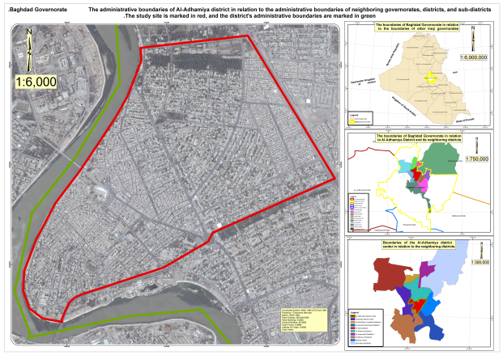
This study adopts a quantitative field approach supported by structured field observation. It aims to measure the extent to which the characteristics of third space are present in Al-Adhamiya, Baghdad. Al-Adhamiya represents a historic urban fabric in which commercial, religious, residential, and informal everyday practices intersect within public and semi-public spaces, as illustrated in Figure 1.
The field survey was conducted within the defined study boundary of Al-Adhamiya. To capture the daily rhythm of socio-spatial use, questionnaire distribution and observation were organized into three periods recorded in the dataset: morning, afternoon, and evening. Respondents were approached in active public and semi-public spaces characterized by pedestrian movement, commercial interaction, informal use, and social encounters within the study boundary. These locations were treated as field collection points representing patterns of use within the historic fabric rather than as separate case-study units.
The final sample consisted of 150 respondents, and the study adopted the field sample method aimed at focusing on users of public and semi-public spaces that are active on a daily basis, rather than statistically representing the entire population of the area. The sample included residents, visitors, and shopkeepers, and it was distributed across the three observation periods to reduce bias towards a specific user category or time period.
Table 3 shows that the sample was closely distributed over the three observation periods, with 46 respondents in the morning, 53 in the afternoon and 51 in the evening. It also included 42 residents, 53 visitors, and 55 shopkeepers. This distribution allowed for a comparison of perceptions between different patterns of daily use and different time conditions within the same historical urban fabric.
Table 3. Distribution of valid questionnaires by user group and observation period
|
User Group |
Morning |
Afternoon |
Evening |
Total |
|
Residents |
16 |
12 |
14 |
42 |
|
Visitors |
17 |
17 |
19 |
53 |
|
Shop owners |
13 |
24 |
18 |
55 |
|
Total |
46 |
53 |
51 |
150 |
Table 4 summarizes the socio-demographic and fieldwork profile of the 150 valid respondents, including gender, age group, user type, and observation period. The table provides the descriptive basis for interpreting the questionnaire results across different categories of everyday users in Al-Adhamiya.
Table 4. Respondents’ socio-demographic and fieldwork profile
|
Variable |
Category |
Frequency |
Percentage |
|
Gender |
Male |
68 |
45.3% |
|
Gender |
Female |
82 |
54.7% |
|
Age group |
18–24 |
29 |
19.3% |
|
Age group |
25–34 |
22 |
14.7% |
|
Age group |
35–44 |
38 |
25.3% |
|
Age group |
45–54 |
36 |
24.0% |
|
Age group |
55+ |
25 |
16.7% |
|
User type |
Resident |
42 |
28.0% |
|
User type |
Visitor |
53 |
35.3% |
|
User type |
Shop owner |
55 |
36.7% |
|
Time period |
Morning / Afternoon / Evening |
46 / 53 / 51 |
30.7% / 35.3% / 34.0% |
|
Total |
All respondents |
150 |
100% |
3.2 Measurement instrument and variable structure
The questionnaire was designed to translate the theoretical framework of Space III into measurable field indicators. Based on the dataset used in the analysis, the questionnaire consisted of two main parts. The first part collected information on respondents and fieldwork, including time period, gender, age group, and type of user. The second part measured the three operational dimensions of Space III: social interaction, spatial and informal flexibility, and belonging and collective memory. Each dimension was measured through six indicators, for a total of eighteen items on the Likert scale. Answers on the five-point Likert scale were symbolized, with higher values indicating greater agreement for the existence of the measured third space attribute.
As shown in Table 5, the questionnaire structure directly corresponded to the three analytical dimensions derived from the theoretical framework. The analysis in this study is based on closed-ended questionnaire items measured on a five-point Likert scale; therefore, no separate qualitative thematic analysis or open-ended response analysis is reported.
Table 5. Questionnaire structure and measured indicators
|
Section |
Dimension / Variable Group |
Items / Variables |
Measurement |
|
A |
Respondent and fieldwork profile |
Time period, gender, age group, user type |
Categorical variables |
|
B1 |
Social interaction |
Unplanned meetings, ease of talking, acceptance of social diversity, encouragement of gathering, feeling safe during interaction, social vitality |
Five-point Likert scale |
|
B2 |
Spatial and informal flexibility |
Versatility, freedom of movement/use, informal activities, edge vibrancy, negotiation with official rules, sense of spatial freedom |
Five-point Likert scale |
|
B3 |
Belonging and collective memory |
Psychological comfort, importance of place to identity, connection to memory and tradition, symbolic value, feeling of loss if changed, sense of community belonging |
Five-point Likert scale |
3.3 Data processing and statistical analysis procedures
After data entry, the questionnaire responses were coded and analyzed using SPSS. The three operational dimensions of third space were measured through six Likert-scale items for each dimension. A composite score was calculated for each respondent by averaging the six items belonging to the same dimension. Accordingly, the composite score for social interaction was calculated from items B1_1 to B1_6, spatial and informal flexibility from items B2_1 to B2_6, and belonging and collective memory from items B3_1 to B3_6. Higher scores indicate a stronger perceived presence of the corresponding third-space characteristic.
The reliability of each dimension was examined using Cronbach's alpha coefficient, where a value of α ≥ 0.70 was considered acceptable for internal consistency. The suitability of the data for exploratory factor analysis was assessed using the Kaiser–Meyer–Olkin scale and the Bartlett spherical test. The explanation of the factors was based on theoretical compatibility with the three predefined dimensions, load coefficients, and cumulative explained variance. A minimum load of 0.40 kbps was adopted as an acceptable threshold for the interpretation of the clauses.
The differences between the three observation periods, morning, noon and evening, were tested using one-way variance analysis (ANOVA) on the composite scores of the three dimensions. The significance level was set at p < 0.05. In addition, the dimensional scores were converted to a composite index ranging from 0 to 100 using the following formula: index = ((average - 1) / 4) × 100. He then calculated the total third space index with equal weights by calculating the average of the three dimensional indicators. A simple sensitivity test was performed by changing the relative weights of the three dimensions to examine whether the overall index remained stable under alternative weighting assumptions.
This section presents the results of the field study in a systematic sequence, beginning with the description of the characteristics of the respondents and the distribution of valid questionnaires by user categories and observation periods. It then provides descriptive statistics for the dimensions of the third space, followed by tests of reliability, correlation and exploratory factor analysis, as well as temporal comparisons and the composite index of the third space. This organization helps to separate the experimental results from their subsequent theoretical and schematic interpretation.
4.1 Descriptive statistics of third-space indicators
4.1.1 Social interaction
Table 6 indicates that respondents perceived social interaction positively within the study area. The indicator of acceptance of social diversity recorded the highest mean, while the remaining indicators were closely grouped. The composite mean of the social interaction dimension was 3.76, with a standard deviation of 0.50, reflecting a relatively high level of perceived social vitality.
Table 6. Mean and standard deviation of social interaction indicators
|
Indicator |
Mean |
Standard Deviation |
|
B1_1 Unplanned meetings |
3.73 |
0.66 |
|
B1_2 Ease of talking |
3.74 |
0.66 |
|
B1_3 Acceptance of social diversity |
3.81 |
0.68 |
|
B1_4 Encouragement of gathering |
3.77 |
0.69 |
|
B1_5 Feeling safe during interaction |
3.76 |
0.72 |
|
B1_6 Social vitality |
3.77 |
0.61 |
4.1.2 Spatial and informal flexibility
Table 7 shows that respondents clearly recognized the flexible and adaptive nature of public and semi-public spaces in Al-Adhamiya. Versatility recorded the highest mean, indicating the ability of the space to accommodate diverse and simultaneous activities. The convergence of the indicators reflects a balance between freedom of use and the presence of informal practices. The composite mean of this dimension was 3.80, with a standard deviation of 0.59, making it the slightly strongest of the three dimensions.
Table 7. Mean and standard deviation of spatial and informal flexibility indicators
|
Indicator |
Mean |
Standard Deviation |
|
B2_1 Versatility |
3.87 |
0.74 |
|
B2_2 Freedom of movement/use |
3.81 |
0.79 |
|
B2_3 Informal activities |
3.81 |
0.69 |
|
B2_4 Edge vibrancy |
3.77 |
0.71 |
|
B2_5 Negotiation with official rules |
3.78 |
0.71 |
|
B2_6 Sense of spatial freedom |
3.75 |
0.76 |
4.1.3 Belonging and collective memory
Table 8 shows that the symbolic and identity-related dimension was also highly perceived by respondents. The importance of place to local identity recorded the highest mean, indicating the strength of symbolic value in the collective perception of Al-Adhamiya. The composite mean of this dimension was 3.79, with a standard deviation of 0.57, reflecting the overlap between symbolic continuity and everyday urban experience.
Table 8. Mean and standard deviation of belonging and collective memory indicators
|
Indicator |
Mean |
Standard Deviation |
|
B3_1 Psychological comfort |
3.79 |
0.71 |
|
B3_2 Importance of place to local identity |
3.84 |
0.71 |
|
B3_3 Connection to memory and tradition |
3.81 |
0.73 |
|
B3_4 Symbolic and representative value |
3.82 |
0.68 |
|
B3_5 Feeling of loss if changed |
3.75 |
0.69 |
|
B3_6 Sense of community belonging |
3.74 |
0.75 |
4.1.4 Comparison of the three operational dimensions
Table 9 shows that the three dimensions were perceived at relatively close levels, with means ranging from 3.76 to 3.80. This indicates that third space in Al-Adhamiya is not produced by a single dominant factor, but by the combined presence of social interaction, adaptive spatial use, and symbolic attachment to place.
Table 9. Composite means and standard deviations of the three operational dimensions
|
Dimension |
Mean |
Standard Deviation |
|
Social interaction |
3.76 |
0.50 |
|
Spatial and informal flexibility |
3.80 |
0.59 |
|
Belonging and collective memory |
3.79 |
0.57 |
4.1.5 Reliability analysis
Table 10 shows that Cronbach’s alpha values ranged from 0.84 to 0.89, exceeding the commonly accepted threshold of 0.70. This confirms that the items within each dimension show good internal consistency and can be used to calculate composite scores for subsequent analysis.
Table 10. Reliability coefficients of the three dimensions
|
Dimension |
Items |
Cronbach’s Alpha |
Interpretation |
|
Social interaction |
6 |
0.84 |
Good reliability |
|
Spatial and informal flexibility |
6 |
0.89 |
High reliability |
|
Belonging and collective memory |
6 |
0.89 |
High reliability |
4.2 Correlation analysis
Table 11 shows that there are relatively positive and strong relationships between the dimensions of the third space, with the highest being between social interaction, belonging, and collective memory (r = 0.74), followed by the relationship between social interaction and spatial flexibility (r = 0.71), and then between spatial flexibility, belonging, and collective memory (r = 0.65). These results indicate that the three dimensions are empirically correlated, with each dimension retaining its analytical specificity.
Table 11. Pearson correlation matrix between the composite dimensions
|
Dimension |
B1 Social Interaction |
B2 Spatial Flexibility |
B3 Belonging and Memory |
|
B1 Social interaction |
1.00 |
0.71 |
0.74 |
|
B2 Spatial flexibility |
0.71 |
1.00 |
0.65 |
|
B3 Belonging and memory |
0.74 |
0.65 |
1.00 |
4.3 Exploratory factor analysis
Table 12 shows that the Kaiser–Meyer–Olkin value was 0.94, indicating a very high fit for the sample, and the Bartlett test was statistically significant, χ² = 1464.10, p < 0.001, confirming the validity of the correlation matrix for factor analysis. The three-component solution explained 61.89% of the total variance. Although only the first two components exceeded the Eigenvalue > 1 criterion, the third component was retained in line with the three predefined theoretical dimensions and the conceptual structure of the questionnaire.
Table 12. Kaiser–Meyer–Olkin, Bartlett’s test, and explained variance
|
Test / Component |
Value |
|
Kaiser–Meyer–Olkin measure |
0.94 |
|
Bartlett’s Chi-square |
1464.10 |
|
Bartlett’s significance |
p < 0.001 |
|
Cumulative explained variance, three-component solution |
61.89% |
|
Minimum loading adopted for interpretation |
0.40 |
4.4 Time-period comparisons
Table 13 shows that there were no statistically significant differences between the three observation periods at the level of 0.05 in the dimensions of the third space. Social interaction showed limited temporal variation, with the highest average recorded in the afternoon and the lowest in the evening, but not at the level of statistical significance (F = 2.84, p = 0.062). Spatial flexibility, affiliation, and collective memory also did not show significant differences, suggesting relative stability in the characteristics of the third space in Al-Adhamiya during the day.
Table 13. One-way ANOVA results across observation periods
|
Dimension |
Morning Mean |
Afternoon Mean |
Evening Mean |
F-Value |
p Value |
Interpretation |
|
Social interaction |
3.75 |
3.88 |
3.65 |
2.84 |
0.062 |
Not significant |
|
Spatial and informal flexibility |
3.78 |
3.87 |
3.74 |
0.67 |
0.514 |
Not significant |
|
Belonging and collective memory |
3.76 |
3.90 |
3.71 |
1.56 |
0.214 |
Not significant |
4.5 Synthetic third-space index and sensitivity test
Table 14 shows the convergence of the values of the three dimensions after converting them to an index from 0–100, with spatial and informal flexibility recording the highest value of 69.97, followed by collective memory and belonging 69.81, and social interaction with 69.11. The total equal-weighted index for the third space was 69.63, indicating a moderate to high level of characteristics of the third space in the study area.
Table 14. Dimension indices and overall synthetic third-space index
|
Dimension |
Mean |
Index 0–100 |
Interpretation |
|
Social interaction |
3.76 |
69.11 |
Moderate-to-high |
|
Spatial and informal flexibility |
3.80 |
69.97 |
Moderate-to-high |
|
Belonging and collective memory |
3.79 |
69.81 |
Moderate-to-high |
|
Overall third-space index |
— |
69.63 |
Moderate-to-high |
Table 15 indicates that the overall index remained highly stable under alternative weighting assumptions. The index ranged only from 69.58 to 69.66, meaning that changing the relative emphasis among the three dimensions did not materially alter the overall assessment. This supports the robustness of the synthetic index and confirms that the diagnosis is not dependent on a single weighting structure.
Table 15. Sensitivity test under alternative weighting scenarios
|
Weighting Scenario |
B1 Weight |
B2 Weight |
B3 Weight |
Overall Index |
|
Equal weights |
0.333 |
0.333 |
0.333 |
69.63 |
|
Social interaction emphasis |
0.40 |
0.30 |
0.30 |
69.58 |
|
Spatial flexibility emphasis |
0.30 |
0.40 |
0.30 |
69.66 |
|
Belonging and memory emphasis |
0.30 |
0.30 |
0.40 |
69.65 |
The experimental results show that the third space in Al-Adhamiya is not just an intermediate physical state, but a socio-spatial state that is shaped through the interaction of daily use, spatial flexibility, and symbolic connection. This confirms Lefebvre's [10] view of space as a social product, and supports Soja’s [11] understanding of the third space as a combination of physical, perceived, and subsistence dimensions. The convergent mean values of the three operational dimensions also indicate that social interaction, spatial and informal flexibility, and belonging are not separate qualities, but rather complementary and interconnected components of the same urban situation.
The relatively high degree of spatial and informal flexibility enriches recent debates about interstitial and intermediate spaces, which emphasize the value of small, adaptive and semi-formal urban environments in everyday life [13, 14, 20, 21]. In the Al-Adhamiya area, this flexibility is not only a morphological feature, but a social practice through which users negotiate mobility, informal activities, and temporary use. This extends the concept of "third place" beyond Oldenburg's focus on informal gatherings outside the home and workplace, showing how "third place" characteristics can emerge within historic streets, periphery, and semi-public spaces, rather than being limited to clearly defined social spaces [6, 12].
The results of strong belonging and collective memory confirm studies that link historic urban spaces to memory, identity, and connection to place [18, 19, 22]. However, the results also add a Middle Eastern perspective, showing that the symbolic value of historic areas is preserved not only through heritage conservation, but also through repetitive daily practices and social intimacy. This calls into question planning approaches that primarily treat historical renewal as material improvement, and instead support more socially sensitive interventions that protect informal use, symbolic continuity, and local identity [15, 17].
In doing so, this study fills a methodological and contextual gap. Methodically, this study translates the broad concept of the third space into measurable schematic dimensions, and tests them through field survey data. Contextually, the study provides evidence from a historic urban area of Baghdad, an area that is still underrepresented in the third space and Third Place literature. The findings suggest that sustainable regeneration in the Middle East's historic urban areas should not replace existing social-spatial practices, but should foster conditions that allow for continued social interaction, spatial resilience and collective memory to work together.
The results of the study offer practical applications of sustainable urban planning in historic areas, with the majority showing the characteristics of a third space at a medium to high level. Therefore, planning interventions should not be based on radical changes in urban structure, but rather selective, limited-impact and socially sensitive improvements that preserve symbolic identity, support informal daily uses, and enhance the quality of social interaction.
From the perspective of sustainable development, the third space framework can be used as a diagnostic tool to identify areas that require the protection of social interaction, spatial resilience and collective memory, especially in the historic urban fabric where public and semi-public spaces are carriers of memory, identity and everyday life, not merely corridors of movement. Accordingly, the schematic intervention in Al-Adhamiya should balance physical modernization with social and cultural protection.
Table 16. Planning implications for sustainable development in Al-Adhamiya
|
Planning Implication |
Responsible Actor |
Timeline |
Planning Tool |
Measurable Indicator |
|
Enhance social interaction during periods of lower urban vitality |
Baghdad Municipality; Al-Adhamiya municipal district; local community representatives |
Short term: 6–12 months |
Lighting improvement; shaded seating; small resting points; pedestrian comfort measures |
Increase in social interaction score; increase in average length of stay; higher perceived safety |
|
Support spatial and informal flexibility without creating visual or movement disorder |
Municipality; local shop owners; market committees |
Short to medium term: 6–18 months |
Flexible-use zones; temporary activity permits; organized vending areas; edge-management guidelines |
Reduction in pedestrian obstruction; increase in perceived spatial freedom; fewer conflicts between formal and informal uses |
|
Protect collective memory and symbolic identity |
Baghdad Municipality; heritage authorities; local cultural institutions |
Medium term: 1–3 years |
Conservation guidelines; façade control; signage regulation; protection of symbolic nodes and traditional visual elements |
Number of protected symbolic elements; user satisfaction with identity value; reduction in inappropriate visual alterations |
|
Improve pedestrian comfort and accessibility |
Municipality; traffic authorities; urban design units |
Short term: 6–12 months |
Micro-scale street improvements; paving maintenance; shaded walking paths; traffic calming around active public spaces |
Increased walkability; reduced pedestrian-vehicle conflict; improved comfort and safety scores |
|
Use the third-space index as a monitoring tool |
Planning departments; academic institutions; municipal decision-makers |
Medium term: annually or every two years |
Periodic survey using the same three-dimensional framework |
Change in the 0–100 third-space index; comparison between intervention areas over time |
|
Strengthen community participation in historic-area regeneration |
Local authority; community groups; shop owners; residents |
Medium term: 1–2 years |
Participatory workshops; local design charrettes; user-perception surveys |
Number of participants; documented community priorities; alignment between interventions and user needs |
Table 16 translates the empirical results into planning actions. The recommendations are intentionally incremental because the study area does not require replacement of its existing socio-spatial structure. Rather, it requires careful reinforcement of the qualities that already support third-space performance. The priority should be to improve comfort, safety, accessibility, and spatial organization while maintaining the informal practices and symbolic references that give Al-Adhamiya its social and cultural meaning.
The study confirms that the concept of the third space can be used as an analytical and planning framework in historical urban contexts. The results of the Al-Adhamiya neighborhood show that it represents a living socio-spatial environment, characterized by medium to high levels of social interaction, spatial and informal flexibility, belonging and collective memory. Spatial flexibility emerged as the strongest dimension, reflecting the neighborhood's ability to accommodate diverse daily uses without losing its urban character, with a clear increase in the value of belonging and memory. The statistical results also supported the consistency of the framework and its reliability, although the study was limited to a single case and cognitive data. The framework could therefore be adopted as a supporting tool for prioritizing intervention and tracking the impact of sustainable urban improvements.
[1] Bhabha, H.K. (2012). The Location of Culture (2nd ed.). Routledge. https://doi.org/10.4324/9780203820551
[2] Soja, E.W. (2010). Seeking Spatial Justice. University of Minnesota Press. https://doi.org/10.5749/minnesota/9780816666676.001.0001
[3] Gieseking, J.J., Mangold, W., Katz, C., Low, S., Saegert, S. (Eds.). (2014). The People, Place, and Space Reader. Routledge. https://doi.org/10.4324/9781315816852
[4] Mansour, E.A., Elazab, E.M., Sheta, S.A. (2025). Reviewing frameworks for identifying the memory of the city in historical urban landscape. Journal of Housing and the Built Environment, 41(2): 691-715. https://doi.org/10.1007/s10901-025-10241-x
[5] Wang, H., Xie, B., Zeng, Y., Liu, A., Liu, B., Qin, L. (2025). Intergenerational transmission of collective memory in public spaces: A case study of Menghe, a historic and cultural town. Sustainability, 17(19): 8596. https://doi.org/10.3390/su17198596
[6] Oldenburg, R. (2023). The Great Good Place: Cafés, Coffee Shops, Bookstores, Bars, Hair Salons, and Other Hangouts at the Heart of a Community. Berkshire Publishing Group. https://doi.org/10.2307/jj.9561417
[7] Abdulmunem, S.A., Shok, M.E., Al-Hussaini, Z.I.H., Alkinani, A.S. (2024). Multigenerational urban design: Creating urban spaces that support active aging and intergenerational interaction. International Journal of Sustainable Development and Planning, 19(10): 3737-3747. https://doi.org/10.18280/ijsdp.191004
[8] Foucault, M., Miskowiec, J. (1986). Of other spaces. Diacritics, 16(1): 22-27. https://doi.org/10.2307/464648
[9] Littman, D.M. (2022). Third places, social capital, and sense of community as mechanisms of adaptive responding for young people who experience social marginalization. American Journal of Community Psychology, 69(3-4): 436-450. https://doi.org/10.1002/ajcp.12531
[10] Lefebvre, H. (1991). The Production of Space. Wiley-Blackwell.
[11] Soja, E.W. (1998). Thirdspace: Journeys to Los Angeles and other real-and-imagined places. Capital & Class, 22(1): 137-139. https://doi.org/10.1177/030981689806400112
[12] Hassan, H.M.M., Alkinani, A.S. (2022). Challenges facing the transition of traditional cities to smart: Studying the challenges faced by the transition of a traditional area such as Al-Kadhimiya city center to the smart style. AIP Conference Proceedings, 2437(1): 020193. https://doi.org/10.1063/5.0093103
[13] Santos-Garcia, A., Braga, I.A. (2025). In-between spaces for today's city: Historical review for identifying their beneficial characteristics. Frontiers of Architectural Research, 14(1): 62-76. https://doi.org/10.1016/j.foar.2024.06.011
[14] Brighenti, A.M. (2013). Urban Interstices: The Aesthetics and the Politics of the In-Between. Routledge. https://doi.org/10.4324/9781315548807
[15] Xu, Y., Tong, H., Chen, M., Rollo, J., Zhang, R. (2023). Examining the urban regeneration of public cultural space using multi-scale geospatial data: A case study of the historic district in Jinan, China. Frontiers in Built Environment, 9: 1328157. https://doi.org/10.3389/fbuil.2023.1328157
[16] Ikalović, V., Covatta, A. (2022). Tokyo liminal spaces as a dispersed constellation of spatial identities. Serbian Architectural Journal, 14(2): 111-133. https://doi.org/10.5937/saj2202111I
[17] Ebraheem, A.K., Farhan, S.L., Shok, M.E., et al. (2025). Preserving and enhancing cultural identity through virtual and augmented reality: The case of Karbala. International Journal of Sustainable Development and Planning, 20(4): 1457-1468. https://doi.org/10.18280/ijsdp.200409
[18] Feola, G., Goodman, M.K., Suzunaga, J., Soler, J. (2023). Collective memories, place-framing and the politics of imaginary futures in sustainability transitions and transformation. Geoforum, 138: 103668. https://doi.org/10.1016/j.geoforum.2022.103668
[19] Nora, P. (1989). Between memory and history: Les lieux de mémoire. Representations, 26: 7-24. https://doi.org/10.2307/2928520
[20] Félix, L., Organista, M. (2024). Understanding the neighborhoods’ in-between spaces on spatial perception, social interaction, and security. Frontiers of Architectural Research, 13(1): 21-36. https://doi.org/10.1016/j.foar.2023.10.001
[21] Silva, C. (2026). The spatial ontologies of interstitial spaces: Insights from Belfast’s “interfaces” and the spatialization of the in-betweenness. Journal of Urban Affairs, 48(3): 703-727. https://doi.org/10.1080/07352166.2024.2419062
[22] Lin, S., van Ameijde, J. (2026). The impact of urban renewal on place attachment: A framework to enhance social structures and resident satisfaction. Cities, 172: 106894. https://doi.org/10.1016/j.cities.2026.106894