Iis Mariam* | Andi Setyo Pambudi | Nidia Sofa | Endah Wartiningsih | Nining Latianingsih | Arif Santoso
© 2026 The authors. This article is published by IIETA and is licensed under the CC BY 4.0 license (http://creativecommons.org/licenses/by/4.0/).
OPEN ACCESS
The rapid shift toward sustainability and Industry 4.0 challenges vocational higher education institutions (VHEIs) to stay relevant and responsive to employers' demands. However, the persistent gap remains between educational outcomes and industry needs. This study explores integrating collaborative knowledge creation (CKC) with the pentahelix framework to strengthen partnerships in VHEIs in Indonesia. Using the Soft Systems Methodology (SSM), this qualitative research involved case studies at two state vocational higher education/polytechnics in Java and Sumatra. Data collected through participatory observations, interviews, and document analysis revealed that CKC processes externalizing, interpreting, negotiating, and synthesizing knowledge play a crucial role in co-developing curricula, fostering institutional agility, and aligning education with labor market needs. The pentahelix model (academia, government, industry, media, and society) has enhanced collaboration in teaching, research, and service, though barriers such as information asymmetry and weak governance remain. The study contributes a CKC-pentahelix integration model and offers strategies for institutionalizing adaptive collaboration.
collaborative knowledge creation, pentahelix, vocational higher education, stakeholder engagement, Soft Systems Methodology
As global attention to sustainable development intensifies, education is increasingly recognized as a cornerstone for achieving social equity, economic resilience, sustainable development in general [1, 2]. Within this paradigm, sustainable education emerges as a transformative approach that prepares learners not only with technical skills but also the capacity for critical thinking, adaptability, and collaborative problem-solving. It envisions learning ecosystems that continuously evolve, where knowledge creation, collaboration, and inclusivity drive long-term societal resilience.
Within this context, Vocational Higher Education Institutions (VHEIs) are increasingly required to evolve from skill providers into innovation hubs that anticipate industry, labor, and societal needs. The transformation of VHEIs, therefore, is not only a response to industrial disruption but also a critical component of sustainable development, linking education to innovation and inclusive growth [1, 3, 4]. The Fourth Industrial Revolution demands that VHEIs move beyond supply-driven models toward adaptive, innovation-oriented governance. Mere job-role training is inadequate in an era defined by lifelong, cross-disciplinary learning.
In Indonesia, vocational education is positioned as central to its 2045 development vision, aimed at fostering inclusive growth and global competitiveness. However, persistent systemic gaps remain. Marked misalignment exists between graduate outcomes and labor market needs, reflected in the higher unemployment rates of vocational graduates compared to their academic counterparts, indicating fundamental issues in curriculum design, stakeholder collaboration, and policy execution [5].
Globally, innovative frameworks like collaborative knowledge creation (CKC) and the pentahelix model have emerged to bridge education and innovation systems. CKC organizational knowledge theory conceptualizes learning as a dynamic, iterative process involving externalization, interpretation, negotiation, and synthesis [6-8]. This framework is especially relevant to vocational education, which integrates tacit industrial know-how with formal academic content. Meanwhile, the pentahelix model complements CKC by institutionalizing collaboration among academia, industry, government, civil society, and media [9, 10]. Its inclusive structure supports the development of responsive curricula and socially embedded research [4, 11-14]. These frameworks operationalize the principles of sustainable education, fostering adaptive, inclusive, and innovation-driven learning systems that align with the broader goals of sustainable development.
Previous studies have emphasized that CKC plays an important role in transforming organizational agility and performance [15-18] and in improving student competence [3]. In an environment of uncertainty, knowledge creation becomes more meaningful when carried out in a collaborative system [19-21]. Despite the promise of both models, their integrated application in vocational education governance remains limited. Therefore, this study aims to address a gap in the literature by synthesizing CKC and pentahelix into a hybrid governance model appropriate for the Indonesian socio-cultural context. Using the Soft Systems Methodology (SSM) [22-25], the research navigates institutional complexity, stakeholder dynamics, and context-sensitive reforms, offering practical insights for reimagining governance innovation within VHEIs.
The urgency of this research is underscored by policy momentum. The Ministry of Education, Culture, Research, and Technology (MoECRT) has articulated a renewed vision for vocational transformation, emphasizing industrial relevance, ecosystem integration, and cross-sectoral partnerships [2, 14, 26]. However, as this study demonstrates, implementation has remained fragmented, with collaborative initiatives often ad hoc, dependent on personal networks, and lacking sustainability. The absence of institutionalized frameworks for knowledge co-creation and multi-stakeholder engagement severely limits VHEIs' potential to contribute meaningfully to national innovation and human capital development goals. Considering these challenges and opportunities, this study is guided by the following research questions:
By investigating these questions through comparative case studies of two state VHEIs in Indonesia (Java and Sumatra), the study offers several key contributions. First, it proposes a theoretically grounded yet empirically informed hybrid framework for stakeholder governance in vocational education. Second, it advances methodological innovation by applying SSM to capture the nuances of institutional dynamics and stakeholder interplay in education reform. Third, it provides actionable insights for practitioners and policymakers on how to design, institutionalize, and scale contextually adaptive, socially inclusive collaborative governance models.
The relevance of this study extends beyond Indonesia. As emerging economies around the world grapple with the challenges of skilling their populations for uncertain futures, the need for integrative, collaborative, and locally attuned education governance models is more critical than ever. By demonstrating how CKC and the pentahelix can be effectively woven into the institutional fabric of VHEIs, this research contributes to the global discourse on how vocational education can become a catalyst for innovation, resilience, and inclusive development.
2.1 Vocational higher education
Vocational higher education (VHE) is a form of tertiary education that combines advanced theoretical knowledge with occupation-specific practical skills through close collaboration with industry, work-based learning, and competency-oriented curricula, with the primary goal of preparing graduates for professional practice and enhancing employability in specific sectors of the labor market [27, 28]. VHE refers to tertiary-level education designed to develop advanced vocational competencies, professional expertise, and industry-relevant knowledge through the integration of academic learning and practical workplace experience, enabling graduates to meet evolving labor market demands and transition effectively into skilled employment. Current trends in education suggest that combining seemingly different competencies and skills can generate distinctive profiles with high employability [29-31].
The implementation of VHE refers to the systematic process of designing, delivering, and evaluating tertiary-level educational programs that integrate academic knowledge, technical competencies, industry-based learning experiences, and employability skills to prepare graduates for professional practice and the evolving demands of the labor market. Effective implementation involves competency-based curricula, close collaboration with industry partners, work-integrated learning, digital and technological adaptation, continuous quality assurance, and alignment with national and global workforce standards [32, 33].
The implementation of VHE is the coordinated application of policies, curricula, teaching and learning strategies, industry partnerships, and assessment systems that combine theoretical knowledge with practical occupational competencies to produce highly skilled, adaptable, and employable graduates capable of responding to technological change and global labor market demands [34, 35]. In this situation Educational Challenges Globalization has transformed economies through rapid technological advancement, digitalization, international competition, and increased workforce mobility. In this context, the role of VHE is crucial, as it equips learners with specialized technical expertise and transferable skills required in a global knowledge economy. Beyond technical skills, VHE fosters competencies such as: critical thinking and problem-solving; creativity and innovation; communication and collaboration; digital literacy; adaptability and lifelong learning [36-38].
2.2 University–industry collaboration
In the era of globalization, a nation's main resources are no longer just capital and natural resources, but also knowledge, innovation, and the ability to adapt to technological change. In higher education, especially VHE, it is expected not only to produce graduates who are ready to work, but also to create solutions, innovations, and new knowledge in collaboration with industry [38, 39]. Recent research shows that university–industry collaboration brings direct benefits, such as innovation, technology transfer, and improved graduate competencies, as well as indirect benefits, such as knowledge networks and opportunities for ongoing collaboration. From a 21st-century education perspective, collaboration is a way to develop skills in critical thinking, complex problem-solving, creativity, communication, digital literacy, and lifelong learning [40, 41].
2.3 Collaborative knowledge creation
Academic knowledge (research-based knowledge) meets practical industry knowledge (practice-based knowledge) to develop solutions, innovations, technologies, or business models that are valuable to both sides and becomes important. The concept of CKC emerged from organizational knowledge creation theory and collaborative learning [6, 42]. Today, CKC is no longer just about sharing information, but a joint process of generating new knowledge, innovative solutions, and collective understanding that individuals cannot achieve on their own [43, 44]. CKC is the process of creating new knowledge through active interactions among various actors (universities, industry, government, students, and the community) who share experiences, expertise, data, and resources to develop innovations that cannot be achieved individually. The process in which participants share information, refine ideas, and build collective knowledge through ongoing social interaction and collaboration with other parties [45, 46].
2.4 Pentahelix
The pentahelix model is a multi-stakeholder collaboration framework that promotes harmony among diverse actors in the execution of programs and initiatives, thereby ensuring alignment with established objectives, targets, and expected outcomes [47]. Initially employed to examine issues related to economic development, management, and tourism, the model has gradually evolved into a widely adopted analytical framework for addressing challenges in political, social, cultural, environmental, defense, and security contexts [48]. This framework is built upon the active participation of five principal stakeholder—academia, business, community, government, and media (ABCGM)—whose collective engagement supports effective governance and innovation processes [49].
Therefore, the success of policy implementation is strongly influenced by the extent to which these stakeholders can develop and sustain productive collaboration and mutual harmony. Carayannis et al. [50] conceptualized helix-based models as innovation ecosystems in which knowledge creation arises from interactions among multiple societal actors rather than from a single institution or sector. pentahelix is multi-actor collaboration framework that facilitates knowledge sharing, innovation development, policy implementation, and sustainable problem-solving by leveraging the complementary roles of academia, business, government, community, and media.
The pentahelix model establishes a collaborative multi-actor ecosystem that supports knowledge co-creation in higher education by involving academia, industry, government, community, and media. In this framework, knowledge is generated collectively rather than independently, emerging from ongoing interaction, information exchange, and collaborative problem-solving among the stakeholders. Universities function as integrators of scientific knowledge, while industry provides applied and technological expertise. The government provides regulatory and policy direction, the community offers contextual and experiential insights, and the media plays a key role in disseminating knowledge. Consequently, CKC serves as a fundamental mechanism that enables higher education institutions to strengthen innovation capacity, improve graduate employability, and respond effectively to the challenges of the twenty-first-century global knowledge-based economy.
2.5 Multi-Helix Innovation System
A Multi-Helix Innovation System is a dynamic, multi-actor framework in which universities, industry, government, and additional societal subsystems such as civil society, media, culture, and the environment interact to co-create knowledge, foster innovation, and support sustainable socio-economic development through continuous exchange of resources, ideas, and competencies [51].
The Multi-Helix Innovation System is a collaborative network of societal actors who work together to produce innovation and knowledge, with universities, industry, and government supported by society, media, and environmental systems to solve complex challenges. For details of Multi-Helix Innovation Systems, there are several characteristics, such as multi-actor collaboration (beyond 3 actors), knowledge co-creation and exchange, networked innovation ecosystem, integration of academic and practical knowledge, sustainability orientation (especially in Quintuple Helix), and strong role of digital and social systems [52]. The relationship between Multi-Helix Innovation Systems and CKC is that the former provides the structural ecosystem. In contrast, CKC represents the dynamic process through which knowledge is jointly produced, shared, and applied within that ecosystem, particularly in VHE [53, 54]. In multi-helix systems, knowledge is created through continuous feedback loops among actors, cross-sector collaboration, shared problem-solving environments, and hybrid institutions [55-57].
2.6 Soft Systems Methodology
SSM is an action-oriented, participatory systems approach used to explore, structure, and improve problematic real-world situations by comparing different perceptions of reality and building models of purposeful human activity systems to support learning and change [22, 58, 59].
This study employs a qualitative research design grounded in post-positivist philosophy, in which the researcher serves as the primary instrument for data collection through purposive and snowball sampling [22, 59-61]. Data triangulation and inductive analysis are utilized to ensure contextual depth and analytical rigor. Central to this inquiry is the application of SSM, a qualitative framework designed to interrogate complex, ill-structured problem situations through participatory and iterative learning processes [22, 25, 59]. This study uses SSM because it is considered more appropriate given that the problems occurring in VHEIs have not been clearly defined, many stakeholders have different perspectives, and improvements to organizational systems and processes are needed to produce VHEI outputs that are more relevant to needs [60, 61].
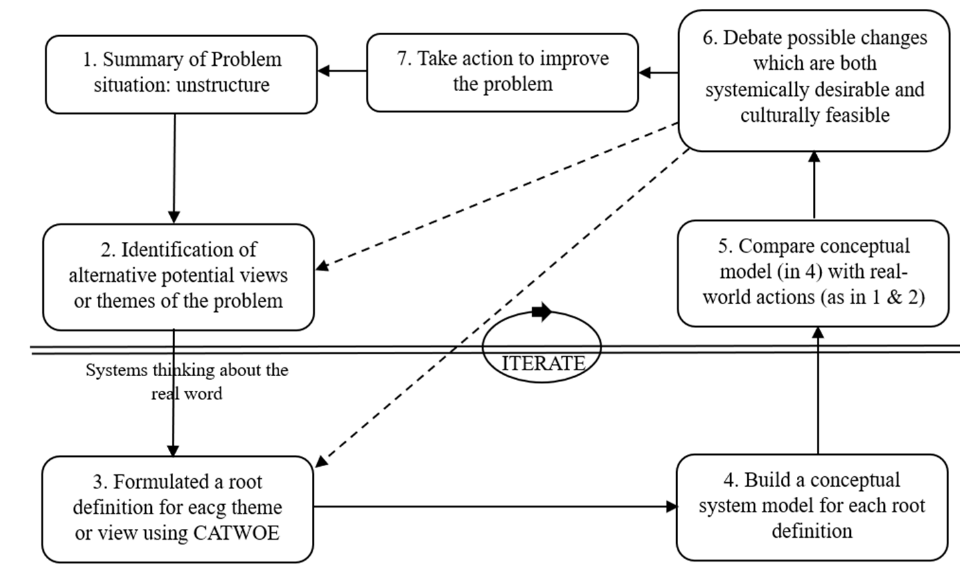
SSM was operationalized using the CATWOE approach and its seven-stage process (Figure 1): (1) considering the problem situation, (2) expressing the situation, (3) defining purposeful activity systems, (4) constructing conceptual models, (5) comparing models with real-world conditions, (6) identifying culturally feasible and systematically desirable changes, and (7) implementing improvement actions [22, 62-64]. This methodology facilitates pragmatic interventions in organizational and community contexts, emphasizing collaborative learning and stakeholder participation [24]. Field-based data collection aligns with SSM’s iterative structure, enabling empirically grounded insights into governance and policy reform [60, 61]. The approach yields actionable understanding by juxtaposing existing realities with ideal models to inform transformative change.
This study examines two state VHEIs in Indonesia, one from Java (Politeknik Negeri Jakarta) and one from Sumatra (Politeknik Negeri Padang) selected due to their excellent accreditation and industrial relationships and partnerships within the vocational education framework. The number of respondents involved in this study using the interview technique for two polytechnics, with the criteria that respondents have duties and functions as leaders, such as: head of study program, head of department, vice director of the polytechnic for academic affairs, vice director of the polytechnic for cooperation and industry affairs, companies that hire graduates, and alums who have been working in companies.
The roles of each respondent in this research are: (a) The head of study program provides information related to student academics, develops and organizes the curriculum, arranges student internships, improves the quality and competence of both students and lecturers, and builds collaboration and partnerships with the government, institutions, companies, and the community, (b) The head of department also helps coordinate collaborations and partnerships for each study program, creates MoU to be reported to the vice director of cooperation and industrial relations, (c) The vice director of cooperation and industrial relations facilitates the approval of MoU and MoA with external parties for collaborations and partnerships proposed by the study programs, and (d) The government, academic institutions, companies, community, and media respond to the collaboration proposals if accepted from the polytechnic by signing the MoU and MoA.
The criteria for the research sample are: polytechnics that have been established for more than 20 years, have a student body of over 7,000 people, offering programs such as diploma, applied bachelor's, and applied master's programs, have excellent institutional accreditation, show an increasing number of industry partnerships and collaborations each year, have graduates who are absorbed to work in companies/industries, and graduates are employed within no more than three months after being declared graduated.
The reason for choosing PNJ and PNP in this research is that PNJ is the best polytechnic in Indonesia according to the QS Asia University Rankings 2024, and has just made history after successfully entering the university rankings list by Quacquarelli Symonds (QS). The PNJ has held excellent academic accreditation from the Indonesian national accreditation body since 2024. Meanwhile, PNP has once again recorded a remarkable achievement. In the 2025/2026 academic year, the number of applicants to the largest vocational campus in West Sumatra reached 27,657, the highest number in history. At the same time, PNP ranked second among the top 10 national polytechnics in the July 2025 Webometrics ranking.
Data collection employed participatory observation, in-depth interviews with institutional leaders (Head of study program, Head of department, Vice director for industrial relations and cooperation), document analysis, enabling insights into curriculum implementation and stakeholder involvement in curriculum development. Key stakeholders included academics, industry practitioners, alumni, and professional associations. Data was gathered through direct methods (observations, interviews) and indirect sources (literature, institutional documents), ensuring richness and contextual accuracy within naturalistic settings.
Implementation interviews for each polytechnic involved the head of the study program, the head of the department, and the vice director for industry relations and cooperation, and were conducted in a hybrid format. The details of information about the research object are as follows: (a) For PNJ, interviews were conducted in person with a set of questions tailored to each person based on their duties and functions. Meanwhile, for PNP, interviews were conducted in a hybrid format, except for the head of department, who was interviewed in person. (b) Interview timing was arranged through written interviews (PNP) and in-person interviews at PNJ, with a maximum duration of 2 hours per interviewee.
The observation period ran from August 2024 to July 2025. The documents observed included: university accreditation, curriculum, number of new student applicants, number of institutional achievements, number of industry relations and collaborations in education and teaching, research, and community service, which are established with the government, institutions, companies/industries, communities, and the media as a realization of the implementation of the CKC and pentahelix concept.
The analysis followed qualitative data reduction and presentation techniques, with findings verified via methodological triangulation. The SSM guided the analytical process, incorporating the CATWOE framework: Customer, Actors, Transformation process, Weltanschauung, Owner, and Environmental constraints to evaluate efficacy, efficiency, and effectiveness of institutional collaborations [22, 59, 62-64]. This approach enabled a systemic understanding of complex educational processes across seven iterative SSM stages, enhancing the validity and reliability of findings. By integrating multiple perspectives and contextual factors, the study provides a comprehensive model for analyzing VHE partnerships, ensuring outcomes are both credible and actionable within dynamic educational and industrial environments.
The documents that were analyzed include: the curriculum used by the study program, the types and amount of research offered to lecturers and students, the patterns of community service carried out by lecturers, as well as forms of collaboration with external parties related to education and teaching, graduate employability in the industry, research, and community service.
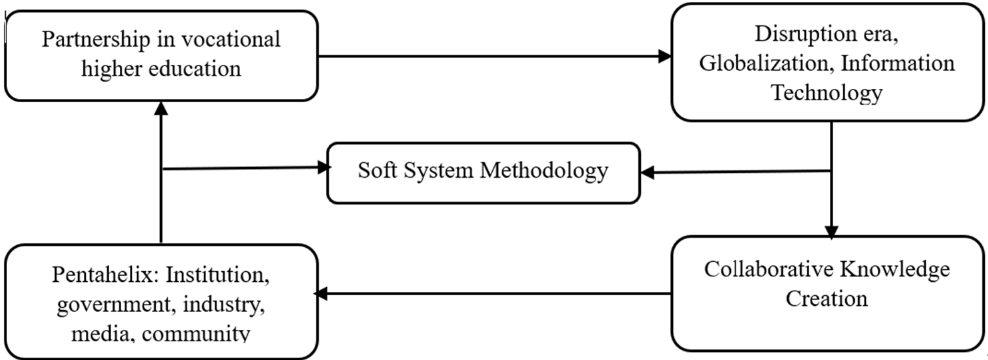
Figure 2 explains the CKC and pentahelix in building cooperation patterns in VHE in Indonesia (Java and Sumatra). Table 1 explains the third stage in SSM, namely the root definition (RD) for CKC and pentahelix in improving cooperation models in VHE.
Table 1. Root definition (RD) building cooperation through collaborative knowledge creation (CKC) and pentahelix between two vocational higher education (VHE)
|
RD |
Process |
System |
|
RD1 |
Policy formulation involves fostering synergistic collaboration across pentahelix actors to institutionalize collaborative knowledge creation in vocational education. |
Enhancing policy ownership in vocational higher education requires strengthening interaction at the externalizing stage to reduce information asymmetry, enabling full implementation of CKC processes and pentahelix elements in formulating collaborative governance frameworks across institutional networks in Java and Sumatra. |
Source: Authors, 2025.
In Table 1 regarding the RD, the CKC and pentahelix concepts applied in polytechnic in Java and Sumatra are measured based on the results of the rules and policies of the cooperation patterns that have been built, and whether they have delivered on the initial plan before the activity was carried out. Furthermore, Table 2 explains the CATWOE and 3E processes for the field of cooperation at these two institutions in CKC and pentahelix efforts.
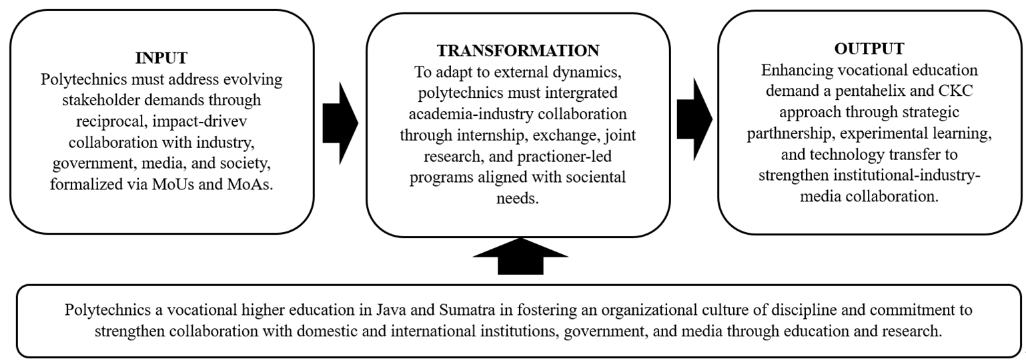
How changes occur from the collaboration process carried out with external partners implemented by VHE in Java and Sumatra, such as academic/institution, government, industry/company, media, and community, by considering the application of the concept of CKC and pentahelix can be explained in Figure 3.
The polytechnics, as VHEIs in Java and Sumatra, have implemented comprehensive partnership models with external stakeholders, including government, industry, media, academic institutions, and local communities [65-67]. These collaborations extend beyond academic initiatives to encompass joint research and community service programs. Notably, the polytechnic in Java has established structured learning collaborations with state owned enterprises, multinational firms, and national industries [68, 69]. In addition, academic partnerships have been forged with universities across Indonesia and Southeast Asia. In the domain of research and community engagement, both institutions collaborate actively with local governments, reinforcing their roles as ecosystem actors within the pentahelix framework of innovation-driven vocational education [70, 71].
Table 2. CATWOE and 3E for partnership using the concepts of collaborative knowledge creation (CKC) and pentahelix in vocational higher education (VHE) in Java and Sumatra
|
Customers |
Director, Vice Director for Cooperation, Lecturer, Government, Industry, User, Media and Community. |
|
Actors |
Director, Vice Director for Industrial Partnership, and Lecturer. |
|
Transformation |
Externalizing and sharing in overcoming the challenges of information asymmetry between education providers. |
|
Worldview |
The exchange of information among organizers is important for developing strategies to strengthen the organization's dynamic capabilities. |
|
Owner |
Director, Vice Director for Industrial Partnership, Lecturer. |
|
Environment |
Constraints in the limited time and budget available, the organizational culture of the polytechnic as well as the needs of different industries and companies, the role of government, the type of media and the characteristics of the community. |
|
E-Efficacy |
Existence, externalizing, and sharing to overcome the challenges of information asymmetry in the cooperative network of polytechnic institutions with external relations coming from government, industry, media, and community. |
|
E-Efficient |
Use resources, such as funds and equipment, to carry out cooperation programs effectively, have agreements with external forces (government, industry), and secure media partner support. |
|
E- Effective |
Achieving an increase in institutional cooperation networks with external parties of the polytechnic in Java and Sumatra, who have agreements such as an MoU and are implemented with MoA. |
Source: Authors, 2025.
4.1 Results
In terms of research and community service (RCS) funding, VHE in Sumatra reported 4 research titles funded internally and 15 funded by external grants. Community service activities received internal support for 18 titles and external funding for four. At the polytechnic in Java, there were 25 internally funded research titles, while community service projects included 13 internally funded and two externally funded titles.
The types of RCS schemes vary across institutions. In Sumatra, research grants were distributed through schemes such as Excellent Applied Research, Junior Lecturer, and Doctoral and Master's degrees. In Java, internal research schemes included Beginner Lecturer, Doctoral Assistant, Economics-Business-Humanities, and International Publication, with four titles related to student final project assistance. Community service schemes included society-based, competency-based, and international community service, while two externally supported schemes involved Matching Funds and Innovation.
Regarding RCS collaboration processes, VHE in Sumatra requires lecturers and students to involve partner institutions that must commit to the collaboration. If agreed, proposals are submitted to Research and Community Service or the Cooperation unit, followed by the drafting of an MoU or a MoA, as necessary. Both parties sign joint agreements, with the MoU process typically taking two weeks. Obstacles include delays in obtaining partner signatures and low responsiveness from some industry partners who view the activity as corporate social responsibility (CSR) only and not mutually beneficial. Institutional collaboration extends to broader stakeholder networks. In Sumatra, there were 24 cooperation agreements over the past two years with government bodies, institutions, associations, media, and the community. The Department of Business Administration engaged with 56 micro-, small-, and medium-sized enterprises (MSMEs) or regional entities to utilize research and service outputs. Results were disseminated through institutional websites, department portals, lecturer-selected online media, and student social media accounts.
VHE in Java, collaboration supports the learning process through partnerships with local city governments (Depok, Demak, Pekalongan) and with Management Science University, according to the Ministry of Tourism, the Ministry of Trade, and the Judicial Commission. Academic associations such as Content Creators, Professional and Industry Association, and the Translators Association have also contributed to learning enhancement. International service was conducted with the Indonesian School of Kuala Lumpur (SIKL), and domestic engagement involved cities such as Aceh, Bali, Depok, Bogor, Subang, Bandung, Demak, and Pekalongan.
In terms of promotion, both polytechnics, as VHEIs, rely on centralized systems supported by the Public Relations Unit. Study programs complement this by providing program-specific updates. Curricular and extracurricular information is disseminated via internal channels (social media, WhatsApp, memos, digital flyers) and external platforms (websites, banners, TikTok, Instagram). The media, print, digital, and social media play a crucial role in ensuring rapid, targeted, and inclusive information flows for vocational advancement.
4.2 Discussion
CKC is increasingly recognized as a core competency for both higher education institutions and the 21st-century workforce [6, 71]. Simultaneously, the pentahelix model, an expansion of the Triple Helix, offers an inclusive governance framework involving five key stakeholders: the public sector, private sector, academia, civil society, and social entrepreneurs. This integrated model has been implemented in VHE to align academic content with industrial demands and technological shifts [72].
Based on interviews with institutional leaders of VHE in Java (PNJ) and West Sumatra (PNP), building partnerships and aligning curriculum with job qualifications have become institutional imperatives. Regular workshops with industry, associations, and practitioners are held to co-develop curricula that respond to labor-market needs. These efforts ensure that teaching content is creative, innovative, and rooted in real-world job requirements [9, 73, 74].
The use of SSM in this study facilitates culturally feasible and systemically desirable change. In line with Law No. 12/2012 on the National Qualifications Framework (NQF), curriculum development includes pre-workshops involving lecturers, practitioners, and association experts to map job positions to learning outcomes. These discussions ensure curricular content mirrors current industry expectations and standards.
CKC serves as the cognitive backbone of this process. As articulated [3, 6, 16, 75, 76], the CKC process unfolds in four stages: externalizing and sharing, interpreting and analyzing, negotiating and revising, and combining and creating [56, 77]. This framework is embedded into curriculum building, ensuring iterative, inclusive development [19, 65, 66, 78, 79].
The pentahelix model further supports collaborative implementation by establishing partnerships across institutions, government, industry, media, and community stakeholders [1, 3, 80, 81]. Dissemination of curriculum outcomes is conducted through institutional platforms and digital media [9, 13].
In SSM’s final stage, action is taken to resolve core problems. Each study program is required to evaluate partnerships annually, involving feedback from companies, associations, media, and communities [57, 68, 69, 75]. Sustaining these partnerships is essential for ensuring institutional responsiveness and vocational relevance [14, 71, 82-85].
This study identifies critical gaps in integrating CKC with the pentahelix model within VHEIs. Institutions lacking knowledge-based governance frameworks often fail to cultivate internal human capital, limiting organizational dynamism and innovation, the core concern of CKC theory. Moreover, vocational institutions rarely possess comprehensive strategies for aligning infrastructure and human resources with innovation mandates. A structural disconnect also persists between partnership policies and their actual outcomes, hindering the conversion of collaboration into impactful innovation, as noted in critiques of the pentahelix model.
Despite nominal adoption, the pentahelix has yet to yield substantial innovation with economic value, and CKC remains marginally applied. These limitations curtail VHEIs' transformative capacity to serve as innovative ecosystems. Three policy recommendations are proposed: First, VHEIs must adopt agile governance that can respond to rapid technological shifts. Second, CKC should be institutionalized as a foundational mechanism for fostering shared knowledge and sustainable partnerships. Third, the pentahelix must evolve from a conceptual framework into an embedded practice of co-creation. When effectively implemented, these strategies can enhance institutional responsiveness, multi-stakeholder engagement, and the broader societal value of vocational education in Indonesia and other emerging economies.
This study provides new insights into the CKC and pentahelix literature. However, this study has several limitations that provide opportunities for further research. First, the analysis is limited to two state polytechnics in Java and Sumatra. Although it has implications for global VHEIs, in some respects, it may limit the generalization of findings to certain types of vocational education with specific characteristics. Institutional differences in size, governance autonomy, and regional innovation ecosystems can lead to diverse collaborations and knowledge creation. Second, the qualitative approach provides important contextual insight but has limitations for quantifying the causal relationships among CKC, pentahelix collaboration, and VHEI outcomes.
Nevertheless, this study lays an essential foundation for integrating CKC and pentahelix. Future research could expand the sample of VHEIs to include both public and private institutions, thereby enabling cross-comparisons across regions and institutional types. A mixed-methods approach could statistically examine how CKC dynamics affect vocational education performance and stakeholder engagement. In addition, integrating digital collaboration tools into the CKC framework could provide new insights into adaptive governance and sustainable innovation in vocational education.
We would like to thank the Politeknik Negeri Jakarta Center for Research and Community Service for providing research funding assistance, which enabled this research to be completed, and the Politeknik Negeri Padang for permitting this research.
This study adheres to the ethical principles and privacy rights of all human subjects involved. All participants were fully informed about the nature, purpose, and potential impact of the research, and informed consent was obtained prior to any data collection or experimentation. Participation was voluntary, and participants retained the right to withdraw at any time. Measures were taken to ensure that all personal data was anonymized and handled in strict confidence in compliance with applicable privacy regulations and ethical standards.
[1] Leal Filho, W., Raath, S., Lazzarini, B., et al. (2018). The role of transformation in learning and education for sustainability. Journal of Cleaner Production, 199: 286-295. https://doi.org/10.1016/j.jclepro.2018.07.017
[2] Zhiying, Z., Sidi, Z. (2025). Exploring the impact of education on sustainable resource efficiency: The interplay with CO2 emissions, renewable energy, and agriculture in G20 nations. Frontiers in Environmental Science, 13: 1623978. https://doi.org/10.3389/fenvs.2025.1623978
[3] Muukkonen, H., Lakkala, M., Ilomäki, L., Toom, A. (2022). Juxtaposing generic skills development in collaborative knowledge work competencies and related pedagogical practices in higher education. Frontiers in Education, 7: 886726. https://doi.org/10.3389/feduc.2022.886726
[4] Muscio, A., Shibayama, S., Ramaciotti, L. (2022). Universities and start-up creation by Ph.D. graduates: The role of scientific and social capital of academic laboratories. The Journal of Technology Transfer, 47: 147-175. https://doi.org/10.1007/s10961-020-09841-2
[5] Kementerian PPN/Bappenas. (2024). Jumlah perguruan tinggi menurut akreditasi - 2024. https://data.go.id/dataset/dataset/jumlah-perguruan-tinggi-menurut-akreditasi-2024.
[6] Du Chatenier, E., Verstegen, J.A.A.M., Biemans, H.J.A., Mulder, M., Omta, O. (2009). The challenge of collaborative knowledge creation in open innovation teams. Human Resource Development Review, 8(3): 350-381. https://doi.org/10.1177/1534484309338265
[7] O'Dwyer, M., Filieri, R., O'Malley, L. (2023). Establishing successful university–industry collaborations: Barriers and enablers deconstructed. The Journal of Technology Transfer, 48: 900-931. https://doi.org/10.1007/s10961-022-09932-2
[8] Tu, J. (2020). The role of dyadic social capital in enhancing collaborative knowledge creation. Journal of Informetrics, 14(2): 101034. https://doi.org/10.1016/j.joi.2020.101034
[9] Kadhila, N., Malatji, K.S., Malatji, M.J. (2024). Higher education: Towards a model for successful university-industry collaboration in Africa. In Sustainable Development Goals Series, pp. 251-280. https://doi.org/10.1007/978-3-031-46242-9_11
[10] Kolk, A., Lenfant, F. (2015). Cross-sector collaboration, institutional gaps, and fragility: The role of social innovation partnerships in a conflict-affected region. Journal of Public Policy & Marketing, 34(2): 287-303. https://doi.org/10.1509/jppm.14.157
[11] Calzada, I. (2020). Democratising smart cities? Penta-helix multistakeholder social innovation framework. Smart Cities, 3(4): 1145-1172. https://doi.org/10.3390/smartcities3040057
[12] Paavola, S., Lipponen, L., Hakkarainen, K. (2004). Models of innovative knowledge communities and three metaphors of learning. Review of Educational Research, 74(4): 557-576. https://doi.org/10.3102/00346543074004557
[13] Menzli, L.J., Smirani, L.K., Boulahia, J.A., Hadjouni, M. (2022). Investigation of open educational resources adoption in higher education using Rogers' diffusion of innovation theory. Heliyon, 8(7): e09885. https://doi.org/10.1016/j.heliyon.2022.e09885
[14] Mariam, I., Sofa, N., Wartiningsih, E., Latianingsih, N. (2020). Time management and learning strategy in polytechnic in the digital transformation era. In 4th International Conference on Language, Literature, Culture, and Education (ICOLLITE 2020), pp. 316-320. https://doi.org/10.2991/assehr.k.201215.049
[15] Chahal, H., Gupta, A. (2024). Mediating role of capabilities in organisational agility-performance relationship in J&K, India. International Journal of Educational Management, 38(7): 1862-1883. https://doi.org/10.1108/IJEM-08-2023-0397
[16] Chan, C.K.Y. (2023). A comprehensive AI policy education framework for university teaching and learning. International Journal of Educational Technology in Higher Education, 20: 38. https://doi.org/10.1186/s41239-023-00408-3
[17] Byun, C.G., Sung, C.S., Park, J.Y., Choi, D.S. (2018). A study on the effectiveness of entrepreneurship education programs in higher education institutions: A case study of Korean graduate programs. Journal of Open Innovation: Technology, Market, and Complexity, 4(3): 26. https://doi.org/10.3390/joitmc4030026
[18] Bodolica, V., Spraggon, M. (2021). Incubating innovation in university settings: Building entrepreneurial mindsets in the future generation of innovative emerging market leaders. Education + Training, 63(4): 613-631. https://doi.org/10.1108/ET-06-2020-0145
[19] Shi, H. (2017). Learning strategies and classification in education. Institute for Learning Styles Journal, 1(1): 24-36.
[20] Hartner-Tiefenthaler, M., Roetzer, K., Bottaro, G., Peschl, M.F. (2018). When relational and epistemological uncertainty act as driving forces in collaborative knowledge creation processes among university students. Thinking Skills and Creativity, 28: 21-40. https://doi.org/10.1016/j.tsc.2018.02.013
[21] Schiuma, G., Carlucci, D. (2018). Managing strategic partnerships with universities in innovation ecosystems: A research agenda. Journal of Open Innovation: Technology, Market, and Complexity, 4(3): 25. https://doi.org/10.3390/joitmc4030025
[22] Checkland, P., Poulter, J. (2006). Learning For Action: A Short Definitive Account of Soft Systems Methodology, and Its Use for Practitioners, Teachers and Students. John Wiley & Son, New York, USA.
[23] Wan Rosely, W.I.H., Voulvoulis, N. (2024). System thinking for sustainable water management: The use of system tools in sustainability transitions. Water Resources Management, 38: 1315-1337. https://doi.org/10.1007/s11269-023-03723-6
[24] Sandfreni, S., Adikara, F. (2020). The implementation of soft system methodology (SSM) for systems development in organizations (Study case: The development of tourism information system in Palembang City). In Proceedings of the First International Conference of Science, Engineering and Technology, ICSET 2019, Jakarta, Indonesia. https://doi.org/10.4108/eai.23-11-2019.2301495
[25] Warsiyanto, F.A., Sunitiyoso, Y., Budiarso, B. (2025). Soft system methodology (SSM) approach to address organizational inefficiencies in huff and puff operations. Costing: Journal of Economic, Business and Accounting, 8(4): 137-149. https://doi.org/10.31539/costing.v8i4.15552
[26] Zhao, H.Y., Lesage, D. (2020). Explaining BRICS outreach: Motivations and institutionalization. International Organisations Research Journal, 15(2): 68-91. https://doi.org/10.17323/1996-7845-2020-02-05
[27] Powell, J.J.W., Solga, H. (2010). Analyzing the nexus of higher education and vocational training in Europe: A comparative-institutional framework. Studies in Higher Education, 35(6): 705-721. https://doi.org/10.1080/03075070903295829
[28] Belchior-Rocha, H., Casquilho-Martins, I., Simões, E. (2022). Transversal competencies for employability: From higher education to the labour market. Education Sciences, 12(4): 255. https://doi.org/10.3390/educsci12040255
[29] Choi, S.J., Jeong, J.C., Kim, S.N. (2019). Impact of vocational education and training on adult skills and employment: An applied multilevel analysis. International Journal of Educational Development, 66: 129-138. https://doi.org/10.1016/j.ijedudev.2018.09.007
[30] Graf, L. (2016). The rise of work-based academic education in Austria, Germany and Switzerland. Journal of Vocational Education & Training, 68(1): 1-16. https://doi.org/10.1080/13636820.2015.1107749
[31] Kim, Y.A., Kim, K.A., Tzokas, N. (2022). Entrepreneurial universities and the effect of the types of vocational education and internships on graduates' employability. Studies in Higher Education, 47(5): 1000-1009. https://doi.org/10.1080/03075079.2022.2055324
[32] Mason, G. (2020). Higher education, initial vocational education and training and continuing education and training: Where should the balance lie? Journal of Education and Work, 33(7-8): 468-490. https://doi.org/10.1080/13639080.2020.1755428
[33] Nägele, C., Neuenschwander, M.P., Rodcharoen, P. (2018). Higher education in Switzerland: Predictors of becoming engaged in higher vocational or academic education – The role of workplace factors. International Journal for Research in Vocational Education and Training, 5(4): 264-284. https://doi.org/10.13152/IJRVET.5.4.2
[34] Löfgren, S., Ilomäki, L., Toom, A. (2020). Employer views on upper-secondary vocational graduate competences. Journal of Vocational Education & Training, 72(3): 435-460. https://doi.org/10.1080/13636820.2019.1635633
[35] Oswald-Egg, M.E., Renold, U. (2021). No experience, no employment: The effect of vocational education and training work experience on labour market outcomes after higher education. Economics of Education Review, 80: 102065. https://doi.org/10.1016/j.econedurev.2020.102065
[36] Farran, I., Nunez, I. (2024). Converging pathways: New approaches to integrate vocational education training and higher education. Journal of Vocational Education and Training, 77(4): 1147-1165. https://doi.org/10.1080/13636820.2024.2428769
[37] Graf, L., Lohse, A.P., Bernhard, N. (2024). Varieties of work-based higher education: France, Germany and the United States compared. International Journal of Training and Development, 28(4): 385-403. https://doi.org/10.1111/ijtd.12329
[38] Rafiq, A.A., Triyono, M.B., Djatmiko, I.W. (2022). Enhancing student engagement in vocational education by using virtual reality. Waikato Journal of Education, 27(3): 175-188. https://doi.org/10.15663/wje.v27i3.964
[39] Esangbedo, C.O., Zhang, J.X., Esangbedo, M.O., Kone, S.D., Xu, L. (2024). The role of industry-academia collaboration in enhancing educational opportunities and outcomes under the digital driven Industry 4.0. Journal of Infrastructure, Policy and Development, 8(1): 2569. https://doi.org/10.24294/jipd.v8i1.2569
[40] Fernandes, G., O'Sullivan, D. (2021). Benefits management in university-industry collaboration programs. International Journal of Project Management, 39(1): 71-84. https://doi.org/10.1016/j.ijproman.2020.10.002
[41] As’ari, H., Adianto, A., Hadi, A., et al. (2025). Penta helix in realizing the capacity for social innovation development in addressing coastal poverty. E3S Web of Conferences, 611: 03009. https://doi.org/10.1051/e3sconf/202561103009
[42] Pranita, D., Musthofa, B.M., Kusumastuti, H., Haidlir, B.M. (2025). Transforming vocational higher education on the path toward Golden Indonesia 2045. Vocational Technology and Education, 2(1): e8. https://doi.org/10.54844/vte.2024.0806
[43] Zhang, S., Liu, Q.T., Cai, Z.Q. (2019). Exploring primary school teachers' technological pedagogical content knowledge (TPACK) in online collaborative discourse: An epistemic network analysis. British Journal of Educational Technology, 50(6): 3437-3455. https://doi.org/10.1111/bjet.12751
[44] Zhao, J.Q., Bai, T., Wei, Y.T., Wu, B. (2022). PoetryBERT: Pre-training with sememe knowledge for classical Chinese poetry. In Communications in Computer and Information Science, pp. 369-384. https://doi.org/10.1007/978-981-19-8991-9_26
[45] Zabolotna, K., Malmberg, J., Järvenoja, H. (2023). Examining the interplay of knowledge construction and group-level regulation in a computer-supported collaborative learning physics task. Computers in Human Behavior, 138: 107494. https://doi.org/10.1016/j.chb.2022.107494
[46] Wen, Z.Y., Gui, L., Wang, Q.L., et al. (2022). Sememe knowledge and auxiliary information enhanced approach for sarcasm detection. Information Processing & Management, 59(3): 102883. https://doi.org/10.1016/j.ipm.2022.102883
[47] Emerson, K., Nabatchi, T., Balogh, S. (2012). An integrative framework for collaborative governance. Journal of Public Administration Research and Theory, 22(1): 1-29. https://doi.org/10.1093/jopart/mur011
[48] S Halibas, A., Ocier Sibayan, R., Lyn Maata, R. (2017). The pentahelix model of innovation in Oman: An HEI perspective. Interdisciplinary Journal of Information, Knowledge, and Management, 12: 159-174. https://doi.org/10.28945/3735
[49] Sturesson, E., Lindmark, A., Nilsson Roos, M. (2009). Collaboration for Innovation - A study in the Öresund Region. Sweden: Lund University Libraries. https://www.lunduniversity.lu.se/publication/1437850.
[50] Carayannis, E.G., Barth, T.D., Campbell, D.F.J. (2012). The Quintuple Helix innovation model: Global warming as a challenge and driver for innovation. Journal of Innovation and Entrepreneurship, 1: 2. https://doi.org/10.1186/2192-5372-1-2
[51] Etzkowitz, H., Leydesdorff, L. (2000). The dynamics of innovation: From National Systems and "Mode 2" to a Triple Helix of university–industry–government relations. Research Policy, 29(2): 109-123. https://doi.org/10.1016/S0048-7333(99)00055-4
[52] Carayannis, E.G., Campbell, D.F.J. (2012). Mode 3 Knowledge Production in Quadruple Helix Innovation Systems. Springer New York, NY. https://doi.org/10.1007/978-1-4614-2062-0
[53] Carayannis, E.G., Campbell, D.F.J. (2014). Developed democracies versus emerging autocracies: Arts, democracy, and innovation in Quadruple Helix innovation systems. Journal of Innovation and Entrepreneurship, 3: 12. https://doi.org/10.1186/s13731-014-0012-2
[54] Zakaria, H., Kamarudin, D., Fauzi, M.A., Wider, W. (2023). Mapping the helix model of innovation influence on education: A bibliometric review. Frontiers in Education, 8: 1142502. https://doi.org/10.3389/feduc.2023.1142502
[55] Cheng, C., Zhong, H.H., Cao, L.B. (2020). Facilitating speed of internationalization: The roles of business intelligence and organizational agility. Journal of Business Research, 110: 95-103. https://doi.org/10.1016/j.jbusres.2020.01.003
[56] Hadziahmetovic, N., Dinc, M.S. (2023). Fostering organizational performance at Central and Eastern European universities: The impact of knowledge creation and affective commitment. Eurasian Journal of Business and Economics, 16(31): 1-21. https://doi.org/10.17015/ejbe.2023.031.01
[57] Muhyi, H.A., Chan, A., Sukoco, I., Herawaty, T. (2017). The penta helix collaboration model in developing centers of flagship industry in Bandung City. Review of Integrative Business and Economics Research, 6(1): 412-417. https://www.sibresearch.org/uploads/3/4/0/9/34097180/riber_th16-131_412-417.pdf.
[58] Creswell, J.W. (2014). Research Design: Qualitative, Quantitative, and Mixed Methods Approaches (4th ed.). SAGE Publications.
[59] Hardjosoekarto, S. (2012). Soft Systems Methodology. UI Press, Jakarta.
[60] Osei-Nimo, S., Millman, C., Aboagye-Nimo, E. (2022). The interplay of alcohol and wellbeing in the workplace: Combining soft systems methodology and Foucauldian approach. Systemic Practice and Action Research, 35: 765-787. https://doi.org/10.1007/s11213-022-09591-2
[61] Óskarsdóttir, H.G., Oddsson, G.V. (2017). A soft systems approach to knowledge worker productivity—Analysis of the problem situation. Economies, 5(3): 28. https://doi.org/10.3390/economies5030028
[62] Augustsson, H., Churruca, K., Braithwaite, J. (2020). Change and improvement 50 years in the making: A scoping review of the use of soft systems methodology in healthcare. BMC Health Services Research, 20: 1063. https://doi.org/10.1186/s12913-020-05929-5
[63] Nair, U. (2015). Soft system methodology for personalized learning environment. E-Learning and Digital Media, 12(1): 34-56. https://doi.org/10.1177/2042753014558375
[64] Nakakawa, A., de Manuel Keenoy, E., Zabala, A.F., Berastegui, D.V., Suarez, J.T. (2024). Mutual adoption of soft systems methodology, co-creation, enterprise architecture, and balanced scorecard for continuous assessment and improvement of programmes on integrated care for multimorbid patients. Systemic Practice and Action Research, 37: 351-386. https://doi.org/10.1007/s11213-023-09648-w
[65] Sukri, S., Riskiyani, S., Syafar, M. (2023). The Pentahelix partnership responses during COVID-19 pandemic in Makassar. International Journal of Statistics in Medical Research, 12: 161-170. https://doi.org/10.6000/1929-6029.2023.12.20
[66] Nurhaeni, I.D.A., Putri, I.S., Mulyadi, A.W.E., Sudibyo, D.P. (2024). Penta helix collaboration in developing social inclusion for persons with disabilities. Journal of Contemporary Governance and Public Policy, 5(1): 19-32. https://doi.org/10.46507/jcgpp.v5i1.105
[67] Subagyo, A., Simons, G. (2021). The implementation of the Pentahelix model for the terrorism deradicalization program in Indonesia. Cogent Social Sciences, 7(1): 1964720. https://doi.org/10.1080/23311886.2021.1964720
[68] Hoerniasih, N., Hufad, A., Wahyudin, U., Sudiapermana, E., Yunus, D., Sukmana, C. (2022). Pentahelix based entrepreneurship management at PKBM Asholahiyah. International Journal of Professional Business Review, 7(3): e0616. https://doi.org/10.26668/businessreview/2022.v7i3.e616
[69] Ho, J.C. (2022). Disruptive innovation from the perspective of innovation diffusion theory. Technology Analysis & Strategic Management, 34(4): 363-376. https://doi.org/10.1080/09537325.2021.1901873
[70] Lee, Y.S., Schottenfeld, M.A. (2014). Collaborative knowledge creation in the higher education academic library. Journal of Learning Spaces, 3(1). https://files.eric.ed.gov/fulltext/EJ1152684.pdf.
[71] Lutchen, K.R. (2024). A new model for university-industry partnerships: To ensure curricula evolve as technologies do. Harvard Business Review. https://hbsp.harvard.edu/inspiring-minds/a-new-model-for-university-industry-partnerships.
[72] Huang, F. (2025). Exploring a new model of undergraduate vocational education. Vocation, Technology & Education, 2(1). https://doi.org/10.54844/vte.2025.0869
[73] Arsawan, I.W.E., Hariyanti, N.K.S.D., Atmaja, I.M.A.D.S., Suhartanto, D., Koval, V. (2022). Developing organizational agility in SMEs: An investigation of innovation's roles and strategic flexibility. Journal of Open Innovation: Technology, Markets, and Complexity, 8(3): 149. https://doi.org/10.3390/joitmc8030149
[74] Azizi, N., Akhavan, P., Ahsan, A., Khatami, R., Haass, O., Saremi, S. (2023). Influence of motivational factors on knowledge sharing methods and knowledge creation process in an emerging economic context. Knowledge Management & E-Learning: An International Journal, 15(1): 115-132. https://doi.org/10.34105/j.kmel.2023.15.007
[75] Karlgren, K., Paavola, S., Ligorio, M.B. (2020). Introduction: What are knowledge work practices in education? How can we study and promote them? Research Papers in Education, 35(1): 1-7. https://doi.org/10.1080/02671522.2019.1677761
[76] Kezar, A. (2005). Redesigning for collaboration within higher education institutions: An exploration into the developmental process. Research in Higher Education, 46: 831-860. https://doi.org/10.1007/s11162-004-6227-5
[77] Al-Omoush, K.S., Simón-Moya, V., Sendra-García, J. (2020). The impact of social capital and collaborative knowledge creation on e-business proactiveness and organizational agility in responding to the COVID-19 crisis. Journal of Innovation & Knowledge, 5(4): 279-288. https://doi.org/10.1016/j.jik.2020.10.002
[78] Nugraha, Y.K., Sumaryatiningsih, S. (2023). The pentahelix model: Strengthening innovation potential and fostering science and education integration. Proceeding of International Conference on Islamic Education (ICIED), 8(1): 540-554. https://conferences.uin-malang.ac.id/index.php/icied/article/view/2649.
[79] Ankrah, S., Al-Tabbaa, O. (2015). University-industry collaboration: A systematic review. Scandinavian Journal of Management, 31(3): 387-408. https://doi.org/10.1016/j.scaman.2015.02.003
[80] Faezah, J.N., Yusliza, M.Y., Muhammad, Z., Fawehinmi, O. (2022). Promoting employee ecological behavior through green initiatives. International Journal of Sustainable Development and Planning, 17(1): 41-49. https://doi.org/10.18280/ijsdp.170104
[81] Marta, A., Asrida, W., Amin, R.M., Febrina, R., Harirah, Z. (2024). Pentahelix collaboration on environmental perspective: Handling underdeveloped villages in conservation forests. E3S Web of Conferences, 506: 05006. https://doi.org/10.1051/e3sconf/202450605006
[82] Papavasileiou, A., Konteos, G., Kalogiannidis, S., Kalfas, D., Papaevangelou, O. (2025). Investigating good practices for implementing the 17 SDGs in Greek secondary schools by 2026. Challenges in Sustainability, 13(3): 316-333. https://doi.org/10.56578/cis130301
[83] Nilsson Dahlström, Å. (2025). Challenges and opportunities for social sustainability in education: A scoping review. Cogent Social Sciences, 11(1): 2491706. https://doi.org/10.1080/23311886.2025.2491706
[84] Soemaryani, I. (2016). Pentahelix model to increase tourist visits to Bandung and its surrounding areas through human resource development. Academy of Strategic Management Journal, 15(S3): 249-259.
[85] Yan-Ning, T., Wellington, E. (2024). Exploring government, industry, and academia collaborations for effectiveness and sustainability in the multimedia art industry. Asia Pacific Journal of Business, Humanities and Education, 9(1): 1-21.