Idham Arsyad* | Moh. Khusaini| Soemarno| Moh. Fadli
© 2026 The authors. This article is published by IIETA and is licensed under the CC BY 4.0 license (http://creativecommons.org/licenses/by/4.0/).
OPEN ACCESS
This study examines the determinants of contract farming performance and evaluates its contribution to urban food-supply resilience in Jakarta. Using primary data from rice-producing farmers participating in PT ß Jaya’s contract farming program and applying a Partial Least Squares–Structural Equation Modeling (PLS-SEM) approach, the analysis investigates the effects of individual farmer characteristics, production factors, and farmer institutional capacity on contract farming performance, as well as its subsequent impact on farmers’ perceived contribution to Jakarta’s urban food-supply resilience through the upstream rice-supply partnership network. The results indicate that farmer institutional capacity is the most influential determinant of contract farming performance, followed by production-related factors, while individual characteristics exhibit negligible explanatory power. Furthermore, the implementation of contract farming exerts a positive and statistically significant, albeit moderate, effect on the perceived contribution to urban food-supply resilience, reflecting the complex and multi-dimensional nature of metropolitan food systems. Indirect-effect analysis confirms that institutional capacity contributes most substantially to perceived food-supply resilience through the mediating role of contract farming. These findings highlight that resilience in metropolitan food systems is shaped primarily by collective institutional arrangements, structured governance, and secure market partnerships rather than by individual farmer attributes alone. The study underscores the importance of strengthening farmer institutions, improving organizational governance, and complementing contract farming with targeted financial support, capacity-building initiatives, and technology adoption aligned with farmers’ absorptive capacity. For Jakarta, contract farming should therefore be understood as an important supply-side mechanism that supports, but does not solely determine, broader urban food-system resilience.
contract farming, institutional capacity, production factors, food-system resilience, Partial Least Squares–Structural Equation Modeling
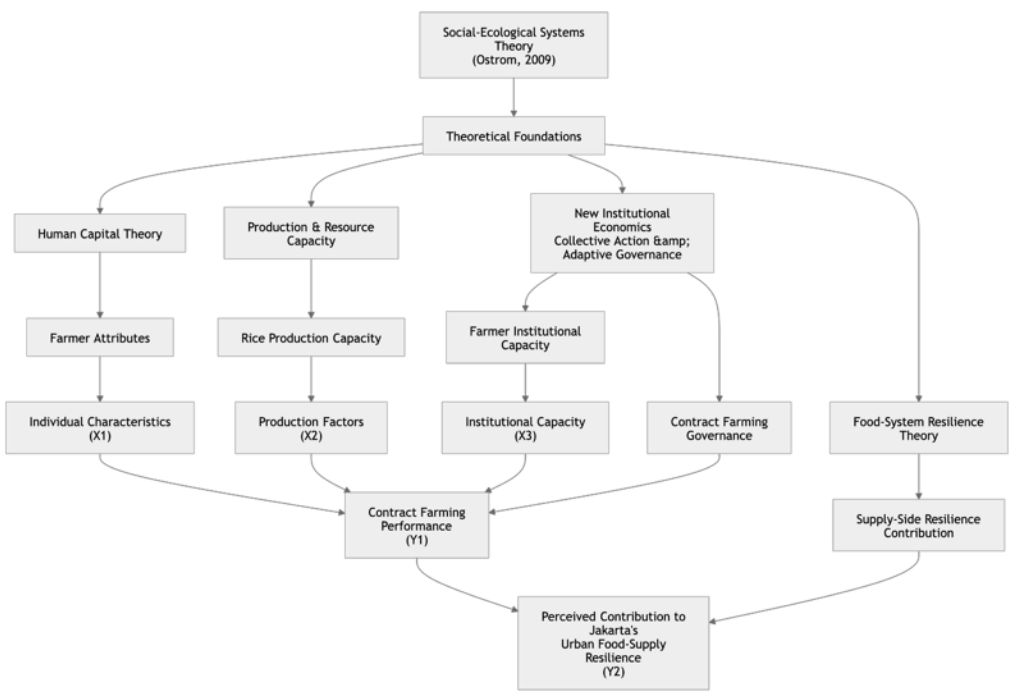
The concept of food-system resilience has rapidly evolved as a central paradigm for addressing the complexity of contemporary global food challenges. Its theoretical foundations lie in the Social-Ecological Systems (SES) framework developed by Ostrom [1], which views food systems as interconnected social and ecological subsystems, resources, resource users, governance structures, and interactions. Food System Resilience (FSR) Theory [2], defines resilience as the capacity of food systems to provide adequate, accessible, and acceptable food for all in the face of shocks and long-term stresses.
Recent empirical work reinforces the urgency of resilience-oriented approaches. Favas et al. [3], in a multi-country analysis across Asia, revealed that countries with stronger pre-crisis resilience were significantly less affected during the recent polycrisis. Walker and Salt’s [4] four resilience dimensions, latitude, resistance, precariousness, and panarchy, underscore how food systems operate across interconnected spatial and temporal scales, from households to global markets [5]. These insights highlight why institutional arrangements such as contract farming have gained importance as mechanisms for enabling cross-scale coordination within food systems.
Food-system resilience is a strategic pillar of national stability, particularly for countries with large populations such as Indonesia. As the dominant staple food, rice underpins more than half of the nation’s average caloric intake and remains central to socio-economic stability. The combination of Indonesia’s demographic scale and its structural dependence on rice necessitates a comprehensive and sustainable food-resilience strategy, as mandated by the country’s Law No. 18 of 2012 concerning Food. At the same time, the national food system faces additional vulnerabilities due to high import dependence on key complementary commodities: wheat (95%), soybeans (60%), and sugar (67%), which significantly heighten exposure to external shocks [6]. The 2024 FSR Index shows that countries with high import reliance require recovery periods up to 2.5 times longer after supply disruptions than those with diversified domestic production. These vulnerabilities are further amplified by global geopolitical tensions, such as the Russia–Ukraine conflict, and by domestic climate-related risks that threaten rice production. Collectively, these pressures underscore the urgency for developing resilience strategies tailored to Indonesia’s spatial, demographic, and institutional realities.
Jakarta represents an extreme case of urban food-system vulnerability with direct implications for national food stability. Jakarta’s government and resilience indicators constitute the most interconnected drivers of systemic transformation in food systems, an observation particularly relevant considering Jakarta is the capital city of Indonesia. First, BPS (Statistics Indonesia) data show that demographic pressures are severe: Jakarta is the most densely populated province in the country, with 16,155 people per square kilometer in 2025, intensified by 3.6 million daily commuters from Bogor, Depok, Tangerang, Bekasi (popularly abbreviated into Bodetabek) regions. These dynamics create volatile food-demand patterns that cascade across national distribution networks. Secondly, Jakarta exhibits deep structural dependency on external food sources, with 95% of its rice supply originating from other regions. Local rice production has declined sharply, from 2,278 tons in 2020 to 1,255 tons in 2024, placing the city in the “extreme risk” category of the Urban Food Security Risk Assessment. Thirdly, socio-economic shocks have widespread effects: the number of poor residents increased by 36.3% during the pandemic, demonstrating limited shock-absorption capacity within the city’s food system.
The Jakarta Provincial Government has adopted institutional innovation through contract farming as adaptive governance instruments [7]. Jakarta’s contract-farming program, implemented through partnerships with 185 farmer groups, cooperatives, and enterprises across 40 rice-producing regions, currently secures 450,000 tons of rice annually, about 35% of the city’s rice needs, and the site is projected to expand to 8,180 hectares by 2027. Complementing this, contract farming led by PT Food Station Tjipinang Jaya functions as an institutional anchor, acting as both off-taker and supply-chain manager to stabilize rice quality, ensure production continuity, and mitigate risks along the supply chain. In this sense, contract farming are not treated as urban agricultural activities within Jakarta, but as institutional mechanisms linking upstream rice-producing regions with Jakarta’s urban food-supply system.
The broader theoretical literature also emphasizes the centrality of farmer-level institutional capacities. Strong farmer institutions, through clear-cut rules, mutual trust-based relationships, and collective action, enhance coordination, information sharing, and risk distribution. More recent findings report positive environmental and welfare impacts of contract farming, contingent on organizational structures and support systems [8-11]. Despite substantial literature on food systems and agricultural partnerships, several research gaps persist. First, micro–macro linkages remain underexplored; how individual farmer behavior aggregates into system-level resilience outcomes is poorly understood. Secondly, research rarely integrates short-term absorption, medium-term adaptation, and long-term transformation dynamics into partnership evaluations. Thirdly, the rural–urban interface, particularly the transmission of resilience from rice-producing areas to urban consumption centers, remains insufficiently conceptualized. Fourthly, behavioral dimensions of institutional resilience, including farmer perceptions and attitudes, are often overlooked. Finally, existing evidence is sparse for megacities with extreme food dependencies such as Jakarta.
These gaps have significant implications for Indonesia’s national food security. As a geographically dispersed archipelago highly dependent on interprovincial rice flows, the country faces increasing risk from climate variability, supply-chain fragility, and geopolitical disruptions. For Jakarta, rice stability is not merely a market concern but a national security priority; disruptions threaten urban stability, political legitimacy, and socio-economic cohesion. This study therefore seeks to answer one central question: How do contract farming, shaped by farmer characteristics, production processes, and institutional structures among rice-supplying farmers, contribute to Jakarta’s urban food-supply resilience? By integrating behavioral, institutional, and production-level determinants with resilience outcomes, this research offers new empirical evidence on the role of agricultural partnerships in strengthening food-supply resilience in one of Southeast Asia’s most complex megacities.
The resilience of food systems has been widely conceptualized through the SES framework, which highlights the interdependence of ecological, social, and institutional subsystems in determining system stability. Ostrom [1] emphasized how interactions among resource systems, resource units, governance structures, and users shape ecological sustainability and social welfare, including farmer livelihoods and urban food access, a perspective consistent with Walker et al. [12], who defined resilience as the ability of systems to absorb disturbances while maintaining essential functions. Folke et al. [13] further refined this conceptualization through persistence, adaptability, and transformability, underscoring the need for food systems not only to withstand shocks but also to learn, adjust, and reorganize when necessary. Building on this theoretical foundation, Tendall et al. [2] and Meuwissen et al. [14] framed FSR as a multidimensional construct encompassing food provisioning, livelihood generation, environmental sustainability, rural development, and cultural identity, illustrating how resilience is inseparable from governance quality, social capital, and institutional robustness.
Empirical evidence consistently demonstrates the centrality of institutional arrangements in enhancing resilience. Ton et al.’s [15] meta-analysis shows that contract farming increases farmer income by an average of 38%, although variations arise due to commodity characteristics, contract design, and local governance, a pattern aligned with Transaction Cost Economics [16, 17], which posits that asset specificity and incomplete contracts create vulnerabilities requiring hybrid governance solutions. Supporting this, Wang et al. [18] found that productivity and technical efficiency improve when contract farming is combined with strong farmer organizations, while Bellemare and Bloem [19] showed improvements in household food security through enhanced income and credit access. Otsuka et al. [20] highlighted that contract-farming systems evolve as labor costs, consumer preferences, and technologies change, reinforcing the relevance of adaptive governance in dynamic food systems. The resilience to food insecurity is shaped by household assets, livelihood diversification, and socio-economic conditions, demonstrating the importance of multi-dimensional capacities at the micro level [21-23].
Farmer organizations and collective structures also play a crucial role. Hermanto and Swastika [24] showed that farmer groups function as learning platforms, collaboration hubs, and production units, while Hellin et al. [25] emphasized that clear membership rules, participatory decision-making, and sanctioning mechanisms, the core of Ostrom’s design principles enhance market access and reduce transaction failures. These findings underscore that institutional capacity at the farmer-group level is essential to sustain long-term partnerships and mitigate risks related to price volatility, quality control, and supply-chain disruptions.
Urban food systems introduce additional vulnerabilities. Crush and Frayne [26] described a food security paradox in rapidly urbanizing regions, where increased demand coincides with declining local production, resulting in deeper dependence on external supply chains. Across these studies, Human Capital Theory [27, 28] provides insight into how farmer characteristics, education, skills, and technical knowledge, influence the adoption of contracts, adherence to quality standards, and engagement in collective action, findings supported by Davis et al. [29].
Figure 1 shows how the conceptual framework synthesizes these theoretical insights by positioning food resilience as an emergent property of SES interactions, shaped through the absorptive, adaptive, and transformative capacities described in FSR Theory. Institutional mechanisms within contract farming are interpreted through Transaction Cost Economics and Collective Action Theory, which explain how hybrid governance, shared rules, participation, and trust reduce coordination failures and enhance production stability. Adaptive Governance Theory and Human Capital Theory further illuminate how multi-actor learning, flexible institutions, and farmer capabilities strengthen contractual arrangements in complex, highly interconnected urban food systems such as Jakarta. Accordingly, this study formulates the following hypotheses.
H1. Individual farmer characteristics have a positive and significant effect on the implementation of contract farming as mechanisms supporting food-system resilience.
H2. Production-related factors have a positive and significant effect on the implementation of contract farming.
H3. Farmer institutional capacity has a positive and significant effect on the implementation of contract farming.
H4. The implementation of contract farming has a positive and significant effect on food-system resilience.
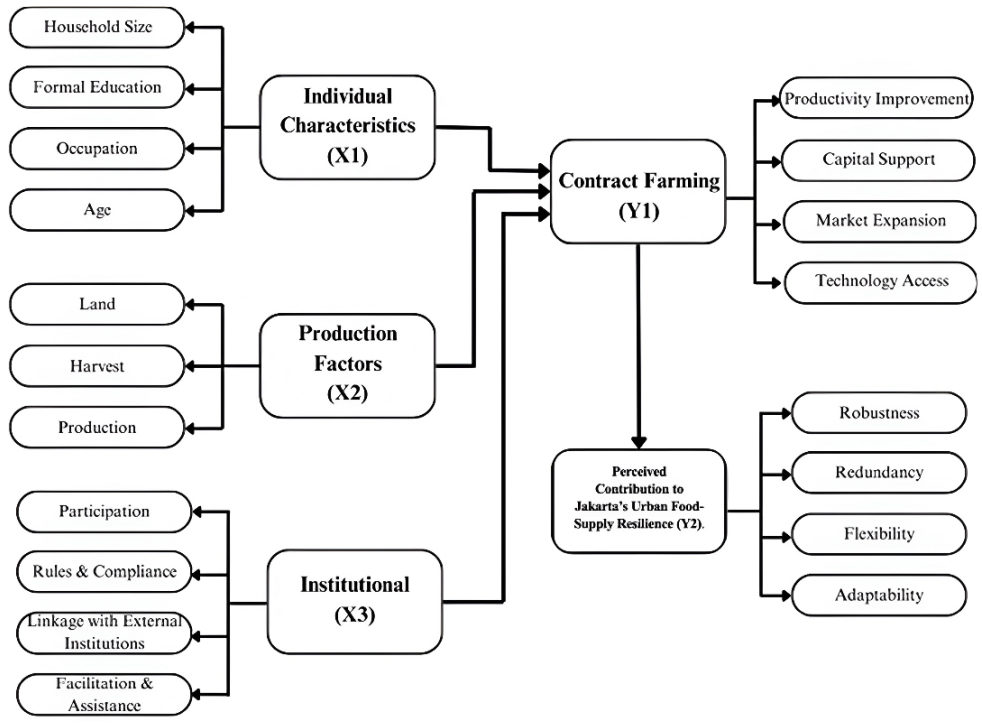
This study employs a quantitative research design. A survey method with a multi-analytic strategy was implemented, combining descriptive statistics using SPSS with inferential modeling through Partial Least Squares–Structural Equation Modeling (PLS-SEM). The study population consists of 770 rice-producing farmers participating in PT Food Station Tjipinang Jaya’s contract farming program, distributed across 22 partner farmer groups in selected rice-producing districts supplying rice to Jakarta. The sampling frame was obtained from the list of registered partner farmers provided by the farmer groups and program coordinators. From this population, 120 respondents were selected using a random sampling procedure within the partner farmer groups. To ensure representation across locations, the sample was distributed across the selected partner districts, with approximately 15 farmers drawn from each district, depending on the availability of eligible farmers and the size of the partner farmer groups. The final sample size also satisfies the recommended minimum of 5–10 respondents per indicator for PLS-SEM, given the study’s use of 18 indicators. Data were collected directly by the research team and trained enumerators through field visits.
The study measures three exogenous latent variables and two endogenous latent variables. Three exogenous latent variables include individual characteristics (X1), rice production processes (X2), and farmer institutional capacity (X3). Two endogenous latent variables include contract farming performance (Y1) and perceived contribution to Jakarta’s Urban Food-Supply Resilience (Y2). In this empirical model, corporate farming is not measured as a separate latent construct, but is treated as the broader institutional and supply-chain governance framework through which PT Food Station Tjipinang Jaya organizes procurement, off-taking, aggregation, and coordination with partner farmers. Y2 is defined as farmers’ perceived contribution to Jakarta’s urban food-supply resilience, measured through perceptions of robustness, redundancy, flexibility, and adaptability within the upstream rice-supply partnership network. Therefore, Y2 does not directly measure Jakarta’s objective metropolitan food-system resilience, but captures how partner farmers perceive the contribution of contract farming to supply-side resilience. All constructs were operationalized through multi-item indicators measured using structured questionnaires. Quantitative responses were scored, tabulated, categorized, and analyzed using frequency distributions to describe respondent profiles and variable tendencies. The operational definitions and variables are presented in Table A1 and Figure 2, respectively.
Inferential analysis employed PLS-SEM using SmartPLS version 3 owing to its suitability for predictive modeling, exploratory analysis, theory development, small-to-medium sample sizes, and tolerance for non-normal data. The methodology accommodates both reflective and formative indicators, allowing the simultaneous estimation of measurement and structural models. Consistent with Subhaktiyasa [30] and Kanchanawongpaisan and Paijit [31], the SEM framework enables evaluation of direct and indirect relationships among latent constructs, providing a comprehensive analytical basis for testing the hypothesized effects of individual characteristics, production processes, and institutional capacity on contract-farming performance, and subsequently, on Jakarta’s urban food-supply resilience through its upstream rice-supply partnership network.
PT Food Station Tjipinang Jaya, established under Deed No. 46 dated 28 April 1972, has undergone several strategic transitions that shaped its current role in Jakarta’s urban food-supply governance. The first major milestone was the establishment and management of the Cipinang Rice Central Market (Pasar Induk Beras Cipinang, PIBC), which served as a reform initiative to improve rice procurement, distribution, and price stabilization mechanisms within the Jakarta metropolitan area. In this phase, the company was appointed as the sole operator of PIBC and the primary entity responsible for distributing staple foods across Jakarta’s markets. The second milestone was achieved with the formal designation of the company as a regionally owned enterprise (Badan Usaha Milik Daerah, BUMD) through Regional Regulation No. 6 of 2014. Building on this institutional mandate, the company expanded its commercial activities beginning in 2015 by entering modern retail, traditional markets, institutional buyers, and the hotel–restaurant–café (popularly dubbed as Horeka) sector, supported by the operation of multiple rice-milling units (RMUs) owned or jointly managed with private partners. To ensure upstream rice-supply continuity for Jakarta, the company simultaneously strengthened partnerships with farmer groups (Gapoktan/Poktan) and agribusiness entities located in major rice-producing regions.
Given Jakarta’s extremely limited agricultural land, PT Food Station has adopted a food-resilience ecosystem model that integrates upstream production, midstream storage, and downstream distribution. This model includes three core programs. First, the Contract Farming program, initiated in 2018 covering 500 hectares of paddyfield, which expanded to 8,180 hectares by 2022, and is projected to extend to 18,000 hectares by 2027, ensuring raw-material reliability through direct partnerships with farmer organizations and agribusiness units. Secondly, the On-Farm program was developed to mitigate raw-material price volatility by implementing standardized cultivation practices through farming-management partners. In 2022, on-farm cultivation covered 500 hectares, supported by input loans to farmer groups; by 2027, the program aims to cultivate 2,000 hectares, producing an estimated 240,000 tons of paddy (equivalent to 132,000 tons of rice annually). Thirdly, storage-capacity strengthening has been prioritized to maintain supply readiness. By 2022, storage capacity had reached 23,250 tons through a combination of company-owned and partner facilities, with a target of 25,500 tons by 2027. When combined with the average daily PIBC stock of 37,000 tons, these capacities collectively ensure a 20-day buffer for Jakarta in the event of supply disruptions. Thus, the empirical context of this study is not urban farming within Jakarta, but Jakarta’s institutionalized rice-supply network involving farmers located in external rice-producing regions.
The respondents in this study consist of 120 rice-supplying farmers located in partner rice-producing regions participating in the contract farming programs under PT Food Station Tjipinang Jaya (see Table 1). These respondents are institutionally connected to Jakarta through PT Food Station’s procurement, off-taking, and supply-chain coordination mechanisms, rather than through their physical location within Jakarta’s administrative territory. The majority are older adults, with 65% aged above 50 years and 25.83% aged 40–49 years, indicating a predominantly aging farming population. Most farmers have relatively low formal education, with 79.17% completing only primary or junior secondary school and only 4.16% attaining tertiary education. In terms of production structure, more than half (55%) cultivate less than one hectare of land. Production processes are equally divided between family labor and hired labor, while harvest volumes are relatively high, with 43.33% producing 5-9 tons per season. Institutional capacity appears strong, as most farmers report high participation in farmer groups, high compliance with group rules, strong institutional linkages, and substantial access to extension services. However, despite this organizational strength, formal mentoring intensity remains low for most farmers, indicating that institutional capacity is predominantly coordination-based rather than technical in nature. The effectiveness of contract farming remains mixed, productivity gains are largely perceived as very low (80.83%), although improvements in market access, capital support, and technology adoption show more variation across farmers. Food-system resilience indicators should therefore be interpreted from the perspective of Jakarta’s upstream rice-supply network, reflecting farmers’ perceived contribution to supply reliability, flexibility, adaptation, and institutional coordination within the partnership system.
Table 1. Respondent characteristics
|
Variable Group |
Category |
Criteria |
Percentage (%) |
Total of (%) |
|
Individual characteristics |
Age |
19–29 years |
1.67 |
100 |
|
30–39 years |
6.67 |
|||
|
40–49 years |
26.66 |
|||
|
> 50 years |
65.00 |
|||
|
Education |
No schooling |
2.50 |
100 |
|
|
Primary–Junior Secondary |
79.17 |
|||
|
Upper Secondary |
14.17 |
|||
|
Tertiary (University) |
4.16 |
|||
|
Occupation |
Farmer/Livestock/Fisheries |
95.83 |
100 |
|
|
Village Apparatus |
1.67 |
|||
|
Self-Employed |
2.50 |
|||
|
Household size |
1 person |
15.83 |
100 |
|
|
2–3 persons |
78.33 |
|||
|
4–5 persons |
5.84 |
|||
|
Production structure |
Land size |
< 1 hectare (Low) |
55.00 |
100 |
|
1–2 hectares (High) |
31.67 |
|||
|
> 2 hectares (Very High) |
13.33 |
|||
|
Low |
50.00 |
100 |
||
|
Production activities |
High |
35.00 |
||
|
Very High |
15.00 |
|||
|
Harvest volume |
2–4 tons (Low) |
35.84 |
100 |
|
|
5–9 tons (High) |
43.33 |
|||
|
> 10 tons (Very High) |
20.83 |
|||
|
Institutional capacity |
Participation |
Very low |
17.50 |
100 |
|
Low |
5.83 |
|||
|
High |
35.83 |
|||
|
Very high |
40.84 |
|||
|
Rules & compliance |
Very low |
19.17 |
100 |
|
|
Low |
49.17 |
|||
|
High |
0.83 |
|||
|
Very high |
30.83 |
|||
|
Linkage with external institutions |
Very low |
20.83 |
100 |
|
|
Low |
15.83 |
|||
|
High |
51.67 |
|||
|
Very high |
11.67 |
|||
|
Facilitation & assistance |
Very low |
60.00 |
100 |
|
|
Low |
37.50 |
|||
|
High |
0.83 |
|||
|
Very high |
1.67 |
|||
|
Effectiveness of contract farming |
Productivity improvement |
Very low |
80.83 |
100 |
|
Low |
10.01 |
|||
|
High |
3.33 |
|||
|
Very high |
5.83 |
|||
|
Capital support |
Very low |
65.83 |
100 |
|
|
Low |
25.00 |
|||
|
High |
1.67 |
|||
|
Very high |
7.50 |
|||
|
Market access improvement |
Very low |
8.33 |
100 |
|
|
Low |
20.84 |
|||
|
High |
43.33 |
|||
|
Very high |
27.50 |
|||
|
Technology improvement |
Very low |
30.83 |
100 |
|
|
Low |
39.17 |
|||
|
High |
15.00 |
|||
|
Very high |
15.00 |
|||
|
Perceived contribution to Jakarta’s Urban food-supply resilience |
Robustness |
Very low |
7.50 |
100 |
|
Low |
30.00 |
|||
|
High |
44.17 |
|||
|
Very high |
18.33 |
|||
|
Redundancy flexibility |
Very low |
0.00 |
100 |
|
|
Low |
8.34 |
|||
|
High |
59.16 |
|||
|
Very high |
32.50 |
|||
|
Very low |
9.17 |
100 |
||
|
Low |
23.33 |
|||
|
High |
51.67 |
|||
|
Very high |
15.83 |
|||
|
Adaptation |
Very low |
0.00 |
100 |
|
|
Low |
12.50 |
|||
|
High |
52.50 |
|||
|
Very high |
35.00 |
The evaluation of the PLS-SEM model was conducted in two stages: assessment of the measurement model and assessment of the structural model. The measurement model was first examined to ensure the validity and reliability of the constructs. In this study, individual characteristics (X1), production factors (X2), and farmer institutional capacity (X3) were specified as formative constructs because their indicators represent distinct components that jointly form each construct rather than interchangeable manifestations of a single latent variable. For instance, age, education, occupation, household size, land, harvest, and production are not expected to covary as reflective indicators. Meanwhile, contract farming performance (Y1) and perceived contribution to Jakarta’s urban food-supply resilience (Y2) were specified as reflective constructs because their indicators represent perceived manifestations of program performance and resilience contribution.
For reflective constructs, the measurement model was assessed using outer loadings, Cronbach’s alpha, composite reliability, average variance extracted (AVE), and the heterotrait–monotrait ratio (HTMT). For formative constructs, the assessment focused on indicator relevance and multicollinearity using outer weights, variance inflation factor (VIF), bootstrapped p-values, and confidence intervals. After confirming the adequacy of the measurement model, the structural model was evaluated using path coefficients, t-statistics, bootstrapped p-values, confidence intervals, coefficient of determination (R²), effect size (f²), predictive relevance (Q²), and standardized root mean square residual (SRMR).
Based on Table 2, the initial evaluation of the measurement model indicates that several indicators had low outer loading values below 0.70 or negative loadings and were therefore eliminated. The retained indicators were occupation and education for individual characteristics; harvest and production for production factors; rules and compliance, external linkages, and participation for institutional capacity; capital improvement and market expansion for contract farming performance; and robustness and redundancy for perceived contribution to Jakarta’s urban food-supply resilience. In addition, most constructs did not yet meet the required thresholds for reliability and convergent validity, particularly as reflected in the AVE values. Therefore, the model was respecified by removing indicators that did not satisfy the measurement criteria in order to obtain a more robust measurement model.
Table 2. Initial outer loading results
|
Variable |
Indicator |
Outer Loading |
Decision |
CA |
CR |
AVE |
|
Individual characteristics (X1) |
Household size |
0.138 |
Eliminated |
0.359 |
0.432 |
0.279 |
|
Education |
0.469 |
Retained |
||||
|
Occupation |
0.934 |
Retained |
||||
|
Age |
-0.059 |
Eliminated |
||||
|
Production structure (X2) |
Land size |
0.265 |
Eliminated |
0.436 |
0.639 |
0.407 |
|
Harvest volume |
0.670 |
Retained |
||||
|
Production activities |
0.838 |
Retained |
||||
|
Institutional capacity (X3) |
Rules & compliance |
0.893 |
Retained |
0.657 |
0.756 |
0.518 |
|
Linkage with external institutions |
0.683 |
Retained |
||||
|
Participation |
0.899 |
Retained |
||||
|
Facilitation & assistance |
-0.029 |
Eliminated |
||||
|
Effectiveness of contract farming (Y1) |
Capital support |
0.520 |
Retained |
0.254 |
0.534 |
0.303 |
|
Market access improvement |
0.866 |
Retained |
||||
|
Productivity improvement |
0.439 |
Eliminated |
||||
|
Technology improvement |
-0.036 |
Eliminated |
||||
|
Perceived contribution to Jakarta’s urban food-supply resilience (Y2) |
Adaptation |
0.614 |
Eliminated |
0.376 |
0.647 |
0.368 |
|
Flexibility |
0.058 |
Eliminated |
||||
|
Robustness |
0.723 |
Retained |
||||
|
Redundancy |
0.755 |
Retained |
|
|
|
Based on the model respecification results (Table 3), all remaining indicators have outer loading values that meet the required criteria and are therefore considered valid. In addition, all constructs satisfy the thresholds for composite reliability (CR > 0.70) and AVE > 0.50: individual characteristics (CR = 0.730; AVE = 0.578), production factors (CR = 0.729; AVE = 0.578), institutional capacity (CR = 0.873; AVE = 0.698), contract farming performance (CR = 0.716; AVE = 0.570), and perceived contribution to Jakarta’s urban food-supply resilience (CR = 0.770; AVE = 0.628). Although the Cronbach’s alpha values for several constructs remain below 0.70, the model can still be considered reliable because it meets the CR and AVE criteria, making it suitable for subsequent analysis.
Table 3. Outer loading results after model respecification
|
Variable |
Indicator |
Outer Loading |
Decision |
CA |
CR |
AVE |
|
Individual characteristics (X1) |
Occupation |
0.663 |
Valid |
0.280 |
0.730 |
0.578 |
|
Education |
0.846 |
Valid |
||||
|
Production structure (X2) |
Harvest Volume |
0.649 |
Valid |
0.283 |
0.729 |
0.578 |
|
Production Activities |
0.857 |
Valid |
||||
|
Institutional capacity (X3) |
Rules & Compliance |
0.895 |
Valid |
0.802 |
0.873 |
0.698 |
|
Linkage with External Institutions |
0.689 |
Valid |
||||
|
Participation |
0.904 |
Valid |
||||
|
Effectiveness of contract farming (Y1) |
Capital support |
0.570 |
Valid |
0.278 |
0.716 |
0.570 |
|
Market Access Improvement |
0.903 |
Valid |
||||
|
Perceived contribution to Jakarta’s urban food-supply resilience (Y2) |
Robustness |
0.724 |
Valid |
0.414 |
0.770 |
0.628 |
|
Redundancy |
0.855 |
Valid |
Table 4 was used to assess discriminant validity among constructs, with the recommended threshold of HTMT < 0.90. The results show that most construct pairs met this criterion, with HTMT values ranging from 0.263 to 0.883. However, two construct pairs did not satisfy the discriminant validity threshold: contract farming performance–production factors (1.265) and contract farming performance–institutional capacity (0.970), as their values exceeded 0.90. Overall, these findings indicate that most constructs demonstrate adequate discriminant validity, although two construct pairs exhibit relatively high conceptual overlap.
Table 4. Heterotrait–monotrait ratio (HTMT)
|
Effectiveness of Contract Farming (Y1) |
Production Structure (X2) |
Individual Characteristics (X1) |
Institutional Capacity (X3) |
Perceived Contribution to Jakarta’s Urban Food-Supply Resilience (Y2) |
|
|
Effectiveness of contract farming (Y1) |
|||||
|
Production structure (X2) |
1.265 |
||||
|
Individual characteristics (X1) |
0.629 |
0.883 |
|||
|
Institutional capacity (X3) |
0.970 |
0.565 |
0.517 |
||
|
Perceived contribution to Jakarta’s urban food-supply resilience (Y2) |
0.843 |
0.263 |
0.366 |
0.523 |
The inner VIF (Table 5) values for all structural paths range from 1.000 to 1.168. Specifically, the VIF value for individual characteristics toward contract farming performance is 1.077, production factors toward contract farming performance is 1.088, institutional capacity toward contract farming performance is 1.168, and contract farming performance toward perceived contribution to Jakarta’s urban food-supply resilience is 1.000. All VIF values are below the recommended threshold of 3.0, indicating that multicollinearity is not a concern in the structural model.
Table 5. Inner variance inflation factor (VIF)
|
Path |
VIF |
|
Individual Characteristics (X1) → Effectiveness of Contract Farming (Y1) |
1.077 |
|
Production Structure (X2) → Effectiveness of Contract Farming (Y1) |
1.088 |
|
Institutional Capacity (X3) → Effectiveness of Contract Farming (Y1) |
1.168 |
|
Effectiveness of Contract Farming (Y1) → Perceived Contribution to Jakarta’s Urban Food-Supply Resilience (Y2) |
1.000 |
The model fit evaluation (Table 6) shows that the SRMR value is 0.128 for the saturated model and 0.130 for the estimated model. A model is generally considered to have a good fit when SRMR is below 0.08, while values below 0.10 may still be regarded as indicating an acceptable fit. Therefore, the SRMR values in this study exceed 0.10, suggesting that the model does not fully meet the conventional goodness-of-fit criterion. Meanwhile, the d_ULS, d_G, Chi-square, and NFI values are presented as supporting information for the overall model evaluation.
Table 6. Model fit
|
Saturated Model |
Estimated Model |
|
|
SRMR |
0.128 |
0.130 |
|
d_ULS |
1.078 |
1.118 |
|
d_G |
0.355 |
0.358 |
|
Chi-Square |
266.645 |
267.877 |
|
NFI |
0.154 |
0.150 |
Based on Table 7, the R² value indicates that contract farming performance (Y1) has a value of 0.320, which falls into the weak category according to the criteria, as it is above 0.25 but below 0.50. This means that 32.0% of the variation in contract farming performance can be explained by the exogenous variables included in the model, while the remaining 68.0% is explained by other factors outside the model. Meanwhile, perceived contribution to Jakarta’s urban food-supply resilience (Y2) has an R² value of 0.113, which is below 0.25, indicating a very weak explanatory power. This suggests that only 11.3% of the variation in perceived food-supply resilience can be explained by the model. The Q² value of 0.397 is greater than zero, indicating that the model has predictive relevance. Thus, despite its limited explanatory power for some endogenous constructs, the model still demonstrates an adequate ability to predict the endogenous variables.
Table 7. R square and Q square
|
Endogenous Variable |
R2 |
Q2 |
|
Contract Farming (Y1) |
0.320 |
1 – (1-0.320) × (1-0.113) = 0.397 |
|
Perceived Contribution to Jakarta’s Urban Food-Supply Resilience (Y2) |
0.113 |
In this study, the structural model tests the causal influence of three exogenous variables, Individual Characteristics (X1), Production Factors (X2), and Farmer Institutional Capacity (X3) on the endogenous variable Contract Farming (Y1) within PT Food Station’s rice-supply partnership program for Jakarta. The effect size (f²) reflects the relative contribution of each exogenous variable to the R² value of the endogenous construct. Following Cohen’s [32] guidelines, f² values are categorized as small (0.02), medium (0.15), and large (0.35). These thresholds help determine the substantive impact of each predictor within the model. The results of this study indicate that efforts to strengthen the effectiveness of contract farming should prioritize enhancing farmer institutional capacity, as this variable demonstrates the most substantively meaningful contribution to the structural model.
The analysis shows (Table 8) that Farmer Institutional Capacity (X3) exerts a positive, statistically significant, and the most dominant influence on the implementation of Contract Farming (Y1), as indicated by a path coefficient of β = 0.437 and a t-statistic of 6.546. The medium–large effect size (f² = 0.241) further confirms that institutional arrangements function as the strongest predictor in the structural model. This implies that a one–standard deviation increase in institutional capacity improves contract farming performance by 0.437 standard deviations, holding other variables constant. The prominence of institutional capacity is well explained by New Institutional Economics (NIE), which conceptualizes contract farming as a hybrid governance structure situated between spot markets and full vertical integration [17, 33]. The success of such hybrid arrangements hinges on institutional mechanisms that reduce transaction costs and mitigate opportunism between contracting parties. In this study, institutional capacity is reflected by three indicators with high loadings: Participation (λ = 0.925), Rules and Compliance (λ = 0.915), and External Linkages (λ = 0.820), which together form an institutional environment conducive to effective contract implementation. Participation represents active farmer engagement in planning, implementation, and monitoring within farmer groups, consistent with Ostrom’s [34] Collective Action Theory and supported empirically by Hellin et al. [25]. Rules and Compliance indicate formal governance quality; approximately 90% of farmer groups possess clear organizational structures and bylaws, consistent with institutional principles articulated by Ostrom [34] and North [35]. External linkages represent strong relationships between farmer groups, government institutions, and private partners, functioning as essential social capital that facilitates coordination and contract enforcement. Nonetheless, the limited mentoring intensity suggests that institutional effectiveness currently relies more on governance and coordination than on continuous technical upgrading.
Table 8. Path coefficient analysis and effect size of the structural model
|
Variable Definition |
Path Coefficient |
t-Statistic |
p Value |
f² |
Interpretation |
Confidence Interval (2.5%-97.5%) |
|
X₁ Individual Characteristics → Y₁ Contract Farming Performance |
0.030 |
0.454 |
0.650 |
0.001 |
Negligible |
-0.061-0.190 |
|
X₂ Production Factors → Y₁ Contract Farming Performance |
0.246 |
3.328** |
0.001 |
0.082 |
Small |
0.110-0.399 |
|
X₃ Institutional Capacity → Y₁ Contract Farming Performance |
0.437 |
6.546** |
0.000 |
0.241 |
Medium–Large |
0.303-0.555 |
Production Factors (X2) also have a positive and statistically significant effect on Contract Farming (Y1), with β = 0.246 and t = 3.328. Although the effect size is small (f² = 0.082), it nonetheless demonstrates meaningful influence. This relationship is consistent with the Resource-Based View [36], which underscores the role of production resources and capabilities in creating competitive advantage. High loadings for Production (λ = 0.987) and Harvest (λ = 0.900) indicate that production efficiency and yield capacity form the core of this construct. Descriptive evidence shows that most farmers achieve high production levels, with typical yields of 7–10 tons per season, average landholdings of around two hectares, and productivity levels of 5–6 tons per hectare. Importantly, this positive effect reflects objective production capacity rather than farmers’ subjective perceptions of productivity improvement, which explains why relatively high output levels coexist with low reported productivity gains. These findings align with the literature suggesting that firms typically contract with farmers meeting minimum production thresholds [37].
In contrast, Individual Characteristics (X1) exhibit a positive but statistically insignificant influence on Contract Farming (β = 0.030; t = 0.454; f² = 0.001), reflecting a negligible effect. This indicates that demographic characteristics provide minimal explanatory power in determining contract farming performance. This phenomenon aligns with what may be described as a Human Capital Paradox in contract farming. While Human Capital Theory [27, 28] posits that education enhances productivity, contract farming practices rely more heavily on tacit, experience-based skills than on formal schooling. Farmers with higher education often have alternative non-farm employment options, decreasing their likelihood of committing to agricultural partnerships, as noted by Neglo et al. [38] and Zhang and Zhao [39]. Furthermore, strong institutional support structures can compensate for low levels of formal education, explaining why the predominantly older and less-educated respondent population, 65% above age 50, with 80% educated at primary or junior secondary levels can still participate effectively. Older farmers may also possess accumulated experience and social networks that offset limitations in formal human capital, consistent with [40].
The SEM–PLS results (Table 9) indicate that the implementation of contract farming exerts a positive and statistically significant effect on Jakarta’s urban food-supply resilience through its upstream rice-supply partnership network. The path coefficient of 0.336 suggests that a one-unit increase in the effectiveness of contract farming leads to a 0.336-unit increase in food resilience, holding other variables constant. A t-statistic of 4.119 and a p-value of 0.000 below the 0.01 significance threshold, confirm that this influence is statistically significant at the 99% confidence level. These findings imply that the contract farming program implemented by PT Food Station Tjipinang Jaya positively strengthens the supply-side component of Jakarta’s food resilience. However, this result should not be interpreted as a direct measurement of Jakarta’s entire urban food system. Rather, it captures the contribution of rice-supplying farmers and institutionalized procurement arrangements to Jakarta’s food-supply resilience.
Table 9. Path analysis results: Effect of contract farming on food resilience
|
Variable Relationship |
Path Coefficient |
t-Statistic |
p-Value |
f2 |
Remarks |
Confidence Interval (2.5%-97.5%) |
|
Contract Farming → perceived contribution to Jakarta’s Urban Food-Supply Resilience |
0.336 |
4.119** |
0.000 |
0.128 (small effect) |
Significant |
0.165-0.485 |
|
Coefficient of Determination (R²) |
0.113 |
– |
– |
|
11.3% |
|
This result is consistent with Adebisi et al. [41], who found that poultry farmers participating in contract farming schemes in Nigeria exhibited higher levels of food security compared to non-participants. Participation in such schemes was also associated with increased daily caloric intake, indicating improvements in both food availability and household access. Theoretically, this supports the conceptualization of food-system resilience proposed by Tendall et al. [2], which frames resilience as the capacity of a system to ensure the availability, accessibility, and adequacy of food in the face of chronic and acute shocks. In the context of this study, such resilience is examined specifically through the upstream supply-side pathway that connects rice-producing farmers outside Jakarta with Jakarta’s urban food-provisioning system.
The R² value for the food-resilience variable is 0.113, meaning that contract farming explain 11.3% of the variance in urban food-supply resilience as captured through the upstream partnership network, while the remaining 88.7% is influenced by factors outside the model. This magnitude is reasonable given the structural complexity of urban food systems, which are shaped by multiple determinants beyond agricultural institutional arrangements, including national food trade policies, logistics and infrastructure, global market volatility, and local government fiscal capacity. The modest R² value therefore reinforces the interpretation that contract farming represent one supply-side resilience mechanism rather than the sole determinant of Jakarta’s overall food-system resilience.
The mechanism through which contract farming influence food-system resilience operates through enhanced market assurance, price stability, and greater efficiency within the supply chain. In an urban environment such as Jakarta, characterized by severe land constraints and intense market pressures, contract farming provides rice-supplying farmers in partner production regions with production certainty and reduces business risks by guaranteeing markets and stabilizing income. These dynamics align with food-resilience theory, which emphasizes the critical roles of production stability and sustainable economic access as foundational pillars of a resilient food system. Hoang [37] further highlighted that contract farming facilitates agricultural production and alleviates key constraints faced by farmers, particularly in accessing markets and essential production inputs. For Jakarta, these farmer-level improvements matter because they support the continuity, predictability, and coordination of rice flows from external production regions into the metropolitan food-supply system.
Table 10. Indirect effects on food resilience
|
Influence Path |
Calculation |
Indirect Effect |
Interpretation |
t Statistics |
p Value |
Confidence Interval (2.5%-97.5%) |
|
Individual Characteristics → CF → Resilience |
0.030 × 0.336 |
0.010 |
Very Weak |
0.451 |
0.652 |
-0.024-0.066 |
|
Production Factors → CF → Resilience |
0.246 × 0.336 |
0.083 |
Weak |
2.537* |
0.011 |
0.029-0.155 |
|
Institutional Capacity → CF → Resilience |
0.437 × 0.336 |
0.147 |
Moderate |
3.388** |
0.001 |
0.067-0.240 |
In addition to the direct effects (Table 10), food resilience is also influenced indirectly by individual characteristics (X₁), production processes (X₂), and institutional capacity (X₃) through the mediating role of contract farming. Based on the SEM-PLS results, the indirect effects were obtained by multiplying the path coefficients from each exogenous variable to Y₁ with the coefficient from Y₁ to Y₂, as presented in the table. The analysis shows that institutional capacity exerts the strongest indirect influence on food resilience (0.147), followed by production processes (0.083) and individual characteristics (0.010). These findings confirm that strengthening farmer institutions is a strategic lever for enhancing Jakarta’s urban food-supply resilience through the upstream rice-supply partnership pathway. From the SES perspective [1], institutions operate as the interface that links farmers as social actors with natural resources and cultivation practices as ecological components through collectively agreed rules. Descriptive data indicate that farmers fall into the high institutional-relationship category, suggesting that social capital within the system is already well established as a foundation for resilience. Nevertheless, the interpretation remains limited to the farmer-institutional side of Jakarta’s rice-supply network, rather than to all dimensions of urban food resilience.
The dominant role of institutional capacity can also be explained through Adaptive Governance Theory [7], which highlights how institutions can be designed to enhance a system’s adaptive capacity under conditions of uncertainty. The contract farming scheme implemented by PT Food Station Tjipinang Jaya demonstrates features of adaptive governance through contractual flexibility, joint learning processes, and feedback mechanisms embedded in routine farmer-group meetings. These mechanisms contribute to the high levels of adaptation observed in the study.
The findings provide both theoretical and practical implications for the development of urban food-supply systems that depend heavily on external production regions. Theoretically, this study advances the literature by integrating food-system resilience theory with agricultural institutional theory. The significant relationship between contract farming and food resilience reinforces the argument that structured institutional arrangements can build systemic resilience by linking upstream producers with urban consumption centers. The study proposes the notion of Behaviorally Embedded Institutional Resilience, suggesting that food-system resilience emerges from the dynamic interplay between individual farmer behavior and the institutional architecture of contract farming. In this study, this concept is specifically situated within Jakarta’s upstream rice-supply network, where farmer behavior and institutional coordination jointly shape the reliability of urban food provisioning.
Practically, the results offer an empirical basis for PT Food Station Tjipinang Jaya and the Provincial Government of Jakarta to formulate strategies to strengthen Jakarta’s rice-supply resilience. Given that market expansion emerged as the strongest contributor, securing and expanding purchase guarantees at competitive prices should remain a priority for enhancing farmer resilience. The observation that farmers report low levels of capital improvement indicates an urgent need for financial innovation within contract farming schemes, such as low-interest agricultural loans, advance payment mechanisms, or warehouse-receipt financing. Meanwhile, the negative loading factor on technology suggests a misalignment between available technologies and farmers’ absorptive capacity, highlighting the necessity for more structured training and technical assistance programs to facilitate effective technology adoption.
For the Provincial Government of Jakarta, the findings suggest that contract farming can function as one institutional mechanism for supporting the city’s upstream rice-supply resilience. However, the R² value of 0.113 indicates that contract farming explains only a limited portion of the variance in farmers’ perceived contribution to Jakarta’s urban food-supply resilience. Therefore, this finding should not be interpreted as evidence that contract farming alone determines Jakarta’s overall food-system resilience. Rather, contract farming should be positioned as one supply-side component within a broader food-governance strategy. Policy interventions should integrate contract farming with supply-chain diversification, investment in logistics and storage infrastructure, enhanced market-information systems, and stronger food-reserve management. Such integration is necessary because contract farming can support the supply-side foundation of food resilience, but cannot by itself address the full complexity of Jakarta’s metropolitan food system.
The empirical findings demonstrate that farmer institutional capacity is the most influential determinant of contract farming performance, surpassing the contributions of production-related factors and far exceeding the explanatory power of individual demographic characteristics. While production factors exhibit a positive and statistically significant effect, their role primarily reflects objective production capacity rather than perceived productivity improvement. Individual characteristics contribute only marginally once institutional and production conditions are accounted for. Importantly, the study shows that effective contract farming has a positive and statistically significant relationship with farmers’ perceived contribution to Jakarta’s urban food-supply resilience through its upstream rice-supply partnership network. However, the magnitude of this effect is moderate, and the R² value of 0.113 indicates that contract farming explains only a limited portion of the variance in perceived food-supply resilience. Therefore, this finding should not be interpreted as evidence that contract farming alone determines Jakarta’s overall food-system resilience. Rather, it suggests that structured partnerships with rice-supplying farmers contribute to one supply-side component of urban food resilience, operating alongside broader structural determinants inherent to complex metropolitan food systems.
From a policy perspective, strengthening Jakarta’s urban food-supply resilience should not rely solely on contract farming, but should position it as one component within a broader food-governance strategy. Policy efforts may prioritize the reinforcement of farmer institutions through improved organizational governance, enforceable rules, participatory decision-making, and stronger vertical and horizontal linkages with public and private actors. Given the observed limitations in formal mentoring, capital improvement, and technology adoption, institutional strengthening should be complemented by targeted capacity-building initiatives, including affordable and accessible financing schemes, structured and continuous technical assistance, and technology deployment aligned with farmers’ absorptive capacity. For the Provincial Government of Jakarta, contract farming should be integrated with supply-chain diversification, investment in logistics and storage infrastructure, enhanced market-information systems, and stronger food-reserve management. These measures are necessary because contract farming can support the supply-side foundation of food resilience, but cannot by itself address the full complexity of Jakarta’s metropolitan food system.
This study has several limitations. First, food-supply resilience is measured through farmers’ perceived contribution rather than objective system-level indicators such as stock buffer, delivery reliability, price stability, or disruption recovery capacity. Secondly, the analysis focuses on rice-supplying farmers within PT Food Station’s upstream partnership network and therefore does not capture all actors in Jakarta’s food system, including traders, distributors, retailers, consumers, and government agencies. Thirdly, the modest explanatory power of the model indicates that future studies should incorporate broader structural, logistical, market, and policy variables to provide a more comprehensive assessment of urban food-system resilience.
Table A1. The operational definitions
|
Variable / Dimension |
Operational Definition |
Indicators |
Measurement Categories |
|
Individual Characteristics (X1) |
Attributes inherent to farmers that may influence decision-making, participation, and engagement in contract farming. |
||
|
Age |
Length of time the respondent has lived from birth to the time of interview. |
Number of years lived. |
19–29 years; 30–39 years; 40–49 years; > 50 years |
|
Formal Education |
Formal learning processes undertaken at school. |
Highest formal education attained. |
No schooling; Primary–Lower Secondary (SD–SMP); Upper Secondary (SMA); Tertiary (University) |
|
Occupation |
Main economic activity performed regularly to earn income. |
Type of main occupation carried out. |
Farmer; Village apparatus; Self-employed |
|
Household Size |
Number of household members residing together and sharing kinship with the farmer. |
Number of dependents in the household. |
1 person; 2–3 persons; 4–5 persons; |
|
Rice Production Factors (X2) |
Resources and activities used by farmers to cultivate, manage, and harvest rice. |
||
|
Land |
The area of agricultural land used for rice cultivation. |
Status and size of cultivated land. |
Very low; Low; High; Very high |
|
Production Activities |
Systematic cultivation activities conducted by farmers to manage productive resources. |
Type of field-management system and availability of production tools. |
Very low; Low; High; Very high |
|
Harvest |
Activities conducted to collect rice yields at the end of the growing cycle. |
Total harvested area and volume. |
Very low; Low; High; Very high |
|
Institutional Capacity (X3) |
The strength of farmer-group governance, participation, and support systems that facilitate collective action. |
||
|
Participation |
The extent to which members engage in collective activities provided by farmer institutions. |
Frequency of attendance in group meetings. |
Very low; Low; High; Very high |
|
Rules & Compliance |
Formal and informal rules governing rights, obligations, procedures, and sanctions within farmer institutions. |
Adherence to institutional regulations and decisions. |
Very low; Low; High; Very high |
|
Linkages with External Institutions |
Degree of interaction with external agencies supporting farmer needs and productivity. |
Activities related to facilitating farmer needs, solving problems, increasing productivity and quality. |
Very low; Low; High; Very high |
|
Facilitation & Assistance |
Institutional support for training, capacity building, and extension services. |
Participation in training, extension, and related programs. |
Very low; Low; High; Very high |
|
Effectiveness of Contract Farming Performance (Y1) |
The effectiveness of contract farming arrangements in improving production, market access, and technology adoption. |
||
|
Productivity Improvement |
Efforts to increase yield quantity and quality through contractual schemes. |
Perceived increase in production volume and quality. |
Very low; Low; High; Very high |
|
Capital Support |
Financial or input support provided by partner institutions. |
Perceived increase in credit access, inputs (seeds, fertilizer), and pesticides. |
Very low; Low; High; Very high |
|
Market Access Improvement |
Activities that enhance product marketing and contractual purchasing obligations. |
Perceived assurance of product purchase by integrators. |
Very low; Low; High; Very high |
|
Technology Improvement |
Provision of new technologies and technical assistance to farmers. |
Perceived access to extension services and technical guidance. |
Very low; Low; High; Very high |
|
Perceived Contribution to Jakarta’s Urban Food-Supply Resilience (Y2) |
The capacity of the food system to absorb, adapt to, and recover from shocks while maintaining essential functions. |
||
|
Robustness |
Ability to withstand disruptions before food security deteriorates. |
Farmer ability to prevent food-security losses. |
Very low; Low; High; Very high |
|
Redundancy |
Ability to absorb shocks and avoid system-wide vulnerability. |
Farmer strategies for absorbing and avoiding disturbances. |
Very low; Low; High; Very high |
|
Flexibility |
Speed with which farmers can restore lost food-security capacity. |
Ability to recover and stabilize food conditions after disturbances. |
Very low; Low; High; Very high |
|
Adaptability |
Degree to which lost food-security functions can be restored or improved. |
Farmer ability to respond to and manage food-security losses. |
Very low; Low; High; Very high |
[1] Ostrom, E. (2009). A general framework for analyzing sustainability of social-ecological systems. Science, 325(5939): 419-422. https://doi.org/10.1126/science.1172133
[2] Tendall, D.M., Joerin, J., Kopainsky, B., et al. (2015). Food system resilience: Defining the concept. Global Food Security, 6: 17-23. https://doi.org/10.1016/j.gfs.2015.08.001
[3] Favas, C., Cresta, C., Whelan, E., et al. (2024). Exploring food system resilience to the global polycrisis in six Asian countries. Frontiers in Nutrition, 11: 1347186. https://doi.org/10.3389/fnut.2024.1347186
[4] Walker, B., Salt, D. (2012). Resilience Thinking: Sustaining Ecosystems and People in a Changing World. Island Press.
[5] Holling, C.S., Gunderson, L.H. (Eds.). (2001). Panarchy: Understanding Transformations in Human and Natural Systems. Island Press.
[6] Ministry of Agriculture of the Republic of Indonesia. (2024). Statistik Pertanian 2024 [Agricultural Statistics 2024]. https://satudata.pertanian.go.id/details/publikasi/768.
[7] Folke, C., Hahn, T., Olsson, P., Norberg, J. (2005). Adaptive governance of social-ecological systems. Annual Review of Environment and Resources, 30: 441-473. https://doi.org/10.1146/annurev.energy.30.050504.144511
[8] Ray, N., Clarke, G., Waley, P. (2021). The impact of contract farming on the welfare and livelihoods of farmers: A village case study from West Bengal. Journal of Rural Studies, 86: 127-135. https://doi.org/10.1016/j.jrurstud.2021.06.003
[9] Li, Q., Wang, Z. (2024). Impact of contract farming on green technological efficiency of farmers: A comparative study of two contract organizational models. Frontiers in Sustainable Food Systems, 8: 1368997. https://doi.org/10.3389/fsufs.2024.1368997
[10] Liang, Y., Zhang, P., Bi, W., Qi, Q., Xie, F. (2025). Contract farming and pro-environmental behavior: Insights from beef cattle farmers. Frontiers in Sustainable Food Systems, 9: 1590726. https://doi.org/10.3389/fsufs.2025.1590726
[11] Khalili, F., Choobchian, S., Abbasi, E. (2024). Investigating the factors affecting farmers’ intention to adopt contract farming. Scientific Reports, 14(1): 9670. https://doi.org/10.1038/s41598-024-60317-x
[12] Walker, B., Holling, C.S., Carpenter, S.R., Kinzig, A. (2004). Resilience, adaptability and transformability in social–ecological systems. Ecology and Society, 9(2): 5. https://doi.org/10.5751/ES-00650-090205
[13] Folke, C., Carpenter, S.R., Walker, B., Scheffer, M., Chapin, T., Rockström, J. (2010). Resilience thinking: Integrating resilience, adaptability and transformability. Ecology and Society, 15(4): 20. https://www.jstor.org/stable/26268226.
[14] Meuwissen, M.P.M., Feindt, P.H., Spiegel, A., et al. (2019). A framework to assess the resilience of farming systems. Agricultural Systems, 176: 102656. https://doi.org/10.1016/j.agsy.2019.102656
[15] Ton, G., Vellema, W., Desiere, S., Weituschat, S., D'Haese, M. (2018). Contract farming for improving smallholder incomes: What can we learn from effectiveness studies? World Development, 104: 46-64. https://doi.org/10.1016/j.worlddev.2017.11.015
[16] Williamson, O.E. (1975). Markets and Hierarchies: Analysis and Antitrust Implications: A Study in the Economics of Internal Organization. Free Press. https://ssrn.com/abstract=1496220.
[17] Williamson, O.E. (1985). The economic institutions of capitalism. Firms, markets, relational contracting. In Das Summa Summarum des Management: Die 25 Wichtigsten Werke für Strategie, Führung und Veränderung, pp. 61-75. https://doi.org/10.1007/978-3-8349-9320-5_6
[18] Wang, H.H., Wang, Y., Delgado, M.S. (2014). The transition to modern agriculture: Contract farming in developing economies. American Journal of Agricultural Economics, 96(5): 1257-1271. https://doi.org/10.1093/ajae/aau036
[19] Bellemare, M.F., Bloem, J.R. (2018). Does contract farming improve welfare? A review. World Development, 112: 259-271. https://doi.org/10.1016/j.worlddev.2018.08.018
[20] Otsuka, K., Nakano, Y., Takahashi, K. (2016). Contract farming in developed and developing countries. Annual Review of Resource Economics, 8: 353-376. https://doi.org/10.1146/annurev-resource-100815-095459
[21] Egamberdiev, B. (2025). Household resilience capacity and food security in Central Asia. https://doi.org/10.25673/120337
[22] Egamberdiev, B., Bobojonov, I., Kuhn, L., Glauben, T. (2023). Household resilience capacity and food security: Evidence from Kyrgyzstan. Food Security, 15(4): 967-988. https://doi.org/10.1007/s12571-023-01369-1
[23] Sun, Y., Wang, Y., Tan, R., et al. (2025). How do rural households’ livelihood vulnerability affect their resilience? A spatiotemporal empirical analysis from a multi-risk perspective. Sustainability, 17(17): 7695. https://doi.org/10.3390/su17177695
[24] Hermanto, N., Swastika, D.K.S. (2011). Penguatan kelompok tani: Langkah awal peningkatan kesejahteraan petani. Analisis Kebijakan Pertanian, 9(4): 371-390. https://doi.org/10.21082/akp.v9n4.2011.371-390
[25] Hellin, J., Lundy, M., Meijer, M. (2009). Farmer organization, collective action and market access in Meso-America. Food Policy, 34(1): 16-22. https://doi.org/10.1016/j.foodpol.2008.10.003
[26] Crush, J., Frayne, B. (2011). Supermarket expansion and the informal food economy in Southern African cities: Implications for urban food security. Journal of Southern African Studies, 37(4): 781-807. https://doi.org/10.1080/03057070.2011.617532
[27] Becker, G.S. (1964). Human Capital: A Theoretical and Empirical Analysis, with Special Reference to Education. National Bureau of Economic Research.
[28] Schultz, T.W. (1961). Investment in human capital: Reply. The American Economic Review, 51(5): 1035-1039. http://www.jstor.org/stable/1813848.
[29] Davis, K., Gammelgaard, J., Preissing, J., Gilbert, R., Ngwenya, H. (2021). Investing in Farmers: Agriculture Human Capital Investment Strategies (Vol. 4). Food and Agriculture Organization. https://doi.org/10.4060/cb7134en
[30] Subhaktiyasa, P.G. (2024). PLS-SEM for multivariate analysis: A practical guide to educational research using SmartPLS. EduLine: Journal of Education and Learning Innovation, 4(3): 353-365. https://doi.org/10.35877/454RI.eduline2861
[31] Kanchanawongpaisan, S., Paijit, C. (2024). Navigating the future of quantitative research: The power of structural equation modeling. Multidisciplinary Journal of Shinawatra University, 1(3): 1-13. https://li04.tci-thaijo.org/index.php/mjs/article/view/2848.
[32] Cohen, J. (2013). Statistical Power Analysis for the Behavioral Sciences. Routledge. https://doi.org/10.4324/9780203771587
[33] Williamson, O.E. (1979). Transaction-cost economics: The governance of contractual relations. The Journal of Law and Economics, 22(2): 233-261. https://doi.org/10.1086/466942
[34] Ostrom, E. (1990). Governing the Commons: The Evolution of Institutions for Collective Action (Vol. 10). Cambridge University Press. https://doi.org/10.1017/CBO9780511807763
[35] North, D.C. (1990). Institutions, Institutional Change and Economic Performance. Cambridge University Press. https://doi.org/10.1017/CBO9780511808678
[36] Barney, J. (1991). Firm resources and sustained competitive advantage. Journal of Management, 17(1): 99-120. https://doi.org/10.1177/014920639101700108
[37] Hoang, V. (2021). Impact of contract farming on farmers’ income in the food value chain: A theoretical analysis and empirical study in Vietnam. Agriculture, 11(8): 797. https://doi.org/10.3390/agriculture11080797
[38] Neglo, K.A.W., Gebrekidan, T., Lyu, K. (2021). Determinants of participation in non-farm activities and its effect on household income: An empirical study in Ethiopia. Journal of Development and Agricultural Economics, 13(1): 72-92. https://doi.org/10.5897/JDAE2020.1231
[39] Zhang, Y., Zhao, W. (2025). Enhancing Chinese farmers’ livelihoods: The role of non-agricultural employment and social capital. Human Ecology, 53(1): 99-112. https://doi.org/10.1007/s10745-025-00581-1
[40] Rasmikayati, E., Karyani, T., Saefudin, B.R. (2023). Hubungan karakteristik petani padi dengan faktor produksi dan hasilnya di kabupaten bogor. Jurnal Pertanian Agros, 25(1): 779-803.
[41] Adebisi, L.O., Jimoh, O., Asuquo, J., Osasona, K.K., Ojediran, E.O. (2019). Effect of contract farming on poultry farming households food security in Osun State, Nigeria. Agro-Science, 18(1): 45-49. https://doi.org/10.4314/as.v18i1.7