Irma Paramita Sofia* | Hendi Hermawan | Fitriyah Nurhidayah | Edi Purwanto
© 2026 The authors. This article is published by IIETA and is licensed under the CC BY 4.0 license (http://creativecommons.org/licenses/by/4.0/).
OPEN ACCESS
This study addresses the growing need for robust, scalable, and data-driven environmental assessment tools at the firm level, particularly in emerging economies where sustainability reporting practices are expanding but remain heterogeneous. While manufacturing firms increasingly disclose environmental information through sustainability and annual reports, the evaluation of green innovation performance remains fragmented, subjective, and manually intensive. This study aims to develop and validate a web-based Green Innovation Index (GII) as a disclosure-based environmental assessment tool for manufacturing firms in Indonesia. A mixed-methods sequential exploratory design is employed, combining qualitative content analysis and quantitative index construction. Sustainability reports and annual reports of Indonesian manufacturing companies are systematically analyzed using a structured coding framework based on input, process, and output dimensions integrated with the triple bottom line perspective (economic, environmental, and social). The extracted indicators are then operationalized into a composite index and implemented through web-assisted scoring and index calculation, data structuring, and visualization. The results demonstrate that the GII system effectively transforms unstructured corporate disclosures into standardized and comparable environmental performance metrics. The analysis reveals a consistent pattern across firms, where strong performance in input-related indicators, such as human capital development and organizational capability, is not matched by corresponding innovation outputs, indicating a gap in capability translation. Additionally, firms exhibit high compliance with environmental regulations but limited engagement in open innovation practices, such as research collaboration and patenting activities. The study concludes that digital, disclosure-based assessment tools can significantly enhance environmental governance by improving transparency, comparability, and decision-making quality. The proposed GII contributes to the environmental assessment literature by providing a scalable and practical framework for evaluating green innovation performance at the firm level. It also offers policy implications for strengthening innovation ecosystems and promoting outcome-oriented sustainability strategies in emerging economies.
Green Innovation Index, environmental assessment, sustainability reporting, digital transformation, manufacturing industry, environmental, social, and governance, environmental governance, emerging economies
Manufacturing remains central to economic development, yet it is also one of the sectors most closely associated with intensive energy use, material throughput, waste generation, and pollutant emissions. As regulatory expectations, stakeholder scrutiny, and market demand for environmentally responsible production continue to increase, manufacturing firms are under growing pressure to demonstrate not only environmental commitment but also measurable environmental improvement [1]. In this context, green innovation has emerged as a strategic pathway through which firms can redesign products, processes, managerial systems, and market practices to reduce ecological burdens while sustaining competitiveness. Recent studies show that green innovation is increasingly linked to environmental upgrading, environmental, social, and governance (ESG) improvement, and long-term corporate performance, particularly when firms embed innovation into broader organizational capabilities and sustainability strategies [2-5].
At the same time, digital transformation is reshaping how firms generate, manage, and use environmental information. Digital technologies such as data integration systems, smart monitoring platforms, artificial intelligence, and advanced analytics can improve the speed, granularity, and consistency of sustainability-related decision-making [6]. Recent evidence suggests that digital transformation does not merely support operational efficiency [7]; it can also act as a catalyst for green innovation and broader green transformation in manufacturing firms [8]. By improving information visibility, coordination, and adaptive capability, digitalization allows firms to identify environmental inefficiencies, monitor performance indicators, and align innovation activity with sustainability objectives more effectively [9-12].
Despite this progress, a major challenge persists at the level of measurement. While firms increasingly publish sustainability reports, annual reports, and ESG-related disclosures, the evaluation of green innovation performance often remains fragmented, subjective, and manually intensive. Existing studies on sustainable manufacturing and corporate sustainability assessment repeatedly note the lack of practical, enterprise-level tools that can integrate multidimensional indicators into a coherent index for organizational assessment. Composite and indicator-based approaches have been proposed for manufacturing sustainability assessment, but many remain methodologically complex, insufficiently digitalized, or not specifically designed to capture green innovation through routinely disclosed corporate information. This leaves an important gap between sustainability disclosure and actionable environmental assessment [13-16].
The challenge is not only technical but also epistemic. Sustainability reports are now a major channel through which companies communicate environmental initiatives, risks, and performance, yet disclosure quality varies substantially and may contain symbolic rather than substantive claims. Recent studies using textual analysis and disclosure-based assessment show that corporate sustainability reporting can provide valuable signals for environmental evaluation, but such signals require systematic extraction, structuring, and interpretation. This is especially relevant when the aim is to move beyond narrative reporting toward comparable firm-level indicators that can inform benchmarking, governance, and strategic planning. In other words, the growing availability of sustainability disclosures has created the data foundation for digital assessment, but robust tools are still needed to convert disclosures into measurable environmental intelligence [17-21].
This issue is particularly salient in emerging economies such as Indonesia, where industrial expansion, sustainability pressures, and digital transformation are unfolding simultaneously. According to WIPO, Indonesia ranked 54th in the Global Innovation Index 2024 and 55th in 2025, indicating continuing innovation progress but also the need to strengthen firm-level innovation systems and assessment capacity. For Indonesian manufacturing firms, the challenge is therefore not only to pursue greener practices, but also to build credible and scalable mechanisms for evaluating those practices in a transparent and decision-relevant manner. A web-based green innovation assessment system can be valuable in this respect because it can reduce reliance on purely manual interpretation, improve consistency across firms, and generate comparative evidence that is useful for managers, investors, and policymakers [22].
From a theoretical perspective, this study is anchored in the Resource-Based View (RBV), which argues that firm-specific resources and capabilities are central to the creation of sustained competitive advantage. In the present context, digital infrastructure, information-processing capability, organizational routines, and green innovation capacity can be understood as strategic resources that enable firms to transform environmental pressure into performance-enhancing innovation [23]. However, the RBV value of these capabilities cannot be fully demonstrated without a measurement architecture capable of capturing how green innovation is manifested across organizational inputs, processes, and outputs. Thus, developing a digital assessment tool is not merely a methodological exercise; it is also a way of operationalizing the resource-based logic of sustainability-oriented competitive advantage [9, 11, 24].
Against this background, the present study develops a web-based Green Innovation Index (GII) to assess the green innovation performance of Indonesian manufacturing companies using information disclosed in sustainability reports and annual reports. The proposed index integrates input, process, and output dimensions with the triple bottom line perspective, economic, environmental, and social, so that green innovation is evaluated not as a single isolated activity, but as a multidimensional organizational capability. This study contributes in three ways. First, it advances the environmental assessment literature by proposing a disclosure-based, firm-level index tailored to manufacturing contexts. Second, it extends research on digital transformation and green innovation by showing how digital tools can support standardized environmental evaluation rather than only operational change. Third, it offers practical relevance for corporate managers and policymakers by providing a structured mechanism for benchmarking green innovation performance and identifying areas requiring strategic improvement [9, 13, 14, 18].
2.1 Resource-based view and environmental capability development
The RBV offers a foundational lens for understanding how firms develop and sustain a competitive advantage through their internal resources and capabilities. Originally articulated by Birger Wernerfelt and later extended by Jay Barney, RBV posits that valuable, rare, inimitable, and non-substitutable (VRIN) resources form the basis of sustained firm performance. In the context of environmental sustainability, RBV has evolved to incorporate environmental capabilities as strategic resources that enable firms to respond effectively to ecological challenges.
Recent studies emphasize that digital infrastructure, knowledge integration systems, and sustainability-oriented organizational routines constitute critical environmental capabilities that support green innovation and long-term performance [25]. These capabilities are particularly important in manufacturing contexts, where environmental pressures are closely linked to production systems, resource efficiency, and regulatory compliance.
Moreover, the integration of digital technologies into firm resources has expanded the RBV framework toward digital resource orchestration, where firms leverage big data, artificial intelligence, and information systems to enhance decision-making and operational responsiveness. In sustainability contexts, this implies that firms with superior digital capabilities are better positioned to monitor environmental performance, identify inefficiencies, and implement innovation strategies aligned with sustainability objectives [23]. However, while RBV explains why firms with superior resources achieve better sustainability outcomes, it does not fully address how these capabilities are measured. This limitation highlights the need for structured assessment frameworks that can operationalize environmental capabilities, particularly green innovation, into measurable indicators. Therefore, this study extends RBV by proposing a digital measurement system that translates intangible environmental capabilities into observable performance metrics.
2.2 Green innovation as a driver of environmental performance
Green innovation has emerged as a central concept in environmental management and sustainable industrial development. It encompasses the development and implementation of new or improved products, processes, managerial practices, and marketing approaches that reduce environmental impacts while enhancing economic performance [1, 26].
The literature generally categorizes green innovation into several dimensions, including: Green product innovation (eco-friendly product design), Green process innovation (cleaner production and resource efficiency), Green managerial innovation (environmental governance and policies), and Green marketing innovation (environmentally oriented market positioning) [8].
These dimensions reflect the multidimensional nature of green innovation, which spans across the entire value chain of manufacturing firms. Empirical studies demonstrate that green innovation contributes not only to environmental performance, such as reduced emissions and waste, but also to operational efficiency, brand reputation, and competitive advantage [27].
In manufacturing industries, green innovation is closely linked to the principles of Green Supply Chain Management (GSCM), where environmental considerations are embedded in sourcing, production, distribution, and product lifecycle management [28]. This integration enables firms to achieve both environmental and economic benefits, reinforcing the business case for sustainability.
Despite its importance, the measurement of green innovation remains inconsistent across studies. Many existing approaches rely on proxy indicators such as R&D expenditure, patent counts, or survey-based assessments, which may not fully capture the breadth and depth of green innovation activities. This limitation underscores the need for a more comprehensive and systematic measurement framework that integrates multiple dimensions of innovation across organizational processes.
2.3 Digital transformation and environmental assessment systems
Digital transformation plays a pivotal role in enabling more effective environmental management and sustainability assessment. Technologies such as the Internet of Things (IoT), big data analytics, and cloud-based platforms enable firms to collect, process, and analyze environmental data in real-time, thereby improving transparency and decision-making accuracy [7]. In recent years, digitalization has also facilitated the development of environmental monitoring and assessment systems that move beyond static reporting toward dynamic, data-driven evaluation. For example, AI-based systems can track energy consumption patterns, identify emission hotspots, and generate predictive insights for sustainability planning. These capabilities are particularly relevant for manufacturing firms, where environmental impacts are closely tied to operational processes.
Furthermore, digital technologies enable the integration of heterogeneous data sources, including sustainability reports, operational databases, and external environmental datasets. This integration supports the development of composite indices that can capture complex sustainability phenomena in a structured and comparable manner. However, most existing digital sustainability tools focus on operational monitoring rather than disclosure-based assessment. As sustainability reporting becomes increasingly standardized and widespread, there is a growing opportunity to leverage disclosed corporate data as a basis for systematic environmental evaluation. Yet, the transformation of narrative disclosures into structured, quantifiable indicators remains underexplored. This study addresses this gap by developing a web-based GII that utilizes corporate sustainability disclosures as input data, thereby bridging the gap between reporting practices and environmental performance assessment.
2.4 Sustainability reporting and disclosure-based measurement
Sustainability reporting has become a key mechanism through which firms communicate their ESG performance to stakeholders. Frameworks such as the Global Reporting Initiative (GRI) and integrated reporting standards have encouraged firms to disclose detailed information on environmental practices, resource use, emissions, and sustainability strategies. While sustainability reports provide rich qualitative and quantitative data, their use for performance assessment remains challenging due to issues of inconsistency, subjectivity, and potential bias. Studies have shown that sustainability disclosures may vary significantly in terms of completeness, credibility, and substantive content, raising concerns about greenwashing and symbolic reporting practices [29].
To address these challenges, recent research has explored the use of content analysis and text-based methodologies to systematically extract and evaluate information from sustainability reports. These approaches enable researchers to transform qualitative disclosures into structured datasets that can be analyzed quantitatively [30]. Moreover, disclosure-based measurement offers several advantages: It reflects actual reported practices rather than perceptions, it enables comparability across firms, and it supports longitudinal analysis of sustainability performance. Nevertheless, existing disclosure-based studies often focus on limited indicators or specific aspects of sustainability, such as carbon disclosure or ESG scores. There is still a lack of comprehensive frameworks that integrate multiple dimensions of green innovation into a unified index.
2.5 Composite environmental indices and measurement gaps
Composite indices have been widely used to assess sustainability performance at national and sectoral levels, such as the GII and ESG rating systems. These indices provide aggregated measures that facilitate benchmarking and policy evaluation. However, at the firm level, particularly in manufacturing contexts, the development of composite indices remains limited. Existing frameworks often suffer from several limitations: Fragmentation of indicators across different sustainability dimensions, a lack of integration between input, process, and output stages, and limited use of real-time or automated data processing systems.
Recent studies on sustainability assessment emphasize the importance of holistic and integrated frameworks that capture the full lifecycle of environmental performance, from resource inputs to innovation processes and final outputs. Such frameworks are essential for understanding not only the outcomes of sustainability practices but also the underlying mechanisms that drive them. The increasing availability of digital technologies creates new opportunities for developing web-based and automated assessment systems that can improve efficiency, scalability, and transparency. Despite this potential, the application of digital tools in constructing firm-level environmental indices remains underdeveloped, particularly in emerging economies.
2.6 Research gap and conceptual contribution
Based on the preceding discussion, several key research gaps can be identified. First, while green innovation has been widely recognized as a driver of sustainability, its measurement remains fragmented and lacks standardized frameworks that integrate multiple dimensions of innovation. Second, although digital transformation has enhanced environmental data management, its application in disclosure-based environmental assessment systems is still limited. Third, existing composite indices are predominantly developed at the macro level and do not adequately capture firm-level sustainability performance, particularly in manufacturing sectors within emerging economies.
To address these gaps, this study proposes a web-based GII that: (1) Integrates input–process–output dimensions of innovation, (2) Incorporates the triple bottom line perspective (economic, environmental, social), (3) Utilizes corporate sustainability disclosures as primary data sources, (4) Employs digital technology for automated and scalable measurement. By doing so, this study contributes to the literature on environmental assessment, sustainability governance, and digital transformation, while also providing a practical tool for evaluating and benchmarking green innovation performance in manufacturing firms.
This study adopts a mixed-methods research design with a sequential exploratory approach to develop and validate a web-based GII as a digital environmental assessment tool for manufacturing firms. The methodological approach is structured to ensure both conceptual rigor in indicator development and empirical robustness in measurement implementation. The research integrates qualitative content analysis with quantitative index construction, allowing the transformation of unstructured sustainability disclosures into a structured, comparable, and scalable environmental performance metric.
The research process begins with a qualitative exploratory phase, aimed at identifying and constructing the core indicators of green innovation. Data for this phase are derived from publicly available Sustainability Reports and Annual Reports of companies listed on the Indonesia Stock Exchange (IDX). These documents are selected because they represent the most comprehensive and standardized source of corporate environmental disclosure, widely used in sustainability assessment and ESG evaluation studies. The analysis follows the content analysis framework proposed by Matthew B. Miles and A. Michael Huberman, which consists of data reduction, data display, and conclusion drawing. During this stage, relevant statements, narratives, and quantitative disclosures related to environmental practices and innovation activities are systematically extracted and coded into predefined thematic categories.
To enhance analytical rigor, the content analysis process is guided by a structured coding scheme based on three main dimensions: input, process, and output, which reflect the lifecycle of innovation activities. These dimensions are further integrated with the triple bottom line framework, economic, environmental, and social, ensuring that the resulting index captures the multidimensional nature of sustainability performance. The coding process applies a Content Analysis Method (CAM), combining qualitative interpretation with quantitative scoring, where each indicator is assigned a standardized ordinal value based on the presence, intensity, and quality of disclosure. This approach enables the conversion of qualitative corporate reports into quantifiable data suitable for index construction.
Following the qualitative phase, the study proceeds to the quantitative development and implementation phase, in which the Green Innovation Index is constructed and operationalized through a web-based platform. The index is designed as a composite indicator system, where each dimension (input, process, output) consists of multiple indicators representing specific aspects of green innovation practices. The scoring mechanism is standardized across firms to ensure comparability, using a uniform scale that reflects the level of implementation and disclosure completeness. The aggregated index score is calculated using a weighted or unweighted summation approach, depending on indicator relevance and validation outcomes, allowing the generation of firm-level GII scores.
The empirical dataset consists of manufacturing companies listed on the IDX that publish complete Sustainability Reports, Annual Reports, and financial disclosures for the most recent reporting year. A purposive sampling technique is applied to ensure that selected firms meet the criteria of data availability, reporting consistency, and relevance to environmental assessment. This study is the initial phase of the proposed GII implementation and is not intended to assess the entire population of manufacturing companies listed on the Indonesia Stock Exchange. Instead, the sampling strategy was designed to select the five manufacturing companies with the highest ESG scores for the 2024 reporting period. These companies were selected because they are considered to have better ESG performance, indicating a higher commitment to sustainability and green innovation practices, and therefore suitable for testing the proposed index. We also ensured that all selected companies had prepared annual reports, financial statements, and sustainability reports for 2024. Given that this study does not perform a step-by-step screening of the entire manufacturing population, no exclusion procedures were applied. To strengthen the robustness of the system, the developed GII platform is pilot-tested on a subset of firms with relatively high ESG performance and sustainability reporting quality. This pilot testing serves as a functional validation stage, evaluating the system’s ability to extract, process, and visualize environmental performance data consistently and reliably.
The web-based system is designed to perform three main functions: (1) data structuring, where qualitative disclosures are transformed into coded indicators; (2) index calculation, where scores are automatically generated based on predefined algorithms; and (3) data visualization, where results are presented through comparative dashboards and performance charts. This digital architecture enables real-time or near real-time environmental assessment, significantly improving efficiency compared to manual evaluation methods.
To ensure methodological validity, several strategies are employed. First, construct validity is addressed by grounding the indicators in established literature on green innovation and sustainability assessment. Second, content validity is ensured through iterative refinement of indicators during the qualitative coding process. Third, reliability is enhanced by applying consistent coding rules and standardized scoring procedures across all sampled firms. Disclosure is evaluated on a scale from 0 to 3, depending on the amount of information presented; 0 indicates no disclosure at all, 1 indicates one sentence of disclosure, 2 indicates one paragraph of disclosure, and 3 indicates two or more paragraphs of disclosure. Real-world illustrations are provided for clarity and ease of replication. Furthermore, each marker carries equal value, and the method for summing and adjusting the index is now explained in detail in the text.
All 28 indicators are equally weighted because there is no compelling evidence that one marker should be considered more important than the others. Therefore, each indicator contributes equally to the overall Green Innovation Index score. Where applicable, inter-coder reliability or cross-validation procedures can be incorporated to minimize subjectivity in the interpretation of qualitative disclosures.
Finally, the resulting GII scores are analyzed using descriptive statistical techniques, including mean, median, and distribution analysis, to identify patterns of green innovation performance across firms. The analysis focuses on comparing performance across input, process, and output dimensions, as well as identifying gaps and asymmetries in sustainability practices. This analytical approach supports not only academic interpretation but also practical insights for corporate decision-making and environmental governance.
4.1 System validation and functional performance of the Green Innovation Index
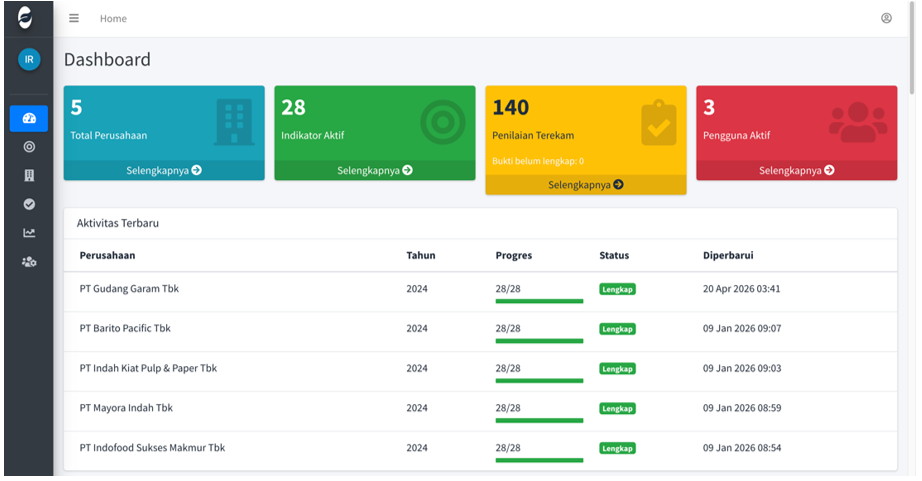
The results demonstrate that the developed web-based GII system functions effectively as a digital environmental assessment tool, capable of transforming unstructured corporate sustainability disclosures into structured, comparable, and quantifiable performance indicators. As illustrated in Figure 1, the web-based GII platform provides an integrated digital interface that supports the end-to-end environmental assessment process, including data input, indicator structuring, automated scoring, and visual performance representation. The system architecture reflects a user-friendly dashboard design that enables stakeholders to navigate across different dimensions of green innovation, namely input, process, and output indicators, coherently and interactively. The visualization features embedded in the platform facilitate comparative analysis across firms and indicators, thereby enhancing the interpretability and usability of sustainability data. This visual representation is particularly important in transforming complex and unstructured disclosure information into actionable insights, allowing decision-makers to quickly identify performance gaps and strategic priorities in green innovation implementation. The system successfully performs three key functions: automated data structuring, standardized index calculation, and visual performance representation through dashboards.
Figure 1. Web of Green Innovation Index (GII) portal
The pilot implementation confirms that the GII system can generate consistent firm-level scores across multiple indicators and dimensions, including input, process, and output components of green innovation. This finding indicates that disclosure-based environmental data, traditionally qualitative and heterogeneous, can be operationalized into a measurable framework through digital processing. From an environmental assessment perspective, this result is significant because it addresses a key limitation in sustainability evaluation, namely the lack of scalable and standardized measurement tools at the firm level. By enabling automated and repeatable evaluation, the GII contributes to improving transparency, comparability, and decision usefulness of sustainability disclosures.
Table 1. Green Innovation Index (GII) indicator data
|
No. |
Indicator |
Manufacturing Companies with the Highest ESG Scores Listed on the Indonesia Stock Exchange |
||||
|
GGRM |
INDF |
MYOR |
INKP |
BRPT |
||
|
1 |
Human resource capability reflected in employee competency and career development pathways |
3 |
3 |
3 |
3 |
3 |
|
2 |
Investment in employee training and development |
3 |
3 |
3 |
3 |
3 |
|
3 |
Development of infrastructure aligned with environmental assessment results |
|
2 |
2 |
3 |
2 |
|
4 |
Availability and utilization of information technology within the company |
2 |
3 |
2 |
3 |
3 |
|
5 |
Development and upgrading of production machinery |
0 |
2 |
2 |
1 |
2 |
|
6 |
Innovation development strategy |
2 |
3 |
3 |
3 |
3 |
|
7 |
Access to international markets |
0 |
3 |
3 |
2 |
2 |
|
8 |
Requiring suppliers to develop and maintain an Environmental Management System (EMS) |
0 |
3 |
2 |
2 |
3 |
|
9 |
Ensuring that purchased products contain environmentally friendly attributes (e.g., recycled or reusable materials) and exclude hazardous substances such as lead and other toxic materials |
0 |
3 |
3 |
2 |
3 |
|
10 |
Integrating environmental issues into corporate policies, vision, mission, or other procedures to demonstrate commitment to green innovation |
1 |
3 |
3 |
3 |
3 |
|
11 |
Commitment to investing in research and development (R&D) initiatives |
1 |
3 |
2 |
2 |
2 |
|
12 |
Enhancing brand loyalty and corporate reputation through environmentally friendly business practices |
0 |
3 |
2 |
2 |
2 |
|
13 |
Promoting innovation within the organizational culture and corporate values |
1 |
3 |
1 |
2 |
3 |
|
14 |
Participation in environmental award programs to strengthen the company’s environmental profile among customers and stakeholders |
2 |
3 |
0 |
3 |
3 |
|
15 |
Compliance with environmental regulations and strong awareness of environmental risks |
1 |
3 |
2 |
3 |
3 |
|
16 |
Evaluation, reporting, communication, and feedback regarding the implementation of policies supporting environmentally friendly business practices |
1 |
3 |
2 |
3 |
3 |
|
17 |
Appointment of designated personnel (Person-in-Charge/PIC) to promote green business practices to employees and stakeholders |
0 |
1 |
0 |
0 |
0 |
|
18 |
Partnerships and collaboration with universities, research institutions, industry peers, and start-ups to foster innovation |
0 |
3 |
0 |
2 |
3 |
|
19 |
Low energy consumption (e.g., water, electricity, gas) during production, product use, and disposal |
1 |
3 |
2 |
3 |
3 |
|
20 |
Adoption of cleaner technologies to conserve energy, water, and other resources while minimizing pollution |
0 |
2 |
1 |
3 |
3 |
|
21 |
Recycling, reuse, and remanufacturing of internal materials |
1 |
2 |
3 |
2 |
3 |
|
22 |
Patent applications filed at both national and international levels |
0 |
0 |
0 |
3 |
2 |
|
23 |
Certification under ISO 9001 Quality Management System |
0 |
2 |
0 |
2 |
3 |
|
24 |
Improvement and eco-design of packaging for existing and new products |
0 |
3 |
3 |
2 |
2 |
|
25 |
Product design modifications aimed at improving energy efficiency |
0 |
3 |
3 |
2 |
2 |
|
26 |
Development of environmentally friendly innovative products |
2 |
3 |
1 |
2 |
3 |
|
27 |
Adoption of green marketing practices to raise customer awareness of environmentally friendly business operations |
1 |
3 |
3 |
2 |
1 |
|
28 |
Community participation to gather stakeholder input in developing green products that meet customer needs and expectations |
1 |
2 |
3 |
2 |
3 |
|
Total Score |
23 |
73 |
54 |
65 |
71 |
|
4.2 Patterns of green innovation performance across firms
The descriptive results reveal substantial variation in green innovation performance across firms, as shown in Table 1 particularly between input, process, and output dimensions. While most firms demonstrate relatively strong performance in input-related indicators, such as human resource capability and investment in training, performance declines in process and output dimensions. Indicators related to internal capability development, including employee skills and training investment, consistently achieve the highest scores across firms. This pattern suggests that firms prioritize foundational resources as a basis for sustainability transformation. In contrast, output-oriented indicators, such as patent applications, eco-friendly product design, and innovation commercialization, exhibit significantly lower scores. This asymmetry indicates that many firms remain in an “early-stage green innovation maturity phase,” where internal preparation and compliance dominate, but innovation outcomes are not yet fully realized or commercialized.
4.3 Linking findings to Resource-Based View
The observed dominance of input-related indicators strongly supports the RBV framework. Firms appear to invest heavily in developing internal resources, particularly human capital and organizational capabilities, as a foundation for green innovation. This aligns with the RBV argument that valuable and rare resources are prerequisites for achieving sustained competitive advantage. However, the findings also reveal a capability translation gap, where strong resource endowments do not necessarily lead to high innovation outputs. This suggests that while firms possess the necessary resources, they may lack the dynamic capabilities required to transform these resources into marketable green innovations. This gap can be interpreted through the lens of capability orchestration theory, which emphasizes the importance of integrating, reconfiguring, and deploying resources effectively. In the context of this study, digital transformation plays a crucial role in bridging this gap by enabling better coordination between information systems, innovation processes, and sustainability objectives.
4.4 Environmental governance and institutional pressures
The results also highlight the strong influence of institutional and regulatory pressures on corporate environmental behavior. Indicators related to compliance, environmental policy integration, and participation in sustainability programs show relatively high scores across firms. This pattern is consistent with institutional theory, which suggests that firms adopt environmental practices in response to regulatory requirements, stakeholder expectations, and legitimacy concerns. In emerging economies such as Indonesia, where environmental regulations and ESG expectations are intensifying, firms tend to prioritize compliance-driven activities. However, the relatively lower performance in innovation-related outputs indicates that compliance alone is insufficient to drive transformative sustainability outcomes. Instead, firms need to move beyond regulatory adherence toward proactive innovation strategies that create both environmental and economic value.
4.5 Digital transformation as an enabler of environmental assessment
One of the key contributions of this study lies in demonstrating how digital technologies can enhance environmental assessment practices. The GII system enables: Automated extraction of sustainability indicators, standardized scoring across firms, real-time or near real-time performance monitoring. These capabilities significantly improve the efficiency and reliability of environmental assessment compared to manual approaches. From a theoretical perspective, this finding extends the role of digital transformation from an operational enabler to a governance and assessment mechanism. Digital systems not only support green innovation implementation but also facilitate evidence-based sustainability governance by providing structured and timely information. This aligns with recent literature emphasizing that digitalization can strengthen environmental governance by improving data transparency, accountability, and decision-making quality.
4.6 Gaps in open innovation and knowledge collaboration
A critical finding of this study is the relatively low performance of indicators related to external collaboration, including partnerships with universities and research institutions, as well as patenting activities. This suggests that firms predominantly rely on internal innovation models, with limited engagement in open innovation ecosystems. Such a pattern may constrain the speed and scope of innovation, particularly in complex sustainability challenges that require interdisciplinary knowledge and technological integration. From an innovation systems perspective, this highlights the need to strengthen triple helix collaboration between industry, academia, and government. Without such collaboration, firms may struggle to move from incremental improvements toward more transformative green innovations.
4.7 Policy implications for environmental governance
The findings of this study have several important implications for environmental policy and governance. First, the development of a digital, disclosure-based environmental assessment tool provides policymakers with a scalable mechanism for monitoring corporate sustainability performance. Regulators can leverage such tools to enhance ESG evaluation, improve compliance monitoring, and support evidence-based policy design. Second, the observed gap between input and output dimensions suggests the need for policies that incentivize innovation outcomes, not just compliance. This may include: (1) Tax incentives for green R&D and patenting, (2) Support for industry–academia collaboration, and (3) Innovation grants for sustainable product development. Third, the low level of external collaboration indicates that policy interventions should focus on strengthening innovation ecosystems, particularly in emerging economies. Programs that facilitate knowledge transfer, joint research, and technology diffusion can accelerate the development of green innovation capabilities. Fourth, the integration of digital technologies into environmental assessment highlights the importance of digital governance frameworks. Governments should promote the standardization of sustainability reporting formats and encourage the adoption of digital tools for environmental monitoring.
4.8 Managerial implications
For practitioners, the results suggest that achieving sustainable performance requires more than internal capability development. Firms need to: (1) Translate internal resources into market-oriented green innovations, (2) Strengthen external collaboration networks, (3) Leverage digital systems for continuous environmental monitoring, and (4) Integrate sustainability into core strategic decision-making. The GII framework can serve as a practical tool for identifying performance gaps and guiding strategic improvements in green innovation.
4.9 Theoretical contribution
This study contributes to the literature in three main ways. First, it extends the RBV framework by operationalizing environmental capabilities through a digital measurement system, bridging the gap between theory and empirical assessment. Second, it advances the environmental assessment literature by introducing a disclosure-based composite index tailored to firm-level analysis in manufacturing contexts. Third, it integrates digital transformation into sustainability research by demonstrating its role as both an enabler of innovation and a mechanism for environmental governance and assessment.
The findings of this study provide several important insights into the measurement and interpretation of green innovation in manufacturing firms. First, the results show that the web-based GII successfully translates heterogeneous sustainability disclosures into a standardized and comparable firm-level assessment framework. This is important because previous research has repeatedly noted that sustainability assessment in manufacturing is often fragmented, difficult to operationalize, and insufficiently standardized for use in real organizational settings. In this regard, the present study extends earlier indicator-based approaches by demonstrating that disclosure-based information can be digitally structured into a practical assessment architecture, rather than remaining a largely descriptive reporting exercise. This confirms the relevance of recent work arguing that manufacturing organizations need systematic and usable sustainability assessment tools that move beyond static or overly complex frameworks [13].
Second, the descriptive pattern observed in this study, namely strong performance in input-related indicators but weaker performance in output-oriented indicators, suggests that many firms are still positioned in an intermediate phase of green innovation development. The firms in the sample appear to have invested in foundational resources such as employee capability, training, and organizational systems, but these investments have not yet been consistently converted into patents, eco-designed products, or commercialized green innovations. This finding is highly consistent with the Resource-Based View, which emphasizes the strategic value of internal resources, but it also indicates that resource possession alone is insufficient unless firms can orchestrate those resources into tangible innovation outcomes. In that sense, the present study nuances the RBV literature by showing that environmental capability should not be inferred solely from organizational readiness; it must also be evidenced through output realization.
Third, the study’s results are broadly in line with emerging international evidence showing that digital transformation can strengthen green innovation and environmental performance. For example, recent research on listed firms found that digital transformation significantly improves both the quantity and quality of green innovation, while other work in traditional manufacturing sectors shows that digital transformation enhances corporate environmental responsibility through better ESG performance and stronger resource utilization. The present study supports this line of argument, but contributes a different angle: rather than focusing only on digitalization as an operational or strategic driver of green innovation, it shows that digitalization also matters as an assessment infrastructure. In other words, digital transformation is not only a cause of greener behavior; it is also an enabler of more transparent, standardized, and decision-relevant environmental evaluation. This is a meaningful extension of the literature because many prior studies focus on performance effects, whereas this article demonstrates how digital systems can make green innovation measurable at the firm level [31, 32].
Fourth, the findings also speak directly to the sustainability reporting literature. Prior studies show that issuing sustainability reports and using recognized frameworks such as GRI are positively associated with environmental performance, and that greater integration of ESG disclosures can improve internal decision-making and ESG outcomes. However, the same literature also warns that disclosure expansion does not automatically mean disclosure quality, and that reporting may still contain symbolic or impression-management elements. This concern is especially relevant to the present study because the GII relies on disclosed information as its primary data source. The article therefore makes an important methodological contribution: it treats sustainability reports not as unquestioned evidence of environmental excellence, but as structured inputs that require systematic coding and standardized interpretation. In the Indonesian context, this is particularly significant, because recent evidence suggests that while the number of sustainability reports has increased after the transition toward mandatory reporting, disclosure quality has not always improved accordingly. Thus, the GII framework responds to a real governance need: not merely more reporting, but better tools for extracting comparable substance from reported narratives [18, 20, 33-35].
Fifth, one of the most important findings in this study is the gap between compliance-oriented behavior and innovation-oriented outcomes. Firms scored relatively well on indicators related to environmental policy integration, regulation compliance, and participation in environmental programs, yet they performed much more weakly on patenting, open collaboration, and product-level innovation outputs. This suggests that environmental legitimacy is being built primarily through conformity and procedural commitment rather than through breakthrough innovation. Such a pattern is understandable in emerging-economy settings where institutional pressures are strong, but it also reveals an important limitation: compliance may improve environmental governance at a basic level without necessarily generating higher-value innovation. This interpretation is reinforced by recent evidence showing that not all forms of green innovation generate equivalent benefits. Research distinguishing pollution prevention innovation from pollution control innovation finds that prevention-oriented innovation is more strongly associated with future financial and environmental performance, whereas control-oriented innovation tends to produce weaker downstream benefits. Applied to the present study, this implies that the relatively low output scores may reflect not only limited innovation quantity, but also a continuing emphasis on defensive or compliance-based environmental practices rather than transformative innovation [36].
Sixth, the low scores on collaboration with universities, research institutions, and peers indicate that the firms in this sample still rely predominantly on inward-looking innovation models. This is an important finding because contemporary green innovation increasingly depends on open innovation ecosystems, inter-organizational learning, and knowledge recombination across institutional boundaries. Recent reviews on university–industry open innovation emphasize that collaboration mechanisms are central to the creation, diffusion, and scaling of innovation. In contrast, the limited collaboration and patenting activity observed in this study suggest that green innovation in the sampled firms remains only partially embedded in broader innovation networks. This helps explain why internal capabilities do not automatically translate into stronger outputs: without external linkages, firms may struggle to access complementary knowledge, advanced technologies, and co-development opportunities needed for more substantive green innovation. Therefore, the present study adds an ecosystem perspective to the firm-level assessment literature by showing that weak external connectedness is a plausible bottleneck in green capability conversion [37].
Finally, the broader implication of this study is that digital, disclosure-based environmental assessment should be understood as both a managerial tool and a governance mechanism. For managers, the GII can reveal where firms are accumulating capability but failing to convert it into outcomes. For policymakers, it offers a scalable way to benchmark firms and monitor whether sustainability reporting is producing substantive innovation signals rather than symbolic narratives alone. For researchers, the study opens an important pathway for integrating resource-based theory, disclosure studies, and digital governance into one analytical framework. Compared with prior literature, the novelty of this article lies not simply in proposing another sustainability index, but in demonstrating how a web-based system can operationalize green innovation from corporate disclosures in a way that is theoretically grounded, practically scalable, and contextually relevant to emerging manufacturing economies such as Indonesia [13, 31, 35].
This study develops and validates a web-based GII as a disclosure-based environmental assessment tool for manufacturing firms in Indonesia. The findings demonstrate that the proposed system is capable of transforming heterogeneous and unstructured sustainability disclosures into standardized, comparable, and quantifiable environmental performance metrics. By integrating input, process, and output dimensions within a triple bottom line framework, the GII provides a comprehensive and scalable approach to evaluating firm-level green innovation.
Empirically, the results reveal a consistent pattern across firms, where strong performance in input-related indicators, particularly in human capital development and organizational capability, is not matched by corresponding performance in output-oriented indicators such as patenting, eco-product development, and innovation commercialization. This finding highlights a critical capability–outcome gap, suggesting that while firms have begun to invest in foundational resources for sustainability, they face challenges in translating these capabilities into tangible innovation outcomes. Additionally, the study finds that firms tend to emphasize compliance with environmental regulations and internal governance mechanisms, while exhibiting relatively limited engagement in open innovation practices and external collaboration.
From a theoretical perspective, this study extends the RBV by operationalizing environmental capabilities through a digital measurement system, demonstrating that the value of firm resources must be assessed not only in terms of their existence but also in terms of their ability to generate innovation outputs. Furthermore, the study contributes to the environmental assessment literature by proposing a disclosure-based composite index that bridges the gap between sustainability reporting and performance evaluation. It also highlights the role of digital transformation as not only an enabler of green innovation but also a critical infrastructure for environmental governance and assessment.
From a practical standpoint, the proposed GII offers valuable implications for both managers and policymakers. For firms, the index provides a diagnostic tool to identify performance gaps and guide strategic improvements in green innovation. For policymakers, it offers a scalable mechanism for benchmarking corporate sustainability performance and designing evidence-based policies that encourage outcome-oriented innovation rather than mere regulatory compliance.
Despite its contributions, this study has several limitations. First, the analysis is based on a purposive sample of manufacturing firms listed on the Indonesia Stock Exchange, which may limit the generalizability of the findings to other sectors or countries. Second, the reliance on sustainability disclosures as the primary data source introduces potential bias related to reporting quality and completeness. Third, the study focuses on cross-sectional data, which does not capture the dynamic evolution of green innovation over time.
Future research is encouraged to expand the scope of analysis by incorporating longitudinal data, cross-country comparisons, and additional validation techniques, such as inter-coder reliability testing and advanced statistical modeling. Further studies may also integrate alternative data sources, such as real-time environmental performance data or patent databases, to enhance the robustness of green innovation measurement. Additionally, exploring the integration of artificial intelligence and machine learning techniques into disclosure analysis could further enhance the accuracy and scalability of digital environmental assessment systems.
The authors would like to acknowledge the support of Universitas Pembangunan Jaya, particularly the Center for Research & Community Service (LP2M), for facilitating the research environment and providing institutional support for this study. This research was funded by the Center for Research & Community Service (LP2M) Universitas Pembangunan Jaya through the Internal Research Grant Scheme for the Fiscal Year 2025/2026 (Grant Number: 017/PKS-LP2M/UPJ/10.25). The authors also appreciate the availability of corporate sustainability disclosures that made this research possible.
[1] Zhang, M., Zhang, D.T., Xie, T.F. (2023). Technology innovations and carbon neutrality in technologically advanced economies: Imperative agenda for COP26. Economic Research-Ekonomska Istraživanja, 36(2): 2178017. https://doi.org/10.1080/1331677X.2023.2178017
[2] Liu, X.J., Huang, N.R., Su, W.H., Zhou, H.Y. (2024). Green innovation and corporate ESG performance: Evidence from Chinese listed companies. International Review of Economics & Finance, 95: 103461. https://doi.org/10.1016/j.iref.2024.103461
[3] Wang, Y.Z., Ahmad, S. (2024). Green process innovation, green product innovation, leverage, and corporate financial performance; evidence from system GMM. Heliyon, 10: e25819. https://doi.org/10.1016/j.heliyon.2024.e25819
[4] Ahmed, R.R., Akbar, W., Aijaz, M., Channar, Z.A., Ahmed, F., Parmar, V. (2023). The role of green innovation on environmental and organizational performance: Moderation of human resource practices and management commitment. Heliyon, 9(1): e12679. https://doi.org/10.1016/j.heliyon.2022.e12679
[5] Levi-Bliech, M., Dahan, G. (2026). The impact of green innovation products on an organization’s social performance via green supply chain management. Green Technologies and Sustainability, 4(2): 100273. https://doi.org/10.1016/j.grets.2025.100273
[6] Fantazy, K., Singh, S., Dash, T.R. (2026). Green innovation, supply chain management and sustainable business performance. International Encyclopedia of Business Management, 3: 165-168. https://doi.org/10.1016/B978-0-443-13701-3.00358-3
[7] Pricopoaia, O., Cristache, N., Lupașc, A., Iancu, D. (2025). The implications of digital transformation and environmental innovation for sustainability. Journal of Innovation & Knowledge, 10(3): 100713. https://doi.org/10.1016/j.jik.2025.100713
[8] Liu, M.X., Liu, L.Q., Feng, A. (2024). The impact of green innovation on corporate performance: An analysis based on substantive and strategic green innovations. Sustainability, 16(6): 2588. https://doi.org/10.3390/su16062588
[9] Zhu, Q., Huang, S.Z., Koompai, S. (2024). Digital transformation as a catalyst for green innovation: An examination of high-tech enterprises in China’s Yangtze River Delta. Sustainable Futures, 8: 100277. https://doi.org/10.1016/j.sftr.2024.100277
[10] Hoque, M.M., Lee, S.J. (2025). How digital transformation drives green Innovation: An empirical study. Journal of Cleaner Production, 522: 146236. https://doi.org/10.1016/j.jclepro.2025.146236
[11] Liu, M., Huang, X., Wang, P.C., Liao, Y.T. (2025). Enterprise digitalization, organizational slack, and green innovation. International Review of Economics & Finance, 103: 104443. https://doi.org/10.1016/j.iref.2025.104443
[12] Wang, Y.L., Ziya, A., Li, M.M., Li, G.R. (2025). Digital transformation, green behaviors, and environmental policy heterogeneity in resource-based enterprises. International Review of Economics & Finance, 102: 104291. https://doi.org/10.1016/j.iref.2025.104291
[13] Eslami, Y., Lezoche, M., Panetto, H., Dassisti, M. (2023). An indicator-based sustainability assessment framework in manufacturing organisations. Journal of Industrial Information Integration, 36: 100516. https://doi.org/10.1016/j.jii.2023.100516
[14] Kaldas, O., Shihata, L.A., Kiefer, J. (2021). An index-based sustainability assessment framework for manufacturing organizations. Procedia CIRP, 97: 235-240. https://doi.org/10.1016/j.procir.2020.05.231
[15] Moldavska, A., Welo, T. (2019). A holistic approach to corporate sustainability assessment: Incorporating sustainable development goals into sustainable manufacturing performance evaluation. Journal of Manufacturing Systems, 50: 53-68. https://doi.org/10.1016/j.jmsy.2018.11.004
[16] Swarnakar, V., Singh, A.R., Antony, J., Tiwari, A.K., Cudney, E. (2021). Development of a conceptual method for sustainability assessment in manufacturing. Computers & Industrial Engineering, 158: 107403. https://doi.org/10.1016/j.cie.2021.107403
[17] Ferjančič, U., Ichev, R., Lončarski, I., et al. (2024). Textual analysis of corporate sustainability reporting and corporate ESG scores. International Review of Financial Analysis, 96: 103669. https://doi.org/10.1016/j.irfa.2024.103669
[18] Khatri, I., Kjærland, F. (2023). Sustainability reporting practices and environmental performance amongst nordic listed firms. Journal of Cleaner Production, 418: 138172. https://doi.org/10.1016/j.jclepro.2023.138172
[19] Gotoh, R. (2025). Quantitative text analysis of sustainability reporting: Decarbonization strategies and company characteristics in Japan. Energy Reports, 13: 2722-2739. https://doi.org/10.1016/j.egyr.2025.02.016
[20] Lagasio, V. (2024). ESG-washing detection in corporate sustainability reports. International Review of Financial Analysis, 96: 103742. https://doi.org/10.1016/j.irfa.2024.103742
[21] Lee, H., Lee, S.H., Park, H., Kim, J.H., Jung, H.S. (2024). ESG2PreEM: Automated ESG grade assessment framework using pre-trained ensemble models. Heliyon, 10(4): e26404. https://doi.org/10.1016/j.heliyon.2024.e26404
[22] WIPO. (2024). Global Innovation Index 2024. https://www.wipo.int/web-publications/global-innovation-index-2024/en/gii-2024-results.html.
[23] Le, T.T., Phan Vo Nhu, Q., Bui Ngoc Bao, T., Vu Nguyen Thao, L., Pereira, V. (2024). Digitalisation driving sustainable corporate performance: The mediation of green innovation and green supply chain management. Journal of Cleaner Production, 446: 141290. https://doi.org/10.1016/j.jclepro.2024.141290
[24] Nazir, S., Mehmood, S., Liu, J.X., Gao, R. (2026). Improving environmental performance in manufacturing through sustainability with digitalization: A mediation and moderation study. Sustainable Cities and Society: Advances, 2(1): 100029. https://doi.org/10.1016/j.scsadv.2026.100029
[25] Vale, J., Miranda, R., Azevedo, G., Tavares, M.C. (2022). The impact of sustainable intellectual capital on sustainable performance: A case study. Sustainability, 14(8): 4382. https://doi.org/10.3390/su14084382
[26] Wang, Q., Dong, Z.Q., Li, R.R., Wang, L.L. (2022). Renewable energy and economic growth: New insight from country risks. Energy, 238: 122018. https://doi.org/10.1016/j.energy.2021.122018
[27] Guinot, J., Barghouti, Z., Chiva, R. (2022). Understanding green innovation: A conceptual framework. Sustainability, 14(10): 5787. https://doi.org/10.3390/su14105787
[28] Novitasari, M., Agustia, D. (2021). Green supply chain management and firm performance: The mediating effect of green innovation. Journal of Industrial Engineering and Management, 14(2): 391-403. https://doi.org/10.3926/jiem.3384
[29] Delmas, M.A., Burbano, V.C. (2011). The drivers of greenwashing. California Management Review, 54(1): 64-87. https://doi.org/10.1525/cmr.2011.54.1.64
[30] Susanto, C., Leonora, H., Meiden, C. (2022). Content analysis method: Analisis prinsip isi dan prinsip kualitas laporan keberlanjutan. Ekonomis: Journal of Economics and Business, 6(2): 619-627. https://doi.org/10.33087/ekonomis.v6i2.650
[31] Li, H.M., Liu, Z.Y., Hachard, V. (2024). Digital transformation driving green innovation: Evidence from Chinese A-Share firms. International Review of Economics & Finance, 95: 103487. https://doi.org/10.1016/j.iref.2024.103487
[32] Lin, M., Zhang, Z.H., Arif, M. (2025). The intersection of digital transformation and environmental responsibility in traditional manufacturing enterprises amid new productive forces. Journal of Cleaner Production, 503: 145426. https://doi.org/10.1016/j.jclepro.2025.145426
[33] Sun, Y.Q. (2024). The real effect of innovation in environmental, social, and governance (ESG) disclosures on ESG performance: An integrated reporting perspective. Journal of Cleaner Production, 460: 142592. https://doi.org/10.1016/j.jclepro.2024.142592
[34] Sun, Y.Q., Zhao, D., Cao, Y.Y. (2024). The impact of ESG performance, reporting framework, and reporting assurance on the tone of ESG disclosures: Evidence from Chinese listed firms. Journal of Cleaner Production, 466: 142698. https://doi.org/10.1016/j.jclepro.2024.142698
[35] Sri Wahyuningrum, I.F., Sriningsih, Puspita, A.S., Budihardjo, M.A., Chegenizadeh, A., Nikraz, H. (2025). Has mandatory reporting improved environmental disclosure quality in Indonesia? World Development Perspectives, 39: 100718. https://doi.org/10.1016/j.wdp.2025.100718
[36] Cheng, Q., Lin, A.P., Yang, M.J. (2025). Green innovation and firms’ financial and environmental performance: The roles of pollution prevention versus control. Journal of Accounting and Economics, 79(1): 101706. https://doi.org/10.1016/j.jacceco.2024.101706
[37] Gustina, A., Nurmasari, N.D., Liu, J.S.C. (2024). Open innovation between university-industry: A review of research trends and practices. Journal of Open Innovation: Technology, Market, and Complexity, 10(4): 100419. https://doi.org/10.1016/j.joitmc.2024.100419