Hendry Selanno* | Ahmad Rosandi Sakir
© 2026 The authors. This article is published by IIETA and is licensed under the CC BY 4.0 license (http://creativecommons.org/licenses/by/4.0/).
OPEN ACCESS
This study examines the role of the Sasi system as a customary marine and fisheries governance mechanism in Ambon Island within the policy context of Maluku as a National Fish Barn. It applies an empirical secondary-data and qualitative evidence synthesis design by integrating official fisheries statistics, landed-fish records, laboratory-based water-quality indicators, coastal ecosystem studies, peer-reviewed Sasi literature, and comparative evidence on customary marine governance. The findings indicate that Sasi remains relevant as a locally legitimate institution because it regulates harvesting time, resource access, customary sanctions, community obligations, and collective responsibility through kewang and traditional village authorities. However, its effectiveness is conditional on ecological quality, institutional continuity, livelihood resilience, and formal policy support. Fisheries indicators confirm the sector’s economic relevance, while water-quality and ecosystem evidence show that nutrient enrichment, sedimentation, coral-reef degradation, variable seagrass conditions, and limited mangrove rehabilitation may reduce the ecological benefits of temporary closures. Socially, compliance is supported by adat legitimacy, ritual continuity, and customary enforcement, but may weaken under livelihood pressure, external fishing, urbanization, weak intergenerational transmission, and limited legal recognition. The study argues that Sasi should be strengthened through fisheries zoning, co-management, participatory monitoring, pollution control, habitat rehabilitation, livelihood diversification, benefit-sharing mechanisms, and local regulations as an adaptive social–ecological governance instrument for sustainable small-island fisheries.
adaptive governance, community-based fisheries management, coastal planning, National Fish Barn policy, Sasi, social–ecological system, traditional ecological knowledge
Coastal areas play a strategic role in sustaining ecological systems while serving as the primary living space for communities dependent on marine resources [1, 2]. In many regions of Indonesia, including Ambon Island, fisheries exploitation has intensified alongside economic growth and population expansion. Increasing fishing pressure, coastal land-use change, tourism development, and the modernization of fishing technologies have contributed to widespread coastal ecosystem degradation [2-4]. These dynamics highlight the need for adaptive resource management mechanisms capable of integrating long-established local socio-cultural systems into contemporary governance frameworks [5, 6].
Maluku Province occupies a strategic position in Indonesia’s marine and fisheries development due to its extensive maritime territory and abundant fishery resources. The Indonesian government has designated the Maluku Archipelago as a National Fish Barn [7, 8], aiming to establish it as a center for fisheries production, processing, and distribution. This policy is supported by the potential of Fisheries Management Areas (WPP) 714, 715, and 718 [8], which contain substantial pelagic and demersal stocks and exhibit lower exploitation levels compared to western Indonesian waters. Under sustainability-oriented management, the fisheries sector in Maluku holds significant potential to support regional economic growth and national food security.
However, the National Fish Barn policy must extend beyond production-oriented objectives. Without adequate governance safeguards, previous studies [9-11] intensified production risks accelerating overexploitation and undermining coastal community welfare. Strengthening fisheries value chains, promoting value-added processing, and embedding sustainability principles within governance arrangements are therefore essential. In this context, local wisdom systems such as Sasi are particularly relevant, as they represent long-standing community-based mechanisms for regulating access, timing, and use of marine resources [12-14]. Integrating national fisheries policies with Sasi practices offers a pathway toward governance models that are economically productive, socially equitable, and ecologically sustainable.
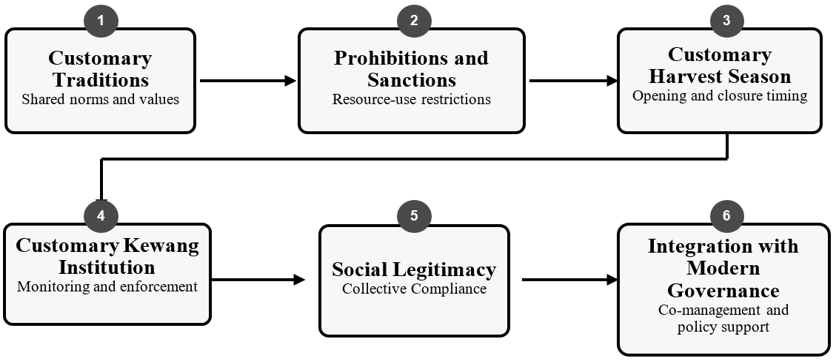
In Maluku, Sasi has long functioned as a social–ecological institution governing the temporal opening and closure of natural resource use within defined terrestrial and marine areas. Beyond its regulatory function, Sasi reinforces community identity, social cohesion, and ecological balance [12, 13]. On Ambon Island, Sasi has been applied to key resources such as Lompa fish, sea cucumbers, shellfish, and small pelagic species that are central to local food security and coastal livelihoods [14-16]. The conceptual evolution of Sasi is illustrated in Figure 1.
Figure 1. Evolution of Sasi from customary practice to modern governance instrument
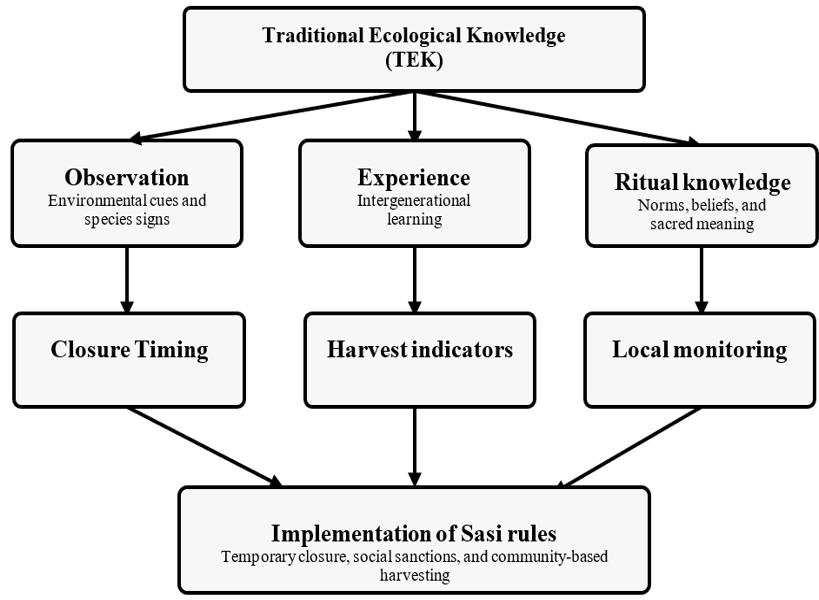
The implementation of Sasi involves multiple customary institutions, including kewang, village leaders (raja negeri), saniri councils, and religious authorities. The kewang plays a central role as an enforcement body responsible for monitoring compliance and applying sanctions [13, 17]. The effectiveness of this system is grounded in strong moral legitimacy and the internalization of customary norms as part of community identity [14, 16]. Long before modern conservation frameworks emerged, Maluku communities had operationalized ecological principles through customary rules that proved effective in maintaining fish stock balance. The main components of traditional ecological knowledge (TEK) are presented in Figure 2.
Figure 2. Components of traditional ecological knowledge (TEK) in coastal resource management
Despite its strengths, Sasi faces growing challenges in contemporary contexts. Population mobility, economic pressures, technological change, and external interventions increasingly erode the social foundations that support customary governance [13, 18]. In addition, weak integration between Sasi and formal regulatory systems places customary rules in a legally ambiguous position [10, 19]. These conditions indicate the need for governance-oriented strategies that strengthen Sasi without undermining its local foundations.
At the global level, research shows that archipelagic regions possess strong potential for sustainable fisheries development when supported by inclusive and adaptive governance arrangements [20-22]. Community-based fisheries management has been shown to improve compliance, enhance fish stocks, and strengthen coastal livelihoods [3, 11, 23]. Evidence further suggests that hybrid governance models integrating state policies and customary institutions outperform purely top-down approaches, with customary systems functioning as effective mechanisms of social control.
The effectiveness of Sasi is closely linked to TEK [24, 25], which has developed cumulatively across generations. TEK encompasses detailed understandings of ecosystem dynamics, species behavior, and environmental indicators that inform the timing of Sasi closures and openings [24, 26]. This knowledge is adaptive and context-specific, as illustrated by Sasi Lompa in Haruku, where reproductive cycles are identified through environmental cues rather than formal scientific measurement [14-16]. Empirical studies confirm that TEK-based management contributes significantly to sustaining fish stocks in Maluku.
Within contemporary governance and planning literature, TEK is increasingly recognized as a core component of adaptive governance systems [25-27]. Integrating TEK with scientific knowledge enhances ecological robustness while strengthening social legitimacy and cultural alignment, which is essential for sustaining Sasi amid ongoing social and economic change.
The governance relevance of Sasi is further reinforced through the Community-Based Marine Resource Management (CBMRM) perspective, which positions local communities as central governance actors [10, 11]. CBMRM is most effective where communities possess a strong sense of resource ownership—an attribute embedded within Sasi through customary norms, ritual practices, and community-based monitoring [22, 23, 28]. Empirical evidence indicates that areas with consistent Sasi implementation demonstrate improved fish stocks and healthier coral reef ecosystems. Nonetheless, CBMRM faces persistent challenges in its institutionalization within formal governance systems [18, 25].
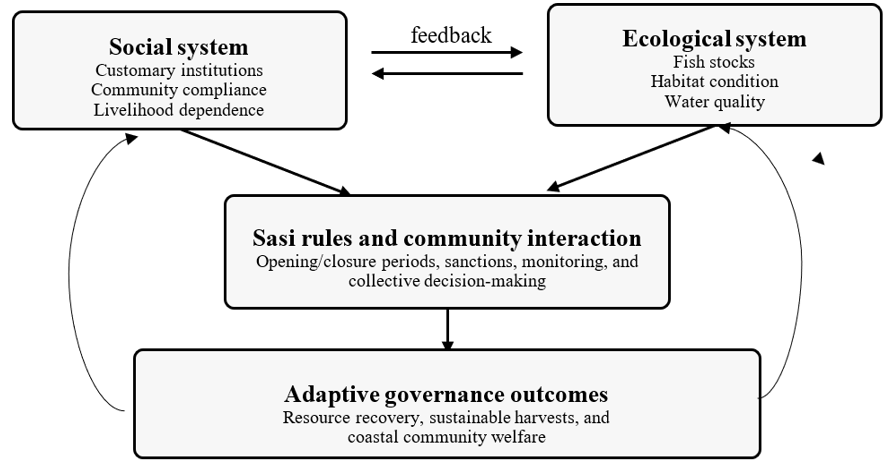
The social–ecological system (SES) framework provides an integrated lens for understanding Sasi as a dynamic interaction between social institutions and ecological processes [5, 6, 29]. Economic pressures can intensify resource exploitation, while ecological degradation may reshape social relations and trigger conflict. Applying the SES framework enables the design of strengthening strategies that enhance both social and ecological resilience [20, 21]. The SES framework used to analyse Sasi is shown in Figure 3.
Figure 3. Social–ecological system (SES) framework applied to the Sasi system on Ambon Island
Through the integration of Sasi, TEK, CBMRM principles, and the SES framework, the development of Maluku as a National Fish Barn can be positioned within an adaptive and sustainability-oriented fisheries governance model [11, 14, 20]. In this framing, Sasi is not merely preserved as cultural heritage but repositioned as a strategic governance instrument supporting ecological sustainability, coastal welfare, and the long-term competitiveness of Indonesia’s fisheries sector.
2.1 Research design
This study applies an empirical secondary-data and qualitative evidence synthesis design [30-32] to examine the role and effectiveness of Sasi in coastal and fisheries resource management on Ambon Island. The empirical component is based on traceable secondary indicators, including official fisheries statistics, landed-fish production records, laboratory-based water-quality indicators, and published coastal ecosystem evidence. The qualitative synthesis component is used to interpret institutional, social, ecological, and livelihood-related dimensions of Sasi based on identifiable peer-reviewed studies, policy documents, and comparative literature on customary and community-based marine governance.
This design was selected because Sasi is not merely a cultural practice, but a governance mechanism embedded in a broader SES [5, 6]. Its effectiveness cannot be assessed only through biological indicators or only through institutional narratives. Therefore, the analysis combines traceable secondary quantitative evidence with qualitative interpretation to explain how ecological conditions, customary authority, community compliance, livelihood vulnerability, and formal governance arrangements shape the performance of Sasi.
The status and source classification of the empirical indicators used in this study are summarized in Table 1.
Table 1. Status and source classification of empirical indicators used in the study
|
Empirical Indicator |
Specific Source/Document |
Year of Data |
Page/Table/Section |
Use in This Study |
Data Treatment |
|
Ambon City capture fisheries production |
Buku Statistik Sektoral Kota Ambon 2025, Dinas Komunikasi, Informatika dan Persandian Kota Ambon; data source: Dinas Perikanan Kota Ambon [33, 34] |
2023–2024 |
Table 3.15, p. 204 |
Used to describe the general fisheries-production context of Ambon City |
Secondary official statistical data |
|
Ambon City aquaculture production |
Buku Statistik Sektoral Kota Ambon 2025, Dinas Komunikasi, Informatika dan Persandian Kota Ambon; data source: Dinas Perikanan Kota Ambon [33, 34] |
2023–2024 |
Table 3.15, p. 204 |
Used to complement the capture-fisheries context and indicate broader fisheries-sector activity |
Secondary official statistical data |
|
Production value of Ambon City capture fisheries and aquaculture |
Buku Statistik Sektoral Kota Ambon 2025, Dinas Komunikasi, Informatika dan Persandian Kota Ambon; data source: Dinas Perikanan Kota Ambon [33] |
2023–2024 |
Table 3.16, p. 205 |
Used to contextualize the economic relevance of fisheries in Ambon City |
Secondary official statistical data |
|
Fish landed at PPN Ambon |
Laporan Tahunan Pelabuhan Perikanan Nusantara Ambon Tahun 2024, Ministry of Marine Affairs and Fisheries / PPN Ambon [7] |
2023–2024 |
Table 15, p. 48 |
Used to show annual landed-fish production and production-value changes at PPN Ambon |
Secondary official administrative data |
|
Composition of landed fish by fish group |
Laporan Tahunan Pelabuhan Perikanan Nusantara Ambon Tahun 2024, Ministry of Marine Affairs and Fisheries / PPN Ambon [7] |
2024 |
Section 6.2, pp. 46–47 |
Used to identify the dominance of small pelagic fish in landed production |
Secondary official administrative data |
|
Landed fish by Fisheries Management Area / WPP NRI |
Laporan Tahunan Pelabuhan Perikanan Nusantara Ambon Tahun 2024, Ministry of Marine Affairs and Fisheries / PPN Ambon [7] |
2024 |
Section 6.2, pp. 46–47 |
Used to connect Ambon fisheries activity with WPP NRI 714, 715, and 718 |
Secondary official administrative data |
|
Percentage change in production |
Author calculation based on the numerical values reported in the official sources listed above |
2023–2024 |
Calculation basis: $\frac{\left( { Value}_{\{2024\}}- {Value}_{\{2023\}}\right)}{{Value}_{\{2023\}}} \times 100 \%$ |
Used only as descriptive trend information |
Derived calculation from traceable official data |
|
Sasi-related compliance, violations, biomass, and livelihood outcomes |
Peer-reviewed studies, local institutional literature, and qualitative synthesis; numerical values are not retained unless directly traceable |
Not applicable |
Not applicable |
Used to support qualitative interpretation of Sasi governance performance |
Qualitative synthesis; non-traceable numerical claims removed |
2.2 Study area and empirical focus
The study focuses on coastal areas of Ambon Island where Sasi or Sasi-related customary marine management practices remain socially recognized, historically documented, or institutionally relevant. The empirical discussion distinguishes between relatively strong customary governance areas, such as Haruku and Hitu Lama, and more peri-urban or environmentally pressured areas, such as Passo and other coastal communities affected by urbanization, pollution, and fishing-space competition. This spatial distinction is important because the effectiveness of Sasi depends on both social legitimacy and ecological carrying capacity.
2.3 Data sources and status of empirical data
Data were obtained from four main categories of sources: official fisheries and environmental reports, laboratory-based water-quality studies, peer-reviewed studies on Sasi and coastal ecosystems, and comparative literature on customary marine tenure and community-based marine resource management. Official statistical and administrative sources were used for fisheries production and landed-fish indicators. Published empirical studies were used for water quality, coral reefs, seagrass beds, mangrove rehabilitation, institutional performance, community compliance, livelihood vulnerability, and Sasi-related governance dynamics.
The numerical values presented in this study are not claimed as newly collected primary field measurements unless explicitly stated. Quantitative values are used only when they can be traced to identifiable sources, such as official reports, published articles, tables, pages, DOI information, or explicit author calculations based on those sources [30, 32]. Indicators without traceable numerical sources are treated as qualitative evidence rather than direct quantitative empirical measurements. This distinction is necessary to avoid interpreting secondary, estimated, or synthesized information as original survey, ecological, or household-income data collected by the authors.
To improve transparency, the study provides a data source and traceability matrix indicating the source document, year of data, page, table, section, use in the study, and data treatment for each main empirical indicator. Comparative evidence from Maluku, the Kei Islands, Fiji, Samoa, Tonga, and Vanuatu is used only as contextual and analytical background, while Ambon Island remains the primary empirical focus of the study.
2.4 Data analysis
Quantitative secondary indicators were analyzed descriptively using trend interpretation, percentage change, and source-based comparison. Fisheries production and landed-fish data were used to describe the economic and production context of Ambon’s fisheries sector. Water-quality and coastal ecosystem indicators were used to identify ecological pressures that may affect the performance of Sasi-based resource management. Percentage changes were calculated only when the baseline and comparison values were available from traceable official or published sources.
Qualitative evidence was analyzed through thematic synthesis [30, 35]. The analysis focused on recurring themes related to customary authority, kewang enforcement, community compliance, local ecological knowledge, livelihood vulnerability, benefit distribution, external fishing pressure, ecological degradation, policy recognition, and co-management arrangements. Evidence from Ambon and Maluku was distinguished from broader comparative evidence from other island customary marine governance systems.
The study avoids strong causal claims [5, 29] where direct field measurement or controlled ecological assessment is not available. Expressions such as “available evidence suggests,” “is associated with,” “indicates a tendency,” and “supports the interpretation” are used to maintain analytical caution. Therefore, Sasi effectiveness is interpreted as a conditional social–ecological governance outcome shaped by ecological quality, institutional legitimacy, livelihood resilience, community participation, and formal policy support.
2.5 Analytical framework
The analytical framework combines the SES perspective and co-management governance [6, 10, 36]. The SES framework is used to examine interactions between ecological variables, such as fish stocks, water quality, and habitat condition, and social variables, such as customary rules, community compliance, sanctions, and livelihood dependence. The co-management perspective is used to assess how Sasi can be integrated into fisheries zoning, participatory monitoring, local regulations, and the National Fish Barn policy. Through this framework, Sasi is evaluated as an adaptive governance instrument whose effectiveness depends on the alignment of ecological condition, social legitimacy, economic resilience, and formal institutional support [11, 21, 25].
This section presents Ambon-specific empirical indicators and distinguishes them from broader comparative evidence drawn from other Maluku and Pacific Island customary marine tenure systems. The distinction is important because Sasi practices share common governance principles with other customary systems, but their institutional legitimacy, ecological performance, and policy relevance are shaped by local social-ecological contexts.
3.1 Empirical context of Sasi and the National Fish Barn policy
The designation of Maluku as a National Fish Barn provides a strategic policy context for strengthening Sasi as a locally legitimate fisheries governance instrument. Available evidence indicates that Maluku possesses significant fisheries potential, particularly in surrounding Fisheries Management Areas, but production-oriented policy may increase ecological pressure if not accompanied by effective local control mechanisms [10, 11]. Sasi is relevant in this context because it regulates harvesting time, access, and collective responsibility through customary authority. The fisheries-production indicators in this section are based on official statistical and administrative sources. Ambon City fisheries production data were taken from Buku Statistik Sektoral Kota Ambon 2025 [Ambon City Sectoral Statistics Book 2025], particularly Table 3.15, which reports capture fisheries and aquaculture production for 2023–2024 based on data from the Ambon City Fisheries Office. Complementary landed-fish production data were taken from Laporan Tahunan Pelabuhan Perikanan Nusantara Ambon 2024 [2024 Annual Report of PPN Ambon], particularly Table 15 and Section 6.2, which report annual landed production, production value, fish-group composition, and the contribution of Fisheries Management Areas. Percentage changes were calculated descriptively by the authors using the formula $\frac{ { Value}_{2024}-{ Value}_{2023}}{{ Value}_{2023}} \times 100 \%$.
Therefore, Table 2 should be interpreted as traceable contextual evidence of fisheries pressure and production dynamics, not as primary field measurement by the authors.
Table 2. Traceable fisheries production indicators for Ambon City and PPN Ambon, 2023–2024
|
Indicator |
2023 |
2024 |
Change (%) |
Specific Source/Calculation Basis |
Interpretation |
|
Capture fisheries production in Ambon City (tons) |
28,625.23 |
29,010.50 |
+1.35 |
Buku Statistik Sektoral Kota Ambon 2025, Table 3.15, p. 204; change calculated by the authors |
Capture fisheries production increased slightly, indicating relative stability in Ambon’s fisheries sector. |
|
Aquaculture production in Ambon City (tons) |
198.46 |
214.04 |
+7.85 |
Buku Statistik Sektoral Kota Ambon 2025, Table 3.15, p. 204; change calculated by the authors |
Aquaculture production increased more strongly than capture fisheries, although its volume remained much smaller. |
|
Total fisheries production in Ambon City (tons) |
28,823.69 |
29,224.54 |
+1.39 |
Buku Statistik Sektoral Kota Ambon 2025, Table 3.15, p. 204; change calculated by the authors |
Total fisheries production showed modest growth from 2023 to 2024. |
|
Landed fish production at PPN Ambon (kg) |
2,000,567 |
2,627,057 |
+31.32 |
Laporan Tahunan PPN Ambon 2024, Table 15, p. 63; change calculated by the authors |
Fish landed at PPN Ambon increased substantially in 2024. |
|
Production value at PPN Ambon (IDR) |
30,839,664,210 |
69,923,979,750 |
+126.73 |
Laporan Tahunan PPN Ambon 2024, Table 15, p. 63; change calculated by the authors |
The increase in production value was larger than the increase in landed volume, indicating changes in price, catch composition, or market value. |
|
Small pelagic fish landed at PPN Ambon in 2024 |
— |
1,550 tons, or 59% of landed production |
— |
Laporan Tahunan PPN Ambon 2024, Section 6.2, pp. 62–63 |
Small pelagic fish dominated landed production at PPN Ambon in 2024. |
Table 3. Coastal water-quality indicators of Ambon waters, 2025
|
Location |
Turbidity (NTU) |
Temperature (℃) |
BOD (mg/L) |
Phosphate / PO4-P (mg/L) |
Salinity (‰) |
Standard / Threshold Used |
Ecological Interpretation |
|
Pasar Mardika |
1.90 |
28.6 |
2.0 |
0.0870 |
29.01 |
Turbidity: 5 NTU; temperature: 30 ℃; BOD: 20 mg/L; phosphate: 0.015 mg/L; salinity: 34‰ |
Turbidity, temperature, and BOD were within the reported thresholds, but phosphate exceeded the standard and salinity was lower than the reference value. |
|
Poka Village |
2.20 |
28.5 |
1.6 |
0.0831 |
27.84 |
Turbidity: 5 NTU; temperature: 30 ℃; BOD: 20 mg/L; phosphate: 0.015 mg/L; salinity: 34‰ |
Turbidity, temperature, and BOD were within the reported thresholds, but phosphate exceeded the standard and salinity was lower than the reference value. |
|
Rumah Tiga Village |
2.96 |
28.5 |
2.6 |
0.0914 |
28.38 |
Turbidity: 5 NTU; temperature: 30 ℃; BOD: 20 mg/L; phosphate: 0.015 mg/L; salinity: 34‰ |
Turbidity, temperature, and BOD were within the reported thresholds, but phosphate exceeded the standard and salinity was lower than the reference value. |
3.2 Ecological indicators and limits of Sasi effectiveness
The effectiveness of Sasi is strongly conditioned by ecological quality. The water-quality indicators in this section are based on a laboratory-based study of Inner Ambon Bay (Teluk Dalam, Ambon City). Research measured physical and chemical parameters at three representative locations [34], namely Pasar Mardika, Poka Village, and Rumah Tiga Village, and compared the results with Indonesian seawater-quality thresholds. Therefore, Table 3 should be interpreted as traceable contextual evidence of ecological pressure in Inner Ambon Bay rather than as primary water-quality measurement by the authors [34].
Table 4. Coastal ecosystem evidence relevant to Sasi-based fisheries governance in Ambon
|
Ecosystem |
Study Area / Empirical Focus |
Traceable Empirical Evidence |
Specific Source / Calculation Basis |
Implication for Sasi Governance |
|
Coral reefs |
North coast of Ambon Island |
Coral-reef benthic substrate at 3 m depth was dominated by rubble, ranging from 26.33% to 54.83%. At 10 m depth, rubble ranged from 11.33% to 48.83%, while sand ranged from 4.00% to 54.50%. Overall live coral cover was categorized as poor. |
Barcinta, Sangaji, and Limmon (2023), International Journal of Science and Environment, DOI: 10.51601/ijse.v3i4.81. Data collected using 1 × 1 m quadrats along 20 m transects at 3 m and 10 m depths [38]. |
Sasi closures may have limited ecological recovery effects where coral habitats are already structurally degraded by rubble and sand dominance. |
|
Coral reefs |
Ambon Bay |
Long-term coral studies in Ambon Bay indicate pressure from coastal human activities, including sedimentation during the rainy season, which can reduce coral ecosystem quality. |
Alik (2020), Jenis-Jenis Karang di Teluk Ambon [Coral Species in Ambon Bay], LIPI/BRIN scholarly book [39]. |
Sasi-based fisheries control needs to be linked with sedimentation control, coastal land-use management, and coral-habitat monitoring. |
|
Seagrass beds |
Ambon Bay seagrass ecosystems |
Six seagrass species were recorded in Ambon Bay: Enhalus acoroides, Thalassia hemprichii, Halophila ovalis, Halophila minor, Cymodocea rotundata, and Halodule pinifolia. The study also reported seagrass-cover variation across stations in Ambon Bay. |
Rugebregt, Matuanakotta, and Syafrizal (2020), Jurnal Ilmu Lingkungan, DOI: 10.14710/jil.18.3.589-594 [40]. |
Seagrass beds remain important ecological support areas for fish habitat, nursery functions, and food-web stability; therefore, Sasi should be integrated with seagrass protection. |
|
Mangroves |
Inner Ambon Bay |
Of 1,260 planted mangrove seedlings, only 29 survived, producing a survival rate of 2.3%. Reported failure factors included unsuitable substrate, narrow intertidal zones due to reclamation, and wave disturbance. |
Irwanto, Sahupala, and Soselisa (2024), MARSEGU Journal of Sains dan Teknologi, DOI: 10.69840/marsegu/1.9.2024.1016-1041. Survival rate reported directly by the study [41]. |
Mangrove rehabilitation cannot rely only on planting activities; ecological suitability, intertidal space, substrate improvement, and wave protection must be addressed. |
The water-quality indicators presented in Table 3 show that turbidity, temperature, and BOD remained within the reported thresholds at the three observed locations. However, phosphate concentrations exceeded the reported seawater-quality standard in all locations, while salinity values were lower than the reference value. These findings indicate that Sasi closures alone cannot ensure ecological recovery when coastal waters are affected by nutrient enrichment, freshwater input, domestic waste, and broader land-based pressures [34]. Therefore, Sasi-based fisheries governance should be integrated with pollution control, watershed management, coastal monitoring, and habitat rehabilitation.
Habitat condition also affects the spatial performance of Sasi. Temporary closures are more likely to generate ecological benefits where supporting habitats such as coral reefs, seagrass beds, and mangroves remain functional. Conversely, habitat degradation reduces the capacity of Sasi closures to support fish-stock recovery and livelihood benefits. Therefore, ecosystem-condition evidence is needed to clarify the ecological context in which Sasi-based fisheries governance operates.
The ecosystem evidence presented in Table 4 indicates that the effectiveness of Sasi depends not only on customary rules and community compliance, but also on the ecological condition of supporting coastal habitats [38, 40, 41]. Coral-reef degradation, sedimentation pressure, variable seagrass cover, and limited mangrove rehabilitation success can reduce the ecological benefits of temporary closures. Therefore, Sasi should be positioned as part of a broader coastal governance strategy that combines customary harvesting rules with habitat rehabilitation, pollution control, sedimentation management, and regular ecological monitoring.
3.3 Social compliance, customary enforcement, and economic pressure
The social effectiveness of Sasi depends on customary legitimacy, community compliance, and the institutional capacity of traditional authorities. In Sasi practice, compliance is not merely produced by formal sanctions, but also by shared moral norms, ritual continuity, community recognition of customary rules, and the authority of kewang and village institutions [13, 14, 17]. Therefore, Table 5 presents qualitative empirical evidence on compliance and customary enforcement from identifiable studies on Sasi practices in Maluku.
The evidence presented in Table 5 indicates that community compliance with Sasi is sustained by customary law, kewang enforcement, ritual continuity, shared moral norms, and the legitimacy of traditional village institutions. However, compliance is not automatic or permanently stable. It can weaken when ecological resources decline, when younger generations become less connected to customary authority, or when formal governance fails to provide adequate institutional support. Therefore, Sasi should be strengthened through kewang regeneration, community education, participatory monitoring, and formal recognition within local fisheries and coastal-governance frameworks [16, 17, 19].
Table 5. Qualitative evidence on community compliance and customary enforcement in Sasi practice
|
Case / Empirical Focus |
Specific Source and Methodological Basis |
Evidence on Compliance and Enforcement |
Identified Constraint |
Implication for Sasi Governance |
|
Sasi Lompa in Haruku, Central Maluku |
[14], Soselisa (2019), IOP Conference Series: Earth and Environmental Science, 339, 012013. DOI: 10.1088/1755-1315/339/1/012013. |
Sasi Lompa is described as a culturally appropriate customary mechanism for regulating terrestrial and marine resources. Its enforcement relies on customary rules, community acceptance, and the legitimacy of local institutions. |
The contribution of Sasi to sustainable management depends on the continuity of customary authority and its ability to respond to changing social and ecological pressures. |
Sasi should be strengthened as a locally legitimate governance mechanism that links customary regulation with sustainable marine-resource management. |
|
Institutional status of Sasi Lompa in Haruku |
[17], Lopulalan and Abrahamsz (2023), TRITON: Jurnal Manajemen Sumberdaya Perairan, 19(1): 52-63. DOI: 10.30598/TRITONvol19issue1page52-63. |
The study emphasizes the vital role of customary institutions in the implementation of Sasi Lompa. Institutional performance is assessed through an Ecosystem Approach to Fisheries Management perspective. |
Institutional effectiveness depends on the functioning of local organizations, customary authority, and governance continuity. |
Sasi should be treated not only as a cultural tradition, but also as an institutionally assessable component of ecosystem-based fisheries governance. |
|
Community perception of Sasi Lompa in Negeri Haruku |
[16], Matatula, Rieuwpassa, and Lalihun (2024), KnE Social Sciences, 9(31): 628-640. DOI: 10.18502/kss.v9i31.17621. |
The study reports that the community perceives Sasi Lompa as ancestral heritage, a form of natural-resource conservation, and a guideline for social life. This indicates that compliance is embedded in collective values and local identity. |
Some members of the community may no longer fully appreciate the tradition, showing that compliance can weaken when cultural transmission declines. |
Community education, intergenerational transmission, and ritual continuity are needed to sustain obedience to Sasi rules. |
|
Sasi implementation in Negeri Lima, Leihitu, Maluku |
[19], Soselisa, Alhamid, and Rahanra (2024), Baileo Journal of Social and Humanities, 2(1): 63-75. DOI: 10.30598/baileofisipvol2iss1pp63-75. The study used a qualitative approach with observation and in-depth interviews. |
Traditional village government functions as a mediator between local wisdom and modern policy in Sasi implementation. This supports compliance by connecting customary norms with formal governance structures. |
Sasi requires institutional support from formal government to remain effective under contemporary governance conditions. |
Stronger linkage between customary institutions and formal policy can improve legitimacy, enforcement, and sustainability. |
|
Sasi management in Morella Village, Leihitu, Central Maluku |
[42], Soselisa, Alhamid, and Rahanra (2024), Journal of Governance, 9(1): 29-41. DOI: 10.31506/jog.v9i1.23827. The study used a qualitative case-study approach. |
The study shows that good governance principles are relevant to the management of Sasi, particularly in coordinating local government, customary institutions, and community actors. |
Governance performance may weaken when coordination, legitimacy, and institutional roles are not clearly organized. |
Sasi governance should be supported by transparency, participation, institutional coordination, and recognition of customary authority. |
Table 6. Livelihood vulnerability and implications for Sasi compliance
|
Livelihood-Related Factor |
Traceable Evidence Base |
Possible Influence on Compliance |
Governance Implication |
|
Dependence on daily fishing income |
Hoshino et al. [23] examined community-based coastal resource management in fishing communities in the Kei Islands, Indonesia, and linked community management objectives with perceived environmental and economic outcomes. |
Households that depend heavily on daily fishing income may experience greater pressure during closure periods because temporary restrictions reduce immediate access to marine resources. |
Sasi closures should be accompanied by livelihood-support mechanisms, especially for households with high dependence on small-scale fishing. |
|
Limited alternative livelihoods |
Soselisa [14] discussed Sasi Lompa as a culturally appropriate mechanism for regulating terrestrial and marine resources in Central Maluku, while emphasizing the need to understand Sasi within changing social and ecological conditions. |
When alternative income opportunities are limited, temporary harvesting restrictions may create short-term economic strain, even when communities recognize the cultural and ecological value of Sasi. |
Livelihood diversification, seasonal work support, and community-based economic programs are needed to reduce pressure on Sasi compliance. |
|
Uneven benefit distribution after Sasi reopening |
Matatula et al. [16] showed that Sasi Lompa is perceived as ancestral heritage, conservation practice, and a guideline for social life in Negeri Haruku. |
If post-closure benefits are perceived as uneven, social trust and collective willingness to obey customary restrictions may weaken over time. |
Benefit-sharing mechanisms after Sasi reopening should be transparent, inclusive, and locally agreed upon. |
|
Market and household-consumption pressure |
Hoshino et al. [23] indicated that community-based coastal management is connected not only to ecological objectives but also to economic outcomes perceived by fishers. |
Market demand and household consumption needs may increase pressure to harvest resources before or during closure periods, especially where enforcement is weak. |
Monitoring and enforcement should be combined with economic incentives and community awareness about long-term resource benefits. |
|
Weak linkage between customary rules and formal support |
Soselisa et al. [42] explained that traditional village government can mediate between local wisdom and modern policy in Sasi implementation in Maluku. |
Without formal institutional support, customary rules may become less effective in addressing livelihood pressure, external fishers, and changing coastal economies. |
Sasi should be supported by formal recognition, local regulations, fisheries-agency coordination, and social protection for vulnerable fishers. |
Economic vulnerability further shapes compliance with Sasi rules. This does not mean that economically vulnerable households are culturally less committed to Sasi. Rather, livelihood pressure can make compliance more difficult when households depend on daily fishing income lack alternative income sources, or face long closure periods without adequate social and economic support [1, 23]. Therefore, Table 6 presents a qualitative synthesis of livelihood-related vulnerability factors that may influence compliance with Sasi restrictions.
The evidence presented in Table 6 indicates that economic vulnerability should be treated as a governance condition rather than as a cultural weakness. Households with limited income alternatives may still respect Sasi norms, but long closure periods can create short-term livelihood pressure. Therefore, strengthening Sasi requires not only customary enforcement, but also livelihood diversification, seasonal income support, transparent benefit sharing after reopening, and stronger coordination between customary institutions and formal fisheries agencies [1, 11, 43].
3.4 Ecological outcomes, enforcement risks, and livelihood implications
Available evidence suggests that Sasi and related community-based marine resource management practices can support ecological recovery, resource productivity, and local compliance when customary enforcement is strong and ecological conditions remain supportive [14, 15, 23]. However, these outcomes should not be interpreted as direct causal effects unless supported by controlled ecological measurement. Therefore, Table 7 presents traceable qualitative evidence on ecological outcomes and resource productivity rather than direct biomass comparison.
Institutional strength further determines whether Sasi rules can be effectively monitored and enforced. Violation risk is shaped not only by individual behavior, but also by the presence of kewang, community legitimacy, external fishing pressure, urbanization, intergenerational transmission, and formal legal support. Table 8 therefore presents qualitative evidence on institutional conditions that may influence rule compliance and violation risk [16, 17, 19].
Livelihood outcomes are also important in assessing the sustainability of Sasi. Temporary closure can create ecological and social benefits, but it can also generate short-term livelihood pressure when households depend heavily on daily fishing income. Post-closure benefits are therefore not automatic; they depend on ecological recovery, harvest organization, market access, benefit distribution, and institutional fairness. Table 9 presents qualitative evidence on livelihood-related implications of Sasi and community-based coastal management.
The evidence presented in Tables 7-9 indicates that Sasi effectiveness should be evaluated as a combined social–ecological and livelihood-governance process. Ecological benefits depend on habitat quality and resource recovery; compliance depends on institutional legitimacy and enforcement capacity; and livelihood benefits depend on whether post-closure harvests are managed fairly and supported by broader economic resilience. Therefore, Sasi should not be treated as an isolated customary practice, but as an adaptive governance mechanism that requires ecological monitoring, institutional strengthening, livelihood support, and formal policy recognition [5, 6, 11].
Table 7. Qualitative evidence on ecological outcomes and resource productivity associated with Sasi and community-based marine management
|
Evidence Focus |
Specific Source and Methodological Basis |
Main Evidence Relevant to Ecological Outcomes |
Limitation of Interpretation |
Implication for Sasi Governance |
|
Productivity changes in the Sasi Lompa area of Haruku |
[15]. The study used survey-based primary and secondary data on Sasi Lompa productivity across opening periods. |
The study shows that the Sasi Lompa area has measurable economic and productivity relevance for the Haruku community. It also links productivity change with environmental quality in the Sasi area. |
The evidence concerns productivity and economic valuation in a specific Sasi Lompa context, not a controlled biomass comparison between Sasi and non-Sasi sites. |
Sasi governance should be supported by ecological monitoring so that productivity benefits are not assumed to occur automatically. |
|
Sasi Lompa as a customary resource-management mechanism in Central Maluku |
[14] |
Sasi Lompa is described as a culturally appropriate mechanism for regulating terrestrial and marine resources through customary rules, temporal restrictions, and community-based legitimacy. |
The study is a critical review and does not provide direct biomass measurement. |
Sasi can contribute to sustainable management when customary rules are institutionally maintained and connected to ecological conditions. |
|
Community-based coastal resource management in the Kei Islands, Indonesia |
[23] |
The study shows that fishers perceive community-based coastal resource management as linked to both environmental and socioeconomic objectives. |
The case is located in the Kei Islands and should be used as comparative Maluku evidence rather than direct Ambon Island evidence. |
Sasi should be evaluated through combined ecological, social, and livelihood indicators rather than through ecological indicators alone. |
|
Customary marine tenure and social–ecological dynamics in island contexts |
[44] |
Customary marine tenure systems can support resource governance by linking local institutions, access rules, ecological knowledge, and community-based enforcement. |
The evidence is comparative and not specific to Ambon Island. |
Sasi should be positioned within a broader social–ecological governance framework that integrates customary authority with formal management support. |
|
Community-based marine resource management as a governance approach |
[11] |
Community-based marine resource management is most effective when local communities have recognized roles in rule-making, monitoring, compliance, and benefit distribution. |
The evidence is international and should be used as conceptual support rather than site-specific proof of biomass recovery in Ambon. |
Sasi should be strengthened through participatory monitoring, local rule enforcement, and formal recognition within fisheries governance. |
Table 8. Institutional conditions influencing violation risk in Sasi governance
|
Institutional Condition |
Specific Source and Methodological Basis |
Relevance to Violation Risk |
Governance Implication |
|
Functioning customary institutions and kewang authority |
[17] |
The study emphasizes that customary institutions play an important role in Sasi Lompa implementation. Where customary institutions function effectively, rules are more likely to be socially recognized and monitored. |
Kewang regeneration, institutional clarity, and community-based monitoring should be strengthened to sustain compliance. |
|
Community perception and cultural legitimacy |
[16] |
The study shows that Sasi Lompa is perceived as ancestral heritage, natural-resource conservation, and a guideline for community life. Such perception supports voluntary compliance. |
Cultural transmission and community education are needed so that younger generations continue to recognize Sasi rules as legitimate. |
|
Connection between customary rules and formal governance |
[19] |
Formal governance support can help customary institutions address external pressures and legal ambiguity. Without such support, customary rules may be difficult to enforce beyond adat boundaries. |
Sasi areas, sanctions, and closure rules should be recognized through local policy instruments and fisheries-governance coordination. |
|
Good governance in Sasi management |
[42] |
Sasi management requires coordination among local government, customary institutions, and community actors. Weak coordination may reduce the effectiveness of monitoring and enforcement. |
Participation, transparency, institutional coordination, and recognition of customary authority are needed to reduce violation risk. |
|
External fishing pressure and spatial conflict |
Hoshino et al. [23] examined community-based coastal resource management in the Kei Islands and showed that local management objectives are connected with environmental and economic concerns among fishers. |
External pressure and competition over fishing space can weaken local compliance when customary boundaries are not recognized by outside actors. |
Sasi enforcement should be connected with fisheries agencies, spatial zoning, and mechanisms for addressing conflicts with external fishers. |
|
Urbanization and changing coastal economies |
Soselisa [14] explained Sasi within changing social and ecological conditions in Central Maluku. |
Urbanization, mobility, and changing economic incentives can weaken the social foundations of customary compliance. |
Sasi should be adapted through community education, formal recognition, and monitoring arrangements that respond to contemporary coastal pressures. |
Table 9. Livelihood implications of Sasi and community-based coastal resource management
|
Livelihood Dimension |
Specific Source and Methodological Basis |
Evidence Relevant to Livelihood Outcomes |
Governance Implication |
|
Economic value of the Sasi Lompa area |
[15] |
Sasi Lompa has economic relevance for the community because productivity change in the Sasi area affects the value and benefits of local resources. |
Livelihood outcomes should be monitored alongside ecological indicators so that Sasi is not treated only as a cultural or conservation practice. |
|
Perceived environmental and economic objectives of community-based management |
[23] |
Fishers perceive community-based coastal resource management as connected to both environmental and economic objectives. |
Sasi strengthening should integrate ecological recovery with household welfare, market access, and economic resilience. |
|
Sasi as conservation and community-life guideline |
[16] |
Community perception of Sasi Lompa includes both conservation meaning and social-life orientation. This indicates that livelihood outcomes are embedded in cultural and social values. |
Benefit distribution after Sasi reopening should be transparent and culturally legitimate to maintain trust and compliance. |
|
Customary resource management and sustainable marine-resource governance |
[14] |
Sasi is relevant to sustainable marine-resource management because it regulates access and resource use through local institutions. |
Livelihood benefits can be strengthened when harvesting rules, closure periods, and reopening mechanisms are clearly organized by customary institutions. |
|
Community-based marine resource management in wider contexts |
[11] |
Community-based marine management can contribute to local benefits when communities participate in monitoring, rule-making, and benefit distribution. |
Sasi should be linked with livelihood diversification, seasonal support, participatory monitoring, and fair benefit-sharing mechanisms. |
Table 10. Comparison between Sasi and selected Pacific customary or community-based marine management systems
|
Context |
Main Mechanism |
Specific Source Basis |
Relevance for Ambon Analysis |
|
Sasi, Ambon/Maluku |
Temporary closure, customary sanctions, kewang monitoring, ritual legitimacy, and adat-based authority |
[14, 16, 17] |
Direct local governance institution analyzed in this study. Sasi provides the main empirical and conceptual basis for understanding customary marine governance in Ambon and Maluku. |
|
Fiji |
Customary fishing grounds, locally managed marine areas, qoliqoli-based access, and tabu/no-take areas |
[45, 46] Fiji Locally Managed Marine Area Network materials |
Comparative example of community-based access control and the integration of customary authority with locally managed marine areas. |
|
Samoa |
Village Fisheries Management Plans, village-based rules, community-owned marine protected areas, and fisheries extension support |
[47, 48] Samoa Community-Based Fisheries Management Programme documentation |
Comparative example of village-level planning and community-based fisheries management supported by government facilitation. |
|
Tonga |
Community-managed Special Management Areas, preferential community access, local fisheries management plans, and government-supported coastal community management |
[49, 50] |
Comparative example of legal recognition for community-based coastal fisheries management and locally assigned stewardship responsibilities. |
|
Vanuatu |
Customary tabu areas, village-based marine resource management, chiefly authority, species restrictions, and seasonal closures |
[51-53] |
Comparative example of closure-based conservation and the use of customary authority in village-level marine-resource management. |
Table 11. Operational roles for strengthening Sasi-based fisheries governance
|
Actor |
Operational Role |
Traceable Governance Basis |
Expected Contribution |
|
Local government |
Recognize Sasi areas through local regulation, fisheries zoning, coastal planning, and village-level policy instruments |
[11, 19] |
Legal certainty, policy integration, and stronger coordination between customary and formal governance systems |
|
Customary institutions |
Clarify Sasi rules, sanctions, closure periods, kewang duties, ritual procedures, and community obligations |
[14, 16, 17] |
Social legitimacy, community compliance, customary enforcement, and continuity of local ecological norms |
|
Fisheries agencies |
Support stock assessment, catch monitoring, enforcement coordination, fishing-space management, and technical guidance |
[11, 23, 49] |
Technical support, ecological monitoring, enforcement assistance, and integration with fisheries-management systems |
|
Community groups |
Participate in monitoring, education, rule dissemination, livelihood initiatives, and benefit-sharing arrangements after Sasi reopening |
[16, 23, 47] |
Inclusive governance, social trust, collective responsibility, and fair distribution of Sasi-related benefits |
|
Universities, NGOs, and conservation partners |
Provide research, training, ecological assessment, water-quality monitoring, habitat rehabilitation support, and documentation of local ecological knowledge |
[11, 34, 38] |
Evidence-based strengthening, capacity building, ecological assessment, and long-term adaptive governance support |
3.5 Comparative evidence from customary marine tenure systems
Comparative evidence from Fiji, Samoa, Tonga, and Vanuatu is useful for locating Sasi within a wider family of customary and community-based marine governance systems in island societies. However, these cases are used only as comparative background and not as direct empirical evidence for Ambon Island. The comparison shows that customary or community-based marine management commonly relies on locally recognized access rules, temporary or spatial closures, community monitoring, and the legitimacy of traditional or village institutions. Table 10 clarifies the similarities and differences between Sasi and selected Pacific customary or community-based marine management systems.
3.6 Operational integration into the National Fish Barn policy
The empirical findings indicate that Sasi can support the National Fish Barn policy only if it is operationally integrated into formal fisheries governance. First, Sasi areas should be mapped and incorporated into fisheries zoning through participatory processes involving customary institutions, village governments, fishers, women, youth, fisheries agencies, and conservation partners. This would allow zoning documents to distinguish open fishing areas, temporary closure areas, conservation areas, and community-managed fishing areas.
Second, Sasi should be strengthened through co-management arrangements. Customary institutions can maintain social legitimacy, local rule-making, and community enforcement, while government agencies provide legal recognition, technical guidance, ecological monitoring, and coordination against external fishers. Third, monitoring should combine local observation and scientific assessment, including fish abundance, catch composition, coral-reef condition, water quality, compliance patterns, and livelihood impacts. Fourth, local regulations should recognize Sasi rules, sanctions, closure areas, and institutional roles to reduce legal ambiguity and strengthen enforcement beyond adat boundaries [36].
This study concludes that Sasi remains a relevant customary governance mechanism for marine and fisheries resource management on Ambon Island, particularly when it is understood as part of a broader social–ecological governance system rather than as an isolated cultural practice. The evidence indicates that Sasi has important governance value because it regulates harvesting time, resource access, community obligations, customary sanctions, and collective responsibility through locally legitimate institutions such as kewang, village authorities, and customary councils. Within the policy context of Maluku as a National Fish Barn, Sasi offers a locally grounded mechanism for balancing fisheries productivity, coastal livelihood needs, and ecological sustainability.
The findings also show that the effectiveness of Sasi is conditional. Traceable fisheries-production indicators demonstrate the continuing economic relevance of the fisheries sector in Ambon, while water-quality and ecosystem evidence show that ecological pressures remain significant. Phosphate enrichment, lower salinity values in Inner Ambon Bay, coral-reef degradation, sedimentation pressure, variable seagrass conditions, and limited mangrove rehabilitation success indicate that customary closure alone cannot guarantee ecological recovery. Therefore, Sasi should be integrated with pollution control, watershed management, habitat rehabilitation, coastal monitoring, and spatial planning.
From the social and institutional perspective, Sasi compliance is sustained by customary legitimacy, kewang enforcement, ritual continuity, community recognition of adat rules, and the moral authority of traditional institutions. However, compliance is not automatic or permanently stable. Livelihood pressure, limited alternative income sources, uneven benefit distribution, external fishing pressure, urbanization, weak intergenerational transmission, and limited formal legal support can weaken the effectiveness of customary rules. For this reason, strengthening Sasi requires not only customary enforcement, but also livelihood diversification, transparent benefit-sharing mechanisms, community education, kewang regeneration, and stronger coordination between customary institutions and formal fisheries agencies.
Comparative evidence from customary and community-based marine governance systems in Fiji, Samoa, Tonga, and Vanuatu further confirms that locally recognized access rules, temporary closures, village-level monitoring, and community legitimacy are important elements of sustainable island fisheries governance. However, these comparative cases should be treated as contextual learning rather than direct empirical evidence for Ambon Island. The Ambon case remains distinctive because Sasi operates through adat legitimacy, kewang authority, local ecological knowledge, and its potential integration into Indonesia’s formal fisheries and coastal-governance frameworks.
Operationally, Sasi can support the National Fish Barn policy only if it is formally and practically connected to fisheries zoning, participatory monitoring, co-management arrangements, local regulations, and ecosystem-based coastal planning. Local governments should provide legal recognition and policy integration; customary institutions should clarify rules, sanctions, closure periods, and kewang duties; fisheries agencies should support stock assessment, enforcement coordination, and technical monitoring; community groups should participate in education, monitoring, and benefit sharing; and universities, NGOs, and conservation partners should provide research, training, ecological assessment, and documentation of local ecological knowledge.
This study contributes to the literature by repositioning Sasi as an adaptive social–ecological governance instrument that links local wisdom, community-based marine resource management, TEK, and co-management. At the same time, the study acknowledges that several findings are based on official secondary data, identifiable empirical studies, comparative literature, and qualitative synthesis rather than newly conducted ecological or household surveys. Future research should therefore conduct direct field measurements, household questionnaires, participatory mapping, longitudinal compliance monitoring, and controlled ecological assessments to examine more rigorously the relationship between Sasi closures, ecological recovery, community compliance, livelihood outcomes, and formal policy support.
[1] Allison, E.H., Ellis, F. (2001). The livelihoods approach and management of small-scale fisheries. Marine Policy, 25(5): 377-388. https://doi.org/10.1016/S0308-597X(01)00023-9
[2] Ban, N.C., Adams, V.M., Almany, G.R., et al. (2011). Designing, implementing and managing marine protected areas: Emerging trends and opportunities for coral reef nations. Journal of Experimental Marine Biology and Ecology, 408(1-2): 21-31. https://doi.org/10.1016/j.jembe.2011.07.023
[3] Cinner, J.E., McClanahan, T.R., MacNeil, M.A., et al. (2012). Comanagement of coral reef social-ecological systems. Proceedings of the National Academy of Sciences, 109(14): 5219-5222. https://doi.org/10.1073/pnas.1121215109
[4] Gill, D.A., Mascia, M.B., Ahmadia, G.N., et al. (2017). Capacity shortfalls hinder the performance of marine protected areas globally. Nature, 543(7647): 665-669. https://doi.org/10.1038/nature21708
[5] Folke, C. (2006). Resilience: The emergence of a perspective for social-ecological systems analyses. Global Environmental Change, 16(3): 253-267. https://doi.org/10.1016/j.gloenvcha.2006.04.002
[6] Ostrom, E. (2009). A general framework for analyzing sustainability of social-ecological systems. Science, 325(5939): 419-422. https://doi.org/10.1126/science.1172133
[7] Pelabuhan Perikanan Nusantara Ambon. (2024). Laporan tahunan pelabuhan perikanan nusantara Ambon tahun 2024. Ministry of Marine Affairs and Fisheries, Republic of Indonesia. https://ppid.kkp.go.id/media/uploads/document_information_public/Lap._Tahunan_PPN_Ambon_2024.pdf.
[8] Ministry of Marine Affairs and Fisheries. (2022). Decree of the Minister of Maritime Affairs and Fisheries Number 19 of 2022 concerning the estimation of fish resource potential, allowable fish catch amount, and level of fish resource utilization in the fisheries management area of the Republic of Indonesia. https://jdih.kkp.go.id/Homedev/DetailPeraturan/3434.
[9] Hilborn, R., Orensanz, J.M., Parma, A.M. (2005). Institutions, incentives and the future of fisheries. Philosophical Transactions of the Royal Society B: Biological Sciences, 360(1453): 47-57. https://doi.org/10.1098/rstb.2004.1569
[10] Pomeroy, R.S., Berkes, F. (1997). Two to tango: The role of government in fisheries co-management. Marine Policy, 21(5): 465-480. https://doi.org/10.1016/S0308-597X(97)00017-1
[11] Cohen, P., Evans, L., Govan, H. (2015). Community-based, co-management for governing small-scale fisheries of the Pacific: A Solomon islands’ case study. In MARE Publication Series, pp. 39-59. https://doi.org/10.1007/978-3-319-17034-3_3
[12] Mantjoro, E. (1996). Traditional management of communal-property resources: The practice of the Sasi system. Ocean & Coastal Management, 32(1): 17-37. https://doi.org/10.1016/S0964-5691(96)00013-0
[13] Harkes, I., Novaczek, I. (2002). Presence, performance, and institutional resilience of Sasi, a traditional management institution in Central Maluku, Indonesia. Ocean & Coastal Management, 45(4-5): 237-260. https://doi.org/10.1016/S0964-5691(02)00057-1
[14] Soselisa, H.L. (2019). Sasi Lompa: A critical review of the contribution of local practices to sustainable marine resource management in Central Maluku, Indonesia. IOP Conference Series: Earth and Environmental Science, 339: 012013. https://doi.org/10.1088/1755-1315/339/1/012013
[15] Talakua, W. (2011). Perubahan produktivitas kawasan Sasi Lompa di Negeri Haruku Kecamatan Pulau Haruku Kabupaten Maluku Tengah. TRITON: Jurnal Manajemen Sumberdaya Perairan, 7(2): 71-78. https://ejournal.unpatti.ac.id/ppr_iteminfo_lnk.php?id=1165.
[16] Matatula, S., Rieuwpassa, S., Lalihun, I. (2024). Community perception of Sasi Lompa fish culture: A sociological analysis of the Negeri Haruku community. KnE Social Sciences, 9(31): 628-640. https://doi.org/10.18502/kss.v9i31.17621
[17] Lopulalan, Y., Abrahamsz, J. (2023). Kelembagaan Sasi Lompa dan implikasinya: Studi kasus di Negeri Haruku Kabupaten Maluku Tengah. TRITON: Jurnal Manajemen Sumberdaya Perairan, 19(1): 52-63. https://doi.org/10.30598/TRITONvol19issue1page52-63
[18] Pomeroy, R.S., Katon, B.M., Harkes, I. (2001). Conditions affecting the success of fisheries co-management: Lessons from Asia. Marine Policy, 25(3): 197-208. https://doi.org/10.1016/S0308-597X(01)00010-0
[19] Soselisa, P.S., Alhamid, R., Rahanra, I.Y. (2024). Integration of local wisdom and modern policies: The role of traditional village government in the implementation of Sasi in Morella Village, Leihitu Subdistrict, Central Maluku District. Baileo Journal of Social and Humanities, 2(1): 63-75. https://doi.org/10.30598/baileofisipvol2iss1pp63-75
[20] Folke, C., Hahn, T., Olsson, P., Norberg, J. (2005). Adaptive governance of social–ecological systems. Annual Review of Environment and Resources, 30: 441-473. https://doi.org/10.1146/annurev.energy.30.050504.144511
[21] Armitage, D.R., Plummer, R., Berkes, F., et al. (2009). Adaptive co-management for social-ecological complexity. Frontiers in Ecology and the Environment, 7(2): 95-102. https://doi.org/10.1890/070089
[22] Cinner, J.E., Aswani, S. (2007). Integrating customary management into marine conservation. Biological Conservation, 140(3-4): 201-216. https://doi.org/10.1016/j.biocon.2007.08.008
[23] Hoshino, E., van Putten, E.I., Girsang, W., Resosudarmo, B.P., Yamazaki, S. (2017). Fishers’ perceived objectives of community-based coastal resource management in the Kei Islands, Indonesia. Frontiers in Marine Science, 4: 141. https://doi.org/10.3389/fmars.2017.00141
[24] Berkes, F., Colding, J., Folke, C. (2000). Rediscovery of traditional ecological knowledge as adaptive management. Ecological Applications, 10(5): 1251-1262. https://doi.org/10.1890/1051-0761(2000)010[1251:ROTEKA]2.0.CO;2
[25] Berkes, F. (2009). Evolution of co-management: Role of knowledge generation, bridging organizations and social learning. Journal of Environmental Management, 90(5): 1692-1702. https://doi.org/10.1016/j.jenvman.2008.12.001
[26] Tengö, M., Brondizio, E.S., Elmqvist, T., Malmer, P., Spierenburg, M. (2014). Connecting diverse knowledge systems for enhanced ecosystem governance: The multiple evidence base approach. Ambio, 43(5): 579-591. https://doi.org/10.1007/s13280-014-0501-3
[27] Tengö, M., Hill, R., Malmer, P., et al. (2017). Weaving knowledge systems in IPBES, CBD and beyond: Lessons learned for sustainability. Current Opinion in Environmental Sustainability, 26-27: 17-25. https://doi.org/10.1016/j.cosust.2016.12.005
[28] Berkes, F. (2004). Rethinking community-based conservation. Conservation Biology, 18(3): 621-630. https://doi.org/10.1111/j.1523-1739.2004.00077.x
[29] Ostrom, E., Cox, M. (2010). Moving beyond panaceas: A multi-tiered diagnostic approach for social-ecological analysis. Environmental Conservation, 37(4): 451-463. https://doi.org/10.1017/S0376892910000834
[30] Snyder, H. (2019). Literature review as a research methodology: An overview and guidelines. Journal of Business Research, 104: 333-339. https://doi.org/10.1016/j.jbusres.2019.07.039
[31] Whittemore, R., Knafl, K. (2005). The integrative review: Updated methodology. Journal of Advanced Nursing, 52(5): 546-553. https://doi.org/10.1111/j.1365-2648.2005.03621.x
[32] Bowen, G.A. (2009). Document analysis as a qualitative research method. Qualitative Research Journal, 9(2): 27-40. https://doi.org/10.3316/QRJ0902027
[33] Dinas Komunikasi dan Informatika Kota Ambon. (2025). Buku statistik sektoral Kota Ambon 2025. Pemerintah Kota Ambon. https://ambon.go.id/wp-content/uploads/2025/11/Buku-Statistik-Sektoral-2025_02.pdf.
[34] Salelatu, K., Sihasale, D.A., Riry, J. (2025). Kualitas air laut dan indeks pencemaran berdasarkan parameter fisik kimia pada perairan laut Teluk Dalam Kota Ambon. Hatunuku Journal of Pendidikan IPS, 1(1): 98-111. https://doi.org/10.62710/3sp11014.
[35] Braun, V., Clarke, V. (2006). Using thematic analysis in psychology. Qualitative Research in Psychology, 3(2): 77-101. https://doi.org/10.1191/1478088706qp063oa
[36] Jentoft, S. (1989). Fisheries co-management: Delegating government responsibility to fishermen’s organizations. Marine Policy, 13(2): 137-154. https://doi.org/10.1016/0308-597X(89)90004-3
[37] Republic of Indonesia. (2021). Government Regulation of the Republic of Indonesia Number 22 of 2021 concerning the implementation of environmental protection and management. Republic of Indonesia. https://peraturan.bpk.go.id/Download/354244/Salinan%20PP%20Nomor%2022%20Tahun%202021.pdf.
[38] Barcinta, M.F., Sangaji, M., Limmon, G.V. (2023). Conditions of scleractinian coral cover percentage on the north coast of Ambon Island, Maluku Province. International Journal of Science and Environment, 3(4): 138-144. https://doi.org/10.51601/ijse.v3i4.81
[39] Alik, R. (2020). Jenis-Jenis Karang di Teluk Ambon. Lembaga Ilmu Pengetahuan Indonesia Press.
[40] Rugebregt, M.J., Matuanakotta, C., Syafrizal, M. (2020). Keanekaragaman jenis, tutupan lamun, dan kualitas air di perairan Teluk Ambon. Jurnal Ilmu Lingkungan, 18(3): 589-594. https://doi.org/10.14710/jil.18.3.589-594
[41] Irwanto, Sahupala, A., Soselisa, P. (2024). Study on the success rate and solutions for mangrove rehabilitation in Inner Ambon Bay, Maluku Province. MARSEGU Journal of Sains dan Teknologi, 1(9): 1016-1041. https://doi.org/10.69840/marsegu/1.9.2024.1016-1041
[42] Soselisa, P.S., Alhamid, R., Rahanra, I.Y. (2024). The implementation of good governance by the local government in the management of Sasi in Morella Village, Leihitu Subdistrict, Central Maluku District. Journal of Governance, 9(1): 29-41. https://doi.org/10.31506/jog.v9i1.23827
[43] Yamazaki, S., Resosudarmo, B.P., Girsang, W., Hoshino, E. (2018). Intra-village and inter-village resource use conflict in Indonesia: The case of the Kei Islands. Ocean & Coastal Management, 155: 50-59. https://doi.org/10.1016/j.ocecoaman.2018.01.022
[44] Aswani, S. (2005). Customary sea tenure in Oceania as a case of rights-based fishery management: Does it work? Reviews in Fish Biology and Fisheries, 15: 285-307. https://doi.org/10.1007/s11160-005-4868-x
[45] Clarke, P., Jupiter, S.D. (2010). Law, custom and community-based natural resource management in Kubulau District, Fiji. Environmental Conservation, 37(1): 98-106. https://doi.org/10.1017/S0376892910000354
[46] Jupiter, S.D., Cohen, P.J., Weeks, R., Tawake, A., Govan, H. (2014). Locally-managed marine areas: Multiple objectives and diverse strategies. Pacific Conservation Biology, 20(2): 165-179. https://doi.org/10.1071/PC140165
[47] King, M., Fa’asili, U. (1999). Community-based management of subsistence fisheries in Samoa. Fisheries Management and Ecology, 6(2): 133-144. https://doi.org/10.1046/j.1365-2400.1999.00136.x
[48] Faasili, U., Taua, A. (2001). Review of the village fisheries management plans of the Extension Programme in Samoa. SPC Traditional Marine Resource Management and Knowledge Information Bulletin, 13: 19-26.
[49] Smallhorn-West, P.F., Sheehan, J., Malimali, S., et al. (2020). Incentivizing co-management for impact: Mechanisms driving the successful national expansion of Tonga’s special management area program. Conservation Letters, 13(6): e12742. https://doi.org/10.1111/conl.12742
[50] Ford-Learner, N., Gordon, S., Smallhorn-West, P., et al. (2024). Status of monitoring and evaluation of Tonga’s Special Management Areas. Pacific Conservation Biology, 30(5): PC24003. https://doi.org/10.1071/PC24003
[51] Johannes, R.E., Hickey, F.R. (2004). Evolution of village-based marine resource management in Vanuatu between 1993 and 2001. UNESCO. https://www.vliz.be/imisdocs/publications/ocrd/270184.pdf.
[52] Hickey, F.R., Johannes, R.E. (2002). Recent evolution of village-based marine resource management in Vanuatu. SPC Traditional Marine Resource Management and Knowledge Information Bulletin, 14: 8-21. https://www.spc.int/digitallibrary/get/tu8kk.
[53] Vierros, M., Tawake, A., Hickey, F., Tiraa, A., Noa, R. (2010). Traditional Marine Management Areas of the Pacific in the Context of National and International Law and Policy. Darwin, Australia: United Nations University—Traditional Knowledge Initiative. https://www.sprep.org/attachments/VirLib/Regional/9.pdf.