Trie Sakti | Eliana Sidipurwanty | Nanang Haryono | Arditya Wicaksono* | Yudha Purbawa | Septina Marryanti Prihatin | Gustaf Wijaya | Intan Hapsari Surya Putri | Eko Wahyono | Rosita Novi Andari | Herlina Tarigan | Herma Juniati | Tri Bastuti Purwantini
© 2026 The authors. This article is published by IIETA and is licensed under the CC BY 4.0 license (http://creativecommons.org/licenses/by/4.0/).
OPEN ACCESS
Plantations have long been central to Indonesia's economy but have also generated severe structural agrarian conflicts over land rights and resource distribution between communities and Right to Cultivate (Hak Guna Usah, HGU) holders in provinces such as West Java and Bengkulu. This study critically examines the efficacy of current agrarian reform policies in resolving these persistent disputes, focusing on the gap between aspiration and implementation at the local level. Employing a descriptive-qualitative methodology, the research utilized in-depth interviews, media analysis, and document reviews across conflict-prone districts. Findings reveal that conflicts are perpetuated by historical land dispossession, unequal tenure, and weak legal recognition of customary rights across both private and state-owned enterprise (SOE) contexts. While private plantation companies occasionally adopt mitigating partnership models, state-owned plantations face significant bureaucratic hurdles in land redistribution, and the Agrarian Reform Task Force (GTRA) remains largely underutilized locally due to governance deficits. The research concludes that current reform efforts are insufficient and recommends a holistic framework integrating asset reform, access support, rigorous GTRA activation through local executive discretion, and the application of restorative justice principles to achieve sustainable land governance.
agrarian reform, Agrarian Reform Task Force, Indonesia, land governance, land rights, plantation conflict
Plantations have long been a fundamental pillar of Indonesia's economy, a pattern also seen in many developing countries, where commercial agriculture contributes significant economic benefits and labor absorption [1]. Since the colonial era of the 17th century, the sector has evolved into a mainstay of the country's foreign exchange, with oil palm itself covering a very large planting area and projected to continue to grow to millions of hectares [2, 3]. Although the sector's economic calculations are substantial [4], its rapid economic growth overshadows sustainability and social justice issues. The expansion of plantations, especially oil palm, is closely linked to environmental damage [5-7].
But beyond the ecological impacts, the structural consequences for human populations remain a pressing concern, especially when land ownership concentrations exclude smallholder farmers and indigenous groups [8]. The sector's historical development, triggered by colonial policies that favored large capital investments, structurally marginalized indigenous peoples' land rights [9] through systematic land grabbing practices [10, 11]. Even after decentralization, economic liberalization often perpetuates the resource gap through rent-seeking practices and the issuance of permits that ignore social and environmental considerations [12]. Consequently, plantation operations are often characterized by asymmetrical power dynamics in which corporations maintain privileged access to the political sphere, while plantation workers receive low wages and live in poverty [10]. The socio-economic gap between the holder of the Right to Cultivate (Hak Guna Usaha, HGU) and the surrounding community is at the core of the deep-rooted agrarian conflict [13]. In this article, HGU refers to a state-granted land right for agricultural, plantation, fishery, or livestock activities. The term state-owned enterprise (SOE) is used consistently for government-owned plantation companies, while private plantation companies refer to non-state corporate HGU holders.
The main problem is the failure of existing mechanisms in resolving structural agrarian conflicts in the plantation sector. Although the state has intervened through regulations such as the Regulation of the Minister of ATR/BPN No. 21 of 2020 and Presidential Regulation No. 86 of 2018 concerning land redistribution, its implementation has been hampered by bureaucratic inefficiencies, overlapping regulations, and resistance from vested interests [14]. At the heart of the problem is the tension between access and ownership: formal ownership regimes through HGUs often ignore de facto access and historical ties of communities, resulting in protracted disputes that are difficult to resolve [15, 16]. The common solution offered is agrarian reform, which is fundamentally intended as a systemic transformation of land tenure patterns to realize social justice [17]. This concept requires integrating asset reform (redistribution of productive assets) with access reform (provision of access to capital, skills, and markets) to ensure the sustainability of farmers' businesses [18, 19].
Effective agrarian reform has proven to depend on strengthening governance through anti-corruption measures, information disclosure, and reducing the practice of clientelism [19], as well as on the meaningful participation of local communities and social movements [20]. Successful models in other areas highlight the effectiveness of discretionary innovations by regional leaders, such as the use of village funds for conflict resolution, which enabled grassroots participation [21]. The literature on structural agrarian conflicts, such as Rachman's [22], emphasizes that these conflicts are chronic and systemic, perpetuated by the lack of recognition of existing access rights, and asserts that land issues are essentially a matter of power and control rather than mere legal titles [23]. However, there has been a gap between the discourse of solutions and practical implementation on the ground.
Studies show that although the Agrarian Reform Task Force (GTRA) is central to national policy, its institutional weaknesses at the local level stem from the misattribution of responsibility and the absence of region-specific funding [24]. The success of GTRA implementation, such as in Bogor Regency, requires strong commitment from the Regent and mobilization across Regional Apparatus Work Units (SKPD), with support from civil society organizations [24]. In contrast, private corporate actions, such as the Company's partnership model in Bandung, offer a local humanist approach through land-use programs for community empowerment, demonstrating that corporate accountability can provide local solutions, even though they are often temporary [19]. The critical gap is the lack of systematic studies comparing the effectiveness of the approach across state-owned plantation companies (SOEs) that face high bureaucratic barriers and private companies that may be more flexible but are still bound by shareholder interests.
This study examines plantation-related agrarian conflicts in selected provinces of West Java and Bengkulu as an exploratory comparative case study. It asks: (1) how do communities, plantation companies, and state institutions interact in the selected conflict cases? (2) how do formal HGU arrangements intersect with community claims based on historical use and access? (3) how do conflict-resolution pathways differ between SOE and private plantation cases? and (4) what institutional conditions enable or constrain the operation of agrarian reform mechanisms, particularly GTRA, at the local level? The contribution of the study is empirical and analytical: it clarifies how institutional coordination, actor discretion, and administrative procedures shape the uneven implementation of agrarian reform in selected plantation-conflict settings. This framework is needed to go beyond reactive dispute management and create a sustainable system that treats land not just as a legal asset, but as a space of identity, equitable access, and sustainable rural transformation [25].
This literature review develops the analytical foundation for examining plantation-related agrarian conflicts through four connected perspectives: agrarian reform, structural agrarian conflict, access and exclusion, and institutional governance. These perspectives help explain why land disputes cannot be reduced to formal ownership alone but must also be understood through power relations, historical access, bureaucratic authority, and local institutional capacity.
2.1 Agrarian reform: From asset redistribution to access transformation
Agrarian reform is theoretically understood as a process of structural transformation of the pattern of land control, ownership, and utilization. The main goal is to create a fairer distribution of resources and improve the welfare of rural communities. Redistributive agrarian reform [17] explains that agrarian reform is essentially a redistributive policy designed to correct historical inequality, especially when land ownership is concentrated in a handful of agrarian elites. In the classical paradigm, the redistribution of assets from large capital owners to small farmers is expected to increase agricultural productivity while strengthening the rural economic base. However, the relevance of this concept in the Indonesian context cannot be separated from the empirical reality on the ground. Studies show that land tenure inequality remains one of the main factors driving structural poverty in rural areas [8]. Therefore, agrarian reform is no longer seen solely as an agricultural sector policy but as a development strategy aimed at creating social justice and economic equity. Furthermore, the latest literature shows that simply distributing land (asset redistribution) is not enough. Kartodiharjo and Cahyono [19] emphasized the importance of integrating asset reform with access reform. This access reform includes provisions for supporting factors such as business capital, agricultural technology, production infrastructure, and market access. The success of agrarian reform is highly dependent on strengthening local institutions and transparent governance [18]. Without strong institutional support, land redistribution can give rise to new inequality. From a global perspective, Sachs [26] also emphasized that equitable land governance is an important prerequisite for achieving sustainable development goals, particularly in poverty alleviation and inclusive rural development.
2.2 Structural agrarian conflict in the expansion of plantation capitalism
If agrarian reform offers an ideal solution, then the theory of agrarian conflict explains why it is difficult to realize this ideal. Agrarian conflicts arise from competing claims to resources among various social actors, including local communities, plantation companies, and the state [27]. These conflicts are often triggered by the formal legal system's inability to accommodate the community's diverse land rights. The imbalance of interests between social groups with different levels of power is the main trigger [28]. Actors who have access to political and economic power tend to be better able to defend their claims [29]. In the context of plantation economics, this conflict is closely related to the expansion process of agrarian capitalism [30]. The development of capitalist agricultural systems often requires the separation of the direct producer (the peasant) from the main means of production, the land, a process known in Marxist literature as primitive accumulation [31]. This concept was then expanded by Harvey [32] through the term accumulation by dispossession [33], which refers to the accumulation of capital through the takeover of resources from local communities into a capitalist production system. In practice, large plantation companies often expand their plantations by acquiring land rights that local communities previously managed under traditional systems. This phenomenon is referred to by Rachman [22] as structural agrarian conflict, a conflict that arises from the inequality of the land tenure system and persists chronically because it is supported by an unjust institutional structure. This kind of conflict does not arise from a single event but from the cumulative effects of historical, economic, political, and legal factors that reinforce one another. In plantation areas, the concentration of large-scale land tenure in the hands of corporations can directly marginalize local communities that have depended on the land for generations.
2.3 Access and exclusion theory: Understanding the gap between formal claims and social reality
To dissect more deeply the mechanisms that lead to such marginalization, the access and exclusion theory approach offers a sharp analytical knife. In the classical study of the ownership rights of natural resources, Schlager and Ostrom [34] introduced the concept of a bundle of rights [35], which views land rights as a collection of rights comprising access, utilization, management, exclusion, and transfer. However, this approach was later significantly developed by Ribot and Peluso [16], who defined access more broadly as the "ability to derive benefit" from resources, regardless of the presence or absence of formal ownership rights. In this perspective, the analysis shifts from the legal status of ownership to the various social, economic, and political mechanisms that enable an individual or group to use resources (see Table 1).
Table 1. The gap between formal claims and social reality
|
Bundle of Rights |
List of Legal/Conventional Rights (Access, Harvesting, etc.). |
What Rights are Legally Recognized by Farmers over Their Land? Is It an Owner, Tenant, or Cultivator? |
|
Concept of Rights |
The position of the rights holder is based on the combination of rights owned. |
What position are farmers or indigenous peoples in? Are they only authorized users, or are they proprietors who have management and exclusion rights? |
|
Access Theory |
Actual ability to benefit, go beyond / equal legal rights. |
Even if the farmer has legal rights (e.g., certificates), does he have the ability to sell his crops at a fair price? Who else actually controls access to that land through power, capital, or relationships? |
This concept becomes particularly relevant in the context of plantation conflicts in Indonesia. Shattuck et al. [36], Hirsch [37], and Hall et al. [38] introduced the concept of powers of exclusion, a mechanism that allows certain parties to control access to land through four main instruments: state regulation, market mechanisms, power or coercion, and social and political legitimacy. In practice, many local communities have de facto access to land through hereditary tenure but have no formal recognition in the country's legal system. The dilemma of exclusion is an integral part of agrarian relations, not just an anomaly that can be overcome by a simple policy of inclusion. This situation reflects the acute tension between the formal legal system and the land tenure system based on local practices. A tension that often has its roots in colonial times, when the plantation concession system was introduced. In this study, access and exclusion theory is used as an analytical lens rather than as direct evidence of the selected cases. The empirical basis for the case analysis comes from interviews, document review, media analysis, and field-based triangulation.
2.4 Institutional governance and the politics of accountability: Finding a way out of the impasse
While structural and access-based theories explain why agrarian conflicts emerge, they do not by themselves explain how conflict-resolution institutions operate in specific local settings. In Indonesia, GTRA has been designed as a cross-sectoral coordination mechanism for agrarian reform, but its practical effectiveness depends on local political commitment, inter-agency coordination, available resources, and the ability of affected communities to participate in the process [21].
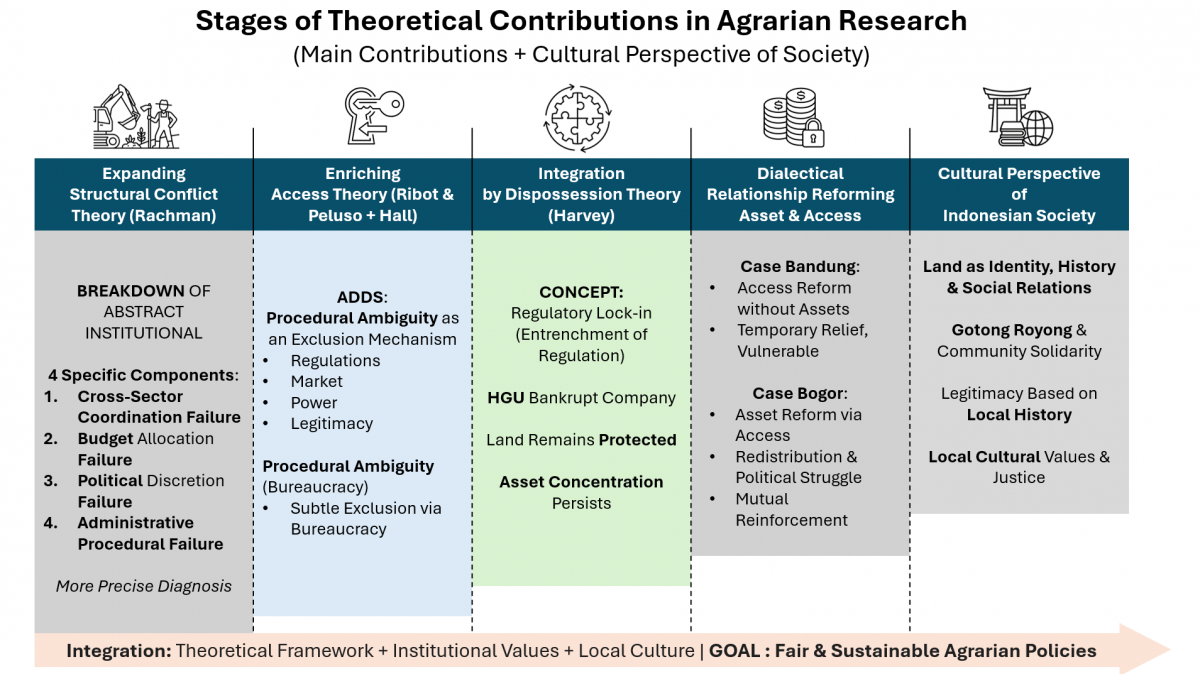
This is where participatory approaches offer alternatives. Participatory mapping, which involves local communities in identifying boundaries and land tenure histories, can be an important tool for building transparency and accountability. In the context of plantation conflicts, this approach has the potential to encourage collaborative solutions among various stakeholders: the state, as regulator and asset owner (SOEs); private companies, as concessionaires; and local communities, as historical land users. Through dialogue and negotiation, facilitated by accurate and participatory data, conflict resolution can be directed toward a win-win solution, for example, through plantation partnership schemes, plasma development, or the integration of agroforestry systems that accommodate the company's economic interests as well as the welfare of the community. Based on the theoretical perspectives discussed above, Figure 1 presents an integrated analytical framework for understanding agrarian conflicts and identifying potential pathways for conflict resolution in Indonesia.
Figure 1. Framework integration solution, new perspective solution, agrarian conflict in Indonesia
Existing literature has explained Indonesian agrarian conflict through structural inequality, land grabbing, access, exclusion, and the uneven implementation of agrarian reform. However, the empirical operation of local conflict-resolution mechanisms remains less clearly understood, especially when cases involve different types of HGU holders. In particular, there are few studies that systematically compare the effectiveness of various conflict-resolution approaches across state-owned plantation companies (SOEs) and private companies. The logic and constraints faced by these two types of entities differ: SOEs are often shackled by bureaucratic constraints, while private companies may be more operationally flexible but tied to shareholder profits. In addition, the effectiveness of GTRA as the main instrument of agrarian reform still requires a more in-depth empirical evaluation, particularly regarding its institutional capacity and accountability at the regional level.
This study contributes to that literature by comparing selected SOE and private plantation-conflict cases in West Java and Bengkulu. Rather than proposing a new theory of agrarian conflict, the study offers an empirical refinement of access and exclusion analysis by showing how administrative procedures, actor discretion, and GTRA activation shape the practical possibility of conflict resolution. The framework not only emphasizes the importance of land ownership redistribution but also explicitly highlights the need to strengthen recognition of people's access rights, adopt genuine participatory governance, and design sustainable post-conflict rural economic transformation.
This study adopts a descriptive qualitative design to examine institutional governance in selected plantation-related agrarian conflicts in West Java and Bengkulu. The design is appropriate because the study aims to understand conflict dynamics, actor relationships, and institutional processes rather than to measure the statistical distribution of agrarian conflicts across Indonesia. To compile an analytical framework, this study uses the Structural Agrarian Conflict Explanatory Chain developed by Rachman [22] as its theoretical foundation. This framework is important because it systematically defines the root causes of chronic conflict, thereby facilitating the identification of appropriate, targeted solutions. In accordance with the theoretical application of the framework, qualitative studies are considered necessary to explore in depth the various factors that comprise plantation conflicts, enabling a comprehensive examination of the underlying causes, complex dynamics, and the specific socio-cultural contexts in which these disputes manifest.
The research was conducted in the Provinces of West Java and Bengkulu. The selection of these research locations was determined by two criteria: representing the potential for significant agrarian conflicts to occur and representing the islands of Java and Sumatra, which have been vulnerable to agrarian conflicts since the colonial era and continue to this day. The case study approach examines the factual occurrence of conflict among local communities, government agencies, the private sector, and interest groups. Other considerations: First, the selected location is designated as an Agrarian Reform Priority Location (LPRA), which is currently under active government supervision through the Agrarian Conflict Resolution Acceleration Team and Agrarian Policy Strengthening. Second, the two provinces exhibit chronic plantation conflicts that have persisted for a long time and culminated in significant socio-agrarian and ecological crises, providing a rich foundation for analyzing their persistence. The empirical focus of the investigation covers four districts in the two provinces of West Java and Bengkulu. This comparative provincial selection enables an analysis that captures variations in corporate responses and in the institutional capabilities of local governments.
Data were collected through three main techniques. First, in-depth interviews were conducted with representatives of farmer groups, plantation companies, central and local government agencies, civil society organizations, and academics. Table 2 presents the distribution of research informants involved in this study. Second, media analysis was conducted using national and local media reports to understand public narratives and conflict framing. Third, document review was used to examine HGU-related information, relevant regulations, agrarian reform documents, and available institutional records. The data were triangulated by comparing interview narratives, documentary evidence, media reports, and theoretical interpretation.
Table 2. Distribution of research informants
|
No. |
Informants |
Total |
Information |
|
1 |
Farming communities (rural communities and indigenous communities) |
16 persons |
Representatives of farmer groups, village leaders, and local customs |
|
2 |
Plantation companies (private and state-owned/state-owned enterprises) |
7 Persons |
Representatives from private companies and state-owned enterprises holding land use rights in Bengkulu and West Java |
|
3 |
Central government |
8 Persons |
Representatives of the Ministry of Agrarian Affairs and Spatial Planning/National Land Agency, Ministry of Agriculture, and other related parties |
|
4 |
Local government |
9 Persons |
Representatives of the BPN Regional Office, Head of the District/City Land Office, Plantation Service, Agriculture Service, and village officials |
|
5 |
Civil society organizations (CSOs) and academics |
10 Persons |
Representatives of the Agrarian Reform Consortium, Farmers Unions, supporting institutions, and researchers from universities |
Research ethics is a non-negotiable foundation for all interactions during the data collection stage, prioritizing informant confidentiality through snowball sampling and data integrity. In accordance with research ethics standards, all interviewed participants were thoroughly informed about the research objectives and the voluntary nature of their involvement. Formal consent is obtained from each subject, and they are explicitly informed of their rights, including the right to confidentiality and the right to withdraw from participation at any time without consequences. To protect privacy and prevent potential negative repercussions, especially for individuals discussing sensitive issues involving powerful corporate or state actors, all collected data is carefully anonymized and stored in secure repositories. In addition, extra care is taken during the analysis stage to prevent any harm, retaliation, or misrepresentation of participants' statements. The objectivity of the analysis is maintained by testing the findings against the current and reliable scientific literature, ensuring that the facts generated accurately reflect the realities observed in the field, in line with the call for rigorous evidence-based claims in academic exploration [16, 38]. To protect informants and avoid potential repercussions, individual names and company names are anonymized. However, provincial and district-level locations are retained because they are necessary for understanding the institutional and historical context of each case.
The presentation of the findings then uses typology based on the subject of the conflict, categorizing disputes between the community and the holder of the HGU, including both private and SOEs. This initial grouping strategy aims to identify innovative, context-specific solutions for each typology in the sample. A significant difference arises regarding state land: once the HGU ends, the unproductive land may be returned to state land for redistribution. However, dispute resolution on SOE land is structurally more complex because it requires tiered approval from the Minister of SOEs and the Minister of Finance, highlighting the specific bureaucratic barriers inherent in state assets. This structural reality is in line with the theoretical distinctions outlined by Ribot and Peluso [16] and Schlager and Ostrom [34], where the de facto historical access of society often clashes directly with formal HGU titles, indicating that the conflict goes beyond mere ownership and touches on issues of social justice and historical reparation.
4.1 The context of plantation conflict: Understanding the root of the problem
This study found that plantation land conflicts in West Java and Bengkulu are not just ordinary legal disputes. These conflicts are structural, meaning they are rooted in an unequal system that has persisted for a long time, not in momentary incidents. This is in line with Rachman's theory [22], which states that agrarian conflicts in Indonesia are chronic and systemic due to deep-rooted institutional failures. Interestingly, even though it occurs in different regions, from Bandung and Bogor to Bengkulu, the conflict pattern is similar. The point is always the same: the contradiction between formal legality and social legitimacy. Formal legality is the legal recognition of the company's HGU. Social legitimacy is the control and use of land by communities that have been going on for generations, often long before plantation concessions were granted. This is where the core of the problem lies: formal law often ignores historical facts on the ground.
Ribot and Peluso's [16] theory of access explains that access to resources is determined not only by formal ownership but also by the social, economic, and political ability to utilize them. Communities may de facto cultivate the land, but without formal recognition, they are in a vulnerable position. This study also found significant differences between conflicts involving SOEs and private companies. Conflicts with SOEs usually stem from a long history dating back to colonial times and a complicated bureaucracy. The case of the company and the community in Bandung shows how state assets are tightly protected by a tiered bureaucratic procedure involving the Ministry of SOEs and the Ministry of Finance, making land redistribution difficult despite urgent social needs. On the other hand, conflicts with the private sector are more about administration, overlapping policies, or land that is not optimally managed. Even in some cases, private companies show greater flexibility, for example, through partnership programs.
To better understand the diverse manifestations of plantation land conflicts, this study examined six conflict cases involving both state-owned and private plantation companies in West Java and Bengkulu. Although these cases differ in terms of location, actors, and commodities, they reveal recurring patterns in the structural roots of conflict, community demands, conflict dynamics, and governance challenges. A summary of these cases is presented in Table 3.
Table 3. Profile of selected plantation-conflict cases
|
No. |
Location & Actors |
Commodities |
Entity Typology |
Structural Roots of the Problem |
Forms of Community Demands/Actions |
Dynamics and Impact of Conflict |
Emerging Governance Issues |
|
|
1 |
Bandung (Farmers vs Companies) |
Tea and coffee plantations |
SOE |
Inequality in land tenure; the legacy of colonial plantations; the difference between the legality of HGUs and historical claims |
Request for access to horticultural management |
Cultivation in the right to cultivate area |
The tension between formal legality and social legitimacy requires a win-win solution |
Tension between formal legality and social legitimacy |
|
Removal of main plants |
Involvement of authorities |
|||||||
|
Recognition of rights by ATR/BPN |
Uncertainty about the legality of farmers |
|||||||
|
2 |
Bandung (Farmers vs Companies) |
Tea, coffee and potato gardens |
SOE |
Dominance of HGUs in village spatial structures; limited productive land |
Proposals as objects of agrarian reform |
Intensification of cultivation |
Synchronizing agrarian reform with active concessions with a more humanistic and just approach |
Synchronization of agrarian reform with active concessions |
|
Demonstrations; horticultural management |
Company-farmer worker interaction |
|||||||
|
Legal uncertainty |
||||||||
|
3 |
Nanggung, Bogor (Farmers vs Companies) |
Chocolate by PT, controlled by the community to become an agricultural crop |
Private Company |
Overlapping redistribution certificates and HGU; indication of less productive land |
Rejection of extension of HGUs |
± 95% of the land is cultivated by the community |
Harmonization of land redistribution policies and integrated HGUs licensing |
Harmonization of redistribution policies and HGU licensing |
|
Proposal of land as an object of agrarian reform; sustainable management |
The legal status remains right to cultivate |
|||||||
|
4 |
Central Bengkulu (Farmers vs Companies) |
Palm oil plantations and settlements are part of the agricultural land |
Private Company |
Land indicated as abandoned; minimal company activity; Community Economic Needs |
Rejection of extension of HGUs |
Hundreds of families manage the land; rubber and palm oil commodities |
Restructuring the abandoned land evaluation mechanism |
Reconfiguration of evaluation mechanisms for abandoned land |
|
Proposal of land as an object of agrarian reform; sustainable management |
Legal status uncertain |
|||||||
|
5 |
North Bengkulu (Farmers vs Companies) |
Palm oil and rubber |
Private Company |
Administrative obstacles in issuing non-HGU letters as a condition for the rejuvenation program |
Request for clarification |
Verification shows land outside the right to cultivate |
Transparency of cultivation rights boundaries and administrative certainty |
Transparency of HGU boundaries and administrative certainty |
|
Land office mediation |
There has been no formal company statement |
|||||||
|
6 |
Central Bengkulu (Farmers and Companies) |
Palm oil and rubber |
SOE |
Inequality of land access and needs; History of Old Concessions |
Community land management; demands for recognition of rights |
Cultivation activities in the right to cultivate area; legal uncertainty |
Review the evaluation of the effectiveness of long-term concession management and strengthen supervisory control and enforce the rights and obligations of HGUs’ holders |
Evaluation of the effectiveness of long-term concession management |
Note: SOE = State-owned enterprise; HGU = Right to Cultivate (Hak Guna Usah).
Interestingly, this study found that although conflicts occurred across different geographical contexts and actors, ranging from Bandung and Bogor to Central and North Bengkulu, the patterns of conflict that emerged showed significant structural similarities. This similarity is especially evident in the tension between two important concepts in agrarian studies, namely formal legality and social legitimacy. Formal legality refers to the legal recognition of the HGU owned by companies, both private and national. On the contrary, social legitimacy is related to the control and use of land by communities that have taken place across generations; this is the essence of the theory of access put forward by Ribot and Peluso [16], which states that access to resources is not only determined by formal ownership, but also by the social, economic, and political ability to utilize those resources. The criminalization of farmers who practice simple cultivation on the land they have relied on for generations is proof that state instruments are ready to be deployed to protect the concentration of corporate landholdings, thereby perpetuating power asymmetry that sustains structural agrarian conflicts. On the other hand, conflicts involving private companies are more related to administrative problems, overlapping policies between agencies, or suboptimal land management. In some cases, private companies have shown greater flexibility, even though they are often reluctant to meet community demands.
4.2 Typology of plantation conflicts: From colonial legacy to administrative barriers
Based on an in-depth analysis of field cases, this study identified five main typologies of plantation conflicts, each with distinct characteristics, root problems, and governance implications. This finding is important because, so far, the literature has tended to treat agrarian conflicts as a monolithic phenomenon, even though the diversity of typologies calls for a different approach to resolution. This in-depth analysis identifies five conflict typologies that each require a different approach to resolution. The first typology of the colonial legacy conflict. This happens when the community has a historical claim to land that is now a company concession. The case in Bandung between the community and the company is a real example. Certain communities and groups claimed rights to the land of the former Dutch plantation, but this claim was formally rejected by the Ministry of ATR/BPN on the grounds of the legality of the HGU. As a result, farmers who farm on the land are criminalized. The second typology of the conflict of inequality in village space. In Margamukti, Bandung, most of the village area is included in the company's concession. The community has almost no access to productive land, so they are forced to work on HGU land to survive. This leads to criminalization and legal uncertainty. The third typology: policy overlap conflicts. In Nanggung, Bogor, there was an overlap between the land redistribution certificate issued by the Prona program in 1983 and the HGU issued to the company in 1988. As a result, although 95 percent of the concession land is cultivated by the community, its legal status remains with the company, creating prolonged uncertainty. The fourth typology: the conflict of abandoned land. In Central Bengkulu, the company acquired 1,400 hectares of HGU but failed to manage the land and did not pay compensation. The community then used the abandoned land to farm rubber and rice. They proposed revoking HGU and designating it as an object of agrarian reform (TORA), but its legal status remains unclear. The fifth typology: conflicts of administrative barriers. This is a new and important finding. In North Bengkulu, the Sumber Rezeki Farmers Group has been working on land that, according to the Land Office's verification, is outside the company's HGU. However, to access the oil palm replanting program, they need a certificate from the company. The company refused to issue the letter without a clear justification. As a result, farmers are cut off from government assistance, even though their rights are recognized informally. These five typologies show the complexity of plantation conflicts. These findings enrich the literature by adding the dimension of administrative barriers as a new arena for access that has gone unnoticed. The difference between HGU-based formal ownership and historical-moral claims to land, with a colonial background that reinforces the perception of sustainability of land tenure inequality [11, 22, 39].
4.3 Synthesis of plantation conflicts: Understanding patterns, dynamics, and implications of governance
To systematically and comparatively understand the dynamics of conflict, the research results are synthesized in the following analysis table (see Table 4). This table not only summarizes the findings of each case but also identifies the common patterns and governance implications that emerge from each conflict typology. The synthesis in the table reveals some important patterns. First, although conflicts have diverse root causes, they all relate to the imbalance between formal tenure and actual land use. Second, the typology of entities (SOEs vs. private) affects the complexity of settlement, with SOEs facing tiered bureaucratic obstacles involving the Ministry of SOEs and the Ministry of Finance, while the private sector is more flexible but still tied to shareholders' interests. Third, a new pattern was found that conflict is not always about physical land grabs, but also about access to government programs that are hampered by administrative procedures, a subtle but effective form of exclusion that escapes conventional analysis.
Conflict-resolution efforts in West Java exhibit two contrasting patterns, offering valuable lessons on the factors that determine the success of agrarian conflict resolution. In Bandung Regency, conflict resolution involves companies adopting a humanist approach through the partnership program "Utilization of Land Assets for the Empowerment of Village Communities Around Plantations. This program involves 17 farmer groups, totaling 400 farmers, who manage 360 hectares of land for horticultural cultivation. The PMDK program is essentially a profit-sharing scheme in which the community has access to plantation land for seasonal crops, while the company maintains its staple crops (cloves and tea). This approach can be understood as a form of access reform within the framework of Kartodiharjo and Cahyono [19] because the community gains access to land use along with technical and institutional assistance. However, this program has not achieved the goal of asset reform, as land ownership remains with the company. This partnership is cooperative and does not fundamentally change the ownership structure, so the community remains in a weak bargaining position because it lacks a long-term tenure guarantee. If the company decides to withdraw from the land, the community lacks adequate legal protection. These findings confirm the warning of Kartodiharjo and Cahyono [19] that solutions based on corporate social responsibility, although they mitigate short-term turmoil, are still far from a fundamental transformation towards agrarian justice as prescribed by comprehensive agrarian reform theory [17]. In contrast, in Bogor Regency, conflict resolution is pursued through a different path: political mobilization and the institutionalization of agrarian reform. The case of the conflict between the Nanggung people and the Company shows how a vast, organized network of struggle can redraw the map of power. Farmer groups that are members of the community group have succeeded in building alliances with various actors. Agrarian and environmental activists, academics from well-known universities, national civil society organizations, and officials at the central government level. The network consistently lobbied various parties, engaged in policy advocacy, and built public opinion in support of the farmers' struggle.
The culmination of this struggle was when the Regent of Bogor committed to cancel the technical recommendation letter for the extension of the company's rights. This political decision was then followed up with the formation and activation of the Bogor Regency GTRA team, which was fully supported by the Land Office and various Regional Apparatus Work Units. The team then worked to facilitate the redistribution of the company's former land-use rights to the community that had been working on the land for many years. The participation of civil society organizations has proven crucial in maintaining peasant groups' determination to continue fighting for their rights until they are formally recognized. The Bogor case is a critical proof-of-concept, showing that when there is strong political commitment from local executives and effective civil society mobilization, GTRA can be a powerful operational motor for land redistribution. This success aligns with Luthfi's [21] findings in Sigi Regency, where the Regent's political discretion to allow the use of village funds for conflict resolution is key to GTRA's success. Thus, success in Bogor is not due to the absence of obstacles, but to the presence of political leadership willing to exercise its discretionary authority for the sake of agrarian justice.
Table 4. Comparative contextual table of agrarian conflict resolution: West Java and Bengkulu
|
No. |
Location |
Actor Conflict |
Root Problem |
Main Trigger |
Solution Mechanism |
Results & Status |
Programs |
Conceptualization |
|
1 |
Bandung Regency (Pangalengan, Margamukti) |
Public Companies vs. Horticultural Farmers & Civil Organizations |
|
Criminalization of 3 farmers who cultivated Right to Cultivate land for horticulture. |
Serious efforts with a corporate humanist approach: profit sharing partnership program involving 400 farmers on 360 hectares of land. |
The conflict subsided. Farmers were able to cultivate the land, but the land remained the property of the company. |
Access Reform |
A cooperative solution that mitigates short-term volatility but doesn't address ownership structures. Tenure security is fragile. |
|
||||||||
|
||||||||
|
2 |
Bogor Regency Nanggung |
Private Companies vs. Nanggung Community |
|
Efforts to extend the Right to Cultivate by the company were rejected by the community. |
Political mobilization & GTRA activation: advocacy of CSOs, academics, lobbying the regent to cancel the HGU recommendation and activate GTRA for redistribution. |
The right to cultivate was not extended. The land was included in the redistribution program. The community received legal certainty. |
Asset Reform |
Success depends on the political commitment of regional heads and the strength of civil society networks. An effective GTRA model. |
|
||||||||
|
||||||||
|
||||||||
|
3 |
Central Bengkulu Regency Pondok Kelapa, Karang Sari |
Private Companies vs. Karang Sari Farmers |
|
The community has been working on the land since 1998 and claims land rights. |
The land object approach for agrarian reform in the process of identifying abandoned land as an object of agrarian reform land by the government. |
Land was certified and distributed. 1,315 families received land rights. |
Asset Reform |
An effective state program for abandoned land cases involving inactive companies. In accordance with Presidential Regulation No. 86/2018. |
|
||||||||
|
4 |
North Bengkulu Regency Pinang Raya, Air Sekamanak |
Public Company vs. Sumber Rezeki Farmers Group |
|
Farmers cannot access the replanting program (oil palm rejuvenation) because they are hampered by letters from the company. |
The land office mediation failed because the company remained adamant of its refusal. |
Not finished farmers are still working, but their access to aid has been cut off. |
Constrained implementation of Asset Reform |
Bureaucracy as a tool of exclusion. Companies use administrative power to maintain control, even though they do not physically own the land. |
|
4.4 The role of the Agrarian Reform Task Force: Failure diagnosis and revitalization formula
One of the most critical findings of this study is that the GTRA, which was designed as a key institution within the national agrarian reform policy architecture, is still far from optimal in fulfilling its role in resolving plantation conflicts. Collective findings from West Java and Bengkulu reveal what can be termed chronic underutilization of GTRA at the local level. Based on an in-depth analysis, this study identified two main factors that cause this condition. The first factor is the misattribution of responsibility, the misperception of where the main responsibility for implementing agrarian reform lies. In almost all research locations, it was found that local governments tend to consider agrarian reform as a matter for the central government, especially the Ministry of ATR/BPN. As a result, local governments do not feel an obligation to be actively involved, let alone to allocate adequate resources to support GTRA's work. This perception is wrong because agrarian reform, especially those related to conflict resolution at the site level, requires cross-sector coordination that can only be effective if led and facilitated by local governments. A comparison of the regulatory frameworks governing agrarian reform under Presidential Regulation No. 86 of 2018 and Presidential Regulation No. 62 of 2023 is presented in Table 5.
In the field, the government is eager to certify land via PTSL; unfortunately, it is also in place in favor of the imaginary living space of farmers. Education and knowledge transfer [40] on agrarian conflict issues is very limited by the government to parties involved in polemics. The second fact is a severe budget deficit for GTRA operations. In all the districts studied, no special budget allocation was found in the APBD to support GTRA activities. In fact, GTRA's work requires funding for various activities, including field verification, mediation, participatory mapping, socialization, and coordination between SKPDs. Without adequate budget support, GTRA is just a regular meeting forum with no meaningful output. This operational shortage manifests as an institutional principal-agent problem, in which the central government (principal) delegates responsibility to local governments (agents), but local agents lack the resources and, often, the political will to carry out the mandate effectively [24].
Table 5. Comparison and implementation dynamics refer to Presidential Regulation No. 86 of 2018 and Presidential Regulation No. 62 of 2023
|
Main Focus |
Asset and Access Arrangement, Dispute Resolution |
Accelerate Implementation with New Targets and Mechanisms |
|
Objective |
Forest and non-forest areas |
Forest and non-forest areas. More comprehensive solutions: results of agrarian conflict resolution |
|
Instrument |
Not running optimally |
The obligation to allocate 20% of corporate land, then integrate it with the land bank |
|
The role of local government |
Not yet fully optimal because they do not understand the concept of agrarian reform to resolve plantation conflicts |
Regional governments are required to budget and use integrated performance indicators to be involved in resolving conflicts in their regions with more operational regulations |
|
Key Criticisms |
The government at the local level does not yet understand the existing context and instruments and still needs to be socialized |
Redistribution dualism, pro-investment, loss of UUPA references, with references to schemes that do not accommodate farmers' interests |
This condition is in sharp contrast to what is happening in Bogor Regency. Bogor's success in activating GTRA proves that this institution can work if supported by two key prerequisites: political commitment of regional executives and adequate resource support. In Bogor, the Regent actively used his discretionary authority to revoke the HGU extension recommendation and instructed the various SKPDs to work together in the GTRA team. This support then translates into the mobilization of personnel and resources from various agencies, although not yet in the form of a special budget. The literature from Sigi Regency [21] further strengthens this argument, suggesting that political discretion to allocate village funds for conflict resolution can mobilize the resources necessary for the success of the GTRA. Thus, GTRA's failure in most regions is not due to the absence of a framework, but rather to the failure to operationalize it through a local governance structure that is empowered, funded, and aligned with the central government's vision. These findings pave the way for more targeted policy recommendations, which will be discussed in the practical implications sub-chapter.
5.1 Theoretical implications: Enriching agrarian understanding
This study offers four analytical contributions to agrarian conflict studies. First, it expands Rachman's structural conflict theory [22] by breaking down the abstract concept of institutional failure into four specific components identified in the field: failure of cross-sector coordination (overlapping policies), failure of budget allocation of GTRA funds, failure of political discretion (lack of courage of regional heads), and administrative procedural failure (bureaucratic ambiguity). This solution allows for a more precise diagnosis of the problem. Second, enriching Ribot and Peluso's [16] access theory by identifying procedural ambiguity as an exclusion mechanism, complementing Hall et al.'s [38] four mechanisms. Regulation, markets, power, and legitimacy. The North Bengkulu case proves that access control can be maintained only through the administrative detention of documents, without violence or physical changes to the land. It is a subtle yet effective form of exclusion that exploits bureaucratic loopholes.
Third, integrating Harvey's [32] theory of accumulation by dispossession in the Indonesian context through the concept of regulatory lock-in. The case of abandoned land in Bengkulu shows that the HGU structure continues to protect assets even though the company is bankrupt and unproductive. The concentration of assets is not due to corporate productivity, but rather bureaucratic inertia and the absence of an effective evaluation mechanism. Fourth, clarifying the dialectical relationship between asset reform and access reform [19]. The Bandung case (asset-free access reform) provides temporary relief, but the community remains vulnerable. The case of Bogor (asset reform through access) shows that political struggle and advocacy can open the door to redistribution. Neither is a linear stage but mutually reinforcing in the process of agrarian transformation. These four contributions not only enrich academic discourse but also provide a conceptual foundation for a more effective and equitable agrarian conflict-resolution policy. In addition to these four theoretical contributions, this research enriches agrarian studies through a perspective grounded in Indonesian society's cultural context. In many of the conflict cases analyzed, land is not only understood as an economic asset or legal object, but also as a social space with historical value, collective identity, and kinship relations inherited across generations. Social ties such as community solidarity, the practice of mutual cooperation in land management, and the historical legitimacy of local control are sources of moral strength that encourage communities to maintain access to land. These findings show that the dynamics of agrarian conflict in Indonesia cannot be fully explained by formal economic, political, or legal frameworks alone, but also by cultural dimensions that shape perceptions of justice and land rights at the local level. Thus, the theoretical approach to agrarian reform needs to integrate the institutional dimension with the socio-cultural values of rural communities, because in the Indonesian context, social legitimacy derived from cultural practices is often an important factor in shaping the sustainability of conflicts and the likelihood of achieving a just and sustainable resolution.
5.2 Practical implications: Five concrete ways out
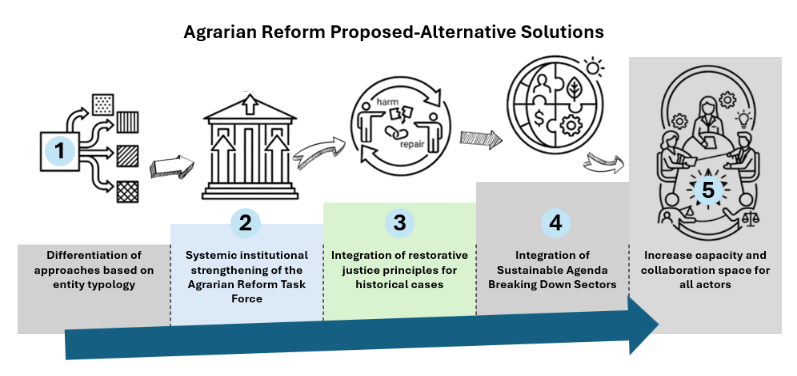
These recommendations were born out of an in-depth diagnosis of identified institutional failures and are designed to address the root causes of structural problems. These five recommendations underscore the practical condition that the rigidity of the state, corporations, and society will only lead to collective losses and perpetuate cycles of conflict, legal uncertainty, economic inefficiency, and environmental degradation. Based on the findings of this study, Figure 2 illustrates an integrated framework of alternative solutions for strengthening agrarian reform and resolving plantation conflicts in Indonesia.
Figure 2. Alternative solutions for all parties related to agrarian reform
First, differentiation of approaches based on entity typology. The rigidity of the bureaucracy has been reflected in the uniform treatment of entities with different fundamentals. For SOEs, a comprehensive instrument is needed that grants limited authority to local governments and the Ministry of ATR/BPN to resolve conflicts without a multi-level approval process from the Ministry of SOEs and the Ministry of Finance, which can take years. Without this, abandoned SOE land remains a source of conflict, harming the state (unproductive assets), the community (closed access), and SOEs themselves (reputational burden). For the private sector, fiscal incentives such as tax reductions should encourage fair and permanent partnerships, not just temporary corporate social responsibility (CSR). If the private sector insists on a business-as-usual approach, conflicts will recur with each HGU extension, creating uncertainty that is detrimental to the long-term investment climate. Second, systemic institutional strengthening of the GTRA. GTRA in the area is paralyzed by misperceptions of responsibility and chronic budget shortfalls. Regulations must require a minimum allocation of funds for GTRA operations to finance field verification, mediation, participatory mapping, and cross-sector coordination. Measurable performance indicators, such as the number of conflicts resolved, the area of land distributed, and the number of beneficiary families, must be part of the performance evaluation of regional heads and all stakeholders. Without this accountability, conflicts are allowed to continue, creating social disadvantages such as the criminalization of farmers, an unproductive land economy, and the erosion of public trust. Third, integrating restorative justice principles into historical cases. Cases with colonial roots cannot be resolved with a legalistic, formal approach alone. The rigidity of the apparatus, which recognizes only the HGU certificate while ignoring evidence of hereditary control, is a denial of justice. Land recognition and redistribution programs must recognize non-formal evidence, such as community testimony, historical documents, old photographs, and participatory maps. Without this, society remains criminalized, fostering resistance that disrupts company operations and regional stability. Historical justice is a prerequisite for lasting social peace. Fourth, integration with the Sustainable Development Agenda. The sectoral rigidity that separates land, forestry, and investment policies has created regulatory overlap and massive deforestation. The integrated approach offers a workaround through a Collaborative Governance Framework [41], participatory spatial audits, and multistakeholder forums to resolve overlapping claims. Without transparency in HGU boundaries and a moratorium on new land clearing in sensitive areas, plantation expansion will continue to contribute to forest degradation. Core-Plasma-Agro-Tourism zoning. The integration of conservation zones, agroforestry, and buffer zones creates resilient landscapes. Distributed land can be part of the solution to climate change, not just an extractive monoculture. The Multi-Stakeholder Consortium Financing Scheme for green credit, blended finance, and carbon access opens up new economic opportunities. Companies that switch to sustainable practices can access a global marketplace that values eco-friendly products and meets environmental, social, and governance (ESG) standards. The mainstreaming of recognition of management rights and productive partnerships for Small and Indigenous Communities puts them at the forefront of conservation, safeguarding customary forests as cultural and ecological heritage.
Optimization of Agro-Tourism. The economic value of land is not only from commodity extraction. With conservation as an attraction, healthy landscapes generate sustainable income through tourism. In the end, these five recommendations affirm that neither side can win in a protracted conflict. The state is losing out because land is unproductive and security costs are falling. Companies lose money due to disrupted investments, tarnished reputations, and closed access to the green market. People are losing their livelihoods and living in uncertainty. The environment is losing out due to deforestation continuing. Rigidity—convoluted bureaucracy, corporate reluctance to share access, resistance without dialogue—only magnifies collective losses. Flexibility, dialogue, and a willingness to transform are the only paths to a just and sustainable solution. Agrarian reform is not a zero-sum game; it is a long-term investment in social stability, economic productivity, and ecological sustainability that benefits all parties.
The next key step in operationalizing these policy recommendations is to position actors (agencies) as the main drivers of agrarian transformation. The findings of this study show that the success or failure of agrarian conflict resolution is not solely determined by policy design or regulatory frameworks, but is also greatly influenced by the capacity, courage, and initiative of the actors involved. Institutional structures such as the GTRA, HGU regulations, and land redistribution programs are only formal instruments whose effectiveness depends heavily on how actors, including local governments, land bureaucrats, civil society organizations, and peasant communities, use the available discretionary space. The success case in Bogor shows that the political commitment of regional heads, the support of the local bureaucracy, and the mobilization of civil society networks can transform previously stagnant policy frameworks into effective redistribution mechanisms.
In this perspective, actors are not only understood as policy implementers but also as agents of institutional change who can negotiate interests, build cross-sectoral coalitions, and open up innovation space in agrarian governance. Local governments, for example, have a strategic position as institutional brokers that can connect the interests of the state, companies, and society. Similarly, civil society organizations and peasant groups play an important role in building social pressure, policy advocacy, and local knowledge production through participatory mapping and historical documentation of land tenure. Without the active involvement of these actors, agrarian reform policies risk remaining a normative framework that lacks operational power at the local level.
Therefore, capacity building and collaboration between actors are important prerequisites in encouraging sustainable agrarian transformation. The state needs to create an institutional space that enables meaningful community participation, strengthens local governments' role as drivers of cross-sectoral coordination, and encourages corporate involvement through a more equal partnership model. When key actors work collaboratively, agrarian reform is no longer just a land redistribution project but a socio-political process that rebuilds a just relationship among the state, the market, and society. Within this framework, the actors' agency serves as a bridge between policy structures and social realities on the ground, determining whether agrarian reform is capable of producing structural change or merely stops at policy rhetoric.
A comprehensive analysis of land conflicts in West Java and Bengkulu reveals that the persistence of these disputes is rooted in structural inequality inherited from the colonial era, which is reinforced by the failure of policy implementation and by asymmetrical power dynamics between the state, corporations, and society. The core findings of this study show divergence in conflict outcomes: private plantation HGU holders occasionally adopt mitigation measures, such as partnership programs that offer limited access but do not challenge formal tenure, while SOEs are often paralyzed by internal bureaucratic barriers stemming from tiered, complex asset management authorities.
A persistent issue in both sectors is the systematic failure to operationalize the GTRA at the regional level, mainly due to misperceptions about the locus of responsibility and the absence of a dedicated budget. On the contrary, the successful mobilization in Bogor Regency demonstrates that the initiation of GTRA, when activated and politically supported and integrated with strong civil society advocacy, can overcome institutional barriers and encourage real redistribution efforts.
This research contributes to agrarian studies by empirically demonstrating the institutional arrangements needed to realize policy objectives in the field. Its main contribution is to go beyond simply cataloging the causes of conflict toward mapping conditions that enable effective resolution using the GTRA structure. The findings on bureaucratic ambiguity as a fifth exclusion mechanism enrich access theory and open up a new research agenda on subtle forms of agrarian control in the modern bureaucratic era. Ultimately, this study confirms that resolving plantation conflicts requires a fundamental paradigm shift from reactive, reactive dispute mediation to a proactive, systemic transformation rooted in justice. A holistic agrarian reform framework that integrates asset and access reforms must be consistently adopted, ensuring that farmers not only acquire land but also have access to capital, technology, markets, and supporting institutions. The principle of restorative justice for historical claims and strict scrutiny of post-redistribution land reconcentration are absolutely necessary to prevent a recurrence of the cycle of inequality. With GTRA's strengthening as a cross-sectoral coordination hub, empowered with adequate fiscal resources, Indonesia has a real opportunity to realize sustainable agrarian justice, where land is no longer a source of conflict but rather a foundation of shared prosperity.
Although this study offers an analytical framework that enriches understanding of agrarian conflicts and the governance of agrarian reform, it faces several theoretical limitations that warrant examination. First, the approach still primarily focuses on the institutional and political dimensions of policy, so it has not fully captured broader economic-political dynamics, such as changes in the structure of the global commodity market, agribusiness investment pressures, and financial capital dynamics that affect plantation expansion. In this context, structural agrarian conflict theory and access theory can indeed explain the mechanisms of exclusion and the distribution of power, but they have not fully integrated the global economic dimension that shapes incentives for states and corporations to maintain the concentration of land tenure. Therefore, future theories need to connect local institutional analysis with the dynamics of the global political economy that affect agrarian policy.
Second, the analytical framework of this study still tends to see actors in the relatively stable institutional categories of the state, companies, and communities, so that they have not fully grasped the complexity of relationships between actors at the local level, such as the role of political brokers, village elites, or patronage networks that often mediate relationships between society and the state. In practice, the success or failure of agrarian reform is often determined not only by formal institutional design, but also by informal power configurations and social relations that develop at the local level. Therefore, improving the theoretical framework in the future should integrate the perspectives of local agencies and politics more systematically, enabling it to explain how coalitions of actors, advocacy networks, and local leadership shape paths of agrarian conflict resolution.
Given these limitations, several advanced research agendas are important to develop in the future. First, cross-regional comparative research is needed to test whether findings on bureaucratic ambiguity as an exclusion mechanism also held in other sectors, such as forestry, mining, or conservation areas. Second, longitudinal studies are needed to assess the sustainability of agrarian reform outcomes, especially the risk of land reconcentration after redistribution and the ability of farmers to maintain long-term economic access. Third, future research needs to explore more deeply the relationship between agrarian reform and the sustainable development agenda, including the potential integration between land redistribution, agroforestry, and the green economy as a rural transformation strategy. Through this research agenda, agrarian studies are expected not only to explain the dynamics of conflict but also to contribute to the formulation of a more equitable, adaptive, and sustainable land governance model.
The authors declare that Artificial Intelligence (AI) tools were used in a limited capacity to support this manuscript, specifically for language refinement, paraphrasing, and sentence structuring in accordance with international academic standards. All analyses, interpretations, and conclusions are the sole responsibility of the authors. AI was not used to replace any part of the scientific process, including data collection, analysis, or validation.
Thank you to the Ministry of Agrarian Affairs and Spatial Planning/National Land Agency for the opportunity given to researchers to conduct this research.
[1] Carle, J., Holmgren, P. (2008). Wood from planted forests: A global outlook 2005-2030. Forest Products Journal, 58(12): 6-18.
[2] Xu, Y.D., Yu, L., Li, W., Ciais, P., Cheng, Y., Gong, P. (2020). Annual oil palm plantation maps in Malaysia and Indonesia from 2001 to 2016. Earth System Science Data Discussions, 12(2): 847-867. https://doi.org/10.5194/essd-12-847-2020
[3] Iddris, N.A.A., Formaglio, G., Paul, C., et al. (2023). Mechanical weeding enhances ecosystem multifunctionality and profit in industrial oil palm. Nature Sustainability, 6(6): 683-695. https://doi.org/10.1038/s41893-023-01076-x
[4] Cramb, R., Mccarthy, J. (2016). The Oil Palm Complex: Smallholders, Agribusiness and the State in Indonesia and Malaysia. NUS Press. https://doi.org/10.2307/j.ctv1xz0km
[5] Wilcove, D.S., Giam, X., Edwards, D.P., Fisher, B., Koh, L.P. (2013). Navjot's nightmare revisited: Logging, agriculture, and biodiversity in Southeast Asia. Trends in Ecology & Evolution, 28(9): 531-540. https://doi.org/10.1016/j.tree.2013.04.005
[6] Laurance, W.F., Sayer, J., Cassman, K.G. (2014). Agricultural expansion and its impacts on tropical nature. Trends in Ecology & Evolution, 29(2): 107-116. https://doi.org/10.1016/j.tree.2013.12.001
[7] Achard, F., Eva, H.D., Stibig, H.J., et al. (2002). Determination of deforestation rates of the world's humid tropical forests. Science, 297(5583): 999-1002. https://doi.org/10.1126/science.1070656
[8] Permadi, I., Azizi, I. (2024). Agrarian reform: Implementation and exploration of land conflicts in several countries (A bibliometric and content analysis of international research on the agrarian reform concept). WSEAS Transactions on Environment and Development, 20: 820-834. https://doi.org/10.37394/232015.2024.20.77
[9] Peluso, N.L., Lund, C. (2011). New frontiers of land control: Introduction. Journal of Peasant Studies, 38(4): 667-681. https://doi.org/10.1080/03066150.2011.607692
[10] Li, T.M. (2018). After the land grab: Infrastructural violence and the 'Mafia System' in Indonesia's oil palm plantation zones. Geoforum, 96: 328-337. https://doi.org/10.1016/j.geoforum.2017.10.012
[11] McCarthy, J.F. (2010). Processes of inclusion and adverse incorporation: Oil palm and agrarian change in Sumatra, Indonesia. Journal of Peasant Studies, 37(4): 821-850. https://doi.org/10.1080/03066150.2010.512460
[12] Peluso, N.L., Afiff, S., Rachman, N.F. (2008). Claiming the grounds for reform: Agrarian and environmental movements in Indonesia. Journal of Agrarian Change, 8(2-3): 377-407. https://doi.org/10.1111/j.1471-0366.2008.00174.x
[13] Faust, H. (2017). Catastrophe & regeneration in Indonesia's peatlands: Ecology, economy & society. AAG Review of Books, 5(4): 259-261. https://doi.org/10.1080/2325548X.2017.1366839
[14] Rahmawati, E., Rahayu, E.W.P., Sukirno. (2023). State actors in agrarian conflicts: A judicial review in rule of law perspective. Journal of Southeast Asian Human Rights, 7(2): 276-298. https://doi.org/10.19184/jseahr.v7i2.43798
[15] Borras, S.M., Hall, R., Scoones, I., White, B., Wolford, W. (2011). Towards a better understanding of global land grabbing: An editorial introduction. Journal of Peasant Studies, 38(2): 209-216. https://doi.org/10.1080/03066150.2011.559005
[16] Ribot, J.C., Peluso, N.L. (2003). A theory of access. Rural Sociology, 68(2): 153-181. https://doi.org/10.1111/j.1549-0831.2003.tb00133.x
[17] Jacobs, S. (2013). Agrarian reforms. Current Sociology, 61(5-6): 862-885. https://doi.org/10.1177/0011392113486660
[18] Widodo, S. (2017). A critical review of Indonesia's agrarian reform policy. Journal of Regional and City Planning, 28(3): 204-218. https://doi.org/10.5614/jrcp.2017.28.3.4
[19] Kartodiharjo, H., Cahyono, E. (2021). Agrarian reform in Indonesia: Analyze concepts and their implementation from a governance perspective. Jurnal Manajemen Hutan Tropika (Journal of Tropical Forest Management), 27(te): 1-8. https://doi.org/10.7226/jtfm.27.te.1
[20] Lee, Z.Y. (2022). Implementation of agrarian reform in North Sumatra, Indonesia: The productiveness of institutional fragmentation. Environment and Planning C: Politics and Space, 40(7): 1589-1605. https://doi.org/10.1177/23996544221094912
[21] Luthfi, A.N. (2018). Institutional reform for agrarian reform policy in the era of Joko Widodo-Jusuf Kalla's reign. BHUMI: Jurnal Agraria dan Pertanahan, 4(2): 140-163. https://www.cabidigitallibrary.org/doi/full/10.5555/20193219407.
[22] Rachman, N.F. (2013). Rantai penjelas konflik-konflik agraria yang kronis, sistemik, dan meluas di Indonesia. BHUMI: Jurnal Agraria dan Pertanahan, 12(37): 1-14. https://doi.org/10.31292/jb.v0i37.148
[23] Fairbairn, M., Fox, J., Isakson, S.R., et al. (2014). Introduction: New directions in agrarian political economy. Journal of Peasant Studies, 41(5): 653-666. https://doi.org/10.1080/03066150.2014.953490
[24] Borras, S.M. (2009). Agrarian change and peasant studies: Changes, continuities and challenges – An introduction. Journal of Peasant Studies, 36(1): 5-31. https://doi.org/10.1080/03066150902820297
[25] Entrena-Durán, F., Muñoz-Sánchez, V.M., Pérez-Flores, A.M. (2021). Sustainability and development: From agrarian development to the paradigm of sustainability. Sustainability, 13(11): 6175. https://doi.org/10.3390/su13116175
[26] Sachs, J.D. (2015). Achieving the Sustainable Development Goals. Journal of International Business Ethics, 8(2): 53-62. http://www.cibe.org.cn/uploadfile/2016/2016_04_14_11193686.pdf#page=53.
[27] Afrizal, Dewi, R.S., Zuldesni. (2026). The developmental politics of land conflict resolution: Insights from Indonesia’s TORA programme. Journal of International Development, 38(4): 651-663. https://doi.org/10.1002/jid.70079
[28] Sakti, T., Sidipurwanty, E. (2026). Conflict on the land of agriculture: Structural land disputes in plantation areas of Central Java. BIO Web of Conferences, 208: 04002. https://doi.org/10.1051/bioconf/202620804002
[29] Berenschot, W., Dhiaulhaq, A., Afrizal, Hospes, O., Adriana, R., Poetry, E. (2022). Anti-corporate activism and collusion: The contentious politics of palm oil expansion in Indonesia. Geoforum, 131: 39-49. https://doi.org/10.1016/j.geoforum.2022.03.002
[30] Macours, K., Swinnen, J.F.M. (2002). Patterns of agrarian transition. Economic Development and Cultural Change, 50(2): 365-394. https://doi.org/10.1086/322883
[31] Abbas, R.R., Soetarto, E., Pandjaitan, N.K., Satria, A. (2021). Land grabbing in Telukjambe Barat, Karawang, West Java and its teoretical hook to David Harvey's and SMP Tjondronegoro's works. Sodality: Jurnal Sosiologi Pedesaan, 9(3). https://doi.org/10.22500/9202135107
[32] Harvey, D.R. (2004). Policy dependency and reform: Economic gains versus political pains. Agricultural Economics, 31(2-3): 265-275. https://doi.org/10.1111/j.1574-0862.2004.tb00263.x
[33] Levien, M. (2015). From primitive accumulation to regimes of dispossession: Six theses on India's land question. Economic and Political Weekly, 50(22): 146-157. http://www.jstor.org/stable/24482497.
[34] Schlager, E., Ostrom, E. (1992). Property-rights regimes and natural resources: A conceptual analysis. Land Economics, 68(3): 249-262. https://doi.org/10.2307/3146375
[35] Razavi, S. (2003). Introduction: Agrarian change, gender and land rights. Journal of Agrarian Change, 3(1-2): 2-32. https://doi.org/10.1111/1471-0366.00049
[36] Shattuck, A., Grajales, J., Jacobs, R., Sauer, S., Galvin, S.S., Hall, R. (2023). Life on the land: New lives for agrarian questions. Journal of Peasant Studies, 50(2): 490-518. https://doi.org/10.1080/03066150.2023.2174859
[37] Hirsch, P. (2012). Reviving agrarian studies in South-East Asia: Geography on the ascendancy. Geographical Research, 50(4): 393-403. https://doi.org/10.1111/j.1745-5871.2012.00779.x
[38] Hall, D., Hirsch, P., Li, T.M. (2011). Introduction to Powers of Exclusion: Land Dilemmas in Southeast Asia. National University of Singapore Press and University of Hawaii Press.
[39] Borras, S.M., McMichael, P., Scoones, I. (2010). The politics of biofuels, land and agrarian change: Editors' introduction. Journal of Peasant Studies, 37(4): 575-592. https://doi.org/10.1080/03066150.2010.512448
[40] Wicaksono, A., Haryono, N., Wahyono, E., et al. (2025). Empowering communities: Knowledge transfer and participatory approaches to revitalization land registration in Indonesia. International Journal of Sustainable Development and Planning, 20(4): 1499-1513. https://doi.org/10.18280/ijsdp.200413
[41] Wicaksono, A., Andari, R.N., Azni, U.S., et al. (2026). Actor collaboration in the implementation of business licensing integrated with the land use framework: Indonesian case study. Urban Governance, 6(1): 45-57. https://doi.org/10.1016/j.ugj.2025.10.003