Gunawan Prayitno* | Aris Subagiyo | Dian Dinanti | Achmad Tjachja Nugraha | Hashfian Ardhana | Fajar Fadhilatun Nisak | Salsa Alifia Najid | Erwin Nugraha
© 2026 The authors. This article is published by IIETA and is licensed under the CC BY 4.0 license (http://creativecommons.org/licenses/by/4.0/).
OPEN ACCESS
This study investigates how livelihood assets, food security, social capital, and institutional innovation are associated with community resilience in tourism villages, focusing on Ketapanrame Village, Trawas District, Mojokerto Regency, East Java, Indonesia. Amid global challenges such as COVID-19 and growing inequality in rural tourism, the research highlights the role of Badan Usaha Milik Desa (Village-Owned Enterprise (BUMDes)), community-based tourism governance, and livelihood resource mobilization in supporting rural resilience. Using a mixed-methods approach and Partial Least Squares Structural Equation Modelling (PLS-SEM) analysis based on 220 valid household responses, the study finds that social capital is the strongest contributor to livelihood assets, followed by physical and financial capital, while natural capital is not statistically significant. Livelihood assets and food security are positively associated with community resilience, and community resilience is positively associated with institutional innovation. Rather than confirming livelihood assets as a mediating variable, the revised model treats livelihood assets as a higher-order composite construct linking multiple capital dimensions to community resilience. However, intra-village variations, particularly between more tourism-integrated and less tourism-integrated hamlets, indicate uneven access to tourism-related benefits and resilience resources. The study emphasizes the importance of inclusive governance frameworks, infrastructure investment, food-security-sensitive livelihood policies, and community participation in reducing these gaps. It concludes by advocating adaptive, decentralized tourism policies that center local voices and promote equitable development. These findings contribute to the growing discourse on sustainable rural tourism and offer practical policy recommendations for strengthening resilience through livelihood-based, socially embedded, and institutionally responsive governance strategies.
tourism village, Badan Usaha Milik Desa (Village-Owned Enterprise), community resilience, social capital, participatory governance, livelihood assets, food security, institutional innovation
In many developing countries, tourism is increasingly positioned not only as a catalyst for economic growth but also as a strategic vehicle for supporting community resilience. Particularly in rural contexts, tourism can generate employment, improve local infrastructure, and preserve cultural heritage while fostering social cohesion [1-3]. As rural communities grapple with the pressures of agricultural decline, climate change, and demographic shifts, tourism offers an opportunity to diversify livelihoods and build adaptive capacities. These benefits are particularly evident during crises, such as the COVID-19 pandemic, which demonstrated that tourism-led economies, especially those embedded in strong community networks, may be better positioned to organize collective responses and recovery efforts [4-6].
Yet, the promise of tourism-led development is tempered by persistent structural inequalities. Within a single tourism village, disparities often emerge along lines of geography, social capital, livelihood assets, infrastructure access, food security, and access to decision-making. Communities with greater infrastructural connectivity, stronger political voice, and higher pre-existing capital often reap disproportionate benefits, while others remain less integrated into tourism flows [7, 8]. Such intra-village inequalities reflect not only spatial divides but also institutional limitations, including the misalignment between national tourism agendas and local priorities, weak coordination among stakeholders, and low levels of transparency [4, 9, 10]. Without mechanisms to ensure equitable access, tourism risks becoming a source of tension rather than empowerment.
Institutional frameworks are central to addressing these tensions. Among the most prominent models in Indonesia is the Village-Owned Enterprise, or Badan Usaha Milik Desa (BUMDes), which serves as an instrument of institutional innovation by managing village assets and supporting locally oriented development [11, 12]. BUMDes differs from conventional top-down institutions by providing a locally embedded mechanism for coordinating tourism activities, facilitating community participation, and linking village resources with local development priorities. Residents may participate as workers, entrepreneurs, community representatives, or beneficiaries, depending on the local governance arrangement. When effectively implemented, BUMDes can help bridge economic development and social equity by supporting local entrepreneurship, strengthening institutional participation, and broadening community access to tourism-related opportunities [11, 13].
However, institutional innovation alone is insufficient without robust social capital. Trust, cooperation, and community participation serve as key relational conditions in translating tourism benefits into livelihood resources, perceived security, and resilience [6, 14, 15]. In tourism villages with dense social networks, information sharing and collective action are more effective, enabling communities to mitigate risks and adapt to shifting economic and environmental conditions [6, 16]. Social capital not only enhances community cohesion and problem-solving capacity but also underpins participatory governance, thus reinforcing the institutional mechanisms that BUMDes promotes.
At the same time, the interplay between institutional access and social capital may reinforce inequality. While some residents can leverage their networks and proximity to tourism hubs for economic gain, others—particularly those in geographically or socially marginalized hamlets—may face more limited access to tourism-related livelihood opportunities [8, 17]. These patterns of inequality challenge the assumption that tourism is inherently inclusive and highlight the need for governance structures that intentionally target equity outcomes. Intra-village inequalities are thus not only a matter of uneven infrastructure but also of asymmetric power, livelihood resources, food security, and participation.
In response, participatory governance emerges as a critical factor in ensuring that tourism village development is associated with inclusive and sustainable outcomes. Research indicates that when communities are engaged in shared decision-making, they are more likely to identify local priorities, distribute resources equitably, and develop a collective vision for tourism [18, 19]. Such engagement reinforces social capital while fostering transparency and accountability. Moreover, participatory governance may enable tourism villages to adapt dynamically to market changes and environmental disruptions, thereby supporting their long-term viability [20, 21].
Although the literature affirms the value of community-based institutions, social capital, and participatory governance, empirical studies integrating these variables in a systematic model remain limited. Most analyses focus either on governance structures or on social dynamics but rarely on their intersection with livelihood assets and food security. Furthermore, while many studies treat the village as a homogeneous unit, few explore intra-village disparities that result from uneven institutional access, unequal livelihood resources, and differentiated social capital. Additionally, the growing body of literature on tourism-based resilience tends to rely on qualitative case studies, with limited use of quantitative models that examine statistical associations among livelihood capital dimensions, food security, community resilience, and institutional innovation.
To address these gaps, this study examines the relationship between livelihood capital dimensions, food security, community resilience, and institutional innovation in a nationally recognized tourism village: Ketapanrame Village, Trawas District, Mojokerto Regency, East Java Province, Indonesia. It investigates how human, physical, natural, financial, and social capital are associated with livelihood assets, how livelihood assets and food security are associated with community resilience, and how community resilience is associated with institutional innovation across three hamlets with varying levels of infrastructure and tourism integration. By employing a Partial Least Squares Structural Equation Modelling (PLS-SEM) approach complemented by qualitative governance evidence, the research advances a comprehensive model that captures direct associations and higher-order livelihood asset formation. The study’s novelty lies in its integration of livelihood-based, relational, food-security, and institutional variables, its intra-village comparative lens, and its empirical focus on the Global South context.
Ultimately, this research aims to contribute to the theoretical and policy-oriented discourse on tourism governance by foregrounding the livelihood assets–food security–community resilience nexus within a BUMDes-based tourism village context. It argues that building resilient tourism villages requires not only innovative institutions like BUMDes but also social capital, livelihood resources, and food-security-sensitive governance arrangements to sustain them. Moreover, it contends that equitable development must be spatially and socially targeted, ensuring that less tourism-integrated hamlets are not left behind. Through its empirical findings and analytical framework, the study offers new insights for designing inclusive, community-driven tourism strategies in Indonesia and beyond.
2.1 Defining and operationalizing tourism village resilience
Tourism village resilience in the Global South is widely defined as the community’s capacity to absorb disturbances, adapt to changes, and recover from external shocks without losing core functions and identity. This concept is deeply embedded in strategies such as participatory governance, leveraging local resources, and building collective capabilities through social capital [15, 22]. Emotional and cultural attachment to place also plays a critical role in sustaining resilience, fostering proactive responses to crises like natural disasters and economic downturns [23]. In tourism villages, resilience should also be understood through residents’ capacity to maintain livelihood assets, secure basic household needs, and participate in local institutions during periods of tourism-related change.
Recent research shows that tourism village resilience is not only a matter of infrastructure or capital investment but also of institutional design, livelihood resources, food security, and community engagement. Villages that embed adaptive governance mechanisms are more likely to be associated with stronger resilience across social, economic, and environmental dimensions. These include forums for community input, accountability frameworks, and redistribution mechanisms that reinforce the community’s sense of ownership and shared responsibility [6]. Accordingly, this study operationalises community resilience as a multidimensional condition shaped by livelihood assets, food-security conditions, and institutional participation rather than as a purely economic outcome.
2.2 Governance models for rural tourism
Rural tourism governance frameworks have evolved to address deep-rooted spatial and social inequalities. Participatory governance models are particularly important in ensuring equitable access to tourism benefits. These models actively involve local stakeholders in planning and decision-making, increasing transparency and accountability [18]. The Penta Helix model—linking government, private sector, academia, community, and the environment—has emerged as a robust strategy to integrate diverse actors while maintaining a sustainability-oriented approach [10]. In this study, the Penta Helix framework is used as a qualitative governance lens rather than as a latent construct in the PLS-SEM model.
Community-driven tourism initiatives may help reduce marginalisation by giving voice to underrepresented groups and promoting equitable access to economic opportunities [24]. However, such inclusive governance structures are still challenged by weak institutional capacity, elite capture, and limited data for monitoring outcomes [25]. Despite these challenges, inclusive models remain central in building adaptive, locally embedded, and socially just tourism systems. For BUMDes-based tourism villages, governance should therefore be examined not only through formal institutional presence, but also through how institutions support livelihood assets, social participation, and resilience across different hamlets.
2.3 Social capital and economic adaptability in tourism communities
Social capital, comprising trust, networks, and shared norms, is increasingly recognized as a foundation for tourism communities to adapt economically to external stressors [26]. Trust enables collective action and mitigates risks associated with tourism fluctuations [27]. Strong networks facilitate knowledge transfer and access to opportunities, while shared norms reinforce cooperation and mutual support [28]. These dimensions are crucial for tourism communities to withstand disruptions such as the COVID-19 pandemic and to sustain livelihood diversification. In livelihood-based tourism systems, social capital can function as a relational asset that enables residents to access information, participate in collective economic activities, and mobilise support during periods of uncertainty.
Empirical cases such as Pujon Kidul in Indonesia illustrate how dense social networks and community cohesion were associated with stronger community adaptation during crisis periods [15]. Similarly, Gardner et al. [29] found that robust social ties allow tourism-dependent households to respond more effectively to market changes and environmental pressures. Social capital thus not only fosters economic resilience but also underpins governance legitimacy and inclusivity. This perspective supports the positioning of social capital as a key component of livelihood assets in the present study.
2.4 Infrastructure and equitable benefit distribution
Basic infrastructure remains a critical enabler of both access and equity in tourism development. Roads, sanitation systems, and telecommunications are not only essential for tourist satisfaction but also serve as mechanisms for spatial inclusion [30]. Infrastructure disparities often mirror and reinforce existing socio-economic inequalities, especially in remote or peripheral hamlets. In tourism villages, infrastructure also shapes physical capital by influencing residents’ access to tourism sites, markets, public facilities, and income-generating opportunities.
Studies from Indonesia indicate that improvements in basic infrastructure are positively associated with tourism income and employment while reducing marginalisation [31, 32]. Conversely, poorly developed areas tend to be excluded from tourism flows, exacerbating intra-village inequalities [13]. Addressing these disparities requires targeted infrastructure investments aligned with local development priorities and inclusive governance frameworks. However, infrastructure alone may not be sufficient to generate resilience unless it is connected with social capital, financial capacity, and food-security conditions.
2.5 Institutional frameworks: Tetrapreneur and Penta Helix
The Tetrapreneur model integrates four key stakeholders, namely government, the private sector, academia, and communities, into a collaborative tourism governance approach aimed at building local entrepreneurship and empowerment [10]. It emphasizes horizontal leadership, shared responsibility, and capacity-building to facilitate tourism innovation at the grassroots level [33]. Although these frameworks are relevant for understanding multi-actor tourism governance, they are not treated as direct measurement constructs in this study.
The Penta Helix model extends this by integrating environmental sustainability as a core element. This five-pillar approach ensures that governance not only focuses on economic performance but also on ecological integrity and social inclusion. Studies show that villages applying Penta Helix principles tend to demonstrate stronger resilience and better inter-stakeholder coordination [18]. In the present study, Penta Helix is used to interpret qualitative evidence on the roles of village government, BUMDes, community groups, tourism actors, external partners, and environmental-management practices in shaping the institutional context of resilience. This distinction prevents the qualitative governance framework from being conflated with the PLS-SEM structural model.
2.6 Measuring livelihood assets, food security, community resilience, and institutional innovation
Operationalising complex constructs such as institutional innovation, social capital, and village resilience requires careful indicator development. For institutional innovation, relevant indicators include participatory decision-making, institutional accessibility, transparency, and community-oriented resource management [27]. Social capital indicators typically involve measures of trust in local leadership, participation in community events, and perceptions of cohesion [34]. In this study, social capital is also conceptualised as one of the livelihood capital dimensions, alongside human, physical, natural, and financial capital.
Tourism-based resilience is assessed through livelihood diversification, adaptability, and subjective well-being [35, 36]. These indicators are adapted to local contexts and measured using validated survey instruments. The revised model extends this measurement approach by including food security as a resilience-supporting condition and by modelling livelihood assets as a higher-order composite construct formed by multiple capital dimensions. PLS-SEM is widely applied in tourism and governance research to model complex statistical associations between institutional and social variables [37, 38].
Recent studies stress the importance of assessing measurement validity and structural robustness in PLS-SEM applications, particularly when dealing with small to moderate samples and non-normal data distributions [39]. Tools such as SmartPLS offer advanced functionalities for modelling higher-order constructs, bootstrapped paths, predictive relevance, and model diagnostics, making them well-suited for research on community-based tourism resilience [40]. Accordingly, this study reports the measurement and structural models separately, including retained indicators, outer loadings, Cronbach’s alpha, rho_A, Composite Reliability (CR), AVE, discriminant validity assessment, VIF-based collinearity assessment, R² and adjusted R², f² effect sizes, Q² predictive relevance, and bootstrapped structural path coefficients with t-values and p-values.
2.7 Positioning this study
The reviewed literature provides critical insights into how institutional frameworks, social capital, infrastructure, livelihood assets, and food security influence tourism village resilience. However, most studies analyse these elements in isolation, neglecting their interdependencies. Moreover, intra-village disparities—particularly those linked to geography, livelihood resources, food-security conditions, infrastructure, and governance access—remain underexplored.
This study addresses these gaps by developing an integrated PLS-SEM model that simultaneously examines livelihood capital dimensions, food security, community resilience, and institutional innovation in the context of Ketapanrame Village, Trawas District, Mojokerto Regency, East Java, Indonesia. By incorporating intra-village comparisons and community-based data, the research offers a nuanced understanding of how livelihood resources, social capital, food-security conditions, and governance mechanisms are associated with tourism resilience across different hamlet contexts. The study positions BUMDes and Penta Helix governance as qualitative institutional contexts that help explain, rather than replace, the quantitative relationships identified in the PLS-SEM model.
3.1 Research design
This study adopts an explanatory case study design, employing a mixed-methods approach that integrates both quantitative and qualitative data to investigate the relationships among livelihood capital dimensions, food security, community resilience, and institutional innovation in the context of a community-based tourism village. The primary analytical tool is PLS-SEM, selected for its suitability in modelling complex interrelationships among latent constructs, especially within small to medium sample sizes and non-normal data distributions [24, 41]. The quantitative component was used to estimate the statistical associations among latent constructs, while the qualitative component was used to interpret the governance context, particularly the role of BUMDes, community participation, and Penta Helix-related stakeholder interactions.
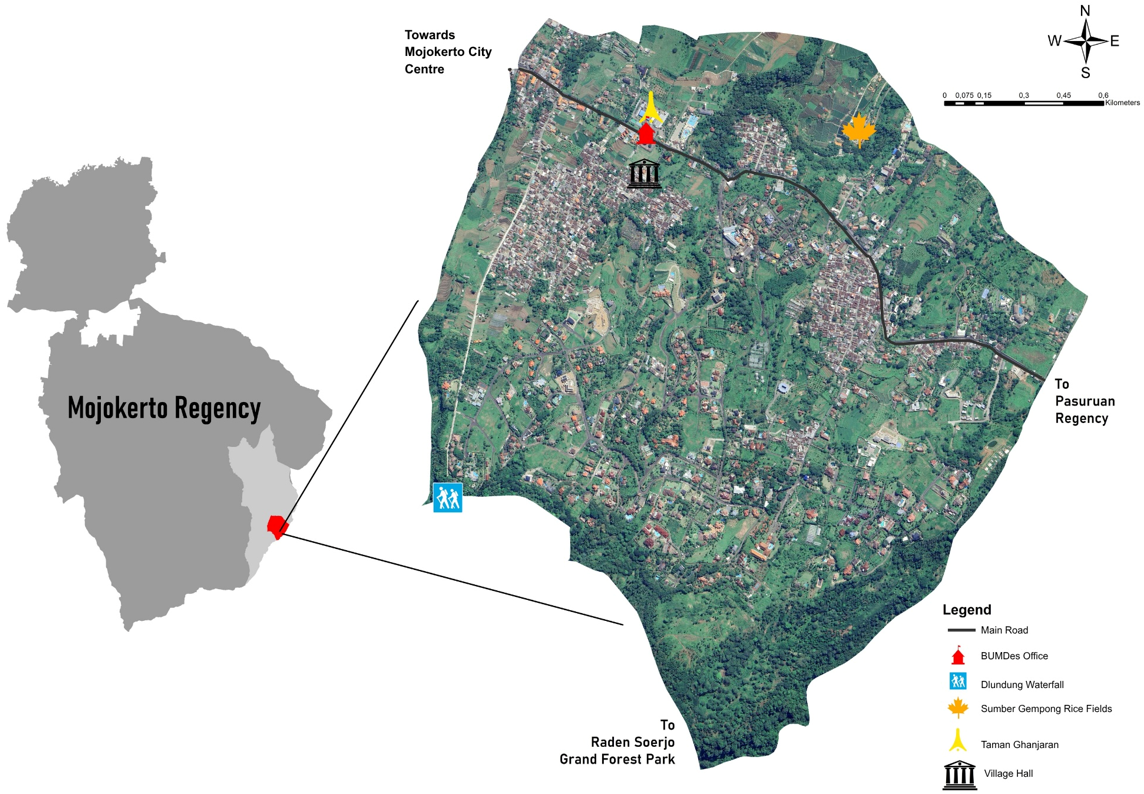
The research was conducted in Ketapanrame Village, Trawas District, Mojokerto Regency, East Java Province, Indonesia, which has received national recognition as one of the country’s best tourism villages. The selection of this site is based on its advanced institutional development through BUMDes Mutiara Welirang, diverse hamlet characteristics, and evident intra-village variation in tourism integration, offering a fertile ground to explore both governance structures and resilience outcomes. The village consists of three hamlets, namely Ketapanrame, Sukorame, and Slepi, as shown in Figure 1. These hamlets have different levels of proximity and connection to major tourism assets, including Taman Ghanjaran, Sumber Gempong, and Dlundung Waterfall.
3.2 Data sources and sampling
Data for this study were obtained through a combination of quantitative and qualitative methods to ensure a comprehensive understanding of the research variables. The primary source of quantitative data was a household survey distributed to 220 valid respondents across three hamlets—Ketapanrame, Sukorame, and Slepi—selected using proportionate stratified random sampling. Respondents were household heads or adult household representatives with permanent residency. The survey instrument was designed using structured Likert-scale questionnaires that captured livelihood capital dimensions, food security, community resilience, and institutional innovation. The livelihood capital dimensions included human capital, physical capital, natural capital, financial capital, and social capital, which were subsequently modelled as components of livelihood assets.
A minimum sample size assessment was conducted to ensure the adequacy of the survey data for PLS-SEM estimation. The assessment was based on the complexity of the revised structural model, particularly the maximum number of predictors directed at an endogenous construct. Following commonly used PLS-SEM sample size guidelines, including the ten-times rule and model-complexity-based considerations, the achieved sample of 220 valid household responses exceeded the minimum requirement for estimating the revised model. Therefore, the sample size was considered adequate for assessing both the measurement model and the structural model.
To complement the quantitative component, qualitative data were collected through semi-structured interviews with key stakeholders, including the village head, BUMDes managers, representatives of tourism awareness groups (Pokdarwis), MSME operators, and community representatives. These interviews provided contextual insights into tourism governance, social dynamics, community participation, livelihood conditions, and residents’ experiences of tourism development and resilience. A total of 18 informants were selected purposively based on their involvement in tourism governance, BUMDes-related activities, community participation, livelihood activities, and hamlet-level development processes. In addition, village archives, tourism-planning documents, and selected BUMDes institutional records were reviewed and triangulated with the survey and interview data to strengthen contextual interpretation and enhance the credibility of the findings. These documents were used primarily to provide background information on tourism development, institutional arrangements, community participation, and hamlet-level development conditions.
A. Construct Operationalization
Each latent construct was measured using multiple reflective indicators adapted from validated instruments in the literature:
Following the revised model specification, the final PLS-SEM model operationalised human capital, physical capital, natural capital, financial capital, and social capital as sustainable livelihood dimensions. Food security was included as a resilience-supporting household condition, community resilience was treated as the main endogenous resilience construct, and institutional innovation was examined as an institutional outcome associated with community resilience.
B. Reliability and Validity
Following international PLS-SEM standards, reliability and validity were assessed using:
3.4 Analytical procedures
The analysis in this study employed PLS-SEM, implemented through SmartPLS 4.0 software. This technique was selected due to its ability to simultaneously estimate both the measurement model, which links observed indicators to latent constructs, and the structural model, which depicts the hypothesized relationships among constructs. Given the study's moderate sample size and potential non-normal data distribution, PLS-SEM offered an appropriate approach to model the complex interdependencies among livelihood capital dimensions, food security, community resilience, and institutional innovation. The analysis was conducted in two stages: measurement model assessment and structural model assessment.
Model estimation proceeded by first validating the measurement model to ensure reliability and validity of all latent constructs. Indicators were assessed using outer loadings, while internal consistency was evaluated using Cronbach’s alpha, rho_A, and CR, with thresholds of 0.70 or higher indicating adequacy. Convergent validity was established through AVE, where values above 0.50 were considered acceptable. Discriminant validity was examined using the Fornell–Larcker criterion and the Heterotrait-Monotrait (HTMT) ratio, ensuring that each construct measured distinct theoretical concepts. Collinearity was assessed using Variance Inflation Factor (VIF) values before interpreting the structural relationships.
Once the measurement model was validated, the structural model was analysed. This involved estimating the path coefficients between constructs and assessing the magnitude and significance of direct effects. The revised model did not treat livelihood assets as a conventional mediating variable. Instead, livelihood assets were specified as a higher-order composite construct formed by multiple capital dimensions. The structural model therefore tested the associations from livelihood assets and food security to community resilience, and from community resilience to institutional innovation. Bootstrapping with 5,000 resamples was used to generate robust standard errors and confidence intervals for hypothesis testing. In addition to p-values and t-statistics, the model’s explanatory power was examined using R-squared (R²) and adjusted R² values for the endogenous constructs. Collinearity was assessed using VIF values before interpreting the structural paths. Effect size was assessed using f², while predictive relevance was examined using Q². These diagnostics were used to support the interpretation of the structural model while avoiding overclaiming causal effects. Accordingly, the structural model results were interpreted cautiously by considering path significance, explanatory power, effect size, predictive relevance, higher-order construct specification, and the cross-sectional nature of the data.
The decision to use PLS-SEM rather than covariance-based SEM or Confirmatory Factor Analysis (CFA) was based on methodological fit. PLS-SEM allows for exploratory testing of theoretical models and is particularly effective when analyzing models that include higher-order constructs, moderate sample sizes, and multiple constructs with reflective and composite specifications. This flexibility made it suitable for modelling the dynamic, interrelated processes that characterize community-based tourism governance and resilience. Given the cross-sectional nature of the survey, all structural paths were interpreted as statistical associations rather than definitive causal effects.
Through this approach, the study was able to provide a detailed, empirically grounded picture of how livelihood assets, social capital, food security, community resilience, and institutional innovation are interrelated in a tourism village context. The quantitative model was complemented by qualitative evidence to explain how BUMDes governance, community participation, institutional coordination, and hamlet-level tourism integration shape the context of community resilience.
3.5 Ethical considerations
This study was a non-clinical social research project and did not involve medical treatment, clinical intervention, biological sample collection, or experimental manipulation. Therefore, clinical trial registration was not applicable. The study followed standard ethical principles for social research involving human participants, including informed consent, voluntary participation, anonymity, confidentiality, and secure data storage.
Prior to data collection, all participants were informed about the objectives and procedures of the study and were asked to provide informed consent. Participation was entirely voluntary, and respondents had the right to decline participation or withdraw from the survey or interviews at any stage without any consequences. Participants were assured that their identities would remain confidential and that their responses would be used solely for academic purposes.
All collected data were anonymized before analysis, and no personally identifiable information was reported in the manuscript. Digital and physical records were stored securely and accessed only by the research team. These ethical measures were particularly important given the community-based setting, ensuring that trust, respect, confidentiality, and transparency were maintained throughout the research process.
3.6 Integration of subjective and objective data
A key strength of this research lies in its methodological triangulation, which integrated household survey data, qualitative interviews, contextual village documents, field observations, and distance-based spatial information to interpret tourism village resilience. Subjective data were gathered through household surveys capturing residents’ perceptions of livelihood capital dimensions, food security, community resilience, and institutional innovation. These perceptual indicators reflect residents’ lived experiences and provide insights into local governance and resilience processes.
Contextual evidence was derived from village records, tourism-planning documents, BUMDes institutional records, interview notes, field observations, and distance information related to tourism access, hamlet-level participation, and local infrastructure conditions. These sources were used to interpret institutional coordination, community participation, tourism integration, livelihood opportunities, and differences among hamlets.
Qualitative interviews with village leaders, tourism actors, and community representatives were used to contextualise the survey findings. Narratives concerning Slepi highlighted more limited tourism integration and different participation channels compared with the more tourism-integrated hamlets. These findings were interpreted as contextual evidence of intra-village variation in tourism access, institutional participation, and livelihood opportunities rather than as definitive proof of spatial inequality. Interview notes, village documents, field observations, and distance information were examined to identify recurring themes related to trust, participation, livelihood opportunities, food-security concerns, institutional coordination, and hamlet-level inclusion.
3.7 Limitations and mitigation strategies
Despite its methodological strengths, the study has certain limitations. First, self-reported data are subject to biases such as social desirability and recall inaccuracy, which may influence the accuracy of responses. To mitigate this, the survey instrument was carefully designed using neutral wording, and anonymity was emphasised to encourage honest reporting. Second, the study’s focus on a single village, while enabling in-depth analysis, may limit the generalisability of the findings to other tourism villages with different socio-cultural or institutional contexts. Third, the cross-sectional design limits the ability to establish temporal causality; therefore, all structural relationships are interpreted as associations.
To address this, the research adopted a comparative intra-village design, exploring three distinct hamlets with varying levels of tourism integration and infrastructure development. This internal comparison helped reveal spatial and social variation often overlooked in single-level village studies. Furthermore, the use of PLS-SEM provided robustness in testing complex associations among higher-order livelihood assets, food security, community resilience, and institutional innovation, and the integration of qualitative data added explanatory depth to the statistical findings. Together, these strategies ensured that the limitations were appropriately accounted for, and that the research remained theoretically grounded and empirically rigorous. Nevertheless, future studies should strengthen the analysis by incorporating longitudinal data, more detailed spatial indicators, and comparative evidence from multiple tourism villages.
4.1 Socioeconomic profile of respondents
As summarized in Table 1, the socioeconomic profile of respondents reveals a demographic largely composed of individuals in productive age groups, with most having attained middle-level education. This demographic characteristic is crucial as it suggests a labor force that is both active and potentially adaptive to tourism-driven transformations. The final survey dataset consisted of 220 valid household responses used for the PLS-SEM analysis. A majority of 38.5% were aged 36–45, a productive age segment likely to be involved in economic and community activities, followed by 26.0% aged 26–35, which is typically associated with early family formation and economic consolidation. The relatively small proportion of respondents over 55 (7.4%) may indicate a demographic tilt toward younger, more economically active individuals in the village. These characteristics suggest that the respondents were sufficiently positioned to evaluate household livelihood assets, food-security conditions, community resilience, and institutional participation in the tourism village context.
Table 1. Characteristics of respondents by age, education level, and household size
|
Socioeconomic Variable |
Category |
Percentage (%) |
|
Age |
17–25 years |
12.5 |
|
26–35 years |
26.0 |
|
|
36–45 years |
38.5 |
|
|
46–55 years |
15.6 |
|
|
>55 years |
7.4 |
|
|
Education Level |
No formal education |
2.1 |
|
Elementary education |
25.5 |
|
|
Junior high school |
30.7 |
|
|
Senior high school |
33.8 |
|
|
University or higher |
7.9 |
|
|
Household Size |
Small (1–3 persons) |
25.5 |
|
Medium (4–6 persons) |
66.1 |
|
|
Large (> 6 persons) |
8.4 |
In terms of education, the distribution shows that while a significant number of residents have completed junior and senior high school (30.7% and 33.8% respectively), only a small fraction (7.9%) have attained higher education. This suggests that while formal education may not be widespread beyond secondary levels, there exists a baseline of literacy and skill sufficient to engage with tourism-related livelihoods. The dominance of medium-sized households (66.1%) further reflects a typical rural family structure, potentially indicating availability of labor within households for tourism and other local economic activities. Because the study examines resilience through livelihood assets and household-level perceptions, these demographic characteristics provide important context for interpreting the PLS-SEM results rather than serving as causal predictors in the model.
4.2 Institutional role of BUMDes in tourism governance
BUMDes Ketapanrame functions as an important institutional actor in coordinating tourism activities, managing village assets, and facilitating community participation. Its locally embedded governance arrangements connect the village government, tourism awareness groups, MSME operators, community representatives, and residents in supporting tourism development. Through these arrangements, residents may participate in tourism-related employment, entrepreneurship, community forums, destination maintenance, and other supporting activities.
The qualitative evidence indicates that transparent rules, participatory decision-making, and coordination among local actors contribute to institutional trust and community engagement. The management of major tourism sites, including Taman Ghanjaran and Sawah Sumber Gempong, also demonstrates the capacity of BUMDes to coordinate village assets and tourism-related activities within a community-based governance framework. These institutional arrangements provide an important context for interpreting the positive relationship between community resilience and institutional innovation identified in the PLS-SEM model.
However, access to tourism-related opportunities remains uneven across the three hamlets. Residents living near major tourism assets appear to have more direct opportunities for employment, entrepreneurship, and participation, whereas residents in less tourism-integrated hamlets rely on more indirect livelihood and institutional channels. This variation suggests that institutional effectiveness should be assessed not only through formal participation mechanisms but also through the extent to which tourism opportunities are accessible across different parts of the village.
Table 2. Qualitative evidence on tourism governance and community participation
|
Theme |
Contextual Evidence |
Relevance to This Study |
|
Institutional coordination |
BUMDes coordinates with village government, tourism groups, MSME operators, and community representatives |
Provides the governance context for institutional innovation |
|
Community participation |
Residents participate through community forums, tourism-related employment, entrepreneurship, and destination-supporting activities |
Supports the role of social capital and livelihood participation |
|
Institutional trust |
Interview evidence indicates that transparency and locally embedded coordination strengthen confidence in village institutions |
Helps interpret the strong contribution of social capital |
|
Hamlet-level variation |
Tourism participation differs according to tourism functions, institutional access, and proximity to major tourism assets |
Supports the intra-village equity analysis |
|
Inclusive governance needs |
Less tourism-integrated hamlets require stronger representation and broader access to tourism-related opportunities |
Supports place-based and equity-oriented policy recommendations |
Table 2 summarises qualitative evidence on institutional coordination, community participation, institutional trust, hamlet-level variation, and inclusive governance needs. These findings position BUMDes primarily as a resilience-supporting governance institution rather than as a financial or business model. They also highlight the importance of broadening representation, strengthening participation from less tourism-integrated hamlets, and preventing excessive concentration of tourism benefits among residents already closely connected to major tourism assets.
4.3 Social capital in tourism-based livelihoods
As shown in Table 3, indicators of social capital in Ketapanrame reveal a socially cohesive environment that is conducive to collective decision-making and tourism governance. Participation rates in community events (78.4%) and decision-making forums (65.3%) indicate that residents are not passive beneficiaries but active stakeholders in shaping local development agendas. The interview evidence further suggests that social capital was expressed not only through formal community participation but also through residents’ involvement in tourism maintenance, parking management, local stalls, community forums, and other tourism-supporting activities.
Table 3. Community participation and trust in local institutions
|
Social Capital Indicators |
Level of Participation (%) |
Level of Trust (%) |
|
Participation in events |
78.4 |
- |
|
Decision-making involvement |
65.3 |
- |
|
Trust in BUMDes |
- |
82.7 |
|
Trust in village leaders |
- |
76.4 |
Institutional trust levels are also high, with 82.7% of respondents expressing confidence in BUMDes and 76.4% in village leadership. These findings signal a fertile environment for social innovation, where institutional actors can rely on community support to implement tourism policies. Moreover, such high social capital plays a critical role in mitigating risks, ensuring cooperation in crisis contexts, and amplifying the effectiveness of institutional interventions. This interpretation is consistent with the PLS-SEM finding that social capital was the strongest contributor to livelihood assets. In Ketapanrame, trust and participation appear to operate as relational resources that enable residents to access livelihood opportunities, participate in tourism-related activities, and support collective resilience.
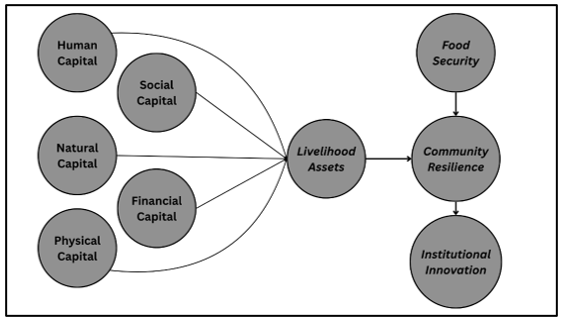
The relationships among livelihood capital dimensions, livelihood assets, food security, community resilience, and institutional innovation are summarized in Figure 2. The figure clarifies that human, social, natural, financial, and physical capital are positioned as components of livelihood assets, while food security is treated as a direct resilience-supporting condition. This visual model helps distinguish the revised higher-order livelihood asset specification from the earlier unsupported mediation claim.
Figure 2. Governance–livelihood–resilience mechanism in Ketapanrame
4.4 Resilience of tourism village system
The measurement of resilience indicators across the hamlets reveals notable intra-village variation. As shown in Table 4, the three hamlets differ in their distance to the main tourism areas, namely Taman Ghanjaran, Sumber Gempong, and Dlundung Waterfall. Ketapanrame, as the village center and administrative hub, leads across all resilience dimensions: employment in tourism (72.1%), household income diversification (64.8%), and community adaptability (75.5%). This performance likely correlates with better access to infrastructure, greater institutional presence, and strategic location. To avoid overclaiming, these differences are interpreted as descriptive evidence of uneven tourism integration rather than definitive proof of spatial inequality.
In contrast, Slepi hamlet exhibits lower resilience-related indicators, with tourism participation at only 24.4%, income diversification at 31.5%, and adaptability perception at 35.2%, as shown in Table 5. Although Table 4 shows that Slepi is not physically very distant from Taman Ghanjaran and Sumber Gempong, it does not function as a major tourism node and has more limited direct tourism activities.
Table 4. Distance from each hamlet to main tourism areas (km)
|
Hamlet |
Taman Ghanjaran |
Sumber Gempong |
Dlundung Waterfall |
Spatial Position |
|
Ketapanrame |
0 |
2.0 |
0 |
Core |
|
Sukorame |
1.0 |
0 |
3.6 |
Semi-core |
|
Slepi |
1.3 |
1.5 |
3.4 |
Tourism edge |
Table 5. Indicators of economic diversification and adaptability by hamlet
|
Indicator |
Ketapanrame (%) |
Sukorame (%) |
Slepi (%) |
|
Tourism employment participation |
72.1 |
68.3 |
24.4 |
|
Household income diversification |
64.8 |
58.7 |
31.5 |
|
Community adaptability perception |
75.5 |
69.8 |
35.2 |
This suggests that intra-village variation is not determined by distance alone, but also by differences in tourism functions, institutional engagement, and household participation in tourism-related livelihood channels. Sukorame occupies an intermediate position because it has direct proximity to Sumber Gempong, while Ketapanrame functions as a core tourism area due to its direct connection with Taman Ghanjaran and Dlundung Waterfall. These variations underscore the need for place-based policy instruments that address not only geographic access but also livelihood participation, institutional inclusion, and benefit distribution across hamlets.
4.5 Partial Least Squares Structural Equation Modelling model of livelihood assets, food security, community resilience, and institutional innovation
Before interpreting the structural relationships, the measurement model was assessed using retained indicators, outer loadings, Cronbach’s alpha, rho_A, CR, AVE, and discriminant validity statistics. Table 6 reports the retained indicators and reliability-validity statistics, while Table 7 presents the retained outer loadings for each construct. The revised PLS-SEM model no longer treats institutional innovation as the main predictor of economic resilience. Instead, it examines how livelihood capital dimensions form livelihood assets, how livelihood assets and food security are associated with community resilience, and how community resilience is associated with institutional innovation.
The structural model results in Table 8 show that social capital was the strongest contributor to livelihood assets (β = 0.666, t = 18.741, p < 0.001), followed by physical capital (β = 0.345, t = 11.727, p < 0.001) and financial capital (β = 0.107, t = 2.425, p = 0.016). Human capital showed a significant negative association with livelihood assets (β = -0.166, t = 3.448, p = 0.001), while natural capital was not statistically significant (β = -0.053, t = 0.925, p = 0.355). These results indicate that livelihood assets in Ketapanrame are more strongly shaped by relational, physical, and financial resources than by natural-resource availability alone.
Table 6. Measurement model assessment
|
Construct |
Retained Indicators |
Cronbach’s Alpha |
rho_A |
CR |
AVE |
|
Community Resilience |
CR1, CR2, CR9 |
0.799 |
0.799 |
0.883 |
0.717 |
|
Financial Capital |
K1, K2, K3 |
0.778 |
0.824 |
0.868 |
0.687 |
|
Food Security |
FC2, FC6, FC10, FC12 |
0.810 |
0.907 |
0.871 |
0.629 |
|
Human Capital |
HC1, HC2, HC3 |
0.703 |
0.703 |
0.834 |
0.627 |
|
Institutional Innovation |
I2, I5, I6 |
0.835 |
0.986 |
0.897 |
0.745 |
|
Natural Capital |
A1, A3 |
0.725 |
0.994 |
0.867 |
0.766 |
|
Physical Capital |
F3, F4, F6 |
0.783 |
0.794 |
0.872 |
0.695 |
|
Social Capital |
SC1, SC4, SC7, SC8, SC12 |
0.845 |
0.848 |
0.890 |
0.618 |
Table 7. Retained indicator loadings
|
Construct |
Indicators and Outer Loadings |
|
Community Resilience |
CR1 = 0.851; CR2 = 0.915; CR9 = 0.767 |
|
Financial Capital |
K1 = 0.874; K2 = 0.841; K3 = 0.768 |
|
Food Security |
FC10 = 0.869; FC12 = 0.804; FC2 = 0.718; FC6 = 0.772 |
|
Human Capital |
HC1 = 0.805; HC2 = 0.777; HC3 = 0.792 |
|
Institutional Innovation |
I2 = 0.806; I5 = 0.938; I6 = 0.840 |
|
Natural Capital |
A1 = 0.954; A3 = 0.789 |
|
Physical Capital |
F3 = 0.821; F4 = 0.857; F6 = 0.822 |
|
Social Capital |
SC1 = 0.762; SC12 = 0.758; SC4 = 0.814; SC7 = 0.772; SC8 = 0.822 |
Table 8. Bootstrapped structural path coefficients
|
Path |
β |
t-Value |
p-Value |
Interpretation |
|
Social Capital → Livelihood Assets |
0.666 |
18.741 |
0.000 |
Significant positive association |
|
Physical Capital → Livelihood Assets |
0.345 |
11.727 |
0.000 |
Significant positive association |
|
Financial Capital → Livelihood Assets |
0.107 |
2.425 |
0.016 |
Significant positive association |
|
Human Capital → Livelihood Assets |
-0.166 |
3.448 |
0.001 |
Significant negative association |
|
Natural Capital → Livelihood Assets |
-0.053 |
0.925 |
0.355 |
Not significant |
|
Livelihood Assets → Community Resilience |
0.541 |
8.232 |
0.000 |
Significant positive association |
|
Food Security → Community Resilience |
0.202 |
2.975 |
0.003 |
Significant positive association |
|
Community Resilience → Institutional Innovation |
0.173 |
2.936 |
0.003 |
Significant positive association |
Although all retained constructs met the recommended reliability and convergent validity thresholds reported in Table 6 and Table 7, the reliability values for some constructs should be interpreted with caution. Natural Capital was retained with only two indicators (A1 and A3), while Institutional Innovation and Natural Capital showed very high rho_A values. Such high reliability values may indicate strong internal consistency, but they may also suggest potential item redundancy or limited conceptual coverage when a construct is represented by a small number of indicators. Therefore, these constructs were retained because they satisfied the minimum statistical criteria, but their interpretation was made cautiously and remained grounded in the theoretical framework and qualitative evidence.
As further shown in Table 8, livelihood assets were positively associated with community resilience (β = 0.541, t = 8.232, p < 0.001), indicating that stronger livelihood resources are linked to higher perceived community resilience. Food security was also positively associated with community resilience (β = 0.202, t = 2.975, p = 0.003), suggesting that food-security conditions function as an important resilience-supporting factor in the tourism village context. Community resilience was positively associated with institutional innovation (β = 0.173, t = 2.936, p = 0.003), although Table 9 indicates that the explanatory power for institutional innovation was weak.
As shown in Table 9, the model explained 49.4% of the variance in community resilience, indicating moderate explanatory power. The R² value for livelihood assets reached 1.000 because livelihood assets were modelled as a higher-order composite construct formed by multiple capital dimensions. Therefore, this value should not be interpreted as a conventional endogenous R² but as a consequence of the higher-order construct specification. Given the cross-sectional design, all relationships are interpreted as statistical associations rather than causal effects.
Table 9. Model explanatory power
|
Endogenous Construct |
R² |
R² Adjusted |
Interpretation |
|
Livelihood Assets |
1.000 |
1.000 |
Higher-order composite construct; not interpreted as conventional endogenous R² |
|
Community Resilience |
0.494 |
0.489 |
Moderate explanatory power |
|
Institutional Innovation |
0.030 |
0.026 |
Weak explanatory power |
As shown in Table 10, all VIF values were below the recommended threshold of 5, indicating that collinearity did not pose a critical concern for interpreting the structural paths. The f² values indicate that livelihood assets had a medium effect on community resilience, while food security had a small effect. Community resilience also had a small effect on institutional innovation. The f² values for the paths from the livelihood capital dimensions to livelihood assets were extremely large because livelihood assets was specified as a higher-order composite construct formed by these dimensions. Therefore, these f² values should not be interpreted in the same way as conventional predictor effects in a standard reflective structural model. Instead, they confirm the dominant contribution of livelihood capital dimensions to the formation of the higher-order livelihood assets construct. The Q² values for community resilience and livelihood assets were above zero, indicating predictive relevance, while the Q² value for institutional innovation was positive but weak. These results support the model’s predictive relevance while reinforcing the need to interpret institutional innovation cautiously because of its weak explanatory and predictive power.
Table 10. Collinearity, effect size, and predictive relevance assessment
|
Path |
VIF |
f² |
Effect Size Interpretation |
Q² |
Predictive Relevance Interpretation |
|
Livelihood Assets → Community Resilience |
2.153 |
0.268 |
Medium effect |
0.339 |
Predictive relevance |
|
Food Security → Community Resilience |
2.153 |
0.037 |
Small effect |
0.339 |
Predictive relevance |
|
Community Resilience → Institutional Innovation |
1.000 |
0.031 |
Small effect |
0.017 |
Weak predictive relevance |
|
Social Capital → Livelihood Assets |
1.535 |
1493.625 |
Very large effect, interpreted cautiously due to higher-order construct specification |
0.271 |
Predictive relevance |
|
Physical Capital → Livelihood Assets |
1.518 |
403.848 |
Very large effect, interpreted cautiously due to higher-order construct specification |
0.271 |
Predictive relevance |
|
Human Capital → Livelihood Assets |
1.135 |
125.810 |
Very large effect, interpreted cautiously due to higher-order construct specification |
0.271 |
Predictive relevance |
|
Financial Capital → Livelihood Assets |
1.051 |
55.977 |
Very large effect, interpreted cautiously due to higher-order construct specification |
0.271 |
Predictive relevance |
|
Natural Capital → Livelihood Assets |
1.044 |
14.020 |
Very large effect, interpreted cautiously due to higher-order construct specification |
0.271 |
Predictive relevance |
4.6 Qualitative triangulation of PLS-SEM findings
The qualitative evidence summarised in Table 2 and the participation–trust indicators in Table 3 help explain why social capital and livelihood assets were central in the PLS-SEM model. Interviews indicated that community participation in Ketapanrame extended beyond formal meetings to tourism-related employment, parking management, food stalls, attraction maintenance, local service provision, and community forums. These multiple forms of participation help explain why social capital contributed strongly to livelihood assets and why livelihood assets were positively associated with community resilience.
5.1 Livelihood assets, food security, and community resilience
The revised PLS-SEM results indicate that community resilience in Ketapanrame is more directly associated with livelihood assets and food security than with institutional innovation as an initial predictor. These findings suggest that resilience in tourism villages should be understood not only through formal governance arrangements, but also through the household and community resources that enable residents to maintain livelihoods, adapt to tourism-related changes, and participate in local economic opportunities. Compared to top-down tourism frameworks that often marginalize local voices [50, 51], Ketapanrame’s institutional context demonstrates how community-based organizations can reduce dependency on external actors while increasing local ownership of tourism outcomes [25, 52].
The structural model shows that livelihood assets were positively associated with community resilience (β = 0.541, p < 0.001), while food security was also positively associated with community resilience (β = 0.202, p = 0.003). This finding supports broader evidence that BUMDes can serve as engines of both economic and social transformation when grounded in democratic governance, inclusive participation, and equitable access to tourism opportunities [53]. However, the revised results suggest that BUMDes-based institutional arrangements operate through livelihood and resilience mechanisms rather than through a simple direct effect of institutional innovation on economic resilience.
5.2 Social capital as the strongest component of livelihood assets
The role of social capital in facilitating village resilience is reinforced by its strong contribution to livelihood assets. The PLS-SEM results show that social capital was the strongest contributor to livelihood assets (β = 0.666, p < 0.001), exceeding the effects of physical and financial capital. High levels of trust in BUMDes and local leadership (82.7% and 76.4% respectively), coupled with robust community participation, illustrate the relational infrastructure that enables coordinated responses to tourism challenges [36, 54].
The significant negative association between human capital and livelihood assets should be interpreted with caution. This result does not suggest that human capital weakens livelihood development. Rather, it may indicate that formal education and skill-related indicators do not directly translate into participation in locally embedded tourism-based livelihoods. In Ketapanrame, livelihood assets appear to be more strongly shaped by social networks, physical access, household livelihood resources, and community involvement than by formal human-capital attributes. Residents with higher education or formal skills may also pursue livelihood opportunities outside village-based tourism activities, reducing their dependence on BUMDes-related livelihood channels. Therefore, this result reflects a context-specific mismatch between formal human-capital indicators and the community-based mechanisms through which tourism livelihood assets are mobilised.
In line with earlier studies, these results confirm that social capital operates as a vital enabler of collaborative governance and innovation [34, 55]. In Ketapanrame, social cohesion appears to support livelihood mobilisation by enabling residents to participate in tourism work, parking management, food stalls, attraction maintenance, community forums, and other tourism-related activities. These dynamic counters the risks of institutional capture or over-tourism identified in other tourism-dependent villages [56]. The qualitative evidence indicates that many village households were involved in tourism-related activities through employment, entrepreneurship, service provision, community participation, or destination-supporting roles.
Moreover, the significance of social capital in supporting livelihood assets underscores its function as a resilience-enhancing asset beyond economic returns. Communities with dense trust networks and shared norms demonstrate higher flexibility in managing uncertainty, thus transforming social cohesion into an adaptive advantage [27, 54]. This explains why social capital is central in the revised model: trust and participation allow residents to mobilise collective resources, access tourism-related opportunities, and sustain community resilience during periods of tourism fluctuation.
5.3 Intra-village variation, hamlet inclusion, and livelihood equity
Despite village-wide improvements, intra-village variation between Ketapanrame, Sukorame, and Slepi indicates that resilience-related gains are not evenly experienced across hamlets. Slepi’s lower tourism employment participation, income diversification, and adaptability perception mirrors literature on the consequences of asymmetric infrastructure, institutional access, and social capital [57, 58]. However, these results should be interpreted as descriptive evidence of uneven tourism integration rather than definitive proof of spatial inequality, because stronger spatial evidence such as distance measures, infrastructure indices, and hamlet-level income data remains limited.
The findings suggest that unless inclusive governance mechanisms deliberately engage less tourism-integrated hamlets, community-based tourism risks reinforcing existing inequalities [4, 59]. Participatory models must extend beyond village centers, incorporating peripheral voices into decision-making and ensuring equitable access to tourism-related opportunities. The literature highlights how institutional innovation must be spatially sensitive to counteract exclusionary patterns [60]. In Ketapanrame, this means that tourism governance should not only maintain successful village-scale enterprises, but also ensure that tourism-related livelihood opportunities reach residents with weaker proximity to major tourism assets.
In Ketapanrame, the divergence in hamlet-level resilience indicators reflects the limits of centralized governance even within community-driven models. The case underscores the need for targeted interventions, such as infrastructure investment, capacity-building programs, and localized social capital mobilization in less tourism-integrated hamlets. Such interventions should be supported by systematic monitoring of tourism participation, access to BUMDes-supported opportunities, food-security conditions, and access to livelihood assets across hamlets.
5.4 Institutional innovation as an outcome of community resilience
These findings offer practical insights for policy and practice in strengthening inclusive tourism village governance. First, the Ketapanrame case suggests that institutional innovation is linked to community resilience rather than functioning only as its initial driver. The PLS-SEM results show that community resilience was positively associated with institutional innovation (β = 0.173, p = 0.003), although the explanatory power for institutional innovation was weak. This indicates that participatory governance structures—such as inclusive decision-making, transparent BUMDes management, and community representation— may broaden access to tourism-related opportunities and enhance institutional legitimacy [52, 55], but they are also reinforced by a resilient and economically engaged community.
Second, to promote equitable resilience, future village tourism policies must prioritize bridging gaps between more tourism-integrated and less tourism-integrated hamlets. This includes: (1) investing in roads and public infrastructure; (2) creating digital platforms to support tourism marketing from less visible hamlets; (3) expanding training programs to enhance entrepreneurship and organizational capacity in underserved areas; (4) integrating food-security-sensitive livelihood support into tourism governance; and (5) monitoring the distribution of BUMDes-related benefits across hamlets [31, 61].
Third, strengthening village-level institutions requires sustained efforts to cultivate social capital through inclusive forums, inter-dusun collaboration, and transparent conflict-resolution mechanisms. Policies should institutionalize meaningful community participation, ensuring that tourism governance is democratic not only in form but also in its distributional outcomes [19]. In Ketapanrame, participation in tourism-related governance arrangements illustrates how transparent rules, inclusive engagement, and locally embedded cooperation may strengthen institutional legitimacy. These mechanisms should be maintained while preventing the excessive concentration of tourism benefits among residents already connected to major tourism assets.
Finally, adaptive governance should remain a central principle of tourism development. The COVID-19 pandemic demonstrated that tourism systems supported by responsive, transparent, and inclusive institutions are better positioned to withstand shocks and strengthen community resilience [53, 62]. The Ketapanrame case further indicates that adaptive governance depends on accountable institutional arrangements, continued community participation, and the capacity to align tourism activities with local development priorities. Documentary evidence provided contextual indications that tourism-generated resources contributed to village development and community-oriented activities. These findings support the interpretation that institutional resilience is maintained through transparent governance, adaptive resource management, and sustained community engagement.
5.5 Limitations and directions for future research
While the study provides evidence of the livelihood assets–food security–community resilience–institutional innovation nexus, its scope is limited by several methodological and contextual factors. First, as a cross-sectional study focused on a single village, its findings may not fully capture temporal dynamics or be generalizable across Indonesia’s diverse tourism villages [27]. Therefore, the structural relationships identified in the model should be interpreted as associations rather than causal effects.
Second, reliance on perception-based indicators for constructs like livelihood assets, food security, and community resilience introduces subjectivity, which may not fully reflect objective conditions. Mixed-method approaches—combining surveys with ethnographic fieldwork—could yield richer insights [63]. Although this study triangulated survey results with interviews and contextual institutional documents, future research should include more detailed hamlet-level spatial and economic indicators.
Third, the resilience indicators employed, while comprehensive, may not sufficiently account for cultural or ecological dimensions of resilience. Future research could integrate qualitative narratives and environmental data to complement socioeconomic metrics [42, 60]. This is particularly important because natural capital was not statistically significant in the revised model, even though environmental assets remain central to tourism attractiveness. Future studies should therefore examine whether natural capital affects resilience indirectly through destination attractiveness, tourism flows, or environmental governance.
Moving forward, comparative case studies across multiple villages can illuminate how different configurations of institutional innovation, social capital, livelihood assets, and food security influence resilience. Furthermore, PLS-SEM modeling can be extended with longitudinal data to assess temporal relationships over time. The development of multidimensional resilience indices—capturing economic, social, cultural, and ecological dimensions—also holds promise for advancing community-based tourism governance models [64, 65]. Future research should also test whether the pathway from community resilience to institutional innovation holds in other BUMDes-based tourism villages or whether it is specific to Ketapanrame’s governance context.
In conclusion, this study lays the groundwork for more inclusive, adaptive, and empirically grounded approaches to tourism village resilience. Its findings reaffirm that institutional and social dimensions are not peripheral but central to shaping sustainable and equitable tourism futures in rural communities. More specifically, the findings show that social capital, livelihood assets, and food security are central conditions for community resilience, while institutional innovation is linked to the capacity of a resilient community to sustain local governance arrangements.
This study concludes that community resilience in Ketapanrame Tourism Village is strongly associated with livelihood assets and food security, while social capital is the most important contributor to livelihood assets. The participatory governance structure observed in Ketapanrame supports community involvement, institutional trust, and broader access to tourism-related livelihood opportunities. Social capital emerges as a critical enabler of resilience by fostering trust, participation, cooperation, and adaptability. Rather than identifying institutional innovation as a simple direct driver of economic resilience, the revised model shows that community resilience is positively associated with institutional innovation, although its explanatory power remains limited.
The findings also reveal meaningful intra-village variation between more tourism-integrated and less tourism-integrated hamlets. These differences underline the need for policies that strengthen infrastructure, local capacity, food-security-sensitive livelihood strategies, and meaningful participation beyond the village’s principal tourism areas. Addressing these gaps is essential for ensuring that tourism development contributes to equitable and sustainable rural transformation.
This study contributes to community-based tourism research by integrating livelihood capital dimensions, food security, community resilience, and institutional innovation within a single empirical model. It also demonstrates the value of examining variation within a village rather than treating rural tourism communities as socially and spatially homogeneous. Resilient tourism villages must ultimately be grounded in livelihood security, institutional trust, inclusive governance, and collective agency.
This research was funded by the Professor Research Grant Program Batch 2, Fiscal Year 2025, Contract No. 24/UN10.F0801/B/PT/2025.
This study involved adult respondents and key informants in a non-clinical social science context. Participation was voluntary, and informed consent was obtained from respondents and interview informants before data collection. No clinical intervention or biomedical procedure was conducted.
[1] Chin, C.H. (2022). Empirical research on the competitiveness of rural tourism destinations: A practical plan for rural tourism industry post-COVID-19. Consumer Behavior in Tourism and Hospitality, 17(2): 211-231. https://doi.org/10.1108/cbth-07-2021-0169
[2] Dolon, M.J.F., Ferdous, M., Hossain, M.A. (2025). Perceptions of tourism impacts and community resilience to natural disasters in Tanguarhaor, Sunamganj. GeoJournal of Tourism and Geosites, 59(2): 978-987. https://doi.org/10.30892/gtg.59241-1473
[3] Hutagalung, H., Purwana, D., Suhud, U., Mukminin, A., Hamidah, H., Rahayu, N. (2022). Community self-reliance of rural tourism in Indonesia: An interpretative phenomenological analysis. The Qualitative Report, 27(7): 1151-1168. https://doi.org/10.46743/2160-3715/2022.5215
[4] Praptika, I.P.G.E., Yusuf, M., Heslinga, J.H. (2024). How can communities better prepare for future disasters? Learning from the tourism community resilience model from Bali, Indonesia. Journal of Tourism Futures, 10(3): 504-523. https://doi.org/10.1108/JTF-04-2023-0092
[5] Prayitno, G., Hayat, A., Efendi, A., Auliah, A., Farrah, A.I. (2022). Structural equation model the development of the COVID 19 community resilience in Pujon Kidul Tourism Village. GeoJournal of Tourism and Geosites, 43(3): 925-936. https://doi.org/10.30892/gtg.43312-906
[6] Hermawan, A., Guntoro, B., Sulhan, M. (2024). Community engagement for disaster preparedness in rural areas of Mount Merapi, Indonesia. International Journal of Sustainable Development and Planning, 19(4): 1505-1518. https://doi.org/10.18280/ijsdp.190427
[7] Sun, K.K., Xing, Z.Y., Cao, X., Li, W.J. (2021). The regime of rural ecotourism stakeholders in poverty-stricken areas of China: Implications for rural revitalization. International Journal of Environmental Research and Public Health, 18(18): 9690. https://doi.org/10.3390/ijerph18189690
[8] Jiang, G.Y., Gao, W.J., Xu, M., Tong, M.J., Liu, Z.H. (2023). Geographic information visualization and sustainable development of low-carbon rural slow tourism under artificial intelligence. Sustainability, 15(4): 3846. https://doi.org/10.3390/su15043846
[9] Yi, J., Ryan, C., Wang, D.G. (2020). China's village tourism committees: A social network analysis. Journal of Travel Research, 60(1): 117-132. https://doi.org/10.1177/0047287519892324
[10] Tong, J.H., Li, Y., Yang, Y.L. (2024). System construction, tourism empowerment, and community participation: The sustainable way of rural tourism development. Sustainability, 16(1): 422. https://doi.org/10.3390/su16010422
[11] Firdaus, Hardjosoekarto, S., Lawang, R.M.Z. (2021). The role of local government on rural tourism development: Case study of Desa Wisata Pujonkidul, Indonesia. International Journal of Sustainable Development and Planning, 16(7): 1299-1307. https://doi.org/10.18280/ijsdp.160710
[12] Saputro, K.E.A., Hasim, Karlinasari, L., Beik, I.S. (2023). Evaluation of sustainable rural tourism development with an integrated approach using MDS and ANP methods: Case study in Ciamis, West Java, Indonesia. Sustainability, 15(3): 1835. https://doi.org/10.3390/su15031835
[13] Prayitno, G., Dinanti, D., Adrianto, D.W., Rahmawati, R., Auliah, A., Wardhani, L.E. (2023). The influence of social capital in improving the quality of life of the community in Sidomulyo tourism village, Indonesia. GeoJournal of Tourism and Geosites, 46(1): 208-217. https://doi.org/10.30892/gtg.46123-1017
[14] Tuya, J.H., Mahmud, K.H. (2024). Socio-demography induced social capital for community resilience in Bangladesh. Geo: Geography and Environment, 11(1): e00137. https://doi.org/10.1002/geo2.137
[15] Prayitno, G., Hayat, A., Efendi, A., Auliah, A., Dinanti, D. (2022). Structural model of community social capital for enhancing rural communities adaptation against the COVID-19 pandemic: Empirical evidence from Pujon Kidul Tourism Village, Malang Regency, Indonesia. Sustainability, 14(19): 12949. https://doi.org/10.3390/su141912949
[16] Chen, Y., Liu, H., Lin, S.C., Wang, Y.P., Zhang, Q., Feng, L.L. (2024). The impact of social capital on community resilience: A comparative study of seven flood-prone communities in Nanjing, China. Land, 13(8): 1145. https://doi.org/10.3390/land13081145
[17] Ćurčić, N., Svitlica, A.M., Brankov, Ј., Bjeljac, Ž., Pavlović, S., Jandžiković, B. (2021). The role of rural tourism in strengthening the sustainability of rural areas: The case of Zlakusa Village. Sustainability, 13(12): 6747. https://doi.org/10.3390/su13126747
[18] Yasir, Y., Firzal, Y., Sulistyani, A., Yesicha, C. (2021). Penta Helix communication model through community based tourism (CBT) for tourism village development in Koto Sentajo, Riau, Indonesia. GeoJournal of Tourism and Geosites, 37(3): 851-860. https://doi.org/10.30892/gtg.37316-718
[19] Tomay, K., Tuboly, E. (2022). The role of social capital and trust in the success of local wine tourism and rural development. Sociologia Ruralis, 63(1): 200-222. https://doi.org/10.1111/soru.12396
[20] Wu, M.Y., Tong, Y.X., Li, Q.C., Wall, G., Wu, X.F. (2022). Interaction rituals and social relationships in a rural tourism destination. Journal of Travel Research, 62(7): 1480-1496. https://doi.org/10.1177/00472875221130495
[21] Wang, G., Huang, L.M., Xu, C.L., He, K., Shen, K., Liang, P.Y. (2022). Analysis of the mediating role of place attachment in the link between tourists' authentic experiences of, involvement in, and loyalty to rural tourism. Sustainability, 14(19): 12795. https://doi.org/10.3390/su141912795
[22] Kastenholz, E., Cunha, D., Cunha, C., et al. (2022). COVID-19, wine routes, crisis management and resilience amongst rural wine tourism businesses. Advances in Hospitality and Tourism Research, 10(1): 1-26. https://doi.org/10.30519/ahtr.929800
[23] Guzal-Dec, D.J., Zwolińska-Ligaj, M.A. (2023). How to deal with crisis? Place attachment as a factor of resilience of urban-rural communes in Poland during the COVID-19 pandemic. Sustainability, 15(7): 6222. https://doi.org/10.3390/su15076222
[24] Hassan, T.H., Salem, A.E., Abdelmoaty, M.A. (2022). Impact of rural tourism development on residents' satisfaction with the local environment, socio-economy and quality of life in Al-Ahsa Region, Saudi Arabia. International Journal of Environmental Research and Public Health, 19(7): 4410. https://doi.org/10.3390/ijerph19074410
[25] Shan, A.S.S., Septemuryantoro, S.A. (2023). Management of tourism village governance in the new normal era. Proceeding of International Conference on Digital Advance Tourism, Management and Technology, 1(2): 145-151. https://doi.org/10.56910/ictmt.v1i2.31
[26] Salsabila, A.P., Prayitno, G., Wicaksono, A.D., Nugraha, A.T., Siankwilimba, E., Dinanti, D. (2025). Inclusive creative tourism through batik ciprat: Empowering individuals with intellectual disabilities in Karangpatihan Village—Indonesia. Tourism and Hospitality, 6(4): 177. https://doi.org/10.3390/tourhosp6040177
[27] Auliah, A., Prayitno, G., Ari, I.R.D., et al. (2025). The role of community social capital and collective action in the development of sustainable tourism. International Social Science Journal, 75(256): 311-325. https://doi.org/10.1111/issj.12554
[28] Dewi, P.P., Prayitno, G., Dinanti, D. (2021). Social capital of the Pujon Kidul tourism village community in facing the COVID-19 pandemic. GeoJournal of Tourism and Geosites, 38(4): 1239-1246. https://doi.org/10.30892/gtg.38431-765
[29] Gardner, M., Webber, D.J., Parry, G., Bradley, P. (2021). COVID-19: How community businesses in England struggled to respond to their communities' needs. Local Economy: The Journal of the Local Economy Policy Unit, 36(6): 524-540. https://doi.org/10.1177/02690942211056034
[30] Meyer, M.R.U., Prochnow, T., Pickett, A.C., et al. (2021). The effects of play streets on social and community connectedness in rural communities. International Journal of Environmental Research and Public Health, 18(19): 9976. https://doi.org/10.3390/ijerph18199976
[31] Prayitno, G., Fikriyah, F., Efendi, A., et al. (2024). Social capital and community adaptation to the COVID-19 pandemic (empirical evidence: Sambirejo Village, Special Region of Yogyakarta, Indonesia). Journal of Regional and City Planning, 35(2): 180-200. https://doi.org/10.5614/jpwk.2024.35.2.4
[32] Joshi, S., Panzer-Krause, S., Zerbe, S., Saurwein, M. (2023). Rural tourism in Europe from a landscape perspective: A systematic review. European Journal of Tourism Research, 36: 3616. https://doi.org/10.54055/ejtr.v36i.3328
[33] Triyuni, N.N., Bagiastuti, N.K., Suparta, I.K., Sukmawati, N.M.R. (2021). Tetrapreneur model in sustaining tourism during COVID-19 pandemic in Bongkasa Pertiwi Village, Badung Regency. In Proceedings of the International Conference on Applied Science and Technology on Social Science (ICAST-SS 2020), Padang, Indonesia, pp. 347-351. https://doi.org/10.2991/assehr.k.210424.067
[34] Putra, T. (2019). A review on Penta Helix actors in village tourism development and management. Journal of Business on Hospitality and Tourism, 5(1): 63-75. https://doi.org/10.22334/jbhost.v5i1.150
[35] Diener, E. (2009). Assessing Well-Being: The Collected Works of Ed Diener. Springer Dordrecht. https://doi.org/10.1007/978-90-481-2354-4
[36] Munanura, I.E., Sabuhoro, E., Hunt, C.A., Ayorekire, J. (2021). Livelihoods and tourism: Capital assets, household resiliency, and subjective wellbeing. Tourism and Hospitality, 2(4): 347-364. https://doi.org/10.3390/tourhosp2040023
[37] Ali, F., Kim, W.G., Li, J., Cobanoglu, C. (2018). A comparative study of covariance and partial least squares based structural equation modelling in hospitality and tourism research. International Journal of Contemporary Hospitality Management, 30(1): 416-435. https://doi.org/10.1108/IJCHM-08-2016-0409
[38] Hair, J.F., Risher, J.J., Sarstedt, M., Ringle, C.M. (2019). When to use and how to report the results of PLS-SEM. European Business Review, 31(1): 2-24. https://doi.org/10.1108/EBR-11-2018-0203
[39] Sarstedt, M., Ringle, C.M., Cheah, J.H., Ting, H., Moisescu, O.I., Radomir, L. (2020). Structural model robustness checks in PLS-SEM. Tourism Economics, 26(4): 531-554. https://doi.org/10.1177/1354816618823921
[40] Fan, Y.D., Mohd Isa, S., Yang, S.H., Zhu, T.T. (2024). Exploring the triggering mechanism of different word-of-mouth intentions by guest experience and well-being perception. SAGE Open, 14(2). https://doi.org/10.1177/21582440241264015
[41] Wei, Z., Qiu, H.L., Morrison, A.M. (2023). Applying a combination of SEM and fsQCA to predict tourist resource-saving behavioral intentions in rural tourism: An extension of the theory of planned behavior. International Journal of Environmental Research and Public Health, 20(2): 1349. https://doi.org/10.3390/ijerph20021349
[42] Shui, W., Zhang, Y.Y., Wang, X.G., et al. (2022). Does Tibetan household livelihood capital enhance tourism participation sustainability? Evidence from China's Jiaju Tibetan Village. International Journal of Environmental Research and Public Health, 19(15): 9183. https://doi.org/10.3390/ijerph19159183
[43] Niu, D.W., Wang, L.C., Li, W., Ma, Y.C. (2022). An international comparative study on the resilience of urban communities after COVID-19 pandemic: A one-year case study between Lanzhou, China and Sarajevo, Bosnia and Herzegovina. International Journal of Environmental Research and Public Health, 19(21): 14458. https://doi.org/10.3390/ijerph192114458
[44] Carter, E.D., Cordero, M.L. (2022). Salir adelante: Social capital and resilience during the COVID-19 pandemic in Argentina. Health & Place, 77: 102870. https://doi.org/10.1016/j.healthplace.2022.102870
[45] Pramono, R., Juliana, J. (2025). Beyond tourism: Community empowerment and resilience in rural Indonesia. Tourism and Hospitality, 6(4): 210. https://doi.org/10.3390/tourhosp6040210
[46] Batista, M.D.G., Couto, G., Castanho, R.A., Sousa, Á., Pimentel, P., Carvalho, C. (2022). The rural and nature tourism development potential in islands. Sustainability, 14(9): 5289. https://doi.org/10.3390/su14095289
[47] Araújo, A., Marques, I.A., Moreno, L.L., García, P.C. (2025). Bridging the attitude-behavior gap in sustainable tourism: An extended TPB model of green hotel purchase intentions. Tourism and Hospitality, 6(4): 215. https://doi.org/10.3390/tourhosp6040215
[48] Ningtias, Y.R., Noviani, R., Wijayanti, P., Osza, A.A. (2025). Preparedness through social capital in Bengawan Solo River communities, Surakarta City. Jàmbá: Journal of Disaster Risk Studies, 17(1): a1857. https://doi.org/10.4102/jamba.v17i1.1857
[49] Prayitno, G., Dinanti, D., Hidayana, I.I., Nugraha, A.T. (2021). Place attachment and agricultural land conversion for sustainable agriculture in Indonesia. Heliyon, 7(7): e07546. https://doi.org/10.1016/j.heliyon.2021.e07546
[50] Yin, L.J. (2023). Research on the current situation, problems and countermeasures of community participation in rural tourism: Based on case analysis of 8 villages. Tourism Management and Technology Economy, 6(4): 14-19. https://doi.org/10.23977/tmte.2023.060403
[51] Lubis, A.F.A. (2023). The governance of tourism village in Sipirok Subdistrict South Tapanuli Regency. Journal of Tourism, Economics and Policy, 3(2): 158-165. https://doi.org/10.38142/jtep.v3i2.640
[52] Gabriel-Campos, E., Werner-Masters, K., Cordova-Buiza, F., Paucar-Caceres, A. (2021). Community eco-tourism in rural Peru: Resilience and adaptive capacities to the COVID-19 pandemic and climate change. Journal of Hospitality and Tourism Management, 48: 416-427. https://doi.org/10.1016/j.jhtm.2021.07.016
[53] Putri, S.P., Permana, M. (2023). Institutional resilience of tourism villages against the COVID-19 pandemic in the Special Region of Yogyakarta. IOP Conference Series: Earth and Environmental Science, 1263(1): 012004. https://doi.org/10.1088/1755-1315/1263/1/012004
[54] Fonseca, X., Lukosch, S., Brazier, F. (2019). Social cohesion revisited: A new definition and how to characterize it. Innovation: The European Journal of Social Science Research, 32(2): 231-253. https://doi.org/10.1080/13511610.2018.1497480
[55] Keyim, P. (2018). Tourism collaborative governance and rural community development in Finland: The case of Vuonislahti. Journal of Travel Research, 57(4): 483-494. https://doi.org/10.1177/0047287517701858
[56] Peterson, R.R. (2023). Over the Caribbean top: Community well-being and over-tourism in small island tourism economies. International Journal of Community Well-Being, 6: 89-126. https://doi.org/10.1007/s42413-020-00094-3
[57] Yeap, P.F., Liow, M.L.S. (2024). Tourist walkability and sustainable community-based tourism: Conceptual framework and strategic model. International Journal of Tourism Cities, 10(1): 78-104. https://doi.org/10.1108/IJTC-05-2022-0117
[58] Rachmawati, E., Fountain, J. (2020). Role of external stakeholders in tourism development and community empowerment. International Journal of Applied Sciences in Tourism and Events, 4(1): 25-36. https://doi.org/10.31940/ijaste.v4i1.1640
[59] Farsari, I. (2023). Exploring the nexus between sustainable tourism governance, resilience and complexity research. Tourism and Recreation Research, 48(3): 352-367. https://doi.org/10.1080/02508281.2021.1922828
[60] Lin, P.S., Lin, W.C. (2020). Rebuilding relocated tribal communities better via culture: Livelihood and social resilience for disaster risk reduction. Sustainability, 12(11): 4538. https://doi.org/10.3390/su12114538
[61] Fernando, F.N., Maloney, M., Tappel, L. (2023). Perceptions of urban community resilience: Beyond disaster recovery in the face of climate change. Sustainability, 15(19): 14543. https://doi.org/10.3390/su151914543
[62] Nasution, M.S., Handoko, T., Rahmanto, F., Mayarni, M. (2023). Post-COVID tourism recovery strategy for tourism villages: Multi-stakeholder participatory approaches. Journal of Contemporary Governance and Public Policy, 4(2): 131-148. https://doi.org/10.46507/jcgpp.v4i2.152
[63] Semmens, K.A., Carr, R.H., Maxfield, K., Sickler, J. (2023). CREATE resilience through science, art, and community engagement. Community Science, 2(3): e2023CSJ000028. https://doi.org/10.1029/2023csj000028
[64] Hall, C.E., Wehling, H., Stansfield, J., et al. (2023). Examining the role of community resilience and social capital on mental health in public health emergency and disaster response: A scoping review. BMC Public Health, 23: 2482. https://doi.org/10.1186/s12889-023-17242-x
[65] Ardhana, H., Prayitno, G., Hidayat, A.R.T., Sugo, K. (2025). Community livelihood assets in Ketapanrame tourism village. Journal of Regional and Rural Studies, 3(2): 81-93. https://doi.org/10.21776/rrs.v3i2.55