Shengnan Xu* | Sirichai Preudhikulpradab
© 2026 The authors. This article is published by IIETA and is licensed under the CC BY 4.0 license (http://creativecommons.org/licenses/by/4.0/).
OPEN ACCESS
This study adopts a mixed research method to identify the gaps between current and preferred competencies in four travel agencies in West Lake, and to explore how competencies of travel agencies in terms of Personal Knowledge and Skills (PKS), Technical Management (TM), Market Communication (MC), Organizational Management (OM), Teamwork (T), and Service Agility (SA) can be enriched according to the perspectives of department managers and their subordinates. Then, this study proposes an enriched competency framework for the four travel agencies. The research is implemented in three stages. First, 409 valid questionnaires were analyzed using SPSS and Priority Needs Index (PNI) Modified to identify competency gaps. Six dimensions were confirmed: TM, SA, OM, MC, T, and PKS. Results identified technical capability as the highest priority, followed by SA and OM. Second, 12 interviews were analyzed using thematic analysis and cross-coding, producing 18 sub-themes mapped into six dimensions. Findings show stable experience and teamwork, but there are still needs in digital integration, agile response, and process coordination. Third, seven experts conducted a two-round Delphi review to refine the plan and reached consensus, forming the final six-dimension framework and upgrade path. This study provides a structured framework for West Lake travel agencies, extends dynamic capability theory in tourism management, and offers guidance for digital transformation and organizational upgrading to enhance competitiveness and resilience.
competencies, Personal Knowledge and Skills, Technical Management, Market Communication, Organizational Management, Teamwork, Service Agility, West Lake
In recent years, driven by rapid technological progress, continuously rising consumer expectations and increasingly diverse market demands, the global tourism industry has undergone a significant transformation from product-centered competition to competency-driven development [1-3]. With the increasing complexity of tourists' preferences and the improvement of service quality standards, tourism enterprises not only need to improve products, but also enhance internal competencies, including employee skills, management systems, technical capabilities and collaboration mechanisms, in order to remain competitive in the volatile market environment [3].
China's tourism industry has become one of the most dynamic components of the service economy, and major tourist destinations are facing fierce competition from domestic and foreign tourists. West Lake in Hangzhou, which was inscribed on the World Heritage List by UNESCO in 2011, is an example of this trend. Its unique natural landscapes and rich cultural heritage attract over 50 million tourists every year (Hangzhou Municipal Bureau of Statistics, 2023). However, the West Lake tourism market is characterized by distinct seasonality and fluctuations in demand. Tourists have increasingly higher expectations for real, immersive and high-quality experiences [4]. This constantly changing environment demands that local travel agencies go beyond traditional itinerary-based operations and place greater emphasis on organizational agility, cross-functional collaboration, and the integration of technology into daily operations.
Against this backdrop, strengthening the competency structure of local travel agencies has become an important strategic task. We pay particular attention to six interrelated aspects: Personal Knowledge and Skills (PKS), Technical Management (TM), Market Communication (MC), Organizational Management (OM), Teamwork (T) and Service Agility (SA), as important factors for maintaining quality service, improving operational efficiency and maintaining customer satisfaction in the highly competitive destination market. However, empirical studies focusing on the comprehensive development of these competencies, especially among small and medium-sized travel agencies in heritage-rich destinations such as West Lake, are still scarce. This gap emphasizes the need for targeted, evidence-based research to examine current competency levels, identify areas that need improvement, and propose a practical framework for competency enhancement.
These global and local developments highlight that travel agencies in West Lake must strengthen their internal competencies to remain competitive. As the tourism market shifts toward experience-driven and technology-supported services, competency development in areas such as personal skills, TM, MC, OM, T, and SA becomes essential. This directly aligns with the focus of this study on identifying competency gaps and developing an enriched competency framework.
The study addresses three research questions. First, what are the gaps between current and preferred competencies in the four travel agencies in West Lake? Second, how do department managers and their subordinates perceive the enrichment of competencies in terms of PKS, TM, MC, OM, T, and SA? Third, what kind of enriched competency framework can be developed for the four travel agencies?
In recent years, the tourism industry has undergone a profound transformation from traditional standardized services to more flexible, intelligent and emotional service forms. Although existing studies have explored competency improvement in tourism, they mostly focus on single elements and lack a systematic competency framework for travel agencies. Based on this, this study focuses on six key competency dimensions of travel agencies to construct a systematic framework for competency enhancement and provide theoretical support for empirical research.
Travel agencies play a central role in the tourism industry by linking supply and demand, and their competencies are closely related to service quality, operational efficiency, and market competitiveness [5, 6]. Against the backdrop of the accelerated digital transformation of the tourism industry and the diversification of tourist demands, traditional intermediary-based models are becoming less competitive [7]. Research shows that competencies not only affect the adaptability and resilience of enterprises in highly uncertain environments, but also are significantly related to the stability of customer relationships and brand loyalty [8]. Meanwhile, with the popularization of digital technologies such as customer relationship management (CRM) systems, AI recommendations, and big data analysis, the management approaches of travel agencies are also evolving.
In the research of tourism and hospitality management, PKS are widely regarded as one of the core competencies affecting customer satisfaction, service quality, and organizational performance. This concept usually refers to the comprehensive professional competencies that employees should possess in actual service scenarios, including mastery of job knowledge, operational skills, interpersonal communication, cross-cultural understanding, as well as flexibility and judgment in dealing with emergencies [9-11]. Baum [12] pointed out that in the tourism industry, which is highly dependent on human interaction, employees’ PKS not only affect the delivery of service quality, but also serve as a key bridge connecting customer expectations with the realization of enterprise value. Kusluvan et al. [13] further emphasized that employees must not only have standardized operational skills but also possess comprehensive competencies to deal with diverse customer needs and cross-cultural communication scenarios.
MC as a core competency requires travel agencies to shift from “telling customers” to “interacting with customers and co-creating experiences”, establishing a communication system that covers the entire journey, enables real-time responses, and integrates multiple communication channels [2, 14]. Hudson and Thal [15] emphasized that effective communication lies not only in conveying product information but also in deeply understanding customer needs, presenting cultural characteristics of the destination, and creating emotional resonance, thereby influencing travel decisions. Integrated Marketing Communication (IMC) emphasizes unified, coordinated, and customer-centered communication across websites, social media, online travel agency (OTA) platforms, and offline channels [16].
Against the backdrop of the continuous growth in the demand for travel service in the tourism industry, "Organizational Management" is increasingly regarded as the key foundation supporting the smooth operation of service, the rational allocation of resources and the rapid response to customer demands. Simply speaking, OM is a systematic process in which an enterprise sets up a clear internal structure, coordinates different departments, clarifies the division of responsibilities, ensures smooth information flow and supervises the execution of tasks in order to achieve the established goals [17, 18]. Daft [19] pointed out that whether an organization is efficient depends not only on whether it has a standardized management structure, but also on whether it can effectively guide the behavior of employees, promote communication and collaboration among departments, and respond flexibly in the face of complex or sudden service scenarios.
In the tourism service industry, especially in the operation of travel agencies, T is generally regarded as the core ability to ensure service consistency, improve operational efficiency, enhance customer experience and promote innovation [20, 21]. The business processes of travel agencies often span multiple departments and positions, including product design, marketing promotion, sales booking, customer service, and supply chain management. The essence of effective teamwork lies in sharing common goals, mutual trust among team members, and having an open and continuous information exchange mechanism [22]. The team effectiveness model proposed by Salas et al. [21] emphasizes that communication, coordination, trust and shared goals are the core process elements driving team performance.
In the highly uncertain and competitive environment of the tourism industry, SA is gradually regarded as a key ability for travel agencies to maintain a competitive edge. Lu and Ramamurthy [23] pointed out that SA can not only help enterprises respond promptly in the face of emergencies, but also enhance the resilience and long-term performance of the organization through continuous adjustment and optimization. Overby et al. [24] further pointed out that to achieve this, within enterprises, there need to be flexible workflows, smooth cross-departmental collaboration mechanisms, and authorization systems that enable front-line personnel to make quick decisions.
This study focuses on six core competencies essential for travel agency competencies, namely PKS, TM, MC, OM, T, and SA. It explores how these competencies interact and complement each other to enrich the competencies of travel service within the context of West Lake, Hangzhou.
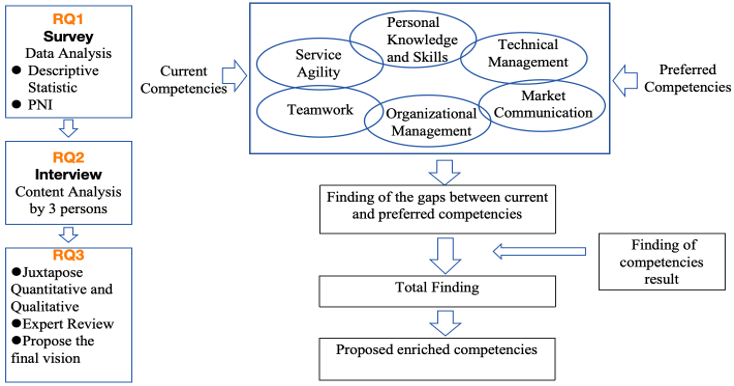
Guided by three central research questions, the study collected data through a combination of questionnaire surveys and in-depth interviews, ensuring both breadth and depth of evidence. A mixed-methods approach was adopted, integrating quantitative and qualitative analysis methods, including descriptive statistics, Priority Needs Index (PNI) analysis, and content analysis. Based on these analyses, the study proposed a systematic competency framework tailored to the operational realities of local travel agencies. Based on the above theoretical analysis, this study has constructed a conceptual framework for the core competitiveness of travel agencies, which consists of six core dimensions. The overall research framework is shown in Figure 1.
3.1 Research design and case setting
This study adopts a mixed-method research design, combining qualitative and quantitative approaches to examine competency optimization in travel agencies. Data were collected through questionnaires and in-depth interviews based on six core dimensions: PKS, TM, MC, OM, T, and SA. Finally, expert review was used to refine the competency framework, providing practical guidance for improving competitiveness and innovation in a changing tourism environment.
The case site was four travel agencies in the West Lake Zhejiang Province, China. The West Lake is a mature cultural tourism destination with abundant resources and diverse types of tourists. During their development, these travel agencies faced similar problems as many other cultural tourism destinations, namely, while enhancing service quality and market competitiveness, they needed to adapt to the diverse changes in tourists' demands and continuously optimize their service capabilities and operation methods. Table 1 is the presentation of the research design for this study.
Table 1. Overview of the explanatory sequential mixed-methods design
|
Phase |
Purpose |
Data Source |
Analytical Treatment |
Main Output |
|
Quantitative |
To identify the gaps between current and preferred competencies. |
409 valid questionnaires from the four major travel agencies employees in West Lake. |
Descriptive statistics, reliability checks in SPSS. |
Descriptive statistics: mean, SD, frequency PNI Modified. |
|
Qualitative |
To explore how competencies of travel agencies in term of personal knowledge and skills, technical management, market communication, organizational management, teamwork and service agility could be enriched from will of department manager and their subordinates. |
Qualitative sample included 12 employees from four travel agencies. Each travel agency selected one department manager and two subordinates. |
Thematic analysis through open coding, axial grouping, theme review, naming, and frequency counting. |
18 final themes and interpretive explanation of the quantitative results. |
|
Integration and expert review |
Translate the mixed evidence into an improvement program. |
Two-round Delphi review with seven experts. |
Evidence juxtaposition, expert rating, revision, and consensus-oriented interpretation. |
Proposed improvement plan. |
3.2 Quantitative phase: Sampling, measurement, and analysis
The quantitative phase of this study targeted 512 employees from four major travel agencies in the West Lake area, with 409 valid responses collected through a structured sampling method. Respondents included both department managers and subordinates, ensuring representation of different organizational levels. Data were collected using a structured questionnaire based on six competency dimensions: PKS, TM, MC, OM, T, and SA. A five-point Likert scale (1 = strongly disagree to 5 = strongly agree) was used to measure both current and preferred competency levels, enabling gap identification across dimensions.
Data analysis was conducted using SPSS 27.0. Descriptive statistics (mean, standard deviation, frequency, and percentage) were used to describe overall competency patterns, while the PNI Modified method was applied to calculate gaps between current and expected performance and determine priority areas for improvement. Reliability and validity were confirmed through pilot testing, IOC evaluation, and Cronbach’s Alpha coefficients (0.795–0.956), ensuring the robustness of the measurement instrument. As presented in Table 2, each of the six competency dimensions retained four measurement items with acceptable Item-Objective Congruence (IOC) values ranging from 0.70 to 1.00, and all dimensions achieved satisfactory Cronbach’s Alpha coefficients above 0.80 for both current and expected competency measurements, demonstrating good scale reliability and validity.
Table 2. Measurement summary and reliability
|
Items |
Items Retained |
IOC Result |
Cronbach’s Alpha (Current) |
Cronbach’s Alpha (Expectation) |
|
Personal Knowledge and Skills (PKS) |
4 |
0.70-1.00 |
0.846 |
0.867 |
|
Technical Management (TM) |
4 |
0.80-1.00 |
0.876 |
0.860 |
|
Market Communication (MC) |
4 |
0.70-1.00 |
0.885 |
0.853 |
|
Organizational Management (OM) |
4 |
0.70-1.00 |
0.884 |
0.858 |
|
Teamwork (T) |
4 |
0.70-1.00 |
0.897 |
0.872 |
|
Service Agility (SA) |
4 |
0.70-1.00 |
0.883 |
0.835 |
3.3 Qualitative phase and coding procedure
The qualitative phase of this study involved 12 participants from four travel agencies in the West Lake area, including department managers and subordinates. Semi-structured interviews were conducted based on six core competency dimensions: PKS, TM, MC, OM, T, and SA. Interviews lasted 30–60 minutes and were recorded, transcribed, and anonymized with participants’ consent.
Data were analyzed using thematic analysis and content analysis. A three-coder system was applied to ensure reliability and consistency. The analysis followed a systematic coding procedure: first, interview transcripts were read thoroughly to identify meaningful segments; second, initial codes were generated to summarize key ideas; third, similar codes were grouped into broader themes aligned with the six competency dimensions; fourth, themes were reviewed and refined to ensure accuracy and consistency; and finally, each theme was clearly defined and reported with supporting evidence.
This process ensured a structured and reliable interpretation of qualitative data, providing in-depth insights into competency development and complementing the quantitative findings.
3.4 Integration and expert validation
This study adopted a mixed-method integration approach to combine quantitative, qualitative, and expert validation findings. Quantitative results were first analyzed using descriptive statistics and the PNI Modified method to identify gaps between current and preferred competencies across six dimensions: PKS, TM, MC, OM, T, and SA. In parallel, qualitative interview data were analyzed through thematic analysis to explore employees’ experiences, challenges, and competency development strategies in depth. The results of both datasets were then integrated through a data juxtaposition process to form an initial competency framework for travel agencies in West Lake.
To ensure the scientific rigor and practical applicability of the proposed framework, expert validation was conducted with seven experts, including two university professors, three senior travel agency managers, and two human resource management specialists. The academic experts provided theoretical insights based on tourism management and organizational development, while industry experts contributed practical experience in strategic planning, service optimization, and market operations. Human resource experts further evaluated the framework from the perspective of talent development, training, and performance management. This combination ensured a balance between theoretical depth and practical relevance.
The expert evaluation focused on five key criteria: theoretical soundness, practical operability, resource feasibility, sustainability, innovativeness, and stakeholder balance. Experts assessed whether the six competency dimensions could be effectively embedded into real travel agency operations, whether sufficient human, financial, and technological resources were available for implementation, and whether the framework could adapt to changing tourism market conditions. They also evaluated whether the framework could generate competitive advantages and support long-term organizational development.
Based on expert feedback, the initial competency framework was refined through a Delphi-based iterative process. In the first round, experts provided independent evaluations and suggestions on the six competency dimensions. The research team then synthesized the feedback, revised areas of disagreement, and conducted a second round of validation to further refine and confirm consensus. This iterative and anonymous process helped reduce bias, enhance objectivity, and improve the reliability of the evaluation results.
Finally, through the integration of quantitative findings, qualitative insights, and expert consensus, a finalized competency framework was developed. This framework provides a systematic and practical guide for competency enrichment in travel agencies in West Lake and ensures both theoretical robustness and practical applicability in tourism management practice.
3.5 Ethical and data confidentiality considerations
This article merely reports the aggregated survey results and anonymized interview evidence. As the paper has not been published and the data contains confidential research materials, the original data has not been made public. The identities of the interviewees are not mentioned in the manuscript. The interview content is presented in a rewritten or abbreviated form to protect the privacy of the participants and ensure that the article focuses on analytical findings.
4.1 Quantitative analysis — Sample profile and measurement quality
The quantitative phase of this study collected data from four travel agencies in the West Lake area, targeting both department managers and frontline employees. A total of 409 valid questionnaires were obtained, covering six competency dimensions: PKS, TM, MC, OM, T, and SA.
In terms of sample characteristics, the respondents were mainly female (58.44%), with subordinates accounting for 90.95% of the total sample. Most participants had 1–10 years of work experience (77.75%), and the dominant age group was 26–35 years old (42.05%), indicating a relatively young and experienced workforce. In terms of education, 66.50% of respondents held a bachelor’s degree or above, reflecting a generally well-educated sample. The sample was distributed across four travel agencies, with Agency A accounting for the largest proportion (40.34%).
To ensure measurement quality, the study applied pilot testing, IOC evaluation, and reliability testing. The IOC results confirmed strong content validity, with all items exceeding the acceptable threshold. Reliability analysis showed that Cronbach’s Alpha values ranged from 0.795 to 0.956, indicating high internal consistency of the measurement scale. These results confirm that the questionnaire is both reliable and valid for further analysis.
4.2 Quantitative analysis — Priority Needs Index modified results
This study applied descriptive statistics and the PNI Modified to examine the gap between current and preferred competencies across six dimensions. Descriptive results show that employees’ current competency levels are generally at a medium-to-above-average level, while expected competencies are significantly higher, indicating strong development expectations across all dimensions.
Among the six dimensions, TM shows the largest competency gap (E–P = 1.47), followed by SA (1.34) and OM (1.23). In contrast, PKS (0.93) and T (0.99) show relatively smaller gaps, indicating more stable development at the individual level.
The PNI Modified results further clarify improvement priorities. TM ranks first (PNI = 0.47), indicating the most urgent need for improvement, particularly in system operation, digital tools, and technical support. SA ranks second (PNI = 0.42), reflecting strong demand for rapid response and adaptive service capability. OM (PNI = 0.38) shows moderate priority, highlighting the need for improved coordination and process efficiency. MC (PNI = 0.34) represents a mid-level improvement need, focusing on communication effectiveness and customer interaction. T (PNI = 0.28) and PKS (PNI = 0.27) show relatively lower urgency, suggesting these areas are relatively stable but still require gradual enhancement. As shown in Table 3, descriptive statistics, competency gaps, modified PNI scores and priority rankings for the six competency dimensions are summarized using data from 409 valid respondents.
Table 3. Descriptive Statistical results for each dimension and the priority need index (n = 409)
|
Dimension |
Current (P) |
Expectation (E) |
Mean Diff (E-P) |
PNI Modified |
Rank |
||
|
Mean |
Std. Deviation |
Mean |
Std. Deviation |
||||
|
Personal Knowledge and Skills (PKS) |
3.47 |
1.13 |
4.40 |
0.62 |
0.93 |
0.27 |
6 |
|
Technical Management (TM) |
3.10 |
1.14 |
4.57 |
0.56 |
1.47 |
0.47 |
1 |
|
Market Communication (MC) |
3.33 |
1.14 |
4.46 |
0.61 |
1.13 |
0.34 |
4 |
|
Organizational Management (OM) |
3.24 |
1.13 |
4.47 |
0.58 |
1.23 |
0.38 |
3 |
|
Teamwork (T) |
3.46 |
1.17 |
4.45 |
0.60 |
0.99 |
0.28 |
5 |
|
Service Agility (SA) |
3.18 |
1.11 |
4.53 |
0.57 |
1.34 |
0.42 |
2 |
4.3 Qualitative findings: From experience fragments to well-being meaning
The qualitative phase of this study explored how managers and frontline employees perceive competency enrichment across six dimensions: PKS, TM, MC, OM, T, and SA. A total of 12 participants (4 managers and 8 subordinates) from four West Lake travel agencies were interviewed through semi-structured interviews conducted. Using inductive content analysis with a three-coder triangulation process, 18 initial themes were generated and further synthesized into six core competency categories. The analysis produced three key outputs, including transcribed interview data, coded thematic structures, and triangulated interpretations validated through expert discussion, ensuring analytical rigor and credibility.
The thematic analysis reveals a coherent and systematic structure of competency perceptions. In terms of PKS, employees emphasized experiential learning, professional knowledge accumulation, and customer response capability as the foundation of service performance, while also highlighting the need for more systematic training and structured capability development. For TM, findings show that although digital systems support operational efficiency and traceability, issues such as system usability limitations and fragmented data integration hinder effective decision-making and frontline efficiency. These constraints reflect a gap between technological design and practical workflow requirements.
Table 4. Summary of the qualitative results of the three coders
|
Q1: From your perspective, what are your (or your team's) current strengths and weaknesses in terms of professional knowledge and service skills? How do you think these competencies can be further developed to support the work of travel agencies? |
1-Accumulation of Professional Knowledge
2-Customer Response Capability
3-Capability Development and Training
|
|
Q2: How do you view the technical systems and tools used in your work (for example, customer management systems, reservation platforms)? What challenges have you experienced? What improvement suggestions do you have to enhance the technical support for your task? |
1-Utilization of System Functions
2-Data and Information Integration
|
|
Q3: In your experience, how do travel agencies effectively communicate with customers about their needs and services? Which aspects of communication need improvement and how can these improvements enhance customers' trust and loyalty? |
1-Differences in Communication Styles
2-Extent of expansion of communication content
3-Standardization of Communication
4-Quality of Communication and Building Trust
|
|
Q4: How do you evaluate the internal management structure and processes of your organization (for example, coordination, clear responsibilities, and work processes)? What kind of changes do you think will enable organizational management to more effectively support the provision of daily services? |
1-Clarity of division of responsibilities
2-Standardization and Flexibility of Processes
3-The Impact of Management Support
|
|
Q5: How do you view the current level of cooperation among colleagues and departments? What difficulties have you encountered in teamwork? How can cooperation be improved to achieve better service results? |
1-Foundation of Daily Collaboration and Cooperation Intentions
2-Information Transmission Among Departments
3-Team Collaboration Mechanism
|
|
Q6: When unexpected changes occur (for example, customer requests, weather disruptions, traffic delays), how do you think your travel agency responds? In this situation, what measures or strategies do you think can enhance the agility and adaptability of travel agencies? |
1-Approaches to Handling Emergencies
2-The issue of Emergency plans and Authorization
3-The Impact of Agile Responses on Service Experience
|
In MC, employees identified significant variation in communication styles, content completeness, standardization, and communication quality. While communication is widely recognized as central to customer satisfaction and trust building, inconsistent practices often lead to misunderstandings and reduced service reliability. Similarly, OM is characterized by relatively clear role division but limited process flexibility and insufficient management support in dynamic situations. Employees highlighted the need to better balance standardization with flexibility, supported by clearer authority structures and stronger coordination mechanisms. In addition, T is generally strong in terms of cooperation willingness, but inefficiencies arise due to delayed interdepartmental communication, fragmented information flow, and the absence of formal collaboration mechanisms.
Finally, SA emerges as a critical but underdeveloped competency. Employees frequently rely on experiential and ad-hoc responses when handling emergencies, such as sudden customer requests or environmental disruptions. While this approach enables basic problem-solving, respondents consistently emphasized the need for structured contingency plans, clearer authorization mechanisms, and standardized response procedures to improve responsiveness and reduce operational pressure. Overall, the qualitative findings indicate that travel agencies are currently transitioning from experience-driven practices toward more system-supported competency development.
The results demonstrate that competency enrichment is perceived as a multi-level process involving individual capability enhancement, technological system optimization, communication improvement, organizational restructuring, strengthened teamwork mechanisms, and improved SA. These findings provide a solid qualitative foundation for interpreting the quantitative gap analysis and support the development of an integrated competency framework for West Lake travel agencies. Table 4 summarizes the qualitative coding outcomes independently generated by three coders for the interview data.
4.4 Mixed-methods integration and Delphi validation
This study integrates quantitative and qualitative findings to develop a comprehensive understanding of competency gaps in West Lake travel agencies. The quantitative results, based on PNI Modified analysis, identify priority areas for improvement across six competency dimensions, while qualitative findings provide contextual explanations through employee experiences and thematic patterns. The juxtaposition of both datasets enhances the robustness and interpretive depth of the results, ensuring that statistical trends are supported by practical insights.
To further validate the proposed competency framework, a two-round Delphi method was conducted with seven experts from academia, industry, and human resource management. In the first round, results showed varying levels of agreement across dimensions. SA (μ = 4.86, σ = 0.38) and OM received high consensus, while TM and PKS showed greater divergence, indicating the need for clarification and refinement.
After revising and refining the competency definitions, the second round achieved strong consensus, with all dimensions scoring above 4. 0 and standard deviations below 0.55. TM (μ = 4.71) and T and execution ability (μ = 4.57) showed particularly high agreement. These results confirm that the final competency framework is both theoretically sound and practically applicable, providing a reliable foundation for competency enhancement in travel agencies. The statistical results of expert ratings for the two rounds of Delphi consultation are detailed in Tables 5 and 6.
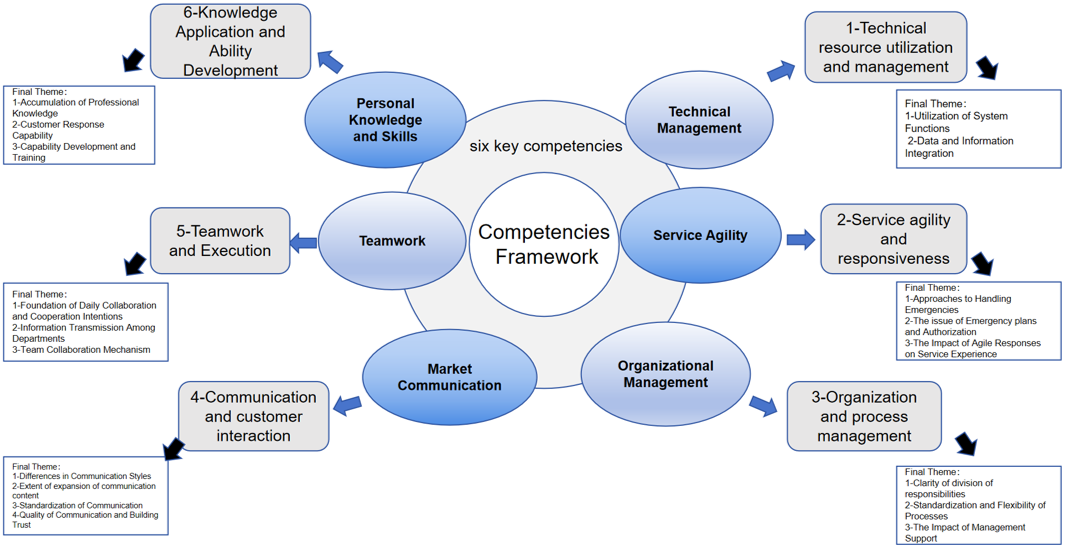
In conclusion, based on the integration of quantitative PNI analysis, qualitative interview findings, and two rounds of Delphi expert validation, this study developed a comprehensive travel agency competency framework consisting of six dimensions: technical resource utilization and management, SA and responsiveness, organizational and process management, communication and customer interaction, teamwork and execution, and knowledge application and development. The framework is grounded in empirical evidence and refined through expert consensus, ensuring both theoretical rigor and practical applicability. Each dimension represents a key aspect of travel agency operations, ranging from technological support and organizational structure to customer interaction and employee capability development. Overall, the framework demonstrates strong logical coherence and high expert agreement, providing a systematic foundation for understanding and improving competency development in travel agencies. This study further constructs a targeted improvement implementation path for local travel agencies, namely the Strategic Execution Model of Improvement Program for Travel Agencies in West Lake, China, as visualized in Figure 2.
Table 5. Statistical summary of the 1st round expert evaluation
|
Dimensions |
Mean (μ) |
Standard Deviation (σ) |
|
Technical management ability |
3.71 |
0.76 |
|
Service agility and responsiveness ability |
4.86 |
0.38 |
|
Organization and process management ability |
4.43 |
0.54 |
|
Market communication ability |
4.14 |
0.69 |
|
Teamwork ability |
4.29 |
0.76 |
Table 6. Statistical summary of the 2nd round expert evaluation
|
Dimensions |
Mean (μ) |
Standard Deviation (σ) |
|
Technical resource utilization and management ability |
4.71 |
0.49 |
|
Service agility and responsiveness ability |
4.86 |
0.38 |
|
Organization and process management ability |
4.43 |
0.54 |
|
Communication and customer interaction ability |
4.43 |
0.54 |
|
Teamwork and execution ability |
4.57 |
0.54 |
5.1 Discussion on key factors for enhancing travel agency competencies
Based on the integrated analysis of quantitative PNI results and qualitative interview data, this study identifies a clear hierarchical structure of competency improvement factors in West Lake travel agencies. The most critical improvement area is technical resource utilization and management ability, which reflects significant deficiencies in digital system operation, data integration, and technology-enabled service processes, making it the foundational bottleneck of overall organizational performance. SA and responsiveness ability emerges as the second key factor, highlighting the need for more structured and mechanism-based responses to dynamic market changes and service uncertainties rather than reliance on individual experience. Organizational and process management ability ranks third, functioning as an institutional support system that ensures coordination efficiency, process standardization, and cross-departmental collaboration. MC and customer interaction ability plays a bridging role by transforming internal capabilities into external customer value, while teamwork and execution ability ensures stable operational delivery through effective collaboration and task coordination. Finally, knowledge application and ability development represents a foundational but relatively stable dimension, emphasizing continuous learning and experience accumulation rather than urgent structural reform. Overall, the findings suggest that competency development in travel agencies is shifting from experience-based individual capabilities toward system-oriented, technology-driven, and coordination-intensive organizational capabilities.
5.2 Construction of an enriched competency framework for the four travel agencies
This study develops an integrated travel agency competency framework based on the triangulation of quantitative PNI analysis, qualitative thematic findings, and two-round Delphi expert validation. The final model identifies six interrelated competency dimensions—technical resource utilization and management ability, SA and responsiveness ability, organizational and process management ability, communication and customer interaction ability, teamwork and execution ability, and knowledge application and ability development—forming a layered structure that progresses from foundational digital capabilities to dynamic responsiveness, institutional coordination, value transformation, operational execution, and continuous knowledge development. Quantitative results highlight TM and SA as the most urgent improvement areas, while qualitative findings further explain that these gaps are driven by system fragmentation, reliance on experiential responses, and insufficient coordination mechanisms. Through Delphi iterations, expert consensus was achieved by refining terminology and clarifying conceptual boundaries, significantly improving clarity and operability of each dimension. The integrated framework therefore reflects both empirical evidence and expert validation, and it conceptualizes competency development as a systematic transition from experience-based operations to a digitally enabled, mechanism-driven, and continuously evolving organizational capability system, providing a robust theoretical and practical foundation for travel agency transformation in the West Lake context.
5.3 Research implications
This study proposes a six-dimensional competency improvement model that provides a systematic pathway for enhancing travel agency organizational capabilities and supports the transformation from experience-driven operations to a more digital, mechanism-based, and continuously developing management model. Specifically, technical resource utilization and management ability should be strengthened as the foundational layer through unified data platforms and standardized digital processes to improve operational transparency and efficiency. SA and responsiveness ability should be institutionalized through standardized emergency procedures, authorization mechanisms, and scenario-based training to enhance organizational responsiveness in uncertain environments. Organizational and process management ability requires improved cross-departmental coordination, clearer job responsibilities, optimized information flow, and strengthened incentive systems to ensure structural efficiency. Communication and customer interaction ability should shift toward value-oriented communication and relationship maintenance to deepen customer trust and long-term engagement. Teamwork and execution ability should be reinforced through clearer role division, collaboration incentives, and knowledge-sharing mechanisms to improve execution efficiency. Finally, knowledge application and ability development should focus on systematic training, experience sharing, and capability development planning to transform individual experience into organizational knowledge assets and ensure sustainable development. Overall, the framework provides an integrated management approach that embeds competency development into daily operations and strategic decision-making, thereby enhancing service quality, organizational stability, and long-term competitiveness.
This study has several limitations that should be acknowledged. First, the empirical findings are based on cross-sectional data collected at a specific time point, which may reflect only the current perception of competency gaps and is subject to temporal and contextual influences. As organizational environments, market conditions, and technological applications continue to evolve, employees’ perceptions of competency priorities may also change over time. Second, the study focuses on travel agencies in the West Lake region, which limits the generalizability of the findings, as different regions and organizational types may exhibit variations in structure, management practices, and market positioning. Third, although the study develops a six-dimensional competency framework, it does not include other potentially influential variables such as organizational culture, leadership style, or external policy environment, which may also shape competency development and implementation outcomes. Finally, the competency priority structure identified through quantitative analysis may shift over time, particularly as digital capabilities mature and organizational learning progresses, suggesting that the framework should be understood as dynamic rather than fixed. Future research could address these limitations by expanding the geographic scope, adopting longitudinal designs, and incorporating additional organizational and environmental variables to further refine and validate the proposed competency model.
Future research can further validate the six-dimensional competency improvement model across different types of tourism enterprises, such as online travel platforms, tourism groups, and cultural tourism organizations, to test its generalizability and structural consistency. In addition, longitudinal studies are needed to examine how competency priorities evolve over time, especially under digital transformation and organizational restructuring. Future research may also incorporate objective data sources such as system usage logs and customer feedback analytics to improve measurement accuracy and reduce subjectivity. Finally, expanding Delphi expert participation to include industry associations, SMEs, and frontline employees can further enhance the practical relevance and robustness of the competency framework. Overall, future studies should focus on cross-context validation, dynamic analysis, and methodological diversification to strengthen the applicability of the model.
In conclusion, this study develops a comprehensive six-dimensional competency improvement framework for travel agencies in the West Lake area by integrating quantitative PNI analysis, qualitative interview findings, and Delphi expert validation. The results highlight a clear shift in competency development from individual experience-based capabilities toward system-driven, technology-enabled, and agility-oriented organizational competencies. The proposed framework not only identifies key competency gaps but also provides a structured pathway for capability enhancement and organizational transformation. Overall, this study contributes both theoretically and practically to understanding competency development in tourism organizations and offers actionable insights for improving service quality and long-term competitiveness in a rapidly changing tourism environment.
[1] Buhalis, D., Amaranggana, A. (2015). Smart tourism destinations enhancing tourism experience through personalisation of services. In Information and Communication Technologies in Tourism 2015: Proceedings of the International Conference, Lugano, Switzerland, pp. 377-389. https://doi.org/10.1007/978-3-319-14343-9_28
[2] Gretzel, U., Sigala, M., Xiang, Z., Koo, C. (2015). Smart tourism: Foundations and developments. Electronic Markets, 25(3): 179-188. https://doi.org/10.1007/s12525-015-0196-8
[3] Hwang, J., Seo, S. (2016). A critical review of research on customer experience management. International Journal of Contemporary Hospitality Management, 28(10): 2218-2246. https://doi.org/10.1108/IJCHM-04-2015-0192
[4] Domínguez-Quintero, A.M., González-Rodríguez, M.R., Paddison, B. (2020). The mediating role of experience quality on authenticity and satisfaction in the context of cultural-heritage tourism. Current Issues in Tourism, 23(2): 248-260. https://doi.org/10.1080/13683500.2018.1502261
[5] Nieves, J., Segarra-Ciprés, M. (2015). Management innovation in the hotel industry. Tourism Management, 46: 51-58. https://doi.org/10.1016/j.tourman.2014.06.002
[6] Elbaz, A.M., Haddoud, M.Y., Shehawy, Y.M. (2018). Nepotism, employees' competencies and firm performance in the tourism sector: A dual multivariate and qualitative comparative analysis approach. Tourism Management, 67: 3-16. https://doi.org/10.1016/j.tourman.2018.01.002
[7] Sigala, M. (2020). Tourism and COVID-19: Impacts and implications for advancing and resetting industry and research. Journal of Business Research, 117: 312-321. https://doi.org/10.1016/j.jbusres.2020.06.015
[8] Doz, Y.L., Kosonen, M. (2010). Embedding strategic agility: A leadership agenda for accelerating business model renewal. Long Range Planning, 43(2-3): 370-382. https://doi.org/10.1016/j.lrp.2009.07.006
[9] Valachis, I., Christou, E., Sigala, M., Maroudas, L. (2009). Developing human resources' skills and knowledge in tourism and hospitality industry through the determination of quality of training programmes. Tourism and Hospitality Management, 15(1): 61-72. https://doi.org/10.20867/thm.15.1.6
[10] Riley, M. (2014). Human Resource Management in the Hospitality and Tourism Industry. Routledge. https://doi.org/10.4324/9781315831565
[11] Chung-Herrera, B.G., Enz, C.A., Lankau, M.J. (2003). Grooming future hospitality leaders: A competencies model. Cornell Hotel and Restaurant Administration Quarterly, 44(3): 17-25. https://doi.org/10.1016/S0010-8804(03)90266-7
[12] Baum, T. (2007). Human resources in tourism: Still waiting for change. Tourism Management, 28(6): 1383-1399. https://doi.org/10.1016/j.tourman.2007.04.005
[13] Kusluvan, S., Kusluvan, Z., Ilhan, I., Buyruk, L. (2010). The human dimension in tourism and hospitality research. Cornell Hospitality Quarterly, 51(2): 171-214. https://doi.org/10.1177/1938965510362871
[14] Kotler, P., Keller, K.L. (2016). A Framework for Marketing Management (6th ed.). Pearson Education.
[15] Hudson, S., Thal, K. (2013). The impact of social media on the consumer decision process. Journal of Travel & Tourism Marketing, 30(1-2): 156-160. https://doi.org/10.1080/10548408.2013.751276
[16] Duncan, T. (2002). IMC: Using Advertising and Promotion to Build Brands. Boston: McGraw-Hill.
[17] Mintzberg, H. (1979). The Structuring of Organizations: A Synthesis of the Research. Prentice-Hall.
[18] Robbins, S.P., Coulter, M. (2016). Management. 13th ed. Pearson Education Limited, Harlow.
[19] Daft, R.L. (2012). Organization Theory and Design. 11th ed. South-Western Publication.
[20] Kozlowski, S.W.J., Ilgen, D.R. (2006). Enhancing the effectiveness of work groups and teams. Psychological Science in the Public Interest, 7(3): 77-124. https://doi.org/10.1111/j.1529-1006.2006.00030.x
[21] Salas, E., Sims, D.E., Burke, C.S. (2005). Is there a “big five” in teamwork? Small Group Research, 36(5): 555-599. https://doi.org/10.1177/1046496405277134
[22] Marks, M.A., Mathieu, J.E., Zaccaro, S.J. (2001). A temporally based framework and taxonomy of team processes. Academy of Management Review, 26(3): 356-376. https://doi.org/10.5465/amr.2001.4845785
[23] Lu, Y., Ramamurthy, K. (2011). Understanding the link between information technology capability and organizational agility: An empirical examination. MIS Quarterly, 35(4): 931-954. https://doi.org/10.2307/41409967
[24] Overby, E., Bharadwaj, A., Sambamurthy, V. (2006). Enterprise agility and the enabling role of information technology. European Journal of Information Systems, 15(2): 120-131. https://doi.org/10.1057/palgrave.ejis.3000600